
2017
4(52)
DOI: 10.5277/arc170409
Wprowadzenie
Prezentowany projekt autorstwa Elżbiety Komen dac
kiej w 2016 r. zdobył wyróżnienie honorowe w między
narodowym konkursie architektonicznym zorganizo
wanym przez fundację Bee Breeders
1
. Tematem było
za pro jektowanie uniwersalnej siedziby Cannabis Bank
tak, aby rozwiązanie łatwo można było zaadaptować do
do wolnej lokalizacji na całym świecie. Założeniem było
stworzenie obiektu o reprezentacyjnej, wzbudzającej za
ufanie formie – co miało przeciwstawiać się potocznej,
złej opinii o marihuanie. Budynek miał mieć zoptyma
lizowaną strukturę, tworząc rozpoznawalną markę dla
swojej specyficznej funkcji. Jednocześnie zakładano, że
bank będzie dostosowywany do konkretnej lokalizacji,
z uwzględnieniem spe cyfiki miejsca, zgodnie ze statusem
prawnym handlu medyczną marihuaną obowiązującym
w danym kraju i restrykcjami urbanistycznymi. Jury
2
* Wydział Architektury Politechniki Wrocławskiej/Faculty of Ar
chitecture, Wrocław University of Science and Technology.
1
Bee Breeders corocznie organizuje kilka tego typu konkursów, sta
rając się dobierać inspirujące tematy ze wszystkich stron świata. Por. [1].
2
W składzie: Alona Martinez – University of Plymouth, United
Kingdom; Andrejs Edvards Rauchut – associate professor at RISEBA
and a Fulbright grant recipient, Latvia; Collin Anderson, Audrey McKee
Introduction
The project by Elżbieta Komendacka was awarded
with an honorable mention in the international architec
tural competition that was organized by the Bee
Breeders
1
in 2016. The theme was to design a universal
form for the Cannabis Bank so that the solution could
easily be adapted to any location in the world. To get
away from the popular bad opinion of marijuana the
bank had to have a representative and friendly structure.
The functionally optimized building had to present a rec
ognizable brand for its specific function. Moreover, the
bank had to be able to be adjusted in case of issues con
nected with the particular site, the specificity of the
place, urban restrictions and the legal status of the med
ical marijuana trade in the concerned country. The jury
2
1
Bee Breeders annually organizes several architecture competi
tions with inspiring topics from all around the world [1].
2
Jury: Alona Martinez – University of Plymouth, United Kingdom;
Andrejs Edvards Rauchut – associate professor at RISEBA and a Ful
bright grant recipient, Latvia; Collin Anderson, Audrey McKee i Daphné
Karaiskaki – Renzo Piano Building Workshop, France; Brittany Utting
– Thomas Phifer and Partners, USA; Carlos M Guimarães – depA, cor
respondent of A10 magazine, Portugal; Daniel Jacobs – SHoP Architects,
New York City, USA; Gemawang Swaribathoro – OMA, Hong Kong;
Bank Medycznych Konopi na wyspie Tamka we Wrocławiu
Medical Cannabis Bank on the Tamka Island in Wrocław
Prezentacje/Presentations
Autorzy:/Authors: Elżbieta Komendacka, Paweł Kirschke*
Nagroda:/Award: Wyróżnienie honorowe w międzynarodowym konkursie architektonicznym zorganizowanym w 2016 r.
przez Bee Breeders: Cannabis Bank Competition/Honorable mention in the international architectural competition
organized in 2016 by Bee Breeders: Cannabis Bank Competition

108 Prezentacje/Presentations
przyznało trzy nagrody oraz pięć wyróżnień hono
rowych
3
.
Projekt
Projekt autorstwa Elżbiety Komendackiej zaprezen
towany został w konkursie pod godłem Cure In The
Cube Cannabis Bank
4
. Program budynku zakładał stwo
rzenie Banku Medycznych Konopi wraz z częścią
laborato ryjną i edukacyjną. Projekt został przedstawiony
w dwóch wariantach. Pierwszy – podstawowy, drugi –
rozbudo wany, dostosowany do działki na wyspie Tamka
we Wrocławiu.
Ze względu na swój uniwersalny charakter bryła bu
dyn ku ma prostą, kubiczną formę. W obiekcie wyróżniono
trzy strefy, z których każda obejmuje inną kondygnację
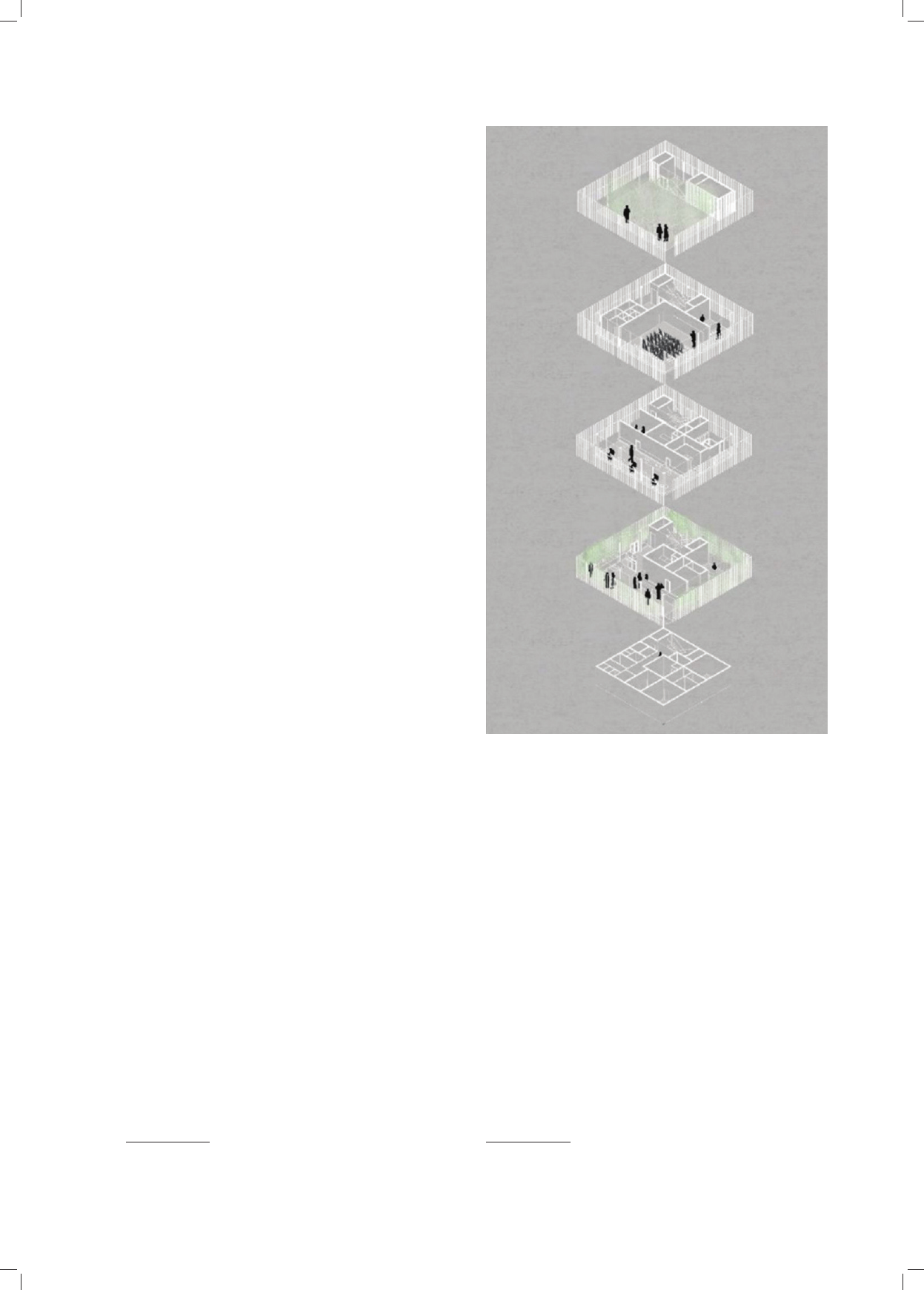
(il. 1). Na parterze zlokalizowano obsługę klienta, czyli
sklep oferujący medyczną marihuanę z bankiem i ga
binetami lekarskimi. Kolejne piętro to strefa badawcza,
w postaci laboratorium przygotowującego preparaty dla
sklepu (analogicznie jak czyni się to w aptekach). Na
trzeciej kondygnacji zaplanowano część edukacyjną
w postaci dwóch salek wielofunkcyjnych. W zależności
od potrzeb konkretnej lokalizacji obiekt można rozbudo
wać o kolejną kondygnację, w wersji podstawowej na
dachu jest taras. W piwnicy znajdują się pomieszczenia
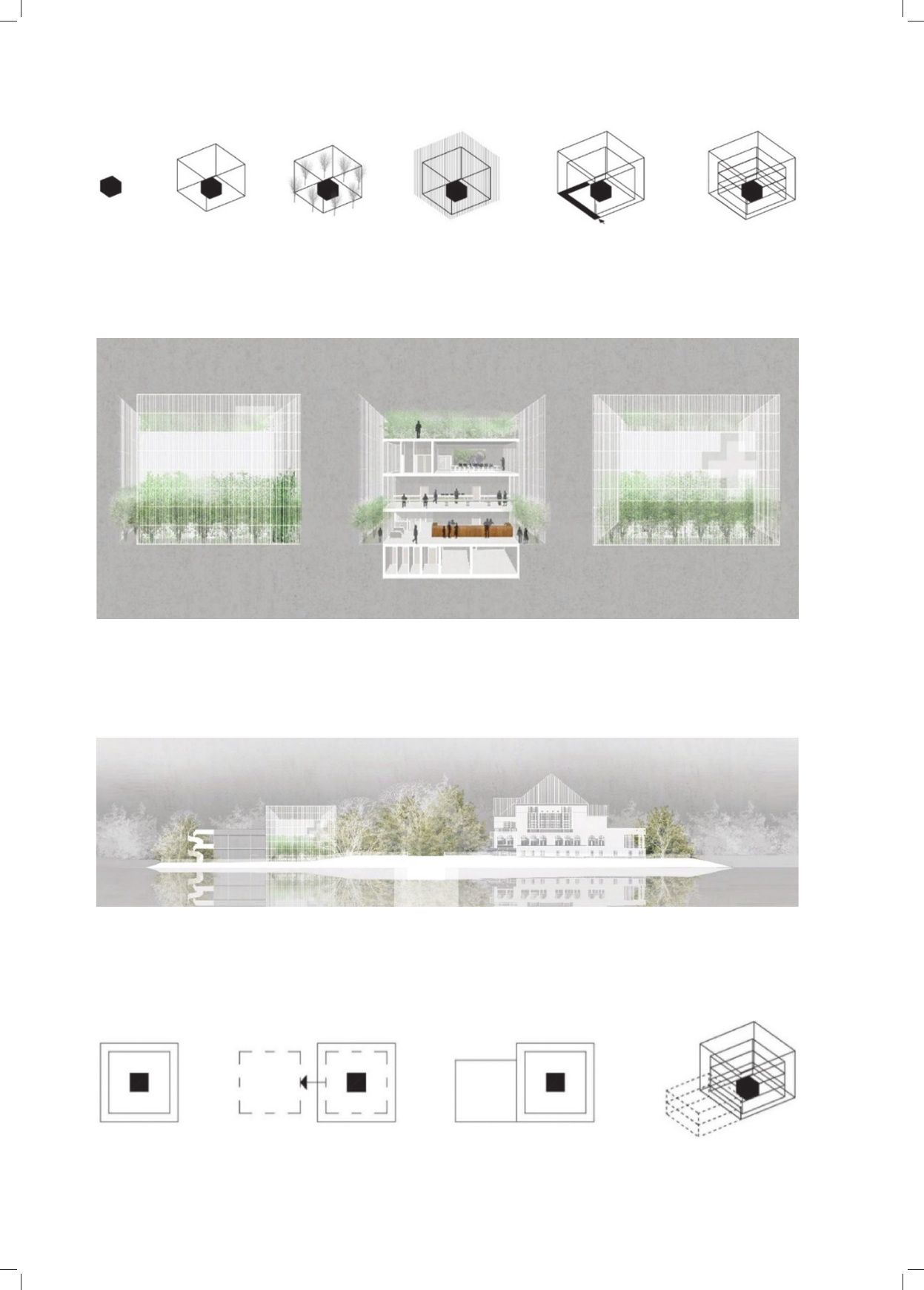
techniczne i gospodarcze. Struktura obiektu jest „war
stwowa” (il. 2). Na zewnątrz umieszczono ażurową obu
dowę z corianu i pas zieleni, trzon stanowi kubistyczny,
przeszklony budynek, w którego centrum znajduje się
masywna struktura banku – pomieszczenie technologicz
ne wymagające ochrony (il. 3).
Drugi wariant ma charakter indywidualny i jest dosto
sowany do wybranej działki znajdującej się w zachodniej
części wyspy Tamka we Wrocławiu. Ta zobowiązująca
lokalizacja, w otoczeniu terenów rekreacyjnych i monu
mentalnych budynków zabytkowych, stanowiła wyzwa
nie, jakim było dopasowanie się do kontekstu i zapropo
nowanie bryły, która nie przyćmiewałaby otoczenia i nie
zasłaniała widoku z ulicy Grodzkiej na wyspę (il. 4).
Osiągnięto to poprzez niewielki rozmiar budynku, trans
parentność obudowy i zieleń. Dodatkowe funkcje, o które
został wzbogacony wariant drugi, umieszczono w dobu
dowanej, całkowicie przeszklonej części (il. 5).
i Da phné Karaiskaki – Renzo Piano Building Workshop, France; Britta ny
Utting – Thomas Phifer and Partners, USA; Carlos M. Guima rães –
depA, correspondent of A10 magazine, Portugal; Daniel Jacobs – SHoP
Architects, New York City, USA; Gemawang Swaribathoro – OMA,
Hong Kong; GiaHy Hoang – Agence Christian de Portzamparc, France;
Jenna Dezinski – University of Texas, Austin, USA; Alterstudio Ar chi
tecture, Austin, Texas, USA; John Paul Rysavy – SHoP Architects, New
York City, USA; AndEitherOr Austin, Texas and Brooklyn, New York,
USA; John Simons – KPF, USA; Mandy Too – DPA, Singapore; Pan ga
los Dugasse Feldmann – École Spéciale d’Architecture, France; Pierre
Henri Baudart – Studio Akkerhuis, France; Rajiv J. Fernandez – Ta mar
kin Co, USA; Simon McGown – COoffice, USA.
3
Wyniki konkursu zostały opublikowane m.in. na stronach: [2], [3].
4
Projekt ten stanowił uproszczoną wersję magisterskiego projektu dy
plomowego Bank Medycznych Konopi na Wyspie Tamka we Wro cła wiu wy
ko nanego w 2016 r. przez Elżbietę Komendacką pod kierunkiem dr. hab. inż.
arch. Pawła Kirschke na Wydziale Architektury Politechniki Wrocławskiej.
awarded three main prizes and five honorable men
tions
3
.
Project
The project by Elżbieta Komendacka was presented in
the competition with the name: Cure In The Cube Canna-
bis Bank
4
. The programe of the building had to take into
consideration the creation of a Medical Cannabis Bank
with a laboratory and educational part. The program was
presented in two variants. The first – basic, the second ver
sion – extended, adapted to the site on the Tamka island.
Due to its universal character, the building has a simple
cubic form. There are three functional zones, each located
on the different floor (Fig. 1). On the ground floor, there
is a customer service with a medical marijuana store and
bank. The next floor has a research purpose, with its labo
ratory preparing the medicines for the store (the same as
it is done in pharmacies). On the third floor – an educa
tional part with two multifunction lecture rooms. De
pending on the needs of a specific location, the building
can be extended with another floor, in the basic version on
the roof there is a terrace. In the basement there are techni
cal and utility rooms. The structure of the object is “lay
ered” (Fig. 2). The outermost layer is an openwork made
from corian, the next is the fully glazed building, in be
tween are plants. The last, the massive structure of the bank
– with its technological character, should be highly
pro
tected so it is placed in the center (Fig. 3).
The second variant is arranged in such a way as to
adapt the building to the chosen site located in the western
part of the Tamka Island in Wrocław. Adjusting the basic
form of the Cannabis Bank to the context of a very oblig
ing location, surrounded by recreational areas and monu
mental historic buildings, in a way to not overwhelm the
surroundings and opening the view from Grodzka Street
(Fig. 4) was a challenge. The statements have been achieved
by the small scale of the building, transparency and the
greenery. Additional features which enriched the second
variant are placed in the added, fully glazed part (Fig. 5).
The project is a part of the renovation of the neglected
Tam ka Island. The existing, overscaled and unattractive build
ing belonging to the University of Wrocław is planned to
be demolished. The Cannabis Bank is to be the replace
ment, enriched with many social services that can attract
people. The visitors have also an opportunity to learn
GiaHy Hoang – Agence Christian de Portzamparc, France; Jenna De zin
ski – University of Texas, Austin, USA; Alterstudio Architecture, Austin,
Texas, USA; John Paul Rysavy – SHoP Architects, New York City, USA;
AndEitherOr Austin, Texas and Brooklyn, New York, USA; John
Simons – KPF, USA; Mandy Too – DPA, Singapore; Pangalos Dugasse
Feldmann – École Spéciale d’Architecture, France; PierreHenri Baudart
– Studio Akkerhuis, France; Rajiv J. Fernandez – Tamarkin Co, USA;
Simon McGown – COoffice, USA.
3
The results are published on the following websites: [2], [3].
4
This project is a simplified version of the master thesis project
Medical Cannabis Bank on the Tamka Island in Wrocław made in 2016
by Elżbieta Komendacka and supervised by dr hab. eng. arch. Paweł
Kirschke at the Faculty of Architecture, Wrocław University of Science
and Technology.
Prezentacje/Presentations 109
Projekt miał stanowić element rewaloryzacji zaniedba
nej obecnie wyspy. Istniejący tu, przeskalowany i mało
atrakcyjny obiekt należący do Uniwersytetu Wroc ław
skie go przewidziano do rozbiórki, a na jego miejsce za
pro ponowano oddział Cannabis Bank, wzbogacony
o wie le prospołecznych usług mających ułatwić odwiedza
ją cym możliwość zasięgnięcia informacji o korzyściach,
ale także o efektach ubocznych stosowania konopi. Obiekt
został zaprojektowany zgodnie z wymaganiami obowią
zującego MPZP
5
, który zakłada maksymalną wysokość
obiektu 16 m we wschodniej części działki i tylko 8 m
w części zachodniej. Plan zakładał także budowę tarasu
widokowego stanowiącego minimum 30% powierzchni
zabudowy działki.
Aby przyciągnąć ludzi i w pełni wykorzystać potencjał
działki, projekt na Tamce został powiększony o małą ga
stronomię i większą salę wielofunkcyjną (konferencyjną).
Obiekt jest w znacznej części oszklony, żeby zapobiec
skojarzeniom z zamkniętą fortecą, do której trudno się
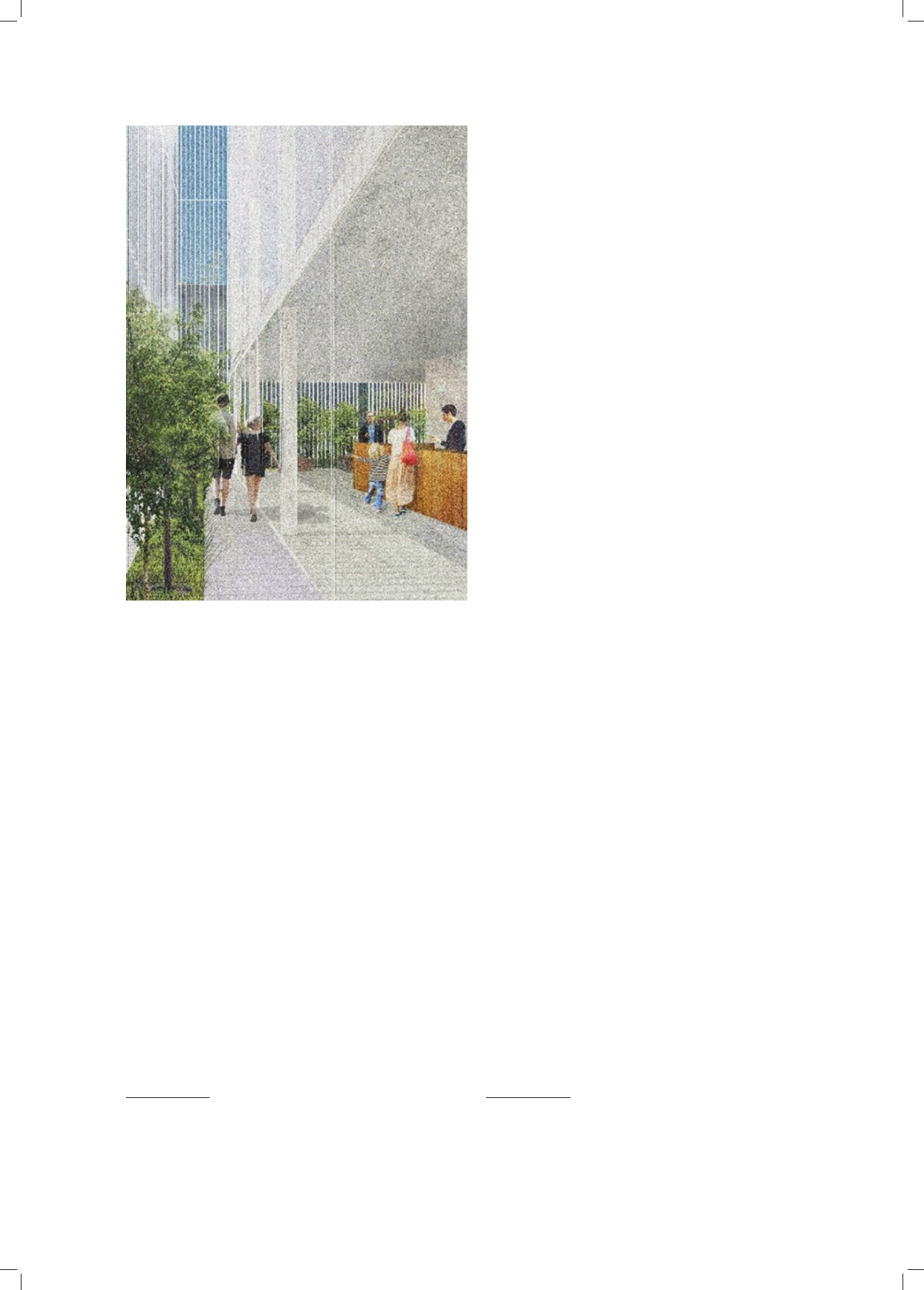
dostać. Aby dotrzeć do wejścia, trzeba pokonać pasaż
między zewnętrznymi ścianami a ażurową strukturą z co
rianu (il. 6). W ten sposób odwiedzający zmuszony jest
do przejścia wzdłuż oszklonej elewacji sklepu. Ta trans
parentność ma na celu pokazanie, że jest to działalność
niemająca nic wspólnego z podejrzanym biznesem.
Ażurowa struktura tworzy grę światła i cienia, a wprowa
dzenie tu miniaturowych drzew działa uspokajająco.
Zabiegi te mają na celu stworzenie przyjemnej atmosfery
odbiegającej od negatywnych skojarzeń, jakie dziś mają
chorzy ludzie „zdobywający” niezbędne do życia leki.
Naj prostsza forma, jaką stanowi sześcian otoczony koron
ką zieleni, jest elegancka i zapadająca w pamięć. Nie tylko
w elewacji, ale też i we wnętrzu dominuje kolor bia ły
jako kojarzący się z czystością, wyrafinowaniem, medy
cyną i reprezentacyjnością. Ażurowa elewacja przeplata
na roślinnością znakomicie wiąże się z wodą i zielenią
wyspy. Przedstawienie graficzne projektu współgra z ideą
i architekturą. Rysunki są minimalistyczne, a kolorystyka
subtelna.
Podsumowanie
Kontrowersje związane z marihuaną medyczną wyni
kają z niewiedzy. W Polsce narkofobia na poziomie elit
politycznych jest przekonaniem lub strategią poli tycz
ną mającą na celu chęć przypodobania się poglądom
większości. Dlatego cały czas regulacje prawne związane
z handlem leczniczą marihuaną są nieludzkie. A przecież
dzięki jej legalizacji można by ulżyć wielu cierpiącym. Ma
rihuana
(łac. Cannabis) jest cenną i interesującą me dycz
nie rośliną. Jej lecznicze zastosowania są znane od dawna.
Pierw sze wzmianki o uzdrawiających właściwościach po
chodzą z Chin (ok. 3000 r. p.n.e.), a prohibicja konopi na
świecie została wprowadzona dopiero w latach 30. XX w.
Uprawianie i zażywanie marihuany jest dziś legalne
5
Miejscowy Plan Zagospodarowania Przestrzennego (MPZP)
wys py Tamka zawarty jest w uchwale nr XXXVII/855/13 Rady Miej
skiej Wrocławia z dnia 17 stycznia 2013 r. Por. [4].
about the medical benefits as well as the side effects of
using marijuana. The Tamka’s Cannabis Bank is designed
according to the requirements of the obligatory urban
plan
5
, for instance, a maximum height of 16 m in the east
ern part of the site and only 8 m in the western part. The
plan also includes an obligatory terrace with the size of
minimum 30% of the building area.
To attract people and make full use of the potential of
the location, the basic version was extended with a small
restaurant and a larger conference center. The Cannabis
Bank’s exterior is fully glazed to prevent the association
with a closed fortress where it is hard to get in and out. To
reach the entrance, you have to cross the passage between
the outer walls and the corian openwork (Fig. 6). In this
5
Local spatial management plan for The Tamka Island is in the
Wro cław’s city council’s resolution no. XXXVII/855/13 from 17 Ja
nuary 2013 [4].
Il. 1. Aksonometria pokazująca układ każdej z kondygnacji
(oprac. E. Komendacka)
Fig. 1. Axonometry showing the layout of each floor
(by E. Komendacka)
110 Prezentacje/Presentations
Il. 5. Schemat rozbudowy wersji podstawowej zgodnie z wymaganiami działki na wyspie Tamka (oprac. E. Komendacka)
Fig. 5. Diagram showing the extension of the basic version according to the requirements of the site on the Tamka Island (by E. Komendacka)
Il. 2. Schemat pokazujący powstawanie obiektu i jego warstwowość (oprac. E. Komendacka)
Fig. 2. The diagram showing the creation of the building and its layers (by E. Komendacka)
Il. 3. Elewacje i przekrój wersji podstawowej (oprac. E. Komendacka)
Fig. 3. The elevations and the section of the basic version (by E. Komendacka)
Il. 4. Elewacja Banku Medycznych Konopi wraz z istniejącym obok budynkiem widziana od strony ul. Grodzkiej (oprac. E. Komendacka)
Fig. 4. The elevation of the Cannabis Bank with the building existing next to it seen from Grodzka street (by E. Komendacka)
Prezentacje/Presentations 111
Il. 6. Korytarz między zasadniczą częścią budynku
a ażurową strukturą z corianu (oprac. E. Komendacka)
Fig. 6. Corridor between the main part of the building
and the openwork structure made of corian (by E. Komendacka)
way the visitors are obliged to walk along the glazed
facade of the store. Using the transparency is intended to
show that what is going on inside has nothing to do with
any shady business. The outer structure creates a play of
light and shadow, while the introduction of small green
ery has a calming effect. These measures are designed to
create a pleasant ambiance, opposite to what its associated
with the lifesaving drug that today patients have to fight
for. The simple form of the cube surrounded by the green
lace looks elegant and memorable. The white color im
plied in the elevation and interiors is associated with puri
ty, sophistication, medicine and representativeness. The
light elevation with the plants behind matches the green
ery of the island and the water around. The graphic repre
sentation is in harmony with the idea and architecture of
the proposal. The drawings are minimalistic, and the
colors are subtle.
Summary
The controversy over medical marijuana is mostly
caused by unawareness. In Poland, narcophoby among
political elites is a solid belief or a political strategy aimed
at pleasing the majority. Therefore, the restrictions on get
ting the medical marijuana are inhumane. The legaliza
tion can relieve the patients from suffering. As a plant
cannabis is extremely valuable and medically interesting.
Its therapeutic use has long been known. The earliest
mention of the healing character of marijuana comes from
China (about 3000 BC). Cannabis was legal until the
1930s when the countries all around the world started pro
hibiting. The cultivation and consumption of marijuana
are legal in several countries
6
. Even though cannabis is
much less harmful than commonly used addictives such
as alcohol, most people perceive it as a very dangerous
sub stance. As a result, the first associations of marijuana
that comes to mind are in a kind of dark streets, suspicious
dealers and crime.
Wrocław’s Cannabis Bank should provoke and trigger
pu blic discussion and it should be a kind of manifesto.
That is why the prominent site in the city center has been
chosen. The implied facilities make the simple, functional
and recognizable design that with its form can help over
come the bad reputation associated with cannabis, which
is the biggest barrier to the availability of marijuanabased
medicines.
Translated by
Elżbieta Komendacka
6
Marijuana for both the recreational and medical uses are fully
legal only in Uruguay, Bangladesh and few states in the USA (Oregon,
Colorado, Alaska, Washington, California, Nevada, Massachusetts and
Maine). In countries like Holland and Czech marijuana is not legal but
using is not punished. Often the law allows for the cultivation of few
seedlings and having about dozen grams of dried marijuana [5].
w kilku krajach
6
. Konopie są znacznie mniej szkodliwe
niż używki po wszech nie dostępne, np. alkohol. Mimo to
większość lu dzi postrzega marihuanę jako bardzo nie
bezpieczną, a automatycznie nasuwające się z nią skoja
rzenia to: ciemne zaułki ulic, podejrzani dilerzy i prze
stępstwo.
Wrocławska siedziba Cannabis Bank powinna prowo
kować i wywoływać reakcje opinii publicznej, być rodza
jem manifestu, dlatego też zdecydowano się na niezwykle
wyeksponowaną działkę w centrum miasta. Zapropo no
wane rozwiązania mają na celu stworzenie prostego,
funkcjo nalnego i rozpoznawalnego obiektu, który poprzez
swoją formę mógłby pomóc w przezwyciężeniu złej sła
wy towarzyszącej konopiom – największej bariery w dro
dze do dostępności leków na bazie marihuany.
6
Marihuana do celów rekreacyjnych i medyczna legalne są w peł
ni tylko w Urugwaju, Bangladeszu i w kilku stanach USA (Oregon, Ko
lo rado, Alaska, Wa szyngton, Kalifornia, Nevada, Massachusetts i Maine).
W krajach jak Holandia lub Czechy marihuana nie jest legalna, ale
zażywanie nie jest karalne. Często prawo pozwala tam hodować kilka
sadzonek i mieć w posiadaniu do kilkunastu gramów suszu. Por. [5].

112 Prezentacje/Presentations
Streszczenie
W artykule zaprezentowano projekt siedziby Cannabis Bank autorstwa Elżbiety Komendackiej, który zdobył wyróżnienie honorowe w międzyna
rodowym konkursie architektonicznym zorganizowanym w 2016 r. przez Bee Breeders. Tematem było zaprojektowanie uniwersalnej siedziby Banku
Medycznych Konopi, tak aby rozwiązanie łatwo można było zaadaptować do dowolnej lokalizacji na całym świecie. Budynkowi nadano prostą
formę i zastosowano szereg zabiegów mających na celu stworzenie przyjemnej atmosfery oddalającej potoczne, negatywne skojarzenia z marihuaną.
Program budynku rozszerzono o funkcje laboratoryjne i edukacyjne. W pracy przedstawiono dodatkowy wariant budynku dostosowany do działki
na wyspie Tamka we Wrocławiu.
Słowa kluczowe: architektura, bank medycznych konopi, apteka, laboratorium, Wrocław
Abstract
The article presents the project of the Cannabis Bank headquarter by Elżbieta Komendacka, which got awarded with an honorable mention in the
international architectural competition for the Cannabis Bank headquarters organized in 2016 by Bee Breeders. The theme was to design a universal
form of the building for the Medical Cannabis Bank so the solution could easily be adapted to any location in the world. The proposal has a very
simple design. Numerous facilities have been implied in order to create a pleasant atmosphere opposite to the current negative associations with
marijuana. The building program has been extended with the research and educational facilities. The project is given in two variants. The basic with
its universal character and the extended one that is adapted to the requirements of the location on the Tamka Island in Wrocław.
Key words: architecture, medical cannabis bank, pharmacy, laboratory, Wrocław
Bibliografia /References
[1] https://beebreeders.com/ [accessed: 15.01.2017].
[2] https://cannabisbank.beebreeders.com/ [accessed: 15.01.2017].
[3] http://www.archdaily.com/791746/beebreedersannouncewinners
ofcannabisbankcomp [accessed: 15.01.2017].
[4] http://geoportal.wroclaw.pl/mpzp/ [accessed: 30.06.2016].
[5]
https://en.wikipedia.org/wiki/Medical_cannabis [accessed: 30.06.2016].