2017
3(51)
DOI: 10.5277/arc170303
Tomasz Omieciński*
Główne założenia estetyczne dekonstruktywizmu
na przykładzie Muzeum Żydowskiego w Berlinie Daniela Libeskinda
Basic aesthetic assumptions of deconstructivism
on the example of the Jewish Museum in Berlin by Daniel Libeskind
Wstęp
Celem niniejszego tekstu jest wnikliwa analiza założeń
estetycznych dekonstruktywizmu na podstawie architektury
Muzeum Żydowskiego w Berlinie. Zróżnicowanie i niezwy-
kłość form architektury tego nurtu oraz powszechne stronie-
nie od analizowania postaw estetycznych współczesnych
artystów przyczyniły się do niewielkiej liczby publikacji
rozważających założenia estetyczne dekonstruktywizmu.
Zakres badawczy opracowania ogranicza się do naj-
bardziej znanej realizacji jednego z czołowych przedsta-
wicieli owego nurtu – Muzeum Żydowskiego w Berlinie
autorstwa Daniela Libeskinda.
Pierwsze rozdziały artykułu przedstawiają pokrótce po-
czątki dekonstruktywizmu oraz jego teoretyczne i lozo-
czne założenia. W dalszej części, na podstawie budynku
Muzeum Żydowskiego, wykazane zostają dwa odmienne
sposoby podejścia Libeskinda do roli estetyki w architek-
turze. Pierwsze stanowisko to postawa odwołująca się do
emocjonalistycznej teorii sztuki, drugie – do konceptuali-
stycznej teorii sztuki.
Definicja dekonstruktywizmu
Już samo określenie bazowych pojęć artykułu wydaje
się problematyczne. Dekonstruktywizm w architekturze
Introduction
The aim of this text is to conduct a detailed analysis of
the aesthetic assumptions of deconstructivism on the basis
of the architecture of the Jewish Museum in Berlin. The
variety and originality of the architectural forms in this
movement, as well as the prevalent tendency among mod-
ern artists to avoid analysing their aesthetic foundations
has led to there being only a small number of publica-
tions considering the aesthetic assumptions of decon-
structivism.
The research work limits its scope to looking at the
best known work by one of the leading representatives of
this movement – the Jewish Museum in Berlin by Daniel
Libeskind.
The first section briefly presents the beginnings of
deconstructivism, together with its theoretical and philo-
sophical assumptions. Further sections, based on the
Jewish Museum, explore the two different approaches of
Libeskind to the role of aesthetics in architecture. The
first position is an attitude related to an emotionalist the-
ory of art, the second – to a conceptualist theory of art.
Definition of deconstructivism
Even the article’s fundamental underlying concept is
problematic. Deconstructivism in architecture has never
been unambiguously defined. As Cezary Wąs puts it –
deconstruction itself (not only architectural deconstruc-
tivism) undermines fundamental ways of thinking and
disrupts systems of conceptual distinctions, thereby
*
Wydział Budownictwa, Architektury i Inżynierii Środowiska Po
li
techniki Łódzkiej/Faculty of Civil Engineering, Architecture and Envi-
ronmental Engineering, Lodz University of Technology.

28 Tomasz Omieciński
nie został jednoznacznie zdeniowany. Jak zauważa Ce-
zary Wąs – sama dekonstrukcja (nie tylko architektonicz-
ny dekonstruktywizm) podważa podstawowe sposoby
myślenia oraz narusza system rozróżnień pojęciowych,
dlatego uniemożliwia tworzenie denicji [1, s. 8]. Nie
można jednak uwikłać się w circulus in deniendo, czyli
pośrednie błędne koło w deniowaniu. Nie stosując zatem
lozoi dekonstrukcji do analizowania niej samej, Wąs
za najbardziej wpływową denicję dekonstrukcji w kon-
tekście architektury uważa wypowiedź Jacques’a Derridy
w wywiadzie przeprowadzonym dla czasopisma „Domus”.
Brzmi ona następująco: […] dekonstrukcja analizuje i kwe-
stionuje konceptualne pary, które obecnie przyjmowane są
jako samoudowadniające się i naturalne, jakby nie zosta
ły zinstytucjonalizowane w pewnym określonym czasie,
jakby nie posiadały żadnej historii. Dlatego, że uznane są
za rzecz oczywistą, ograniczają myślenie [1, s. 14, 15].
Dalej Derrida podaje przykładowe zestawienia takich
par, np. lozoa/architektura, myśl/percepcja czy forma/
treść. Enigmatyczność tej denicji zmusza do posłużenia
się rozszerzonym opisem dekonstruktywizmu architekto-
nicznego Marka Wigleya, jaki moim zdaniem najtrafniej
pozwala zrozumieć to zjawisko. Opis ten pojawił się wraz
z pierwszą wystawą architektury dekonstruktywistycznej.
Pierwsza wystawa
architektury dekonstruktywistycznej
Po raz pierwszy pojęcie dekonstruktywizmu zaist-
niało – a równocześnie zostało przedstawione publicz-
ności – w 1988 r. na wystawie w nowojorskim Museum
of Modern Art, zorganizowanej przez Philipa Johnsona
i Marka Wigleya. Niemałym zaskoczeniem było przed-
stawienie pod jednym szyldem budynków, które wizual-
nie nie do końca do siebie przystawały. Obszerny katalog
do wystawy logicznie łączył wspólnym mianownikiem
tak różne realizacje jak niewielki dom Franka Gehry’ego
z ogromnym założeniem parkowym w paryskiej dzielni-
cy La Villette. Autorzy wystawy przewrotnie wahają się
między podkreślaniem, że dekonstruktywizm nie jest sty-
lem [2, s. 19], a wskazywaniem na niemogące być przy-
padkiem zbieżności pomiędzy prezentowanymi budynka-
mi [3, s. 11, 12].
Waga pierwszej wystawy i jej katalogu jest znacząca,
gdyż rozpoczęła światową dyskusję nad niedostrzeganym
wcześniej zjawiskiem. W czymś, co mogło wydawać się
luźno ze sobą powiązanymi realizacjami eksperymental-
nej architektury, Mark Wigley i Philip Johnson zauważyli
wspólną płaszczyznę, głębszy sens i wyraźną linię prze-
wodnią.
W pierwszych zdaniach katalogu do wystawy Mark Wi-
gley pisze, że właściwościami dotychczasowej architek-
tury są czystość geometryczna i kompozycyjna. Obja
śnia
on, że architekci zawsze marzyli o stabilnej formie pozba-
wionej nieporządku i koniktu, a fragmenty obiektu musia-
ły pozostawać ze sobą w idealnej harmonii
1
. Wrażliwość
1
The architect has always dreamed of pure form, of producing ob
jects from which all instability and disorder have been excluded [2, s. 10].
making it impossible to define [1, p. 8]. However, we can-
not get tied up in a circulus in definiendo, or an indirect
vicious circle of definitions. Hence, not applying the phi-
losophy of deconstructivism to analysing itself, Wąs takes
as the most influential definition of deconstruction in an
architectural context the statement by Derrida, in an inter-
view for the magazine “Domus”. It states the following:
[…] deconstruction analyses and questions the concep-
tual pairs which are currently regarded as selfexplanato-
ry and natural, as if they hadn’t been institutionalised in
a certain period, as if they possessed no history. Because
they are assumed to be obvious, they restrict thinking
[1, pp. 14, 15]. Further on Derrida gives examples of
these pairs, e.g. philosophy/architecture, thought/percep-
tion or form/content. The enigmatic nature of that defini-
tion forces us to employ Mark Wigley’s broad definition
of architectural deconstructivism, which, in my opinion,
helps us to best understand the phenomenon. This descrip-
tion appeared together with the first exhibition of decon-
structivist architecture.
The first exhibition of
deconstructivist architecture
The concept of deconstructivism appeared for the first
time – and was simultaneously presented publicly – in
1988 in an exhibition at the Museum of Modern Art in
New York, organised by Philip Johnson and Mark Wigley.
It was a big surprise to see buildings which were not visu-
ally similar to one another presented under a single label.
The large exhibition catalogue brought under a common
logical denominator such different projects as Frank
Gehry’s small house with the enormous Parc de La Villette
in Paris. The curators of the exhibition oscillate perversely
between emphasising that deconstructivism is not a style
[2, p. 19], and demonstrating that the similarities between
the presented buildings cannot be an accident [3, pp. 11, 12].
The importance of the first exhibition and its catalogue
is enormous, as it initiated a global discussion on a hith-
erto unnoticed phenomenon. In something which could
have appeared to be a loosely related collection of exper-
imental architecture, Mark Wigley and Philip Johnson
saw shared concerns, a deeper sense and a clear pedigree.
In the opening sentences to the exhibition catalogue,
Mark Wigley writes that the hitherto properties of archi-
tecture were geometric and compositional purity. He
explains that architects always dreamt of stable forms,
free from disorder or conflict, and that the fragments of
a building should be in perfect harmony
1
. The architec-
tural sensitivity on display in the MoMA exhibition was
different, though – Wigley goes on to write. Those dreams
listed above, realised in absolute and unarguable form in
modernism, had become a nightmare; something repul-
sive, to be escaped from. Deconstructivism in architecture
is visually characterised by the fragmentation and manip-
ulation of the building’s elements. Manipulation should
1
The architect has always dreamed of pure form, of producing ob
jects from which all instability and disorder have been excluded [2, p. 10].

Założenia estetyczne dekonstruktywizmu/Aesthetic assumptions of deconstructivism 29
architektury przedstawianej na wystawie w MoMA jest
jednak inna – pisze dalej Wigley. Wypunkto wane wyżej
marzenia, spełniając się w absolutnej i nieznoszą cej sprze-
ciwu formie w modernizmie, stały się koszma rami. Na-
tręctwami, od których chciano uciec. De kon struktywizm
w architekturze w sferze wizualnej cha rakteryzuje się
fragmentaryzacją i manipulacją elementami budynku.
Przez manipulację należy tu rozumieć wizualną deforma-
cję kształtów, kwestionującą tradycyjne myślenie o naru-
szanych elementach. Wprowadzanie krzywoliniowości
tam, gdzie zawsze stosuje się logiczne proste piony i po-
ziomy, przerywanie elementów tradycyjnie ciągłych. Za
tak radykalnymi zmianami w sztuce architektonicznej stoi
po części zbliżona nazwą teoria lozoi poststrukturali-
stycznej – dekonstrukcja.
Filozoficzne korzenie dekonstruktywizmu
W latach 70. XX w. śmierć modernizmu wydawała
się nieunikniona i oczy wszystkich zwracały się na wyła
niającego się następcę tego okresu w dziejach. Skoro
mo dernizm przerwał więź z historią, ponowne się z nią
po łączenie nosiło ślady arbitralności i ahistoryczności.
Przed modernistyczny „słownik” architektoniczny był nie
skończoną
kopalnią pomysłów, które architekci, przeciwni
monotonii modernizmu, zaczęli dowolnie wy ko rzysty
wać, zmieniać, rozbijać i łączyć w nowych, nie spotykanych
dotychczas konguracjach.
Stylem, który jako pierwszy tak sprzeciwił się moder-
nizmowi, był postmodernizm
2
. Jego metodą na walkę
z nudą modernistycznych układów urbanistycznych i ry-
gorem funkcjonalnego podejścia było przemyślane sto-
sowanie kolażu, zabawy, żartu. Styl ten nie miał jednak
siły swojego poprzednika i do głosu dochodziły coraz to
nowe, większe bądź mniejsze programy architektury.
W latach 80. nadeszło kolejne pokolenie architektów,
którzy tym razem chcieli dokonać podobnej zmiany,
ale w sposób bardziej wyranowany
3
i mniej dowolny.
Chcieli także uciec od dogmatycznego modernizmu, ale
uczynić to, widząc, od czego się ucieka, nadając nowemu
kierunkowi inne koordynaty. Jak ujął to Michael Hirsch-
bichler: Jakkolwiek usilnie próbowalibyśmy ją przezwy-
ciężyć, historia zawsze będzie obecna. Gdy odsuwamy
się od jednej przeszłości, napotykamy inną. Nowatorstwo
i poszukiwanie nowości zdają się polegać na krążeniu wo-
kół różnych przeszłości. Zamiast objąć kurs na nowe sze-
rokie wody, na chwilę tylko odbijamy sterem jak najdalej
2
Lyotard w swoich rozważaniach przekonuje, że postmodernizm
jest jednolitym okresem nieufności wobec jakichkolwiek metanarracji,
co stawia postmodernizm w jawnym kontraście do monolitycznej wizji
modernizmu. Zmiany te zachodziły równocześnie w węższym zakresie
świata sztuki [4, s. 36, 37].
3
Maria Gołaszewska nie zgadza się z przeświadczeniem, że chcąc
zrozumieć formalną stronę danego stylu, należy go odnieść głównie do
stylu poprzedzającego, a każdy kolejny jest odpowiedzią i prze ciw sta
wie niem się panującym trendom w sztuce. Rozpatrując dekon struk
tywizm, należy zastanowić się nie tylko nad jego podejściem do wcześ
niejszego modernizmu i potępianej przez modernizm tradycji. Ważne są
też jego inne korzenie sięgające radzieckiego konstruktywizmu [5,
s. 196, 197, 200, 201].
be understood here as the visual deformation of shapes, of
questioning traditional thinking about these distorted ele-
ments; the introduction of curved lines, there where
straight verticals and horizontals have always logically
been applied, and breaks in traditionally continuous ele-
ments. Behind such radical changes in architectural art
stands in part the similarly named philosophical theory of
poststructuralism – deconstruction.
The philosophical roots of deconstructivism
In the 1970s, the death of modernism seemed unavoid-
able and everyone’s eyes turned towards the emerging
successor to that period. Seeing as modernism broke the
link with history, reconnecting with it bore traces of arbitra
riness and of being ahistorical. The premodernist
ar chi-
tectural vocabulary was an endless mine of ideas which
architects, opposed to the monotony of modernism, began
making free use of, demolishing and recombining in new,
hitherto unseen configurations.
The first style to oppose modernism was postmodern-
ism
2
. Its method of fighting the boredom of modernist
urban layouts and the rigorously functional approach was
the premeditated application of collage, humour, jokes.
This style lacked the vigour of its predecessor, though,
and so more and more different architectural manifestoes,
of greater of lesser importance, began to find a voice.
In the 1980s, a new generation of architects arrived
who wanted to make a similar change, but in a more
refined
3
less arbitrary manner. They also wanted to escape
from the dogma of modernism, but to do so, seeing what
they were running from, giving the new direction a fresh
set of coordinates. As Michael Hirschbichler put it: The
past is always present, no matter how hard we try to over-
come it. If we move away from one past, we encounter
another. Innovation and the quest for the new seem to
consist of a circumnavigation of different pasts. Instead of
steering towards the wide new open, we steer away from
the old known just to return to it under different circum-
stances [6, p. 422].
The idea of different circumstances in the above quote
is deeply rooted in French philosophical thought, espe-
cially in vogue in Jacques Derrida’s theory of deconstruc-
tion from the 1970s and 1980s. It showed, among other
things, that the new can be sought in a different arrange-
ment of the old, obvious elements of a system. What is
more, the philosopher shows that it is precisely there,
2
Lyotard argues in his considerations that postmodernism is a mo -
nolithic period of mistrust in all kinds of metanarratives, which places
postmodernism in stark contrast to the monolithic visions of modernism.
These changes occurred at the same time to a lesser degree in the art
world [4, pp. 36, 37].
3
Maria Gołaszewska disagrees with the conviction that, wanting
to understand the formal aspects of a given style, it needs to be related
to the preceding style, and that every successive style is in response and
opposition to the ruling trends in art. When looking at deconstructivism,
it is necessary not only to consider its attitude to the preceding modern-
ism and the traditions that modernism denounced. Also important are
its other roots, reaching back to Soviet constructivism [5, pp. 196, 197,
200, 201].

30 Tomasz Omieciński
od tego, co stare, by powrócić tam w innych okoliczno-
ściach [6, s. 196].
Pojęcie innych okoliczności, z powyższego cytatu, jest
bardzo mocno zakorzenione we francuskiej myśli lozo-
cznej, szczególnie w modnej w latach 70. i 80. XX w.
teorii dekonstrukcji autorstwa Derridy. Pokazywał on
między innymi, że można szukać nowego poprzez od-
mienną aranżację starych, oczywistych elementów ukła-
du. Co więcej, lozof wskazuje, że to właśnie tam, gdzie
stykamy się z oczywistością, kryje się niepewność. Ar-
chitektura poprzez swoją masywną obecność oraz swe
czytelne, przedwieczne zasady – trwałości, użyteczno-
ści i piękna – […] budzi podejrzenia o tłumienie wątków
nieobecności i ukrywanie sztuczności swych celów [1,
s. 75]. Dla wielu, w przypadku dekonstruktywizmu ar-
chitektonicznego, mamy do czynienia z najoczywistszym
związkiem lozoi z estetyką, czyli sytuacją, gdy este-
tyka rozwija się w oparciu o dany system lozoczny
4
[5, s. 80–83].
Założenia architektury dekonstruktywistycznej
Klasyczne ideały architektury i jej zasady dały de-
konstruktywizmowi bazę, z której twórcy mogli śmiało
korzystać. Modernistyczna tabula rasa, wyparcie się hi-
storii, nie było już dominującym paradygmatem. Więź
z przeszłością na powrót stała się ważnym punktem od-
niesienia. Można było podważyć znany sposób myślenia
o sztuce budowania. W jego fundamentach można zrobić
szczelinę, ale tylko gdy umie się te fundamenty zlokali-
zować i nazwać. Architektoniczny dekonstruktywizm
istnieje w bardzo świadomej opozycji do klasycznej ar-
chitektury (w przeciwieństwie do swobodnego postmo-
dernizmu). Tylko stąd czerpie swoją wielką siłę. Zaleta-
mi architektury dekonstruktywistycznej są wewnętrzne,
skryte niedoskonałości i wątpliwości, które od zawsze
obecne były w budowlach wcześniejszych nurtów archi-
tektonicznych
5
. Fakt, że dekonstrukcja nie oznacza abso-
lutnego zerwania z przeszłością, jest istotny z tej przy-
czyny, że wywodzący się z niej nurt dekonstruktywizmu
w architekturze nie jest wobec tego zaliczany do radykal-
nej awangardy. Wciąż jest to jednak w znacznym stopniu
awangarda i Maria Gołaszewska do takiej „niesztuki”
zaleca stosowanie jednego kryterium oceny – oryginalno-
ści – zaznaczając, że tradycyjne systemy wartościowania
dzieła sztuki awangardowej prowadzą do nieporozumień.
Silne rozróżnienie poszczególnych nurtów dekonstrukty-
wizmu według autorów budynku jest w takim świetle bar-
dzo logicznie wytłumaczone przez Gołaszewską słowami:
4
Dalsze przemyślenia na temat estetyki dekonstruktywizmu archi
tektonicznego w niniejszym artykule nie będą jednak podążały drogą
odwoływania się do tego systemu, ponieważ taka analiza ma z góry
za ry so wane granice rozważań. Sama filozofia, bez kontaktu ze sztuką
ar chi tek tury dekonstruktywistycznej, nasuwałaby odpowiedź na pytanie
o piękno w dekonstruktywizmie. Ponadto nie można mówić o ścisłym
powiązaniu filozofii dekonstrukcji z architektonicznym dekon struk ty
wizmem.
5
The deconstructive architect puts the pure forms of the archi
tectural tradition on the couch and identifies the symptoms of a repressed
impurity [2, s. 11].
where we encounter obviousness, uncertainty lurks.
Architecture, through its massive presence as well as its
legible, eternal rules – permanence, use and beauty – […]
arouses suspicions of the suppression of the theme of
absence and the hiding of artificiality in its goals [1,
p. 75]. For many, in the case of architectural deconstruc-
tivism, we are dealing with the most blatant connection
between philosophy and aesthetics, an so the situation
where an aesthetic develops out of a given philosophical
system
4
[5, pp. 80–83].
The assumptions of
deconstructivist architecture
The classical ideals of architecture and its principles
provided a foundation for deconstructivism which artists
could make bold use of. The Modernist tabula rasa, the
denial of history, was no longer the dominant paradigm.
The link with the past once again became an important
reference point. It was possible to undermine familiar
ways of the art of building. It was possible to create a fis-
sure in the foundations, but only if you knew what they
were and what they were called. Architectural deconstruc-
tivism exists in highly conscious opposition to classical
architecture (unlike the free postmodernism). But it is
from here that it draws its strength. The benefits of decon-
structivist architecture are the internal, hidden imperfec-
tions and uncertainties which were always present in the
buildings of earlier architectural movements
5
. The fact
that deconstruction does not imply an absolute break with
the past is significant for the reason that the deconstruc-
tivist architecture movement emerging from it is thus not
placed in the radical avant garde. It is still, though, to
a large degree avant garde, and Maria Go łaszewska sug-
gests, for such “nonart”, applying a single criterion for
assessment – originality – stressing that traditional evalu-
ation systems for avant garde works of art leads to a mis-
understanding. The powerful distinctions between indi-
vidual strands of deconstructivism depending on the
building’s author is, in this light, very logically explained
by Gołaszewska with the words: Originality as a […]
symptom of invention, discovery, creativity, leads to a clear
affirmation of the expression of perso nality [7, p. 43].
Visual originality of deconstructivism
No one has any difficulty looking at a classically de
signed architectural object and deciding whether they like
it, if it is correct and aesthetically satisfying. However,
4
Further considerations on the aesthetics of architectural decon-
structivism in this article will not go down the route of referring to this
system, because such analysis creates an a priori limitation on them.
Philosohy alone, without contact with the world of deconstructivist archi-
tecture, would suggest an answer to the question of beauty in de con
structivism. What is more, we cannot speak of a direct connection
between
the philosophy of deconstruction and architectural deconstruc-
tivism.
5
The deconstructive architect puts the pure forms of the architec-
tural tradition on the couch and identifies the symptoms of a repressed
impurity [2, p. 11].

Założenia estetyczne dekonstruktywizmu/Aesthetic assumptions of deconstructivism 31
Oryginalność jako […] przejaw inwencji, wynalazczości,
pomysłowości prowadzi do bezwzględnej armacji eks-
presji osobowości [7, s. 43].
Wizualna oryginalność dekonstruktywizmu
Każdy człowiek bezproblemowo umie rozpoznać kla-
sycznie zaprojektowany obiekt architektoniczny i okre-
ślić, czy mu się podoba, czy jest poprawny i estetycznie
satysfakcjonujący. Kiedy jednak trzeba dokonać takiej sa-
mej oceny dzieła dekonstruktywistycznego (nawet znając
jego „opozycyjne” założenie), nie jest to już takie łatwe.
Skoro usankcjonowana przez wieki tradycja kolumny
składającej się z bazy, trzonu i kapitelu jest rozwiązaniem
oczywistym, to czy robienie tego odwrotnie lub inaczej
jest poprawne w myśl teorii architektury dekonstruktywi-
stycznej? Jakie niesie to za sobą konsekwencje w sferze
estetyki? Już niemieccy romantycy w XIX w., podąża-
jąc za swoimi niedookreślonymi tęsknotami, pokazali,
że piękno nie musi być formą, może być nawet pięknym
bezkształtem i chaosem [8, s. 303]. Czy w ogóle w od-
rzuceniu harmonii i ładu można znaleźć piękno, które nas
poruszy? Czy taki przewrotny budynek zachwyci widza
nieobeznanego z dekonstruktywistycznymi założenia-
mi? Czy może instrukcja myślenia o budynku staje się
niezbędna? W końcu instytucjonalna teoria piękna, jak
zauważa Marcin Napiórkowski, uzmysłowiła nam, że
[...] wartości estetyczne nie mówią same za siebie, lecz
mają społeczny charakter [9, s. 7] i tworzenie pięknych
budynków wymaga równoczesnego budowania kapitału
kulturowego w postaci nauczonych (wychowanych do)
czytania architektury odbiorców.
Wyzwanie, jakim jest analiza budowli dekonstrukty-
wistycznych, jest tutaj wyraźnie postulowane. Spotyka-
jąc się z takim budynkiem, dochodzimy do wniosku, że
nie jest to zwykły budynek, ale dzieło sztuki wymagające
naszego ustosunkowania się do niego. Nurt ten jest za-
rezerwowany dla drogich i często wielkokubaturowych
inwestycji w centrach wielkich miast. Ludziom niezaj-
mującym się architekturą wrażenie obcowania z wielkim
dziełem narzuca dodatkowo wymyślny kształt obiektu
oraz jego ostentacyjność, elitarność. Osobie zajmującej
się zawodowo architekturą – liczba publikacji w fachowej
prasie. Budynek od pierwszego spojrzenia jawi się jako
obiekt zaklasykowany przez świat sztuki jako dzieło
sztuki. Takie podejście zachęca do usilnego szukania od-
czuć estetycznych z większą dociekliwością. Świadomie
dokłada się więcej starań w szukaniu kontaktu ze światem
sztuki [5, s. 129]. Gołaszewska zauważa, że to podejście
może prowadzić do specycznej pułapki w ocenie dzieła,
kiedy odbiorca nieprzeżywający żadnego wrażenia este-
tycznego, albo czując oczekiwanie wobec wyrażenia swo-
jej oceny, daje pośpieszną, pochopną opinię o dziele [5,
s. 138]. Najnowsza biograa Franka Gehry’ego – jednego
z najbardziej znanych przedstawicieli dekonstruktywizmu
– nosi wiele mówiący tytuł Building Art, czyli „Budowa-
nie sztuki” [10].
Być może klucz do zrozumienia estetyki dekonstruk-
tywistycznej tkwi w wypowiedziach samych autorów?
Wszyscy przecież są wciąż czynni zawodowo,
a wywiadów
when you have to make the same assessment of a decon-
structivist work (even being aware of its “oppositional”
assumptions), it is not quite so easy. Seeing the tradition,
sanctioned by history, of having a column composed of
a base, shaft and capital, is such an obvious solution, is
doing it the other way round or differently proper in the
theory of deconstructivist architecture? What are the con-
sequences of this for aesthetics? The German Romantics
in the 19
th
century, following their unspecified yearnings,
showed that beauty does not have to be formal, there can
also be a beautiful formlessness and chaos [8, p. 303]. Is
it possible to find a beauty capable of moving us in
a rejection of harmony and order? Can such a perverse
building enchant a viewer unfamiliar with the assump-
tions of deconstructivism? Is instruction on how to think
about a building necessary? After all, institutionalised
theories of beauty, as Marcin Napiórkowski notes, has
made us aware that [...] aesthetic values do not speak for
themselves, but are social in nature [9, p. 7] and creating
beautiful buildings demands simultaneously building cul-
tural capital in the form of learned (educated) reading of
architecture by viewers.
The challenge of analysing deconstructivist buildings
is clearly postulated here. Encountering such a building,
we come to the conclusion that it is not a typical building,
but a work of art that demands we take up a position in
relation to it. This trend is reserved for expensive and fre-
quently large scale investments in the centres of large cit-
ies. This impression, of dealing with a major work of art,
in people not involved with architecture is additionally
imposed by the building’s exotic shape and its ostentation
and elitism; in those professionally involved in architec-
ture – by the number of publications in the trade press. At
first glance, the building announces itself as something
classified by the art world as a work of art. Such an ap
proach encourages deliberately looking for an aesthetic
response with greater persistence. We consciously put
more effort in when seeking to connect with the world of
art [5, p. 129]. Gołaszewska notes that this approach can
lead to a particular trap in assessing the work, when
a viewer, without experiencing any aesthetic impression
or sensing the expectation of having give an opinion,
makes a hurried, unconsidered response to the work [5,
p. 138]. The most recent biography of Frank Gehry – one
of the best known representatives of deconstructivism –
bears the very meaningful title Building Art [10].
Perhaps the key to understanding deconstructivist aes-
thetics lies in the statements of its creators? After all, they
are all professionally active and unusually keen to give
interviews and lectures
6
[11]. The rhetoric of deconstruc-
tivist architects matches the complex visual aspect of their
work. Authors of projects, (in particular Eisenman and
Tschumi) often cloak their works in rich argumentation,
frequently touching on contemporary philosophy. The use
of poststructural terminology, such as “rejection”, “oppo-
sition”, and hence of placing oneself in the avant garde,
6
Architects intend to communicate specific meanings. If you doubt
this, read the explanations that usually accompany their buildings [11].

32 Tomasz Omieciński
i wykładów udzielają niezwykle chętnie
6
[11]. Retory-
ka architektów dekonstruktywistycznych przystaje do
skomplikowanej wizualnej strony ich działalności. Auto-
rzy projektów (szczególnie Eisenman i Tschumi) często
zasłaniają swoje dzieła bogatą argumentacją, nierzadko
ocierającą się o współczesną lozoę. Użycie poststruk-
turalnego słownika pojęć, takich jak „odrzucenie”, „opo-
zycja”, a także stawianie się w awangardzie zamyka usta
konserwatystom, tradycyjnie wykształconym, a mniej
obeznanym we współczesnej myśli lozocznej. Nawet
niektórzy profesjonalni krytycy (np. Philip Jodidio
7
) do-
stosowali swój przekaz do narzuconych przez twórców
ram. W analizowaniu wizualnej strony tej architektury
nikt nie używa określeń „piękno” i „estetyka”, ale pró-
buje opisać rozwiązania formalne jedynie za pomocą
intelektualnych procesów. Nieprzerwanie od czasu ku-
bistów artyści wplatają myślenie dyskursywne w proces
twórczy, a odbiorcy stawia się wyzwanie, by intelektuali-
zował swoje podejście do dzieła. Przeżycie piękna miało-
by się dokonywać na skutek chłodnej analizy zabiegów
artystycznych i struktury dzieła [5, s. 335]. Architekci
dekonstruktywistyczni nie chcą jednak być postrzegani
jako logiczni inżynierowie, ale jak artyści. Konstrukcyjna
strona ich projektów jest aż nazbyt wyraźnie daleka od
wzorowej, by chcieli ją stawiać za istotę swojego rozumo-
wania (choćby Guardiola House autorstwa Petera Eisen-
mana). Muszą więc, prezentując swoje dzieła, oczarować
wszystkich stroną artystyczną, estetyczną wrażliwością.
Ramy, jakie sobie narzucili, nie pozwalają im jednak mó-
wić o harmonii, o pięknie, o dobranych kolorach, o wy-
łaniających się kształtach. Stali się wobec tego artystami
od kreowania emocji lub lozoi, a nie tworzenia piękna.
Dekonstruktywizm – podobnie jak wszystkie strategie
oparte na marksizmie, freudyzmie czy semiotyce – kon-
centruje się na procesie powstawania dzieła dobitniej niż
na samym dziele. Istotne dla tego nurtu są procesy myślo-
we zachodzące w czasie projektowania. Wydaje się więc,
że nie da się odnaleźć estetyki dekonstruktywistycznej
bez jednoczesnej analizy dzieła i przypisanych mu zna-
czeń. Wąs podkreśla, że dekonstruktywizm można próbo-
wać analizować jedynie na konkretnych przykładach [1,
s. 12]. Zastosuję w tym artykule tę zasadę i posłużę się
najbardziej znanym budynkiem dekonstruktywistycznym,
ikoną tego nurtu w Europie – Muzeum Żydowskim zapro-
jektowanym przez Daniela Libeskinda.
Dekonstruktywizm
a emocjonalistyczna teoria sztuki
Muzeum Żydowskie w Berlinie nie prezentuje historii
Żydów. Ono reprezentuje historię Żydów. Można tu wyraź-
nie zauważyć quasipodmiotowość budynku. Jak bypod
6
Architects intend to communicate specific meanings. If you doubt
this, read the explanations that usually accompany their buildings [11].
7
W kontekście architektury dekonstruktywistów można to za uwa
żyć np. w opisie Central Library Rema Koolhaasa: Choć budynek za
skakuje różnorodnością kątów nachylenia powierzchni elewacji, każda
z nich powstała w wyniku precyzyjnych obliczeń dokonanych z uwzględ
nieniem funkcji i ilości światła słonecznego [12, s. 205].
quietens those more conservative, traditionally educated
and less familiar with modern philosophical thought.
Even some professional critics (e.g. Philip Jodidio
7
) have
adapted their messages to fit the frames of reference cre-
ated by the authors. In analysing the visual aspect of this
architecture, nobody uses the terms “beauty” or “aesthet-
ics”, but we rather try to describe formal solutions exclu-
sively through intellectual processes. Without break, since
the Cubist period, discursive thought has been interwo
ven into the creative process, and viewers faced with the
challenge of intellectualising their approach to the work.
The experience of beauty is to be performed as a result of
a cold analysis of artistic techniques and the structure of
the work [5, p. 335]. Deconstructivist architects, though,
do not want to be perceived as logical engineers, but as
artists. The constructional aspects of their designs is just
too far removed from the model for them to want to pres-
ent it as being the essence of understanding them (if only
in the Guardiola House by Peter Eisenman). They must,
therefore, in presenting their works, dazzle everyone with
their artistic vision, their aesthetic sensibility. The frames
of reference which they have imposed upon themselves
will not allow them to talk about harmony, about beauty,
about choice of colours or the emerging shapes. In the
face of this, they have become artists of emotion or phi-
losophy, and not of creating beauty.
Deconstructivism – like all strategies based on Marx
ism, Freudianism or semiotics – concentrates on the pro-
cess of creation of a work far more than the actual work
itself. What is important for this movement is the thought
processes going on while designing. So it seems that there
is not a deconstructivist aesthetics to be found without at
the same time analysing the work and the meanings
attached to it. Wąs stresses that we can only try to analyse
deconstructivism on the basis of concrete examples [1,
p. 12]. I shall employ this principle here, and make use of
the best known deconstructivist building, an icon of the
movement in Europe – the Jewish Museum designed by
Daniel Libeskind.
Deconstructivism
and emotionalist theory of art
The Jewish Museum in Berlin does not present the his-
tory of Jews. It represents the history of the Jews. We can
clearly see here the quasisubjectivity of the building. The
quasisubject (quasisujet) of a work of art is a term cre-
ated by Mikel Dufrenne, who states that an artwork is not
assigned qualities purely by the author, but that it can
itself express them [5, p. 44]. The museum being analysed
here is definitely an extremely vibrant bearer of content.
I reckon that on leaving the museum, few people are able
to recall any dates or places connected with the objects
displayed in it. In my opinion, they will, however, be
moved by the suffering and wandering the Jewish nation
7
In the context of deconstructivist architecture, we can observe,
e.g. in the description of the Central Library by Rem Koolhaas: Despite
the unexpected angles of the building, each facet is calculated on the
basis of function and sunlight cosiderations [12, p. 205].

Założenia estetyczne dekonstruktywizmu/Aesthetic assumptions of deconstructivism 33
was subjected to, which is suggested by the very architec-
tural form of the museum. It is not important what is told
here, but what emotions are propagated in the visitor and
with what feelings he or she leaves the museum building.
By propagating emotions here, I mean generating the
most basic human and typically spontaneous feelings in
an artificial, almost laboratorylike fashion.
The building itself seems to carry a content, but it is
a content of an unusual type for an institution propagating
knowledge. It is passed by abstract forms, and not muse-
um exhibits. We do not see a narrative here about the fate
of the Jews, but their “representation” in architectural
form. This is a moderate form of perceptual functionalist
art – a theory explaining art which is able to transmit
knowledge not contained in logical judgements, but
through its convictions [5, p. 299]. As Gołaszewska puts
it: In a work of art, it’s about showing the world – not
passing on information about it [...] [5, p. 411]. It is quite
a perverse applying deconstructivism to such a project,
when as Kenneth Frampton notes: […] deconstructivism
is an elitist and disengaged movement [13, p. 313]. It is
an exercise for architects, a game played in open view, not
a style of public spaces, speaking out on important mat-
ters. Frampton’s words suggest that he regards decon-
structivism as an extremely autonomous movement.
Ironi cally the heteronomy of the architecture of the Jewish
Museum in Berlin is very clear. There is an obvious
dependence of the postulated aesthetics on the moral val-
ues [5, p. 470]. How often do buildings create such pow-
erful feelings and reflections of a moral nature in
their users?
The majority of public buildings are used by people of
differing sensibilities at the same time. The museum in
Berlin somewhat escapes this rule. It is more like a cine-
ma or a concert hall, where people go with a particular
expectation of a musical experience, attune themselves
and share their feelings. In such a case it is, however,
musical or cinematic sensations which have a a building
adapted to their function. The architecture itself does not
play a role in generating emotions. The powerful emo-
tions aroused by a work are very often a desirable effect
in the case of literature or painting. There is, however,
something antiarchitectural in speaking about expressive
architecture, as if being in a situation where an architect
displays his or her emotions in public [14, p. 174]. In the
case of the Berlin museum, these are impressions precise-
ly set out by the investor. Libeskind is not telling us about
his emotions, but about the emotions accompanying an
entire community. This is exceptional in the world of
architecture. It is most often encountered in monuments,
and probably only unanimously accepted there and intui-
tively sensed, regardless of the cultural circle [15, p. 154].
Monuments do not display individual feelings, but the
spirit of an entire community. They speak of the grand
events, of mass suffering and universal hopes which
accompanied people in historic moments. They allow the
individual to penetrate that which a part of humanity
experienced before them. Emotionalist theories of art,
especially the expressionist theory of Eugène Véron, reject
evaluating art through the criterion of beauty in favour of
miotowość (quasisujet) dzieła sztuki to określenie ukute
przez Mikela Dufrenne’a, który twierdzi, że dzieło sztu-
ki nie tylko jest wyposażone przez autora w jakości, ale
samo ma zdolność ich wyrażania [5, s. 44]. Analizowane
tu muzeum z pewnością jest bardzo żywym nośnikiem
jakości treściowych. Sądzę, że po wyjściu z muzeum nie-
wiele osób jest w stanie przytoczyć jakąś datę bądź miej-
sce związane z eksponatami wystawianymi w muzeum.
Moim zdaniem jest za to niewątpliwie poruszony cierpie-
niem i tułaczką, jaką musiał przebyć naród żydowski, co
sugeruje sama forma architektoniczna muzeum. Nie jest
ważne, co jest tu opowiadane, ale jakie emocje są prepa-
rowane w odwiedzającym, z jakim poczuciem opuści on
gmach muzeum. Poprzez preparowanie emocji rozumiem
tu wytwarzanie tego najbardziej ludzkiego i zazwyczaj
spontanicznego uczucia w sposób sztuczny, zbliżony do
laboratoryjnego.
Budynek sam zdaje się nieść treść, ale jest to treść nie-
spotykanego, dla instytucji szerzącej wiedzę, rodzaju. Prze-
kazywana wszechobecnymi abstrakcyjnymi formami, a nie
eksponatami muzealnymi. Nie spotykamy się tu z „narra-
cją” o losach Żydów, ale ich „reprezentacją” w formach
architektonicznych. Jest to umiarkowany funkcjo
nalizm
poznawczy sztuki – teoria opowiadająca się za sztuką mo-
gącą przekazać nie wiedzę zawartą w sądach logicznych,
ale przekonania [5, s. 299]. Jak uważa Gołaszewska:
W dziele sztuki chodzi o pokazanie świata – a nie o prze-
kazanie informacji o nim [...] [5, s. 411]. Jest dosyć prze-
wrotne zastosowanie kierunku dekonstruktywistycznego
do takiego projektu, gdyż jak zauważa Kenneth Framp-
ton: […] dekonstruktywizm jest elitarystycznym i nieza-
angażowanym nurtem [13, s. 313]. Jest ćwiczeniem dla ar-
chitektów, zabawą w oczach ludzi, a nie stylem przestrzeni
publicznej mogącym zabierać głos w istotnych sprawach.
Wypowiedź Framptona sugeruje, że uznaje on dekonstruk-
tywizm za nurt mocno autonomiczny. Jak na ironię hete-
ronomiczność architektury Muzeum Żydowskiego w Ber-
linie jest bardzo wyraźna. Jest tu oczywista zależność
postulatywna strony estetycznej od wartości moralnej [5,
s. 470]. Czy budynki często kreują wśród użytkowników
tak silne uczucia oraz przemyślenia natury moralnej?
Z większości budynków publicznych korzystają jed-
nocześnie ludzie o zróżnicowanym samopoczuciu. Mu-
zeum w Berlinie trochę wymyka się takiej klasykacji.
Bliżej mu do kina albo lharmonii, do których ludzie
idą z konkretnym nastawieniem na obiecujące przeży-
cie muzyczne, nastrajają się i dzielą odczucie wspólnie.
W tym przypadku jest to jednak odczucie muzyczne czy
lmowe, które ma przystosowany do swojej funkcji bu-
dynek. Sama architektura nie ma tu pełnić funkcji „emo-
cjotwórczej”. Silne emocje wywoływane przez dzieło są
bardzo często pożądanym efektem w przypadku literatury
czy malarstwa. Jest jednak coś antyarchitektonicznego
w mówieniu o ekspresji architektury jako o sytuacji, gdy
architekt przekazuje swoje uczucia publiczności [14, s.
174]. W przypadku berlińskiego muzeum są to dokład-
nie zdeniowane przez inwestora wrażenia. Libeskind
nie opowiada nam o swoich uczuciach, ale o uczuciach
towarzyszących całej społeczności. To wyjątek w świe-
cie architektury. Najczęściej spotykany w przypadku

34 Tomasz Omieciński
monumentów i chyba tylko tam jednoznacznie akcep-
towany i intuicyjnie wyczuwany niezależnie od kręgu
kulturowego [15, s. 154].
Monumenty nie przekazują
in dy widualnych uczuć, ale ducha całych społeczności.
Mówią o wielkich wydarzeniach, o masowym cierpieniu
i wszech obecnych nadziejach, które przenikały ludność
w historycznych chwilach. Pozwalają wniknąć jednost-
ce we wszystko, co przeżyła przed nią część ludzkości.
Emocjonalistyczne teorie sztuki, szczególnie ekspresjo-
nistyczna teoria Eugène’a Vérona, odrzucają wartościo-
wanie dzieła sztuki kryteriami piękna na rzecz ekspresji
dzieła [16, s. 37]. W podsumowaniu katalogu do wystawy
dekonstruktywistów można jednak przeczytać, że [dekon-
struktywizm] nie jest formą ekspresjonizmu – architekt
nic tu nie wyraża
8
[2, s. 20].
Trzeba zaznaczyć, że architektura jest przedstawienio-
wa w inny sposób niż malarstwo czy rzeźba. Jest różnica
pomiędzy odniesieniem ornamentalnym a reprezentacyj-
nym [14, s. 165–171]. Klasyczne freski albo płaskorzeźby
mają deskrypcyjny charakter i ich zrozumienie nie nastrę-
cza trudności. Ich sposób przekazywania treści i emocji
jest identyczny jak w odseparowanych od architektury
malarstwie przedstawieniowym oraz rzeźbie.
Inny przypadek wizerunków to zdarzające się na star-
szych budowlach rozmaite ornamenty imitujące świat
rzeczywisty (np. rośliny, kariatydy). Jeżeli te fragmenty
budynku nie mają wyraźnych zewnętrznych punktów za-
czepienia myśli widza, nie wywołują obrazu prawdziwych
roślin, są jedynie elementem ornamentalnym. Obserwator
nie zastanawia się, dlaczego przedstawiono akurat rośliny.
Wyczuwa, że to jedynie zdobienie na – płaskiej w punk-
cie wyjścia – powierzchni ściany. Nierzadko są imitacją
rzeczywistego przedmiotu, ale użyte niezgodnie z jego
naturą lub nie podlegając zasadom grawitacji. Myślimy
wtedy o tym, co widzimy i to jest dla nas dziełem sztuki,
przyczyną satysfakcji wzrokowej i kierunkiem myśli.
Kiedy jednak, koncentrując uwagę na ornamencie, na-
sze myśli idą głębiej, do innego tematu, do innej chwili,
która wywołuje w nas przeżycia, to wtedy taki element
jest elementem reprezentacyjnym. Czerpać przyjemność
z obcowania z dziełem to oddać się zadumie na przed-
stawiony temat
9
[14, s. 171]. Wiedza o reprezentowa-
nym obiekcie jest niezbędna do całkowitego zrozumienia
i „przeżycia” architektury.
Ostatnim przypadkiem architektury coś wyrażającej
(po deskrypcji, imitacji i reprezentacji) jest ekspresja. Na-
grobek wywołujący żałobne uczucia, ale bez konkretnej
„narracji” czy „deskrypcji” jest ekspresyjny. Coś jest wte-
dy obecne, chociaż nigdzie nie zostaje wypowiedziane,
ani nawet zasygnalizowane. W ekspresji mamy nagłość
zrozumienia, wyczucia przekazu. Nie doszukujemy się
źródła tego uczucia. W architekturze ono jest tą architek-
turą. Pięknie wyraził to Roger Scruton, porównując tę sy-
tuację do miny, której nie da się odseparować od twarzy
[14, s. 172].
8
Oryg.: [deconstructivism] is not a form of expressionism – the
architect expresses nothing here [2, s. 20; tłum. T.O.].
9
Oryg.: To enjoy the work is to reflect upon its subject [14, s. 171;
tłum. T.O.].
its expression [16, p. 37]. In the conclusion of the cata-
logue for the deconstructivist exhibition, however, we can
read that [deconstructivism] is not a form of expression-
ism – the architect expresses nothing here [2, p. 20].
It must be stated that architecture is presented differ-
ently to painting or sculpture. There is a difference
between an ornamental and a representational reference
[14, pp. 165–171]. Classic frescoes or reliefs are descrip-
tive in nature and understanding them causes no difficul-
ty. Their method of communicating content and emotions
is identical to the distinct from architecture, figurative
painting or sculpture.
Another case of imagery is the various ornaments
found on older buildings imitating the real world (e.g.
vegetation, caryatids). If these fragments of a building do
not have clear, visible points catching the viewer’s atten-
tion, they do not create the image of real plants, but
remain a merely ornamental element. The observer does
not ponder why plants are being presented. He or she sens-
es that they are merely decoration on the – initially flat –
wall surface. Frequently, they imitate real objects, but used
in a manner alien to them or that defies gravity. Then we
consider them, and see them as a work of art and a cause
of visual satisfaction or as being thought provoking.
When, however, we focus our attention on ornament,
our thoughts go deeper, to another subject, to another
moment which provides us with an experience, then such
an element becomes a representational element. To enjoy
the work is to reflect upon its subject [14, p. 171]. Know
ledge about the thing represented is essential to fully
understand and “experience” the architecture.
The final example of architecture saying something
(after description, imitation and representation) is expres-
sion. A gravestone evoking mournful feelings, but with-
out a concrete narrative or description becomes expres-
sive. Then something is present, albeit never stated out
loud, or even indicated. With expression, we have a sud-
den insight, a sense of the message. We do not seek the
source of these feelings. In architecture, it is the architec-
ture itself. Roger Scruton put it beautifully, comparing
these situations to facial expressions which cannot be
separated from the face [14, p. 172].
Libeskind’s deconstructivist architecture is a narration
that stands in contradiction to its theoretical philosophical
basis. Derrida’s philosophical deconstruction demolished
the idea of completeness on a metaphysical level.
The result of this was a lack of faith in the possibility of
any kind of social communication. According to Wąs,
architects who
delved into the assumptions underlying
this theory consciously resigned from giving their designs
any kind of representational message. The author quoted
considers, though, that the works which had such a basis
only managed to escape from a commonly known “vocab-
ulary” of formal elements […] towards meanings coming
from outside
purely autonomous architectural forms [17,
p. 95]. As a result of this movement of the source of the
message away from the visual, intuitively understood
aspect, buildings became even more strongly dependent
on the theoretical assumptions explained by their creators’
statements. The con scious
use of widely known “frag-
Założenia estetyczne dekonstruktywizmu/Aesthetic assumptions of deconstructivism 35
Architektura dekonstruktywistyczna Libeskinda jest
narracyjna w sposób stojący w sprzeczności z jej teo-
retyczną bazą lozoczną. Filozoczna dekonstrukcja
Derridy unicestwiła ideę całości na poziomie metazycz-
nym. Efektem był brak wiary w możliwość jakiejkolwiek
społecznej komunikacji. Według Wąsa architekci, którzy
wniknęli w założenia tej teorii, świadomie rezygnowali
z nadawania swoim projektom reprezentacyjnego prze-
kazu. Cytowany autor zauważa jednak, że dziełom, które
miały takie założenia, udało się jedynie odejść od zna-
nego powszechnie „słownika” elementów formalnych
w […] stronę znaczeń pochodzących spoza ścisłej auto-
nomii form architektonicznych [17, s. 95]. W wyniku tego
przesunięcia źródła przekazu od wizualnej, intuicyjnie
rozumianej strony budowle jeszcze silniej zostały uza-
leżnione od teoretycznych założeń tłumaczonych wypo-
wiedziami twórców. Świadome korzystanie z powszech-
nie znanych „urywków” architektury obarcza ich użycie
w innym kontekście nieustannymi negocjacjami z ich
poprzednimi znaczeniami i zewnętrznymi ideologiami
[6, s. 197].
Niektórzy badacze estetyki, jak Lew Tołstoj, uważają,
że sztuka nie jest tylko zewnętrznym wyrazem emocji jed-
nostki, ale językiem komunikacji uczuć pomiędzy ludźmi.
Sztuką najbardziej godną uznania jest ta traktująca o naj-
ważniejszych lozocznych i etycznych problemach epo-
ki [16, s. 39, 40, 42, 44]. Budynek muzeum Libeskinda
zdaje się dobrze pełnić tę ważną funkcję. Muzeum prze-
kazuje nie tylko wiedzę o narodzie żydowskim za pomo-
cą nauki, ale także pożądane emocje za pomocą sztuki
– architektury. Obiekt muzealny staje się w ten sposób
bardziej kompletny. Każda jego część jest zaangażowana
w szerzenie odpowiedniej treści. Odwiedzający muzeum,
znając tylko jego nazwę, nie wiedząc nic o faktycznym
Holokauście, umiałby po wyjściu powiedzieć, że historia
narodu żydowskiego jest nacechowana cierpieniem i nie-
zrozumieniem.
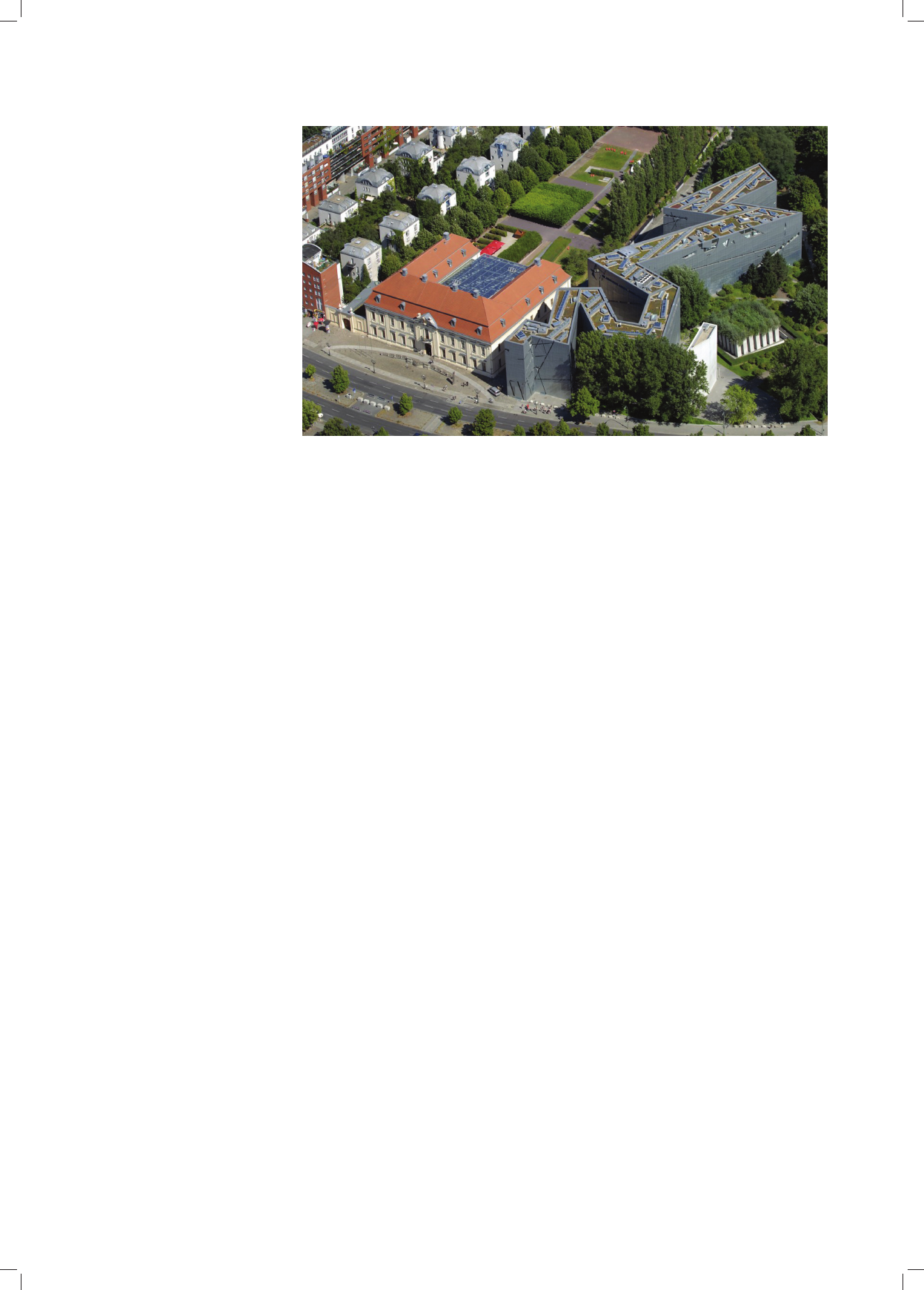
Ostre, dynamiczne, drapieżne wręcz kształty dzieł
sztu ki działają podobnie na każdego człowieka, nie
wyma gając uprzedniego wykształcenia [5, s. 425] (il. 1).
ments” in another context
burdens the architecture with
a constant negotiation with their previous meanings and
external ideologies [6, p. 197].
Certain researchers of aesthetics think, like Lev Tol
stoy, that art is not only an external expression of the emo-
tions of an individual, but it is also a language for com-
municating feelings between people. The art most
deserving of praise is that which deals with the most
important philosophical and ethical problems of an epoch
[16, pp. 39, 40, 42, 44]. Libeskind’s museum building
seems to successfully fulfil this important function. The
museum passes on not only knowledge about the Jewish
nation, through learning, but also the desired emotions
through art – architecture. The museum building in this
manner becomes more complete. Every part of it is en ga
ged in propagating the relevant content. Visitors to the
museum, knowing only its name, knowing nothing of the
actual holocaust, could on leaving state that the history of
the Jewish nation was marked by suffering and misap-
prehension.
The sharp, dynamic, almost predatory forms of art-
work affect everyone similarly without prior instruction
[5, p. 425] (Fig. 1). Paraphrasing the words of Roman
Ingarden on psychologism in aesthetics, it could be said
that, regarding this building […] a special quality appears
that ensures the person experiencing it will not be left
cold [acc. 18, p. 10]. The aesthetic assumptions of this
example of deconstructivism are both expressive and
abstract. Similarly to painting which abandons the figura-
tive and representation, heading towards abstract expres-
sionism, deconstructivism rejects ornament and tradition-
ally understood narrative in favour of geometry and
expression (the use of expressionist deconstructivism in
Germany – the home of expressionism – is interesting). It
is not without significance that artists from other fields
were involved in the first deconstructivist works, such as
Maya Lin (on the Wexner Center project) or Rachel
Whiteread (the “Ghost” project).
The above mentioned Véron thought that science and
art differed in that the first is objective, the other – sub
Il. 1. Muzeum Żydowskie
w Berlinie
(fot. Guenter Schneider,
źródło: http://libeskind.com/
work/jewishmuseumberlin/,
data dostępu: 6.01.2017)
Fig. 1. Jewish Museum in Berlin
(photo by Guenter Schneider,
source: http://libeskind.com/
work/jewishmuseumberlin/,
accessed: 6.01.2017)

36 Tomasz Omieciński
jective [16, p. 37]. The application of an expressionist
theory of aesthetics in the architecture (art) of a museum
building (science) is interesting. Perhaps using art to draw
people’s attention to the fate of the Jews was essential.
The important and for many people delicate issue of the
history of the Jews should not intimidate us into not ana-
lysing the building’s beauty. Hegel considered that, along
with the spread of Christian sensibilities, one of the most
important topics became pain, suffering and torture
[acc. 8, p. 133]. It is precisely beauty that makes these
tragic feelings bearable.
Deconstructivism
and the conceptualist theory of art
Another deconstructivist – Peter Eisenman – states that
the aim of the deconstructivists is to disrupt not the object
itself, but its perception
8
. All solutions, even the simplest
and most sensible ones, are allowable here, as long as the
end effect changes the way the architecture is experi-
enced. Eisenman suggests that perception gives a false
and incomplete picture of a physical object. It is true that,
moving through the Jewish Museum in Berlin, we do not
get a sense of its size or the direction we are moving in.
With time, we lose the sense of the building being
anchored in the world and the relationship of its individ-
ual elements to each other. Completely unseen for the
recipient, but easy to present on the pages of branch mag-
azines and the mass media is the purported creation of the
building’s footprint by squeezing the Star of David (Fig. 2).
The ubiquitous angles fit the mannered approach to pro-
portion and harmony well. The Mannerists rejected this
quality in its pure form in favour of an asymmetrical
geometry, not fitting into the basic outlines. Umberto Eco
stresses that it was only in the modern era that such beau-
ty became fully understood [8, p. 220].
Further component elements of the building – win-
dows, corridors, walls – also in the widely repeated opin-
ions presented on popular sources of information
9
contain
a deeper, hidden meaning. We learn, among other things,
that the elevation cut through with irregular window slits,
which constitute a form of link to the places where out-
standing Jews lived in Berlin before the war, and that the
building has three corridors called “axes”, which symbol-
ise the three spheres of Jewish presence in Berlin. This
description of the artwork, which the architecture of the
building certainly is, draws our attention to the logic of
the design decisions taken. This assessment is based on
the powerful emphasis on the significance of the material
elements of the architecture. It is reached via an approach
to beauty known as critical, or epistemological realism [5,
pp. 101–103]. This states that the experience of aesthetic
values does not necessarily come first, unlike the actual
features of a beautiful object. Within critical realism there
is an attempt to reduce subjective feelings to measurable
8
I would say that tearing things down is oneliner stuff. It is a form
of illustration, not a theoretical position. Eisenman P., About the archi-
tecture of Jim Wines, pretending to be physically damaged [19, p. 218].
9
For example on Wikipedia [20].
Parafrazując słowa Romana Ingardena o psychologizmie
w estetyce, można powiedzieć, że na tle spostrzeżone-
go budynku […] pojawia się szczególna jakość, która
nie pozwala podmiotowi przeżywającemu pozostać zim-
nym [za: 18, s. 10]. Założenia estetyczne tego dekonstruk-
tywistycznego przykładu są ekspresyjne i abstrakcyjne.
Podobnie do malarstwa odchodzącego od guratywnoś
ci i przedstawień w stronę ekspresjonizmu abstrakcyj-
nego, dekonstruktywizm porzuca ornament i tradycyjnie
rozumianą narrację na rzecz geometrii i ekspresji (inte-
resujące wydaje się zastosowanie ekspresjonistycznego
dekonstruktywizmu w Niemczech – ojczyźnie ekspresjo-
nizmu). Nie bez znaczenia jest fakt, że przy pierwszych
dziełach dekonstruktywistów swój czynny udział mieli
artyści z innych dziedzin sztuki, jak Maya Lin (przy pro-
jekcie Wexner Center) czy Rachel Whiteread (projekt
„Duch”).
Wymieniony wcześniej Véron uważał, że naukę od
sztuki odróżnia to, że ta pierwsza jest obiektywna, a dru-
ga – subiektywna [16, s. 37]. Ciekawym zabiegiem jest
zastosowanie ekspresjonistycznej teorii estetyki w archi-
tekturze (sztuka) obiektu muzealnego (nauka). Być może
skorzystanie ze sztuki, by zwrócić uwagę ludzi na losy
Żydów, było niezbędne. Poważna i delikatna dla wielu
ludzi tematyka historii Żydów nie powinna onieśmielać
do analizy piękna budynku. Hegel zauważył, że wraz
z rozpowszechnieniem się chrześcijańskiej wrażliwości
jednym z ważniejszych tematów stały się ból, cierpienie,
śmierć oraz tortura [za: 8, s. 133]. Właśnie piękno czyni te
tragiczne uczucia możliwymi do przyjęcia.
Dekonstruktywizm
a konceptualistyczna teoria sztuki
Inny dekonstruktywista – Peter Eisenman – mówi, że
celem dekonstruktywistów jest zaburzenie nie samego
obiektu, ale jego postrzegania
10
. Wszystkie, nawet najbar-
dziej proste i sensowne rozwiązania są tu dopuszczalne,
o ile końcowy efekt zmieni sposób doświadczania archi-
tektury. Eisenman sugeruje, że percepcja nie daje praw-
dziwej i całkowitej wiedzy o zycznym obiekcie. Moż-
na przyznać, że poruszając się po Muzeum Żydowskim
w Berlinie, nie mamy wyczucia wielkości i kierunków,
w jakich się poruszamy. Z biegiem czasu tracimy wraże-
nie zakotwiczenia budynku w świecie i relacji jego po-
szczególnych elementów do siebie. Zupełnie niewidocz-
ny dla odbiorcy, ale na pewno łatwy do przedsta wienia
w magazynach branżowych i mass mediach jest zabieg
rzekomego utworzenia rzutu budynku poprzez ściśnięcie
gwiazdy Dawida (il. 2). Wszechobecne krzywizny dobrze
pasują do manierystycznego podejścia do proporcji i har-
monii. Manieryści odrzucili te wartości w czystej formie
na rzecz geometrii niesymetrycznych, niewpisujących się
w podstawowe gury. Umberto Eco zaznacza, że dopiero
10
Powiedziałbym, że rozrywanie rzeczy to prosty greps. Rodzaj
ilustracji, a nie stanowisko teoretyczne [I would say that tearing things
down is oneliner stuff. It is a form of illustration, not a theoretical
position]. Eisenman o architekturze Jima Winesa pozorującej fizycznie
zniszczoną [19, s. 218; tłum. T.O.].

Założenia estetyczne dekonstruktywizmu/Aesthetic assumptions of deconstructivism 37
w epoce nowoczesności takie piękno spotkało się z peł-
nym zrozumieniem [8, s. 220].
Kolejne elementy składowe budynku – okna, korytarze,
ściany – również według powszechnej opinii powielanej
w popularnych źródłach informacji
11
niosą za sobą głęb-
sze, drugie dno. Możemy się dowiedzieć m.in. o elewacji
poprzecinanej nieregularnie szczelinami okien, stanowią-
cymi jakoby połączenia między miejscami zamieszkania
wybitnych przedwojennych Żydów w Berlinie, oraz że
budowla ma trzy przejścia nazywane osiami, które sym-
bolizują trzy sfery żydowskiej obecności w Berlinie. Ten
opis dzieła sztuki, jakim niewątpliwie jest architektura
budynku, zwraca uwagę na logikę podjętych decyzji pro-
jektowych. Ocena ta bazuje na silnym nacisku na znacze-
nie materialnych elementów architektury. Jest ona two-
rzona w oparciu o podejście do piękna zwane realizmem
krytycznym, inaczej epistemologicznym [5, s. 101–103].
Głosi on, że przeżywane wartości estetyczne niekoniecz-
nie są pierwotne, w przeciwieństwie do samych cech
pięk nego przedmiotu. W obrębie realizmu krytycznego
tworzy się dążenie do sprowadzania subiektywnego od-
czucia do mierzalnych przedmiotów, do odnajdywania
obiektywnych norm piękna kosztem przeżycia estetycz-
nego. Zamiast subiektywnych wrażeń estetycznych po-
szukuje się przyczyn piękna w obiektywnym zestawie
cech czysto zycznych, co oczywiście jest metodą ba-
dawczą przystającą do analizowania budowli. Gdyby nie
obiektywne prawidłowości w świecie sztuki, niemożliwe
byłoby wydzielenie z wszystkich przedmiotów tych, któ-
re uznaje się za dzieła sztuki, i istnienie nauki o estetyce
budziłoby wątpliwości [5, s. 106, 107]. Ten opis, podob-
nie jak wszystkie inne próby uargumentowania takiego,
a nie innego kształtu budynku, są symboliką właściwą
religijnej świątyni. Libeskind do ekspresyjnego wrażenia
dodaje reprezentacyjną stronę architektury wyniesioną
do poziomu sakralnej narracji. Jest to kolejny przykład,
jak dekonstruktywizm sprzeciwia się czysto pragmatycz-
nemu pięknu oraz stara się być przeciwny dominującym
trendom w świecie. W XX w. narastało przekonanie o po-
winności piękna do wyrażania się siłami handlu, prze-
mysłu i nauki, a nie dawniejszych sił moralności i religii
[8, s. 366].
Ważną częścią dekonstruktywistycznego myślenia jest
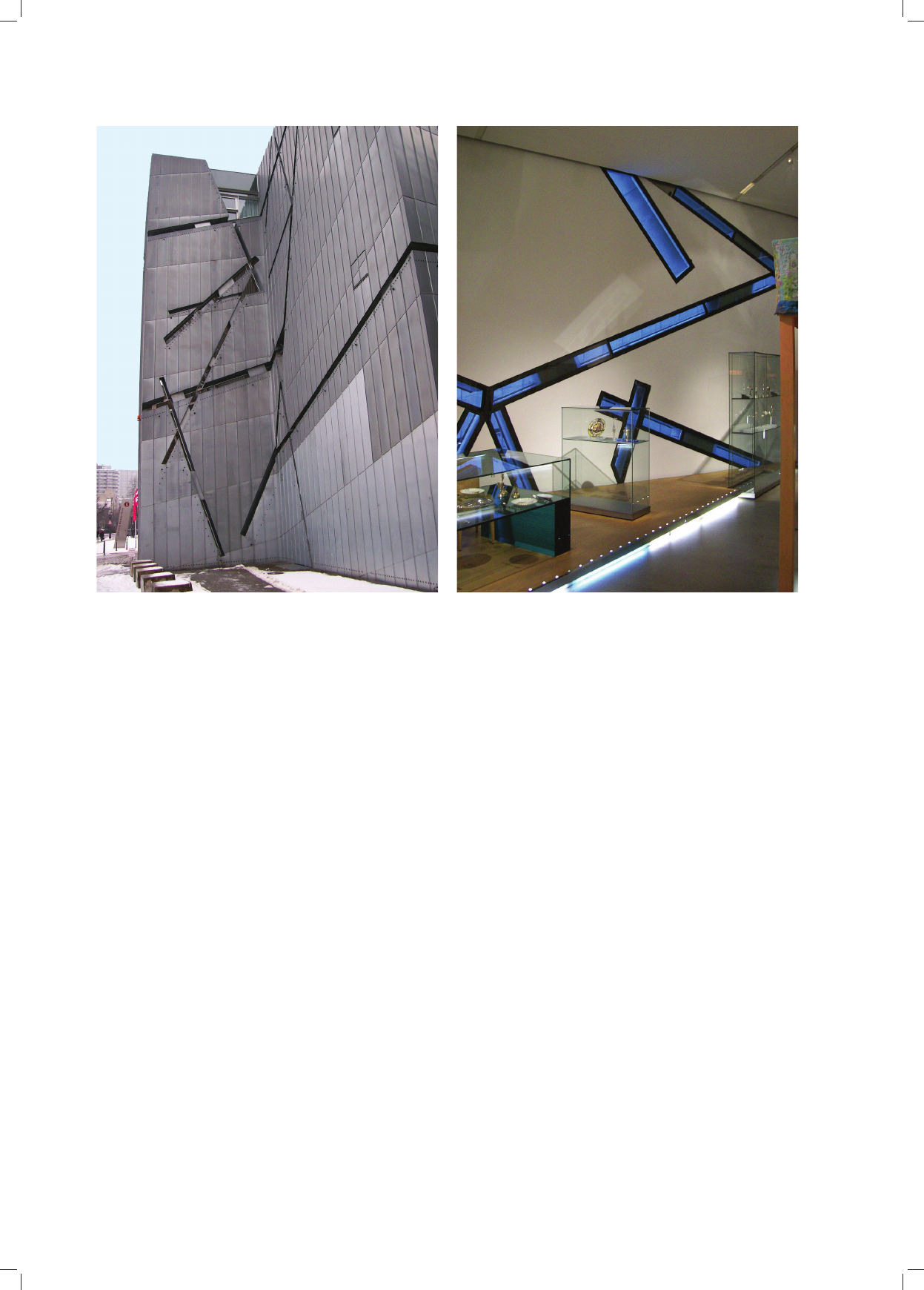
oderwanie elementu od jego znaczenia. Tutaj okno od ze-
wnątrz jest bardziej raną na skórze budynku niż oknem
(il. 3). Nie czujemy potrzeby, by przez nie zajrzeć. Nawet
nie przychodzi to nam do głowy. Patrzymy na nie jak na
plastyczny zabieg na ścianie budowli. Okno z zewnątrz
nie jest oknem. Zabiegi na elewacji nie są zewnętrzną
ingerencją odsłaniającą ukryte wnętrze budynku. Są one
integralną częścią budynku. Oknarany to nie pęknięcia
na elewacji, raczej spękana forma istnienia tej ściany,
niepodważalna i ugruntowana w idei budynku. Wigley
w katalogu z wystawy w MoMA wyraźnie przestrzega
przed nazywaniem dekonstruktywistycznymi budynków,
które udają spękane, rozsadzane i symulują demontaż bu-
dowli na czynniki pierwsze [2, s. 11]. Można powiedzieć,
11
Na przykład w powtarzanym masowo serwisie Wikipedia [20].
objects, to discovering objective norms of beauty at the
cost of the aesthetic experience. Instead of subjective aes-
thetic impressions, it looks for the causes of beauty in an
objective set of purely physical features, which is clearly
a research method suitable for analysing a building. If it
were not for the objective laws of the art world, it would
be impossible to identify from among all objects, those
which are regarded as works of art, and the existence of
the science of aesthetics would be highly debatable [5,
pp. 106, 107]. This description, like all other attempts at
arguing for this shape and not another shape of the build-
ing, is a symbolism appropriate to that of a religious tem-
ple. To the expressive impression, Libeskind adds the
representational aspect of architecture raised to the level
of a sacral narrative. This is another example of how
deconstructivism opposes purely pragmatic beauty and
tries to run counter to the dominant global trends. In the
20
th
century the conviction grew of the duty of beauty to
express the power of business, industry and science, and
not the former powers of morality and religion [8, p. 366].
An important part of deconstructivist thinking is sepa-
rating an element from its meaning. Here, a window, from
outside, is more of a wound in the building’s skin than
a window (Fig. 3). We do not feel the need to look through
it. It does not even enter our minds. We look at them as at
an artistic act on the wall of a building. The window from
outside is not a window. The interventions on the eleva-
tion are not an external interference, revealing the hidden
interior of the building. They are an integral part of the
building. These windowwounds are not a fissure in the
elevation, more a cracked form of the wall’s existence,
Il. 2. Próba uzyskania rzutu budynku muzeum z Gwiazdy Dawida.
Autorka: Victoria Shingleton (źródło: http://ceaseminar.blogspot.
com/2013/02/decomposingstarofdaviddaniel.html,
data dostępu: 8.01.2017)
Fig. 2. The attempt of recreating the museum plan from the Star
of David shape. Author: Victoria Shingleton (source: http://ceasemi-
nar.blogspot.com/2013/02/decomposingstarofdaviddaniel.html,
accessed: 8.01.2017)
38 Tomasz Omieciński
że Libeskind zastosował bardzo harmonijne i wizualnie
jednolite zabiegi rozszarpywania ściany. Architekt nie
jest przeciwny swojemu dziełu. Nie chce pokazać, że je
niszczy. Budynek nie tylko przeżywa swoje tortury, ale
staje się dzięki nim silniejszy. Nie wiadomo, co było
pierwsze – normalny budynek czy jego zaburzenie. Kil-
kukondygnacyjne okna przecinające ukośnie linie pięter
wydają się czerpać swoją moc właśnie z faktu widocz-
nego podziału stropu na ich środku (il. 4). Nie byłoby
tego efektu na jednej dużej ścianie wielopoziomowego
pomieszczenia. Siła tych ukośnych linii jest tak duża, że
zaczynamy wątpić w zupełnie poziome podłogi i równej
wysokości schody. Nie wiadomo, gdzie kończy się ska-
za, a zaczyna perfekcja. To właśnie wywołuje niepokój
w zwiedzającym. Brak poczucia oparcia w wiedzy. Do
efektu wstrząsu w sferze emocji można dodać wstrząs
w sferze logiki.
Dekonstruktywiści używają „słów” z architektonicz-
nego słownika w bardzo nietypowy sposób. Z pewno-
ścią nie wierzą w zawłaszczone przez modernistów hasło
„forma podąża za funkcją”. Nie wierzą w nie, ale świa-
domi stojącego za tą maksymą autorytetu odczuwają ko-
nieczność przeciwstawienia się. Rozmyślnie wykorzy-
stują tę dewizę do swoich celów. Kształty ich obiektów
są dokładną od wrotnością klarowności rozwiązań prze-
strzennych i kon strukcyjnych. Warto zaznaczyć, że moder
nistyczna, pro stolinijna estetyka odrzucała świadomość
indisputable and rooted in the idea of the building. Wigley,
in the catalogue for the MoMA exhibition clearly warns
against labelling buildings deconstructivist which seem
cracked, exploded or simulate the dismantling of a build-
ing into its basic elements [2, p. 11]. You could say that
Libeskind applied a highly harmonious and visually uni-
form approach to shredding the walls. The architect is not
opposed to his own work. He does not want to show that
he is destroying it. The building not only survives its own
torture, but becomes stronger because of it. It is not clear
which came first – the normal building, or its distortion.
The several storey high windows cutting at an angle
across the floors seems to draw its strength precisely from
the fact of the visible division of the ceiling at the centre
(Fig. 4). That effect would not be created on a single,
large wall of a multistorey space. The power of these
angular lines is so great that we begin to doubt the floors
are level or the stairs of even height. We cannot tell where
the defect ends and perfection begins. It is this that evokes
unease in visitors. The lack of a sense of being supported
by knowledge. To the shock effect on the emotions, we
can add a shock to our logic.
Deconstructivists use the “words” of the architectural
vocabulary in a highly unusual way. The certainly do not
believe in the slogan adopted by the modernists of “form
follows function”. They do not believe in it, but conscious
of the authority behind that maxim, they feel the need to
Il. 4. Okno budynku Muzeum Żydowskiego w Berlinie
przedzielone stropem (fot. T. Omieciński)
Fig. 4. Window from the Jewish Museum in Berlin
divided by the ceiling (photo by T. Omieciński)
Il. 3. Okno Muzeum Żydowskiego w Berlinie
przypominające ranę na budynku (fot. T. Omieciński)
Fig. 3. Window from the Jewish Museum in Berlin
resembling scars (photo by T. Omieciński)

Założenia estetyczne dekonstruktywizmu/Aesthetic assumptions of deconstructivism 39
skomplikowanego i nieuporządkowanego nagromadze-
nia i wzajemnego prze nikania się wielu funkcji. Według
Wig leya zniekształ ce nie prostych form w architekturze
de kon struk tywistycznej zapewnia lepsze warunki skom-
plikowanemu dynamiz mowi realnego świata: Zamiast
formy podążają cej za funkcją, to funkcja podąża za defor-
macją
12
[2, s. 19].
Dekonstruktywizm wywodzi się częściowo z radziec-
kiego konstruktywizmu, którego twórcy byli zafascyno-
wani złożoną dynamiką funkcji, w przeciwieństwie do
równolegle rozwijającego się modernizmu, bardziej za-
patrzonego w elegancką estetykę funkcjonalizmu. Mo-
derniści zwyciężyli tę walkę, przywracając podkreślenie
konstrukcji i odrzucenie zbędnego (ich zdaniem), sztucz-
nego ornamentu na rzecz szczerości i prostoty obydwu.
Architektura pozostała rzeczywistym wznoszeniem bu-
dowli, oddalając się od konstruktywistów, których kolej-
ne kroki zmierzały w stronę abstrakcji. Również u dekon-
struktywistów, według Wigleya, nieregularna geometria
nie może być po prostu dynamicznym kształtem, ale
musi przede wszystkim być postrzegana jako właściwość
struktury, konstrukcji [2, s. 11]. Bardzo ważne w kontek-
ście omawianego tu tematu jest zdanie Wigleya, który
uważa, że estetyka w dekonstruktywizmie jest jedynie
drogą do dalszych rozważań teoretycznych. Autor wysta
wy w MoMA utrzymuje, że konstruktywizm wyszedł
z podobnego założenia, ale nigdy w pełni nie rozwinął tej
myśli [2, s. 16].
Obecni krytycy, tacy jak Artur Zaguła [21], podważają
szczerość dekonstrukcji, która przecież nie jest procesem
empirycznym, ale przemyślanym przez wykształconego
eksperta działaniem. Coraz częściej słychać głosy, że jest
to właściwie maniera artystyczna, pewna moda zewnętrz-
nego oblicza architektury, a nie pełnowartościowa, auten-
tyczna idea. Czy współczesny architektdekonstruk
tywi-
sta w coś jeszcze wierzy, czy jest to już tylko kopiowanie
pewnych ogranych sztuczek? Charles Jencks pisze (używa-
jąc słów Roberta Hughesa o Giorgio de Chirico), że współ-
czesny architekt jest zmuszony do „samopodrabiania” swo-
ich najznamienitszych, ikonicznych realizacji [11].
Zakończenie
Należy pamiętać, że na przestrzeni kilku zaledwie
de kad zmieniało się samo pojęcie dekonstruktywizmu
w architekturze [17, s. 88]. Jego twórcy i przedstawiciele
nigdy nie tworzyli spójnej grupy, jak większość ruchów
awangardowych przed nimi, a podczas trzydziestoletniej
historii tego nurtu można zaobserwować nawet zmiany
podejścia poszczególnych twórców.
Daniel Libeskind w Muzeum Żydowskim łączy w in-
teresujący sposób ekspresjonistyczną teorię sztuki, gdzie
dzieło jest wartościowane ze względu na jego ekspresję,
z konceptualistycznym podejściem do estetyki, w którym
podważa powszechnie rozumiane użycie architektonicz-
nych elementów i stosuje do uzupełnienia jej przekazu
12
Oryg.: Instead of form following function, function follows de
for mation [2, s. 19, tłum. T.O.].
oppose it. They deliberately use this currency to achieve
their aims. The shapes of their buildings are a precise
reversal of the clarity of spatial and constructional solu-
tions. It is worth noting that modernist, linear aesthetics
rejected the awareness of complicated and disorganised
accumulations and the mutual intermingling of many
functions. According to Wigley, the distortion of simple
forms in deconstructivist architecture provides better
conditions for the complicated dynamism of the real
world: Instead of form following function, function fol-
lows deformation [2, p. 19].
Deconstructivism is derived partially from Soviet con-
structivism, whose exponents were fascinated with the
complex dynamics of function, in contrast to the modern-
ism which was developing in parallel and which was more
enamoured of the elegant aesthetics of functionalism.
The modernists won that battle, restoring the emphasis on
construction and rejecting the inessential (in their opin-
ion), artificial ornament in favour of the honesty and sim-
plicity of both. Architecture remained with the actual rais-
ing of buildings, distancing itself from the constructivists,
who went step by step in the direction of abstraction. For
the deconstructivists too, according to Wigley, irregular
geometry was not just a dynamic shape, but above all had
to be perceived as a property of the structure [2, p. 11].
An ex tremely important thing in the context of the subject
under discussion here is Wigley’s opinion that aesthetics in
de constructivism are only a starting point for further theo-
retical considerations. The creator of the MoMA exhibi-
tion maintains that constructivism developed out of a sim-
ilar assumption, but never fully realised the idea [2, p. 16].
Current critics, such as Artur Zaguła [21], cast doubt
on the sincerity of deconstruction, which is not an empir-
ical process but a considered activity by a trained expert.
More and more often, we can hear voices calling it an
artistic mannerism, a certain trend in the external appear-
ance of architecture, but not a fully authentic concept. Do
modern deconstructivist architects still believe in any-
thing, or are they just copying the same tired old tricks?
Charles Jencks writes (using Robert Hughes’ words on
Giorgio de Chirico) that the modern architect is forced to
“selfplagiarism” of his or her most identifiable, iconic
projects [11].
Conclusion
It should be remembered that over barely a few decades
the very concept of deconstructivism in architecture has
changed [17, p. 88]. Its exponents and representatives
never formed a coherent group, like most avantgarde
groups before them, and during the thirty year history of
the movement, changes even in the approach of individu-
al artists can be observed.
In the Jewish Museum, Daniel Libeskind has interest-
ingly connected expressionist theories of arts, where
a work is valued in terms of its expressiveness, with
a conceptualist approach to aesthetics, in which widely
understood use of architectural elements is undermined
and used to supplement its common sense explanation. It
uses beauty to make a tragic history conceivable, and the

40 Tomasz Omieciński
Bibliografia /References
[1] Wąs C., Architektura a dekonstrukcja. Przypadek Petera Eisenma-
na i Bernarda Tschumiego, Instytut Historii Sztuki Uniwersytetu
Wrocławskiego, Wrocław 2015.
[2] Johnson Ph., Wigley M., Deconstructivist Architecture, Museum of
Modern Art, New York 1988.
[3] Arrhenius Th., The Construction of a New “ism” – The Rhetori-
cal Context of Architecture, „Nordisk Arkitekturforskning” 1996,
Nr 2, 7–20.
[4] Chromik K., Kryzys metazyki a lyotardowska koncepcja ponowo-
czesności, „Doctrina. Studia SpołecznoPolityczne” 2013, Nr 9,
31–37.
[5] Gołaszewska M., Świadomość piękna, PWN, Warszawa 1970.
[6] Hirschbichler M., REmIKS. Negocjowanie postideologicznych
ideo logii, [w:] B. Świątkowska (red.), Chwała miasta, Fundacja
Bęc Zmiana, Warszawa 2012, 192–198.
[7] Gołaszewska M., Estetyka i antyestetyka, Wiedza Powszechna,
Warszawa 1984.
[8] Eco U. (red.), Historia piękna, Rebis, Poznań 2014.
[9] Napiórkowski M., Nie to ładne, co ładne… Nieco ironiczny prze-
wodnik po denicjach piękna dla architektów, „RZUT +7. Piękno”
2015, Nr 2, 4–7.
[10] Goldberger P., Building Art: The Life and Work of Frank Gehry,
Knopf, New York 2015.
[11] Jencks Ch., In what style shall we build?, „The Architectural Re-
view” 2015, 12.03.2015, https://www.architectural–review.com/
rethink/viewpoints/in–what–style–shall–we–build/8679048.article
[accessed: 7.01.2017].
[12] Jodidio Ph., Architecture Now! 4, Taschen, Cologne 2010.
[13] Frampton K., Modern Architecture: A Critical History, Thames &
Hudson, Milton Keynes 1992.
[14] Scruton R., The Aesthetics of Architecture, Princeton University
Press, New Jersey 2013.
[15]
Loos A., Architektura, [w:] A. Loos, Ornament i zbrodnia. Eseje
wybrane, Fundacja Centrum Architektury, Warszawa 2013, 144–155.
[16] Dziemidok B., Główne kontrowersje estetyki współczesnej, PWN,
Warszawa 2012.
[17]
Wąs C., Przestrzenie różnicy. Modernizm, postmodernizm i de kon
struktywizm w architekturze (próba denicji), „Quart” 2008, Nr 4(10),
88–111.
[18] Wysokiński K., Piękno odczuwalne. Po co nam wychowanie,
„RZUT +7. Piękno” 2015, Nr 2, 10–16.
[19] Rozmowa przeprowadzona z P. Eisenmanem, [w:] Jencks Ch.,
The New Moderns, Academy Editions, London 1990, 209–236.
[20] Muzeum Żydowskie w Berlinie, https://pl.wikipedia.org/wiki/Mu-
zeum_Żydowskie_w_Berlinie [accessed: 2.01.2017].
[21] Zaguła A., Technologiczny i konstrukcyjny manieryzm architek-
tów kręgu dekonstruktywistycznego, wystąpienie konferencyjne na
LX Ogólnopolskiej Sesji SHS „Maniera – Manieryzm – Manie
ryczność”, Gdańsk 24–25.11.2011 [materiał dzięki uprzejmości
autora].
Streszczenie
Celem niniejszego artykułu jest pogłębiona analiza głównych założeń estetycznych dekonstruktywizmu na podstawie znamienitego dzieła architek-
tury Daniela Libeskinda. Przedstawiono początki tego kierunku oraz jego teoretyczne i lozoczne podstawy, a także główne idee. Następnie na
przykładzie budynku Muzeum Żydowskiego w Berlinie wykazano dwa odmienne sposoby podejścia Libeskinda do roli estetyki w architekturze.
Pierwsze stanowisko to postawa odwołująca się do emocjonalistycznej teorii sztuki, drugie – do konceptualistycznej teorii sztuki.
Słowa kluczowe: piękno, estetyka, dekonstruktywizm, Libeskind, Muzeum Żydowskie w Berlinie
Abstract
The aim of this article is a deep analysis of the main aesthetic assumptions in the deconstructivist architecture on the example of Daniel Libeskind’s
remarkable piece of architecture. The origins of this movement, its theoretical and philosophical foundations as well as the main ideas are presented.
Then, based on the building of the Jewish Museum in Berlin, there are demonstrated two of Libeskind’s different approaches to the role of aesthetics
in architecture. The rst position is an attitude that refers to the emotionalist theory of art, the second to the conceptualist theory of art.
Key words: beauty, aesthetics, deconstructivism, Libeskind, Jewish Museum in Berlin
almost religious significance of the symbols, which it has
transformed into architectural elements of expression,
amplify the message which the museum building carries.
This variety of Libeskind in his aesthetic assumptions
may constitute a problem in terms of the challenge that is
defining his approach to aesthetics. An even more diffi-
cult challenge is attempting to define the aesthetic
assumptions of the entire deconstructionist movement,
consisting as it does of such different creative individuals.
As Stuart Hampshire writes: If, in terms of aesthetics,
someone goes from the individual to the general, they’re
going in the wrong direction [acc. 16, p. 169].
Translated by
Graham Crawford
zdroworozsądkowe wyjaśnienia. Używa piękna do uczy-
nienia tragicznej historii możliwej do pojęcia, a prawie
religijne znaczenie symboli, w jakie zamienił elementy
architektonicznego wyrazu, potęguje przekaz, jaki niesie
budynek muzeum.
Ta różnorodność Libeskinda w założeniach estetycz-
nych może sprawiać problem wyzwaniu, jakim jest okre-
ślenie jego jednolitego podejścia do estetyki. Jeszcze
trudniejszym sprawdzianem jest próba określenia zało-
żeń estetycznych całego nurtu dekonstruktywistyczne-
go, składającego się z tak odmiennych indywidualności
twórczych. Jak pisał Stuart Hampshire: Jeśli w estetyce
ktoś porusza się od tego, co indywidualne, do tego, co
ogólne, to porusza się w niewłaściwym kierunku [za: 16,
s. 169].