
2026
1(85)
Radosław Achramowicz*, Ewa Kuhnert**
Identification and description of bio-innovations in architecture
using the dedicated CLM Tool
DOI: 10.37190/arc260108
© by the Author/Authors. Licensee WUST.
Published in open access. CC BY-NC license.
Abstract
What is innovative activity in architecture? This question lies at the core of identifying a research problem situated at the intersection of the mul-
tithreaded decision-making and creative processes undertaken by various entities focused on the commercialization of knowledge. The conducted
review conrms a lack of a systemic solution for identifying and validating innovations related to this knowledge. This observation allows the authors
to hypothesize that it is possible to construct a potentially objective, universal, and intuitive diagnostic system, adapted to the specic of interdisci-
plinary design innovations.
The article provides a revision of the theoretical framework and methods for measuring innovation, based on an original research model called the
Centrifuge Logic Machine (CLM). The aim of the paper is to identify and describe various aspects of innovation in the form of a synthetic diagnosis.
As the rst in a series of articles, it presents the general rationale for applying this novel apparatus and the results of testing it across three scales:
architectural, urban planning, and industrial design. These represent three examples of bio-innovation characterized by a level of complexity adequate
for an eective CLM test.
The study demonstrated the ability to compare innovations from various perspectives: social, cultural, technological and creative, above all, using
a single apparatus. This allowed for a unied image of innovative thought, despite the radically dierent projects tested. The diagnosis of individual
innovation aspects was performed by determining their specic paths using the CLM. The multiplicity of these paths created the map of innovation,
characteristic of a given object, resulting in a unique pattern of “ngerprints”. Their diversity and complexity demonstrate that innovations in design
create networks of complex trajectories, the discovery of which is a form of decoding thought.
Key words: architecture, innovation, processuality, personalization, organicity
Introduction
What is innovative activity in architecture? This seem-
ingly simple question, which any architect will intuitive-
ly answer correctly, hides a research question that is less
obvious and much more complicated. At the outset of its
analysis, one should refer to the origins of the word “in-
novation”, which comes from the Latin word innovare,
meaning “to renew or introduce something new”. Its mod-
ern interpretation dates back to the middle of the previous
century, when the term was relatively quickly adopted in
the economy (OECD 2015). As a result, economic cate
-
gories – hard and quantiable − began to be used to de-
scribe innovation issues, with a simultaneous lack of space
for creative – soft and non-quantiable – categories. And
yet, paradoxically, the greatest “innovative” capability that
humans possess is abstract thinking. Many denitions and
interpretations of innovation have been proposed to date;
however, they can be ignored, because none of them are
complete from the point of view of the architecture and
twin disciplines. The interpretations that have been present-
ed to date are at best quantitative and statistical (EC 1995),
but there is much more to innovative thought, as is well-ex-
plained by the concept formulated more than sixty years
ago by art theorist George Kubler, who claimed that the
existence of unmet needs while having the means to meet
them, can, under the right conditions, foster innovation
(1962). Kubler illustrated this with the example of Chicago
*
ORCID: 0000-0002-3923-4504. Faculty of Architecture, War saw
University of Technology, Poland, e-mail: radoslaw.archramowicz@
pw.edu.pl
** ORCID: 0000-0001-7446-181X. Faculty of Architecture, Warsaw
University of Technology, Poland.

88
Radosław Achramowicz, Ewa Kuhnert
in 1876, when the city became extremely attractive to ar-
chitects after the Great Chicago Fire. This tragic event was
followed by a golden age of the Chicago School, with such
talents as Daniel Burhnam, Louis Henry Sullivan and lat-
er Frank Lloyd Wright. However, the reconstruction of the
city would have been just […] a provincial extension rather
than an epochal renewal of American architecture (Kubler
1962, 117), had it not been for a favourable convergence of
socio-economic and technological-aesthetic needs reaching
beyond purely architectural concerns.
One can agree on the fact that the contemporary param-
eters included in the denitions of innovation, originally
formulated for the economy, do not fully reect the scope
and nature of architectural works that one could declare
to be a novum in their discipline. This observation result-
ed in the formulation of a research problem identied at
the intersection of the multifaceted decision-making and
creative process undertaken by research organizations,
uni versities, and experts as well as accrediting bodies, go-
vern ment administration bodies and other entities. Their
activity focuses on the commercialization of knowledge
produced by the so-called creative class: scientists, in-
ventors, artists, designers and other professionals with the
abi li ty to combine art, modern technology and business,
providing a competitive advantage in their elds (Florida
2010). From this perspective, the entirety of the activities
undertaken by various design disciplines should enhance
the value of human existence, which can be expressed in
innovation. An historical example of this approach is the
visionary Memex system developed by Vannevar Bush
(1945), which anticipated the coding that mimics the way
humans think and associate information, and is used in to-
day’s hypertext and search engines.
Research problem
The research presented herein is based on the assump-
tion that various ways to map the same thing can produce
dierent results. This is inuenced by, among other things,
the research model used, with its strengths and weaknesses,
which is the main tool for conceptual reasoning in shaping
a space, an object, a system and the processes that accom-
pany the designers’ works (Słyk 2018). On the one hand,
specialized issues and the complicated research technique
prevent extensive knowledge of the subject, and on the other
hand, […] despite this impossibility, we still seek to arrive at
a general view (Giedion 1968, 34). Based on this observa-
tion, the following research questions are formulated in this
article: Is it possible to eectively track the evolutionary
paths of design bio-innovation based on a universal research
and diagnostic tool? Are there areas of knowledge from
which one can draw an idea for solutions to such an issue?
Why are architects best able to answer this question? Due
to the specic nature of the tasks entrusted to them and the
learning process they go through, architects are endowed
with the ability to have a dual view: a soft, artistic one that
synthesizes the vision of the world and a hard, technical
one that focuses on solving a complex problem analytically.
Architects therefore operate in a “hybrid” mode that goes
beyond one specialization as well as beyond one scientic
and creative method. This unique “aiction” of a design
-
er’s mind leads to the creation of original research methods
based on analogy and metaphor − unusual for the world of
innovation, but typical of the language of thought (Arendt
1989). These methods make it possible to assimilate new
concepts: to connect the internal, intuitive and invisible with
the world perceived by the senses, the quantiable and or-
derly world, at a deeper level than, for example, the Tech-
nology Readiness Levels (TRLs), which ignore the potential
of innovative thought while describing and validating the
advanced level of innovation in a technological context.
This discrepancy reveals a gap in the area of interpretation
of what innovation is today.
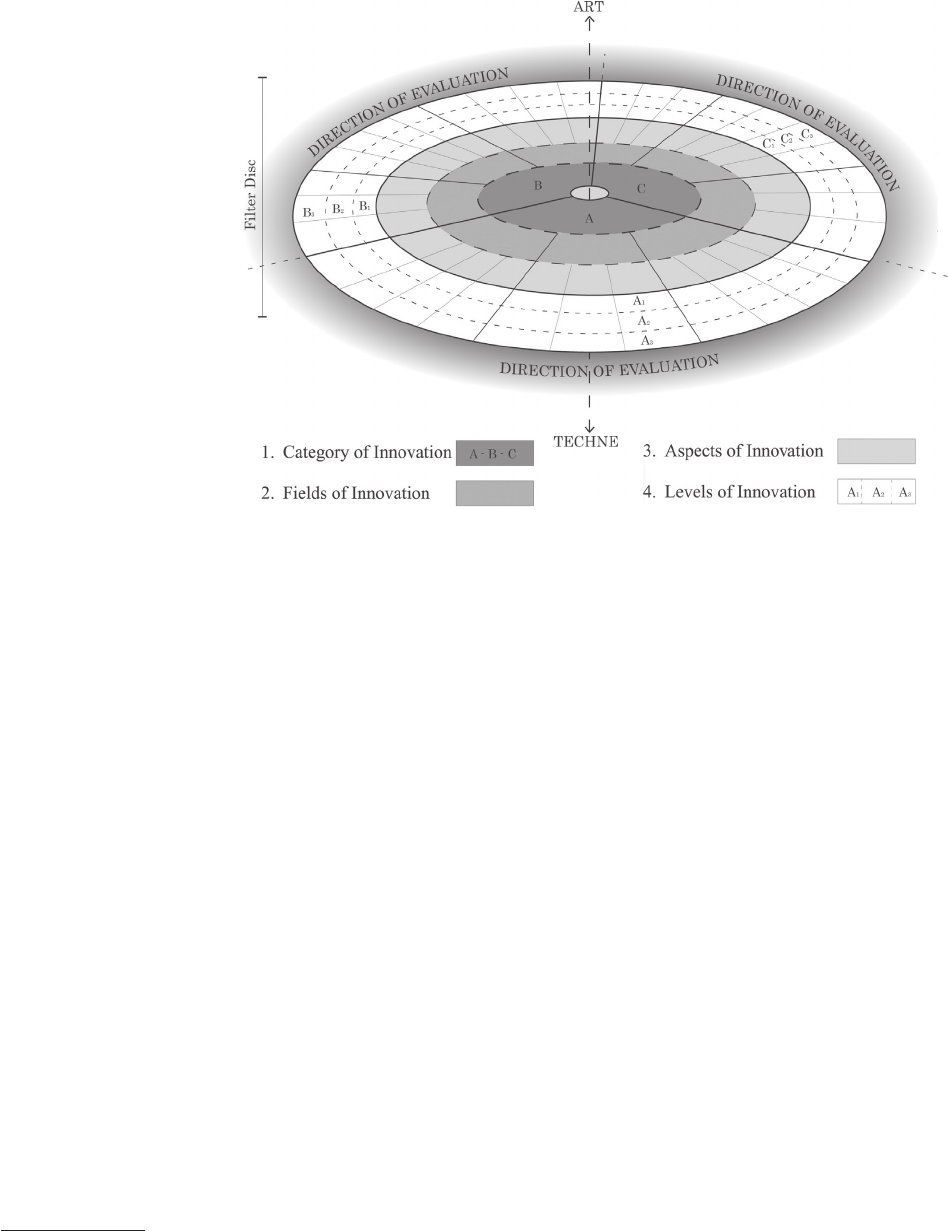
This gap is addressed by the subject matter of a study
− the Centrifugal Logic Machine (CLM) − a proprietary
research model and at tool at the same time
1
, the construct
of which is based on a laboratory centrifuge. As in a cen-
trifuge, a selected architectural “sample” is fed into the
machine, where it is ltered sequentially through elds, pa-
rameters and levels, collectively called attributes. The arti-
cle thus presents the hypothesis that the centrifuge-based
principle can be used to examine architectural innovations,
which are ltered and mapped as “samples” (Fig. 1). The
purpose of this article, which constitutes the rst part of
a larger series, is to show the theoretical basis for the CLM
construct and mechanics, and to provide preliminary veri-
cation of its operation based on a test carried out on three
architectural “samples” selected according to three cri-
teria: (I) they are interdisciplinary; (II) they present three
dierent project scales: urban planning, architectural, and
industrial design; and (III) they are considered bio-inno-
vations. Although these three criteria reduce the area of
analysis, they also allow a semantic comparison of “sam-
ples”, which are characterized by unprecedented exibility
and adaptability (example: NSA Muscle), processual nature
and personalization (example: Bone Chair), circularity and
organicity (example: PhotoSynthetica Tower). The analy-
sis carried out resulted in research paths derived from the
three philosophical categories of Motion, Time, and Space,
moving towards three directions describing bio-innovation:
organicity, processuality and personalization. Identifying
paths through a set of attributes allows diagnosing the po-
tential of innovative solutions. This results in the creation
of individual innovation maps − unique diagrams called
“ngerprints”, as shown in the conclusions. Given the so-
phistication of the research model, it should be emphasized
that the test results presented are not intended to clearly
evaluate the “samples”, but are rather intended to show the
general idea and development potential for the CLM. The
next phases of the study, which will include empirical vali-
dation of the tool, its verication in terms of objectivization
of the criteria, and results by comparing them with other
similar systems (e.g., TRIZ, ARIZ, C-K Theory, and KTH),
will be the subject of subsequent articles.
1
Research based on Grant of the Scientic Council of the Sci-
entic Discipline of Architecture and Urban Planning of the Warsaw
University of Technology and connected with Patent Application titled:
“Method and system for determining the level of innovation of a techni-
cal solution” (P.452198, 2025.05.30 Warsaw).
Identification and description of bio-innovations in architecture using the dedicated CLM Tool
89
State of research
The search conducted revealed the lack of an intuitive
yet universal system for identifying and validating inter-
disciplinary design innovations. Even though there are
various solutions − methods, models and tools − that par-
tially address the problem described herein, none of them
is a single coherent diagnostic solution of a systemic na-
ture, one that responds to the problem comprehensive-
ly
2
. This is probably due to the fact that the origins of the
de nition of innovation should be sought in the economy
and, as a result, none of the denitions used adequately ad-
dresses architectural innovation. An analysis of available
publications − both domestic and foreign − revealed quite
a few approaches to identifying and describing innovation,
but few of them directly address the architectural context.
Some of the most relevant publications for the research
undertaken include Using Design Thinking for Interdis-
ciplinary Curriculum Design and Delivery (Wang 2024),
which provides empirical insight into interdisciplinary
collaboration and the limitations of existing methods for
evaluating innovation in teaching practice, and the article
titled Research on Interdisciplinary Design Thinking and
Methods Based on Programmable Mechanical Metamate-
rials (Liu et al. 2023), whose authors attempt to capture the
multi-level relationships between dierent disciplines, in
2
The authors draw this conclusion from a survey of existing pat-
ents worldwide. Due to the nature of this text, we can only cite the names
and numbers of patents that illustrate the thesis, for example: “Method
and system for measuring innovation level of product using part-whole
relations” (KR101546365 B1); “Future technology value appraisal sys-
tem and method” (KR101265975 B); “Method for evaluating technolo-
gy contribution and method and system for evaluating technology using
the same” (KR101228969 B1); “Technological innovation method based
on innovation dimensions and innovation rules” (JP2020510247 A); “In-
novation content evaluation system” (PT118270 A).
which one can see an analogy to the topic addressed here.
On the other hand, in Poland, in the publication titled Wy-
brane narzę dzia pomiaru innowacyjności [Selected Tools
for Measuring Innovation] (2013), Angelika Wodecka-Hy-
jek points to the dispersion of tools for its measurement in
dierent sectors and the diculty of developing universal
indicators. A similar tone is also adopted by the monograph
titled Innowacje a dobrostan społeczeństwa, gospodarki
i przedsiębiorstw [In novation and the Well-Being of Soci-
ety, Economy and Businesses] (Malara, Tutaj 2019), whose
authors emphasize the need to measure the relationship be-
tween innovation and socioeconomic well-being.
One may also consider publications addressing bio-in-
novation in architecture and design, for example: Nature
Design: From Inspiration to Innovation (Museum für Ge-
staltung Zrich, Angeli Sachs 2007) and Biomimetics for
Designers: Applying Nature’s Processes & Materials in
the Real World (Kapsali 2021). Both show the transfer of
conceptual solutions from biology to the broader eld of
creative disciplines at the formal, processual, and ma terial
levels, but they omit the topic of innovation as such. One
should also mention books titled Biomimetics for Architec-
ture and Design (Pohl, Nachtigall 2015), where evolution
is presented as a source of inspiration providing innova-
tive, optimal and sustainable design solutions, Biomimic-
ry: Innovation Inspired by Nature (Benyus 1997), which
does not refer directly to architecture, but broadly describes
the impact of biomimicry on the socio-cultural context,
and Biomimicry in Architecture (Pawlyn 2011), in which
attention is focused on sustainable aspects of design. The
post-conference article titled Biomimetic Approaches to
Architectural Design for Increased Sustainability (Peder-
sen 2007) presents a similar tone. Numerous articles also
include those that focus on only one aspect, for example,
materials (Addington, Schodek 2005) or technology and
production processes (Mang, Reed 2012).
Fig. 1. Centrifugal Logical
Machine – scheme
(elaborated by R. Achramowicz,
E. Kuhnert)
Il. 1. Centryfugowa Maszyna
Logiczna – schemat
(oprac. R. Achramowicz,
E. Kuhnert)
90
Radosław Achramowicz, Ewa Kuhnert
there are dedicated classication frameworks and tools, such
as Biomimicry Design Lens and Biomimicry Taxonomy/
Ask Nature. They segregate biological solutions by function
and principles of operation. Although they provide concrete
solutions that refer to the “function” and “strategy” of na-
ture, they do not operate in the eld of architectural creation.
Two conclusions can be drawn from the above discus-
sion. First, despite the considerable number of studies de-
voted to the technical and economic aspects or describing
the transfer of solutions transferred from the biological sci-
ences to architecture, there are basically no studies that syn-
thetically address the issues of identication and de scription
of novum with respect to the interdisciplinary na ture of ar-
chitectural matter. Second, there is not a single systemic re-
search approach that would result in an eective analytical
tool for the identication and in-depth qualitative analysis
of this type of innovation.
Methods
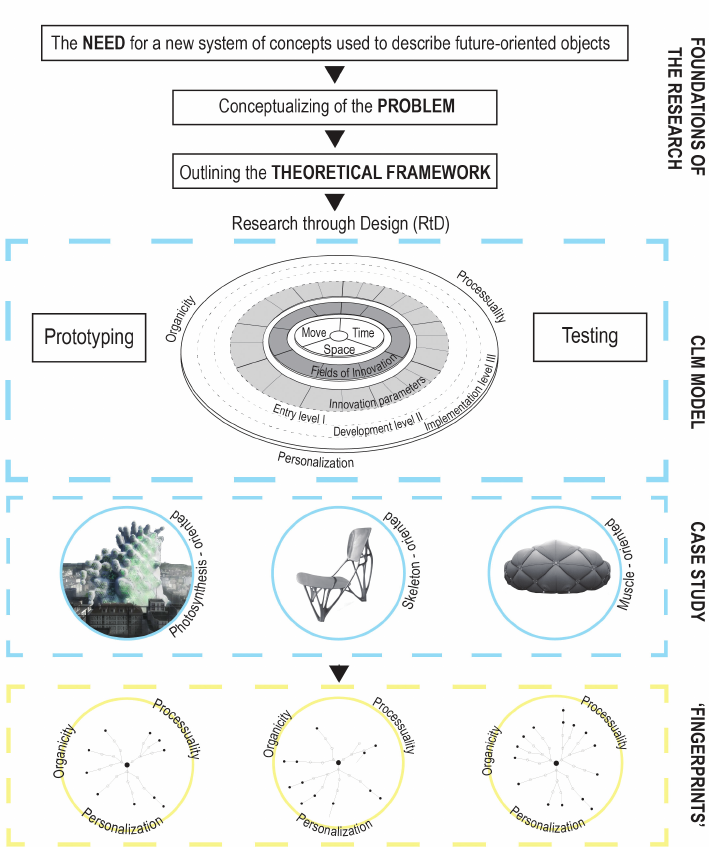
The course of the research is presented in the diagram
(Fig. 2), within which the following steps can be distin-
guished: dening the need for research, conceptualizing the
Thanks to the search carried out, it was also shown that
there are numerous approaches and tools for identifying and
verifying innovation, which can serve as a reference point
for “calibrating” the CLM. Among the most recognizable are
well-established methods in engineering and design, such as
the TRIZ (Russian: Теория решения изобретательских
задач, The Theory of Solving Inventive Problems) and its al-
gorithms (ARIZ), which systematize the detection of design
contradictions and indicate paths for transforming solutions;
they provide a useful example of a systemic approach to in-
novation analysis. Another approach is the Concept-Knowl-
edge (C-K) theoretical framework, which provides a formal
way of thinking about the relationship between the space
of concepts and knowledge resources and is widely used
to generate and validate new concepts in the design pro-
cess. Of particular note is the KTH Innovation Readiness
Level™ tool, which is provided on an open access basis. It
oers a ready-made methodical framework for monitoring
and evaluating the progress of innovations in multiple elds:
technology, market, business model, intellectual property,
teams, and funding, while having a clear visual representa-
tion of the results changing over time. If one were to focus
on biomimicry and biomimetics, it is worth mentioning that
Fig. 2. Diagram illustrating
the process of research
(elaborated by R. Achramowicz,
E. Kuhnert)
Il. 2. Schemat przedstawiający
przebieg badań
(oprac. R. Achramowicz,
E. Kuhnert)
Identification and description of bio-innovations in architecture using the dedicated CLM Tool
91
problem, and outlining the theoretical framework, which
ultimately leads to the creation of a CLM idea. In the next
step, the machine is tested with three sample designs-sam-
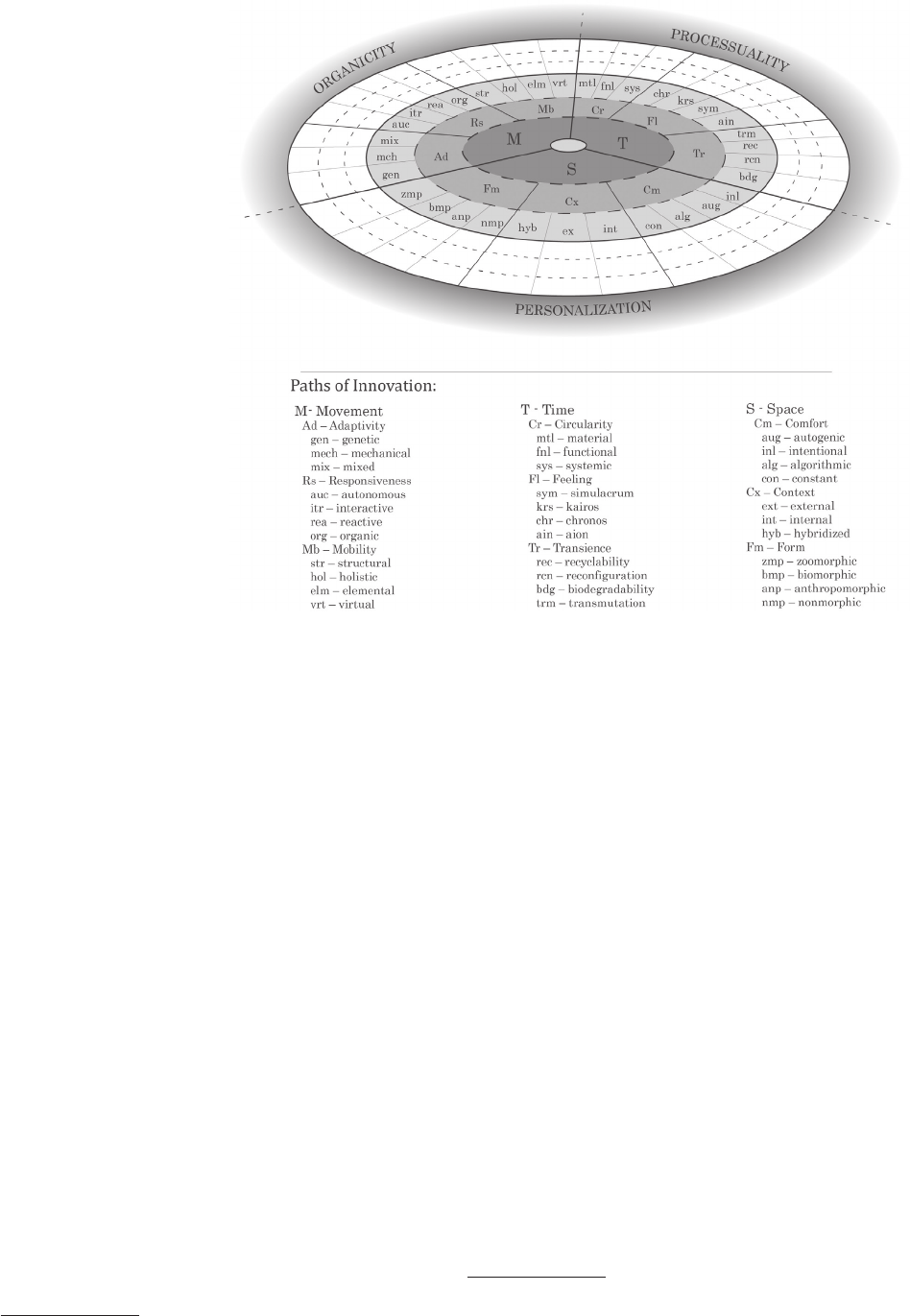
ples. The general idea is that the structure of the CLM is
based on the philosophical categories of Movement, Time,
and Space, which are reected in Organicity, Processuality,
and Personalization, which in turn establish an envelope to
which innovation paths lead through various elds and lev-
els (Fig. 3). The individual study paths lead to a total of nine
elds of innovation: Movement towards adaptability, re-
sponsiveness, and mobility; Time towards feeling, circular-
ity, and transience; and Space towards comfort, context and
form. To the various elds of innovation are assigned nu-
merous parameters (adaptability, interactivity, functionality,
recyclability, simulation, comfort, among others, as well as
purely formal issues), which can be considered at three lev-
els: entry, development and implementation, as alternatives
to the technological readiness levels (TRLs) adopted today
that are inadequate for design disciplines. In this context, the
rst level is interpreted as a conceptual phase and therefore
a barely initiated path of innovation; the second level shows
the potential of a particular pathway for evaluation, for ex-
ample, by prototyping or developing partial technologies;
and the implementation level involves the implementation
of fully developed innovative solutions in practice.
Initially the CLM model was shaped through microtests
conducted on a larger set of architectural cases
3
. In sub-
3
Sample projects used as microtests included built works as well
as design experiments associated with the work of the following design-
ers: Greg Lynn (Embryological House, RV PROTOTYPE House), Kas
sequent iterations of the model, the relationships between
elds, parameters and levels were veried, both changing
their number and scope of impact, and introducing alterna-
tive evaluation criteria. This allowed the CLM’s construct
and mechanics to be gradually rened. The verication pro-
cess was open and heuristic, e.g., in the course of the work
on subsequent designs, it turned out that the parameters in
the Comfort eld, initially included as a set of rigid input
parameters, had to be expanded with additional variables.
This is because the design tests demonstrated that some as-
pects of comfort are much more complex than originally en-
visioned in the model. As a result of the CLM modelling, its
various elements − such as the parameter layout, hierarchy
and levels of advancement − were replaced, simplied or
expanded, so as to produce the most universal model possi-
ble, adapted to dierent types of design innovations − for-
mal, processual or material alike.
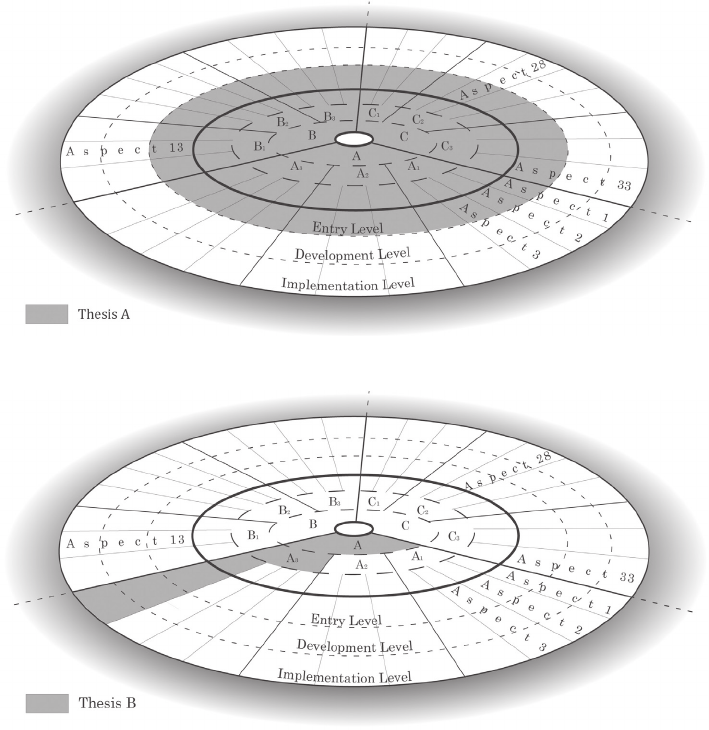
In the diagnosis produced with the CLM, two extremes
− understood here as two extreme views of innovation
− were distinguished, which can be described as follows:
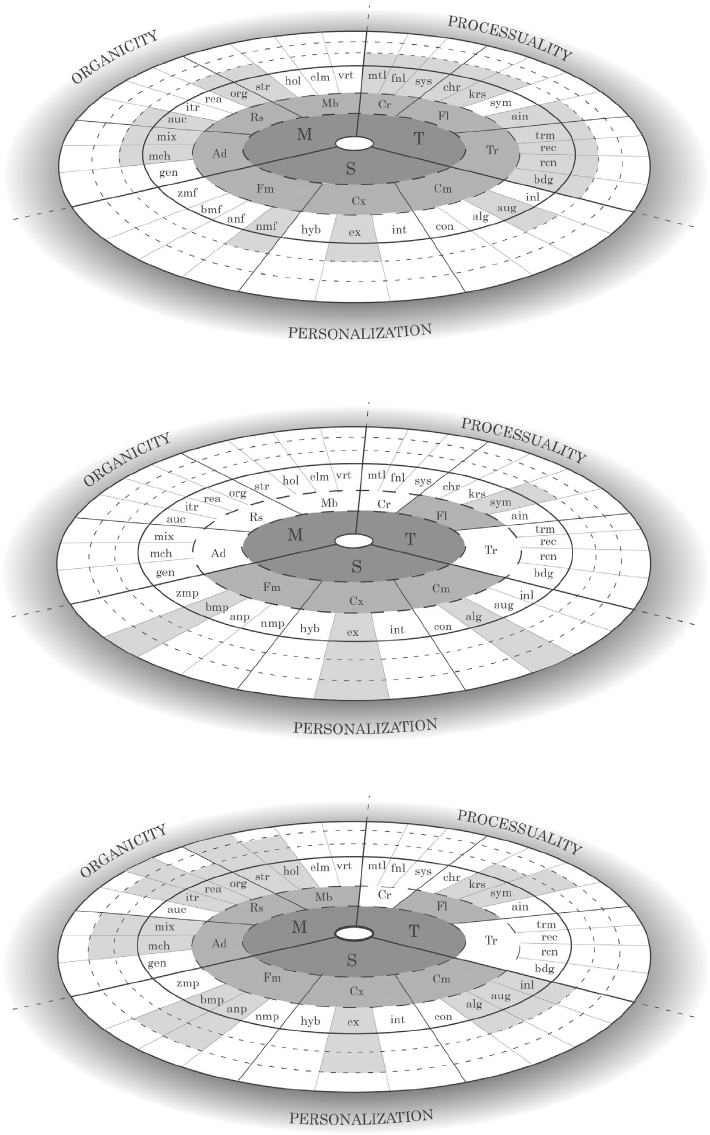
(A) high innovation potential, but low entry level (Fig. 4)
− as represented by the example of Photosythetica Tower;
(B) low innovation potential, but high level of implementa-
tion (Fig. 5) − as represented by the example of Bone Chair.
Thesis A can be found in the following situation: innovation
Oosterhuis and ONL Rotterdam (Saltwater Pavilion, Muscle), the group
R&Sie(n) (Water Flux), Lars Spuybroek / NOX (D-Tower, Son-O-House),
François Roche (Dustyrelief), Peter Cook (Graz Kunsthaus), and Terre-
form ONE (In Vitro Meat Habitat, Fab Tree Hab). Research pavilions of
the ICD/ITKE Institute at the University of Stuttgart were also analysed.
Fig. 3. Detailed description
of CLM
(elaborated by R. Achramowicz,
E. Kuhnert)
Il. 3. Szczegółowy opis CLM
(oprac. R. Achramowicz,
E. Kuhnert)
92
Radosław Achramowicz, Ewa Kuhnert
of a multifaceted nature, combining multiple disciplines and
technologies, stopped at the conceptual level, but with de-
velopment potential in a broad spectrum. Thesis B can be
found in the following situation: innovation of a single-fac-
eted (narrow) nature, which is brought to the level of im-
plementation. For a complete image of the operation of the
CLM, Thesis C of an intermediate nature is proposed, which
has a multifaceted nature and, at the same time, involves
a path of innovation leading to implementation, as repre-
sented by the NSA Muscle design. The test of the machine
therefore involves proving the three theses described above
(A, B, C), which illustrate its eectiveness. The tests-diagno-
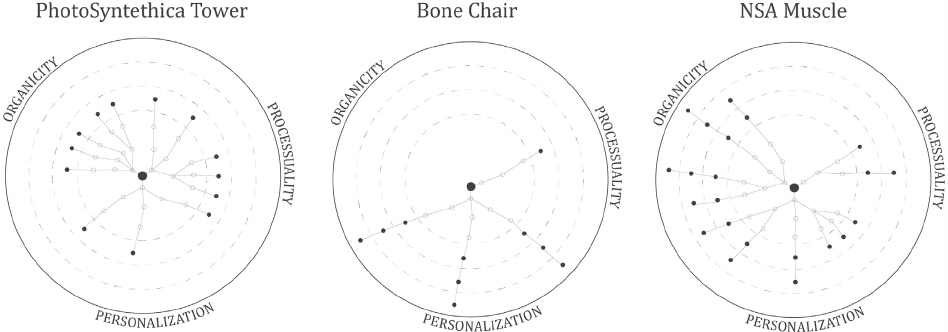
ses carried out resulted in three unique “ngerprint” images.
A case study illustrating each thesis
Thesis A: PhotoSynthetica Tower (2019) represents bio-
innovation of a multifaceted nature, with the potential for
multifaceted development, but stopped at the conceptual
level. The authors from ecoLogicStudio studied the use of
photosynthetic processes occurring in algae to cleanse the
air in a city. They proposed façades tted with photobio-
reactors (ecoLogicStudio 2025, 20) that could respond to
urban smog, dust and particulate matter in the atmosphere.
An algae suspension placed in the façades would capture
and store carbon dioxide molecules. This biochemical pro-
cess would be digitally controlled, and the resulting algal
biomass, in addition to producing oxygen, could be used
to produce biofuels, biodegradable materials, and even an-
imal feed (Wang et al. 2024). The innovations identied
are primarily related to the issues of transitoriness, feeling,
circularity and adaptability. In this vision, architecture be-
comes an active participant in the biotope, submitting to the
life cycle like any other living organism. The project also
touches on aspects of innovation relating to responsiveness
and mobility, among other things, demonstrating a broad
spectrum of innovation issues, many of which remain at the
conceptual level (Fig. 6).
Thesis B: the bio-innovations identied in the case of
the Bone Chair (2006) are single-faceted − narrow and
specialized, dealing primarily with shaping of the form and
comfort relative to user-imposed contexts made possible
by the simulation level (Fig. 7). As a result of these de-
sign and production processes, the assembly line eventually
manufactured a customised piece of furniture (Stals et al.
2015). The author of the design, Joris Laarman, inspired
by the bone growth, created a personalized process for
manufacturing chairs that feature an organic shape and ho-
mogeneous structure resulting from material optimization
(Laarman 2006). The entire cycle, from design to prototyp-
ing and manufacturing, took place at the Adam Opel AG’s
International Developed Centre, which used simulation of
the bone-growing process to produce car bodies. Of note is
the fact that the algorithm itself copied the path of evolu-
Fig. 4. Diagram presenting
thesis A: high innovation
potential but a low level of entry
(elaborated by R. Achramowicz,
E. Kuhnert)
Il. 4. Schemat prezentujący
tezę A: potencjał innowacji wysoki,
ale niski poziom wejścia
(oprac. R. Achramowicz,
E. Kuhnert)
Fig. 5. Diagram presenting
thesis B: low innovation
potential but a high level
of implementation
(elaborated by R. Achramowicz,
E. Kuhnert)
Il. 5. Schemat prezentujący
tezę B: potencjał innowacji niski,
ale wysoki poziom wdrożenia
(oprac. R. Achramowicz,
E. Kuhnert)
Identification and description of bio-innovations in architecture using the dedicated CLM Tool
93
ness, and adaptability. Individual components of the build-
ing, such as sensors connected to a pneumatic system, have
the potential for economic implementation, independent
of the conceptual thought (Biloria 2010). The project also
addresses issues relating to formal and contextual matters
connected with real-time sensing, and integrates architec-
tural space with biomechanics and digital technologies into
a single space. The biotechnological sensor technology de-
veloped by Oosterhuis over the course of more than three
decades is the foundation for shaping sentient architecture
tionary development quite precisely, and yet, as the author
points out (Troika 2008, 25), this unique software was not
only used to create a perfect and optimized chair, but also
enabled achieving a biomorphic form.
Thesis C: the bio-innovation pathways in the case of the
NSA Muscle (Oosterhuis, Biloria 2008) are characterized
both by multifaceted nature at the entry level and by bring-
ing some paths to the level of a fully functioning prototype
(Fig. 8). In this case, the aspects of innovation primarily
concern organicity, revealed through mobility, responsive-
Fig. 6. Bioinnovations identified
in the case of
PhotoSynthEtica Tower
(elaborated by R. Achramowicz,
E. Kuhnert)
Il. 6. Bioinnowacje
zidentyfikowane w projekcie
PhotoSynthEtica Tower
(oprac. R. Achramowicz,
E. Kuhnert)
Fig. 7. Bioinnovations identified
in the case of Bone Chair
(elaborated by R. Achramowicz,
E. Kuhnert)
Il. 7. Bioinnowacje
zidentyfikowane w projekcie
Bone Chair
(oprac. R. Achramowicz,
E. Kuhnert)
Fig. 8. Bioinnovations identified
in the case of NSA Muscle
(elaborated by R. Achramowicz,
E. Kuhnert)
Il. 8. Bioinnowacje
zidentyfikowane w projekcie
NSA Muscle
(oprac. R. Achramowicz,
E. Kuhnert)
94
Radosław Achramowicz, Ewa Kuhnert
(Lan, Luo 2006). In this case, the physical variability of the
building is conditioned by the work of dozens of pneumatic
actuators that form a unique architectural muscle. The arti-
cial organ tightens, contracts and stretches in response to
user-set stimuli coming from sensors placed on the shell.
The concept is part of a larger project named Hyperbody
− a study focused on bio-architecture shaped and operat-
ing like a living organism sensitive to stimuli. According
to the architect’s idea, the prototype is to be just one link in
a chain of many such buildings, which will form a muscular
ecosystem, freed from one place and context.
Discussion on innovation paths
The rst element of the CLM envelope toward which
the innovation paths lead is Organicity, which is linked to
the Movement category. There is no doubt that everything
that is alive is in motion (Aristotle 1937, 441 [698a]). In
architecture, it is generally accepted that movement can be
interpreted in one of two traditional (dating back to the mid-
20
th
century) ways: imagined and real (Bloomer, Moore
1977). With the advent of the digital age, there appeared
a new approach to simulated movement that is inextricably
linked to digital processes. In the public awareness, which is
based on the established classical model, space is associated
with mathematics, while time and movement are linked to
physics; geometric (Platonic) shapes give the impression of
being static, while objects in motion are perceived as dy-
namic. In the case of the Photosynthetica Tower, one can
look at movement as a change in composition of elements
and the transitivity in time of entire organisms. The issue of
time is developed slightly dierently in the case of the Bone
Chair, which arises from an evolutionary process, where the
initial bone tissue evolves to yield a series of dierentiated
target objects. As if coincidentally, the design shows that
new tools dene the production and design processes, fun-
damentally aecting also the aesthetics of the objects them-
selves (Museum fr Gestaltung Zrich, Sachs 2007, 74). In
the NSA Muscle, innovation aspects are related to the com-
munication between the object, the user, and the environ-
ment. In this case, the search for innovative thought leads
to the tactile dimension of space that is not so much visual
as tactile and responsive. In this case, the tactile properties
of an articial muscle cause its shell to take on the char-
acteristics of a skin capable of receiving stimuli from the
environment, and consequently the architectural space itself
becomes, in a way, an extension of the human being and
takes on the characteristics of a medium (McLuhan 1964).
This observation leads to the second element of the CLM
envelope, Processuality, which delineates the paths of inno-
vation derived from the category of Time, according to the
principle that time inscribed in the design process makes
all movement possible. Looking from a philosophical per-
spective, one can refer to Deleuze and Guattari’s description
of an abstract machine, which consists of a certain kind of
code that is embedded and stored in it (Deleuze, Guattari
2017, 44) − this code records of all the transformations tak-
ing place within the body (here: architecture). In the context
of architecture, which is pertinent to this article, time simu-
lated in design processes is the crucial factor. This approach
is reected in the case of the Bone Chair, developed through
computational coding. One can also look at the issue of time
in a dierent way, as a matter of experiencing it in the work,
as reected by the Photosyntetica Tower and the pneumatic
structure of the NSA Muscle, whose deformations occur in
real time. On the one hand, the shell is active in terms of
senses, like a real muscle, but on the other it adapts to the
behaviour of the interacting entity − the participant in the
game with the building. Such “smart cities and biodomes”
(ecoLogicStudio 2025) lead toward Personalization, the
third path set out based on the category of Space.
Personalization directs attention to the user rather than
to geometry, and thus appears less obvious than the previ-
ous two directions − after all, in public awareness, architec-
ture is dened as the art of space shaping. The breadth of
this concept has been shown by the digital revolution, due
to which reality has become an organization of information.
This resonates particularly strongly in NSA Muscle, where
the three-dimensional deformations of a building taking
place in physical space are nothing more than the manifes-
tation of information transmitted between the environment,
the user, and the architecture. Another example of adapta-
tion of an object to the user’s need is Bone Chair, in which
the establishment of an interactive connection between the
conceptual (modelling) and manufacturing (material pro-
cessing) phases has made it possible to simplify the prod-
uct customization process. The result is an object that rep-
resents a unique type and is diverse at the same time − in
other words, no single piece of furniture can be assumed to
be perfect. Each is unique in its own mutation, which meets
the conditions imposed at the time − whether it be context,
comfort, or formal issues. In contrast, in Photo Synthetica
Tower, personalization refers to the behaviour of living al-
gae, which can be controlled to a smaller degree. In the
context of the deliberations on form, there is a shift in em-
phasis from a mechanistic approach to an organic approach
and a transition from abstract to natural forms.
Conclusions
The test conducted showed the functionality of the CLM
and its potential for further evaluation to achieve the fol-
lowing objectives:
− the objectivization of the conceptual apparatus, which
will serve to oset the subjectivity of evaluation of innova-
tion initiatives;
− the universality of the research model, which will im-
prove the transfer of content between dierent design dis-
ciplines; and
− the intuitiveness of the way of depicting innovative
thought, which will facilitate the work of individual stake-
holders.
It was shown that CLM makes it possible to diagnose
individual aspects of innovation on the basis of designated
individual decoding paths. The multiplicity of these path-
ways creates an arrangement of “ngerprints” unique to
each example tested (Fig. 9), which indicate the complexity
of bio-innovation. Despite the fact that the study concerned
only three selected designs, the test showed that CLM has
the potential to identify novum in twin disciplines, in dif-
Identification and description of bio-innovations in architecture using the dedicated CLM Tool
95
ferent types of designs and at dierent scales for which
bio-innovation is the common thread. The proposed tool
also has its limitations related to the geometry and mechan-
ics of the centrifuge, which were found to work for the pro-
posed designs-samples, but they could be transformed to
test other areas of science, such as robotics. The answer to
this problem is the exibility embedded in the CLM con-
struct, based on interchangeable bricks – the aspects. This
will make it possible to adapt the tool to the conditions of
a rapidly evolving world, where keeping up with innova-
tive thought is correlated with going beyond rigid criteria
and beyond accepted ways of thinking.
Summary
Only immovable elements can be arranged. Anything that
changes, especially innovative ideas, eludes rational co gnition
– this observation in the context of innovation ana lysis is rep-
resented by commonly accepted indicators for its measure-
ment, such as TRLs. While existing methods of measuring
innovation serve to determine the state of advancement of
the technology, they also overlook the incalculable potential
of various innovative concepts. Clear examples supporting
the above statement are provided by design bio-innova
-
tions that go beyond the rigid denition. They abandon the
structured nature of innovations in favour of the responsive,
exible, and communicative ones that the CLM serves to
identify. This research model enabled the comparison of in-
novations across related disciplines, while also considering
them from dierent perspectives. In conclusion, it has been
shown that the CLM can be useful at dierent scales: indus-
trial design, architectural and urban planning, unifying the
image of innovative thought, despite the extremely dierent
projects. One should bear in mind, however, that the rec-
ognition and identication of paths of innovation does not
take place automatically in the CLM and requires explana-
tion − an issue perfectly illustrated by the words of Ludwig
Wittgenstein, that every interpretation rests in the “logic of
representation” (Wittgenstein 1922, 40).
Translated by
Lingua Lab
Fig. 9. Unique image of “fingerprints” that represent three theses (elaborated by R. Achramowicz, E. Kuhnert)
Il. 9. Zestaw unikalnych obrazów „linii papilarnych” reprezentujących trzy przedstawione w artykule tezy (oprac. R. Achramowicz, E. Kuhnert)
References
Addington, Michelle, and Daniel L. Schodek. Smart Materials and New
Technologies: For the Architecture and Design Professions. Archi-
tectural Press, 2005.
Arendt, Hannah. O myśleniu. Translated by Halina Buczyńska-Gare-
wicz. EUROPA, 1989.
Aristotle. Parts of Animals. Movement of Animals. Progression of Animals.
Translated by Arthur Leslie Peck (Parts of Animals) and Edward Sey-
mour Forster (Movement of Animals; Progression of Animals). Loeb
Classical Library, 1937. Accessed June 20, 2024, at https://archive.
org/details/L323AristotlePartsOfAnimalsMovementOfAnimalsPro-
gressionOfAnimals/page/n5/mode/2up.
Benyus, Janine M. Biomimicry: Innovation Inspired by Nature. William
Morrow, 1997.
Biloria, Nimish. “Interactive Environments: A Multi-disciplinary Approach
towards Developing Real-Time Performative Spaces.” In Entertain-
ment Computing – ICEC 2010, edited by Hyun Seung Yang, Rainer
Ma laka, Junichi Hoshino, and Jung Hyun Han. Springer, 2010.
Bloomer, Kent C., and Charles W. Moore. Body, Memory, and Architec-
ture. Yale University Press, 1977.
Bush, Vannevar. “As We May Think.” The Atlantic Monthly 176, no. 1
(1945): 101–8.
Deleuze, Gilles, and Félix Guattari. Anty-Edyp. Kapitalizm i schizofre-
nia. Translated by Tomasz Kaszubski. Wydawnictwo Krytyki Poli-
tycznej, 2017.
ecoLogicStudio. Photosynthetic Architecture: Human to Non-Human
Co-Living. The Bartlett School of Architecture, 2025. Accessed May
15, 2025, at https://www.bartlettdesignresearchfolios.com/media/fo-
lio_docs/Design-Research-ecoLogicStudio-Photosynthetic-Architec-
ture.pdf.
European Commission (EC). Green Paper on Innovation. COM (95)688
nal. AEI, 1995. Accessed June 10, at https://aei.pitt.edu/1218/1/in-
novation_gp_COM_95_688.pdf.
Florida, Richard. Narodziny klasy kreatywnej oraz jej wpływ na prze-
obrażenia w charakterze pracy, wypoczynku, społeczeństwa i życia
96
Radosław Achramowicz, Ewa Kuhnert
Streszczenie
Identykacja i opis bioinnowacji w architekturze za pomocą dedykowanego narzędzia CLM
Czym jest działalność innowacyjna w architekturze? To pytanie leży u podstaw identykacji problemu badawczego, ulokowanego na przecię-
ciu wielowątkowego procesu decyzyjnego i twórczego podejmowanego przez różne podmioty, których aktywność koncentruje się na komercjalizacji
wiedzy. Przeprowadzona kwerenda potwierdza brak rozwiązania systemowego służącego identykacji i walidacji innowacji związanych z tą wiedzą.
To spostrzeżenie pozwala autorom postawić hipotezę, że możliwa jest budowa potencjalnie obiektywnego, uniwersalnego oraz intuicyjnego systemu
diagnostycznego, dostosowanego do specyki interdyscyplinarnych innowacji projektowych.
Artykuł stanowi rewizję ram teoretycznych i metod pomiaru innowacji, opierając się na autorskim modelu badawczym nazwanym Centryfugową
Maszyną Logiczną (CLM). Celem autorów tekstu jest identykacja i opis różnorodnych aspektów innowacji w formie syntetycznej diagnozy. W pierw-
szym z serii artykułów przedstawiono ogólne przyczyny zastosowania nowatorskiego aparatu oraz wyniki testowania go w trzech skalach: architek-
tonicznej, urbanistycznej i wzornictwa przemysłowego, które reprezentują trzy przykłady bioinnowacji, charakteryzujące się poziomem złożoności
adekwatnym dla skutecznego testu CLM.
Dzięki przeprowadzonemu badaniu wykazano możliwość porównywania innowacji z różnych perspektyw: społecznej, kulturowej, technologicznej
i przede wszystkim twórczej za pomocą jednego aparatu, który umożliwił uzyskanie ujednoliconego obrazu myśli innowacyjnej, mimo skrajnie odmien-
nych projektów poddanych testowi. Diagnozę poszczególnych aspektów innowacji wykonano poprzez wyznaczenie indywidualnych ich ścieżek za po-
mocą CLM. Wielość tych ścieżek utworzyła mapę innowacji, charakterystyczną dla danego obiektu, dając w efekcie unikalny układ „linii papilarnych”.
Ich różnorodność i złożoność świadczy o tym, iż innowacje w sztukach projektowych tworzą swoiste sieci złożonych trajektorii, których odkrywanie
jest rodzajem dekodowania myśli.
Słowa kluczowe: architektura, innowacja, procesualność, personalizacja, organiczność
codziennego. Translated by Paweł Laskowicz. Narodowe Centrum
Kultury, 2010.
Giedion, Sigfried. Przestrzeń, czas i architektura: narodziny nowej tra-
dycji. Translated by Jerzy Olkiewicz. Państwowe Wydawnictwo
Nau kowe, 1968.
Kapsali, Veronika. Biomimetics for Designers: Applying Nature’s Pro-
cesses & Materials in the Real World. Thames and Hudson, 2021.
Kubler, George. The Shape of Time: Remarks on the History of Things.
Yale University Press, 1962.
Laarman, Joris. “Bone Chair (2006).” Accessed April 10, 2025. https://
www.jorislaarman.com/work/bone-chair/.
Lan, Bruce Q., and Xiaoqu Luo. ONL: Hyperbody Logic. Hebei Educa-
tion Publishing House, 2006.
Liu, Chenyang, Song Qiu, Xi Zhang, Chen Zibin. “Research on Inter-
disciplinary Design Thinking and Methods Based on Programmable
Mechanical Metamaterials.” Buildings 13, no. 4 (2023): 933. https://
doi.org/10.3390/buildings13040933.
Malara, Zdzisław, and Jacek Tutaj, ed. Innowacje a dobrostan społeczeń-
stwa, gospodarki i przedsiębiorstw. Próba pomiaru. Ocyna Wy-
dawnicza Politechniki Wrocławskiej, 2019.
Mang, Pamela, and Bill Reed. “Designing from Place: A Regenerative
Framework and Methodology.” Building Research and Information
40, no. 1 (2012): 23–38. https://doi.org/10.1080/09613218.2012.621341.
McLuhan, Marshall. Understanding Media: The Extensions of Man.
McGraw-Hill, 1964.
Museum fr Gestaltung Zrich, and Angeli Sachs, eds. Nature Design:
From Inspiration to Innovation. Lars Mller Publishers, 2007.
Oosterhuis, Kas, and Nimish Biloria. “Interactions with Proactive Ar-
chitectural Spaces: The Muscle Projects.” Communications of the
ACM, 51 (2008): 70–8. https://doi.org/10.1145/1349026.1349041.
Organisation for Economic Co-operation and Development (OECD).
Frascati Manual 2015: Guidelines for Collecting and Reporting
Data on Research and Experimental Development. OECD Publish-
ing, 2015. https://doi.org/10.1787/9789264239012-en.
Pawlyn, Michael. Biomimicry in Architecture. RIBA Publishing, 2011.
Pasquero, Claudia, Marco Poletto, and Terezia Greskova. “Photosyn-
thetic Architecture in Times of Climate Change and Other Global
Disruptions.” In Anthropologic: Architecture and Fabrication in
the Cognitive Age. Proceedings of the 38
th
eCAADe Conference.
Vo lume 1, edited by Liss Werner and Dietmar Koering. TU Berlin,
2020. https://doi: 10.52842/conf.ecaade.2020.1.583.
Pedersen Zari, Maibritt. Biomimetic Approaches to Architectural Design
for Increased Sustainability. In C/Sustainable Building Confe rence
(SB07), (2007).
Pohl, Göran, and Werner Nachtigall. Biomimetics for Architecture and
Design. Nature – Analogies – Technology. Springer, 2015.
Słyk, Jan. Modele architektoniczne. Ocyna Wydawnicza Politechniki
Warszawskiej, 2018.
Stals, Adeline, Catherine Elsen, Sylvie Jancart, and Frédéric Delvaux.
“Challenges in Teaching Architectural Morphogenesis.” In Proceed ings
of the 3
rd
International Conference for Design Education Re search ers
(LearnXDesign 2015), vol. 3. Design Research Society, 2015.
Troika (Freyer, Conny, Stuart Noel, Eva Rucki). Digital by Design:
Crafting Technology for Products and Environments. Thames and
Hudson, 2008.
Wang, Chia-Chi. “Using Design Thinking for Interdisciplinary Curricu-
lum Design and Teaching: A Case Study in Higher Education.” Hu -
manities and Social Sciences Communications 11 (2024): 307. https://
doi.org/10.1057/s41599-024-02813-z.
Wang, Min, Ye Xiaoxue, Bi Hongwen, and Shen Zhongbao. “Microalgae
biofuels: illuminating the path to a sustainable future amidst chal-
lenges and opportunities.” Biotechnology for Biofuels and Bioprod-
ucts 17 (2024): 10. https://doi.org/10.1186/s13068-024-02461-0.
Wittgenstein, Ludwig. Tractatus Logico-Philosophicus. Kegan Paul,
Trench, Trubner and Co., 1922.
Wodecka-Hyjek, Angelika. “Wybrane narzędzia pomiaru innowacyj noś -
ci.” Zeszyty Naukowe Uniwersytetu Ekonomicznego w Krakowie
922 (2013): 63–82.
