Presentations
,]DEHOD&LFKRĔVND
We can talk about Drohobych in two ways: we can talk
about a provincial town with its present culture and soci-
ology with reference to the existing space or read Bruno
Schulz’s prose and talk about today’s ‘Real Drohobych’
which is not even aware of its own existence, although it
contains ‘Transcendent Drohobych’.
7KLVVSHFL¿FSDUDOOHOLVPRIWKHWRZQ±DVDQXQGRXEW-
HGO\LQWHUHVWLQJSKHQRPHQRQ±FDXVHVFRQÀLFWVSDUDGR[-
HVDQGPLVXQGHUVWDQGLQJVLQWKHPRGHUQWRZQEXWLWDOVR
UDLVHV WKH LPDJH XS WR WKH OHYHO RI DQRWKHU UHDOLW\ 7KDW
which is unreal and was described by Schulz also consti-
WXWHVDUHDOLW\DQGWKHLPDJLQHGZRUOGKDVDULJKWWRH[LVW
and sends out signals of its existence.
The purpose of the project was to generate space on the
EDVLV RI WKH OLWHUDU\ WH[WXUH IHDWXUHV RI SURVH GHIRUPHG
WLPHPXOWLGLPHQVLRQDOLW\RIThe Street of Crocodiles (lit.
Cinnamon ShopsE\%UXQR6FKXO]7KHUHODWLRQVEHWZHHQ
WKHWZRWRZQVVXFKDVWKHLUFRPPRQHOHPHQWVGLIIHUHQFHV
and characteristic features constitute a foundation of the
VWUDWHJLFSURMHFWOHDGLQJWRWKHIRUPDWLRQRI‘Antiquarter’
LGHDLHD VTXDUH ZKLFKFKDQJHVWKHDVVXPSWLRQVRI WKH
DFFHSWHG IRUPXOD RI IRUPLQJ VSDFH LQ 5HDO 'URKRE\FK
DQG JLYHV SRVVLELOLWLHV RI WKH PXOWLIDFHWHG RSHQLQJ7KH
SODFHRIWKHSURMHFWEHFRPHVDVSKHUHEHWZHHQDP\WKDQG
WKHWUXWKLPPHQVLW\DQG¿QLWHQHVVUHDOLW\DQGGUHDPLH
a border between Real and Transcendent Drohobych. In
WKLVZD\LWLVDYHU\FRQFUHWHSODFHLW¶VMXVWWKDWLWVLPSO\
µGLGQRWPDQDJHWR¿WLQWLPH
0\ IRUPDO TXHVWV ZHUH FRQFHQWUDWHG DURXQG WKH IRO-
ORZLQJQRWLRQV PXOWLGLPHQVLRQDOLW\PRELOLW\ DQGLQ¿Q-
LW\,PDGHDQDWWHPSWDWPDWHULDOL]LQJDZRUGWKURXJKDQ
LPDJH,ORRNHGIRUPHWKRGVKRZWRDFKLHYHDFHUWDLQSUH-
WHQVHRILQ¿QLW\E\PHDQVRIPDWWHU
2QH RI WKH ¿UVW DVVXPSWLRQV ZDV WR FUHDWH D PXOWL
WKUHDGHGSXEOLFVTXDUHZLWKLQWKHOLPLWVRIWKHWRZQQHDU
WKHPDUNHWVTXDUHDQGRQWKHERUGHURIGLVLQWHJUDWLRQRI
a quarterly shaped town tissue. I did not think about shap-
LQJ WKH REMHFWV DV IRUPV ZKLFK VWULFWO\ PDUNHG RXW WKH
SXEOLFDQGSULYDWHERUGHUEXWUDWKHUDERXWIRUPLQJSXEOLF
VSDFH ZLWK OLTXLG ERUGHUV VR WKDW D KXPDQ EHLQJ ZDON-
LQJLQWKLVWHUULWRU\FRXOGIUHHO\PRYHIURPDFRPSOHWHO\
opened place to a closed one and a substitute of the object
IRUPHGRQ D SORWRI ODQG FRXOGFRQVWLWXWH D FXOPLQDWLRQ
of closing space and create a sort of an urban set design.
AntiquarterLVRUJDQL]HGDORQJWZRD[HVUHVXOWLQJIURP
DQDQDO\VLVRI ERWK WRZQV± 5HDO7RZQD[LVPDLQWDLQLQJ
the synagogue view and Transcendent Town axis resulting
IURPWKH7RSRJUDSKLF&RPELQDWRULDO$QDO\VLVRISODFHVGH-
scribed in The Street of Crocodiles$GHVLJQHGIXQFWLRQ
ZKLFKLVIRUPHGLQWKHODQGFXEDWXUHDQGGHYHORSPHQWLV
often not fully expressed or has several variants of using
space. In the area of elaboration the following functional
]RQHV LQWHUPLQJOH free transformations, enigmatic func-
WLRQVPDUNHWVFRJQLWLRQRILQWULJXHRILQ¿QLW\DFRQFUHWH
function as well as a zone of theatrical transformations, in-
VSLUHGE\WKHDFWLYLWLHVRI*URWRZVNL¶VH[SHULPHQWDOWKHDWUH
Intrigue of Infinity on the Border of Two Worlds on the basis
of ‘The Street of Crocodiles’ by Bruno Schulz, i.e. a metaphor
RI%UXQR6FKXO]¶VSURVHLQ,]DEHOD&LFKRĔVND¶VFRQFHSW
Author: ,]DEHOD&LFKRĔVND
*
, Jacek Kotz
**
, Roman Czajka
**
*UDGXDWH IURP WKH $UFKLWHFWXUH RI :URFáDZ 8QLYHUVLW\ RI
Technology.
)DFXOW\RI$UFKLWHFWXUH:URFáDZ8QLYHUVLW\RI7HFKQRORJ\
DOI: 10.5277/arc120114
130 Presentations
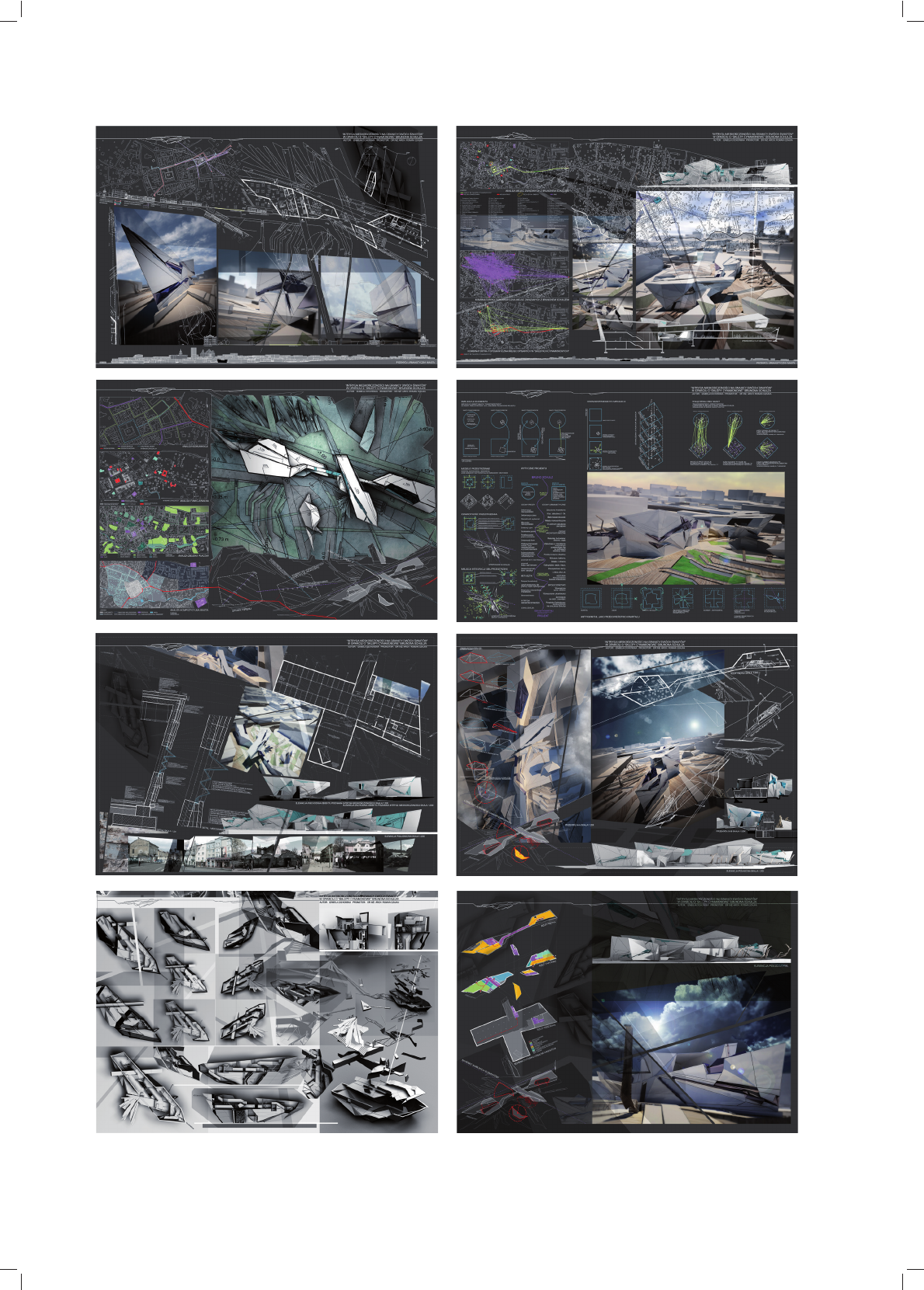
)LJ³,QWULJXHRI,Q¿QLW\RQWKH%RUGHURI7ZR:RUOGVRQWKHEDVLVRIThe Street of CrocodilesE\%UXQR6FKXO]´DXWKRU,]DEHOD&LFKRĔVND
,O³,QWU\JDQLHVNRĔF]RQRĞFLQD*UDQLF\'ZyFKĝZLDWyZZRSDUFLXR6NOHS\F\QDPRQRZH%UXQRQD6FKXO]D´DXWRUND,]DEHOD&LFKRĔVND

Presentations 131
7KHVTXDUHGHYHORSPHQWLVGLVWLQJXLVKHGE\WKUHHLQ-
WHUPLQJOHGREMHFWV7KHDWULFDO2EMHFW*DOOHU\2EMHFWand
2EMHFWRI5HFRJQLVLQJ,QWULJXHRI,Q¿QLW\
7KH ]RQH RI 5HFRJQLVLQJ ,QWULJXH RI ,Q¿QLW\ LV WKH
object strictly connected with Bruno Schulz’s prose. The
EXLOGLQJFRQVWLWXWHVP\VSDWLDOLQWHUSUHWDWLRQRIWKH IDP-
ily house described by Schulz in The Street of Crocodiles.
7KHREMHFWLVVLWXDWHGRQWKH7UDQVFHQGHQW$[LVZKLFKUXQV
through the plot of land. The building is a place for one
SHUVRQZKRGHFLGHVWRXQGHUJRPXOWLIDFHWHGH[SHULHQFHV
$YLVLWRUZLOOKDYHDQRSSRUWXQLW\WRFRQIURQWKLVKHURZQ
LPDJHVFRQFHUQLQJWKH7UDQVFHQGHQWWRZQZLWKWKHH[LVWLQJ
VSDFHDVZHOODVUHFDOOKLVKHURZQFKLOGKRRGPHPRULHVDQG
GUHDPVOLNHWKHPDLQFKDUDFWHURIThe Street of Crocodiles.
The building constitutes real concentration of Schulz’s
µIHUPHQWDWLRQPDWWHU¶6SDFHVDUHKLGGHQLQLWQRWIXOO\H[-
SUHVVHGDQGPRELOHVWLPXODWLQJDOOVHQVHV
6FKXO]LQKLVGHVFULSWLRQVPRYHVYHUWLFDOO\DQGKRUL]RQWDO-
O\±ZKLFKIRUPHFRQVWLWXWHGDVLJQL¿FDQWGHWHUPLQDQWLQWKH
IRUPDWLRQRIVSDFH9LHZLQJWKHZRUOGIURPGLIIHUHQWDQJOHV
ELUG¶VIURJ¶VFKLOG¶VDGXOW¶VDQGIUHHWRXFKLQJRIPLFURPDF-
URDQGPHJDVFDOHVLPEXHVWKHZRUOGRIKLVSURVH&RQVWUXF-
WLRQVXQGHUJRGHVWUXFWLRQDQGVWUDWL¿FDWLRQPXOWLIRUPPDWWHU
LVFRQGHQVHGDQGWKHQHVFDSHVZKHUHDVIRUPVDUHGRXEWIXO
SUREOHPDWLFDQGERUGHUOLNHµ,QWULJXHRI,Q¿QLW\¶LVDQRWLRQ
LQWURGXFHGE\(PPDQXHO/HYLQDVDQGUHIHUVWRUHSHDWDELOLW\
RIWKHZRUOGLWVVFKHPHVDQGSURFHVVHVFRVPRJRQ\RIWKH
8QLYHUVH*RGPDFURDQGPLFURFRVPRVZKLFKSDUWLFLSDWH
LQDFRQWLQXRXVDFWRIFUHDWLRQDQGSHUPDQHQWDFWLRQ$FWLRQ
ZKLFKLVIURPHQGWRHQGFUHDWLYHUHSHDWDEOHDQGFUHDWHVD
WUDQVFHQGHQWHQWLUHW\7KH8QLYHUVHGLVLQWHJUDWHVWUDQVIRUPV
DQGWKHQLWDJDLQDVVXPHVLWVRULJLQDOIRUP:áDG\VáDZ3DQDV
FRPSDUHVWKLVLQ¿QLWHDFWLRQRIFRVPRVWRWKHHOXVLYHDQGGLI-
¿FXOWWRLPLWDWHVW\OHRI6FKXO]6FKXO]ZDQWVWRKDQGRXWKLV
picture of the world to us and it is possible that he wants us
to follow the plots of his unique work and participate in his
LQWULJXHRILQ¿QLW\WDNHXSSORWVGHYHORSWKHPDQGFRPHEDFN
DJDLQWRWKHLUEHJLQQLQJ7KLVLQ¿QLW\LVDOVRDSODQWKDWJRHV
IDUEH\RQGWKHKXPDQFRJQLWLRQYLHZDQGDUFKLWHFWXUDOVSDFH
6FKXO]VLPSO\HQFRXUDJHVXVWRORRNIRUVHQVHDQGIRUµLQ¿QLWH
LQWULJXH¶RIWKHHQLJPDWLFZRUOG
&RPPHQW WR WKH SURMHFW E\ ' (QJ $UFK -DFHN
.RW]DQG'(QJ$UFK5RPDQ&]DMND
7KHREMHFWRUDVDPDWWHURIIDFWWKHVXEMHFWRIWKHDX-
thor’s elaboration is, clad in space and architecture, the bor-
GHURIWZRWRZQV±WKHVDPHDQGVLPXOWDQHRXVO\H[WUHPHO\
different, each of which cannot do without the other one: the
H[LVWLQJ XQWLO WRGD\ SURYLQFLDO 'URKRE\FK DQG WKH LPDJL-
QDU\'URKRE\FKLQKHUHODERUDWLRQQDPHGDVTranscendent
'URKRE\FK ZKLFK FRQVWLWXWHGWKHEDFNJURXQGRI WKHPHWD-
SK\VLFDOGUDPDGHVFULEHGE\%UXQR6FKXOW]LQKLVZRUNThe
Street of Crocodiles. In other words, the said Transcendent
'URKRE\FK±DVPDOOSURYLQFLDO*DOLFLDQWRZQLQ6FKXOW]¶V
story constitutes the locus, background and the entire universe
LQZKLFKQRUPDOERXQGDULHVEHWZHHQWLPHVSDFHDQGSHUVRQDO
UROHVDVFULEHGWRHYHU\GD\OLIHDUHVXVSHQGHG±VLPLODUO\WR
DP\WKLFDOWDOH7KLVXQLYHUVHWRZQNHHSVUHXSGDWLQJDOOWKH
WLPH±LWLVEURNHQLQWRIUDJPHQWVDQGEXLOWXSDQHZ±VLPL-
ODUO\WRWKHODQJXDJHPDWWHURI%UXQR6FKXOW]¶VVWRULHV
7KHERUGHUEHWZHHQWKHVHWZR 'URKRE\FKHV EHFDPH
PDWHULDOL]HGDQGZDVLQWHUSUHWHGE\WKHDXWKRULQWKHSUH-
VHQWHGGLSORPDSURMHFW
The author in her considerations, which are contained in
the written part, arrives at such understanding of the town as
:áDGLPLU7RSRURZRXWOLQHGLQKLVZRUNV+HXQGHUVWDQGVWKH
WRZQLQWKHSRVVLEO\PRVWGHYHORSHGZD\±DVDµVHPLRWLF
FDXOGURQ¶,WLVQRWRQO\WKHPDWWHUDQGVSDFHWKDWFRQVWLWXWHWKH
WRZQEXWDOVR±FUHDWHGE\YDULRXVSUHYLRXVDQGSUHVHQWFRP-
PXQLWLHVOLYLQJLQWKLVWRZQ±LPDJHVGLIIHUHQWNLQGVRIP\WKV
FRQQHFWHGZLWKWKHPVWRULHVKHURHVDVZHOODVWRWDOO\SULYDWH
DQGFROOHFWLYHPHPRULHV±WKRVHQHZO\FUHDWHGH[LVWLQJDQG
WKHSDVW±IRUJRWWHQRQHV$OORIWKHP±SDUWO\SHUVRQL¿HGE\
YDULRXVSHRSOH±RYHUODSFRPHLQWRLQHYLWDEOHFRQÀLFWVDQG
SDUWO\PDWHULDOL]HDQGLQWKLVZD\WKH\FDXVHLWVFRQVWDQWWUDQV-
IRUPDWLRQ/DVWEXWQRWOHDVWWKHWRZQLVWUDQVFHQGHQWLQWKH
sense that at the brink of its beginnings it always possessed its
QRQHDUWKO\PRGHOFRQWDLQHGLQWKHP\WKLFDOWDOHDFFRUGLQJWR
which it was created. In the presented work, this Transcendent
'URKRE\FKE\%UXQR6FKXO]IXO¿OOVDSDUDOOHOUROHRVFLOODWLQJ
EHWZHHQWKHSUHVHQWFRQWHPSRUDU\WLPHVDQGWKHSDVW
+RZHYHUFRQWHPSRUDU\'URKRE\FKVLPLODUO\WRFRQWHP-
SRUDU\:URFáDZDVRSSRVHGWRSUHZDU'URKRE\FKLQZKLFK
6FKXO]OLYHGLVDFRPSOHWHO\GLIIHUHQWWRZQ7KHFRPPXQLW\
living there is different, its statehood has changed as well as
the culture and language which is spoken there; also its space
and architecture has undergone changes. Finally, the attitude
of its residents towards Bruno Schulz and his creative activ-
LW\GLIIHUVVLJQL¿FDQWO\IURPRXUVE\RVFLOODWLQJ±DFFRUGLQJ
WRWKHDXWKRU±EHWZHHQUHMHFWLRQLQFRPSUHKHQVLRQDQGWRWDO
indifference. Schulz and his short stories are known only by
the cultural elite of the town. Therefore, the author’s intention
LVWRUHFDOOIURPREOLYLRQWKH¿JXUHRI%UXQR6FKXO]DQGKLV
short stories; the presented project consequently constitutes
DZLGHO\XQGHUVWRRGWRRODLPHGDWDFKLHYLQJWKLVSXUSRVH
For the needs of the project the author constructed sev-
HUDO PHWKRGRORJLFDO WRROV WDNHQ SDUWO\ IURP VWUXFWXUDOLVP
DQG SDUWO\IURPSRVWVWUXFWXUDOLVP7KH\ DUHFROOHFWLRQV RI
relations connecting the places of those two Drohobyches,
WRSRJUDSKLF FRPELQDWRU\ DQDO\VLV RI SODFHV GHVFULEHG LQ
‘The Street of Crocodiles’ and the idea of antiquarter ±
a ‘quarter the other way round’ which is one of the foun-
GDWLRQVRIWKHSURMHFW7KLVLGHDWDNHQIURPWKHIHDWXUHVRI
7UDQVFHQGHQW7RZQ and the language itself of Schulz’s prose
LVFRQIURQWHGZLWKFRQWHPSRUDU\'URKRE\FKZKLFKZDVSUH-
YLRXVO\GHVFULEHGLQLWVEURDGPHDQLQJZKHUHERWKRIWKHVH
WRZQVDUHXQGHUVWRRGLQDGHHSVHPLRWLFVHQVH$OOWKHVHWRROV
IRUPXODWHDSDUWLFXODUO\ORJLFDOVWUDWHJ\ZKLFKHQDEOHVWKHDX-
WKRUWRWDNHXSWKHSURMHFWDFWLYLWLHV$WWKHVDPHWLPHWKH
author considers her project as an event which does not have
WHPSRUDOFKDUDFWHULVWLFVDQGZKLFK±VLPLODUO\WRWKHHYHQWV
LQ6FKXO]¶VSURVH±GLGQRW¿QGLWVSODFHLQWLPHEHLQJVRPH-
where LQEHWZHHQ
7KHXUEDQVSDFHRIFRQWHPSRUDU\'URKRE\FKKDVLWVRZQ
character which was greatly changed after the war.
The city
FHQWUH KDV D PRQRFHQWULF FKDUDFWHU EDVHG RQ WKH VTXDUH
shaped Market Square along with the town hall with full
IURQWDJHVFKDQJLQJWRTXDUWHUVRIWKHGHYHORSPHQW2XWVLGH
WKHFHQWUHDFRPSDFWGHYHORSPHQWV\VWHP LV GHIUDJPHQWHG
DQGVSUHDGVLQWKHGLUHFWLRQRI/YLYRQWKHEDVLVRIWZRVWUXF-

132 Presentations
WXUHVLHKRXVLQJHVWDWHVZLWKJUHDWVODEEORFNVRIÀDWVEXLOW
in the years 1960–1980, which destroyed the scenery and dis-
persed development of single-family houses.
The author locates her project with the particular
square-sculpture character in the area of the Old Town near
the Market and the so called Small Market – on the border
of disintegration of the quarterly arranged Old Town tis-
sue. The author situates it on the plot of land surrounded
by disorganized development which does not form uniform
frontages and comes from various historical periods, main-
ly from the 1990s. Concurrently, the area of the develop-
ment is situated near an important pedestrian street. A vista
closed by the Synagogue dominant goes through this area,
whereas the Town Hall tower can be seen from the western
side. A further part of a broadly understood context con-
sists of the abovementioned dominants, i.e. trade streets, the
market square and – enormous in the scale of the town –
residential districts.
The author accepted, among other things, the following
project assumptions: maintaining view axes (vistas), respect-
ing cultural landscape by selecting an appropriate scale of the
GHYHORSPHQWZKLFKGRHVQRWH[FHHGWKUHHÀRRUVDVZHOODV
a
perception of the entire complex from the streets leading to the
square. The designed development was based on partly mutu-
ally entwined functional zones of theatrical transformations,
free transformations, functional mysteriousness, marketplace,
SHUFHSWLRQRILQWULJXHRILQ¿QLW\DVZHOODVDSDUWLFXODUIXQF-
tion. The author used here the aforementioned tools. In this
respect, a particular role is played by The Sphere of Theatri-
cal Transformations ZKLFKFRQVWLWXWHV¿UVWO\DVWDJHVFHQH
that works based on Grotowski’s ideas, i.e. eliminating the
difference between the actor and the spectator and secondly,
entwining the market function with the aforementioned one,
similarly to a mediaeval town.
The designed square consists of three intermingled
objects: 2EMHFW RI D WKHDWULFDO FKDUDFWHU DORQJ ZLWK WKH
VWDJH*DOOHU\2EMHFWZLWKWKHHQWUDQFHWRWKHJDUDJH2E-
MHFWRI5HFRJQL]LQJ,QWULJXHRI,Q¿QLW\The entire complex
is built according to the idea of antiquarter.
Object of a theatrical character consists of a café
which opens to The Sphere of Theatrical Transformations,
a small forum with a mezzanine and a rehearsal room on
WKH¿UVWÀRRUDWWKLVOHYHOFRQQHFWLQJWR the Gallery Ob-
ject. The Gallery Object consists of a city information
SRLQWRQWKHJURXQGÀRRUDER[RI¿FHDQGDVWDIIURRP
ZKLOVW RQ WKH ¿UVW ÀRRU WKHUH LV D VPDOO DUW JDOOHU\ WKH
whole object is connected with an underground garage.
7KH2EMHFWRI5HFRJQL]LQJ,QWULJXHRI,Q¿QLW\ is strung on
7KH$[LVRI,Q¿QLW\ that is derived from Topographical Com-
binatorial Analysis of the places described in The Street of
Crocodiles. Having been designed for a stay of one person
who can be confronted here with some experiences, it con-
stitutes a spatial metaphor of Bruno Schulz’s family house
according to the author’s interpretation. Symbolic meanings
RIWKHSDUWLFXODUVWRUH\VRI6FKXO]¶VKRXVH¿QGWKHLUDQDORJ\
here. The concept of LQWULJXHRILQ¿QLW\ – by Emmanuel Levi-
nas as it is used by the author when translating the fragments
of his works which had never been published in Poland into
the native language – refers to the constant process of sur-
round creation, transformation, disintegration and reactiva-
tion of macro- and micro-cosmos. This concept that was the
basis of his vision of cosmogony was transferred to the area
of philosophical and literary studies on Schulz and his prose
E\:áDG\VáDZ3DQDV7KHOLIHRI6FKXO]DOVRPDNHVDFHUWDLQ
metaphorical circle. The author refers this concept to the im-
agination and she uses it in her project as a sort of strategy.
The author’s quest, which intentionally refers to the cat-
egories derived from Bruno Schulz’s short stories: multi-di-
PHQVLRQDOLW\PRELOLW\DQGLQ¿QLW\FRQVWLWXWHVDQDWWHPSWDW
making their spatial images and she assumes a changeable, la-
bile and uncompleted functional programme, and consequent-
ly advanced changeability of the proposed spaces which con-
stitute both exterior and interior of forms. Similarly, the entire
complex which is supposed to constitute a multi-thread town
square – public space with liquid boundaries – is smoothly
connected with labile interior spaces. The opposition interior/
exterior like in the anthropological category of boundary is
eliminated here. Everything is in constant dynamic movement
with internal spaces being transformed while people move
within them. Similarly, the dynamic character of deconstruct-
ing structures – sculptures oscillates on the brink of explosion
being consciously contrasted with the provincial (in a positive
sense) nature of ‘this real’ Drohobych.
In conclusion, it must be said that the presented diploma
project constitutes a remarkable study which goes far be-
yond the scope of requirements for MA theses. The discussed
project is characterised by remarkable consistency and logic
of the project activities based on an equally deep logical foun-
dation – and as a consequence – perfectly designed spaces and
architecture having the features of almost certain virtuosity.
,QWU\JD1LHVNRĔF]RQRĞFLQD*UDQLF\'ZyFKĝZLDWyZZRSDUFLXRÄ6NOHS\F\QDPRQRZH´%UXQRQD6FKXO]D
F]\OLPHWDIRUDSUR]\%UXQRQD6FKXO]DZXMĊFLX,]DEHOL&LFKRĔVNLHM
$UW\NXá MHVW SUH]HQWDFMą SUDF\ G\SORPRZHM 3DQL ,]DEHOL &LFKRĔVNLHM
VWXGHQWNL:\G]LDáX$UFKLWHNWXU\3ROLWHFKQLNL:URFáDZVNLHM3UDFDG\-
SORPRZD]RVWDáDZ\NRQDQDSRGNLHUXQNLHPGUDUFK5RPDQD&]DMNLL
REURQLRQDZURNX7\WXáRU\JLQDOQ\SUDF\G\SORPRZHMÄ,QWU\JD
QLHVNRĔF]RQRĞFL QD *UDQLF\ 'ZyFK ĝZLDWyZ Z RSDUFLX R Sklepy cy-
QDPRQRZH %UXQRQD 6FKXO]D´ '\SORP MHVW DUFKLWHNWRQLF]Qą PHWDIRUą
6NOHSyZF\QDPRQRZ\FK%UXQRQD6FKXO]DRVDG]RQąZUHDOLDFKZVSyá-
czesnego Drohobycza.
Key words: metaphor of Bruno Schulz’s prose 6áRZDNOXF]RZH metafora prozy Brunona Schulza
Translated by
%RJXVáDZ6HWNRZLF]