2026
3(87)
Marek Barański*
The Corinthian capital of Hermopolis Magna (Egypt)
and its geometric analysis
DOI: 10.37190/arc260301
© by the Author/Authors. Licensee WUST.
Published in open access. CC BY-NC license.
Abstract
Paper presents study on the Hellenistic Corinthian capital (240 BC) from Hermopolis Magna (Egypt) Vitruvian proportions of a capital had been
conrmed partly, thus another geometrical solution was analysed. Due to completed geometrical diagrams it became obvious design was rooted in
a system created by gures being inscribed into a bigger and a smaller circles equal to a lower and an upper diameters of the column.
Key words: Corinthian capital, Hermopolis Magna, ancient geometry
Introduction
Vitruvius recounts the genesis of the Corinthian capital
in romantic fashion in “De Architectura” (Vitruvius 1914,
IV, 1, 9, 10, 104–106). The great sculptor Callimachus, he
says, noticed a basket set upon a girl’s grave and protected
by a roof tile; acanthus leaves had sprung up around it, and
their tendrils curled under the tile. Vitruvius commented it
with a concise set of proportions that Greek builders were
thought to have adopted:
– the abacus slab should be 1/7 of the capital’s height;
– the capital’s total height equals the column’s lower
dia meter, while its calathus equals the upper diameter;
– dividing the calathus into three equal zones locates rst
the lower, then the upper row of acanthus leaves, leaving the
third zone for the volutes and the ornament between them;
– the diagonal of the square abacus should equal twice
the upper diameter of the column, and thus twice the mea-
sure of the calathus;
– each corner recess of the abacus is to be one-eighth
of its side.
Since the Renaissance hundreds Corinthian capitals had
been analysed following this description. They were carved
according to Vitruvian model with modication in a form
of leaves and volutes. Discovery of Hellenistic Corinthian
capitals brought a problem, they were not composed ac
-
cording to a perfect description of a Roman author. Still,
it is worth stressing that, although Vitruvius wrote at the
close of the 1
st
century BC, we possess no textual descrip-
tion – and thus no sure notion – of the appearance of earlier
Corinthian capitals. The discussion that began more than
200 years ago is still ongoing (Heilmeyer 1970; Robert-
son 1979, 140–162; Pollitt 1986, 247, 248; Lawrence 1996,
138–145; Wilson Jones 1989; 1991; 2015; 2022). It is note-
worthy, too, that the proportional canons Vitruvius cites for
Ionic columns rely on the treatise of Hermogenes in the 2
nd
century BC. Yet Hermogenes’ work has not survived, nor
have the writings of one Arcesius/Argelius, who is said to
have discussed the Ionic and Corinthian orders in the same
century. We can only infer that the principles embodied in
Hellenistic capitals ca. 360 BC adapted the norms current at
the time – perhaps akin to, but possibly quite distinct from,
the later Vitruvian model.
There are few scientist who proposed explanation of
a problem and presented an origin of the earliest Greek Co-
rinthian capital as a period when form of capital had been
individually shaped by Hellenistic artists (Homolle 1916;
Ebeling 1924; Pedersen 1989; Scahill 2009). Scholars have
tried to account for this divergence by analysing the measure-
ments of individual capitals, hoping there by to detect further
underlying relationships (Bauer 1973). The discrepancy
* ORCID: 0000-0001-8092-9108. Professor emeritus, Poland,
e-mail: pkz.baranski@gmail.com
4
Marek Barański
itself was long taken as evidence of an early phase, a mo-
ment when the rules that Vitruvius would later codify were
only beginning to crystallise. Our recent study on Hellenis-
tic capital from Hermopolis Magna in Middle Egypt pro-
vide highly suggestive evidence that substantially revises
this long-standing perspective.
Corinthian capitals
from Hermopolis Magna
Excavations conducted in the 1940s by Alexandria Uni-
versity at Ashmunein (ancient Hermopolis Magna), on the
area called the “Agora”, produced a series of striking nds
(Wace 1959). Among them there were remnants of sixteen
uted columns with bases and Corinthian capitals of the
Hellenistic period (Wace 1946, 13, 14; Wace, Megaw and
Skeat 1959, 4–11, pl. 1, pl. 15.2, pl. 16). The group has been
dated to about 240 BC, when Greek katoikoi were settled
at Hermopolis Magna in Middle Egypt. They evidently set
out to raise a range of civic and sacred buildings whose
forms would faithfully reect the style of Greek architec-
ture (Wace 1959, 4–11; von Hesberg 1978; Pensa bene
1993, 3–18; Barański 1996; 2004; 2019, 8–10; McKenzie
2007; Hoepfner 2020). The architect at Hermopolis was
pro bably trained in Alexandria, as suggested by the very high
quality of the capitals’ carving. In general, these capitals
correspond to the Style Group I of Konstantin Ronczews-
ki’s typology of Corinthian capitals (Ronczewski 1927),
the group that includes some similar examples to earliest
ca pitals from the Epidauros Tholos, built in 360 BC.
The discovered Hermopolis capitals display crushed cor -
ner volutes; more importantly, traces of their original po -
ly chromy were discovered on the surfaces, greatly enhanc-
ing the signicance of the nd. One of the capitals was
taken to the Graeco-Roman Museum in Alexandria, where
it became a prized exhibit – though not prized enough to
prompt thorough documentation or analysis. It has been
reproduced time and again in surveys of Hellenistic art
and architecture, yet always without in-depth study (Adri-
ani 1972, 124, 125, tav. XV; Pensabene 1993, 324, tav.
8, 43–47; Bauer 1973, 117, 122, 123, taf. 32.5; von Hes-
berg 1978, 138, g. 131; McKenzie 2007, 56; Bassioni
2022, 46).
In 1987, while working in the Hermopolis – Ashmunein
Basilica as part of the Polish–Egyptian Mission, I under-
took a systematic study of this Hellenistic capital (Barański
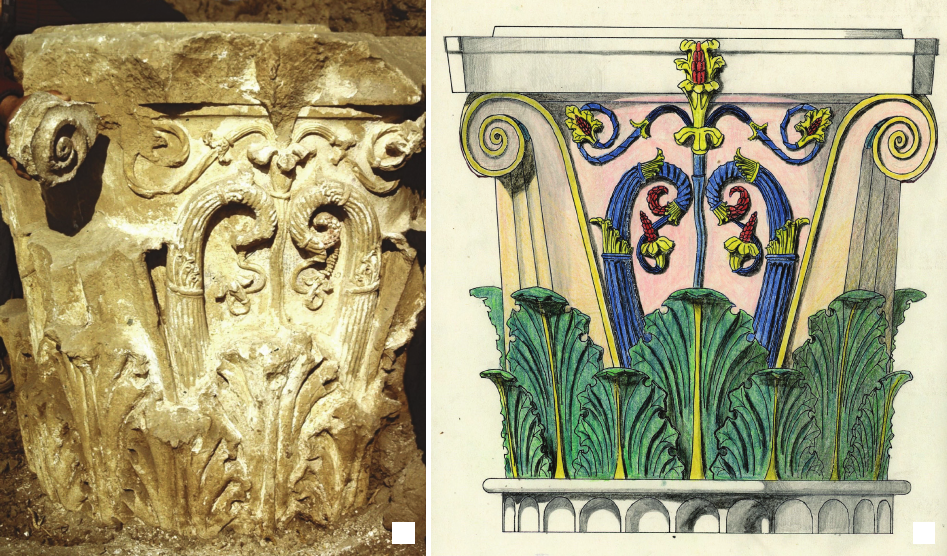
1996, 104; 2004; 2019, 9, 10, gs. 1–4). The discovery of
its missing corner volute during excavation made an almost
complete reconstruction possible. I executed a documenta-
ry drawing at a scale of 1 : 5 that records the capital’s form
in full (Fig. 1a, b). It should be noted that in 2020 Wolfram
Hoepfner, in his study of the Hellenistic nds from Her-
mopolis, presented his own colour drawing of the capital,
derived from Wace’s description (Hoepfner 2020, 43–45,
abb. 33, 35, 36, 49, 51). Nevertheless, in that reconstruc-
tion the corner volutes are rendered too large, altering the
overall proportions of the piece, while a closer inspection
reveals several additional inaccuracies, suggesting that the
drawing was executed from photographs rather than from
direct measurement.
Fig. 1. Corinthian capital from Hermopolis Magna:
a) capital with discovered corner volute (photo by M. Barański), b) coloured reconstruction of a capital (drawing by M. Barański)
Il. 1. Koryncki kapitel z Hermopolis Magna:
a) kapitel ze znalezioną wolutą (fot. M. Barański), b) kolorowana rekonstrukcja kapitela (rys. M. Barański)
a b

The Corinthian capital of Hermopolis Magna (Egypt) and its geometric analysis
5
Revising the capital’s proportions
In the next phase of inquiry I analysed the proportions
of the reconstructed capital and found that only certain el-
ements conform to Vitruvius’ canon. Before moving on to
a proportional analysis, it was necessary to set out the cap-
ital’s overall dimensions. I found a problem when compare
dimension taken at the site with those published by Patricio
Pensabene, who recorded the museal capital – a total height
of 89 cm; a lower-leaf zone of 25.3 cm; an upper-leaf zone
of 39 cm; a calathus height of 78 cm; and an abacus height
of 11.4 cm (Pensabene 1993, 324). Pensabene also men-
tioned a scamillus diameter of 80 cm, but he did not supply
the lower column diameter, because only the capital – with-
out its base – had been transported to the museum. A simple
division of the capital’s height by that of the abacus yields
the unusual ratio of 1 : 6.80, which might be accepted as
plausible. Yet if one divides the overall height into seven
equal parts and the calathus into six, the resulting abacus
units dier (12.71 cm vs. 13 cm). Nor is the arithmetical
sum of Pensabene’s gures satisfactory: 78 cm + 11.4 cm
pro duces 89.4 cm, and not the stated 89 cm.
Subsequent measurements taken on site at Ashmunein
dier slightly. The calathus height is 77.4 cm and the aba-
cus proper 11.4 cm, giving a combined height of 88.8 cm.
Above the abacus a further 1.4 cm of stone was left as
a working margin, a ledge. In my rst analytical step, fol-
lowing Pensabene, I adopted a capital height of 88.8–89 cm,
an abacus height of 11.4 cm, and a corrected calathus
height of 77.4 cm; but the resulting abacus-to-capital ra-
tio of roughly 1 : 6.8–7 remained unsatisfactory (Barański
2019, 9). The capital’s height was therefore adjusted to its
true dimension of approximately 90–90.2 cm, a gure that
includes the 1.4 cm of surplus stone intentionally left on
the abacus. With this margin, a ledge – destined to bear the
architrave – the capital fullled a cardinal proportional rule
of the architectural order. The slight recess cut at the abacus
corners, forming this way a ledge was probably dictated
by the relative softness of the limestone: if the corners had
been fully nished, there was a real risk that they could
be damaged during mounting an architrave. Signicant-
ly, the corrected height also matches the measured lower
diameter of the column, which is likewise about 90 cm.
Once this dimension is incorporated into the abacus measu-
rement, the numerical discrepancies disappear and all g-
ures agree.
At this height the capital can be divided into seven equal
parts, yielding an abacus unit of 12.8–12.9 cm. That same
unit suits the calathus when it is divided into six parts, for
its measured height of 77.4 cm likewise equals six units of
12.88–12.9 cm. The working assumption, then, is that the
capital was laid out according to a single abacus module
common to both the capital as a whole and the calathus;
the unit should be identical in each case. Such a scheme
would corroborate Vitruvius’ partitioning. In consequence,
one-seventh of the abacus slab and the overall heights of
both the capital and the calathus correspond to the lower
and upper diameters of the column. This yields a set of
regular divisions in which normal workmanship tolerances
of roughly 3–5 mm may be allowed. Ultimately, the aba-
cus module may be reckoned either as 1/7 of the capital’s
height or as 1/6 of the calathus height.
In accordance with Vitruvius’ prescription, the width of
the abacus slab can be determined by treating its diagonal as
the equivalent of two upper diameters of the column shaft
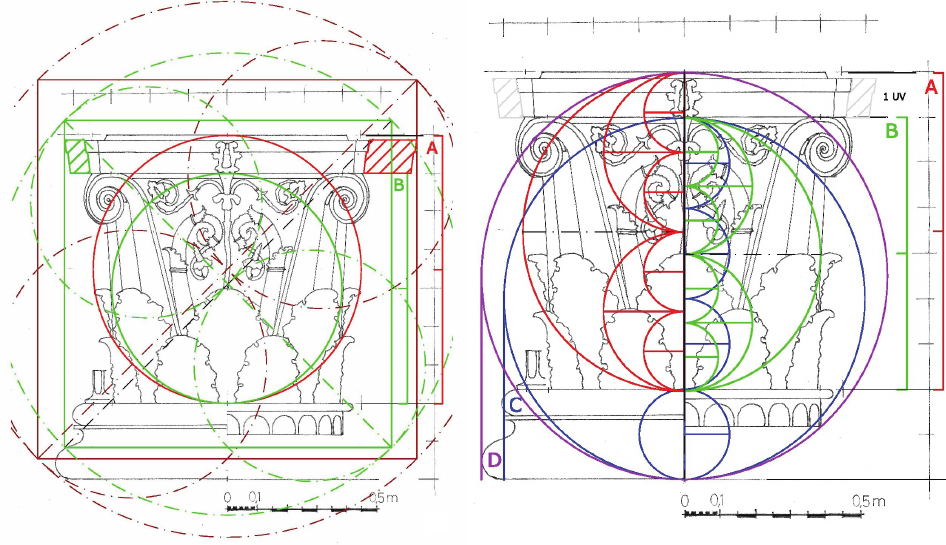
– that is, twice the height of the calathus (Fig. 2a). On this
basis the abacus diagonal should measure 2 × 77.4 cm =
154.8 cm. Dividing this value by √
2
to obtain the side of
the square yields 109.45 cm, or approximately 109.5 cm.
As a control, the calculation may be repeated using the
lower diameter – namely, the capital’s total height – which
gives a diagonal of 2 × 90.2 cm = 180.4 cm and a result-
ing side of circa 127.7 cm. Although this second gure ap-
pears to approach ten abacus modules of 12.9 cm each, the
discrepancy is in fact too great to justify such a reading.
When the two alternative abacus sizes are plotted on the
reconstruction drawing, the corners derived from the upper-
dia meter scheme sit neatly, whereas those derived from the
lower-diameter scheme project well beyond the volutes. In
the discussion that follows this mismatch will not aect our
analysis of the decorative proportions, but we shall return to
the question of how the abacus dimension was established.
According to Vitruvius’ description, the calathus should
be divided arithmetically into three equal parts in order to
x the positions of the leaves and the volutes. In the Her-
mopolis capital, however, the subdivision is dierent. The
height of the upper leaves equals exactly one-half of the ca-
lathus height, while one-half of the entire capital height
marks a distinctive level situated above the upper leaves;
this line passes through the stalks of the inner owers and
through the collars of the middle stems.
A further test experiment was therefore made with
a smaller unit, dividing not into three but into six parts, yet
this scheme added little. A division into eight parts was also
tested – prompted by the number of corner volutes and of
leaf tiers – but that analysis likewise failed to yield a satis-
factory solution. It was observed, meanwhile, that a num-
ber of characteristic points on the capital are determined by
modular grids; still, identifying several key points did not
by itself explain the overall composition. One additional
result of these trials was the realisation that the divisions
employed in the capital could expand from a smaller to
a larger “circle”.
Even more surprising was the discovery that the relations
derived from the column diameters can be linked to the base
in the following way. The base height equals two modular
units (marked at drawings as a UV), so that when the base
and capital are combined the total comes to nine units of the
abacus measure. Remarkably, those nine units correspond
to the lower torus diameter of the base, while the upper to-
rus diameter equals eight such units. Thus four concentric
circles are introduced: “A” comprising seven units, “B” six
units, “C” eight units, and “D” nine units, all referred to the
abacus module [These circles would measure, respectively,
A = 90.2 cm, B = 77.4 cm, C = 103.2 cm, and D = 116.1 cm]
(Fig. 2b). Although such a direct linkage of capital and
base is never encountered in practice, it signals that additio -
nal dependencies may exist, inuencing the mutual rela-
tionships of the order’s components – dependencies that
ought perhaps to be taken into account in the analysis. These
6
Marek Barański
Fig. 2. Hermopolis capital: a) geometric reconstruction of an abacus size depending a lower (red) and upper (green) diameter of a column trunk.
Upper diameter (green) indicates a right solution, b) partition of capital and base
following section of circles A, B, C, D by 4 and 8. Vitruvian
partition unite (UV) of a measuring 1/7 of overal capital height and equal to abacus size
(elaborated by M. Barański, drawing by K. Jezierski)
Il. 2. Kapitel z Hermopolis: a) geometryczna rekonstrukcja wielkości abacusa w zależności od dolnej (czerwona) i górnej (zielona)
średnicy trzonu kolumny. Górna (zielona) średnica wskazuje właściwe rozwiązanie, b) podział kapitela i bazy według kół A, B, C, B mających
podział na 4 i 8. Witruwiańska jednostka podziału (UV) mająca wielkość 1/7 wysokości całego kapitela odpowiada wielkości abakusa
(oprac. M. Barański, rys. K. Jezierski)
inter
connections pertain not only to simple vertical subdivi-
sion but also to the horizontal layout, where the base dimen-
sions represent a modular enlargement of the lower column
diameter. Here, we should mention, a horizontal division of
circles by 4, 8, 12 provides a gene ral distribution of capital
volutes, and leaves of upper and lower row. While these
observations were helpful, they did not yet provide a clear
key to the arrangement of the capital’s decorative scheme.
Another concept of a modular grid adoption was also an-
alysed. The Egyptians employed precisely such a system in
their reliefs and architecture, enabling them to coordinate
dimensions and to position distinctive points within a sculp-
tural composition (Rossi 2007, 113–127). It is quite possible
that a comparable modular grid – conceived as a matrix or
template – was likewise used when carving the capital it-
self. Such a device would have allowed the sculptor, as the
work progressed, to verify the placement of critical points
on every face of the block, in both the vertical and horizon-
tal axes. Although no nished examples of stones so pre-
pared have survived, incised guidelines on Roman blocks
have been documented and analysed (Asgari 1988; Toma
2015). A comparable system of setting-out lines is attest-
ed on late-Hellenistic monuments in Nabataean kingdom,
whose builders were inuenced by Ptolemaic architects
(Dentzer-Feydy 1995). Scribed lines preserved on the upper
and lower faces of capital show that these marks served not
only to position leaves axes, but also control carving depth;
yet characteristic points on the side faces must also have
been dened. Asgari demonstrated how a threefold subdivi-
sion of the capital was used, step by step, to obtain its nal
form. In a Roman capital, the volutes could be produced
simply by trimming the corners to the required prole; in
a Hellenistic capital the same method was followed, but
with greater care to establish the exact positions of the key
features. Marking the half-height of either the capital or the
calathus could have been achieved arithmetically, while the
abacus furnished the principal vertical datum. The acanthus
leaves of both Hellenistic and Roman capitals were laid out
and carved in essentially the same way. Above the leaves,
however, the Hellenistic capital demanded far greater pre-
cision: unlike its Roman counterpart, its upper, exposed
zone gives full prominence to vegetal detail, leaving no
scope for error or for the carver’s whim. Any executional
deviations therefore had to be tiny. An appropriately pre-
pared template, used throughout the carving process, would
have allowed continuous three-dimensional checks.
If the capital’s design was an individual project, it must
nonetheless have obeyed certain rules – and those rules
probably did not rest on a mere arithmetic partition. Could
a geometric model have been employed? One therefore
asks whether the circular diameters that correspond to the
heights of the capital and the calathus might be linked to
still other subdivisions. A further issue is the possible in-
uence of Egyptian mathematical knowledge on the solu-
tions adopted by Ptolemaic scholars and architects (Rossi
2007). The literature on the geometric conception of pyra-
a b

The Corinthian capital of Hermopolis Magna (Egypt) and its geometric analysis
7
mids and temple plans is extensive; such expertise diered
from Greek practice, and we know that in Egypt Hellenistic
builders did not conne themselves to purely Greek-style
temples. The trac in mathematical ideas and architectural
concepts may thus have been two-way.
For more than a century scholars have examined ancient,
a well Gothic monuments and works of art in search of the
practical use of geometry – projecting designs and shaping
representations by means of geometric constructions, g-
ures, and their transformations. There are studies by Matila
Ghyka and Otto Hagenmaier as well Jay Hambidge, Ma-
cody Lund, Ernst Mössel set a special interest on applica-
tion of geometry and the “golden section”. Why not to ex-
amine a Capital from Hermopolis as a geometrical design?
The capital’s geometry
Attempting to test geometry of a capital, I had not consi -
dered Vitruvius description on a method establishing a size
of an abacus plinth as a real geometrical principle. In fact
his saying about a diagonal of an abacus square was a pure
geometry establishing its incommensurable length. It was
in contrary to an overall arithmetical system used for par-
tition of a capital. At that stage of the study, Vitruvius de-
scription had been considered as a simple and practical
meth od, without a deeper geometrical idea.
Geometry makes its appearance in the capital the mo-
ment a square is described upon a circle; conversely, a cyl-
inder can be inscribed in – and extracted from – the cube
whose side equals that square, as has been recognised for
Roman capitals. The system of successive squares, and
of the circles inscribed within them, could in principle be
extended ad innitum by applying the “duplication of the
square” construction discussed in Plato’s Meno: the diag-
onal of a square whose side is a (or 2a) is incommensu-
rable, measuring a√2 (or 2a√2). From the side of the ini-
tial square, therefore, one can generate a larger square and
inscribe within it a larger circle (Saito 1995; Rossi 2006,
88–90; Scott 2006). Other polygons can likewise be set
within the circle, binding them geometrically to the square
(Fowler 1999, 32–34).
In analysing the present capital, however, both circles
corresponding to the lower and the upper column diameters
– the capital height and the calathus height – had to be taken
into account, since their centres are displaced from one an-
other by one-half of the abacus module. The question then
arose: would that oset generate further relationships that
locate any characteristic points on the capital? It is not im-
possible that the capital’s dimensions were also partitioned
by means of the golden section, which Plato refers to as the
“mean ratio” (Ghyka 2001, 41–75; Naredi-Rainer 1982,
193–199; Hagenmaier 1977; Beutelspracher, Petri 1996;
Fowler 1999, 84, 85; Rossi 2007, 23–32, 67). This opens
up a considerable range of geometric possibilities – all
of which must be tested against the fabric of the capital itself.
The performed diagrams are accompanied by the fol-
lowing, two-level system of notation:
– General geometric rules are expressed with lower-case
symbols – for example a, b, 2a, 1/2a, a√3 – which refer
simply to lengths or operations in the abstract.
– Constructions specic to the capital are denoted by
capital letters and by colour:
○
A (red) designates every gure – side A, circle A,
red triangle, red square, red hexagon – drawn on the
lower diameter of the column shaft, that is, on the capi-
tal’s overall height. Diameter A consists of 2 radiuses a,
thus a is equal to 1/2A.
○
B (green) refers to the corresponding gures – cir-
cle B, side B, and so forth – constructed on the upper
diameter of the shaft, which equals the calathus height.
Diameter B consists of 2 radiuses b.
○
A second, equally important point: some geometric
operations are checked arithmetically, and the numerical
results are recorded in square brackets. This dual proce-
dure makes it possible to test whether the constructed di-
agrams are genuinely compatible with the mathematical
calculations based on the two fundamental dimensions
– the lower and upper shaft diameters, corresponding re-
spectively to the heights of the capital and the calathus.
In many instances the arithmetic values will not coincide
perfectly with the drawn gures, because each construc-
tion belongs strictly to magnitude A or magnitude B; the
gures may therefore dier by a minute margin. What
is striking, however, is the remarkable closeness of the
solutions that emerge.
When the geometric analysis began – an exploratory ex-
ercise at rst – the two circles, red and green, were traced on
the capital’s ground plan and squares were described upon
them. Their diagonals were then drawn, producing right-an-
gled triangles. That single subdivision already pointed to
a number of intriguing loci in the layout of the de
co ration
of the capital.
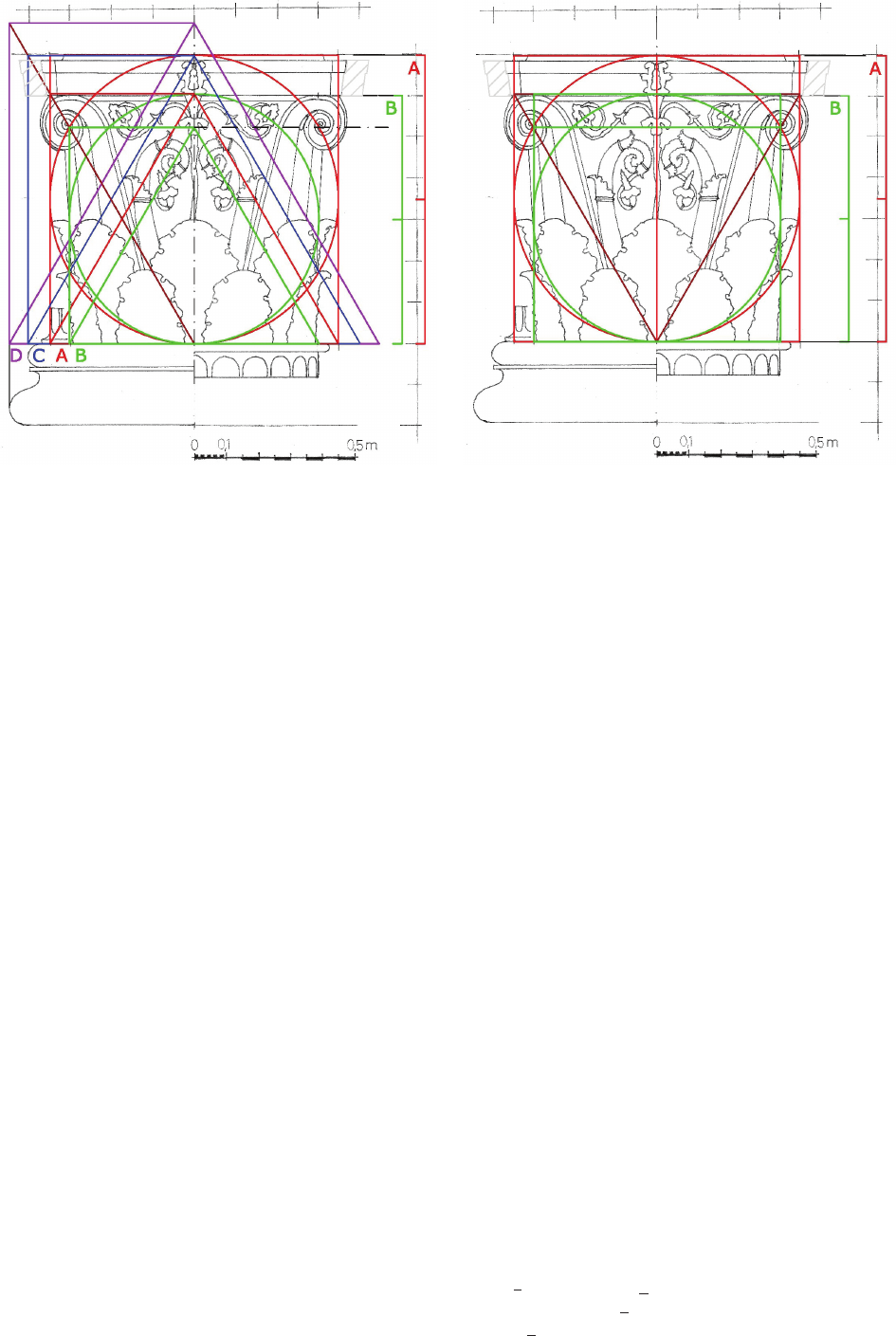
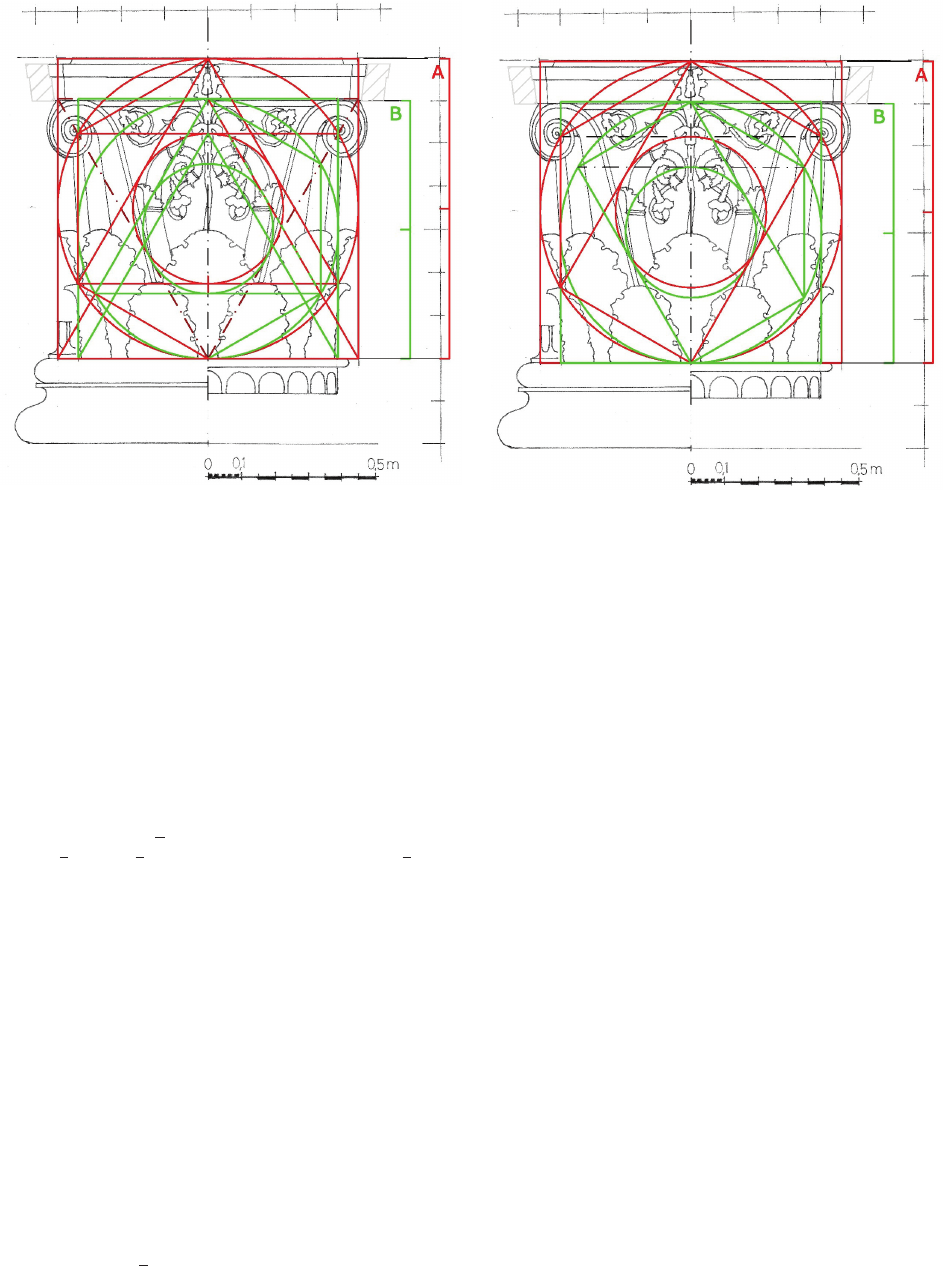
The next step was to construct two equilateral triangles,
with sides A and B, respectively, their bases laid along the
bottom edge of the capital (Fig. 3). Choosing the equilateral
triangle at the outset was a matter of chance; it is not that
the author was prompted by Plato’s dictum on the use of
that gure in generating the regular polyhedra that consti-
tute the fabric of the cosmos (Plato 2016, Timaeus 53c). At
this preliminary stage, moreover, I was unaware of Euclid’s
construction of an equilateral triangle inscribed in a circle.
The diagram was devised on the basis of nothing more than
elementary school geometry.
The very rst equilateral triangle, its side B placed on
the capital’s base, produced an apex that fell precisely on
the centre of the stalk of the central ower. This was an
interesting result – though one that might still have been no
more than fortuitous. The height marked by the rst equi-
lateral triangle proved noteworthy, for it coincides almost
exactly with the level of the centres of the corner volutes.
A second, analogous equilateral triangle with side A was
then drawn; its apex, only slightly higher, fell almost pre-
cisely on the underside of the abacus – an outcome no less
striking. [The height obtained for equilateral triangle B is
67.03 cm. The height of equilateral triangle A is 78.1 cm,
whereas the diameter of circle B equals 77.4 cm, a dier-
ence of merely 6–7 mm over the capital’s full height of
90.2 cm, with an average error of 0.66–0.77%].
The same procedure was applied to side C, correspond-
ing to the upper torus diameter of the base, and to side D,
8
Marek Barański
the lower torus diameter – eight and nine abacus units of
12.9 cm, respectively. The apex of triangle D clearly rose
above the capital, while that of triangle C lay very close to
the capital’s overall height. In the analyses that followed
the diameters associated with circles C and D were there-
fore set aside, and attention focused on the gures con-
structed for A and B.
For certainty, the apex levels of triangles A, B, and C were
recalculated arithmetically. Although they lie near one anoth-
er, dierences greater than a centimetre make it dicult to
accept them as points that coincide exactly with the capital’s
characteristic levels [apex of triangle C = 89.37 cm,
when
hight of the capital is 90–90.2 cm; apex of triangle D =
103.1–103.2 cm]. Even so, the close agreement between the
apices of triangles B and C and the heights of the top of
the calathus (77.4 cm) and of the whole capital (90.2 cm)
may well have oered the ancient designers a clue or guide-
line, despite the small error – about one per cent by modern
reckoning. We must bear in mind that ancient mathematics
could not compute irrational numbers with modern exac-
titude. Magnitudes were determined geometrically and
rounded with great, though not absolute, precision; milli-
metre-scale discrepancies would have been considered neg-
ligible. It is therefore plausible that, in Vitruvius’ simplied
description, such slight deviations were deemed unimport-
ant, allowing the outcome of this geometric construction
to be expressed as the simple, generalised partition of 1/7.
In my next operation, the equilateral triangles were
drawn in the reverse orientation, their apex now placed at
the centre of the capital’s base (Fig. 4). This time the api-
ces of equilateral triangle B marked not only the level of
the centres of the corner volutes [67.03 cm] but also, with
almost perfect accuracy, the reconstructed centres of the vo-
lutes themselves; the small error visible in the drawing is
probably the result of an inevitable imprecision in the recon-
struction. A further coincidence proved equally intriguing:
the side of triangle B intersected the smaller circle at a pair
of highly characteristic points – namely, those at which the
tangent line xes the inclination of the stems before it turns
into the corner volutes. We shall return to this matter later.
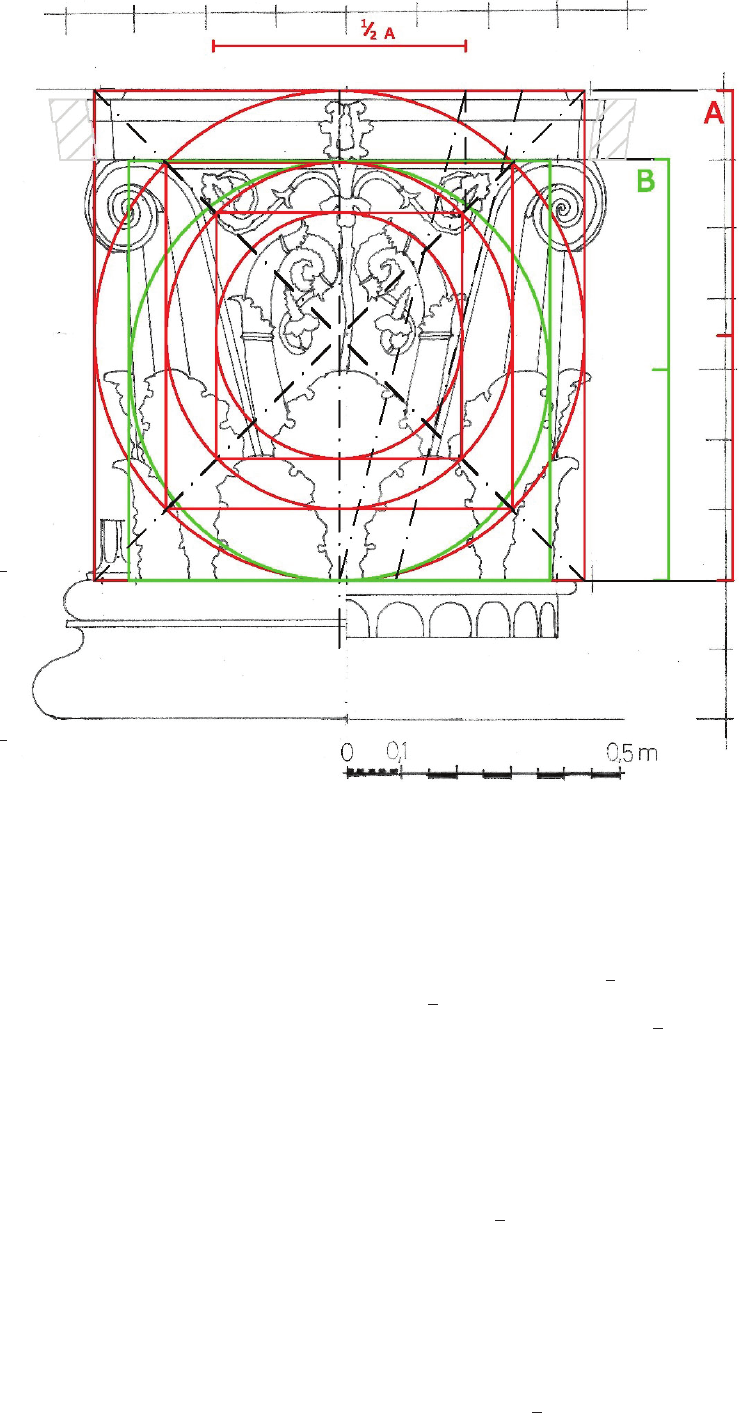
Surprised by these observations, I next drew a large
equilateral triangle with side A equal to the lower diameter
of the column shaft (Fig. 5). As might be expected, one side
of this triangle indicated almost exactly the lower face of
the abacus slab, a level that had already been xed by the
larger circle. What is more, it became evident that the larg-
er circle A, with its greater diameter, met – approximately
– the corners of the smaller triangle B, which had already,
again approximately, located the volute centres. This geo-
metrical diagram was at once unexpected and stimulating,
and it encouraged a search for additional constructions. At
this stage of the analysis some diagrams were produced
almost accidentally, yet the drawings themselves began to
suggest the next steps to be taken.
In the next stage of the investigation the construction of
right-angled triangles was tested (Fig. 6). As is well known,
two types of right triangle can be inscribed in a circle of
radius a being equal to 1/2A. The rst is isosceles, with
catheti measuring 1/2a√2 and a hypotenuse equal to the di-
ameter 2a; its apex coincides with the centre of the circle
and of the square that can be inscribed in it. The second has
Fig. 3. Construction of equilateral triangles of a side equal to A, B, C, D
diameters. Apexes of A and B triangles designates a characteristic
points and lines of the capital (elaborated by M. Barański,
drawing by K. Jezierski)
Il. 3. Konstrukcja trójkątów równoramiennych o bokach równych
średnicom kół A, B, C, D. Wierzchołki trójkątów A i B wyznaczają
charakterystyczne punkty i linie kapitela
(oprac. M. Barański, rys. K. Jezierski)
Fig. 4. Inversion of equilateral triangles A and B marks centers
of a corner volutes
(elaborated by M. Barański, drawing by K. Jezierski)
Il. 4. Odwrócenie trójkątów równobocznych A i B
wyznacza centra narożnych wolut
(oprac. M. Barański, rys. K. Jezierski)
The Corinthian capital of Hermopolis Magna (Egypt) and its geometric analysis
9
catheti a and 1/2a√3, with the same hypotenuse 2a. Both
varieties were drawn in circles A and B.
The apex of the larger, red triangle A fell almost exactly
on the centres of the volutes – points already indicated by
the height of the smaller, green equilateral triangle B. When
the shorter cathetus of this right triangle was set o along
its hypotenuse, which serves as the axis of our geometric
scheme, the distance obtained corresponded to the diameter
of the smaller green circle B. Thus yet another composite re-
lationship emerged, derived from the two diameters A and B.
At this moment memory supplied a schoolroom fact:
using right triangles – rather than merely stepping the com-
pass round the circumference – one can likewise construct
a hexagon inside a circle. Hexagons were therefore drawn
in both circle A and circle B. The outcome was no less
striking than before. The apex of the right triangle whose
hypotenuse equals diameter A and whose shorter cathetus
equals the radius a (1/2A) landed virtually in the centre of
a volute. As noted earlier, the volute-centres lie on the level
determined by the equilateral triangle of side B (67.03 cm);
consequently the longer cathetus of this right triangle ex-
actly equals side B. If the same right triangle is inverted, its
apex marks a distinctive point that is the lower vertex of the
hexagon inscribed in the red circle A. These lower vertices
establish the level of the capital’s lower acanthus leaves.
Fig. 5. Equilateral triangles inscribed into A and B circle.
Pairs of triangles A and B generate a hexagone A and B respectfully.
Apexes of a hexagon A marks characteristic points of a capital.
Triangles also designates a smaller inscribed circles
of 1/2A and 1/2B diameter, when a circle of 1/2A frames
a central decoration of the capital
(elaborated by M. Barański, drawing by K. Jezierski)
Il. 5. Równoboczne trójkąty wpisane w koła A i B. Pary trójkątów A i B
tworzą odpowiednio sześciokąty A i B. Wierzchołki sześciokątów
wyznaczają charakterystyczne punkty kapitelu. Trójkąty wyznaczają
również mniejsze wpisane koła o średnicach 1/2A i 1/2B,
gdzie koło 1/2A obejmuje centralną dekorację kapitela
(oprac. M. Barański, rys. K. Jezierski)
Fig. 6. Points designating by hexagon are mutual to points designated
by a right triangles of hypotenouse equal to a diameter of A and B
circles. Pairs of triangles construct rectangles A and B respectfully
(elaborated by M. Barański, drawing by K. Jezierski)
Il. 6. Punkty wyznaczone przez sześciokąt są również punktami
wyznaczającymi trójkąty prostokątne o przeciwprostokątnej równej
średnicom kół A i B. Pary trójkątów konstruują odpowiednio
prostokąty A i B (oprac. M. Barański, rys. K. Jezierski)
When the analogous right triangle B was constructed for
the smaller green circle, the results were less spectacular
but still signicant. The upper vertices of the smaller hexa-
gon B coincide, with high probability, with the terminations
of the middle blossoms and thereby with the junction of the
intermediate volutes; its lower vertices x the plane where
the lower leaves begin to bend outward.
The composite gure derived from superimposing the
two right triangles A and B not only provided the six vertices
of the hexagon: it produced a six-pointed star – the familiar
form generated by two equilateral triangles rotated relative
to one another and inscribed in the same circle. Inscribing
gures in a circle is, of course, no more than a consequence
of geometric law; yet this diagram yielded another, wholly
unexpected curiosity. The side of the equilateral triangle in-
scribed in circle A is exactly equal to the diameter of circle B.
No such coincidence had been anticipated, and it emphatical-
ly conrms the internal relationships between the two circles.
It was further observed that in this diagram an addition-
al conjunction of gures occurs: the red hexagon A almost
rests against the side of the green square B. This may be
no more than a chance juxtaposition, yet it could equally
be a consequence of the 7 : 6 ratio adopted for the two cir-
cles. An arithmetical check of the relevant dimensions re-
veals only minute discrepancies – something we must bear
in mind when analysing the geometry of such a scheme.
[The side of hexagon A is one-half of the 90.2 cm diameter,
that is, 45.1 cm. From this one can calculate the hexagon’s
“height” (the distance between two opposite sides), which

10
Marek Barański
is 78.1 cm. This is greater than the side of square B, which
measures 77.4 cm, the dierence being ca. 7 mm, thus an
average error is 1%. We should remember, however, that
the divergence between the side of a square and the side of
a hexagon constructed on the same centre amounts to only
half that value – i.e. 3.5 mm, thus an average error is signi-
cantly diminished].
The basic diagram was then expanded with a further set
of constructions. Attention was drawn to the paths taken by
the catheti of the two right-angled triangles. It turns out that
each cathetus is tangent to a subsidiary circle whose diam-
eter is 1/2A, and likewise to a second, still smaller circle
whose diameter is 1/2B. The centres of these two subsidi-
ary circles are displaced from one another by exactly half
an abacus unit of one-seventh of the capital’s height. The
diameters of the smaller circles coincide with the sides of
the hexagons inscribed in circles A and B. Even more tell-
ing is the fact that the 1/2A circle ts neatly into a rectangle
whose shorter side measures 1/2A and whose longer side
equals B; this longer side is the very cathetus that previous-
ly xed the volute centres and the level of the lower leaves.
The arrangement follows inevitably from the geometry of
the construction. A comparable conguration can be drawn
for the smaller 1/2B circle, although its enclosing rectan-
gle lacks such striking side-lengths. Remarkably, however,
the circle of diameter 1/2A denes the span of the capital’s
central decoration, and the 1/2B circle performs a similar
function – though within a slightly dierent zone.
Inscribing those right-angled triangles in the two circles
opened the way to further geometric operations. Two such
triangles can be combined to generate a rectangle whose
diagonal equals the diameter A being equal to 2 radiuses a,
whose shorter side measures a, and whose longer side mea-
sures 1/2a√3. If two of these rectangles are set perpendicu-
lar to one another, their overlap forms a square with side a;
within that square one may inscribe a circle of diameter a
equal to 1/2A. On the common axis of the larger circle
(of 2 radiuses a, being equal to A diameter) one can like-
wise erect two right-angled triangles whose vertices, when
joined, produce a hexagon with side a. That hexagon, how-
ever, can also be obtained in a dierent way: rst inscribe
an equilateral triangle in the circle, then add a second, in-
verted triangle of the same size. The resulting six-pointed
star is composed of twelve small equilateral triangles, each
having a side equal to one-third of the side of the origi-
nal triangle. The intersections of the star’s arms mark out
a smaller hexagon, within which yet another circle of diam-
eter a can be drawn.
All gures inscribed in the circle of diameter 2a or A,
thus share a common inner circle of diameter being equal
to radius a. What interests us here is that this apparently
“simple” geometry, carried out only with compass and
straight-edge, no longer yields simple arithmetic: the side
of the isosceles triangle inscribed in the circle is irratio-
nal (a√3), just as the hexagon described on the same circle
with a side of an identical length A√3. In the course of the
analysis we meet a constant passage from larger to smaller
gures and from rational to irrational magnitudes, only to
return again to rational ones – a chain of interlocking geo-
metric relationships. Although these observations produced
suggestive results and stimulating ideas, they did not yet
explain the capital’s overall composition.
Dening the subsidiary circles with diameters 1/2A and
1/2B – which embrace the central zone of the capital’s dec-
oration – drew attention to another possibility: constructing
a geometric progression based on the sequence a : a√2 : 2a
: 2a√2. The scheme relies on inscribing a square in a circle
and then inscribing a second circle about that square. Such
a relation was often exploited in the Middle Ages “dubbed
ad quadratum” (Naredi-Rainer 1982, 218, 219; Rossi 2007,
65, 66; Majewski 2013, 141, 142) and it reproduces the
“du plication of the square” that Plato sets out in the Meno
– NB this procedure is not connected to the famous proce-
dure of “squaring the circle”, which asks whether one can
construct, with only a straightedge and compass, a square
having the same area as a given circle (Hobson 1913, 14–
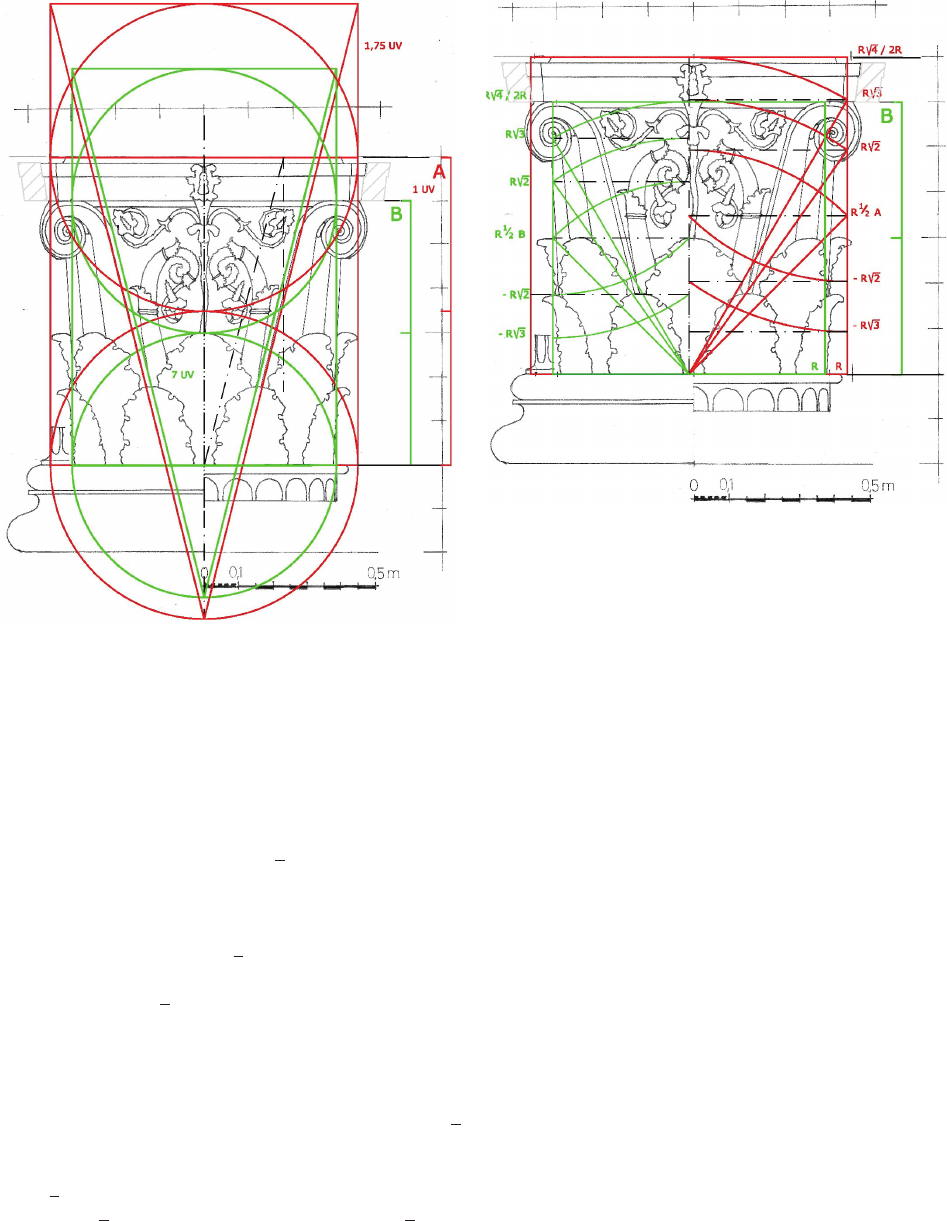
22; Rossi 2007, 67, 68). When this inverted diagram was
applied to the capital, the result was dizzying: almost every
corner of the progressively smaller squares seemed to coin-
cide with a signicant detail. Two steps, however, appeared
genuinely meaningful (Fig. 7). Beginning with circle A,
the rst operation yields square A
1
, inscribed in that circle.
The level of A
1
’s upper side corresponds, in broad terms,
to the lower edge of the abacus, though it is not identical
with it; that lower edge, as we know, is dened by the side
of square B described on the calathus circle B. The lower
vertices of A
1
rest on the tips of the capital’s lowest leaves.
A second iteration produces circle and square A
2
, each
with a diameter and side of 1/2A. Here the upper corners
of square A
2
support the lateral blossoms, and, as previous
constructions have shown, circle A
2
is identical with the
subsidiary circle obtained from the right-angled triangles
and from the equilateral triangle inscribed in the 2 A cir-
cle. Circle A
2
neatly encloses every element of the capital’s
central ornament. Repeating the same procedure for circle
B reveals that the vertices of square B
1
touch the inner edg-
es of the stems from which the corner volutes emerge. The
circle inscribed in B
1
likewise frames part of the capital’s
central decoration. A still smaller square, B
2
(side 1/2B),
has an upper side that marks the junction of the interme-
diate volutes, while its vertical sides intersect the stems at
mid-height. Whether these intersections truly determine the
inclination of the stems remains open to question; mere-
ly picking out conspicuous subdivisions and points on the
capital proved unsatisfying and did not yield a fully coher-
ent constructive schema.
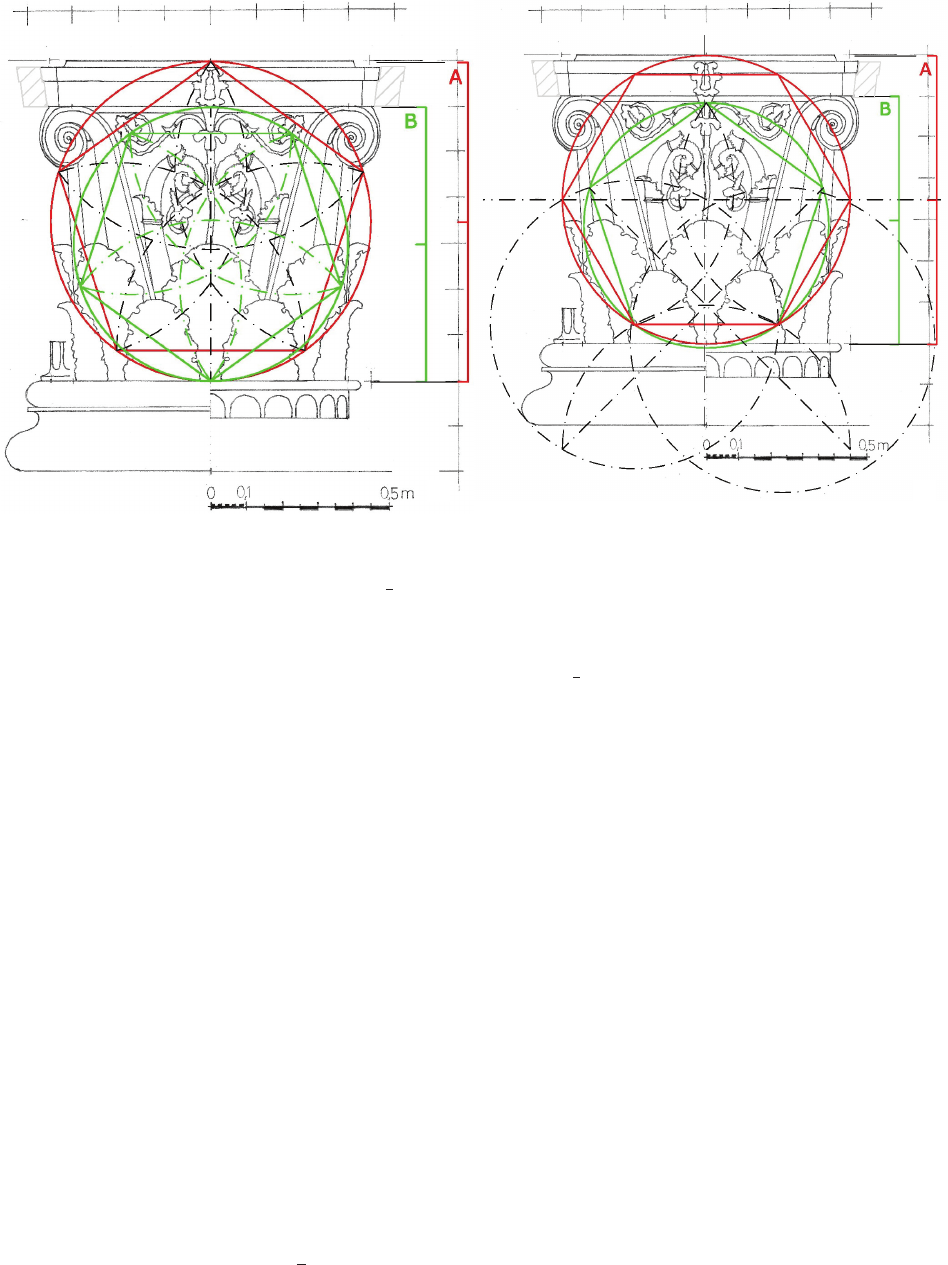
To resolve this problem the following solution was pro-
vided (Fig. 8). Tangents were drawn along the outer edges
of the stems, and it became clear that – below, outside the
capital – these tangents meet at a single point. At the top they
also intersect the extensions of the sides of squares A and B.
Working rst with the B-dimension, I connected that lower
intersection‐point with the two points where the tangents
meet the prolongations of the sides of square B. The three
points form an isosceles triangle of striking height: it equals
two diameters of the smaller circle B, the two diameters
touching one another at the centre of the calathus – in other
words, the calathus height has been enlarged on each side
by the radius 1/2B. Discovering that the inclination of the
stems could be xed by a purely geometric construction
The Corinthian capital of Hermopolis Magna (Egypt) and its geometric analysis
11
was astonishing, but the surprise deepened when I repeated
the operation for circle A.
In the A-case the construction was inverted. Two cir-
cles of diameter A were drawn so that they touch at the ca -
pital’s centre. The lower intersection of circle A with the
ca pital’s vertical axis supplied the apex of an isosceles tri-
angle; from the upper intersection of the axis with the sec-
ond circle A I dropped a perpendicular to locate the base of
that triangle. When I joined the resulting base-points to the
extensions of the larger square’s sides, the full base-length
of the isosceles triangle A emerged. Connecting the apex
to those base-points left me speechless: the sides of the
larger and smaller triangles coincide with the thicknesses
of the stems visible in the drawing. One might have expect-
ed many things, but not so unambiguous a result. Even the
greatest sceptic must concede that the principles of geome-
try are intertwined with the design of the Corinthian capital;
this diagram is no accident but the product of a deliberate
construction.
The construction itself is not conned to the capital
block: it projects well beyond its outline and must have
been worked out geometrically rst, then reduced in scale
and transferred to the working drawing of the capital. The
inclination of the stem lines is determined by the sides of
an isosceles triangle whose height equals fourteen abacus
units and whose base measures seven such units. When that
inclination is carried onto the capital it appears as the hy-
potenuse of a right triangle whose legs are 7 and 1.75 aba-
cus units – or, expressed dierently, 7 units and 7⁄4 units.
Delving still further into the geometry, I prepared a se-
ries of additional diagrams, this time to test the possible
deployment of the irrational quantities √2 – the diagonal
of a square – and √3, which arises in the height of an equi-
lateral triangle, together with the next term √4 (Fig. 9).
The constructions were laid out on one-half of the sides of
squares A and B. Many of the points thus generated had al-
ready surfaced in the work with equilateral triangles, where
– as noted – there is a close correspondence between the
height of the A-triangle and the diameter/side of the B-cir-
cle-and-square.
A particularly instructive result emerged for the segment
1/2B. If the diagonal 1/2B√
2
is “folded down”, it xes the
level of the lower acanthus leaves – the very height previ-
ously determined by the vertices of the hexagon. The test
was repeated with the half-diameter of the smaller circle
– the distance that, as we have seen, governs the lower-leaf
height. The diagonal of the square on that half-diameter in-
tersects the capital’s axis at roughly the depth of the ini-
tial inward curl of the central blossom. By contrast, setting
o the longer irrational 1/2B√
3
gives the now-familiar
Fig. 7. Geometrical sequence of
a circle inscribed into a square
of A side. In a second step
a central circle measuring 1/2A
is reached, and this is
equal to radius a
(elaborated by M. Barański,
drawing by K. Jezierski)
Il. 7. Ciąg geometryczny kół
wpisanych w kwadraty o boku A.
W drugim kroku centralne koło
mierzące 1/2A zostaje
wyznaczone i jest ono
równe promieniowi a
(oprac. M. Barański,
rys. K. Jezierski)
12
Marek Barański
characteristic point: the apex of the small equilateral trian-
gle. Pushing one step further, 1/2B√
4
closes at the underside
of the abacus, completing the square constructed on the up-
per shaft diameter.
An analogous exercise was carried out for half the larger
diameter. The segment 1/2A√
2
marks the upper run of the
intermediate volutes and the seating of their outer stalks.
Extending to 1/2A√
3
yields a point very close to the di-
ameter of the subsidiary circle and almost coincident with
the height of equilateral triangle A (the calathus height is
77.4 cm, whereas the computed apex of the A-triangle is
78.1 cm – a divergence of about 0.7 cm, slightly larger than
one would wish, an average error is 0.9%). Plotting 1/2A√
3
revealed that the arc so described cuts the volute centres;
that same arc is also intersected by the line that constructs
1/2A√
4
, and it lies almost exactly on the volute centre de-
rived from √
3
of the smaller circle. Reversing the √
2
oper-
ation on the side B again located the lower-leaf level, but
performing the same reversal on the side A produced no
signicant result.
During the course of the investigation the golden-section
principle was also put to the test. Plato describes that pro-
portion, calling it aesthetically perfect (Plato 2016, Timaeus
31c–32a); Euclid sets out its construction in Book II, Prop-
osition 11, naming it “the extreme and mean ratio.” The
ratio was examined for the capital’s height by constructing
a right-angled triangle whose shorter cathetus measures
1/2A and whose longer cathetus equals A. The shorter side
proved to correspond, more or less, to the side of the abacus
slab as xed by Vitruvius’ rule. When the golden division
was marked on the hypotenuse, the point obtained coincid
-
ed with the level of the upper acanthus leaves – a level that,
in any case, results from halving circle B. A parallel test
on the right-angled triangle constructed for dimension B
yielded no signicant result.
This analysis therefore produced no conclusive evidence,
although one must remember that the golden ratio can arise
in other congurations, notably within the pentagon. Given
the paucity of ancient sources, it remains dicult to deter-
mine which additional constructions were actually familiar
in the Hellenistic period (Fowler 1999, 84, 85); many of
the more elaborate procedures were introduced much later,
some in the 20
th
century.
Here the diculty arises of deciding which geometric
constructions were actually known in the Hellenistic peri-
od and which were introduced only later, even in modern
times. Geometrically, the golden ratio can be demonstrated
in a right triangle whose sides have the requisite lengths;
by operating on a square and taking the diagonal of one of
the rectangles obtained by halving it; by forming a right
triangle whose vertices belong, respectively, to a pentagon,
a hexagon, and a decagon inscribed in circles of identical
diameter; by a construction based on the sides of a penta-
gram; and – most recently – by a procedure derived from
Fig. 9. Characteristic points of a capital are related to progression
of a side equal to radius (R) of circles A and B by a root of 2, 3, 4.
Minus “–” marks inverted progression
(elaborated by M. Barański, drawing by K. Jezierski)
Il. 9. Charakterystyczne punkty kapitela odnoszą się do postępu
kwadratu, sześcianu i czwartej potęgi budowanego dla promienia (R)
kół A i B. Minus „–” oznacza odwrócony postęp
(oprac. M. Barański, rys. K. Jezierski)
Fig. 8. Geometrical construction of two circles A and two circles B
designates both an angle of a corner stem leaning, as well as thickness
of a stem edge (elaborated by M. Barański, drawing by K. Jezierski)
Il. 8. Geometryczna konstrukcja dwóch kół A i dwóch kół B wyznacza
zarówno kąt pochylenia narożnych łodyg, jak i grubość krawędzi
łodygi (oprac. M. Barański, rys. K. Jezierski)
The Corinthian capital of Hermopolis Magna (Egypt) and its geometric analysis
13
an equilateral triangle inscribed in a circle, rst generated
geometrically in 1984 (Odom, van de Craats 1986).
The last of these, together with the pentagram-in-a-circle
diagram, is of particular interest in the present context: both
represent further examples of gures inscribed in a circle,
analogous to the hexagon and the square already considered.
A full discussion of the golden section and its possible con-
nection with the capital will demand a separate geometrical
analysis, but it is worth emphasising here the simple case of
an inscribed pentagon – a possibility not yet explored.
The pentagon – one of the forms employed in the con-
struction of Platonic bodies – was next tested. A pentagon
was inscribed in each of the two circles, A and B, that is,
on the lower and upper shaft diameters. When the gures
were set with their apices pointing upward they yielded
nothing of particular interest. It is worth noting, however,
that the arcs traced to generate the vertices of both penta-
gons A and B enter into special relationships that govern
the outlines and positions of key elements in the capital’s
central ornament, the zone delimited by the circle of di-
ameter 1/2A being equal to a radius a. A second diagram
was drawn with the pentagons inverted, their apices turned
downward (Fig. 10a). To my surprise, the base of penta-
gon B now established a horizontal line that links the stem
of the central blossom with the centres of the lateral blos-
soms; indeed, the centres of those side blossoms lie exact-
ly at the vertices of the same pentagon. The situation re-
calls an earlier result obtained with the equilateral triangle,
whose vertices located the centres of the corner volutes.
The pentagon thus proves to be a useful gure, even though
it identies relatively few characteristic points. An intrigu-
ing question now arises: might the very act of inscribing
a pentagon within a circle have been consciously exploited
in designing a Corinthian capital? Was the pentagon itself
a signicant gure in the original conception? One further
– and quite unexpected – feature of the geometry seems to
support such a view. We recall that inscribing a hexagon in
a circle produces a gure whose side equals half the cir-
cle’s diameter, that is, the radius on which the hexagon is
constructed. At rst sight one would assume that no com-
parable relation could apply to the pentagons employed in
the capital, for the side of a regular pentagon is by nature
larger than one-half the diameter of its circumscribed cir-
cle. Yet a surprising equivalence emerges when the side
of pentagon B is compared with one-half the diameter of
circle A: the two measures coincide precisely (Fig. 10b).
Such concordance can hardly be accidental; rather, it is the
result of a perfect calibration between the dimensions of the
two circles. We have here yet another instance of the way
the entire network of gures – essentially generated from
a single segment – locks together, taking full account of the
special reciprocal relations between the circles that corre-
spond to the lower and upper diameters of the column shaft.
Let us now return to our basic geometric operations and
consider them in terms of rationality, irrationality, and the in-
ter-relations of the gures. The rst gure was an equilateral
Fig.10. Geometric analysis of capital: a) pentagram inscribed into A and B circle. An upper corners of B pentagon designates centers of side
flowers, b) side of hexagon inscribed into A circle is equal to a side of pentagon inscribed into B circle. Thus we can construct a capital scheme
being on a line segment equal to 1/2 of A circle or radius a. Circles A and B are in proportion 7 to 6, thus a diferences is 1/7A and this is equal
to abacus height (elaborated by M. Barański, drawing by K. Jezierski)
Il. 10. Geometryczna analiza kapitela: a) pięciokąt wpisany w koła A i B. Górne naroża pięciokąta B wyznaczają środki bocznych kwadratów,
b) bok sześciokąta wpisanego w koło A jest równy bokowi pięciokąta wpisanego w koło B. W ten sposób możemy konstruować schemat kapitela
będącego opartym o odcinek równy połowie średnicy koła A, będącym promienieniem a. Koła A i B mają proporcje 7 i 6, co daje różnicę 1/7A,
a to jest równe wysokości abakusa (oprac. M. Barański, rys. K. Jezierski)
a b

14
Marek Barański
triangle resting on the capital’s base, its side equal to the
diameter of circle A. That produced a second equilateral
triangle inscribed in the same circle; its side is irrational,
yet within that triangle one can inscribe a circle whose di-
ameter is 1/2A. A striking conjunction emerges: the verti-
cal distance between the apex of the large triangle (side A)
and the apex of the inscribed equilateral triangle is, to
a close approximation, 1/7 of the diameter of circle A – in
other words, the abacus height. Both 1/7A and 6/7A are ir-
rational magnitudes, but, as we have seen, 6/7A is the di-
ameter of circle B. By further operations on circle B we
can generate new gures that interlock successively within
circles A and B.
Superposing two equilateral triangles in circle A produc-
es a six-pointed star whose outer vertices dene a hexagon
with side 1/2A; that hexagon can in turn accommodate, al-
most exactly, a square whose side is B. It is remarkable that,
starting from a triangle with an irrational side, we obtain
a hexagon whose side is the rational segment 1/2A – and
that both triangles and the hexagon can each contain a cir-
cle of diameter 1/2A.
Right-angled triangles inscribed in circle A, with the
diameter as hypotenuse, yield two further constructions
depending on the catheti chosen. In the rst case the right
triangle is half of the square inscribed in the circle; as per
Plato’s Meno, this square has an irrational side. Within it
one can inscribe a circle of diameter 1/2A, which recurs
in the geometric progression founded on alternately in-
scribing circles and squares: in a circle of diameter 2a we
inscribe a square of side a√2; within that square a second
circle of the same diameter; and then a new smaller square
and circle of diameter a.
A six-pointed star (and hence a hexagon) can also be
obtained from the vertices of right-angled triangles whose
hypotenuse equals A, whose shorter cathetus is 1/2A, and
whose longer cathetus is A√3. Combining two such trian-
gles gives rectangles with one irrational side and one side
1/2A, each rectangle admitting a circle of diameter 1/2A;
three such rectangles together outline a hexagon of side
1/2A. A pentagon with irrational sides relative to circle
A can likewise be inscribed in that circle, and further g-
ures can be placed in circle B; each generates smaller but
ana logous forms and, with them, new relationships. The
Her mopolis capital is therefore saturated with just such
nested, mutually dependent congurations.
Conclusions
By working with two such schemata – the larger and
the smaller, corresponding respectively to the lower and the
upper diameter of the column shaft – the designer gained
a range of options that could individualise any given cap-
ital. A further point must be stressed when we examine
the geometry deployed in the diagrams discussed above:
the gures employed mesh with one another, forming in-
ter-locking constructions that seem to be the product of
a deliberate manipulation of geometric relationships. The
two systems based on the circles are displaced from one
another by exactly half a unit of the abacus height; in oth-
er capitals additional geometric constraints may well have
dictated a dierent oset. The model adopted here embrac-
es gures generated from circles, squares, triangles, penta-
gons, and hexagons. Constructed on the lengths A and B,
these gures mark the characteristic points of the capital’s
ornament, and the model readily incorporates the irrational
magnitudes that arise from them. Only after considerable
time did I grasp what Vitruvius really meant when he de-
scribed the method for determining the size of the abacus
slab. At rst I failed to grasp the import of the seemingly
simple instruction that “two diameters of the circles form
the diagonal of the square abacus”: it appeared to lack any
concrete geometric meaning. Once I began to work routine-
ly with geometric models – including recursive progres-
sions – it became clear that Vitruvius’ words are a practical
shorthand for an entire sequence of geometric proportions
generated from a circle’s diameter and the square erected
upon it. Measuring the size of the abacus by setting o a di-
agonal equal to two circle diameters signals that a circle
can be inscribed within that square, and that within that cir-
cle one may in turn draw the square whose side equals the
primary diameter. The same geometric logic underlies the
scheme that xes the inclination of the stems: there, too, we
have an isosceles triangle whose height equals two diame-
ters. Signicantly, the basis for constructing that isosceles
triangle is identical in form and dimension to the proce-
dure used to establish the abacus size; the only dierence
lies in the location – on the capital’s axis rather than on the
diagonal. Nothing here is accidental or idiosyncratic: each
element is a geometrically intelligible step in a single pro-
portional sequence.
The inter-relations between circles A and B do not, by
themselves, explain how the actual diameters were chosen
– diameters that represent the lower and upper widths of the
column shaft, or, in other words, the total height of the capi-
tal subdivided into abacus and calathus. The diameter of the
smaller circle B can, of course, be derived from the larger
circle A by a straightforward application of Thales’ theo-
rem; yet other methods are available. As we have already
shown for the Hermopolis capital, the apex of an equilateral
triangle whose side equals A – or, equivalently, the apex ob-
tained by setting out √3 on the half-side 1/2A – falls almost
exactly on the level of the abacus slab and thus determines
the diameter of circle B. That construction yields a division
that comes very close to the canonical ratio of one-seventh.
There is, however, an even more elegant way to obtain
both circles at once in the desired 6 : 7 ratio. In this solution
neither circle is derived from the other; instead, both are
constructed simultaneously from a single chosen segment
line (Fig. 10b). The key observation is that the side of the
hexagon inscribed in circle A is equal to the side of the pen-
tagon inscribed in circle B. On that basis one can devise
a geometric construction that xes the diameters of both
circles by starting with a segment equal to the order-mod-
ule – that is, the radius of circle A. The dierence between
the two diameters then corresponds exactly to one-seventh
of the diameter of circle A. Recognising this dependence
suggests that a dual system may have been developed, anal-
ogous to the method of locating the vertices of a hexagon by
halving its side, or to the constructions that employ right-an-
gled or equilateral triangles erected on half the diameter
The Corinthian capital of Hermopolis Magna (Egypt) and its geometric analysis
15
References
Adriani, Achille. Lezioni sull’arte Alessandrina. Libreria scientica ed i-
trice, 1972.
Asgari, Nusin. “The Stages of Workmanship of the Corinthian Capital in
Proconnesus and its Export Form.” In Classical Marble: Geochemi -
stry, Technology, Trade, edited by Norman Herz, Marc Waelkens.
Kluwer Academic Publishers, 1988.
Barański, Marek. “The Archaeological Setting of the Great Basilica at el
Ashmunein.” Journal of Roman Archaeology. Supplementary series
19 (1996): 98–106.
Barański, Marek. “Coloured Hellenistic Architectural Remains from El
Ashmunein (Hermopolis Magna Egypt).” In Colour in the Ancient
Mediterranean World, edited by Liza Cleland, Karen Stears and Gle-
nys Davies. BAR Publishing, 2004.
Barański, Marek. “Hermopolis Magna at the Crossroads of Cultures.” In
Greco-Roman Cities at the Crossroads of Culture, edited by Rafał
Czerner and Grażyna Czerner-Bąkowska. Archaeopress, 2019.
Bassioni, Ahmed M. The Alexandrian Corinthian Capital and its Role in
the Evolution of the Corinthian Order in Hellenistic, Roman and Late
Roman Architecture. A Comparative Study (3
rd
century BC–7
th
centu-
ry AD). Archaeopress, 2022.
Bauer, Heinrich. Korinthische Kapitelle des 4. und 3. Jahrhunderts v. Chr.
Gebr. Mann, 1973.
Beutelspracher, Albrecht, and Bernhard Petri. Der Goldene Schnitt, Spec-
trum Akademischer Verlag, 1996.
Dentzer-Feydy, Jacqueline. “Remarques sur la métrologie et le projet ar-
chitectural de quelques monuments d’époque hellénistique et romaine
en Transjordanie.” Studies in the history and archaeology of Jordan
5, (1995): 161–71.
Ebeling, Herman Louis. “The Origin of the Corinthian Capital.” The Art
Bulletin 6, no. 3 (1924): 75–81.
Fowler, Dawid. The Mathematics of Plato’s Academy: A New Reconstruc-
tion. Clarendon Press, 1999.
Ghyka, Matila C. Złota liczba: rytuały i rytmy pitagorejskie w rozwoju cy-
wilizacji zachodniej. Translated by Ireneusz Kania. Universitas, 2001.
Hagenmaier, Otto. Der Goldene Schnitt. Ein Harmoniegesetz und seine
Anduendung. Weltbild Verlag, 1977.
Heilmeyer, Wolf Dieter. Korinthische Normalkapitelle: Studien zur Ge
schichte der Römischen Architekturdekoration. Kerle, 1970.
Hesberg, Henner von. “Zur Entwicklung der griechischen Architektur im
Ptolemäischen Reich.” In Das ptolemäische Ägypten. Akten des Inter-
nationalen Symposions 27.–29. September 1976 in Berlin, edited by
Herwig Maehler, Volker Michael Strocka. Philipp von Zabern, 1978.
Hobson, Enest William. Squaring the Circle. A History of the Problem.
Cambridge, University Press, 1913.
Hoepfner, Wolfram. Hermopolis Magna das Heiligtum für Ptolemaios III.
Eine Nachlese, UVK Verlagsgesellschaft, 2020.
Homolle, Théophile. “L’origine du chapiteau corinthien.” Revue Archae-
ologique 2, (1916): 17–60.
Król, Zbigniew. “Geometria starożytna i lozoa Platona na podstawie
komentarza Pappusa do X księgi ‘Elementów’ Euklidesa.” Kwartal-
nik Historii Nauki i Techniki 51, no. 3–4 (2006): 169-203.
Król, Zbigniew. Platonism and the Development of Mathematics. Innity
and Geometry. Instytut Filozoi i Socjologii PAN, 2015.
Lawrence, Arnold Walter. Greek Architecture. Revised by R.A. Tomlison.
Yale University Press, 1996.
Majewski, Mirosław. Szkice o geometrii i sztuce: sztuka konstrukcji geo-
metrycznych. Aksjomat, 2013.
McKenzie, Judith. The Architecture of Alexandria and Egypt c. 300 B.C.
to A.D. 700. Yale University Press, 2007.
Naredi-Rainer, Paul von. Architektur und Harmonie. Zahl, Maβ und
Pro portion in der abendländischen Baukust. DuMont Buchverlag,
1982.
Odom, George, and Jan Van de Craats. “E 3007, The Golden Ratio from an
Equilateral Triangle and its Circumcircle.” Problems and Solutions.
The American Mathematical Monthly 93, no. 7 (1986): 572.
Pedersen, Poul. The Parthenon and the Origin of the Corinthian Capital.
Odense University Press, 1989.
Pensabene, Patricio. Elementi architettonici di Alessandria e di altri siti
Egiziani. “L’Erma” di Breittschneider, 1993.
Plato. Timaeus. Translated Peter Kalkavage. Hackett Publishing, 2016.
Pollitt, Jerome Jordan. Art in the Hellenistic Age. Cambridge University
Press, 1986.
–
namely, the radius – of the fundamental circle. All regu-
lar geometric gures can be constructed from a single seg-
ment or line (Majewski 2013, 108–112, 116). But our study
pointed out relations among gures inscribed into circles,
being constructed this way, on a basic segment, a module
responsible for a general architectural design, as well as
governing decoration of a crucial element – a capital.
The geometric model here reconstructed for the Corin-
thian capital from Hermopolis Magna was subsequent-
ly applied to other, earlier Hellenistic capitals of a simi-
lar form
– among them those of the Tholos at Epidauros
(ca. 360 BC), the Asklepieion in Athens (ca. 350 BC), and
the Propylon on Samothrace (ca. 260 BC). The preliminary
tests conrmed that the same underlying principles were in
force, even though the individual capitals reveal a dier-
ent choice of geometric gures – a variation that appears
to reect their diering proportions The earliest examples
exploit the interlocking relations of the gures in quite
a straightforward manner, whereas the later ones display
the system in a more elaborated form.
The issue of geometrical concept applied to Corinthian
capital design has to be discussed in a wider context. At that
moment we can only mention it perfectly ts to Phytagorean
philosophy, as well as achievements of ancient geometry of
this age. The studies of Theatetus of Athens (417–369 BC)
explains concept of a chosen basal segment line (Król 2006,
173; 2015, 30, 53–59, 79–90). This idea seems to be a prin-
ciple being used in a Corinthian capital design of Hellenistic
period Author is preparing currently a study “Early Corin-
thian Capitals and their geometry. A microcosm of Pythag-
orean perfection” explaining development of the concept.
Let us return once more to the capital’s proportions
scheme as it described by Vitruvius. In the Hermopolis ex-
ample, the ratio 6 : 7 denes the height of the abacus – pre-
cisely the dierence between the lower and the upper diam-
eters of the column shaft – exactly as Vitruvius describes
1:7. On the other hand, the lower diameter is the module of
the order, the basis of every proportional scheme in a Greek
temple. Thus it would be possible to dene proportion
scheme mentioning only partition of a main circle, but not
of two units. Referring to two dierent units inevitably in-
vites more error than working with a single measure. It is
striking that our ancient author did not put the matter more
simply – explaining a partition calculation as being based
on a module only. In the source elaborated by Hellenistic
architect, on which Vitruvius presumably relied, distingui-
shing the two diameters must have been crucial.
Translated by
Patryk Jan Bartuś
16
Marek Barański
Streszczenie
Koryncki kapitel z Hermopolis Magna (Egipt) i jego geometryczna analiza
W artykule zaprezentowano studium hellenistycznego korynckiego kapitela (240 p.n.e.) z Hermopolis Magna w Egipcie. Witruwiańskie propor-
cje zostały potwierdzone tylko częściowo. Spowodowało to podjęcie analizy geometrycznej. Wykonanie geometrycznych diagramów potwierdziło,
że projekt był efektem systemu kreowanego przez gury wpisane w większe i mniejsze koła odpowiadające dolnej i górnej średnicy trzonu kolumny.
Słowa kluczowe: kapitel koryncki, Hermopolis Magna, geometria starożytna
Robertson, Donald Struan. Greek and Roman Architecture. Cambridge
University Press, 1979.
Ronczewski, Konstantin. “Les Chapiteaux corinthiens et variés du Musée
gréco-romain d’Alexandrie.” Bulletin de la Société Archeologique
d’Alexandrie, no. 22, (1927): 3–36.
Rossi, Corinna. Architecture and Mathematics in Ancient Egypt. Cam-
bridge University Press, 2007.
Saito, Ken. “Doubling the Cube, A New Interpretation of Its Signicance for
Early Greek Geometry.” Historia Mathematica 11, no. 2 (22) (1995):
119–37.
Scahill, David. “The Origins of the Corinthian Capital.” In Structure, Im-
age, Ornament: Architectural Sculpture in the Greek World, edited by
Peter Schultz and Rolf von den Ho. Oxbow Books, 2009.
Scott, Dominic. Plato’s Meno. Cambridge University Press, 2006.
Toma, Natalia. “Carving a Corinthian Capital: New Technical Aspects Re-
garding the Carving Process.” In Asmosia X: Proceedings of the Tenth
International Conference. Interdisciplinary Studies on Ancient Stone,
edited by Patricio Pensabene and Eleonora Gasparini. “L’Erma” di
Bretschneider, 2015.
Vitruvius, Marcus Pollio. The Ten Books on Architecture. Translated by
Morris Hicky Morgan. Harvard University Press, 1914.
Wace, Alan. “Hermopolis Magna.” Journal of Hellenic Studies 65, (1946):
109.
Wace, Alan John Bayard, Artur Hubert Stanley Megaw, and Teodore
Cressy Skeat. Hermopolis Magna, El Ashmunein: The Ptolemaic
Sanctuary and the Basilica. Alexandria University Press, 1959.
Wilson Jones, Mark. “Designing the Roman Corinthian Order.” Journal
of Roman Archaeology 2, (1989): 35–69. https://doi.org/10.1017/
S1047759400010291.
Wilson Jones, Mark. “Designing the Roman Corinthian Capital.” Pa
-
pers of the British School at Rome 59, (1991): 89–150. https://doi.
org/10.1017/S0068246200009685.
Wilson Jones, Mark. “Greek and Roman Architectural Theory.” In The
Oxford Handbook of Greek and Roman Art and Architecture, edited
by Clemente Marconi. Oxford University Press, 2015.
Wilson Jones, Mark. “Accentuating the Calathus.” The Journal of Ancient
Architecture 1, (2022): 87–113.