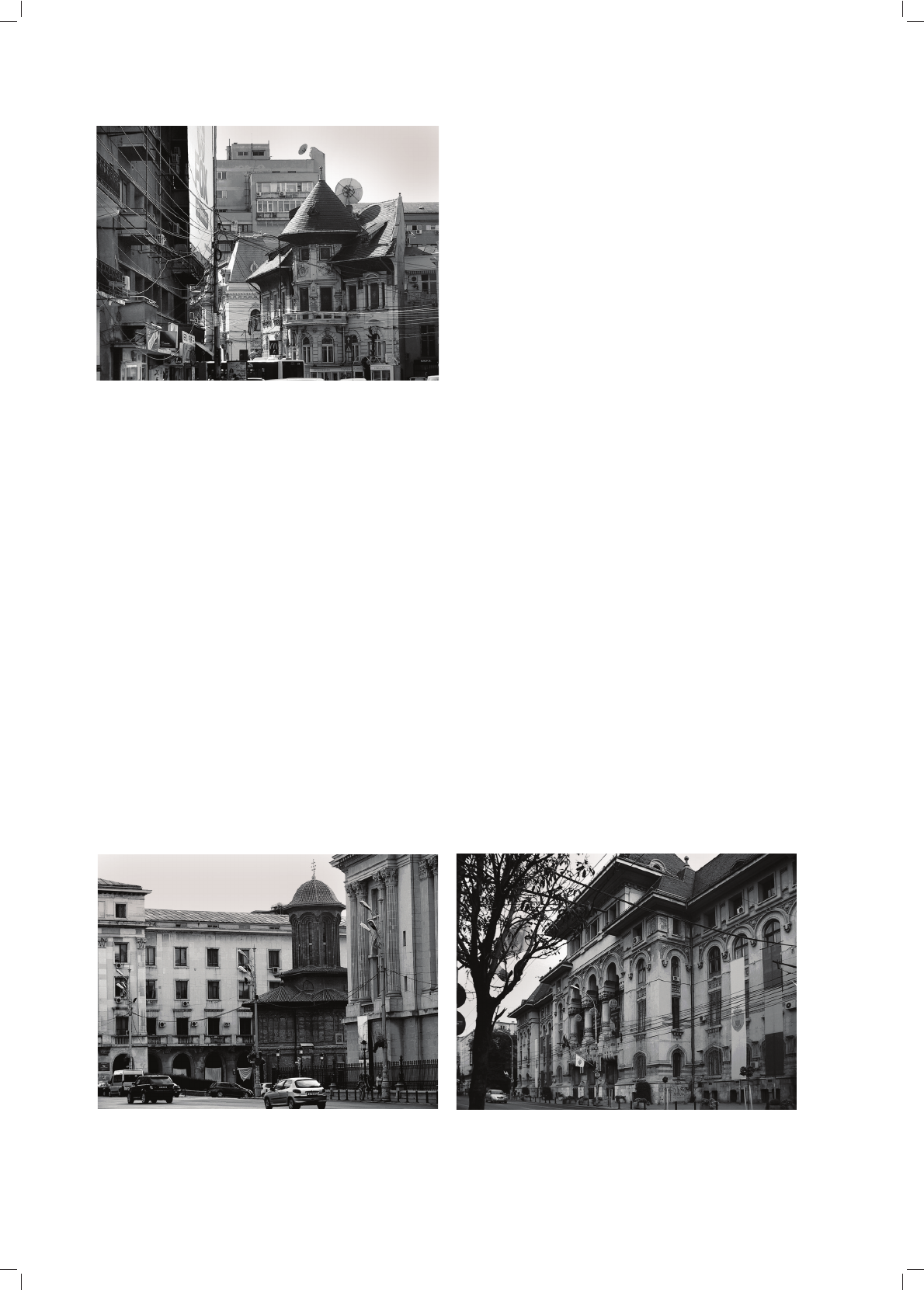
This is how Ferdinand Lassale – the 19
th
century
socialist activist – described Bucharest and its social
inequities in his writings from Romania. This comment
seems correct also in regards to the spatial plan of the
capital city. What distinguishes that city is the excep-
tional diversity of its architectural elements. Bucharest’s
architecture is a melting pot of contrasts of scale,
shapes, style and function (Fig. 1). The city’s architec-
tural forms are grandiose. The local characteristic fea-
tures are spectacular and they include eccentric forms
and abundance of details. The architects of Bucharest
always wanted to create something exceptional. The
most daring attempts were not only typical of eminent
masters, but a standard of architectural designs. [...]
Bucharest drew without any qualms from all sources
and adopted all patterns only to astonish and show
diversity – wrote the Romanian architect, Marian Celac
[1, p. 14].
The origin of this special surrealism lies in the spe-
cific Romanian culture developed as a result of mixture
of the motifs of the East and the West over the centuries.
Bucharest’s urban plan and architecture demonstrate
a myriad of directions which formed under the influ-
ence of Western European ideas. On the other hand, the
picturesque disorder of Bucharest and the magnificence
Wojciech Januszewski*
Between Europe and the East
– draft on architectural landscape of Bucharest
Bucharest – the capital city and the most important
center of industry and services in Romania – is in many
respects an exceptional city compared to other Central
European metropolises. One of the most interesting
aspects of Bucharest is its architecture and the land-
scape created by it. Its beauty defies conventional
aesthetic criteria, creating a special genius loci. This
paper presents an outline description of this extraordi-
nary landscape and the factors which affected its devel-
opment.
* Institute of Architecture and Urban Planning, Kielce University of
Technology.
Introduction
“Savage hotchpotch”
Fig. 1. Neo-Romanian style, modernism and eclecticism in architecture
RI3LDĠD5RPăQDSKRWR:-DQXV]HZVNL
,O6W\OQHRUXPXĔVNLPRGHUQL]PLHNOHNW\]PZ]DEXGRZLH3LDĠD
5RPăQDIRW:-DQXV]HZVNL
DOI: 10.5277/arc120112
118 :RMFLHFK-DQXV]HZVNL
The original Romanian architecture is an account of
the complex historical process which shaped the culture
of Romania.
In this respect 106 AD is an important turning point
when the area of Romania, inhabited at that time by Indo-
(XURSHDQWULEHV7KUDFLDQE\RULJLQ±*HWDHDQG'DFLDQV
– was conquered by Emperor Trajan. Consequently,
5RPDQLD ZDV LQFRUSRUDWHG LQWR WKH :HVWHUQ FXOWXUH ,Q
around the 9
th
century, after the period of the Barbarian
Invasions, the lands by the Danube became part of the
Bulgarian state and the Thraco-Roman people inhabiting
that area were converted to Eastern Christianity and sub-
MHFWHGWRWKHLQIOXHQFHRIWKH%\]DQWLQHFXOWXUH
In the 14
th
century, two independent Romanian princi-
SDOLWLHV ZHUH IRXQGHG 0ROGDYLD DQG :DOODFKLD ,Q WKH
15
th
century, after the fall of Constantinople, they fought
DJDLQVW7XUNVEXWORVWDQGDFFHSWHGWKHVX]HUDLQW\RIWKH
Ottoman Empire. The first mention of Bucharest dates
back from that time (1459). Until the middle of the 19
th
FHQWXU\WKHFLW\ZDVWKHFDSLWDORI:DOODFKLDDQGWKHVHDW
of hospodars (local rulers) [2].
The peak development of the Romanian national style
is associated with the reign of Constantin Brâncoveanu
(1654–1714) who became famous as an excellent politi-
cal leader and patron of the arts. Consequently, that style
is often termed the Brâncovenesc style. A number of
buildings in the Brâncovenesc style have been preserved
in their original form – especially orthodox churches and
monasteries from the 17
th
–18
th
century scattered over the
area of the center of Bucharest (Fig. 3).
At the beginning of the 20
th
century, after a period of
XQFULWLFDO IDVFLQDWLRQ ZLWK WKH :HVWHUQ(XURSHDQ SDWWHUQV
these buildings inspired the architects who wished to express
the national ideas (Fig. 4). One of the most prominent repre-
of architectural forms resemble the spirit of the
Levantine cities (Fig. 2). The specific natural features
of the city also affect its special landscape. An increased
seismic activity of that area results in a faster technical
degradation of the city structures. The buildings which
were damaged, or the ones which did not meet the
growing needs, were replaced with bigger or more
imposing ones – erected in line with currently fashion-
able stylistic conventions.
Despite the complexity of the architectural land-
VFDSH RI WKH FLW\ LW LV SRVVLEOH WR DQDO\]H DQG V\V-
WHPDWL]H LW ,Q WKH VHHPLQJO\ FKDRWLF DUFKLWHFWXUH RI
the city, there can be distinguished a few main “lay-
HUV´ VXFK DV LQGLJHQRXV VW\OH DUFKLWHFWXUH RI WKH
³/LWWOH3DULV´PRGHUQLVPDQGVRFLDOLVWUHDOLVP7KLV
division is rather stylistic than chronological in its
character because these layers often overlapped and
mixed in time, creating hybrid forms or they reap-
SHDUHGDV³QHRVW\OHV´
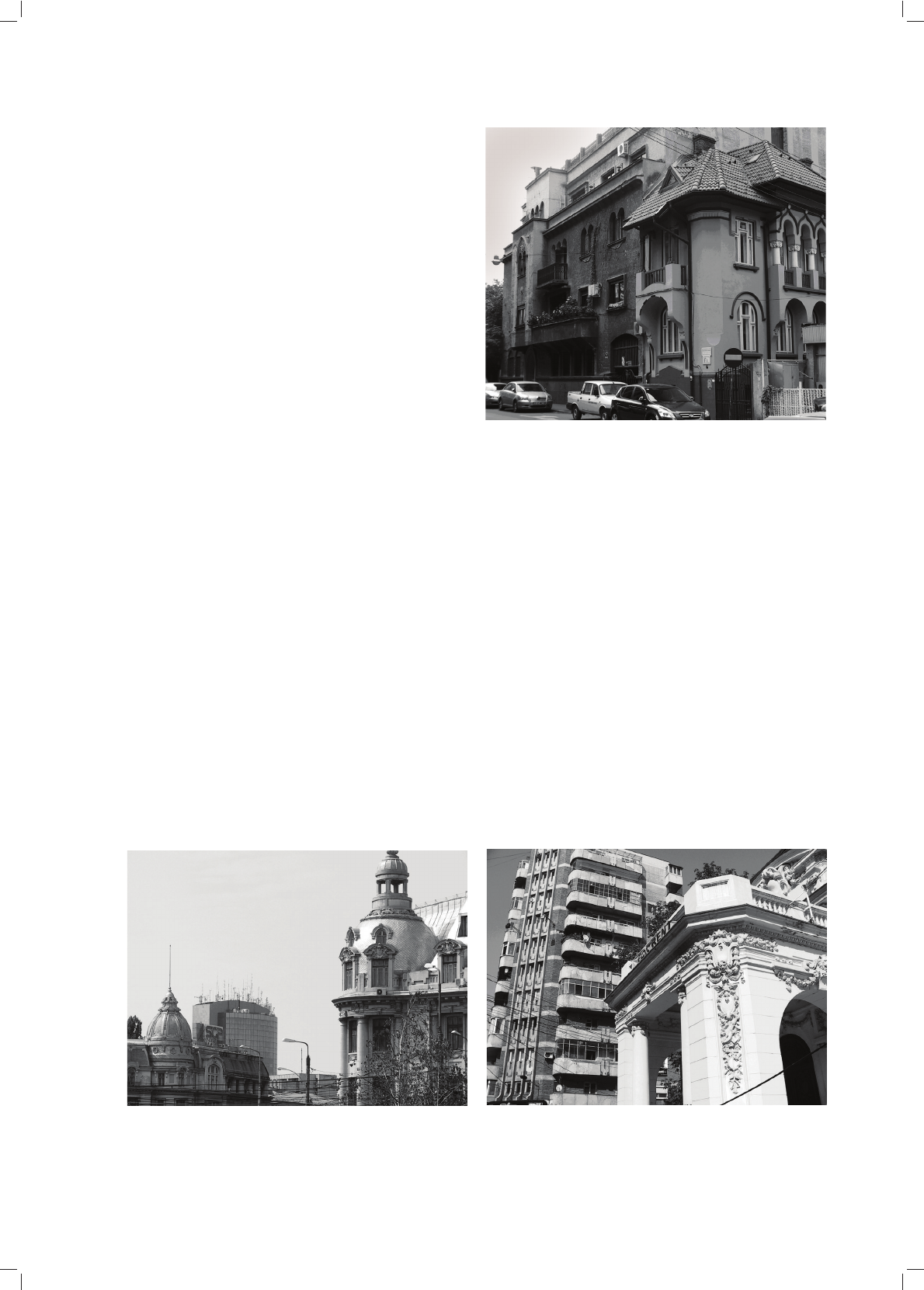
)LJ.UHW]XOHVFX2UWKRGR[&KXUFK±LQWKH5HYROXWLRQ
6TXDUHSKRWR:-DQXV]HZVNL
,O&HUNLHZ.UHW]XOHVFX±QDSODFX5HZROXFML
(fot. :-DQXV]HZVNL)
Indigenous style
)LJ'LYHUVL¿HGDUFKLWHFWXUHRI%XFKDUHVW
FHQWHUSKRWR:-DQXV]HZVNL
,O=UyĪQLFRZDQD]DEXGRZDĞUyGPLHĞFLD%XNDUHV]WX
IRW:-DQXV]HZVNL
Fig. 4. Town Hall in Bucharest (1906–1910) designed in the Neo-
Romanian style by Petre Antonescu (photo: :-DQXV]HZVNL)
,O5DWXV]Z%XNDUHV]FLH±]DSURMHNWRZDQ\ZVW\OX
QHRUXPXĔVNLPSU]H]DUFK3HWUH$QWRQHVFXIRW:-DQXV]HZVNL)
%HWZHHQ(XURSHDQGWKH(DVW±GUDIWRQDUFKLWHFWXUDOODQGVFDSHRI%XFKDUHVW 119
sentatives of that group was Ion Mincu (1852–1912) who
first designed a series of public buildings, townhouses and
other Neo-Romanian houses.
The Brâncovenesc style and its Neo-Romanian interpre-
tation use artistic motifs of various origin. That architecture
features the Renaissance harmony of elements, rhythmic
articulation and frequent repetition of arcaded loggias and
SRUWLFRV7KH%\]DQWLQHPRWLIVDUHYLVLEOHLQWKHIRUPVRI
full arches, short columns – sometimes with spiral twisted
shafts – and abundant floral decorations of archivolts and
IULH]HV6RPH,VODPLFPRWLIVVXFKDV0RRULVKDUFKHVDQG
stone ornamented openwork in balustrades are also used.
The style’s characteristic feature adopted from the Medieval
5RPDQLDQDUFKLWHFWXUHLVLWV³GHIHQVLYHQHVV´DVWDEOHPDLQ
body of the building, strengthened base course and the pres-
ence of oriels and towers. However, the most characteristic
element is the steep roof with overhanging eaves [5].
The indigenous style has numerous variations which
vary depending on the moment of origin and the archi-
tect’s ingenuity. Apart from academic examples of the
Neo-Romanian school, the indigenous elements were
introduced selectively into eclectic architecture and even
modern designs from the 1930s (Fig. 5).
Architecture of the “Little Paris”
The turning point in the growth of the city was the incor-
SRUDWLRQRI:DOORFKLDZLWK0ROGRYDLQDQGWKHQWKH
emergence of the Kingdom of Romania in 1881 with its
capital in Bucharest. Romania broke free from the political
influence of Turkey. The second half of the 19
th
century
ZDVWKHSHULRGZKHQ5RPDQLDZLGHO\RSHQHGWR:HVWHUQ
Europe. This is when the European patterns were adopted
LQPDQ\DVSHFWVRIOLIH7KHUHODWLQL]DWLRQRIWKHODQJXDJH
consisting in replacing the words with Slavic, Hungarian,
and Turkish origin with the words borrowed directly from
Italian or French, was symbolically significant and it was
supported by the authorities [2].
Consequently, it is not surprising that the expansion of
%XFKDUHVWWULJJHUHGE\WKHQHFHVVDU\PRGHUQL]DWLRQRIWKH
capital city, followed the then popular French patterns.
6SHFLILFDOO\ WKH SODQVPDGH E\ *HRUJHV+DXVVPDQQ IRU
Paris were applied. The design included broad avenues
JRLQJQRUWKVRXWK1%DOFHVFXDQG&%UăWLDQXERXOHYDUG
and east-west (Regina Elisabeta and Carol I boulevard)
FURVVLQJDWWKH³JUDQGLQWHUVHFWLRQ´JUDQGHFURLVHHDWWKH
8QLYHUVLW\6TXDUH3LDĠD8QLYHUVLWăĠLL>@)LJ
Over the last two decades of the 19
th
century,
a number of representative buildings of public utility and
government administration were erected in the area of the
Fig. 5. In the foreground, Neo-Romanian city house; in the back-
ground, modern building with details inspired by indigenous style
SKRWR:-DQXV]HZVNL
,O1DSLHUZV]\PSODQLHGRPPLHMVNLZVW\OXQHRUXPXĔVNLPZJáĊEL
EXG\QHNPRGHUQLVW\F]Q\]GHWDOHPLQVSLURZDQ\PVW\OHPURG]LP\P
(fot. :-DQXV]HZVNL)
)LJ(FOHFWLFDUFKLWHFWXUHRI3LDĠD8QLYHUVLWăĠLL
SKRWR:-DQXV]HZVNL
,O(NOHNW\F]QD]DEXGRZD3LDĠD8QLYHUVLWăĠLL
(fot. :-DQXV]HZVNL)
Fig. 7. City house with rich decorations from the period of the “Little
3DULV´SKRWR:-DQXV]HZVNL
,O'RPPLHMVNLRERJDWHMGHNRUDFML]RNUHVXÄPDáHJR3DU\ĪD´
(fot. :-DQXV]HZVNL)
120 Wojciech Januszewski
new center. They were designed by Romanian architects
educated in Ècole des Beaux Arts in Paris and often by
French designers themselves.
The buildings from that period are monumental and
they feature sophisticated details as well as impeccable
workmanship. The style of the new buildings was cosmo-
politan and generally followed the trends popular then in
French architecture. The dominant conventions included
neo-classicism, eclecticism, and French neo-renaissance
as well as Art Nouveau around 1900.
The expansion of the city, which was carried out on
a grand scale, followed the idea of transforming Bucharest
into “Little Paris.” The fashion for imported architecture
affected not only huge public investments but also indi-
vidual buildings such as palaces of aristocracy and rich
bourgeoisie, townhouses and city houses [6] (Fig. 7).
Modernism
The next stage of the city’s rapid growth was the period
between the wars when Bucharest was the capital of so called
Great Romania which significantly expanded to include new
territories. A new literary and art movement inspired by the
ideas of European avant-garde played an important role in the
cultural life at that time. Its advocates gathered around
Contimporanul – a magazine published between 1924 and
1934. It was a forum for the young generation of designers
who adopted the ideas of architecture of the Bauhaus, Le
Corbusier or de Stijl. Hundreds of new buildings in the
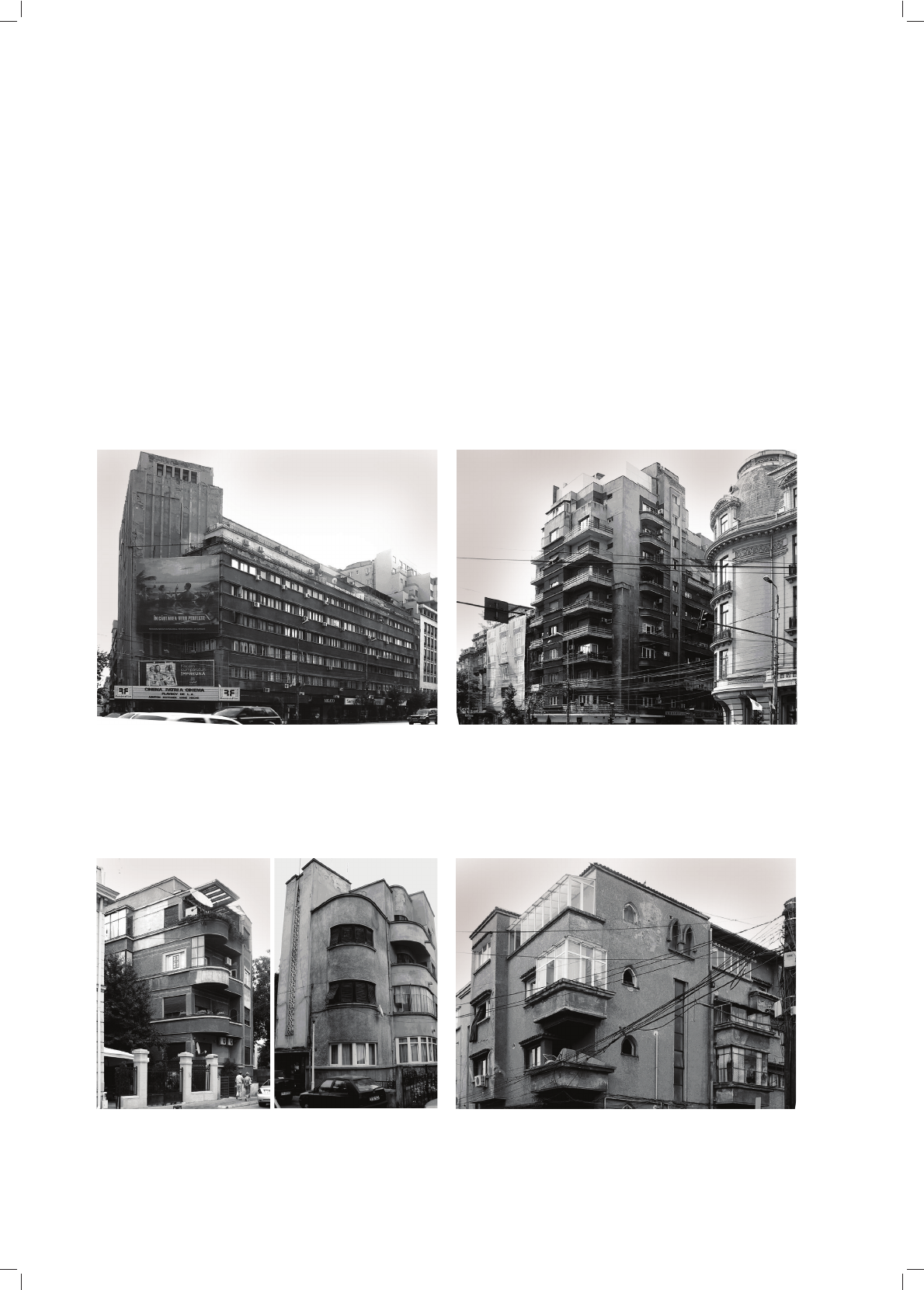
Fig. 8. Modern architecture of Bulevardul Magheru – ARO insurance
building from 1929 – designed by Horia Creanga
(photo: W. Januszewski)
Il. 8. Modernistyczna zabudowa Bulevardul Magheru – budynek
towarzystwa ubezpieczeniowego z 1929 r. – arch. Horia Creanga
(fot. W. Januszewski)
Fig. 9. Coexistence of modernism and eclecticism
(photo: W. Januszewski)
,O:VSyáLVWQLHQLHPRGHUQL]PXLHNOHNW\]PX
(fot. W. Januszewski)
Fig. 10. Examples of modern houses in Bucharest
(photo: W. Januszewski)
,O3U]\NáDG\PRGHUQLVW\F]Q\FKGRPyZZ%XNDUHV]FLH
(fot. W. Januszewski)
Fig. 11. Modern body of the building and historicizing detail
(photo: W. Januszewski)
,O0RGHUQLVW\F]QDEU\áDLKLVWRU\]XMąF\GHWDO
(fot. W. Januszewski)
%HWZHHQ(XURSHDQGWKH(DVW±GUDIWRQDUFKLWHFWXUDOODQGVFDSHRI%XFKDUHVW 121
International style, including monument office buildings, resi-
dential buildings and houses, were designed in Bucharest
especially in the middle of the 1930s, when, after the great
crisis, the building investments became the best means to save
the capital [4] (Fig. 8, 9).
Despite the fact that the Romanian modernism was an
imported idea, the avant-garde architecture of Bucharest is
extraordinary on the European scale and its modern designs
are remarkable. It is surprising how easily the interwar soci-
ety adopted the completely new style of architecture. On the
other hand, the activities of the state in respect of social hous-
ing – so typical of modern ideas – were insufficient. The new
style was mainly applied in private building. Modernism was
perceived separately from its original, social principles and
consequently it was only a kind of fashionable modern cos-
tume (Fig. 10, 11).
That is why the specific features of Bucharest avant-
garde focus on the external form of the buildings.
Architects freely and skillfully used all resources of mod-
ern formal means. New architecture used asymmetrical
FRPSRVLWLRQ KRUL]RQWDO UK\WKPV EDQG DQG URXQG ZLQ-
dows, loggias and balconies, brise-soleil, ship balus-
trades, rounded corners resembling the designs by Erich
Mendelsohn, etc. The minimalist solutions were not
popular – on the contrary – the buildings were composed
of many sections and they had a lot of details (cornices,
frames, etc.) [3].
This way modernism of the capital city falls in line
with the long tradition of extravert and decorative
architecture of Bucharest. Frequently, this continuity
can be perceived literally when the functional archi-
WHFWXUH LQFOXGHV SRLQWHG DUFKHV %\]DQWLQH FROXPQV
or pseudo-Moorish bars as well as warm colors.
These surprising deviations from stylistic purity tes-
tify best to the uniqueness of the Romanian avant-
garde (Fig. 11).
The modern movement ended with the outbreak of the
6HFRQG :RUOG :DU ZKLFK UHVXOWHG LQ WKH VXEVWDQWLDO
destruction of the city. After 1947, Romania became
a Socialist Republic. New authorities considered avant-
garde bourgeois formalism and it was doomed to artistic
void. Instead, there was a return of the spirit of neo-clas-
sicism. It did return but in a distorted form.
This is when socialist realism began, which was also
known in other countries of so called Eastern Bloc. The
temporary turn towards so called socialist modernism in
the 1960s–1970s did not stop an urban catastrophe. The
huge earthquake in 1977, which did a lot of damage in the
historic fabric of Bucharest, became a pretext for party
GHFLVLRQPDNHUVOHGE\1LFRODH&HDXúHVFXWRLPSOHPHQW
the plans to remodel the capital city and turn it into a
propaganda flagship of socialist Romania. In 1980, the
FOHDQLQJRIWKHDUHDIRUWKH³QHZVRFLDOLVWFLW\´ZKLFKZDV
planned on the south side of the existing city center by the
'kPERYLĠD5LYHULQWKHDUHDRIWKHROGHVWPHGLHYDOSDUW
of Bucharest began. In order to execute that undertaking
the area of about 7 km
2
of the city, that is about 1/3 of the
area of the city center, was leveled. About 40 000 resi-
dents were relocated. The old street network, the hum-
PRFN\ODQGVFDSHDGR]HQRUVRRIRUWKRGR[FKXUFKHVDQG
monasteries as well as numerous other valuable, historic
buildings were completely destroyed [1].
The plan of the new design was based on extremely sim-
plified layout. It had two main elements: the “People’s
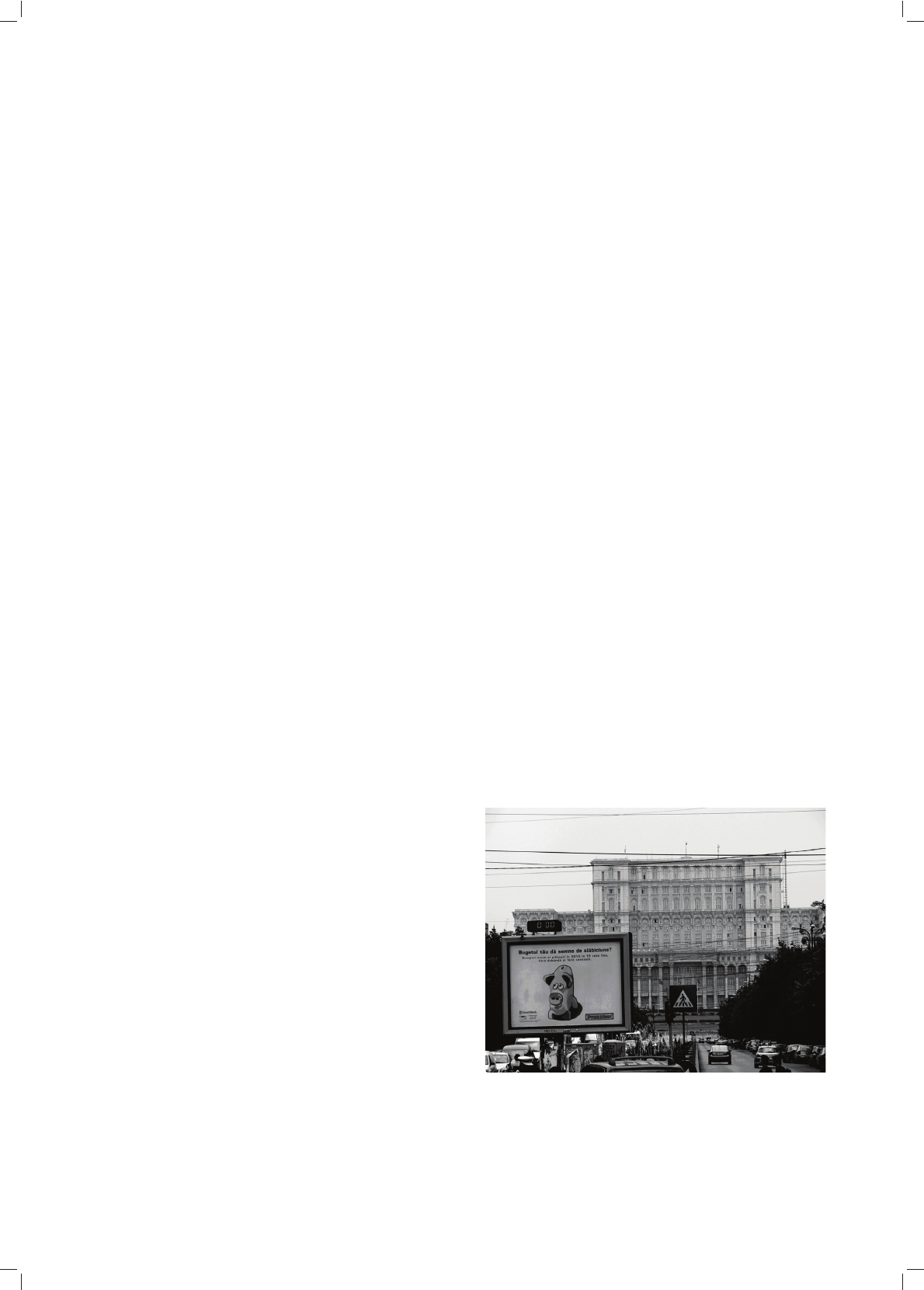
+RXVH´DQGWKH³$YHQXHRI9LFWRU\RI6RFLDOLVP´)LJ
The construction of the People’s House – one of the big-
gest buildings in the world, which was built in the years
1984–1989 according to the plans prepared by a team of
a few hundred architects – required a lot of effort. The com-
SOH[ZKLFKZDVEXLOWUHPLQGHGWKH%DE\ORQLDQ]LNNXUDWLQLWV
SURSRUWLRQVDQG9HUVDLOOHVLQLWVDUFKLWHFWXUH7KHVFDOHDQG
grandeur of the structure defies all classification.
7KH³$YHQXHRI9LFWRU\RI6RFLDOLVP´LVDILYHNLORP-
HWHUORQJD[LV D IHZ GR]HQ PHWHUV ORQJHU ± ZKLFK ZDV
a source of its builders’ pride – than the Avenue des
Champs-Élysées in Paris. A number of government and
apartment buildings were designed with rows of trees and
tens of fountains along the sides of the Avenue. The
monumental Unirii Square with commodity warehouses
was located in the area where the Avenue crosses the
existing south-north axis.
The schematic and monumental architecture of these
buildings is a combination of socialist realism, a sort of
Ricardo Bofill’s European post-modernism and the style
of official building in North Korea, with which the dicta-
tor maintained close relations (Fig. 13).
New Socialist City
Fig. 12. The Palace of the Parliament (former People’s House) at the
FORVLQJRIWKHYLHZLQJD[LVSKRWR:-DQXV]HZVNL
,O%U\áD3DáDFX3DUODPHQWXGDZQLHM'RPX/XGRZHJRQD
]DPNQLĊFLXRVLIRW:-DQXV]HZVNL)
122 :RMFLHFK-DQXV]HZVNL
&HDXúHVFX¶VDFWLYLWLHVUHVXOWHGLQLUUHYHUVLEOHFKDQJ-
es in the face of Bucharest. The diverse historic land-
scape of the city was replaced with a monotonous and
RYHUVL]HG XUEDQ GHVLJQ 7KH RQO\ UHPDLQV RI WKH
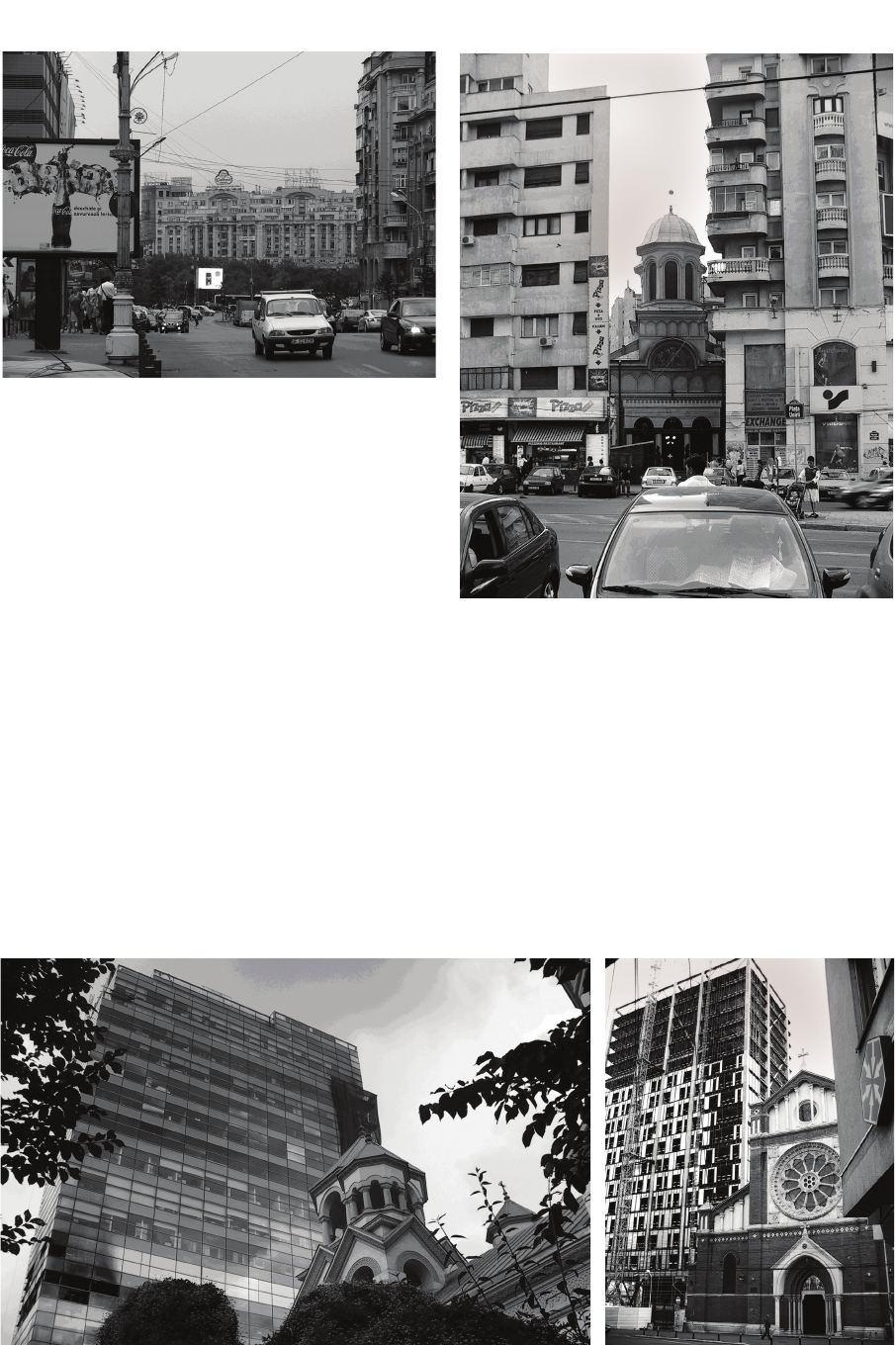
destroyed district are its historic orthodox churches
and monasteries which for ideological reasons were
blocked by new buildings or hidden inside the quarters
(Fig. 14).
)LJ9LHZRIIRUPHU³6RFLDOLVW&LW\´
SKRWR:-DQXV]HZVNL
,O:LGRNGDZQHJRÄ0LDVWD6RFMDOLVW\F]QHJR´
(fot. :-DQXV]HZVNL)
Fig. 14. Historic Orthodox Church hidden among socialist architecture
DURXQG3LDWD8QLULLSKRWR:-DQXV]HZVNL
,O=DE\WNRZDFHUNLHZXNU\WDZĞUyGVRFMDOLVW\F]QHM]DEXGRZ\
w okolicy Piata Uniri (fot. :-DQXV]HZVNL)
The present
In December 1989, Bucharest became an arena of
EORRG\FODVKHVDVDUHVXOWRIZKLFKWKH1LFRODH&HDXúHVFX¶V
dictatorship was overthrown. The revolution stopped the
building program of the regime in its prime. The con-
struction of the People’s House was not fully completed.
7KHEXLOGLQJVIURP&HDXúHVFX¶VWLPHKDYHUHPDLQHGXVH-
less and unfinished in Bucharest until today.
Romania adopted the market economy. The People’s
House – currently the Palace of the Parliament – became
tourist attraction and former commodity warehouses were
)LJ&RQWURYHUVLDOLQYHVWPHQWVE\WKH&DWKROLF&DWKHGUDODQG$UPHQLDQ&KXUFKSKRWR:-DQXV]HZVNL
,O.RQWURZHUV\MQHLQZHVW\FMHSU]\.DWHGU]H.DWROLFNLHML.RĞFLHOH2UPLDĔVNLPIRW:-DQXV]HZVNL)

%HWZHHQ(XURSHDQGWKH(DVW±GUDIWRQDUFKLWHFWXUDOODQGVFDSHRI%XFKDUHVW 123
converted into shopping centers. The huge walls of the
IRUPHU ³VRFLDOLVW FLW\´ DUH FRYHUHG WRGD\ ZLWK PRWOH\
advertising banners.
Today’s Bucharest suffers from a lot of problems con-
nected with the maintenance of its heritage. Its existing
urban fabric, which demonstrates high architectural
value, often deteriorates because of neglect of conserva-
tion work or intentional devastation.
The city lacks an effective space planning policy. The
face of the capital city is heavily affected by powerful
investors who force construction of more and more high-
rise buildings, usually with no regard to their surround-
ings. Public opinion was on many occasions appalled at
suggested locations of commercial architecture. In 2008,
street protests were held during the debate on the shape of
one of the most symbolic places in Bucharest – Revolution
Square in the vicinity of the Royal Palace. The construc-
tion of skyscrapers right next to such temples as the
Catholic Cathedral or by the historic Armenian Church
caused huge scandals (Fig. 15). Paradoxically, free mar-
ket today – just like socialism in the past – causes the
degradation of historic sites and devastation of the cul-
tural landscape of Bucharest.
Contrasts have always been the defining elements of
Bucharest’s urban landscape and its unique character.
However, diversity does not mean complete lack of any
principles. The architecture of the capital city of Romania
had impassable limits – the limits of human scale – and
because of those limits the streets and squares of old
Bucharest offer true public spaces. However, since the
second half of the 20
th
century, this natural border has
EHHQEUHDFKHGPRUHDQGPRUHRIWHQ*ODVVVN\VFUDSHUV
just like socialist boulevards, are the most evident exam-
ples of that violation. New architecture also breaks the
limits of schematism beyond which form becomes cliché.
The architecture of glass boxes whose presence in
Bucharest has become universal today does not match the
artistic value of the interwar modernism. Maybe the con-
temporary builders of Bucharest should learn more from
their great predecessors.
[1] Celac M., Carabela O., Marcu-Lapadat M., %XFKDUHVW±DUFKLWHFWXUH
and modernity, Simetria, Bucuresti 2005, p. 14.
[2] Demel J., +LVWRULD 5XPXQLL =DNáDG 1DURGRZ\ LP 2VVROLĔVNLFK ±
:\GDZQLFWZR:URFáDZSS±
[3] Machedon L., Scoffham E., 5RPDQLDQPRGHUQLVP7KHDUFKLWHFWXUH
of Bucharest 1920–, MIT Press, Cambridge 1999, pp. 10–31.
>@2JLĔVNL 7 +LODULRSROLV 6FKD\HU L LQQL, August 18, 2008 [accessed:
December 12, 2010], http://schayer.blox.pl/2008/08/Hilaropolis.html.
[5] Stanculescu F., $UKLWHFWXUD3RSXODUD5RPLQHDVVD5HJLXQHD%XFXUHVWL,
Editura Tehnica, Bucuresti 1958, pp. 3–50.
[6] Tudor O., ,QWHUEHOOXP%XFKDUHVW9LFWRULD$YHQXH, Noi Media Print,
Buchuresti 2009, pp. 2–15.
References
0LĊG]\(XURSąD:VFKRGHP±V]NLFRNUDMREUD]LHDUFKLWHNWRQLF]Q\P%XNDUHV]WX
.UDMREUD]PLHMVNLUXPXĔVNLHMVWROLF\VWDQRZLV]F]HJyOQLHLQWHUH-
VXMąFH]MDZLVNRZDVSHNFLHXUEDQLVW\NLLIRUPDUFKLWHNWRQLF]Q\FKQD
WOHZLHONLFKPHWURSROLL(XURS\ĝURGNRZHML3RáXGQLRZHM2U\JLQDOQD
NRPSR]\FMD SU]HVWU]HQQD MHVW ]DSLVHP VSHF\ILF]Q\FK XZDUXQNRZDĔ
NXOWXURZ\FKKLVWRU\F]Q\FKLQDWXUDOQ\FK:DUW\NXOHSU]HGVWDZLRQR
]DU\V ZDUVWZRZHM VWUXNWXU\ SU]HVWU]HQQHM PLDVWD WZRU]RQHM SU]H]
SRV]F]HJyOQHJUXS\VW\OLVW\F]QHVW\OURG]LP\ÄPDá\3DU\Ī´PRGHU-
QL]PVRFUHDOL]PLZVSyáF]HVQRĞü
Key words: Bucharest, urban space, modernism 6áRZDNOXF]RZH%XNDUHV]WSU]HVWU]HĔPLHMVNDPRGHUQL]P
Translated by
7DGHXV]6]DáDPDFKD
Drawn by Mateusz Olczyk