
2014
3(39)
DOI: 10.5277/arc140307
Anna Sygulska*
Modyfikacje przestrzenne sceny teatru operowego na potrzeby koncertu
Spatial modifications of the stage of the opera house for the needs of a concert
Wprowadzenie
Do adaptowania sceny operowej na potrzeby koncer-
tu stosuje się zabudowę sceny muszlą koncertową. W te-
atrach operowych wykorzystuje się ją, gdy prezento wana
jest wersja koncertowa spektaklu operowego albo podczas
recitalu czy gali operowej, gdy soliści i orkiestra występu-
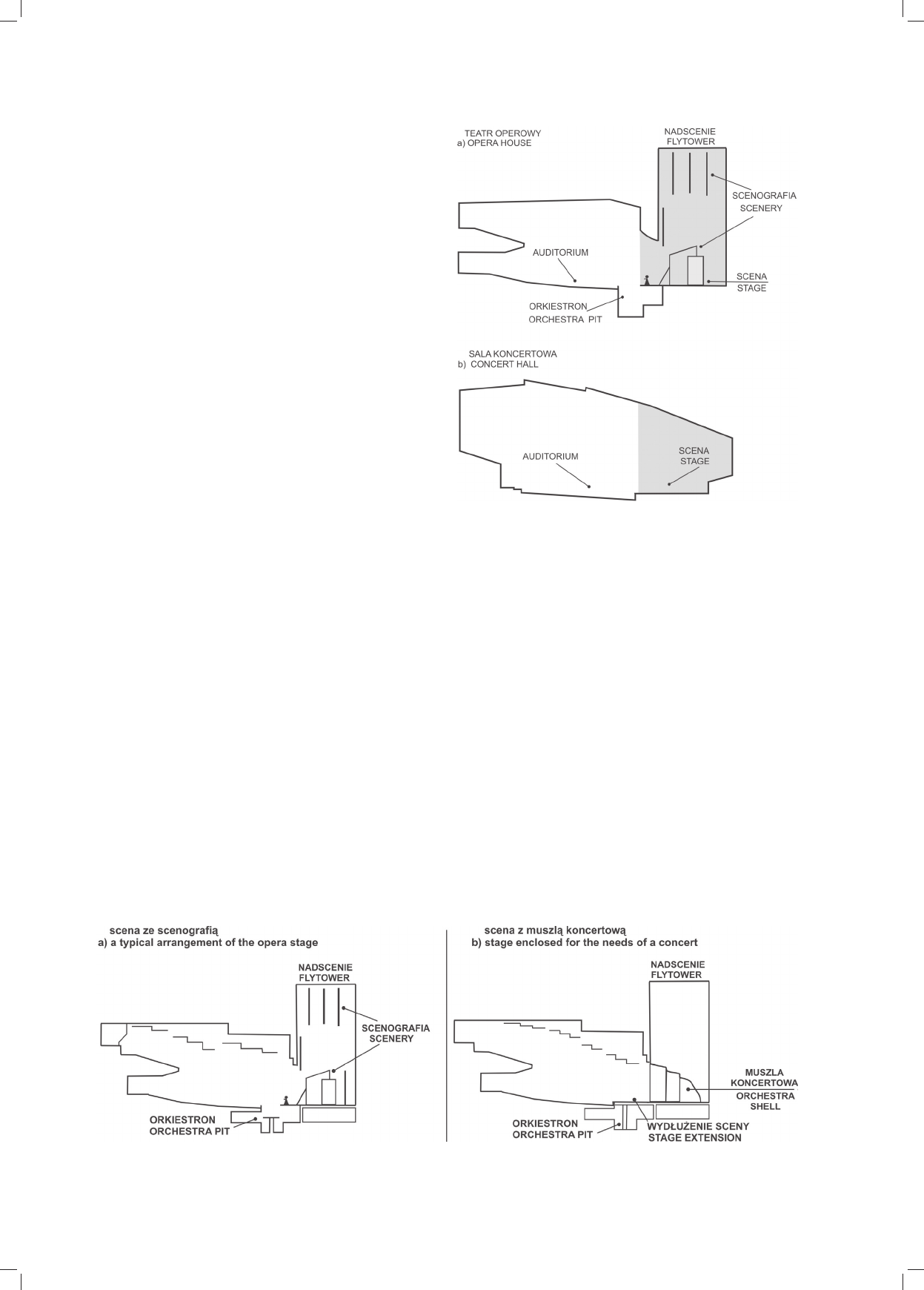
ją na scenie. Na ilustracji 1 pokazano schema ty cz ny prze-
krój typowej sali operowej i typowej sali kon certo wej.
Scena operowa jest typem sceny pudełkowej, w kształcie
prostopadłościanu, przypomina pudło z wyciętym otwo-
rem, przez który widzowie obserwują akcję sceniczną.
Tworzy odrębną przestrzeń w stosunku do audy torium.
Natomiast estrada sali koncertowej wraz z audy torium
znajdują się w tej samej przestrzeni.
Scena sali operowej nie spełnia wymagań stawianych
salom koncertowym – potrzebne są modyfi kacje architek-
toniczne, aby ją przystosować. Wraz z nadsceniem stano-
wi ona bardzo dużą przestrzeń. Kubatura nadscenia w sto-
sunku do kubatury audytorium jest znacznie większa.
Pro por cje nadscenia do audytorium są różne np.: Grand
Theatre de Bordeaux – 2,9; Magyar Állami Operahaz
w Bu dapeszcie – 1,93; Festspielhaus w Bayreuth – 2,8;
Teatr Wielki w Poznaniu – 2,26. Umieszczenie orkies-
try na pus tej scenie dałoby efekt rozproszenia dźwięku
w nad sceniu, mogłoby również wywołać inne niekorzyst-
ne efekty akustyczne, np. echo
. Ponadto optymalne war-
tości parametrów akustycznych dla sal koncertowych są
* Wydział Architektury Politechniki Poznańskiej/Faculty of Ar chi-
tecture, Poznan University of Technology.
Introduction
In order to adapt the opera stage for the needs of
a concert, one applies the orchestra shell. In opera houses,
it is applied either when a concert version of an opera spe-
cta cle is staged or during a recital or an opera gala when
soloists perform on the stage to the accompaniment of the
orchestra. Figure 1 shows the schematic longitudinal sec-
tion of a typical opera house and of a typical concert hall.
The opera stage is the proscenium stage (also known as
the picture frame stage); therefore, it is a stage resembling
a box with a cut-out large opening (the pro sce nium arch),
through which spectators watch stage action. It creates
a space separated from the auditorium, whereas in the con-
cert hall the stage and the auditorium are in the same space.
The stage of the opera house is not suitable for the
needs of a concert; therefore, architectural modifi cations
are required in order to adapt the stage to meet these needs.
The stage of the opera house alongside the fl ytower form
a very huge space. The cubature of the fl ytower is much
bigger by comparison with the cubature of the auditorium.
The ratios of the fl ytower to the auditorium differ, e.g.
Grand Theatre de Bordeaux – 2.9; Magyar Állami Opera-
haz in Budapest – 1.93; Festspielhaus in Bayreuth – 2.8;
Teatr Wielki (Grand Theatre) in Poznań – 2.26. The pla-
ce ment of the or chestra on an empty stage would result
in sound diffusion in the fl ytower. Moreover, the optimal
va lues of acoustic parameters for concert halls differ from
those for opera halls, e.g. the recommended reverberation
time RT for the opera is 1.3–1.6 s, whereas for the concert
it is 1.7–2.1 s. In order to adapt acoustic conditions of the
opera house for the needs of a concert, one encloses the
stage. The en closure joins the stage and the auditorium
76 Anna Sygulska
inne niż dla sal operowych, przykładowo zalecany czas
pogłosu RT dla opery wynosi 1,3–1,6 s, natomiast dla
koncertu 1,7–2,1 s. Aby dostosować warunki akustyczne
opery, wykorzystuje się zabudowę, która łączy przestrzeń
sceny z przestrzenią widowni i tworzy warunki podobne
do występujących w salach koncertowych [1]. Wieża sce-
niczna zostaje odcięta, aby scena wraz z audytorium sta-
nowiła jedną przestrzeń. Zostaje również przykryty kanał
orkiestrowy (il. 2b), dzięki czemu źródło dźwięku w po-
staci osoby śpiewaka lub instrumentów jest przesunięte
bliżej publiczności. Muszla koncertowa jest potrzebna do
zapewnienia dobrych warunków akustycznych dla muzy-
ków na scenie. Wpływa ona także na zmiany parametrów
akustycznych na widowni. Odbicie dźwięku wewnątrz
zabudowy oraz rozproszenie dźwięku od powierzchni jej
ścian sprawia, że dźwięk na widownię dociera wymiesza-
ny i jednolity. Odpowiednio zaprojektowana muszla kon-
certowa musi zatem spełniać wymogi architektoniczne
i akustyczne.
Omawiana problematyka by
ła analizowana przez
wie lu autorów. Przede wszystkim należy tu wymie-
nić pracę Bradleya [3], w której przedstawiono pomia-
ry pa ra metrów akustycznych dla różnych typów zabu-
dowy sceny. Analizowano trzy duże sale, w których
za stosowa no muszle koncertowe o różnej architekturze,
a tak że wyko nano pomiary na widowni dla sceny pustej
i za bu dowanej. Warto również wspomnieć o dwóch pra-
cach, których autorami są Farina, Fausti i Pompoli [1],
[4]. Poru szono w nich problematykę konstrukcji muszli
koncer towej w Teatro Comunale w Cagliari. Fausti i Pro-
di omówili projekt nowej muszli koncertowej w Operze
Romo Valli w Reggio Emilia [5]. Natomiast Orlow-
ski w pracy [6] opisał przystosowanie sali Milton Key-
nes Theatre. W projekcie poza wprowadzeniem muszli
koncertowej został zastosowany ruchomy sufi t nad wi-
downią. Z kolei w pracy [7], której autorami są Cocchi,
Garai i Tavernelli, przedstawiono proces projektowania
muszli koncertowej przy użyciu programu komputerowe-
go. Za gadnienia adaptacji sali opero wej na potrzeby kon-
certu prezentują również książki Beranka [8], Egana [9]
i Izenoura [10].
together so as to create conditions similar to those exis-
ting in concert halls [1]. The fl ytower is cut off so that the
stage forms one space alongside the auditorium. Also, the
orchestra pit is covered (Fig. 2b), by means of which the
sound source (a singer or musical instruments) is shifted
towards the audience. The orchestra shell is also needed
to provide good acoustic conditions for musicians on the
stage. More over, it has an infl uence on the change in acous-
tic parameters in the auditorium. The sound re fl ec tion
within the enclosure as well as sound diffusion from the
surface of its walls enable the sound to reach the au dience
well-blended and uniform. A duly designed orchestra
shell has to meet architectural and acoustic requirements.
Il. 2. Przekrój podłużny: a) typowa aranżacja sceny operowej, b) scena zabudowana na potrzeby koncertu (na podstawie [2])
Fig. 2. The longitudinal section: a) a typical arrangement of the opera stage, b) stage enclosed for the needs of a concert (on the basis of [2])
Il. 1. Przykładowy teatr operowy i sala koncertowa
– schemat ukazujący różnice przestrzenne (oprac. autorki)
Fig. 1. An exemplary opera house and a concert hall
– the scheme shows spatial differences (drawn by the author)

Modyfikacje przestrzenne sceny teatru operowego /
Spatial modifications of the stage of the opera house
77
Wymogi architektoniczne
stawiane muszlom koncertowym
Muszla koncertowa swoją wielkością dostosowana
jest do liczebności muzyków biorących udział w koncer -
cie. Pełen skład osobowy przewiduje udział orkiestry, chó-
ru i solistów. Na ilustracji 3 pokazane są trzy możli we wa-
rianty położenia tylnej ściany muszli w zależnoś ci od typu
produkcji muzycznej (pełen skład osobowy, sama orkiestra
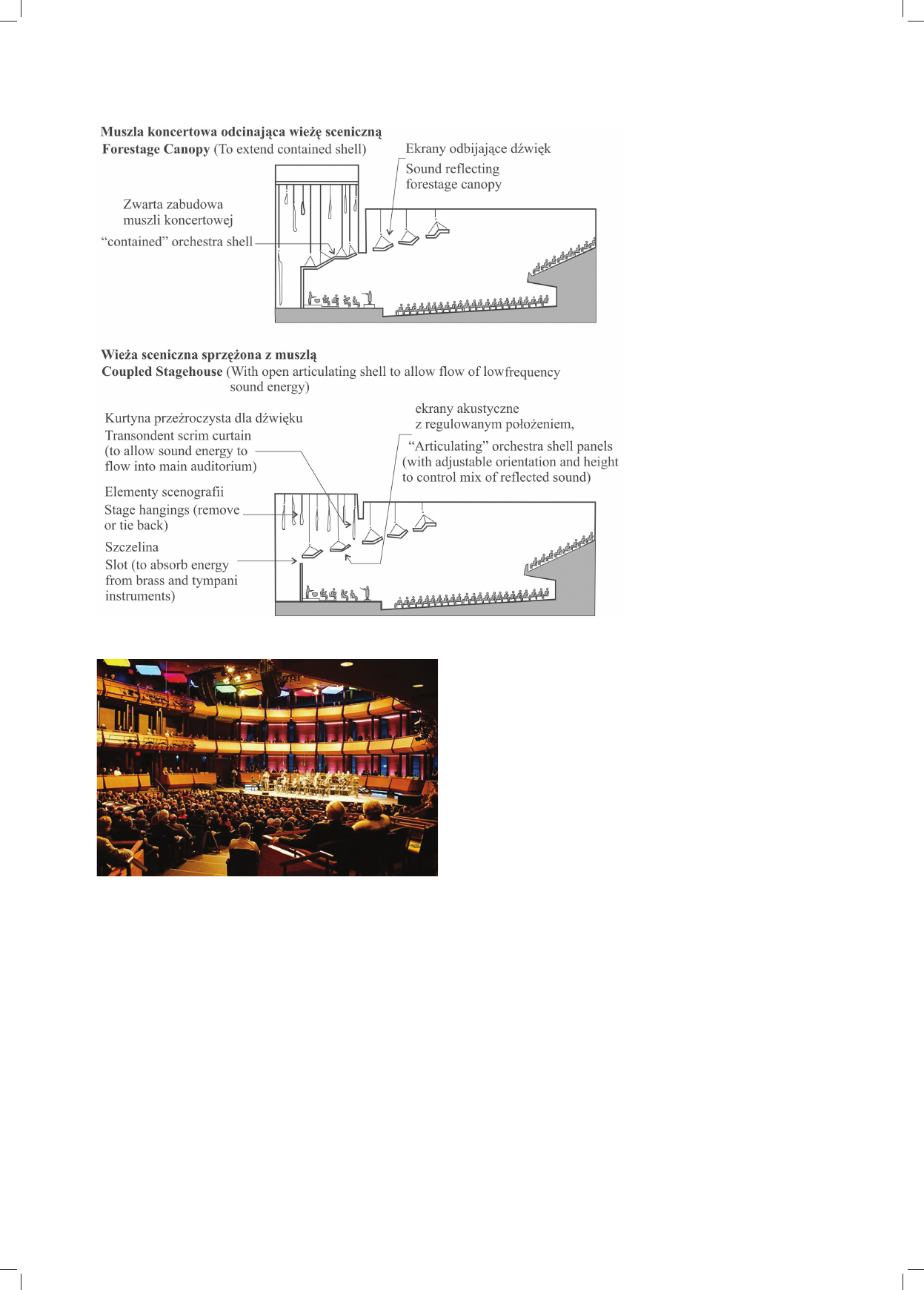
lub recital kilku muzyków). Na ilustracji 4 na przekroju po-
kazano elementy nadscenia i muszli koncertowej
1
. Nad-
scenie pełni różne funkcje. Znajdują się tam liczne gale-
rie, pomosty, windy, mostki oświetleniowe, a w większych
teatrach otwarte pomieszczenia do przechowywania de-
koracji. Jest to jednak przestrzeń, w której przede wszyst-
kim mieści się scenografi a podwieszona linami do sztankiet
(sztankiety – belki nad sceną do podwieszenia dekoracji).
Sztankiety z podwieszoną dekoracją przemieszczają się od
powierzchni sceny do poziomu stropu technicznego [11].
Muszla koncertowa może być zaprojektowana jako
zwarta zabudowa (Salle Wilfrid Pelletier w Montrealu
i Eastman Theatre w Nowym Jorku) bądź z paneli do-
stawianych do siebie (Opera of the National Arts Centre
w Ottawie i Alberta Jubilee Auditorium w Albercie).
Mu szle koncertowe odcinają nadscenie lub włączają je
w przestrzeń audytorium (il. 5). W przypadku gdy szczeli-
ny w muszli koncertowej łączą wieżę sceniczną z audyto-
rium, usuwa się wiszące tam elementy scenografi i, a prze-
strzeń tę traktuje się jak komorę pogłosową.
Projektując muszlę koncertową, należy wziąć również
pod uwagę styl wnętrza sali teatru operowego. Dob re
roz wiązania zapewniają jedność stylu. Jest to waż ne za -
gad nienie, gdyż wielokrotnie koncerty odbywają się przy
1
O tym, że w teatrze występuje nadscenie, zwane inaczej sznu rownią
lub wieżą sceniczną, można mówić, gdy sufit nad sceną znajduje się ponad
1,5 m nad sufitem proscenium (proscenium jest to obszar między kurtyną
a kanałem orkiestrowym, natomiast w przypadku przykrycia kanału orkies-
trowego – między kurtyną a widownią). Opty malna wysokość nadscenia to
2,5 do 3,5 wysokości okna sceny powięk szona o wysokość stropu technicz-
nego oraz o przestrzeń dachu z klapa mi dymowymi.
In the literature concerning the issue, Bradley’s [3]
publication plays an important role. The author presents the
investigation of acoustic parameters for different types of
stage enclosures. Three big halls were analyzed, in which
orchestra shells of different architecture were applied. The
measurements in the auditorium were taken for empty and
enclosed stages. Papers [1] and [4] by Fa rina, Fausti and
Pompoli address the issue of the struc ture of the orchestra
shell in Teatro Comunale in Cagliari. The paper by Fausti
and Prodi [5] discusses the design of the new orchestra shell
in Romo Valli Opera House in Reggio Emilia. In pa per
[6], Orlowski presents the adaptation of the Milton Key-
nes Theatre Hall for the needs of a concert. Apart from the
introduction of the concert shell, a movable ceiling above
the auditorium was applied. The paper [7] by Cocchi,
Garai and Tavernelli shows the process of the design of the
concert shell by means of a computer pro gram. Adaptation
issues of the opera house for the needs of a concert are also
shown in books by Beranek [8], Egan [9] and Izenour [10].
Architectural solutions for orchestra shells
The size of the orchestra shell is determined by the nu -
mber of performing musicians. The full set consists of
the orchestra, the choir and soloists. Figure 3 shows three
possible options depending on the type of music production
– the full set, only the orchestra or a recital for a couple
of musicians. The stagehouse section in Figure 4 shows
elements of the fl ytower and of the orchestra shell
1
. The
fl ytower performs a multitude of functions. There are many
galleries, catwalks, lifts, and light ladders there. However,
fi rst of all it is a space in which scenery, suspended on
1
It can be assumed that a theatre has a fl ytower (in other words
a stagehouse, known also as a stage tower), when the ceiling above the
stage is more than 1.5 m above the proscenium ceiling (proscenium is
the area between the curtain and the orchestra pit; when the orchestra pit
is covered, it is the area between the curtain and the auditorium). The
optimal height of the fl ytower is from 2.5 to 3.5 of the height of the
proscenium opening enlarged by the height of the fl y loft and by the area
of the roof with smoke dampers.
Il. 4. Przekrój nadscenia ukazujący przykład aranżacji sceny
muszlą koncertową (na podstawie [9])
Fig. 4. The stagehouse section shows an exemplary arrangement
for a stage with an orchestra shell (on the basis of [9])
Il. 3. Rzut ukazujący przykład aranżacji sceny muszlą koncertową
(na podstawie [9])
Fig. 3. The view shows an exemplary arrangement for a stage
with an orchestra shell (on the basis of [9])
78 Anna Sygulska
częściowo zapalonym świetle. Przykładem teatru, gdzie
muszla koncertowa stanowi ścisłe połączenie z au dy torium,
jest Rose Theater at Jazz at Lincoln Cen ter w Nowym
Jorku (proj. Rafael Viñoly Architects, ARTEC acoustics)
(il. 6). Jedność stylu zabudowy kon certo wej z ar chitekturą
widow ni osiągnięto tu po przez konty nuacje balkonów
w zabudowie. Oprócz spek takli operowych w Rose
Theater odbywają się rów nież koncerty muzyki jazzo-
wej, klasycznej, a także przedstawienia baletu i tań ca
współ czesnego. Tak sze roki wachlarz możliwości osiąg-
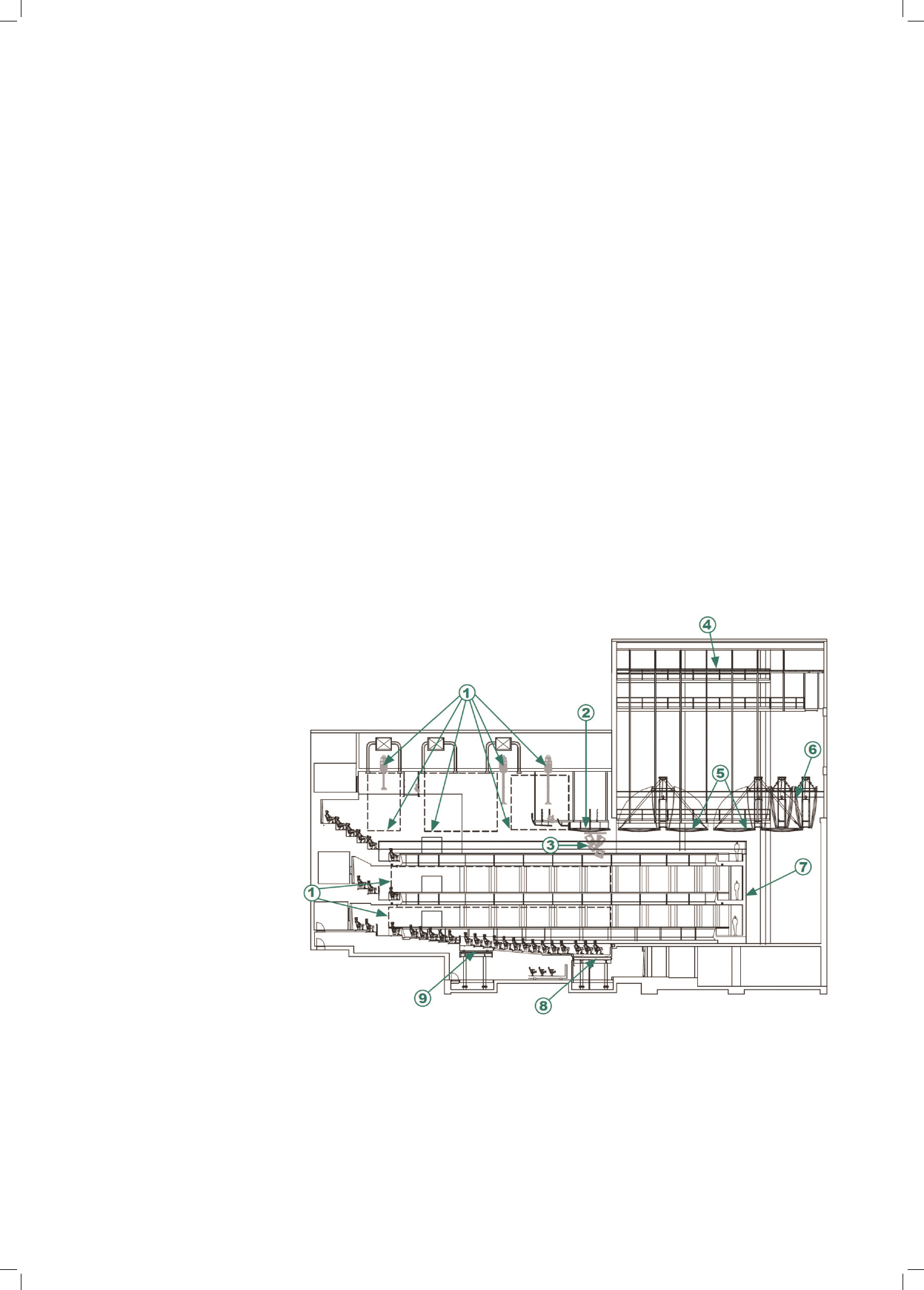
nię to dzięki adaptacji sceny i audytorium. Na ilustracji 7
lift lines, is attached to battens (a batten is a beam above
the stage to suspend scenery). The battens move from the
surface of the stage to the level of the fl y loft [11].
The orchestra shell may be designed as a solid en-
closure or as a set of panels brought together.
Orchestra shells cut the fl ytower off or they include it
in the auditorium space (Fig. 5). If the slits in the orchestra
shell connect the stage house with the auditorium, pieces
of scenery usually hanging there are removed, and the
whole area is considered as a reverberation chamber.
While designing an orchestra shell, one should also
allow for the style of the interior of an opera house. Good
solutions retain the unity of style with the auditorium. It
is an important issue, as many a time concerts are held by
a partly-lit auditorium. An example of a hall in which the
orchestra shell constitutes an extension of the auditorium
is Rose Theater at Jazz at Lincoln Center, USA (by Rafael
Viñoly Architects, ARTEC acoustics) (Fig. 6). The unity of
style of the enclosure and architecture of auditorium was
achieved by means of the continuation of the balconies in
the enclosure. Beside opera performances, the theatre is not
only used for jazz and classical music concerts, but is also
adapted for the needs of ballet and modern dance. The vast
array of options can be achieved through adaptation of the
stage. Figure 7 describes elements of acoustic adaption. On
the side walls there are acoustic banners and curtains which
can be extended to absorb energy during an amplifi ed music
performance. The fi xed acoustic “eyebrow” (in front of
the proscenium arch) refl ects sound energy to the audience
area (No. 2). The loudspeaker array cluster provides sound
Il. 5. Przekrój przez salę
z muszlą koncertową odcinającą
nadscenie i z muszlą koncertową,
która włącza nadscenie
w przes trzeń audytorium
(na podstawie [9])
Fig. 5. The longitudinal section
across the hall with an orchestra
shell cutting off the flytower
and with the orchestra shell
which includes the flytower
into the area of the auditorium
(on the basis of [9])
Il. 6. Rose Theater at Jazz at Lincoln Center w Nowym Jorku
(przedruk za zgodą Artec Consultants Inc, New York, USA)
Fig. 6. Rose Theater at Jazz at Lincoln Center in New York
(reprinted with permission of Artec Consultants Inc, New York, USA)
Modyfikacje przestrzenne sceny teatru operowego /
Spatial modifications of the stage of the opera house
79
opisane są elementy służące do adaptacji akustycznej.
Na bocznych ścianach znajdują się mobilne kurtyny
akustyczne, które po rozwinięciu służą do pochłania nia
dźwięku podczas koncertów z nagłośnieniem (na il. 7 oz-
na czone jako 1). Ekran akustyczny w obszarze pro sce nium
odbija dźwięk ze sceny i kieruje na widownię (2). Głośni-
ki dla produkcji muzycznych wymagających nagłośnie nia
znajdują się również w obszarze proscenium (3). Wieża
jest zapleczem technicznym na potrzeby przedstawień
scenicznych (4). Ruchome ekrany akus tyczne nad sceną
służą do odcięcia wieży scenicznej pod czas koncertu (5).
Ekrany akustyczne w pozycji zło żonej pokazano jako 6.
Zabudowa sceny tworząca ro dzaj muszli koncertowej
składa się z 11 paneli, które w sumie zapewniają miejsca
siedzące dla 124 osób (7). W obrębie audytorium znajdu-
ją się windy gwarantujące wielofunkcyjność sali (8 i 9).
Za budowa w postaci ru chomych paneli umożliwia róż-
ne rozwiązania. Można je obracać, żeby zapewnić doda -
t kowe miejsca siedzące na scenie lub dookoła niej, albo
odwrócić, aby zapewnić powierzchnię odbijającą dźwięk.
Jest to rodzaj zabudowy sceny, który różni się od ty po wej
muszli koncertowej ze względu na to, że w spo sób aktywny
wykorzystuje się przestrzeń sceny poza pa ne la mi. Dzięki
możliwoś ciom aranżacyjnym, jakie stwa rza ją panele, można
dostosować sposób dostarczania wcze snej i późnej energii
reinforcement during non-acoustic performances. Acoustic
ceilings shown in stored position are shown in No. 6. The
enclosure consists of 11 concert towers which provide seating
for 124 people (No. 7). The lifts in the auditorium enable
multifunctionality of the hall (No. 8 and 9). The enclosure
in the form of movable to wers promotes application of
different solutions. The to wers can be turned to provide
additional seating on or around the stage, or can be reversed
to provide a refl ective surface. This is an enclosure rather
than a shell because the space over the towers is used as part
of the active acoustic volume. The towers can be arranged
and adjusted so that early energy and late e
nergy can be
refl ected back to reach the musicians and the audience, the
result of which is a more balanced and homogeneous sound.
Thus, in com parison with an enclosed orchestra shell, the
movable ele ments of a concert enclosure offer considerable
fl exibility as far as stage acoustics are concerned.
Acoustic requirements for orchestra shells
The purpose of orchestra shells is to enable the audito-
rium to achieve acoustic conditions required for a concert.
To meet acoustic requirements, it is vital to pay special
attention to the material used for the construction of the
orchestra shell as well as the structure of the material.
Il. 7. Przekrój Rose Theater
at Jazz at Lincoln Center wraz
z opisem przyjętych rozwiązań
(przedruk za zgodą Artec
Consultants Inc, New York, USA)
Fig. 7. The longitudinal section
of the Rose Theater at Jazz
at Lincoln Center
along with the description
of the adapted solutions
(reprinted with permission
of Artec Consultants Inc,
New York, USA)
1. mobilne kurtyny akustyczne/acoustic banners and curtains
2. ekran akustyczny w obszarze proscenium/fixed acoustic “eyebrow”
3. głośniki/loudspeaker array cluster
4. wieża sceniczna/stage tower and flyloft
5. ruchome ekrany akustyczne nad sceną/retractable acoustic ceiling
6. ekrany akustyczne w pozycji złożonej/acoustic ceilings shown in stored position
7. panele/concert towers
8. winda/forestage lift
9. winda/house sound mix lift

80 Anna Sygulska
tak, by dotarła do muzyków i do audytorium. W rezultacie
uzyskiwany jest bardziej wy rów nany i jed no lity dźwięk.
Przedstawiony system w po równaniu z ty pową muszlą
koncertową zapewnia więk szą elastyczność aranżacji sceny.
Wymogi akustyczne stawiane muszlom koncertowym
Zabudowa sceny muszlą koncertową ma doprowadzić
do osiągnięcia na widowni warunków akustycznych odpo-
wiednich dla koncertu. Aby spełnić wymogi akustyczne,
należy zwrócić uwagę na materiał używany do konstrukcji
zabudowy sceny, jak również na jego strukturę.
Materiał użyty do konstrukcji
Muszla koncertowa powinna być zbudowana z ma -
syw nych paneli. Z danych zamieszczonych w lite ra -
turze przedmiotu wynika, że pozytywny efekt akus tyczny
zostanie osiągnięty, kiedy masa jednostkowa sto sowanych
elementów wyniesie od 5 do 10 kg/m
2
. W ba daniach opi -
sanych w pracy [3] muszle koncertowe peł niły fun kcję
wzmacniającą dźwięk przy masie około 8 kg/m
2
. Z prze-
prowadzonych przez autorkę badań w Teatrze Wiel kim
w Poznaniu wynika, że lekka zabudowa sceny nie powoduje
wzmocnienia dźwięku na widowni [12]. Pro wadzone
pomiary miały na celu określenie parametrów akustycznych,
takich jak czas pogłosu i poziom ciśnienia akustycznego na
widowni. W celu poznania wpływu mu szli koncertowej na
akus tykę widowni ocenie poddano dwa przypadki: scenę
pustą i scenę z muszlą koncertową
2
. Dla sceny z muszlą
koncertową średni poziom dźwięku na widowni zmalał
o mniej więcej 2,2 dB. Powodem tego są materiały użyte do
konstrukcji zabudowy w po staci cienkiej sklejki o grubości
3 mm. Również duża ilość wiszących tkanin za zabudową
powoduje sil ne po chłanianie dźwięku. Przy użyciu pro-
gramu kom pu te rowego RAY MODEL przeanalizowano
także zabudowę sceny muszlą kon certową w projekcie
Opery Kameralnej w Kaliszu [13]. Z badań tych wynika,
że po zastosowaniu muszli kon certowej nastąpiła znaczna
poprawa warunków akus tycznych na widowni. W analizach
numerycznych przy jęta zabudowa była masywna i szczelna,
tak więc na stąpił wzrost poziomu dźwięku na widowni, który
wy niósł od 4 do 6 dB w zależności od punktu pomiarowego
[12]. Czasami, aby uzyskać dobre wymieszanie dźwię ku
pomiędzy różnymi sekcjami orkiestry, stosuje się ma teriały
lekko pochłaniające dźwięk przy sekcji in stru mentów
blaszanych i perkusji. Takie rozwiązanie za sto sowano np.
w Academy of Music w Filadelfi i, gdzie za sekcją in stru-
mentów dętych blaszanych umieszczono płótno zamiast
masywnej przegrody [8].
Struktura materiału
Równowaga akustyczna (balance), wymieszanie dźwię -
ku
(blend) i zespołowość (ensamble) są istotnymi pa -
2
Badania wykonano metodą szumu przerywanego w sześciu pas-
mach oktawowych. Do pomiarów wykorzystano analizator dźwięku
Svan 912 AE.
Material used for construction
An orchestra shell should be built of massive panels.
The literature analyses show that a positive acoustic effect
will be attained when unit mass of the used elements
will be within the scope of 5 to 10 kg/m
2
. In the research
presented in paper [3], orchestra shells performed the
function of reinforcing sound with mass of about 8 kg/m
2
.
The research conducted by the author in the Teatr Wielki
in Poznań shows that a lightweight stage en closure does
not reinforce sound in the auditorium [12]. The aim of
the investigation was to determine acoustic parameters
such as reverberation time and sound pressure level in
the auditorium. To examine the infl uence of the con -
cert shell on the acoustics in the auditorium, two ca ses
were analyzed: an empty stage and a stage with a con-
cert shell
2
. The average sound pressure level in the au-
di torium diminished by about 2.2 dB. The reason for
this is the materials used to put up the enclosure, which
is 3 mm-thick plywood. Also, a huge number of hanging
fabrics behind the enclosure causes considerable sound
absorption. Additionally, the enclosure of the stage with an
orchestra shell in the design of Chamber Opera in Kalisz
was analyzed with the RAY MODEL computer program
[13]. The computer analyses show that after applying the
orchestra shell there was a huge improvement in acoustic
conditions in the auditorium. In numerical analyses, the
adopted enclosure was massive and tight. This resulted in
the increase of sound level in the auditorium, which was
from about 4 to 6 dB depending on the measuring point
in the auditorium [12]. Occasionally, to attain good sound
blend of different orchestra sections, materials slightly
absorbing sound are applied; the materials are placed by
the sections of brass and percussion instruments. Such
solution has been applied in the Academy of Music in
Philadelphia, where canvas has been applied in lieu of
a massive partition behind the section of brass wind in-
struments [8].
Structure of the material
The acoustic balance, sound blend, and ensemble are
substantial parameters for the stage design. Good acoustic
balance means that none of the groups of instruments
is dominant. Proper sound blend means that particular
instrument sections sound consistent, whereas ensemble
means good mutual hearing between all the sections of
the orchestra. Many factors have a crucial impact on the
parameters, e.g. location of the orchestra, proportions
of the stage, solutions for the walls and the ceiling as
well as structure of the material. Orchestra shells often
are designed so that the surface of the enclosure diffuses
sound. The effect of sound diffusion is attained by sur-
face texture, just like in the Eastmann Theater in New
York (architectural elements such as pilasters, cornices,
2
The investigations were carried out by means of interrupted noise
method in six octave bands. Sound Level Meter Svan 912 AE was used
for measurements.

Modyfikacje przestrzenne sceny teatru operowego /
Spatial modifications of the stage of the opera house
81
ra me trami dla projektowanej sceny. Dobra równowaga
aku styczna oznacza, że żadna z grup instrumentów nie
dominuje nad pozostałymi. Odpowiednie wymieszanie
dźwięku oznacza, że poszczególne sekcje instrumentów
brzmią spójnie. Natomiast zespołowość to dobra wzajemna
słyszalność pomiędzy poszczególnymi sekcjami or kie s-
try. Na parametry te decydujący wpływ ma wiele czyn-
ni ków, np. rozmieszczenie orkiestry, proporcje sceny,
roz wiązanie sufi tu i ścian, a także struktura materiału
uży tego do konstrukcji zabudowy. Muszle koncertowe
częs to projektowane są tak, aby powierzchnia zabudowy
roz praszała dźwięk. Efekt rozproszenia dźwięku uzy skuje
się poprzez rozrzeźbienie ścian i sufi tu muszli. Tego typu
rozwiązanie zastosowano w Eastmann Theater w No -
wym Jorku, gdzie zaprojektowano takie elementy ar-
chi tektoniczne, jak pilastry, gzymsy, boniowanie. Wy-
korzystuje się też inne zabiegi architektoniczne, między
innymi naprzemienne ułożenie materiałów o różnych włas -
nościach akustycznych (np. Teatro Comunale w Ca gliari),
panele z elementami w kształcie piramidek (Re cital Hall,
Wilfrid Laurier University w Ontario), ruszt z drewnianych
listewek (Opera Romo Valli w Reggio Emi lia) i inne. Ze
względu na akustykę ważne jest również rozwiązanie
obszaru proscenium. Jako przedłużenie sufitu muszli
koncertowej często montuje się tam ekrany. Mają one za
zadanie wzmacnianie dźwięku instrumentów smycz ko-
wych i tym samym niedopuszczenie do za głu szania ich
przez instrumenty znajdujące się w głębi sce ny, których
dźwięk jest wzmacniany przez tylną ścianę muszli [8].
Czas pogłosu
Pogłosowość pomieszczenia jest określana ilościowo
przez czas pogłosu. Jest to podstawowy parametr służą-
cy do opisania własności akustycznych pomieszczenia.
Czas pogłosu RT (reverberation time) jest to czas, po któ-
rym poziom natężenia dźwięku zmaleje o 60 dB po wyłą-
czeniu ciągłego źródła dźwięku. Oznacza się go na pod-
stawie krzywej zaniku dźwięku. Czas pogłosu można też
obliczyć teoretycznie w sposób przybliżony na podstawie
znajomości współczynników pochłaniania dźwięku mate-
riałów, z których wykonane jest wnętrze pomieszczenia.
Ma tutaj zastosowanie wzór Sabine’a (1):
(1)
gdzie:
RT – czas pogłosu [s],
V – objętość pomieszczenia [m
3
],
A = Sα
– całkowita chłonność akustyczna [m
2
]
S –
pole powierzchni wewnętrznej pomieszczenia [m
2
]
α
– średni współczynnik pochłaniania dźwięku
Z powyższego wzoru wynika, że na czas pogłosu ma
wpływ kubatura i użyte materiały wykończeniowe. Czas po-
głosu jest wprost proporcjonalny do kubatury, czyli im więk-
sza objętość, tym dłuższy czas pogłosu. Natomiast wpływ
materiałów związany jest ze współczynnikiem α. Współ-
czynnik pochłaniania dźwięku α jest używany do oceny
stopnia pochłaniania dźwięku przez materiał. Całkowite po-
chłonięcie dźwięku oznaczone jest przez α = 1, natomiast
rustication). Also, other architectural solutions are applied,
such as the alternate use of materials of different acoustic
features, like in Teatro Comunale in Cagliari; panels with
pyramid-shaped elements in Recital Hall, Wilfrid Laurier
University in Ontario, a grid of wooden slats in the Romo
Valli Opera House in Regio Emilia and others. For the
sake of good acoustics, a solution to the issue of the pro-
sce nium area is also important. Thus, acoustic screens
are often placed there as the extension of the ceiling of
the orchestra shell. The acoustic screens are to reinforce
sound of string instruments and to prevent them from
being drowned out by instruments located more deeply
into the stage, whose sound is reinforced by the back wall
of the orchestra shell [8].
Reverberation time
Reverberation is described quantitatively by reverber-
ation time. This is a basic parameter used to determine
acoustic properties of the interior. Reverberation time
(RT) is a measure of the rate of decay of sound. It is de-
fi ned as the time in seconds required for sound intensity in
a room to drop 60 dB from its original level [6].
Sabine’s equation is applied here (1):
(1)
where:
RT – reverberation time [s]
V – volume of room [m³]
A = Sα – total absorption of room [m
2
]
S – surface area [m²]
α – mean absorption coeffi cient
The above equation indicates that cubature and applied
fi nishing materials infl uence reverberation time. Rever-
beration time is proportional to cubature, i.e. the bigger
cubature, the longer reverberation time. The infl uence of
applied materials is connected with α coeffi cient. Absorp-
tion coeffi cients are used to rate material’s effectiveness
in absorbing sound. A perfect sound absorber will absorb
100% of incident sound; thus, α is 1.0. A perfectly refl ect-
ing surface would have α of 0.0. The absorption coeffi -
cient of a material varies with frequency. Coeffi cients are
typically published at the six standard frequencies of 125;
250; 500; 1000; 2000; and 4000 Hz [14].
The required reverberation time of a particular interior
depends on its function. The greater participation of
speech, the lower reverberation time the room should
have. As it was mentioned before, required reverberation
time for a concert is longer than for an opera. After
enclosing the stage with the orchestra shell, it often
happens that reverberation time is too short. In order to
lengthen reverberation time, different solutions are
applied. One of these is connecting the orchestra shell to
the stage house. What is attained in such a case is a kind
of reverberation chamber. The condition that must be met
in order to use the fl ytower as the reverberation chamber
is to remove sound absorbing materials situated there,
such as pieces of scenery. In opera halls or multi-pur-
pose halls used intensely for a variety of functions, there
RT =
0,161V
A
RT =
0.161V
A

82 Anna Sygulska
całkowite odbicie przez α = 0. Wartość współczynnika po-
chłaniania zależy od częstotliwości dźwięku i jest typowo
podawana dla sześciu pasm oktawowych, które wynoszą od-
powiednio: 125; 250; 500; 1000; 2000 i 4000 Hz [14].
Wymagany czas pogłosu pomieszczenia zależy od jego
funkcji. Im większy udział mowy, tym mniejszy pogłos
powinno mieć pomieszczenie. Jak wcześniej wspomnia-
no, wymagany czas pogłosu dla koncertu jest większy niż
dla opery. Po zabudowaniu sceny muszlą koncertową zda-
rza się, że czas pogłosu jest za krótki. W celu zwiększe-
nia czasu pogłosu stosuje się różne rozwiązania. Jedną
z możliwości jest połączenie muszli koncertowej z wieżą
sceniczną – tworzy się wtedy rodzaj komory pogłosowej.
Warunkiem wykorzystania nadscenia jako komory pogło-
sowej jest usunięcie znajdujących się tam materiałów po-
chłaniających dźwięk, takich jak elementy scenografi i.
W salach operowych lub wielofunkcyjnych wykorzys -
tywanych intensywnie dla różnych funkcji może się jed-
nak zdarzyć sytuacja, gdy ze względów organizacyjnych
niemo
żliwe będzie usunięcie scenografi i z nad scenia.
Wtedy przestrzeń wieży scenicznej zamiast zwięk-
szać czas pogło su będzie dźwięk po chła niać. Rozwiąza-
niem tego proble mu może być tzw. shaper wraz z ekra-
nami akustyczny mi [15]. Jest to jakby drugi sufi t, któ ry
zo staje opuszczo ny, aby odciąć część wieży scenicz nej
(il. 8). Również scenografi a wisząca w nadsce niu znajdu-
je się ponad shaperem. Do konstrukcji użyto masywnych
materiałów, w któ rych umieszczono również oświetlenie.
Zamontowanie shapera zajmuje około go dziny. Shaper
zastosowano między innymi w Bass Hall w Fort Worth
w Teksasie.
Farina, Fausti i Pompoli w swojej pracy [1] zalecają
usunięcie znajdujących się na widowni materiałów po-
chłaniających dźwięk, aby uzyskać wartości czasu po-
głosu od powiednie dla koncertu. W salach wielofunkcyj-
nych o regulowanej akustyce sytuacja jest prostsza, gdyż
audytorium ma przewidzianą możliwość regulacji czasu
pogłosu widowni. Widoczne jest zatem, że nie można roz-
patrywać akustyki muszli koncertowej w oderwaniu od
audytorium.
Wnioski
Adaptacja sceny na potrzeby koncertu jest niezbędna,
ponieważ koncert ma inne wymagania przestrzenne
i akustyczne niż przedstawienie operowe. Dobra adapta -
cja wymaga wielu zabiegów mających na celu odpo-
wiednie zaprojektowanie muszli koncertowej. Istotne jest
zarówno dostosowanie jej do architektury audytorium,
jak i wykonanie projektu zgodnego z wymaganiami
akustycznymi. Przede wszystkim muszla koncertowa
powinna mieć masywną konstrukcję, ponieważ zapewnia
to wzmocnienie dźwięku. Równie istotne jest, aby struktura
materiału, z którego zbudowana jest muszla, zapewniała
rozproszenie dźwięku. Kolejny wymóg stanowi za pew -
nienie odpowiedniego czasu pogłosu. W teatrach ope -
rowych czas pogłosu jest za krótki, należy zatem zwięk-
szyć pogłosowość wnętrza. Analizy wykazały, że możliwe
są różnorakie rozwiązania muszli koncertowych, które
spełniają akustyczne i architektoniczne wymagania.
may be a situation when, due to organizational issues, it
will be impossible to remove scenery from the fl ytower.
In such a case, the space of the stage house will absorb
sound instead of lengthening reverberation time. In order
to apply single acoustic screens above each instrument
section as well as to eliminate the absorbing area, one
applies the so-called “shaper” [15]. This is as a kind of
se cond ceiling, which is moved down so as to cut off
a part of the stage house (Fig. 8). Also, scenery hanging
in the fl ytower is situated above the “shaper”. For its
con struction massive materials were used in which also
lighting was placed. Installing the “shaper” takes one
hour or so. The “shaper” was installed inter alia in Bass
Hall in Fort Worth in Texas.
In paper [1], Farina, Fausti and Pompoli advise on
how to attain reverberation time values recommended
for the concert by removing sound absorbing materials
in the auditorium. This is much simpler in multi-purpose
houses with adjustable acoustics, as the auditorium is
architecturally adapted to regulate reverberation time
of the auditorium area. Therefore, acoustics of the or-
chestra shell cannot be considered in isolation from the
auditorium.
Conclusions
Adaptation of the stage for the needs of a concert is nec-
essary as spatial and acoustic requirements for a concert dif-
fer from those for an opera performance. An expert adapta-
tion involves a series of steps in order to properly design
a concert shell whose congruence with the architecture of
the auditorium is as important as the acoustic requirements.
In the fi rst place, the concert shell should have a solid con-
struction since this quality ensures sound reinforcement.
Next, the structure of the material should ensure sound
dif
fusion, and appropriate reverberation time should be
con sidered, too, because it is, as a rule, too short in opera
houses. Therefore, the reverberation time of the interior
must be increased. Analyses show that actually various con -
cert shells can meet acoustic and architectural conditions.
Translated by
Kamila Korus
Il. 8. Ilustracja idei shapera (oprac. autorki)
Fig. 8. The illustration of the idea of the shaper (drawn by the author)

Modyfikacje przestrzenne sceny teatru operowego /
Spatial modifications of the stage of the opera house
83
Bibliografia /References
[1] Farina A., Fausti P., Pompoli R., The acoustical shell of the “Nuovo
Teatro Comunale” in Cagliari, [w:] Proceedings of the 15
th
Inter-
national Congress on Acoustics, Trondheim, Norway, 26–30 June,
1995, Vol. 2, 449–452.
[2] Design guide: music and drama centers, Department of Defense
USA, UFC 4-740-08AN, 1 March 2005.
[3] Bradley J.S., Some effects of orchestra shell, „Journal of the
Acoustical Society of America” 1996, 100(2), 889–898.
[4] Pompoli R., Farina A., Fausti P., The acoustics of the „Nuovo
Teatro Comunale” in Cagliari, [w:] Proceeding of the 1995 In-
ter national Auditoria Conference „Opera and Concert Hall
Acoustics”, London Gatwick 10–12 Feb. 1995, http://pcfarina.eng.
unipr.it/Public/Papers/062-IOA95 [accessed: 29.08.2014].
[5] Fausti P., Prodi N., On the testing of renovations inside histori-
cal ope ra houses, „Journal of Sound and Vibration” 2002, 258(3),
563–575.
[6] Orlowski R., Multi-purpose halls and variable acoustics, „Inter-
national Congress Forum Acusticum Sevilla 2002, Sevilla, Spain,
September 16–20, 2002”, http://webistem.com/acoustics2008/
acoustics2008/cd1/data/fa2002-sevilla/forumacusticum/archivos/
rba02010.pdf [accessed: 29.08.2014].
[7] Cocchi A., Garai M., Tavernelli C., Boxes and sound quality in
an Italian opera house, „Journal of Sound and Vibration” 2000,
232(1), 171–191.
[8] Beranek L.L., Music, acoustics and architecture, John Wiley and
Sons, New York–London 1962.
[9] Egan M.D., Architectural acoustics, McGraw-Hill, New York 1988.
[10] Izenour G.C., Theater design, Yale University Press, New Heaven
1996.
[11] Wojciechowski M., Projektowanie w zakresie techniki i technologii
teatralnej, wykład 21 maja 2002 w siedzibie Opery Krakowskiej.
[12] Sygulska A., The adaptation of the stage in opera house for
concert, [w:] 58
th
Open Seminar on Acoustics, 13–16 September
2011, Gdańsk–Jurata, Polskie Towarzystwo Akustyczne Oddział
Gdański, German Acoustical Society DEGA, Gdańsk–Jurata, 2011,
T. 2, 297–308.
[13] Kulowski A., Algorithmic representation of the ray tracing tech-
nique, „Applied Acoustics” 1985, 18, 449–469.
[14] Everest F.A., Pohlmann K.C., Master handbook of acoustics,
5
th
ed., McGraw Hill, USA 2009.
[15] Jaffe J.C., Innovative approaches to the design of symphony halls,
„Acoustical Science and Technology” 2005, 26, 2, 240–243.
Streszczenie
Teatr operowy jako przestrzeń kulturalna i muzyczna jest wpisany w strukturę przestrzenną miasta. W obrębie swojej struktury architektonicznej
podlega modyfi kacjom. W pracy podjęto problematykę przystosowania sceny operowej na potrzeby koncertu. Adaptacja sceny jest niezbędna, gdyż
przedstawienie operowe stawia inne wymagania przestrzenne i akustyczne niż koncert. Wraz ze zmianami przestrzennymi w obrębie sceny następu-
ją zmiany własności akustycznych na widowni. Na podstawie konkretnych realizacji przedstawiono różne typy muszli koncertowych oraz wskaza-
no powiązania pomiędzy architekturą muszli koncertowej a akustyką. Dodatkowo przedstawiono wnioski z symulacji komputerowych dla obiektu
projektowanego i z badań doświadczalnych w obiekcie rzeczywistym. Analizy wskazują, że jest to istotne zagadnienie architektoniczne, albowiem
brak wiedzy o wymaganiach architektoniczno-akustycznych dla projektowanych muszli koncertowych skutkuje tym, że konstrukcja ta nie spełnia
swojej funkcji.
Słowa kluczowe: muszle koncertowe, teatr operowy, scena operowa, koncert
Abstract
The opera house as a cultural and musical area writes itself well into the spatial structure of the city. Within its own architectural structure, it is subject
to modifi cations. The following paper addresses the issue of adapting the opera stage for the needs of a concert. Adaptation of the stage is necessary as
the opera performance has different spatial and acoustic requirements from those of the concert. Alongside spatial changes within the stage, acoustic
properties in the auditorium change. On the basis of concrete realizations, different types of orchestra shells have been shown and connections
between orchestra shell architecture and acoustics have been pointed out. In addition, conclusions of computer simulations for an object whose design
is under way, and conclusions of investigation in an actual object have been presented here. The analyses point out that it is a crucial architectural
issue. Lack of knowledge of architectural-acoustic requirements for orchestra shells results in constructions not performing their function.
Key words: orchestra shells, opera house, opera stage, concert
Katedra we Fromborku,
dekoracja ściany kruchty zachodniej
(fot. E. Łużyniecka)
The cathedral in Frombork,
wall decoration of the west vestibule
(photo by E. Łużyniecka)