2026
1(85)
DOI: 10.37190/arc260109
© by the Author/Authors. Licensee WUST.
Published in open access. CC BY-NC license.
Abstract
The article is dedicated to honouring the memory of Professor Rafał Czerner – a respected academic teacher, a scholar of ancient and medieval ar-
chitecture, the author of fundamental studies on the market‑block developments of Silesian towns and numerous publications on Egyptian architecture
and the conservation of monuments in Marina el‑Alamein, and long‑time head of the Department of History of Architecture, Art and Technology as well
as Chair of the Scientic Discipline Council of Architecture and Urban Planning at the Faculty of Architecture of Wrocław University of Science and
Technology.
Key words: Rafał Czerner, Wrocław, Marina el‑Alamein, archaeology, architecture, monuments conservation
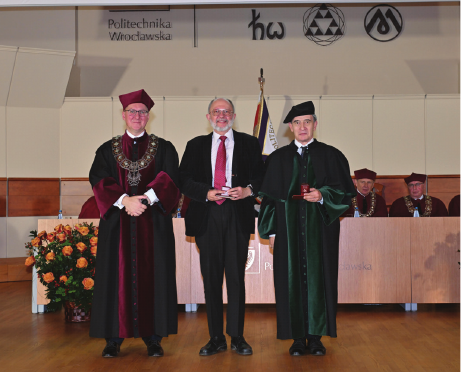
Professor Rafał Czerner, DSc, PhD, Eng., Architect,
long‑standing Head of the Department of the History of Ar-
chitecture, Art and Technology and Chair of the Scientic
Discipline Council for Architecture and Urban Planning at
the Faculty of Architecture of Wrocław University of Sci-
ence and Technology, passed away on 3 May 2024. His
departure left an immense void, yet above all it preserved
warm memories of a good and honest man, a kind and hu-
morous colleague, and an outstanding scholar and educator.
He will always remain with us as our Master, Friend, and
Mentor (Fig. 1).
Rafał Czerner was born on 3 March 1958 in Wrocław.
He completed his studies at the Faculty of Architecture of
Wrocław University of Science and Technology in 1982.
He obtained his doctoral degree in technical sciences in
1990 and his postdoctoral (habilitation) degree in 2003.
The title of Professor was conferred upon him in 2012.
In 1982 and again from 1983 to 1991, Rafał Czerner
completed professional internships with the architect and
structural engineer Stefan Du Chateau in Paris, and with the
architect Konrad Szabelewski in Monaco (working on the
revitalisation of the town of Castillon, France). In 1990 and
1993 he pursued conservation studies at the International
Course on the Conservation of Architectural Heritage at the
International Centre for the Study of the Preservation and
Restoration of Cultural Property (ICCROM) in Rome, as
well as at the 10
th
International Course on Stone Conser-
Our Masters
Professor Rafał Czerner
Fig. 1. Rafał Czerner in August 2008 (photo by G. Bąkowska‑Czerner)
Il. 1. Rafał Czerner w sierpniu 2008 (fot. G. Bąkowska‑Czerner)
98 Professor Rafał Czerner
vation organised by ICCROM and UNESCO in Venice. In
1992 he undertook professional practice in the oce of the
conservation architect Yves Boiret, Architecte en chef des
monuments historiques, in Paris.
From 1983 onward he was employed at the Institute
of the History of Architecture, Art and Technology at the
Faculty of Architecture of Wrocław University of Science
and Technology, holding the following positions: assistant
(1983–1993), assistant professor (1994–2003), assistant
professor with habilitation (2003–2008), associate pro-
fessor of Wrocław University of Science and Technology
(from 2008), and full professor (from 2012).
Between 2005 and 2014 he served as Deputy Director
of the Institute of the History of Architecture, Art and Tech-
nology at the Faculty of Architecture, and from 2014 he
held the position of Head of the Department of the History
of Architecture, Art and Technology. In 2020 he was ap-
pointed Chair of the Scientic Discipline Council for Ar-
chitecture and Urban Planning at Wrocław University of
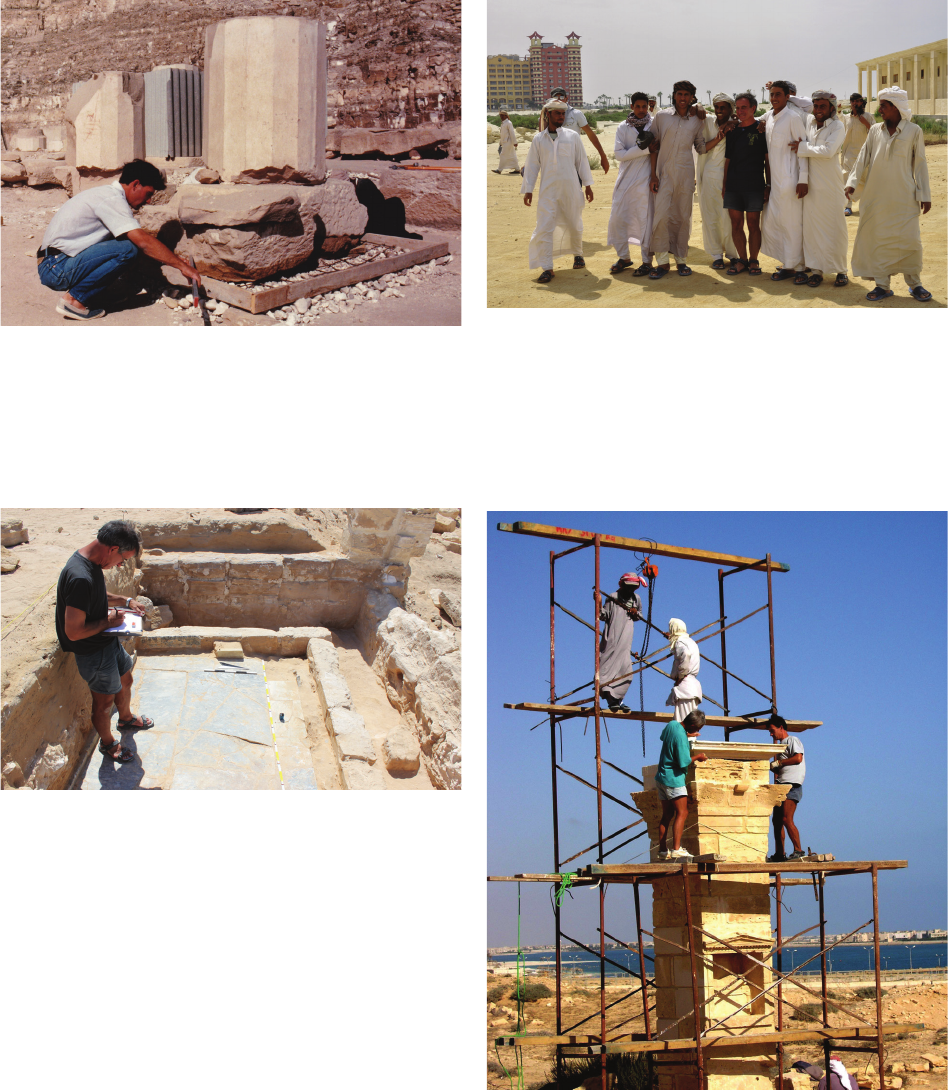
Science and Technology. In 2019 Professor Rafał Czerner
was honoured with the Wrocław University of Science and
Technology Award with Diamond Distinction (Fig. 2).
Rafał Czerner’s scholarly interests were closely con-
nected with the history of architecture and the preserva-
tion of architectural heritage, and were pursued in parallel
across four elds: the history of medieval architecture, the
history of ancient architecture, the history of contemporary
architecture, and monument conservation. His studies and
research on medieval architecture focused on Silesia, par-
ticularly on secular medieval urban architecture (Czerner
1994; 2002). Working predominantly within interdisci-
plinary architectural–archaeological teams, he examined
numerous burgher houses and churches in Silesian towns.
His most highly regarded contributions concerned the
so‑called intra‑market building complexes, as well as the
market squares and town halls of several major Silesian
cities, including Wrocław (Czerner, Lasota 2000). These
studies resulted from architectural and archaeological in-
vestigations undertaken in connection with conservation,
renovation, and reconstruction works carried out on these
structures – often on an unprecedented scale. This enabled
the formulation of a new research direction, at that time
pioneering in Poland and still of leading signicance: the
comprehensive reconstruction of the spatial development
of medieval urban centres based on integrated architectural
and archaeological research combined with the analysis of
written sources. As a result, Professor Czerner developed
new research methodologies and assembled an exception-
ally extensive body of study material.
Beyond intellectual tools, he often had to prepare his
working environment in the most literal sense. He used his
manual skills to build tables, cabinets, small instruments,
and even to repair oce equipment. One day, a colleague
found him in the former institute library repairing a type-
writer. Surprised, she asked what he was doing.
– I’m writing an article, he replied simply.
– Then why have you taken the typewriter apart?
– Because the “ś” isn’t working.
– Can’t you nish rst and x it afterwards? Or take it
to be repaired?
– No, in fact I can’t, because I’m writing about Środa
Śląska!
Rafał Czerner approached eldwork with great serious-
ness and deep personal commitment, yet at the same time
he often spoke about it with humour. One could frequently
hear him say, for example, that he was “sitting in a ravine”.
He would sometimes put on a straw hat and – parodying
a French accent – complain that a proper French archae-
ologist ought to be digging in Egyptian sand rather than in
Silesian mud.
This, of course, was connected with the second area of
his scholarly interests, which over time came to dominate
his academic output: ancient architecture and the conserva-
tion of its remains at archaeological sites. He participated
in numerous research expeditions to Macedonia, Bulgaria,
and Egypt, collaborating with distinguished scholars. He
conducted studies on ancient Egyptian, early Christian, and
Hellenistic–Roman architecture.
In 1984 and 1985 he took part in the investigation and
conservation of the Roman theatre at Heraclea (Bitola, Ma ‑
cedonia). From 1986 he was a permanent collaborator of
the Polish Centre of Mediterranean Archaeology of the Uni-
versity of Warsaw. In 1986 he joined the Polish–Egyptian
Conservation and Archaeological Mission at the Temple of
Thutmose III in Deir el‑Bahari, Egypt, where he worked un-
til 2000, conducting studies on the temple’s architecture and
overseeing the conservation of its in situ remains – initially
as deputy director and, from 1992, as director of conserva-
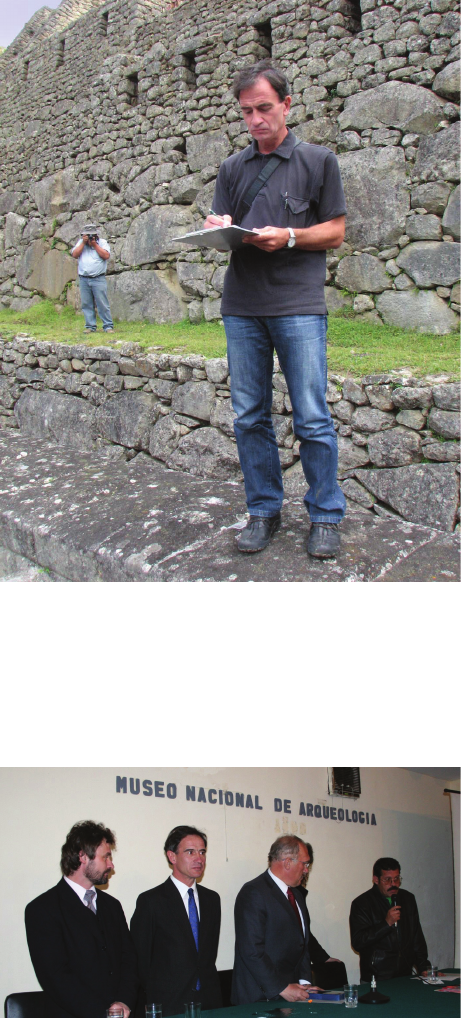
tion works (Fig. 3).
The discovery of the remains of the Temple of Thut-
mose III in 1961 was one of the greatest achievements of
Polish Egyptology. Building upon the architectural recon-
struction developed after the discovery by Professor Jad-
wiga Li piń ska and later by Professor Stanisław Medeksza,
Rafał Czer ner contributed further signicant ndings based
on his own research.
Fig. 2. Presentation of the Golden Badge of Wrocław University
of Science and Technology with Diamond in 2023
(source: family archive photograph provided by G. Bąkowska‑Czerner)
Il. 2. Wręczenie Złotej Odznaki Politechniki Wrocławskiej
z Brylantem w 2023 r. (źródło: fot. z archiwum rodzinnego
udostępniona przez G. Bąkowską‑Czerner)
Professor Rafał Czerner 99
From 1996 he served as a member and deputy director
of the Polish–Egyptian Conservation Mission at Marina
el‑Alamein (Wrocław University of Science and Technol-
ogy, University of Warsaw, and the Supreme Council of
Antiquities of the Arab Republic of Egypt), and from 2011
he organised the mission and directed its eldwork (Fig. 4).
He rarely limited himself to planning or even to supervising
the workers – who, incidentally, adored him (Fig. 5). He
would climb the scaolding himself and handle the stones,
although his archaeologist colleagues regularly reminded
him that stones were to be moved with one’s index nger,
and preferably without getting up from one’s chair (Fig. 6).
Passive observation of others at work was entirely foreign
to his nature. Whenever his hands were free, he produced
remarkably accurate situational sketches, capturing not
only architectural details but also the character of the indi-
viduals participating in the excavations.
In Marina el‑Alamein, from the very beginning, Profes-
sor Czerner conducted research on the architecture of the
Fig. 4. Rafał Czerner during conservation work in Marina el‑Alamein,
Egypt, in 2012 (source: family archive photograph
provided by G. Bąkowska‑Czerner)
Il. 4. Rafał Czerner podczas prac konserwatorskich
w Marina el‑Alamein (Egipt) w 2012 r. (źródło: fot. z archiwum
rodzinnego udostępniona przez G. Bąkowską‑Czerner)
Fig. 5. Rafał Czerner with workers in Marina el‑Alamein, Egypt,
in 2011 (source: family archive photograph
provided by G. Bąkowska‑Czerner)
Il. 5. Rafał Czerner z robotnikami w Marina el‑Alamein (Egipt)
w 2011 r. (źródło: fot. z archiwum rodzinnego udostępniona
przez G. Bąkowską‑Czerner)
Fig. 3. Rafał Czerner during work at the Temple of Thutmose III, Egypt
(source: family archive photograph provided by G. Bąkowska‑Czerner)
Il. 3. Rafał Czerner podczas prac w świątyni Totmesa III, Egipt
(źródło: fot. z archiwum rodzinnego udostępniona przez
G. Bąkowską‑Czerner)
Fig. 6. Rafał Czerner on scaffolding in Marina el‑Alamein, Egypt
(source: family archive photograph provided by G. Bąkowska‑Czerner)
Il. 6. Rafał Czerner na rusztowaniu w Marina el‑Alamein (Egipt)
(źródło: fot. z archiwum rodzinnego
udostępniona przez G. Bąkowską‑Czerner)
ancient city dating to the Hellenistic and Roman periods,
discovered there in 1986. He played a signicant role in the
scholarly development of the results obtained at this site.
In addition to advancing knowledge of ancient architecture
in a region where it had previously been little studied, his
particular achievement lay in his analyses of architectural
decoration and detail.
100 Professor Rafał Czerner
Rafał Czerner produced the rst scientic study of the
unique and highly distinctive architectural ornamentation
whose origins are associated with the region of Alexandria
and whose most prominent concentration today is found
at Marina el‑Alamein. Together with the discoverer of the
site, Professor Wiktor A. Daszewski, he introduced these
forms into academic discourse as the “Marina type”. He
characterised their similarities and dierences in relation
to Greek and Roman antiquity and identied their den-
Fig. 8. Rafał Czerner giving a lecture at the Archaeological Museum
in Lima (Peru) in 2008 (source: family archive photograph provided by
G. Bąkowska‑Czerner)
Il. 8. Rafał Czerner podczas wykładu w Muzeum Archeologicznym
w Limie (Peru) w 2008 r. (źródło: fot. z archiwum rodzinnego
udostępniona przez G. Bąkowską‑Czerner)
Fig. 7. Rafał Czerner working in Machu Picchu, Peru, in 2008
(source: family archive photograph provided by G. Bąkowska‑Czerner)
Il. 7. Rafał Czerner podczas pracy w Machu Picchu (Peru) w 2008 r.
(źródło: fot. z archiwum rodzinnego
udostępniona przez G. Bąkowską‑Czerner)
ing features. The results of these studies were published in
2009 in the British Archaeological Reports monograph The
Architectural Decoration of Marina elAlamein, as well as
in national and international articles (Czerner 2012; 2015;
Bąkowska‑Czerner, Czerner 2015; Czerner et al. 2017).
He was also the initiator of social life among the “mission-
aries”, as members of the archaeological mission referred to
themselves. Together with his wife, Grażyna Bą kowska‑
Czerner, and friends – Professor Stanisław Me dek sza, Piotr
Zambrzycki, and Wiesław Grzegorek – he formed an ex-
traordinary dance‑and‑vocal ensemble, famed for its spirited
performance of The Tokens’ The Lion Sleeps Tonight (Wi-
moweh), known widely from Disney’s lm The Lion King.
Since 2004, Rafał Czerner had been a member of the In-
ternational Interdisciplinary Archaeological Expedition at
Novae (Svishtov, Bulgaria), where he conducted studies on
the architecture of the baths of the Roman legionary camp
and the Byzantine episcopal complex (Biernacki, Czerner
2013). This work continued the longstanding research car-
ried out by the site’s discoverers and their successors. His
analyses resulted in a comprehensive study of the architec-
ture of the episcopal complex, including reconstructions of
its forms, functions, and the successive phases of its devel-
opment and transformation.
In connection with his scholarly interest in antiquity,
Rafał Czerner also undertook studies in ancient aesthet-
ics, followed later by research in modern aesthetics and,
ultimately, in the history of contemporary architecture – an
area that likewise became an intensively developed eld of
his work (Czerner, Widera 2004; Widera, Czerner 2009).
All of his studies on ancient architecture had practical
applications, as they were closely linked to the safeguarding
and conservation of historic remains carried out within ar-
chaeological – and above all conservation – missions in the
eld. On the basis of his research results, comprehensive
and later detailed conservation projects were prepared and
subsequently implemented under his supervision. This body
of work includes the execution of more than a dozen con-
servation and anastylosis projects for historic structures at
the site of Marina el‑Alamein, the long‑term conservation of
the remains of the Temple of Thutmose III in Deir el‑Bahari,
and the protection of relics at other archaeologi cal sites.
In 2007, Rafał Czerner was invited to collaborate with
the Polish Centre for Pre‑Columbian Studies. He began this
cooperation by delivering a series of lectures on the conser-
vation of monuments at archaeological sites, while simulta-
neously consulting conservation work in Peru (Maucallacta,
Cópan, Saqsaywaman, Machu Picchu) and Bolivia (Tiahua-
naco) (Figs. 7, 8). In 2008 he participated in another delega-
tion of the Polish Ministry of Science and Higher Education
to Peru, at the invitation of the Centro Nacional de Cultura
and the management of the Machu Picchu Archaeological
Park. His work focused on conservation consultations with-
in the park (Czerner, Martusewicz 2012). As a result of these
activities, the Centro Nacional de Cultura in Cusco invited
the mission members to continue their collaboration.
A specialised scholarly and professional background
in the conservation of monuments enabled Rafał Czerner
to develop the experience he had gained during advanced
training organised by the international conservation cen-
Professor Rafał Czerner 101
tre ICCROM and UNESCO, through professional practice
with the Paris conservator Yves Boiret, and through collab-
oration with art conservators from, among others, the Acad-
emy of Fine Arts in Warsaw and the Inter‑University Insti-
tute for the Conservation and Restoration of Works of Art.
He was a well‑known gure within the Polish academic
community, respected and recognised as an authority in the
study of medieval civic architecture and in the conservation
of architectural remains at archaeological sites. In the latter
eld in particular – closely linked with his studies of ancient
architecture – Rafał Czerner continues to be widely rec-
ognised and highly esteemed among scholars of Mediter-
ranean architecture and archaeology in Poland and abroad.
The results of his research were published in prestigious
academic journals and have been frequently cited by other
specialists. His ndings on the architecture of town halls and
commercial buildings within medieval intra‑market blocks
have been referenced by researchers in Poland (Goliński
2001), as well as in the Czech Republic (Čapský 2006) and
Germany (Bahlcke 2005). His studies on the architecture of
the temple of Pharaoh Thutmose III have been noted by Te ‑
re sa Bedman (2000) and Dieter Arnold (1994). His work on
the Hellenistic–Roman architecture of the site at Marina el‑
Alamein has likewise been cited (Bagnall, Rathbone 2004).
The international recognition of Professor Czerner’s ex-
pertise is evidenced by his admission to the International
Council on Monuments and Sites (ICOMOS), the Inter-
national Association of Egyptologists, and the German ar-
chitectural historians’ association Koldewey Gesellschaft.
Rafał Czerner actively participated in numerous academ-
ic conferences, most of them held outside Poland (Turin,
Cairo, Rhodes, Syracuse). Among these were events of the
highest importance: the International Congresses of Egyp-
tology organised by the Egyptian Museum in Turin and the
University of the Aegean, the International Symposium of
World Heritage Cities, and the International Congress of
Egyptology and Papyrology organised by the Istituto Italia-
no per la Civiltà Egizia (Fig. 9).
He delivered lectures at foreign academic institutions,
including Universität Karlsruhe, the Ponticia Universidad
Católica del Perú (Lima), the Museo Nacional de Arqueo‑
logía, Antropología e Historia del Perú (Lima) (Fig. 8), the
Colegio de Arquitectos del Perú (Arequipa), the Convento
de Santo Domingo – Qorikancha (Cusco), the Museo Na-
cional de Arqueología in La Paz (Bolivia), the Museo de
Tiwanaku (Bolivia), the Polish Centre of Mediterranean
Archaeology (Cairo), the National Museum in Alexandria
(Egypt), and during the Summer School in Piazza Armerina
(Sicily, Italy). In 2018 he organised the international confer-
ence “Greco‑Roman Cities at the Crossroads of Cultures”,
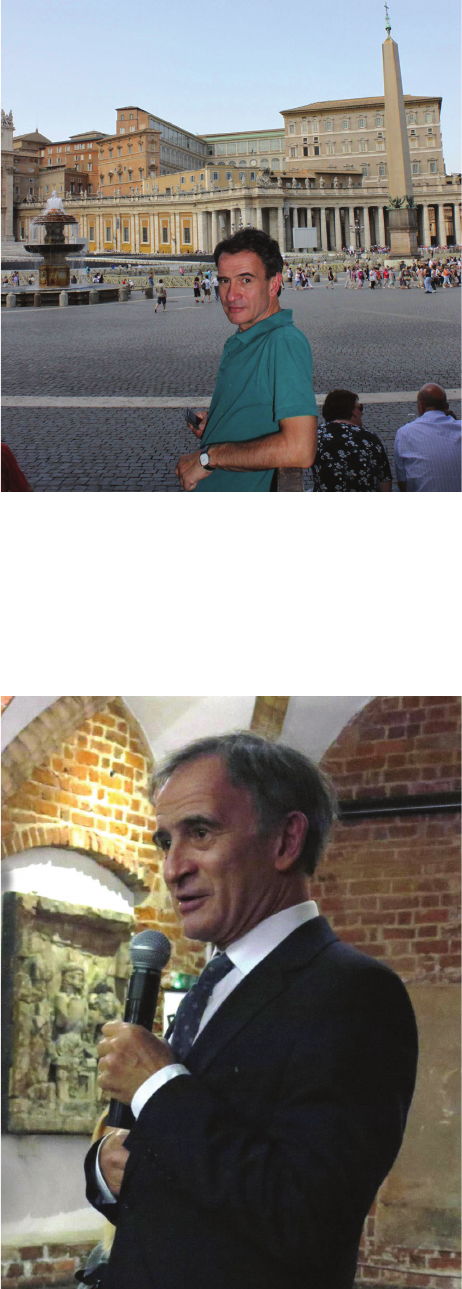
held at the Museum of Architecture in Wrocław (Fig. 10).
Rafał Czerner taught a wide range of courses, primarily at
the Faculty of Architecture of Wrocław University of Science
and Technology: seminars on the history of medieval and
early modern Polish architecture and on aesthetics; design
courses in the Conservation of Architectural Heritage and
Protection of the Cultural Landscape; lectures on the Con-
servation of Archaeological Remains; and classes in freehand
drawing, architectural and conservation inventory, and docu-
mentation. From 1998 he taught core lectures and seminars
Fig. 9. Rafał Czerner during a break at a conference on antiquity
in Rome in 2010 (source: family archive
photograph provided by G. Bąkowska‑Czerner)
Il. 9. Rafał Czerner podczas przerwy w konferencji na temat antyku
w Rzymie w 2010 r. (źródło: fot. z archiwum rodzinnego udostępniona
przez G. Bąkowską‑Czerner)
Fig. 10. Rafał Czerner giving a lecture at the Museum of Architecture
in Wrocław, 2015 (source: family archive photograph
provided by G. Bąkowska‑Czerner)
Il. 10. Rafał Czerner podczas wykładu w Muzeum Architektury
we Wrocławiu, 2015 (źródło: fot. z archiwum rodzinnego
udostępniona przez G. Bąkowską‑Czerner)

102 Professor Rafał Czerner
in the history of contemporary architecture, including courses
in English within the ERASMUS programme, and in 2003
also for the Faculty of Interior Architecture at the Academy
of Fine Arts in Poznań. He additionally taught a course on
design principles in the spatial planning programme.
He supervised student research eldwork, including (as
part of a team) a series of four international Polish–Ger-
man camps (Institute of the History of Architecture, Art and
Technology and the Institut für Baugeschichte of the Uni-
versity of Karlsruhe) devoted to the inventory and study of
wooden churches in Silesia. For his achievements in teach-
ing he received numerous awards from the Dean of the Fac-
ulty of Architecture and the Rector of Wrocław University
of Science and Technology. Yet the greatest reward for him
was the recognition and aection of his students, who al-
ways attended his classes in large numbers and expressed
the highest praise in course evaluations.
Rafał Czerner supervised ve completed doctoral disser-
tations at the Faculty of Architecture of Wrocław Univer-
sity of Science and Technology, the rst of which received
a Distinction from the Minister of Infrastructure in 2009.
The research results of this dissertation were published as
a monograph, and the intensive continuation of studies in
this pioneering eld led to their presentation at internation-
al symposia and in academic articles. The thematic scope
of the dissertations prepared under his supervision contin-
ued and expanded his own research interests: the history of
contemporary architecture and studies on ancient architec-
ture. He also contributed to the training of academic sta
within foreign archaeological and conservation missions.
He authored reviews of doctoral dissertations as well as
one habilitation dissertation and its accompanying schol-
arly output. He served as a member and chair of numerous
committees responsible for habilitation proceedings.
Particularly noteworthy is Professor Czerner’s long ‑stand ‑
ing work on organising and rening the specialised stu dy
programme Heritage Conservation at the Faculty of Ar chi‑
tecture of Wrocław University of Science and Tech no logy
(1998–1999). This was a pioneering achievement and re-
mains the only full‑time programme of its kind oered at
schools of architecture in Poland.
In 2022, together with an interdisciplinary team that
in cluded archaeologists, architects, and art conservators,
Rafał Czerner established a new Polish–Egyptian Conser-
vation Mission at El Darazya/Marina el‑Alamein (Bąkow‑
ska‑Czer ner, Czerner 2023). He was its founder and direc-
tor. Until the very last days of his life, he hoped to continue
leading this mission. The newly identied archaeological
site will remain his legacy for future generations of re-
searchers.
Professor Rafał Czerner, apart from the international or-
ganizations already mentioned, also belonged to national
scholarly associations, the most important of which were:
– Association of Monument Conservators
– Association of Art Historians
– Committee on Architecture and Urban Planning of the
Polish Academy of Sciences, Wrocław branch
– Committee on the Archaeology of the Mediterranean
Countries of the Polish Academy of Arts and Sciences
(from 2016)
– Scientic Council of the Institute of Mediterranean
and Oriental Cultures of the Polish Academy of Sciences
(term 2019–2022).
The scholarly output of Rafał Czerner comprises 128
works. These include historical‑architectural studies, archi-
tectural‑conservation analyses, reports on the results of archi-
tectural‑archaeological research and conservation work, as
well as expert opinions and conservation recommendations.
They concern sites in Wrocław and Lower Silesia, as well as
foreign archaeological sites of antiquity, primarily in Egypt.
Professor Rafał Czerner was a world‑renowned research-
er, a person of versatile talents and exceptional intel li gence.
At the same time, he was remarkably modest, and any men-
tion of his achievements was usually met with a joke or an
embarrassed smile. Few people knew that he was closely
related to Stanisław Lem, and only a circle of close friends
knew the stories “from the Lem family couch”. When asked
why he mentioned this so rarely, he re plied that he did not
want family history to be interpreted as claiming credit
through a famous uncle.
Rafał Czerner was one of those rare people who, when
faced with a choice between their own benet and that of
another person, would never choose their own comfort if
it meant causing someone harm. Even when someone took
advantage of his kindness and integrity, he simply could not
act otherwise. Until his last moments he retained a boyish
freshness and a brilliant sense of humour, combining them
with a very high level of personal culture and tact. His
charming anecdotes and situational jokes will remain in
our memory. Once, as a joke, he and his colleagues – art
conservators – fabricated a small triptych and planted it for
another colleague at the spot where he was conducting exca-
vations. They hid, waiting impatiently for the “epoch‑mak-
ing discovery”. When it nally happened, they tried to keep
straight faces, but their creation turned out to be so good,
and the discoverer’s enthusiasm so great, that they quickly
confessed and began apologizing.
Rafał also had plenty of self‑irony. Once he joked about
his eyesight, saying that either he had to buy glasses or
I had to buy a bigger car, because if he couldn’t see it in the
parking lot, then the car must be too low. I protested that my
car was not low at all, only sporty, which he answered with
laughter. A few days later, when I asked whether he would
hang the curtains in our freshly repainted oce at the uni-
versity, he replied that unfortunately he was “too sporty”
for that task and would have to borrow a ladder. Another
time, when he received a book about his favourite artist,
Henri Matisse, for his birthday, I joked that before opening
the present he had to promise that even if he already had
something similar, he should pretend he didn’t. He imme-
diately exclaimed, “A book? Never! Not a single one!” He
was already a full professor at the time. This joyful and kind
Professor is the one we will remember, because although
he never became the dean of the Faculty of Architecture, he
was undoubtedly its heart.
Barbara Widera
*
* ORCID: 0000‑0003‑0218‑8038. Faculty of Architecture, Wrocław
University of Science and Technology, Poland, e‑mail: barbara.widera@
pwr.edu.pl
Professor Rafał Czerner 103
Arnold, Dieter. Lexikon der ägyptischen Baukunst. Artemis and Winkler,
1994.
Bagnall, Roger S., and Dominic W. Rathbone, eds. Egypt from Alexander
to the Copts. An Archaeological and Historical Guide. British Muse-
um Press, 2004.
Bahlcke, von Joachim, ed. Historische Schlesienforschung. Methoden,
The men und Perspektiven zwischen traditioneller Landesgeschichtss-
chreibung und moderner Kulturwissenschaft. Böhlau, 2005.
Bąkowska‑Czerner, Grażyna, and Rafał Czerner. “El Darazya – Marina
el‑Alamein. La prima campagna della Missione di Restauro Polac-
co‑Egiziana.” In Atti del XX Convegno di Egittologia e Papirologia,
Siracusa, 30 Settembre – 3 Ottobre 2021, edited by Anna Di Natale,
Corrado Basile. Istituto internazionale del papiro, 2023.
Bąkowska‑Czerner, Grażyna, and Rafał Czerner. “Le inuenze dell’Oc-
cidente romano sull’antica città di Marina el‑Alamein in Egitto.”
In L’Africa romana. Momenti di continuità e rottura: bilancio di
trent’anni di convegni L’Africa romana: atti del XX Convegno Inter-
nazionale di studi, Alghero, 26–29 settembre 2013, edited by Paola
Ruggeri. Carocci editore, 2015.
Bedman, Teresa. El Templo Hatshepsut en Deir el Bahari. La escalera ha-
cia el cielo el dios de Tebas. Instituto de Estudios del Antiguo Egipto,
Madrid 2000.
Biernacki, Andrzej, and Rafał Czerner. Biskupstwo w Novae (Moesia Se-
cunda) IV–VI w.: historia, architektura, życie codzienne. T. 1: Histo-
ria i architektura. Wydawnictwo Poznańskie, 2013.
Ĉapský, Martin. Vévoda Přemek Opavský (1366–1433): ve službách po-
sledních Lucemburků. Matice moravská, 2005.
Czerner, Rafał. “Architecture of the temple of Tutmosis III at Deir el‑Ba-
hari. Some remarks on the hypostyle hall: study on architectural ele-
ments of the roof structure.” In Proceedings of the Tenth International
Congress of Egyptologists, Rhodes, 22–29 May 2008, edited by Pa-
nagiotis Kousoulis and Nikolaos Lazardis. Peeters, 2015.
Czerner, Rafał. “Kapitel uproszczony czy stylizowany? Dalszy ciąg dys-
kusji.” In Nie tylko trony. Księga jubileuszowa oarowana profesoro-
wi Ernestowi Niemczykowi, edited by Janusz L. Dobesz, Agnieszka
Gryglewska and Marta M. Rudnicka‑Bogusz. Ocyna Wydawnicza
PWr, 2012.
Czerner, Rafał. “The monumentality retrieved, in other words the anas-
tylosis of the pillar funerary monuments of Marina El‑Alamein.” Ar-
chitectus 43, no. 3 (2015): 5–12. https://doi.org/10.5277/arc150301.
Czerner, Rafał. Ratusz w Brzegu. Ocyna Wydawnicza PWr, 1994.
Czerner, Rafał. Zabudowy rynków: Średniowieczne bloki śródrynkowe
wybranych dużych miast Śląska. Ocyna Wydawnicza PWr, 2002.
Czerner, Rafał, and Barbara Widera. “Interpretacja tradycji w szwajcar-
skiej architekturze współczesnej.” In Ta Szwajcaria to nie Szwajca-
ria. Studia nad kulturową tożsamością narodu, edited by Marek Ha-
łub, Dariusz Komorowski and Ulrich Stadler. Wydawnictwo UWr,
2004.
Czerner, Rafał, and Czesław Lasota. “Średniowieczne murowane obiekty
handlowe na rynku wrocławskim.” In Średniowieczny Śląsk i Czechy.
Centrum średniowiecznego miasta. Wrocław a Europa Środkowa,
edited by Jerzy Piekalski and Krzysztof Wachowski. Instytut Archeo‑
logii UWr, AKME Zdzisław Wiśniewski, 2000.
Czerner, Rafał, and Jacek Martusewicz. “Resultados de las investiga-
ciones realizadas en los terrenos del Parque Arqueológico Machu
Picchu (Perú) por la Misión Arqueológica y de Conservación polaca
enviada por el Ministerio de la Cultura y el Patrimonio Nacionales
y por el Ministerio de Asuntos Exteriores (República de Polonia) en
el año 2008.” Estudios Latinoamericanos 32 (2012): 131–91. https://
doi.org/10.36447/Estudios2012.v32.art7.
Czerner, Rafał, Grażyna Bąkowska‑Czerner, Wiesław Grzegorek, and
Piotr Zambrzycki. “Research and conservation in Marina el‑Alamein
in 2016 (Polish‑Egyptian Conservation Mission).” Polish Archaeo
logy in the Mediterranean 26, no. 1 (2017): 85–107. https://doi.
org/10.5604/01.3001.0012.1770.
Goliński, Mateusz. Historia Wrocławia: Od pradziejów do końca czasów
habsburskich. Wydawnictwo Dolnośląskie, 2001.
Widera, Barbara, and Rafał Czerner. “Architektura współczesna Wrocła-
wia.” In Oblicza Wrocławia: historia, kultura, rozwój, edited by To-
masz Woźniakowski. VIA NOVA, 2009.
References
Acknowledgements
The article uses fragments of the professorial application prepared in
2012 by Rafał Czerner, as well as photographs from the family archive,
made available by Dr Grażyna BąkowskaCzerner, the wife of Professor
Czerner.
Streszczenie
Profesor Rafał Czerner
Artykuł poświęcony jest upamiętnieniu sylwetki Profesora Rafała Czernera – cenionego nauczyciela akademickiego, badacza architektury staro-
żytnej i średniowiecznej, autora fundamentalnych opracowań dotyczących zabudowy śródrynkowej miast śląskich i licznych publikacji poświęconych
architekturze Egiptu oraz konserwacji zabytków w Marina el‑Alamein, wieloletniego kierownika Katedry Historii Architektury Sztuki i Techniki, Prze-
wodniczącego Rady Dyscypliny Naukowej Architektura i Urbanistyka na Wydziale Architektury Politechniki Wrocławskiej.
Słowa kluczowe: Rafał Czerner, Wrocław, Marina el‑Alamein, archeologia, architektura, konserwacja zabytków
