2016
4(48)
DOI: 10.5277/arc160402
Marzanna Jagiełło*, Wojciech Brzezowski*
Ogrody rezydencji gorzanowskiej w XVII i XVIII w.
Gardens of Gorzanów residence in the 17
th
and 18
th
centuries
W
1
„Roczniku Historii Sztuki” opublikowanym w 2009 r.
ukazał się obszerny artykuł znanego badacza dziedzictwa
śląskiego Krzysztofa Eysymontta poświęcony „rezyden-
cji i ogrodom Herbersteina w Gorzanowie” [2]. Sta
nowi
on rozwinięcie rozważań na temat tego zespołu pod ję
tych w ramach wcześniejszego opracowania jego autor
stwa, trak tującego o śląskich założeniach ogrodowych
z 2. po
łowy XVII w., do których włączony także zo stał
ogród leżący na terenie hrabstwa kłodzkiego [3], [4].
Niewyjaśnione w tekście przyczyny takiej decyzji po
ciągnęły za sobą liczne, ujęte jako wspólne, odniesienia
do ówczesnej sztuki ogrodowej tworzonej w obrębie sze
roko rozumianej niemieckiej strefy językowej (czyli krain
I Rzeszy, której częścią były Czechy), choć z powodu
bez pośrednich związków państwowych należałoby ich
szu kać raczej w królestwie czeskim, a sięgając nieco sze-
rzej, na terenie ówczesnej monarchii austriackiej
2
.
Jednocześnie jednak nie można przecież całkiem wy
kluczyć artystycznych związków hrabstwa ze Śląs kiem,
i to co najmniej z dwóch powodów. Po pierwsze z racji
* Wydział Architektury Politechniki Wrocławskiej/Faculty of Ar
chi tecture, Wrocław University of Science and Technology.
1
„Piękny Gorzanowie/Hiszpan to ci powiedział:/Gdybyś był w in
nym miejscu/Byłbyś rajem” [1, s. 369].
2
Hrabstwo kłodzkie od 1534 r. (z przerwą na lata 1537–1567) do
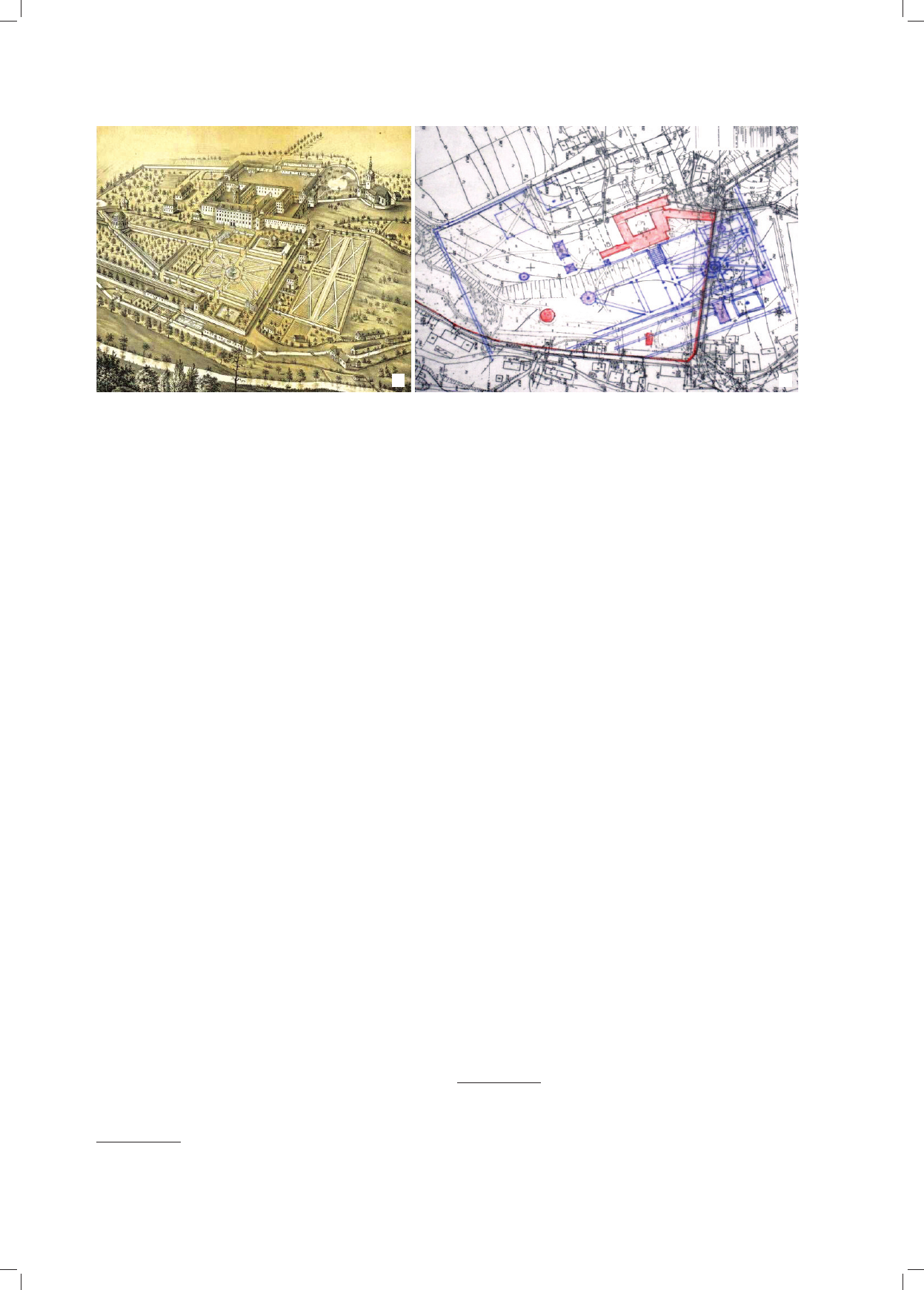
1742 r. podlegało bezpośrednio królowi Czech.
In
1
the “Rocznik Historii Sztuki” published in 2009
there was a comprehensive article by Krzysztof Eysy
montt, a wellknown researcher of the Silesian Heritage,
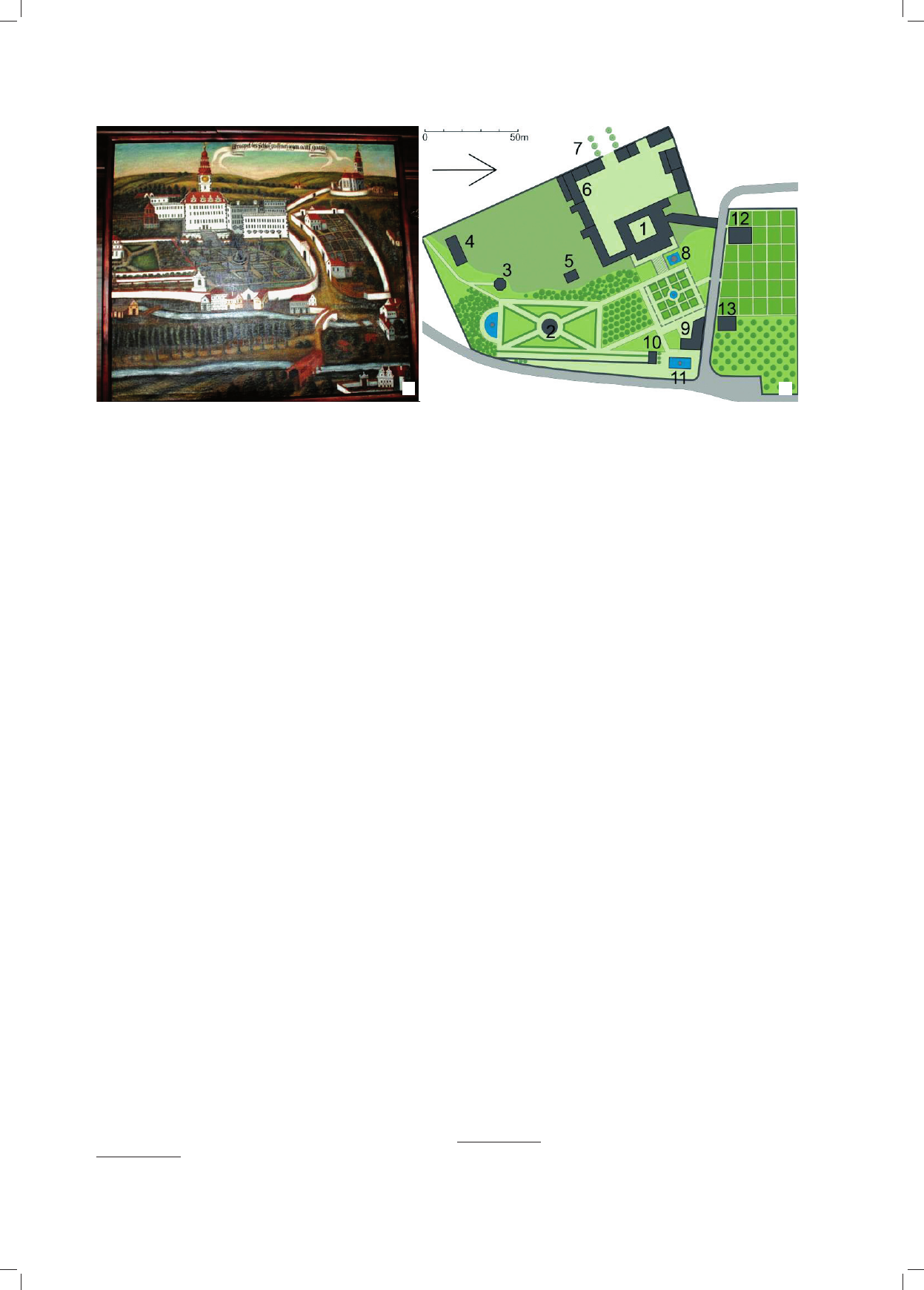
which was dedicated to “Herberstein residence and gar-
dens in Gorzanów” [2]. It constituted a continuation of
reflections on this complex that was undertaken within
the framework of this author’s former study dedicated to
the Silesian garden layouts from the 2
nd
half of the 17
th
century, which also comprised the garden situated in the
area of the County of Kłodzko [3], [4].
The reasons for this decision, which were unexplained
in the text, entailed numerous, considered as common,
references to the then garden art that was created within
the areas of widely understood German speaking coun-
tries (namely the lands of the First Reich that also includ-
ed Bohemia), although due to direct relationships of the
state they should rather be searched for in the kingdom of
Bohemia and even on a broader scale in the territory of
the contemporary monarchy of Austria
2
.
At the same time, however, artistic relations of the
county with Silesia cannot be completely ruled out and
there are at least two reasons for this. Firstly, because of
1
“Beautiful Gorzanów/Spaniard told you this:/If you were in
another place/You would be a paradise” [1, p. 369].
2
The County of Kłodzko since 1534 (with a break in the years
1537–1567) till 1742 was subordinate directly to the King of Bohemia.
Du schönes Grafenort,
Ein Spanier sagt Dir dies:
Wärst Du an einem anderen Ort,
Du wärst ein Paradies
1
.

24 Marzanna Jagiełło, Wojciech Brzezowski
powiązań majątkowych i rodzinnych, czego przykładem
choćby rodzina Herbersteinów. Otóż brat właściciela Go
rzanowa Hansa Arbogasta von Herbersteina – Johann
Bern hardt II (1630–1685) pełnił wysokie funkcje urzędo-
we na Śląsku, będąc kolejno starostą wrocławskim (1671–
1672) i głogowskim (1673–1685), a w skład jego majątku
wchodził m.in. dom z ogrodem na terenie podwrocław-
skiego Ołbina oraz pałac w Brzegu Głogowskim
3
przebu-
dowany w latach 1671–1685 przez warsztat Carla Luragi
(1615–1684)
4
.
Nie sposób także pominąć pośrednich inspiracji płyną-
cych z głębi cesarstwa, a to za sprawą rozlicznych podró-
ży po Europie (edukacyjnych, służbowych, towarzy-
skich), które były udziałem przedstawicieli ówczesnego
establishmentu. Odwiedzano w ich trakcie także ogrody,
zwłaszcza te najsłynniejsze, towarzyszące rezydencjom
elektorskim w Monachium i Heidelbergu, cesarskiej Neu
ge bäude, arcy biskupiej w Hellbrunn i ksią żęcych w Kö
then i Stuttgarcie
5
. Ich niewątpliwą „zasługą” było wy
znaczenie „wielkodworskich” standardów funkcjonalnych
ogrodów, czego przykładem choćby ostatnie z przywoła-
nych założeń, na którego terenie (w latach 1611–1644)
oprócz okazałego Lusthausu
6
(z salą reprezentacyjną, ga
binetami osobliwości, galeriami i wieżami widokowymi),
budynku Ballhausu, wydzielonych ogrodów ozdobnych
z licznymi fontannami, w tym labiryntu z centralnie usy-
tuowanym pawilonem letnim oraz ogrodu pomarańczo-
wego z rozbieraną na lato pomarańczarnią, wybudowano
również wolnostojącą grotę ze sztukami wodnymi (m.in.
wodnymi organami). Na terenie Lustgarten wyznaczono
też tory wyścigowe, strzelnice (dla kusz) oraz urządzono
królikarnię i ptaszarnię dla czapli oraz żurawi [10, s. 65],
a w pobliżu wytyczono obszerny zwierzyniec.
Wymianie poglądów na zagadnienia związane ze sztu-
ką sprzyjały także różne stowarzyszenia obejmują ce swo-
im zasięgiem cały obszar nationis germaniae. Pośród naj-
bardziej wpływowych wymienić można elitarne
Frucht bringende Gesellschaft założone w 1617 r. w Wei
marze przez księcia Ludwiga von AnhaltKöthena, wzo-
rowane na florenckiej Accademia della Crusca, a zajmu-
jące się krzewieniem cnót humanizmu i patriotyzmu oraz
propagowaniem kultury i literatury niemieckojęzycznej.
Jej członkami byli liczni arystokraci głównie Rzeszy
7
,
w tym śląscy książęta oleśniccy – Sylwiusz II Fryderyk
3
W licznych dokumentach określany jest jako Freiherr zu Neuberg
und Guttenhaag, Herr auf Lanckowitz, Glösen, Brieg, Drogelwitz,
Golgwitz, Salisch und Mertz [5].
4
Luradze przypisuje się także dekoracje sztukatorskie kaplicy
grobowej Herbersteinów w Głogowie oraz powstałe z fundacji Johanna
Bernhardta II około 1680 r. stiuki w kaplicach i prezbiterium kościoła
Bożego Ciała w Brzegu Głogowskim [6, s. 163], [7, s. 47].
5
Takie podróże odbył np. urodzony w Kłodzku syn starosty hrab-
stwa kłodzkiego, Tyrolczyka z pochodzenia Rudolfa Philippa von
Liechten steinKastelkorna, Karl von LiechtensteinKastelkorn (1624–
1695), biskup Ołomuńca rezydujący w rozbudowanym przez siebie
Kromieryżu. Okazją do nich były wcześniejsze studia w Ingolstadt
(ukończone w 1737) i kanonia w Salzburgu [8, s. 794], [9, s. 197–198].
6
A nawet dwóch, albowiem po wybudowaniu nowego zachowano
także stary.
7
Także przedstawiciele arystokracji szwedzkiej, np. Carl Gustav
Wrangel, Axel Oxenstierna.
finan
cial and family relationships, an example of which is
the family of Herberstein. Thus, Johann Bernhardt II (1630–
1685) who was the brother of Hans Arbogast von Her ber
stein, the owner of Gorzanów, performed important official
functions in Silesia being successively the governor of
Wrocław (1671–1672) and then of Głogów (1673–1685),
and his property included, inter alia, a house with a gar-
den in the area of Ołbin near Wrocław as well as a palace
in Brzeg Głogowski
3
which was remodelled in the years
1671–1685 by Carl Lurago’s workshop (1615–1684)
4
.
It is also impossible to ignore indirect inspirations
deriving from the depths of the empire due to numerous
journeys around Europe (educational, business, sociable),
which were made by representatives of the contemporary
establishment. During these trips they visited gardens,
especially the most famous ones, which accompanied ele
c toral residences in Munich and Heidelberg, imperial
Neugebäude, the archiepiscopal residence in Hellbrunn
and the princely residence in Köthen and Stuttgart
5
. Their
undoubted “achievement” was the determination of
“manorlike” standards of functional gardens, which is
exemplified by the above mentioned layout which, (in the
years 1611–1644), apart from splendid Lusthaus
6
(with
a ceremonial hall, rooms of curiosities, galleries and ob
servation towers), a Ballhaus building, separated decora-
tive gardens with numerous fountains, including a laby-
rinth along with a centrally situated summer pavilion and
an orange garden with an orangery which was dismantled
for summer, was also the home of a detached Kłodzko
with water works (such as e.g. the water organ). Race
tracks and a crossbow shooting range were also arranged
in Lust garten area and in the vicinity a rabbit house and
a birdhouse for herons and cranes [10, p. 65] and an
extensive menagerie were marked out.
Various associations, which were active in the entire
area of nationis germaniae, also contributed to the ex
change of opinions on the issues connected with art.
Among the most influential organisations we can mention
the exclusive Fruchtbringende Gesellschaft which was
founded by Prince Ludwig von AnhaltKöthen in Weimar
in 1617 and modelled on the Florentine Accademia della
Crusca which dealt with spreading virtues of humanism
and patriotism as well as promoting German culture and
literature. Its members were numerous aristocrats, mainly
3
In many documents it is defined as Freiherr zu Neuberg und
Guttenhaag, Herr auf Lanckowitz, Glösen, Brieg, Drogelwitz, Golgwitz,
Salisch and Mertz [5].
4
Lurago is said to be the author of stucco decorations in
Herberstein tomb chapel in Głogów as well as the stucco in chapels and
in the presbytery of Corpus Christi Church in Brzeg Głogowski, which
were financed by Johann Bernhardt II Foundation in about 1680 [6,
p. 163], [7, p. 47].
5
Such trips were made by, for example, Karl von Liechtenstein
Kastelkorn (1624–1695) who was born in Kłodzko as the son of County
of Kłodzko (Kłodzko) governor, a Tyrolean Rudolf Philipp von
LiechtensteinKastelkorn, the bishop of Olomouc who resided in ex
tended by him Kroměříž. He had an opportunity to travel during his
earlier studies in Ingolstadt (completed in 1737) and Canony in Salzburg
[8, p. 794], [9, pp. 197–198].
6
Even two because after having built a new one, the old one was
preserved too.

Ogrody rezydencji gorzanowskiej w XVII i XVIII w. /Gardens of Gorzanów residence in the 17
th
and 18
th
centuries 25
i Juliusz Zygmunt, oraz powiązani ze śląskimi dworami
literaci, m.in.: Andreas Gryphius, Friedrich von Logau
oraz Martin Opitz. Do stowarzyszenia tego należeli także
inni poddani monarchii, właściciele rezydencji (Náchod,
Kraliky, Ostrov nad Ohři, Ploskovice), które będą kilka-
krotnie przywoływane w niniejszym artykule.
Kolejną ważną przyczyną przenoszenia artystycznych
wpływów była aktywność (wzmożona w 2. poł. XVII w.,
obejmująca zarówno hrabstwo, jak i Śląsk) północnowło-
skich warsztatów budowlanych i rzeźbiarskosztukator-
skich, pośród których najbardziej znane firmowane są
na zwiskami Carla Rossiego, Giovanniego Seregniego, Giu
lia Simonettiego i wspomnianego Carla Luragi. Przy pom
nijmy, że działalność tego ostatniego, pochodzącego znad
Como artysty (od 1648 r. obywatela Pragi, a dokładnie
praskiej Małej Strany) i powiązanych z nim warsztatów
budowlanych oraz sztukatorskich odcisnęła znaczące pięt-
no na terenie hrabstwa (Gorzanów, Kłodzko), ale przede
wszystkim zaznaczyła się mocno w Czechach i na Mora-
wach, w tym w położonych w pobliżu Gorzanowa zamkach
w Náchodzie (przebudowa 1650–1659)
8
i No wym Mieś
cie nad Metują (Nové Město nad Metují) (1655–1661).
Powiązania te czytelne są także w sztuce ogrodowej.
Łączą one zarówno hrabstwo kłodzkie, jak i Śląsk z całą
ówczesną monarchią. Dowodów na to dostarczają liczne
ogrody i świeckie, i klasztorne, znane głównie z rycin Geor
ga Visschera i Matthäusa Meriana (m.in. Favorita pod
Wied niem; Admont, klasztor benedyktyński, Styria;
Schlacken werth, dzisiejszy Ostrov nad Ohří, Czechy; Wind
haag bei Perg, Górna Austria) podzielone na wiele nie-
związanych kompozycyjnie i odrębnych funkcjonalnie
części, a zarazem bogatych w liczne elementy wyposaże-
nia. Tym, co je odróżniało od włoskich, była wyrosła
z wcześniejszej jeszcze tradycji lokalizacja ogrodów, któ
re zakładano raczej nieopodal rezydencji niż w bezpośred
nim z nią związku kompozycyjnym, co pokazują dobitnie
założenia: Hellbrunn pod Innsbruckiem (1613–1615)
i Schlackenwerth (1625), a co dostrzeżemy także w więk-
szości zespołów rezydencjonalnych na Śląsku, gdzie ten-
dencja ta była powielana do końca XVII w. (Bierutów,
Oleśnica, Międzylesie), utrzymując się w wielu przypad-
kach nawet do połowy XVIII w. Odmienna od włoskiej
była także topografia terenu, raczej równinnego i zazwy-
czaj obfitującego w wodę, bywało, że w nadmiarze.
Próby zakreślenia wzorców dla gorzanowskiego zało-
żenia odnajdziemy także w artykule Eysymontta. Odwołał
się on, poprzez wspólny rodowód wywiedziony od
Albertiego, do licznych ogrodów z terenu Niemiec pow
stałych w XVI i na początku XVII w.
9
Wskazał także na
inspiracje włoską villa suburbana widoczne – jego zda-
8
Została ona przeprowadzona z inicjatywy nowego właściciela
rezydencji, pochodzącego z Florencji Octavia Piccolominiego, który za
zasługi dla cesarza został mianowany w końcowej fazie wojny 30let-
niej generałem. Austriacka badaczka I. Schemper przypisuje wykonanie
dekoracji sztukatorskich kaplicy zamkowej w Nachodzie Domenico
Rossiemu, zatrudnionemu w warsztacie Carla Luragi [11, s. 166].
9
Lustgarten w Hechingen należący do Hohenzollernów, rezyden-
cja książąt wirtemberskich w Stuttgarcie, Hortus Palatinus założony dla
elektora Palatynatu Fryderyka V oraz Neugebäude – letnia rezydencja
cesarza Maksymiliana II [2, s. 63–79].
of the Reich
7
, including Silesian Oleśnica princes – Syl
wiusz II Fryderyk and Juliusz Zygmunt as well as literary
men
Andreas Gryphius, Friedrich von Logau and Martin
Opitz who were connected with Silesian courts. Other sub
jects of the monarchy, owners of residences (Náchod, Kra
li ky, Ostrov upon Ohři, Ploskovice) which will be men
tioned in this article, also belonged to this association.
Another important reason for transferring artistic influ-
ences was the activity (intensified in the 2
nd
half of the
17
th
century, which comprised both the County and
Silesia) of North Italian construction as well as sculpture
and stucco workshops, among which the most famous
were studios of Carlo Rossi, Giovanni Seregni, Giulio
Simonetti and the above mentioned Carlo Lurago. Let us
remind that the activity of the latter artist, who came from
Como (he was a citizen of Prague since 1648, specifically
Lesser Town of Prague) as well as construction and stuc-
co workshops which were connected with him, left a sig-
nificant mark in the territory of the County (Gorzanów,
Kłodzko), but above all it could be seen in Bohemia and
Moravia, including castles in Náchod which were located
near Gorzanów (reconstruction 1650–1659)
8
and New
Town upon Metuji (Nové M
ě
sto nad Metují) (1655–1661).
These connections are also readable in garden art.
They combine both the County of Kłodzko and Silesia
with the whole contemporary monarchy. Evidence for this
fact is provided by numerous secular and monastic gar-
dens, known mainly from drawings by George Visscher
and Matthäus Merian (including Favorita near Vienna;
Admont, the Benedictine monastery, Styria; Schlacken
werth, today’s Ostrov upon Ohří, Bohemia; Windhaag bei
Perg, Upper Austria) which are divided into many compo-
sitionally unrelated and functionally distinct parts and at
the same time rich in plentiful elements of the equipment.
What distinguished them from the Italian one was the
location of gardens, originating yet from an earlier tradi-
tion, which were established nearby a residence rather
than in a direct compositional arrangement with it, which
is presented explicitly in the layouts such as Hellbrunn
near Innsbruck (1613–1615) and Schlackenwerth (1625),
and which can also be seen in most of the residence com-
plexes in Silesia, where this trend was duplicated till the
end of the 17
th
century (Bierutów, Oleśnica, Międzylesie)
or in many cases even up to the mid18
th
century.
Different from the Italian was also topography of the land
which was rather flat and usually abundant in water, even
in excess at times.
Attempts to circumscribe models for Gorzanów layout
can also be found in the article by Eysymontt. It referred,
through a common lineage originating from Alberti, to
numerous gardens from the territory of Germany which
7
Also representatives of Swedish aristocracy, e.g. Carl Gustav
Wrangel, Axel Oxenstierna.
8
It was carried out on the initiative of the new owner of the resi-
dence Octavio Piccolomini, who came from Florence and was appointed
a general for services to the emperor in the final phase of the Thirty
Years’ War. According to Austrian researcher I. Schemper, Domenico
Rossi, who was employed in Carlo Lurago’s workshop, is said to be the
author of stucco decorations in the castle chapel in Náchod [11, p. 166].
26 Marzanna Jagiełło, Wojciech Brzezowski
niem – w długich alejach żywopłotowych, rozległym lasku
(bosco), a także w oranżerii i towarzyszącym jej „ogrodzie
letnim” oraz w prostokątnym w planie stawie i sali zwanej
Ballhausem. Odnotował również elementy „wielkodwor-
skie” założenia takie jak strzelnica, bażantarnia, królikarnia,
ptaszarnia, szkoła jazdy, a także Lust hausy i grotę
10
. Za-
znaczył na koniec podobieństwo w usytuo waniu i formie
pawilonu gorzanowskiego z ro tundą ogrodu ozdobnego
biskupa Ołomuńca w Kromiery żu, przywołując jednocześ
nie przykłady grot z ogro dów genueń skich [2, s. 63–79].
Wszystkie te ustalenia zostały poczynione przez Eysy
montta na podstawie litografii Friedricha Augusta Pom
pejusa z 1862 r. (przygotowanej według zaginionego ry-
sunku Wernera prezentującego stan założenia w 1738 r.
[12]) (il. 1a), uważanej przez długie lata za jedyne źródło
ikonograficzne dla tej rezydencji, z zastrzeżeniem au to ra,
że być może pokazuje ona efekt przekształceń ja kichś
wcześniejszych ogrodów sięgających historią do cza sów
von Annenberga. Wydawać by się zatem mogło, że
o ogrodach Herbersteinów w Gorzanowie powiedziano
już wszyst ko i szczegółowo.
Tymczasem jednak nawet proste odniesienie tego
przed stawienia do planu sytuacyjnego pokazuje, że w za-
prezentowanym na rycinie kształcie ogród w Gorzanowie
nigdy nie zaistniał i to z bardzo prostego powodu – braku
miejsca (il. 1b). Świadczy o tym dobitnie rekonstrukcja
wykonana w oparciu o grafikę Pompejusa i współczesną
mapę geodezyjną. Widać na niej, że wiele elementów
przedstawionych na litografii, m.in. ogród ozdobny, sa-
dzawka, oranżeria, strzelnica, a nawet królikarnia znala-
zły się wyraźnie poza rzeczywistymi granicami założenia.
Nie sposób również poprowadzić tak silnie zaznaczonej
10
Wszystkie dodające założeniu gorzanowskiemu przepychu
porównywanego – jego zdaniem – ze splendorem rezydencji książęcej
w Stuttgarcie [2, s. 63–79].
were created in the 16
th
and at the beginning of the 17
th
century
9
. He also pointed to the inspirations by Italian
villa suburbana which were visible – in his opinion – in
long hedge alleys, extensive woods (bosco) as well as in
the orangery along with its accompanying “summer gar-
den” and in a pond on the rectangular plan as well as in the
hall called Ballhaus. He also noted “manorlike” elements
of the layout such as a shooting range, pheasant house,
rabbit house, birdhouse, horse riding school as well as
Lusthaus and a grotto
10
. In the end he emphasized a simi-
larity in the location and form of Gorzanów pavilion with
a rotunda of the ornamental garden owned by the Bishop
of Olomouc in Kroměříž, at the same time referring to the
examples of grottos from Genoese gardens [2, pp. 63–79].
All of these findings were made by Eysymontt on the
basis of lithography by Friedrich August Pompejus from
1862 (prepared according to a missing drawing by Werner
which presented the state of the layout in 1738 [12])
(Fig. 1a), which for many years was considered to be the
only iconographic source for this residence, with the
author’s reservation that perhaps it showed the effect of
transformations of some previous gardens dating back to
the history of von Anneberg times. It might seem, there-
fore, that everything has already been said in detail about
the gardens of Herberstein family in Gorzanów.
Nevertheless, even a simple reference of this presenta-
tion to the site plan shows that the garden in Gorzanów, in
the shape that had been presented in the drawing, never
existed due to a very simple reason – lack of space
9
Lustgarten in Hechingen which belonged to Hohenzollerns,
a residence of Württemberg princes in Stuttgart, Hortus Palatinus estab-
lished for the electorate of Palatinate of Frederick V and Neugebäude –
a summer residence of Emperor Maximilian II [2, pp. 63–79].
10
All of the elements which added glamour to Gorzanów layout
can be compared – in his opinion – with the splendour of the princely
residence in Stuttgart [2, pp. 63–79].
a
b
Il. 1. Założenie dworskie w Gorzanowie:
a) w 1738 r. na ryc. F.A. Pompejusa z 1862 r. [12],
b) weryfikacja wiarygodności tej ryciny poprzez naniesienie na plan geodezyjny (rys. M. Jagiełło)
Fig. 1. Manor layout in Gorzanów:
a) in 1738 in Fig. by F.A. Pompejus from 1862 [12],
b) verification of credibility of this fig. by applying a geodetic plan (picture by M. Jagiełło)

Ogrody rezydencji gorzanowskiej w XVII i XVIII w. /Gardens of Gorzanów residence in the 17
th
and 18
th
centuries 27
na grafice osi poprzecznej ogrodu i zarazem utrzymać
wy kreślonej starannie przez Pompejusa równoległości
większości głównych alei. Uniemożliwia to kształt dział-
ki oraz topografia terenu.
Trudno dziś dociec, czy zawinił nieprecyzyjny rysunek
Wernera, czy też błędna jego interpretacja przez Pom
pejusa. Zapewne i jedno, i drugie. Badacze twórczości
Wernera, nie kwestionując jej wielkiej wartości doku-
mentacyjnej, zwracali wielokrotnie uwagę na sporą liczbę
zawartych w jego pracach nieścisłości i zniekształceń
perspektywicznych
11
. Te same uwagi można – jak się
wydaje – odnieść do prac Pompejusa, porównując cho-
ciażby trzy ujęcia kłodzkiego ogrodu klasztornego mino-
rytów, za każdym razem przedstawionego nieco inaczej,
czy też – wracając do Gorzanowa – odnotowując niepra-
widłowe usytuowanie budynku zamykającego pierwszy
z pałacowych dziedzińców od wschodu.
Wniosek z tego nasuwa się jeden: w czasach Pompeju
sa po regularnym ogrodzie nie było już dawno śladu
12
,
a mało precyzyjny, choć wyjątkowo dokładnie opisany
rysunek Wernera twórca albumu poświęconego hrabstwu
kłodzkiemu po swojemu – zapewne w dobrej wierze –
uładził, wyprostował, nadał planowi ogrodu uporządko-
wane, geometryczne kształty.
Tyle że one nigdy tak regularne nie były. Wynikało to
z mało foremnej i stosunkowo niewielkiej działki towa-
rzyszącej pałacowi po jego wschodniej stronie, położonej
poniżej skarpy. Teren ten przypominał trójkąt i zajmował
około połowy hektara. Rozplanowanie na nim ogrodu
było przedsięwzięciem mało wdzięcznym i wymagało
sporej zręczności. O tym, jak ów ogród wyglądał w 2. po
łowie XVII w., kiedy właścicielem Gorzanowa był Jo
hann Friedrich Herberstein, a więc w czasie poprzedzają-
cym o mniej więcej pół wieku rysunek Wernera, in formują
nas dwa obrazy olejne anonimowego autora
13
, przecho-
wywane obecnie w archiwum Herbersteinów w St Johann
bei Herberstein, a zwłaszcza jeden z nich prezentujący
założenie od wschodu (il. 2a). Widzimy na nim okazałą
rezydencję przebudowaną w latach 50.–60. XVII stulecia,
górującą nad położonym zespołem ogrodowym podzielo-
nym na zróżnicowane funkcjonalnie i formalnie części,
ograni
czonym od północy drogą dojazdową do pałacu, od
wscho du
kanałem Młynówki, od południa i zachodu
grani cami posiadłości przebiegającymi wzdłuż linii zabu-
dowań folwarku; całość otoczono murami. Odmienność
11
Odnajdujemy je m.in. w przedstawieniach ogrodów przyklasz-
tornych w Henrykowie, Lubiążu, Kamieńcu Ząbkowickim oraz Leg
nickim Polu. Dają się one tłumaczyć nie tyle brakiem staranności, ile
chęcią pokazania jak największej liczby elementów w możliwie najczy-
telniejszy sposób.
12
Przekształcanie ogrodu regularnego w swobodny rozpoczęto
u pro gu XIX stulecia. Jego druga faza miała miejsce w latach 40.
XIX w.
13
Powstały one najpewniej jeszcze za czasów Johanna Friedricha
v. Herbersteina, który umarł w 1701 r. Zlecenie ich wykonania mogło
mieć związek ze zmianą nazwy miejscowości z Armsdorf na Grafenort
(ta ostatnia widnieje na obrazach), która została dokonana w 1670 r.,
a następnie staraniami właściciela o nadanie Gorzanowowi praw miej-
skich, do czego ostatecznie nie doszło z powodu sprzeciwu innych miast
hrabstwa [13, s. 147, 148].
(Fig. 1b). It is explicitly proved by the reconstruction
which was made on the basis of Pompejus’ graphics and
a modern geodetic map. It shows that many elements
which are presented in the lithography, including, inter
alia, a decorative garden, pond, orangery, shooting range,
and even a rabbit house were clearly beyond the actual
boundaries of the layout. It is not possible either to run
a transverse axis of the garden, which is so clearly marked
in the graphic and at the same time maintain parallelism
of most of the major alleys, which was carefully drafted
by Pompejus. This is impossible due to the shape of the
plot of land and its topography.
Today, it is difficult to figure out whether to blame the
imprecise drawing by Werner or the wrong interpretation
by Pompejus. Probably both facts have to be considered.
Researchers of Werner’s creative activity, without ques-
tioning its great documentary value, repeatedly drew
atten tion to a large number of inaccuracies and perspective
distortions included in his works
11
. As it may seem, the
same comments can be referred to the works by Pompejus
by comparing at least the three views of Brown Fran cis
cans monastery garden in Kłodzko, which was presented
a little differently each time or – coming back to Gorza
nów – by noting the wrong location of the building which
closed the first of the palace courtyards from the east.
One conclusion to be drawn here is this: in the times of
Pompejus the concept of a regular garden had been long
gone
12
, whereas what the author of the album devoted to
the
County of Kłodzko did – probably in good faith – was
to
smoothen and straighten the Werner’s drawing which was
not too exact although extremely precisely described, and
he
finally gave an orderly geometric form to the garden plan.
But the form of the garden was never so regular. This
resulted from the fact the plot of land accompanying the
palace on the east and situated below the escarpment was
not very shapely and relatively small. This area resem-
bled triangle and occupied about half a hectare. Planning
a garden on it was an arduous task and required a lot of
skilfulness. We get information on what that garden
looked like in the 2
nd
half of the 17
th
century when Go rza
nów was owned by Johann Friedrich Herberstein, namely
about half a century before Werner’s drawing was made,
from two oil paintings by an anonymous author
13
, which
are now kept in the archives of Herberstein family in St
Johann bei Herberstein, especially one of them depicting
the layout from the east (Fig. 2a). On it we can see a mag-
nificent residence rebuilt in the years 1650–1660, domi-
11
We find them, among other things, in his representations of mon-
astery gardens in Henryków, Lubiąż, Kamieniec Ząbkowicki and
Legnickie Pole. This can be explained not so much by a lack of diligence
as a desire to show as many elements as possible in the most readable way.
12
The transformation of a regular garden to a free one started at the
beginning of the 19
th
century. Its second phase took place in the 1840s.
13
Most probably, they were made still at the time of Johann
Friedrich v. Herberstein who died in 1701. They might have been com-
missioned in connection with a change of the name of the village from
Armsdorf to Grafenort (the latter is shown in the paintings), which was
made in 1670, and then also with the efforts made by the owner in order
to grant Gorzanów with town privileges, which finally did not take place
due to the opposition of other cities of the county [13, pp. 147, 148].
28 Marzanna Jagiełło, Wojciech Brzezowski
funkcji, addycyjna zasada, jaką przyjęto dla kompozycji
ogrodu, oraz jego ukształtowanie topograficzne (z różnicą
terenu sięgającą 7 m dla położenia pałacu, a na południe
od zabudowań gospodarczych przekraczającą 10 m) za-
decydowały o jego strukturze, w której dominantami są
różnego rodzaju budynki i budowle. Wyjątek stanowi po
wią zany kompozycyjnie bezpośrednio z rezydencją oz
dob ny parter kwiatowy. Na terenie dolnego ogrodu roz
miesz czono trzy budynki, a mianowicie: wolnostojący
pawilon (grotę) strzelnicę oraz niewielki Lusthaus powią-
zany z torem do jazdy konnej. Pozostałe z widocznych na
obrazach obiektów odnajdujemy na terenie górnej części
założenia urządzonej na południe od rezydencji. Składała
się nań ptaszarnia oraz budynek związany z bażantarnią.
Na obrazie prezentującym rezydencję od zachodu widocz
ne są jeszcze dwa inne obiekty (identyczne z tymi od
notowanymi później przez Wernera), a mianowicie ujeż
dżal nia (której zapewne towarzyszył maneż) oraz Ballhaus.
Lista ta nie byłaby pełna, gdyby pominięto rozległe
ogrody użytkowe na północ od pałacu, w których znajdo-
wały się dwa okazałe budynki
14
. Teren ten otoczono wy-
sokimi murami zaopatrzonymi w kilka bram.
Przedstawienia malarskie założenia nie są jednak wy
starczająco precyzyjne, aby odczytać wszystkie szczegó-
ły. Nie są one także wolne od błędów perspektywicznych.
Dopiero ich zestawienie (obrazów i grafiki) ze współczes
nym planem sytuacyjnym ogrodu zawierającym roz-
mieszczenie jego podstawowych historycznych elementów,
a mianowicie granic działki wytyczonych za cho wanym
kamiennym murem, zarysu planu pałacu wraz z jego go
14
Być może już wtedy pełniły którąś z funkcji opisanych później
przez Wernera jako: Hofmeisterhaus, Raitschmiedehaus, Amtschreiber haus.
nating over a garden complex divided into functionally
and formally varied parts, limited from the north by
a driveway to the palace, from the east by Młynówka
canal, from the south and west by boundaries of the prop-
erty extending along the line of farm buildings; everything
was surrounded by walls. A dissimilarity of functions and
additivity principle which were adopted for the arrange-
ment of the garden and its topographic form (with a differ-
ence of land up to 7 m for the location of the palace, and
south of the farm buildings exceeding 10 m) had an influ-
ence on its structure in which various kinds of buildings
and constructions constituted its dominants. An exception
is a decorative floral floor which is directly and composi-
tionally connected with the residence. In the area of the
lower gar den there were three buildings, namely a detached
pa vilion (grotto), a shooting range and a small Lusthaus
which was connected with the horse riding track. Other
objects, which can be seen in the paintings, are situated in
the area of the upper part of the layout, which was located
south of the residence. It consisted of a birdhouse and
a building that was connected with a pheasant house. In
the painting, which presents the residence from the west,
there are also two other objects (identical to those noticed
later by Werner), namely a horse riding school (which was
probably accompanied by a manège) and the Ballhaus.
This list would not be complete if we neglected some
extensive utility gardens, which were situated north of the
palace where two magnificent buildings were located
14
.
This area was surrounded by high walls with several
gates.
14
Perhaps already at that time they performed some of the func-
tions which were described later by Werner as Hofmeisterhaus, Rait-
schmie dehaus, Amtschreiberhaus.
a
b
Il. 2. Założenie dworskie w Gorzanowie pod koniec XVII w.: a) obraz nieznanego autora (zbiory archiwum Herbersteinów w St. Johann bei
Herberstein; fot. A. Siatka, 2013), b) rekonstrukcja wykonana na podstawie tego obrazu (oprac. M. Jagiełło, K. Pietras): 1 – pałac, 2 – grota,
3 – mały Lusthaus, 4 – bażantarnia, 5 – ptaszarnia, 6 – Ballhaus, 7 – aleja prowadząca do zwierzyńca, 8 – królikarnia, 9 – cieplarnia (owocarnia),
10 – strzelnica, 11 – sadzawka Meluzyny, 12, 13 – budynki gospodarcze na terenie ogrodu użytkowego i sadu
Fig. 2. Manor layout in Gorzanów at the end of the 17
th
century: a) unknown author’s painting (Herberstein’s archive collections in St Johann bei
Herberstein; photo by A. Siatka, 2013), b) reconstruction made on the basis of this painting (by M. Jagiełło, K. Pietras): 1 – palace, 2 – grotto,
3 – small Lusthaus, 4 – pheasantry, 5 – aviary, 6 – Ballhaus, 7 – alley leading to the zoo, 8 – rabbit house, 9 – greenhouse (for fruits),
10 – shooting range, 11 – Melusine pond, 12, 13 – farm buildings in the utility garden and orchard

Ogrody rezydencji gorzanowskiej w XVII i XVIII w. /Gardens of Gorzanów residence in the 17
th
and 18
th
centuries 29
spodarczym otoczeniem, oraz umiejscowienie ogrodowe-
go pawilonu, strzelnicy i dwóch stawów pozwalają na
wy konanie hipotetycznej rekonstrukcji gorzanowskiego
og rodu w kształcie z czasów związanych z przebudową
pa łacu przeprowadzoną w latach 50.–60. XVII w. (il. 2b).
Na rekonstrukcji tej widzimy, że poszczególne części
założenia urządzono na dwóch poziomach: górnym zwią-
zanym z usytuowaniem rezydencji
15
– na południe od niej
– oraz dolnym, złożonym z kilku zróżnicowanych funk-
cjonalnie elementów. Najważniejsze z nich połączono z pa-
łacem, wytyczając dwie osie, w czym dostrzec można
próbę przełamania renesansowej jeszcze konwencji ogro-
du
16
. Pierwsza z nich pokrywała się z centralną częścią
elewacji. Biegła od urządzonej w parterze rezydencji sala
terrena
17
, następnie przecinała wąski taras ograniczony
wy sokim murem oporowym, a następnie kierowała ku
scho dom, które prowadziły wprost do wytyczonego na
niższym poziomie kwadratowego w planie ogrodu kwia-
towego. Szeroki bieg reprezentacyjnych schodów ujęto
balustradami z ozdobnymi wazami i przerzucono nad
murem oddzielającym tę część założenia od zachodu
18
.
Ogród kwiatowy podzielono alejkami na kwadratowe
kwatery (w układzie 4 × 4) ujęte niskimi żywopłotami,
pomiędzy którymi ustawiono obeliski, najprawdopodob-
niej ze strzyżonych krzewów. Jego środek zaznaczono
kamienną fontanną z trudną do określenia kompozycją
rzeźbiarską, której forma przypomina jednak fontanny
ogrodów Villa Castello i Villa La Petraia, autorstwa
Giam bologny
19
(obie pod Florencją
20
). Ich wpływ można
dostrzec w wielu ogrodach europejskich, m.in. na terenie
monarchii (Neugebaude, Ostrov nad Ohři, Kromieryż).
Ca łość otoczono ramą, prawdopodobnie żywopłotową,
w któ rej uformowane zostały nisze ujęte w bogate portale
i zamykające widokowo każdą z alejek
21
. Przypomina to
oczywiście rozwiązanie przyjęte w latach 40. XVI stule-
cia przez słynnego Niccola Tribolę w Villa Castello, zało-
żonej w 1538 r. dla Kosmy I Medyceusza, gdzie w mu rze
15
Na którą składały się: pałac, liczne budynki gospodarcze zgru-
powane wokół położonego po stronie wschodniej dziedzińca oraz góru-
jący nad całością kościół.
16
W tym sensie przypomina on ogród Wallensteina w Pradze,
założony w 1624 r. na działce o podobnej nieregularności i skonstru-
owany w oparciu o dwie osie.
17
Powstała ona w czasie przebudowy pałacu tuż po połowie
XVII w., w wyniku przekształcenia dawnej sieni.
18
To oznacza, że pierwotnie nie było w tym miejscu obecnej tam
teraz skarpy i że można było pod przęsłem mostu przejść na drugą stro-
nę ogrodu.
19
A właściwie Jeana de Boulogne (1529–1608) rzeźbiarza pocho-
dzenia flamandzkiego zatrudnionego od 1553 r. we Florencji na dworze
Medyceuszy. Był on twór cą wielu rzeźb dla ogrodów Villa Medici
w Castello, Boboli i Pratolino.
20
Podobne odnajdziemy także w kromieryżskiej Kvĕtnej Za hra
dzie. Najokazalsze z nich to fontanny Trytona i Herkulesa wykonane
przez pochodzącego z Gdańska rzeźbiarza Michaela Mandika, dla któ-
rego inspiracją były projekty fontann zawarte w pracy norymberskiego
architekta specjalizującego się w zagadnieniach hydraulicznych Georga
Andreasa Böcklera Architectura curiosa nova […] (1664) oraz Theatrum
machinarum novum […] (1661).
21
Na obrazie zgrupowano je nieregularnie, przypisując poszcze-
gólnym bokom nierówne liczby bram (od 3 do 5), co wydaje się wyni-
kać z niestaranności autora.
Yet the painting representations of the layout are not
precise enough in order to read all the details. They are
also not free from perspective errors. Only after we com-
pare them (the paintings and graphics) with a contempo-
rary situational plan of the garden containing the distribu-
tion of its basic historical elements, namely the borders of
the plot marked by the preserved stone wall, the outline
of the palace plan along with its farming environment,
and the location of the garden pavilion, shooting range
and two ponds, can we arrive at a hypothetical reconstruc-
tion of Gorzanów garden in its form from the times con-
nected with the reconstruction of the palace which was
carried out in the years 1650s–1660s (Fig. 2b).
Looking at this reconstruction we can see that the par-
ticular parts of the layout were arranged on two levels, i.e.
the upper one which was connected with the location of the
residence
15
south of it – and the lower one which consisted
of several functionally diverse elements. The most impor-
tant of them were connected with the palace, marking out
two axes, which can be seen as an attempt to break the
Renaissance concept of the garden
16
. The first of them
coincides with a central part of the facade. It ran from the
residence’s ground floor sala terrena
17
, then it crossed a nar-
row terrace limited by a high retaining wall and finally it
headed for stairs which led directly to the flower garden that
was marked out on the lower level in the form of a square
plan. A wide flight of representative stairs re ceived hand
rails with decorative vases and it was situated over the wall
which separated this part of the layout from the west
18
.
The flower garden was divided into square quarters by
means of little alleys (in a 4 × 4 system) surrounded with
hedges between which two obelisks were situated, most
probably made of cut shrubs. Its centre was emphasised
by a stone fountain with a difficult to define sculpture
composition whose form resembles, however, the foun-
tains from Villa Castello and Villa La Petraia gardens by
Giambologna
19
(both near Florence
20
). Their influence
can be seen in many European gardens, inter alia, in the
territory of the monarchy (Neugebaude, Ostrov upon
Ohři, Kroměříž). The whole area was surrounded by
15
It consisted of a palace, numerous farm buildings grouped
around the courtyard which was situated on the eastern side and a church
that dominated over the whole complex.
16
In this sense, it resembles Wallenstein Garden in Prague, which
was founded in 1624 on a plot of land with similar irregularities and
constructed on the basis of two axes.
17
It was built during the remodelling of the palace shortly after the
mid17
th
century as a result of the transformation of the old vestibule.
18
This means that originally there was no escarpment at that place,
which escarpment is present now, and it was possible to go to the other
side of the garden under the span of the bridge.
19
Actually, Jean de Boulogne (1529–1608), a sculptor of the
Flemish origin who was employed at the Medici Court in Florence from
1553. He was the author of many sculptures for the gardens of Villa
Medici in Castello, Boboli and Pratolino.
20
Similar gardens can be also found in Kroměříž Kvĕtna Zahrada.
The most impressive of them are the fountains of Triton and Hercules
which were made by Michael Mandík, a sculptor from Gdańsk, who was
inspired by the designs of the fountains contained in the work of the
Nuremberg architect who specialized in hydraulic issues by Georg
Andreas Böckler Architectura curiosa nova [...] (1664) and Theatrum
machinarum novum [...] (1661).

30 Marzanna Jagiełło, Wojciech Brzezowski
oddzielającym labiryntowy ogród ozdobny z fontanną
Wenus od części przeznaczonej dla cytrusów umieszczo-
no zróżnicowane wielkością portale oraz cztery rytmicz-
nie rozstawione nisze z rzeźbami
22
. Układ ten powtórzo-
no w wysokim murze oporowym zamykającym ogród
oranżeriowy od strony północnowschodniej, wyróżnia-
jąc środkowy portal ujmujący wejście do jednej z najsłyn-
niejszych włoskich grot.
Również kolejne dzieło Tribola – ogrody Boboli miały
założony przy północnowschodnim skrzydle rezydencji sto
sunkowo niewielki kwadratowy ogród (zapewne giardino
segreto), otoczony murem z szeregiem portali (znów pię
ciu) umieszczonych po stronie południowowschodniej
23
.
Bardziej konsekwentnie motyw kwadratowego ogrodu
ujętego murem z portalami został zrealizowany w giardi-
no dei semplici (czyli ogrodzie o charakterze botanicz-
nym z „prostymi” – semplice – roślinami) stanowiącym
kompozycyjne pendant dla rezydencji w Villa d’Este
należącej do kardynała Hipolita II d’Este. Został on oto-
czony niewysokim żywopłotem, z którego wyrastają re-
gularnie rozstawione w układzie 4 × 3 okazałe trejażowe
kon strukcje 12 bram
24
.
Co znamienne, ten manierystyczny ogród zrealizowa-
ny pod kierunkiem Pirra Ligoria
25
powstał tuż po połowie
XVI w. (z 1573 r. pochodzi rycina Etienne’a Dupéraca
prezentująca gotowe założenie), a więc w okresie intensy-
fikacji działań kontrreformacyjnych i przy tym dla osoby
duchownej. Hipolit II d’Este znany był jednak nie tylko
z aktywności na rzecz Kościoła oraz wielkiego majątku
i szerokich wpływów, ale także z wszechstronnego zain-
teresowania sztuką, którego istotny wątek stanowiło roz-
poczęte tuż przed połową XVI w. odkrywanie położonego
w pobliżu Tivoli antycznego kompleksu pałacowego na-
leżącego niegdyś do cesarza Hadriana. Marmurowe posą-
gi oraz liczne detale architektoniczne tam znalezione
umieszczone zostały w kardynalskiej rezydencji
26
.
Ta w pełni rozwinięta w Tivoli koncepcja kwadratowe-
go ogrodu otoczonego murem z 12 bramami doczekała
się realizacji na terenie monarchii habsburskiej
27
, głów-
22
Istnienie tego muru z bramami odróżnia Castello od innych
włoskich ogrodów, urządzonych ad quadratum, np. Capraroli oraz willi
Medyceuszy pod Rzymem.
23
Gwoli prawdy dopowiedzieć należy, że dzisiejsza wiedza na
temat kształtu medycejskich ogrodów opiera się na malowanych przed-
stawieniach Giusto Utensa, wykonanych dopiero w latach 1599–1602.
24
Gdy tymczasem powierzchnia ogrodu podzielona została na 16
kwadratowych pól wyodrębnionych za pomocą alejek, z czego środko-
we ocieniono za pomocą bersa, a miejsce ich przecięcia zaznaczono
okazałym pawilonem.
25
Pirro Ligorio był nadwornym architektem papieży Pawła IV i Piu
sa IV. W 1549 r. pod jego kierunkiem rozpoczęto odkrywanie ruin willi
Hadriana w Tivoli na zlecenie kardynała Hipolita II d’Este. Był także
autorem projektu fontanny dla Villa Lante w Bagnaia oraz Casina Pio IV
w ogrodach Watykanu (1559–1562).
26
Odnajdziemy je również w wielu innych kolekcjach prywatnych
oraz pośród zbiorów muzealnych, m.in. w madryckim Prado i rzymskim
muzeum na Kapitolu.
27
Także w planie zespołu pałacowoklasztornego zwanego Esco
rialem, który został wzniesiony w latach 1563–1584 z inicjatywy
ówczesnego króla Hiszpanii Filipa II Habsburga. W zamyśle władcy
miał się on stać ośrodkiem badań (opartym na wielkiej bibliotece) na
rzecz kontrreformacji; także nekropolią władców Hiszpanii.
a frame, probably made of hedges, within which there
were niches surrounded by rich portals and closing sceni-
cally each of the alleys
21
. This evidently resembles the
solution adopted in the 1540s by famous Niccolò Tribolo
in Villa Castello which was founded in 1538 for Cosimo
de’ Medici, where in the wall separating the labyrinth de
corative garden with a fountain of Venus from the part
in tended for citrus plants, portals of various sizes and four
rhythmically situated niches with sculptures were placed
22
.
This system was repeated in a high retaining wall which
closed the orangery garden from the northeastern side,
highlighting the central portal with the en trance to one of
the most famous Italian grottos.
Also another work by Tribolo, i.e. the Boboli Gardens
had a relatively small square garden which was founded
near the northeastern wing of the residence (most prob-
ably called giardino segreto) and surrounded by a wall
with a num ber of portals (again five) located on the south
eastern side
23
.
The motif of the square garden surrounded with a wall
with portals was applied more consistently in giardino dei
semplici (i.e. the garden of a botanical character with
“simple” – semplice, plants), which constituted a compo-
sitional pendant for the residence in Villa d’Este belong-
ing to Cardinal Ippolito II d’Este. It was surrounded by
a low hedge fence with regular gorgeous trellis structures
of twelve gates which were arranged in a 4 × 3 system
24
.
What is characteristic, this Mannerist garden which
was created under the guide of Pirro Ligorio
25
, was estab-
lished right after the 1550s (a drawing by Etienne Du pé
rac which presents the completed layout dates back to
1573), thus during the intensification of CounterRe for
mation actions, and at the same time for a clergyman.
Ippolito II d’Este was known not only for his activity for the
Church, his enormous wealth and considerable influence,
but also for his comprehensive interest in art, whose sig-
nificant aspect was connected with the discovery, just be
fore 1550s, of the ancient palace complex situated in the vi
cinity of Tivoli, which once belonged to Emperor Ha drian.
Marble statues and numerous architectural details that were
found there were placed in the Cardinal’s residence
26
.
21
In the painting they were grouped irregularly by assigning the
particular sides uneven numbers of gates (3 to 5), which seems to stem
from the author’s negligence.
22
The existence of this wall along with the gates differs Castello
from other Italian gardens arranged ad quadratum, e.g. Caprarola and
Villa Medici in Rome.
23
As a matter of fact, we must admit that today’s knowledge about
the form of Medici gardens is based on the painted representations by
Giusto Utens which were made only in the years 1599–1602.
24
Whereas the garden area was divided into 16 square fields separated
by walkways, the middle of which was shaded by means of a tunnel vault
and the place of their intersection was marked out by a splendid pavilion.
25
Pirro Ligorio was the court architect of Popes Paul IV and
Pius IV. Under his guidance the exploration of the ruins of Hadrian’s
villa in Tivoli at the request of Cardinal Ippolito II d’Este II started in
1549. He was also the author of the design of Villa Lante fountain in
Bagnaia and Casino Pio IV in the Vatican gardens (1559–1562).
26
We can also find them in many other private collections as well
as among museum collections, including El Prado in Madrid and the
Roman Museum on the Capitoline Hill.
Ogrody rezydencji gorzanowskiej w XVII i XVIII w. /Gardens of Gorzanów residence in the 17
th
and 18
th
centuries 31
This concept of a square garden, which was fully
developed in Tivoli, surrounded with a wall with twelve
gates was finally implemented in the territory of the
Habsburg Monarchy
27
, mainly in Styria (today divided
between Austria and Slovenia), which was then an impor-
tant province of the empire that underwent intensive
CounterReformation actions in the years 1580–1630
28
,
the undeniable evidence of which was the largest number
of Calvary complexes founded there [15].
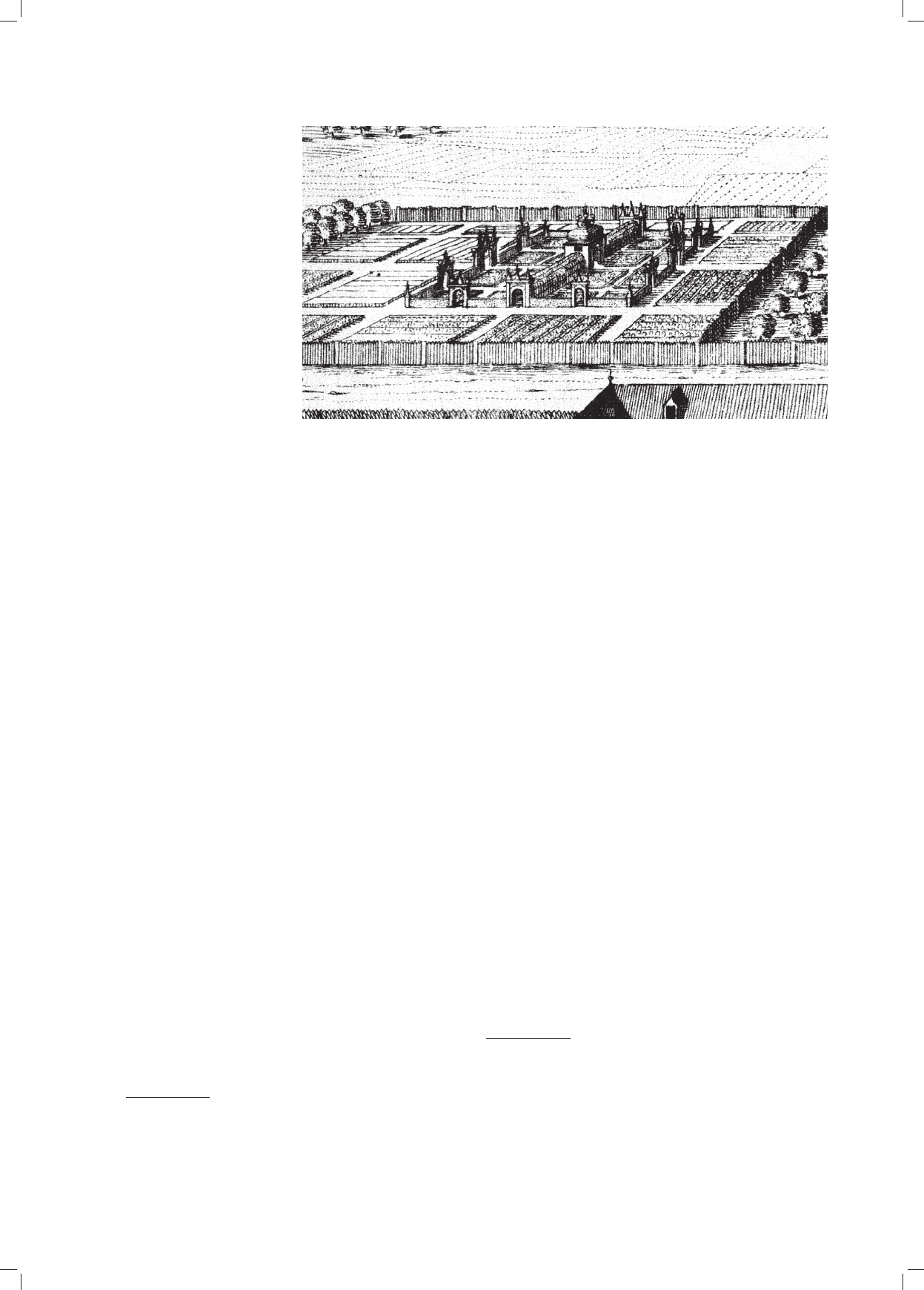
The appearance of Styrian gardens, which was based
on the compositional principles described above, is pre-
sented in graphics made in the mid17
th
century by
a topographer and graphic draftsman Georg Matthäus
Vischer who came from Tyrol [16], [17]. We can find
such gardens near several residences, inter alia, in An
chen stein (at present, the Slovenian Cirkulane), Tillysburg
and Maria Lankowitz, where they performed the function
of the main and exposed parts of layouts (Fig. 3). For
further considerations it will be important to take into
account the fact of their considerable similarity to the
solution adopted in Gorzanów and also the fact that the
residence in Maria Lankowitz belonged to Herberstein
family in the years 1511–1634, and then it became the
property of the Augustinian monastery from Stainz
(Styria). Interestingly, we do not know any examples of
such compositions of gardens in other parts of the
Habsburg Empire apart from a garden in the former
Schlackenwerth, today’s the Czech town of Ostrov upon
Ohří. This layout was erected in the years 1623–1625 on
the initiative of the new owner of the property. Duke
Julius Heinrich von SachsenLauenburg was granted with
27
Also in the plan of the palace and monastery complex called
Escorial, which was built in the years 1563–1584 on the initiative of the
then King of Spain Philip II of Habsburg. According to the intention of
the ruler it was supposed to become a centre of research (based on a huge
library) for the CounterReformation; the necropolis of the rulers of
Spain as well.
28
Monastic and church foundations (including a great extension of
the Benedictine Abbey in Seckau) in the territory of Styria started the
CounterReformation activity of Emperor Charles II, continued later by
Ferdinand II, which led to the outbreak of the Thirty Years’ War [14], [15].
nie Styrii (dziś podzielonej pomiędzy Austrię i Słowenię),
ważnej wówczas prowincji imperium poddanej w latach
1580–1630 intensywnym działaniom kontrreformacyj-
nym
28
, czego bezsprzecznym dowodem największa w Eu-
ropie liczba zespołów kalwaryjnych tam założonych [15].
Wygląd styryjskich ogrodów opartych na opisanych
wy żej zasadach kompozycyjnych prezentują grafiki wy
ko nane w połowie XVII stulecia przez pochodzącego z Ty-
rolu topografa i grafika Georga Matthäusa Vischera [16],
[17]. Ogrody takie odnajdujemy przy kilku rezy den cjach,
m.in. w: Anchensteinie (dzisiejsze słoweńskie Cirkula ne),
Tillysburgu i Maria Lankowitz, gdzie pełniły funkcję głów
nych, wyeksponowanych części założeń (il. 3). Dla dal
szych rozważań istotny będzie fakt ich ogromnego po do
bieństwa do roz wią zania przyjętego w Gorza no wie, a tak że
to, że re zydencja w Maria Lankowitz należała w latach
1511–1634 do Herbersteinów, po czym przeszła na włas
ność klasztoru augustianów ze Stainzu (Styria). Co cieka-
we, nieznane są nam przykłady takiej kompozycji ogro-
dów z innych części habsburskiego imperium, poza
jednym – ogrodem w dawnym Schlackenwerth, dzisiej-
szym czeskim Ostrovie nad Ohří. Założenie to
powstało
w latach 1623–1625 z inicjatywy nowego właściciela ma-
jątku. Za zasługi w bitwie pod Białą Górą został nim obda-
rowany przez cesarza książę Julius Heinrich von Sachsen-
Lauenburg. Pośród wielu kunsztownie opracowanych
elementów (m.in. centralnie położonego Lusthausu z wi-
dokowym tarasem) wydzielono w tym ogrodzie zbliżony
do kwadratu obszar otoczony murem z 12 portalami.
Kompozycja ta zadziwiająco sugestywnie przypomina
znane już od średniowiecza wizualizacje przyszłej Nowej
Jerozolimy rozumianej jako ogród rajski
29
. Według św.
Jana otaczać ją mają – kwadratową w planie i zorientowa-
ną geograficznie – wysokie mury oddzielające od profa-
28
Fundacje klasztorne (m.in. wielka rozbudowa benedyktyńskie-
go opactwa w Seckau) i kościelne na terenie Styrii rozpoczęły aktyw-
ność kontrreformacyjną cesarza Karola II, kontynuowaną później przez
Ferdynanda II, co doprowadziło do wybuchu wojny 30letniej [14], [15].
29
Opartej na wizji powstania Nowej Jerozolimy zawartej w Księ
dze Ezechiela, a następnie Objawieniu św. Jana (Apokalipsa) [18].
Il. 3. Ogród przy rezydencji
Maria Lankowitz (Styria).
Ryc. G.M. Vischera [17]
Fig. 3. Garden at the Maria
Lankowitz residence (Styria).
Engraving by G.M. Vischer [17]

32 Marzanna Jagiełło, Wojciech Brzezowski
it by the Emperor for his contributions in the Battle of
White Mountain. Among many exquisitely designed ele-
ments (including centrally located Lusthaus with a pano-
ramic terrace), a squarelike area surrounded by the wall
with twelve portals was marked out in this garden.
This composition surprisingly suggestively resembles
the known since the Middle Ages visualizations of future
New Jerusalem understood as the Garden of Eden
29
.
According to St John, New Jerusalem – square in the plan
and geographically oriented – was supposed to be sur-
rounded with high walls which separate it from the pro-
fane world, where gates were arranged in a 4 × 3 system.
There are as many of them as the tribes of Israel and at the
same time the apostles
30
. This composition had particu-
larly effective forms in a famous since the Middle Ages
centre of pilgrimage Maria Lankowitz, in the garden situ-
ated close to that palace (representing Wasserschloss
type), which is shown in Vischer’s drawing from 1681.
Inside the walls equipped with twelve splendid and im
pressive gates, a regular quartered garden, in the middle
of which Lusthaus with an open ground floor probably
covering the water intake was established.
This arrangement suggests relationships, similarly to
the case of monastery cloister garths, with ideograms of
the Garden of Eden. This time it is not about a lost para-
dise due to the disobedience of our first parents, but about
the eschatological vision of the new Eden
31
and at the
same time New Jerusalem understood as the city of the
saved
32
. There will be no temples in this city (I did not see
a temple in the city, because the Lord God Almighty and
the Lamb are its temple [18, Rev 22.23]), and from the
throne of God the river will flow (Then he showed me the
river of the water of life, as clear as crystal, flowing from
the throne of God and of the Lamb [18, Rev 22.1]), on the
shore of which a tree of life will grow (down the middle
of the great street of the city on each side of the river
stood the tree of life, bearing twelve crops of fruit, yield-
ing its fruit every month, and the leaves of the tree are for
the healing of the nations [18, Rev 22.2]).
The garden in Gorzanów, as the only one of this kind
in the territory of the County of Kłodzko
33
that is known
to us, can be included in the group represented by the
above mentioned garden layouts and in this way, apart
from its undoubted ornamental values, it carries a possi-
ble message of a religious character
34
connecting it with
Styria by means of a delicate thread, and in the sense of
29
Based on the vision of the creation of New Jerusalem contained in
the Book of Ezekiel and then in Revelation of St John (Revelation) [18].
30
And had a wall great and high, and had twelve gates… [18, Rev
21.12].
31
Then I saw a new heaven and a new earth, for the first heaven
and the first earth had passed away [18, Rev 21.1].
32
But the cowardly, the unbelieving, the vile [...] and all liars —
they will be consigned to the fiery lake of burning sulphur. This is the
second death [18, Ap. 22.8].
33
Solutions of this type will not be found either in the territory of
Bohemia or Silesia. In the area of the monarchy they seem to constitute
the specificity of Styria.
34
This issue, also with regard to the Styrian gardens, has not yet
been considered by researchers on the history of gardens.
nicznego świata, w których w układzie 4 × 3 rozmieszczo-
no bramy. Jest ich tyle, ile plemion Izraela i zarazem
apo stołów
30
. Szczególnie efektowne formy przybrała
taka kompozycja w słynnym od średniowiecza ośrodku
pielg rzymkowym Maria Lankowitz, w ogrodzie położo-
nym nieopodal tamtejszego pałacu (reprezentującego typ
Wasserschloss), co pokazuje rycina Vischera z 1681 r.
Wewnątrz murów zaopatrzonych w 12 okazałych, efek-
townych bram urządzono tam regularny ogród kwatero-
wy, pośrodku którego ustawiono Lusthaus z otwartym
parterem kryjącym najprawdopodobniej ujęcie wody.
Układ ten sugeruje związki, podobnie jak w przypadku
klasztornych wirydarzy, z ideogramami raju. Tym razem
nie chodzi jednak o raj utracony z powodu nieposłuszeń-
stwa pierwszych rodziców, ale o eschatologiczną wizję
nowego Edenu
31
i zarazem Nowej Jerozolimy rozumianej
jako miasto zbawionych
32
. W mieście tym nie będzie
świątyń (A świątyni w nim nie widziałem; albowiem Pan,
Bóg, Wszechmocny jest jego świątynią, oraz Baranek [18,
Ap. 22.23]), a od tronu Boga popłynie rzeka (I pokazał mi
rzekę wody żywota, czystą jak kryształ, wypływającą
z trony Boga i Baranka [18, Ap. 22.1]), na której brzegu
rosnąć ma drzewo życia (Na środku ulicy jego i na obu
brzegach rzeki drzewo żywota, rodzące dwanaście razy,
wydające co miesiąc swój owoc, a liście drzewa służą do
uzdrawiania narodów [18, Ap. 21.22]).
Do reprezentowanej przez wspomniane wyżej założe-
nia ogrodowe grupy, jako jedyny znany nam taki na tere-
nie hrabstwa kłodzkiego
33
, zaliczyć można ogród w Go
rzanowie, niosący tym sposobem, poza niewątpliwymi
walorami ozdobnymi, możliwe przesłanie o charakterze
religijnym
34
łączące go delikatną nicią ze Styrią, a w sen-
sie pierwotnej inspiracji – jeszcze subtelniejszą z naj-
świetniejszymi ogrodowymi kreacjami XVIwiecznej
Italii.
Oprócz ogrodu kwiatowego ważnym elementem na
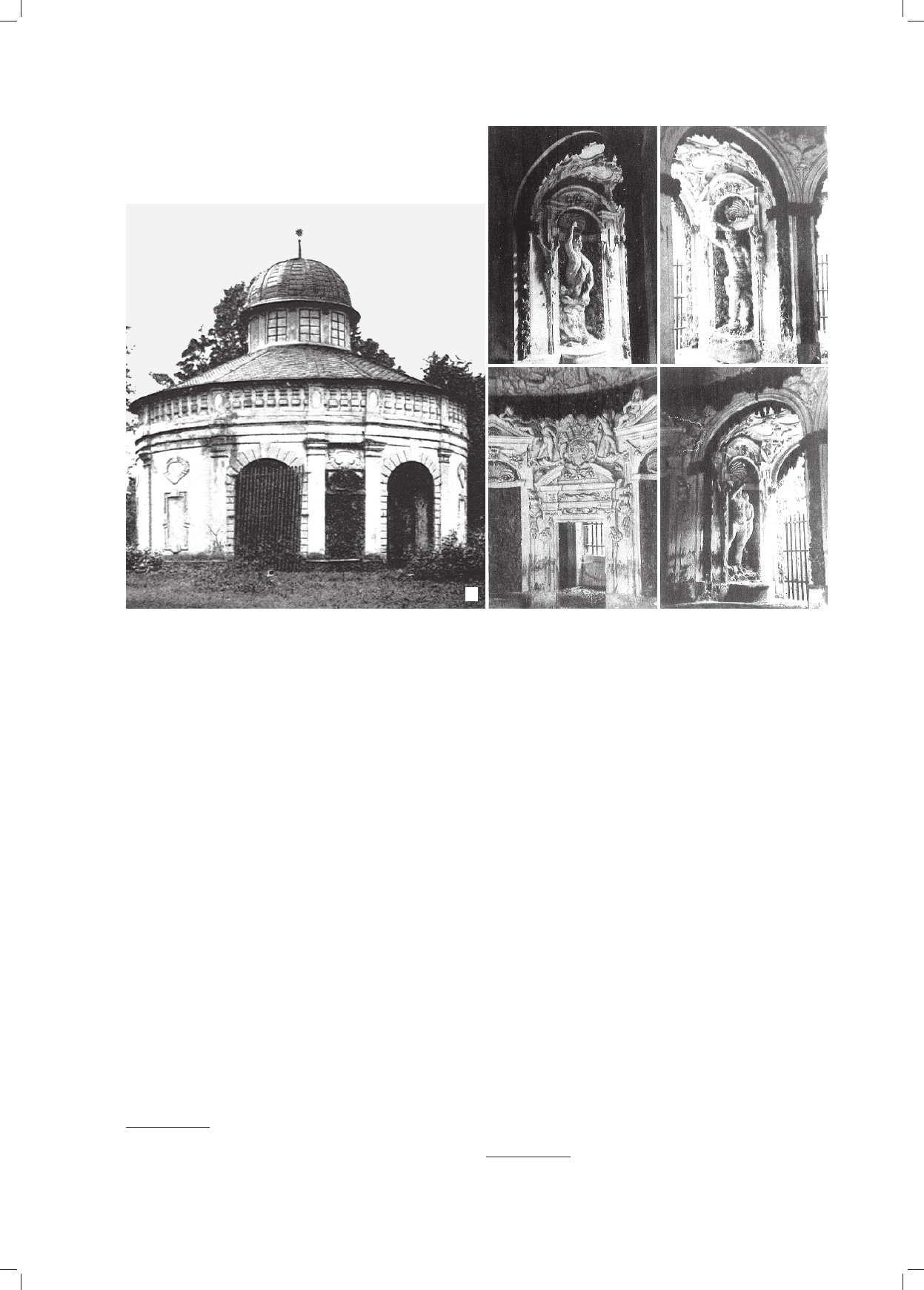
terenie znajdującym się poniżej skarpy był położony nie-
co na uboczu pawilon mieszczący w swoim wnętrzu
grotę (il. 4a). To z nim związana była druga oś kompozy-
cyjna założenia poprowadzona od podstawy schodów
w prawo, w kierunku jednego z wejść do tego obiektu.
W ten sposób zadbano o wygodny do niego dostęp
35
.
Choć z drugiej strony otoczono całość murem, który izo-
lował to miejsce, czyniąc je odosobnionym i przez to
bardziej tajemniczym i zaskakującym.
30
Miało ono potężny i wysoki mur, miało dwanaście bram… [18,
Ap. 21.12].
31
Potem widziałem niebo nowe i ziemię nową. Bo pierwsze niebo
i pierwsza ziemia już przeminęły [18, Ap. 21.1].
32
Udziałem zaś bojaźliwych i niewierzących, i skalanych […]
i wszystkich kłamców będzie jezioro płonące ogniem i siarką. To jest
śmierć druga [18, Ap. 22.8].
33
Rozwiązań tego typu próżno szukać zarówno na terenie Czech,
jak i Śląska. Na obszarze monarchii wydają się one stanowić specyfikę
styryjską.
34
Zagadnienie to, także w odniesieniu do ogrodów styryjskich, nie
było dotychczas przedmiotem rozważań badaczy zajmujących się histo-
rią ogrodów.
35
Takie ulokowanie groty wobec ogrodu ozdobnego nasuwa sko-
jarzenia z Villa Castello.
Ogrody rezydencji gorzanowskiej w XVII i XVIII w. /Gardens of Gorzanów residence in the 17
th
and 18
th
centuries 33
Idąc z pałacu ku grocie, mijano po drodze niewielki
i niewysoki trapezoidalny w planie boskiet, pozwalający
„nadrobić” nieregularności w planie ogrodu. Sam zaś
budynek ustawiono na okrągłym placyku umieszczonym
pośrodku prostokątnego parteru przeciętego poprowadzo-
nymi wzdłuż jego przekątnych alejkami (ujętymi niskimi
żywopłotami), które wiodły wprost ku czterem do niego
wejściom i to z tej przyczyny zostały one rozmieszczone
nieregularnie, a dokładniej zgrupowane w dwie pary.
Gorzanowska grota miała pierwotnie
36
(co widać wy-
raźnie na obu przedstawieniach) dwie kondygnacje, przy
czym wyższa związana była z tarasem widokowym ota-
czającym tambur kopuły, nad którą górowała latarnia.
Kiedy przyjrzymy się planowi tego obiektu, zobaczymy,
że został on skonstruowany z dwóch kolistych pierścieni:
mniejszego (o średnicy 7,42 m) wyznaczającego jej cen-
tralne wnętrze oświetlone przez okna znajdujące się
w dziś zaślepionych tamburach górującej nad nim latarni
i maleńkiej latarenki (w późniejszym okresie zlikwidowa-
nej), a także dzięki światłu wpadającemu przez otwory
wejściowe, oraz większego poprowadzonego po obwo-
36
Obecny jej kształt jest wynikiem przebudowy obiektu przepro-
wadzonej według Patzaka w 1884 r. po to, żeby uniemożliwić spływanie
gromadzącej się na tarasie wody poprzez schody do wnętrza obiektu
[20, s. 40].
a
b
Il. 4. Grota z ogrodu w Gorzanowie:
a) fotografia z 1913 r. (źródło: [19]), b) wnętrze groty w 1932 r. (źródło: [20, s. 40])
Fig. 4. Grotto from Gorzanów garden:
a) photo from 1913 (source: [19]); b) grotto interior in 1932 (source: [20, p. 40])
the original inspiration – yet even subtle, with the most
exquisite garden creations of the 16
th
century Italia.
Apart from the flower garden, a pavilion that was lo
cated slightly off the beaten track and housed a grotto in
its interior was an important element in the area which
was situated below the escarpment (Fig. 4a). The second
composition axis of the layout was connected with it and
ran from the base of the stairs to the right in the direction of
one of the entrances to this building. In this way com fort
able access to it was provided
35
. Nevertheless, every thing
was surrounded by the wall which separated the place and
made it isolated, hence more mysterious and asto nishing.
Walking from the palace to the grotto, one could pass
a small and not too high bosquet, trapezoidal in the plan,
which allowed for “making up for” irregularities in the
plan of the garden. The building was situated on a circular
square which was located in the middle of the rectangular
ground floor which in turn was divided by paths runn
ing along its diagonals (surrounded by low hedges),
which led directly to the four entrances to it and just for
this reason they were deployed irregularly or more pre-
cisely, they were grouped in two pairs.
35
Such a location of the grotto in relation to the decorative garden
gives rise to associations with Villa Castello.

34 Marzanna Jagiełło, Wojciech Brzezowski
dzie budynku (11,1 m). W pasie między owymi pierście-
niami urządzono po naprzeciwległych stronach dwa nie-
wielkie przedsionki wiodące do malutkich pomieszczeń
identyfikowanych przez niektórych badaczy jako łazienki
[20, s. 39–43]
37
oraz wąskich kręconych schodów kieru-
jących pierwotnie na taras na dachu
38
. Rozciągała się
stamtąd panorama założenia ogrodowego wraz z pałacem
w jego najbardziej efektownym ujęciu (znanym z wielu
późniejszych przedstawień założenia). Jeszcze rozleglej-
szych widoków, choć z racji szczupłości miejsca limito-
wanych dla nielicznych osób, dostarczała wąska (ok.
90 cm) galeria umieszczona po wewnętrznej stronie latar-
ni, w której bębnie znalazło się 10 okazałych otworów
okiennych. Dzięki temu budynek zyskiwał jeszcze jedną
funkcję – belwederu.
Z zewnątrz grota przedstawiała się jako parterowy,
centralny w planie pawilon z dachem pulpitowym, zwień-
czony dwiema (jedna nad drugą) latarniami. Jej łączna
wysokość wynosiła ponad 14 m
39
. Elewacje tego budyn-
ku zaopatrzono w cztery zgrupowane w parach wejścia
ujęte rustykalnymi obramowaniami, pomiędzy które
wstawiono nisze z konchami, wyłożone czarnym tufem
wulkanicznym. W partiach ścian odpowiadających bocz-
nym aneksom umieszczono nisko osadzone okna (po trzy
z każdej strony), a nad nimi owalne „ślepe” okienka uzu-
pełniające tę kompozycję. Wszystkie otwory rozdzielono
na elewacji pilastrami podtrzymującymi belkowanie, na
którym ustawiona została attyka będąca jednocześnie ba-
lustradą tarasu, pełną z półplastycznymi tralkami, wyko-
naną z cegły pokrytej tynkiem
40
. W sposób ozdobny po-
traktowano także ściankę, na której oparto dach pulpitowy.
„Rozrzeźbiono” ją półkolistymi niszami (z motywami
muszli), zaopatrując je dodatkowo w kamienne ławeczki.
Dodajmy, że zarówno dach pulpitowy, jak i kopuły obu
latarń pokryto dekoracyjnie ułożonym łupkiem
41
.
Aby należycie przeanalizować funkcję, jaką pełnił
wówczas ów obiekt, należy sięgnąć do rodowodu ogrodo-
wych grot. Inspiracji dla nich szukać należy w starożytnej
Grecji, gdzie występowały najpierw jako obiekty natural-
ne zamieszkane przez bóstwa i wyrocznie, ewoluując
następnie ku specjalnie wznoszonym budowlom przezna-
czonym dla nimf, zwanych nimfeami. Modę na obie for-
my
42
przejął antyczny Rzym, gdzie małe nimfea zakłada-
no przy rezydencjach oraz na terenie willi i związanych
z nimi ogrodów. Symboliczne związki grot z wodą wyra-
37
Tezę tę potwierdzić mogą jedynie gruntowne badania architek-
toniczne obiektu.
38
Dziś jedno z wejść jest zaślepione, drugie zaś prowadzi do ukry-
tego pod dachem obejścia kopuły, a dalej ku schodkom, dzięki którym
można dostać się poprzez otwór wejściowy umieszczony w jej tamburze
do wnętrza latarni, na galeryjkę.
39
Na obrazie olejnym oraz litografii, przedstawiających rezyden-
cję w Gorzanowie, w tamburze kopuły zaznaczono okna. Biorąc pod
uwagę kompozycję dekoracji sztukateryjnych, musiały one mieć cha-
rakter okien iluzorycznych, zaślepionych. Dodajmy, iż ta część zwień-
czenia pawilonu została przekształcona po likwidacji tarasu na początku
XIX w. i zastąpieniu kopuły dachem namiotowym.
40
Przestała ona pełnić swoją funkcję po likwidacji tarasu.
41
Wymienionym na zachowaną do dziś blachę przed 1945 r.
42
Jako naturalne wymienić można m.in. słynne groty Wenus koło
Neapolu. Sztuczne towarzyszyły m.in. słynnej willi Hadriana.
Originally
36
, the Gorzanów grotto had (which can be
clearly seen in the two representations) two floors; the
higher was connected with a panoramic terrace surround-
ing the tambour of the dome, over which a roof lantern
dominated. When we look at the plan of this building, we
will see that it was constructed of two circular rings:
a smaller one (7.42 m in diameter) determining its central
interior illuminated by windows in tambours, which are
blinded today, of the roof lantern towering over them and
a tiny lantern (later removed), and also thanks to the light
coming through the entrance openings and through a great-
er one made in the circumference of the building (11.1 m).
In the belt between these rings two small vestibules were
arranged on opposite sides, which led to the tiny rooms iden-
tified as bathrooms by some researchers [20, pp. 39–43]
37
and narrow spiral stairs leading originally to the terrace on
the roof
38
. A panorama of the garden layout along with the
palace in its most impressive view extended from there
(known from many subsequent representations of the lay-
out). Even more extensive views, although limited for
a few people due to the thinness of the place, were pro-
vided by a narrow (circa 90 cm) gallery located on the
inner side of the roof lantern, in the tambour of which
there were ten imposing window openings. As a result,
the building gained another function – a belvedere.
From the outside the grotto appeared as a onestorey
and central in the plan pavilion with a oneslope roof,
crowned with two (one above the other) lanterns. Its total
height was more than 14 m
39
. The facades of this building
were provided with four entrances grouped in pairs and
surrounded by rustic frames between which there were
niches with lunettes lined with black volcanic tuff. In the
parts of the walls corresponding to the side annexes there
were lowembedded windows (three on each side) and
above them oval “blind” windows which supplemented
this composition. On the facade all of the openings were
separated by means of pilasters supporting the entablature
on which the attic was set being at the same time a full
terrace balustrade with semisculptured balusters made of
brick which was covered with plaster
40
. A little wall
which supported the oneslope roof was also treated in
a decorative way. It was sculptured by means of semicir-
36
Its present form is the result of remodelling the object, which
was carried out according to Patzak in 1884 in order to prevent the water
accumulated on the terrace from flowing down the stairs to the inside of
the building [20, p. 40].
37
This thesis can be confirmed only by thorough architectural
research on the object.
38
Today, one of the entrances is blinded, the other leads to the
dome bypass which is hidden under the roof and further towards little
stairs thanks to which it is possible to get to the inside the roof lantern,
i.e. to the gallery through the entrance opening in its tambour.
39
In the oil painting and lithographs, which depict the residence in
Gorzanów, windows were marked in the tambour of the dome. Taking
into account the arrangement of molding decorations, they must have
had a character of illusory and blinded windows. Let us add that this part
of the pavilion crowning was transformed after the liquidation of the
terrace and replacing the dome with a tent roof at the beginning of the
19
th
century.
40
It ceased performing its function after the liquidation of the
terrace.

Ogrody rezydencji gorzanowskiej w XVII i XVIII w. /Gardens of Gorzanów residence in the 17
th
and 18
th
centuries 35
żane wprowadzaniem do wnętrza zbiorników, fontann
i źródeł powodowały, że do ich wystroju używano często
elementów z tym żywiołem powiązanych, a mianowicie
muszli, korali (także imitujących je gąbek) oraz obro
bionych przez wodę otoczaków.
Warto zauważyć, że rola, jaką przypisywano grotom
naturalnym, miała także swoje biblijne odniesienia. Wy
stępują one zarówno w Starym, jak i w Nowym Te sta
mencie, stanowiąc m.in. miejsce objawień
43
. Ważne są
tak że ich związki z biografią Chrystusa (groty: Na ro dze
nia, Mlecz na, grób Chrystusa w gro cie Józefa z Ary ma
tei), gdyż zna lazły one odzwier cie dlenie w ikonografii
niektórych obiektów tego rodzaju mieszczących się w og
rodach
44
.
Dla dalszych rozważań istotny będzie fakt, że od po-
czątku XVI w. grota stanowiła niezbywalny element
ogrodów włoskich, doskonale sprawdzający się w tam
tejszym klimacie jako miejsce zapewniające rekreację
i regenerację oraz stwarzające warunki do kontemplacji,
dodający zarazem „antycznego” poloru. Ten ostatni
wzmac niała tematyka wypełniających je scen – rzeźbio-
nych, płas korzeźbionych, czasem malowanych, dla któ-
rych inspirację główną stanowiły Metamorfozy Owidiu
sza, dzieło o charakterze kosmogonicznym [23, s. 4].
Obiekty te „zasiedlano” również przedstawieniami nimf,
nereid oraz satyrów, którzy występowali jako symbole
płodności, podkreślające jednocześnie (jako istoty lu-
dziom raczej niechętne i żyjące osobno) niedostępność
świata groty. Czasem wypełniały je także inne elementy
rzeźbiarskie, jak w przypadku Villa Castello pod Flo
rencją, gdzie różne zwierzęta (umieszczone w grupach
skupionych przy wodopojach) oczarowane muzyką Or
feu sza współżyją w pełnej harmonii i poczuciu bezpie-
czeństwa (jak w raju), który to motyw został powtórzony
w Grocie Orfeusza w Helbrunnie (ok. 1615)
45
.
Kolejny symboliczny wątek powiązany z grotami za-
wdzięczamy onirycznej opowieści o Polifilu poszukują-
cym ukochanej Polii
46
. Opisana przez Colonnę i bogato
ilustrowana drzeworytami podróż Polifila jest bowiem
odczytywana jako duchowa wędrówka po alegorycznym
ogrodzie właśnie ku znajdującej się na szczycie tarasowo
ukształtowanego wzgórza grocie, z której wypływało
źródło. Droga do niego oznaczać miała wędrówkę przez
życie, dotarcie – osiągnięcie samoświadomości i wie-
dzy [24].
Warto też zwrócić uwagę na usytuowanie grot oraz ich
formę, a zwłaszcza na wykształcenie się we Włoszech, co
43
Prorok Eliasz usłyszał głos Pana w jaskini góry Horeb [18,
Ks. I Królewska 1, 17]. Także zwiastowanie Marii miało miejsce w gro-
cie nazareńskiej.
44
Na przykład we wrocławskim ogrodzie Scholza, gdzie we wnę-
trzu groty umieszczono figurę Adama potraktowaną jako prefigurę
Jezusa Chrystusa. Niektórzy badacze rozpoznają w niej postać cyklopa
Polifema mającego występować tutaj w roli strażnika ogrodu. Taka
interpretacja wydaje się nie mieć uzasadnienia, zwłaszcza wobec napi-
sów pokrywających ściany groty. Por. [21], [22, s. 128, 129].
45
Także w innych ogrodach europejskich z tego czasu, np. w Hei
delbergu.
46
Ten anonimowy poemat przypisywany jest dominikańskiemu
mnichowi o nazwisku Collonna [24].
cular niches (with motifs of shells) which were addition-
ally supplied with stone benches. It should be added that
both the oneslope roof and the domes of two roof lan-
terns were covered with decoratively laid slate
41
.
In order to properly analyse the function this object
performed at that time, it is necessary to refer to the origin
of garden grottoes. Inspirations for them should be sought
in ancient Greece where they first appeared as natural
objects inhabited by deities and oracles, then evolving
towards structures which were erected for nymphs called
nymphaes. The fashion for both forms
42
was taken over
by ancient Rome where small nymphaeums were founded
at residences and in the area of villas and gardens con-
nected with them. Symbolic relationships of grottos with
water which were expressed by introducing tanks, foun-
tains and streams into their interiors resulted in using
objects connected with this element in order to decorate
them, namely, shells, corals (also sponges imitating them)
and pebbles processed by water.
It is worth noticing that the role which is attributed to
natural grottos (caves) also had their biblical references.
They are found in both the Old and the New Testament
acting, inter alia, as the place of apparitions
43
. The rela-
tions with the biography of Christ are also important
(grottoes such as Nativity, Milk Grotto, the tomb of Christ
in the cave of Joseph of Arimathea) as they found their
reflection in the iconography of some of the objects of
this type existing in gardens
44
.
For further considerations it will be important to focus
on the fact that from the beginning of the 16
th
century the
grotto constituted the inalienable element of Italian gar-
dens, which was perfectly adapted to the local climate as
a place providing recreation and regeneration as well as
creating the conditions for contemplation, at the same
time adding the “ancient” courtliness. The latter was
strengt hened by the themes of scenes which filled them
– sculp tured, with basreliefs, sometimes painted, for
which the main inspiration constituted Metamorphoses by
Ovid, the work of a cosmological character [23, p. 4].
These objects were “inhabited” by representations of
nymphs, the Nereids and satyrs who acted as symbols of
fertility, emphasizing at the same time (creatures which
treated people rather reluctantly and lived in isolation) the
unavailability of the grotto world. Sometimes they were
filled with other sculptural elements as in the case of Villa
Castello near Florence, where various animals (gathered
41
Before 1945 it was replaced for sheet metal which is preserved
till today.
42
Famous grottos of Venus near Naples can be mentioned as natu-
ral. Artificial grottos accompanied, among other things, the famous
Hadrian’s Villa.
43
Elijah the prophet heard the voice of the Lord in the cave of
Mount Horeb [18, 1 Kings 1, 17]. Also Annunciation to the Blessed
Virgin Mary took place in the cave of Nazareth.
44
For example, in Wrocław Scholz Garden, where a statue of
Adam treated as a prefigure of Jesus Christ was placed inside a grotto.
Some researchers recognize in it the figure of Cyclop Polyphemus who
was supposed to perform here the role of the garden’s guardian. This
interpretation seems to have no justification, especially as regards
inscriptions covering the walls of the grotto. Cf. [21], [22, pp. 128, 129].

36 Marzanna Jagiełło, Wojciech Brzezowski
okaże się istotne dla rozważań o budowli gorzanowskiej,
takiego ich modelu, który przeciwstawia architektonicz-
nie ukształtowane zewnętrze naturalistycznie potraktowa-
nemu wnętrzu. Odpowiada to manierystycznej tendencji
do posługiwania się dwuznacznością
47
. Podobny zabieg
stosowano również we wnętrzach takich obiektów, swo-
bodnie i zaskakująco przechodząc od form imitujących
nieprzekształconą surowość do przedstawień figural nych,
[…] ani chwilę nie budząc wątpliwości, że jest to dzieło
kunsztu artysty [25, s. 156]. Nietrudno się domyślić, że
barok rozwieje to uwikłanie, opowiadając się, także
w kom pozycji grot, za niepodważalnym triumfem sztuki
nad naturą.
Za pomocą sztuki (sztuczek) ujarzmiano też obecną od
początku w grotach wodę, której użycie sprowadzano
często do figlarnego żartu, bezpretensjonalnej zabawy
kończącej się oblewaniem udających zaskoczenie gości.
Do Włoch pomysł ten dotarł z dworu książęcego Bur
gundii, gdzie już w XV w. znane były urządzenia wodne
służące rozrywce. Na początku następnego stulecia pod-
biły one Italię, stając się elementem niemal powszechnym
w tamtejszych ogrodach [25, s. 157].
Wątek wyrafinowanego wykorzystania wody w gro-
tach był następnie pomysłowo „eksploatowany” przez
XVI i XVIIwiecznych inżynierów, którzy zajmowali się
zagadnieniami hydraulicznymi, projektując tzw. sztuki
wodne (wł. giochi d’aqua, fr. jeux d’eau, niem. Wasser -
künste) w wielu krajach europejskich. Konstruowali oni
dla grot także skomplikowane automaty wykorzystujące
osiągnięcia wiedzy hydraulicznej (zarówno antycznej, jak
i nowożytnej). Mistrzami tych ostatnich byli: hugenocki
uciekinier z Francji pracujący na dworach Anglii i Niemiec
(Heidelberg) – Salomon de Caus [26] oraz włoski inży-
nier Agostino Ramelli [27].
Moda na groty pociągnęła za sobą projekty przezna-
czone dla tego typu obiektów, a także praktyczne opisy
ich wykonywania. Pierwszy z nich zamieścił Alberti, któ
ry zalecił użycie ciekłego zielonego wosku do polewania
elementów kamiennych, przez co miały wyglądać jak
omszałe [28, Ks. 9, 4]. Przepis na grotę podał też w jed-
nym ze swoich dzieł Joseph Furttenbach [29, s. 15], który
lata 1607–1620 spędził na dworach Mediolanu, Genui
i Florencji. Ten niemiecki architekt i inżynier opisał grotę
pełniącą funkcję letniej jadalni w jego własnym ogrodzie
w Ulm, ozdobioną inkrustacjami z muszli i koralowców,
odłamków szkła i luster oraz malowidłami, wyposażoną
ponadto w wodne automaty połączone z niewielkimi
kompozycjami rzeźbiarskimi [29, s. 18]. Furttenbachowi
zawdzięczamy również opisy grot włoskich, które zawarł
w swojej kronice podróży po Italii [30]. Szczególnie wie-
le uwagi poświęcił w niej wspaniałym obiektom genueń-
skim, m.in. z ogrodów Pavese, dołączając do ich opisu
ilustracje z przekrojami, widokami i detalami wystroju
wnętrz udekorowanych kompozycjami wykonanymi z róż-
nokolorowych kamieni i muszli [30, s. 220–222, il. 16–1].
47
Jak pisze Shearmann: Zwiedzający może bawić się zgadywa-
niem, czy jest to wyżłobiona w skale jaskinia, której nadano architekto-
niczną formę, czy też architektura, pokryta przez czas grubą warstwą
na tu ralnych osadów [25, s. 157].
in groups at waterholes) enchanted by the music of
Orpheus coexist in full harmony and a sense of security
(as in paradise), which motif was repeated in Orpheus
Grotto in Hellbrunn (circa 1615)
45
.
Another symbolic aspect which was connected with
grottoes comes from a dreamlike story about Polifil look-
ing for his beloved Polia
46
. The journey of Polifil, as it
was described by Colonna and richly illustrated with
wood engravings, is in fact understood as a spiritual wan-
der around the allegorical garden towards the grotto which
was situated at the top of the te rraced hill, from which
a spring flew out. The way to the spring was to imply
a jour ney through life, and reaching its destination meant
the achievement of selfawareness and knowledge [24].
It is also worth paying attention to the location of grot-
toes as well as their forms, and especially to the formation
of such a model in Italy – what will turn out to be signifi-
cant for considerations of the Gorzanów object – which
sets an architecturally arranged exterior against a natural-
istically designed interior. This corresponds to a Mannerist
tendency to use the ambiguity
47
. A similar procedure was
also applied in the interiors of such objects, freely and
surprisingly starting from forms imitating intact severity
and ending with figural representations, [...] arising no
doubt at all that this is a work of the artist’s craftsmanship
[25, p. 156]. It is easy to anticipate that the baroque will
dispel this entanglement, by advocating for, also as
regards the composition of grottoes, an indisputable tri-
umph of art over nature.
By means of art (or tricks) the water that was present
in the grottos from the beginning was tamed; its use was
often turned to a playful joke, unpretentious fun which
ended in sprinkling the visitors who pretended to be sur-
prised. This idea was brought to Italy from the princely
court of Burgundy where such water entertainment de
vices were known as early as in the 15
th
century. At the
be ginning of the next century they conquered Italia,
becoming almost universal elements in their local gardens
[25, p. 157].
The motif of sophisticated use of water in the grottos
was then cleverly “exploited” by the 16
th
and 17
th
century
engineers who were preoccupied with hydraulic issues
designing so called water works (Italian: giochi d’aqua,
French: jeux d’eau, German: Wasserkünste) in many Eu
ro pean countries. They also constructed complex ma chines
for grottos using the achievements of hydraulic knowl-
edge (both ancient and modern). The masters of the latter
were: a Huguenot refugee from France working at the
courts of England and Germany (Heidelberg) – Sa lo mon
de Caus [26] and Italian engineer Agostino Ramelli [27].
The fashion for grottos resulted in designs designated
for objects of this type as well as practical descriptions of
45
Also in other European gardens of that time, e.g. in Heidelberg.
46
This anonymous poem is attributed to a Dominican monk whose
name was Collonna [24].
47
According to Shearmann: A visitor may wonder and guess
whether it is a cave grooved in rock which has been given an architec-
tural form, or architecture covered in time by a thick layer of natural
deposits [25, p. 157].

Ogrody rezydencji gorzanowskiej w XVII i XVIII w. /Gardens of Gorzanów residence in the 17
th
and 18
th
centuries 37
Elementów tego rodzaju nie odnajdziemy w Go rza
nowie, bogatym natomiast w dekoracje sztukateryjne:
wyobrażenia nereid, hipokampów, trytonów, a także po-
staci satyrów i licznych puttów. Podtrzymują one festony
i girlandy z owoców oraz kwiatów. Część z nich w po
łączeniu z tzw. ornamentem zwijanym i chrząst kowo
małżowinowym stanowi ramy dla medalionów o po-
wierzchniach zróżnicowanych (w większości owalnych),
wy peł nionych pierwotnie polichromiami o trudnej dziś,
z racji słabego stanu zachowania, do rozszyfrowania te-
matyce
48
; także dla herbu właścicieli osadzonego w na-
czółkach portali prowadzących do aneksów.
Ważny element wyposażenia gorzanowskiej groty sta-
nowiły również rzeźby w strefach wejściowych, a dokład-
nie w niszach (4 × 2) zaopatrzonych w kamienne zbior niki
na wodę (il. 4b). Były to pełnoplastyczne kompozycje
rzeź biarskie interpretowane do tej pory jako sceny przed
sta wiające Herkulesa walczącego z Anteuszem, Plutona
porywającego Prozerpinę oraz inne czyny Herkulesa
49
. Do
dziś przetrwały ich marne, nieułatwiające odczytania po
zostałości, co skazuje badaczy na (jak się wydaje upraw
nione) domysły snute na podstawie kilku fotografii groty
z lat 1903, 1913 i 1932 oraz ich interpretację uwzględ
niającą pierwotne odniesienia symboliczne
50
. Na tej pod-
stawie można wnosić, iż powyższy zestaw sugeruje praw-
dopodobne sięgnięcie do jednego z cyklów, a mianowicie
do personifikacji Czterech Żywiołów, z których para Her
kulesa z An teuszem uosabiała Ziemię, a Pluton z Pro
zerpiną – Ogień. Oznacza to, że pozostałe dwie grupy
mogły przedstawiać Boreasza unoszącego Orejtyję (Po
wiet rze) oraz Neptuna porywającego jedną z nereid Am
fitrytę (Woda)
51
. Po zo stałe czyny Herkulesa, a w grocie
gorzanowskiej odczytać można jeszcze trzy (zabicie lwa
nemejskiego, które dokonało się w jaskini; zgładzenie
hydry lernejskiej mie szkającej w skalnej grocie, uśmier-
cenie giganta Kakusa mieszkającego w grocie pod Awen
tynem i nękającego okolicę) wpisują się w kolejny, czte-
roelementowy cykl.
Warto w tym miejscu przypomnieć, że scena walki
Herkulesa z Anteuszem, a właściwie osiągniętego spry-
tem i mądrością triumfu słynnego herosa stanowiła naj-
bliższy rezydencji, powiązany z fontanną element rzeź-
biarski w ogrodzie Villa Castello, symbolizujący samego
Kosmę I Medyceusza oraz jego sukcesy odniesione dzię-
ki właściwościom charakteru i umysłu [32]. Wydaje się,
że wielokrotną obecność w gorzanowskiej grocie inter-
pretować można poprzez symboliczne odwołania do
48
Pewne podobieństwo jednej z malowanych scen z gorzanow-
skiej groty do malowidła z wnętrza kopuły pawilonu Kvĕtnej Zahrady
w Kromieryżu sugeruje sięgnięcie po zidentyfikowane tam sceny ilu-
strujące Metamorfozy.
49
Takie odczytanie kompozycji rzeźbiarskich groty gorzanow-
skiej zaproponował Kalinowski na podstawie archiwalnych fotografii
(lata 1903, 1913, 1932) [7, s. 86].
50
Fotografie te przedstawiają tylko kilka rzeźb. Prawdopodobnie
dlatego, że pozostałe już nie istniały. Wskazuje na to Patzak, który pisze:
[…] przy wejściach w niszach stały kiedyś figury mitologiczne ponadna-
turalnej wielkości [20, s. 39].
51
Podobny zestaw wiele lat później umieszczono na dziedzińcu
zamku w Książu [31, s. 249, 250].
their implementation. The first known example is by
Alberti who recommended to use liquid green wax to
pour on stone elements, which was supposed to give them
a mossy appearance [28, Ks. 9, 4]. A recipe for a grottos
was also included in one of the works of Joseph Furtten
bach [29, p. 15], who spent the years 1607–1620 on the
courts of Milano, Genoa and Florence. This German ar
chitect and engineer described a grotto serving as a sum-
mer dining room in his own garden in Ulm, decorated
with inlays of shells and corals, shards of glass and mir-
rors as well as paintings, additionally equipped with water
machines combined with small sculptural com positions
[29, p. 18]. We also owe to Furttenbach de scrip tions of
Italian grottos which he included in his chro nicle of jour-
neys to Italy [30]. He devoted special attention to mag-
nificent Genoa objects, e.g. from Pavese gar dens, accom-
panying their descriptions with illustrations containing
crosssections, views and details of interiors de corated
with compositions made from different co loured stones
and shells [30, pp. 220–222, Fig. 16–1].
Such elements are not to be found in Gorzanów, which
on the other hand, is rich in moulding decorations: repre-
sentations of the nereids, hippocampus, tritons, as well as
satyrs and numerous putti. They support festoons and
garlands of fruits and flowers. Some of them, in combina-
tion with the so called scroll and auricular style orna-
ments, constitute frames for medallions of varied surfaces
(mostly oval), originally filled with polichromy which is
difficult to recognise today because of the weak state of
preservation
48
; also for the owners’ coat of arms embed-
ded in pediments of the portals leading to the annexes.
An important element of the Gorzanów grotto consti-
tuted sculptures in the entrance zones, more exactly in the
niches (4 × 2) equipped with stone receptacles for water
(Fig. 4b). These were artistic sculptural compositions
interpreted so far as scenes presenting Hercules fighting
with Antaeus, Pluto kidnapping Proserpina or other Her
cules’ labours
49
. Their only remnants that survived until
today are so miserable and hardly legible that researchers
are condemned to speculate (as it seems legitimately) on
the basis of few photographs of the grotto from the years
1903, 1913 and 1932 and make interpretations taking into
account the original symbolic references
50
. On that basis
we can assume that the aforementioned list suggests refer-
ring to one of the cycles, namely the personification of the
Four Elements, of which the couple of Hercules with
Antaeus epitomized the Earth, while Pluto with Proserpina
– Fire. This means that the other two groups could repre-
sent Boreas carrying Orithyia (Air) and Neptune grabbing
48
A certain similarity of one of the painted scenes from the
Gorzanów grotto to a painting from the dome of the pavilion of Květná
Zahrada in Kroměříž suggests references to the scenes identified there
illustrating Metamorphoses.
49
This interpretation of sculptural compositions of the Gorzanów
grotto was proposed by Kalinowski on the basis of archival photographs
(years 1903, 1913, 1932) [7, p. 86].
50
These photographs show only a few sculptures. Probably the
others did not exist then. This is suggested by Patzak who writes: [...] at
the entrance niches there used to be supernatural size mythological
figures [20, p. 39].

38 Marzanna Jagiełło, Wojciech Brzezowski
przy miotów Herbersteinów. Sugestię taką uzasadnia
umiesz czenie w jej wnętrzu herbu właścicieli założenia
52
,
co kieruje znów ku Villa Castello i wspomnianej fontan-
nie z Herkulesem i Anteuszem, na której czaszy umiesz-
czone zostały elementy związane z emblematem Me dy
ceuszy, m.in. koziorożec (powiązany zodiakalnie z ziemią
i władzą, symbolizujący także ambicję, inteligencję, cie-
kawość oraz opanowanie) [33, s. 29], [35]. Kieruje także
ku tamtejszej grocie, której architektonicznie opracowane
wejście wyposażono zarówno w herb Medyceuszy, jak
i elementy emblematyczne: przedstawienia koziorożca
i żółwia. Można zatem przypuszczać, że w Gorzanowie
Herkules występował jako symbol zwycięstwa z przy-
domkami Victor i Invictus (Niezwyciężony), odnoszący-
mi się prawdopodobnie do sukcesów całej, wielce zasłu-
żonej dla dworu cesarskiego rodziny von Herbersteinów.
Trzeba dodać na koniec tej części rozważań, biorąc pod
uwagę lokalizację groty, o odwołaniach najbardziej bezpo-
średnich, a mianowicie o związkach Herkulesa, po przez
jedną z jego 12 prac, z mitycznym ogrodem Hesperyd.
Rzeźby z groty gorzanowskiej wykonano w oryginal-
nej technice, którą przynieśli na Śląsk artyści włoscy –
sztukatorzyrzeźbiarze zwani plasticatori
53
. Polegała ona
na modelowaniu brył na metalowodrewnianym szkiele-
cie [7, s. 86]
54
. W przypadku większych figur stelaż ten
wzmacniano kawałkami kamieni i cegieł, co pokazują
dzisiaj ich okaleczone pozostałości. Niektóre z nich zdra-
dzają rozwiązania pełnoplastyczne i przyzwoity warsztat
rzeźbiarski, pozostałe, jak scena Boreasza z Orejtyją (wi-
doczna na archiwalnej fotografii) potraktowane zostały
półplastycznie.
Jak już wspomnieliśmy, woda w grocie występowała
w kilku miejscach, także pod postacią fontanny, której
misa znajdowała się w centrum głównego pomieszczenia.
Jej obecność związana była również z przedstawionymi
wyżej kompozycjami rzeźbiarskimi, a ściślej z umiejsco-
wionymi pod nimi kamiennymi zbiornikami, do których
– jak pisał Patzak – z pysków delfinów tryskała woda [20,
s. 40]. Prawdopodobnie doprowadzono ją również do
pokoików w aneksach oddzielonych od głównego po-
mieszczenia groty drewnianymi ozdobnymi drzwiami
[20, s. 41]. Potwierdzenie tego przypuszczenia wymaga
badań architektonicznych groty oraz jej najbliższego oto-
czenia. Podbudowuje je wykorzystanie podobnych anek-
sów do zamontowania sztuk wodnych w rotundzie,
w pewnym sensie siostrzanej, choć nie bliźniaczej i młod-
szej, bo wzniesionej dopiero w latach 1666–1668 na tere-
nie Květnej Zahrady w Kromieryżu
55
. Czy mogły one
pełnić, jak to sugerował Patzak, funkcję łazienek, na co
pośrednio wskazuje obecność wspomnianych drzwi po-
52
Herb von Herbersteinów przedstawia umieszczoną w środko-
wym miejscu srebrną krokiew na czerwonym polu.
53
Budowę groty (podobnie jak modernizacje pałacu) przypisuje
się warsztatowi Carla Luragi. Zatrudnieni przez Luragę sztukatorzy:
Domenico Rossi, Andrea Galli i Andrea Cyrus wykonali najprawdopo-
dobniej, oprócz wystroju groty, także dekoracje kaplicy zamkowej i pa
łacowej sala terrena oraz gorzanowskiego kościoła [7, s. 87].
54
Szerzej o technikach sztukatorskich warsztatów włoskich dzia-
łających w kręgu oddziaływania Wiednia w [11].
55
Zostały one rozebrane pod koniec XIX w. [9, s. 204].
one of the nereids Amphitrite (Water)
51
. The remaining
Her cules’ labours of which Gorzanów grotto has three
(killing the Nemean Lion, which took place in a cave; ex
terminating the Lernaean Hydra living in a rock cave,
killing Cacus giant living in a cave under the Aventine
Hill and terrorizing the surrounding area) are part of
another, fourelement cycle.
It is worth noting here that the scene of Hercules fight-
ing with Antaeus, actually the famous hero’s triumph
scored by his cleverness and wisdom, constituted the
sculptural component that was closest to the residence,
combined with the fountain in Villa Castello garden, sym-
bolizing Cosimo de’ Medici himself and the successes he
achieved thanks to the properties of his character and
mind [32]. It seems that the multiple presence in Gorzanów
grotto can be interpreted through symbolic references to
the qualities of Herberstein family. This suggestion is jus-
tified by placing the owners’ coat of arms
52
inside it,
which again leads us to Villa Castello and the aforemen-
tioned fountain with Hercules and Antaeus on whose bowl
there are elements connected with the Medici em blem
such as Capricorn (by signs of Zodiac associated with land
and power, also symbolizing the ambition, in telligence,
curiosity and selfcontrol) [33, p. 29], [35]. It also leads us
to the local grotto whose architecturally designed entrance
was equipped with the Medici coat of arms and emblem-
atic elements, i.e. representations of Capricorn and turtle.
It can therefore be presumed that Hercules in Gorzanów
appeared as a symbol of victory with the nicknames of
Victor and Invictus (Invincible), referring probably to the
successes of the whole von Her berstein family that was
very welldeserved for the im perial court.
At the end of this part of our considerations, with
regard to the location of the grotto, we cannot fail to men-
tion the most direct references, namely the connections of
Hercules, through one of his 12 labours, with the mythical
garden of the Hesperides.
The sculptures from the Gorzanów grotto were made
in the original technique which was brought to Silesia by
Italian artists – stucco plastererssculptors called plastica-
tori
53
. It consisted in the modeling of solids on a metal
and wood frame [7, p. 86]
54
. In the case of larger figures
this frame was reinforced with pieces of stones and
bricks, which can be seen today by their mutilated re
mains. Some of them reveal full artistic solutions and
decent sculptural techniques while others, like the scene
of Boreas with Orithyia (visible in an archival photo-
graph), were made as semisculptures in the wall.
51
Many years later a similar set was placed in the courtyard of the
castle in Książ [31, pp. 249, 250].
52
Von Herberstein coat of arms features a centrally located silver
rafter on a red field.
53
The construction of the grotto (like the modernization of the
palace) is attributed to Carlo Lurago’s workshop. The stucco workers
employed by Lurago, i.e. Domenico Rossi, Andrea Galli and Andrea
Cyrus most probably, apart from the grotto interior, also made decora-
tions for the castle chapel and palace hall sala terrena as well as the
church in Gorzanów [7, p. 87].
54
More information on the stucco workshop techniques operating
under the influence of Vienna in [11].

Ogrody rezydencji gorzanowskiej w XVII i XVIII w. /Gardens of Gorzanów residence in the 17
th
and 18
th
centuries 39
świadczających dbałość o zapewnienie intymności? Su
pozycję taką wzmacnia fakt, że połączenie grot z ła zien
kami ma swoją „włoską”
56
historię, a na terenach
nie mieckiej strefy językowej wzbogacenie tego rodzaju
obiektów o funkcję kąpielową (niem. Bade-grotte) spoty-
kamy w kilku XVIIwiecznych ogrodach, m.in. przy
zamku Salaberg (Dolna Austria). Co więcej, niewiele lat
później te mało komfortowe początkowo obiekty rozwi-
nęły się w luksusowe łazienki ogrodowe, czego przykła-
dów dostarczają m.in. Badenburg w ogrodzie Nym phen
burg (1718) oraz tzw. Marmorbad z ogrodów w Karls ruhe
(z lat 1722–1733)
57
. Zanim jednak do tego doszło, w kra-
jach położonych na północ od Alp grota pojawiła się naj-
pierw w ogrodach Fontainebleau (1541–1543), a w stre fie
niemieckojęzycznej w 2. połowie XVI w. m.in. w Ambras
pod Innsbruckiem. Cały zaś kompleks takich pomiesz-
czeń i budowli, zaopatrzonych ponadto w wymyślne
sztuki wodne i automaty, skonstruowano w 1612 r. na te-
renie podmiejskiej willi (wzorowanej na włoskiej villa
suburbana) należącej do biskupa Salzburga Markusa
Sitti kusa (Hellbrunn), a nie mniej interesujące urządzenia
wodne zaprojektował w 1620 r. Salomon de Caus do og
rodów w Heidelbergu
58
.
Analizując formę architektoniczną oraz lokalizację
większości grot, musimy stwierdzić, że rzadko były one
wznoszone jako obiekty wolnostojące. We Włoszech
z po wodów topograficznych najczęściej wykorzystywano
do tego celu naturalne zagłębienia terenu oraz nisze
w murach oporowych oddzielających ogrodowe tarasy.
Po zwalało to także na wykorzystanie do aranżacji ich
wnętrz naturalnych skał. W przypadku Gorzanowa taką
możliwość stwarzał mur oporowy zabezpieczający skar-
pę, na której stoi pałac. Zapewne dla lepszej ekspozycji
lub z przyczyn technicznych (zbyt duże osłabienie skar-
py) uznano jednak za korzystniejsze takie usytuowanie
groty, które pokrywało się z lokalizacją bardzo popu
larnego w strefie niemieckojęzycznej elementu ogro
dowego, jakim był Lusthaus, odpowiadający po części
włoskiemu casino i pełniący najczęściej funkcję letniej
ja dalni
59
. W bardziej okazałych wersjach mieszczący tak
że inne funkcje, np.: sale widowiskowe, gabinety oso
bliwoś ci, obserwatoria oraz laboratoria chemiczne lub
piro techniczne (Stuttgart, Gottorf, Hradczany – Leto
hrádek, ogrody Kielmanna pod Wiedniem, a na terenie
hrabstwa – Międzylesie). W wielu Lusthausach, zwłasz-
cza piętrowych, urządzano w przyziemiu również groty
(Heidelberg, Hellbrunn, Stuttgart, Prater – Grüne Lust
haus). Część z nich pełniła też, wzorem włoskich ca -
sini, funkcję ogrodowych belwederów (Stuttgart, Leto
h
rá dek Hvězda w Białej Górze, Hradczany, Heidelberg,
56
Pokój kąpielowy urządzono m.in. w tzw. Grotta della Stufa
w o grodach Pratolino z około 1600 r., opisanej przez Schickhardta [34].
57
Warto przypomnieć, że jako luksusowy kąpielowy pawilon
ogrodowy księcia Lubomirskiego rozpoczęły swoją karierę późniejsze
Łazienki Królewskie.
58
Warte odnotowania jest przy okazji pierwsze (1588) znane nam
pojawienie się groty na Śląsku, a mianowicie we Wrocławiu, w słynnym
ogrodzie Laurentiusa Scholza.
59
Grota w powiązaniu z jadalnią po raz pierwszy wystąpiła w tzw.
sali Herkulesa pałacu Farnese w Capraroli, datowanej na 1559 r. [35, s. 39].
As it has been mentioned, the water in the grotto
appeared in several places, also in the form of a fountain
whose bowl was in the centre of the main room. Its pres-
ence was also connected with the above presented sculp-
tural compositions, more exactly with the stone recepta-
cles placed below, to which, according to Patzak, the
water gushed from the dolphins’ mouths [20, p. 40]. The
water was also probably brought to the small rooms in
annexes separated from the main grotto room by means of
a wooden ornamental door [20, p. 41]. Confirmation of this
assumption requires architectural research into the grotto
and its immediate surroundings. This idea is further sup-
ported by the use of similar annexes to install water works
in a rotunda, which is in a sense sisterly, although not twin
and younger as it was not erected until the years 1666–1668
in the area of Května Zahrada in Kroměříž
55
. Could they
perform the function of bathrooms, as suggested by Patzak,
which claim is indirectly supported by the presence of the
aforementioned door confirming the attention to ensure pri-
vacy? This supposition is strengthened by the fact that the
combination of grottos with bathrooms has its “Italian”
56
history, while in the German speaking countries enriching
this type of objects by a bath function (German: Bade-
grotte) can be noticed in several 17
th
century gardens, e.g. at
Salaberg castle (Lower Austria). More over, few years later
these initially rather uncomfortable ob jects developed into
luxurious garden bathrooms, which is exemplified, inter
alia, by Badenburg in Nymphenburg garden (1718) and the
so called Mar morbad from gardens in Karlsruhe (years
1722–1733)
57
. However, before that happened, in the coun-
tries north of the Alps a grotto appeared first in Fontaine
bleau gardens (1541–1543), and in the German speaking
countries in the second half of 16
th
century in Ambras near
Innsbruck. A whole complex of such rooms and buildings,
additionally equipped with sophisticated water arts and
machines, was constructed in 1612 in the area of a subur-
ban villa (modelled on Italian villa suburbana) belonging
to Markus Sittikus the bishop of Salzburg (Hellbrunn), and
some equally interesting water devices were de signed in
1620 by Salomon de Caus to the gardens in Hei delberg
58
.
Analyzing the architectural form and location of most
grottos we must conclude that they were rarely erected as
detached buildings. In Italy for topographical reasons
most commonly used for this purpose were natural land
depressions and niches in retaining walls separating the
garden terraces. This also allowed for the use of natural
rocks in arranging their interiors. In the case of Gorzanów
this opportunity was provided by the retaining wall that
secured the escarpment on which the palace stood. Most
probably, in order to display it more clearly or for techni-
55
They were dismantled at the end of the 19
th
century [9, p. 204].
56
A bath room was furnished e.g. in the so called Grotta della Stu
fa in Pratolino gardens in circa 1600, as described by Schickhardt
[34].
57
It is worth recalling that the luxurious bath garden pavilion of
Lubomirski Prince was the origin of the later Royal Baths (Łazienki
Królewskie).
58
What is worth mentioning here is the first (1588) known occur-
rence of a grotto in Silesia, namely in Wrocław in the famous garden of
Laurentius Scholzius.

40 Marzanna Jagiełło, Wojciech Brzezowski
Schlackenwerth – dzisiejszy Ostrov nad Ohří w Czechach
oraz ogród klasztorny St. Lambrecht). O trwałości podob-
nych rozwiązań świadczą również przykłady wolnostoją-
cych grot wzniesionych w ogrodach w pobliżu miasta
Gotha na terenie letnich rezydencji należących do książąt
SachsenGothaAltenburg, a mianowicie Friedrichswerth
(lata 80. XVII w.) i Friedrichsthal (1720), obu centralnych
w planie i zaopatrzonych w tarasy oraz widokowe galerie
urządzo ne na poziomie tamburu kopuł, a wewnątrz zaopa-
trzone w sztuki wodne i rzeźby
60
. Warto także wspomnieć
o jednym z pierwszych na ziemiach czeskich Lust hausie
wzniesionym na okrągłym planie, a mianowicie o tzw. Ron-
dlu powstałym w latach 1591–1596 według projektu wło
s -
kich artystów w ogrodzie rezydencji w Jind ři chův Hra
dec. W ogólnej dyspozycji zarówno pla nu, jak i bryły
przy pomina on pierwotną wersję gorzanow skiej bu dowli.
Powielenie lokalizacji typowej dla Lusthausu wydaje
się bardziej prawdopodobne, jeśli uznać za prawdziwe
informacje zawarte w napisach wypełniających wnętrze
tamburu, z których wynika, że w tym samym miejscu
znajdował się wcześniej drewniany pawilon określony
jako SommerPalast, który w 1617 r. miał spłonąć po
uderzeniu pioruna
61
. Pozostałe dane tam zamieszczone
odnoszą się do fundatora tego obiektu, którym miał być
graf von Annenberg, określony jako „Obrigster und
Commandant in Glatz”
62
. Na tej samej płycinie czytamy
także, że „w latach 1627–1640, a następnie w 1640 r. grot
a ta została wybudowana przez Johanna Friedricha
Sen(iora), grafa von Herbersteina”. W inskrypcji wspom
niano również o włoskich budowniczych i sztukato rach,
oraz inspiracji dla tego obiektu, która miała płynąć
z „Schönbrunn bey Wien”
63
. W tym kontekście nie sposób
nie odnieść się do sugestii Patzaka, który jako wzorzec
wskazuje tzw. Quellenhäuschen [20, s. 39], wol nostojący
pawilon o charakterze groty
64
wzniesiony w 1619 r. na
terenie rezydencji myśliwskiej cesarza Maksymilia na II.
Budynek ten zachował się do dziś, nie przypomina jednak
ani formą, ani planem obiektu z Gorzanowa
65
.
Nie jest to jedyny napis w grocie. Pozostałe naniesiono
na sąsiadujące ze sobą płyciny wypełniające prostokątne
pola umieszczone w bębnie latarni. Na kolejnej zawarto
60
Co pokazują grafiki z 1717 r. oraz obraz wnętrza groty przy
letnim pałacyku Friedrichswerth wykonany przez nieznanego artystę
w 1. połowie XVIII w. [36].
61
Wraz z sąsiednim dworkiem i folwarkiem w Moschen (Mu
szynie).
62
Cały napis brzmi: Anno 1617 ein höltzernes Sommer-Palast auf
dieser Stelle, welches dieses Jahr der Bitz anzündete, wobei auch durch
einen grossen Wind das angrenzende Moschner Schlössel und Hof
abbrante. Autorzy artykułu przekazują niniejszym serdecznie podzięko-
wania panu Piotrowi Wanatowi za udostępnienie zdjęć przedstawiają-
cych napisy z wnętrza latarni.
63
Inskrypcja ta głosiła: 1627–38 und 1640 ist diese Grotten geb-
auth worden von Johann Friedrich Sen (ior), Grafen v. Herberstein.
Kostet in Summa 22000 Thaler. Bau-Meister und Stoccetier waren aus
Wälschland. Der Abriss war auss Schönbrunn bey Wien.
64
W jej wnętrzu ustawiono później rzeźbę marmurowej nimfy
dłuta Raphaela Donnera.
65
Patzak wskazuje także na związki gorzanowskiego pawilonu
z bliżej nieokreślonym i niezachowanym do dzisiaj Lusthausem, wznie-
sionym w 1654 r. w ogrodzie przy zamku w Náchodzie [20, s. 40].
cal reasons (excessive weakness of the escarpment) in the
end the grotto was located on the model of another garden
element so popular in German speaking countries, namely
Lusthaus, which was partly an equivalent of an Italian
casino and most frequently performed the role of a sum-
mer dining room
59
. In its more sumptuous versions it also
housed other functions such as concert halls, cabinets of
curiosities, observatories and chemical or pyrotechnic
laboratories (Stuttgart, Gottorf, Hradczany – Letohrádek,
Kielmann gardens near Vienna, and within the county –
Międzylesie). In many Lusthauses, especially the multi
storey ones, grottos were also organized in basements
(Hei delberg, Hellbrunn, Stuttgart, Prater – Grüne Lust
haus). Some of them also performed, like Italian casini,
func tions of garden belvederes (Stuttgart, Letohrádek
Hvězda in White Mountain, Hradčany, Heidelberg,
Schlackenwerth – today Ostrov upon Ohří in Bohemia and
a cloister garden in St Lambrecht). The durability of si
milar solutions can also be seen on the examples of de
tached grottos built in gardens near Gotha in the areas of
today’s summer residences owned by princes of Sachsen
GothaAltenburg, namely Friedrichswerth (the 1680s)
and Friedrichsthal (1720), both centrally planned and
equipped with terraces and viewing galleries decorated at
the tambour dome level, and inside decorated with water
arts and sculptures
60
. Another object worth men tioning is
one of the first Bohemian Lusthauses erected on a circu
lar plan, i.e. the so called Rondel (Sauce pan) built in
the years 1591–1596 according to an Italian design in the
garden of the residence in Jindřichův Hradec, which re
sembles the original version of the Go rza nów grotto in
general features both in respect of its plan and body.
Reproducing the location typical of Lusthaus seems
more probable if we regard as correct the information
contained in the inscriptions that filled the tambour’s
interior, according to which some time earlier in the same
place there was a wooden pavilion identified as Sommer
Palast, which in 1617 was said to have burnt after being
struck by a lightning
61
. The remaining data found there
refer to the founder of this building who supposedly was
Graf von Annenberg, also known as “Obrigster und
Commandant in Glatz”
62
. From the same panel we can
also read that “in the years 1627–1640 and in 1640 this
grotto was built by Johann Friedrich Sen(ior), Graf von
Herberstein”. In the inscription there is also a mention of
Italian builders and stuccoworkers and the inspiration
59
A grotto in combination with a dining room appeared for the
first time in the so called Hercules room of Villa Farnese in Caprarola,
dated for 1559 [35, p. 39].
60
Which is shown in some engravings from 1717 and in a painting
of the grotto interior at the summer palace of Friedrichswerth by an
unknown artist in the first half of the 18
th
century [36].
61
Along with the neighbouring manor and farm in Moschen
(Muszyn).
62
The whole inscription is: Anno 1617 ein höltzernes Sommer-
Palast auf dieser Stelle, welches dieses Jahr der Bitz anzündete, wobei
auch durch einen grossen Wind das angrenzende Moschner Schlössel
und Hof abbrante. The authors of the article would like to thank sin-
cerely Mr Piotr Wanat for sharing photographs depicting the inscriptions
from the interior of the roof lantern.

Ogrody rezydencji gorzanowskiej w XVII i XVIII w. /Gardens of Gorzanów residence in the 17
th
and 18
th
centuries 41
informację (trudną dziś do precyzyjnego odszyfrowania
z powodu licznych wpisów późniejszych „turystów”
66
)
o szkodach w grocie wyrządzonych w 1763 r. przez za-
marzniętą wodę
67
. Jest pośród nich także inskrypcja za-
wierająca zestawienie sześciu dat, z których pierwsza –
1779 – informuje o zrujnowaniu groty i kradzieży jej
wyposażenia przez austriackich żołnierzy wycofujących
się z Kotliny Kłodzkiej (jak się można domyślać w czasie
działań związanych z tzw. sukcesją bawarską), a kolejne
(1780, 1782, 1783, 1784, 1786 oraz 1881) – prac napraw-
czych i renowacyjnych. Ostatnia zaś, krótsza od pozosta-
łych głosi, że grota została poddana renowacji w 1866 r.,
„wśród gromów wojny”
68
(jak się można domyślać pru-
skoaustriackiej). Wszystkie zostały naniesione na pobie-
lone powierzchnie płycin, głównie pędzlem, zmieniają-
cym się z czasem krojem liter (chronologicznie ostatnia
pisana jest gotykiem z użyciem szablonu), różnym cha-
rakterem pisma, także w obrębie jednej płyciny. To ostat-
nie świadczy o sukcesywnym dopisywaniu kolejnych in-
formacji. Jest to wyraźny zapis wszystkich kluczowych
wydarzeń i działań dotyczących groty, nanoszonych od
pewnego momentu, nie wcześniej jednak niż od czasu
zaślepienia okien tamburu kopuły, co miało miejsce po-
między 1737 r. (rysunek Wernera z widocznymi otworami
okiennymi) i zapiskiem Karla Holteia, z którego wynika,
że w 1816 r. „po ciemnych schodach” wspiął się on na
galerię, gdzie wśród nazwisk odwiedzających i inskrypcji
znaj dowała się jedna – wierszowana
69
. Analizując przed
stawione wyżej zapisy, jako równouprawnione przy jąć
można hipotetycznie dwie daty zamurowania okien (a za-
razem początku czynienia zapisków), które były związa-
ne z gruntownymi pracami przeprowadzonymi w grocie
– 1763 lub 1779.
Wartość tych wszystkich inskrypcji byłaby bezcenna
pod jednym wszakże warunkiem: gdyby były prawdziwe.
Ich wiarygodność podważają jednak liczne błędy doty-
czące najwcześniejszych informacji, poczynając od poda-
nej (1617) daty przejęcia majątku przez von Annenberga,
poprzedzającej powstanie czeskie, wybuch wojny 30let-
niej i jej konsekwencje dla hrabstwa, w tym fakt, że An-
nenberg przedstawiony w inskrypcji jako komendant
twierdzy w Kłodzku został nim dopiero po 1624 r. Zasad-
nicze wątpliwości budzi także data wzniesienia groty,
zwłaszcza w kontekście osoby jej inwestora Johanna Fried
richa von Herbersteina, w 1637 r. (tak w napisie ozna czono
rozpoczęcie budowy) zaledwie 13letniego chłop ca
70
i jego
przyszłej żony, której zawdzięczał go rzanow ski majątek,
wówczas (sic!) dwuletniej. Równie fantastycz na wydaje
się podana w inskrypcji kwota (22 tys. talarów), za którą
66
Ich liczba wzrosła po tym, kiedy ogród został udostępnio ny
szerokiej publiczności w XIX w.
67
Mściła się zapewne, przyjęta przez Włochów, struktura
funkcjonalna i konstrukcja tarasu, dla których nie przewidziano skutków
surowszego niż w Italii klimatu. Doprowadziło to w końcu do przykry-
cia tarasu dachem pulpitowym i zaślepienia okienek w latarni.
68
W oryginale: 1866 unter dem Donner der Schlacht renoviert.
69
Została ona przywołana jako motto niniejszego artykułu
[1, s. 369].
70
Na ten fakt zwrócili uwagę zarówno Patzak, jak i Eysymontt, co
nie uchroniło ich przed dywagacjami na temat tak wczesnego datowania
groty [20, s. 39], [2, s. 72].
for this object which was to came from “Schönbrunn bey
Wien”
63
. In this context we cannot fail to refer to a sugges-
tion by Patzak, who indicates the so called Quellen
häuschen [20, p. 39] as a model, i.e. a detached pavi lion
looking like a grotto
64
erected in 1619 in the terrains of the
hunting residence of Emperor Maximilian II. This build
ing is preserved until today, however, it does not re semble
the Gorzanów object either by its form or plan
65
.
That is not the only inscription in the grotto. The other
ones can be found in the neighbouring panels that fill rec-
tangular fields placed in the tambour of the roof lantern.
One inscription includes information (it is now difficult to
accurately decipher because of the numerous entries made
by subsequent “tourists”
66
) about damages caused in the
grotto in 1763 by frozen water
67
. There is also an inscrip-
tion containing a list of six dates of which the first one –
1779 – informs us about the destruction of the grotto and
robbing its interiors by Austrian soldiers retreating from
the Kłodzko Valley (as we can gather during the war
activities connected with the so called War of the Bavarian
Succession), while the other dates (1780, 1782, 1783,
1784, 1786 and 1881) signify repair and re novation works.
The last inscription which is shorter that the others reads
that the grotto underwent renovation in 1866, “among the
thunders of war”
68
(as we can guess the AustroPrussian
War). All of them were applied on the bleached surfaces of
the panels, mainly with the use of a brush, using typeface
letters changing with time (chronologically the last is writ-
ten in Gothic script using the template) and with various
handwriting, including within one panel, which means that
the successive information was added in time. This is an
explicit record of all the key events and activities with
regard to the grotto entered from a certain moment, how-
ever, not earlier than from the time of blinding the win-
dows of the dome tambour which took place between
1737 (Werner’s picture with the visible window open-
ings) and an entry by Karl Holtei, according to which in
1816 “up the dark stairs” he climbed on to the gallery
where under the inscriptions and visitors’ names there
was one – which caught the poet’s attention – written in
verse
69
. Analyzing the above presented records we can
assume that the two hypothetical dates of bricking the
windows (which means the beginning of making these
63
The inscription was: 1627–38 und 1640 ist diese Grotten geb-
auth worden von Johann Friedrich Sen (ior), Grafen v. Herberstein.
Kostet in Summa 22000 Thaler. Bau-Meister und Stoccetier waren aus
Wälschland. Der Abriss war auss Schönbrunn bey Wien.
64
Later inside it a sculpture of a marble nymph by Raphael
Donner was placed.
65
Patzak also indicates connections of the Gorzanów pavilion with
an unspecified and unpreserved to our times Lusthaus that was erected
in 1654 in the castle garden in Náchod [20, p. 40].
66
Their number increased in the 19
th
century after the garden was
opened to the general public.
67
This was certainly due to the terrace’s functional structure and
its construction as it was assumed by Italians who simply did not foresee
possible effects of the climate that was not as mild as in Italia. As
a result, the terrace was finally covered by a oneslope roof and the
windows in the roof lantern were blinded.
68
In the original: 1866 unter dem Donner der Schlacht renoviert.
69
It was cited as the motto of this article [1, p. 369].
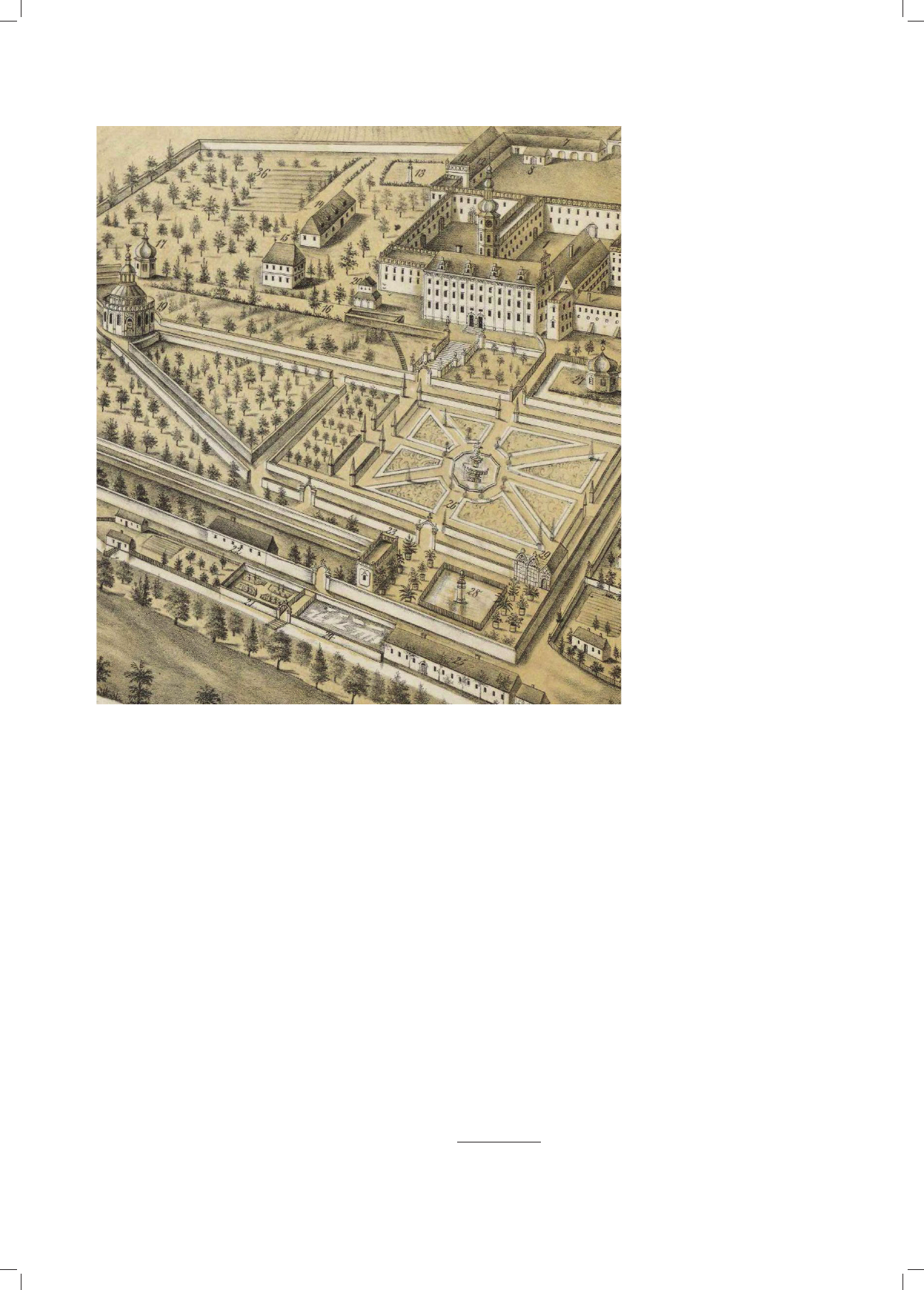
42 Marzanna Jagiełło, Wojciech Brzezowski
grota została wzniesiona, szczególnie gdy uwzględ ni się
koszty zakupu przez von Annen berga w 1738 r. ca łego
majątku Ratschinhof za sumę 30 tys. talarów.
Rodzi się zatem pytanie o czas i przyczyny (s)tworze-
nia tej osobliwej kroniki gorzanowskiej groty, zwłaszcza
o umieszczone w niej fałszywe informacje, a tak należa-
łoby je traktować, zważywszy na trudny do wyobrażenia
brak pamięci do wydarzeń związanych z hekatombą woj-
ny 30letniej, czego nie tłumaczy nawet fakt przejęcia
Gorzanowa w 1729 r. przez styryjską linię rodziny von
Herbersteinów. Za dziwnie mizerną należałoby także
uznać świadomość właścicieli majątku dotyczącą biogra-
fii antenatów, zwłaszcza w odniesieniu do osoby Johanna
Friedricha, której Gorzanów zawdzięcza tak wiele.
Gdyby za wskazówkę do rozwiązania tej zagadki przy-
jąć „pomyłkę” w dacie wymuszonego przejęcia ma
jątku z rąk jego protestanckich właścicieli – rodziny
v. Rat schinów, przesuwającą ten moment na rok 1617,
a więc przed rozpoczęcie wojny 30letniej, można by
podej rzewać chęć zakamuflowania niechlubnej, w no-
wym politycznym kontekście, działalności poprzedników
(mogła się pojawić po włączeniu hrabstwa w 1742 r. do
przychylnego protestantom państwa pruskiego). Mielibyś
my zatem do czynienia z historyczną mistyfikacją, która
wprowadziła spore zamieszanie do badań nad gorza
entries) are equally possible in connection with the thor-
ough works carried out in the grotto – 1763 or 1779.
The value of all these inscriptions would be priceless,
yet under one condition: if they were true. Their credibil-
ity is undermined, however, by numerous errors referring
to the earliest information, starting from the specified
(1617) date of taking the property over by von Annenberg,
preceding the Bohemian Revolt, the outbreak of the
Thirty Years’ War and its consequences for the county,
including the fact that Annenberg, who is presented in the
inscription as the commander of the fort in Kłodzko, did
not become the commander until 1624. Also the date of
erecting the grotto raises fundamental doubts, especially in
the context of its investor Johann Friedrich von Herberstein,
who in 1637 (in the inscription this is the time of starting
the construction) was only 13 years old
70
, and his future
wife to whom he owed the Gorzanów property, who was
just two years old then. What seems equally fantastic is the
amount (22 thousand thalers) given in the inscription for
which the grotto was built, espe cially in the context of the
70
Both Patzak and Eysymontt paid attention to this fact, which did
not protect them from comments on so early dating of the grotto [20,
p. 39], [22, p. 72].
Il. 5. Fragment ogrodu w Gorza
nowie na ryc. F.A. Pompejusa
z 1862 r. (według stanu z 1738 r.):
11, 12, 13 – ujeżdżalnia, Ball haus
i maneż, 16 – tor wyś ci go wy,
19 – grota, 20 – woliera, 23 – strzel
nica z torem, 26 – ogród ozdobny,
27 – króli karnia, 28 – staw Melu
zyny, 29 – cieplarnia, 36 – bażan
tarnia [12]
Fig. 5. Fragment of Gorzanów
garden in engraving by F.A. Pom
pe jus from 1862 (according to the
state in 1738): 11, 12, 13 –
horse
riding school, Ballhaus and manège,
16 – racing track, 19 – grotto,
20 – aviary, 23 – shooting range
with track, 27 – rabbit house,
28 – Melusine pond, 29 – green-
house, 36 – pheasantry [12]

Ogrody rezydencji gorzanowskiej w XVII i XVIII w. /Gardens of Gorzanów residence in the 17
th
and 18
th
centuries 43
nowskimi ogrodami, które i bez tego okazują się wystar-
czająco inspirujące dla wielowątkowych rozważań.
Kolejnym ważnym elementem gorzanowskiego ogrodu
w jego kształcie z końca XVII w. był tor, który wyznaczo no
między dwoma pasami murów, pierwszego związanego
z ogrodem otaczającym grotę i drugiego zamykającego całe
założenie od wschodu (il. 5). Elementy go wyposażające –
drewniane barierki oraz wysoki słup z nieokreślonym po-
piersiem na szczycie, widoczny na granicy obrazu na wyso
kości groty – świadczą o tym, że był to tor strzelniczy
przeznaczo ny rozrywce mającej średniowieczny jeszcze
rodo wód. Obiekty tego typu, towarzyszące zarówno mia-
stom, jak i rezydencjom już od średniowiecza
71
, służyły
doskonaleniu umiejętności strze leckich przydatnych w wal-
ce, ale także w czasie polowań. Te ostatnie stanowiły ważny
element życia dworskiego i z tego powodu miejscom do
strzelania, zaopatrzonym początkowo w wysokie słupy z ku-
kłą najczęściej ptaka na szczycie, a później wydzielonym
torem ujętym wysokimi żywopłotami z tarczą na końcu,
nadawano stosowną rangę. W przypadku Gorzanowa pod-
kreślono ją niewielkim co prawda, ale dekoracyjnym w for-
mie parterowym pawilonem
72
. W owym czasie strzelano
jeszcze czasem z kuszy, a coraz częściej z lekkiej broni
myśliwskiej, np. strzelb ptaszniczych (tzw. cieszynianek)
73
.
Na obrazie prezentującym rezydencję gorzanowską od
zachodu widoczny jest jeszcze jeden tor ograniczo ny
drewnianymi barierkami (il. 5). Z ryciny Pompejusa wy-
nika, że wytyczono go wzdłuż dłuższego boku części
ogrodu związanej z grotą. Na zamknięciu toru od strony
południowej ustawiono niewielki Lusthaus. Lokalizacja ta
była podyktowana usytuowaniem groty, której taras – po-
dobnie jak w przypadku strzelnicy – służył jako miejsce
obserwacji zawodów, a także bliskością innych obiek-
tów związanych z końmi – ujeżdżalni oraz szkoły jeździec-
kiej, zamykających od południa dziedziniec gospodarczy.
Obecność torów jeździeckich, którą odnotowujemy
w wielu nowożytnych „wielkodworskich” rezyden cjach
– za równo w Villa Castello, jak i zamku książęcym
w Stutt garcie oraz w Hechingen (BadeniaWirtembergia)
i w Kuks (Morawy) – dodawała im „rycerskiego” polo
ru. Co charakterystyczne, na terenach Rzeszy lokowano
je w pobliżu okazałych, piętrowych Lusthausów pełnią-
cych w tym przypadku funkcję belwederów, a organizo-
wane na terenie torów imprezy ograniczano w tym czasie
do efektownej widowiskowo zabawy o charakterze zręcz-
nościowym (zwanej w Austrii Ringelspiel), która polega-
ła na przechwytywaniu przez rozpędzonego jeźdźca
z kopią w ręce metalowego kółka zawieszonego przy
słupie lub na linie pomiędzy wysokimi słupami ustawio-
nymi w połowie długości toru.
71
Na terenie Czech i Śląska od czasu wojen husyckich, czyli od
połowy XIV w.
72
Przy wielu rezydencjach w niemieckiej strefie językowej okaza-
łe budynki strzelnic służyły jednocześnie jako miejsca przeznaczone do
organizacji widowisk i festynów. Gorzanowska strzelnica została nato-
miast przebudowana na początku XIX w. na pawilon kąpielowy, który
zrujnowany istnieje do dzisiaj.
73
Jedynie na strzelnicach „miejskich” używano arkebuzów, a od
około 1650 głównie muszkietów [37].
costs of purchase of the entire property of Ratschinhof by
von Annenberg in 1738 for the sum of 30 thousand thalers.
Hence a question arises as to the time and reasons of
creating this peculiar chronicle of the Gorzanów grotto, in
particular as regards the false information contained there
since it must be regarded as such, taking into considera-
tion quite unimaginable lack of memory for events related
to the hecatomb of the Thirty Years’ War, which cannot be
even explained by the fact of taking over Gorzanów in
1729 by the Styrian line of von Herberstein family. At the
same time, the property owners’ awareness of biographies
of ancestors would have to be regarded as strangely mis-
erable, especially in reference to Johann Friedrich whom
Gorzanów owes so much.
If a clue to solve this puzzle that we were to accept is
an “error” in the date of forced taking over the property
from its Protestant owners, i.e. von Ratschin family, shift-
ing that moment to the year 1617, so before the start of the
Thirty Years’ War, we could then suspect the desire to
camouflage the infamous, in a new political context,
activity of predecessors (it could appear after the inclu-
sion of the county into the Prussian state that was favour-
able to Protestants in 1742). We would therefore deal with
a historical mystification which introduced a lot of confu-
sion into the research on the Gorzanów gardens that even
without it turn out to be inspiring enough for multiaspect
considerations.
Another important element of the Gorzanów garden in
its shape from the end of the 17
th
century is a track that
was marked out between two belts of walls, the first one
connected with the garden surrounding the grotto and the
second one closing the entire layout from the east (Fig. 5).
The components of this track such as wooden railings and
a high pole with an unspecified bust on top, visible on the
border of the picture at the height of the grotto, prove that
it was a shooting track for entertainment having its origins
in the Middle Ages. Facilities of this type accompanying
both towns and residences since medieval times
71
served
the purpose of improving shooting skills useful in battle,
but also during hunting. Hunting skills constituted an
important element of the court life and therefore the
shooting places, initially equipped with high poles with
a dummy, most commonly of a bird on the top, and later
with a separate track surrounded by high hedges with
a shield at the end, were given an appropriate rank. In the
case of Gorzanów this rank was additionally emphasized
by a small decorative onestorey pavilion
72
. In those
times the shooting was sometimes done with the use of
crossbows, and then more often with light hunting weap-
ons, e.g. fowling pieces (so called Cieszynka)
73
.
71
In the territory of Bohemia and Silesia since the Hussite wars,
namely from the mid14
th
century.
72
Near many residences in the German language countries stately
buildings of shooting ranges serve at the same time as places for the
organization of shows and festivals. However, Gorzanów shooting range
was rebuilt at the beginning of the 19
th
century and changed to a bathing
pavilion, which exists today as a ruin.
73
Only in the “city” shooting ranges arquebuses were used and
from about 1650 mainly muskets [37].

44 Marzanna Jagiełło, Wojciech Brzezowski
Z torem turniejowym związane było funkcjonowanie
w obrębie rezydencji gorzanowskiej maneżu, a obok nie-
go szkoły jeździeckiej (il. 5). Ten rodzaj obiektu wy-
kształcił się na terenie monarchii za sprawą cesarza
Ferdynanda I, którego trzyletni pobyt w Hiszpanii zain-
spirował do urządzania, począwszy od 1533 r., stajni
i szkół dla koni jeździeckich przy rezydencjach w Wiedniu
i w Pradze, nazwanych później Spanische Reitschule [38,
s. 144–150]. Władca wykorzystał przy tym zarówno hisz-
pańskie wzory, jak i hiszpańskich masztalerzy, a także
iberyjskie konie (ogiery lipiańskie), zastępowane czasem
neapolitańskimi. W szkołach tych przygotowywano
jeźdźców do wyrafinowanych pokazów prezentowanych
na specjalnych placach urządzanych w królewskich ogro-
dach
74
. W przypadku Gorzanowa mamy zatem do czynie-
nia z re cepcją monarszego pomysłu zrealizowanego póź-
niej na najświetniejszych dworach Rzeszy.
Szkoła jeździecka w Gorzanowie sąsiadowała z bu-
dynkiem określonym przez Pompejusa jako Ballhaus
(il. 5). Eysymontt scharakteryzował przeznaczenie tego
obiektu, pisząc, że służył on […] grze w kule mającej
swoje śródziemnomorskie tradycje [2, s. 72]. Gdy tym-
czasem salę taką wykorzystywano do gry przypominają-
cej dzisiejszego tenisa. Została ona wymyślona jeszcze
w starożytności, a w okresie średniowiecza spopularyzo-
wano ją we Francji, w klasztorach Pikardii, gdzie nazywa-
no ją cache. Wkrótce potem została przyjęta jako gra kró-
lewska w Anglii, Flandrii oraz krajach niemieckich [39].
Naj bardziej znanymi w Europie obiektami dla niej prze-
znaczonymi były paryski Jeu de Paume z 1630 r. (il. 6)
i za chowa na do dzisiaj sala w Hampton Court z 1625 r.
Na terenach rządzonych przez austriackich Habsbur
gów wzniesiono sporą grupę Ballhausów
75
. Jeden z pierw
szych powstał w 1521 r. z inicjatywy Ferdynanda I na
terenie wiedeńskiego Hofburgu, kolejny urządzono w la-
tach 1567–1569 dla cesarza Maksymiliana II na Hrad
czanach
76
. Poza inwestycjami dworskimi Ballhausy bu-
dowano także przy uniwersytetach jako miejsca ćwiczeń
dla studentów
77
oraz w miastach, czego przykładem Wro
cław, na którego terenie powstały kolejno trzy obiekty
tego typu. Co ciekawe, pierwszy z nich
78
wybudowano na
początku lat 70. XVII w. na terenie Ołbina, a jego fun da
torem był brat właściciela Gorzanowa Johanna Ar bo gasta
– starosta wrocławski Johann Bernard II von Her berstein
79
.
Obiekt ten pełnił głównie funkcję sceny teat ralnej, co
wpisuje się w aktywne zainteresowania tym ro dzajem
74
Jako pierwszy tzw. Thumblplatz w ogrodzie przy Hofburgu,
urządzony w 1565 r.
75
M.in. na zamku Trausnitz w Landshut w 1568 r. dla księcia
Wilhelma V. W 1579 r. za czasów ks. Wilhelma V powstał Ballhaus przy
rezydencji w Monachium [39].
76
Ten okazały, pokryty dekoracją sgraffitową, zachowany do dzi-
siaj budynek zaprojektował Bonifaz Wohlmuth.
77
Na przykład w Tübingen (1593) i Marburgu (od 1605) [40].
78
Ostatnim był Ballhaus wzniesiony przy dzisiejszej ul. Purky
niego, wcześniej okazjonalnie służący trupom artystycznym, w 1725 r.
zaadaptowany na pierwszy we Wrocławiu teatr.
79
Ballhaus ten znajdował się najprawdopodobniej koło domu
Herbersteina, gdzie uprawiano figi oraz inne „włoskie” rośliny. Został
on sprzedany w 1672 r. gminie Ołbin [41, s. 817], [42, s. 33].
In the painting presenting the residence in Gorzanów
from the west, we can see one more track which is limited
by wooden railings (Fig. 5). The Pompejus’ drawing
shows that it was marked out along the longer side of the
garden, which was connected with the grotto. At the clo-
sure of the track on the south side a small Lusthaus was
situated. This resulted from the location of the grotto
whose terrace – similarly to the case of the shooting range
– served as a place for observing tournaments and due to
the proximity of other objects connected with horses –
a manege and a horse riding school which closed the farm
courtyard from the south.
The presence of horse riding tracks, which we note in
many modern “courtlike” residences – both in Villa
Castello and the princely castle in Stuttgart as well as in
Hechingen (BadenWürttemberg) and in Kuks (Moravia)
– added them “knightly” courtliness. Characteristically, in
the territory of Reich they were located near impressive
storied Lusthauses performing in this case the function of
belvederes and the events which were organized on the
riding tracks were limited at that time to the spectacularly
attractive entertainment of an arcade character (called
Ringelspiel in Austria), which consisted in capturing a metal
ring by a speeding rider with a lance in the hand; the ring
was suspended at the pole or on the line between high
poles set in the middle of the track’s length.
The functioning of the manege within Gorzanów resi-
dence was connected with the tournament track and
a nearby horse riding school (Fig. 5). This type of object
was formed in the territory of the monarchy thanks to
Emperor Ferdinand I who was inspired by his threeyear
stay in Spain to organise, starting from 1533, stables and
horse riding schools near residences in Vienna and Prague,
named later Spanische Reitschule [38, p. 144–150]. At the
same time the emperor used both Spanish designs and
Spanish equerries as well as Iberian horses (Lipiany’s stal-
lions) which were sometimes replaced by Neapolitan hors-
es. In these schools riders were prepared to perform sophis-
ticated shows presented on special squares, which were
or ganized in the royal gardens
74
. So, in the case of Go rza
nów we deal with the understanding of the monarchic
idea which was realized later at the finest courts of Reich.
The riding school in Gorzanów neighboured the build-
ing which was defined by Pompejus as the Ballhaus.
Eysymontt characterised the purpose of this object by say-
ing that it served for a [...] ball game having its Medi-
terranean traditions [2, p. 72]. On the other hand, this hall
was used for a game which resembled today’s tennis. It
was invented still in Antiquity and during the Middle Ages
it was popularised in France, in the monasteries of Picard
where it was called cache. Soon afterwards, it was accept-
ed as a royal game in England, Flanders and German
countries [39]. The best known places in Europe, which
were used for this game, were Parisian Jeu de Paume
from 1630 (Fig. 6) and the hall in Hampton Court from
1625, which has been preserved until today.
74
As the first, the so called Thumblplatz in the garden near
Hofburg, arranged in 1565.

Ogrody rezydencji gorzanowskiej w XVII i XVIII w. /Gardens of Gorzanów residence in the 17
th
and 18
th
centuries 45
sztuki starosty, który po przeprowadzce do Gło gowa za-
adaptował na podobne cele jedno z pomieszczeń tamtej-
szego zamku. Można zatem przypuszczać, że i w Go
rzanowie do czasu urządzenia teatru w pałacu (nastąpiło
to dopiero na początku XIX w.) wykorzystywano do ce-
lów widowiskowych Ballhaus, co sytuuje tę rezydencję
w roli miejsca wyjątkowego na terenie hrabstwa, świad-
cząc jednocześnie o niebanalnych zainteresowaniach ar-
tystycznych właścicieli
80
.
Na górnym poziomie ogrodu, w otoczeniu sadu, w po-
bliżu południowej fasady wzniesiono widoczną na ob
razie olejnym dwukondygnacyjną ptaszarnię (il. 5), co
jest po mysłem o starożytnym rodowodzie, podjętym
w re ne sansowych Włoszech (dość przypomnieć niezwy-
kłe wo liery powiązane z budynkami casini w rzymskiej
Villa Farnese, a także dwa pawilony o podobnej funk-
cji umiesz czone przy bocznych elewacjach Villa Castello).
Ażu rowe ściany takich obiektów pozwalały na oglądanie
pta ków z bliskiej odległości. Czasem trzymano w nich
tak że ptaki śpiewające, przechowywane wiosną i latem
w zaciemnionych pomieszczeniach, co zaburzało poczu-
cie czasu tych zwierząt, a co za tym idzie pory godowej.
Umieszczano je w wolierach pod koniec lata (kiedy ptaki
żyjące na wolności milkły) i słuchano ich śpiewu do koń-
ca jesieni. Z tej przyczyny obiekty te lokowano, podobnie
jak w Gorzanowie, w pobliżu rezydencji.
Z hodowlą ozdobnych ptaków wiąże się jeszcze jeden
element, który był obecny w gorzanowskim ogrodzie już
w 2. połowie XVII w., a mianowicie bażantarnia (niem.
Fasanerie) (il. 5), nawiązująca do prestiżowych w Euro
pie Środ kowej od początku XVII w. obiektów
81
, stano-
wiących istotny składnik założeń ogrodowych należących
do arys tokracji i szlachty
82
. Widać go na obrazie prezen-
tującym rezydencję od zachodu, choć jego funkcję zdra-
dza nam dopiero litografia Pompejusa. Obiekty te służyły
ho dowli i obserwacji bażantów, ptaków pochodzących
z Azji, ale znanych w Europie śródziemnomorskiej już
w starożytności. Jako zwierzęta ciepłolubne wymagały
one miejsca z południową ekspozycją, z licznymi elemen-
tami osłaniającymi przed chłodnymi wiatrami. Wymagały
także obecności wody. Teren na siedzibę tych ptaków
wy dzielono w górnej części ogrodu, miękko opadającej
ku południowi w stronę dużego sadu (mniejszy założono
po między murem północnym założenia a kościołem).
Obok przeznaczonego dla bażantów areału wzniesiono
bu dynek, w którym przechowywano je zimą.
Wiadomo także, iż w okresie późniejszym bażantarnię
przeniesiono do zwierzyńca założonego jeszcze za Jo
hanna Friedricha von Herbersteina na zachód od Go
rzanowa w odległości około 1 km, w pobliżu wsi Łom
nica. Urządzono go na terenie lasu przeciętego rzeką,
wytyczając niemal kwadrat o powierzchni około 1,5 ha,
80
Przypomnijmy, że tradycja ta była kontynuowana w Gorzanowie
od początku XIX w. poprzez działanie teatru dworskiego.
81
Na początku XVII w. bażantarnię założył przy swojej oleśnic-
kiej rezydencji książę Karol II. Jej lokalizację, utrzymaną przez stulecie,
poznajemy dzięki rysunkowi F.B. Wernera.
82
W ogrodzie rezydencji książęcej w Stuttgarcie znajdował się
spory zadrzewiony wybieg dla czapli i żurawi.
In the territories ruled by the Austrian Habsburgs a large
group of Ballhauses was erected
75
. One of the first was built
in 1521 on the initiative of Ferdinand I in the area of
Vienna’s Hofburg; another one was arranged in the years
1567–1569 for Emperor Maximilian II in Hrad čany
76
. Apart
from courtly investments, Ballhauses were also built near
universities as places for students’ classes
77
as well as in cit-
ies like in Wrocław where three objects of this type were
built one by one. Interestingly, the first of them
78
was built at
the beginning of the 1670s in Ołbin and its founder was the
governor of Wrocław Johann Bernard II von Herberstein,
the brother of Johann Arbo gast, the owner of Gorza nów
79
.
This object performed mainly the function of the theatre
stage, which was part of an active interest of the go vernor in
this kind of art, who after having moved to Głogów adapted
one of the rooms of the local castle for similar purposes. It
can therefore be assumed that also in Gorzanów, until the
theat
re was arranged in the palace (it only took place at the
beginning of the 19
th
century), the Ballhaus was used for
the purpose of entertainment, which makes this residence
a unique place in the territory of the county, at the same
time showing unusual artistic interests of the owners
80
.
On the upper level of the garden, surrounded by the
orchard, near the southern facade a twostorey birdhouse
(Fig. 5) that can be seen in the oil painting was erected,
which is the idea of the ancient origin undertaken in the
Renaissance Italy (suffice to recall extraordinary aviaries
connected with the buildings of casini in the Roman Villa
Farnese as well as two pavilions of a similar function
situated at the side facades of Villa Castello). Openwork
walls of such objects allowed for watching birds at close
range. Sometimes songbirds were also kept there; they
stayed in darkened rooms in spring and summer, which
interfered with the sense of time of these animals, and as
a consequence their breeding season. They were placed in
aviaries at the end of the summer (when the birds living
in the wild fell silent) and people listened to their singing
till the end of autumn. For this reason, these objects were
located, as in Gorzanów, near the residence.
Breeding decorative birds is connected with yet one
more element that was present in Gorzanów garden
already in the 2
nd
half of the 17
th
century, namely a pheas-
ant house (in German Fasanerie) (Fig. 5) referring to the
prestigious objects
81
in Central Europe since the begin-
75
In 1568, for instance, in the Castle of Trausnitz in Landshut for
Prince William V. In 1579 at the time of Prince William V the Ballhaus
was built near the residence in Munich [39].
76
This stately, covered with sgraffito, preserved to this day build-
ing was designed by Bonifaz Wohlmuth.
77
For example in Tübingen (1593) and Marburg (from 1605) [40].
78
The last Ballhaus was erected at today’s Purkyniego Street,
earlier occasionally used for artistic troupes, in 1725 adapted for the first
theatre in Wrocław.
79
This Ballhaus was most probably situated near the house of
Herberstein where figs were grown as well as other “Italian” plants. In
1672 it was sold to Ołbin municipality [41, p. 817], [42, p. 33].
80
Let us recall that this tradition was continued in Gorzanów from
the beginning of the 19
th
century through the court theatre’s activities.
81
At the beginning of the 17
th
century Prince Charles II founded
a pheasant house near his Oleśnica residence. Its location, which was
kept for the whole century, is known thanks to F.B. Werner’s drawing.

46 Marzanna Jagiełło, Wojciech Brzezowski
podzielony czterema alejkami przecinającymi się w punk-
cie centralnym podkreślonym okazałym dębem. Na tere-
nie zwierzyńca znajdowała się także leśniczówka, a w jego
stronę prowadziły od strony Gorzanowa trzy równoległe
aleje, z których jedna wychodziła wprost z dziedzińca
gospodarczego majątku
83
.
Zaprezentowane ogrody (dolny i górny) nie były jedy-
nymi istniejącymi przy zamku gorzanowskim w 2. poło-
wie XVII w. Wytyczono tam także spore założenie użyt-
kowe, pod które przeznaczono obszerny areał położony
po drugiej stronie drogi prowadzącej od wschodu do pa-
łacu. Został on podzielony na sporej wielkości kwatery
w układzie 5 na 6 i otoczony murem z kilkoma bramami.
Na jego terenie znajdowały się dwa budynki o nieznanej
nam dzisiaj funkcji.
Pozostałe elementy związane z gorzanowskim zespo-
łem dworskim poznajemy dopiero dzięki rycinie Pom
pejusa, odwzorowującej – co warto przypomnieć – rysu-
nek Wernera z 1737 r., co oznacza, że ich pojawienie
można wiązać dopiero z przekształceniem ogrodów, które
dokonało się najprawdopodobniej na początku XVIII w.
Znajduje się pośród nich pawilon dla królików (il. 5).
Nadano mu formę małego Lusthausu i ustawiono pośrod-
ku prostokątnego trawnika otoczonego wodą. Całość
usytuowano tuż obok schodów prowadzących z tarasu
84
do ogrodu. Przykładu takiego zachowanego obiektu do-
starcza ogród Villa Barbarigo w Valsanzibio (L’Isola dei
Conigli) (il. 7). Kró liki jako zwierzęta ozdobne hodowa-
no również w ogrodzie książęcym w Stuttgarcie. Wiado
mo także, iż podobny w funkcji obiekt (choć w formie
sztucznego kopca zwieńczonego figurą Flory) istniał
w ogrodzie biskupim w Kromieryżu, co pokazuje grafika
J. Ny poorta
85
.
Analizując kolejne elementy ryciny Pompejusa przed-
stawiającej rezydencję w Gorzanowie, nie można pomi-
nąć cieplarni
86
(il. 5) ustawionej na zamknięciu osi pro-
wadzącej od pałacu do ogrodu kwiatowego, budynku
samego w sobie wówczas bardzo prestiżowego w ogro-
dach Euro py po łożonej na północ od Alp, wiążącego się
z rosnącym – po cząwszy od XVI w. – zainteresowaniem
roślina mi pochodzącymi z południa naszego kontynentu
(określanymi jako włoskie), przede wszystkim z cytrusa-
mi, owocami ko ja rzonymi z mitycznym ogrodem He spe
ryd (i Her ku lesem), których trudna w warunkach zaalpej-
skich uprawa była symbolem władzy nad naturą, a przez
to władzy jako takiej. Cieplarniom nadawano początkowo
mało reprezentacyjną, bardziej utylitarną formę, ograni-
czając się do drew nianego budynku o konstrukcji umożli-
wiającej częś ciowe, sezonowe usunięcie dachu i części
ścian, co wiązało się z uprawą cytrusów głównie w grun-
cie. Taką właś nie budowlę zaprojektował dla ogrodu
83
Druga prowadziła z majątku Muszyn, a trzecia wprost z ma
jątku Raczyn. Bezpośredniość tego ostatniego połączenia sugeruje
wcześ niej sze zwią zane z tym majątkiem istnienie zwierzyńca.
84
Niezaznaczonego na rycinie. Pominięto także mur oporowy, co
zatarło rzeczywistą różnicę poziomów założenia.
85
Został on ostatnio zrekonstruowany.
86
Określoną na litografii jako Fruchthaus. Sądząc jednak z licz-
nych roślin kubłowych w pobliżu, budynek ten pełnił funkcję cieplarni.
ning of the 17
th
century, which constituted a significant
component of garden layouts belonging to the aristocracy
and nobility
82
. It can be seen in the painting presenting
the residence from the west, although its function is
revealed to us only in the lithography by Pompejus. These
facilities were used for breeding and observations of
pheasants, birds from Asia but known in the Mediterranean
Europe already in Antiquity. As heatloving animals, they
required a place with a southern exposure with numerous
elements protecting them against cool winds. They also
required the presence of water. The area for the house of
these birds was marked out in the upper part of the gar-
den, which softly sloped towards the south in the direc-
tion of a large orchard (the smaller one was established
between the northern wall of the layout and the church).
Beside the area which was intended for pheasants,
a building where they stayed in winter was erected.
We also know that later the pheasant house was moved
to the zoo which was established still during Johann
Fried rich von Herberstein’s life west of Gorzanów, appro
xi mately 1 km away, in the vicinity of the village of Łom
nica. It was arranged in the forest that was crossed by
a river, in the form of almost a square area of about 1.5 hec
tare,
divided into four paths intersecting at a central point
which was underlined by a stately oak. Within the zoo
there was also a forest house to which three parallel alleys
led from Gorzanów, one of which ran directly from the
farm courtyard of the property
83
.
The presented gardens (upper and lower) were not the
only ones that existed near Gorzanów Castle in the 2
nd
half of the 17
th
century. A big facility layout was designed
there too which was supposed to be founded on the exten-
sive acreage located on the other side of the road leading
to the palace from the east. It was divided into large quar-
ters in a 5 × 6 system and surrounded by a wall with sev-
eral gates. On its territory there were two buildings with
a function which is unknown to us today.
Other elements connected with Gorzanów manor com-
plex were revealed only thanks to Pompejus’ drawing that
imitated – what it is worth recalling – the drawing by
Werner from 1737, which means that their appearance can
be associated only with the transformation of the gardens,
which most probably took place at the beginning of the
18
th
century. A pavilion for rabbits is situated among them
(Fig. 5). It had the form of a small Lusthaus and was set
in the middle of the rectangular lawn surrounded by
water. The whole was situated right next to the stairs lead-
ing from the terrace
84
to the garden. The example of such
a preserved object is provided by the garden of Villa
Barbarigo in Valsanzibio (L’Isola dei Conigli) (Fig. 7).
Rabbits as decorative animals were bred in the princely
garden in Stuttgart. It is also known that an object similar
82
In the garden of the prince’s residence in Stuttgart there was
quite a big wooded run for herons and cranes.
83
The second one ran from the property of Muszyn and the third
one straight from Raczyn. The directness of this last connection suggests
the earlier presence of the zoo which was connected with this property.
84
Not indicated in the drawing. The retaining wall was also
skipped, which blurred the real difference of the layout levels.
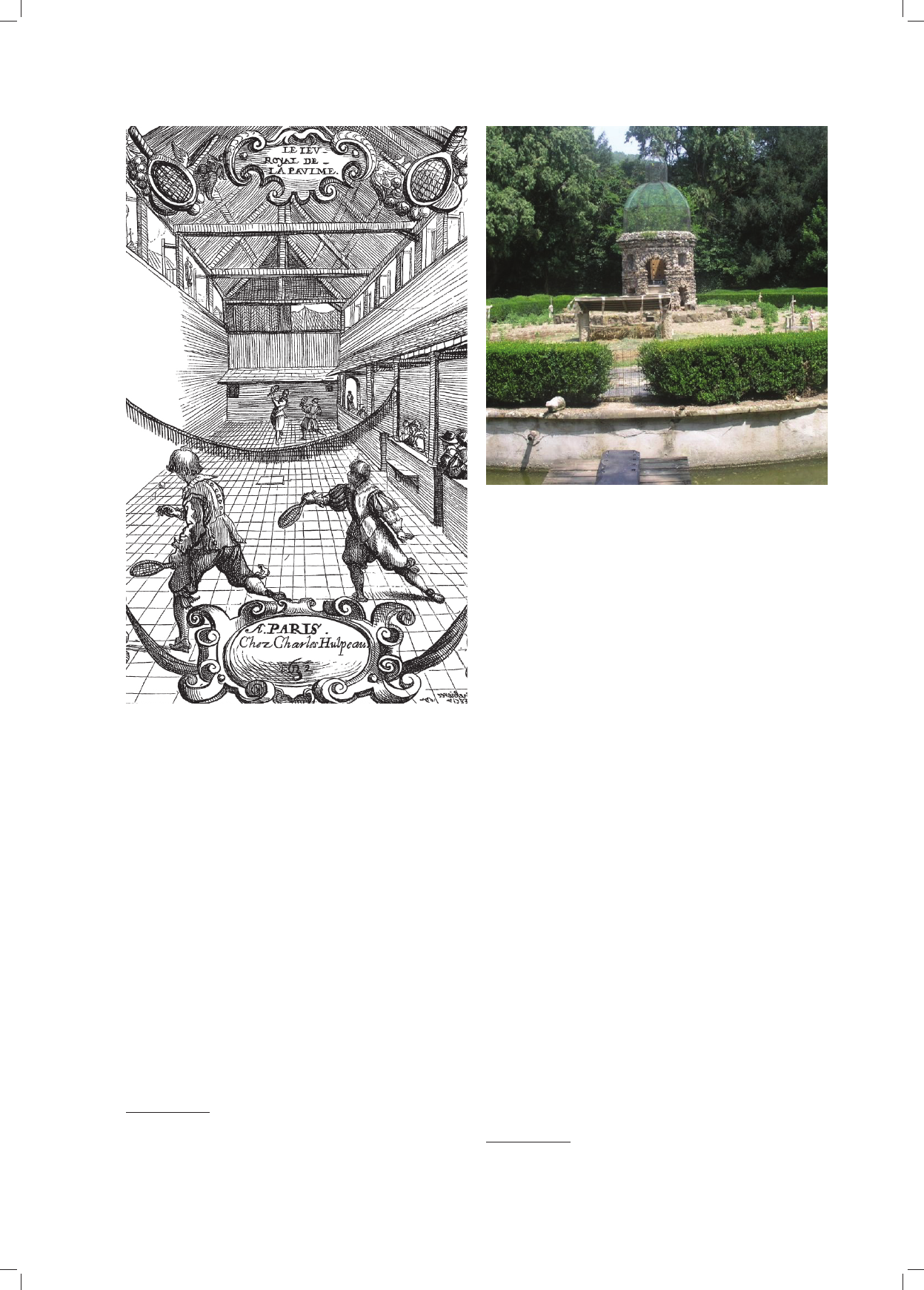
Ogrody rezydencji gorzanowskiej w XVII i XVIII w. /Gardens of Gorzanów residence in the 17
th
and 18
th
centuries 47
w Hei del bergu (ok. 1620) Salomon de Caus, a dla Stutt
gartu (1627) Hein rich Schickhardt, który wcześniej od-
był podróż do Włoch, notując spostrzeżenia dotyczące
tam tejszych ogro dów, także cytrusowych m.in. z Ferra
ry [43].
Forma zaprezentowana przez Pompejusa odbiega od
tych pierwszych cieplarni, przypominając wytworniejsze
budynki o podobnej funkcji, które zaczęto wznosić jako
murowane pawilony dopiero około połowy XVII w., naj-
pierw we Francji. Później coraz bardziej ozdobne oranże-
rie wykorzystywano także jako letnie pawilony
87
. Pomysł
ten bardzo szybko rozprzestrzenił się w Europie, czyniąc
z nich niemal nieodzowny element ogrodów
88
.
87
Pierwsze oranżerie nowego typu wzniesiono we Francji:
w 1654 r. w Meudon i w 1663 r. w Wersalu, obie autorstwa Louisa le
Vau.
88
Już w 1676 r. projekty murowanych cieplarni zawarł w swoim
dziele Nederlantze Hesperides niderlandzki botanik Jan Commmelin.
in func tion (although in the form of an artificial mound
topped with the statue of Flora) existed in the garden of
the bi shop in Kroměříž, which is showed in J. Nypoort’s
graphics
85
.
Analysing the next elements of the drawing by Pom
pejus, which presented the residence in Gorzanów, we
cannot ignore the orangery
86
(Fig. 5) situated at the clo-
sure of the axes leading to the flower garden from the
palace, which was at that time a very prestigious building
in the gardens of Europe north of the Alps, connected
with an increasing – from the 16
th
century – interest in
plants coming from the south of Europe (referred to as
Italian plants), mainly citrus, the fruits associated with the
mythical garden of the Hesperides (and Hercules), whose
difficult cultivation in the transalpine conditions was
a symbol of power over nature, and thus power as such.
Initially, greenhouses had a hardly representative and
more utilitarian form being limited to a wooden build
ing with a structure allowing for partial and seasonal re
moval of the roof as well as some of the walls, which was
connected with the cultivation of citrus mainly in dirt.
Salomon de Caus designed this type of a struc ture for the
garden in Heidelberg (circa in 1620), whereas in Stuttgart
(1627) it was done by Heinrich Schick hardt who earlier
made a trip to Italy making observations about local gar-
dens, including citrus, inter alia, in Ferrara [43].
The form which was presented by Pompejus differed
from the first greenhouses resembling more distinguished
85
It has been reconstructed recently.
86
Specified in the lithography as Fruchthaus. Considering numer-
ous bucket plants nearby, the building served as the greenhouse.
Il. 6. Sala do gry w piłkę Jeu de Paume w Paryżu.
Ryc. Ch. Hulpeau, XVII w. (za: https://upload.wikimedia.org/wikipedia/
commons/d/d1/Jeu_de_paume.jpg; data dostępu: 11.12.2016)
Fig. 6. Hall for ball games Jeu de Paume in Paris. Engraving by
Ch. Hulpeau, 17
th
century (source: https://upload.wikimedia.org/wiki-
pedia/commons/d/d1/Jeu_de_paume.jpg; accessed: 11.12.2016)
Il. 7. Pawilon dla królików w Villa Barbarigo koło Valsanzibio
(fot. W. Brzezowski, 2013)
Fig. 7. Pavilion for rabbits in Villa Barbarigo near Valsanzibio
(photo by W. Brzezowski, 2013)

48 Marzanna Jagiełło, Wojciech Brzezowski
Za oranżerią mieściła się niewielka prostokątna sa-
dzawka określona jako staw Meluzyny (il. 5). W jej towa-
rzystwie ustawiono w donicach rośliny cieplarniane.
Motyw takiej sadzawki znany jest z wielu XVIwiecznych
ogrodów włoskich (Villa Castello, Villa d’Este w Tivoli,
Orti Farnesiani), skąd dotarł do krajów niemiec kich (Hei
del berg
89
, rezydencja książęca w Monachium
90
). Po jawił
się także w Niderlandach, w ogrodach zaprojektowanych
przez André Molleta związanego z dworami władców
Francji, Anglii i Szwecji, gdzie wprowadzał – w sobie
właściwy sposób – barokowe rozwiązania formalne, in-
spirowane w znacznej części sztuką włoską, jednak no-
watorsko przekształcone z uwzględnieniem lokalnych
uwarunkowań. Uwagę zwracają jego ogrody Huis Hon
selaarsdijk oraz Huis ter Nieuburg (dzisiejsza Holandia)
zaopatrzone w niewielkie prostokątne sadzawki, a także
jego autorstwa szwedzki ogród Jakobsdal – z racji cen-
tralnego usytuowania oddalonego od rezydencji okazałe-
go Lusthausu, w którym mieściła się grota, oraz prosto-
kątnego basenu z kompozycją rzeźbiarską pośrodku.
Prawdopodobieństwo oddziaływania Molleta na
znacz ną część Europy wzmacnia fakt zamieszczenia wie-
lu jego konceptów przez Jana van der Groena – holen
derskie go autora traktatu ogrodowego cieszącego się
znacznym po wodzeniem na terenach niemieckojęzycz-
nych [44], [45]
91
.
Czerpiąc najprawdopodobniej inspirację z tego właś
nie traktatu, utworzono eksedrę, która od południa za-
mknęła część ogrodu otaczającą grotę. Nie widać jej na
litografii Pompejusa (tu pokazany został fragment stawu
dla łabędzi), ale na obecność takiego rozwiązania wska-
zuje istniejąca dzisiaj, eliptyczna w planie sadzawka
z małą wysepką pośrodku, umieszczona dokładnie na osi
groty. Jej regularność i symetryczne usytuowanie wzglę-
dem groty i jej otoczenia skłaniają do przyjęcia wersji
zamknięcia tej części ogrodu za pomocą eksedry wyzna-
czonej zarysem półkolistego (półeliptycznego) obejścia
stawu otulonego szpalerem drzew. Warto pamiętać, że
eksedrę jako formę ogrodową o rodowodzie antycznym
(m.in. Villa Hadriana w Tivoli, obie rezydencje Pliniusza
– Tusculum Lauren tinum
92
) spotykamy w czasach nowo-
żytnych w wielu włoskich założeniach rezydencjonal-
nych, np.: Villa Giu lia, Villa Madama i Villa d’Este
93
.
Wszędzie tam kształtowano je przy użyciu elementów
ar chi tektonicznych
94
.
89
Ogród został zaprojektowany przez Salomona de Causa.
90
Zaprojektowana przez holenderskiego artystę z wieloletnim
włoskim stażem, m.in. u boku G. Vasariego, Friedricha Sustrisa.
91
Dzieło to ukazało się w 1669 r. w dwóch wersjach językowych
– holenderskiej i niemieckiej. Zawarto w nim wiele przykładów ogro-
dów zrealizowanych przez Molleta na terenie Niderlandów, a także
wzory dla niewielkich fontann, ozdobnych kwater, konstrukcji trejażo-
wych oraz projekty cieplarń.
92
Takie formy ogrodowe pojawiają się w rekonstrukcjach obu
założeń.
93
Reminiscencje tego rozwiązania odnajdziemy także we francus kim
Charleval (1573) oraz w ogrodach Tuileries w Paryżu (lata 60. XVI w.).
94
Na Śląsku rozwiązania takie zostały przyjęte na początku XVIII
stulecia (Jezierzyce i Sikorzyce), gdzie uformowano je za pomocą pół-
kolistego kanału (ramującego także pozostałą część ogrodu) ograniczo-
nego od strony zewnętrznej szpalerami drzew.
buildings with similar functions, which were erected as
brick pavilions only about the middle of the 17
th
century,
first in France. Later, more and more decorative oranger-
ies were also used as summer pavilions
87
. This idea
quickly spread in Europe, making them almost an indis-
pensable element of gardens
88
.
A small rectangular pond defined as a pool of Melusine
(Fig. 5) was situated behind the orangery. It was accompa-
nied by greenhouse plants in pots. The motif of this pool is
known from many 16
th
century Italian gardens (Villa
Castello, Villa d’Este in Tivoli, Orti Farnesiani) from where
it arrived in German speaking countries (Heidelberg
89
,
a prin cely residence in Munich
90
). It also appeared in the
Ne ther lands, in the gardens designed by André Mollet who
was connected with the courts of the rulers of France,
England
and Sweden, where he introduced – in his own
way – Baroque formal solutions inspired by Italian art to
a large extent, however, inventively transformed regarding
local conditions. What is worth paying attention to are his
gardens Huis Honselaarsdijk and Huis ter Nieuburg
(today’s Netherlands) equipped with small rectangular
pools as well as his Swedish garden Jakobsdal – due to the
central location away from the residence of the magnificent
Lusthaus, which housed a grotto and a rectangular swim-
ming pool with a sculptural composition in the middle.
The probability of Mollet’s influence on a significant
part of Europe is reinforced by the fact that many of his
concepts were presented by Jan van der Groen – a Dutch
author of the very successful garden tractate in German
speaking areas [44], [45]
91
.
By drawing the inspiration most probably from this
tractate an exedra was created, which from the south closed
a part of the garden surrounding the grotto. It is not present
in the lithography by Pompejus (a fragment of the pond for
swans was showed here), but the existing today pond ellip-
tical in the plan, with a small island in the middle, which is
situated exactly on the axis of the grotto proves the pres-
ence of such a solution. Its regularity and a symmetrical
location in relation to the grotto as well as its surroundings
encourages us to come up with the version that this part of
the garden was closed by means of an exedra which was
outlined by a semicircular (semielliptical) bypass of the
pond surrounded with a row of trees. It is worth remember-
ing that an exedra as a garden form of the ancient origin
(including Hadrian’s Villa in Tivoli, both residences of
Pliny – Tusculum and Lau ren ti num
92
) can be encountered
87
The first orangeries of a new type were erected in France, in
1654 in Meudon and in 1663 in Versailles, both by Louis le Vau.
88
Already in 1676 a Dutch botanist Jan Commmelin included the
projects of brick greenhouses in his work Nederlantze Hesperides.
89
The garden was designed by Salomon de Caus.
90
Designed by Friedrich Sustris – a Dutch artist with manyyear
Italian practice, including practices with G. Vasari.
91
This work was published in 1669 in two language versions –
Dutch and German. It included many examples of gardens realized by
Mollet in the territory of Netherlands as well as designs for small
fountains, ornamental quarters, trellis structures and designs of green-
houses.
92
Such garden forms appear in the reconstructions of both
assumptions.

Ogrody rezydencji gorzanowskiej w XVII i XVIII w. /Gardens of Gorzanów residence in the 17
th
and 18
th
centuries 49
Na rycinie Pompejusa widzimy także zmodyfikowa
ny ogród ozdobny, który podzielono ośmioma alejkami
(w tym przekątniowymi)
95
na zbliżone do trójkątów pola,
wypełnione zgodnie z francuską modą motywami hafto-
wymi, zachowując jednak zarówno jego pierwotną loka-
lizację, kształt, jak i centralnie usytuowaną fontannę oraz
(częściowo) obeliski. Zrezygnowano natomiast całkowi-
cie z muru z bramami, których miejsce zajęły żywopło-
ty
96
. Podobnymi formami wzmocniono także kompozy-
cyjnie rolę alei prowadzących do groty. Rozwiązania te
nawiązują wprost do baroku francuskiego i zbliżone są
do (znanych również dzięki Pompejusowi) wzorów przy-
jętych w hrabstwie kłodzkim, np. dla ogrodu w Wil ka
nowie.
Warto na koniec odnotować powstanie na początku
XVIII w. jeszcze jednego ogródka ulokowanego między
wschodnim murem a kanałem Młynówki, któremu towa-
rzyszyły: mały Lustgarten, teren do bielenia płótna, go-
rzelnia, pralnia oraz domek ogrodnika.
Wszystko to składało się na wieloczłonowe i wielo-
funkcyjne założenie wyrosłe z tradycji manierystycznych
ogrodów z terenu Italii, bogate nasyceniem różnego ro-
dzaju obiektami przeznaczonymi do rekreacji i rozrywki,
które niewątpliwie służyły budowaniu prestiżu właści
cieli i manifestowaniu ich aspiracji. W jego powstaniu
brali udział artyści włoscy (budowniczowie, rzeźbiarze,
sztukatorzy, malarze), którzy zapewne odwołali się do
doświadczeń wywiezionych bezpośrednio z ojczyzny, ale
także z terenów wielkiego państwa Habsburgów, obejmu-
jącego m.in. Styrię, miejsce pochodzenia ówczesnych
wła ścicieli Gorzanowa, gdzie za ich sprawą włoskie in-
spiracje ogrodowe, zmodyfikowane według lokalnych po
trzeb i możliwości, odcisnęły swoje piętno już przed po
łową XVII w. Z czasem, co pokazuje wyraźnie litografia
Pompejusa, wpływy włoskie osłabły, wobec czego miejsce
niektórych dotychczasowych elementów zajęły na począt-
ku XVIII stulecia
97
formy o rodowodzie francuskim.
Możliwa jest także bardziej bezpośrednia inspiracja dla
tej drugiej fazy przekształceń ogrodu, zwłaszcza w od
niesieniu do królikarni oraz stawu Meluzyny, pochodząca
z kromieryżskiej Kvĕtnej Zahrady, założonej w latach
1665–1675, według projektu artystów włoskich – Fili berta
Luchese i Pietra Tencalli
98
. Dla niektórych ele men tów
mogła ona pły nąć także w drugą stronę – z Gorzano wa, na
co wskazuje jedno z pomieszczeń wieloczęścio wej sala
terrena urzą dzonej w par terze pałacu bis kupiego w Kro
mieryżu, bardzo podobne w formie i kom pozycji dekoracji
do gorza nowskiej odpowiedniczki. Rzecz to tyle prawdo-
95
Nowe, analogiczne do wspomnianych podziały przekątniowe
wprowadzono także w ogrodzie kuchennym, wznosząc tam jednocze-
śnie domki: zarządcy folwarku, kowala i dworskiego pisarza.
96
Na litografii Pompejusa wyglądają one jak mury, co stanowi
oczywiste przekłamanie rysunku Wernera. Podobny zabieg zastosował
Pompejus także w przypadku przedstawienia Wilkanowa.
97
Najprawdopodobniej za czasów, kiedy właścicielem Gorzanowa
był któryś z synów Johanna Friedricha Herbersteina – starosta kłodzki
Johann Friedrich Erdmann (1701–1709) lub radca kamery cesarskiej na
Śląsku i hrabia Rzeszy, Johann Anton Friedrich (1707–1725).
98
Sztukaterię w pawilonie ogrodowym wykonał Quirico Castelli
Carlo Borsa, a polichromię Carpoforo oraz Giacomo Tencalla.
in modern times in many Italian residential layouts, e.g.
Villa Giulia, Villa Madama and Villa d’Este
93
. In each place
exedras were shaped by using architectural elements
94
.
In the drawing by Pompejus we can also see a modi-
fied decorative garden which was divided by eight alleys
(including diagonal)
95
into trianglelike fields filled with
embroidery motifs in accordance with the French fashion,
but at the same time preserving its original location, form
and a centrally situated fountain as well as (partially)
obelisks. However, there was no wall with gates which
were replaced by hedges
96
. The role of the alleys leading
to the grotto was also reinforced compositionally with
similar forms. These solutions refer directly to the French
Baroque and are similar (also known thanks to Pompejus)
to the models adopted in the County of Kłodzko, e.g. for
the garden in Wilkanów.
All in all, it is worth noticing the fact that one more gar-
den was created at the beginning of the 18
th
century, which
was situated between the east wall and Młynówka canal and
accompanied by a small Lustgarten, an area for bleaching
linen, a distillery, a laundry and a gardener’s house.
All these elements created a multipart and multifunc-
tional layout which grew out from the Mannerist gardens
tradition from the area of Italy, excessively rich in all
kinds of facilities designed for recreation and entertain-
ment, which undoubtedly served the purpose of building
the prestige of the owners and to manifest their aspira-
tions. Italian artists participated in its construction (archi-
tects, sculptors, stucco artists, painters) who probably
referred not only to their experiences in their homeland,
but also in the territory of the great Habsburg state, in
cluding, among other things, Styria, the place of origin of
the then owners of Gorzanów, where thanks to their ac
tivities, Italian garden inspirations, which were modified
according to local needs and possibilities, had their strong
influence even before the mid17
th
century. With time,
which is clearly showed in the lithography by Pompejus,
Italian influences weakened, therefore the place of certain
existing elements were occupied by forms of the French
origin at the beginning of the 18
th
century
97
.
A more direct inspiration for this second phase of trans-
formations of the garden is also possible, especially in rela-
tion to the rabbit house and Melusine pond, coming from
Kroměříž Kvĕtna Zahrada, founded in the years 1665–
1675, designed by Italian artists – Filiberto Luchese and
93
Reminiscences of this solution can be also found in the French
Charleval (1573) and in the Tuileries gardens in Paris (1560s).
94
In Silesia, these solutions were adopted at the beginning of the
18
th
century (Jezierzyce and Sikorzyce), where they were formed by
means of a semicircular canal (which framed also as the rest of the
garden) limited by rows of trees on the outside.
95
New, analogous with the above mentioned diagonal divisions
were also introduced in the kitchen garden, at the same time erecting
cottages there for a farm manager, a blacksmith and a court writer.
96
In the lithography by Pompejus they look like walls, which is
a clear misrepresentation of the drawing by Werner. A similar procedure
was applied by Pompejus also in the case of Wilkanów representation.
97
Most probably at the time when the owner of Gorzanów was one of
the sons of Johann Friedrich Herberstein – the governor of Kłodzko Johann
Friedrich Erdmann (1701–1709) or the imperial Treasury De partment in
Silesia and Count of the Reich, Johann Anton Friedrich (1707–1725).

50 Marzanna Jagiełło, Wojciech Brzezowski
Bibliografia /References
[1] Holtei K. von, Vierzig Jahre, Bd. 2, Berlin 1843, 369.
[2] Eysymontt K., Rezydencja i ogrody Herbersteina w Gorzanowie
(Grafenort), „Rocznik Historii Sztuki” 1980, t. 34, 63–79.
[3] Eysymontt K., Studium historyczno-stylistyczne ogrodu i parku
w Gorzanowie (pow. Bystrzyca), mps PKZ, Wrocław 1968.
[4] Eysymontt K., Śląskie ogrody XVIII i XVIII wieku, [w:] Z. Świe
chowski (red.), Z dziejów sztuki śląskiej, PWN, Warszawa 1978,
273–299.
[5] Gryphius A., Epigrammata oder Bey-Schrifften, Jehna 1663, 3,
[za:] http://digital.staatsbibliothekberlin.de/werkansicht/?PPN=P
PN742540278&PHYSID=PHYS_0004 [accessed: 26.09.2015].
[6] Zabytki sztuki w Polsce. Śląsk, (red.) S. Brzezicki, G. Grajewski,
D. Popp, A. Tomaszewski, D. von Winterfeld, Krajowy Ośrodek
Badań i Dokumentacji Zabytków Warszawa 2006.
[7] Kalinowski K., Rzeźba barokowa na Śląsku, PWN, Warszawa
1986.
[8] Snopek F., Olomoucký kníže biskup Karel z Lichtenštejna a cti-
hodný sluha boží Marek d’ Aviano, „Časopis pro katolicke ducho
wenstwo” 1917, R. 58, 794.
[9] Zatloukal O., Guide to the floral garden, [w:] L. Daniel, M. Pe
růtka, M. Togner (ed.), Archibishop’s chateau & gardens in Kro-
měříž, The National Institute for Heritage Preservation, branch
Kroměříž, Kroměříž 2009, 197–198.
[10] Merian M., Die schönsten Schlösser Burgen und Gärten. Aus den
Topographien und dem Theatrum Europeum, Hoffmann u. Campe,
Hamburg 1965.
[11] Schemper I., Stuckdekorationen des 17 Jahrhunderts im Wiener
Raum, Böhlau Verlag, Wien–KölnGraz 1983.
[12] Pompejus F.A., Album der Grafschaft Glatz, oder Abbildungen der
Städte, Kirchen, Klöster, Schlösser und Burgen derselben, vor
mehr als 150 Jahren, Selbstverlag des Herausgebers, Glatz 1862.
[13] Herzig A., Ruchniewicz M., Dzieje Ziemi Kłodzkiej, Oficyna
Wydawnicza ATUT, Hamburg–Wrocław 2006.
[14] Poertner R., The Counter-Reformation in Central Europe: Styria
1580–1630, Oxford University Press Books, Oxford 2001.
[15] Chrząszczewski J., Kalwarie austriackie XVII i XVIII wieku, t. 1,
praca doktorska, Politechnika Krakowska, Kraków 2014.
[16] Vischer G.M., Topographia Austriae superioris modernae, Vienna
1674.
[17] Vischer G.M., Topographia Ducatus Stiriae, Graz 1681.
[18] Biblia, to jest Pismo Święte Starego i Nowego Testamentu, Bry-
tyjskie i Zagraniczne Towarzystwo Biblijne, Warszawa 1981.
[19] Konwiarz R., Alt-Schlesien: Architektur, Raumkunst, Kunstgewer-
be, Verlag von Julius Hoffmann, Stuttgart 1913.
[20] Patzak B., Die Badegrotte in Grafenorten Schlosspark, „Guda
Obend” 1932, Vol. 32, 39–43 [oryg. w zbiorach Biblioteki Uniwer
sy teckiej we Wrocławiu].
[21] Oszczanowski P., Wrocławski ogród Laurentiusa Scholza St.
(1552–1599) – sceneria spotkań elity intelektualnej końca XVII
wieku, [w:] M. Hałub, A. MańkoMatysiak (red.), Śląska Re
publika Uczonych, Oficyna Wydawnicza ATUT, Wrocław 2004,
98–145.
[22] Jagiełło M., Brzezowski W., Ogrody na Śląsku. T. 1. Od średnio-
wiecza do XVII w., Oficyna Wydawnicza PWr, Wrocław 2014.
[23] Jackson H., Shell houses and grottoes, Shire Publications, Oxford
2012, 4.
Pietro Tencalla
98
. For some elements it could also be taken
the other way round – from Gorzanów, which is indicated
by one of the rooms of the multipart sala terrena arranged
on the ground floor of the bishop’s palace in Kroměříž,
very similar in the ornamentation form and composition to
its Gorzanów counterpart. It is quite probable due to the
fact that the father of Bishop of Olomouc – General of the
imperial army Rudolf Philip von LiechtensteinKastelkorn
– in the years 1622–1625 was the governor of Kłodzko
Land, similarly to Johann von Annenberg Arbogast and his
grandson Johann Friedrich von Herberstein who subse-
quently held this post, and all of them belonged to the
group of people closely connected with the imperial court.
Finally, in order to be reliable as researchers, we must
point to the fact that – contrary to the impression which
was made by the preserved oil painting and especially by
Pompejus’ graphics – it was still a relatively small layout
which at that time could not compete with many other
Silesian gardens in terms of its size. But at the same time
it is so saturated with a multitude of miscellaneous and
symbolic elements as well as functions which ambitiously
perform the program of a manorlike character that this
allows us to class it among the most sophisticated con-
temporary gardens not only of the lands of Kłodzko, but
also of the monarchy.
Translated by
Bogusław Setkowicz
98
Molding in the garden pavilion was by made Quirico Castelli
Carlo Borsa, the polychrome by Carpoforo and Giacomo Tencalla.
podobna, że ojciec biskupa Oło muńca – generał wojsk ce-
sarskich Rudolf Philip von LiechtensteinKastelkorn – był
w latach 1622–1625 starostą ziemi kłodz kiej, podobnie jak
później Johann Arbogast von Annen berg oraz jego wnuk
Johann Friedrich von Her ber stein, a wszyscy oni należeli
do grona osób ściśle związanych z dworem cesarskim.
Rzetelność badaczy każe także odnotować na koniec,
że – wbrew wrażeniu zbudowanemu przez zachowany
obraz olejny, a zwłaszcza grafikę Pompejusa – było to
jednak założenie stosunkowo niewielkie, niemogące kon-
kurować rozmiarami z wieloma innymi ogrodami śląski-
mi tamtych czasów. Choć jednocześnie tak nasycone
mnogością rozmaitych i symbolicznych elementów oraz
funkcji wypełniających ambitnie program o charakterze
wielkodworskim, że pozwala nam je sytuować pośród
najbardziej wyrafinowanych ówczesnych ogrodów nie
tylko ziemi kłodzkiej, ale także monarchii.

Ogrody rezydencji gorzanowskiej w XVII i XVIII w. /Gardens of Gorzanów residence in the 17
th
and 18
th
centuries 51
Streszczenie
Artykuł traktuje o jednym z najbardziej interesujących ogrodów dawnego hrabstwa kłodzkiego, zrealizowanym w oparciu o bogaty program
funkcjonalny przewidziany dla założeń wielkodworskich. Prezentacja dotyczy dwóch faz przekształceń tego założenia przeprowadzonych w okresie
od połowy XVII do połowy XVIII w.
Słowa kluczowe: sztuka ogrodowa, ogród dworski, XVII–XVIII w., hrabstwo kłodzkie
Abstract
The article deals with one of the most interesting gardens of the former County of Kłodzko, realized on the basis of an extensive functional pro-
gramme provided for the grand court complexes. The presentation covers two phases of transformation of the complex which took place in the
period between the middle of the 17
th
and 18
th
centuries.
Key words: garden art, court garden, 17
th
and 18
th
centuries, County of Kłodzko
[24] Colonna F., Hypnerotomachia Poliphili, Aldus Manutius, Venetiis
1499.
[25] Shearman J., Manieryzm, PWN, Warszawa 1970.
[26] Caus S. de, Les Raisons des forces mouvantes, Jan Norton, Fran
cofort 1615.
[27] Ramelli A., Le diverse et artificiose machine, Parigi 1599.
[28] Alberti L.B., De Re Aedificatoria, Firenze 1485, Ks. 9, 4.
[29] Furttenbach J., Architectura Privata, Ulm 1641.
[30] Furttenbach J., Newes Itinerarium Italiae, Ulm 1627.
[31] Brzezowski W., JagiełłoKołaczyk M., Cztery stulecia zamku
w Ksią żu, „Czasopismo Techniczne. Architektura” 2010, R. 107,
z. 5A, 249–250.
[32] Veen Th. van, Cosimo I De’ Medici and His Self-Representation in
Florentine Art and Culture, Cambridge University Press, Cam-
bridge 2006.
[33] Attlee H., Italian Gardens. A cultural history, Frances Lincoln,
Lon don 2006.
[34] Schickhardt H., Reisetagebuch, [rkps, Landesbibliothek, Stutt-
gardt], [za:] http://pratolino.mpiwgberlin.mpg.de/imageServer?ge
neric=no&showall=no&group=44&filename=Schickhardt_Stufa
[accessed: 4.06.2015].
[35] Miller N., Heavently Caves. Reflection on the Garden Grotto,
George Braziller, New York 1982.
[36] [Wnętrze groty we Friedrichswerth] https://upload.wikimedia.org/
wikipedia/commons/thumb/3/37/Grotte_innen.jpg/800pxGrotte_
innen.jpg [accessed: 19.09.2015].
[37] Kastner A., Geschichte der neisser Schützengilde, Joseph Graver,
Neisse 1850.
[38] Laferi Ch.L., Die Kultur der Spanier in Österreich unter Ferdi-
nand I. 1522–1564, Böhlau, Wien–Köln–Weimar 1997.
[39] Vaupel B., Die vergessene Geschichte der Ballhäuser, „Monumente.
Magazin der Deutschen Stiftung Denkmalschutz”, April 2014,
http://www.monumenteonline.de/14/02/leitartikel/Ballhaeuser_
Geschichte_Tennis.php [accessed: 20.01.2015].
[40] Nail R., „...ganz ruiniret und zum Ballspielen untauglich gemacht”
– Zur Geschichte des Marburger Ballhauses, http://www.staff.uni
marburg.de/~nail/pdf/ballhaus.pdf [accessed: 22.01.2015].
[41] Lucae F., Schlesiens curiose Denckwürdigkeiten oder vollkom-
mener Chronick, Bd. 2, Frankfurt a. M. 1689.
[42] Schube Th., Gartenpflanzen in Schlesien im Zeitalter Ludwigs XIV,
Beilage zum Jahresberiche 1910/11 des Realgymnasiums am
Zwinger zu Breslau, Grass, Barth&Comp., Breslau 1910, 33.
[43] Schickhardt H., Beschreibung einer Reiß, welche... Friderich
Hertzog zu Würtemberg vnnd Teck, ...im Jahr 1599 selb neundt,
auß dem Landt zu Würtemberg, in Italiam gethan, Mömpelgard
1602.
[44] Mollet A., Le jardin de plaisir, H. Kayser, Stocholm 1651.
[45] Groen J. van der, Le Jardinier Hollandois […]/Der niderländische
Gärtner […], Amsterdam 1669.
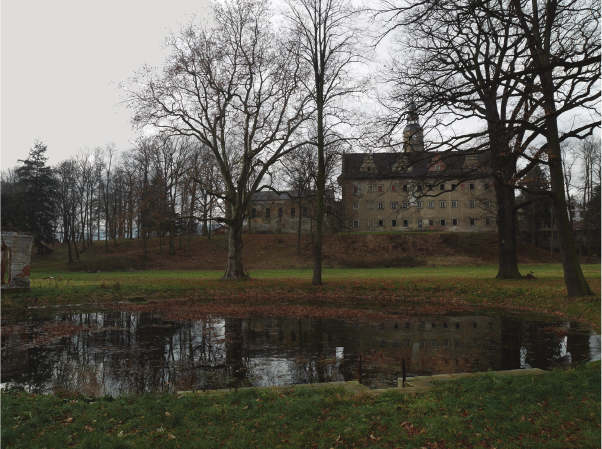
Pałac w Gorzanowie (fot. M. Jagiełło, 2016)
Palace in Gorzanów (photo by M. Jagiełło, 2016)