
2025
4(84)
Karol Czajka-Giełdon*, Krystyna Kirschke**
Pipe organ of the Aula of the Technische Hochschule Breslau
(Wrocław University of Science and Technology)
DOI: 10.37190/arc250407
Published in open access. CC BY NC ND license
Abstract
This text outlines the history of the organ built by Gebrüder Rieger in 1929 for the auditorium of the Technische Hochschule Breslau. The in-
strument was an important part of the hall’s original design, serving to add splendour to academic events and to conduct music and teaching classes
at the Institute of Music Technology – the only body of its kind within the structure of a technical university in the Weimar Republic. As a result of
the destruction that engulfed the whole of Wrocław in the nal phase of the Second World War, the surviving organ was a valuable possession of the
newly opened Polish university in Polish Wrocław. It was repaired and has served for many years of concerts, embedding itself into the city’s cultural
landscape. During the remodelling of the auditorium in the 1970s, it was relocated as redundant to the St Mary Magdalene Church in Wrocław, which
had been rebuilt from ruin and was deprived of its organ as a result of the war. After a short period of use in their new location, the organ was vandal-
ized and remains out of service. The way in which the instrument is situated in the church betrays the ad hoc and makeshift nature of this arrangement,
and its current state calls for swift and decisive remedial action. The organ has historic value today and still retains the potential for possible revalori-
sation and restoration of its primary musical function. This text features a conservation analysis of this object and the possibility of its worthy display
in accordance with current conservation standards in its original location, the auditorium of the Wrocław University of Science and Technology.
Key words: organ, relocation, revaluation, architecture, Wrocław University of Science and Technology, Technische Hochschule Breslau
Introduction
This article discusses the organ in the auditorium of the
main building of the Technische Hochschule Breslau (now
the Wrocław University of Science and Technology). The
goal of the authors was to retrace the history of this spe-
cial cultural heritage asset, a musical instrument that is now
almost a century old. In the literature there is a dearth of
detailed studies on this asset, with the exception of a small
publication from its construction period, Die Musik an der
Technischen Hochschule zu Breslau, nebst Würdigung ihrer
Orgel (Matzke 1929), and the work Breslauer Orgeln in
Weltlichen Räume (Subel 2015).
Built by the Gebrüder Rieger company in 1929 to en
-
hance the splendour of university ceremonies and concerts,
the organ survived the Second World War in a slightly dam-
aged state. When, after the Potsdam Conference, Breslau
became part of Poland, the city’s broadly understood recon-
struction was initiated. A Polish University and Polytechnic
University were established in 1945, based in buildings left
by the Germans. Although the renovation of the organ was
not a priority, it succeeded when the decision was made to
hold the World Congress of Intellectuals in Defence of Peace
in the auditorium of the Wrocław University of Science and
Technology (WUST) in 1948. Over the following years the
instrument was also used for non-university events, but in
the 1970s, by decision of the WUST Senate, the organ was
given to the State Philharmonics in Wrocław. The organ
was ultimately installed in the Wrocław Polish Catholic of
St Mary Magdalene, which had lost its main organ in a blast
shortly after the conclusion of the Second World War. This
relocation allowed the organisation of the cyclical Wratisla-
via Cantans festival in this church. The Rieger organ is now
* ORCID:
0000-0003-3006-477X. Faculty of Architecture, Wro-
cław University of Science and Technology, Poland, e-mail: karol.czajka-
gieldon@pwr.edu.pl
** ORCID: 0000-0003-4278-263X. Faculty of Architecture, Wro-
cław University of Science and Technology, Poland.

76 Karol Czajka-Giełdon, Krystyna Kirschke
damaged and has been silent for years. In light of the plans
made to replace it with an instrument that would be better
suited for a church interior, it is necessary to perform an
analysis and formulate conservation guidelines on solving
the current situation in terms of repairing the organ and the
feasibility of its relocation. One possible scenario is the re-
turn of the instrument to the auditorium of the WUST.
Organs – their role, conservation
and relocation cases from Wrocław
Historically, organ music was a very important identity
element in the German cultural circle, and the associated
organ-building craft is still appreciated today. In 2014, or-
gan building and organ music were placed on the national
list of intangible cultural assets, and in 2018 organ building
and music were placed on the UNESCO Intangible Cultural
Heritage List (Hey Pipe Organ Builders 2018). The experi-
ence of Polish conservators in maintaining historic organs
is slowly catching up with standards from Germany or
France, compensating for the backwardness resulting from
the underappreciation of organ building during the Polish
People’s Republic era. Pioneering postulates concerning the
principles of recording, protection and the revalorisation
of historic organs were formulated in the 1960s by Fr Jan
Chwa łek and Marian Dorawa (Bielawski 1969; Chwałek
1971). Since then, research on organ building in Poland
and in the lands of the partitioning powers has progressed
considerably thanks to historical studies and the revival of
traditional craftsmanship. At present, historic instruments
are being renovated at the highest execution level, with the
distinctiveness of the craft of a given period being given the
highest respect, and much care is given to faithfully recon-
struct sound quality
1
. This applies to the oldest instruments
from the 16
th
and 17
th
centuries (e.g., the parish church in
Ol kusz, the parish church in Kazimierz nad Wisłą), but also
from periods closer to the time of the Wrocław University
of Sci ence and Technology’s instrument (e.g., the church
of Sa lesians in Gdańsk-Orunia, the church of the Order of
St Do minic in Krakow).
The organ stock of Wrocław has undergone a series of
transformations in the 20
th
century that are unique in the
country. It was primarily the pre-Second-World-War period
that can be seen as pioneering the research-based organ con-
servation that resulted in professional literature. Der Orgel-
bau in Schlesien
2
, rst published in 1925 in Strasbourg and
then renewed and expanded in 1973, can be considered
a leading specialist item (Burgemeister 1973). The begin-
nings of historic organ conservation came at a time when
highly intrusive remodels were made, often in good will,
but nevertheless resulted in the erasure of the instruments’
historical character (e.g., the contemporaneous organ in the
1
According to data from Statistics Poland for 2022, 21,000 peo-
ple were organ builders. Only 10% were employed in the public sector.
There is a demand for newly built instruments, and existing instruments
require ongoing care and maintenance (Mapa Karier 2025).
2
Architect, conservator and art historian Ludwig Burgemeister,
was a co-author of the design of the Technische Hochschule Breslau
building complex.
Corpus Christi Church, remodelled in 1934). The particular-
ly severe wartime destruction of 1945 led to an irreversible
loss of a high number of historic organs, among which many
featured outstanding architectural and sculptural designs
(e.g., the organ in the cathedral and church of St Mary Mag-
dalene). Finally, the end of the conagration was followed
by the exploitation of the surviving stock of instruments in
a way that was the result of the new political and econom-
ic reality in which Lower Silesia found itself. Organs from
abandoned churches or devastated concert halls were be-
ing relocated on an unprecedented scale. These relocations
were made both between towns and cities, especially to the
churches of Warsaw, Lesser Poland or Lublin, but also with-
in Lower Silesia and Wrocław itself, that had been damaged
by war
3
(Brylla 2012; Trzaskalik-Wyrwa 2012).
Among the post-war organ relocations, mention should
be made of the largest project of its kind – the relocation of
an organ designed for the huge volume of the Centennial
Hall (Jahrhunderthalle). The colossal instrument, with 222
voices at its peak (after a looting, this number was reduced
by about 30%), was inserted into the much smaller naves of
the Cathedral of St John the Baptist, rebuilt after a bombing
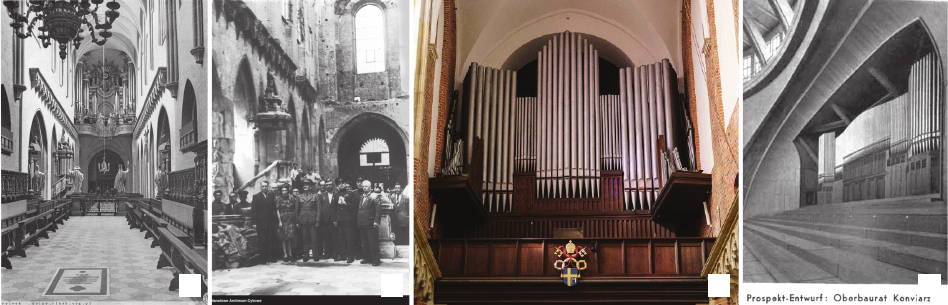
raid (Bukowski 1959). With this relocation, the architecture,
spatial composition and characteristics of the instrument
were permanently changed (Fig. 1). The organ was also sup-
plemented by the addition of elements from other Wrocław
instruments, but also new elements acquired from domestic
and foreign organ-builders. Work is currently underway to
revitalise it and properly adapt it to its current location. It is
a complex task both because of the enormity of the project
and because of the need to tie together into a coherent whole
a series of technical and stylistic layers resulting from an
intricate history
4
.
Another relocation was the transfer of the organ that had
been in the WUST in the years 1929–1970 (Technische
Hoch schule Breslau up to 1945) to the west gallery of the
Church of St Mary Magdalene in Wrocław. The modest size
of the relocated Gebrüder Rieger organ and the Modernist
styling of its case meant that it was not well suited to the
grand interior of the Church of St Mary Magdalene. For
a time, they were used during concerts, and presumably
also for liturgy. Today, various possible scenarios of once
again equipping the church with a worthy instrument appear
viable, with the most interesting – both due to aesthetic and
musicological considerations – being the recreation of the
Michael Röder Baroque organ in the gallery, tied with the
relocation of the Gebrüder Rieger organ to the WUST audi-
torium (Czajka-Giełdon, Kirschke 2025).
This should be linked to the relocation of the organ by
Gebrüder Rieger to the auditorium of the WUST. The fur-
ther fate of the current instrument is also an opportunity for
the University to take charge of its own heritage. This organ,
designed for a lay interior, is a testament to a higher under-
3
Another great loss was the complete destruction of the organ with
its Baroque prospect located in St Elizabeth’s Church in Wrocław in
1976. Its reconstruction did not take place until the years 2022–2025.
4
The individual organ segments were disassembled and repaired in
the workshop of the Zych organ company in Wołomin (Ulrich-Kornacka
2024) .
Pipe organ of the Aula of the Technische Hochschule Breslau 77
Fig. 1. An example of an organ’s transformation due to damage caused by war – the case of St John the Baptist Cathedral:
a) Late Baroque organ, photo from ca. 1935 (source: https://polska-org.pl/894026,foto.html?idEntity=545938), b) the organ’s condition in 1947
(source: Narodowe Archiwum Cyfrowe, signature: 3/3/0/9.5/398), c) the organ relocated in fragments from the Centennial Hall, photo from 2024
(photo by M. Pasiewicz), d) Jahrhunderthalle, organ prospect by Sauer,
built in 1911–1913, state after extension in 1937 (source: https://polska-org.pl/799235,foto.html?idEntity=542804)
Il. 1. Przykład przekształceń organów w związku ze zniszczeniami wojennymi – casus katedry pw. Św. Jana Chrzciciela:
a) organy późnobarokowe, fot. ok. 1935 r. (źródło: https://polska-org.pl/894026,foto.html?idEntity=545938), b) stan organów w 1947 r.
(źródło: Narodowe Archiwum Cyfrowe, sygn. 3/3/0/9.5/398), c) organy translokowane we fragmentach z Hali Stulecia, 2024 (fot. M. Pasiewicz),
d) Jahrhunderthalle, prospekt organowy firmy Sauer zbudowany w latach 1911–1913, stan po rozbudowie w 1937 r.
(źródło: https://polska-org.pl/799235,foto.html?idEntity=542804)
standing of the art of organ building, which is a convergence
of many polytechnic disciplines with the artistry of music.
The restoration of the instrument in its original dedicated
space, along with the conservation of the surviving sub-
stance and complementation as per the best standards of his-
toric organ restoration, would be a most honourable deed.
Technische Hochschule Breslau
in the years 1902–1945
and the history of the Gebrüder Rieger organ
At the turn of the 20
th
century, united Germany was one
of the most powerful countries in Europe, whose thriving
industry needed a well-educated engineering workforce.
Technical schools established as early as the 1820s in Ber-
lin, Nuremberg, Karlsruhe or Munich were no longer suf-
cient and eorts were therefore made to establish them
in additional states. In Breslau, the decision to establish
a technical college (Königliche Technische Hochschule)
was taken in 1902. In the newly designed complex, between
a boulevard and Smoluchowskiego Street (Borsig Strasse),
around a dozen teaching and laboratory buildings were
planned (Die neue Technische Hochschule in Breslau 1910;
Die Technische Hochschule Breslau 1910). They were com-
mis sioned in two essential stages: in the years 1905–1914
and, after a pause caused by the First World War and the
nancial crisis, in the years 1925–1930.
An architectural proposal was developed in 1925 by Max
Schindowski and Fritz Schirmer, and the technical designer
was architect Gottfried Müller, who oversaw the construc-
tion proper carried out in the years 1925–1928. The elongat-
ed body of the building, aligned along the east–west direc-
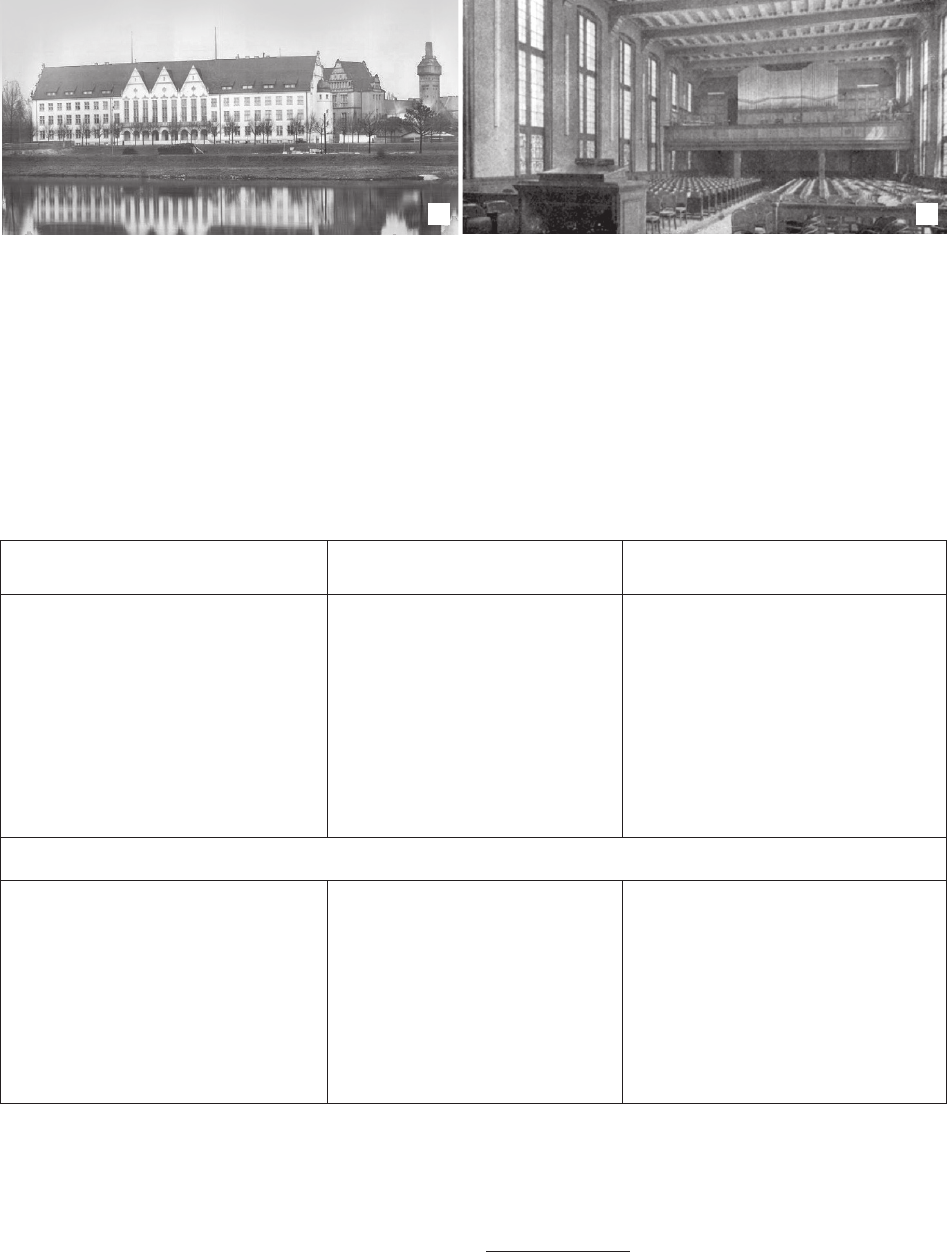
tion along the Oder embankment (Fig. 2a), was connected
to the older part by curved side wings (east and west), cre-
ating a spacious, trapezoidal-shaped inner courtyard. The
three-storey high front building featured a basement and an
immense usable attic. The symmetrical, three-storey façade
that faced Wybrzeże Wyspiańskiego (Uferstrasse) was cov-
ered with plaster and was given a steep roof and modest
stone detailing to better t with earlier, Historical-Revival
buildings. The 9-axis central section of the building was ac-
centuated within the 27-axis façade. The ground oor fea-
tured an arched arcade supported by massive pillars, bound
at the rst-oor level with a wide balcony. It was connected
with an auditorium, which lled two storeys and featured
a gallery on which an organ was placed (Fig. 2b). The sepa-
rated section was accentuated in the roof area by three adja-
cent triangular gables. The building’s mass was simple and
heavily cuboid, which set it apart from the older sections.
The façade was enriched by the installation of sculptures
by Kurt Bimler in the window pediments of the auditorium,
depicting prominent academics. The rich ornamentation of
the bay window on the west façade was created by Albert
Krämer (Die Technische Hochschule Breslau 1985; Gmach
główny – część nowsza 2010).
Located on the rst oor of the new main wing of the
building, the new auditorium was opened in June 1928. The
spacious hall, measuring 31.8 × 14.7 m and 9.15 m high, of-
fered a oor space of around 475 m
2
. The eastern part of the
room had a wide podium and a at audience seating 400 peo-
ple. Opposite, on a large balcony accessible from the second
oor, was another 100 seats with an amphitheatre layout and
an organ, centrally located between the two entrances. From
both the front and the courtyard, the auditorium was illumi-
nated by full-height, rhythmically arranged windows. The
large volume of the hall, its elongated layout and wooden
coered ceiling, as well as the oak panelling and wooden
furniture, reected and diused sound, which gave a specif-
ic character to the acoustics of the interior – not very good
for speeches, but perfectly suitable for organ concerts.
a b c d
78 Karol Czajka-Giełdon, Krystyna Kirschke
On 21 July 1928, the new main building of the Tech-
nische Hochschule Breslau was ocially opened and conse-
crated. The nal element of construction was the installation
of an instrument (29 voices, 2+P) by the Gebrüder Rieger
company of Jägerndorf (now Krnov, Czech Republic) in the
auditorium in 1929 (Table 1). The organ case, 7 m wide,
6
m deep and 6 m tall, was harmoniously tted into the cen-
tral space of the balcony. Pneumatic action operated conical
wind chest. In front of the organ was a place for singers
and a free-standing counter. The Modernist aesthetics of
the instrument’s case corresponded to the austere, historical
Modern design of the hall. The case was designed as open
– that is, without an architectural nial
5
. The upper front
line was drawn by pipe outlets formed into two outermost,
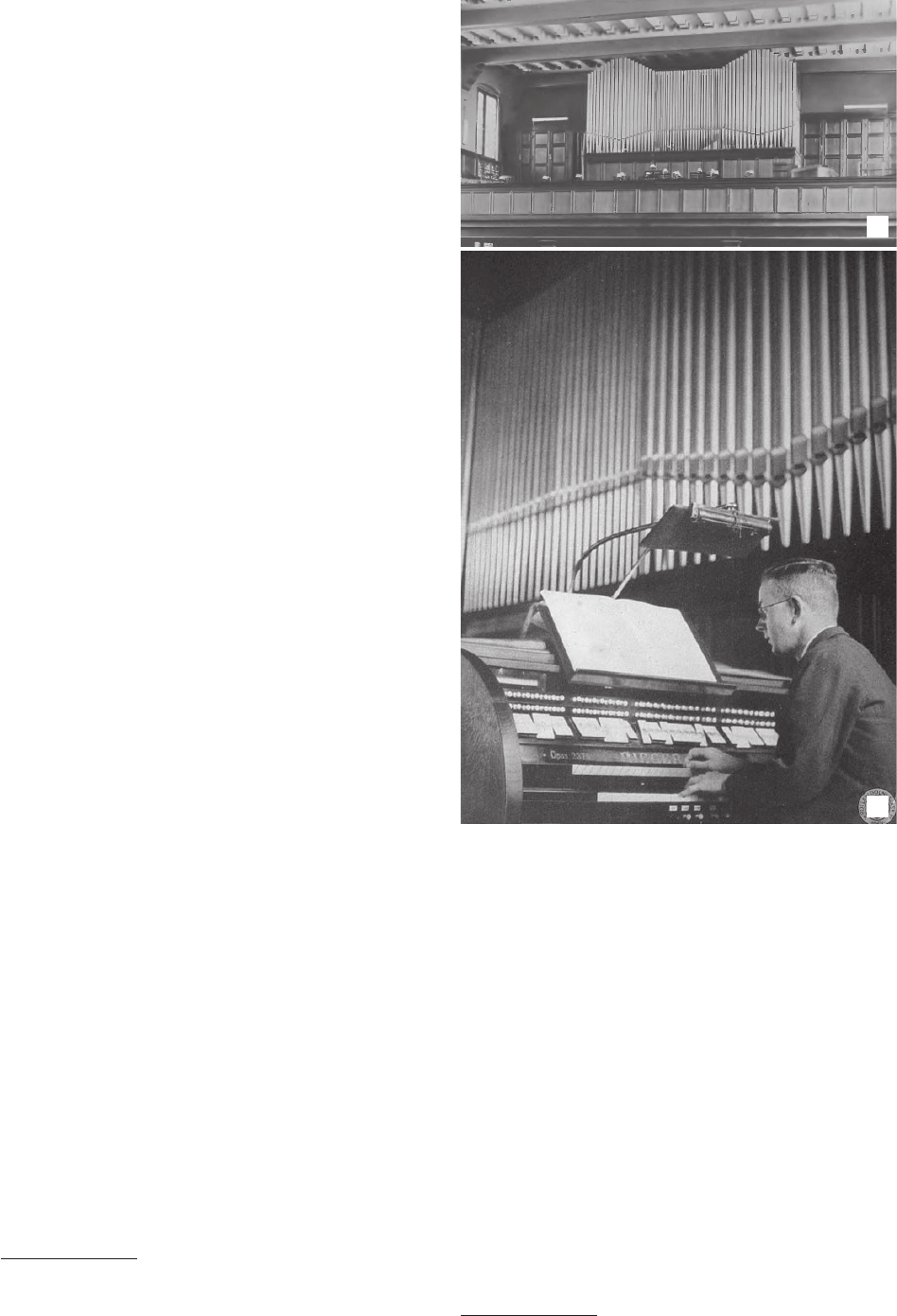
slightly risalit-like towers and a at central eld (Fig. 3)
6
.
5
In Breslau, the rst organ with architecture in a Modernist spirit was
installed in the Centennial Hall in 1913. Between the wars, such instruments
were built, among others, in the Church of the Holy Family at 68 Monte
Cassino Street (Damaschke-Strasse, Zimpel) and the concert hall of the ra-
dio station in Karkonoska Street (Rundfunk Breslau, Waldenburgerstrasse).
6
The organ was rst played on 23.06.1929. On this occasion, a lecture
entitled “Die neue Orgel in ihren zeitgeschichtlichen und lokalen Zusam-
menhängen” [New organ in a historic and local context] was delivered by
Professor Hermann Matzke (Die Technische Hochschule Breslau 1985, 339).
Fig. 2. Main building of the Technische Hochschule: a) as seen from the side of the Oder River, circa 1930, under the three identical gables,
nine tall windows indicate the location of the auditorium (source: Burak, Dackiewicz and Pregiel 2010),
b) interior of the auditorium in 1929, after the commissioning of the Gebrüder Rieger organ (source: Matzke 1929, 5)
Il. 2. Budynek główny Technische Hochschule: a) widok od strony Odry około 1930 r. – pod trzema identycznymi szczytami
dziewięć wysokich okien wskazuje lokalizację auli (źródło: Burak, Dackiewicz i Pregiel 2010, 83),
b) wnętrze auli w 1929 r., po oddaniu do użytku organów firmy Gebrüder Rieger (źródło: Matzke 1929, 5)
a b
I. Manual – Hauptwerk
II. Manual – Oberwerk
(in an expression case)
Pedal
Principal 8’
Gedackt 8’
Salicional 8’
Oktave 4’
Bach-flöte 4’
Oktave 2’
Mixtur 4 fach 2 2/3’
Dulcian 16’
Vox humana 8’ (in a separate expression case)
Flöten Principal 8’
Nachthorn 8’
Fernflöte 8’
Viola di Gamba
Vox coelestis 8’
Gems-horn 4’
Rohr-flöte 4’
Sifflöte 2’
Kornett 3–4 fach 4’
Trompette harm. 8’
Regal 4’
Offen-bass 16’
Subbas 16’
Oktave 8’
Gedackt 8’
Bass-flöte 4’
Posaune 16’
Dulcian 16’ (transmission from 1. man.)
Regal 4’ (transmission from 2. man)
Aids
manubria:
4 O-H,
16 O-H,
4 O,
16 O,
O-H,
H-P,
O-P
Buttons under manual 1:
Auslöser,
Fr. Komb. II,
Fr. Komb. I,
Tutti,
Handreg ab.,
Zungen ab,
Tremolo O,
Tremolo
Vox hum.
Foot-operated levers:
Octavkoppeln, Normalkoppeln,
O-P,
H-P,
Koppeln aus Walze,
Rollschweller ab.
Walec Crescendo
II man. louvre pedal
Vox humana louvre pedal
Table 1. Original disposition of the organ of the Technische Hochschule Breslau auditorium, now located in the church of St Mary Magdalene
in Wrocław, builder: Gebrüder Rieger, op. 2375, year of construction: 1929 (elaborated by K. Czajka-Giełdon)
Tabela 1. Oryginalna dyspozycja organów auli Technische Hochschule Breslau, zlokalizowanych obecnie w kościele pw. św. Marii Magdaleny
we Wrocławiu, budowniczy: Gebrüder Rieger, op. 2375, rok budowy: 1929 (oprac. K. Czajka-Giełdon)
Pipe organ of the Aula of the Technische Hochschule Breslau 79
This organ was one of the rst instruments in Wrocław to
be built in compliance with the Orgelbewegung’s principles
– a style of sound distinct for the 1920s and 30s which drew
from Baroque organ musical heritage (Prasał 2019, 156).
The organ was highly signicant to the academic com-
munity of the University, which in the 1910s resounded with
music. The growing activity of the university’s musical and
singing ensembles was coordinated by Professor Hermann
Matzke, a versatile musician who took up the post of lectur-
er in music in 1924 and founded the Collegium Musicum
– an organisation for choirs and instrumental ensembles. He
headed Germany’s only academic Institute for Music and
Music Technology (Musik und musikalische Technologie)
up to 1945
7
. With the new instrument, organ playing could
be trained during courses. The activity of this body was cer-
tainly also a form of substantive and technical support for
the developing instrument building sectors, among which
organ building grew especially dynamically, in no small
part due to the application of electricity in the operation of
action mechanisms.
In 1933, in the face of the 1929–1930 nancial crisis,
it was decided to merge the excellently functioning Tech-
nische Hochschule with a school that had an entirely dier-
ent prole, the Schlesische Friedrich-Wilhelms-Universität
zu Breslau. This coincided with the political upheaval in
Germany, namely the Nazis’ rise to power. The Technische
Hochschule tried to maintain its autonomy in this situation
8
.
The period’s university reform did not have a signicant im-
pact on Hermann Matzke’s classes, whose curriculum refer-
enced both technical and humanistic matters (Burak 2010).
The Institute of Musical Technology was maintained until
the end of the German university, and this despite the ad-
ministrative repression by the fascist authorities, which in-
tensied from around 1942 onwards and found organ-build-
ing to be costly and to consume a considerable amount of
valuable raw materials (tin, lead, copper and silver).
History of the organ in the auditorium
of the WUST
in the years 1945–1970
The siege of Festung Breslau turned many districts of the
city into ruins. After the German army signed the German
Instrument of Surrender, as a result of the Potsdam Con-
ference, Wrocław’s state aliation changed from German
to Polish. The university’s surviving buildings were reno-
vated and a Polish academic life began forming. The rst
to begin their operations were the Wrocław University and
the WUST. The research and teaching personnel of this
university had their roots mostly from the Lviv Polytech-
nic University and the Jan Kazimierz University in Lviv.
The best-preserved part of the Wrocław University was the
faculties left over from Technische Hochschule. Fortunate-
ly, most of the buildings on this campus had suered only
7
Biography of Hermann Matzke (Prieberg 2009, 4802–4804).
8
One occasion to manifest this state of aairs was the celebra-
tion of the 25
th
anniversary of the Technische Hochschule in 1935. After
1937, the role and autonomy of the university’s technical faculties was
signicantly strengthened.
minor damage, and their furnishings and even some labo-
ratories had survived. The campus housed the engineering
faculties operating under the WUST, which soon gained
considerable autonomy and, in 1951, the status of a separate
university
9
.
The main building was preserved almost fully intact. The
organ in the auditorium also survived, although it was not
fully operational. There are documents in the archives of
the WUST that describe the steps taken in 1947 to repair
9
The Genesis of the WUST and its initial years are extensively do-
cumented in (Burak, Dackiewicz and Pregiel 2010, 179–224).
Fig. 3. The Gebrüder Rieger organ in the Technische Hochschule
auditorium; a) general view of the balcony in in 1929
(source: Matzke 1929), b) a 1935 concert (source: Wo studiere ich
technische Wissenschaften? 1935, 22)
Il. 3. Organy firmy Gebrüder Rieger w auli Technische Hochschule:
a) widok ogólny balkonu w 1929 r. (źródło: Matzke 1929)
b) koncert
w 1935 r. (źródło: Wo studierte ich technische
Wissenschaften? 1935, 22)
a
b

80 Karol Czajka-Giełdon, Krystyna Kirschke
the instrument
10
. The bid for the work was submitted by
two students from the Electromechanical Faculty, Edward
Popiel and Marian Śliwiński. The cost estimate included:
a full cleaning of the organ and pipes, setting up the con-
necting pipes, gluing together some of the wind chests for
the pedal voices, repairing the punctured front pipes, turn-
ing on the “Vox humana” voice, tuning the 28 voices, clean-
ing the organ console, keyboard and inspecting the motor.
The entire work was expected to cost 35,000 PLN. The
missing pipes were to be made at the University’s expense.
In December, Vice-Rector Kazi mierz Zipser contacted the
Central Executive Committee of the Polish Socialist Party
asking for funding to repair the organ
11
. The repair process
ended on 22 March 1948 with the acceptance of the com-
pleted work
12
. It is important to mention that there was also
another political theme emerging here, which increased the
chances of a rapid renovation of the organ. On 25–28 Au-
gust 1948, an extremely spectacular event was to take place
– the World Congress of Intellectuals in Defence of Peace
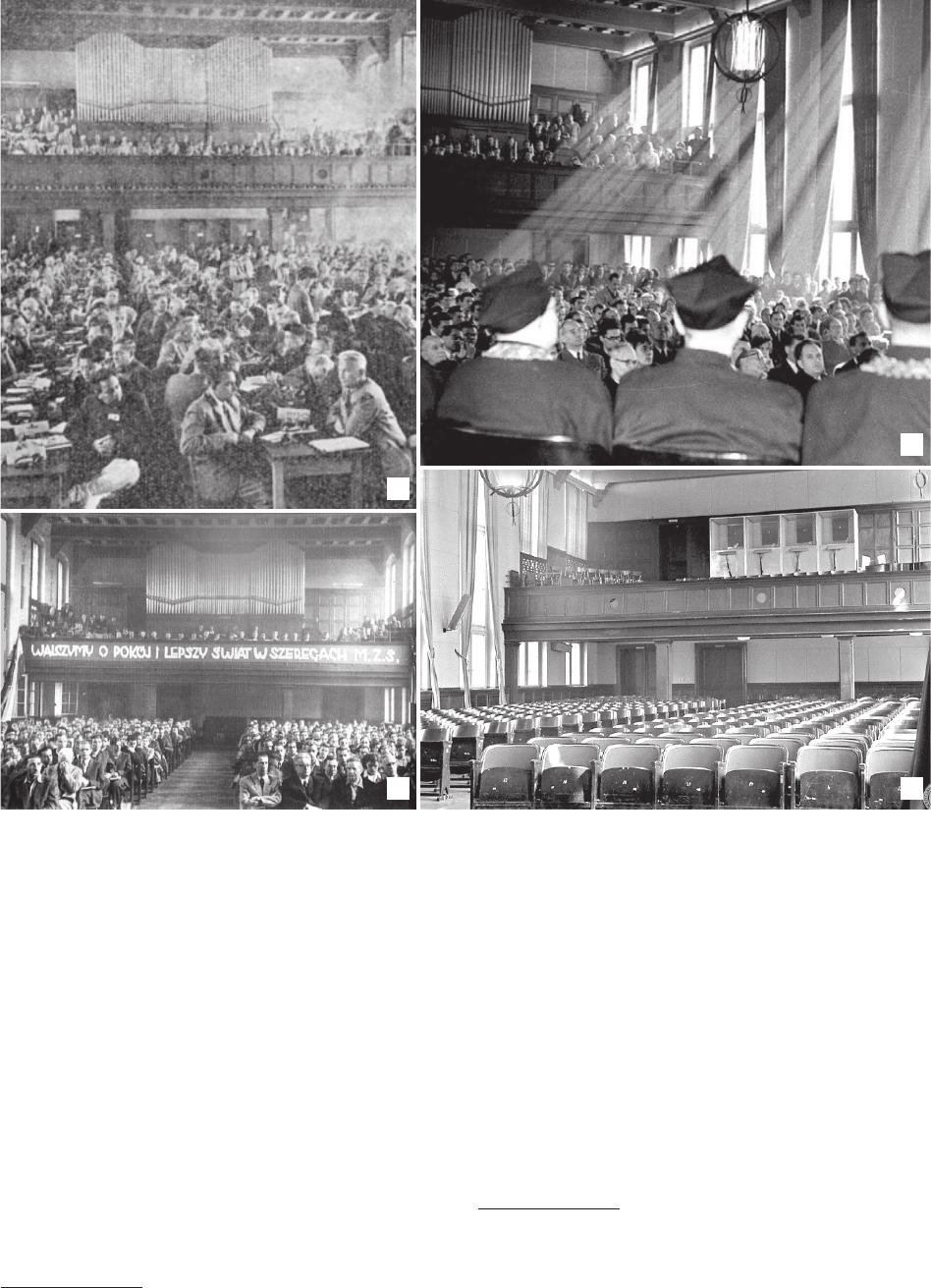
(Fig. 4a), which was ultimately attended by 400 delegates
from 46 countries. It was part of an exhibition presenting
the achievements of the reconstruction of the Recovered
Territories after the Second World War, which was sched-
uled to be hosted from 21 July to 31 October 1948. The cost
of this gigantic propaganda project was 715 million PLN
(Zwierz 2016).
The refurbished instrument was used for various univer-
sity events over the following years, as well as when the
auditorium was made available to external users as a con-
ference or concert hall (Historia jednego zdjęcia 2020)
(Fig. 4b, c). In the 1960s, for example, music classes were
still held here for students of High School II, located on
what is now Parkowa Street. In 1969, Professor Tadeusz
Porębski became the next Rector of the WUST, leading
the preparation and subsequent implementation of a reform
of the educational process and a change in the university’s
structure. His plans also included a renovation of the audito-
rium, tied with the idea to remodel the organ gallery, where
interpreter booths were proposed in place of the instrument.
The organ, which had been renovated 22 years earlier, was
declared redundant, and was dismantled and handed over
to the State Philharmonic in Wrocław (Fig. 4d).
13
It was ul-
timately relocated to the Church of St Mary Magdalene in
Wrocław.
10
Archiwum Politechniki Wrocławskiej, 1947, sign. 135.
11
The Vice-Chancellor justied his request by the fact that only
three days earlier, the proceedings of the 27
th
PSP Congress had taken
place in the hall. Archiwum Politechniki Wrocławskiej, 1947, sign. 122.
12
The commission consisted of pipe organ professor Julian Bi-
dziński (in 1946–1970, director of the Wrocław music school, then
named after Fryderyk Chopin), Dionizy Smoleński and Franciszek Pał-
ka. In their opinion, […] the works listed in the attached cost estimate
were executed expertly. On inspection, it was found: correct intonation
of all voices, clean tuning, the addition of missing voices was adjusted
to the disposition guidelines for organ construction. The entirety of the
repairs was done professionally and soundly (Archiwum Politechniki
Wrocławskiej, 1947, sign. 135, document no. 78).
13
This was based on a decision of the University’s Senate Taken on
20 March 1970. Cf. Brandt-Golecka, Burak and Januszewska (2005, 167,
footnote 66).
Outline of the history of the organ
in the Church of St Mary Magdalene,
the rebuilding of the church after
the Second World War and the relocation
of the organ from the auditorium of the WUST
Insofar as the Wrocław University and University of
Tech nology had a complex of buildings that had survived
the war from the very start, the state of preservation reli-
gious buildings in Wrocław was marked by heavy losses.
The new state regime, which was hostile to all religions,
nevertheless took great care of the oldest churches, treating
them as testimony to Silesia’s historical belonging to the
Piast dynasty. For these reasons, the reconstruction and res-
toration work also included the severely damaged medieval
Church of St Mary Magdalene. In May 1945, an explosion
tore apart its tower mass, causing part of the south tower and
the west gable to collapse, along with the gallery housing
its great organ, which was completely destroyed. Thanks
to the innovative methods used during the reconstruction,
the tower and gable were successfully reconstructed (albeit
without the tower domes) in 1952. Work on the interior con-
tinued for another ten years, during which the west gallery
was also rebuilt and given a spatial form close to the one
from the Middle Ages. The immense window in the gable
wall above the gallery was also restored (Broniewski 1952).
After the end of the war, the church remained under the
management of the Evangelical parish centred on the city’s
German citizens – services were held in the surviving sacris-
ty in the northern annex. In the 1960s, a Polish-Catholic par-
ish and cathedral were established in the now-rebuilt church.
There was no organ in the interior during the postwar
reconstruction period, a departure from a tradition (Seibt
1938; Kmita-Skarsgård 2013) that had continued since
the Middle Ages
14
, as an organ player of this church had
rst been mentioned already in 1380, and after the per-
manent takeover of by the Protestants, the town council
commissioned the construction of the great organ to Mi-
chael Hirschfeldt of Żary in the late 16
th
century. The work
was completed in 1602, and as early as 1634 a major re-
modelling project was carried out
15
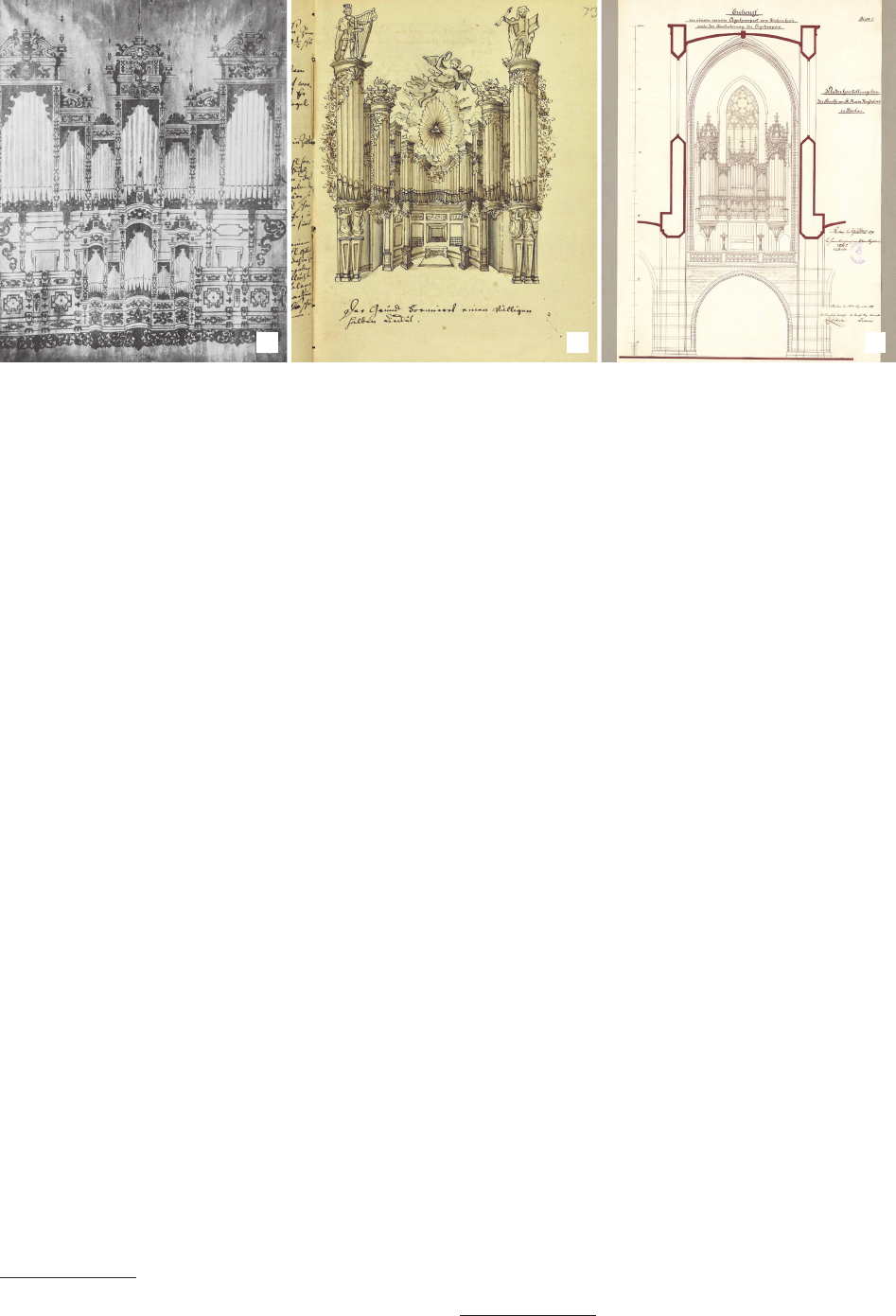
. The following were
preserved: the location on the cantilevered gallery above
the pulpit and the case (Fig. 5a) that consisted of a Late
Renaissance main case (Hauptwerk) and the back positive
(Rückpositiv). The dismantling of the instrument and the
gallery in 1722 was preceded by the construction of a new
great organ, which was planned to be located in the western
gallery (called Burgerchor or Hellenfeldscher Chor). The
builder was Michael Röder from Berlin
16
. The design was
14
The year 1380 is seen as the boundary when an organist named
Gregor was rst mentioned, which attests to the existence of an organ. At
the end of the 16
th
century, the church sported a large organ and a small
organ (700 Jahre St. Maria Magdalena 1926).
15
Michael Hirschfeldt also referred to as Hirschfelder (154?–1602),
with the collaboration of Martin Scheuer, completed the construction of
this experimental organ in 1602. Despite improvements during the con-
struction phase, the technical solution was not successful and the organ
malfunctioned, and a decision was made to rebuild it fully in 1623.
16
Johann Michael Röder (late 17
th
century to the early 18
th
centu-
ry), was a pupil of eminent organ builder Arp Schnitger (1648–1719)
Pipe organ of the Aula of the Technische Hochschule Breslau 81
characterised by an innovative approach to the case layout
(with a 32’ tin principal voice), as well as the organ cabinet
(Fig. 5b). The lightness of Johann Georg Urbansky’s Ba-
roque woodcarving and the dynamism of the design lines
corresponded with the complementary wall paintings that
extended up to the nave vault. This organ laid the ground-
work in the redenition of the characteristics of the Silesian
who had been active in northern Germany. His exceptional technical
skills allowed him to animate the movement of the sculptures adorning
the organ case, earning him the nickname “Mechanicus”. In the years
1721–1726, reusing parts of the earlier organ by Hirschfeld and Scheu-
er, Röder built a movable great organ in the Church of St Mary Mag-
dalene in Wrocław.
organ case, which was based on a concave oor plan line
and strong centrifugal tendencies in the composition of its
frontal view (Radziewicz-Winnicki 1986)
17
.
17
In addition to this organ, the church also had had a small organ
on the gallery in the north wall, which was dismantled in the 18
th
centu-
ry. There was also a “positive in the singers’ gallery” – a dozen-or-so–
voice instrument located in the centre of the presbytery’s space, directly
in front of the great altar. It referenced a tradition of liturgical music
unique to Wrocław, based on performing ceremonial pieces in a dozen-
or-so–member singing ensemble with the accompaniment of an organ or
other cameral instruments. This unusual location had no parallel in either
Protestant or Catholic churches in other urban centres. Cf. (Fischer 1821;
700 Jahre St. Maria Magdalena 1926; Burgemeister 1973).
Fig. 4. Interior of the auditorium of the WUST with its organ: a) opening ceremony of the World Congress
of Intellectuals in Defence of Peace on 25 August 1948 (source: Słowa prawdy i nadziei 1948, 2), b) proceedings of the Congress of Democratic
Unity of Polish Students in Wrocław, July 1948 (source: https://polska-org.pl/672979,foto.html?idEntity=563597), c) view towards the balcony
of the remodelled auditorium in 1959 (source: Burak, Dackiewicz, and Pregiel 2010, 287),
d) interpreters’ booths that took the place of the organ in the gallery in 1970 (source: https://polska-org.pl/863644,foto.html?idEntity=563597)
Il. 4. Wnętrze auli Politechniki Wrocławskiej z organami: a) uroczystość otwarcia 25.08.1948 r. Światowego Kongresu Intelektualistów w Obronie
Pokoju (źródło: Słowa prawdy i nadziei 1948, 2), b) obrady Kongresu Jedności Demokratycznej Studentów Polskich we Wrocławiu, lipiec 1948
(źródło: https://polska-org.pl/672979,foto.html?idEntity=563597), c) widok przebudowanej auli w kierunku balkonu w 1959 r.
(źródło: Burak, Dackiewicz i Pregiel 2010, 287), d) kabiny tłumaczy, które w 1970 r. zajęły na emporze miejsce organów
(źródło: https://polska-org.pl/863644,foto.html?idEntity=563597)
a
b
c
d
82 Karol Czajka-Giełdon, Krystyna Kirschke
the presentation of chamber music, which was adequately
served by the Rieger organ. In 1990, an additional small or-
gan (8 voices, 1+P) constructed by Józef Cynar’s company
was installed in the south side aisle, in the presbytery area
19
(Konopka 2017). At present, it is the only functioning in-
strument in the building, as the organ made by Gebrüder
Rieger in the western gallery has been worn out by the pas-
sage of time and has remained silent for several years.
Conservation analysis
of the Gebrüder Rieger organ
and a proposal for its relocation
The organ of the Gebrüder Rieger company in the west
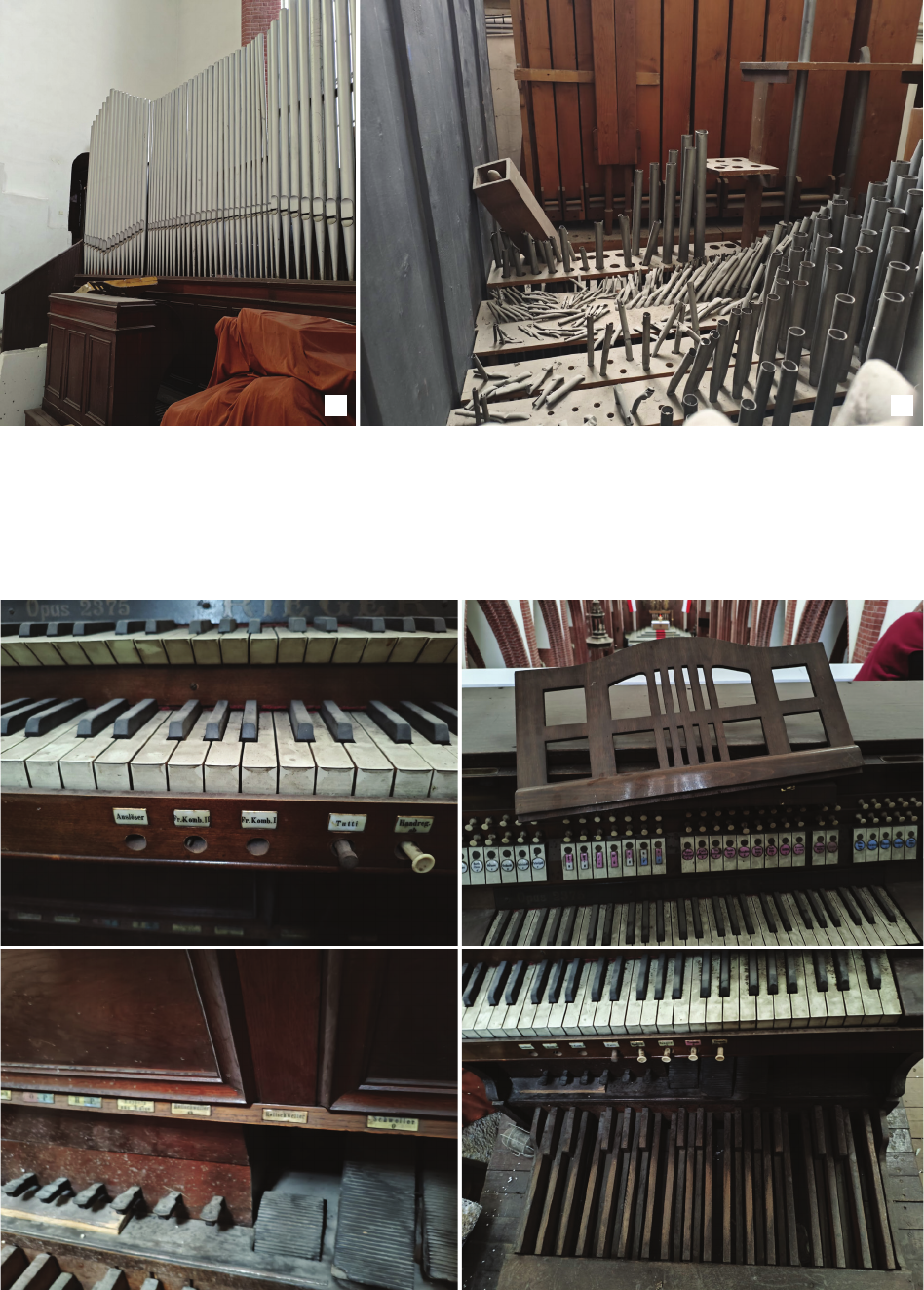
gallery of the St Mary Magdalene Church is now in such poor
condition that it is impossible to play it without extensive re-
pairs and numerous treatments involving basic work, includ-
ing the reassembly of the entire werk (Figs. 7, 8). Some of
the ner metal pipes have been destroyed by being crushed,
which indicates insucient protection against tampering. An
on-site inspection carried out in March 2025 found the in-
strument to be authentic, many of the original parts, largely
complete choir pipes, the original tongue voices, or entire
technological solutions, e.g., swell boxes with louvres, were
preserved. The north tower room also houses the original
Rieger bellows, which used a Soviet-made engine to power
it. The organ console is also largely original, featuring reg-
ister switches characteristic of the workshop from which it
originated, together with enamelled stained plates with de-
scriptions of the voices. The organ case is also complete, but,
19
The rich body of work of organ builder Józef Cynar is described
in: (Kmita-Skarsgård 2020).
Fig. 5. Drawings that depict the historic organ case in the Church of St Mary Magdalene in Wrocław:
a) the instrument by Michael Hirschfeldt from 1602 (source: Burgemeister 1973, 379), b) the Michael Röder organ with woodcarving
by Johann Georg Urbansky that existed in the years 1724–1888 (source: Silbermann, 1741), c) case design by Carl Lüdecke in 1889 (fragment)
(source: Architekturmuseum TU Berlin, Inv. nr 5999)
Il. 5. Rysunki przedstawiające historyczne prospekty organów w kościele św. Marii Magdaleny we Wrocławiu:
a) instrument Michaela Hirschfeldta z 1602 r. (źródło: Burgemeister 1973, 379), b) organy Michaela Rödera ze snycerką Johanna Georga
Urbansky’ego istniejące w latach 1724–1888 (źródło: Silbermann 1741), c) projekt prospektu Carla Lüdeckego z 1889 r. (fragment)
(źródło: Architekturmuseum TU Berlin, Inv. nr 5999)
a b c
The dismantling of the Röder great organ
18
was carried
out in 1888, under the pretext of renovating the interior of
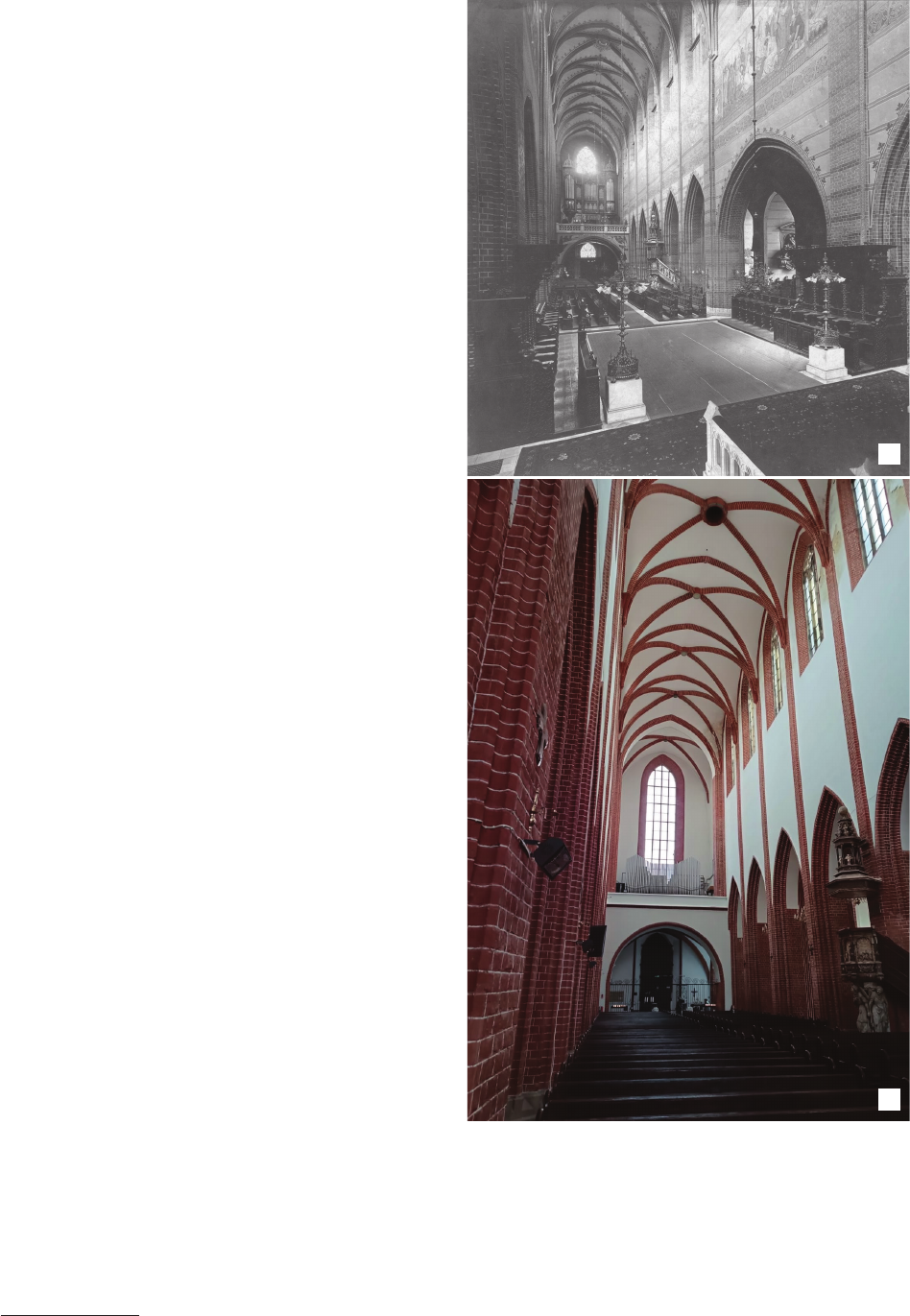
the church after the north tower had burnt down. The purist
Gothic-Revival interior design by Carl Lüdecke was execut-
ed in 1887–1891, and the new organ case with Gothic-Re-
vival forms (Figs. 5c, 6a) with organs by Carl and Eduard
Wilhelm (3+P instrument, 62 voices) were its key elements.
This was a high-quality organ, but with its heavy styling
and closed mass composition, it completely contradicted the
previous Baroque design. In 1922, the Sauer-Walcker com-
pany carried out a modernisation and extension of this organ
(3+P instrument, 89 voices, extended in 1938 to 4+P, 100
voices), which greatly enhanced its qualities (Höcker 2020).
In this condition the great organ of the Church of St Mary
Magdalene survived until 1945 (Burgemeister 1973).
The interior space of the Church of St Mary Magdalene,
shaped by its Gothic architecture, has attracted musical cir-
cles over the centuries. After the war, this tradition was in-
terrupted as there was no great organ in the church for more
than twenty-ve years. It was not until the early 1970s that it
was decided to relocate the Gebrüder Rieger organ (Fig. 6b),
which had been disposed of by the WUST, to the western
gallery of the church. A plaque reading “Jarzymowski Fa-
bian, Bruczyno, p-ta Dretyń” informs us of who made the
work on the instrument, which can presumably be linked to
its relocation. In 1976, after a re in St Elizabeth’s Church,
it was decided to move the concerts of the renowned ora-
torio-cantata festival Wratislavia Cantans to St Mary Mag-
dalene’s Church. The interior was
still a space suitable for
18
Röder’s Baroque case, created in collaboration with Urbansky,
was dismantled and deposited in the warehouses of the Museum of Arts
and Crafts, thus avoiding destruction in 1945. At present, its surviving
elements are exhibited in the National Museum in Wrocław.
Pipe organ of the Aula of the Technische Hochschule Breslau 83
Fig. 6. Church of St Mary Magdalene: a) after restoration under
the direction of Carl Lüdecke, on the gallery is the Gothic-Revival
organ by Carl and Eduard Wilhelm (source: AP Wrocław:
Ref. 82/1868/0/7/856), b) in 2025, on the rebuilt emporium
we can see the Modernist Rieger organ relocated from
the auditorium of the WUST (photo by K. Kirschke)
Il. 6. Kościół św. Marii Magdaleny: a) wnętrze w 1891 r.
po konserwacji przeprowadzonej pod kierunkiem C. Lüdeckego
– na emporze neogotyckie organy wykonane przez Carla i Eduarda
Wilhelmów (źródło: AP Wrocław, sygn. 82/1868/0/7/856),
b) nawa w 2025 r. – na odbudowanej emporze modernistyczne organy
Riegera translokowane z auli Politechniki Wrocławskiej (fot. K. Kirschke)
like the organ itself, it is in need of restoration. The current
display inside the church further detracts from the technical
and visual qualities of the instrument. As a result of its po-
sitioning in front of the large west window illuminating the
nave, it found itself in indoor climatic and temperature con-
ditions that are not stable and a number of case pipes are ex-
posed, which was not the case at its original location, and the
bass pipes deeper in the werk have been obscured. A full as-
sessment of the state of preservation of all the organ’s compo-
nents: wind chests, vents, relays, conductors or the air supply
system, including bellows and the authentic blower, should
be the subject of a separate thorough survey prior to drafting
a restoration work programme for the instrument.
The instrument in question should be renovated and ef-
fectively revalorised, restoring its sound quality and techni-
cal eectiveness in a suitable interior in terms of size and
decor. The organ’s current condition brings disrepute to one
of Wrocław’s most important architectural monuments, the
Church of St Mary Magdalene. The continuation of this
state of aairs may soon translate into the complete and ir-
reversible devastation of the preserved substance of unques-
tionable historic value. This threat is all the more serious
as this organ is not under statutory conservation under law.
When deciding on the further fate of the Rieger organ, we
should consider how much of Lower Silesia’s organ stock
had been lost during the Second World War and due to the
post-war exploitation of that which survived. In this state, all
remaining examples of old organ building works should be
maintained at all costs. Examples of untransformed and au-
thentic works, such as the instrument discussed here, which
comes from the auditorium of the Technische Hochschule
Breslau, should be subject to this demand rst and foremost.
The instrument’s historical ties to the university in question
is its completely unique value. This organ’s very construc-
tion is the result of the operation of this school, the eect of
the academic interest in the complicated technology behind
organ building, which combines technical and artistic crafts,
and has its result in the form of a work of architecture. This
interest continued for several decades at the WUST, where
the organ graced the ceremonies in the auditorium of the
main building.
The rst matter that should be resolved in revalorisa-
tion is to nd a suitable place for relocating the instrument.
Given the size of the werk and the size of the sound layout,
the current volume of the church interior appears exces-
sively large. The shortcomings of the organ’s placement
near a windowed wall should also be eliminated via the
relocation. The stylistic consistency of the organ case with
the interior design is also desirable. One of the main alter-
natives is to return the organ to its former location in the
gallery of the Wrocław University of Science and Tech-
nology’s auditorium. We can also consider changing its
placement by positioning it in the front part of the hall.
Such a solution was considered in the auditorium mod-
ernisation design developed in 2004 by architect Andrzej
Grudziński and Izabela Ertel-Kuś
20
. This design planned
20
In 2003, an architectural competition was held to modernise the
furnishings and decoration and improve the acoustics and the Audito-
rium of the WUST. In 2004, the commission to prepare the technical
b
a
84 Karol Czajka-Giełdon, Krystyna Kirschke
Fig. 8. Devastated playing console of the Gebrüder Rieger organ located in the west emporium of the Church of St Mary Magdalene
(photos by K. Czajka-Giełdon, 2025)
Il. 8. Zdewastowany stół gry organów Gebrüder Rieger znajdujących się na emporze zachodniej kościoła św. Marii Magdaleny
(fot. K. Czajka-Giełdon, 2025)
Fig. 7. The Rieger organ in the space of the west gallery of the church of St Mary Magdalene: a) the organ case and console,
b) the mechanically damaged smallest pipes of the first manual section (photos by K. Czajka-Giełdon, 2025)
Il. 7. Organy Riegera w przestrzeni empory zachodniej kościoła św. Marii Magdaleny: a) prospekt i kontuar,
b) uszkodzone mechanicznie najmniejsze piszczałki sekcji pierwszego manuału (fot. K. Czajka-Giełdon, 2025)
a b

Pipe organ of the Aula of the Technische Hochschule Breslau 85
the second phase of the remodel to include a new pipe or-
gan near the western wall, above the backstage passage
(2.2 m above the stage), whose case would have had exter-
nal dimensions of around 6 × 6 m. The argument for this
solution cited “elevating the prestige of the main interior
of the University” (Grudziński, Ertel-Kuś and Armałowicz
2007, 27). Both possible proposals would have been asso-
ciated with additional arrangement measures as the space
of the auditorium had already been modied. In the event
of a return to the gallery, there would be a need to remod-
el or relocate the rooms housing the sound and lighting
controls. Another alternative is to choose a completely dif-
ferent loca tion, which may very well be a medium-sized
church with Modernist decor features.
Conclusions
The identication of the history and state of preserva-
tion of the Gebrüder Rieger organ from the Technische Ho-
schule Breslau auditorium allows us to conclude that they
possess all the values that qualify it as a heritage object. It
is therefore necessary to include it in the register of monu-
ments, which would guarantee its protection from further
degradation
21
. We should direct further revalorisation mea-
sures, which, due to fact that entire instrument has survived
in a relatively complete form, should take into account the
restoration of the original sound disposition and performing
a reconstruction following what we know of the characteris-
tics of Gebrüder Rieger. The measures, thus planned, should
act as a form of protecting and revalorising the Wrocław
University of Science and Technology’s tangible and intan-
gible heritage. The tangible aspect consists of an organ that
has survived in a highly original form, adapted to a Mod-
ernist interior style, that follows a concert instrument’s
characteristics, and is equipped with unique and outstand-
ing technical solutions. The intangible aspect is linked to
the fact that the organ was created in close connection with
the establishment of the only academic Institute of Music
Technology in the whole of the Weimar Republic, operat-
ing within the Wrocław-based university. In addition, the
instrument is a testament to the high musical culture and
a vehicle of the organ building traditions represented by the
local academic community. The organ continued to serve
the people of Wrocław after the Second World War, giving
them an opportunity for live contact with music performed
at the highest level during the renowned Wratislavia Can-
tans festivals.
The proposed project can also be a step towards the ef-
fective revalorisation of the organ instrumentarium of the
Church of St Mary Magdalene in Wrocław. An in-depth
analysis of the rich musical and organ tradition of this
and execution documentation was given to a team of architects from
the Faculty of Architecture of the Wrocław University of Science and
Technology, which included: Andrzej Grudziński, Izabela Ertel-Kuś and
Paweł Amałowicz (2007).
21
In the absence of statutory conservation, the defunct Rieger or-
gan is in danger of outright disposal as waste. This would run counter
to heritage preservation principles and violate the standards of handling
cultural heritage assets.
church and the proposals for further measures to restore its
great organ go beyond the scope of this text. However, even
a cursory assessment would lead one to conclude that there
was a signicant regression in this sphere after the Second
World War. On the basis of an assessment of the architec-
tural and acoustic parameters that characterise the Gebrüder
Rieger organ that currently exists in the west gallery, it can
be concluded that this non-original location should not be
considered as a target placement. It is an organ that is too
small for the spacious naves and demanding acoustics of the
church. Its architectural qualities, which draw on an early
Modernist style, are matched by their original location in
the auditorium of the Technische Hochschule, while in the
church space, just below the immense Gothic window, they
completely lose their original elegance and aesthetic har-
mony. In this situation, there is a need to replace the organ
with another, more suitable instrument whose scale would
match the former great organ that had existed in this church.
In view of the outstanding artistic value and the preserved
elements of the Baroque organ case, a reconstruction of the
organ by Johann Michael Röder would seem to be the most
feasible option
22
.
Well-planned revalorisation measures may provide an
opportunity to avoid mistakes made in other, similar cas-
es. The organ from the Church of St Mary Magdalene in
Wrocław is by no means the only relocated organ instrument
from Lower Silesia
23
. It has survived as a largely complete
work, while many organs have been destroyed or perma-
nently altered as a result of relocation or inappropriate re-
pair work. Right now, organ building is facing another chal-
lenge: the oversupply of instruments from the desacralised
churches of Western Europe. Treated as a bargain purchase,
they are often not as valuable from a musicological point
of view as the often historic organs from our churches and
concert halls that they displace.
Just as in the eld of construction, the Modernist style
developed in organ building with the advent of the 20
th
century, which produced organ cases devoid of added ar-
chitectural or gurative decoration. The straight line of the
pipes was intended to impact with its monumental, linear
outline. This was the vision of the modern organ case pre-
sented by the architects of the Modernist period in Wrocław
in their designs: Max Berg (the organ in the Centennial Hall
– unbuilt), Hans Poelzig (organ in the Evangelical Church
in Malczyce) or Richard Konwiarz (organ extension in the
Centennial Hall in 1937). This line continued with works
by Polish architects who rebuilt Wrocław, such as the new
case for the organ acquired from the Centennial Hall and
intended for the Wrocław Cathedral, designed by Aleksan-
der Krzywobłocki. The trend set architects and art historians
was also picked up with varying degrees of success by the
instrument builders themselves. The following organ build-
ers stood out in terms of their perfect sense for Modern-
ist forms: Paul Berschdor, a German builder from Nysa,
22
Their dismantling was criticised as early as the 1920s, and the
recomposition of the case was demanded by the conservation ocer of
the Silesian Province at the time, Ludwig Burgemeister.
23
Cf. on the relocations of Lower Silesian organ instruments after
the Second World War (Pasternak 2020).

86 Karol Czajka-Giełdon, Krystyna Kirschke
References
700 Jahre St. Maria Magdalena 1226–1926. Streifzüge durch ihre Ver-
gangenheit, ihren Bau und ihre Gegenwart. Wilh. Gottl. Korn, 1926.
Archiwum Politechniki Wrocławskiej. Koncerty w Auli Politechniki Wro-
cławskiej. 1947, sygn. 122; sygn. 135, dokument 7.
Bielawski, Bolesław. “Sprawozdanie z konferencji dotyczącej zabytko-
wych organów i prospektów organowych w Polsce.” Ochrona Zabyt-
ków 22, no. 1 (1969): 68–70.
Brandt-Golecka, Barbara, Marek Burak, and Gabryela Januszewska. Po-
litechnika Wrocławska 1945–1951. Wybór źródeł. Ocyna Wydaw-
nicza PWr, 2005.
Broniewski, Tadeusz. “Odbudowa zabytków Wrocławia: kościół św. Ma-
rii Magdaleny.” Ochrona Zabytków, no. 5/4 (1952): 253–70.
Brylla, Wolfgang. “Udokumentowane translokacje dolnośląskich orga-
nów.” In Organy na Śląsku IV, edited by Julian Gembalski. Akade-
mia Muzyczna w Katowicach, 2012.
Bukowski, Marcin. “Odbudowa ośrodka historycznego we Wrocławiu.”
Zaranie Śląskie 22, no. 3 (1959): 66–82.
Burak, Marek, Krzysztof Dackiewicz, and Piotr Pregiel. Wrocławskie
uczelnie techniczne 1910–2010. Muzeum Architektury we Wrocła-
wiu, JAKS, 2010.
Burgemeister, Ludwig. Der Orgelbau in Schlesien. Wolfgang Weidlich,
1973.
Chwałek, Jan. Budowa organów: wprowadzenie do inwentaryzacji i do-
kumentacji zabytkowych organów w Polsce. Ministerstwo Kultury
i Sztuki, Zarząd Muzeów i Ochrony Zabytków, 1971.
Czajka-Giełdon, Karol, and Krystyna Kirschke. „History and Overview
of the Unique Architecture of Pipe Organs in St. Mary Magda-
lene’s Church in Wrocław (Poland) from the Middle Ages to the
Present Day.” Arts 14, no. 5 (2025): 121. https://doi.org/10.3390/
arts14050121.
“Die neue Technische Hochschule in Breslau.” Zeitschrift für Bauwesen
60, no. 10–12 (1910): 489–514.
Die Technische Hochschule Breslau: Festschrift zur Erönung 1. Okto-
ber 1910. Ferdinand Hirt, 1910.
Die Technische Hochschule Breslau: Beiträge zur Geschichte der Tech-
nischen Hochschule Breslau zum 75-Jährigen Gedenken an die Er-
önungim Jahre 1910. Eigenverlag der Gesellschaft der Freunde der
Technischen Hochschule, 1985.
Fischer, Johann Wilhelm. Geschichte und Beschreibung der Grossen Or-
gel in der Haupt-und Pfarr-kirchezum St. Maria Magdalena in Bre-
slau. Graß, Barth, 1821.
Grudziński, Andrzej, Izabela Ertel-Kuś, and Paweł Amałowicz. “Audy-
toria dydaktyczne II: na przykładzie projektu przebudowy wnętrza
Auli Głównej w budynku A-1 Politechniki Wrocławskiej.” Raporty
Wydziałowego Zakładu Architektury Użyteczności Publicznej Poli-
techniki Wrocławskiej, seria SPR nr 791, (2007): 1–55. [Manuscript
in: private archive of Paweł Amałowicz].
“Gmach główny – część nowsza.” Pryzmat. Pismo Informacyjne Poli-
techniki Wrocławskiej. Special issue 1 (2010): 28–31.
Hey Pipe Organ Builders. UNESCO: Intangible World Heritage Organ
building and music. Published November 5, 2018. Accessed May 15,
2025, at https://www.hey-orgelbau.com/news/details/unesco-intan-
gible-world-herit.html.
“Historia jednego zdjęcia. Usłyszeć organy w auli #75latPWr.” Pub-
lished August 21, 2020. Accessed January 27, 2025, at https://pwr.
edu.pl/uczelnia/aktualnosci/historia-jednego-zdjecia-uslyszec-orga-
ny-w-auli-75latpwr-11694.html.
Höcker, Egon. Breslau in Mir, Musikalische Ermunterung, Dokumente
aus Der Konzerttätigkeit von Gerhard Zeggert. 2020.
Kmita-Skarsgård, Tomasz. Kultura muzyczna kościoła Św. Marii Magda-
leny we Wrocławiu w latach 1923–1945. Historia, dziedzictwo i per-
spektywy. Dom Wydawniczy LYNX Tomasz Kmita-Skarsgård, 2013.
Kmita-Skarsgård, Tomasz. “Józefa Cynara droga ku Anglii – krytyczna
analiza reminiscencji anglosaskiej myśli organmistrzowskiej w dzie-
łach polskiego budowniczego.” In Organy i ludzie. 2. Katalogi, opra-
cowania, reeksje, edited by Małgorzata Trzaskalik-Wyrwa. Chopin
University Press, 2020.
Konopka, Teodor. Katedra polskokatolicka św. Marii Magdaleny Wro-
cław (dolnośląskie). Last modied February 7, 2017. Accessed Ja-
nua ry 27, 2025, at https://musicamsacram.pl/instrumenty/944-wro-
claw-katedra-polskokatolicka-sw-marii-magdaleny.
Mapa Karier. “Organmistrz.” Accesed May 1, 2025, at https://mapakarier.
org/sciezki-kariery/623/m/organmistrz/specyka-pracy/.
Matzke, Hermann. Die Musik an der Technischen Hochschule zu Breslau,
nebst Würdigungihrer Orgel. Bärenreiter-Verlag, 1929.
Ochse, Orpha. The History of the Organ in the United States. Indiana
University Press, 1975.
Pasternak, Paweł. “Translokacje śląskich organów po 1945 roku na teren
diecezji tarnowskiej.” Folia Organologica. International Yearbook
of Organ and Organ Music, no. 3 (2020): 7–29.
Prasał, Andrzej. “Der Orgelbau in Schlesien im 20. und 21. Jahrhundert.”
Ars Organi 67, no. 3 (2019): 155–7.
Prieberg, Fred K. Handbuch Deutsche Musiker 1933–1945. Kopf, 2009.
Radziewicz-Winnicki, Jacek. “Architektura organów w Polsce – geneza
i ewolucja formy.” Zeszyty Naukowe, no. 875 (1986): 7–115
“Słowa prawdy i nadziei”. Jestem na stanowisku w czasie pokoju i woj-
ny: ilustrowany miesięcznik Polskiego Czerwonego Krzyża 21, no. 10
(1948): 1–4.
Seibt, Hans Georg. Die Geschichte der Orgel in der Haupt- Und Pfar-
rkirche zum St. Maria Magdalena in Breslau. Kantorat zu St. Ma-
ria-Magdalena, 1938.
Silbermann, Johann Andreas. Anmerkungen einiger außerdem Elsaß stehen-
den Orgeln, davon ich viele gesehen, oder aus erhaltenen Nachrichten
hier verzeichnet habe. Darunter keine Silbermännische bendlich. [ca.
1741]. Die Sächsische Landesbibliothek – Staats- und Universitätsbib-
liothek Dresden. Mscr. Dresd. App. 3165. Accessed May 27, 2025, at
https://digital.slub-dresden.de/werkansicht/dlf/391195/1.
Subel, Joanna. “Breslauer Orgeln in Weltlichen Räumen.” In Musikges-
chichte in Mittel- und Osteuropa: Mitteilungen der internationalen
Arbeitsgemeinschaft an der Universität Leipzig, edited by Helmut
Loos, Eberhard Möller, and Klaus-Peter Koch. Gudrun Schröder
Verlag, 2015.
or Józef Cynar, an organ builder from post-war Wrocław.
The instrument from the Wrocław University of Science
and Technology is a part of this stylistic trend, which is still
so undervalued and in many cases not covered by statutory
conservation. It would therefore be desirable for it to once
again visually and acoustically complement the interior of
the historic auditorium of this university
24
.
Translated by
Krzysztof Barnaś
24
Pipe organs, although no longer central to university life and
music education today, is present at many universities in the USA. They
are located in chapels, concert halls or dedicated music buildings. Some
universities, such as Berkeley and Harvard, in recognition of their histor-
ical and cultural signicance, even have collections of such instruments
dating from dierent eras (Ochse 1975).
Pipe organ of the Aula of the Technische Hochschule Breslau 87
Streszczenie
Organy piszczałkowe auli Technische Hochschule Breslau (Politechniki Wrocławskiej)
W niniejszym tekście zarysowana została historia organów wybudowanych przez rmę Gebrüder Rieger w 1929 r. dla auli Technische Hochschule
Breslau. Instrument ten stanowił istotną część oryginalnego wystroju sali, służąc uświetnianiu uroczystości akademickich oraz prowadzeniu zajęć mu-
zycznych i dydaktycznych w ramach Instytutu Technologii Muzycznej – jedynej tego typu jednostki w strukturze uczelni technicznej na terenie Republiki
Weimarskiej. Na skutek zniszczeń, jakie objęły cały Wrocław w schyłkowej fazie II wojny światowej, ocalałe organy stanowiły cenny dobytek nowo
otwartej uczelni w polskim Wrocławiu. Zostały naprawione i służyły przez wiele lat działalności koncertowej, wpisując się w krajobraz kulturowy mia-
sta. W trakcie przebudowy auli w latach 70. XX w. jako zbędne zostały przeniesione do odbudowanego ze zniszczeń wrocławskiego kościoła św. Marii
Magdaleny, pozbawionego na skutek wojny organów. Po krótkim okresie użytkowania w nowej lokalizacji zostały zdewastowane i pozostają nieczynne.
Sposób usytuowania instrumentu w kościele zdradza doraźność i prowizoryczność tego rozwiązania, a obecny stan domaga się podjęcia szybkich i zde-
cydowanych działań naprawczych. Organy mają dziś wartość zabytkową i nadal zachowują potencjał dla ewentualnej rewaloryzacji i przywrócenia im
podstawowej funkcji muzycznej. Tekst stanowi próbę dokonania analizy konserwatorskiej tego obiektu i możliwości jego godnego wyeksponowania
zgodnie z obecnymi standardami konserwatorskimi w pierwotnej lokalizacji, w auli Politechniki Wrocławskiej.
Słowa kluczowe: organy, relokacja, rewaloryzacja, architektura, Politechnika Wrocławska, Technische Hochschule Breslau
Trzaskalik-Wyrwa, Małgorzata. “Organy ze Śląska w diecezji siedleckiej
i drohiczyńskiej.” Organy na Śląsku IV, edited by Julian Gembalski.
Akademia Muzyczna w Katowicach, 2012.
Ulrich-Kornacka, Małgorzata. Die Sauer-Orgel im Breslauer Dom wird-
saniert. 2024. Published July 10, 2024. Accessed May 5, 2025, at
https://www.silesia-news.de/2024/07/10/die-sauer-orgel-im-breslau-
er-dom-wird-gruendlich-saniert/.
Wo studiere ich technischeWissenschaften?. Published 1935. Accessed
May 15, 2025, at https://kmim.wm.pwr.edu.pl/blog/2018/08/21/fold-
er-reklamowy-technischen-hochschule-breslau/ [folder].
Zwierz, Maria. Tradycje wystawiennicze we Wrocławiu w latach 1818–
1948. Muzeum Architektury we Wrocławiu, 2016.