
2017
4(52)
DOI: 10.5277/arc170401
Ada Kwiatkowska*
Paradygmaty strategii gier w projektowaniu architektonicznym
Paradigms of the games’ strategy in architectural design
Wprowadzenie
Rzeczywistość wirtualna umożliwia prowadzenie eks
pe rymentów z formami architektonicznymi, pozwala na
poznawanie ich złożoności strukturalnej dzięki możli
wości sterowania poszczególnymi jej elementami na
od rębnych poziomach zapisu, a także poszerza wiedzę
o samym procesie twórczym kreowania form przez wgląd
do wnętrza struktury. Wirtualna przestrzeń jest dla archi
tekta swoistym laboratorium, w którym może sprawdzać
różne stany materii oraz wnikać w strukturę przestrzen
ną dowolnych form. Pozwala ona również na świadome
posługiwanie się algorytmami w kreacji i transformacji
struktur przestrzennych oraz na transfer doświadczeń
z przestrzeni wirtualnej do realnej.
Koncepcja przestrzeni, aż do początku XX w., bazowa
ła na trójwymiarowym modelu opisanym przez wymiar
długości, szerokości i wysokości. Model ten był podstawą
w deniowaniu fundamentalnych zasad teorii architektury;
teorii mającej swoje źródła w dziele Witruwiusza De ar-
chitecture libri decem (por. [1]). Zasady kreacji formy ar
chitektonicznej dotyczyły przede wszystkim wzajemnych
relacji między człowiekiem, formą architektoniczną a jej
kontekstem w trójwymiarowej przestrzeni oraz deniowały
podstawowe wzorce kompozycji architektonicznej, a tak
że kryteria estetycznego wartościowania formy (por. [2]).
Na początku XX w. koncepcje dotyczące istoty czło
wieka i rzeczywistości stawały się coraz bardziej złożone,
ukazując wymiary, które do tej pory nie były dostrzegane,
Introduction
The virtual reality enables us to experiment with the
architectural forms and it allows us to study their struc
tural complexity at the same time, due to the possibility
of steering the particular elements of the structure on the
separate levels of its notation, and it extends the knowl
edge about the process of creation of forms by the view
into the structure. For the architect, the virtual space is
a kind of laboratory, in which it is possible to verify diffe
rent states of the matter and to inltrate the spatial structure
of optional forms. It also enables us to use the al gorithms
in creation and transformation of the spatial structures,
and to transfer the experiences from virtual to real space
in a conscious way.
The idea of space was founded on the threedimen
sional model described by the length, width and height’s
dimensions untill the beginning of the 20
th
century. This
model was the basis in dening of the fundamental prin
ciples of architectural theory; the theory originated in the
work of Vitruvius – De architecture libri decem [1]. The
principles of the architectural form’s creation referred
rst of all to the mutual relations between man, the archi
tectural form and its context in the threedimensional
space and they dened essential patterns of the architec
tural composition esthetical criteria of the form’s evalua
tion [2].
At the beginning of the 20
th
century, ideas relating to
the phenomenon of man and reality, became more and
more complex, expressing the dimensions which up until
now were not perceived, and which showed new elds of
exploration for science. Change of one of the scientic
paradigms, describing the relativity of the meaning of the
* Wydział Architektury Politechniki Wrocławskiej/Faculty of Ar
chitecture, Wrocław University of Science and Technology.
4 Ada Kwiatkowska
a które przed nauką odsłoniły nowe pola eksploracji.
Zmiana jednego z paradygmatów nauki, określającego
względność znaczenia relacji człowiek a rzeczywistość
(teoria względności: rola obserwatora w percepcji cza
soprzestrzeni), a także stworzenie wielowymiarowego
modelu przestrzeni zycznej (teoria superstrun, Mteoria
– por. [3]) otworzyły nowe perspektywy w deniowaniu,
czym jest forma i struktura przestrzenna w architekturze.
Przełom XX i XXI w. przyniósł ze sobą kolejne zmiany,
które dotyczyły przede wszystkim eksploracji dopiero co
odkrytego wymiaru informacji. Przez kreowanie lub ma
nipulowanie zapisem informatycznym biologicznego kodu
genetycznego różnych gatunków, w tym ludzkim DNA
(rewolucja biotechnologiczna), oraz przez tworzenie coraz
bardziej złożonego oprogramowania dla systemów kom
puterowych (rewolucja informatyczna), cywilizacja ludz
ka weszła w epokę technologicznej osobliwości (por. [4]).
Sztuka science ction pokazuje różne wizje przyszłego
kierunku rozwoju gatunku homo sapiens oraz środowiska
jego życia. Od wizji człowieka wspomaganego przez ro
boty (np. Gwiezdne wojny, reż. George Lucas; Ja, Robot,
relation between man and reality (theory of relativity: role
of an observer in spacetime perception) and creation of
the multidimensional model of the physical space (su
perstring theory, Mtheory [3]), all of these opened new
perspectives for denition of form and spatial structure in
architecture.
Since the turn of the 20
th
century, there were further
changes, which related rst of all to exploration of the
only just discovered dimension of information. The hu
man civilization started the age of the technological sin-
gularity [4] by the creation or manipulation of the biologi
cal infogenetic codes of different species, including the
human DNA (biotechnological revolution) and introduc
tion of more and more complex software for the computer
systems (information revolution).
The art of science ction expresses different visions of
the future direction of homo sapiens
’
and their surround
ings’ development. From the vision of man supported by
robots (e.g. Star Wars by George Lucas, I, Robot by Alex
Proyas) to the idea of androids and cyborgs (e.g. Blade
Runner by Ridley Scott, A.I. by Steven Spielberg, Matrix
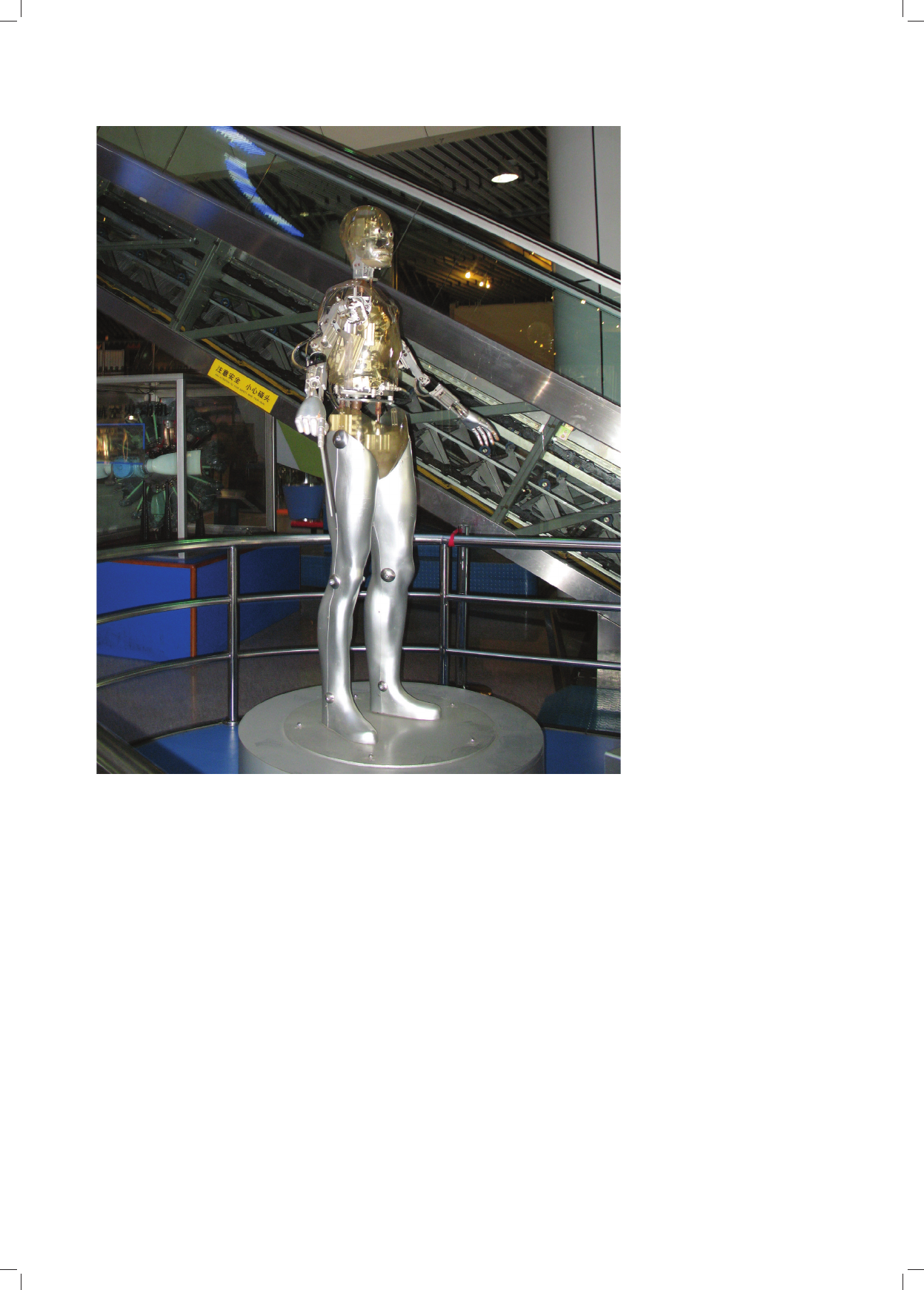
Il. 1. Uczłowieczony robot –
zrobotyzowany człowiek.
Ekspozycja w Muzeum Nauki
i Techniki w Pekinie
(fot. A. Kwiatkowska)
Fig. 1. Humanized robot –
Robotic man. Exhibition,
China Science and
Technology Museum, Beijing
(photo by A. Kwiatkowska)
Paradygmaty strategii gier w projektowaniu architektonicznym /Paradigms of the games’ strategy in architectural design 5
reż. Alex Proyas) do koncepcji androidów i cyborgów
(np. Łowca Androidów, reż. Rid ley Scott, A.I., reż. Ste
ven Spielberg, Matrix, reż. Andy i Larry Wachowscy),
czyli ewolucji od homo sapiens, jako gatunku żyjącego
w środowisku naturalnym, do robo sapiens – istniejące
go w interaktywnym biotechnologicz nym środowisku.
Podążając za tymi wizjami, można prze widywać, że ad
resatem architektury przyszłości nie będzie już człowiek,
lecz na przykład cyborg będący jego ulepszoną wersją
dzięki elektronicznym ekstensjom, które wzmacniają jego
zyczny i intelektualny potencjał, lub android – robot
o cechach człowieka, a może biocyborg (robo sapiens) –
produkt inżynierii genetycznej (por. [5], [6]).
Zrobotyzowany człowiek (il. 1) nie będzie postrzegał
przestrzeni w sposób, który jest nam znany od wieków.
Będzie uwzględniał wszystkie dostępne informacje nie
tylko dzięki wizualnej percepcji, ale także dzięki senso
rycznym i intelektualnym rozszerzeniom jego ciała, co
bę dzie pozwalało na docieranie do ukrytych wymiarów
rze czywistości, często oddziałujących niebezpośrednio
na zmysły oraz nielokalnie. Środowisko życia człowieka
by Andy & Larry Wachowski), it means the evolution of
homo sapiens, as the species living in the natural environ
ment, to robo sapiens – existing in biotechnological en
vironment. Following the visions, it is possible to predict
that the receiver of future architecture will not be man,
but it will be for instance cyborg, being the better version
of man thanks to the electronic extensions, or android
– a robot characterized by human features, or maybe –
a biocyborg (robo sapiens) – a pro duct of genetic engi
neering [5], [6].
A robotic man (Fig. 1) will not perceive space in the
manner wellknown from time of long ago. Future man
will take into consideration all available information, not
only because of the visual perception, but also due to sen
sory and intellectual extensions of his or her body, which
will let us reach the hidden dimensions of reality, often re
acting notdirectly and notlocally to the senses. The liv
ing surroundings of man of the future will represent rather
virtual than real space. This means that the rules and pat
terns of shaping of the environment will have to change.
Spatial structures will be replete with information, in
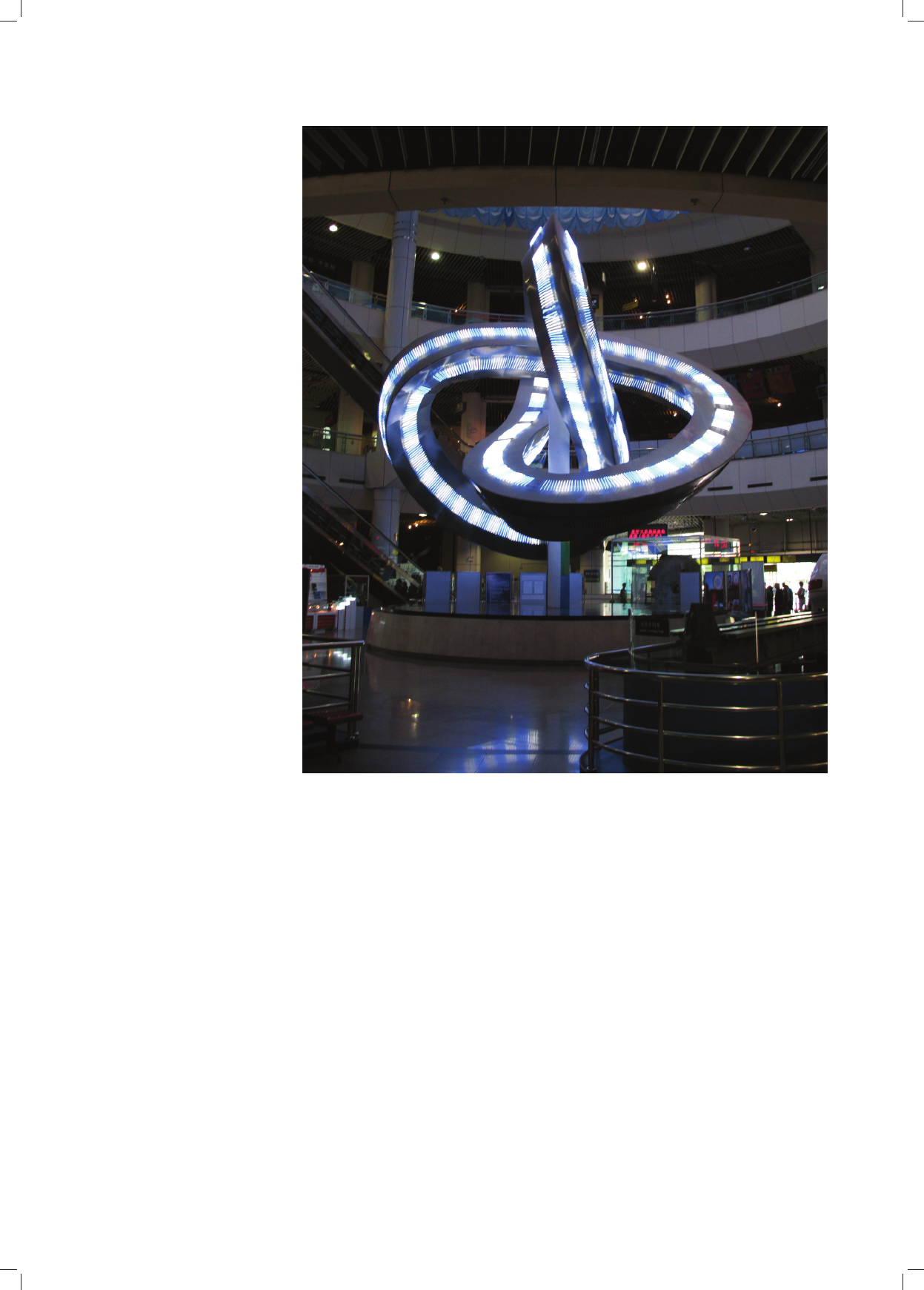
Il. 2. Iluminacja struktury
przestrzennej sterowana
przez program komputerowy.
Ekspozycja w Muzeum Nauki
i Techniki w Pekinie
(fot. A. Kwiatkowska)
Fig. 2. Illumination of the spatial
structure steered by the computer
program. Exhibition, China
Science and Technology
Museum, Beijing
(photo by A. Kwiatkowska)

6 Ada Kwiatkowska
przyszłości będzie bardziej przypominać przestrzeń wir
tualną niż realną. To oznacza, że będą musiały się zmie
nić również zasady i wzorce kształtowania środowiska.
Struktury przestrzenne będą w większym stopniu nasy
cone informacją, niż ma to miejsce obecnie, a sposób ich
projektowania będzie analogiczny do strategii projektowa
nia gier komputerowych i symulacji wirtualnych światów
(por. [7]) (il. 2), w których zawsze za strukturami kryją
się określone kody informacyjne, protokoły, ścieżki czy
linie dostępu.
Język architektoniczny
wielowymiarowej przestrzeni ery informacji
Sformułowana na początku XX w. koncepcja cztero
wymiarowej przestrzeni (tzw. czasoprzestrzeni) stała się
inspiracją dla działań naukowców i współczesnych arty
stów. Choć w przypadku architektury wymiar czasu, do
momentu upowszechnienia technologii digitalnych, nie
mógł znaleźć swojej właściwej reprezentacji w modelach
przestrzennych. Dopiero techniki symulacji komputero
wej umożliwiły ukazywanie przestrzeni w jej czasowym
wymiarze. Ale wciąż większość obiektów architekto
nicznych jest przedstawiana w trójwymiarowym systemie
współrzędnych, podczas gdy czas pozostaje zmienną nie
zależną w prezentacji struktury przestrzennej. Dwudzie
ste stulecie przyniosło ze sobą odkrycie nie tylko czaso
przestrzeni, ale i następnych wymiarów rzeczywistości,
takich jak energia i informacja. Wymiary te znalazły swoje
pełniejsze odzwierciedlenie dopiero w architekturze po
czątku XXI w. Krótką historię wpływu odkrycia nowych
wymiarów przestrzeni na kształtowanie formy architekto
nicznej można przedstawić następująco:
– materia – od materiałów naturalnych, przez synte
tyczne do inteligentnych,
– przestrzeń – od przestrzeni 3D do przestrzeni topolo
gicznej,
– czas – od widoku perspektywicznego (sekwencja sta
tycznych ujęć) do komputerowej symulacji ruchu w prze
strzeni (animacje komputerowe),
– energia – od mierzenia potencjału energetycznego
struktur architektonicznych do symulacji przepływu ener
gii przez struktury,
–
informacja – od formy statycznej do formy interaktyw
nej,
wchodzącej w mediacje z użytkownikiem (por. [8]).
Architektura ery informacji, w której podstawową rolę
odgrywają technologie digitalne (hardware i software),
wymaga opracowania nowych strategii projektowania
oraz kodów reprezentacji form architektonicznych, ponie
waż trójwymiarowe rysunki nie oddają całej złożoności
struktur przestrzennych oraz nie pozwalają na ich pełną
kontrolę i optymalizację.
Przyszłe kody języka architektonicznego będą odno
sić
się do interaktywnych programów komputerowych umoż
liwiających kontrolę struktury przestrzennej przez ar chi
tekta i użytkownika w trakcie procesu projektowego (inte
raktywna partycypacja) oraz podczas eksploatacji obiektu
architektonicznego (przekształcanie przestrzeni i kontrola
pracy struktury przestrzennej w jej wszystkich wy miarach).
Zasady kompozycji, wzorce i archetypy prze strzenne będą
a more remarkable degree than in the present, and the way
of their creation will be analogous to the strategy of the
computer games’ designing and simulations of the vir
tual worlds [7] (Fig. 2), in which the specic information
codes, protocols, access paths or lines will be hidden be
hind the structures.
Architectural language of multidimensional space
of the information age
The idea of fourdimensional space (socalled space
time), created at the beginning of the 20
th
century, became
an inspiration for the way of activity of scientists and
contemporary artists. Though in the case of architecture,
the time dimension could not nd its own representation
in the spatial models until the appearance of digital tech
nologies. Not before the techniques of computer simu
lation made possible the expression of space in its time
dimension. However, most of the architectural objects are
still presented in the threedimensional system of coordi
nates, while time is variableindependent in expression of
the spatial structure. In the 20
th
century, there were also
discovered other dimensions of the reality such as energy
and information. These dimensions found their represen
tations in architecture at the beginning of the 21
st
century.
A short history of the inuence of new dimensions’ dis
covery on shaping of the architectural form can be de
scribed as follows:
– matter – from natural through synthetic to intelligent
materials,
– space – from 3D to topological space,
– time – from perspective view (sequence of the static
images) to computer simulation of movement in space
(computer animations),
– energy – from measurement of the energypotential
of architectural structures to simulation of the energy ow
through the structures,
– information – from the static to interactive form,
me diating with the user [8].
Architecture of the information age, in which digital
technologies (hardware and software) play a fundamental
role, calls for creation of new design strategies and codes
of the architectural forms’ representation, because three
dimensional drawings cannot express all the complexity
of the spatial structures and do not allow their full control
and optimalization.
Future codes of the architectural language will relate to
the interactive computer programs, making it possible to
control the spatial structure by the architect and the user
during the design process (interactive participation) and
during the architectural object’s utilization (transformation
of the space and control of the spatial structure’s function
ing in all its dimensions). The principles of composition,
patterns and spatial archetypes will be replaced by the sys
tems of a higher degree of organization and complexity [9].
Strategies of the simulation games introduce a new qua
lity in the structures’ designing in topological cyberspace.
These strategies make it possible to control the
variable
states of spatial structure, connected with the cir
cula tion
of the courses of matter, energy and information and

Paradygmaty strategii gier w projektowaniu architektonicznym /Paradigms of the games’ strategy in architectural design 7
zastępowane przez systemy o wyższym stop niu
zorganizo
wania i złożoności (por. [9]).
Strategie gier symulacyjnych wprowadzają nową ja
kość w projektowanie struktur w przestrzeni topologicz
nej cyberprzestrzeni. Strategie te umożliwiają kontrolę
zmiennych stanów struktury przestrzennej związanych
z cyrkulacją strumieni materii, energii i informacji oraz
ocenę ich wpływu na kształt formy architektonicznej,
a także pozwalają na interakcje użytkownika z formą archi
tektoniczną. Współczesne oprogramowanie architektonicz
ne, a także szybki rozwój technologii związanych z kreacją
wirtualnej rzeczywistości (od Internetu do interaktyw
nych gier komputerowych) są zapowiedzią nowych me
tod projektowania architektonicznego opartych na inte
raktywnych strategiach gier, co będzie miało wpływ na
kształt przestrzeni zurbanizowanej oraz architektonicz
nej. Rzeczywistość zyczna (ground reality – GR) będzie
się przenikać z rzeczywistością wirtualną (virtual reality
– VR) w jej wszystkich wymiarach (por. [10], [11]).
Strategie gier jako symulacja rzeczywistości
Współczesne gry komputerowe wpływają na oczeki
wania użytkowników w stosunku do oprawy przestrzen
nej ich życia, zwłaszcza w zakresie dotyczącym zarów
no wyglądu i estetycznej atrakcyjności przestrzeni, jak
i stopnia jej interaktywności. Niektóre z doświadczanych
obecnie zachowań w wirtualnej przestrzeni gier będą
transferowane do przestrzeni rzeczywistej w sposób
świadomy lub podświadomy, gdyż nawyki nabyte w wir
tualnej przestrzeni wpiszą się do repertuaru zachowań
człowieka. Przestrzeń, w której żyjemy, kształtuje nasze
potrzeby i zachowania. Można z dużą dozą prawdopodo
bieństwa założyć, że zasada ta będzie również dotyczyć
wpływu wirtualnej przestrzeni – i czasu w niej spędzone
go – na przyszłe oczekiwania użytkowników odnośnie do
jakości aranżacji przestrzeni realnej.
Koncepcja wirtualnej przestrzeni kreowana w grach
kom puterowych lub udostępniana w sieci Internetu jako
wirtualna symulacja realnego świata, na przykład w ta
kich przedsięwzięciach jak Home rmy Sony Playstation
Network czy Second Life rmy Linden Research Inc. (por.
[12]), staje się wyzwaniem dla architektury. Duża popular
ność tego typu aktywności wśród użytkowników jest zapo
wiedzią upowszechnienia się wzorca zachowań nastawio
nych na nieograniczony dostęp do informacji w każdym
miejscu, w którym znajduje się użytkownik, bez względu
na fakt, czy jest on w danym czasie w przestrzeni realnej
czy wirtualnej. Zarazem, choć trudno ocenić, czy trend ten
będzie się upowszechniał, mamy do czynienia z przenosze
niem pewnych rodzajów aktywności z jednej przestrzeni
do drugiej oraz ich współistnieniem w tym samym czasie.
Oprawa przestrzenna życia człowieka zaczyna być postrze
gana jako przestrzeń zabawy, i to nie w metaforycznym
znaczeniu, tylko w realnym. Na przykład turnieje w grach
wyścigowych, takich jak Midnight Club Los Angeles czy
Gran Turismo, są inspiracją do nielegalnych noc nych
wyścigów samochodowych na ulicach metropolii; gry
przygodowe (np. Broken Sword: The Shadow of the Tem-
plars) zachęcają pewne grupy społeczne do poszukiwania
evaluation of their inuence on the shape of the architec
tural form and also allow interactions of the user with the
architectural form. The contemporary architectural soft
ware and the rapid development of technologies connect
ed with the creation of virtual reality (from the Internet to
interactive computer games), announce new methods of
the architectural design, based on interactive game strate
gies, which will have an impact on urban and architec
tural space. The physical space (ground reality – GR) will
intermix with virtual reality (virtual reality – VR) in all its
dimensions [10], [11].
Game strategies as simulation of the reality
The present computer games have an inuence on us
ers’ expectations according to the spatial setting of their
life, particularly in the aspects of the aesthetical attrac
tiveness of space and degree of the space interactivity.
Some of the existing practices, appearing in virtual space
of games, will be transferred into reality, in a conscious or
subconscious way, and the acquired habits in the virtual
space will be added to the repertoire of human activities.
Space, that we live in, modies our needs and behaviors.
One can assume, with high probability, that this rule will
also refer to the inuence of virtual space, and time spent
in it, on future users’ expectations relating to the quality
of arrangement of the real space.
The concept of virtual space, created in computer
games or made available on such platforms as Home by
Sony Playstation Network and Second Life by Linden Re
search Inc. [12] becomes a challenge for the architecture.
These concepts and types of activities are very popular
among the users; they announce spreading of the man
ners directed to unlimited access to information in every
place, in which the user occurs, regardless of being in real
or virtual space. At the same time, though it is difcult
to foresee, whether this trend will become general, there
are symptoms of transferring of the certain activities from
one space to the another and their parallel coexistence
as well. The spatial settings of man’s life is becoming
a place of playing, not in the metaphoric meaning, but in
real one. For instance – the tournaments in racing games,
e.g. Midnight Club Los Angeles or Gran Turismo, are
the inspirations to illegal night cars’ racing on the streets
of different metropolises; adventure games (e.g. Broken
Sword: The Shadow of the Templars) encourage some so
cial groups to seek and solve real problems; strategic and
episodic games (e.g. SimCity, Tomb Raider) show how to
explore the real space; MMO (massive multiplayer online
– e.g. EverQuest) – online games, based on cooperation
and competition of gamers in virtual space, are often the
origins of creation of the hobby or tournamentgroups in
the real world [13].
The virtual reality will more and more affect the theory
of architecture and the algorithms of programming, and
game strategies as well, will become a part of the archi
tectural language. The architectural object, existing in the
real space, will have its representation in the virtual space
as the best place to control the parameters of the complex
architectural structure in matter, spacetime, energy and

8 Ada Kwiatkowska
i rozwiązywania rzeczywistych problemów; gry strate
giczne (np. SimCity, Tomb Raider) uczą, jak eksplorować
przestrzeń rzeczywistą; MMO (massive multiplayer online,
np. EverQuest) – sieciowe gry wieloosobowe bazujące na
współdziałaniu i rywalizacji graczy w wirtualnym świecie
są często przyczynkiem do powstania grup hobbistycz
nych i turniejowych w świecie rzeczywistym (por. [13]).
Rzeczywistość wirtualna będzie w coraz większym
stop niu wpływać na teorię architektury, zaś algorytmy
pro gramowania i strategie gier staną się częścią języka
architektury. Obiekt architektoniczny istniejący w realnej
przestrzeni będzie miał swoją reprezentację w przestrzeni
wirtualnej, w której najlepiej można kontrolować wszyst
kie parametry złożonej struktury obiektu architektoniczne
go w wymiarze materialnym, czasoprzestrzennym, ener ge
tycznym i informacyjnym, tak jak ma to miejsce w świecie
gier. Architektura digitalna zaczyna testować różne para
dygmaty i strategie gier w wirtualnej przestrzeni architek
tonicznej, takie jak:
– RTS – strategie gier w czasie rzeczywistym w prze
strzeni architektonicznej,
– DNA – kodowanie struktur przestrzennych,
– CTRL – kontrola przepływu materii, energii i infor
macji w strukturach przestrzennych,
– OSS – architektoniczne formy jako ekspresja otwar
tego oprogramowania i informacyjnowizualnej transpa
rentności,
– Play Create Share – interaktywna i spersonalizowa
na przestrzeń architektoniczna.
RTS – strategie gier w czasie rzeczywistym
w przestrzeni architektonicznej
Źródła strategii gier w czasie rzeczywistym (tzw. RTS
– real time strategy) leżą w rozwoju komputerowych gier
wojennych (np. Command and Conquer, Homeworld – por.
[
13], [14]), których koncepcja polega na ulokowaniu gra
czy na różnych typach map (planów od 2D do 3D, w wi
doku izometrycznym lub perspektywicznym), dając im
pełną kontrolę nad wszystkimi przedmiotami w wirtualnej
przestrzeni gry. Gracze dostają dodatkowe narzędzia kon
troli otoczenia w postaci kamer i radarów oraz dostęp do
we
wnętrznych komend sterujących ruchem w grze. Gracze
mogą budować i burzyć obiekty, a także przemodelować
przestrzenną strukturę stosownie do własnej strategii.
Koncepcja form interaktywnych w architekturze digi
talnej oparta jest na podobnych strategiach czasu rzeczy
wistego, które pozwalają użytkownikom komunikować
się i wchodzić w interakcje z obiektami architektonicz
nymi na różnych poziomach ich strukturalnej złożoności
oraz umożliwiają przemodelowanie układu przestrzen
nego przez dostęp do komend programu sterującego.
Użyt kownicy mogą komunikować się z programami we
wnętrznymi systemów architektonicznourbanistycznych
od poziomu sterującego wyglądem lub innymi parame
trami
wnętrz architektonicznych (il. 3, 4), przez poziom
dotyczący modykowania zewnętrznej powłoki budynku,
aż do poziomu przekształcania struktur miejskich. Czynni
kiem sprawczym jest wydanie dyspozycji zmian lub prze
mieszczania się konkretnym jednostkom układu w czasie
information dimensions, similar to the game world. Digi
tal architecture begins to examine different paradigms and
game strategies in virtual architectural space, as follows:
– RTS – realtime game strategies in the architectural
space,
– DNA – coding of the spatial structure,
– CTRL – control of the matter, energy and informa
tion ow in the spatial structures,
– OSS – architectural form as expression of the open
source software and infovisual transparency,
– Play Create Share – interactive and personalized ar
chitectural space.
RTS – real-time game strategies
in the architectural space
Sources of the realtime game strategies (RTS) are in
development of the computer war games (e.g. Command
and Conquer, Homeworld, [13], [14]), the concepts of
which are based on placing of the gamers on different
types of maps (from 2D to 3D plans; in isometric or per
spective point of view) giving them the full control over
all objects in virtual space of the game. Players get such
additional tools of control as cameras and radars, and ac
cess to the inner commands, steering their movements.
They can build and destroy the objects, and modify the
spatial structure according to their own game strategy.
The idea of interactive forms of digital architecture is
founded on similar realtime strategies which allow the
users to communicate and enter the interactions with ar
chitectural objects on different levels of their structural
complexity, and they make possible to transform the spa
tial system by the access to commands of the steering
program. Users can negotiate with internal programs of
urbanarchitectural systems – from the level of steering
of the surfaces or parameters of the architectural interi
ors (Fig. 3, 4), through modifying of the external shapes
of the building, to transformation of the city structures.
Disposition of the changes, or displacement of the spe
cic parts of the system in realtime, is a causative fac
tor (e.g. 3DCity: Multiplying Urban Capacities by arch.
MVRDV, Media Galaxy by arch. MVRDV [15]).
DNA – coding of the spatial structure
In the strategic games, based on creation and explora
tion of the spatial system in realtime (e.g. SimCity [16]),
players get the tools for designing of the virtual world
in the scale of city or region. These tools are similar to
certain functions of the architectural computer programs,
connected with land transformation (socalled morphing,
terraforming) or building of the spatial structures by us
ing of the basic forms from the menu of abstract gures
(socalled primitive solids) in the topological space of
the game eld. Spatial composition, created in this way,
can then be programmed, according to the chosen algo
rithm of transformation by the player, and controlled dur
ing the whole process of creation as well, for instance:
growth of the structures in time, closed matter and energy
circulation in the structures, coming into existence of the
Paradygmaty strategii gier w projektowaniu architektonicznym /Paradigms of the games’ strategy in architectural design 9
rzeczywistym (np. 3DCity: Multiplying Urban Capacities,
arch. MVRDV; Media Galaxy, arch. MVRDV – por. [15]).
DNA – kodowanie struktur przestrzennych
W grach strategicznych opierających się na kreowaniu
i eksploracji systemu przestrzennego w czasie rzeczywi
stym (np. SimCity – por. [16]) gracze otrzymują narzę
dzia do tworzenia wirtualnego świata w skali miasta lub
regionu. Narzędzia te są podobne do niektórych funkcji
programów architektonicznych związanych z przekształ
caniem terenu (tzw. morphing, terraforming) lub budowa
niem struktur przestrzennych z użyciem brył podstawo
wych z palety gur (tzw. primitive solids) w przestrzeni
topologicznej pola gry. Kreowana w ten sposób kompo
zycja przestrzenna może być następnie programowana
zgodnie
z założonym przez gracza algorytmem przekształ
ceń, a tym samym kontrolowana w trakcie całego procesu
two
rzenia, np. wzrost struktur w czasie, zamknięty obieg
materii i energii w strukturach, zaistnienie zdarzeń przy
padkowych i ich kolizja z istniejącymi strukturami.
W efekcie, w grach strategicznych wirtualny świat jest
realizacją koncepcji kodowanego krajobrazu, który podob
nie jak naturalne systemy w przyrodzie może się roz wijać
dzięki zdeniowaniu jego początkowego kodu (tzw. na
sienie – odpowiednik kodu genetycznego DNA żywych
organizmów) i algorytmu przekształceń, określa jącego
kierunki rozwoju i ewolucji systemów. Większość struk
tur przestrzennych w wirtualnym świecie gier rozwija
się na prostych zasadach przypadkowej kompilacji brył,
w których dużą rolę odgrywa zasada łącząca wielkość
struktury z ilością posiadanych zasobów (np. Popu lous,
The Sims – por. [13]). Inaczej mówiąc, gracze są na
gradzani, jeżeli wzmacniają ekonomiczną efektywność
prze strzennych struktur podczas gry. Tym samym zwy
cięzcami zostają ci, którzy dokonują prokonsumpcyjnych
wyborów oraz wspomagają technologiczny postęp. Gry
strategiczne pro mują konsumpcjonizm i modernizację
casual events and their conicts with the structures. In
effect, the virtual world of the strategic games expresses
a concept of coded landscape, which can develop, simi
larly to natural systems, due to dening of its initial code
(socalled seed – representation of DNA genetic code of
living organisms) and algorithm of transformation, de
scribing the directions of systems’ growth and evolution.
Most of the spatial structures of the virtual game world
develop based on simple principles of random compila
tion of solid gures, in which an important role plays the
rule which denes the close relationship between the size
of the structure and the quantity of possessed resources
(e.g. Po pulous, The Sims [13]). In other words, the play
ers are re warded if they strengthen the economic effec
tiveness of the spatial structures during the game. The
winners are those who make proconsumer choices and
support technological progress. Strategic games promote
consumption and modernization as afrmative values,
contributing to the success of the player, and representing
the world of technoculture [17].
Metamorphic and generative forms of digital archi
tecture come from a similar origin, this means, they are
generated by a code – fundamental infonotation dening
the seed structure – being the germ of the form, and by
an algorithm of transformation – determining the possi
ble states of structural development. Metamorphic forms
are characterized, rst of all, by the alterations of their
structure although keeping the topological cohesion at the
same time (e.g. Saltwater Pavilion by arch. Kas Ooster huis
[18], [19]). While generative forms are based on specic
mutations of codes and form algorithms; they are a set of
autonomous structures, coming from the common DNA
code, but evolving in an individual way (e.g. DataDriven
Forms by arch. Marcos Novak [19]). The new genera
tion of digital architectural forms requires bionic mate
rials and nanotechnologies, steering of the processes of
transformation and structural growth, to materialize in the
physical world.
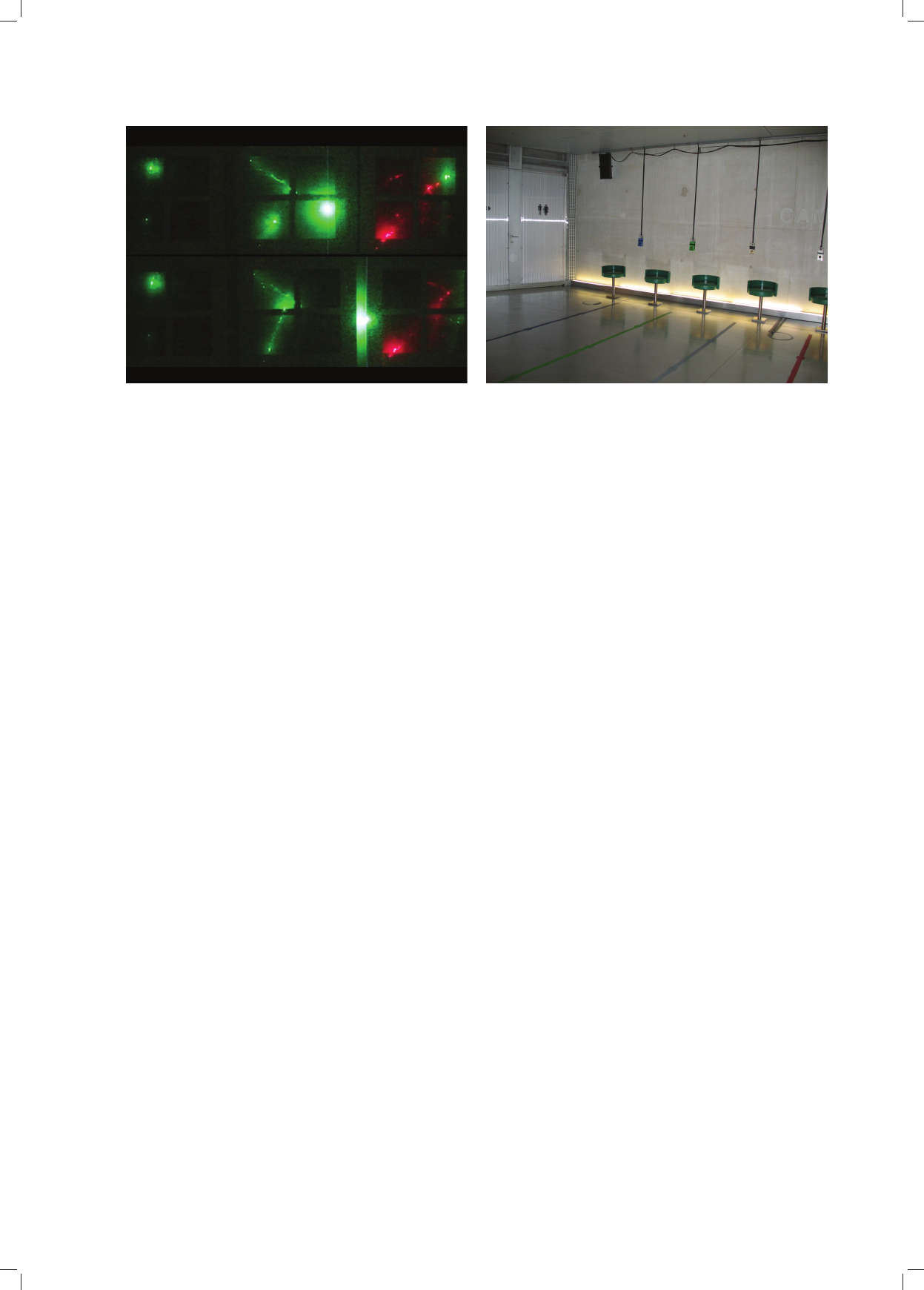
Il. 3. Generowanie świetlnych pikseli przez ruchy człowieka.
Ekspozycja w Muzeum Sztuki w Pekinie (fot. A. Kwiatkowska)
Fig. 3. Generating of the lightpixels by man’s motion.
Exhibition, The National Art Museum of China, Beijing
(photo by A. Kwiatkowska)
Il. 4. Generowanie dźwięków w przestrzeni przez ruchy człowieka.
Ekspozycja w Casa da Música w Porto (fot. A. Kwiatkowska)
Fig. 4. Generating of sounds by man’s motion.
Exhibition, Casa da Música, Porto
(photo by A. Kwiatkowska)

10 Ada Kwiatkowska
jako wartości pozytywne, przyczyniające się do sukcesu
gracza, a reprezentujące świat technokultury (por. [17]).
Formy metamorczne i generatywne w architekturze
digitalnej mają podobną genezę, czyli powstają w oparciu
o kod – zapis podstawowy deniujący strukturę nasienia –
zaczynu formy, oraz algorytm przekształceń – determinują
cy możliwe stany rozwoju struktury. Metamorczne formy
charakteryzują się przede wszystkim zmianami zachodzą
cymi w ich wewnętrznej strukturze przy zachowaniu to
pologicznej spójności (np. Saltwater Pavilion, arch. Kas
Oosterhuis – por. [18], [19]), podczas gdy formy genera
tywne są swoistymi mutacjami kodów i algorytmów form;
tym samym są zbiorem niezależnych struktur mających
wspólny początek w zapisie DNA, lecz podlegających in
dywidualnym przemianom ewolucyjnym (np. DataDriven
Forms, arch. Marcos Novak – por. [19]). Nowa generacja
form architektury digitalnej, aby móc zmaterializować się
w świecie zycznym, wymaga zastosowania materiałów
bionicznych oraz nanotechnologii do sterowania procesa
mi transformacji i wzrostu struktur przestrzennych.
CTRL – kontrola przepływu materii, energii
i informacji w strukturach przestrzennych
W grach przygodowych, szczególnie o tematyce sensa
cyjnej (np. Tom Clancy’s Splinter Cell: Chaos Theory; por.
[20]), główni bohaterowie są wspierani przez inteligentne
technologie działające w inteligentnym środowisku. Tech
nologie te umożliwiają pełną kontrolę otoczenia zarówno
pod względem możliwości wnikania w wewnętrzną struk
turę systemu, jak i pełnego dostępu do informacji dotyczą
cych osób i zdarzeń, a także otrzymywania ostrzeżeń o wy
stępujących zagrożeniach w otoczeniu. W swych misjach
bohaterowie gier przygodowych są oprzyrządowani w róż
nego typu gadżety hightechu, bę dące często ekstensjami
zmysłów człowieka lub sensorami wbudowanymi w ciało
(cyborg). Do przyrządów tych należą między innymi nano
komputery, noktowizory, kamery, detektory hałasu, skane
ry i różnego typu czujniki pozwalające na wszechstronną
recepcję przestrzeni, w której przebywa bohater gry.
W architekturze digitalnej jest wiele przykładów ta
kich rozwiązań, w których wykorzystuje się ten rodzaj
oprzyrządowania jako ważnego składnika inteligentnych
budynków. Głównym celem wzmacniania sztucznej inte
ligencji struktur przestrzennych jest uzyskanie ich samo
sterowności oraz optymalizacja ich pracy (utrzymywanie
stanu równowagi wszystkich podsystemów, np. JTC I: Ju
rong Industrial Town Strategic Planning, arch. A. Tan Hee
Hung, RAD – por. [21]); odzyskiwanie energii ze źródeł
alternatywnych (np. Intelligent House, arch. K. Sakamura
– por. [22]), a także w niektórych futurystycznych wi
zjach pojawia się dodatkowy cel, jakim jest osiągnięcie
przez struktury przestrzenne stanu samoświadomości (np.
StaC, arch. Sixteen* Makers; Pods, Biennale Exhibition,
arch. AMID – por. [23]). Współczesne eksperymental
ne formy architektury digitalnej, które ogniskują się na
wzmocnieniu sztucznej inteligencji (tzw. A.I. – Articial
Intelligence) struktur przestrzennych, są podporządko
wane kontroli przepływów strumieni energii i informacji
(il. 5, 6). Strumienie te powodują określone odkształcenia
CTRL – control of the matter, energy
and information flow in the spatial structures
In the adventure games, especially relating to the spy
stories (e.g. Tom Clancy’s Splinter Cell: Chaos Theory;
[20]) the main characters are supported by the intelligent
technologies, working in the smart environment. These
technologies make possible the total control of the sur
roundings, in the meaning of the inltration of internal
structure of the system, full access to the information
about persons and events, and getting the warning mes
sages about dangers in spatial settings. The characters of
adventure games, during their missions, acquire different
hightech gadgets, being the extensions of human senses
or the sensors builtin the human body (cyborg). Among
gadgets, one can nd such electronic devices as nano
computers, nightvision goggles, cameras, noisedetec
tors, scanners and other sensors of allaround observation
of the space, in which the character stays.
There are many examples of such solutions in digital
architecture, in which this kind of the smart technologies
are used, as the important component of the intelligent
buildings. A basic aim of strengthening of the articial in
telligence of spatial structures is to get their selfsteering
and optimisation of their capacity (keeping in the state of
balance of all the subsystems, e.g. JTC I: Jurong Indus
trial Town Strategic Planning by arch. A. Tan Hee Hung,
RAD [21]); gaining the energy from alternative sources
(e.g. Intelligent House by arch. K. Sakamura [22]); there
is also an additional aim in futuristic visions – obtain
ing the selfconsciousness by the spatial structures (e.g.
StaC by arch. Sixteen* Makers; Pods, Biennale Exhibi
tion by arch. AMID [23]). Present experimental forms of
digital architecture, concentrating on the strengthening of
the articial intelligence (A.I.) of the spatial structures,
are subordinated to control of ows of the energy and in
formation streams (Fig. 5, 6). These streams cause some
denite deformation of the spatial structures according to
the direction of their ow. The user, who has an access to
the steering program of the spatial structure can have an
inuence on the shape and optimisation of its parameters.
OSS – architectural forms as expression of
the open-source software and info-visual transparency
Some adventure games (e.g. Enter the Matrix, The Ma-
trix: Path of Neo [24]) make it possible to have an ac
cess by the player not only to information, but also – to
the source code of this information, which allows hacking
the system which means making changes in a much wider
range than was permitted by the programmer. This hack
ingsystem makes possible to reach and control the hidden
and inaccessible places in the structure, and to write one’s
own commands in it, which give a chance to the player
to have an inuence on the run of events. It is the high
est level of interactions with the surroundings. The player
discovers and explores new elds of activities, entering
into interactions with the system from one side, but from
the other – taking control of it. This requires more innova
tiveness and creativeness from the player. In this activity,

Paradygmaty strategii gier w projektowaniu architektonicznym /Paradigms of the games’ strategy in architectural design 11
the gamer is supported by different additional devices,
such as chips, scanners, memory cards, decryption codes
or spying software that permits to get inside the system.
The virtual space and digital architecture, in their own
core of essence, can be perceived as a Matrix, in regard
of the hidden source code of the 3D CAD software and
the visual – information inaccessibility of the topologi
cal space. Total control of the metamorphic transforma
tion of the spatial structures in the process of designing
is not possible now, because the architects do not have
a full access to the language of information programming
and algorithms of the computer programs. A conscious
game with architectural form will be possible only then
when the architects have a wider access to architectural
programming of codes. It is a sine qua non condition to
not be condemned only to a visual verication of possi
ble variants of transformation of form by using the com
puter programs (e.g. Haptic horizon by arch. S. Perrella
[19]). To follow the creative intention in a conscious way,
the architect has to write his own fragments of the infor
mation language code, in effect – to create the author’s
unique forms and spatial arrangements (e.g. XL Bar New
York by arch. Desgrippes Gobe Group [25]).
Play Create Share – interactive and personalized
architectural space
In the last decade, the platform game LittleBigPlanet
by Molecule [26] has been very popular, and it has intro
duced a new quality to the game strategies. The players
have received a tools of creation of their own game lev
els, getting the possibility of designing of the game eld
in a virtual 3Dspace according to their own scenario.
The game makers challenged the players to Play Create
Share; to share the created levels with the game commu
nity. As for now, there is about a million of game levels,
designed by the players and made available online. The
struktur przestrzennych stosownie do kierunku ich prze
pływu. Użytkownik, który ma dostęp do programu steru
jącego pracą struktury przestrzennej, może wpływać na
wygląd formy i optymalizację jej parametrów.
OSS – architektoniczne formy jako ekspresja
otwartego oprogramowania
i informacyjno-wizualnej transparentności
Niektóre gry przygodowe (np. Enter the Matrix, The
Matrix: Path of Neo – por. [24]) umożliwiają dostęp gracza
nie tylko do informacji, ale też do kodu źródłowego tej in
formacji, co pozwala na hakowanie systemu (tzw. hacking
system), a więc dokonywanie w nim zmian w szerszym
zakresie niż przewidział to programista. System hakowa
nia pozwala na dotarcie i skontrolowanie ukrytych oraz
niedostępnych miejsc w strukturze, a także na wpisanie
własnych komend, umożliwiając tym samym graczowi
wpływ na przebieg wydarzeń. Jest to najwyższy stopień
interakcji z otoczeniem. Gracz odkrywa i eksploruje nowe
pola aktywności, z jednej strony wchodząc w interakcje
z systemem, z drugiej zaś – przejmując nad nim kontrolę.
Wymaga to od gracza większej innowacyjności i kreatyw
ności. W tym działaniu jest on wspomagany przez różne
dodatkowe urządzenia, takie jak chipy, skanery, karty pa
mięci, kody deszyfrujące czy oprogramowanie szpiegują
ce, które pozwala dostać się do wnętrza systemu.
Przestrzeń wirtualna oraz architektura digitalna, w sa
mej swojej istocie, mogą być postrzegane jako swoisty
Matrix ze względu na ukryty kod źródłowy oprogra
mowania 3D CAD oraz na nieprzystępność wizualno
informacyjną przestrzeni topologicznej. Pełna kontrola
metamorcznych transformacji struktur przestrzennych
w procesie projektowania nie jest obecnie możliwa, gdyż
architekci nie mają pełnego dostępu do języka oprogramo
wania oraz do algorytmów programów komputerowych.
Świadoma gra z formą architektoniczną będzie możliwa
Il. 5. Struktura przestrzenna jako przepływ energii świetlnej.
Fasada medialna sterowana programem komputerowym, Bangkok
(fot. A. Kwiatkowska)
Fig. 5. Spatial structure as the lightenergy flow.
Mediafacade, Bangkok
(photo by A. Kwiatkowska)
Il. 6. Struktura przestrzenna jako przepływ energii świetlnej.
Fasada medialna sterowana programem komputerowym, Bangkok
(fot. A. Kwiatkowska)
Fig. 6. Spatial structure as the lightenergy flow.
Mediafacade, Bangkok
(photo by A. Kwiatkowska)

12 Ada Kwiatkowska
more innovative, original and individualized concepts
the greater the popularity among the other players. In
troduction of this strategy to the world of games teaches
the community of players how to be creative which will
have an inuence on the future expectations relating to
the spatial settings of their life as the space which may be
transformed according to own likings.
The concept of interactive and personalized space is
very popular in digital architecture. Many architects prop
agate the idea of participatory designing with the users,
giving them an opportunity to express the own individual
needs and likings in the design process. Space becomes
for architects a medium and contact with the users (e.g.
Les Eclaireuses: Cultural Platform by arch. M. Gautrand
[21]). Architect Kas Oosterhuis, in his project Variomatic
House [27], goes one step farther towards designing of
the personalized housing. The architectural computer
program, accessible to the architect and user at the same
time, analyses and learns the expectations and likings of
the user in the process of mutual relations of both sides.
The program is a specic platform game, during which
the real house and its user become conscious of each oth
er, space is personalized, and the user identies with the
space created by him or herself in the range of this game.
Conclusions
Virtual reality and game strategies will have a more
important inuence on shaping of the architectural forms
in the real world in the near future, both in the aestheti
cal dimension – mutual inspirations, structural – build
ing of the intelligent environment, and logistic – using of
the similar strategies of activity. Computers are not only
a tool for designing the architectural forms, their software
– internal languages, commands, codes, functions or li
braries of materials and basic forms – become a part of
the architectural reality.
As Sarah Chaplin [28] wrote, the virtual reality is sup
plementary to the real world, while cyberspace is a place
of mutual interactions between reality and ction. The
question is, whether the present relation between physical
and virtual reality will be kept in the same proportion in
the future. The consequence of imbalance, in favour of
virtual reality in our real life, would mean demateriali
zation of architecture and conversion of the architectural
language into media language, in other words passing
from the creation of forms to creation of ction.
Another important aspect of digital architecture is the
strengthening of tendency of the intelligent builtenviron
ment and intelligent spatial structures’ creation. Kas Oost
erhuis denes the architectural form as body-building
[acc. 19, p. 72], that is to say an organic and intelligent
object. The organic form means the evolving and adapt
ing itself to the changes in the environment; the intelligent
form – a structure integrated with global digital network
of communication and transformed according to the in
dividual likings of the users [18]. Integration of the spa
tial structure with the communication network, in a sig
nicant way, strengthens the importance of the games’
strategy role in architectural design.
dopiero wtedy, gdy architekci będą mieli większy dostęp
do kodów oprogramowania architektonicznego. Jest to
warunek konieczny, aby nie być skazanym tylko na wizu
alne werykowanie możliwych wariantów przekształceń
formy, używając programów komputerowych (np. Haptic
horizon, arch. S. Perrella – por. [19]). W pełni świadome
podążanie architekta za swoją intencją twórczą oznacza
pisanie własnych fragmentów kodu języka informatycz
nego, a w efekcie – tworzenie autorskich, unikatowych
form i aranżacji przestrzennych (np. XL Bar New York,
arch. Desgrippes Gobe Group – por. [25]).
Play Create Share – interaktywna i spersonalizowana
przestrzeń architektoniczna
W ostatnich latach wielką popularnością cieszy się gra
platformowa LittleBigPlanet rmy Molecule (por. [26]),
która wprowadziła nową jakość do strategii gier. Gracze
otrzymali narzędzia do kreacji własnych poziomów pole
gające na możliwości zaprojektowania pola gry w wirtual
nej przestrzeni 3D według własnego scenariusza. Twórcy
postawili przed graczami wyzwanie: baw się, twórz i dziel
się ze społecznością (Play Create Share) stworzonymi
przez siebie poziomami gry. Do tej pory powstało już
ponad milion poziomów tej gry, zaprojektowanych przez
graczy i udostępnionych w sieci. Im bardziej nowatorskie,
oryginalne i zindywidualizowane projekty, tym większą
cieszą się popularnością. Wprowadzenie tej strategii do
świata gier uczy społeczność graczy bycia kreatywnym,
co będzie miało swój wpływ na przyszłe oczekiwania wo
bec przestrzennej oprawy ich życia jako przestrzeni, którą
można przekształcać zgodnie z własnymi upodobaniami.
Koncepcja przestrzeni interaktywnej i spersonalizo
wanej jest bardzo popularna w architekturze digitalnej.
Wielu architektów propaguje ideę projektowania party
cypacyjnego, z udziałem użytkowników, dając im możli
wość wyrażania swoich indywidualnych potrzeb i upodo
bań w procesie projektowym. Przestrzeń staje się dla
architektów środkiem mediacji oraz komunikowania się
z użytkownikami (np. Les Eclaireuses: Cultural Platform,
arch. M. Gautrand – por. [21]). Architekt Kas Oosterhu
is w swoim projekcie Variomatic House (por. [27]) idzie
o krok dalej w kierunku projektowania spersonalizowa
nych domów mieszkalnych. Komputerowy program ar chi
tektoniczny, dostępny dla architekta i użytkownika w tym
samym czasie, analizuje i uczy się oczekiwań oraz upodo
bań użytkownika w procesie wzajemnych relacji między
stronami. Program jest swoistą grą platformową, pod
czas której rzeczywisty dom i jego użytkownik stają się
świadomi siebie nawzajem, przestrzeń nabiera cech sper
sonalizowanych, zaś użytkownik identykuje się z za
projektowaną przez siebie przestrzenią w ramach tej gry.
Wnioski
Rzeczywistość wirtualna oraz strategie gier w najbliż
szej przyszłości będą mieć coraz większy wpływ na kształ
towanie form architektonicznych w realnym świecie, za
równo w wymiarze estetycznym (wzajemne inspiracje),
strukturalnym (budowanie środowiska inteligentnego),

Paradygmaty strategii gier w projektowaniu architektonicznym /Paradigms of the games’ strategy in architectural design 13
jak i w wymiarze logistycznym (wykorzystywanie po
dobnych strategii działania). Komputery nie są tylko na
rzędziem do projektowania form architektonicznych, ich
oprogramowanie – wewnętrzne języki, komendy, kody,
funkcje czy biblioteki materiałów i form podstawowych –
stają się częścią architektonicznej rzeczywistości.
Jak napisała Sarah Chaplin (por. [28]), wirtualna rze
czywistość jest komplementarna ze światem rzeczywi
stym, zaś cyberprzestrzeń jest miejscem wzajemnych
interakcji między realnością a kcją. Pozostaje tylko py
tanie, czy obecna relacja między zyczną a wirtualną rze
czywistością będzie w przyszłości zachowana w tej samej
proporcji. Konsekwencją zachwiania się tej równowagi,
na korzyść większego udziału w naszym życiu rzeczy
wistości wirtualnej, oznaczałaby dematerializację archi
tektury i przemianę języka architektonicznego w język
mediów, czyli przejście od kreacji form do kreacji kcji.
Innym ważnym wątkiem w architekturze digitalnej
jest wzmocnienie się tendencji kreowania inteligentnego
środowiska zurbanizowanego oraz inteligentnych struktur
przestrzennych. Kas Oosterhuis deniuje współczesną
formę architektoniczną jak body-building [za: 19, s. 72],
czyli organiczny i inteligentny obiekt. Forma organiczna
oznacza strukturę przestrzenną ewoluującą i adaptującą
się do zmian zachodzących w środowisku, forma inte
ligentna – strukturę zintegrowaną z siecią globalnej cy
frowej komunikacji i przekształcającą się stosownie do
indywidualnych upodobań użytkowników (por. [18]).
Zintegrowanie struktury przestrzennej z siecią komuni
kacyjną w znaczący sposób zwiększy rolę strategii gier
w projektowaniu architektonicznym.
Powstaje coraz więcej programów komputerowych,
które pozwalają zacierać różnicę między światem wir
tualnym i realnym, jeżeli idzie o sposób działania. Świat
wirtualny jest też coraz bardziej dostępny i zrozumiały
dla jego użytkowników, dzięki powstaniu przyjaznego
interfejsu programów komputerowych oraz intuicyjnym
narzędziom programowania. Wydaje się, że przyszła
pracownia architekta będzie pracownią w świecie wirtu
alnym, powiązaną z użytkownikami, producentami ele
mentów struktury oraz zautomatyzowanym placem bu
dowy. Charakter i sposób działania w tej pracowni będzie
coraz bardziej zbliżony do sposobu podejmowania decyzji
w świecie współczesnych gier strategii czasu rzeczywiste
go i gier platformowych. Dostępne narzędzia projektowa
nia będą symulować procesy zachodzące w rzeczywisto
ści, a tym samym umożliwiać architektowi kontrolę pracy
wszystkich parametrów struktury w czasie rzeczywistym.
There are more and more computer programs which
enable removing the difference between the virtual and
real world according to modus operandi. Virtual reality is
also more accessible and intelligible for the users due to
creation of the userfriendly software’s interface and the
intuitive tools of programming. It seems, that the future
architectural ofce will be a studio in virtual reality, con
nected with the users, builders and robotic building site.
The character and modus operandi of this studio will be
more and more related to the way of decision making in
the present realtime strategy and platform game world.
The available design tools will simulate the processes tak
ing place in the reality, and in effect, make it possible to
control by architects the functioning of all parameters of
the structure in real time.
Translated by
Ada Kwiatkowska
Bibliografia /References
[1] Witruwiusz, O architekturze ksiąg dziesięć, Prószyński i Ska, War
szawa 1999.
[2] Tatarkiewicz W., Historia estetyki, Arkady, Warszawa 1985.
[3] Greene B., Struktura kosmosu: przestrzeń, czas i struktura, Prószyń
ski i Ska, Warszawa 2004.
[4] Kurzweil R., The Singularity Is Near, Viking, New York 2005.
[5] Kwiatkowska A., Forma architektoniczna jako kod digitalny w erze
elektronicznego ekosystemu, „Archivolta” 2006, Nr 4, 52–58.
[6] Kwiatkowska A., Architectural interfaces of hybrid humans, [w:]
M. Voyatzaki, C. Spiridonidis (eds.), Rethinking the human in tech-
nology-driven architecture, European Association for Architectural
Education, Leuven 2012, 363–370.

14 Ada Kwiatkowska
[7] Kwiatkowska A., Gametecture: architectural form in augmen-
ted rea lity, „Technical Transactions. Architecture” 2015, R. 112,
z. 9A, 165–171.
[8] Kwiatkowska A., Informative-Interactive Design Theory of So-
ftware Age, [w:] Environment-Behavior Studies for the 21
st
Centu-
ry, University of Tokyo, Tokyo 1997, 405–408.
[9] Novak M., Transmitting architecture: transTerraFirma/Tidsvag-
Noll v2.0, „Architectural Design” 1995, No. 118, 43–47.
[10] Kwiatkowska A., Forma eksperymentalna w erze digitalnych tech-
nologii, „Architectus” 2004, Nr 1(15), 59–67.
[11] Thompson R.L., Maja – świat jako rzeczywistość wirtualna, Patra,
Wrocław 2004.
[12] Myoo S., Ontoelektronika, Wydawnictwo Uniwersytetu Jagielloń
skiego, Kraków 2013.
[13] Curran S., Game Plan: Great Designs that Changed the Face of
Computer Gaming, RotoVision, Mies 2004.
[14] Homeworld 2, https://en.wikipedia.org/wiki/Homeworld_2 [acces
sed: 21.05.2017].
[15] Levene R., Márquez F.C. (eds.), MVRDV 1991–2002, El Croquis
Editorial, Madrid 2003.
[16] SimCity, http://www.simcity.com [accessed: 21.05.2017].
[17] Gałuszka D., Ptaszek G., ŻuchowskaSkiba D. (red.), Technokul-
tura: transhumanizm i sztuka cyfrowa, Libron, Kraków 2016.
[18] Oosterhuis K., Trans_Ports 2001, „Architectural Design” 1999,
No. 9–10, 87–89.
[19] Zellner P., Hybrid Space: New Forms in Digital Architecture,
Thames & Hudson, London 1999.
[20] Tom Clancy’s Splinter Cell: Chaos Theory, https://en.wikipedia.
org/wiki/Tom_Clancy%27s_Splinter_Cell:_Chaos_Theory [acces
sed: 21.05.2017].
[21] Brayer M.A., Simonot B. (eds.), ArchiLab’s Earth Buildings: Radi-
cal Experiments in Land Architecture, Thames & Hudson, Orléans
2003.
[22] Sakamura K., TRON-Concept: Intelligent house, „Japan Architect”
1990, No. 4, 35–40.
[23] Spiller N., Digital Architecture Now: A Global Survey of Emerging
Talent, Thames & Hudson, London 2008.
[24] Enter the Matrix, https://en.wikipedia.org/wiki/Enter_the_Matrix
[accessed: 21.05.2017].
[25] XL Bar New York, Desgrippes Gobe Group, http://www.interacti
vearchitecture.org/xlnewyorkdesgrippesgobegroup.html [ac
cessed: 21.05.2017].
[26] LittleBigPlanet, http://littlebigplanet.playstation.com [accessed:
21.05.2017].
[27] Smith C., Topham S., Xtreme Houses, Prestel Verlag, New York
2002.
[28] Chaplin S., Cyberspace: Lingering on the Threshold, „Architectu
ral Design” 1995, No. 118, 32–35.
Streszczenie
Architektura XXI w. jest w stanie ciągłej erupcji idei i wzorców inspirowanych teorią informacji i napędzanych technicznym rozwojem ery digital
nej. Komputery są nie tylko narzędziem w projektowaniu architektonicznym, a ich wewnętrzne języki, kody i graczne konwencje mają wpływ na
kształtowanie form architektonicznych. Realne życie jest wspierane przez działania podejmowane w wirtualnej rzeczywistości, natomiast istniejące
obiekty architektoniczne mają swoją reprezentację w wirtualnym świecie. Ta mieszanka rzeczywistych i wirtualnych wymiarów powoduje, że prze
strzenna oprawa życia człowieka staje się polem gry, w którym są wykorzystywane różne strategie gier, a architekci i użytkownicy są aktywnymi
graczami w przestrzeni architektonicznej.
Celem pracy jest zdeniowanie przyszłych kierunków zmian w projektowaniu architektonicznym pod wpływem rozwoju technologii informatycz
nych oraz implementacji różnych strategii gier umożliwiających symulację zmiennych stanów struktur przestrzennych. W artykule omówiono naj
ważniejsze wyzwania w oparciu o analizę porównawczointerpretacyjną współczesnych gier oraz innowacyjnych koncepcji architektury digitalnej,
ukazanych w aspekcie ich zgodności pod względem użytych strategii projektowania. Na podstawie analizy wyróżniono następujące paradygmaty
projektowania architektonicznego, będące odzwierciedleniem istniejących strategii gier i mające bezpośredni wpływ na kształtowanie form architek
tonicznych: RTS – strategie gier w czasie rzeczywistym w przestrzeni architektonicznej, DNA – kodowanie struktur przestrzennych, CTRL – kon
trola przepływu materii, energii i informacji w strukturze przestrzennej, OSS – architektoniczne formy jako ekspresja otwartego oprogramowania
i informacyjnowizualnej transparentności oraz Play Create Share – interaktywna i spersonalizowana przestrzeń architektoniczna. Te strategie będą
deniować przyszły kształt interaktywnego i inteligentnego środowiska zurbanizowanego, a także będą miały wpływ na przyszłe oczekiwania
użytkowników odnośnie do atrakcyjności i interaktywności oprawy przestrzennej życia człowieka.
Słowa kluczowe: symulacja, pole eksploracji, gry przestrzenne, architektoniczny scenariusz
Abstract
Architecture of the 21
st
century is in a state of the everlasting eruption of ideas and patterns, inspired by the informative theory and driven by the
technological development of digital age. Computers are not only tools of architectural design, but their inner languages, codes and graphic conven
tions have an inuence on architectural forms. Real life is supplemented by actions in virtual reality and the architectural objects have their represen
tation in the virtual world. The mixture of real and virtual matters causes that the setting of man’s life becomes a kind of gameland, and the architects
and users are the active gamers in architectural space.
The aim of the research paper is to dene the future direction of changes in architectural design inuenced by the progress of information tech
nologies and by implementation of different gaming strategies, making it possible to simulate variable states of the spatial structures. The paper
points out the most important challenges on the basis of comparative and interpretative analysis of the present games and innovative architectural
concepts of digital architecture, shown in the aspects of their congruency in relation to the used design strategies. On the basis of analysis, the
following paradigms of the architectural design, relating to the existing gaming strategies which have direct inuence on shaping of the architectural
forms, are distinguished: RTS – realtime game strategies in the architectural space, DNA – coding of the spatial structures, CTRL – control of the
infomatterenergy ow in the spatial structures, OSS – architectural form as expression of the opensource software and infovisual transparency,
and Play Create Share – interactive and personalized architectural space. These strategies will dene the future shape of interactive and smart built
environment and will have an impact on the future users’ expectations, relating to the attractiveness and interactivity of man’s life settings.
Key words: simulation, eld of exploration, spatial games, architectural scenario