In order to develop the method to select the planks
forthe construction of carrying elements, the author called
the attention to the potential selection of wood basing on
the dynamic testing.
To recognize the issue, the author conducted the bibli-
ography research in the field of the dynamics and theory of
viscoelastic materials. In Poland, several authors dealt with
the issues of the viscoelastic construction dynamics. The
first problem in the theory of viscoelastic materials was
formulated and resolved by Kowal in the 60s of the 20
th
Century. In his paper [1], he studied the vibrations: of
a viscoleastic beam and a rigid beam on the supports: vis-
cous, viscoelastic and rigid. He determined the dynamic
coefficients to determine the maximum vibration amplitude
and maximum forces in the system. In his paper [6],
Nowacki presented the mathematical rudiments of the
dynamics of linear viscoelastic constructions. In his paper
[3], Langer specified the solutions related to the dynamics
of viscoelastic system and the propagation of viscoelastic
waves. He demonstrated that the model of an elastic body
was insufficient to describe the state of stress and strain of
the majority of building structures. The method of dynamic
vibration coercion was applied by Kowal et al. [2] in prac-
tice, to detect damaged girders in the ceiling roof having
a construction of pre-tensioned pre-stressed girders. Upon
the induction of vibration in successive girders, the fre-
quencies of their vibration were measured, and their values
showed the girders of a lower rigidity. The girders of
a reduced rigidity due to mechanical damages demonstrat-
Barbara Misztal*
Dynamic parameters of the free vibrations of various wood species
Wood used for the construction of prestigious building
facilities has to show high strength parameters taking into
account the required durability of the building. The wood
selection and choice is a difficult task. Such wood selec-
tion is required that out of the mass of planks the best
wood is selected in order to build it into the most strained
sections whilst the elements of a worse quality should be
used in less burdened zones, or rejected. In the daily prac-
tice the wood choice follows against visual inspection.
For instance, the Japanese company, Miyazaki Prefectural
Wood Utilization Research Center, in charge of the
accomplishment of the Konohana Dome in the city of
Miyazaki made, in 2002, the choice of the best planks
according to the measurement of the spacing between
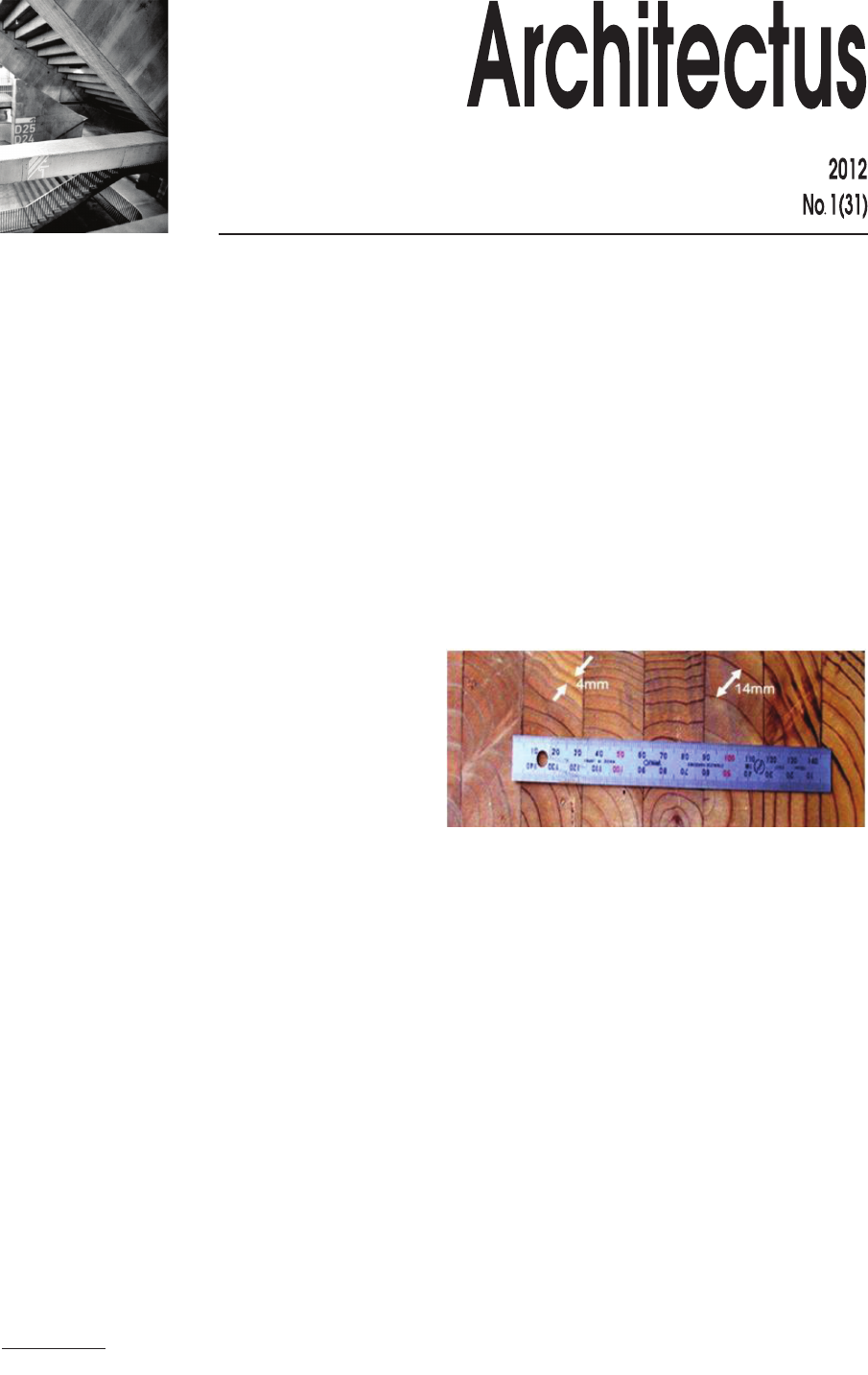
wood fibers. Figure 1 shows the sections of planks cut out
in 45-year-old Sugi trees (Cryptomeria japonica) used for
the construction of the carrying element. Those planks
were picked out for the elements of the structure so that
the spacing distances between the fibers are included in
the range of 4 mm through 14 mm.
)DFXOW\RI$UFKLWHFWXUH:URFáDZ8QLYHUVLW\RI7HFKQRORJ\
Introduction
Fig. 1. Planks selected against the criterion of the spacing distance
between the fibers [7]
,O'HVNLZ\VHOHNFMRQRZDQHQDSRGVWDZLHNU\WHULXPRGOHJáRĞFL
SRPLĊG]\ZáyNQDPL>@
Bibliography research
DOI: 10.5277/arc120113
126 Barbara Misztal
This paper describes the dynamic testing of beams made
of two wood species: oak tree and pine tree. The testing was
conducted on both dry and wet models. For formal reasons,
this paper depicts the testing of models in the air-dried state of
oak and pine wood. The plank models, of a 10×40 mm sec-
tion, 1200 mm long, were prepared for the testing. Before the
testing experiment, the planks were weighed in the air-dried
state. The load at the end of the support was applied perpen-
dicularly to the plane of the beam’s lower rigidity (Fig. 2).
In order to eliminate the second-order vibration the mass
of m = 250.0 g at the end of the support was introduced.
The frequency n and the damping
U
of free vibration
coerced by the force P = 250.0 g suspended on a thread at
the end of the support was tested. In all the cases the
damped free vibration, regardless of the wood species, is
well described by the function (1) pursuant to [3]:
MUD
U
22
0
cos teyy
t
t
(1)
Specified below are the parameters of the vibrating move-
ment measured on the models made of oak and pine wood
planks, assessed according to the formulae as below:
– the vibration period T was measured in [s],
– vibration frequency: n = 1/T [1/s] (2)
– the circular velocity of the damped free vibration
was calculated from the formula:
Z
= 2 Sn (3)
– the dimensionless logarithmic damping decrement '
was calculated from the formula:
T
A
A
U
'
10
0
ln
ln
n
(4)
the damping coefficient
U
is:
U
= '/T [1/s] (5)
Figures 3 and 4 show the exemplary charts of dampened
free vibration of the plank models: oak wood plank and
pine wood plank, during the first 10 s. For each grade of
dry planks the following was calculated: The elastic rigid-
ity K is measured using the vibration velocity
Z
and the
damping
U
from the paper [1]:
Į
2
= Ȧ
2
+
U
2
=K/m
zr
(6)
Ȧ = free vibration frequency measured [radians],
ȡ = free vibration damping measured,
Į = specific vibration (non-damped) measured [radians],
K
ef
= m
zr
Ȧ
2
– effective rigidity of the beam, as measured
on the model,
y
o
= P/K
ef
.
– immediate displacement under load
P = m
zr
g.
The circular velocity of non-damped free vibration,
required to assess the rigidity of both dry and wet planks,
was calculated from the formula pursuant to [1]:
]/1[
22
s
sss
UZD
(7)
where: Ȧ – specific vibration, Į – free vibration, ȡ –vibra-
tion dampening.
ed a lower free vibration frequency than the non-damaged
girders. Those date allowed to conclude on the need for
their replacement or strengthening. The hypotheses on the
use of dynamic testing for the evaluation of the strength
properties of wood were first formulated in the papers pub-
lished by the author [4], [5]. The author suggests recogniz-
ing the features of wood in the dynamic testing that yields
clear results, instead of visual inspection or long-term test-
ing used to date. Short dynamic tests are recommended for
the selection of wood chosen for the building of elements
of prestigious structures, also to detect damaged elements
in the already constructed wooden structures.
Description of experimental testing
Fig. 3. Schematic diagram of the dry oak model vibration
,O:\NUHVGUJDĔPRGHOX]VXFKHJRGĊEX
Fig. 4. Schematic diagram of the dry pine model vibration
,O:\NUHVGUJDĔPRGHOX]VXFKHMVRVQ\
Fig. 2. Model of beams being tested: a) Schematic of a beam for
dynamic testing, b) Section
,O0RGHOWHVWRZDQ\FKEHOHNDVFKHPDWEHONLGREDGDĔ
G\QDPLF]Q\FKESU]HNUyM
a
b

Dynamic parameters of the free vibrations of varions wood species 127
Tab. 1. Parameters of the vibrating movement
of the dry oak model loaded with a mass at the end
7DE3DUDPHWU\UXFKXGUJDMąFHJRPRGHOX]GĊEXVXFKHJR
REFLąĪRQHJRPDVąQDNRĔFX
T
s
t
0
y
0
ȡ
s
n
s
Ȧ
s
ij ¨
s
[s] [s] [mm] [1/s] [1/s] [1/s] [°]
0.253 0.11067 25.77 0.1673 3.953 24.835 2.251 0.0423
Table 1 specifies the parameters of the vibrating move-
ment of the models made of oak wood, Table 2 specifies
those for the model of pine wood, in the air dried condition.
Table 1 comprises the parameters of the vibrating
movement as measured on the dry oak model, and
assessed as follows:
– the vibration period measured is: T
s
= 0,253 s,
– vibration frequency: n
s
=1/T
s
T
s
Vĺn
s
= 3.953 [1/s],
– the circular velocity of free vibration, as measured
from the formula: Ȧ
s
= 2Sn
s
is: 24.835/s,
– the dimensionless logarithmic damping decrement
of a dry plank '
s
is: '
s
= ȡ
s
T
s
= 0.04233
– the dimensional damping
U
s
is:
U
s
='
s
/T = 0.04233/0.253 = 0.1673
(8)
Tab. 2. Parameters of the vibrating movement
of the dry pine model loaded with a mass at the end
7DE3DUDPHWU\UXFKXGUJDMąFHJRPRGHOX]VRVQ\VXFKHM
REFLąĪRQHJRPDVąQDNRĔFX
T
s
t
0
y
0
ȡ
s
n
s
Ȧ
s
ij ¨
s
[s] [s] [mm] [1/s] [1/s] [1/s] [°]
0.186 0.5733 13.68 0.14 5.38 33.8 11.15 0.026
Table 2 comprises the parameters of the vibrating
movement as measured on the dry pine model, and
assessed as follows:
– the vibration period measured is: T
s
= 0.186 s,
– vibration frequency: n
s
= 1/T
s
T
s
Vĺn
s
= 5.38 [1/s],
– the circular velocity of free vibration, as measured
from the formula:
Z
s
= 2 Sn
s
is: 33.8/s,
– the dimensionless logarithmic damping decrement
of a dry plank '
s
is: '
s
=
U
T = 0.026
– the dimensional damping
U
s
is:
U
s
= '
s
/T = 0.026/0.186 = 0.14 (9)
Conclusions
The comparison of the formulation of the vibration of
planks made of various wood species shows evident dif-
ferences in the vibration period, damping, circular fre-
quency and logarithmic damping decrement. The follow-
ing conclusions were drawn on the basis of the testing
performed:
1. There is a potential for drawing conclusions about
the mechanical properties of the constructional wood bas-
ing on the dynamic testing.
2. The free damped vibration as shown in Figures 3
and 4 is well described with the function (1), regardless of
the wood species.
3. Dry beams of a coniferous tree species, as repre-
sented by pine wood, have a lower period of specific
vibration than beams made of deciduous trees, as repre-
sented by oak tree.
4. An oak wood beam has a significantly higher damp-
ing r of free vibration than that of pine wood, and
a higher period of free vibration damped.
5. The dimensionless logarithmic decrement '=
U
T
of free vibration damping of free beams made of decidu-
ous trees is significantly higher than for those made of
coniferous trees.
6. The conclusions drawn from the analysis of the
experimental testing can be a basis for the dynamic diag-
nostics of wooden elements, both monumental and mod-
ern, for the use of qualifying them for replacement, repair
or application in prestigious facilities.
[1] Kowal Z., '\QDPLNDQLHZDĪNLHMEHONLQDSRGSRUDFKOHSNRVSUĊĪ\VW\FK,
³$UFKLZXP,QĪ\QLHULL/ąGRZHM´9RO1RSS±
[2] Kowal Z., Sendkowski J., Walasek A., :\NU\ZDQLH SRUyZQDZF]ą
PHWRGąG\QDPLF]QąHOHPHQWyZ]DU\VRZDQ\FKSRSXODFMLEHOHNVWUXQR-
betonowych, Politechnika Rzeszowska, Rzeszów 1983.
>@ /DQJHU - '\QDPLND EXGRZOL, Wydawnictwo Politechniki
:URFáDZVNLHM:URFáDZ
[4] Misztal B., &RPSDULVRQRIWKH9LEUDWLRQ)UHTXHQF\DQG'DPSLQJRI
%HDP0RGHOV0DGHRI'U\DQG:HW3LQH:RRGWCTE 2008 – 10
th
World Conference on Timber Engineering – Miyazaki, Japan, June
2–5, 2008.
[5] Misztal B., Pomiary dynamiczne w diagnostyce stropów drewnia-
nych. 5(02 U ;, .RQIHUHQFMD 1DXNRZR7HFKQLF]QD
Problemy Remontowe w Budownictwie Ogólnym i Obiektach
=DE\WNRZ\FK:URFáDZ±=DPHN.OLF]NyZ'HFHPEHU±
>@ 1RZDFNL:'\QDPLNDEXGRZOL, Arkady, Warszawa 1972.
[7] Yutaka Iimura, 3HUIRUPDQFH(YDOXDWLRQRIWKH³.RQRKDQD'RPH´%XLOW
ZLWK)DVW±JURZLQJ6XJLWCTE 2008, June 2–5, 2008, Miyazaki, Japan.
References
7UDQVODWHGE\
%DUEDUD0LV]WDO

128 %DUEDUD0LV]WDO
Key words: wood, wooden constructions
6áRZDNOXF]RZHdrewno, konstrukcje drewniane
:SXEOLNDFMLREOLF]RQRSDUDPHWU\UXFKXGUJDMąFHJREHOHN]GZyFK
JDWXQNyZGUHZQDGĊEXLVRVQ\ZVWDQLHSRZLHWU]QRVXFK\P3RND]DQR
MDNQDSRGVWDZLHF]ĊVWRWOLZRĞFLGUJDĔVZRERGQ\FKRUD]WáXPLHQLDGUJDĔ
PRĪQDGRNRQDüZ\ERUXJDWXQNXGUHZQDGREXGRZ\NRQVWUXNFML]GUHZ-
QD =DSURSRQRZDQR ]DVWRVRZDQLH SRPLDUX GUJDĔ VZRERGQ\FK GR
Z\]QDF]DQLDZáDĞFLZRĞFLPHFKDQLF]Q\FKHOHPHQWyZ
3DUDPHWU\G\QDPLF]QHGUJDĔVZRERGQ\FKUyĪQ\FKJDWXQNyZGUHZQD