2021
3(67)
DOI: 10.37190/arc210308
Krzysztof Mycielski*, Tomasz Trzupek**
Design priorities on the example of the modernization
of Abram Gurewicz Health Resort in Otwock
Introduction
Theory and practice in the eld of architecture rare-
ly go hand in hand. Theory does not want to tolerate the
compromises of practice, while the latter does not very
often look at the deliberations of the former. The follow-
ing article presents the process of interpenetration of these
two issues aimed at implementing the best practical solu-
tions based on earlier research.
Nadświdrzańska architecture – the genesis, definition
The name of Nadświdrzańska architecture is used to
dene objects with a summer function, occurring within
the so-called “region of the historical Otwock line”
1
. The
popular name “Świdermajer” was given to them later, and
it was recorded and made famous in 1949 in the poem
Trip to Świder by Konstanty Ildefons Gałczyński. Adam
Miłobędzki notes the inuence of Swiss patterns on the
construction of summer resorts, including those in the
suburbs of Warsaw, at the turn of the 19
th
and 20
th
centu-
ries due to the expansion of railway junctions, including
* ORCID: 0000-0001-5334-5131. Faculty of Architecture, War-
saw University of Technology.
** ORCID: 0000-0001-5893-6790. Faculty of Architecture, War-
saw University of Technology, e-mail: tomasz.trzupek@pw.edu.pl
1
Adam Krajewski determines the range of the occurrence of the
Nadświdrzańska architecture as an area along the so-called Otwock line
from Śródborów to Wawer [1, p. 127]. Today they are: Anin, Między-
lesie, Radość, Zbójna Góra, Miedzeszyn, Falenica, Michalin, Emilia-
nów, Józefów, Świder, Otwock. Robert Lewandowski extends the list of
towns to include Daków, Miedzeszyn Nowy, Emilianów, Rycice, Anielin
vel Jarosław, Świder with the health resorts of Otwock, Błota, Nowa
Wieś, Świdry Małe, Świdry Wielkie and Celestynów; however, the au-
thor in his research does not distinguish the changing, with time, names
of places, using the valid addresses [2, p. 41].
the Warsaw–Vienna railway [3, pp. 295, 296]. The Al-
pine style appeared in the present territory of Poland in
the 19
th
century in an eclectic-historical version, which
only freely referred to the vernacular architecture of the
Alpine region. This process is already related to a com-
pletely new social system, which is part of the modern
world of railways, mass tourism and democratic changes.
With time, the “Alpine style” objects began to move fur-
ther away from their models. The role of ornamentation
has increased, and the remnants of the original architec-
tural features of the Alpine region are the prominent roof
eaves and balconies under the gables. The summer resort
architecture, with its roots originating from the objects
found in the mountains, began to appear regardless of
the topography, e.g. in Ciechocinek or Międzyzdroje [4,
p. 232]. According to Aleksander Wojciechowski, it was
[…] the most universal and cosmopolitan style of wooden
architecture (after: [5, p. 102]). Marek Olkuśnik, in his
cross-sectional work on tourism in Europe at the turn of
the 19
th
and 20
th
centuries, mentions the characteristic
way of building summer resorts near Warsaw, criticized,
mocked and ridiculed by the then elite as excessively
oriental and decorated [6, pp. 206–208]. However, when
comparing the “Świdermajer” architectural objects with,
for example, the objects of neo-Russian style of dachas
near Moscow and near Petersburg, the examples from
the suburbs of Warsaw clearly show greater modesty and
economy in the expression of decorations, or more modest
articulation of the walls (there is no construction of round
log walls, such as in Pogodin’s House by Nikolai Nitkin).
The purpose and the method
The purpose of this paper can be divided into two
groups. In the rst part, the intention of the text is to pres-
ent Abram Gurewicz Health Resort in Otwock as a non-
82 Krzysztof Mycielski, Tomasz Trzupek
studies he deals with Michał Elwiro Andriolli, the genesis
and area of occurrence of the phenomenon in question [2,
pp. 35–47]. Adam Krajewski in his works denes the re-
gion of its origin, discusses its individual elements, deals
with its periodization and attempts to dene the architec-
ture of the Vistula river and points to its Swiss-Russian
genesis [1, pp. 127–141]. Jerzy Szałygin [8, pp. 216–238],
Marcin Górski [9, pp. 72–75] together with Wiktor Lach
[10, pp. 6–25], [11, pp. 5–20] are dening the character-
istic features. Ewa Pustoła-Kozłowska wrote about urban
changes in the region [12, p. 11]. Iwona Trzcińska dealt
with the social impact of so called “Świdermajer” ar chi-
tecture [13, pp. 11–15, 75]. Agnieszka Szurek wrote about
Otwock in the context of visiting trends in other ho liday
resorts in Poland and around the world [14, p. 75]. Ag-
nieszka Wośko-Czerniakowska created drawing charts
with over a series of examples of façade compositions,
formwork, porch structure and a list of formwork ends
[15, pp. 108–113].
Extension
Abram Gurewicz Health Resort against
the background of the features
of Nadświdrzańska Architecture
Marcin Górski carried out a comprehensive and clear
analysis of the features of Nadświdrzańska architecture in
the case of the building in question [9, pp. 72–75]. Abram
Gurewicz Health Resort was created in 1906–1943.
From
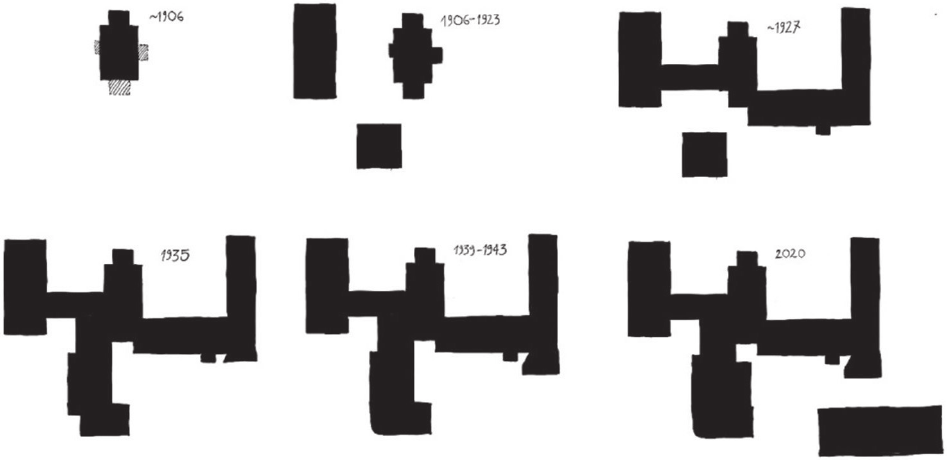
a single “Gurewiczanka” villa, it grew by adding more
wings and merging several objects (Fig. 1). “Gurewiczan-
ka”, already after the plan, the location of the entrance and
typical but also unique example of Nadświdrzań ska archi-
tecture, present on a large scale, with an additive, random-
ly shaped body. Another goal of this study is to revalue
the concept of decoration in Nadświdrzańska architecture
because the decorations in verandas can be something
more than just ornaments and constitute one of the main
identity factors of Nadświdrzańska architecture. The sec-
ond group of the goals of this work is to present the process
of reconstruction of Abram Gurewicz Health Resort in the
context of the situation in that facility existing in 2015 and
to present design priorities behind the modernization.
A comparative analysis of the features of Abram Gu re-
wicz Health Resort against the background of other build-
ings of the Nadświdrzańska architecture will be carried
out, with particular emphasis on buildings of a similar
scale and similarities in the shape of the body. Next, there
will be a distinction between ornament and decoration in
the Nadświdrzańska architecture and the key role of open-
work decorations on verandas in dening the architecture
under discussion will be indicated. In the second part of
the text, specic features will be compared with the ac-
tual technical condition of the facility before the recon-
struction, and the modernization process will be described
based on the preservation of three identities: function,
form and material.
Researchers
Andrzej Cichy dealt with the periodization of build-
ings, the development of a typology of formwork, and
pointed to its role as one of the style features of this ar-
chitecture architecture [7, p. 35]. Robert Lewandowski
is a popularizer of the architecture of the region, in his
Fig. 1. Following stages of development of Abram Gurewicz Health Resort in Otwock.
It can be seen how the typical shape of “Nadświdrzańska” Architecture in the case of villa “Gurewiczanka” (~1906–1923) was continuously
developing in a much richer shape. The three separate facilities were connected by wings in the years 1927–1935 (drawing T. Trzupek)
Il. 1. Kolejne etapy rozwoju Uzdrowiska Abrama Gurewicza w Otwocku.
Typowy kształt architektury „nadświdrzańskiej” w przypadku willi „Gurewiczanka” (~1906–1923)
przemieniał się w znacznie bardziej złożoną formę. Trzy odrębne obiekty połączono skrzydłami w latach 1927–1935 (rys. T. Trzupek)
Design priorities on the example of the modernization of Abram Gurewicz Health Resort in Otwock 83
the veranda, resembles the characteristic shapes of other
“Świdermajer” objects with a similar scale and principles
of shaping the body. The complex obtained its individual
character after numerous reconstructions, multi plying the
typical features of Nadświdrzańska architec ture, such as:
additivity or stepped character of the blocks.
In the architecture of the so-called “Świdermajer” ob-
jects, verandas are their main architectural distinguishing
feature. They come in many dierent variants. There are
1-,
2- and 3-level, polygonal, glazed and stepped veran-
das. The front façade of verandas usually had 3 or 5 mod-
ules (an even number of pillars), the side façade usually
had 2 modules (3 pillars). In addition to verandas, there
are also entrance porches, turrets, balconies, balcony ter-
races and loggias. There are also hipped roofs, mansard
roofs, and roofs with angles clearly exceeding 30°, veran-
das appear in dierent numbers and in dierent places.
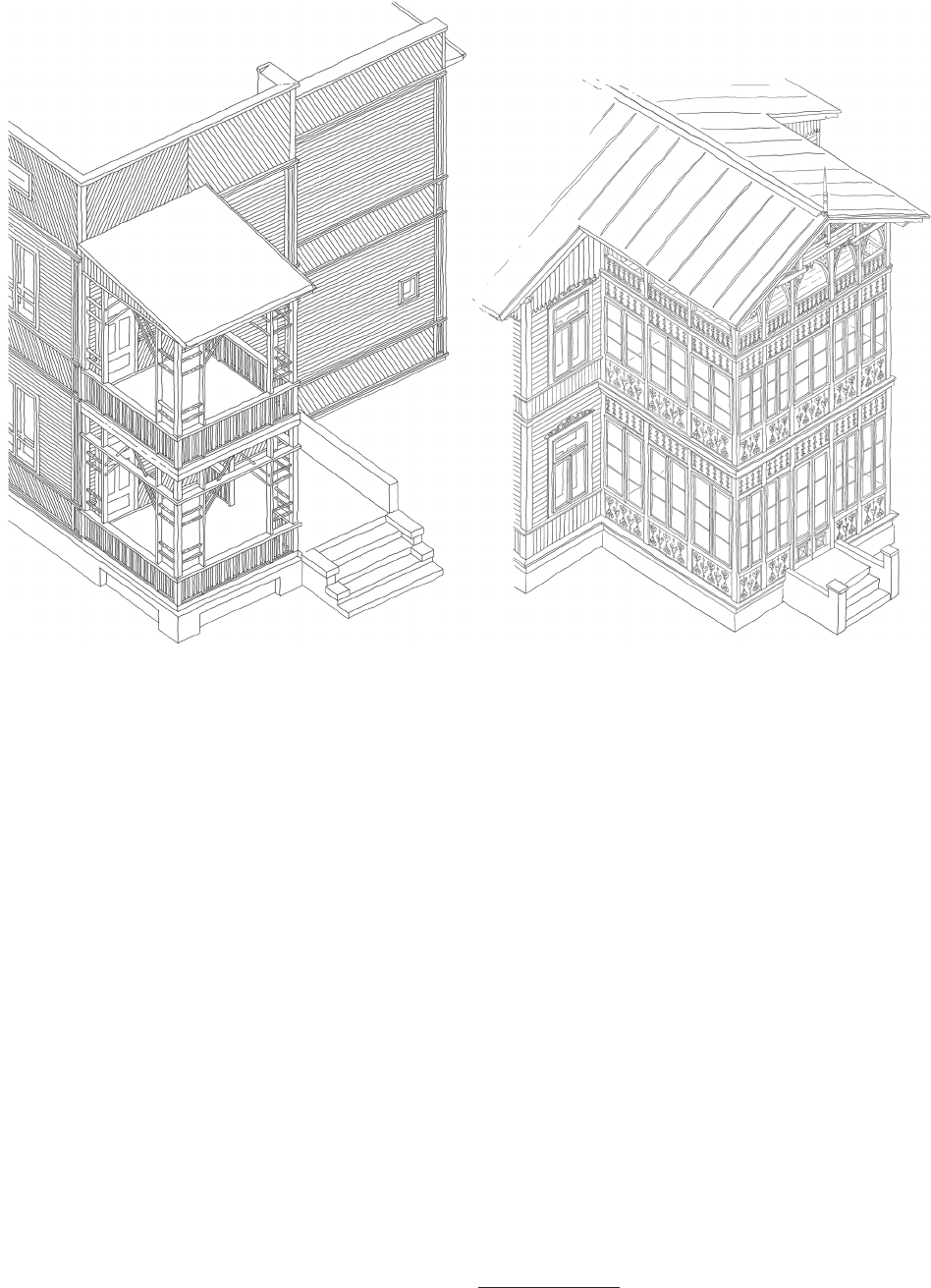
Both of the presented examples (Fig. 2) are unusual and
therefore meaningful. Villa “U Dziadka” is specic due
to the asymmetrically located entrance, simplied detail
or the use of a shed roof. The inter-window strips have
obliquely arranged formwork, and the boards that ll the
balustrades are straight, the decorative eect is obtained
by interchangeably using a wide and narrow prole. The
veranda in the Abram Gurewicz Health Resort building is
also unusual, it is extended by another, non-usable level,
added later. In the archival photos, the height of the veran
-
da’s roof is lower than the roof above the building’s body.
The veranda is closed and glazed, the openings in the bal-
ustrades are built-up. There are also external stairs here,
this time located centrally.
The main function of the architecture under analysis
were living quarters, intended for rent in the summer
2
.
Hence the need for several multi-storey structures to al-
low all guests to enter their own part of the veranda. The
buildings were entered through a small porch to the stair-
case from which you could get to a 2.5-track system with
2
Some claim that Nadświdrzańska architecture assumed the func-
tions of schools, hospitals, sanatoriums and health resorts as well as pri-
vate residential houses, but the rst two uses are not conrmed in reality.
In fact, the building at 101 Kraszewskiego Street in Otwock was used as
a primary school, although it was not designed for that purpose, but only
adapted after the war [8, p. 365].
a b
Fig. 2. Comparison of verandas:
a) “Willa u Dziadka” (Otwock, 43/47 Mickiewicza Street),
b) Abram Gurewicz Health Resort (Otwock, 8 Armii Krajowej Street).
The first one was seriously remodelled in the 1970s (drawing T. Trzupek)
Il. 2. Porównanie werand:
a) „Willa u Dziadka” (Otwock, ul. Mickiewicza 43/47),
b) uzdrowisko Abrama Gurewicza
(Otwock, ul. Armii Krajowej 8).
Pierwsza została poważnie
przebudowana w latach 70. XX w.
(rys. T. Trzupek)
84 Krzysztof Mycielski, Tomasz Trzupek
a corridor in the middle. On the side of the entrance porch
there were kitchens and bathrooms, and on the front and
side there were rooms for rent and verandas. Comparing
the shape of the primary object – Villa “Gure wi czan ka” it
was initially similar, but due to growth of whole complex,
the typical arrangements started to change.
The dominant building materials were pine and oak
wood for the foundations. The construction of the walls
of the ground oor was post-log, the structure of the rst
oor was skeletal (the discussed example of Abram Gure -
wicz Health Resort). The insulation was often made of
compacted needles, clay, straw and wood shavings. The
interiors were nished with rough boards covered with pla -
ster on reeds. The outer plinth of the building was about
40–60 cm high and was made of brick, sometimes it was
plastered. Simple purlin and purlin-collar systems do-
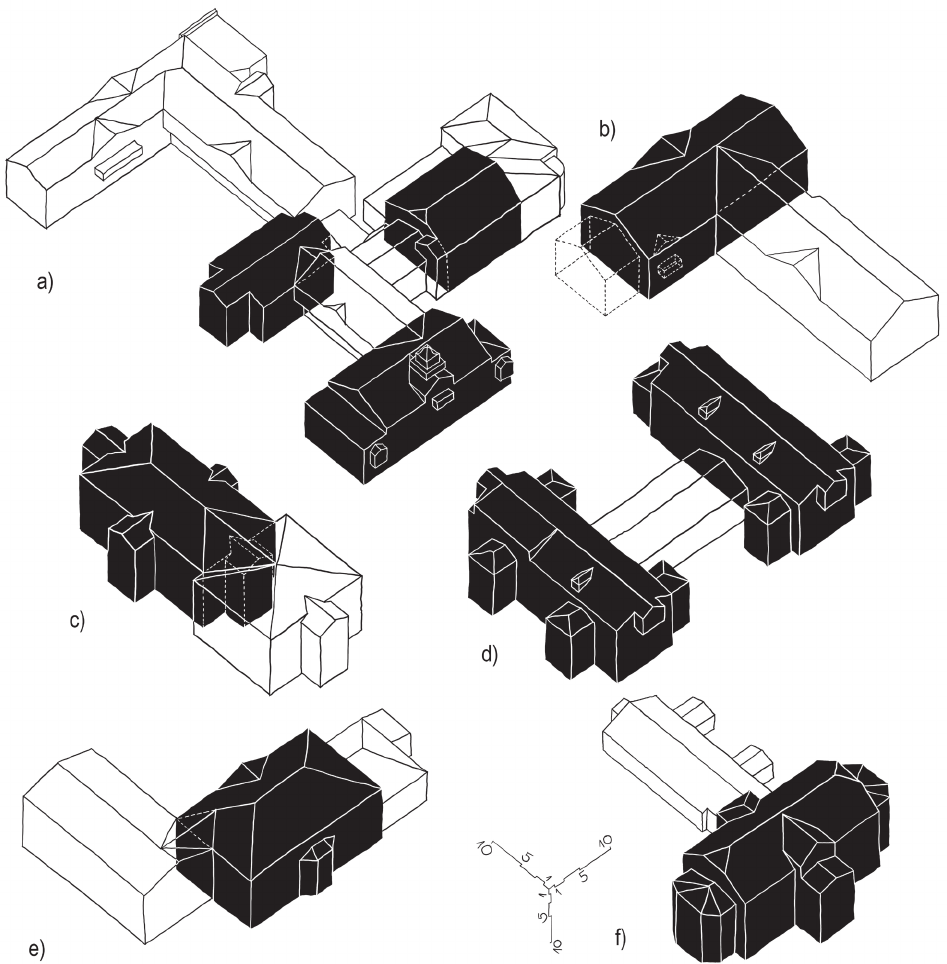
Fig. 3. Axonometry of buildings with complex shapes: a) Abram Gurewicz Health Resort, 8 Armii Krajowej Street (early 1906),
b) Dr Przygoda Sanatorium, 5 Warszawska Street (1
st
quarter of 20
th
century), c) 10 Moniuszki Street (1929),
d) 24 Zaciszna Street (approx. 1920), e) 13A Samorządowa Street, Villa “Nowość II”, f) 5 Kościuszki Street (before 1893).
All facilities are located in Otwock. The black forms are in fact examples of the most typical solid structures in the Nadświdrzańska architecture,
they can be distinguished in much richer and complex shapes of bigger objects (drawing T. Trzupek)
Il. 3. Aksonometrie budynków o złożonych kształtach: a) Uzdrowisko Abrama Gurewicza, ul. Armii Krajowej 8 (pocz. 1906),
b) Sanatorium Dr Przygody, ul. Warszawska 5 (1. ćw. XX w.), c) ul. Moniuszki 10 (1929), d) ul. Zaciszna 24 (ok. 1920),
e) ul. Samorządowa 13A, willa „Nowość II”, f) ul. Kościuszki 5 (przed 1893 r.). Wszystkie obiekty znajdują się w Otwocku.
Podkreślenie części brył przez zaczernienie ma wydobyć najbardziej typowe układy brył w architekturze nadświdrzańskiej.
Są one odnajdywalne w znacznie bogatszych i złożonych zespołach brył (rys. T. Trzupek)

Design priorities on the example of the modernization of Abram Gurewicz Health Resort in Otwock 85
minated in the roofs covered with light tar paper or asbestos
cement. Gutters and nishing were made of zinc sheets
3
[7, pp. 36–40], [10, pp. 10–25], [1, pp. 134–138], [8, p. 366].
The formwork, its dimensions and prole are an im-
portant element when considering the features of the
Nadświdrzańska architecture. There were two horizontal
friezes: window friezes and inter-story friezes. The upper
part, located on the knee wall, had a vertical formwork
direction and was nished with decorative cut-outs. The
corners of the building were additionally accentuated with
moldings. The decoration was also present in llings of
balustrades, under and over the windows, window frames,
shutters in protruding eaves of gable walls and verandas,
and in llings of veranda structures [7, pp. 36–40].
In most of the summer houses in Otwock, the façades
were impregnated with linseed oil. The villas were also
painted in light colors: light aquamarine, pink, white, pale
yellow, light beige, azure, various shades of gray. Sanato-
riums and treatment facilities were painted in light gray
and white (e.g., Abram Gurewicz Health Resort). The
schedule of conservation works on the discussed complex
contains conclusions from stratigraphic studies, which
show that at the end of the 1920s the Health Resort was
white and gray. In the 1920s, when the extension of the
guesthouse was completed, all wings were unied. The
façades were designed in a very light gray color scheme,
with the exception of white windows [11, p. 20]. The com-
position of the body of a typical building consisted of the
main body founded on a brick foundation and verandas
added on three sides in a skeleton structure. Attics, usu-
ally usable, with a knee wall, were covered with a gable
roof (with a slope of within 30°) protruding beyond the
gable wall and centrally crossing the roof of a small avant-
corps. There were dormers in the roof slope illuminating
the attic rooms. The buildings are characterized by a frag-
mented body shaped by adding smaller ones, covered with
a separate, gable roof.
Abram Gurewicz Health Resort is an unusual example
among other buildings of Nadświdrzańska architecture.
By juxtaposing its body with objects of a similar scale,
one can see the randomness of this system compared to
other objects, and at the same time it is possible to nd
some similarities. It is possible to distinguish characteris-
tic modules repeated in the solids, which are in fact exam-
ples of the most typical solid structures in Nadświdrzańs-
ka architecture (Fig. 3). In the case of Abram Gurewicz
Health Resort under analysis, these were three separate
facilities connected by wings in the years 1927–1935. In
Figure 3 there is also the newest intervention, which does
not disturb the characteristics of the form.
The issue of ornament and decoration
in the Nadświdrzańska architecture
The problem of ornamentation in the Nadświdrzańska
architecture occurs with virtually every attempt to dene
3
There is also information about other species such as spruce and
larch.
it, for many researchers it is identity factor of this build-
ings
4
[10, pp. 16, 17], [1, pp. 133–136], [8, p. 366]. An
interesting distinction is made by Antonio Monestiroli
by separating the concepts of decoration and ornament.
According to Monestiroli, decoration, in the Vitruvian
approach, consists in searching for forms appropriate for
a given building, and “building elements take represent-
ative forms” and become inextricably linked with the
whole. Ornament, as understood by Monestiroli, is some-
thing secondary to architecture, it functions in the form
of “stage directions”, leading its own narrative, often not
directly related to the building
5
[16, p. 37].
The issue of ornaments in architecture had its ethi-
cal dimension from the very beginning of development
of architectural theories. Architects and theorists such as
Christopher Wren, Johann Bernhard Fisher von Erlach,
Emmanuel Viollet-le-Duc, Walter Gropius and Adolf
Loos emphasized, above all, the purposefulness of its use,
connection with the material and they were critical of its
various manifestations
6
. At the end of the 20
th
century,
the problem of ornament ceased to be so passionately dis-
cussed with the simultaneous increase in popularity of use
and a complete change in the understanding of the prob-
lem of ornament in architecture, just to mention Daniel
Liebeskind’s or Zaha Hadid’s works, where whole build-
ing appears as decoration/ornament.
The decorations appear in the so called “Świdermajer”
architecture in the form of boards cut with a hair saw. One
of the main features of the Nadświdrzańska architecture is
the veranda, which was to be a buer space between the
interior of the building and the surrounding nature, and the
openwork partitions were to lter the sun and constitute
an additional membrane between man and the forest. The
forms that the openwork decorations took are secondary
to the role they played – they were aimed at bringing peo-
ple closer to nature and at the same time separating them,
and in this sense, located in the verandas, determined the
sense of this architecture. Therefore, in the understanding
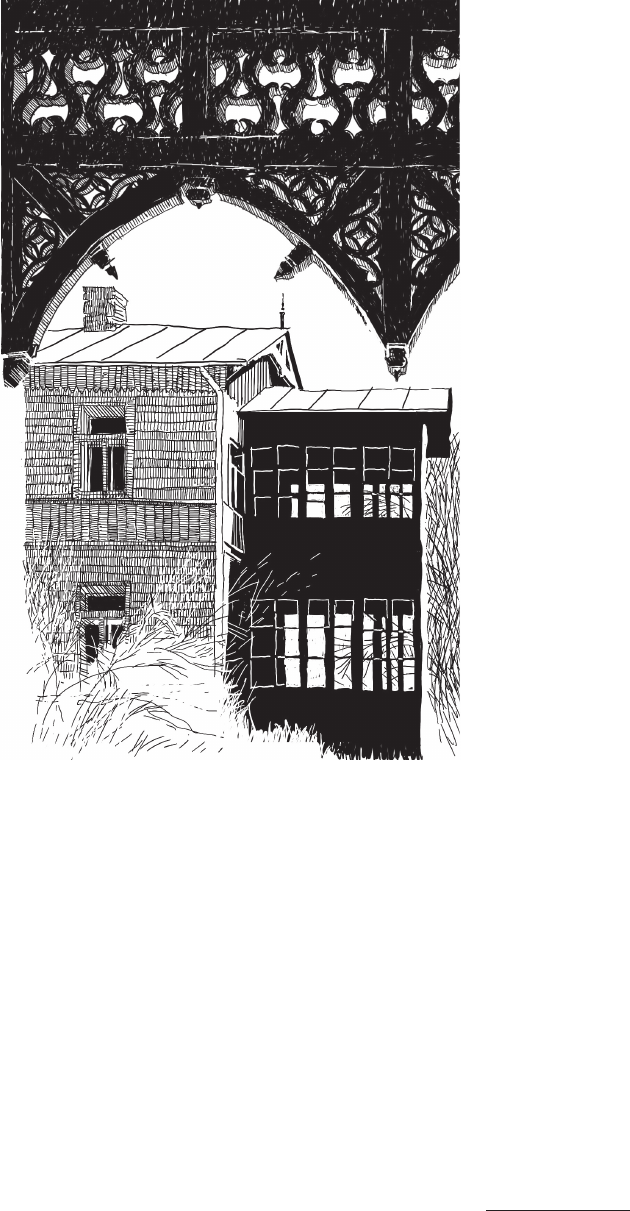
of Monestiroli, cut-outs on verandas are decorations, and
not only mere ornaments (Fig. 4).
Modernization of the Abram Gurewicz
Health Resort – the situation now
Abram Gurewicz Health Resort in Otwock, designed
by architects unknown to this day, is the largest preserved
building representative of the so called “Świdermajer”
architecture. The analysis of the issues described above
shows that it is a non-typical example of the Nad świ-
drzań ska architecture, occurring on a large scale, with
4
Krajewski draws attention to the misuse of the concept of “wood-
carving” (consisting of carving) in relation to ornamentation found in the
Nadświdrzańska architecture, which is based on cutting with a hair saw
(laubzega) [1, pp. 137, 138].
5
The decorum principle was based on the compliance (unity) of
the form with the content.
6
Hakan Sağlam in his paper Re-thinking the Concept of “Orna-
ment” in Architectural Design presents the attitudes of leading architects
towards ornament from antiquity to the present day [17, pp. 126–133].
86 Krzysztof Mycielski, Tomasz Trzupek
an additive, specically shaped body. Its other features,
such as colors, materials and façade composition, are cha-
racteristic of the Nadświdrzańska architecture as a group.
In 2015, when the preliminary works related to the
modernization of the facility and its adaptation to a mo-
dern medical clinic were commenced, designers from the
Warsaw-based Grupa 5 Architekci studio faced two ma-
jor challenges. These translated into specic design deci-
sions, supervised by the Masovian Conservator of Monu-
ments, requiring a precise denition of priorities essential
for maintaining the architectural character of the building.
The rst issue concerned the existing building sub-
stance. During its several decades of history, the build ing
changed its users and was rebuilt several times, in cluding
Fig. 4. Abram Gurewicz Health Resort – the verandas
– one of the main features of the so called “Świdermajer” architecture,
which were to separate and link the interior
with the exterior in the same time.
In the understanding of A. Monestiroli,
the cut-out wooden planks were decorations
and not only mere ornaments (drawing T. Trzupek)
Il. 4. Uzdrowisko Abrama Gurewicza – werandy,
jedna z głównych cech tzw. architektury świdermajer,
jednocześnie miały oddzielać i łączyć wnętrze z zewnętrzem.
W rozumieniu A. Monestiroliego wycinane deski
były dekoracją, a nie tylko ornamentem
(rys. T. Trzupek)
even enlarging it during the Nazi occupation with addition-
al brick segments referring to the style of reduction classi-
cism, which was the ocial style of the Third Reich. Af-
ter the pre-war period of splendor, when the building was
a guesthouse with an exotic garden advertised as “A. Gu -
rewicz’s Health Resort”, the building served as a military
aviation hospital, and from 1960 to 1991 it served as a me-
dical high school for nurses [11, p. 5].
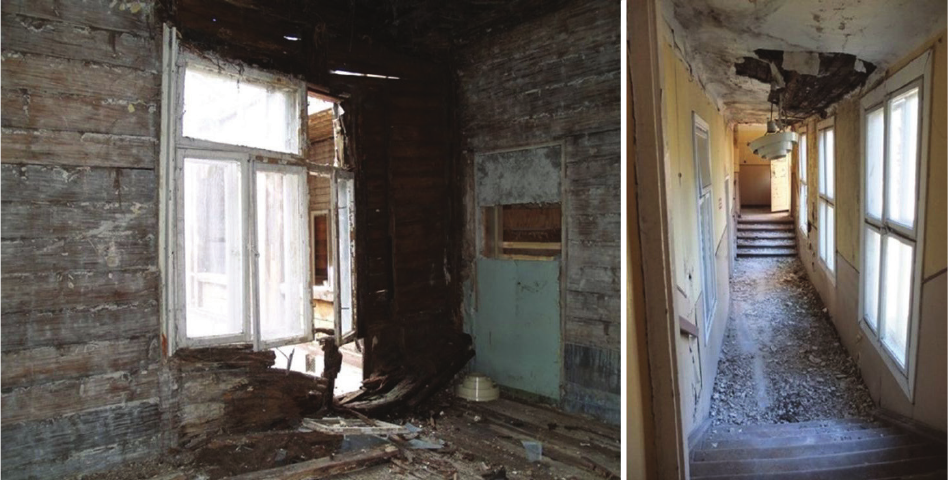
The monument, left unattended in recent years before
modernization by the Polish Alzheimer Foundation, which
was its another owner, was in agonizing technical con-
dition in 2015. The construction expertise of the existing
object showed a diversied internal structure of the build-
ing deviating from its original purely wooden structure.
In the four wings of the building, including the former
villa “Gurewiczanka”, in the 1980s, in place of the former
internal wooden structure, brick walls and Klein ceilings
were made, and a reinforced concrete staircase was also
implemented in one of these wings. However, when the
building was rebuilt from the inside, the wooden structure
of the external walls was preserved along with the form-
work attached to it and ornamented with it. The internal
wooden structure was preserved in its entirety in only two
wings of the building, which, according to the authors of
the expert opinion, were not suitable for repair due to their
disastrous condition and should be dismantled and then
recreated in the present form
7
.
Both the construction expertise, the architectural in-
ventory and the analysis of archival photos showed that
the surviving, though heavily degraded external ornament
required numerous replacements and additions. The only
larger elements of the building that have survived to this
day in a relatively intact condition were richly decorat-
ed wooden verandas – ventilated and thus not exposed to
progressive biological corrosion.
At the beginning of the design work, a fundamental
question arose related to the need to dene the adopted
conservation formula, namely, which historical elements
can be preserved and which should be recreated, bearing
in mind the most important values of the existing architec-
ture [18, pp. 102–108] (Fig. 5).
The identity of the function
The rst issue concerned the function of the modernized
building, which was to consist of a medical center with
a hotel part and a small orthopedic hospital with operat-
ing rooms with an ICU, rehabilitation rooms and heavy
diagnostics. The related question could not be reduced to
7
The geometry of the existing building as deformed due to the sub-
sidence of shallow foundation footings. The foundation walls, which do not
have any insulation and are signicantly damp, cannot be used as founda-
tions for the modernized facility. The static and strength analysis included
in the expert opinion showed that the preserved roof truss did not meet the
load requirements already at the time of the building’s construction. The
on-site inspection revealed leaking roong in many places, causing ood-
ing of the building. The wooden walls were assessed in the expert opinion
as damp, corroded as a result of fungus and insect activity and deformed.
Biological corrosion, which is still active, caused advanced degradation of
the wooden ceilings and their fragmentary collapse in many places.
Design priorities on the example of the modernization of Abram Gurewicz Health Resort in Otwock 87
a purely functional problem, separate from conservation is-
sues. It concerned the real possibilities of designing a par-
tially wooden and strictly limited size historic building,
a hospital function with advanced medical technology and
extensive installations. Therefore, the conservation issues
overlapped with the contemporary rigors related to the de-
sign of health care facilities, concerning, inter alia, the need
to strengthen the structure, the requirements of the Depart-
ment of Health and Safety and re regulations [18, pp.
102–108]. Both the authors of the modernization project
from Grupa 5 Architekci studio, and the authors of the con-
servation work program involved in the project, as well as
the representatives of the Provincial Conservator of Mon-
uments decided that maintaining the building’s medical
function, referring to its original purpose, is an important
value related to the identity of the place. Among the inhab-
itants of Otwock, this investment began to be perceived as
an important stage in regaining the status of a health resort
supporting the development of tourism [19, pp. 95–110].
The distribution of functions in the designed mo der-
nization partially corresponded to the historical layout.
The hotel rooms and the restaurant are situated in their
original location. In this part of the building, a few original
interior design elements have been preserved, such as the
cast iron railing of the staircase, tiled stoves and internal
wooden carpentry, which have been renovated and partial-
ly relocated. The interior design of this part of the building
made as part of the modernization (by Grupa 5 Ar chitekci,
Renata Pieńkowska and Urszula Brzozowska-Majdecka),
along with selected contemporary furniture, can be per-
ceived as today’s interpretation of the pre-war decor cap-
tured in the photos in the archival advertising materials of
the Abram Gurewicz Health Resort.
The planning of the medical functions required respect
for the characteristic additivity of the object and the inti-
mate scale of its individual wings. For this reason, some
of the designed functions, which did not t into the given
cubic capacity, were located in the basement (including
diagnostics rooms), as the temporary disassembly of the
building during its implementation allowed for its base-
ment. The equipment related to emergency supply of
electricity and heat to hospital, also outside the outline of
the monumental building, was located in a new technical
pavilion erected on the site of the former free-standing
boiler room. At the back of the modernized guesthouse,
the designers from Group 5 Architects designed a mod-
ern building of a swimming pool and spa, unnished so
far, in the scale of the wings of the historic building and
constituting a contemporary interpretation of local histor-
ical architecture with a veranda with an exposed wood-
en structure but devoid of ornaments and maintained in
a minimalist style.
The valorization method and its priorities were dened
in the program of conservation works prepared by Fest-
grupa. The desire to maintain the authenticity of the func-
tion (“subject to changes of the structure of demands” [11,
p. 16]) was conrmed, the need to maintain the authen-
ticity of the form while retaining the traces of subsequent
changes in the building and preserving the authenticity
of the structure and material of coniferous wood within
the external walls was emphasized. The study clearly em-
phasizes that […] one of the key elements for the artistic
value is the location of the former guesthouse building in
a forest garden and the organic connection with the sur-
roundings by means of open arbours, glazing and terraces
[11, p. 17].
Fig. 5. Biologically corroded wooden walls and ceilings of the Abram Gurewicz Health Resort – condition in 2015
(source: archive of the Grupa 5 Architekci)
Il. 5. Biologicznie skorodowane drewniane ściany i stropy Uzdrowiska Abrama Gurewicza – stan w 2015 r.
(źródło: archiwum Grupy 5 Architekci)
88 Krzysztof Mycielski, Tomasz Trzupek
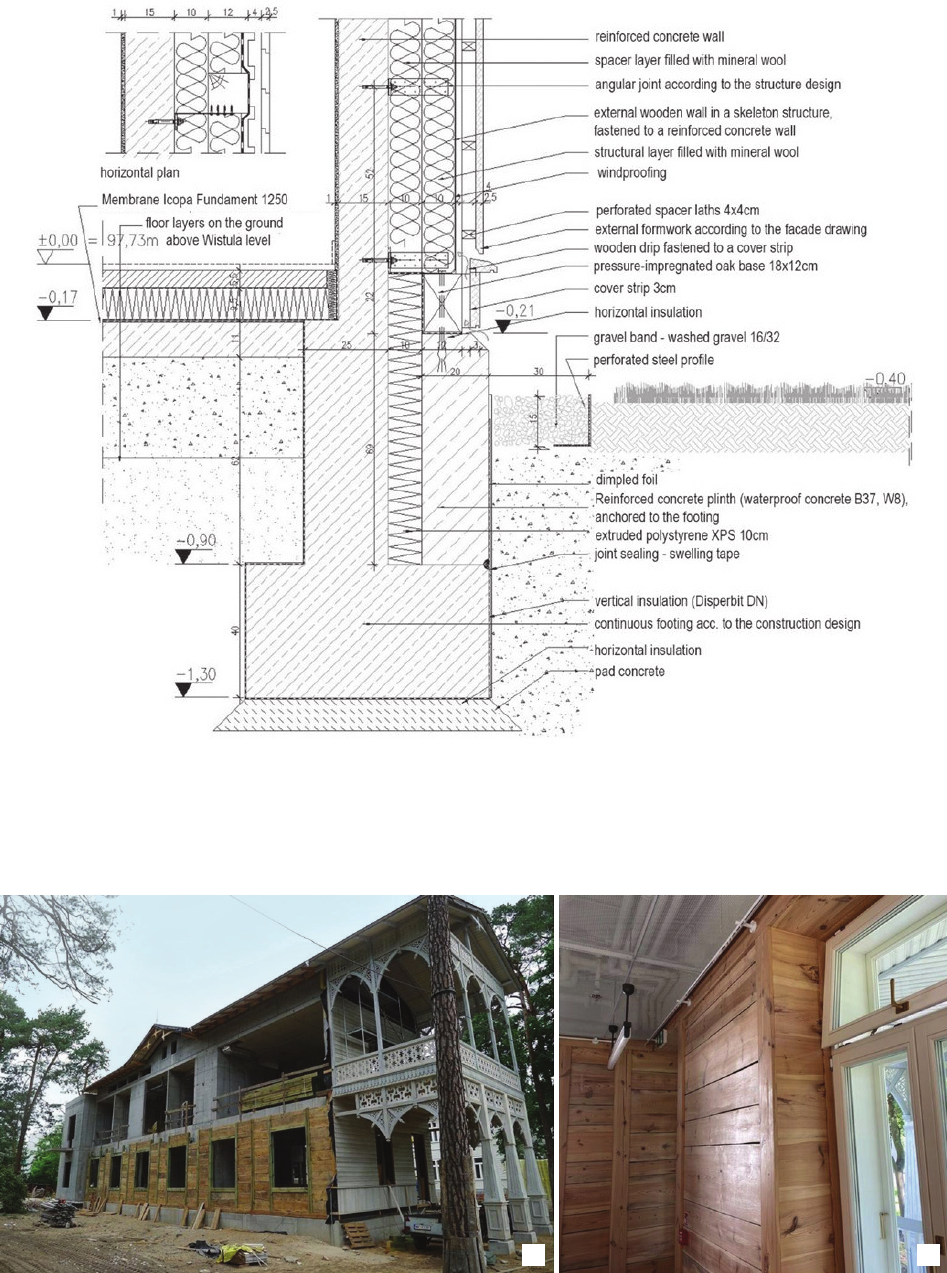
Fig. 6. Cross-section through the footing and the outer wall of the modernized Abram Gurewicz Health Resort, consisting of a thin inner reinforced
concrete partition and a self-supporting wooden outer structure with formwork mounted on it (source: archive of Grupa 5 Architekci)
Il. 6. Przekrój przez podstawę i ścianę zewnętrzną zmodernizowanego Uzdrowiska Abrama Gurewicza, składającego się z cienkiej wewnętrznej
przegrody żelbetowej i samonośnej drewnianej konstrukcji zewnętrznej z zamontowanym szalunkiem (źródło: archiwum Grupy 5 Architekci)
Fig. 7. Abram Gurewicz Health Resort:
a) the preserved wooden elements of the post-and-plunk structure are being reassembled on the southern façade of the southern wing,
b) display of the post-and-plank (characteristic for Mazovia) structure in the interior of a public café (source: archive of Grupa 5 Architekci)
Il. 7. Uzdrowisko Abrama Gurewicza:
a) montaż zachowanych drewnianych elementów konstrukcji słupowo-ryglowej na elewacji południowej południowego skrzydła,
b) ekspozycja konstrukcji słupowo-ryglowej (charakterystycznej dla regionu Mazowsza) we wnętrzach kawiarni publicznej
(źródło: archiwum Grupy 5 Architekci)
a b
Design priorities on the example of the modernization of Abram Gurewicz Health Resort in Otwock 89
The identity of the form
The degree of degradation of the building, including
its secondary brick part (and, as it turned out after the un-
covering works on the construction site – made contra-
ry to the art of construction), inuenced the decision to
completely demolish and dismantle the building, to select
carefully biologically non-corroded wooden elements in
consultation with wood experts from the Warsaw Uni-
versity of Life Sciences and about to recreate faithfully
its form and decoration. It was found that the seriously
damaged internal structure of the building (and largely
not preserved as wooden to this day, or documented by an
inventory) has a largely utilitarian value, not translating
into the most important values related to the identity of the
Nadświdrzańska architecture. Inside the building, it was
replaced with another utilitarian structure – reinforced
concrete, adapted to the demanding modern standards of
healthcare facilities
8
.
In the spatial sense, the adopted principle can be
compared to the modernist concept of “box in the box”
– the new monolithic reinforced concrete structure was
8
According to Program prac konserwatorskich dot. budynku daw-
nego uzdrowiska Abrama Gurewicza w Otwocku [The program of con-
servation works on the building of the former Abram Gurewicz Health
Resort in Otwock] prepared by the Festgrupa company, The aim of the
project is to adapt the building of the former Gurewicz guesthouse to
new functions, while maintaining the highest possible authenticity of the
substance in the face of its serious degradation (vide: mycological and
construction expertise). The new structure of the partitions will be a rein-
forced concrete monolith inserted into the interior, while maintaining the
structural system of the external perimeter walls of the building [11, p. 3].
covered with the fully preserved but largely reconstruct-
ed traditional wooden structure, both skeletal and post-
and-plank, typical of the historical buildings of Mazovia.
Only in this way was the historical structure of the exter-
nal walls covered with a shuttering and wooden ornament
(Figs. 6, 7).
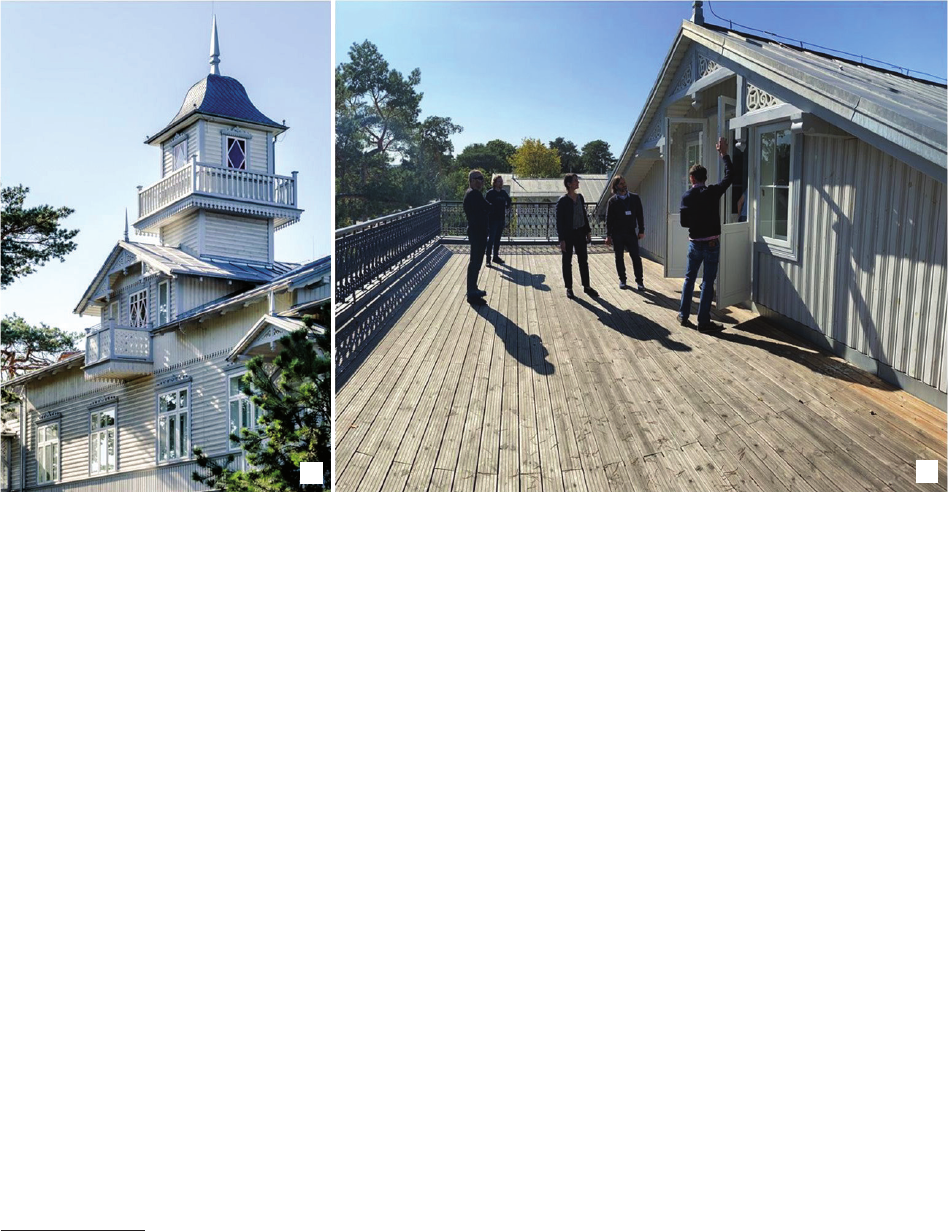
On the initiative of the architects and the investor, and
at the same time the owner of the building (Carolina Car
Company) and with the approval of the Masovian Mon-
ument Conservator, in the northern wing of the building,
elements of architecture important for the character of the
place, the existence of which in the pre-war period were
conrmed by archival photographs – a wooden tower and
a terrace for sunbathing, were recreated (Fig. 8).
The identity of the material
The structure of the external walls was best recreated
from the elements preserved on the southern façade of the
wing of the building housing hotel rooms. The sunlit wall
did not suer from fungal growth. In addition, in the same
south wing, in the interior of a public cafe (the entrance
of which is located in the arcade of a representative open-
work veranda), selected elements of the post-and-plank
structure were displayed.
In the existing building, ve types of preserved exter-
nal shuttering were discovered, which, in consultation
with the conservation services, were limited to three – au-
thentically historical – on the reconstructed façades. How-
ever, during the construction works it was decided that the
formwork should be reconstructed in its entirety, and not
the preserved one supplemented, as the old elements with
the new ones could not undergo similar deformations.
Fig. 8. Elements of the Abram Gurewicz Health Resort recreated on the basis of archival photos:
a turret (a) and a sun terrace (b) in the northern wing of the building (photo by A. Grzesik, K. Mycielski, archive Grupa 5 Architekci)
Il. 8. Elementy Uzdrowiska Abrama Gurewicza odtworzone na podstawie archiwalnych zdjęć:
wieżyczka (a) i taras słoneczny (b) w skrzydle północnym budynku (fot. A. Grzesik, K. Mycielski, archiwum Grupa 5 Architekci)
a
b
90 Krzysztof Mycielski, Tomasz Trzupek
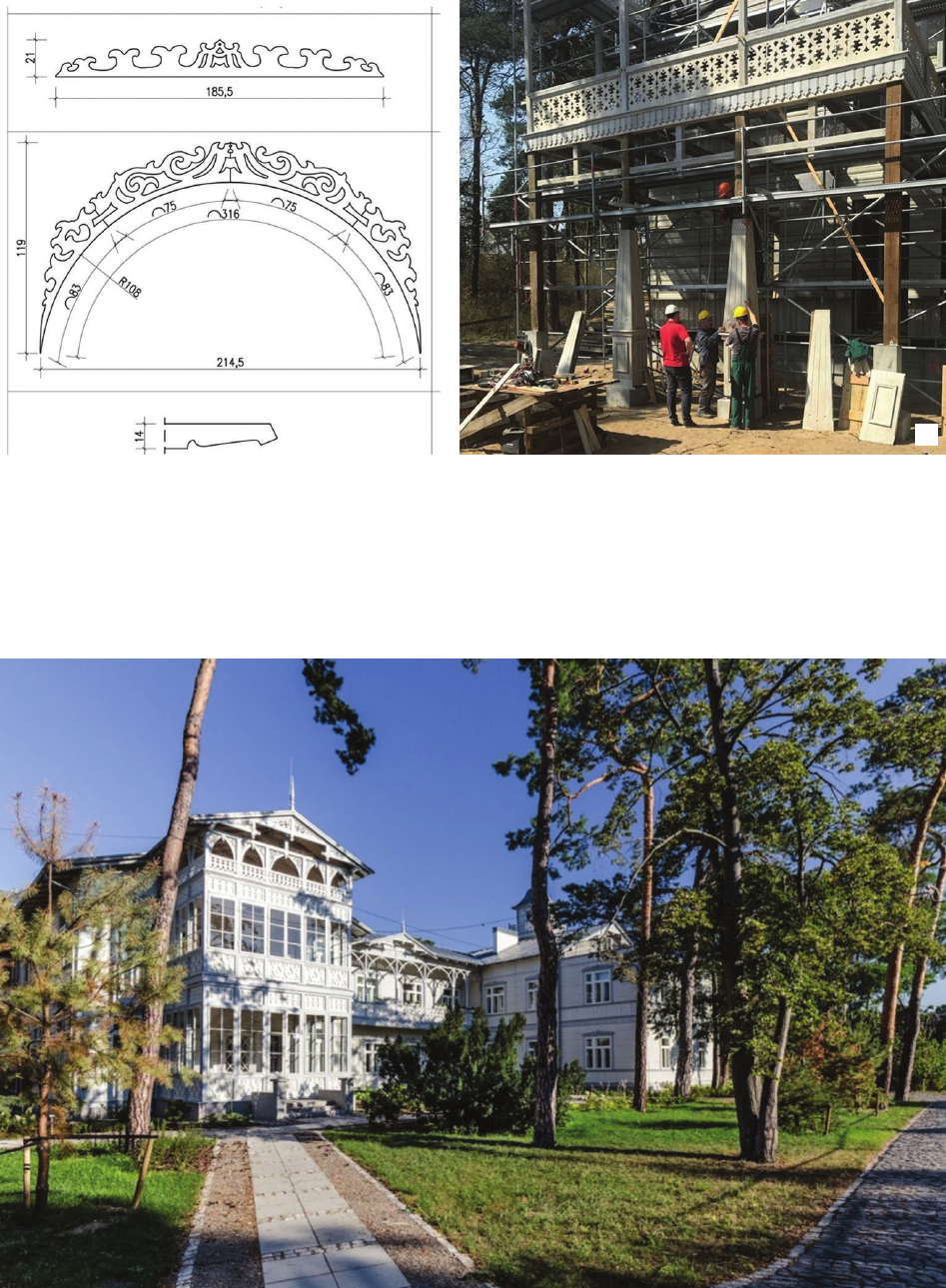
Fig. 10. The wooden veranda of the Abram Gurewicz Health Resort
adjacent to the central wing of the eastern façade of the building after its renovation and reassembly
(photo by A. Grzesik, the archive of Grupa 5 Architekci)
Il. 10. Drewniana weranda Uzdrowiska Abrama Gurewicza
przylegająca do środkowego skrzydła elewacji wschodniej budynku po jego remoncie i ponownym montażu
(fot. A. Grzesik, archiwum Grupy 5 Architekci)
Fig. 9. The inventory drawings of the preserved woodcarving details of the Abram Gurewicz Health Resort made in 2015 (a)
and reassembly of the openwork southern veranda (b)
(source: archive of Grupa 5 Architekci)
Il. 9 Rysunki inwentaryzacyjne zachowanych detali snycerskich Uzdrowiska Abrama Gurewicza wykonane w 2015 r. (a)
i ponowny montaż ażurowej werandy południowej (b)
(źródło: archiwum Grupy 5 Architekci)
a
b
Design priorities on the example of the modernization of Abram Gurewicz Health Resort in Otwock 91
This would cause the wooden structure of the façade to
degrade quickly again.
The precisely inventoried decorative openwork elements
were recreated on the construction site by highlander crafts-
men. The exception were two representative wooden ve-
randas, which, after the disassembly, careful cleaning and
impregnation, were retained in the original with the ttings,
which, due to the fundamental role played by these ele-
ments in the context of the identity of the Nadświdrzań ska
architecture, was a key achievement of the entire modern-
ization (Fig. 9).
Summary and conclusions
Modernization of the Abram Gurewicz Health Resort
in Otwock and adapting it to a modern medical function,
both due to the modern requirements put forward to such
facilities and the disastrous technical condition of the
monument and its previous numerous reconstructions,
required many consciously made compromise design de-
cisions. The authenticity that is still visible in the modern-
ized building was determined by the clear conservation
formula consisting in the careful reconstruction of the
wooden self-supporting structure of the external walls,
the ornament covering it, and above all in the renovation
and preservation of the original wooden verandas of the
building. The ornaments appearing on them are more than
just ornaments – they constitute a kind of decoration in the
understanding of Antonio Monestiroli, and thus are one
of the main identity factors of the Nadświdrzańska archi-
tecture (Fig. 10). Eorts have been made to maintain the
continuity of the medical function, consistency of form
(both historical and new extensions) and maintain the ma-
terial identity of the object by preserving and conserving
the historical tissue using the latest conservation methods.
One should point out the formal uniqueness of Abram
Gurewicz Health Resort compared to other buildings of
the Nadświdrzańska architecture, but also the representa-
tiveness of the features present. Interdisciplinary collabo-
ration with specialists in various elds, including monu-
ment conservators, and the use of scientic research to set
design priorities early in the design process, provide the
possibility to create a bridge between practice and theory.
Translated by
Jadwiga Andrejczuk-Panasiuk
References
[1] Krajewski A., Niektóre problemy ochrony obiektów architektury
w tzw. stylu nadświdrzańskim, “Budownictwo i Architektura” 2015,
nr 14(3), 127–142.
[2] Lewandowski R., Linia Otwocka jako pasmo historyczno-urbani-
styczne?, “Rocznik Józefowski” 2016, t. 2, 35–47.
[3] Miłobędzki A., Zarys dziejów architektury w Polsce, Wiedza Po-
wszechna, Warszawa 1988.
[4] Tarnowski J., Styl alpejski w środkowej Europie i polska kontrakcja
wobec niego – styl zakopiański, “Estetyka i Krytyka” 2012, nr 25(2),
232–246.
[5] Szewczyk J., Regionalizm w teorii i praktyce architektonicznej,
“Teka Komisji Architektury, Urbanistyki i Studiów Krajobrazo-
wych” 2006, t. 2, 97–108.
[6] Olkuśnik M., Podróż, turystyka i wypoczynek pozamiejski w świado-
mości społeczeństwa Warszawy na przełomie XIX i XX wieku, UW,
Warszawa 2013.
[7] Cichy A., Znaczenie ozdobnego deskowania w periodyzacji drew-
nianej architektury w paśmie otwockim. Problematyka badawcza
i konserwatorska, “Ochrona Zabytków” 2007, nr 3, 35–57.
[8] Szałygin J., Styl otwocki, “Ochrona Zabytków” 1998, nr 51/4(203),
361–369.
[9] Górski M., Dawne uzdrowisko Abrama Gurewicza w Otwocku
– ocena oddziaływania zmian projektowych na dziedzictwo archi-
tek toniczne, [in:] C. Głuszek, M. Lewicka (red.), Dziedzictwo. Ar-
chi tektura historyczna współcześnie, Ocyna Wydawnicza PW,
Warszawa 2018, 72–75.
[10] Górski M., Lach W., Jak wyremontować ŚWIDERMAJERA, Powiat
Otwocki, Warszawa–Otwock 2016.
[11]
Górski M., Kubisa B., Lach W., Kowalik T., Program prac kon ser wa-
tor skich dot. budynku dawnego uzdrowiska Abrama Gurewicza w Ot-
woc ku, Warszawa 2016 [manuscript in archive of Grupa 5 Architekci].
[12] Pustoła-Kozłowska E., Z przeszłości Otwocka – „wzorowej miej-
scowości letniczej”, “Mazowsze” 1994, nr 2(3), 3–11.
[13] Trzcińska I., Społeczne oddziaływanie lokalnego dziedzictwa kultu-
rowego na przykładzie otwockiej architektury drewnianej Świder-
majer, Towarzystwo Przyjaciół Otwocka, Otwock 2015.
[14] Szurek A., Obraz podwarszawskich letnisk w prasie dwudziestole-
cia międzywojennego, “Kultura Popularna” 2016, nr 1(47), 74–87,
doi: 10.5604/16448340.1219683.
[15] Wośko-Czerniakowska A., Genius loci i rysunek, [in:] M. Orze-
chowski (red.), Rysunek – zmysł architektury, Blue Bird, Warszawa
2014, 108–113.
[16] Monestiroli A., Tryglif i metopa. Dziewięć wykładów o architektu-
rze, Wydawnictwo PK, Kraków 2008.
[17] Sağlam H., Re-thinking the Concept of “Ornament” in Architec-
tural Design, “Procedia – Social and Behavioral Sciences” 2014,
Vol. 22, 126–133.
[18] Mycielski K., Zelent R., Sanatorium Gurewicza, “Architektura
Mu rator” 2020, nr 3(306), 102–108.
[19] Petryk D., Health resorts past and the unique architecture of Otwock,
near Warsaw, as its potential growth factors. Gurewicz example,
“Przestrzeń i Forma” 2018, nr 34, 95–110.
Abstract
Design priorities on the example of the modernization of Abram Gurewicz Health Resort in Otwock
The purpose of the paper is to present Abram Gurewicz Health Resort in Otwock as a non-typical but also unique example of the Nadświdrzańska
architecture. The next aim is to reevaluate the concept of decoration as the constitutive factor of the Nadświdrzańska architecture, using Mone-
stiroli’s theories regarding ornament and decoration. A comparative analysis of the Gurewicz building against the background of other buildings of
92 Krzysztof Mycielski, Tomasz Trzupek
the
Nad świdrzańska architecture shows that the discussed building is a specic version of a characteristic composition of forms. Another goal is to
show the processes behind the reconstruction of the Health Resort in the context of the situation of that object in 2015 in order to nally carry out
design priorities behind the modernization based on the preservation of three identities: function, form and material.
Key words: Świdermajer, Nadświdrzańska architecture, wooden architecture, modernization
Streszczenie
Priorytety projektowe na przykładzie modernizacji Uzdrowiska Abrama Gurewicza w Otwocku
Celem autorów artykułu jest przedstawienie Uzdrowiska Abrama Gurewicza w Otwocku jako nietypowego i unikatowego przykładu architektury
nadświdrzańskiej. Kolejnym celem jest przewartościowanie koncepcji dekoracji jako konstytutywnego czynnika architektury nadświdrzańskiej przy
wykorzystaniu teorii Monestirolego dotyczących ornamentu i dekoracji. Analiza budynku Gurewicza na tle innych budowli architektury nadświ-
drzańskiej pokazuje, że omawiany zabytek jest specyczną wersją charakterystycznej kompozycji form. Autorzy artykułu ukazali także procesy prze-
budowy uzdrowiska w kontekście sytuacji tego obiektu w 2015 r. Przedstawione zostały priorytety projektowe modernizacji opartej na zachowaniu
trzech tożsamości: funkcji, formy i materiału.
Słowa kluczowe: świdermajer, architektura nadświdrzańska, architektura drewniana, modernizacja