
2023
2(74)
Dominik Przygodzki*, Magda Szarkowska**
Restoration of medieval gords on the example
of the “in the meadows” Gord in Wiślica: a case study
Introduction
In Poland, there are many instances of traces of set-
tlement left by dierent cultures. These include, among
others, relics from the prehistoric period, i.e. settlements
of the Lusatian culture, early medieval remains of Slav-
ic settlements or structures from the time of the estab-
lishment and existence of the Polish state. Gords, which
are part of the history of settlement, due to their struc-
ture, are distinctive and mostly easily identiable in the
landscape, while also excellently blending in with their
surroundings. Due to scant information about them and
little public knowledge concerning them, they are often
confused with natural geological formations. In Poland
we have more than 2.500 examples of recorded gords,
most of which are under statutory conservation, e.g., in
the form of archaeological preserves [1]. The inadequate
marking of these sites in space, combined with a lack of
widespread information, results in little public interest
and, consequently, in monuments becoming forgotten and
falling into disrepair. This contributes to a lack of atten-
tion to history and the upholding of values associated with
cultural heritage.
In recent years, there has been a marked increase in in-
terest in revitalising and revalorising the remains of medie-
val structures, including gords, together with their immedi-
ate surroundings. The overarching aim of these measures is
to protect monuments and provide public, attractive access
to the cultural heritage, as well as to develop social and
regional awareness and identity. The skilful maintenance
of monuments allows the site to be made accessible to the
public, while emphasising its educational value, in a way
that protects its historical value and prevents damage. As
a result, society is becoming more aware, but also more
discerning in its search for specialist knowledge.
Despite the increasing number of examples of the re-
vitalisation of gords, preparing design documentation and
carrying out projects still face numerous diculties and
requirements. Funding such projects is often marginalised
by local governments, which allocate funds in their bud-
gets to other, more pressing needs. The areas on which the
gords are located are often privately owned and, conse-
quently, there are instances of damage through agricultural
cultivation. Informed local authorities are making eorts to
reclaim these areas and implement procedures to start their
restoration as soon as possible. Structures such as gords,
which are nationally and continentally unique monuments,
when restored, contribute signicantly to social and eco-
nomic activity, including increasing tourist trac in a giv-
en region. One example of such a process is the Karpacka
Troja archaeological open-air museum in Trzcinica, whose
main element are the remains of a gord. Łukasz Śpiewla
stated that the local population is fully aware of the open-
air museum, as are tourists who come here in large num-
bers from various parts of the country and abroad, whose
number reached around 60 thousand in 2011 [2]. Gords
and their surroundings are beginning to transform from
land forms that are often decayed and generate material
loss, into spaces that bring prot and that sport well-exhib-
ited rampart forms enhanced with information about their
history. Such measures make these facilities more nan-
cially independent of state administrative resources. There
is no clear-cut concept for the revitalisation of medieval
gord remains. Each site, by virtue of its location, state of
preservation, legal status, the state of knowledge about it,
the way it is developed, must be considered individually.
DOI: 10.37190/arc230204
Published in open access. CC BY NC ND license
* ORCID: 0000-0002-0943-4556. Faculty of Architecture, Cra-
cow University of Technology, Poland, e-mail: dominik.przygodzki@
pk.edu.pl
** ORCID: 0000-0003-4225-5338. Doctoral School, Cracow Uni-
versity of Technology, Poland.

42 Dominik Przygodzki, Magda Szarkowska
Nevertheless, there are general principles that should be
followed. The authors of this paper discuss the develop-
ment of the gord “in the meadows” in Wiślica, as related
to the accessibility of the site to visitors in the context of
the constraints arising from the impossibility of interfering
with the historical fabric.
In situ exposition of gords,
on the example of the gord in Wiślica
The debate on the appropriateness of reconstructing
gords is still ongoing. There are both supporters and oppo-
nents of this form of spatial visualisation among specialists
in the eld. The International Charter for the Protection
and Management of the Archaeological Heritage, the so-
called Lausanne Charter of 1989, states that The presen-
tation of the archaeological heritage to the general pub-
lic is an essential method of promoting an understanding
of the origins and development of modern societies. […]
Where possible and appropriate, reconstructions should
not be built immediately on the archaeological remains,
and should be identiable as such [3, p. 12]. According to
Michał Pawleta, two basic forms of reconstruction should
be distinguished – preserves and archaeological parks. An
archaeological preserve is a faithful reconstruction devel-
oped on the site of an excavation, while an archaeological
park is a reconstruction of structures or a demonstration
of ancient building techniques developed on any site.
The preserve is of academic and natural value, yet its pri-
mary role is to protect and publicly share archaeological
heritage. Meanwhile, the main purpose of archaeologi-
cal parks is entertainment, recreation and education [4].
There are known examples of gords whose condition and
extent of surviving relics have allowed the development
of a reliable reconstruction. In Poland, one such site is
the Archaeological Museum in Biskupin, which presents
a reconstruction of a defensive settlement from the turn of
the Bronze and Iron Ages. Another interesting example is
the reconstruction of a settlement located on an island in
Lake Āraiši, in what is now Latvia, some 80 km north-east
of Riga. Due to numerous archaeological discoveries and
extensive research by Jānis Apals in the 1960s and 1970s,
the remains of ancient houses, many artefacts and pieces
of pottery were found. This provided in-depth insight into
how the gord was built and how it functioned. This made
it possible to arrive at a credible reconstruction of a set-
tlement that functioned in the 9
th
century. The buildings
were erected using carpentry techniques, with attention to
historical detail and the use of natural materials [5].
Wiślica is a unique medieval town
1
rich in numerous
historical buildings. It is located in south-eastern Po-
land, in the picturesque Nida Valley, in what is now the
Świętokrzyskie Voivodeship. Today Wiślica is one of the
smaller towns in Poland [6]
2
. A short distance from its
centre, on an outcrop of gypsum rock, there is an early
1
It was granted town rights in 1326.
2
In 2018, it was given title of the smallest city in Poland, with
a population of 503.
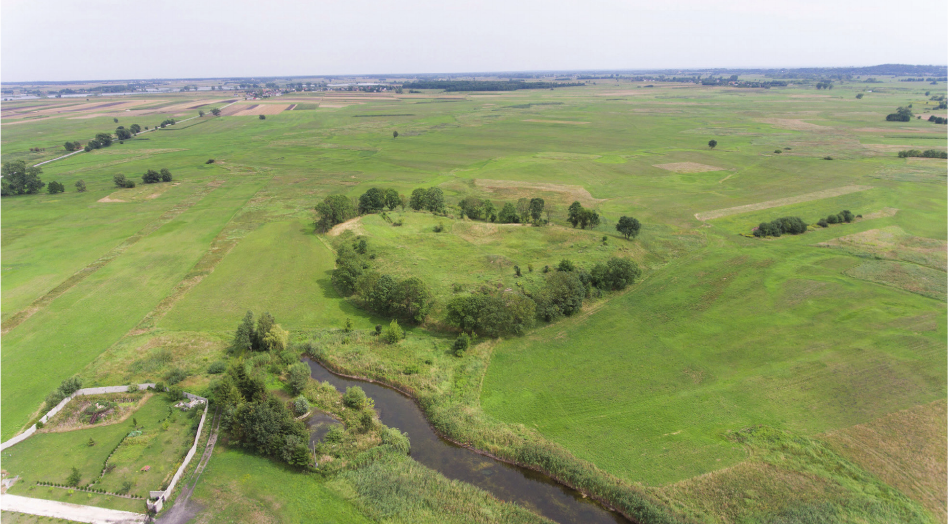
medieval gord known as “in the meadows” (Fig. 1). It
is covered by statutory conservation via a listing in the
register of monuments under No. Aa329/508. Archaeo-
logical investigations of the site have been carried out
on several occasions. In the years 1949–1960, archaeo-
logical investigation was carried out as part of a broad
research programme of the so-called millennium studies
led by Włodzimierz Antoniewicz and Zoa Wartołow ska
[7]. They were focused, among other things, on identi-
fying the techniques used to build the ramparts in the
north and west sections. The study of the gord was revis-
ited several more times by Dorota Górna, Joanna Kalaga
and Zbigniew Pianowski and in 1996–1998 by Waldemar
Gliński, whose aim was to identify the construction tech-
nique of the eastern line of fortications [8], [9]. At the
beginning of May 2021, archaeological work once again
began on the gord, led by Nina Glińska on behalf of the
Voivodeship Conservator of Monuments in Kielce. The
aim of the non-invasive geophysical survey was to dene
the boundaries of the entire complex and to understand
the construction of its ramparts. The form of the gord is
well preserved and legible in the terrain. Unfortunately,
its current state can be assessed as “neglected”. The site
is overgrown with trees, self-sown plants and weeds, and
there are mounds in the eastern part of the site which are
the remains of former archaeological investigations. The
municipality of Wiślica has made eorts to restructure the
gord together with the adjacent area
3
and to make the site
accessible to the public by carrying out its revalorisation.
Pursuant to the applicable Ustawa z dnia 23 lipca 2003 r.
o ochronie zabytków i opiece nad zabytkami [Monument
Protection and Preservation Act], […] the protection of
monuments consists, in particular, of ensuring legal, or-
ganisational and nancial conditions that enable the per-
manent preservation of monuments and their development
and maintenance, and the preservation of a monument
consists, in particular, in popularising and disseminat-
ing knowledge about the monument and its signicance
for history and culture [10, art. 4, 5]. It is clear from the
quoted sections of the Act that the owner of a monument
is obligated to make the site available to the public and at
the same time ensure its survival for future generations.
The protection of gords consists, among other things, of
preventing further damage to the site, […] because, re-
gardless of its state of preservation, the form that has sur-
vived to our times is part of the historical fabric and is
subject to conservation [11, p. 274]. The restoration of
gords is always a challenge for the designer. Adaptive re-
use, associated with opening the site to visitors, must be
performed without interfering with the historical tissue of
the relic. Another consideration is the presence of the ar-
chaeological site in the cultural landscape, of which gords
are a prime example. The relationship of architectural and
urban heritage to the landscape is emphasised by the so-
called Krakow Charter of 2000, whose authors stated that
Landscapes […] are testimony to the evolving relation-
3
Initially, the site extended beyond the boundary of the plot of land
on which the gord was located.
Restoration of medieval gords 43
ship of communities, individuals and their environment.
[…] It is important to understand and respect the charac-
ter of landscapes, and apply appropriate laws and norms
to harmonize relevant territorial functions with essential
values. In many societies, landscapes are historically re-
lated to urban territories and inuences [12, p. 137].
The landscape of Wiślica should be placed under spe-
cial protection not only because the town’s location on the
charming River Nida is exceptionally picturesque. Most
importantly, Wiślica is located in an area protected under
the Natura 2000 programme, and within the boundaries
of the Nadnidziański Landscape Park [13]. The area has
retained exceptional natural landscape features as it is
still not intensively populated or urbanised. The necessity
of introducing new elements to enable safe and eective
as well as interesting visits to the site is connected with
a construction project at the gord. A compromise has to
be found that reconciles the needs of the tourist with the
obligation to protect the historical site, while respecting
the needs and customs of the local community, and using
engineering solutions that make it possible to minimise
interference with the archaeological layers of the gord.
Revalorisation objectives and presumptions
The Municipality of Wiślica has developed Revitalisa-
tion Programme 2016–2025 for the Municipality of Wiś-
li ca, which aimed to address the low socio-economic
de ve lopment of the region. Measures were taken to cre-
ate a new tourist product – a historical and tourist trail
that would lead to the early medieval gord. The planned
project involved the refurbishment and restoration of the
gord [14]. The revitalisation project was expected to con-
tribute to the establishment of new businesses, new jobs,
and to increase the number of tourists visiting Wiślica. In
advance, in 2005, the municipality, in consultation with
the Voivodeship Oce for the Protection of Monuments
in Kielce, issued a public project siting decision [15]. In
2018, thanks to the eorts of the then mayor Stanisław
Krzak, Wiślica regained its urban status, and the President
of the Republic of Poland recognised the collegiate church
complex of the Nativity of the Blessed Virgin Mary, to-
gether with the relics of the church of St. Nicholas and the
Wiślica gord, as a Monument to History [16]. In the same
year, the municipality of Wiślica announced a competition
for an urban and architectural design proposal for the proj-
ect entitled Thousand-Year-Old Wiślica – in the footsteps
of splendour – establishment of the “Through the Prehis-
tory of Christian Wiślica” tourist route. The competition
was to select the best entry, which would become a basis
for the preparation of further technical documentation.
Following this, a conceptual design was drafted, which, as
per the competition’s scope, included the adaptation of the
site for tourist trac, the restoration of the original angle of
the ramparts and their elevation, the refurbishment of the
main square and the rampart, the clearing of unnecessary
greenery, the introduction of footpaths with educational
elements, reconstructing the gate, the former buildings of
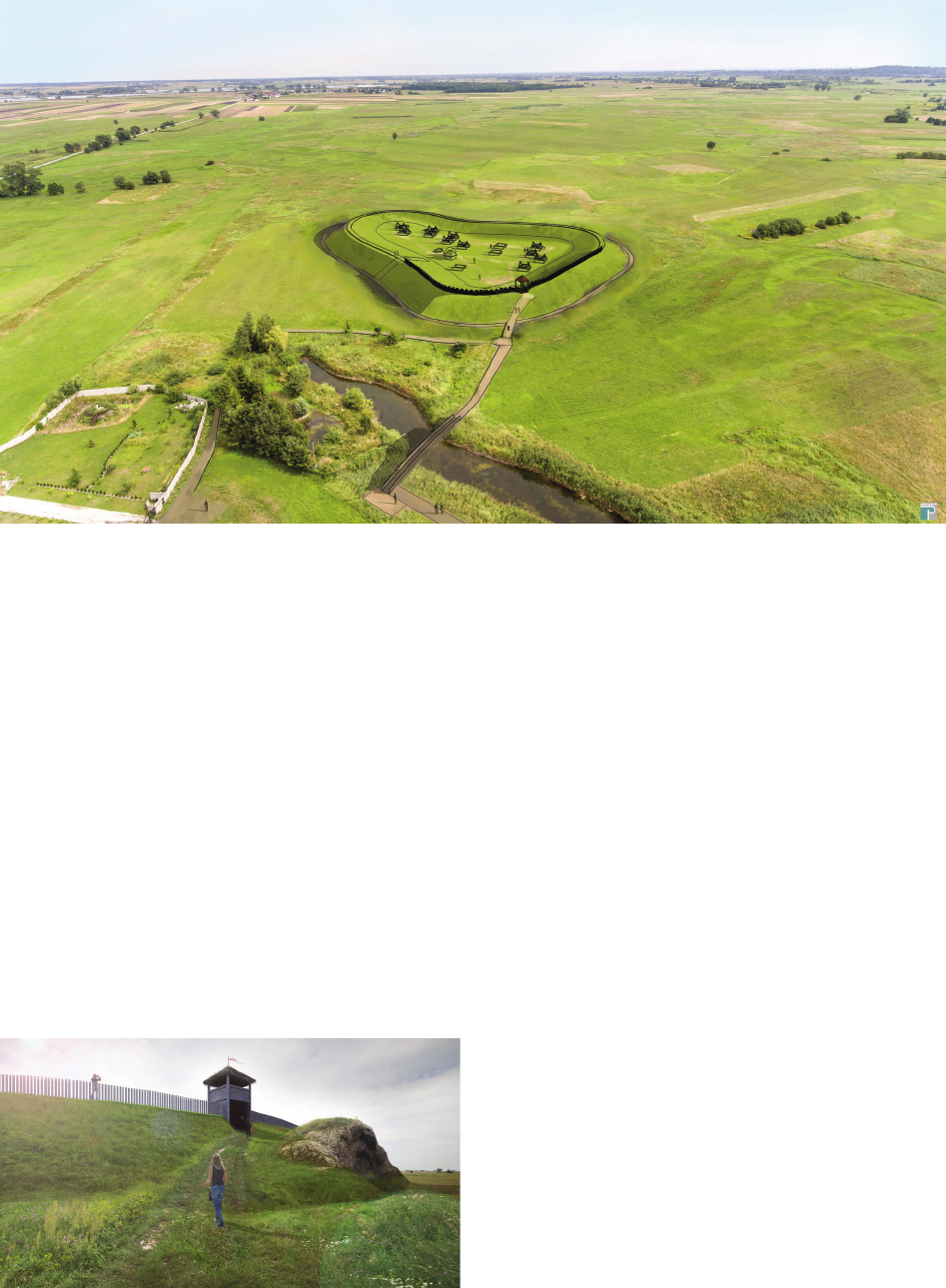
the gord and the partial restoration of the palisade (Figs. 2,
3) [17, p. 6]. As a result of
approvals of the planned proj-
ect with administrative bodies, the Voivodeship Oce for
the Protection of Monuments in Kielce and the National
Institute of Cultural Heritage (NID) issued their opinions
and recommendations. The documents are a response to
a design proposal developed by Arche-con, a Krakow-
based architectural studio. Both documents conrm that
Fig. 1. Gord “in the meadows” in Wiślica, aerial view (photo by D. Przygodzki, 2018)
Il. 1. Grodzisko „na łąkach” w Wiślicy, widok z lotu ptaka (fot. D. Przygodzki, 2018)
44 Dominik Przygodzki, Magda Szarkowska
damage the preserved historical substance of the site [18].
The guidelines […] indicate the principle of maximum re-
spect for the original substance of the monument and all
its values, the principle of minimum necessary interfer-
ence (refraining from unnecessary actions). These princi-
ples correspond with the 1989 International Charter for
the Protection and Management of the Archaeological
Heritage, which stipulates, among other things, that re-
constructed structures should not be implemented directly
as a part of authentic sites – archaeological monuments
[19, p. 2]. The authors of both opinions emphasise that
the Wiślica gord is one of the most important sites related
to the formation of Polish statehood and deserves world-
class presentation. Following discussions with representa-
tives of the Voivodeship Monument Protection Oce in
Kielce, Arche-con created a design which combines the
expectations of the municipality’s representatives with the
assumptions and requirements of the decision-making in-
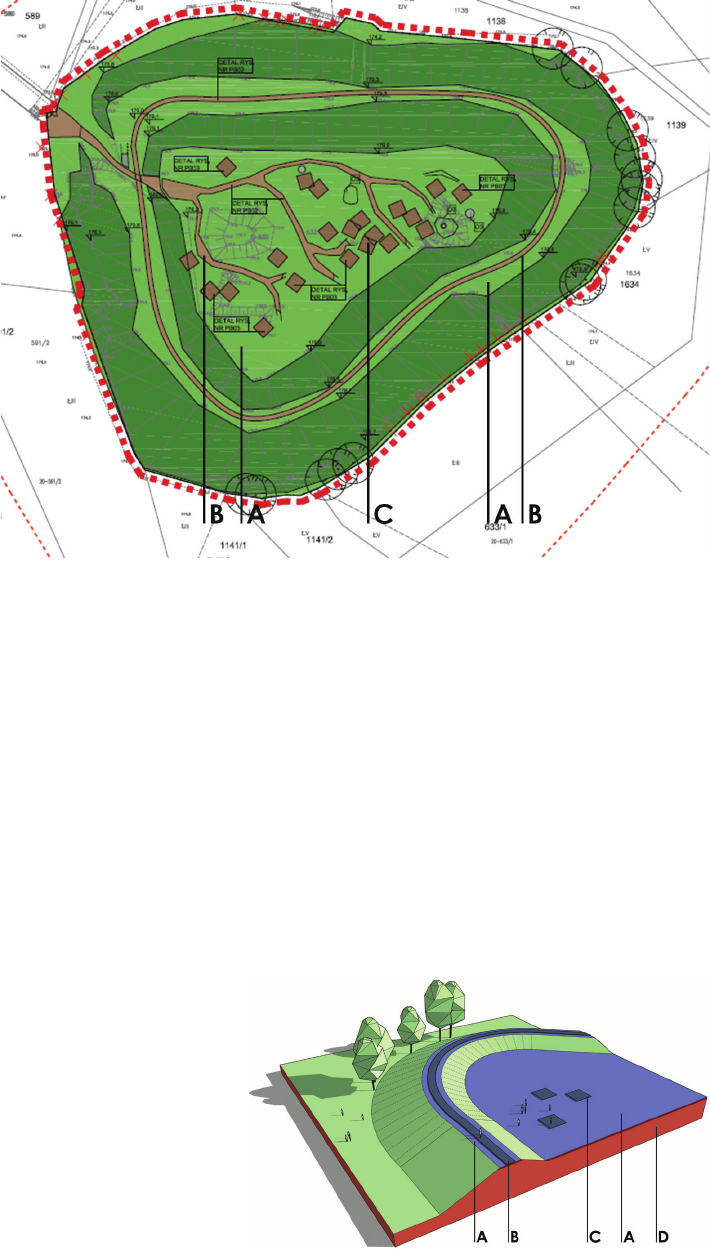
stitutions (Fig. 4).
Proposed technical solutions
The restoration of the gord was divided into two phases.
The rst stage involved the clearing of the rampart and
yard from excess greenery, primarily low, wild bushes,
which disrupted the perception of the outline of the ram-
part crest, as well as the incline and form of the rampart
itself. The trees at the foot of the rampart on its outer side
will be retained as their crowns are well above the rampart
crest and do not obstruct it. The former archaeological ex-
cavations left over from the period of archaeological ex-
ploration in the 1960s and 1970s will be backlled, while
the excavated soil will be spread over the surface of the
the initiative to create a historical and educational tourist
route that will highlight the monuments of Wiślica and con-
tribute to the attractiveness of the area is justied. Howev-
er, the most relevant guidelines concerned the gord. Both
institutions considered it benecial, indeed necessary, to
work on refurbishing the main yard and the rampart after
the previous archaeological investigations. On the other
hand, the proposal for the partial reconstruction of the for-
mer gord buildings was assessed negatively, and it was
argued that this would displace other monuments that are
more conducive to preserving the most highly valued his-
toric values, i.e., authenticity of substance and form. In its
opinion, the NID negatively assessed measures to correct
the rampart, which would change the form of the gord and
Fig. 2. Gord “in the meadows” in Wiślica, competition design (elaborated by Arche-con, 2018)
Il. 2. Grodzisko „na łąkach” w Wiślicy, projekt konkursowy (oprac. Arche-con, 2018)
Fig. 3. Conceptual design of the restoration of the gord
“in the meadows”. The restoration of a stylised gate and palisade
on the rampart crest (elaborated by Arche-con, 2019)
Il. 3. Projekt ideowy rewaloryzacji grodziska „na łąkach”.
Restytucja na koronie wału symbolicznie stylizowanej bramy
wraz z palisadą (oprac. Arche-con, 2019)
Restoration of medieval gords 45
yard. Remnants of former excavations are located on the
eastern part of the gord yard and on the eastern rampart.
The work will be carried out under close archaeological
supervision and using a metal detector to check for hidden
artefacts in the excavated soil. The aim of this measure is
to secure the cultural layers exposed in the archaeological
proles, to improve the appearance of the gord by making
its preserved form more legible, and to make the site safe
for use by partially levelling the surface of the yard and
the eastern rampart while maintaining its present form and
natural relief. The second phase of the project involves the
introduction of a small buer layer of a few centimetres
on the yard and on the crest of the rampart in the form of
new turf evenly distributed in a way that does not interfere
with the current form of the gord, i.e., its shape, angle of
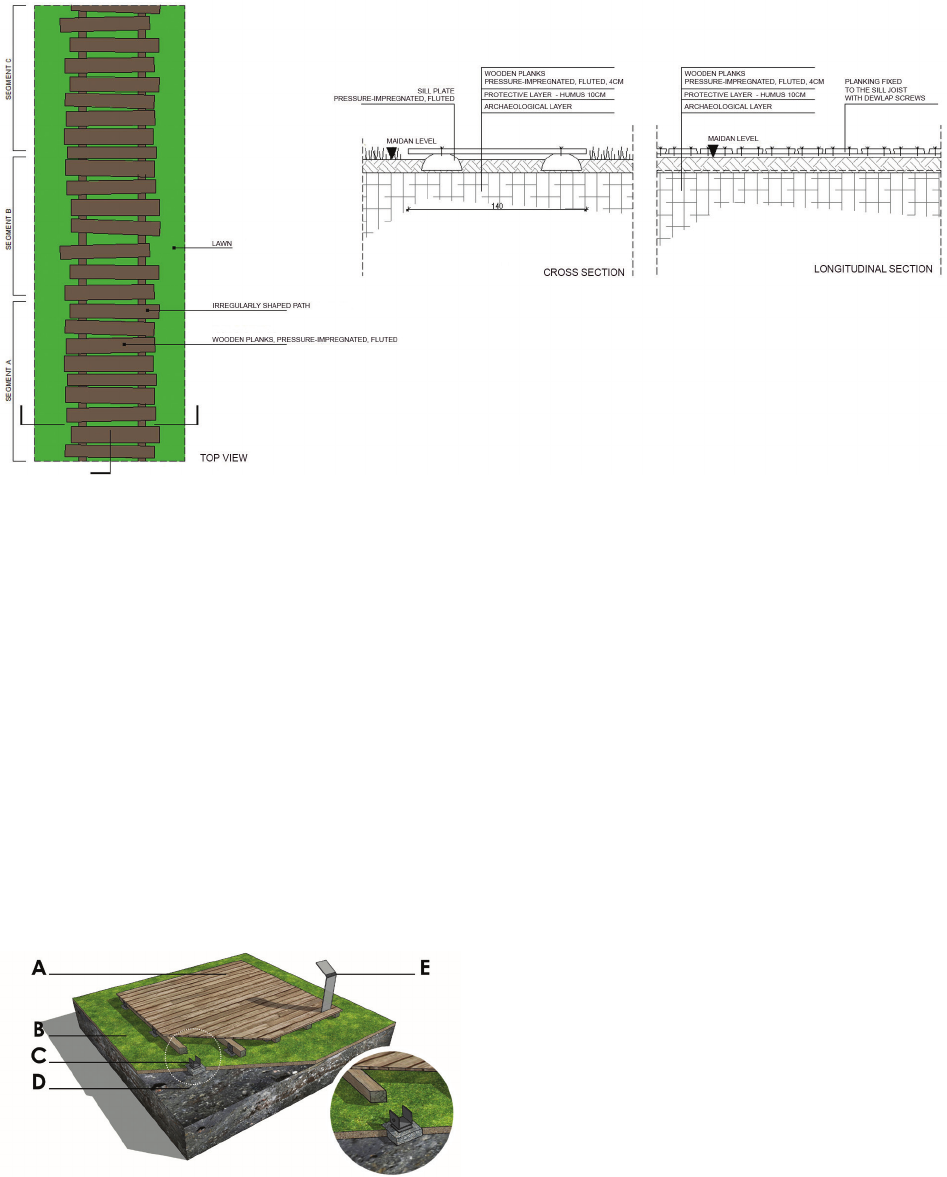
inclination and height of the rampart (Fig. 5). The buer
zone will allow new timbers to be laid in a way that does
not interfere with the protected authentic historic layer of
the gord. In the interior of the gord, the course of foot-
paths will be replicated, in accordance with the concept
developed by Tomasz Sajecki [20]. In the area of the yard
and on the crest of the rampart, pedestrian circulation will
take place along free-form, irregular wooden paths de-
signed in the form of transverse wooden planks attached
to longitudinal joists. This structure will be laid on top
of the buer layer to protect the archaeological layers
(Fig. 6). The locations of the original gord buildings will
be highlighted by wooden platforms, slightly raised above
ground level, placed in the actual locations of the exposed
buildings [21]. The dimensions of the platforms will cor-
respond to the actual size of the discovered objects [22]. It
is planned to include 21 platforms made using traditional
carpentry techniques. Planks measuring 20 × 4 cm will be
xed to 16 × 16 cm wooden mudsills. The structure will
Fig. 4. The final version of
the development project
for the gord area:
A – buffer layer on the rampart
crest and the yard,
B – path,
C – platform,
(elaborated by Arche-con, 2019)
Il. 4. Ostateczna wersja projektu
zagospodarowania terenu grodziska:
A – warstwa buforowa na koronie
wału oraz majdanie,
B – ścieżka,
C – podest,
(oprac. Arche-con, 2019)
be xed in the ground using steel picks with a stabilising
plate on a “buer” gravel layer. The symbolic platforms
will be complemented by information boards depicting ar-
chaeological discoveries relating to the site, together with
a description and drawing of its presumed appearance and
function (Fig. 7).
Conclusions
To summarise the information presented in this paper,
it should be emphasised that the concept of developing
the gord “in the meadows” in Wiślica is of key signi-
Fig. 5. A fragment of the gord. Distribution of buffer zones:
A – buffer layer on the rampart crest and the yard,
B – path, C – platform, D – archaeological layers
(elaborated by D. Przygodzki, 2023)
Il. 5. Fragment grodziska. Rozmieszczenie stref buforowych:
A – warstwa buforowa na koronie wału oraz majdanie,
B – ścieżka, C – podest, D – warstwy archeologiczne
(oprac. D. Przygodzki, 2023)
46 Dominik Przygodzki, Magda Szarkowska
cance for more than just the region itself. In the cited de-
sign of the development of the gord, it was possible to
develop a shared, satisfactory vision of the scope of the
site’s revalorisation. Technical solutions were proposed
to make the site accessible and visitable, while preserv-
ing its priceless historical value for future generations of
researchers. By introducing several centimetres of buer
layer, tourist trac outside the designated paths will not
expose the gord to damage. The adopted form of the new
elements, which does not directly suggest the shapes of
the presumed structures located on the gord site, allows
for reinterpretations of current and future architectural
and archaeological research, leaving the possibility for
Fig. 7. A platform symbolising the gord’s development:
A – platform, B – buffer layer on the yard,
C – steel pin with stabilising plate on the “buffer” gravel layer,
D – archaeological layers, E – information board
(elaborated by D. Przygodzki, 2023)
Il. 7. Podest symbolizujący zabudowę grodziska:
A – podest, B – warstwa buforowa na majdanie,
C – stalowy szpikulec z płytką stabilizującą
na „buforowej” warstwie żwirowej, D – warstwy archeologiczne,
E – tablica informacyjna (oprac. D. Przygodzki, 2023)
Fig. 6. Wooden path (elaborated by Arche-con, 2019)
Il. 6. Ścieżka drewniana (oprac. Arche-con, 2019)
further projects intended to popularise and protect the site.
The solutions adopted are aligned with sustainability prin-
ciples. The measures taken will have a positive impact on
the local community, as not only the economic, but also
the social and cultural situation of Wiślica will be pos-
itively changed with the provision of access to cultural
heritage. The project to develop the gord is currently un-
derway. The selected construction contractor is making
preparations for the project.
Zbigniew Kobyliński wrote of cultural heritage: […] al-
though it consists of the creations of the past, it is to a large
extent a product of the present; it is a contemporary social
construct, attributed in a continuous process of change
to ever-new phenomena from the past [23, p. 1141]. Any
projects carried out on historic buildings provide a link
between the past and the present, including by their adap-
tive reuse, for instance as a museum. There are numerous
projects that feature providing visitors access to a gord,
such as the reconstruction of the Owidz 11
th
-century gord
[24]. Reconstructions erected at original sites often meet
with disapproval from historians and archaeologists, due to
the lack of sucient and reliable archaeological research.
In the opinion of the authors, the tendency to gradually
move away from erecting reconstructions and the design
of structures that are typically insuciently based on ar-
chitectural and archaeological ndings, is correct. Instead,
it becomes more benecial to use the latest media technol-
ogies. They enable digital reconstructions to be made and
a virtual model to be built in augmented reality. They allow
the resulting image to be adjusted as new ndings emerge,
so as to ensure compliance with up-to-date knowledge.
Translated by
Krzysztof Barnaś
Restoration of medieval gords 47
[1] Bugaj M., Grodziska w zasobach dziedzictwa archeologicznego
kraju, [in:] G. Szczurek, A. Różański (red.), Grodzisko z wcześ-
niej szej epoki żelaza i wczesnego średniowiecza w Grodzisku,
PROFIL-ARCHEO, Poznań 2013, 135–142.
[2] Śpiewla Ł., Wybrane grodziska wczesnośredniowieczne a kwestia
turystyki na terenie województwa podkarpackiego, “Raport” 2019,
t. 14, 83–99.
[3] Jaskanis D., Międzynarodowa Karta Ochrony i Zarządzania Dzie-
dzic twem Archeologicznym, “Wiadomości Konserwatorskie” 1991,
nr 3–4, 10–13.
[4] Pawleta M., Rekonstrukcje i inscenizacje przeszłości w perspektywie
tu rys tyki archeologicznej w Polsce, [in:] J. Garncarski (red.), Skan-
seny archeologiczne i archeologia eksperymentalna, Muzeum Pod-
kar packie w Krośnie, Krosno 2012, 364–387.
[5] Apals J., Āraišu ezerpils, Latvijas vēstures institūta apgāds, Riga
2012.
[6] Kadłuczka A., Przeszłość dla przyszłości: tysiącletnia Wiślica i jej
ma terialne i niematerialne dziedzictwo. Pomnik historii jako forma
opieki RP, “Wiadomości Konserwatorskie” 2019, nr 60, 10–16,
doi: 10.17425/WK60WISLICA.
[7] Wartołowska Z., Osada i gród w Wiślicy w świetle badań wy ko-
pa liskowych do 1962 r., [in:] W. Antoniewicz, P. Biegański (red.),
Od kry cia w Wiślicy, PWN, Warszawa 1963, 33–45.
[8] Górna D., Kalaga J., Pianowski Z., Wiślica, woj. kieleckie. Stano-
wis ko – grodzisko, “Informator Archeologiczny: badania” 1980,
t. 14, 177–178.
[9] Gliński W., Wczesnośredniowieczne zausznice z czterema pa cior-
kami z Wiślicy, stan. Regia, “Sprawozdania Archeologiczne” 1999,
t. 51, 211–233.
[10] Ustawa z dnia 23 lipca 2003 o ochronie zabytków i opiece nad za -
bytkami, Dz.U. 2003, nr 162, poz. 1568, https://isap.sejm.gov.pl/
isap.nsf/download.xsp/WDU20031621568/T/D20031568L.pdf
[accessed: 10.01.2023].
[11] Augustyniak J., Z zagadnień ekspozycji zabytków archeologicz-
nych in situ: problemy ekspozycji na grodzisku, “Ochrona Za byt-
ków” 1973, nr 4(103), 270–283.
[12] Karta krakowska, [in:] B. Szmygin (red.), Vademecum kon ser -
wa tora zabytków. Międzynarodowe Normy Ochrony Dziedzic twa
Kul tury, Polski Komitet Narodowy ICOMOS, War sza wa 2015,
135–138.
[13] Kalina D., Miasto i Gmina Wiślica: dziedzictwo kulturowe, Dru kar-
nia Kontur, Wiślica 2018.
[14] Program rewitalizacji na lata 2016–2025 dla gminy Wiślica, Wi śli -
ca 2016, http://wislica.pl/1523/program-rewitalizacji-na-lata-2016-
2025-dla-gminy-wislica.html [accessed: 10.01.2023].
[15] Urząd Gminy Wiślica, Decyzja nr 5/05 o Ustaleniu Lokalizacji
Inwestycji Celu Publicz nego z dnia 15.03.2005 r., Wiślica 2005
[manuscript in: Arche-con].
[16]
Rozporządzenie Prezydenta Rzeczypospolitej Polskiej z dnia 10 grud -
nia 2018 r. w sprawie uznania za pomnik historii “Wiślica – ze spół
ko legiaty pod wezwaniem Narodzenia Najświętszej Maryi Pan ny
wraz z reliktami kościoła pod wezwaniem św. Mikołaja oraz gro-
dzisko”, Dz.U. 2018, poz. 2418, https://isap.sejm.gov.pl/isap.nsf/
download.xsp/WDU20180002418/O/D20182418.pdf [accessed:
20.05.2023].
[17] Miasto i Gmina Wiślica, Konkurs otwarty, jednoetapowy o wartości
poniżej kwoty 221 000 euro, przeprowadzany na podstawie ustawy
z dnia 29 stycznia 2004 r. Prawo zamówień publicznych (t.j. Dz. U.
z 2017 r., poz. 1579 z późn. zm.), www.wislica.pl/2978/konkurs-
otwarty-jednoetapowy-o-wartosci-ponizej-kwoty-221-000-euro-
przeprowadzany-na-podstawie-ustawy-z-dnia-29-stycznia-2004r-
prawo-zamowien-publicznych-tj-dz-u-z-2017-r-poz-1579-z-pozn-
zm-dalej-tez-pzp.html [accessed: 2.04.2023].
[18] Narodowy Instytut Dziedzictwa, Opinia w sprawie oceny wpływu
pla nowanej inwestycji pn.: “Tysiącletnia Wiślica – śladami świet-
noś ci – utworzenie trasy turystycznej Przez Pradzieje Chrześ ci jań-
skiej Wiślicy” na zachowanie wartości zabytkowych sta no wiska
archeologicznego Wiślica st. 1 “Grodzisko”, wpisanego do re jes-
tru zabytków pod numerem 329/508Aa z dnia 28.06.2019 r., Kiel ce
2019 [manuscript in: Arche-con].
[19] Świętokrzyski Wojewódzki Konserwator Zabytków w Kielcach,
Opi nia w sprawie: ZATiRA.RA.5132.2.2019 z dnia 22.01.2019 r.,
Kielce 2019 [manuscript in: Arche-con].
[20] Sajecki T., Koszarowa warowania w Wiślicy. Studium archeolo-
gicz ne do rozplanowania przestrzennego wczesnośredniowiecznego
sta no wiska, “Radzyński Rocznik Humanistyczny” 2017, t. 15, 7–21.
[21] Wartołowska Z., Górska I., Graba-Łęcka I., Okulicz Ł., Badania
gro dziska w Wiślicy w 1956 r., “Sprawozdania Archeologiczne”
1959, t. 7, 49–56.
[22] Górna D., Drewniana zabudowa grodu wiślickiego, “Światowit”
1982, t. 35, 129–164.
[23] Kobyliński Z., Dziedzictwo kulturowe: wartość i własność, [in:]
S. Tabaczyński, A. Marciniak, D. Cyngot, A. Zalewska (red.), Prze -
szłość społeczna. Próba konceptualizacji, Wydawnictwo Poz nań-
skie, Poznań 2012, 1141–1158.
[24] Łaguna W., Rayss J., Zmiany w krajobrazie kulturowym wywołane
rekonstrukcją grodziska średniowiecznego w Owidzu (gmina Sta-
ro gard Gd.) – jako przykład świadomego kształtowania krajobrazu
historycznego, “Teka Komisji Architektury, Urbanistyki i Studiów
Krajobrazowych” 2013, Vol. 9, Iss. 1, 55–69.
References
Abstract
Restoration of medieval gords on the example of the “in the meadows” gord in Wiślica: a case study
This paper presents a case study of the revalorisation of the gord “in the meadows” in Wiślica. The authors present design issues related to the
archaeological-architectural site. The administrative and legal processes that resulted in the implementation of a restoration plan for a building under
statutory conservation are illustrated. The paper presents design decisions made on the basis of collected information, archaeological ndings, con-
servation guidelines, administrative permits and conservatorial constraints. The solutions adopted to preserve the priceless historical value of the site,
while making it accessible to tourists and researchers, are explained and presented.
Key words: architecture, revalorisation, Wiślica, conservation of monuments, gord
Streszczenie
Problematyka rewaloryzacji grodzisk średniowiecznych. Grodzisko „na łąkach” w Wiślicy – studium przypadku
W artykule omówiono studium przypadku rewaloryzacji grodziska „na łąkach” w Wiślicy. Autorzy przedstawili problematykę projektową zwią-
zaną z obiektem archeologiczno-architektonicznym. Ukazali procesy administracyjno-prawne skutkujące wdrożeniem planu rewaloryzacji obiektu
objętego ochroną konserwatorską. W pracy zaprezentowano decyzje projektowe podjęte na podstawie zebranych informacji, badań archeologicz-
48 Dominik Przygodzki, Magda Szarkowska
nych, wytycznych konserwatorskich, uzyskanych pozwoleń oraz ograniczeń natury konserwatorskiej. Wyjaśniono i zaprezentowano przyjęte roz-
wiązania, które pozwalają na zachowanie bezcennej wartości historycznej obiektu, a jednocześnie umożliwiają udostępnienie obiektu zwiedzającym
turystom i badaczom.
Słowa kluczowe: architektura, rewaloryzacja, Wiślica, konserwacja zabytków, grodzisko