
2026
1(85)
Urszula Forczek-Brataniec*, Katarzyna Jamioł**
A review of pro-climate solutions carried out in selected projects
of public space
DOI: 10.37190/arc260106
© by the Author/Authors. Licensee WUST.
Published in open access. CC BY-NC license.
Abstract
In the face of ongoing climate change, urban public spaces must respond to new adaptation challenges. Implementing environmentally friendly
solutions in their design can contribute to increasing the resilience of the urban environment to climate-related threats and improving residents’ qual-
ity of life. The aim of this article is to review, identify, and develop a typology of pro-ecological solutions applied in contemporary European public
space projects, with particular emphasis on measures related to water management and green infrastructure.
The research material consisted of public space projects presented during two editions of the IFLA Europe exhibition. Two main categories of in-
terventions were distinguished: “water” and “greenery”, both related to the development of blue–green infrastructure in cities. The analysis included
both Nature-based Solutions (NBS) and interventions incorporating elements of technical infrastructure.
The results indicate the growing importance of integrating measures related to water retention, increasing biologically active surfaces, and
strengthening ecosystem functions in the process of shaping contemporary urban public spaces.
Key words: climate change adaptation, public spaces, blue–green infrastructure, Nature-based Solutions, urban resilience
Introduction
The adverse impacts of climate and microclimate
change are becoming increasingly evident, particularly
in urban areas. The Paris Agreement (2015) is intended
to be
a catalyst for remedial action. It sets out the objec-
tive of achieving climate neutrality by 2050 and, under an
ambitious scenario, limiting global temperature increase to
1.5°C above pre-industrial levels (UNFCCC 2015). The
European Union (EU) has adopted numerous laws in re-
sponse to these aspirations. Among them are the European
Green Deal (Fetting 2020) and its follow-up document, the
Nature Restoration Law (Council of the European Union
2024). The assumptions presented in these documents are
intended to help the European Union (EU) achieve climate
neutrality through cooperation across all sectors of the
economy (including construction), which should prioritise
reducing greenhouse gas emissions. Increased commitment
to the development and implementation of climate-neutral
solutions, as well as to minimising their adverse environ-
mental impacts, is strongly advocated. Gradual adaptation
has been identied as a key component of the long-term
response to climate change impacts (Council of the Euro-
pean Union 2021), encompassing, inter alia, measures re-
lated to urban development. In 2015, 76.5% of the world’s
population lived in urban areas (European Commission
2020a), compared to 72% in the EU (PBL Netherlands
Environmental Assessment Agency 2016). Most Europe-
an cities are projected to continue to grow, with the share
of Europe’s urban population expected to rise to approx-
imately 83.7% by 2050 (European Commission 2020b).
This process will accelerate the optimisation of public
space design and its use (Alberti et al. 2019). Urban ar-
eas are vulnerable to the eects of climate change, such as
extreme heat, oods, droughts, and water shortages, and
improper management of urban space further exacerbates
these phenomena. Given the substantial proportion of the
global population residing in urban areas and the projected
continued growth of urban populations, it is essential to
* ORCID:
0000-0003-1600-4332. Faculty of Architecture, Cra cow
University of Technology, Poland, e-mail: uforczek-brataniec@pk.edu.pl
** ORCID:
0009-0005-8155-2935. Faculty of Architecture, Cra-
cow University of Technology, Poland.
68 Urszula Forczek-Brataniec, Katarzyna Jamioł
emphasise that climate change mitigation and adaptation
measures should focus particularly on cities.
The study aimed to review climate-responsive design so-
lu tions implemented in public space projects presented at
the 2018 and 2022 exhibitions of the European Region of
the International Federation of Landscape Architects (IFLA
Europe 2018; 2022). It examined how projects from the past
decade address the local-scale impacts of climate change.
The analysis enabled the identication of distinct groups of
design interventions, which were subsequently classied ac-
cording to specic categories of climate-related threats. This
review responds to the current need to implement such mea-
sures, as emphasised by the Council of the European Union
(2021), by systematising and synthesising a set of applicable
solutions. Consequently, the ndings may serve as practical
design recommendations for the development of more resil-
ient and climate-responsive public spaces. In addition, the
study sought to disseminate knowledge about existing best
practices and to raise public awareness of the potential for
implementing similar interventions in publicly accessible
urban areas. In the long term, this may contribute to increas-
ing the number of pro-environmental actions at the local
level, fostering strategic planning processes, and strength-
ening resilience across broader urban agglomerations.
State of research
The role of public spaces in enhancing local resilience
to climate change has become an increasingly prominent
subject of scholarly inquiry (European Environment Agen-
cy 2020). Public spaces play a crucial role in creating a sat-
isfactory quality of life in cities, both in the social context
and in terms of the eciency of the urban ecosystem. Bar-
celona provides an example of a European city that has
eectively leveraged the potential of public spaces in the
development of its climate strategy. For several years, the
municipality has implemented programmes aimed at in-
tegrating and enhancing the accessibility of public spaces
(Amati, Stevens and Rueda 2023). One of the more recent
initiatives involves the creation of a network of “climate
shelters”, designed to provide residents with refuge during
heatwaves and periods of extreme cold. A vast number of
the shelters is in public urban parks and gardens (Barcelona
City Council 2024). However, parks are not the only key to
achieving the ecological transformation of cities. The green
transformation of urban infrastructure, often encapsulated
in the concept of “grey to green”, is assuming a prominent
role in contemporary climate policy and planning. Street
greening, which is popular in many cities, noticeably re-
duces urban heat island eects and improves stormwater
management systems (Gimenez-Maranges, Breuste and
Hof 2020). Analyses of the potential of streets in Vienna
(Furchtlehner, Lehner and Lička 2022) and Leipzig (Mar-
selle et al. 2022) have demonstrated the measurable eects
of these measures. Properly designed public spaces also
play a signicant role in urban ood risk reduction. Inte-
grated water management approaches, such as Sustainable
Urban Drainage Systems (SUDS), have for many years
de monstrated tangible benets in this regard (Silva, Costa
2018). The growing scholarly interest in completed proj-
ects incorporating such solutions is reected, for example,
in an analysis conducted by Spanish researchers of projects
nominated for the European Union Prize for Contemporary
Architecture – Mies van der Rohe Award. Their study is
focused on public spaces found near water bodies and the
impact of spatial features on the eects of rising ocean lev-
els (Dal Cin, Hooimeijer and Matos Silva 2021). The rel-
evance of this type of research is further conrmed by the
noticeable increase in the diversity of design solutions that
address specic climate threats in dierent regions, such as
heavy rainfall, heat waves, or ood risks (Forczek-Brata-
niec, Jamioł 2024). Hiltrud Pötz, among others, attempted
to categorise pro-climate measures, including nature-based
solutions (NBS), in her book Green-blue grids. Manual for
resilient cities, dividing these measures into seven main
thematic blocks: water challenges, heat, biodiversity, urban
agriculture, air quality, energy, and the social and economic
importance of blue-green infrastructure areas (Pötz 2016).
Researchers from the European Commission, in turn, di-
vided NBS into three main types: Type 1 NBS – minimal
or no intervention in ecosystems, with objectives related to
maintaining or improving delivery of ecosystem services
within and beyond the protected ecosystems; Type 2 NBS
– extensive or intensive management approaches seeking to
develop sustainable, multifunctional ecosystems and land-
scapes in order to improve delivery of ecosystem services
relative to conventional interventions; Type 3 NBS – char-
acterised by highly intensive ecosystem management or
creation of new ecosystems (European Commission 2021).
Methods
The research was conducted based on a selection of proj-
ects presented at IFLA Europe exhibitions, included in the
2018 “Landscape as a Common Ground” and 2022 “Recon-
sidering Nature” catalogues. The objective of the study was
to categorise design initiatives addressing the climate chal-
lenges which Europe is currently facing within the frame-
work of blue–green infrastructure. The research was based
on an analysis of project descriptions highlighting the cli-
mate-responsive solutions implemented, as well as on ac-
tivities previously classied in the literature. Earlier studies
sought to compare pro-climate interventions identied in
projects presented during the second edition of the exhibi-
tion with specic environmental stressors (Jamioł, Jaróg and
Nowak 2023). They also examined the principal objectives
pursued by designers such as prevention, protection, contri-
bution to the circular economy, restoration of degraded ele-
ments, or education and assessed whether the adopted mea-
sures responded to threats characteristic of the Nomenclature
of Territorial Units for Statistics (NUTS 3) regions in which
the projects were located (Forczek-Brataniec, Jamioł 2024).
In the present study, neither the dataset nor the corpus
of analysed projects was altered; rather, the classication
framework was revised. The identied design solutions
were subsequently compared with the principal climate-re-
lated challenges outlined in legal and policy documents
issued by the EU, including reports of the European Envi-
ronment Agency (2024). Reference was also made to the
Nature-based Solutions (NBS) typology proposed by the
A review of pro-climate solutions carried out in selected projects of public space 69
European Commission (2021), as well as to the categori-
sation framework developed by Hiltrud Pötz (2016). In the
rst stage of the analysis, the projects were examined ac-
cording to the types of interventions implemented. In total,
114 project descriptions from 29 countries aliated with
IFLA Europe were analysed. The sample included projects
located outside geographical Europe (e.g., Turkey and Is-
rael) and outside the EU (Norway, Switzerland, Ukraine,
and the United Kingdom, which withdrew from the EU in
2020). Each IFLA Europe landscape architecture associa-
tion could submit a maximum of three proposals, which in
many cases required pre-selection at the national level. The
analysed projects were assigned alphanumeric identiers, in
which the two-digit prex denotes the year of the exhibition,
the subsequent two letters indicate the country of implemen-
tation, and the nal number refers to the project’s sequence
within that country. It should be noted, however, that sub-
mitting a project to the exhibition did not require the use of
pro-ecological solutions, and the adopted research method
has its limitations and may involve a degree of subjectivity.
Due to the wide range of interpretations of the solutions pre-
sented in the design drawings, the scope of the analysis cov-
ered only the design elements described in the catalogues.
Grouping similar solutions allowed us to identify two
main categories related to blue-green infrastructure: “wa-
ter”, which includes actions aimed at managing water excess
and decit in the landscape, and “greenery”, which includes
solutions that strengthen and protect the integrity of green
infrastructure. Subcategories of actions were assigned to the
main categories, and within each subcategory, types of solu-
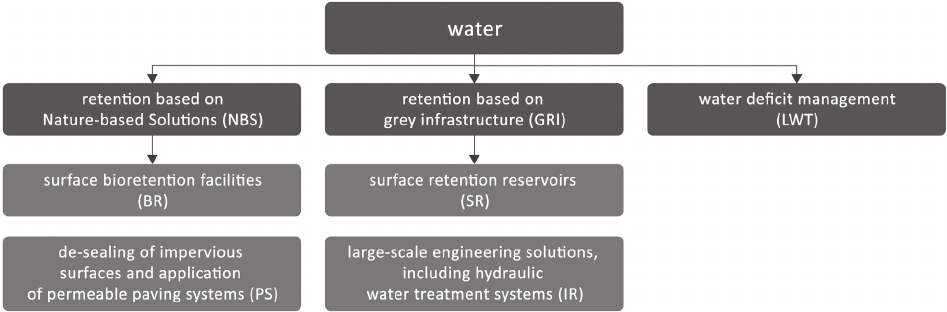
tions were specied. The “water” category included: retention
based on NBS, which specied: surface bioretention facilities
(BR), de-sealing impermeable surfaces and application of
permeable paving systems (PS); and then retention based
on grey infrastructure (GRI), divided into: surface retention
reservoirs (SR) and large-scale engineering solutions, includ-
ing hydraulic water treatment systems (IR) and water de-
cit management (LWT). The “greenery” category includes
protection of green infrastructure and existing ecosystems
(PRG), vegetation design for enhanced biodiversity support
(GBD) and restoration of lost ecosystem functions (REC).
The above categorisation was intended to systematise
the analytical framework. However, it should be empha-
sised that blue–green infrastructure interventions are in-
he rently interconnected and function through multiple,
in teracting mechanisms. Nature-based Solutions (NBS),
in cluding blue–green infrastructure elements, generate
co-benets for both water management and biodiversity
enhancement. Measures such as rain gardens and retention
basins increase inltration capacity and stormwater reten-
tion, thereby reducing pressure on conventional drainage
systems (Kimic, Ostrysz 2021). At the same time, they can
support the creation of diverse habitats, complement urban
green networks, and contribute to the conservation and en-
hancement of biodiversity (Bowler et al. 2024).
Results
A preliminary analysis of the use of pro-climate solu-
tions related to blue-green infrastructure applied in com-
pleted projects from both editions of the IFLA Europe
exhibition showed that they were mentioned in the de-
scriptions of 96 projects, which constitutes 84.21% of the
total and shows that the pro-ecological aspect plays a sig-
nicant role in presenting project ideas. The following
number of projects was assigned to individual categories:
“water” – managing stormwater excess and decit – 26
(22.81%), including in the subcategories: retention based
on NBS (NBS) – 19 projects (16.67%); surface bioret-
ention facilities (BR) – 15 projects (13.16%); de-sealing
impermeable surfaces and application of permeable pav-
ing systems (PS) – 9 projects (7.89%), retention based on
grey infrastructure (GRI) – 8 projects (7.02%); surface re-
tention reservoirs (SR) – 2 projects (1.75%); large-scale
engineering solutions including hydraulic water treatment
systems (IR) – 6 projects (5.26%), as well as water de-
cit management (LWT) – 4 projects (3.51%); “greenery”
– strengthening and protecting the integrity of green infra-
structure: protection of green infrastructure and existing
ecosystems (PRG) – 41 projects (35.96%), vegetation de-
sign for enhanced biodiversity support (GBD) – 47 proj-
ects (41.23%), and restoration of lost ecosystem functions
(REC) – 9 projects (7.89%). The research also shows that
33 out of 114 projects (28.95%) included solutions that fell
into both the “greenery” and “water” categories in their de-
scriptions (Table 1).
Water
– managing excess and deficit rainwater
• Retention based on Nature-based Solutions (NBS)
The “water” category was divided into three subcatego-
ries. The rst one includes nature-based retention solutions,
so-called NBS, which were further divided into surface bio-
retention facilities (BR), which included such activities as
the use of retention greenery, which was designed through,
among others, the use of retention basins (18_DK_030),
rain gardens (22_GR_01, 22-IT_02, 22_iT_03, 18-LV_02,
22_NO_02, 22_PL_03), green inltration ditches (922-
NO_03) or biolters (18_NL_02), as well as the de-seal-
ing impermeable surfaces and application of permeable
paving systems (PS), notable in the projects from Austria
(22-AT_01), Belgium (22_BE_03), Italy (22_IT_02, 22_
IT_03), Norway (22_NO_02), Poland (22_PL_01, 22_
PL_03), Slovenia (22_SI_01) and Spain (22_ES_01).
•
Retention based on grey infrastructure (GRI)
The second identied category – retention based on grey
infrastructure – was divided into retention using surface
retention reservoirs (SR), which took the form of water
sculptures (22_NO_02, 18_BG_02). The analysed descrip-
tions did not mention articial underground retention res-
ervoirs. The subsequent subgroup comprised large-scale
engineering interventions (IR), including hydraulic water
management systems such as embankments and ood pro-
tection levees integrated with extensive underground in-
frastructure (e.g., 18_FI_01; 18_NL_03; 18_CH_03). This
category also encompassed underground sewerage systems
equipped with water treatment and ltration components
(e.g., 18_DK_03; 18_FR_02; 22_FI_02).

70 Urszula Forczek-Brataniec, Katarzyna Jamioł
Table 1. Results of the analysis of project descriptions from the 2018 and 2022 exhibitions – assignment of activities from individual projects
to selected categories and their assigned subcategories (elaborated by U. Forczek-Brataniec, K. Jamioł)
Tabela 1. Wyniki analizy opisów projektów z wystaw z 2018 i 2022 r. – przyporządkowanie działań z poszczególnych projektów
do wybranych kategorii i przypisanych im podkategorii (oprac. U. Froczek-Brataniec, K. Jamioł)
Project ID
Water Greenery
Project ID
Water Greenery
NBS GRI
LWT PGR GBD REC
NBS GRI
LWT PGR GBD REC
BR PS SR IR BR PS SR IR
18_AT_01 + 22_LT_02 +
22_AT_01 + + 22_LT_03
22_AT_02 18_NL_01 + +
22_BE_01 18_NL_02 + + +
22_BE_02 18_NL_03 + +
22_BE_03 + 18_NO_01
18_BG_01 + 18_NO_02 +
22_BG_01 + 18_NO_03 +
22_BG_02 + 22_NO_01
18_HR_01 + 22_NO_02 + + +
18_CZ_01 + 22_NO_03 + +
18_CZ_02 + + 18_PL_01
18_CZ_03 + + 18_PL_02
22_CZ_01 + + 18_PL_03 +
22_CZ_02 + + + + 22_PL_01 + + +
22_CZ_03 + + 22_PL_02 + +
18_DK_01 + + 22_PL_03 + + + +
18_DK_02 + 18_RO_01
18_DK_03 + + + + 18_RO_02
22_DK_01 + + 18_RO_03 +
22_DK_02 22_RO_01 + +
18_EE_01 + 22_RO_02
18_EE_02 22_RO_03 + +
18_EE_03 18_SK_01
22_EE_01 + + + 18_SK_02
22_EE_02 + + 18_SK_03
22_EE_03 + 18_SI_01
18_FI_01 + 18_SI_02 + +
18_FI_02 18_SI_03 +
18_FI_03 22_SI_01 + + +

A review of pro-climate solutions carried out in selected projects of public space 71
Project ID
Water Greenery
Project ID
Water Greenery
NBS GRI
LWT PGR GBD REC
NBS GRI
LWT PGR GBD REC
BR PS SR IR BR PS SR IR
22_FI_01 + + 22_SI_02
22_FI_02 + + 22_SI_03 +
22_FI_03 18_ES_01 +
18_FR_01 18_ES_02
18_FR_02 + + 18_ES_03 +
18_FR_03 + 22_ES_01 + +
22_DE_01 + 22_ES_02 + +
22_DE_02 + 22_ES_03 + +
22_DE_03 + 18_SE_01
18_GR_01 + + 18_SE_02
22_GR_01 + + 18_SE_03 + +
22_GR_02 + 22_SE_01 +
18_HU_01 22_SE_02 +
18_HU_02 22_SE_03
18_HU_03 18_CH_01 + +
22_HU_01 18_CH_02 +
22_HU_02 18_CH_03 + + +
22_IE_01 22_CH_01
18_IL_01 22_CH_02 + +
18_IL_02 22_CH_03 +
22_IT_01 + + 18_TR_01
22_IT_02 + + + + 18_TR_02 + +
22_IT_03 + + + + 18_TR_03 +
18_LV_01 + 18_UA_01 +
18_LV_02 + + 18_GB_01
18_LV_03 + 18_GB_02 + +
22_LT_01 + 18_GB_03 +
Legend:
NBS – retention based on Nature-based Solutions: BR – surface bioretention facilities, PS – de-sealing impermeable surfaces and application of
permeable paving systems.
GRI – retention based on grey infrastructure: SR – surface retention reservoirs, IR – large-scale engineering solutions, including hydraulic water
treatment systems.
LWT – water deficit management.
PRG – protection of green infrastructure and existing ecosystems.
GBD – vegetation design for enhanced biodiversity support.
REC – restoration of lost ecosystem functions.
(+) – a design solution that fits the issues of a specific category was included in the description of the analysed project.
72 Urszula Forczek-Brataniec, Katarzyna Jamioł
•
Water deficit management (LWT)
The third distinct category presents activities aimed
at preparing planned areas for periodic water shortages.
Methods described include reusing collected rainwater for
irrigation (18_DK_03, 18_FR_02) and selecting planned
vegetation so that it can survive on natural water sources
(22_CZ_03, 22_CH_02) (Fig. 1).
Greenery – strengthening and protecting
the integrity of green infrastructure
•
Protection of green infrastructure and existing eco-
systems (PRG)
In the “greenery” group, the rst identied subcategory
is the protection of green infrastructure and existing eco-
systems (PRG). It includes preserving existing greenery by
incorporating it into the design concept (e.g., 22_AT_01,
22_GB_02, 18_CZ_02, 22_EE_03, 22_IT_01) and pre-
serving its original, most often natural character (18_
GB_01, 22_CZ_01, 18_GR_01). The projects described,
among other things, the preservation of fragments of mead-
ow undergrowth (22_CZ_02), vegetation that appeared
on the site through the process of secondary succession
(18_CZ_01) and the natural values of so-called wasteland
(22_EE_01). The integrity of green infrastructure systems
was further reinforced through measures aimed at main-
taining ecological continuity and safeguarding sensitive
landscapes. These included preserving the continuity of the
greater fjord landscape (18_DK_02) and protecting valu-
able areas through the careful spatial distribution of rec-
reational functions as dispersed elements within dened
enclaves (22_EE_02). Additional interventions involved
the incorporation of new design elements that accounted
for erosion processes and episodic ooding (22_FI_02), the
alignment of pathways to prevent dune erosion and avoid
disturbance to the unique vegetation of coastal dune sys-
tems (22_LT_02), and the provision of controlled access
to riverside alder forests while maintaining their distinctive
ecological values (18_SE_03). System integrity was also
supported through regular monitoring of ora and fauna
(22_FI_01), as well as through the introduction or strength-
ening of legal protection mechanisms – such as improving
the conservation status of coastal meadow and lagoon hab-
itats (18_EE_01) or designating parts of the area as ecolog-
ical reserves (22_DE_02).
•
Vegetation design for enhanced biodiversity support
(GBR)
The problem of biodiversity loss is one of the greatest
negative impacts of climate change. The EU’s goal is for
European biodiversity to be on a path to recovery by 2030,
helping people, the planet, the climate, and our economy
(Council of the European Union 2024). Designing vegeta-
tion to support biodiversity (GBR) was also the most often
addressed topic in the analysed projects.
Solutions assigned to this subcategory primarily focused
on enhancing both the horizontal and vertical structural di-
versity of the landscape, as well as on the careful selection
of plant species to provide shelter and food resources for
local fauna (e.g., 18_CZ_03; 22_RO_01). Multi-layered
vegetation compositions combining ground-cover plants,
shrubs, and trees (18_LV_01) were implemented along-
side perennial species (18_PL_03), with planting schemes
designed to ensure continuous owering throughout the
growing season (18_LV_03). Additional measures includ-
ed the integration of both deciduous and evergreen conif-
erous tree species (22_BG_01), as well as the prioritisation
of native species (e.g., 18_GR_01; 22_IT_01), selected
and arranged according to local environmental conditions
(22_CZ_03; 18_NO_03; 22_PL_03). Diversication of
the horizontal landscape mosaic was achieved through the
introduction of new aquatic biotopes adjacent to ower
beds (18_CZ_02) or grass-dominated areas (18_DK_01),
the establishment of pollinator-friendly ower meadows
combined with the designation of less frequently mown
zones (22_EE_02; 22_DE_01), and the creation of sun-ex-
posed stone piles to provide habitats for reptiles and am-
phibians (22_EE_01).
It is important to emphasise that protecting the integ-
rity of green infrastructure whose fragmentation in urban
areas is frequently associated with infrastructure expan-
sion (Pasek 2008) as well as implementing well-designed
NBS, particularly bioretention systems, can signicantly
contribute to the enhancement of local biodiversity. Em-
Fig. 1. Diagram illustrating the synthesis of activities undertaken in projects assigned to the “water” category (elaborated by K. Jamioł)
Il. 1. Schemat ilustrujący syntezę działań podjętych w projektach przypisanych do kategorii „woda” (oprac. K. Jamioł)

A review of pro-climate solutions carried out in selected projects of public space 73
of materials that absorb and retain heat in urban spaces. An-
other factor that worsens this eect is the signicant lim-
itation or absence of vegetation or natural water retention,
which can positively contribute to local air temperature
reduction (Błażejczyk et al. 2014). To reduce heat islands,
designers attempted to increase the number of trees in cit-
ies (10_CZ_03; 22_AT_01) and design greenery of diverse
types, not forgetting perennial owerbeds, ground-covers,
shrubs (18_PL_03), and grasses (22_EE_03). However,
increasing the shaded area was also achieved by proper
small-scale architecture (18_SI_03), and increasing air
humidity had a positive impact on local microclimate im-
provement (22_BG_01). The designs emphasised reducing
winter wind force achieving it by planting evergreen spe-
cies (22_BG_01) and designing multi-story greenery, as
well as minimising articial lighting pollution (22_PL_03),
which negatively aects biodiversity and landscape pro-
cesses (Zalesińska 2024). Furthermore, interventions not
directly associated with blue–green infrastructure can still
contribute positively to urban climate adaptation, as well
as to other environmental benets, such as noise reduc-
tion (18_AT_01). Designers also emphasised the integra-
tion of renewable energy technologies, particularly solar
energy, including on-site energy generation (18_LV_03;
18_NL_01). Another strategy contributing to emission
reduction and supporting EU climate objectives involves
promoting the circular economy through the use of recy-
cled materials (22_EE_01; 22_FI_01), such as granite slabs
(22_SI_01) or stones salvaged from decommissioned dams
(22_FI_02), as well as the use of locally sourced materi-
als (22_PL_03), which reduces supply chain distances and
enables on-site reuse of waste. Complementary measures
included design approaches aimed at minimising long-term
maintenance requirements (22_PL_03). A further key as-
pect observed across the analysed projects was the empha-
sis on educational components, aimed at raising awareness
of climate change, its mitigation, and the purpose of the im-
plemented design interventions (Gkoltsiou, Forczek-Brata-
niec 2024).
Conclusions
The analysis of pro-ecological initiatives proved that the
projects presented at IFLA Europe exhibitions constitute
valuable research material, and their analysis in terms of
pro-climate implementations presents a broad, albeit in-
complete, range of design solutions that can be implement-
ed in urban public spaces. It is important to emphasise that
pirical evidence supports this claim, indicating that bioret-
ention basins located within street greenbelts can function
as small, spatially dispersed habitat patches, facilitating the
movement of ora and fauna between larger natural areas
(Bjørn, Howe 2023).
•
Restoration of lost ecosystem functions (REC)
The analysed projects involved land undergoing rec-
lamation – the process of restoring degraded or damaged
areas to their original natural, ecological, and function-
al values, identied as the third subcategory (IRP 2019).
This was achieved by converting intensively used arable
land into pastures (22_CZ_02), cleaning water bodies to
improve amphibian habitats (22_EE_01), or purifying
soil using phytoremediation techniques (18_NL_01, 22_
NO_03) a process in which plants are used as natural “l-
ters” that absorb, transform, store, or neutralise pollutants.
This method is ecological, inexpensive, and easy to imple-
ment (Rymsza, Gawroński and Gawrońska 2013). Another
noteworthy example involves the reclamation of land pre-
viously occupied by a landll and its transformation into
recreational areas of high ecological value (22_FI_01).
Further interventions related to blue infrastructure included
the restoration of degraded coastal ecosystems (22_ES_03)
and wetland-associated habitats (18_TR_02), the renatura-
tion of watercourses (18_CH_01), and the reconnection of
previously fragmented hydrological systems (18_NL_03).
Such measures not only enhance ecological integrity but
may also contribute to improved management of both ex-
cess and decit rainfall by increasing the overall retention
capacity of the landscape.
These actions are consistent with the strategy related to
the second goal of the Nature Restoration Law – ensuring
that at least 30% of degraded areas are eectively restored
by 2030 (Council of the European Union 2024). While this
law only entered into force in 2024, projects implemented
over the last decade can serve as examples of solutions that
can be used to positively contribute to the restoration of
degraded urban areas (Fig. 2).
Other pro-ecological activities
The above categories only include activities related to
blue–green infrastructure. It is important to note that these
activities contribute to local microclimate improvement, in-
cluding reducing the urban heat island eect (Łęczek 2022).
The formation of a heat island is caused by factors such as
dense development that reduces air circulation and the use
Fig. 2. Diagram illustrating the synthesis of activities undertaken in projects assigned to the “green” category (elaborated by K. Jamioł)
Il. 2. Schemat ilustrujący syntezę działań podjętych w projektach przypisanych do kategorii „zieleń” (oprac. K. Jamioł)
74 Urszula Forczek-Brataniec, Katarzyna Jamioł
these solutions inuence each other and positively change
the mitigation of other negative eects. For example, en-
hancing biodiversity through the diversication of green
spaces positively aects the microclimate, which mitigates
the urban heat island eect and can thus contribute to in-
creasing water retention and reducing the negative eects
of periodic droughts.
The adopted division into categories and subcategories,
along with the dened types of activities, complements
contemporary landscape architecture patterns and provides
an overview of solutions implemented in recent years. The
analysed projects include activities already catalogued in
the studies (European Commission 2021; Pötz 2016), but
many of them represent solutions not previously men-
tioned. Together, they create a dictionary of new landscape
architecture tools, a compendium of knowledge based on
a creative approach to the issue, veried by a completed
project. The implementation in this case may be evidence of
a positive transition through the later stages: from competi-
tion and tender, through procurement, nancing, regulatory
approval, and nally, the implementation of pro-ecological
solutions in public spaces. It should be noted, however, that
the eectiveness of such interventions is highly dependent
on local conditions and may vary over time.
The analysed projects were developed by multidisci-
plinary teams that included landscape architects, an ap-
proach considered particularly appropriate in the context
of escalating climate change impacts (Gkoltsiou, For czek-
Brataniec 2024). Multidisciplinary collaboration ensures
the integration of current scientic knowledge and design
tools, enabling a holistic approach that harmonises inter-
ventions with both natural and cultural contexts.
During the research, a set of good practices was iden-
tied and systematically classied. In the future, their ef-
fectiveness during the operational phase can be evaluated,
and their eciency assessed. Examples of such analyses
include the Green–Blue Grids: Manual for Resilient Cities
(Pötz 2016) and city-published catalogues of good practic-
es, such as those from Wrocław, where selected retention
solutions in public spaces were assessed in terms of reten-
tion capacity, replacement costs, operational challenges,
and water purication potential (Lejcuś et al. 2017). It is
also essential to determine which measures are most appro-
priate for implementation in dierent types of public spac-
es. Such classication will facilitate an understanding of
which interventions are likely to perform most eectively
in specic urban contexts.
The research generated data on currently implemented
climate-responsive solutions in public space projects, pre-
dominantly within Europe. Given the signicance of the
topic, a substantial sample of implementation examples
from the past decade was analysed. Continued research in
this area is warranted to expand and update the spectrum
of climate-adaptive interventions, ensuring their alignment
with the evolving dynamics of local environmental threats.
Translated by
Katarzyna Jamioł
References
Alberti, Valentina, Maria Alonso Raposo, Carmelo Attardo, et al. The
Future of Cities. Opportunities, Challenges and the Way Forward.
Publications Oce of the European Union, 2019. https://doi.
org/10.2760/375209.
Amati, Marco, Quentin Stevens, and Salvador Rueda. “Taking Play
Seriously in Urban Design: The Evolution of Barcelona’s Super-
blocks.” Space and Culture 27, no. 8 (2023): 1–16. https://doi.
org/10.1177/12063312231159229.
Barcelona City Council. Barcelona for Climate. Barcelona, 2024. Accessed
December 23, 2024, at https://www.barcelona.cat/barcelona-pel-cli-
ma/en/barcelona-responds/specic-actions/climate-shelters-network.
Bjørn, Mona Chor, and Andy G. Howe. “Multifunctional Bioretention Ba-
sins as Urban Stepping Stone Habitats for Wildowers and Pollina-
tors.” Urban Forestry and Urban Greening (2023): 1–15. https://doi.
org/10.1016/j.ufug.2023.128133.
Błażejczyk, Krzysztof, Magdalena Kuchcik, Paweł Milewski, et al. Miej-
ska wyspa ciepła w Warszawie: uwarunkowania klimatyczne i urba-
nistyczne. Wydawnictwo Akademickie SEDNO, 2014.
Bowler, Diana E., Corey T. Callaghan, Jéssica F., et al. “Evidence-base for
Urban Green-blue Infrastructure to Support Insect Diversity.” Urban
Ecosystems (2024): 1–14. https://doi.org/10.1007/s11252-024-01649-4.
Council of the European Union, European Parliament. Regulation (EU)
2021/1119 of the European Parliament and of the Council of 30 June
2021 establishing the framework for achieving climate neutrality and
amending Regulations (EC) No 401/2009 and (EU) 2018/1999 (‘Eu-
ropean Climate Law’). Ocial Journal of the European Union. 2021,
L 243/1. Accessed December 23, 2024, at https://eur-lex.europa.eu/
eli/reg/2021/1119/oj.
Council of the European Union, European Parliament. Regulation (EU)
2024/1991 of the European Parliament and of the Council of 24 June
2024 on nature restoration and amending Regulation (EU) 2022/869.
Ocial Journal of the European Union. 2024. L 29.7.2024. Accessed
December 23, 2024, at https://eur-lex.europa.eu/eli/reg/2024/1991/oj.
Dal Cin, Francesca, Fransje Hooimeijer, and Maria Matos Silva. “Plan-
ning the Urban Waterfront Transformation, from Infrastructures to
Public Space Design in a Sea-Level Rise Scenario: The European
Union Prize for Contemporary Architecture Case.” Water 13, no. 2
(2021): 1–25. https://doi.org/10.3390/w13020218.
European Commission. “Developments and Forecasts on Continuing
Urbanisation.” Knowledge4Policy, 2020a. Accessed November 18,
2025, at https://knowledge4policy.ec.europa.eu/foresight/topic/con-
tinuing-urbanisation/developments-and-forecasts-on-continuing-ur-
banisation_en.
European Commission. “Urbanisation in Europe.” Knowledge4Policy,
2020b. Accessed November 12, 2025, at https://knowledge4policy.
ec.europa.eu/foresight/topic/continuing-urbanisation/urbanisation-eu-
rope_en.
European Commission. Evaluating the Impact of Nature-based Solutions:
A Handbook for Practitioners. 2021. https://doi.org/10.2777/244577.
European Environment Agency. European Climate Risk Assessment. EEA
Report 01/2024. 2024. https://doi.org/10.2800/204249.
European Environment Agency. Urban Adaptation in Europe: How Cities
and Towns Respond to Climate Change. EEA Report No. 12/2020.
Accessed February 4, 2025, at https://www.eea.europa.eu/en/analy-
sis/publications/urban-adaptation-in-europe.
Fetting, Constanze. The European Green Deal. ESDN Report. ESDN
Oce, 2020. Accessed December 23, 2024, at https://www.esdn.eu/
leadmin/ESDN_Reports/ESDN_Report_2_2020.pdf.
Forczek-Brataniec, Urszula, and Karolina Jamioł. “The Role of Public
Space in Building the Resilience of Cities: Analysis of Representative
Projects from IFLA Europe Exhibitions.” Sustainability 16 (2024):
1–26. https://doi.org/10.3390/su16125105.
A review of pro-climate solutions carried out in selected projects of public space 75
Furchtlehner, Jürgen, Daniela Lehner, and Lilli Lička. “Sustainable
Street scapes: Design Approaches and Examples of Viennese Prac-
tice.” Sustainability 14, no. 2 (2022): 1–21. https://doi.org/10.3390/
su14020961.
Gimenez-Maranges, Marc, Jürgen Breuste, and Angela Hof. “Sustain-
able Drainage Systems for Transitioning to Sustainable Urban
Flood Management in the European Union: A Review.” Journal of
Cleaner Production 255, no. 1 (2020). https://doi.org/10.1016/j.jcle-
pro.2020.120191.
Gkoltsiou, Aikaterini, and Urszula Forczek-Brataniec. “The Role of Land-
scape Architecture Profession Recognition in the Context of Facing
Contemporary Challenges.” Sustainability 16, no. 13 (2024): 1–19.
https://doi.org/10.3390/su16135362.
IFLA Europe. IFLA Europe Exhibition – Landscape Architecture as
a Common Ground. IFLA Europe, 2018. Accessed December 21,
2024, at https://www.iaeurope.eu/assets/docs/IFLA_Europe_Exhibi-
tion_Landscape_Architecture_as_a_common_ground_Catalogue.pdf.
IFLA Europe. IFLA Europe Exhibition – Reconsidering Nature. IFLA
Europe, 2022. Accessed December 21, 2024, at https://www.ia-
europe.eu/assets/docs/IFLAEurope_Exhibition2022_catalogue_vir-
tual13MB.pdf.
IRP. Land Restoration for Achieving the Sustainable Development Goals.
United Nations Environment Programme, 2019.
Jamioł, Katarzyna, Tomasz Jaróg, and Natalia Nowak. “Reconsidering
Nature – Analysis of Design Solutions Which Improve the Resil-
ience of Urban Landscapes.” Przestrzeń Urbanistyka Architektura
1 (2023): 189–99. https://doi.org/10.37705/PUA/1/2023/13.
Kimic, Kinga, and Karina Ostrysz. “Assessment of Blue and Green In-
frastructure Solutions in Shaping Urban Public Spaces – Spatial
and Functional, Environmental, and Social Aspects.” Sustainability
(2021): 1–31. https://doi.org/10.3390/su131911041.
Lejcuś, Krzysztof, Ewa Burszta-Adamiak, Jolanta Dąbrowska, et al. Ka-
talog dobrych praktyk – zasady zrównoważonego gospodarowania
wodami opadowymi pochodzącymi z nawierzchni pasów drogowych.
Wrocław, 2017.
Łęczek, Aleksandra. Miejska wyspa ciepła, czyli dlaczego w obszarach zur -
ba ni zowanych jest gorąco i co zrobić, żeby było chłodniej? WUF11
– Światowe Forum Miejskie. 2022. Accessed February 2, 2025, at ht-
tps://www.gov.pl/web/wuf11/miejska-wyspa-ciepla-czyli-dlaczego-w
-obszarach-zurbanizowanych-jest-goraco-i-co-zrobic-zeby-bylo-chlo-
dniej2.
Marselle, Melissa R., Diana E. Bowler, Jan Watzema, David Eichenberg,
Toralf Kirsten, and Aletta Bonn. “Urban Street Tree Biodiversity and
Antidepressant Prescriptions.” Scientic Reports 10 (2022): 1–11.
https://doi.org/10.1038/s41598-020-79924-5.
Pasek, Jarosław. “Ocena wpływu programów rozwoju infrastruktury na
korytarze ekologiczne.” In Ochrona łączności ekologicznej w Pol-
sce, edited by Włodzimierz Jędrzejewski, Dorota Ławreszuk. Zakład
Badania Ssaków Polskiej Akademii Nauk, 2008. Accessed Decem-
ber 27, 2024, at https://www.ibs.bialowieza.pl/g2/big/2009_12/f9be-
872871ad4df5d46b9b157525a3b4.pdf.
PBL Netherlands Environmental Assessment Agency. Cities in Europe.
Facts and Figures on Cities and Urban Areas. PBL Publishers, 2016.
Pötz, Hiltrud. Green-blue grids. Manual for resilient cities. atelier
GROENBLAUW, 2016.
Rymsza, Barbara, Stanisław Gawroński, and Helena Gawrońska. “Fitore-
mediacja szansą na przyjazne środowisko wokół dróg i ulic.” Trans-
port Miejski i Regionalny 3 (2013): 3–7.
Silva, Maria Matos, and João Pedro Costa. “Urban Floods and Climate
Change Adaptation: The Potential of Public Space Design When Ac-
commodating Natural Processes.” Water 10, no. 2 (2018). https://doi.
org/10.3390/w10020180.
UNFCCC. The Paris Agreement. Paris, 2015. Accessed December 23,
2024, at https://unfccc.int/documents/184656.
Zalesińska, Małgorzata. “Zanieczyszczenie światłem i jego negatywne
skutki dla człowieka i środowiska.” Energetyka 5 (2024): 205–8.
Streszczenie
Przegląd rozwiązań proklimatycznych w przestrzeniach publicznych na przykładzie wybranych projektów
W obliczu postępujących zmian klimatu przestrzenie publiczne w miastach muszą sprostać nowym wyzwaniom adaptacyjnym. Wdrażanie w projek-
tach rozwiązań proekologicznych może przyczyniać się do zwiększania odporności środowiska miejskiego na zagrożenia klimatyczne oraz do poprawy
jakości życia mieszkańców. Celem autorek artykułu jest przegląd, identykacja oraz opracowanie typologii rozwiązań proekologicznych stosowanych
we współczesnych projektach europejskich przestrzeni publicznych, ze szczególnym uwzględnieniem działań związanych z gospodarką wodną oraz
zieloną infrastrukturą.
Materiał badawczy stanowiły projekty przestrzeni publicznych prezentowane podczas dwóch edycji wystawy IFLA Europe. Wyróżniono dwie
główne kategorie działań: „woda” oraz „zieleń”, powiązane z kształtowaniem błękitno-zielonej infrastruktury w miastach. Uwzględniono zarówno
rozwiązania oparte na naturze (Nature-based Solutions – NBS), jak i rozwiązania wykorzystujące elementy infrastruktury technicznej.
Wyniki wskazują na rosnące znaczenie integracji rozwiązań związanych z retencją wody, zwiększaniem powierzchni biologicznie czynnych oraz
wzmacnianiem funkcji ekosystemowych w procesie kształtowania współczesnych przestrzeni miejskich.
Słowa kluczowe: adaptacja do zmian klimatu, przestrzenie publiczne, błękitno-zielona infrastruktura, rozwiązania oparte na przyrodzie,
miasta odporne
