
2016
2(46)
DOI: 10.5277/arc160205
Katarzyna Foljanty*
Przekształcanie zabytkowych dworców i terenów kolejowych
w struktury wielofunkcyjne
Transformation of historic stations and railway areas
into multi-purpose structures
Wprowadzenie
Rozwój systemu kolejowego był jednym z ważniejszych
motorów rozwoju miast końca XIX i początku XX w.
Pociąg, jako pierwszy środek lokomocji o dużej pojemno-
ści, przyczynił się do masowej migracji ludności z obsza-
rów wiejskich do miast oraz przewozu żywności i mate-
riałów budowlanych dla szybko rosnącej populacji.
Mimo sprzeciwu publicznego, często z powodów po
li tycznych i ekonomicznych, w latach 60. XX w. wybu-
rzono wiele dworców. Kolej ustąpiła pierwszeństwa sa-
mochodom i ogromne budynki dworcowe stały się mało
praktyczne i zbyt drogie w utrzymaniu. Bezpowrotnie
utra cono wiele wspaniałych, historycznych konstrukcji
z żelaza i stali takich jak St Enoch w Glasgow, Anhalter
Bahn hof w Berlinie czy Euston Station w Londynie.
Pod koniec XX w. kolej ponownie stała się atrakcyj-
nym środkiem transportu. Na przykład, w Berlinie w la-
tach 90. XX w., po 40 latach separacji zdecydowano się
na reorganizację i ponowną integrację systemu transpor-
towego. Głównym elementem nowej koncepcji była ko-
lejowa linia w kierunku północ–południe wraz z tunelem
pod częścią śródmiejską. Miejsce przecięcia projektowa-
nej linii z już istniejącą zachodniowschodnią zostało wy-
brane na lokalizację nowego dworca centralnego (Berlin
Hauptbahnhof). Powstały również dwa dodatkowe głów-
ne dworce na przecięciu nowej linii z linią Ringbahn (dwo-
Introduction
The development of the railway system was one of the
major driving forces of the development of cities at the
end of the 19
th
and the beginning of the 20
th
centuries.
The train, as the rst high volume means of transportation,
con
tributed to mass migration of people from the country
to the cities as well as the transportation of food and
building materials for the fastgrowing population.
In spite of social protests, often for political and eco
nomic reasons, many train stations were demolished in
the 1960s. The train lost with the car, huge train station
buildings became virtually useless and their maintenance
too expensive. Many great, historic structures made of
iron and steel, such as St Enoch in Glasgow, Anhalter
Bahnhof in Berlin, Euston Station in London were lost
forever.
At the end of the 20
th
century, the train became an
attrac tive means of transportation again. For instance in
the 1990s, after 40 years of separation, it was decided to
reorganize and reintegrate the system of transportation
in Berlin. The main element of the new conception was
a railway line going north–south with a tunnel underneath
the downtown area. The place where the line crossed the
existing line going westeast was selected for the location
of a new central train station (Berlin Hauptbahnhof). Two
other, additional, main train stations were also built in
the place where the new line crossed the Ringbahn line
(Gesundbrunnen station in the north and Suedkreuz sta
tion in the south). When planning new railway connection
and building the stations the useless railway areas left
* Wydział Architektury Politechniki Warszawskiej/Faculty of Ar
chi tecture, Warsaw University of Technology.

66 Katarzyna Foljanty
rzec Gesundbrunnen na północy i Suedkreuz na południu).
Przy jednoczesnym planowaniu nowych połączeń kole-
jowych i budowaniu dworców następowała transforma
cja nieużytków kolejowych po dworcach czołowych na
nowe funkcje związane z rekreacją i kultu rą (np. Goelitzer
Bahnhof, Anhalter Bahnhof, Anhalter Gueter bahnhof).
Wraz z renesansem kolei od lat 80. XX w. obserwuje-
my częściowy renesans dworców. Peters i Novy [1] wy-
różniają pięć czynników mających wpływ na to zjawisko:
– trwającą deindustrializację miast,
– pojawienie się kolei dużych prędkości (KDP) w klu-
czowych krajach Europy Zachodniej,
– prywatyzację państwowych przedsiębiorstw kolejo-
wych,
– zachodzące złożone procesy restrukturyzacji miej-
skiej jako część globalizacji gospodarczej,
– zmianę paradygmatu w planowaniu transportu i za-
gospodarowaniu przestrzennym; priorytetami stają się:
zwarta zabudowa, tereny o funkcjach mieszanych, orien-
tacja na transport publiczny oraz pieszy.
W krajach Europy Wschodniej procesy te zachodzą
z opóźnieniem. W latach 2000–2010 nastąpił wzrost wy-
korzystania samochodów osobowych wśród wielu państw
członkowskich, które przystąpiły do Unii Europejskiej
(UE) w 2004 i 2007 r., zwłaszcza w Bułgarii, Estonii i na
Słowacji. Według pierwszego raportu Towards Passenger
Intermodality samochód osobowy jest głównym środkiem
transportu dla wszystkich monomodalnych podróży od-
bywanych w krajach UE. Dlatego też obecne odrodzenie
kolei występuje równolegle z jej regresem [1].
Dworce zlokalizowane zwykle na obrzeżach małych
miast, często sprzedawane lub przekazywane samorządom
czy prywatnym inwestorom (np. w 2013 r. w ofercie PKP
„Dworzec na własność” były 53 dworce) znajdują się
w trudnej sytuacji. Przy braku zainteresowania przeję-
ciem dworca budynki, nawet te wpisane na listę zabytków,
ulegają dalszej degradacji. Tak zwany renesans dworców
kolejowych jest więc zjawiskiem dotyczącym stosunko-
wo niewielkiej liczby obiektów w większych mia stach
w lo kalizacjach najbardziej dochodowych [2]. Za chowa nie
i rewitalizacja zabytkowych dworców zwięk sza jed nakże
świadomość społeczeństwa na temat bo ga tego dzie dzic
twa tego typu budynków [3], a zaintereso wanie miesz kań
ców i ich partycypacja pomnaża szanse na dobrze prze
prowadzoną rewitalizację obiektów dworcowych.
Głównymi czynnikami pobudzającymi rozbudowę kon
wen cjonalnych dworców kolejowych są:
– wzrost liczby osób korzystających z kolei (wprowa-
dzenie linii dużych prędkości, zwiększenie atrakcyjności
połączeń podmiejskich, regionalnych itd.),
– rozbudowa systemu transportowego, a przez to prze-
kształcenie dworca kolejowego w wielofunkcyjny pasażer-
ski terminal przesiadkowy.
Prezentowane w tym artykule współczesne
europejskie
przykłady wskazują te realizacje, które są skupione na re-
nesansie dworców rozumianym jako rozwój infrastruktu-
ry kolejowej. Wiele dworców zostało zmodernizowanych
lub przebudowanych przy jednoczesnym zachowaniu
dominującej funkcji kolejowej i wprowadzeniu funkcji
dodatkowych. Są to projekty kontrastujące
z dworcami
after terminus stations were transformed and acquired
new functions connected with recreation and culture (e.g.
Goeli tzer Bahnhof, Anhalter Bahnhof, Anhalter Gueter
bahnhof).
The renaissance of the railway since the 1980s was
accompanied with a partial renaissance of train stations.
Peters and Novy [1] mention ve factors that affect that
phenomenon:
– ongoing deindustrialization of the cities,
– emergence of highspeed trains in key Western Euro
pean countries,
– privatization of the state railway company,
– ongoing complex urban restructuring processes as
part of the globalization,
– change of the paradigm in planning transportation
and space development; priorities include: denser settle
ments, mixedfunction areas, public transportation and
pe destrian orientation.
These processes are delayed in the Easter European
coun tries. In 2000–2010, the use of passenger cars grew
in many member states which joined the European Union
(EU) in 2004 and 2007, especially in Bulgaria, Estonia and
Slovakia. According to the rst report Towards Passenger
Intermodality, the passenger car is the main means of
transportation for all single mode trips taking place in the
EU countries. Con sequently, at present the rebirth of the
railway occurs along with its regression [1].
The situation of the train stations located usually on the
outskirts of small cities which are often sold or transferred
to local authorities or private investors (e.g. in 2013 the
offer of Polish State Railways “Your own train station”
included 53 sta tions) is difcult. As there are no entities
interested in taking over the train station buildings, even
the ones listed as historic monuments fall further into ruin.
The so called renaissance of train stations is a phenomenon
which con cerns a relatively small number of structures
in bigger ci ties with the most pro table locations [2].
However, the maintenance and re vi talization of historic
train stations increase the po pular knowledge of the great
heritage of this type of build ings [3] and the interest of the
residents as well as their participation increase the chance
of a well conducted revi ta lization of railway structures.
The main factors triggering the extension of conven
tional train stations include the following:
– increase in the number of railway users (introduction
of highspeed trains, more attractive suburban, regional
connections, etc.);
– extension of the transportation system and trans for
mation of the train station into an intermodal platform.
The contemporary European examples presented in
this article demonstrate the implemented designs which
focus on the renaissance of train stations understood as the
development of railway infrastructure. Many train stations
have been modernized or remodeled while maintaining
the dominant railway function and introducing additional
functions. These are designs different from the train sta
tions providing exclusively for commercial needs and
ser vices where the train station function (despite a large
num ber of passengers) was reduced to the very basic mi
ni mum, and the space of the building is used mainly for

Przekształcanie dworców i terenów kolejowych/Transformation of stations and railway areas 67
ofces and shopping centers (e.g. Dworzec Główny in
Poznań, new Dworzec Zachodni in Warsaw).
The examples of train stations presented in this article
are divided into three groups, depending on the scope of
modernization:
– extension of the train station buildings which was
con ducted only in the train station building within the
com pact urban fabric,
– conversion of the train stations into transport hubs
regarding the train stations and their immediate surround
ings connected with the transportation network or public
space,
– urban plans including train stations as their core
where the train station remodeling is part of a largescale
trans portation design, including mixed use development.
A separate subsection specically presents contem po
rary modernizations of Polish train stations.
Extension of the train station buildings
Atocha in Madrid which was opened in 1892 is an
example of an extension of a historic downtown train
station to a highspeed train station. It was connected with
a metro station already in 1921 and in the 1960s it was
connected through a tunnel with Chamartin train station.
However, the biggest remodeling of the design by the
architect Rafael Moneo was conducted at the turn of the
1980s and the 1990s. The objective of the modernization
was to increase the station trafc capacity four times and
its extension to the main transfer node in the city. In 1992,
the former hall of the station (154 m long, 49 m wide and
27 m tall) was closed for railway trafc. A tropical garden
of the area of 4.000 m
2
as well as cafes, shops and clubs
were designed in the hall. At the same time the construction
of two new stations (Atocha Cercanías, Puerta de Atocha)
and a bus station as well as a parking lot for cars began.
As a result the train station operating highspeed trains
and regional trains was connected di rect ly with two metro
stations, commuter rail (Cercanías) and a bus station as
well as a taxi stand. Ten years later, in 2001, it was decided
to further extend the Atocha rail station in connection with
opening of new highspeed rail lines. The main architect
was also Rafael Mo neo and Pedro Elcuaz cooperated with
him. The new terminus station which was opened in 2010
is accessible exclusively for the passengers travelling to
Madrid. A 200 m long corridor connects the platform hall
with the main concourse with connecting passageways to
other plat forms and the parking lot. The roof in the form
of a hy per bolic paraboloid is made of steel painted white
and co vers eight platforms.
The design of Waterloo International railway station in
London is architecturally interesting although not com
ple tely successful in regard of its comprehensiveness. It
was opened in 1994 as Eurostar line station but already
in 2007 it was closed because the railway connections
which it operated were moved to the newly modernized
St Pancras railway station. Different plans of re opening
railway trafc were developed for many years. Waterloo is
Britain’s busiest railway station by passenger usage with
over 94 million passenger entries and exists annually (in
nastawionymi wyłącznie na potrzeby handlowousługowe,
gdzie funkcja dworcowa (mimo dużej liczby pasażerów)
została okrojona do bardzo podstawowego minimum, a do
minujące wykorzystanie powierzchni budynku przypa da
na biura i centra handlowe (np. Dworzec Główny w Po-
znaniu, nowy projekt Dworca Zachodniego w Warszawie).
W pracy przykłady dworców podzielono na trzy grupy.
Za kryterium tego podziału przyjęto zakres modernizacji:
– rozbudowa budynków dworcowych, która nastąpiła
jedynie w ramach budynku dworca kolejowego znajdują-
cego się w zwartej tkance miejskiej,
– przebudowa dworców kolejowych na węzły komu-
nikacyjne dotycząca dworca kolejowego oraz jego naj-
bliższego otoczenia związanego z siecią transportu lub
przestrzenią publiczną,
– założenia urbanistyczne z dworcem kolejowym jako
ich rdzeniem, w których przebudowa dworca jest częś cią
wielkoskalarnego założenia komunikacyjnego obejmują-
cego projekt zabudowy wielofunkcyjnej.
W osobnym podrozdziale zwrócono szczególną uwagę
na współczesne modernizacje polskich dworców kolejo-
wych.
Rozbudowa budynków dworcowych
Przykładem rozbudowy zabytkowego dworca śród
miej skiego do dworca kolei dużych prędkości (KDP) jest
Atocha w Madrycie otwarty w 1892 r. Już w 1921 r. po
łą czono go ze stacją metra, natomiast w latach 60. XX w.
tunelem z dworcem kolejowym Chamartin. Jednak naj-
większą przebudowę projektu architekta Rafaela Moneo
przeprowadzono na przełomie lat 80. i 90. ubiegłego
wie ku. Celem modernizacji było czterokrotne zwiększe-
nie przepustowości dworca i jego rozbudowa na główny
węzeł przesiadkowy w mieście. W 1992 r. dawna hala
dwor ca o wymiarach 154 m długości, 49 m szerokości
i 27 m wysokości została zamknięta dla ruchu kolejowe-
go. W hali umieszczono ogród tropikalny o powierzchni
4000 m
2
, a także kawiarnie, sklepy i kluby. Jednocześnie
roz poczęła się budowa dwóch nowych stacji (Atocha Cer-
canías i Puerta de Atocha) i dworca autobusowego oraz
parkingu dla samochodów. W rezultacie dworzec kolejo-
wy obsługujący koleje dużych prędkości i pociągi regio-
nalne został połączony bezpośrednio z dwiema stacjami
metra, koleją metropolitarną (Cercanías) oraz dworcem
autobusowym i postojem taksówek. Dziewięć lat później,
w 2001 r. podjęto decyzję o kolejnym powiększeniu dwor-
ca Atocha w związku z otwarciem nowych linii dużych
prędkości. Architektem prowadzącym również został Ra-
fael Moneo, a współpracował z nim Pedro Elcuaz. Nowa
stacja końcowa otwarta w 2010 r. jest dostępna wyłącznie
dla osób przyjeżdzających do Madrytu. Korytarz o dłu-
gości 200 m łączy halę peronową z halą główną, w której
znajdują się przejścia na inne perony oraz na parking. Za-
daszenie o formie paraboloidy hiperbolicznej wykonane
ze stali malowanej na biało przykrywa osiem peronów.
Interesującym architektonicznie, ale nie do końca
udanym pod względem całościowego planowania przy-
kładem jest dworzec Waterloo International w Londynie.
Otwarto go w 1994 r. jako stację linii Eurostar, ale już

68 Katarzyna Foljanty
w 2007 r. zamknięto, gdyż połączenia kolejowe, które
obsługiwał, przeniesiono na nowo zmodernizowany dwo-
rzec St Pancras. Przez wiele lat pojawiały się różne plany
przywrócenia ruchu kolejowego. Dworzec Waterloo jest
najbardziej ruchliwym dworcem w Wielkiej Brytanii ob-
sługującym ponad 94 miliony pasażerów rocznie (w roku
skalnym 2013/2014), jednak obecnie cały ruch odbywa
się wyłącznie w obrębie starej części. Według oświadcze-
nia wydanego przez minister transportu w 2014 r. przewi-
duje się otwarcie peronów dworca Waterloo International
dla pociągów podmiejskich do końca 2017 r.
Przebudowa dworców kolejowych
na węzły komunikacyjne
Przy wielu przeprowadzonych w 2. połowie XX w.
modernizacjach dworców zabrakło kompleksowego po-
dejścia projektowego. Poszczególne przystanki nowych
środków transportu „dostawiano” do głównej bryły bez
uwzględnienia możliwości przyszłej rozbudowy. Prze-
strzeń wokoło dworca stawała się nieuporządkowana
i nieczytelna. Pasażerowie, szczególnie ci korzystający
z dworca po raz pierwszy, mieli problemy ze znalezie-
niem drogi do celu. Architekci z biura AREP przy prze-
budowie dworca w Strasburgu stworzyli zadaszenie, któ-
re obejmuje przystanki wszystkich dostępnych środków
transportu. Poza tym układ dróg przed dworcem został
zmieniony, tak aby dojazd do budynku zlokalizowany
był możliwie jak najbliżej. Główny przystanek tramwa-
jowy umieszczono na kondygnacji –4. Na poziomie –1
znajduje się parking krótkiego postoju oraz parking ro-
werowy. Odprawa pociągów odbywa się na poziomie ±0.
Ścieżki na placu przed dworcem zostały zaprojektowane
na podstawie analizy przemieszczania się ludzi. Według
architekta prowadzącego plac ten powinien stanowić po-
łączenie budynku dworcowego z miastem i pełnić funk-
cję poczekalni w przestrzeni otwartej. Niestety plac przed
dworcem w chwili obecnej nie prezentuje się najlepiej,
nawet w okresie letnim korzysta z niego mała liczba osób,
a elementy architektury krajobrazu są zaniedbane (il. 1).
Również główne założenie projektantów, jakim było uła-
twienie komunikacji pomiędzy przystankami różnych
środków transportu, nie zostało do końca spełnione. Przy-
stanki niektórych linii tramwajowych znajdują się poza
budynkiem dworca, co przy niewystarczającym oznako-
waniu utrudnia orientację w przestrzeni.
Biuro AREP przy współpracy z wewnętrzną jednost-
ką Kolei Francuskich SNCF Gares & Connexions wyko-
nało wiele innych projektów dworców kolejowych, np.
rozbudowy dworca SaintCharles w Marsylii, do którego
w 2007 r. zostało dobudowane nowe skrzydło, czy pary-
skiego Gare de Lyon, który w 2013 r. z powodu zwięk-
szenia ruchu wywołanego przez linię TGV Rhine–Rhōne
powiększono o dwa nowe hole. Założenia architektów
w tym wypadku różnią się od omówionej powyżej rozbu-
dowy dworca Atocha, gdzie nowo powstałe budynki wy-
raźnie kontrastują z zabytkową halą. W przypadku Gare
de Lyon przekrycia zarówno hali A, jak i hali B zostały
celowo zaprojektowane w podobnej konwencji do zada-
szenia z 1927 r.
nancial year 2013–2014). However, at present the whole
trafc goes through the old part of the station. According
to a statement issued by the Minister of Transport in 2014,
it is expected to open Waterloo International station for
the commuter trains by the end of 2017.
Conversion of train stations into transport hubs
Many modernizations of train stations conducted in the
2
nd
half of the 20
th
century had no comprehensive design.
Individual stops along new transportation systems were
“annexed” to the main station buildings with no regard
to possible future extension. The space around the train
stations would remain unimproved and become unclear.
The passengers, especially those using the sta tions for the
rst time, had problems getting around. The ar chitects
from AREP, when remodeling the station in Strasburg,
developed a roof which covers the stops of all available
means of transportation. Furthermore, the road layout in
front of the station was changed to pro vide access as close
to the building as possible. The main tram stop is located
on level –4. On level –1 there is a short term parking lot
and a bicycle parking facility. The trains operate on level
±0. The footpaths on the square in front of the station were
designed on the basis of analysis of pedestrian trafc.
According to the leading ar chitect the square should
connect the station building with the city and serve as an
open space waiting room. Unfortunately, the square in
front of the station at the moment does not look good;
few people use it even in the summer and the landscaping
elements are neglected (Fig. 1). The main objective of
the designers, which was to facilitate connection between
stops for different means of transportation, was not
achieved completely either. The stops of some tram lines
are located away from the station building what, along
with poor signage, makes orientation in space difcult.
The architects from AREP cooperating with an internal
unit from the French National Railway Company (SNCF
Gares & Connexions) developed many other designs of
train stations, such as extension of SaintCharles station
in Marseilles, to which a new wing was added in 2007
or Gare de Lyon in Paris which in 2013 due to increasing
trafc caused by TGV Rhine–Rhōne line was enlarged
by adding two new halls. The objectives of the architects
Il. 1. Nowa hala wejściowa dworca w Strasburgu,
widok od strony placu przed dworcem (fot. K. Foljanty, 2014)
Fig. 1. New entrance hall of Strasbourg Station,
view from the forecourt (photo by K. Foljanty, 2014)

Przekształcanie dworców i terenów kolejowych/Transformation of stations and railway areas 69
Usytuowanie nowych inwestycji publicznych blisko
węz ła przesiadkowego zachęca ludzi do korzystania
z trans portu publicznego (a przez to poprawia warun-
ki ży cia lokalnej społeczności) i podnosi atrakcyjność
przestrze ni, co może przyczynić się do dalszych zamie-
rzeń budowlanych w sąsiedztwie. Największy wzrost
nowych inwestycji notuje się w tzw. bezpośredniej stre-
e, która zawiera się w promieniu 300–500 m od dworca
[4]. Pośrednie oddziaływanie dworca odnosi się do pro-
mienia około 1 km (strefa druga) i powyżej 1 km (strefa
trzecia), gdzie wzrost inwestycji będzie najmniejszy [4].
Warunkiem niezbędnym do uzyskania pozytywnego od-
działywania jest usunięcie barier zycznych i mentalnych
przeszkadzających w ruchu pieszym. Punkt przesiadkowy
powinien funkcjonować w relacji z otoczeniem zewnętrz-
nym i przestrzeniami publicznymi. Tylko wtedy zdoła
wygenerować napływ użytkowników, którzy wyjdą poza
budynek dworca.
Przykładem stworzenia śródmiejskiej przestrzeni pu
blicz nej otoczonej zespołem budynków wielofunkcyj nych
jest przebudowa Piazza Garibaldi w Neapolu według pro
jektu pracowni Dominique Perrault Architecture. Za go
spo darowanie placu obejmuje wydzielenie strefy pieszej
z ogrodem i hypogeum. Ponadto zaprojektowano nowe
wej ś cie do metra oraz do dworca kolejowego Na poli Cen-
trale, a także podziemny parking i promenadę hand lo wą.
Stworzenie placu przed dworcem będącym jed no cześ nie
ogólnie dostępną przestrzenią publiczną pla nowane jest
również w ramach przebudowy dworca Bil bao Abando.
Kolejnym przykładem jest reorganizacja komu ni ka cji
na wy spie dworcowej (Stationseiland) w Am ster da mie,
gdzie nie tylko sam dworzec zo sta nie wy remon to wany
i prze kształ cony w wie lo fun kcyjny pasażerski terminal
prze siad kowy, ale rów nież te reny do nie go przyległe uleg
ną przebudowie. Czyn nikiem warunkującym tak duże
zmia ny w centrum miasta jest budowa linii metra w kie
runku pół noc–południe. Jak pod kreśla Jan Benthem z Ben
them Crouwel Architects – biura odpowiadającego za
pro jekt architektoniczny – plac przed dworcem zostanie
upo rządkowany, tak aby stał się ponownie miejscem spo-
tkań. Obecnie w budowie jest stacja metra umieszczona
pod placem dworcowym, a także zadaszenie dworca au-
tobusowego zaprojektowane od strony nabrzeża. Pod po-
ziomem terenu zaplanowano tu nel dla samochodów oraz
in this case differ from the extension of Atocha station
described above, as the newly constructed buildings are
evidently in contrast with the historic hall. In the case
of Gare de Lyon the roong of hall A and hall B was
deliberately designed similar to the roof from 1927.
The location of new public buildings close to the trans
port hub encourages people to use public trans portation
(and consequently improves the living con di tions of local
communities) and increases the space attrac tiveness,
which can contribute to further construction development
in the neighborhood. The biggest growth in new in vest
ments is noticed in the so called immediate zone that
is within 300–500 m from the station [4]. The indirect
effect of the train station regards the radius of about 1 km
(second zone) and above 1 km (third zone), where the
growth in the number of investments is the smallest [4]. It
is necessary to get rid of both physical and mental barriers
of the pedestrian trafc to provide a positive impact. The
transfer point should operate in relation to the outside
surroundings and public spaces. Only then will it be able
to generate an inux of users who leave the train station
building.
The remodeling of the Piazza Garibaldi in Naples
according to the design by Dominique Perrault Architec
ture is an example of development of a downtown
public space surrounded with mixed use buildings. The
development of the square includes separating a pedestrian
zone with a garden and a hypogeum. Furthermore, a new
entrance to the metro and to the Napoli Centrale train
station was designed as well as an underground parking
lot and a shopp ing promenade. The remodeling of the
Bilbao Aban do train station also includes the development
of a plaza in front of the station which is at the same time
a universally accessible public space.
Another example is the reorganization of transportation
on the Station Island (Stationseiland) in Amsterdam
where not only the train station itself will be renovated
and transformed into an intermodal passenger platform
but also the areas adjacent to it will be remodeled. Such
big changes in the city center depend on the construction
of the metro line going north–south. As stressed by Jan
Benthem from Benthem Crouwel Architects – the ofce
responsible for the architectural plans – the square in
front of the station will be improved so that it would
Il. 2. Przebudowa dworca Amsterdam Centraal (źródło: Gemeente Amsterdam, www.amsterdam.nl, data dostępu: 24.07.2014)
Fig. 2. Redevelopment of Amsterdam Centraal (source: Gemeente Amsterdam, www.amsterdam.nl, accessed: 24.07.2014)
wejście do metra
metro entrance
tunel samochodowy
car tunnel
stacja metra
metro station
prom
ferry
ścieżka rowerowa
bicycle path
dworzec autobusowy
bus station
dworzec kolejowy
train station
wejście do metra
metro entrance
70 Katarzyna Foljanty
oddzielny tunel dla rowerzystów i pieszych, który ma
ułatwić połączenie historycznej częś ci miasta z przystanią
dla promów odpływających w kierunku północnym (il. 2).
Założenia urbanistyczne z dworcem kolejowym
jako ich rdzeniem
Należy zauważyć, że rozbudowanie połączeń kolejo-
wych, a zarazem modernizacja dworca kolejowego może
pozytywnie wpłynąć na projektowanie w skali urbani-
stycznej. Przekształcanie nieużytkowanych terenów po-
przemysłowych, leżących często w centrach miast stano-
wi dużą szansę rozwoju dla danego obszaru. Na uwagę
za sługują dwa londyńskie dworce połączone w jeden wę
zeł przesiadkowy. Katalizatorem zmian następujących na
tym obszarze stało się przeniesienie przystanku kolei du
żych prędkości (Channel Tunnel Rail Link) z dworca Wa
terloo International. Dworzec St Pancras w 1967 r. został
wpisany na listę zabytków klasy 1 i dzięki temu nie po
dzie lił losu pobliskiego Euston Station
1
. Jego moderni
za cja i rozbudowa obejmująca m.in. wykonanie nowego
zadaszenia niezbędnego do pomieszczenia długich pocią-
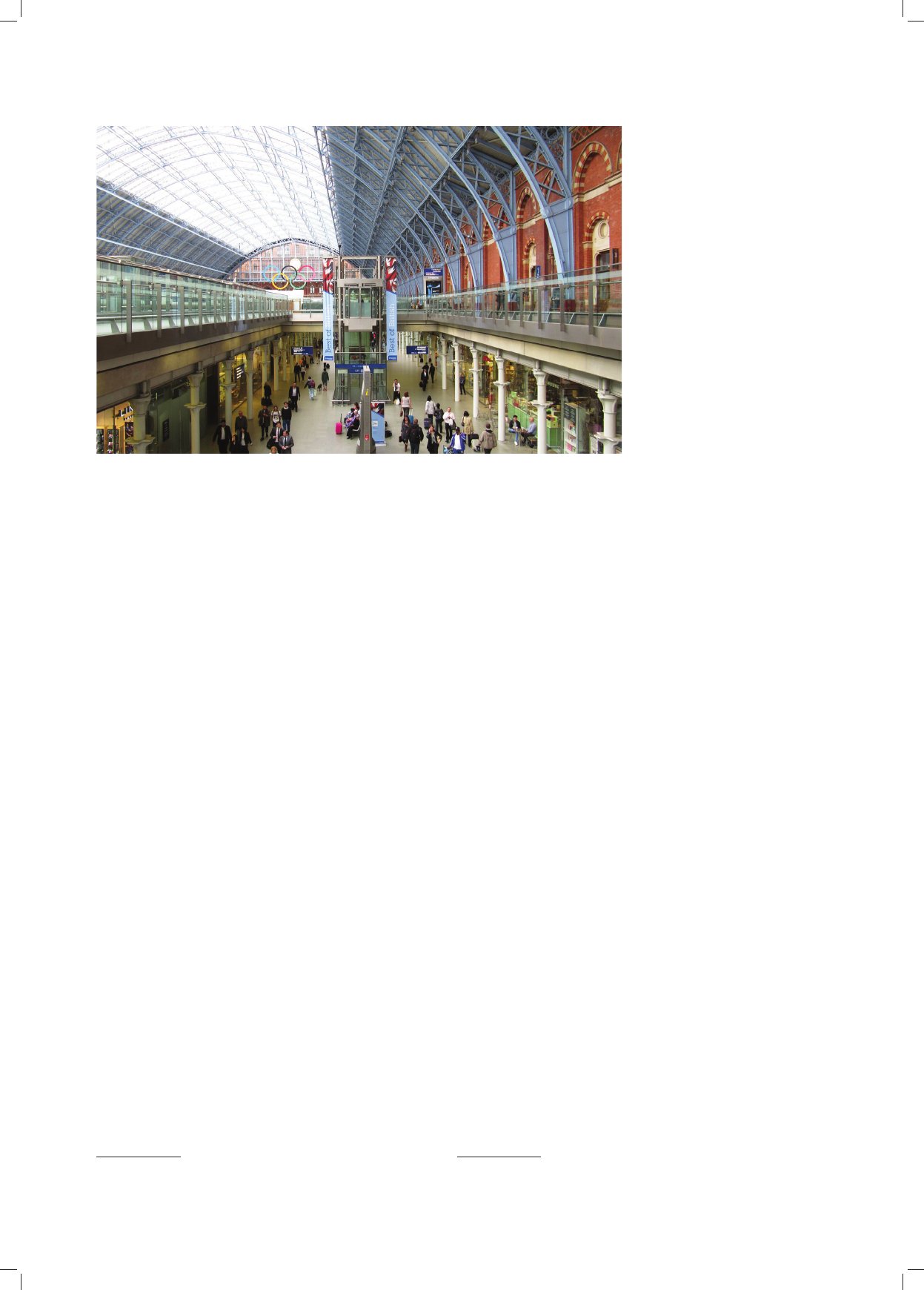
gów Eurostar rozpoczęła się w 2003 r. (il. 3). Halę perono-
wą przedłużono o 240 m. W roku podatkowym 2014/2015
dworzec obsłużył ponad 28 milionów pasażerów [5].
Przebudowę znajdującego się po drugiej stronie Pancras
Road dworca King’s Cross ukończono w 2012 r. Dwo rzec
ten połączono z dworcem St Pancras oraz ze sta cją metra
obsługującą sześć linii i 65 tysięcy pasażerów w poran-
nych godzinach szczytu, z przystankami au to busowymi
obsługującymi 14 linii i postojem taksówek. W ramach
rozbudowy powstał zachodni hol główny oraz nowa sieć
połączeń nadziemnych (kładki, antresole) i podziemnych
pomiędzy przystankami różnych środków transportu.
Obecnie przekształcane są przyległe do obu dworców te-
1
Dworzec Euston, mimo ogromnego publicznego sprzeciwu, zo
stał wyburzony w latach 1961–1962.
be a meeting place again. At present, the metro station
located under the station square and the roong of the
bus station designed from the side of the waterfront are
under construction. A tunnel for cars as well as a separate
tunnel for bicyclists and pedestrians is planned under
the ground level to facilitate the connection between the
historic part of the city and the marina for ferries going
north (Fig. 2).
Urban plans with the train station as their core
It should be noted that the extension of railway connec
tions with a simultaneous modernization of the train
stations can positively affect the designing in the urban
scale. The transformation of unused postindustrial areas
often located in the city centers provides a big opportu nity
for growth of a given area. Two train stations in Lon don
connected together to create one transport hub should be
men tioned here. Moving the highspeed rail stop (Channel
Tunnel Rail Link) from Waterloo International sta tion
be came a catalyst of changes taking place in this area.
St Pancras railway station was put on Statutory List of
Build ings of Special Architectural or Historic Interest
(Grade I) in 1967 and consequently it did not end up like
nearby Euston Station
1
. Its modernization and extension
including, e.g. making new canopy necessary for the
long Eurostar trains began in 2003 (Fig. 3). The pla t
form hall was extended by 240 m. In the nancial year
of 2014–2015 the estimation of annual entries/exits and
interchanges reached over 28 millions [5].
The restoration of King’s Cross train station which is
located on the other side of Pancras Road nished in 2012.
The station was connected with St Pancras railway sta
tion and the metro station operating six lines and 65,000
passengers in the morning rush hour, with bus stops
1
Euston train station, in spite of great public outcry, was demo
lished in 1961–1962.
Il. 3. Wnętrze dworca
St Pancras
w Londynie
(fot. K. Foljanty, 2012)
Fig. 3. Interior of
St Pancras Station
(photo by K. Foljanty, 2012)
Przekształcanie dworców i terenów kolejowych/Transformation of stations and railway areas 71
reny poprzemysłowe. Główny nacisk po łożono na stwo-
rzenie funkcji mieszanych, które będą przy ciągać różne
grupy użytkowników, przy założeniu mak sy malnego po-
łączenia z transportem publicznym oraz ruchem pieszym
i rowerowym. Założenie o nazwie King’s Cross Central,
obejmujące około 27 ha, zakłada budowę biur i budynków
mieszkalnych (uwzględniając mieszkania socjalne), jak
również adaptację ponad 20 zabytkowych obiektów na
nowe funkcje, w tym renowację hotelu przydworcowego
z 1854 r. (Great Northern Hotel). Ponadto zaprojektowa-
no 10 nowych otwartych przestrzeni publicznych na 40%
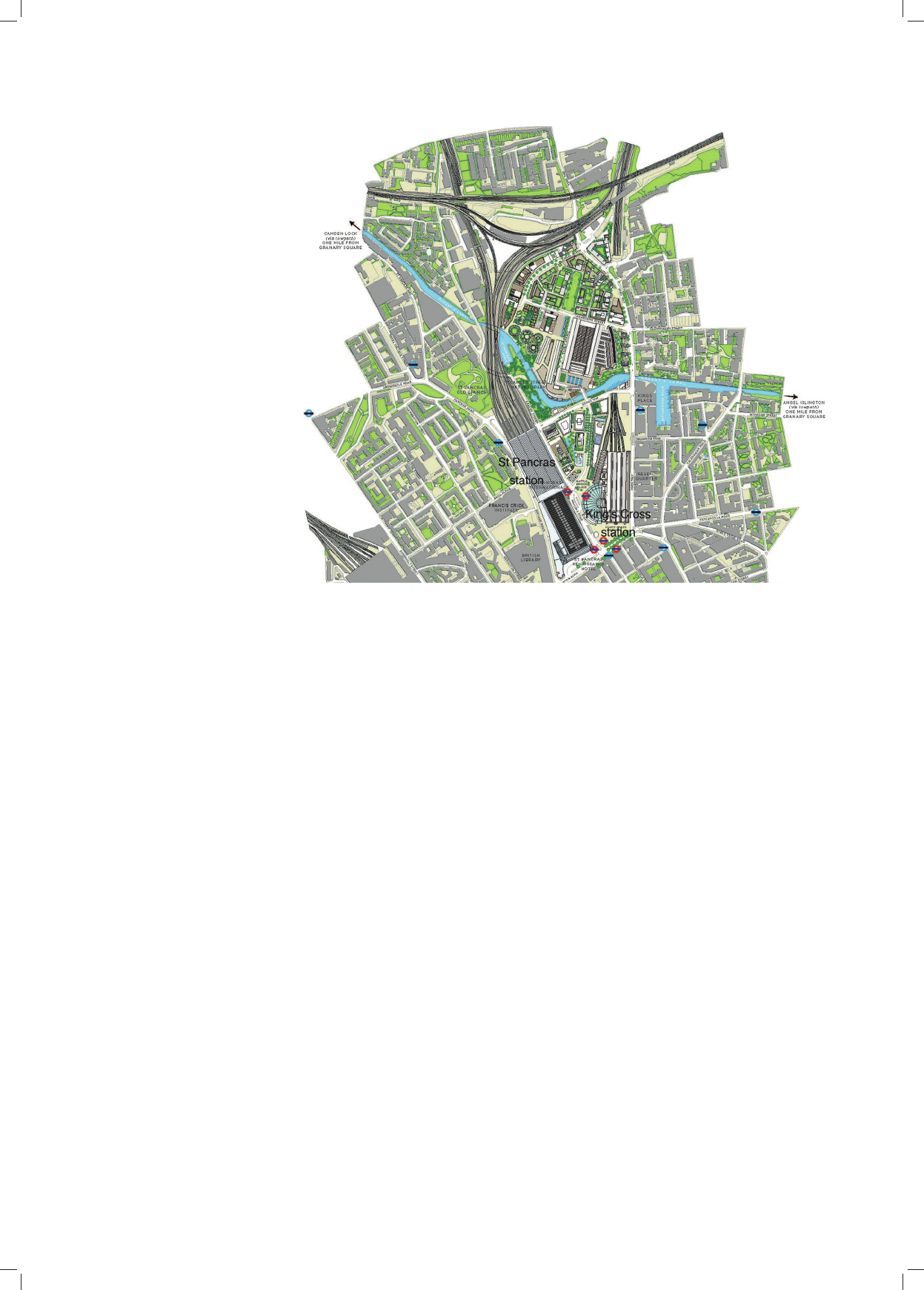
powierzchni całego terenu. Plan zagospodarowania (il. 4)
przygotowały w 2001 r. biura Allies and Morrison Archi-
tects oraz Porphyrios Associates. Po sześciu latach kon-
sultacji z administracją dzielnicową, burmistrzem Lon
dynu, organizacją English Heritage oraz mieszkańcami
uzyskano pozwolenie na budowę. Przeprowadzono wy-
wiady i ankiety na ulicy, konsultacje z grupami młodzieży
oraz organizowano imprezy, na których testowano różne
pomysły. Stoiska ustawione na wolnym powietrzu były
bardziej atrakcyjne dla mieszkańców niż rozpowszech
nio ne umieszczanie informacji w miejscowym ratuszu.
An kie ty przeprowadzało się również w trakcie budowy.
Ukoń czenie całego założenia przewidywane jest na 2020 r.
Przekształcanie terenów przylegających do działają-
cego dworca kolejowego różni się od przekształcania te-
renów industrialnych, na których przemysł już nie funk-
cjonuje. Priemus, Flyvbjerg i van Wee [6] podkreślają,
że jeszcze do niedawna sektor infrastruktury transportu
nasowany był wyłącznie ze środków publicznych, co
zwykle skutkowało słabą orientacją na rynku oraz nie-
doszacowaniem kosztów. Obecnie dominuje partnerstwo
operating 14 lines and a taxi stand. The extension included
the construction of the west main concourse and a new
network of abovetheground connections (footbridges
and mezzanines) and underground ones between stops
for various means of transportation. At present, the post
industrial areas located next to both stations are being
redeveloped. The main emphasis is placed on generating
residential functions which would attract different groups
of users, maintaining the maximum connection with
public transportation, pedestrian trafc and bicyclists. The
design called King’s Cross Central, covering about 27 ha,
encompasses the construction of ofces and residential
buildings (including council ats) as well as conversion
of over 20 historic structures to accommodate new func
tions, including a renovation of the hotel from 1854
(Great Northern Hotel). Furthermore, 10 new open public
spaces were designed on 40% of the whole area. The
development plan (Fig. 4) was developed in 2001 by
Allies and Morrison Architects together with Porphyrios
Associates. After six years of consulta tion with the di
strict administra tion, mayor of London, Eng lish Heri tage
and the residents the building permit was nally granted.
Street interviews and questionnai res were con ducted,
youth groups were consulted and events were organized
during which various ideas were tested. Open air stands
were more attractive for the residents than the information
provided in the local town hall. The que stionnaires were
also con ducted during the con struction. The completion of
the whole project is scheduled for 2020.
The transformation of the areas next to the operating
train station differs from the transformation of the in
du strial areas where no businesses operate any more.
Il. 4. Zagospodarowanie terenu
w rejonie dworców St Pancras
i King’s Cross w Londynie
(źródło: http://uli.org/wpcontent/
uploads/2014/06/p7Kings
Cross_marketingmodel.jpg,
data dostępu: 8.10.2014)
Fig. 4. Redevelopment in the
area of St Pancras and
King’s Cross Stations in London
(source: http://uli.org/wpcon-
tent/uploads/2014/06/p7Kings
Cross_marketingmodel.jpg,
accessed: 8.10.2014)

72 Katarzyna Foljanty
publicznoprywatne, które nastawione jest głównie na
zyski ekonomiczne. Należy pamiętać, że dworzec kole-
jowy nie jest źródłem sukcesu gospodarczego, ale jego
wynikiem [7]. Oosten [8] tak charakteryzuje zależność
między infrastrukturą a rozwojem: po pierwsze, żeby in-
westycje infrastrukturalne mogły mieć pozytywny wpływ
na wytwórczość, potrzebny jest wystarczający poziom
działalności produkcyjnej, po drugie, żadna liczba inwe-
stycji w infrastrukturę nie jest w stanie przezwyciężyć ne-
gatywnego wpływu niekorzystnej lokalizacji, a po trzecie
związek między inwestycją a wzrostem gospodarczym
jest współzależny.
Przekształcenia terenów kolejowych związanych
z dwor cem to jednocześnie projekty ingerujące w użytko-
waną przestrzeń publiczną przy jednoczesnym nastawie-
niu na zysk z nieruchomości. Oba te czynniki należy wy-
ważyć poprzez szczegółowy proces planowania, w który
powinni być zaangażowani przedstawiciele wielu profesji
oraz sami mieszkańcy. Jeśli te elementy nie zostaną od-
powiednio zbilansowane, ambitne megaprojekty mogą
spotkać się z silnym sprzeciwem publicz nym i poniosą
asko, powodując nie tylko straty nansowe, ale także
możliwą ponowną degradację terenu. Skomplikowanym
przykładem jest wielokrotnie krytykowany projekt Stut-
tgart 21 (S21). Rozległe tereny, które do tej pory zajmo-
wało torowisko, zostaną zagospodarowane pod obiekty
wielofunkcyjne. Bryła główna obecnego dworca czoło-
wego i przyległa do niej wieża staną się częścią nowe-
go kompleksu (skrzydła dworca opartego na planie litery
U zostały już wyburzone). Nowoczesny, podziemny dwo-
rzec zaprojektowano jako przelotowy i usytuowano po-
przecznie do istniejącego torowiska. Dziewięć głównych
wejść do dworca będzie się znajdować z czterech stron
świata. Dystrybucja ruchu nastąpi poprzez specjalną stre-
fę umieszczoną na poziomie ±0. Cztery perony zaprojek-
towano 11 m poniżej obecnego poziomu torowiska. Stąd
będzie bezpośredni dostęp do istniejącej stacji kolei aglo-
meracyjnej SBahn. Poprzez nowo zaplanowaną Athener
Strasse pasażerowie będą mieli dostęp do parkingu pod-
ziemnego umieszczonego pod północną częścią dwor-
ca. Miejsca krótkiego postoju przewidziano przy wieży
dworcowej oraz przy placu KurtaGeorga Kiesingera. Ja-
ko bezpośrednie połączenie pomiędzy placem a Schloss-
garten, ponad nową halą peronową, na poziomie terenu
znajdować się będzie teren pokryty roślinnością z wkom-
ponowanymi „świetlnymi wy pustkami”, świetlikami
o średnicy 15 m doprowadzają cymi światło dzienne do
podziemnych kondygnacji. Projekt ten pomimo swojej in-
teresującej idei przebudowy centralnie usytuowanego ob-
szaru o powierzchni około 100 ha spotkał się z ogromnym
sprzeciwem mieszkańców, którzy organizowali liczne de-
monstracje na terenie całych Niemiec. W 2007 r. urząd
miasta odrzucił prośbę mieszkańców o przeprowadzenie
referendum. W 2010 r. proces budowy został rozpoczęty
od częściowego wyburzenia istniejącego dworca, który
uznawany jest za ikonę architektury lat 20. XX w. oraz
za jeden z najbardziej znanych symboli Stuttgartu. Wy-
wołało to kolejną falę sprzeciwów. Protestujący byli bar-
dzo dobrze poinformowani o szczegółach alternatywnego
planu „K21”. Opór zapoczątkowany przez wielokrotne
Prie mus, Flyvbjerg and van Wee [6] stress that until re
cently the sector of transportation infrastructure was
nanced ex clu si vely with public funds, which usually
resulted in poor market knowledge and cost under esti
mation. At present, the publicprivate partnership is do
minant and it is oriented mainly to making prot. It should
be kept in mind that the train station is not a source of
eco no mic success but its effect [7]. Oosten [8] describes
the rela tionship between infrastructure and growth as
follows: rstly, in order for the infrastructure in vest
ments to positively affect manu fac turing, the le vel of pro
duction ope rations needs to be high enough; secondly, no
number of invest ments in in frastructure can over come
the negative inuence of in con venient loca tion; and third
ly, the rela tion ship between investment and the eco nomic
growth is interdependent.
The transformations of railway areas connected with
the train station are at the same time projects invading
the used public space and intended to make prot on
property. Both of the factors should be balanced through
a careful planning process involving the representatives
of many professions as well as the residents themselves.
If the elements are not properly balanced, the ambitious
megaprojects can face a strong public resistance and fail,
causing not only nancial losses but possible degrada
tion of the area as well. The Stuttgart 21 (S21) develop
ment pro ject, which was criticized on many occasions,
is a com plicated example. Large areas which previously
were occupied by railway tracks will be used for multi
pur pose structures. The main building of the current ter
minus station and the tower adjacent to it will become
a part of a new facility (the wings of the station on the
letter U plan have already been demolished). The modern,
under ground train station is designed as a through station
and it is situated crosswise to the existing track. Nine main
entrances to the station will be located from four cardinal
points of the compass. The trafc will be distributed
through a special zone located on level ±0. Four platforms
are designed 11 m below the present track level to provide
direct access to the existing station of the subur ban rail
way system (SBahn). The passengers will have access
to the underground parking lot in the north part of the
station through newly designed Athener Strasse. A short
term parking space is designed by the station tower and
by KurtGeorg Kiesinger square. As a direct connection
between the square and Schlossgarten, going above the
new platform hall, at ground level, there will be a green
area with skylights 15 m in diameter to allow daylight
to underground levels. In spite of its interesting idea to
re develop the centrally located site of the area of about
100 ha the project was strongly opposed by the residents
who organized numerous protests all over Germany. In
2007, the city ofce rejected the request of the residents
to hold a referendum. In 2010, the con struction pro
cess
started with partial demolition of the existing station which
is considered to be an icon of architecture of the 1920s and
one of the most famous symbols of Stuttgart. It caused
another wave of protests. The protesters were very well
informed of the details of the alternative plan “K21”. The
outcry, which was initially caused by the exceeding costs

Przekształcanie dworców i terenów kolejowych/Transformation of stations and railway areas 73
przekroczenie kosztów szybko przekształcił się w nazwa-
nie procesu planowania S21, rozpoczętego na początku lat
90. XX w., niedemokratycznym i preferującym rozwiąza-
nia zapewniające wyłącznie zyski nansowe niemieckim
kolejom (Deu tsche Bahn – DB). W 2011 r., po kilku ty-
godniach mediacji wyrażono zgodę na przeprowadzenie
referendum poprzedzonego analizą studium przypadku.
Pomiędzy rozpoczęciem planowania a budową minęło
ponad 15 lat, okres ten przyniósł zmiany na wielu pozio-
mach. Takie rozłożenie w czasie jest częstym problemem
dużych projektów urbanistycznych, które rozpoczynają
się od dość abstrakcyjnych denicji celów. Na każdym
etapie plan staje się coraz bardziej konkretny, a możliwość
wpłynięcia na jego wynik maleje. Uwaga opinii publicz-
nej działa wprost proporcjonalnie: pierwsze etapy plano-
wania nie są dla większości mieszkańców zbyt interesują-
ce, ponieważ nie znają oni jeszcze ich lokal nych efektów.
Z chwilą rozpoczęcia budowy ludzie uz my sławiają sobie
skutki, jakie może ona przynieść. Przykład Stuttgartu 21
ukazuje, że nawet w kraju o długiej tradycji silnej opozy-
cji wobec projektów infrastrukturalnych (np. przeciwko
rozbudo wie portu lotniczego we Frankfurcie nad Menem
czy budo wie linii Transrapid maglev pomiędzy Berlinem
a Hamburgiem) przeprowadzanie wszystkich formal nych
etapów partycypacji publicznej za pisanej w niemiec kim
prawie budowlanym może być niewystarczające.
Trudny okazał się również projekt w Leuven. Pod ko-
niec lat 80. XX w. koleje belgijskie (Nationale Maatschap-
pij der Belgische Spoorwegen – SNCB/NMBS) zwróciły
uwagę na potencjał drzemiący w ich nieruchomościach.
Inwestycja w Leuven jest pierwszym związanym z dwor-
cem kolejowym belgijskim przedsięwzięciem, przy któ-
rym współpracowały władze publiczne, prywatni inwe-
storzy i zespoły projektowe. W latach 70. i 80. XX w.
nastąpiła degradacja terenów po północnej stronie dwor-
ca. Suburbanizacja i upadek przemysłu spowodowały
migrację rm do sąsiednich gmin, wzrost użycia samo-
chodów i zmniejszenie się liczby osób korzystających
z kolei. Pierwsze plany przekształceń omawianych tere-
nów kolejowych sięgają początku lat 90. ubiegłego wie-
ku. Od 2000 r. w sąsiedztwie dworca powstała nowa hala
peronowa, parking dla samochodów, parking rowerowy,
dworzec autobusowy, Centrum Administracji Flamandii
(Vlaams Administratief Centrum – VAC), obiekty biuro-
we i mieszkaniowe, kładka dla pieszych i rowerzystów
oraz tunel podziemny łączący historyczne centrum miasta
Leuven z KesselLo (il. 5). Równolegle do procesu plano-
wania następowały przemiany społeczne, które wpłynęły
na końcowy projekt, w szczególności: restrukturyzacja
spółki kolejowej, realizacja sieci kolei dużych prędkości
oraz rozwój lokalnego browaru Stella Artois. Niezależnie
od istotnego rozwoju zycznego, projekt ma ograniczony
wpływ na zrównoważone odnowienie relacji społecznych
[9]. W rezultacie silnych sugestii ze strony rady miasta,
ministerstw, spółek: autobusowej i kolejowej oraz lobby-
stów interesy społeczne nie były w procesie planowania
reprezentowane. Projekt przekształceń dworca kolejowe-
go i jego otoczenia zastąpił nieużytkowane tereny kole-
jowe głównie zabudową biurową i administracyjną (bez
połączenia z obszarem sąsiadującym) – nie udało się uzy-
many times, quickly turned into calling the S21 planning
process, which started at the beginning of the 1990s,
undemocratic and preferring solutions guaranteeing only
nancial prots for German railway company (Deutsche
Bahn – DB). In 2011, after a few weeks of mediation,
a permit was granted to hold a referendum preceded by
a case study analysis. Over 15 years passed between the
beginning of planning and the construction, the period
brought changes at many levels. Such a stretch over time
is a frequent problem with largescale urban projects
which begin with a rather abstract denition of goals.
At every stage the plan becomes more and more specic
and the possibility of affecting its result weakens. The
attention of public opinion is directly proportional: the
rst stages of planning are not really interesting for most
residents because they do not know yet their local effects.
When the construction begins people realize the effects
it can have. The example of Stuttgart 21 demonstrates
that even in the country with a long tradition of strong
opposition against infrastructure projects (e.g. against the
extension of the airport in Frankfurt am Main or the con
struction of Transrapid maglev line between Ber lin and
Hamburg) conducting all formal stages of public par ti ci
pation provided for in the German construction law can
be insufcient.
The project in Leuven also proved difcult. At the
end of the 1980s, the Belgian railway (Nationale Maat
schappij der Belgische Spoorwegen – SNCB/NMBS)
noticed the potential hidden in their property assets.
The investment in Leuven is the rst Belgian under
taking connected with a train station implemented with
cooperation of pub lic authorities, private investors and
design teams. In the 1970s and in the 1980s, the areas
on the north side of the sta tion deteriorated. The subur
banization and the collapse of industry caused the mi
gration of companies to nearby districts, the increase
in the use of cars and decrease in the number of people
using trains. The rst plans of the trans for mation of the
railway areas in question were made at the beginning of
Il. 5. Nowa hala peronowa dworca w Leuven
(źródło: www.samynandpartners.be, data dostępu: 20.10.2015)
Fig. 5. New train sched in Leuven
(source: www.samynandpartners.be, accessed: 20.10.2015)

74 Katarzyna Foljanty
skać równowagi pomiędzy potrzebami gospodarczymi,
społecznymi i kulturalnymi w tym rejonie. Mimo zmia-
ny postrzegania Leuven jako aktywnego i atrakcyjnego
miasta van den Broeck podkreśla, że projekt ten przyczy-
nił się do symptomatycznego wzrostu imigracji wysoko
wykwalikowanych pracowników, znacznego wzrostu
cen gruntów i nieruchomości, a przez to do zmniejszenia
różnorodności subkulturowej istniejącej na tym obszarze
przed 1970 r. [9].
Wiele dużych i interesujących projektów się ogranicza,
a nawet nie wychodzą poza proces planowania (Frankfurt
21, Monachium 21). Za przykład może posłużyć projekt
w Rotterdamie. Dworzec z 1957 r. ze względu na zwięk-
szającą się liczbę pasażerów okazał się zbyt mały i został
wyburzony 50 lat później. W 2001 r. architekci z biura
Willa Alsopa opublikowali koncepcję nowego dworca
oraz plan zagospodarowania 20 ha powierzchni wokół
niego. Założenie przewidywało budowę „rotterdamskiego
Manhattanu”, który miałby przyciągnąć największe rmy.
Architekt twierdził, że będzie to katalizatorem dalszej re-
generacji tej części miasta. Ostatecznie skala projektu zo-
stała bardzo zmniejszona. Zaprojektowano infrastrukturę
ściśle związaną z węzłem przesiadkowym: dworzec au-
tobusowy, stację metra, parking dla rowerów, parking na
760 samochodów oraz place przydworcowe. Will Alsop
zrealizował małą część pierwotnego planu zagospoda-
rowania jako projekt wielofunkcyjny o nazwie Calypso.
Przy udziale trzech biur architektonicznych dworzec ko-
lejowy zaprojektowano tak, aby do 2025 r. mógł przyjąć
trzykrotnie większą liczbę pasażerów. Jego otwarcie na-
stąpiło w 2014 r.
Przebudowa dworców kolejowych w Polsce
W posiadaniu PKP S.A. znajduje się ponad 2500 dwor-
ców kolejowych (z czego w sierpniu 2014 r. 596 było
czynnych dla ruchu pasażerskiego), które funkcjonują
w czterech kategoriach. W kategorii A o rocznej odprawie
podróżnych powyżej 2 milionów znajduje się 15 dwor-
ców (stan na 6.02.2009). W 2010 r. została powołana
spółka Dworzec Polski S.A., której głównym zadaniem
miało być zarządzanie 72 największymi dworcami ko-
lejowymi. W ramach procesu restrukturyzacji w grupie
PKP spółkę zlikwidowano dwa lata później. Można przy-
puszczać, że niejasne i skomplikowane administrowanie
dworcami i związane z tym zagadnienia prawne i orga-
nizacyjne, brak środków na modernizacje i utrzymanie
są przyczynami zaniedbania obiektów dworcowych oraz
trwającej latami degradacji. Z raportu w sprawie rewita-
lizacji dworców kolejowych opracowanego przez Rail-
way Business Forum wynika, że 65% dworców w Polsce
w 2011 r. pozostawiało wiele do życzenia pod względem
technicznym.
W związku z organizacją mistrzostw Europy w piłce
nożnej i ustaleniem możliwości współnansowania mo-
dernizacji dworców kolejowych z budżetu państwa, inwe-
stycje związane z poprawą warunków panujących na kolei
stały się sprawą priorytetową w projektach stra tegicznego
rozwoju transportu. W latach 2010–2013 zostało zmoder-
nizowanych i oddanych do użytku 47 dwor ców. W 2014 r.
the 1990s. A new platform hall was built near the station
after 2000, a parking lot, a bicycle parking facility, a bus
station, Flemish Administration Center (Vlaams Admi ni
stratief Centrum – VAC), ofce and residential build ings,
a footpath and bicycle bridge as well as an
underground
tunnel connecting the historic center of Leuven with Kessel
Lo (Fig. 5). The planning process was accompanied by
social changes which affected the nal design, especially
the restructuring of the rail way company, the building of
the highspeed rail network and the development of the
local brewery Stella Artois. Regardless of the signicant
physical development, the project has a limited impact
on the sustainable renewal of social relations [9]. As
a result of strong suggestions on the part of the city
council, ministries, bus and railway companies as well
as lobbyists the social interests were not represented in
the process of planning. The project of transformation of
the train station and its surround ings replaced the unused
railway areas mainly with ofce and administration
buildings (with no connection with the neighboring area)
– the balance between the economic, social and cultural
needs in that area was not provided. Although Leuven was
no longer perceived as an inactive and unattractive city
van den Broeck stresses that the project contributed to
a characteristic growth in immi gration of highly qualied
employees, a signicant increase of land and property
prices and consequently to reducing sub cultural diversity
existing in this area before 1970 [9].
Many interesting, largescale projects are limited and
they do not even go beyond the planning process (Frank
furt 21, Monachium 21). The project in Rotterdam can
be used as a good example. The train station from 1957
proved too small, as the number of passengers grew, and
it was demolished 50 years later. In 2001, the architects
from Will Alsop’s ofce published a concept of a new
train station and the development plan for 20 ha of the
area around it. The project included the construction of
a “Rotterdam Manhattan” that would attract the biggest
companies; the architect claimed that this would be
a ca talyst for further regeneration of that part of the city.
Ulti mately, the scale of the project was greatly reduced.
The infrastructure was designed to be closely connected
with the transport hub: bus station, metro station, bicycle
parking facility, parking lot for 760 cars and squares by
the station. Will Alsop implemented a small part of the
original development plan as a multifunctional project
called Calypso. The train station was designed by three
ar chi tectural ofces so that it could receive three times
more passengers by 2025. It was opened in 2014.
The redevelopment of train stations in Poland
PKP S.A. (Polish State Railways) owns over 2500 train
stations (596 of which were opened for passenger trafc
in August 2014) ope rating in four categories. Category
A – 15 stations (as of 6.02.2009) with more than 2 million
travelers annually. In 2010, the company Dworzec Pols
ki S.A. was established and its main objective was to
manage 72 biggest train stations. During the restructuring
process in PKP group the company was liquidated two

Przekształcanie dworców i terenów kolejowych/Transformation of stations and railway areas 75
oddano 12 dworców, a kolejne 15 znajduje się w trak-
cie realizacji [10]. Większość inwestycji doprowadziła
do przywrócenia chociażby częściowego blasku budyn-
kom dworcowym (m.in. Warszawa Centralna, Warszawa
Wschodnia, Wrocław Główny, Opole Główne, Gdynia
Główna) i wiatom peronowym, jednak z powodu krótkich
terminów modernizacje ograniczono głównie do poprawy
stanu technicznego zabytkowych obiektów, stworzenia
centrum obsługi klienta oraz nowych lokali gastronomicz-
nych i handlowych.
Projektem, który uwzględnia przyszłe plany rozbudo-
wy dworca do obsługi linii KDP, jest przebudowa dworca
Łódź Fabryczna na dworzec podziemny przy jednocze-
snej przebudowie układu komunikacyjnego i zagospoda-
rowaniu terenów przyległych w ramach projektu Nowe
Centrum Łodzi. Założenie urbanistyczne o łącznej po-
wierzchni około 100 ha podzielono na trzy strefy:
– strefa 1 o funkcjach handlowych, mieszkaniowych
i kulturalnych,
– strefa 2 o funkcjach komercyjnych przy zachowaniu
budynków historycznych,
– strefa 3 o gęstej zabudowie historycznej wymagają-
cej modernizacji i uzupełnień.
W oparciu o koncepcję urbanistyczną został sporzą-
dzony MPZP dla tego terenu. Na jego podstawie Miasto
Łódź przygotowuje oferty dla inwestorów prywatnych.
W ramach nowego węzła komunikacyjnego powstanie
dworzec autobusowy, parking P+R i parking dla rowerów,
a także nastąpi przebudowa systemu drogowego wokół
dworca. Dyrektor spółki powołanej do budowy nowe-
go dworca zapowiedział, że we wnętrzu nowego obiek-
tu zostaną odwzorowane fasady starego dworca. Projekt
przewiduje 44 000 m
2
powierzchni użytkowej z czego
4000 m
2
przeznaczonych na handel i gastronomię. W re-
alizacji znajduje się również zagospodarowanie komplek-
su pobliskiej elektrociepłowni EC1 z 1907 r. na funkcje
związane z kulturą i sztuką, włączając Centrum Nauki
i Techniki oraz Centrum Sztuki Filmowej.
Kontrowersyjnym okazał się projekt nowego dwor-
ca głównego w Katowicach. Informacja o wyburzeniu
starego obiektu wywołała falę sprzeciwu polskich i za-
granicznych architektów. Utajone negocjacje pomiędzy
PKP a inwestorem doprowadziły do podpisania umowy
w 2009 r. Miesiąc później inwestor zapowiedział, że wy-
burzenie unikatowej konstrukcji zadaszenia jest koniecz-
ne ze względu na zły stan techniczny. Nowy dworzec,
gdzie podobnie jak w projekcie dworca w Łodzi pojawiły
się odtworzone elementy konstrukcyjne nawiązujące do
dawnej bryły, to połączenie dworca kolejowego z Gale-
rią Katowicką oraz podziemnym dworcem autobusowym.
Cały kompleks otwarto w 2013 r.
Pierwsze plany przebudowy terenów przy dworcu Kra-
ków Główny sięgają lat 70. ubiegłego wieku. W 1995 r.
rozpisano konkurs, na podstawie którego stworzono tzw.
Plan Koordynacyjny Krakowskiego Centrum Komuni-
kacyjnego (KCK), w którym przyjęto, że obszar wokół
dworca zostanie zagospodarowany na centrum wielo-
funkcyjne [11]. Spory związane z użytkowaniem grun-
tów zostały rozstrzygnięte siedem lat później. Na prze-
strzeni lat projekt był stopniowo ograniczany zarówno
years later. It can be assumed that the unclear and com
plicated managing of the train stations as well as the legal
and organizational issues connected with it, the lack of
funds for modernization and maintenance have been the
reasons of the neglect of the railway structures and their
deterioration for years. The report on revitalization of
train stations developed by the Railway Business Forum
indicates that the technical condition of 65% of train
stations in Poland in 2011 was very bad.
In connection with the hosting of Euro pean Soccer
Cham pionship and agreeing on the possi bi lity of co
nancing the modernization of train stations from the
state budget the investments connected with the im pro
vement of railway conditions became a priority in the
strategic projects for the development of transportation.
In 2010–2013, 47 train stations were modernized and put
in operation, 12 train stations in 2014, and 15 more are
under reconstruction [10]. Most in vestments resulted in at
least partial restoration of the train station buildings (e.g.
Warszawa Centralna, Warszawa Wschodnia, Wrocław
Głów ny, Opole Główne, Gdynia Główna) and platform
roofs, however, due to short deadlines the modernizations
were limited mainly to improving the technical condition
of historic structures, establishing customer service cen
ters as well as new food and services outlets.
The remodeling of Łódź Fabryczna train station into an
underground train station combined with the remodeling
of the transportation system and the development of the
adjacent areas within the Nowe Centrum Łodzi project
is a project which takes into account the future plans of
extension of the train station to operate the highspeed
rail. The urban layout of the total area of about 100 ha was
divided into three zones:
– zone 1 with commercial, residential and cultural ser
vices,
– zone 2 with commercial services, maintaining histo
ric buildings,
– zone 3 with compact historic architecture requiring
modernization and inll elements.
A Local Development Plan was elaborated on the basis
of the master urban concept for this area, which in turn is
the basis for the City of Łódź preparing offers for private
investors. The new transportation node will include a bus
station, P+R facility and parking space for bicycles. The
road layout around the train station will be redeveloped.
The director of the company established to build a new
train station declared that the interiors of the new structure
will render facades of the old train station. The project
will have 44,000 m
2
of oor area, including 4,000 m
2
with
commercial services and food. The project includes also
the conversion of the nearby heat and power station EC1
from 1907 for culture and art purposes, such as a Science
and Technology Center or Film Art Center.
The project of the new main train station in Katowice
proved controversial. The information about the demo li
tion of the old structure stirred a wave of protest of Polish
and foreign architects. The secret negotiations between
PKP and the investor ended up in signing an agreement
in 2009. A month later the investor said that the demoli
shing of the unique roof structure is necessary due to its

76 Katarzyna Foljanty
pod względem powierzchni terenu, jak i różnorodności
funkcji. W os tateczny skład KCK weszły: budowa regio-
nalnego dwor ca autobusowego, budowa tunelu drogowe-
go i tunelu szybkiego tramwaju oraz przebudowa dwóch
ulic wraz z torowiskiem tramwajowym. Ostatnim etapem
budowy był nowy podziemny dworzec kolejowy otwarty
w 2014 r. Polskie Koleje Państwowe szukają obecnie po-
mysłów na nową funkcję dla starego budynku.
Mniejsze dworce przekazywane są często jednostkom
samorządu terytorialnego i Skarbowi Państwa. W 2013 r.
przejęły one od PKP S.A. 84 budynki, prowadzone są roz-
mowy o kolejnych 150 obiektach [12]. Dworce takie jak
Świdnica Miasto czy Toruń Główny zostały wyremonto
wane w ramach środków unijnych. Część byłych budyn-
ków dworcowych, które nie pełnią już funkcji związanych
z obsługą transportu, adaptowana jest na funkcje społecz-
nokulturalne. Przykładami są: Centrum Edukacji, Tu-
rystyki i Kultury w byłym dworcu Stronie Śląskie (woj.
dolnośląskie), Miejska Biblioteka Publiczna w Sokołowie
Podlaskim (woj. mazowieckie) oraz dworzec w Radzion-
kowie (woj. śląskie) obecnie przekształcany na Centrum
Dokumentacji Deportacji Górnoślązaków do ZSRR.
Podsumowanie
Wiele czynników, w tym brak funduszy na odbudowę
i modernizację oraz zwiększająca się popularność samo-
chodu jako luksusowego środka transportu doprowa dziło
po II wojnie światowej do spadku zainteresowania trans-
portem kolejowym. W efekcie kolej utraciła swój pe wien
romantyczny urok i zaczęła być postrzegana jako środek
transportu dla osób, które nie mogą sobie pozwolić na za-
kup samochodu lub podróż samolotem. Dworce kolejowe
zaczęły popadać w ruinę, a taki stan wywołał problemy
społeczne na obszarach przyległych do budynków dwor-
cowych (np. powstanie tzw. dzielnic czerwonych latarni).
Czynniki takie jak dewastacja obiektów, pojawienie się
bezdomnych i narkomanów przez wiele lat tworzyły nie-
korzystny obraz dworców i stawały się barierą psycholo-
giczną dla potencjalnych użytkowników kolei.
W 1996 r. von Gerkan wymienił trzy podstawowe za-
dania na przyszłość odnoszące się do transportu kolejo-
wego i dworców: atrakcyjność podróży, nową oryginalną
architekturę dworców kolejowych i szansę na nowy etap
rozwoju miasta poprzez transformacje pokolejowych,
centralnie położonych terenów z dworcem kolejowym ja-
ko ich rdzeniem [13]. Od lat 80. XX w. następuje zmiana
wizerunku kolei w Europie, a co za tym idzie, zmiana wi-
zerunku samego dworca, który staje się atrakcyjnym miej-
scem w mieście. W Niemczech po prywatyzacji kolei,
w 1996 r. wprowadzono program „Bahnhof 21”, którego
ideą było przekształcenie miejskich terenów kolejowych
przy współpracy z władzami regionalnymi i lokalnymi.
W skład tego przedsięwzięcia wchodzą projekty: Neu-
Ulm 21, Saarbrücken 21, Stuttgart 21 i inne.
Dominujący staje się model dworca jako wielofunk-
cyjnego pasażerskiego terminalu przesiadkowego łączą-
cego atrakcyjną architekturę z wygodą i efektywnoś
cią,
co oprócz znacznego ułatwienia ruchu dla pasażerów
zwiększa przewozy samej kolei, a także powoduje ak-
poor technical condition. The new train station, with the
restored structural elements alluding to its former build
ing similar to those in the design of the train station
in Łódź, is a combination of the train station with Kato
wic ka Galeria shopping center and underground bus sta
tion. The whole complex was opened in 2013.
The rst plans of the redevelopment of the areas by
Kraków Główny train station come from the 1970s. In
1995, a competition was announced on the basis of which
the so called Coordination Plan for Cracow Transit Sy
stem Center was approved which provided that the area
around the station would be converted to a multi func tion
center [11]. The disputes connected with the use of the
land were resolved seven years later. Over the years, the
project was gradually limited in respect of both the area
and the diversity of functions. Ultimately, the Coordination
Plan included the construction of the regional bus station,
the construction of the road tunnel and fast tram tunnel
as well as the reconstruction of two streets with a tram
track. The last stage of the construction was a new under
ground train station opened in 2014. At present, Polish
State Railways (PKP S.A.) is looking for ideas for a new
function of the old building.
Smaller train stations are often transferred to local au
thorities and the State Treasury. In 2013, those two entities
took over 84 buildings from PKP S.A. and there are talks
about 150 more structures [12]. The train stations, such
as Świdnica Miasto or Toruń Główny were renovated
with the Union’s funds. Some of the former train station
buildings which no longer provide any transportation
ser vices are converted for social and cultural functions.
Examples include Education, Tourism and Culture Cen
ter in the former Stronie Śląskie train station (Lower
Si lesia Province), Public Library in Sokołów Podlaski
(Ma zovia Province) and the train station in Radzionków
(Si lesia Province) currently converted to the Center for
Do cu men tation of Deportation of Upper Silesians to the
USSR.
Conclusion
Many factors, including the lack of funds for the re
storation and modernization as well as the growing po
pularity of the car as a luxurious means of transportation,
resulted in the decline of interest in railway transportation
after World War II. Consequently, the train lost its some
what romantic charm and was perceived as a means of
transportation for those who cannot afford to buy a car
or to travel by plane. Train stations began to fall into ruin
and that caused social problems in the areas around train
station buildings (e.g. red light districts emerged). The
factors, such as vandalism of structures, homeless people
and drug addicts resulted in a negative reputation of the
train stations for many years and they provided a mental
barrier for prospective railway users.
In 1996, von Gerkan mentioned three basic objec tives
for the future regarding railway transporta tion and train
stations: travel attractiveness, new origi nal archi tec ture of
train stations and a chance for a new city deve lopment
stage through the transformations of postrailway, cen

Przekształcanie dworców i terenów kolejowych/Transformation of stations and railway areas 77
tywne oddziaływanie takiego dworca na uatrakcyjnienie
okolicy. Ze względu na zwiększenie (lub zmniejszenie)
intensywności niektórych usług i zapewnienie komfortu
oczekiwanego przez użytkowników oraz dostosowanie
do nowych wymagań technicznych, węzły przesiadkowe
łączące systemy komunikacji dalekobieżnej, regional nej
i lokalnej wymagają na przestrzeni lat powiększenia lub
przebudowy. Dlatego też w procesie planowania bardzo
ważne staje się kształtowanie bryły i jej zadaszenia oraz
wnętrza pozwalające na elastyczność dostosowania dwor-
ca wraz z terenami przyległymi do nowych potrzeb. Prze-
kształcanie historycznych dworców kolejowych stanowi
okazję do reorganizacji sąsiadujących obszarów oraz po-
zwala na stworzenie przestrzeni publicznych i terenów
zielonych. Śródmiejska lokalizacja wielu stacji kolejo-
wych sprawia, że są to idealne miejsca na nowe węzły
komunika cyj ne połączone z obiektami aktywności miej-
skiej związanymi z biznesem i kulturą, zapewniającymi
napływ różnych grup użytkowników również poza godzi-
nami szczytów komunikacyjnych. Dobrymi przykładami
przekształceń budynków dworcowych w wielozadaniowe
obiekty przestrzenne są londyńskie dworce King’s Cross
i St Pancras oraz przyległe do nich tereny pokolejowe
i poprzemysłowe.
Historyczne budynki dworcowe są częścią tożsamo-
ści lokalnej społeczności, trwałym znakiem przestrzen-
nym, stąd istnieje potrzeba zachowania i adaptacji takich
obiektów do zmieniających się uwarunkowań przestrzen-
nofunkcjonalnych danego miejsca. Budynki zabytko-
we stanowią często dominanty przestrzenne w pamięci
mieszkańców, dlatego ich burzenie i nieuwzględnienie
w procesie planowania partycypacji publicznej może
przyczynić się do silnego oporu publicznego (np. dwo-
rzec Katowice Główne, Stuttgart 21). Zabytkowe dworce,
zmodernizowane z poszanowaniem elementów historycz-
nych, jednakże odpowiadające współczesnym wymaga-
niom funkcjonalnym i posiadające atrakcyjne rozwiązania
konstrukcyjne mogą ponownie stać się wizytówką przed-
siębiorstw kolejowych i miast, zwiększając przy tym ich
prestiż i podnosząc walory estetyczne okolicy.
trally located areas with train stations as their cores [13].
The reputation of the railway in Europe began to change
in the 1980s and consequently the reputa tion of the train
station itself, which becomes an attrac tive place in the
city. After privatiza tion of rail ways in Germany in 1996,
the “Bahnhof 21” pro gram was implemented; its main
idea was to transform the city railway areas with the par
ticipation of the regional and local authorities. That under
taking included the projects, such as, e.g. NeuUlm 21,
Saarbrücken 21, Stuttgart 21.
The model of the train station as an intermodal passen
ger node, combining attractive architecture with comfort
and effec tiveness became dominant, which apart from
signicantly improving the trafc of passengers in general
also in creases the railway travel efciency and makes such
train stations actively affect unattractive neighborhood. As
a re sult of an increase (or decrease) in the intensiveness
of some services and providing comfort expected by the
users and adjustment to new technical requirements, the
trans port hubs which connect the longdistance, regional
and local transformation systems require extension or re
development over the years. That is why it is very im
portant to plan the buildings and their canopies as well
as interiors in such a way as to provide for exibility in
ad justing the train station with its surroundings to new
needs. The transformation of historic train stations into
transit centers is a chance to redevelop the neigh boring
areas as well as create public spaces and green areas. Due
to their downtown location many train sta tions provide
perfect spaces for new transport hubs con nected with
struc tures accommodating urban activities connected
with business and culture, providing inux of various
groups of users also outside the rush hour. Good exam ples
of transformations of train station buildings into multi
purpose space structures include London’s King’s Cross
and St Pancras train stations with the postrailway and
postindustrial areas around them.
Historic train station buildings are part of the identity
of the local communities, permanent punctuation marks
and that is why there is a need to save and convert such
structures to the changing space and functions of a given
place. Historic buildings are often imprinted as landmarks
in the residents’ minds and that is why their demolition
and failure to take them into account when planning pub
lic participation can cause a serious public resistance
(e.g. Katowice Główne, Stuttgart 21). Historic train sta
tions, modernized with respect to historic elements, but
still meeting the contemporary requirements in the scope
of func tionality and providing attractive construction so
lu tions can again become a positive mark of the railway
en tities and the cities, increasing their prestige and im
proving the local aesthetic qualities.
Translated by
Tadeusz Szałamacha

78 Katarzyna Foljanty
Bibliografia /References
[1] Peters D., Novy J., Rail Station Mega-Projects: Overlooked Cen-
trepieces in the Complex Puzzle of Urban Restructuring in Europe,
„Built Environment” 2012, Vol. 38, No. 1, 5–12.
[2] Peters D., The Renaissance of Inner-City Rail Station Areas: A Key
Element in Contemporary Urban Restructuring Dynamics, „Criti-
cal Planning” 2009, No. 16, 163–185.
[3] Modern trains and splendid stations: architecture, design, and rail
travel for the twenty-rst century, M. Thorne (ed.), Merrell Pub
lishers, Chicago 2001.
[4] Załuski D., Śródmiejskie przestrzenie podróży – dworce kolejowe,
Politechnika Gdańska, Gdańsk 2010.
[5] Ofce of Rail and Road, Estimates of station usage, http://orr.gov.
uk/statistics/publishedstats/stationusageestimates [accessed:
10.06.2016].
[6] Decision-making on mega-projects: cost-benet analysis, planning
and innovation, H. Priemus, B. Flyvbjerg, B. van Wee (ed.), Elgar,
Cheltenham 2008.
[7] de Jong M., European high-speed train station areas: the re nais-
sance of the railway station, European Transport Conference 2009,
http://abstracts.aetransport.org/paper/download/id/3116 [accessed:
12.12.2014].
[8] Oosten W., Railway stations and a geography of networks, [w:]
Paper presented at the 6th Annual Congress of the Netherlands
Research School for Transport, Infrastructure and Logistics. The
Congress took place at The Hague, December 12
th
2000, Delft
2000, 1–12.
[9] van den Broeck P., Limits to social innovation. Shifts in Flemish
strategic projects towards market oriented approaches, „Belgeo”
2011, No. 1–2, 75–88.
[10]
Nasze dworce, http://pkpsa.pl/pkpsa/naszedworce/ [accessed:
12.05.2016].
[11] Zuziak Z., Kolej a racjonalizacja miejskiej struktury przestrzen -
nej – między teorią a praktyką, [w:] D. Załuski (red.), Dworzec
kole jowy w strukturze miasta, Urbanista, Warszawa 2006, 10–19.
[12] Gminy przejmują dworce, „Rynek Kolejowy”, http://www.rynek-
kolejowy.pl/52607/gminy_przejmuja_dworce.htm [accessed:
10.07.2014].
[13] von Gerkan M., Renaissance der Bahnhoefe als Nukleus des
Staedte baus, [w:] G. Kähler, C. Steckeweh, K. Weiss (Hrsg.), Re-
naissance der Bahnhöfe: Die Stadt im 21 Jahrhundert, Vieweg,
Braunschweig 1996.
Streszczenie
Dworzec kolejowy odegrał znaczącą rolę w rozwoju urbanistycznym w XIX i na początku XX w. Po II wojnie światowej wiele oryginalnych histo-
rycznych struktur zostało wyburzonych. Kolej ustąpiła miejsca samochodom i ogromne terminale kolejowe w centrach miast stały się nieużyteczne
i drogie w utrzymaniu. Wraz z pojawieniem się kolei dużych prędkości obserwujemy renesans dworców, które muszą być dostosowane do zmienia-
jących się potrzeb. Przy jednoczesnym planowaniu połączeń kolejowych i budowaniu dworców następuje transformacja nieużytków kolejowych na
nowe funkcje. W niniejszym artykule zaprezentowano i przeanalizowano przykładowe modernizacje śródmiejskich dworców kolejowych i terenów
do nich przyległych przeprowadzone w krajach Unii Europejskiej.
Słowa kluczowe: dworzec kolejowy, tereny kolejowe, megaprojekty
Abstract
The railway station has played a signicant role in urban development of European Cities in the 19
th
and early 20
th
century. After World War II many
of the original historic structures were demolished. Railways had to give way to cars and terminus stations in the city centers became impractical
and too expensive to maintain. With the development of highspeed rail, a renaissance of railway stations can be observed, in which the stations
are adapted to the changing needs of passengers and transportation. A new planning approach focuses not on the station building alone, but also the
surrounding areas are transformed. This article presents and analyzes selected examples of modernization projects of railway stations and adjacent
downtown areas carried out in the European Union.
Key words: train station, railway areas, megaprojects