
2026
1(85)
Dominika Kumorek*, Przemysław Kiełb**
Biophilic solutions in higher education – an analysis of their presence
on the Central Campus of the Warsaw University of Technology
DOI: 10.37190/arc260105
© by the Author/Authors. Licensee WUST.
Published in open access. CC BY-NC license.
Abstract
For millennia, humans have been closely connected to nature. The progress of industrialization has significantly limited this connection. Bio phi-
lic design is a response to the effort to reintegrate nature into everyday life. The aim of this article is to assess the presence and extent of selected
biophilic patterns within the Central Campus of the Warsaw University of Technology. The adopted research methods included a literature
review,
field observation, and an analysis of the occurrence of 14 biophilic patterns at selected campus locations. Data, in the form of ratings assigned to each
point, were collected through an online survey form. The results of the study are presented as maps of the Central Campus, with color-coded
markings
corresponding to the collected evaluations. The article concludes with recommendations for the future development of the campus in line with the
principles of biophilia.
Key words: biophilia, biophilic design, 14 patterns, academic campus, Warsaw University of Technology
Introduction
What is biophilia?
For millennia, humans were inextricably linked with na-
ture. It dictated the rhythm of daily and annual life, agricul-
tural practices, seasonal activities, and many other aspects
of human existence. However, the last centuries of indus-
trialization have eectively limited our connection with the
natural world. Before the Industrial Revolution, the vast
majority of people lived in rural areas and, by necessity,
spent much of their time in natural surroundings. The Amer-
ican landscape architect Frederick Law Olmsted argued as
early as 1865 that […] the enjoyment of scenery employs the
mind without fatigue and yet exercises it, tranquilizes it and
yet enlivens it; and thus, through the inuence of the mind
over the body, gives the eect of refreshing rest and rein-
vigoration to the whole system (Olmsted 1990, 504). This
tendency stems from the human inclination to seek a con-
nection with nature. Such an innate attachment to life or liv-
ing systems eventually came to be known as biophilia. The
term was rst dened by the German psychoanalyst Erich
Fromm, who in 1973 wrote that it is […] the passionate love
of life and of all that is alive; it is the wish to further growth,
whether in a person, a plant, an idea, or a social group
(1973, 365). The concept was subsequently popularized by
the biologist Edward O. Wilson. In his book Biophilia, he
dened the phenomenon as: […] innate tendency to focus
on life and lifelike processes (1984, 1) and put forward the
hypothesis that this relationship is not merely physiologi-
cal but has a genetic basis. This hypothesis assumes that
humans possess an inherited need to connect with nature
and other biotic forms due to their evolutionary dependence
on them, rooted in the fundamental drive for survival as
well as personal fulllment.
Biophilic design
The theoretical foundations of biophilic design were
de ve loped in the 1990s by Stephen Kellert, a professor of
* ORCID: 0009-0000-3477-5558. Faculty of Architecture, Warsaw
University of Technology Doctoral School, Poland, e-mail: dominika.
kumorek.dokt@pw.edu.pl
** ORCID: 0009-0000-0965-8528. Faculty of Architecture, Warsaw
University of Technology Doctoral School, Poland.
56 Dominika Kumorek, Przemysław Kiełb
social ecology. In his subsequent publications, he tried to
translate theory into the foundations for the practical appli-
cation of biophilia (Kellert, Wilson 1993; Kellert 1997;
2008; 2018; Kellert et al. 2008). To this end, he dened the
principles of biophilic design as having two fundamental
dimensions. The rst is the organic or naturalistic dimen-
sion, dened as shapes and forms within the built environ-
ment that reect the innate human anity for nature in the
following ways:
– direct – unstructured contact with elements of the nat-
ural environment, such as daylight, plants, animals, natural
habitats, and ecosystems;
– indirect – contact with nature that requires ongoing
human intervention to survive, e.g., a potted plant, a foun-
tain, or an aquarium;
– symbolical – not requiring actual contact with nature,
e.g., a painting, photograph, etc.
The second dimension concerns buildings and land-
scapes
that connect with the culture and ecology of a given
place or geographic area. It encompasses what has been
termed the “spirit of place” (genius loci), that is, the way in
which […] buildings and landscapes of meaning to people
become integral to their individual and collective identities,
metaphorically transforming inanimate matter into some-
thing that feels lifelike and often sustains life (Kellert et al.
2008, 6). Based on these fundamental dimensions, Kellert
further identied six elements of biophilic design: environ-
mental features, natural shapes and forms, natural patterns
and processes, light and space, place-based relationships,
and evolved human–nature relationships. These were sub-
sequently elaborated into more than 70 attributes of bio-
philic design. However, the foundations outlined by Kellert
for designers were largely intuitive. He did not dene spe-
cic measurments, characteristics, or other parameters that
would clearly indicate guidelines for implementation in
design. Nor did he present empirical evidence justifying the
validity of his assumptions. Nevertheless, the health-pro-
moting eects of contact with nature had already been
conrmed at that time, among others through the ground-
breaking study by Roger Ulrich, which compared recovery
indicators among patients with access to a view of nature
and those without such access (Ulrich 1983).
Over time, biophilic design – albeit still largely intuitive-
ly – began to be implemented dynamically in new projects.
We weren’t trying to ride the green wave, we were driving
that wave […] (mcdonoughpartners.com), stated Ed Nagel-
kirk from the American company Herman Miller, whose
manufacturing facility designed by William McDonough +
Partners in the 1990s was one of the rst projects conrming
the validity of these assumptions. The experiment conducted
there linked mechanisms of increased productivity with con-
necting building users to nature (Heerwagen, Hase 2001).
Since then, scientists and designers have continued to work
on dening those aspects that have the greatest impact on
our satisfaction with the built environment. In the last dec-
ade, there has been a steady increase in studies at the inter-
section of neuroscience and architecture, both in research
and in practice (Cama 2009; McCollough 2009; Bowler et
al. 2010; Annerstedt, Währborg 2011; Marcus, Sachs 2014;
Frumkin 2001; Ulrich et al. 2008; Gillis, Gatersleben 2015).
Design patterns – search criteria
One of the key contributions to the development of design
patterns is the report prepared by William Browning, Cathe-
rine Ryan, and Joseph Clancy (Browning et al. 2014). In this
work, the authors move from research on human respons-
es to biophilic factors toward practical design applications.
They present biophilic design in the context of the history
of architecture, health sciences, and contemporary architec-
tural practice, and also briey address key issues related to
its implementation. The report concludes with 14 patterns
of biophilic design, supported by empirical evidence and
theoretical studies derived from extensive interdisciplinary
research. The authors focus on the psychological, physiolog-
ical, and cognitive benets resulting from the application of
individual patterns. The use of the term “patterns” is justied
by the explanation oered by the architect and theorist Chris-
topher Alexander, who stated that patterns […] describes
a problem which occurs over and over again in our environ-
ment, and then describes the core of the solution to that prob-
lem, in such a way that you can use this solution a million
times over, without ever doing it the same way twice (Alex-
ander et al. 1977, 10). Browning, Ryan, and Clancy focus
on known, suggested, or theorized patterns of nature that
can be applied across dierent sectors and scales in order to
mitigate common stressors or enhance other selected charac-
teristics. They divide biophilic design into three categories:
Nature in the Space, Natural Analogues, and Nature of the
Space. These are further specied through 14 patterns (7 for
Nature in the Space, 3 for Natural Analogues, and 4 for
Nature of the Space), illustrating their usefulness in support-
ing three functions: stress reduction, enhancement of cogni-
tive performance, and improvement of emotions, mood, and
the overall condition of the human body. The authors outline
what may be described as degrees of proven eectiveness,
through which they scale the extent to which a given pattern
has been scientically conrmed by rigorous empirical data.
The better documented the health-promoting eects of a giv-
en attribute (in terms of the quantity and quality of availa-
ble peer-reviewed evidence), the more points it received on
a unit scale (0–3), and thus the greater its impact. Although
some of the presented patterns received a score of zero, the
researchers emphasize that […] the anecdotal information is
adequate for hypothesizing its potential impact and impor-
tance as a unique pattern (Browning et al. 2014, 22).
Moreover, Browning, Ryan, and Clancy provided de -
tailed descriptions of each pattern, emphasizing the relation-
ships between them, the ways in which they are experi-
enced, their origins, and approaches to working with them
in design. More importantly, from the perspective of the
research presented in this article, they also presented exam-
ples of built projects employing individual patterns, as well
as spatial or experiential elements – either occurring natu-
rally or simulated – that determine the identication of pat-
terns within a given space. These elements are particularly
useful in the context of analyzing the scale and locations of
biophilic components on the Central Campus of the Warsaw
University of Technology.
Nature in the Space refers to the presence of natural ele-
ments within a given environment, both in physical form
Biophilic solutions in higher education – an analysis of their presence on the Central Campus of the Warsaw University of Technology 57
– plants, water, and animals – and in ephemeral forms
– wind, sounds, scents, and other less tangible natural phe-
nomena. Their material representation may include potted
plants, ower beds, bird feeders, buttery houses, water bod-
ies, fountains, aquaria, courtyard gardens, as well as green
walls or roofs, among others. Creating meaningful and di -
rect interactions with these elements – through their diver-
sity, movement, and multisensory engagement – makes it
possible to achieve the greatest benets associated with
Nature in the Space (Browning et al. 2014). This category
includes seven biophilic design patterns:
1. Visual Connection with Nature – a view to elements of
nature, living systems, and natural processes.
2. Non-Visual Connection with Nature – auditory, haptic,
olfactory, or gustatory stimuli that engender a deliberate
and positive reference to nature, living systems or natural
processes.
3. Non-Rhythmic Sensory Stimuli – stochastic and ephe-
meral connections with nature that may be analyzed statis-
tically but may not be predicted precisely.
4. Thermal & Airow Variability – subtle changes in air
temperature, relative humidity, airow across the skin, and
surface temperatures that mimic natural environments.
5. Presence of Water – a condition that enhances the
experience of a place through the seeing, hearing or touch-
ing of water.
6. Dynamic & Diuse Light – leveraging varying inten-
sities of light and shadow that change over time to create
conditions that occur in nature.
7. Connection with Natural Systems – awareness of na -
tu ral processes, especially seasonal and temporal changes
cha racteristic of a healthy ecosystem (Browning et al.
2014, 9).
Natural Analogues refer to organic, non-living, and in -
di rect associations with and representations of nature, ex -
pressed through objects, materials, colors, shapes, se quences,
and patterns found in nature, and manifested in the built
environment as artworks, ornaments, furniture, decorations,
and textiles. Imitating organic forms and natural materials
provides a substitute for direct connections with nature. The
strongest experience of Natural Analogues can be achieved
by providing a richness of information in an organized – and
sometimes evolving – manner. This category includes three
biophilic design patterns:
8. Biomorphic Forms & Patterns – symbolic references
to contoured, patterned, textured, or numerical arrange-
ments that persist in nature.
9. Material Connection with Nature – materials and ele-
ments from nature that, through minimal processing, reect
the local ecology or geology and create a distinct sense of
place.
10. Complexity and Order – rich sensory information
that adheres to a spatial hierarchy similar to those encoun-
tered in nature (Browning et al. 2014, 10).
Nature of the Space refers to spatial congurations found
in the natural environment. This includes both the innate
and learned human desire to perceive surroundings beyond
one’s immediate range, as well as a fascination with what
is potentially dangerous or unknown – such as obscured
views and the moments of discovery associated with them
– while still incorporating a trusted element that ensures
safety. A meaningful experience of the Nature of Space is
achieved by creating intentional and engaging spatial solu-
tions combined with patterns of Nature in the Space and
Natural Analogues. This category includes four biophilic
design patterns:
11. Perspective – an unimpeded view over a distance, for
surveillance and planning.
12. Refuge – a place for withdrawal from environmental
conditions or the main ow of activity, in which the individ-
ual is protected from behind and overhead.
13. Mysery – the promise of more information, achieved
through partially obscured views or other sensory devices
that entice the individual to travel deeper into the environ-
ment.
14. Risk/Peril – an identiable threat coupled with a reli-
able safeguard (Browning et al. 2014, 10).
State of research
For the purposes of this article, an analysis of scientic
literature was conducted on studies concerning biophilic
solutions in higher education institutions, as well as in
classrooms of upper secondary schools representing a group
comparable in age and stress exposure to university stu-
dents. Due to the lack of prior comprehensive studies, the
analysis focuses on publications from 2019 to 2024. Many
of the available studies report experimental research com-
paring students’ perceptions of two learning environments:
biophilic and non-biophilic. These comparative studies can
be divided into those in which environments were physi-
cally arranged for the duration of the experiment (Burton
2022) and those in which a simulated biophilic space was
created using Virtual Reality (VR) tools (Mahrous et al.
2022; 2023). The primary focus of such studies is students’
perceptions, levels of satisfaction, and cognitive perfor-
mance. Parameters were assessed using surveys and inter-
views with numerical and descriptive scales (Burton 2022),
focus groups (Peters, D’Penna 2020), as well as psycholog-
ical and functional tests conducted before and after classes
(Mahrous et al. 2022; 2023). Using these methods, a study
conducted in a secondary school in Baltimore, USA, demon-
strated that students using a biophilic classroom achieved
better results than those in a control classroom (Determan
et al. 2019). Moreover, the average increase in monthly
test scores over three months for students in the biophilic
classroom was more than three times higher than for those
in the control classroom (Determan et al. 2019). The stud-
ies also indicated relationships between specic biophilic
attributes and student preferences (Mahrous et al. 2022),
showing that the greatest impact on performance improve-
ment in academic design studios comes from [...] lighting
and shading, plantation, naturally inspired color [...] and
daylighting (Mahrous et al. 2022, 11). In terms of satisfac-
tion, the most inuential factors were natural lighting, the
presence of greenery, large windows, indirect contact with
nature, and natural nishing materials, increasing it by 78%,
76%, 63%, 66%, and 51%, respectively (Mahrous et al.
2023). The most frequently highlighted advantage of bio-
philic design in academic set
tings is stress reduction. This is
58 Dominika Kumorek, Przemysław Kiełb
rangement of outdoor learning and recreational spaces. In
educational areas, vertical natural elements were desira-
ble, whereas in recreational spaces, the key features were
shade-providing trees and benches. Additionally, winding
sensory paths and colorful vegetation were shown to sup-
port student community engagement, promoting interac-
tion and social integration (Hami, Abdi 2019). At the same
time, prior studies indicate that students have limited – but
growing – awareness of the concept of biophilia. They
understand it primarily as the human need for contact with
nature and the harmonious integration of natural elements
into urban spaces. They are aware of the necessity for pub-
lic participation in environmental protection and recognize
the importance of education in fostering pro-ecological
attitudes (Shin, Seol 2020). However, a thorough review of
the literature revealed a lack of studies specically address-
ing the knowledge, preferences, and impact of biophilic
solutions on teachers and academic sta.
Methods
The study was conducted to analyze the presence, scale,
and spatial distribution of biophilic elements on the Central
Campus of the Warsaw University of Technology. The ter-
ritorial scope of the research encompassed publicly acces-
sible outdoor spaces. The existing campus layout, including
the distribution of low and high vegetation as well as the
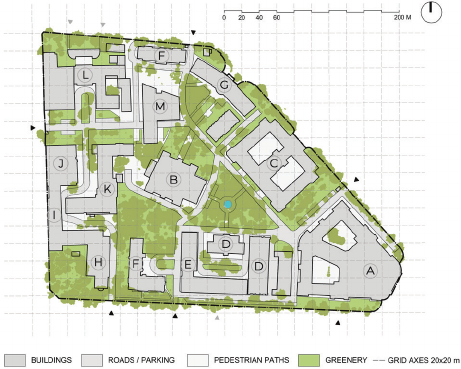
functional zoning of the area, is presented in Figure 1.
The study was conducted in January and February 2025
(winter semester). To ensure reliable results, each day of
data collection was selected to have similar weather condi-
tions. Meteorological data for January and February were
analyzed, and the following criteria were established:
– general conditions: moderate cloud cover;
– air temperature: 0–5°C,
– precipitation: none,
– wind speed: 1–5 m/s,
– wind direction: stable, without sudden changes,
– visibility: very good, no fog.
Data collection was conducted between 10:00 a.m. and
3:00 p.m., corresponding to peak campus activity. For the
eld study, observation and analysis of the presence and
scale of the 14 biophilic design patterns were performed.
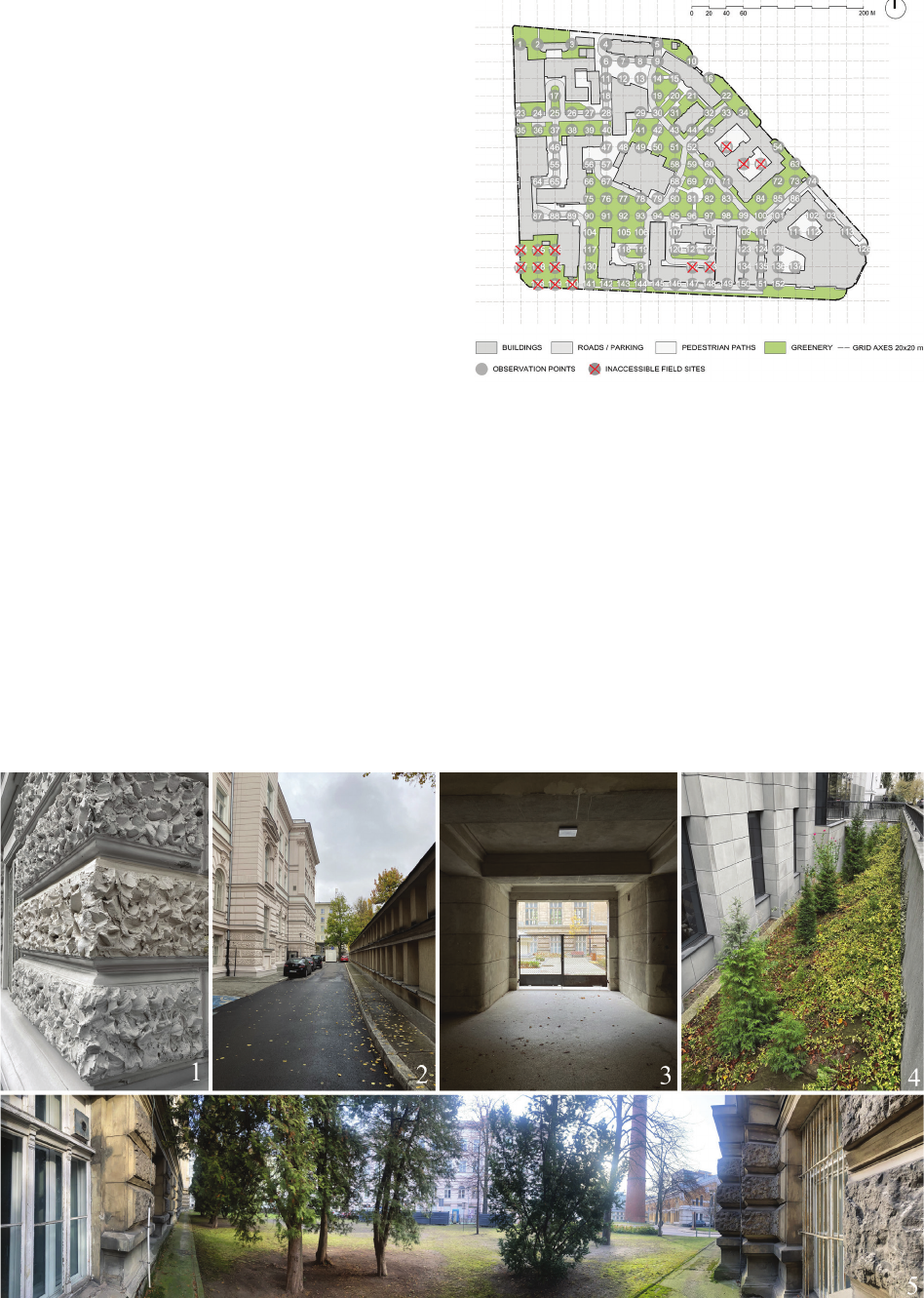
The assessment was carried out at pre-selected eld points
using a prepared data recording form. Field points were
determined by overlaying a 20 × 20 m grid on a map of the
campus, positioned so that the grid nodes covered as many
publicly accessible outdoor spaces as possible (Fig. 2).
From preliminary spacing proposals, this grid width was
chosen to generate a sucient number of points for accurate
analysis while avoiding unnecessary data multiplication.
This resulted in 152 survey points. During the study, 14 of
the 152 points were excluded from the assessment due to
lack of access, caused by ongoing construction work, entry
restrictions, or encountering closed areas. Consequently,
138 eld points were analyzed.
Due to the large volume of potential data and the resulting
need to optimize data collection time, the survey form was
created using a Google Workspace tool – Google Forms. It
consisted of a set of questions aimed at both identifying the
particularly signicant given that, globally, the prevalence
of depression among students often exceeds that of the
general population (Peters, D’Penna 2020). Students face
stress stemming from academic demands, nancial dicul-
ties, family situations, and general uncertainty (Mahrous et
al. 2022). Enhancing the health-promoting qualities of the
environment through the introduction of biophilic attrib-
utes helps students reduce stress and focus better on their
studies (Peters, D’Penna 2020).
Analysis of publications on biophilic preferences in out-
door spaces has revealed a clear preference for environ-
ments that are interesting and non-monotonous. Diversity
in forms translates into a strong sense of comfort and attrac-
tiveness. Previous research consistently shows a preference
for natural environments over urbanized spaces (Dosen,
Ostwald 2016). Studies conrmed the preference for ele-
ments such as vegetation, seating areas, and water features.
Student research also highlighted a strong liking for open
spaces with lawns, while paved surfaces were considered
the least attractive element (Hami, Abdi 2019). Preferred
na tural materials included wood and stone, with an empha-
sis on the importance of using local materials and styles
as elements that foster a sense of place (Peters, D’Penna
2020). Diverse preferences were also observed for the ar -
Fig. 1. Location of high greenery within the Central Campus
of the Warsaw University of Technology: A – Main Building;
B – Physics Building; C – Chemistry Building; D – Mechanics
Building and The Old Boiler House; E – Environmental Engineering
Building; F – residential buildings; G – New Drawing Office Building;
H – Aerodynamics Building; I – Aeronautics Building;
J – New Aeronautics Building; K – Electrical Engineering Building;
L – Chemical Technology Building; M – Mathematics Building;
▲ – open entrance gates; ▲ – closed entrance gates; ● – fountain
(elaborated by D. Kumorek, P. Kiełb based on data provided by the
Environmental Protection Department, Office of the City of Warsaw)
Il. 1. Lokalizacja zieleni wysokiej na terenie Kampusu Centralnego
Politechniki Warszawskiej: A – gmach główny; B – gmach fizyki;
C – gmach chemii; D – gmach mechaniki i starej kotłowni;
E – gmach inżynierii środowiska; F – budynki mieszkalne; G – gmach
nowej kreślarni; H – gmach aerodynamiki; I – gmach lotniczy;
J – gmach lotniczy nowy; K – gmach elektrotechniki; L – gmach
technologii chemicznej; M – gmach matematyki; ▲ – bramy
wjazdowe czynne; ▲ – bramy wjazdowe nieczynne; ● – fontanna
(oprac. D. Kumorek, P. Kiełb na podstawie danych udostępnionych
przez Biuro Ochrony Środowiska Urzędu Miasta Stołecznego Warszawy)
Biophilic solutions in higher education – an analysis of their presence on the Central Campus of the Warsaw University of Technology 59
presence of and assessing the intensity of the 14 biophilic
patterns at each eld point. The evaluation used a semantic
scale with the following values and descriptions:
0 – absence of the pattern and no impact,
1 – presence with very weak impact,
2 – presence with weak impact,
3 – presence with moderate impact,
4 – presence with strong impact,
5 – presence with very strong impact.
Each survey response was assigned the number of the
corresponding eld point, according to the previously de -
scribed grid. The criteria for assessment were based on the
work of Browning et al. (2014), which provided guidance
on what should be considered a manifestation of a given
pattern. A detailed analysis of the implementation of pat-
terns – which were often incidental or based solely on the
researchers’ impressions – was not the focus of this article.
The respondents for the survey were exclusively the authors
of this publication. Selected biophilic elements were photo-
graphed to validate the authors’ assessments and are present-
ed in Figure 3.
Results
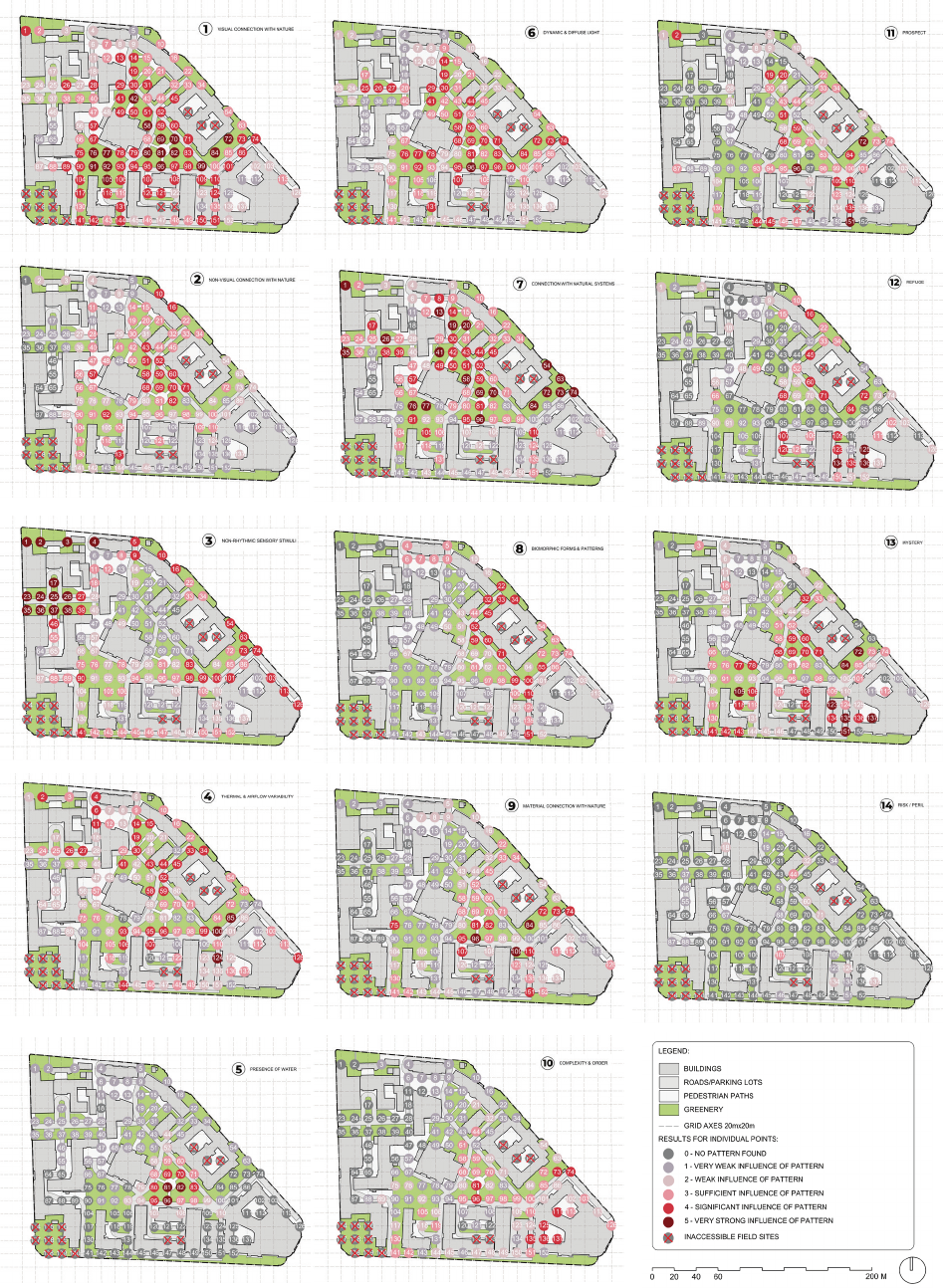
The results of the study are presented as a set of campus
maps with color-coded markings (Fig. 4). The colors cor-
respond to the ratings of individual biophilic patterns (1 to
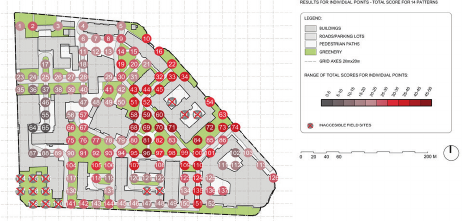
14) at the nodes of the initially established grid. The pres-
entation of results also includes a map showing the cumu-
lative assessment of the degree of biophilia at the surveyed
locations, using a dierent color scheme for clarity (Fig. 5).
Fig. 3. Compilation of photographs of selected biophilic elements: 1 – biophilic forms and patterns, 2 – perspective, 3 – refuge,
4 – risk/danger, 5 – mystery (photo by D. Kumorek)
Il. 3. Zestawienie fotografii wybranych elementów biofilnych: 1 – formy i wzory biomorficzne, 2 – perspektywa, 3 – schronienie,
4 – ryzyko/niebezpieczeństwo, 5 – tajemnica (fot. D. Kumorek)
The analysis of the presence and impact of the 14 bio-
philic design patterns on the Central Campus of the Warsaw
University of Technology revealed signicant variation
both in their spatial distribution and in the intensity of their
eects.
The patterns with the greatest representation belonged
to the Nature in the Space category, particularly Visual
Fig. 2. Map of the Central Campus of the Warsaw University
of Technology showing the locations of field points
(elaborated by D. Kumorek, P. Kiełb)
Il. 2. Mapa Kampusu Centralnego Politechniki Warszawskiej
z lokalizacją punktów terenowych (oprac. D. Kumorek, P. Kiełb)
60 Dominika Kumorek, Przemysław Kiełb
Fig. 4. Compilation of maps of the Central Campus of the Warsaw University of Technology with color-coded markings
corresponding to the ratings of individual biophilic patterns (1–14) at the surveyed field points
(elaborated by D. Kumorek, P. Kiełb based on data provided by the Environmental Protection Department, Office of the City of Warsaw)
Il. 4. Zestawienie map Kampusu Centralnego Politechniki Warszawskiej z oznaczeniami kolorystycznymi
odpowiadającymi ocenom poszczególnych wzorców biofilnych (1–14) w badanych punktach węzłowych
(oprac. D. Kumorek, P. Kiełb na podstawie danych udostępnionych przez Biuro Ochrony Środowiska Urzędu Miasta Stołecznego Warszawy)
Biophilic solutions in higher education – an analysis of their presence on the Central Campus of the Warsaw University of Technology 61
the subject of future research, as the knowledge of other
campus users regarding biophilia was not addressed in the
present article.
In future studies, it would be valuable to involve a broader
group of respondents – including students, academic sta,
and administrative personnel – to better reect the diverse
experiences of campus users. Another limitation was the
inaccessibility of certain survey points due to ongoing ren-
ovation works, which prevented a complete recording of
the existing conditions.
Future research should focus on several directions of
development. It would be important to extend the analysis
to the interiors of educational and administrative buildings,
where biophilic attributes play an equally signicant role,
particularly in the context of stress reduction and cognitive
performance enhancement. The use of surveys, qualitative
interviews, or psychological experiments could be consid-
ered to evaluate users’ subjective experiences in compari-
son with the results of eld observations.
This article presented the results of a spatial analysis,
which provides a foundation for further empirical studies.
An additional promising direction for future research could
be a comparative study of the Warsaw University of Tech-
nology campus with other academic campuses in Poland
and abroad. Such a comparison would situate the ndings
within a broader context and allow verication of the uni-
versality of the proposed recommendations.
Conclusions
Based on the presented results and the reviewed liter-
ature, conclusions were formulated in the form of design
recommendations to support the development of the Cen-
tral Campus of the Warsaw University of Technology in
accordance with the principles of biophilia.
The recommendations were classied into two catego-
ries: general recommendations, which include spatially
non-specic, universal guidelines, and detailed recommen-
dations, which outline stages for implementing potential
corrective measures in the areas of the campus with the
most unfavorable biophilic conditions.
Connection with Nature (pattern 1), Connection with Nat
-
ural Systems (pattern 7), and Dynamic and Diuse Light
(pattern 6). These patterns are mainly present in the central
part of the campus, among the greenery surrounding the
Physics building and along pedestrian routes traversing the
more open areas of the campus. In the center, due to the
fountain located there, an increased presence of Water (pat-
tern 5) was also observed. Moving toward the periphery of
the study area, an increase in the impact of Non-Rhythmic
Sensory Stimuli (pattern 3) can be noted.
Patterns from the Natural Analogues group were much
less represented. In particular, Biomorphic Forms and Pat-
terns (pattern 8) and Material Connection with Nature (pat-
tern 9) appeared only sporadically with high values, while
in most cases they exhibited a low degree of impact. They
were mainly present as incidental decorations or architec-
tural details lacking coherence and systematization. A con-
sistent material narrative referencing the local ecology or
geology was also absent. The lack of rhythmic façades and
the diversity of architectural styles was reected in the very
low values for Complexity and Order (pattern 10).
Elements assigned to the Nature of the Space category,
such as Prospect (pattern 11), Refuge (pattern 12), Mystery
(pattern 13), and Risk/Peril (pattern 14), appeared only
incidentally, mainly in relation to the existing spatial layout
(e.g., alcoves and courtyards). There was no evidence that
these elements had been intentionally designed to utilize
these patterns. Functional limitations – such as an excess
of parking spaces, low-quality pedestrian areas, and insuf-
cient accessibility for people with disabilities – further
diminish the opportunities for experiencing and using the
space in accordance with biophilic design principles.
The conducted study, while enabling the identication
of signicant biophilic gaps on the Central Campus of the
Warsaw University of Technology, has certain limitations
that should be considered when interpreting the results.
First, eld observations were carried out during the win-
ter season, which aected the perception of some biophilic
patterns, particularly those related to the seasonality of veg-
etation or variability in weather conditions. Repeating the
analysis in other seasons could reveal a dierent picture
of the intensity and distribution of the examined patterns.
While the study could be classied as a “winter study”, the
authors considered that conducting it at this time would not
fundamentally determine its overall outcomes.
Second, the evaluation forms were completed exclusive-
ly by the authors. Although this ensured consistency in the
applied criteria, it limited the objectivity of the results. Due
to the availability of literature sources, ndings from previ-
ous studies (Dosen, Ostwald 2016; Hami, Abdi 2019; Peters,
D’Penna 2020) were used as a reference for understanding
the perceptions and preferences of users
of the Central Cam-
pus. Additional data from current campus users could be
obtained through structured, two-stage workshops. In the
rst stage, participants would assess the space intuitively,
without prior knowledge, and in the second stage, follow-
ing a lecture component, they would evaluate the area again
equipped with the appropriate “tools”. This approach would
allow a comparison between innate sensitivity to nature and
the theoretical aspects of biophilia. Such a study could be
Fig. 5. Map of the Central Campus of the Warsaw University
of Technology with markings corresponding to the overall biophilic
quality assessment at the surveyed field points
(elaborated by D. Kumorek, P. Kiełb)
Il. 5. Mapa Kampusu Centralnego Politechniki Warszawskiej
z oznaczeniami odpowiadającymi sumarycznej ocenie
jakości biofilnej w badanych punktach węzłowych
(oprac. D. Kumorek, P. Kiełb)
62 Dominika Kumorek, Przemysław Kiełb
General recommendations
1. Reorganization and rationalization of space.
It is recommended to relocate a signicant portion of
parking functions outside the campus to free up space for
the predominantly pedestrian trac within the study area.
Parking spaces that must remain on campus should not sig-
nicantly interfere with the green fabric. Solutions such
as permeable surfaces or integrating parking areas with
com pact high- and medium-height greenery as visual and
acoustic buers are suggested. New structures, however,
should not obstruct existing axial lines and sightlines (Pros-
pect, pattern 11). Reducing the share of car-related func-
tions in the campus layout will allow for a more ecient
organization of space that meets the needs of the academic
community. Recommendations in this area include creating
green, quiet spaces for relaxation and recreation, and areas
for direct contact with nature, such as campus communi-
ty gardens that integrate permanent campus residents with
other users, or outdoor recreational zones. Zoning function-
ally diverse spaces will provide users with a sense of Ref-
uge and impart a sense of Mystery to the environment (Ref-
uge and Mystery, patterns 12 and 13). This goal can also be
supported through the design of urban niches and interiors,
year-round pavilions, and thoughtfully arranged greenery.
2. Increasing year-round accessibility of spaces.
Recommended actions, considering the seasonal varia-
bility of weather conditions, include increasing the acces-
sibility of public spaces during colder periods, such as the
central square, forecourts, and urban interiors of selected
buildings. It is advisable to introduce solutions within the
campus layout such as permanent or seasonal canopies and
shelters, green windbreak structures, or local temporary
heating installations like radiant heaters. These structures
can also serve in warmer periods by providing localized
shading, thereby reducing air temperature (Thermal & Air-
ow Variability, pattern 4). Openwork elements will addi-
tionally enhance the visual appeal of the space, creating
dynamic patterns of light and shadow (Dynamic & Diuse
Light, pattern 6).
3. Increasing the presence and continuity of greenery.
Actions in this area should focus on increasing the pres-
ence of low-, medium-, and high-height vegetation. Par-
ticularly important for enhancing Visual Connection with
Nature (pattern 1) is the addition of new medium- and
high-height structures along publicly accessible pedestri-
an routes. To maintain the continuity of greenery, existing
tree rows should be supplemented, forming a network of
green landscape corridors that provide the site with bio-
philic cohesion. The proposed additional plantings would
consist of targeted, small-scale interventions that improve
the overall perception of the space without compromis-
ing usability or recreational opportunities, functioning as
a form of spatial “acupuncture”. Improving the condition of
low vegetation will activate users, increasing both the func-
tional and visual attractiveness of the space. Recommenda-
tions also include enhancing the biodiversity of plantings.
Seasonal vegetation in pedestrian zones will help ensure
a continuous visual presence of greenery throughout the
year (Connection with Natural Systems, pattern 7).
4. Introducing a diversity of sensory stimuli.
It is recommended to introduce elements on campus that
engage the senses–hearing, smell, and touch. Non-visual
connection with nature (pattern 2) can be achieved through
solutions that promote direct contact with natural ele
-
ments. Examples include sensory gardens, aromatic ow-
er meadows, or other low, multi-colored vegetation with
olfactory qualities, such as herbs, as well as freestanding
vertical gardens, green façades, and accessible green roofs.
The presence of water can be provided through fountains,
water curtains, or misting installations (Water, pattern 5).
A Material Connection with Nature (pattern 9) and sources
of Non-Rhythmic Sensory Stimuli (pattern 3) can be cre-
ated through structures supporting small fauna – such as
bird feeders and insect hotels – as well as sensory path-
ways composed of diverse natural materials, such as gravel,
bark, or stones. When adding additional educational trails,
care should be taken to maintain smooth circulation while
enriching the space with features that improve areas exhib-
iting a low presence of biophilic elements. Local variations
in terrain, such as small bridges, embankments, or local-
ized depressions, can signicantly enhance the perception
of space and, combined with safe cues of Risk/Peril (pat-
tern 14), create an environment that stimulates cognitive
and physical engagement.
5. Implementation of biomorphic patterns and use of
natural materials.
It is recommended to use renewable and locally sourced
natural materials that complement the architectural expres-
sion of the existing campus buildings. Such materials in-
clude wood, stone, and brick (Material Connection with
Na ture, pattern 9). Existing Biomorphic Forms & Patterns
in the study area, particularly sculptural elements on build-
ing façades, should be regularly maintained and supple-
mented as needed (pattern 8). New design and material
structures should be visually coherent and consistent with
the spatial hierarchy of the existing campus. It is especial-
ly important to respect the original fabric by maintaining
the hierarchy of newly designed elements (Complexity &
Order, pattern 10).
6. Educating and engaging the academic community.
Educational activities aimed at deepening knowledge of
biophilia and the benecial eects of biophilic design on
human health and functional well-being constitute a par-
ticularly important element of strategies supporting the
welfare of the academic community. Increasing awareness
in this area can contribute to greater engagement in shaping
campus spaces and, in the long term, support the mental,
physical, and cognitive health of users. Recommended so -
lutions to achieve these goals include: organizing indepen-
dent workshops, seminars, and thematic meetings; inte-
grating biophilia into the curricula of individual faculties;
promoting the topic through semester projects and theses;
and developing and disseminating innovative educational
materials, such as multimedia games and applications with
experience-mapping systems, or participatory platforms.
7. Systematic monitoring of biophilic quality.
A key element of a long-term strategy to enhance the
biophilic quality of the Central Campus of the Warsaw
Uni versity of Technology is the systematic monitoring and
Biophilic solutions in higher education – an analysis of their presence on the Central Campus of the Warsaw University of Technology 63
assessment of current conditions. Regular evaluation of
the environment will enable the development and imple-
mentation of realistic management programs and support
eective design decisions. It is therefore recommended to
establish an interdisciplinary team responsible for man-
aging environmental quality in the context of biophilic
impact on campus, with tasks including the development
of reliable research tools, preparation of regular reports
with an updated list of recommendations, and implementa-
tion of pilot interventions along with studies of their social
impact. Currently, digital IoT sensors are being used on
campus for environmental monitoring (Koszewski et al.
2025). It is recommended to utilize such devices for col-
lecting and analyzing data, including parameters such as
air temperature and quality, wind direction and strength,
humidity, noise levels, and sunlight exposure.
Detailed recommendations
The detailed recommendations include a timeline for the
potential implementation of corrective actions. They refer
to spatially dened clusters of biophilic nodes, hereafter
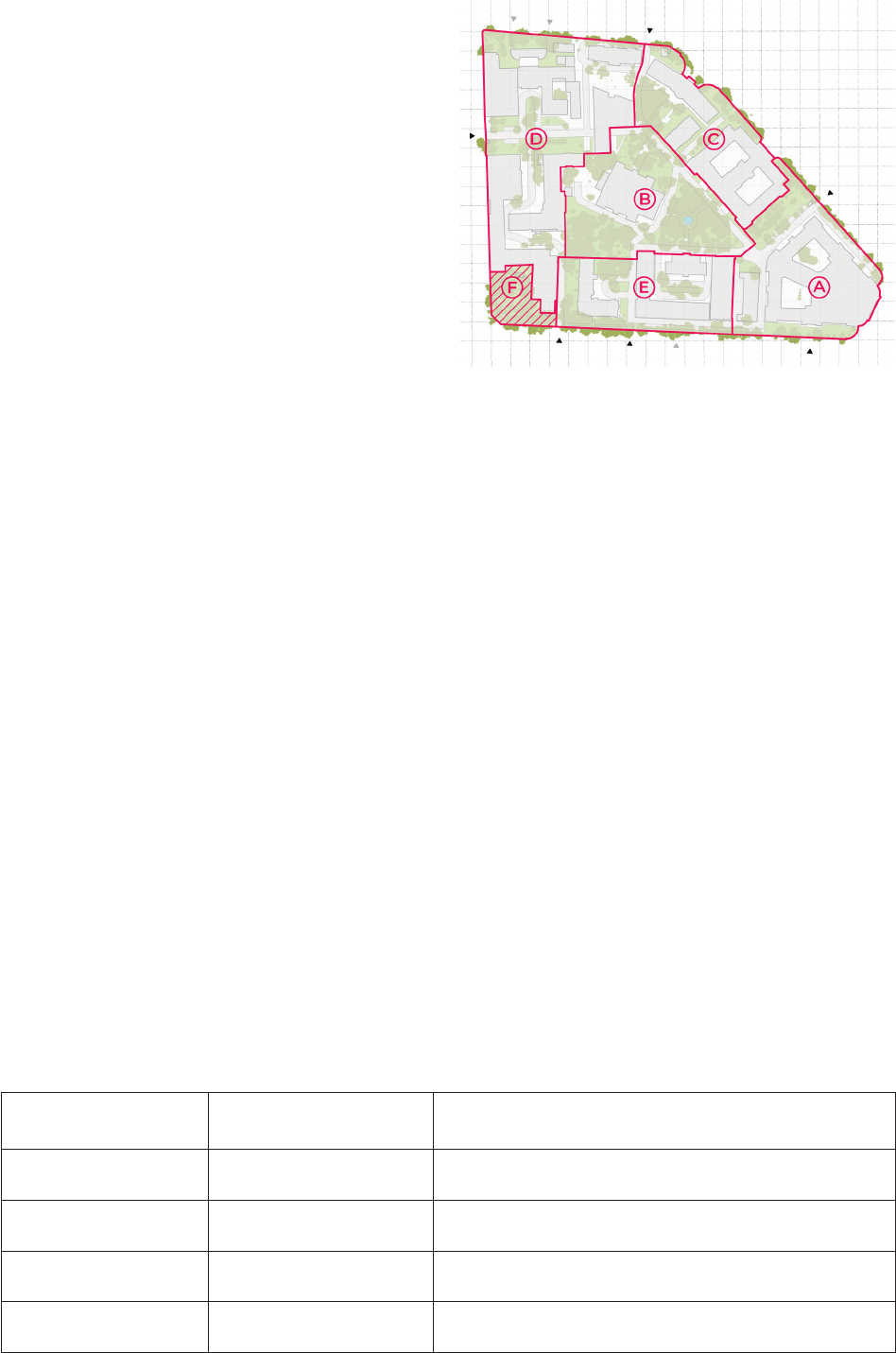
referred to as areas (Fig. 6). This division was developed
based on an analysis of the campus’s spatial and circula-
tion conditions, combined with results collected during the
eld study. Using literature sources and on-site observa-
tions, an analysis of user spatial activity was conducted,
allowing the identication of zones with varying levels
of foot trac, including areas functioning as nodes and
circulation corridors (Koszewski et al. 2025). As a result,
Zone B was recognized as the area characterized by the
highest pedestrian trac intensity. This zone includes both
a square serving as a gathering space and two key transit
routes leading deeper into the campus. Zone A was recog-
nized as a high, though not the highest, pedestrian trac
area. This zone includes two entrances facing the external
circulation network and the main communication node of
the system. Additionally, a factor reinforcing the concen-
tration of movement within this area is the presence of the
most intensively used building, i.e., the Main Building.
Due to functional and spatial conditions, zones C, D, and E
were recognized as areas with a similar, moderate level of
pedestrian trac. The results of the analysis were used to
relate the conclusions drawn from the study to the intensity
of biophilic pattern impact.
The stages of implementing the recommended actions
are presented in Table 1.
The detailed recommendations for individual areas are
presented in Table 2. It should be emphasized, however, that
any interventions aimed at improving the biophilic quality
of the campus should be planned and implemented holisti-
cally, taking into account the complexity and interrelation-
ships of the site’s spatial and biological features. This article
does not constitute an execution-level design; its purpose
was solely to gather information on the existing presence
of biophilic design elements on the campus and to indicate
where deciencies require investment and which elements
can improve the situation.
Fig. 6. Map of the Central Campus of the Warsaw University
of Technology divided into areas: A – eastern area, B – central area,
C – north-eastern area, D – north-western area, E – southern area,
F – area not included in the study
(elaborated by D. Kumorek, P. Kiełb)
Il. 6. Mapa Kampusu Centralnego Politechniki Warszawskiej
z podziałem na obszary: A – obszar wschodni, B – obszar centralny,
C – obszar północno-wschodni, D – obszar północno-zachodni,
E – obszar południowy, F – obszar nieobjęty badaniem
(oprac. D. Kumorek, P. Kiełb)
Timeline name Implementation time (years) Actions description
Quick 0–1
actions not requiring significant time
or financial investment
Medium-term 1–5
actions requiring a carefully planned implementation
but not involving significant intervention
Strategic +5
actions requiring a precise management plan
and significant financial investment
Permanent –
actions requiring continuous, systematic implementation
as part of ongoing operations
Table 1. Classification of remedial actions based on their implementation timeframe (elaborated by D. Kumorek, P. Kiełb)
Tabela 1. Klasyfikacja działań naprawczych ze względu na czas ich wdrażania (oprac. D. Kumorek, P. Kiełb)

64 Dominika Kumorek, Przemysław Kiełb
Area name
Timeline name
Zone A
Eastern Area
Zone B
Central
Zone C
North-eastern Area
Zone D
North-western Area
Zone E
Southern Area
Quick
Supplementing tree rows
with dense; insulating green
structures; planting medium
– to tall-height greenery;
interventions of
a “spatial acupuncture” character.
Planting medium- to tall-height greenery;
installation of devices and elements such
as water misters, heaters, bird feeders; small
sensory installations, e.g., aromatic
flowerbeds; reactivation of the existing
fountain; reorganization and supplementation
of small architectural elements, including
benches, trash bins, and lighting.
Installation of devices and elements
such as water misters, heaters, bird
feeders; small-scale installations,
e.g., aromatic flowerbeds; sensory
installations.
Planting of tall and medium-high
vegetation; installation of elements
such as: water misters, heat emitters,
bird feeders; small sensory installations,
e.g., aromatic flowerbeds.
Supplementing tree alleys
with dense; insulating green
structures; interventions of
a “spatial acupuncture”
character.
Medium-term
Replacement of parts
of the Main Building courtyard
surfaces with green pavements.
Designation of small zones for recreation,
rest, and study; introduction of minor
freestanding structures, e.g., thematic
pavilions, acoustic sculptures, canopies
and shelters; localized replacement of
surfaces with sensory pavements;
arrangement of community gardens.
Introduction of small freestanding
structures, e.g., thematic pavilions,
acoustic sculptures, canopies
and shelters; introduction of flower
meadows or other plants
with aromatic and colorful qualities;
arrangement of community gardens.
Introduction of small freestanding
structures, e.g., thematic pavilions,
acoustic sculptures, canopies
and shelters; establishment of flower
meadows; arrangement
of community gardens.
–
Strategic
Reorganization of parking areas;
replacement of hard surfaces
with permeable pavements;
construction of freestanding
vertical gardens in the courtyards
of the Main Building.
–
Reorganization of parking areas;
replacement of hardened surfaces
with permeable pavements;
construction of green roofs
and façades.
Reorganization of parking areas;
replacement of hard surfaces
with permeable pavements; construction
of green roofs and green façades.
Reorganization of parking
areas; replacement of hard
surfaces with permeable
pavements; construction
of green roofs and façades;
replacement of artificial façade
materials with natural
and/or biomorphic ones.
Permanent Maintenance of existing biophilic elements; educational and promotional activities; monitoring and assessment of biophilic quality.
Table 2. Compilation of detailed recommendations for individual areas, including a timeline for their implementation
(elaborated by D. Kumorek, P. Kiełb)
Tabela 2. Rekomendacje szczegółowe dla poszczególnych obszarów z uwzględnieniem schematu czasowego ich wdrażania
(oprac. D. Kumorek, P. Kiełb)
Biophilic solutions in higher education – an analysis of their presence on the Central Campus of the Warsaw University of Technology 65
Summary
The analysis of the presence and intensity of the 14 bio-
philic design patterns across the Central Campus of the
Warsaw University of Technology highlighted the varied
character of the space, revealing both its strengths and de-
ciencies. The assessment showed that the campus’s poten-
tial is not fully utilized – particularly in patterns related to
sensory diversity, multi-sensory interaction with nature,
and complexity and order. Several spatial and functional
barriers were also identied, such as excessive parking
areas, lack of material consistency, and limited accessibili-
ty for people with disabilities.
The results indicate the need for a comprehensive ap -
proach to campus planning in line with biophilic principles.
Future interventions should include reorganizing the trans-
Acknowledgement
The article was developed as part of the course program “Experimental
Research Project” conducted at the Faculty of Architecture, Warsaw Uni-
versity of Technology during the winter semester 2024/2025.
portation layout, enhancing the role of greenery and water
in public spaces, and implementing sensory, material, and
spatial elements that support feelings of shelter, mystery,
and discovery. Equally important is engaging the academ-
ic community in the transformation process through edu-
cational and participatory initiatives.
Overall, the Central Campus of the Warsaw University
of Technology possesses signicant biophilic potential,
but currently it is only partially realized. Further design
and research eorts could transform it into a model of
a modern academic environment that promotes well-be-
ing, where architectural space harmoniously integrates
with nature.
Translated by
Dominika Kumorek
References
Alexander, Christopher, Sara Ishikawa, Murray Silverstein, Max Jacobson,
Ingrid Fiksdahl-King, and Shlomo Angel. A Pattern Language: Towns,
Buildings, Construction. Oxford University Press, 1977.
Annerstedt, Matilda, and Peter Währborg. “Nature-Assisted Therapy:
Systematic Review of Controlled and Observational Studies.” Scan-
di navian Journal of Public Health 39, no. 4 (2011): 371–88. https://
doi.org/10.1177/1403494810396400.
Bowler, Diana E., Lisette Buyung-Ali, Teri Knight, and Andrew Pullin.
“A Systematic Review of Evidence for the Added Benets to Health
of Exposure to Natural Environments.” BMC Public Health 10, no.
456 (2010): 1–10. https://doi.org/10.1186/1471-2458-10-456.
Browning, William, Catherine Ryan, and Joseph Clancy. 14 Patterns of
Biophilic Design: Improving Health and Well-Being in the Built En -
vironment. Terrapin Bright Green, 2014.
Burton, Danielle. “Biophilic Design in Higher Education: Exploring Na -
ture-Based Design Inclusion in Classrooms.” Georgia Southern Uni-
versity, 2022. Honors College Theses. 734. Accessed August 14, 2025,
at https://digitalcommons.georgiasouthern.edu/honors-theses/734/.
Cama, Rosalyn. Evidence-Based Healthcare Design. John Wiley and
Sons, 2009.
Determan, Jim, Mary Anne Akers, Tom Albright, et al. “The Impact of
Bio philic Learning Spaces on Student Success.” American Institute
of Ar chi tecture, Building Research Knowledgebase, 2019. Accessed
August 14, 2025, at https://cgdarch.com/wp-content/uploads/2019/12/
The-Impact-of-Biophilic-Learning-Spaces-on-Student-Success.pdf.
Dosen, Annemarie S., and Michael J. Ostwald. “Evidence for Prospect-
Refuge Theory: A Meta-Analysis of the Findings of Environmental
Preference Research.” City, Territory and Architecture 3, no. 4 (2016):
1–14. https://doi.org/10.1186/s40410-016-0033-1.
Frumkin, Howard. “Beyond Toxicity: Human Health and the Natural
En vironment.” American Journal of Preventive Medicine 20, no. 3
(2001): 234–40. https://doi.org/10.1016/S0749-3797(00)00317-1.
Fromm, Erich. The Anatomy of Human Destructiveness. Holt, Rinehart
and Winston, 1973.
Gillis, Kaitlyn, and Birgitta Gatersleben. “A Review of Psychological
Literature on the Health and Wellbeing Benets of Biophilic
Design.” Buildings 5, no. 3 (2015): 948–63. https://doi.org/10.3390/
buildings5030948.
Hami, Ahmad, and Babak Abdi. “Students’ Landscaping Preferences for Open
Spaces for Their Campus Environment.” Indoor and Built En vi ron -
ment 30, no. 1 (2019): 1–12. https://doi.org/10.1177/ 1420326X19887207.
Heerwagen, Judith H., and Betty Hase. “Building Biophilia: Connecting
People to Nature in Building Design.” 2001. Accessed August 14,
2025, at https://www.slideshare.net/slideshow/building- biophilia-
connecting-people-to-nature-in-building-design-pdf/273332207.
Kellert, Stephen R. The Value of Life. Island Press, 1997.
Kellert, Stephen R. “Dimensions, Elements, and Attributes of Biophilic
Design.” In Biophilic Design: The Theory, Science, and Practice of
Bringing Buildings to Life, edited by Stephen R. Kellert, Judith H.
Heerwagen, and Martin L. Mador. John Wiley and Sons, 2008.
Kellert, Stephen R. Nature by Design: The Practice of Biophilic Design.
Yale University Press, 2018.
Kellert, Stephen R., Judith H. Heerwagen, and Martin L. Mador, eds.
Bio philic Design: The Theory, Science and Practice of Bringing
Build ings to Life. John Wiley and Sons, 2008.
Kellert, Stephen R., and Edward O. Wilson. The Biophilia Hypothesis.
Island Press, 1993.
Koszewski, Krzysztof, Robert Olszewski, Piotr Pałka, et al. “Utilizing
IoT Sensors and Spatial Data Mining for Analysis of Urban Space
Actors’ Behavior in University Campus Space Design.” Sensors 25,
no. 5 (2025): 1–27. https://doi.org/10.3390/s25051393.
Mahrous, Amira, Khaled Dewidar, Mostafa Refaat, and Ashraf Nessim.
“Biophilia as a Sustainable Design Approach for University Build-
ings Design: A Case Study in University Campus Drawing Studios,
Cairo, Egypt.” IOP Conference Series: Earth and En vironmental
Science 1113, no. 1 (2022): 1–14. https://doi.org/ 10.1088/1755-
1315/1113/1/012001.
Mahrous, Amira, Khaled Dewidar, Mostafa Refaat, and Ashraf Nessim. “The
Impact of Biophilic Attributes on University Students’ Level of Sa tis-
faction: Using Virtual Reality Stimulation.” Ain Shams En gineering
Jour nal 15, no. 17 (2023): 1–11. https://doi.org/10.1016/j.asej.2023.102304.
Marcus, Clare C., and Naomi Sachs. Therapeutic Landscapes: An Evi-
dence-Based Approach to Designing Healing Gardens and Resto ra-
tive Outdoor Spaces. John Wiley and Sons, 2014.
McCullough, Cynthia. Evidence-Based Design for Healthcare Facilities.
Sigma Theta Tau International, 2009.
66 Dominika Kumorek, Przemysław Kiełb
Olmsted, Frederick L. The Papers of Frederick Law Olmsted: The Ca li-
fornia Frontier, 1863–1865 (Volume 5). Johns Hopkins University
Press, 1990.
Peters, Terri, and Kristen D’Penna. “Biophilic Design for Restorative
University Learning Environments: A Critical Review of Literature
and Design Recommendations.” Sustainability 12, no. 17 (2020):
1–17. https://doi.org/10.3390/su12177064.
Shin, Jihye, and Mihyun Seol. “A Study on the Awareness of the Uni-
versity Students about the Biophilic City.” Journal of the Korean
Institute of Landscape Architecture 28, no. 4 (2020): 73–90. https://
doi.org/10.17279/jkagee.2020.28.4.73.
Ulrich, Roger S. “Aesthetic and Aective Response to Natural En vi ron-
ment.” In Behavior and the Natural Environment, edited by Irwin
Alt man and Joachim F. Wohlwill. Plenum Press, 1983.
Ulrich, Roger S., Craig Zimring, Xuemei Zhu, et al. “A Review of the
Research Literature on Evidence-Based Healthcare Design.” HERD 1,
no. 3 (2008): 61–125. https://doi.org/10.1177/ 193758670800100306.
Wilson, Edward O. Biophilia. Harvard University Press, 1984.
Streszczenie
Rozwiązania biolne w szkolnictwie wyższym
– analiza występowania na Kampusie Centralnym Politechniki Warszawskiej
Przez tysiąclecia człowiek związany był z przyrodą. Postęp industrializacji znacznie wpłynął na ograniczenie tej łączności. Odpowiedzią na próbę
ponownego włączenia natury w codzienność społeczeństwa jest projektowanie biolne.
Celem autorów artykułu była ocena obecności i skali występowania wybranych wzorców biolnych na terenie Kampusu Centralnego Politechniki
Warszawskiej. Za metody badawcze przyjęto studia literaturowe, obserwację obszaru badań oraz analizę skali występowania 14 wzorców biolnych
w wybranych punktach terenowych. Dane w postaci ocen, przyporządkowanych każdemu punktowi, zebrano za pomocą formularza internetowego.
Wyniki badania przedstawiono w postaci map kampusu z oznaczeniami kolorystycznymi, odpowiadającymi zebranym ocenom. Artykuł wieńczą wnioski
w postaci rekomendacji dla kierunku rozwoju tego terenu, zgodnego z duchem biolii.
Słowa kluczowe: biolia, projektowanie, 14 wzorców, kampus, Politechnika Warszawska
