2021
1(65)
DOI: 10.37190/arc210101
Mateusz Michalski*
Tikkun Chatzot – semiotics of synagogues on the example
of the synagogue in Siemiatycze
Introduction
One of the manifestations of Judaism’s architecture is
the aspect of gematria [1]. This peculiar feature of syna-
gogues clearly shows that synagogue architecture is deep-
ly rooted in Judaism. In addition to the prominent and
visible features such as the decor, the layout of the plan
emphasizing the ritual’s character, attention should also
be paid to the crucial aspect of the word, rooted in gemat-
rical activities in the synagogue architecture
1
. To present
the described phenomenon in more detail, the author used
the example of a synagogue in Siemiatycze.
The state and aim of research
-
tory of the Siemiatycze synagogue in 1911. In his arti-
cle: Siemiatycka synagoga i przekazy o niej [Siemiatycze
synagogue and stories about it] [2], Avierbuch provided
information about the building’s history, based more on
legends and stories than on architecture or documents
that the synagogue was built in 1755, when Princess
construction of an alley through the Jewish cemetery.
1
The aspect of gematria in the architecture of Judaism is dealt with
in detail in the author’s doctoral thesis written under the supervision of
and Technology. A monograph was also issued on its basis [1].
seems that this is the most probable hypothesis, also in-
cluded in the Katalog zabytków sztuki w Polsce [Cata-
logue of art monuments in Poland] [5, p. 71], in which the
authors specify the date of the synagogue construction
for the years 1797–1801. The design execution time by
-
show also that the Jews resisted long before accepting
the town heiress’s proposition to erect a synagogue for
the kehillah.
As a matter of fact, apart from short studies, the syn-
agogue in Siemiatycze did not receive a monograph and
been any complete research either, and the wall painting
was hidden under another lime layer.
Of course, the object is mentioned by Eleonora Berg-
Zachowane synago-
gi i domy modlitwy w Polsce: katalog [Preserved syn-
-
The most information about the synagogue can be found
in the city’s monograph and Katalog zabytków sztuki
w Polsce [5].
The article aims to describe the semiotic aspect of the sy-
nagogue architecture in Siemiatycze in the Tikkun Chatz
ot
prayer context. So far, no one has attempted to demon-
strate a direct relationship between the building’s dimen-
sions and the individual verses of the above mentioned
prayer while considering the history of the building and
its original architectural form.

Historical background
The synagogue is situated in the south-western part of
the commune was not very large and dependent on the
began to compete in crafts with the local population. Ac-
cording to the agreement of the Siemiatycze kehillah with
[…]
it is appropriate to give overburned spirit into booz
to the Siemiatycze town hall
2
it as follows: […] individually, we have the privilege of
Her Majesty, Our Lady of the Voivode of Vilnius Kopciów-
na Sapieżyna, of the hetman, Grand Duchy of Lithuania,
our lady and benefactor, that we are allowed to multiply
all kinds of benets, trade goods and whatever we under-
stand for our benet for our money, we are allowed to
multiply all this
This privilege freed Jews from any restrictions in trade
-
Despite the repeated punishments and orders imposed on
the Jewish population not to engage in unfair competition,
nothing changed in this regard.
the Siemiatycze kehillah slowed down due to the cholera
epidemic in 1710–1711. The people who emigrated from
the city with the pestilential air’s advent began to return
in March 1711.
The 18
th
century saw a period of dynamic development
of the city. The number of inhabitants, including Jews, in-
town’s turnover also increased. Bringing over missionaries
in the 1720s resulted in a return to the foundation charter
the Siemiatycze kehillah
Thursday, and the change was to be propagated by Jews
Sunday, but it was forbidden to do it in public, i.e. in the
-
agogue). This document shows that at that time, there was
2
[…] ratione dawania do przepalonej okowity gorzałki na ratusz
sie mia tyckiej pewnej [original spelling in old Polish].
[…] z osobna mamy przywilej Jaśnie Wielmożnej Jej Mci Pani
wo jewodziny wileńskiej Kopciówny Sapieżynej, hetmanowej, Wielkiego
Księs twa Litewskiego, pani i dobrodziejki naszej, że nam wolno wsze
lakie pożytki przymnażać, towarami handlować i cokolwiek byśmy ro
zu mieli do pożytku naszego za pieniądze nasze pomnażać wolno nam to
wszystko jest [original spelling in old Polish].
its location and appearance. It can be said with high prob-
the city burned down. At that time, the reconstruction of
castrum Romanum, with cardo and decumanus
their intersection. The synagogue was probably built after
-
1770s. This street ran from the palace gate through the
-
mine whether this was the condition for building the syna-
higher than the old orthodox church and almost as high
-
Siemiatycze [2, p. 40].
-
during the uprising despite its proximity to the palace.
War I without any damage. In the interwar period, Jews
owned four houses of prayer in Siemiatycze.
In 1942, the Germans established a ghetto in Siemi-
atycze, and the synagogue was used as a warehouse for
place in 1944 after the front had passed. The wooden
Aron
ha-Kodesh were destroyed. In the post-war period, the
synagogue was used as warehouses and shops. At the be-
-
verted into a community centre.
It houses a performance hall, and an exhibition show-
ing the history and culture of Siemiatycze was organized
at the women’s gallery.
Analysis of the synagogue architecture
The historical and urban study from 1957 stated: Syna-
gogue […] Oriented. Brick. Plastered. Painted white. On
a rectangular plan similar to a square. Three-aisle. Two-
story. Embanked. Main entrance from the west, leading to
the hallway, on both sides of which there are two similar
rooms. The nave is wide, separated by two rows of square
pillars, connected by full arches. Half-height side aisles
are separated by galleries, supported from the west in the
nave on two massive Doric stylized columns. There is one
large room above the hall and western rooms, connected
with galleries into one whole. Flat ceilings. The rest of the
original decoration on the eastern wall with animal and
oral motifs. The rest of the polychrome decoration is new.
The façade without divisions, topped with a full entabla-
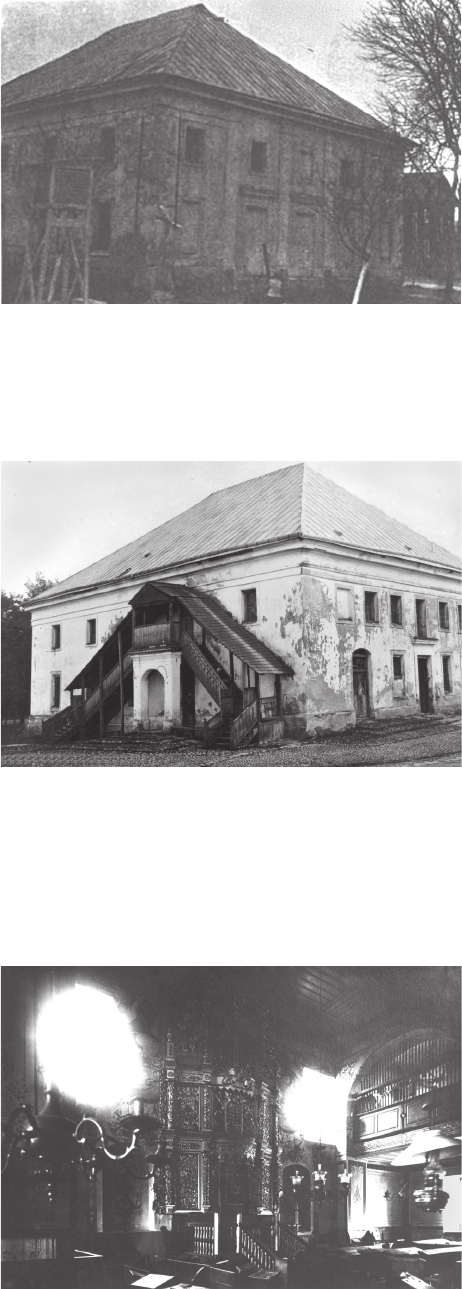
Tikkun Chatzot – semiotics of synagogues on the example of the synagogue in Siemiatycze 5
Il. 2. Synagoga w Siemiatyczach.
early 20
th
century
ture. The eastern wall is pilastered and has pseudoportals
on the aisles’ axes. High, hipped roof, covered with shin-
gles, sheet metal. The condition of the building is terrible
Detailed information about the building’s original ap -
pear ance can be found in the report from the 1959 inspec-
-
cording to this documentation, the original outer wall of
cornice and at the jambs, including the window sills.
In the eastern façade, there have initially been blind
-
ings served as windows. The niches in the outer axes on
-
dows later, probably along with interior design change.
The elevation played the front façade’s role and was thus
has initially been situated above the main entrance on the
The northern and southern elevations were initially de-
window openings in the northern elevation before World
War II [9, p. 4].
The men’s hall was divided by rows of pillars on
which the gallery for women was based. The pillars were
connected with semicircular arcades that were initially
open. The last preserved interior of the synagogue can be
read from photos from the beginning of the 20
th
century
mechitza
made of vertical bars, the lower part of which is a balus-
trade in the form of a panel. The western gallery was sup-
ported in the centre by two stylized Doric columns, with
two round pillars above them. In the columns’ axis, the
pillars supporting the gallery were octagonal at the bottom
There was a vast and decorative three-story Aron ha-
Kodesh, on the eastern wall, to which stairs led by a bal-
on both sides, with niches closed with a segmental arch.
In the upper part of the wall, there were two windows. The
synagogue had a rich painting decoration, which consist-
ed of animal and plant motifs, plant, meanders, geometric
and frame arrangements. On the eastern wall, there are
-
tunately, during the post-war renovation, they were cov-
ered with layers of paint. The decoration probably dates
entire composition passed or joined the wall due to the
facets or very densely placed consoles.
-
went a renovation, which partially blurred its style fea-
-
tions, windows were made in place of the door openings,
the external stairs leading to the women’s gallery were not
reconstructed.
Existing state
Pilasters in giant order introduced the order of the façade.
three-axis central part. Basically, the façade was restored
to its condition from the beginning of the 20
th
century.
The west elevation has seven axes and was topped with
-
rectangular window openings. In the second axis from the
Inside, the ceilings were replaced with reinforced con-
crete. Apart from the general layout of the interior, nothing
painted with oil paint. Inside, the ceilings were replaced
with reinforced concrete. Apart from the general layout of
the interior, nothing is left of the original synagogue. The
frames, which were painted with oil paint. The eastern
wall was covered with a stage. All traces of the niche for
scrolls disappeared, and wooden panelling was used on
the pillars and walls. The damaged bima was also not re-
open to the room, there is a permanent exhibition and the
director’s rooms. Both the interior and the exterior do not
resemble the original purpose of the building.
At the end of 2019, a major overhaul of the building
began, including the reconstruction of the existing inter-
in the hall and vestibule, lowering the door thresholds, re-
novation of internal doors with the restoration of the orig-
inal colours, renovation of walls and pillars.
Metrological analysis
The synagogue in Siemiatycze was planned entirely
using the new Warsaw measure. It means that it could not
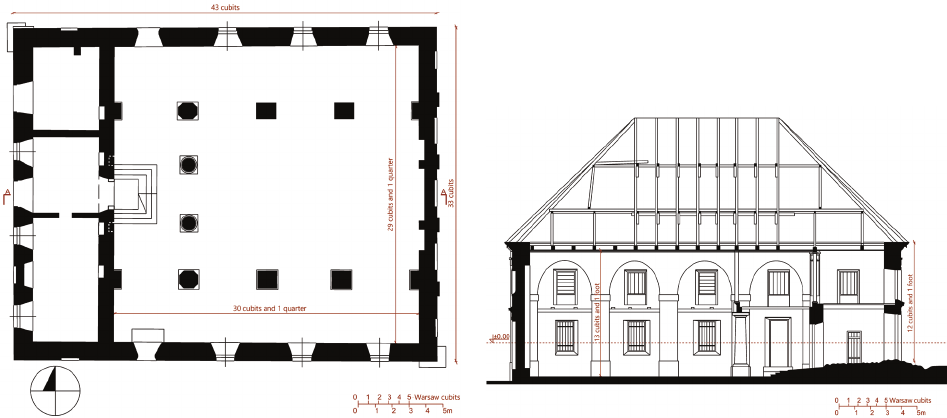
To conduct a metrological analysis, in situ measure-
ments were made. These measurements were compiled and
-
tion
being in the Provincial Heritage Monuments Protec-
in situ height
dimension of the men’s hall’s interior was compared with
the inventory dimension from the 1950s. It was assumed
that the inventory shows the interior’s proper height,
based on the ceiling beam nests and remnants of decora-
tions visible in the 1950s.
The measurements show that the building was erected
-
eaves. The hall’s interior is arranged on a rectangle meas-
-
Based on the values obtained during the metrological
analysis, research was conducted to obtain a linguistic
representation for the obtained numerical values.

Tikkun Chatzot – semiotics of synagogues on the example of the synagogue in Siemiatycze 7
that the letter qof -
ter of the alphabet tav
kafmemnunpetsadi
of 20, 40, 50, 80, 90, respectively.
mispar siduri
method. It is based on assigning 22 letters of the alphabet
The last, third method that has not been mentioned
mispar katan). This meth-
od assumes – similarly to the mispar hechrachi method
alphabet – from alephtet
1 to 9. The next 9 letters – from yodtsade
have a value from 1 to 9. The remaining four letters – from
qoftav
method, numerical values of the letters from the mispar
hechrachi method all zeros are reduced.
When choosing a prayer for analysis, attention should
be paid to the texts that have gained importance in the
liturgy since the 17
th
th
were innovative and did not change the liturgy’s general
arrangement or prayers’ texts. Instead, they focused on in-
troducing meditation, hymns, chants, and kavanah. There-
fore, the relations between the synagogue’s dimensions in
Shema Yisrael, Amidah,
Lekhah Dodi, Kabbalat Shabbat, Yigdal, Shir Hakavod)
were analyzed. However, in this paper, it was decided to
discuss the Tikkun Chatzot-
-
listic movements in Safed. During this service, in tears,
laments were said about the destruction of Jerusalem and
interior of the synagogue, usually sitting, each Jew indi-
vidually recited lamentation over the destruction of the
temple. Tikkun Chatzot is divided into two parts: Tikkun
Rachel and Tikkun Leah, from the names of the two wives
of Patriarch Jacob. Tikkun Rachel is said while sitting low
mourning. Tikkun Leah is said while sitting in a chair, not
on the number value of dimensions and their conversion
An analysis of verses related to the dimensions of the
synagogue in Siemiatycze is described below
4
.
That Your way should be known on earth, Your salva-
tion among all nations
5
.
86
4
The text of the prayer based on [14].
5
The Tikkun Leah
Gematrical analysis
Gematria is a particular type of letter mysticism that
consists of transforming the letters of words into numbers.
This method assumes that letters in a word are understood
as graphic signs of numbers. This interesting relationship
the cosmos is the code of the name of God
and the Torah
is not only a cognitive element but a phenomenon of cre-
ative power, the esoteric meaning has its culmination in
Research studies in this part of the article are based on
the dependence in which a particular numerical value ob-
tained from metrological analysis should have a semantic
meaning. It cannot be a random string of letters, the sym-
bols of individual digits being searched for, giving the sum
of the value sought. It must have a meaning in addition to
the phonetic value. This method is complicated, mostly as
of semantically and phonetically correct terms. One word,
the constant value assigned to a given gematrical method.
The analysis was carried out following several gematria
the sotes-
ferent form in the middle and at the end of a word, individual
sounds’ numerical values have been standardized with the
base form in all gematria methods. It should be emphasized
mispar hechrachi), divides
-
ters range from 1 – alephtet
letters correspond to the values from 10 – yod
– tsade
Synagogue length along the east–west axis
Synagogue width along the north–south axis
Height to the roof eaves
744.00 cm
25 feet
Men’s hall interior length along the east–west axis
1800.00 cm
Men’s hall interior width along north–south axis
1741.00 cm
Men’s hall interior height at the highest point
27 feet

117
Our heritage has been turned over to strangers, our
houses to aliens
15
.
324
the analyzed objects is as follows:
Synagogue length (86):
That Your way should be known on earth, Your salvation
among all nations.
Synagogue width (132):
Our sanctuary and our glory, wherein our forefathers
praised You is burnt with re, and all our coveted places
have become a waste!
Synagogue high (300):
How shall we sing the song of the Lord on foreign soil?
(300):
The crown of our head has fallen, woe to us, for we have
sinned.
(300):
O Lord, You shall open my lips, and my mouth will recite
Your praise!
Men’s hall length (121):
For [but] a short time Your holy people inherited; our
adversaries trampled Your sanctuary.
(121):
Hallelujah, I shall thank the Lord with all my heart with
the counsel of the upright and [in] the congregation.
(121):
The strength of His works He related to His people, to
give them the inheritance of the nations.
Men’s hall width (117):
God will be gracious to us and bless us; He will cause
His countenance to shine with us forever.
(117):
The works of His hands are truth and justice; all His
commandments are faithful.
Men’s hall high (324):
Our heritage has been turned over to strangers, our
houses to aliens.
15
The Tikkun Rachel
Our sanctuary and our glory, wherein our forefathers
praised You is burnt with re, and all our coveted places
have become a waste!
132
How shall we sing the song of the Lord on foreign soil?
7
300
The crown of our head has fallen, woe to us, for we
have sinned!
8
300
O Lord, You shall open my lips, and my mouth will re-
cite Your praise!
9
300
For [but] a short time Your holy people inherited; our
adversaries trampled Your sanctuary
10
.
121
Hallelujah, I shall thank the Lord with all my heart with
the counsel of the upright and [in] the congregation
11
.
121
The strength of His works He related to His people, to
give them the inheritance of the nations
12
.
121
God will be gracious to us and bless us; He will cause
His countenance to shine with us forever
.
117
The works of His hands are truth and justice; all His
commandments are faithful
14
.
The Tikkun Rachel
7
The Tikkun Rachel
8
The Tikkun Rachel
9
The Tikkun Leah fragment from: Ps 51,17.
10
The Tikkun Rachel
11
The Tikkun Leah fragment from: Ps 111,1.
12
The Tikkun Leah
The Tikkun Leah
14
The Tikkun Leah fragment from: Ps 111,7.
י ֵא ר י ש ָ נ ת ֶא ר י ש ה ָוה ְי ל ַע ת ַמ ְד ַא ׃ר ָכ ֵנ
ה ָל ְפ ָ נ ת ֶר ֶט ֲ ע נ ש אֹ ר יא אָנ נ ָל י כ ׃נא ָטָח
׃םִי ת ַל ֲח ַנ ם ֶה ָל ת ֵת ָל ַע ְל ד י ִ ִה ו י ָש ֲ ע ַמ ַח כ
Tikkun Chatzot – semiotics of synagogues on the example of the synagogue in Siemiatycze 9
Concerning the analyzed fragments and their location
within the synagogue, we can draw the following conclu-
phrases referring to exile and nostalgia for the temple and
Jerusalem. Most often, terms praising God refer to interi-
or dimensions. Based on the analyzed fragments, it can be
concluded that the synagogue presents the complex history
of the people of Israel, pointing to the destruction of the
temple and the scattering of Jews resulting from it. Despite
this tragedy, the community remains faithful, glorifying
God and awaiting His blessing. It proves that the syna-
gogue is treated specially as an object distinguished by its
binary character. On the one hand, there is a sacred, liturgi-
cal-oriented interior that intentionally praises God, remem-
bers His attributes, and remembers temples. On the other
hand, the exterior reminds us that the Jew is a wanderer, has
lost his temple and homeland, and is now in a foreign land.
Conclusion
The synagogue in Siemiatycze is not the only building
showing gematrical connections with liturgical texts. Sim-
ilar relationships can be found, for example, in the syna-
Tikkun Chatzot are also divided into those corresponding
Tikkun Chat-
zot and the dimensions of the synagogue in Siemiatycze
do not seem to be accidental. One can try to determine
synagogue’s dimensions. The chance of hitting six numer-
ical values that correspond to six passages of this prayer
Translated by
Mateusz Michalski
References
[1] Gematria, geometria i inne fenomeny w architekturze
judaizmu
[2] Avierbuch M., Siemiatycka synagoga i przekazy o niej-
Siemiatycze jako ośrodek dóbr ziemskich XV–XVIII
wieku (do 1801 roku)Studia i materiały do
dziejów Siemiatycz
[4] Synagoga w Siemiatyczach
[5] Siemiatycze, Drohiczyn i okolice
Katalog zabytków sztuki w Polsce. Seria
nowa, t. 12, Województwo Białostockie (Podlaskie),
Zachowane synagogi i domy modlitwy
w Polsce: katalog
[7] Siemiatycze. Zarys monograi od pradziejów do 1939
roku
[8] Siemiatycze, woj. białostockie. Studium historycznourbanistyczne
do planu zagospodarowania przestrzennego miasta
manuscript in
.
[9] Synagoga w Siemiatyczach (woj. białostockie).
Sprawozdanie z oględzin dokonanych w kwietniu 1959 r.
[10]
Siemiatycze synagoga – Inwentaryzacja Budynku
sto-
[11] Gorlin A., Kabbalah in art and architecture, Thames & Hudson,
[12] Scholem G., Mistycyzm żydowski i jego główne kierunki, Aletheia,
Warszawa 2007.
Szulchan Aruch, https://torah.org/series/shulchan-aruch/
[14] Tikkun Chatzot The Midnight Rite, Tukkun Rachel, Tikkun Leah
with Psalms, Readings and Confession
[accessed: 15.11.2015].
Abstract
Tikkun Chatzot
– semiotics of synagogues on the example of a synagogue in Siemiatycze
The article aims to describe the semiotic aspect of synagogue architecture in the context of liturgical texts and show the direct relationship between
th
century.
The example of prayer was Tikkun Chatzot
th
and 18
th
-century mystical movements, it became part of the synagogue liturgy in Europe.
The article presents a metrological analysis of the synagogue’s dimensions in Siemiatycze based on in situ research and the related Tikkun Chatzot
-
sists of converting the letters of words into numbers. This method assumes that letters in a word are understood as graphic signs of numbers. During
During the research, it was possible to indicate the relationship between the Tikkun Chatzot prayer fragments and the synagogue’s dimensions
often in the external dimensions, whereas in interior dimensions we encounter expressions praising God. At the same time, it was indicated that this
relationship represents the linguistically binary character of the synagogue architecture rooted in the exterior–interior opposition.
Key words: synagogue, Tikkun Chatzot, Siemiatycze, gematria
10
Streszczenie
Tikkun Chacot
– semiotyka synagogi na przykładzie bożnicy w Siemiatyczach
Tikkun Chacot
in situ
Tikkun Chacot
Tikkun Chacot
Słowa kluczowe: synagoga, Tikkun Chacot