Piotr Furmanek*
W poszukiwaniu zasad architektury fraktalnej
In search of fractal architecture’s principles
Charles Jencks, amerykański architekt i historyk archi-
tektury, znany krytyk, który jako pierwszy ogłosił upadek
modernizmu w architekturze oraz zdefiniował postmoder-
nizm, jest autorem wielu książek na temat architektury
i kultury. Jedną z ważniejszych pozycji w jego dorobku
zajmuje dzieło zatytułowane Język postmodernistycznej
architektury po raz pierwszy wydane w 1977 r. i kilkakrot-
nie w kolejnych latach wznawiane. Nas tępne wydania były
sukcesywnie uzupełniane nowymi przykładami i wzbo-
gacane błyskotliwymi komentarzami autora (w Polsce
książ k ę opublikowano w 1987 r. pod tytułem Architektura
post mo dernistyczna). Ostatnie – siódme – wydanie ukaza-
ło się w 2002 r. jako The New Paradigm in Architecture
z pod tytułem The Language of Post-Modern Architecture
(Nowy paradygmat architektury – język architektury post-
modernistycznej). Do podstawowej części dzieła dotyczą-
cej teorii postmodernizmu Jencks dodał dwa nowe rozdzia-
ły: „The New Paradigm I – Complexity Architecture”
(Nowy paradygmat I – Architektura złożoności) oraz „The
New Paradigm II – «Fractal Architecture»” (Nowy para-
dygmat II – architektura fraktalna). W rozdziałach tych
głosi narodziny nowych kierunków, twierdząc, że przy-
szłość architektury należeć będzie do fraktali, kosmosu
i form falujących. Analizując dokładniej prezentowane
przez Jencksa poglądy, daje się dostrzec pewne nieścisło-
ści w zakresie doboru przykładów ilustrujących postawio-
ne tezy. W artykule podjęto polemikę z autorem The New
Paradigm in Architecture na temat cech charakterystycz-
nych architektury fraktalnej.
* Wydział Architektury Politechniki Wrocławskiej / Faculty of
Archi tec ture, Wrocław University of Technology.
Charles Jencks, a renown American architect, histo-
rian, and architecture critic was first to announce the col-
lapse of modernism in architecture and defined postmoder-
nism, is the author of many publications on architecture
and culture. One of his major books titled The Language
of Post-Modern Architecture was first published in 1977
and several times reissued in the following years. In its
successive editions the book was completed with new
examples and brilliant comments of the author (in Poland
the book was published in 1987 titled Architektura post-
modernistyczna). Its last – seventh – edition was pub-
lished in 2002 as The New Paradigm in Architecture
sub titled The Language of Post-Modern Architecture
Jencks added two new chapters to the main part of the
book regarding the theory of postmodernism: “The New
Paradigm I – Complexity Architecture” and “The New
Paradigm II – ‘Fractal Architecture’ ”. In those chapters,
he proclaims the birth of new directions, claiming that the
future of architecture will belong to fractals, universe, and
undulating forms. When analyzing in detail the ideas pre-
sented by Jencks, one can notice certain inconsistencies in
respect of selection of examples illustrating the proposed
theses. This paper is a polemic with the author of The New
Paradigm in Architecture on characteristic features of
frac tal architecture.
One of the objects mentioned by Jencks in the chapter
titled “Fractal Architecture” is the Eurythmics Sport Center
in Alicante. This is one of the projects designed by a tan-
dem of architects Enric Miralles and Carme Pinos. Jencks
reads the photo-collage method developed by David
Hockney, consisting in photographing an object from dif-
ferent angles and putting them together into one composi-
tion, into the idea of development of the Center: This form
2013
1(33)
DOI: 10.5277/arc130106

64 Piotr Furmanek
W rozdziale zatytułowanym „Fractal Architecture”
jednym z obiektów wymienianych przez Jencksa jest cen-
trum baletowe Eurythmics Sport Center w Alicante. Jest
to
jeden z projektów tandemu architektonicznego Enric
Miralles i Carme Pinos. W idei tworzenia Centrum Jencks
doszukuje się metody foto-collage’u wynalezionej przez
Davida Hockneya, polegającej na fotografowaniu obiektu
z różnych ujęć i zestawianiu ich w całość w jednej kom-
pozycji: Ta forma foto-kubizmu odkrywa fraktalną toż-
samość dzieła, falujące formy są samopodobne, ale nie
samopowtarzalne
1
[2, s. 235].
Pisząc o falujących formach,
Jencks zapewne ma na myśli konstrukcję wsporczą dachu
centrum baletowego w formie kratownic przypominają-
cych konstrukcję mostu lub – według Jencksa – wars t wo-
we przekroje pofałdowanego terenu. Nie re gularne kształ-
ty kratownic mogą stanowić reminiscencję konturów gór-
skich szczytów obecnych w krajobrazie, na wiązując
w or ganiczny sposób do otoczenia, w które budynek został
wpisany, ale trudno dopatrzeć się samopodobieństwa form
jako jednej z głównych zasad konstrukcji obiektów frak-
talnych. Jencks, opisując budynek, przyznaje: W rzeczywis-
tości całkowita falistość Eurhytmics Center jest kolejnym
fraktalem, tym razem takim, który naśladuje otaczające
góry
2
[2, s. 235].
W przypadku Eurythmics Center mamy
za tem bardziej do czynienia z przykładem architektury
organicznej niż architektury o cechach fraktalnych.
Innym obiektem, którego formie Jencks przypisuje
cechy fraktalne, jest Heinz Galinski School autorstwa Zvi
Heckera – izraelskiego architekta o polskim pochodzeniu.
Szkoła została zrealizowana w latach 80. XX w. przez
żydowską społeczność w berlińskiej dzielnicy Char lo t-
tenburg. Heinz Galinski School jest zespołem budynków
w niskiej dwu- i trzykondygnacyjnej zabudowie. Rzut
poziomy stanowi dynamiczną kompozycję brył zaprojek-
towanych na planach trójkątów o różnych skalach. Całość
wpisana jest w układ przypominający niektórym kryty-
kom architektury kwiatostan słonecznika. W rzeczywistoś-
ci bardziej adekwatne jest porównanie kompozycji rzutu
do kształtu spirali, co sugerować może jeden z wcześniej
zrealizowanych budynków tego samego autora, Spiral
Apart ment House w Ramat Gan w Izraelu, a także od -
ręcz ne notatki na jednym ze szkiców projektowych szko-
ły wykonane przez samego autora. W architekturze Heinz
Galinski School Jencks doszukuje się cech architektury
fraktalnej, pisząc: Dla odmiany izraelski architekt Zvi
Hecker wbudowuje reprezentatywne znaki w swoich frak-
talnych budynkach, takie jak spirale czy inne tradycyjne
formy, ale są one ukryte, widoczne dopiero na drugi rzut
oka
3
[2, s. 237–238].
Z powyższego wywodu wynika, że tym razem autor
The New Paradigm in Architecture zaliczył spiralę do
1
Oryg.: This form of photo-Cubism reveals the fractal identity of
a work, the wave forms are self-similiar but not self-same.
2
Oryg.: Indeed, the overall undulation of the Center is another frac-
tal, this time one, which mimics the surrounding mountains.
3
Oryg.: By contrast, the Israeli architect, Zvi Hecker, incorporates
representational signs into his fractal buildings, both the spiral and any
other conventional forms, but these are veiled and only apparent on
second glance.
of photo-
Cubism reveals the fractal identity of a work, the
wave forms are self-similar but not self-same [2, p. 235].
Writing about wave forms, Jencks surely means the sup-
porting structure of the roof of the ballet center in the form
of trusses resembling a bridge structure or – accor ding to
Jencks – layers of sections of an undu lating area. The
irregular shapes of the trusses can be a re miniscence of
the
contours of the mountains present in the landscape,
organically alluding to the surrounding into which the
building was blended, but it is difficult to see self-simila-
rity of the forms, being one of the key principles of fractal
objects. In his description of the building, Jencks admits:
Indeed, the overall undulation of the Center is another
frac tal, this time one, which mimics the surrounding
mountains [2, p. 235]. In the case of Eurythmics Center we
are dealing more with organic than fractal architecture.
Another object in whose form Jencks sees fractal fea-
tures is the Heinz Galinski School designed by Zvi Hecker
– Polish-born Israeli architect. The school was built in the
1980
s
by the Jewish community in Charlottenburg district
in Berlin. The Heinz Galinski School is a group of low
two and three-storied buildings. The layout plan is
a dy namic composition of structures designed on trian-
gular-plans of various scales. The whole development
blends into a project that reminds some critics of architec-
ture of a sunflower. In fact it would be more appropriate
to compare the plan of the composition to a spiral, which
can be suggested by one of the buildings designed earlier
by the same author, namely the Spiral Apartment House
in Ramat Gan in Israel, as well as handwritten notes on
one of the design sketches of the school made by the
author himself. Jencks reads the characteristic features of
fractal architecture into the architecture of the Heinz
Ga linski School, writing that: By contrast, the Israeli
architect, Zvi Hecker, incorporates representational signs
into his fractal buildings, both the spiral and any other
conventional forms, but these are veiled and only appar-
ent on second glance [2, pp. 237–238].
The above indicates that this time the author of The
New Paradigm in Architecture classified a spiral as
a frac tal object, whereas in fact a spiral is a curve that
lacks the characteristic features of fractal objects such
as e.g. self-similarity. Most probably associating a spiral
with fractals can be contributed to nautilus – a marine
mollusk, whose spiral but at the same time segmental
structure is given as an example of a natural fractal. The
fractal features in the construction of nautilus are evident
in the sequence of segments whose size and their relations
are connected with a mathematical formula (Fig. 1).
Another object mentioned by Jencks is the Cinema
Center in Dresden designed by Coop Himmelblau. When
describing that work, Jencks reads the building grid with
fractal self-similar rectangles, tilted at an angle of 45 and
60 degrees, into the drawing of the section of the object,
conveying the order of collapsing ice-floe, or growing
crystal [2]. Similarly in this case one can tell that the
author abuses the term “fractal” relying on the etymology
of that word (Latin fractus – fractured, broken), meaning
only some deviations from classical geometry, regular
objects, and fractured form structure.
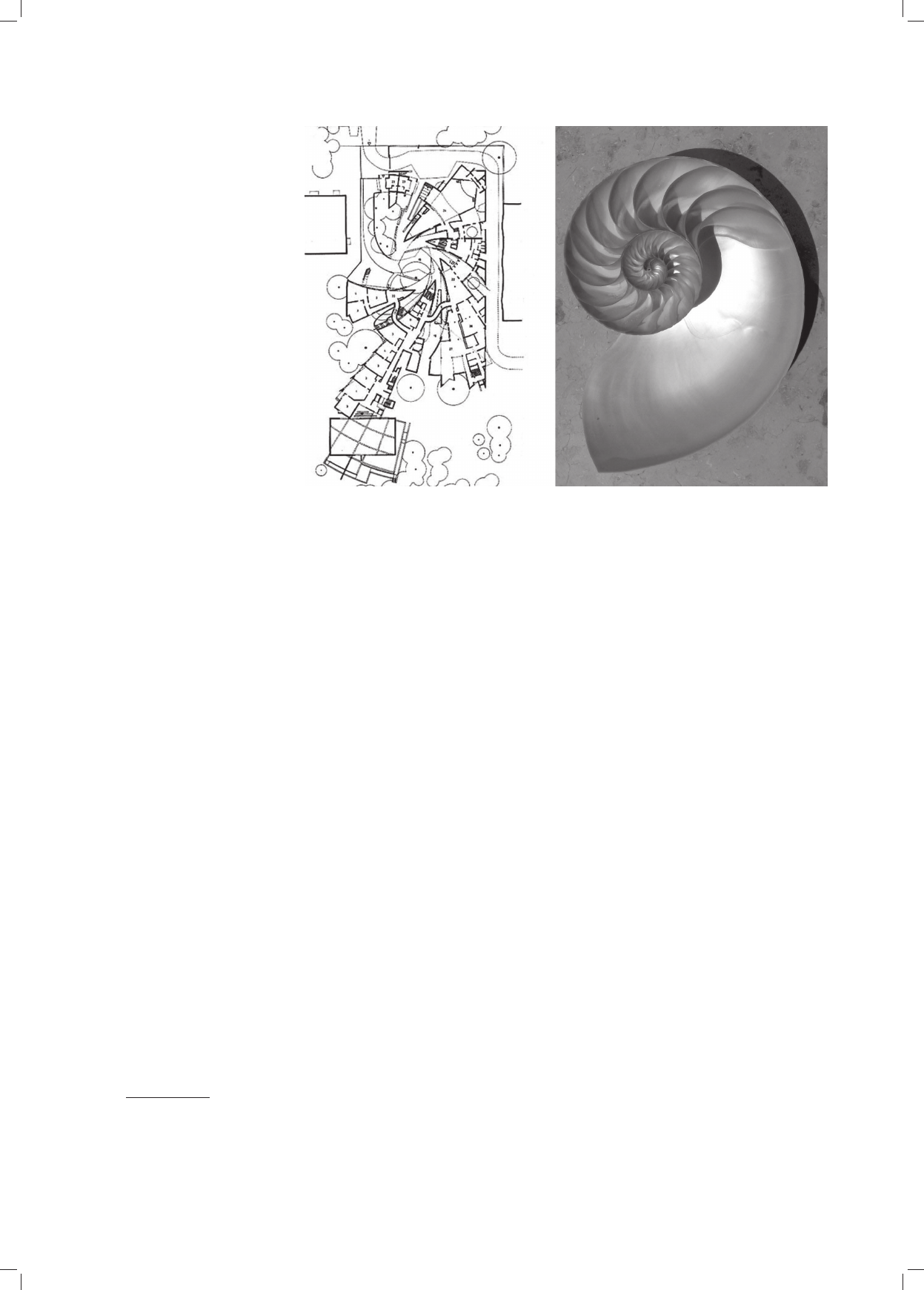
W poszukiwaniu zasad architektury fraktalnej / In search of fractal architecture’s principles 65
obiektów fraktalnych, podczas gdy w rzeczywistości spi-
rala jest krzywą, której brak charakterystycznych dla
o
biektów fraktalnych cech, takich jak np. samopodobień-
stwo. Najprawdopodobniej skojarzenie spirali z fraktalami
można zawdzięczyć nautilusowi, morskiemu mięczakowi,
którego spiralna, ale zarazem segmentowa budowa poda-
wana jest jako przykład fraktala występującego w natu-
rze. W budowie nautilusa cechy fraktalne przejawiają się
właś nie w sekwencji segmentów, których gabaryty i wza-
jemny układ związane są matematyczną formułą (il. 1).
Kolejnym obiektem wymienianym przez Jencksa jest
Cinema Center w Dreźnie autorstwa spółki Coop Himmel-
blau. Opisując to dzieło, Jencks doszukuje się na rysunku
przekroju obiektu siatki konstrukcyjnej o fraktalnych
samopodobnych prostokątach odchylonych pod kątem
45 i 60 stopni, wywołujących wrażenie pękającej kry
lodowej lub rosnącego kryształu
4
[2]. I tym razem można
odnieść wrażenie, że autor nadużywa określenia „frak-
tal”, bazując na etymologii tego wyrazu (łac. fractus
– częściowy, połamany), mając na myśli jedynie pewne
odstępstwa od klasycznej geometrii, obiektów foremnych
i łamaną strukturę formy.
Następne przykłady pochodzą z Melbourne. Jednym
z nich jest budynek Storey Hall, o którym w pierwszych
słowach Jencks pisze: Storey Hall w Melbourne jest kolej-
nym, o wiele bardziej kolorowym bujnym fraktalem
5
[2, s. 240]. Budynek Story Hall to siedziba galerii sztuki
RMIT Galery i należy do kompleksu Royal Melbourne
Institute of Technology (RMIT). Obiekt zaprojektowany
4
Oryg.: Seen from the exterior, the crystalline walls lean out pre-
cariously following different mullion grids, at diferrent scale. It has
fractal of rectangles, forty-five and sixty degrees; it conveys the order of
collapsing ice-floe, or growing crystal on the glazed side.
5
Oryg.: Storey Hall is another exuberent fractal, and much more
colorful.
Further examples come from Melbourne. One of them
is the building of Storey Hall which Jencks describes as
follows: Storey Hall is another exuberant fractal, and
much more colorful [2, p. 240]. The building of Storey
Hall is the seat of RMIT Gallery and it is part of the com-
plex of Royal Melbourne Institute of Technology (RMIT).
It was designed by Ashton Raggatt Mc Dougall architec-
ture design studio as an infill building in Swanston Street,
between two Classical buildings. The design idea was to
create contrast both in form and in color between old
architecture and the newly designed building. Jencks
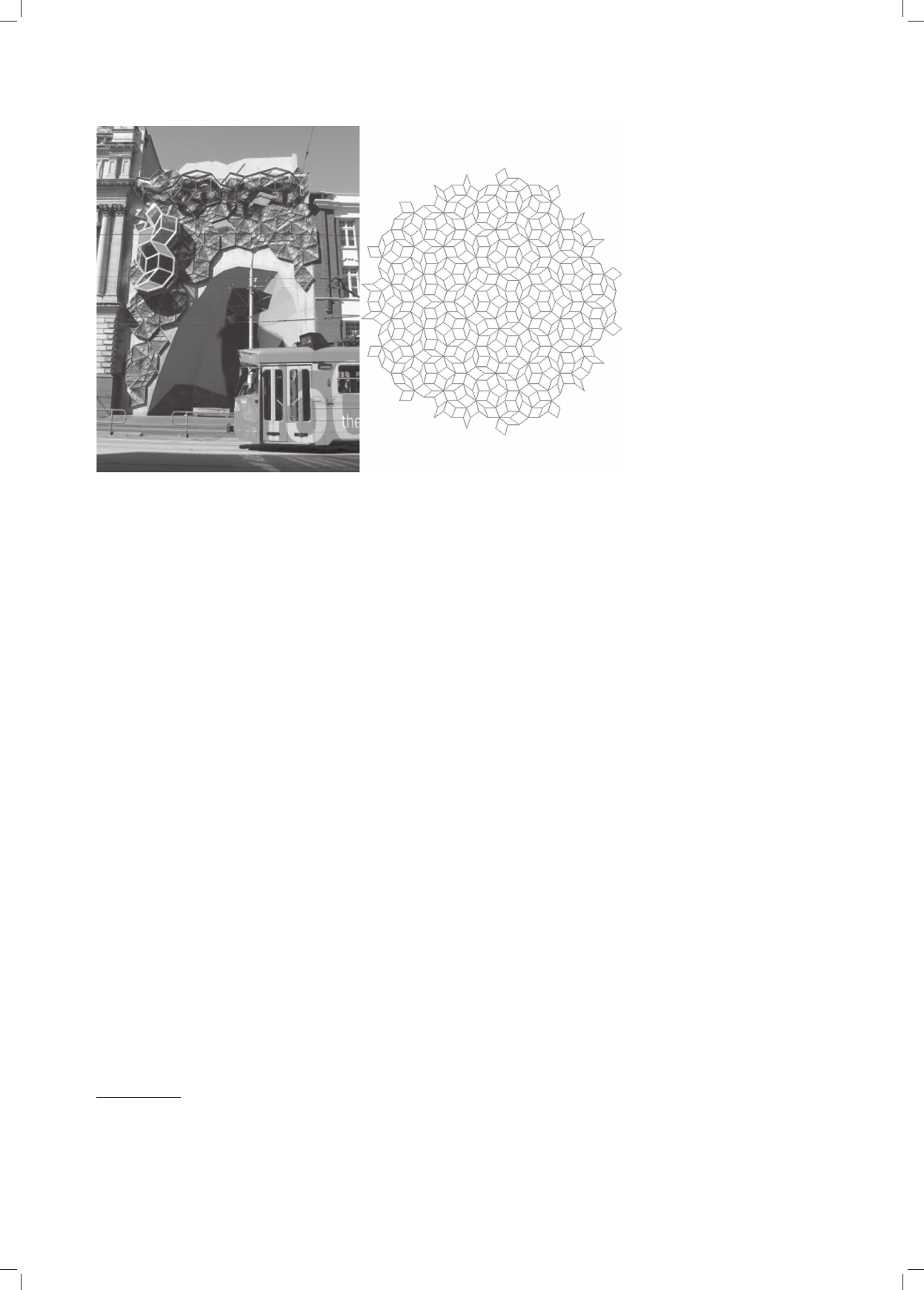
correctly reads the similarity between the structure and
tiling of Roger Penrose into the facade composition,
describing the facade as: Fractal forms based on the ape-
riodic tiling of Roger Penrose create larger patterns that
never repeat exactly and yet are always self-similar [2,
p. 240]. The search for the analogy to the Penrose mosaic
seems more appropriate than the search for fractal self-
similar forms in the facade structure (Fig. 2). It is proper
to call the composition of the front facade of Storey Hall
undulating or fractured (fractus). The elements of self-
similar pentagons of different scales are visible, however,
inside the building in the foyer decoration as well as in
acoustic and lighting elements of the auditorium, which
Jencks correctly described as: Fractal forms on the inte-
rior auditorium become acoustic tiles and lighting system
that,
every so often, turn into superordinate pattern of pen-
tagon [2, p. 241].
When presenting Storey Hall, Jencks
dwells on the urban aspect of the context of the object in
relation to the existing architecture of Swanston Street,
try
ing to
figure out if it is a new order – different from the
previous one – or maybe an example of a new grammar
presented by Michael Batty and Paul Longley in their
book
on fractal cities which demonstrate the emerging self-
-similar order at regional level and in megalopolis [1], [2].
Further in the chapter, Jencks gives more examples of
what he considers to be fractal buildings, which are tradi-
Il. 1. Heinz Galinski School
(rzut poziomy przyziemia)
i nautilus – mięczak morski
Fig. 1. The Heinz Galinski School
(ground floor layout plan)
and nautilus – marine mollusk
66 Piotr Furmanek
został przez pracownię architektoniczną Ashton Raggatt
Mc Dougall jako uzupełnienie zabudowy pierzei ulicy
Swanston Street, pomiędzy dwoma klasycystycznymi
budynkami. Idea projektowa polegała na stworzeniu kon-
trastu zarówno formalnego, jak i kolorystycznego pomię-
dzy starą i nowoprojektowaną zabudową. W kompozycji
elewacji Jencks doszukuje się – trafnie – podobieństwa
struktury do parkietażu Rogera Penrose’a, opisując fasa-
dę: Fraktalne formy bazujące na nieokresowym parkieta-
żu Rogera Penrose’a tworzą ogromne wzory, które nigdy
nie powtarzają się dokładnie, pozostając ciągle samopo-
dobne
6
[2, s. 240]. Poszukiwanie analogii do mozaiki
Penrose’a wydaje się bardziej właściwe niż poszukiwanie
w strukturze elewacji fraktalnych samopodobnych form
(il. 2). Ade kwatne w stosunku do elewacji frontowej
Storey Hall jest określenie jej jako kompozycji pofałdo-
wanej, można po wiedzieć połamanej (fractus). Elementy
samopodobnych pięciokątów o różnych skalach widocz-
ne są natomiast we wnętrzu budynku jako dekoracja foyer
oraz jako elementy akustyczne i oświetleniowe wnętrza
audytorium, co słusznie zauważa Jencks: Fraktalnymi
formami w wnętrzu au dytorium są płyty akustyczne i sys-
tem oś
wiet leniowy podporządkowany nadrzędnej formie
pięciokąta
7
[2, s. 241]. Przy okazji prezentacji Storey Hall
Jencks rozważa aspekt urbanistyczny kontekstu obiektu
w stosunku do istniejącej zabudowy ulicy Swanston,
zastanawiając się, czy jest to nowy porządek inny od
dotychczas obowiązującego, czy może przykład nowej
gra matyki głoszonej w pracy Mi chaela Batty’ego i Paula
Longleya o fraktalnych mias tach, które prezentują poja-
6
Oryg.: Fractal forms based on the aperiodic tiling of Roger
Penrose create larger patterns that never repeat exactly and yet are
always self-similar.
7
Oryg.: Fractal forms on the interior audytorium become acoustic
tiles and lighting system that, every so often, turn into superordinate
pattern of pentagon.
tionally referred to in the literature on the subject as
examples of deconstructivism in architecture. They
in clude Daniel Libeskind’s Jewish Museum in Berlin and
Frank O’Gehry Guggenheim Museum in Bilbao. Writing
about the first of the examples, Jencks emphatically
stresses: Without doubt the most convincing fractal build-
ing finished so far is Daniel Libeskind’s Jewish Museum
in Berlin [2, p. 243]. The feature which triggered Jencks
to use the term “fractal” is the repetitive broken lines
going at various angles both in the facades and in the floor
plans which additionally ideally match the Latin term
fractus (fractured). Regarding the other example – Jencks
describes its designer as the undoubted master of fluid
fractal [2, p. 250], unconvincingly explaining why
a curve, which is “fluid”, demonstrates the features of
fractal objects.
The analysis of his work, and especially the examples
he gives, indicates that Charles Jencks is undoubtedly
fascinated by the theory of fractals, trying to implement it
in architecture. This undoubtedly interesting idea is
unfortunately unsupported by more profound studies of
the essence of fractal objects. One can be then tempted to
ask the following question: What should the fusion of the
theory of fractals with the theory and practice of architec-
ture look like? It is impossible to answer that question
without knowledge of the fundamentals of the theory of
fractals, and the definition as well as a set of features
characteristic of fractal objects should be the basis of the
theory.
According to Benoit Mandelbrot – a Polish-born
French mathematician, universally considered to be the
father of the theory of fractals – fractal objects feature
three properties [3, p. 16]:
1) their generation method, which is determined by
the recursive relation,
2) their dimension, which is usually a fractional num-
ber,
3) their self-similarity.
Il. 2. Storey Hall w Melbourne
i parkietaż Rogera Penrose’a
Fig. 2. Storey Hall in Melbourne
and tiling of Roger Penrose

W poszukiwaniu zasad architektury fraktalnej / In search of fractal architecture’s principles 67
wiający się samopodobny porządek na poziomie regionu
i megalopolis
8
[1], [2].
W dalszej części rozdziału Jencks przytacza kolejne
przykłady, według jego opinii budynków fraktalnych,
a tradycyjnie w literaturze przedmiotu podawanych jako
przykłady architektury dekonstruktywistycznej. Są to Mu -
zeum Żydowskie w Berlinie autorstwa Daniela Libes kinda
oraz Muzeum Guggenheima w Bilbao Franka O’Gehry’ego
.
Pisząc o pierwszym z przykładów, emfatycznie pod-
kreśla: Bez wątpienia jednym z najbardziej przekonują-
cych fraktalnych budynków, jakie do tej pory powstały,
jest Muzeum Żydowskie w Berlinie Daniela Libeskinda
9
[2, s. 243]. Cechą, która sprowokowała Jencksa do użycia
określenia „fraktalne”, są linie łamane powtarzające się
i występujące pod różnymi kątami zarówno w elewacji,
jak i w rzutach obiektu, a dodatkowo idealnie pasujące do
łacińskiego określenia fractus (łamany). Odnośnie do
drugiego przykładu – nazywa jego twórcę niewątpliwym
mistrzem płynnych fraktali
10
[2, s. 250], nieprzekonująco
tłumacząc, dlaczego linia krzywa, a zatem „płynna”, ma
cechy obiektów fraktalnych.
Jak wynika z analizy treści pracy, a zwłaszcza załączo-
nych przykładów, Charles Jencks uległ niewątpliwej
fascynacji teorią fraktali, podejmując próbę jej implemen-
tacji do dziedziny architektury. Pomysł z pewnością inte-
resujący, ale niestety niepodbudowany głębszymi studia-
mi nad istotą obiektów fraktalnych. Można zatem się
pokusić o postawienie pytania: Jak powinna wyglądać
fuzja teorii fraktali z teorią i praktyką architektury? Nie
sposób odpowiedzieć bez znajomości podstaw teorii frak-
tali. A podstawą teorii niech będą definicja i zbiór cech
charakterystycznych obiektów fraktalnych.
Obiekty fraktalne według Benoit Mandelbrota – fran-
cuskiego matematyka polskiego pochodzenia uważanego
powszechnie za ojca teorii fraktali – charakteryzują się
trzema własnościami [3, s. 16]:
1) metoda generowania jest określona zależnością
rekurencyjną,
2) wymiar najczęściej jest liczbą ułamkową,
3) cechą charakterystyczną jest samo podobieństwo.
Dwie pierwsze dotyczą ściśle matematycznych właści-
wości, które ze względu na charakter niniejszej pracy nie
mają większego znaczenia, natomiast trzecia cecha samo-
podobieństwa – dla odmiany trudna do zdefiniowania
w kategoriach matematycznych – jest cechą najbardziej
wyróżniającą fraktale pośród innych obiektów geome-
trycznych i najbardziej zrozumiałą w sensie powszechne-
go użycia. Samopodobieństwo najłatwiej jest scharakte-
ryzować w kategoriach intuicyjnych na przykładzie kala-
fiora. Główka kalafiora składa się z gałązek, które po
oddzieleniu od reszty przypominają główkę. Z gałązki
można oddzielić jeszcze mniejsze części, które są podob-
8
Oryg.: As the work of Batty and Longley on Fractal Cities has
shown, there is an emergent order at the level of the region and mega-
lopolis.
9
Oryg.: Without doubt the most convincing fractal building fini-
shed so far is Daniel Libeskind’s Jewish Museum in Berlin.
10
Oryg.: The undoubted master of fluid fractal is Frank Gehry.
The first two regard strictly mathematical properties,
which due to the nature of this paper are actually irrele-
vant, whereas the third property – which is by contrast
difficult to define in mathematical categories – is the
property which distinguishes fractals from among other
geometrical objects most and at the same time it is most
understandable in everyday life. The easiest way to
de scribe self-similarity in intuitive categories is to
de scribe it with the use of cauliflower. The cauliflower
head is composed of stems, which, when separated from
the rest, resemble the head. The stems can be further
divided into smaller and smaller parts which are similar
both to the head and to the stem from which they come.
That property is visible in the third or even fourth genera-
tion. In mathematical models of fractals the property of
self-similarity is repeated in the next generation indefinite
number of times. When defining self-similarity in the
case of fractals, it can be said in simple terms that every
part of a fractal is a reduced copy of the whole [4]. The
most famous fractals include the Sierpinski Triangle and
Pyramid, the Van Koch Curve, the Sierpinski Carpet and
the Menger Sponge, the Barnsley Fern. Fractal objects
can be generated with the use of descriptive procedure,
which is the case with classic fractals, or with the use of
IFS method (Iterated Function System) which generates
both classic and general type of fractals. The implementa-
tion of IFS can be described as follows:
There is a fixed subset A in space R, usually referred
to as initiator and an affine transformation W. Affine
transformations include e.g. translation, rotation, scaling.
Transformation W can be a series of transformations
W = W
1
+ W
2
+…+ W
n
. As a result of transformation W of
set A, A
1
is generated, that is W(A) = A
1
. Set A
1
is usually
referred to as generator. The generated set A
1
is subjected
again to the same transformation W and set A
2
is genera-
ted, that is W(A
1
) = A
2
. A multiple transformation of suc-
cessively generated sets with the same transformation is
called iteration. Iteration generates a sequence of sets
which for certain parameters of transformation W tends to
the limit of the final set A
∞
called attractor of a given
transformation. Attractor is a set or a geometrical object
which demonstrates the properties of fractal objects, and
which is additionally continuous on the left, which in
simple terms means that element A
n
is basically the same
as the preceding element A
n–1
. A slight modification of
IFS, consisting in generating a set that is sum of the terms
of the sequence A = A
1
∪ A
2
∪…∪ A
n
, also generates a set
with fractal properties.
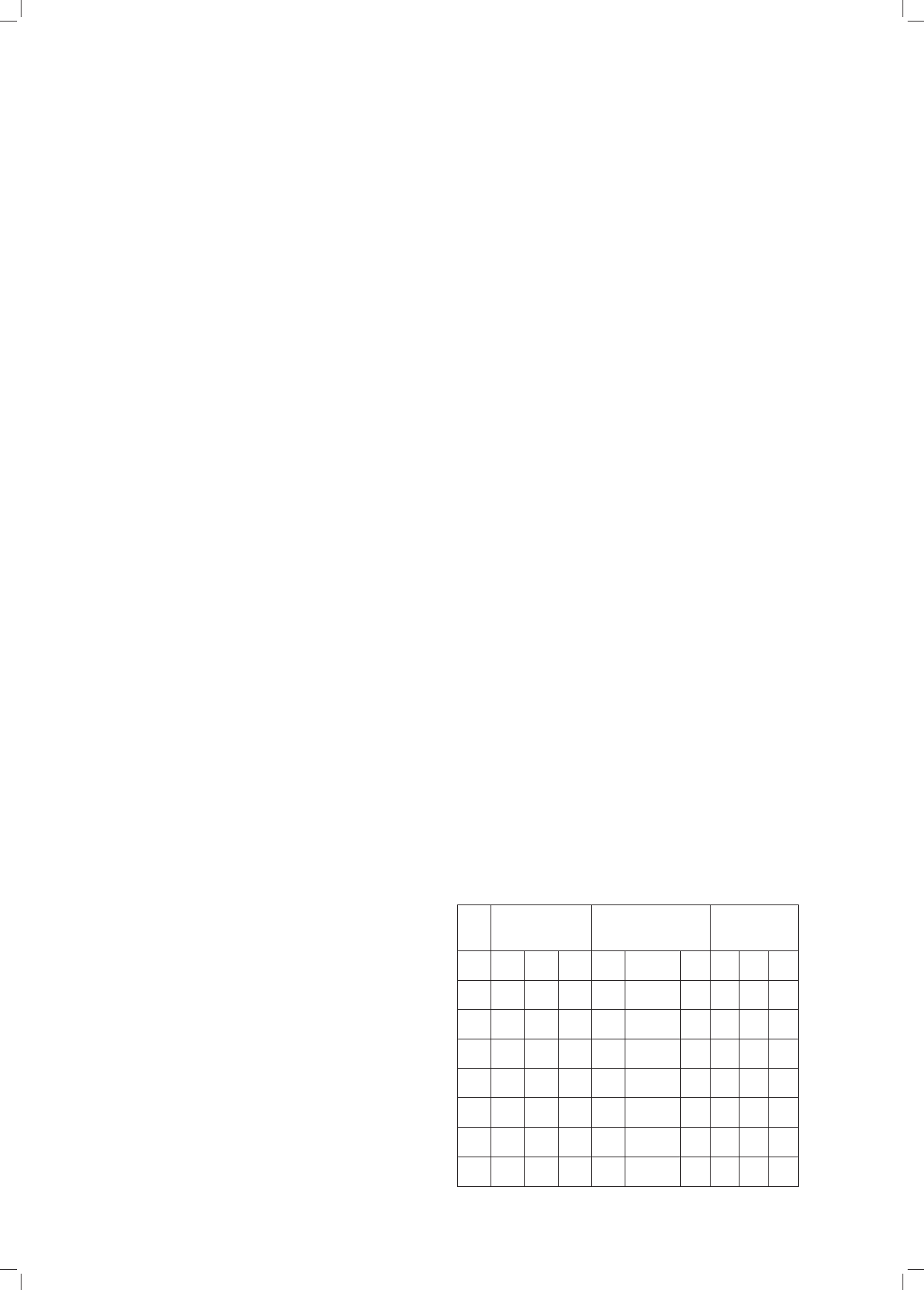
Example 1
A given prism G, with its height h and the base in the
shape of a regular hexagon with the side a, is situated in
a system of coordinates and transformation W, which is
a series of seven transformations W
1
, W
2
… W
7
.
W(A) = W
1
(G) ∪ W
2
(G) ∪…∪ W
7
(G)
Each of the transformations W
1
, W
2 .
… W
7
is addition-
ally a series of scaling and translation. Table 1 shows the
parameters of transformations.
Prism G, called initiator, is subjected to successive
transformations of scaling and translation
W
1
(G), W
2
(G), … W
7
(G)
68 Piotr Furmanek
ne zarówno do główki, jak i do gałązki, z której pocho-
dzą. Ta własność przenosi się na trzecią, a nawet na
czwartą generację. W matematycznych modelach fraktali
własność samopodobieństwa przenosi się na następną
generację nieskończoną liczbę razy. Definiując samopo-
dobieństwo w przypadku fraktali, można w uproszczeniu
powiedzieć, że każda część fraktala jest pomniejszoną
kopią całości [4]. Najbardziej znane fraktale to Trójkąt
i Piramida Sierpińskiego, Krzywa Van Kocha, Dywan
Sierpińskiego i Gąbka Mengera, Paprotka Barnsleya.
Generowanie obiektów fraktalnych może odbywać się za
pomocą procedury opisowej, tak jak to się dzieje w przy-
padku fraktali klasycznych, lub za pomocą metody IFS
(Iterated Function System), dzięki której generuje się
zarówno fraktale klasyczne, jak i ogólnego typu. Działanie
metody IFS można opisać w sposób następujący:
Dany jest podzbiór A przestrzeni R, zwany najczęściej
inicjatorem, oraz przekształcenie afiniczne W. Do grupy
przekształceń afinicznych zalicza się m.in. przesunięcie,
obrót, skalowanie. Przekształcenie W może być złoże-
niem przekształceń W = W
1
+ W
2
+…+ W
n
. W wyniku
działania przekształcenia W na zbiór A powstaje zbiór A
1
,
czyli W(A) = A
1
. Zbiór A
1
nazywany jest zazwyczaj gene-
ratorem. Uzyskany zbiór A
1
ponownie poddaje się działa-
niu tego samego przekształcenia W i otrzymuje się zbiór
A
2
, czyli W(A
1
) = A
2
. Wielokrotne przekształcanie kolejno
uzyskanych zbiorów za pomocą tego samego przekształ-
cenia nazywane jest iterowaniem. W wyniku iterowania
powstaje ciąg zbiorów, który dla pewnych parametrów
przekształcenia W dąży w granicy do zbioru końcowego
A
∞
zwanego atraktorem danego przekształcenia. Atraktor
to zbiór, czy inaczej obiekt geometryczny, który wykazu-
je cechy obiektów fraktalnych, a dodatkowo jest obiek-
tem lewostronnie niezmienniczym, co w uproszczeniu
oz nacza, że element A
n
nie różni się zasadniczo od ele-
mentu poprzedzającego A
n–1
. Nieznaczna modyfikacja
metody IFS polegająca na generowaniu zbioru, który jest
sumą wyrazów ciągu A = A
1
∪ A
2
∪…∪ A
n
, również pro-
wadzi do uzyskania zbioru o cechach fraktalnych.
Przykład 1
Niech będzie dany graniastosłup G o wysokości h
i pod stawie w kształcie sześciokąta foremnego o boku a,
usytuowany w układzie współrzędnych oraz przekształ-
cenie W, które jest złożeniem siedmiu przekształceń W
1
,
W
2
… W
7
.
W(A) = W
1
(G) ∪ W
2
(G) ∪…∪ W
7
(G)
Każde z przekształceń W
1
, W
2
… W
7
jest dodatkowo
złożeniem skalowania i translacji. Parametry przekształ-
ceń określa tabela 1.
Graniastosłup G, zwany inicjatorem, jest poddawa-
ny kolejno przekształceniom skalowania i translacji
W
1
(G), W
2
(G), … W
7
(G), w wyniku czego otrzymuje się
obiekt G
1
, który jest zbiorem (sumą) siedmiu przekształ-
conych graniastosłupów. Uzyskany obiekt G
1
nazywany
jest generatorem. Kolejność stosowanych przekształceń
nie jest zasadniczo dowolna, jednakże w niniejszym przy-
kładzie jest obojętna. Procedurę składania przekształceń
przedstawiono na ilustracji 3.
Otrzymany w wyniku przekształcenia obiekt generato-
ra G
1
jest w następnej kolejności przekształcany ponow-
which generate object G
1
which is a set (sum) of seven
transformed prisms. The generated object G
1
is referred to
as generator. Although the sequence of implemented trans-
formations
is basically not random, it is irrelevant in this
example. Figure 3 shows the series of transformations.
Object G
1
, generated as a result of transformation, is
then transformed again by transformation W(G
1
) which is
a series of the same transformations of scaling and trans-
la tion W
1
, W
2
, … W
7
defined in Table 1. The sequence of
im plementation of transformations should be identical to
those in the first step of the construction. As a result of
transformation of object G
1
by transformation W object
G
2
is generates. The following steps in the construction
consisting in a multiple recursive implementation of
trans formation W(G) to successively generated objects
G
1
, G
2
…
G
n
generate a sequence of terms which tends to
attractor of transformation W which demonstrates the
properties of fractal objects (Fig. 4). Defining parameters
of transformation W
1
, with value 1 for scaling and 0 for
translation, results in the first transformation being in fact
in every step of iteration a copy of the preceding term, and
consequently the object generated ultimately is the sum of
all previous terms of the sequence. The object constructed
in this way was generated as a re sult of a recursive proce-
dure, has self-similar properties, and its fractal dimension
is a frac tional number. The consistency of those factors
with Mandelbrot’s definition of fractals classifies the
object as a fractal object. Figure 4 shows the first four
steps of iteration.
The object generated as a result of strict implementa-
tion of the procedure of generation of fractal objects can
be a source of inspiration in the process of development
of architectural forms. According to the classification of
forms proposed by Juliusz Żórawski in his book titled
O budowie formy architektonicznej the generated object
can be described as a cohesive form with multi-plane
symmetry, multiple rhythm, and strict harmony based on
a fixed digital relation between its component elements.
Skalowanie
Scaling
Translacja
Translation
Obrót
Rotation
s
x
s
y
s
z
t
x
t
y
t
z
ϕ
x
ϕ
y
ϕ
z
W
1
1110 0 0000
W
2
1/2 1/2 4/5 0 a 0 0 0 0
W
3
1/2 1/2 3/5
a/2 a√3/2a
0000
W
4
1/2 1/2 3/5
–a/2 a√3/2a
0000
W
5
1/2 1/2 4/5
a/2 –a√3/2a
0000
W
6
1/2 1/2 4/5
–a/2 –a√3/2a
0000
W
7
1/2 1/2 2/5
a
00000
Tab. 1. Parametry przekształceń W
1
(G), W
2
(G), … W
7
(G)
Tab. 1.
Parameters of transformations W
1
(G), W
2
(G), … W
7
(G)
W poszukiwaniu zasad architektury fraktalnej / In search of fractal architecture’s principles 69
nie przez transformację W(G
1
), która jest złożeniem tych
samych transformacji skalowania i translacji W
1
, W
2
, … W
7
zdefiniowanych w tabeli 1. Kolejność stosowania prze-
kształceń winna być identyczna jak w pierwszym kroku
konstrukcji. W wyniku przekształcenia obiektu G
1
trans-
formacją W otrzymuje się obiekt G
2
. Kolejne kroki kon-
strukcji polegające na wielokrotnym rekurencyjnym sto-
sowaniu przekształcenia W(G) w stosunku do kolejno
uzyskiwanych obiektów G
1
, G
2
…
G
n
generują ciąg wyra-
zów dążący w granicy do atraktora przekształcenia W,
który wykazuje cechy obiektów fraktalnych (il. 4). Zde-
finiowanie parametrów transformacji W
1
, o wartoś ciach
1 dla skalowania i 0 dla translacji, powoduje, że w wyni-
ku pierwszego przekształcenia w rzeczywistości powsta-
je w każdym kroku iteracji kopia wyrazu poprzedniego,
a w konsekwencji uzyskany w granicy obiekt jest sumą
wszystkich poprzednich wyrazów ciągu. Skon struo wa ny
w ten sposób obiekt powstał w wyniku procedury reku-
rencyjnej, ma cechy samopodobieństwa, a wymiar frak-
talny jest liczbą ułamkową. Zgodność wy mie nionych
czynników z definicją fraktali według Mandelbrota klasy-
fikuje obiekt jako obiekt fraktalny. Cztery pierwsze kroki
iteracji przedstawiono na ilustracji 4.
Uzyskany w wyniku ścisłego stosowania procedury
generowania obiektów fraktalnych obiekt może stanowić
źródło inspiracji w procesie kształtowania formy architek-
tonicznej. Zgodnie z klasyfikacją form proponowaną przez
Juliusza Żórawskiego w dziele zatytułowanym O budo-
These properties predispose the generated form to the use
in architecture and provide an appropriate example of an
object which can be classified as fractal architecture.
The presented method of search for an architectural
form based on the strictly mathematical formula for
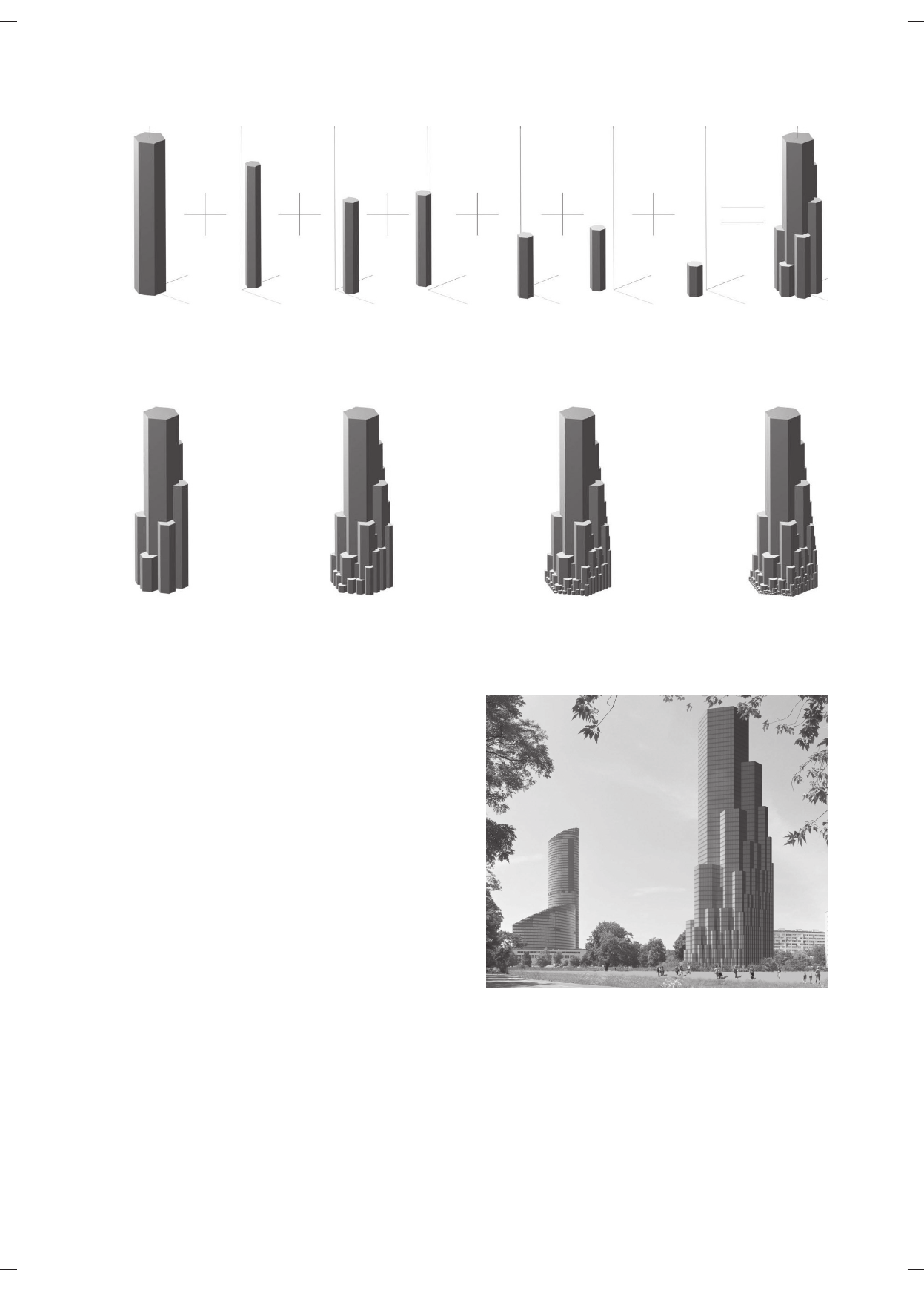
Il. 3. Złożenie transformacji afinicznych W
1
, W
2
... W
7
kształtuje obiekt generatora
Fig. 3. A series of affine transformations W
1
, W
2
... W
7
generates the shape of generator
Il. 4. Iterowanie generatora kształtuje w granicy obiekt atraktora transformacji W(G)
Fig. 4. Iteration of generator ultimately generates the object of attractor of transformation W(G)
Il. 5. Fractal Tower jako teoretyczny przykład budynku
o cechach ściśle fraktalnych
Fig. 5. Fractal Tower as a theoretical example of a building
with strictly fractal properties

70 Piotr Furmanek
wie
formy architektonicznej otrzymany obiekt można okreś-
lić
jako formę spoistą o wielopłaszczyznowej symetrii,
wielokrotnym rytmie oraz ścisłej harmonii opartej na sta-
łym stosunku liczbowym między elementami składowy-
mi. Cechy te predysponują uzyskaną formę do wykorzy-
stania w architekturze oraz stanowią właściwy przykład
obiektu, który zaliczyć można do architektury fraktalnej.
Prezentowana metoda poszukiwania formy architekto-
nicznej opartej na ściśle matematycznej formule genero-
wania kształtu zapewnia uzyskanie właściwej geometrii
obiektu, a tym samym wyznacza prawidłowy kierunek
rozwoju architektury fraktalnej stanowiącej interesującą
alternatywę dla dekonstruktywizmu i odradzającego się
neomodernizmu.
Przedstawiony na ilustracji 5 obiekt nazwany roboczo
Fractal Tower (zgodnie z aktualnie modną tendencją) jest
przykładem czysto teoretycznym zaprojektowanym jedy-
nie w celu prezentacji metody, zlokalizowanym wpraw-
dzie w rzeczywistej sytuacji, ale niemającym podstaw
i cech realnej inwestycji.
Bibliografia/References
[1] Batty M., Longely P., Fractal Cities. A Geometry of Form and Func-
tion, Academic Press, London 1994.
[2] Jencks Ch., The New Paradigm in Architecture. The Language of
Post Modernism, Yale University Press, New Haven–London 2002.
[3] Kudrewicz J., Fraktale i chaos, WNT, Warszawa 1993.
[4] Peitgen H., Jurgens H., Saupe D., Granice chaosu. Fraktale, PWN,
Warszawa 1995.
Streszczenie
W roku 2002 Charles Jencks, znany amerykański architekt, historyk i krytyk architektury, do jednego z ważniejszych dzieł w swoim dorobku (Język
postmodernistycznej architektury) dodał dwa rozdziały: „The New Paradigm I – Complexity Architecture” (Nowy paradygmat I – Architektura
złożo ności) oraz „The New Paradigm II – «Fractal Architecture»” (Nowy paradygmat II – Architektura fraktalna). W rozdziałach tych autor głosi
narodziny nowych kierunków, twierdząc, że przyszłość architektury należeć będzie do fraktali, kosmosu i form falujących. Analizując dokładniej
postawione tezy, daje się dostrzec pewne nieścisłości w zakresie doboru przykładów ilustrujących postawione tezy. W artykule podjęto polemikę
z autorem, sugerując właściwe zasady kształtowania architektury fraktalnej oparte na matematycznej teorii fraktali.
Słowa kluczowe: obiekty fraktalne, system funkcji iterowanych, architektura fraktalna
Abstract
In 2002 Charles Jencks, a famous American architect, historian and architecture critic added two new chapters to one of his most important works
The Language of Post-Modern Architecture: “
The New Paradigm I
–
Complexity Architecture
” and “
The New Paradigm II
– ‘
Fractal Architecture
’ ”.
In the newly added chapters, the author proclaims the birth of new trends in contemporary architecture, saying that its future will belong to fractals,
universe and waving forms. Analyzing this thesis further one can notice certain inconsistencies in Charles Jencks’ argumentation and so the author
of this article writes a polemic, suggesting appropriate principles of fractal architecture based on mathematical theory of fractals.
Key words: fractal objects, iterated function system, fractal architecture
the generation of shape guarantees the right geometry of
an object, and consequently, sets the correct direction for
the development of fractal architecture which is an inter-
esting alternative to deconstructivism and re-emerging
neomodernism.
The presented object called Fractal Tower (in line with
today’s trend) is a purely theoretical example designed
only to present the method which, in spite of being locat-
ed in a real situation, has no basis or features of a real
investment (Fig. 5).
Translated by
Tadeusz Szałamacha