2014
4(40)
DOI: 10.5277/arc140404
René Motro*
„Węzły i struktury przestrzenne” – w hołdzie Stefanowi du Château
“Nodes and Spatial Structures”, a tribute to Stéphane du Château
Wprowadzenie
Stefan du Château urodził się w Solwyczegodzku
w 1908 r., a po drugiej wojnie światowej, aż do swojej
śmierci w 1999 r., pracował we Francji.
Nie mam żadnych wątpliwości co do tego, że to on wła-
śnie wprowadził mnie w świat struktur przestrzennych,
znając moje zainteresowanie tym tematem. O ile dobrze
pamiętam, pierwszy raz spotkaliśmy się w Szkole Archi-
tektury w Montpellier, gdzie uczyłem wytrzy małości ma -
teriałów. Trzy lata wcześniej, w roku 1966, uczestniczył
w bardzo interesującej, pierwszej Międzynarodowej Kon-
ferencji nt. Struktur Przestrzennych w Guild fordzie, zor-
ganizowanej przez Zygmunta Stanisława Makowskiego
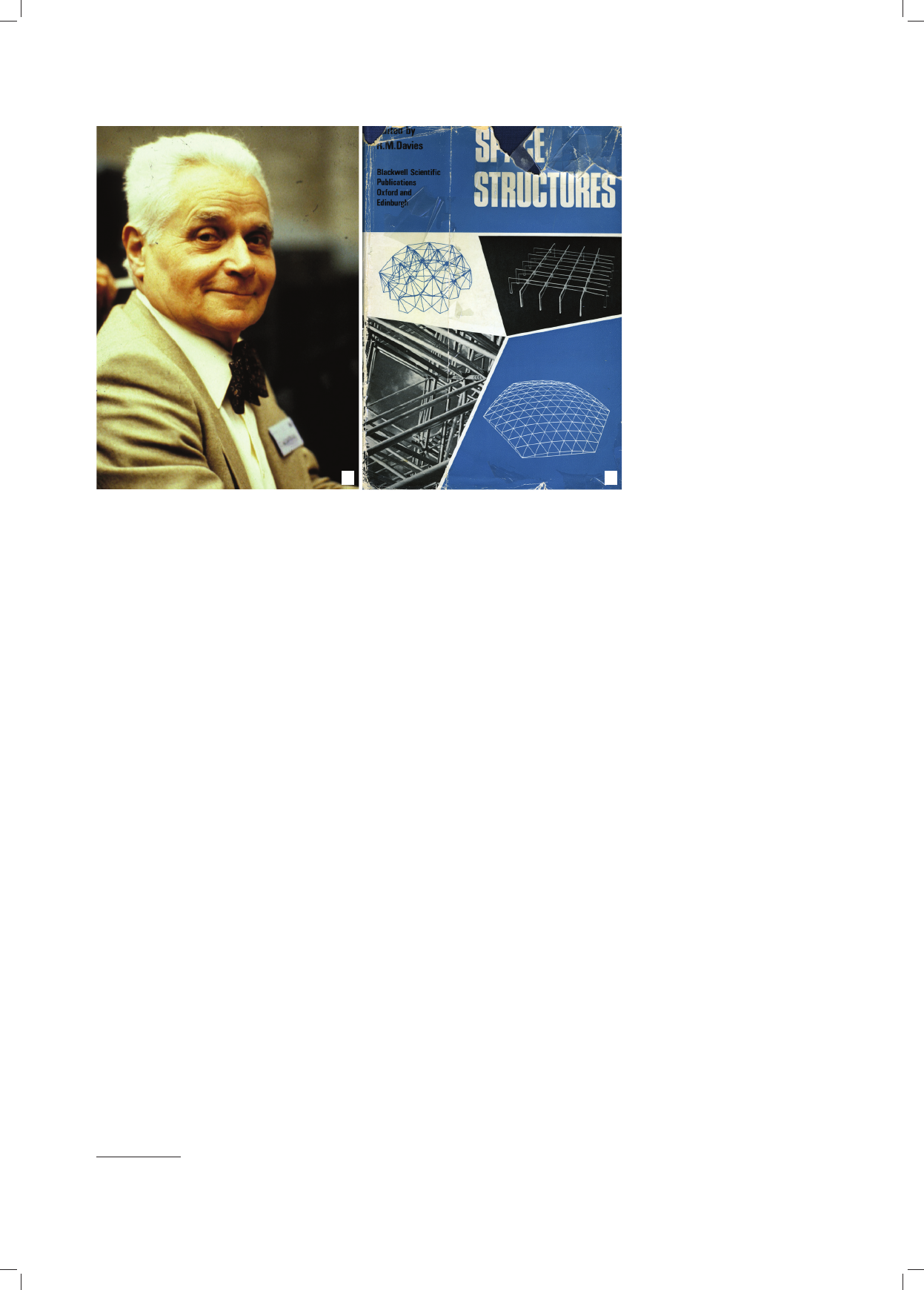
(il. 1). Stefan du Château był jednym z au torów uczest-
niczących w tym wydarzeniu; jego praca zatytułowana
była L’intégration de la pensée technique dans la création
architecturale. Została ona ujęta w części 7.: „Projekt:
Przyszłość” [1]. Tytuł mówi wszystko. „Myśl technicz-
na”, „tworzenie”, „architektura” – te słowa dobrze opisują
tego człowieka. Praca był
a napisana po francusku (auto-
rzy tacy jak M. Mengeringhausen i Y. Friedman również
pisali artykuły konferencyjne w swoich języ kach ojczy-
stych), ale Stefan du Château zawsze mówił po francusku
i od czasu do czasu w latach następnych prosił mnie o tłu-
maczenie swoich wykładów.
W tamtych latach, tworzący jednocześnie wybitni pro -
jektanci, tacy jak Frei Otto i Eduardo Torroja, mogli pre -
* Uniwersytet w Montpellier, Francja/University Montpellier 2,
Montpellier, France.
Introduction
Stéphane du Château, was born in Solvychegodsk, in
1908, and after the second world war, worked in France,
until his death in 1999.
He clearly introduced me in the world of spatial struc-
tures, knowing my personal interest for this fi eld. As far
as I remember we met for the fi rst time in Mont pellier
at the School of Architecture where I taught strength of
ma terials. Three years before, in 1966, he attended the fi rst
International Conference on Space Structures in Guildford,
this conference was organized by Zyg munt Stanis ław Ma-
kowski. The proceedings were very impressive (Fig. 1).
Du Château was one of the authors who participated to
this event, his paper was titled L’intégration de la pensée
technique dans la création architecturale. It was includ-
ed in the part 7 “Design: The Future” [1]. Every thing is
said in this title. “Technical thought”, “creation”, “archi-
tecture” these words described the man. The paper was
written in French (and authors like M. Mengeringhausen
and Y. Friedman wrote in conference proceedings also
in their own native language), but Stéphane du Château
always spoke French, and from time to time, du ring
the following years he asked me to translate his lectures.
It was in these years when simultaneously eminent
designers, Frei Otto, Eduardo Torroja were able to sub-
mit innovative lightweight structures taking advantage of
emerging numerical methods. In 1962 Nicolas Esquillan,
the designer of the CNIT (Paris), organized the IASS
1
Symposium in the capital of France. This event was de-
1
International Association for Shell and Spatial Structures.
42 René Motro
zentować swoje innowacyjne i lekkie struktury, korzys ta jąc
z możliwości, które dawały nowe metody nu me rycz-
ne. W roku 1962 Nicolas Esquillan, projektant zwią zany
z CNIT w Paryżu, zorganizował w stolicy Francji sympo-
zjum International Association for Shell and Spa tial Struc -
tures (IASS)
1
. Wydarzenie to było poświęcone „wiszącym
dachom” i Frei Otto wygłosił swój pierwszy wykład pod
tytułem „Einleitende Bemerkungen zum Kolloquium”.
International Association for Shell and Spatial Struc-
tures zostało założone trzy lata wcześniej przez Eduarda
Torroję. Du Château namawiał mnie, żebym wstąpił do
tego Stowarzyszenia. I tak też zrobiłem.
Wybitna osoba
Z pewnością niewielu ludzi miało możliwość zoba-
czyć go na konferencjach bez słynnej muszki, symbolu
wytworności i szczerej uprzejmości. Była ona sym bolem
jego głębokiego człowieczeństwa i kultury. Jako architekt
z wykształcenia, zawsze głosił potrzebę dobrego zro-
zumienia istoty sprawy. Przywiązany był bardzo do języ-
ka francuskiego i uważał to za punkt honoru, aby za bierać
głos w tym języku, upewniając się najpierw, że większość
uczestników będzie mogła go zrozumieć. Prezentując
swoje prace, zawsze korzystał ze slajdów, których całą
kolekcję otrzymał później Uniwersytet w Mont pellier
dzię ki mieszkającemu na południu Francji siostrzeńco-
wi Stefana. Architekt, inżynier, ale także malarz Stefan
du Château był kimś, kogo określa się po francusku un
honnête homme. Jego prace i życiorys dobrze opisał Tade-
usz Barucki [2]. Nie trzeba przy tym dodawać, że biuro du
Château w Paryżu było miejscem, gdzie jego rodacy za-
wsze mogli uzyskać pomoc i opiekę, której potrzebowali.
1
Międzynarodowe Stowarzyszenie Konstrukcji Powłokowych
i Prze strzennych.
voted to “Hanging Roofs” and Frei Otto gave his fi rst lec-
ture titled “Einleitende Bemerkungen zum Kolloquium”.
The International Association for Shell and Spatial
Structures was founded three years earlier by Eduardo
Torroja. Stéphane du Château urged me to join this Asso-
ciation, I did.
A distinguished person
Certainly few people saw him in conferences with-
out his famous bow tie, symbol of distinction and sin-
cere courtesy. This was the symbol of his deep human-
ity and culture. Educated as architect he always claimed
the necessity to have a good understanding of the essen-
ce of the program. Attached to the French language,
he made it a point of ho nor to make interventions in
French, having made sure that a majority of the attend-
ing persons could understand him. He always presented
his works with slides, and actually University of Mont-
pellier received the whole collection of them, thanks to his
nephew; lives in the south of France. Architect, engineer
but also painter Stéphane du Château was in the French
meaning un honnête homme. His works and curricu lum
are well described by Tadeusz Barucki [2]. Is it not ne-
cessary to say, that his offi ce in Paris was the place where
his fellow countrymen were insured to fi nd the assistance
and the welcome which they needed.
An imaginative engineer
Basic ideas
Stéphane du Château was one of the most productive
engineers in the fi eld of spatial structures during the se-
cond half of the 20
th
century. He was a specia list of tubular
construction and worked in close relation with Zygmunt
Stanisław Makowski who was established in London
Il. 1. Stefan du Château (a),
okładka Proceedings of the 1
st
International Conference on
Space Structures (b)
(fot. R. Motro)
Fig. 1. Stéphane du Château (a),
cover of Proceedings of the 1
st
International Conference on
Space Structures (b)
(photo by R. Motro)
a
b

„Węzły i struktury przestrzenne” – w hołdzie Stefanowi du Château / “Nodes and Spatial Structures”, a tribute to Stéphane du Château 43
Inżynier z wyobraźnią
Podstawowe idee
Stefan du Château był jednym z najbardziej produk-
tywnych inżynierów w dziedzinie struktur przestrzen-
nych 2. poł. XX w. Był specjalistą od wykorzystania rur
do budowy konstrukcji i blisko współpracował z Zyg-
muntem Sta nisławem Makowskim, który działał w Lon-
dynie (w Imperial College), a później także w Guild-
fordzie (w Space Structure Research Centre
2
). Różnica
po między słowami „przestrzeń” a „przestrzenny” nie ma
znaczenia w niniejszym tekście
3
. Stefan du Château był
specja listą w dziedzinie geometrii i potrafi ł projekto wać
wszelkiego rodzaju struktury przestrzenne: ruszty dwu-
war stwowe, sklepienia, systemy podwójnie zakrzywio-
ne..., ale zawsze szczególnie interesowały go dwa zagad-
nienia: węzły oraz proces uprzemysłowienia. Każdy, kto
zajmował się strukturami przestrzennymi, wie, że kluczo-
wym zagadnieniem do rozwiązania w tym zakresie jest
projekt węzłów.
Węzły
• Rozwiązanie dwukierunkowe – Unibat
Na początku rozwoju badań nad rusztami dwuwars t-
wo wymi większość z nich była dwukierunkowa. Miały
one dwie równoległe warstwy – „górną” i „dolną” – z ele-
mentami wiążącymi pomiędzy nimi. Z geometrycznego
punktu widzenia jednym z rozwiązań było uzyskanie
względnego obrotu o 45° pomiędzy głównymi kierunka-
mi warstwy górnej i warstwy dolnej, z których każda była
kwadratową siatką. Stefan du Château był przekonany, że
to bardziej efektywne niż rozwiązanie „kwadrat na kwa-
dracie”. Potwierdzają to wyniki, które opublikowałem
w 1975 r. [3]; ciężar własny został znacznie zmniejszony.
Jestem wdzięczny Stefanowi du Château, Zygmuntowi
Stanisławowi Makowskiemu i Hoshyarowi Nooshinowi,
którzy zachęcili mnie do wykonania tej pracy podczas
mojej wizyty w Centrum Badań Struktur Przestrzennych
w Guildfordzie (1973).
Co było węzłem w takiej geometrii, w systemie Unibat?
Nic, ponieważ nie ma żadnych części węzłowych w tej
sieci dwuwarstwowej. Jest to stosowane w pira midach
o podstawie kwadratowej, montowanych przy użyciu jed-
nej poziomej śruby na rogach kwadratów, które stano wią
warstwę górną (podstawę piramid). Pozostałe krawędzie
piramidy są elementami usztywniającymi. Warstwa dolna
jest najprostsza: elementy nie są docinane do wymiarów
geometrycznych, całkowita długość rur jest zachowana,
ale są one zgniatane w odpowiednich odległościach i prze-
wiercane tak, aby wprowadzić w nie śrubę przechodzącą
przez dwa elementy warstwy dolnej krzyżujące się pod
2
Centrum Badań Struktur Przestrzennych.
3
W języku angielskim konstrukcje przestrzenne określa się termi-
nem „spatial structures”. Jednak Z.S. Makowski używał także określenia
„space structures” i założony przez niego ośrodek badawczy nazywa się
Space Structures Research Centre. Ten drugi termin jest obecnie
używany przede wszystkim w kontekście prac tego ośrodka.
(at Imperial College), and then in Guildford, Surrey (at
the Space Structure Research Centre). The difference be-
tween the two words “space” and “spatial” is meaning-
less in this paper. Stéphane du Château was a specialist
of geometry and was able do design all kinds of spatial
structures: double layer grids, vaults, double curved
systems... However, he was always concerned with two
problems: the node and the industrialization process. All
people who were involved in spatial structures design,
know that the main question to solve is the node design.
Nodes
• Bidirectional solutio n – Unibat
At the beginning of investigations into double-layer
grids, most of them were bidirectional. They contained
two parallel layers, “top” and “bottom” ones, and in be-
tween bracing members. Geometrically speaking one of
the solutions was to get a forty fi ve degrees relative ro-
tation between the main directions of the top layer and
the bottom layer, both being a square meshing. Stéphane
du Château was convinced that it was more effi cient than
a “square on square” choice. This was confi rmed by the
results that I published in 1975 [3]; self-weight was sig-
nifi cantly reduced. I am indebted to Stéphane du Château,
Zygmunt Stanisław Makowski and Hoshyar Nooshin who
urged me to do this work, when I visited the Space Struc-
tures Centre in Guildford (1973).
Which was the node for this geometry, for this Unibat
system? None, since there are no node parts for this dou-
ble layer grid. It is realized with square pyramids that are
assembled by a single horizontal bolt at the corners of
the squares that constitute the upper layer (basis of the
pyramids). The other edges of the pyramid are the brac-
ing members. The bottom layer is the simplest that can be
found: members are not cut to meet the geometrical sizes,
the whole length of tubes is kept, but they are crushed at
ne cessary distances and drilled so as to introduce a bolt
through two bottom layer members crossing at 90°, and the
apex of the pyramid where four bracing members are joined.
It can be said that this is a solution without nodes, or with
bolts as nodes: the simplest solution that could be found.
Lightness and transparency result from this design.
In 1976, I organized a colloquium on structures in Mont-
pellier [4], and for this event we assembled two double
layer grids so as to constitute a kind of vault inside our
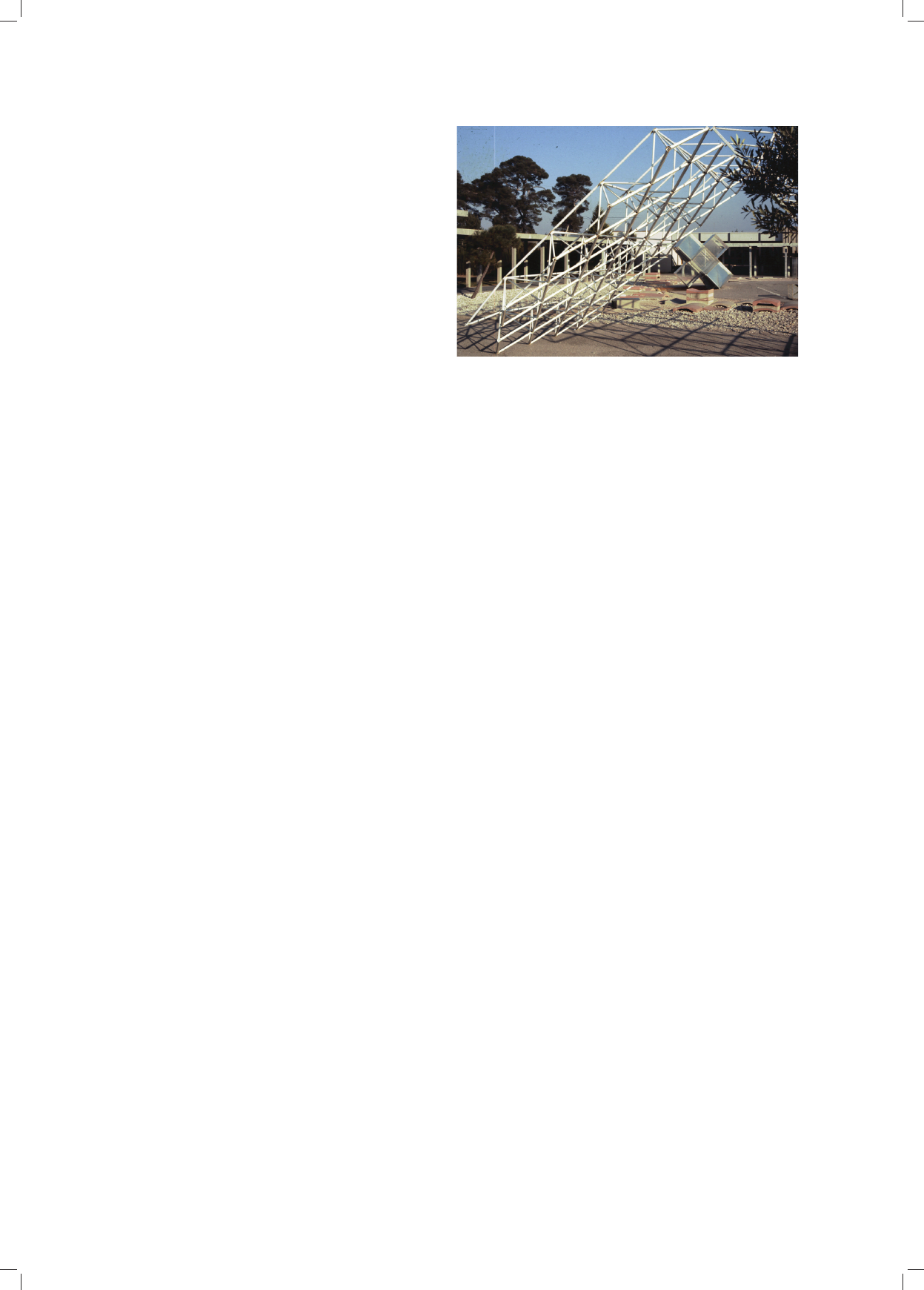
University (Fig. 2).
• Three directional solutions
Stéphane du Château was also aware of the structural
effi ciency of the double curved system and realized what
he called a “three directional” cupola in Grandval with
a very clever molded steel node. This cupola has a dia-
meter equal to 42 m. The radius of the complete sphere
is equal to 40 m. With a sag of 6 m, the total length of
members is 2,136 m, and there are 313 nodes.
Stéphane du Château was convinced by the rigidifying
effect of the double positive curvature, and simultane-
ously by the effi ciency of the three-directional orienta-
tion of the members that was also in accordance with the
44 René Motro
kątem 90° oraz na wierzchołku piramidy, gdzie połączone
są cztery elementy wiążące. Można powiedzieć, że jest
to rozwiązanie bez węzłów lub ze śrubami stanowiącymi
węzły; najprostsze możliwe rozwiązanie.
Taki projekt daje lekkość i przejrzystość. W roku 1976
zorganizowałem w Montpellier kolokwium na temat
struk tur [4] i na to wydarzenie zmontowaliśmy dwa ruszty
dwuwarstwowe, które tworzyły rodzaj sklepienia na tere-
nie naszego Uniwersytetu (il. 2).
• Rozwiązania trójkierunkowe
Stefan du Château zdawał sobie sprawę ze struktu-
ralnej efektywności zastosowania systemu podwójnie
zakrzywionego i w Grandval zrealizował coś, co nazwał
kopułą „trójkierunkową” z bardzo pomysłowo ufor mo-
wa nym stalowym węzłem. Ta kopuła ma średnicę 42 m.
Promień całej kuli sięga 40 m. Przy strzałce 6 m, łączna
długość elementów to 2136 m, a węzłów jest 313.
Du Château był przekonany o usztywniającym dzia -
ła niu podwójnej krzywizny dodatniej oraz jednocześ nie
o efektywności trójkierunkowej orientacji elementów, któ-
ra dodatkowo była zgodna z trójkątnym rzutem obiektu.
Problemem, który musiał rozwiązać, była siatka o po-
wierzchni podwójnie zakrzywionej. Warto podkreślić, że
z geometrycz nego pun
ktu widzenia nie jest łatwo ustalić
długość każdego elementu. Nawet jeśli trójkąty wygląda-
ją podobnie, w rze czywistości takie nie są, a w tamtych
czasach nie było odpowiedniego oprogramowania wspo-
magającego projektanta. Ale zasada opiera się na trzech
krzyżujących się ze sobą sześciokątnych regularnych łu-
kach oraz trójkątnym oddzieleniu pomiędzy nimi.
Projektanci radzili sobie z tym wyzwaniem, budując mo-
dele fi zyczne w małej skali oraz mierząc długość każdego
elementu takiego modelu. Nie było to jednak zbyt precyzyj-
ne, a jednym z ograniczeń projektowania węzłów była moż-
liwość zmiany długości poszczególnych elementów pod-
czas samej realizacji. Konieczne było również znalezienie
sposobu na uzyskanie systemu po dwójnej krzywizny. Ste-
fan du Château zaprojektował i opatentował „węzeł SDC”.
System SDC rozwiązuje trzy główne problemy w taki
sposób, że:
– do każdego węzła może dochodzić sześć elementów;
–
dołączając odpowiednią liczbę rur wewnątrz węz-
ła, pro blem ograniczenia długości zostaje rozwiązany.
Wszys t kie elementy mogą mieć ten sam rozmiar, różnice
są niwe lo wane poprzez zmianę długości poprzez wsunię-
cie do węzła;
– krzywizna jest możliwa, ponieważ przestrzeń we-
wnątrz węzła umożliwia zapewnienie wymaganego na-
chylenia elementów (wystarczy zaledwie kilka stopni).
Po uzyskaniu przez projekt odpowiedniej geometrii,
następnym krokiem jest wybór sposobu realizacji. Głów-
nym sposobem realizacji jest spawanie: węzeł składa się
z dwóch części zespawanych ze sobą przy prawidłowym
ułożeniu elementów spełniającym ograniczenia geome-
tryczne wymiarów i kątów. Mniejsze grupy elementów są
łączone na ziemi, a następnie włączane do całej struktu-
ry przestrzennej.
Jeśli chodzi o płaskie podwójne sieci trójkierunko-
we, warto może również opisać inne rozwiązanie za-
triangular in plane shape. He had to solve the meshing
of the double curved surface. It is worth saying that geo-
metrically speaking it is not easy to determine the length
of every member. Even if triangles look similar they are
not, and in those times there was no form-fi nding soft-
ware to help the designer. But the principle relies on three
intersecting hexagonal regular arches, and in between
a triangular partition.
But designers used to build physical models in small-
scale and to measure the length of every member of this
model. The precision was not achieved exactly, and one
of the constraints for the node design was to allow length
modifi cation during the realization itself. It was also ne-
cessary to fi nd a way to get a double curvature system. Sté -
phane du Château designed and patented the “SDC node”.
The three main problems are solved in SDC system in
such a way that:
– every node can receive six members;
– by adding an appropriate number of tubes inside the
node, the length constraint is solved. All members can be
of the same size, the variations are absorbed by the pen-
etration length inside the node;
– the curvature is possible since the space inside the
node allows providing the required inclination of the
members (only some degrees are suffi cient).
Once the design has achieved proper geometry, the fol-
lowing step is to choose a realization process. Welding is the
main method go verning this process: the node is molded in
two parts that are welded together when members are cor-
rectly in place meeting the geometrical constraints of size
and angles. Subgroups of members are realized at ground
level and then included in the whole spatial structure.
As far as three directional fl at double grids are con-
cerned, it can be also useful to describe another solution
designed by Stéphane du Château for a three directional
double layer, built in Nîmes, close to the highway.
The design principle chosen by Stéphane du Château is
similar to bidirectional solutions presented above: tubes
are crushed and drilled (bottom layers), and in this case
specifi c pieces are designed for joining members of the
Il. 2. Dwa ruszty dwuwarstwowe zmontowane na terenie ogrodu
Uniwersytetu (fot. R. Motro)
Fig. 2. Two assembled double layer grids inside the University garden
(photo by R. Motro)
„Węzły i struktury przestrzenne” – w hołdzie Stefanowi du Château / “Nodes and Spatial Structures”, a tribute to Stéphane du Château 45
pro jek towane przez du Château dla trójkierunkowej
warst wy podwójnej wybudowanej w Nîmes niedaleko
auto strady.
Zasada projektowania wybrana przez niego jest podob-
na do rozwiązań dwukierunkowych przedstawionych po-
wyżej: rury są gniecione i przewiercane (warstwy dolne)
i w tym przypadku poszczególne elementy są zaprojekto-
wane dla elementów łączących warstwę dolną zaledwie
jedną śrubą. Na warstwie górnej siatka jest trójkątna i po-
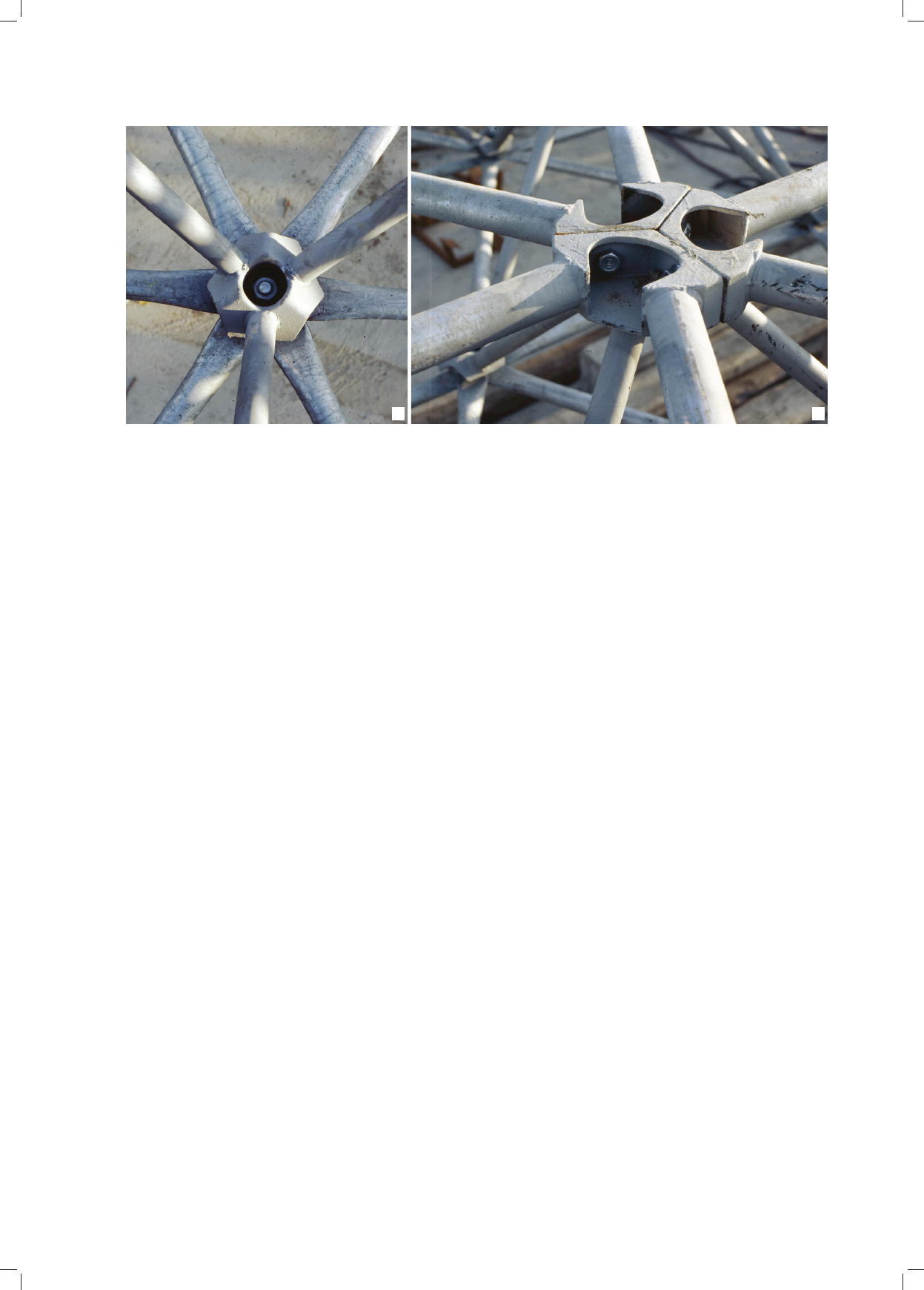
trzebne są trzy śruby na każdym węźle (il. 3). Projekt wę-
zła musi brać pod uwagę nie tylko fi zyczne występowanie
danego elementu, węzła, ale również wszystkich powią-
zanych ograniczeń, od uprzemysłowienia jego produkcji,
aż do zastosowania specjalnie przystosowanych narzędzi,
dla których trzeba pozostawić miejsce. „Otwory”, które są
widoczne w węzłach warstwy górnej, umożliwiają wpro-
wadzenie klucza do dokręcenia śrub.
• Węzeł kulisty – Spherobat
Mimo że Unibat był rozwiązaniem udanym, okazało
się, że realizacje Stefana du Château potrzebują innego
systemu węzłów i elementów, który będzie można ła-
twiej transportować niż piramidy. Na szczęście wszyscy
specjaliści w tamtych czasach znali skuteczne zastosowa-
nie tzw. węzła Mero, a w konkursie na projekt lotniska
w Baltimore (1975) amerykańscy architekci chętnie wy-
korzystali węzły kuliste. Stefan du Château zaprojektował
kulę z wierconymi otworami, w której mogły schodzić
się elementy. Po jakimś czasie badania nad węzłem ku-
listym umożliwiającym montaż elementów, bez względu
na ich wzajemne położenie, pozwoliły na zastosowanie
węzła kulistego, składającego się z dwóch części: jednej
stanowiącej jedną trzecią kuli i drugiej stanowiącej dwie
trzecie kuli.
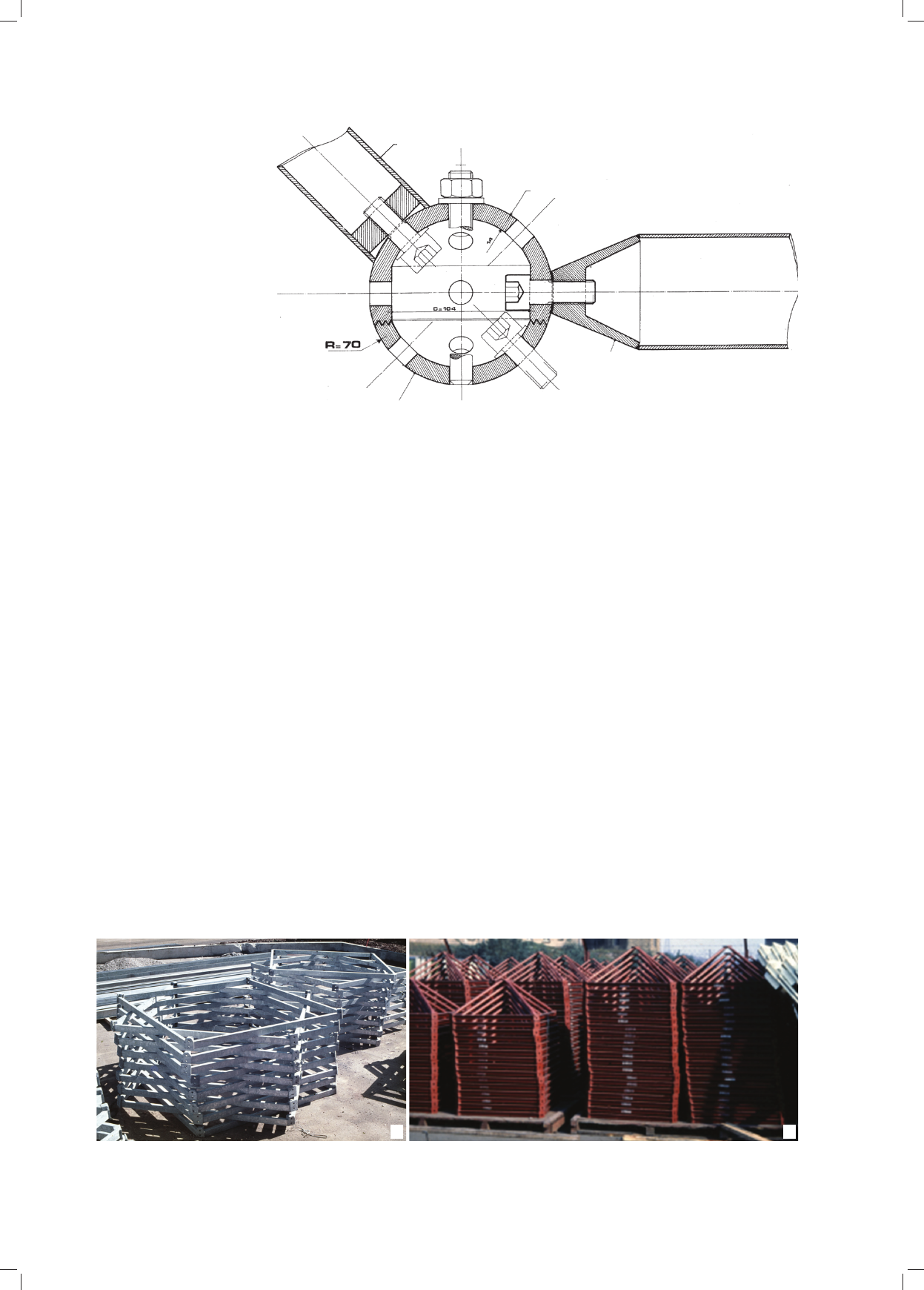
Jeden osiowy łącznik jest wykorzystywany do po łą-
czenia dwóch części węzła. Śruby z łbem imbuso wym
służą do połączenia prętów z węzłem. Możliwe jest rów-
nież wykonanie prętów z końcówką stożkową (il. 4).
bottom layer with again only one bolt. On the upper layer,
the mesh is triangular and three bolts are necessary at each
node (Fig. 3). The node’s design must include not only the
physical existence of this specifi c piece, the node, but also
all the surrounding constraints, from its industrialization
to their implementation by the use of adapted tools for
which it is necessary to make way. The “holes” that ap-
pear on the top layer are used to introduce the tools that
are applied to tighten the bolts.
• Spherical node – Spherobat
Even if Unibat was successful it appeared that du Châ-
teau’s realizations needed another system with nodes and
members, which are easier to transport than pyramids.
And all specialists knew the success of the so-called Mero
node in those years. Taking advantage of the contest for the
Baltimore airport (1975), American architects were will-
ing to use spherical nodes. Du Château designed a drilled
sphere that could receive the members. Some time after
the research for a spherical node enabling the assembly
of members whatever their relative positions, ends in
a spherical node assembled in two pieces: one is one third
of the sphere, the second one is two-thirds of the sphere.
One axial node is used to assemble the two pieces,
socket head cap screws are used to assemble the members
to the node itself. Conical rod end housings can also be
manufactured for some members (Fig. 4).
Industrialization and patents
Stéphane du Château patented many systems. Pyra-
mitec, Tridimatec, Unibat, Spherobat are some of them.
He is also the author of around two hundred and fi fty
projects based on nodes’ patents. A comprehensive list
of these projects can be found in the thesis submitted by
Claudia Estrela Porto [5].
Three constraints governed the design:
– simple manufacturing in factory,
Il. 3. Sieć trójkierunkowa: a) węzeł warstwy dolnej, b) węzeł warstwy górnej (fot. R. Motro)
Fig. 3. Three directional grid: a) bottom layer “node”, b) top layer “node” (photo by R. Motro)
a
b
46 René Motro
Uprzemysłowienie i patenty
Stefan du Château opatentował wiele systemów kon-
strukcyjnych, np. Pyramitec, Tridimatec, Unibat czy też
Spherobat. Jest on również autorem około 250 projek-
tów opartych na opatentowanych węzłach. Wyczerpującą
listę tych projektów można znaleźć w pracy Claudii Es-
treli Porto [5].
Istniały trzy wymagania projektowe:
– prosta produkcja w fabryce,
– łatwy transport i składowanie (il. 5),
– uproszczony montaż.
W czasie całego procesu projektowego Stefan du Châ-
teau współpracował z Zygmuntem Stanisławem Makow-
skim, który wykonał analizy numeryczne jego struktur
oraz w niektórych przypadkach badania eksperymentalne.
Ta współpraca była bardzo owocna podczas prac i nnowa-
cyjnych.
Niestrudzony obrońca struktur przestrzennych
Stefan du Château pracował z najsłynniejszymi in ży-
nierami i architektami na całym świecie. Konsultował
się z nim np. Frei Otto w związku ze składaną membraną
w Cannes we Francji. Maszt, wykonany w tym obiekcie
– easy transport and storage (Fig. 5),
– simplifi ed implementation.
All along his design process Stéphane du Château co-
worked with Zygmunt Stanisław Makowski, who made
numerical analyses of his structures and for some cases
experimental tests. This collaboration was very fruitful
during this period of innovation.
A tireless defender of spatial structures
Du Château worked with the most famous engineers and
architects in the whole world. He was consulted by Frei
Otto for a foldable membrane in Cannes, France (Fig. 6),
certainly one of the fi rst foldable membrane projects. The
fi rst central mast buckled and a new one was designed by
Stéphane du Château.
Founder of many associations, Stéphane du Château
tried to unify the action of French designers namely in his
IRASS (Institut de Recherche et d’Applications des Struc-
tures Spatiales) where famous engineers and architects
exchanged their ideas. Paul Maymont, Jean Cesselin (for
cable nets), Yona Friedman (architecture), Yves Chaperot
(polycorolles), Robert Lourdin (timber spatial structures)
were some of them. We organized together several events
in France in order to publicize spatial structures, namely
Il. 4. Spherobat
– zasada projektowania
(rys. S. du Château)
Fig. 4. Spherobat
– design prin ciple
(drawing by S. du Château)
końcówka pręta, aktualna/the end of the rod, current
/embout de barre courant
SPHEROBAT
śruba łącząca półkule/screw connecting hemispheres
/vis d’assemblage des calottes
duża półkula/large hemisphere/grande calotte
mała półkula
/small hemisphere/petit calotte
końcówka pręta, wariant/the end of the rod, variant
/
embout de barre, variante
śruba o wysokiej wytrzymałości z łbem imbusowym
/high strength socket head screw/vis 6 pans creux h.r
Il. 5. Komponenty przemysłowe: a) elementy warstwy dolnej, b) piramidki tworzące warstwę górną i środkową (fot. R. Motro)
Fig. 5. Industrialized components: a) elements of the bottom layer, b)pyramids composing the upper and middle layer (photo by R. Motro)
a
b
„Węzły i struktury przestrzenne” – w hołdzie Stefanowi du Château / “Nodes and Spatial Structures”, a tribute to Stéphane du Château 47
według pierwotnego projektu, uległ wyboczeniu i du Châ-
teau zaprojektował nowy (il. 6).
Założyciel wielu stowarzyszeń, Stefan du Château,
pró bo wał zjednoczyć działania francuskich projektan-
tów w swo im Instytucie IRASS (Institut de Recherche et
d’Appli cations des Structures Spatiales), gdzie wymie niali
poglądy znani inżynierowie i architekci, tacy jak Paul May-
mont, Jean Cesselin (konstrukcje cięgnowe), Yona Fried-
man (architektura), Yves Chaperot (polyco rolles), Robert
Lour din (drewniane struktury przestrzenne). Razem ze Ste -
fanem du Château zorganizowaliśmy kilka imprez we Fran -
cji (w Paryżu, Lyonie i Rennes) w celu spopularyzowa nia
struktur przestrzennych. Stefan zaprosił nawet do Paryża
Feliksa Candelę i był bardzo dumny z tego, że mógł go
uhonorować. Wszystkie regularne spotkania IRASS odby-
wały się w jego biurze Paryżu 15 rue Hégésippe Moreau.
Christel Frapier opisał niektóre z jego działań w pra-
cy opublikowanej przez „International Journal of Space
Structures” [6].
Grupa ta utrzymywała również kontakty z Robertem
Le Ricolais’m (il. 7). Ale on miał specyfi czną sytuację.
Niestety we Francji nie mógł on znaleźć niezbędnego
kontekstu merytorycznego ani wsparcia fi nansowego dla
swoich badaczy i przeniósł się do Filadelfi i.
Robert Le Ricolais nie był w stanie dalej prowadzić
badań we Francji, mimo że wiele oddanych mu osób
próbowało mu pomóc, jednak z niewielkim sukcesem.
Na leży tutaj wspomnieć Davida Georges’a Emmericha
i je go próby powołania do życia Warszta tu Badań Struk-
turalnych, gdzie Le Ricolais mógłby kontynuować swoje
prace. Kiedy ostatni raz uczestni czył on w działaniach
tej grupy zagorzałych zwolenni ków (IRASS), tak o tym
mówił, w relacji Henri Drevona w styczniu 1977 r.:
Le Ricolais, który zabrał ze sobą dwóch swoich ucz-
niów, donosił o zadaniach, które były mu przy dziela ne
in Paris, Lyon and Rennes. He invited to Paris Felix Can-
dela, and was very proud to honor him. All the IRASS
regular meetings were held in his offi ce in Paris 15 rue
Hégésippe Moreau.
Christel Frapier described some of his activities in a pa -
per published by the “International Journal of Space Struc -
tures” [6].
This group was also maintained contacts with Robert Le
Ricolais (Fig. 7). But he had a specifi c role. Unfortunately he
could not fi nd the necessary context and the fi nancial support
for his researches in France and migrated to Philadelphia.
Robert Le Ricolais was unable to further his research
in France, but many of his devotees endeavored to help
him to do so, unfortunately with little success. Reference
must be made here of the action of David Georges Emme -
rich who tried to set up a Structural Research Workshop
that could have welcomed Le Ricolais. The last time he
partici pated in this fervent group of followers (IRASS)
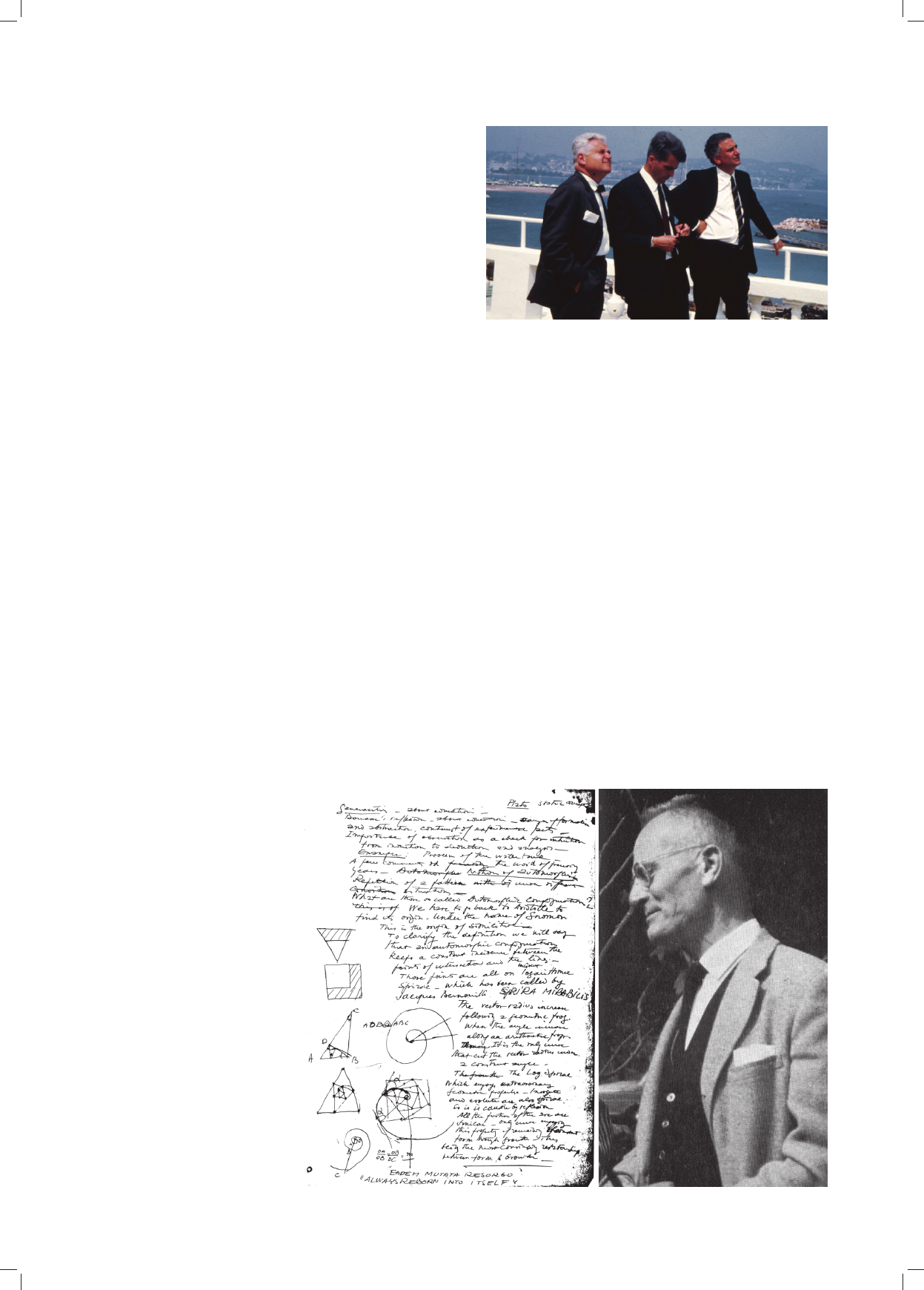
Il. 6. Od lewej: Stefan du Château i Frei Otto (archiwum S. du Château)
Fig. 6. From the left: Stéphane du Château and Frei Otto
(S. du Château archive)
Il. 7. „Zawsze wradzające się
na nowo w siebie” – Le Ricolais
(fot. R. Motro)
Fig. 7. “Always reborn
into itself” – Le Ricolais
(photo by R. Motro)
48 René Motro
he spoke in these terms, as related by Henri Drevon in
January 1977:
Le Ricolais, who had taken two of his students with
him, reported on the missions always assigned to him in
the USA. He regrets that the doctors do not allow him to
do more and that he has been unable to fi nd an organiza-
tion in France that would enable him to pursue his task.
This entails, among other things, repatriating the impres-
sive set of models made with his students in Philadelphia,
which would put up a very good show in Pompidou Center.
Further he writes:
The proposal to honor Le Ricolais by transforming the
IRASS into a Le Ricolais Foundation is adopted unani-
mously and with an ovation [7].
It is not surprising that the so-called “IRASS” became
at the end the “Robert Le Ricolais Institute”.
Tireless propagator of spatial structures, Stéphane du
Château taught in many schools of architecture, increas-
ing the curiosity of young people, organized several scien-
tifi c meetings. I had the chance to share these experiences
with him [8].
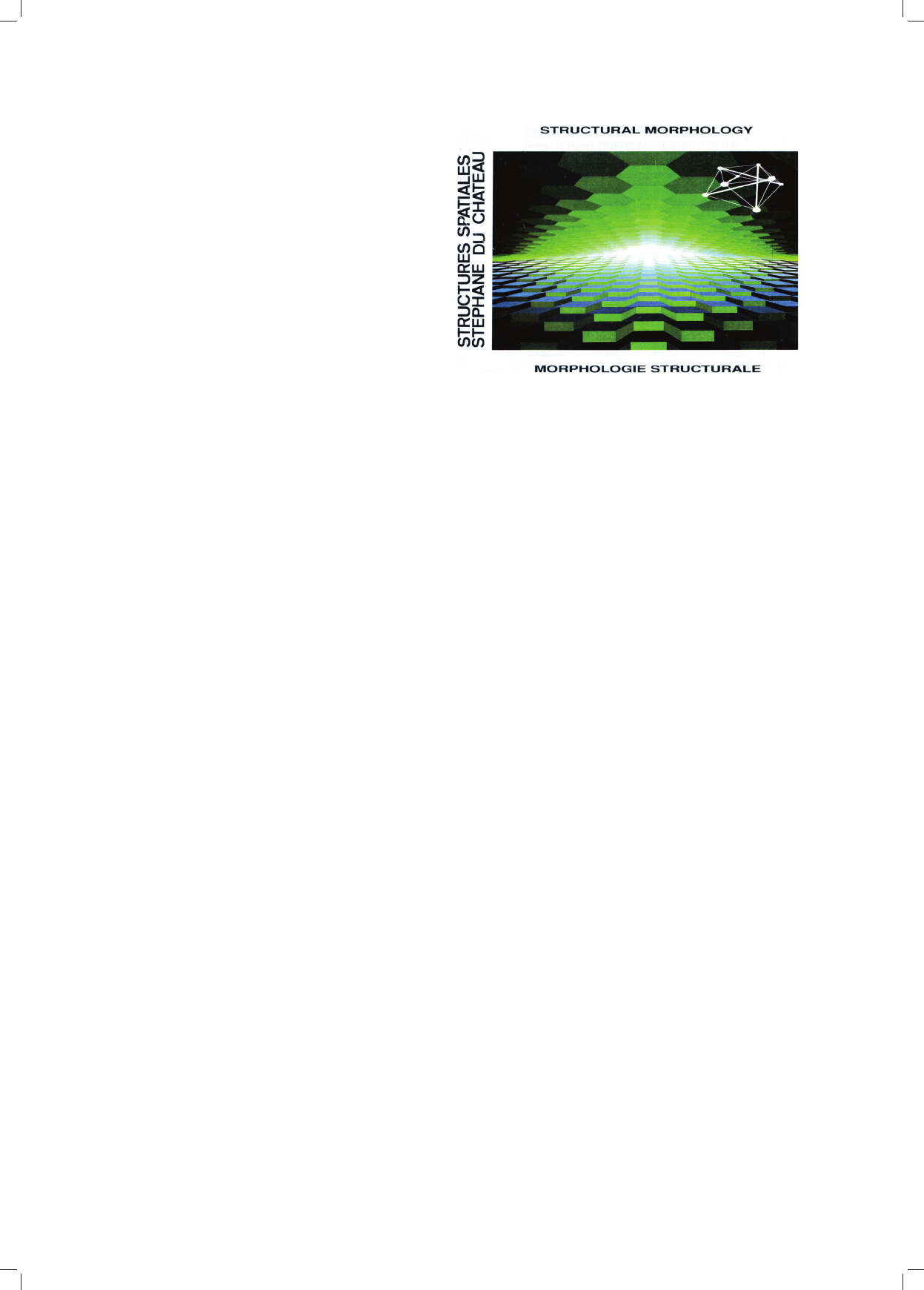
Consequently I asked him to be the honorary chairman
of a scientifi c seminar on structural morphology that I or-
ganized in the south of France (Fig. 8) [9]. It was simulta-
neously possible to organize two exhibitions one devoted
to Ro bert Le Ricolais, and one to his close friend Stéphane
du Château. In both cases we could exhibit models from
their projects and studies.
Conclusion
Stéphane du Château was undoubtedly one of the
leaders in the fi eld of space structures during the second
half of the 20
th
century. Designer, architect, space struc-
tures defender, teacher, he was a multiple expertise man.
I had the honor and privilege to work with him in many
circumstances and had the opportunity to discover his
deep humanity.
I also received a wonderful collection of slides from
his nephew, and my task is now to give access to this
collection, and to coordinate my action with Polish people
in charge of his foundation in Hrubieszów.
w USA. Żałuje on, że lekarze nie pozwalają mu więcej
pracować i że nie może znaleźć organizacji we Francji,
która umożliwiłaby mu realizację tego zadania. Wiąże się
to m.in. z przywiezieniem („repatriacją”) wspaniałych
modeli wykonanych z jego uczniami w Filadelfi i, co umoż-
liwiłoby zorganizowanie wspaniałej wystawy w Centrum
Pompidou.
Dalej pisze, że:
Propozycja uhonorowania Le Ricolais’go poprzez
przekształcenie IRASS w Le Ricolais Foundation została
owacyjnie i jednogłośnie przyjęta [7].
Nie jest niczym dziwnym, że tak zwany „Instytut
IRASS” stał się w końcu „Instytutem Roberta Le Rico-
lais’go”.
Niestrudzony propagator struktur przestrzennych, Ste-
fan du Château, uczył w wielu szkołach architektury, roz-
budzając zainteresowanie wśród młodych ludzi, i organi-
zował spotkania naukowe. Miałem szansę razem z nim
uczestniczy
ć w takich wydarzeniach [8].
W związku z tym poprosiłem go, aby został honoro-
wym prezesem seminarium naukowego na temat morfolo-
gii strukturalnej, które zorganizowałem na południu Fran-
cji (il. 8) [9]. Jednocześnie możliwe było zorganizowanie
dwóch wystaw, jednej poświęconej Robertowi Le Rico-
lais’mu, a drugiej jego bliskiemu przyjacielowi Stefano-
wi du Château. W obu przypadkach zaprezentowaliśmy
modele ich projektów i badań.
Podsumowanie
Stefan du Château był niewątpliwie jednym z lide rów
w dziedzinie struktur przestrzennych w 2. poł. XX w.
Był projektantem, architektem, obrońcą struktur prze-
strzennych, nauczycielem, człowiekiem o wielkiej facho -
wej wie dzy. Miałem honor i przywilej pracowania
z nim w wie lu różnych okolicznościach, a także oka-
zję do pozna nia jego charakteru, który cechuje jego głę-
boki hu ma nizm.
Ponadto otrzymałem od jego siostrzeńca wspaniały
zbiór slajdów i teraz stoi przede mną zadanie udostępnie-
nia tej kolekcji szerszej publiczności oraz skoordynowania
moich działań z działaniami Polaków pracujących w Fun-
dacji Krystyny i Stefana Du Château w Hrubieszowie.
Tłumaczenie
Tadeusz Szałamacha
Il. 8. Okładka katalogu wystawy z 1992 r.
Fig. 8. S. du Château Exhibition Catalog 1992

„Węzły i struktury przestrzenne” – w hołdzie Stefanowi du Château / “Nodes and Spatial Structures”, a tribute to Stéphane du Château 49
Streszczenie
Twórczość Stefana du Château jest wyraźnie wpisana w rozwój myśli architektonicznej 2. poł. XX w. Opracował on kilka systemów struktur
przestrzennych w oparciu o pomysłowy projekt węzłów, które wszystkie zostały opatentowane. Pona d 250 jego projektów zostało w pełni
zrealizowanych. Opr ócz tego Stefan du Château założył kilka stowarzyszeń, aby przyciągnąć projektantów i popularyzować struktury przestrzenne.
Jego charyzma i zaangażowanie były kluczem do niebywałego rozwoju struktur przestrzennych. Ten artykuł jest krótkim podsumowaniem oraz
przypomnieniem jego osiągnięć i ic h znaczenia dla rozwoju konstrukcji przestrzennych.
Słowa kluczowe: struktury przestrzenne, Stefan du Château, węzeł, uprzemysłowienie, Institut Le Rico lais
Abstract
The work of Stéphane du Château is clearly inscribed in the second half of the 20
th
century. He developed several spatial structures’ systems based
on a clever design of nodes, which were all patented. More than two hundred and fifty projects were effectively built. Besides this productive work
Stéphane du Château founded several associations in order to gather designers and to promote Spatial Structures. His charisma and his commitment
were the keys of a remarkable contribution to spatial structures. This paper is a short summary and a reminder of his achievements and importance
for the development of spatial structures.
Key words: spatial structures, Stéphane du Château, node, industrialisation, Institut Le Ricolais
Bibliografia /References
[1] Du Château S., L’intégration de la pensée technique dans la créa-
tion architecturale, [w:] R.M. Davies (ed.), Proceedings of the First
International Conference on Space Structures, Blackwell Scientifi c
Publications, London 1966, 1180–1198.
[2] Barucki T., Stéphane du Château, Kanon, Warszawa 1995.
[3] Motro R., Optimisation de Structures Spatiales et application à des
grilles à double nappe (2 vol.), Thèse de Docteur Ingénieur. Univer-
sité Paul Sabatier, Toulouse 1975.
[4] Motro R. (ed.), Colloque Recherches en Structures: Bilan et Pers-
pectives, Université Montpellier II, Montpellier 1976.
[5] Estrela Porto C., L’évolution des Structures Spatiales à travers
l’œuvre de Stéphane du Château, Thèse Université Paris 1, Paris 1993.
[6] Frapier C., Stéphane du Château, „International Journal of Space
Structures” (Special Issue The pioneers of Space Structures), 2006,
Vol. 21, No. 1, 53–59.
[7] Unpublished report of IRASS meeting. Personal correspondence
between H. Drevon and R. Motro.
[8] Motro R., Wester T., Proceedings of the fi rst International Seminar
on Structural Morphology, Montpellier 1992.
[9] Motro R. (ed.), Structural Morphology by R. Le Ricolais and S. du
Château, Katalog wystawy/Catalog of the exhibition, Montpellier
199 2.
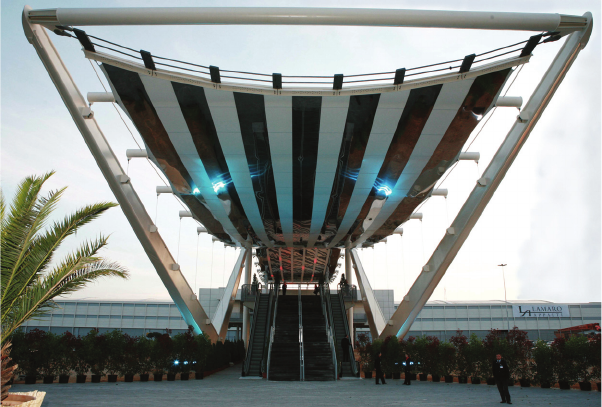
Nowe tereny targowe Nuova Fiera di Roma
w Rzymie – główne wejście z przekryciem
membranowym ze stali nierdzewnej
nad kładką dla pieszych o długości 1,8 km
(arch. T. Valle, konstr. M. Majowiecki)
(fot. M. Majowiecki)
New market areas, Nuova Fiera di Roma,
in Rome – main entrance with a membrane
covering made of stainless steel above the foot-
bridge of 1.8 km in lenght (arch. T. Valle,
structural engineer
M. Majowiecki)
(photo by M. Majowiecki)