
2017
4(52)
DOI: 10.5277/arc170408
Architektura od zawsze była krok z tyłu za zmianami
występującymi w innych dziedzinach. Spowodowane jest
to tym, że przestrzeń do życia to tak naprawdę forma wyj
ściowa wynikająca z analizy złożonej sieci informacji
społecznych, politycznych, ekonomicznych czy techno
logicznych. Ponieważ jest to forma wynikowa, mody
kacje w jej strukturze nie mogą zaistnieć bez wcześniej
szych przemian w dziedzinach, z których czerpie dane.
W XX w. zmiany te nie następowały na tyle szybko, aby
architektura musiała dostosowywać się do nich natych
miastowo. Pomimo tego powstawały utopijne wizje miast
kreowane m.in. przez Archigram czy metabolistów. Tym
bardziej dziś, w dobie Internetu, gdy pomysł może naro
dzić się w Ameryce, a kilka sekund później rozpowszech
nić w Europie, zaś technologie rozwijają się w sposób wy
kładniczy [1], należy szukać rozwiązań, które pozwolą na
samoaktualizację przestrzeni do życia.
W opracowaniu zajęto się problematyką rewolucji
w sposobie pracy społeczeństwa, gdyż to w tej dziedzi
nie możemy zaobserwować największą dynamikę zmian.
Wirtualne społeczeństwo a miejsca pracy:
Blok 477, Sieć Wiedzy: Inkubator, NY
Virtual society and workplaces:
Block 477, Sharing Knowledge: Incubator, NY
Prezentacje/Presentations
Autor:/Author: Michał Bala*
Praca dyplomowa/Master’s Thesis
Promotor:/Tutor: dr inż. arch. Ada Kwiatkowska
* Wydział Architektury Politechniki Wrocławskiej/Faculty of Ar
chitecture, Wrocław University of Science and Technology.
Architecture has always been a step back compared to
changes that could be observed in other fields. The reason
for this is probably the fact that living space is the result
of a complicated set of social, economic, political or tech
nological information analysis. As a final form of all of
these, modifications in its structure cannot be implement
ed without changes in the fields that have influence on it.
In the 20
th
century these changes did not occur fast
enough to force architecture to react very quickly. Never
the less, utopian visions of cities were created, among others,
by Archigram or metabolists. Even more, nowadays, in the
age of Internet Society, when an idea born in Ame rica,
a few seconds later may be implemented in Europe, while
technologies develop in an exponential way [1], we are
supposed to look for solutions that will allow for selfactua
li zation of living space.
The present article concentrates on the problem of revolu
tion in the way of working of the society, because in this field
we can observe the most dynamical changes. Many profes
sions and workplaces did not exist almost a decade ago.
The present article has been written on the base of the di plo
ma work: “Block 477, Sharing Knowledge: Incubator, NY”.
After analyzing the most recent changes in the func
tioning of the West’s civilization, a certain weariness of

100 Prezentacje/Presentations
Wiele zawodów oraz miejsc pracy nie istniało jeszcze
dekadę temu. Niniejszy artykuł został napisany na pod
stawie pracy dyplomowej pt. „Blok 477, Sieć Wiedzy:
Inkubator, NY”.
Po analizie najnowszych zmian w sposobie funkcjo
nowania zachodniej cywilizacji można zaobserwować
pewne znużenie konsumpcjonizmem. Rozwinięte społe
czeństwa coraz trudniej dają się omamić obietnicami do
brobytu czy namówić na kupowanie coraz większej liczby
rzeczy. Jeszcze w ubiegłym stuleciu Richard Florida pisał
o potencjale tzw. creative class – klasy ludzi kreatyw
nych, którzy mieli być generatorem rozwoju społeczeństw
i przestrzeni zurbanizowanej [1]. Przewidywania te do
prowadziły jedynie do gentrykacji i zwiększania warto
ści działek śródmiejskich. Miastom zależało bardziej na
potencjalnych zyskach niż na stworzeniu demokratycz
nych przestrzeni. Sam twórca teorii przyznał, że wspiera
nie klasy kreatywnej doprowadziło tylko do zwiększenia
podziałów społecznych i faworyzowania wy branych grup.
Kilka lat temu powstał nowy termin: wspól na konsump
cja. Stał się on inspiracją dla ruchu proekologicznego
zakładającego odrzucenie materializmu, który był pod
stawową przesłanką dotychczasowego konsumpcyjnego
społeczeństwa. Ruch ten propaguje dzielenie się dobrami
z innymi jako podstawę funkcjonowania społeczeństwa.
Zastąpienie systemu wartości Marksa ideologią, w któ
rej najważniejsza jest wiedza i współpraca, a nie dobra
ma terialne, mogłoby skutkować możliwością szybszego
rozwoju społecznego. Zwłaszcza gdy rozpowszechniane
informacje byłyby dzielone w ogólnie dostępnych insty
tucjach [2]. W dzisiejszych czasach mamy do czynienia
z wieloma ruchami społecznymi, które wyznają podob
ną ideologię. Na szczególną uwagę zasługuje powiązana
z tym nurtem kultura makerów. Popularność DIY (Do it
yourself [zrób to sam] – metoda konstruowania i renowa
cji przedmiotów czy miejsc) w ostatnich latach wzrasta.
Aby przełożyć nową ideologię na architekturę, na
leżało wybrać, które budynki będą w stanie stać się jej
inkubatorami. Zaczęto od przeanalizowania instytucji od
wieków zajmujących się gromadzeniem i udostępnianiem
wiedzy, a od niedawna również współpracą między ludź
mi – bibliotekami.
Biblioteka to miejsce gromadzenia, przechowywania
i udostępniania spisanych na papierze źródeł informacji.
W ciągu ostatnich lat budynki te straciły na znaczeniu.
Postęp Internetu spowodował, że zaczęto szukać nowych
funkcji, które mogą towarzyszyć kolekcjom książek.
Przez wiele lat znaczenie i symbolika budynku bibliote
ki ewoluowała. Dziś tworzą bardziej centra edukacji, ta
kie jak Rolex Learning Center w Szwajcarii. Miejsca do
współpracy to nieodłączny element dzisiejszych bibliotek
[3]. Coraz częściej bibliotekarze przekształcają przestrze
nie w miejsca do rozwoju kultury makerów [4].
Świat Internetu i ilość danych powodują, że klasyczne
biblioteki nie są przyszłościowe. Seth Lloyd, profesor
zyki MIT, wyliczył, że potrzeba 10
68
zettabajtów, aby opi
sać wszechświat [5]. Biorąc pod uwagę fakt, że dzisiejsza
zdolność zapisu świata wirtualnego to 1,2 zettabajta, czę
sto będąca w rękach prywatnych korporacji, to ludzkość
stoi przed poważnym problemem.
consumerism can be observed. Developed societies are
harder to be deceaved by promises of wealth or be per
suaded to buy more and more things. In the last century
Richard Florida wrote about the potential of the socalled
creative class – people who were supposed to be a genera
tor of the development of societies and urbanized space [1].
These predictions only led to gentrification and increas
ing the value of urban plots. The cities cared more about
earnings than creating democratic spaces. Even Richard
Florida admitted that supporting the creative class led to the
increase of social divisions and favoring of chosen groups.
A few years ago a new term came into existence: the
Sharing Society. It was an inspiration for the proecologi
cal movement, which initiated the discarding of ma teria lism,
which was basic for the hirtherto consumer so ciety. This
mo vement favors the sharing of goods as a base
of society
functioning.
Supersession of Mark’s system by an ideology in which
knowledge and cooperation and not material goods are
most important, could be an impulse to faster society de
velopment. Especially, when that information would be
widely available and shared in accesible institutions [2].
At present we have to do with many social movements
which acknowledge a similar ideology. The most promis
ing part of this culture is the maker movement. Popularity
of DIY – the method of constructing and renovating of
objects or places – is increasing in recent years.
To adapt the new ideology to architecture it had to be
decided which buildings will be its incubators. First of all
libraries as institutions that for centuries have been known
for keeping and sharing knowledge and recently also co
operation between people, were analyzed.
Libraries are the source of information written on pa
per, which is collected, kept and shared. During the last
years library buildings lost their importance. The internet
development forced librarians to search for other activi
ties that can be hosted there.
Through many years the meaning and symbol of the
library building evolved. Nowadays they are more educa
tional centers, like the Rolex Learning Center in Swi tzer
land. Work places for cooperation is an inseparable ele ment
of today’s libraries [3]. More and more often libra rians
transform spaces into places for the development of ma kers
culture [4].
The internet’s world and the amount of data cause that
classical libraries have not future. Seth Lloyd, MIT phys
ics professor calculated that humanity needs 10
68
zetta
bytes to describe the universe [5]. Having in mind the fact
that today’s data storage capacity of the virtual world is
1.2 zettabyte often being in private hands of a corpora
tion, then humanity is facing a serious problem.
In this work the library is a source of knowledge in the
network, created by everyone. It allows the materializa
tion of the demand for functions through architecture,
whose programe is based on information included in it.
Materialization is the network of incubators which
contain tools which are most needed in the given place
and which may be used by local inhabitants. Of the mate
rial part of the libraries only coworking spaces remain in
the project. The building becomes an incubator for coop
Prezentacje/Presentations 101
W niniejszym opracowaniu biblioteka to źródło wiedzy
w sieci tworzone przez wszystkich, pozwalające na mate
rializację zapotrzebowania na funkcje poprzez architekturę,
której program bazuje na informacji w niej zawartej. Ma
terializacją jest sieć inkubatorów zawierających narzędzia,
które są najbardziej potrzebne w danym miejscu i z których
mogą korzystać okoliczni mieszkańcy. Z materialnej części
bibliotek pozostają w projekcie tylko przestrzenie cowor
kingowe. Budynek staje się inkubatorem do współpracy,
nowoczesnym miejscem pracy, z którego każdy może ko
rzystać. Dzięki swojemu publicznemu charakterowi obiek
ty te świetnie wpisują się w ideę wspólnej konsumpcji.
Węzły sieci internetowej: lokalizacja inkubatorów
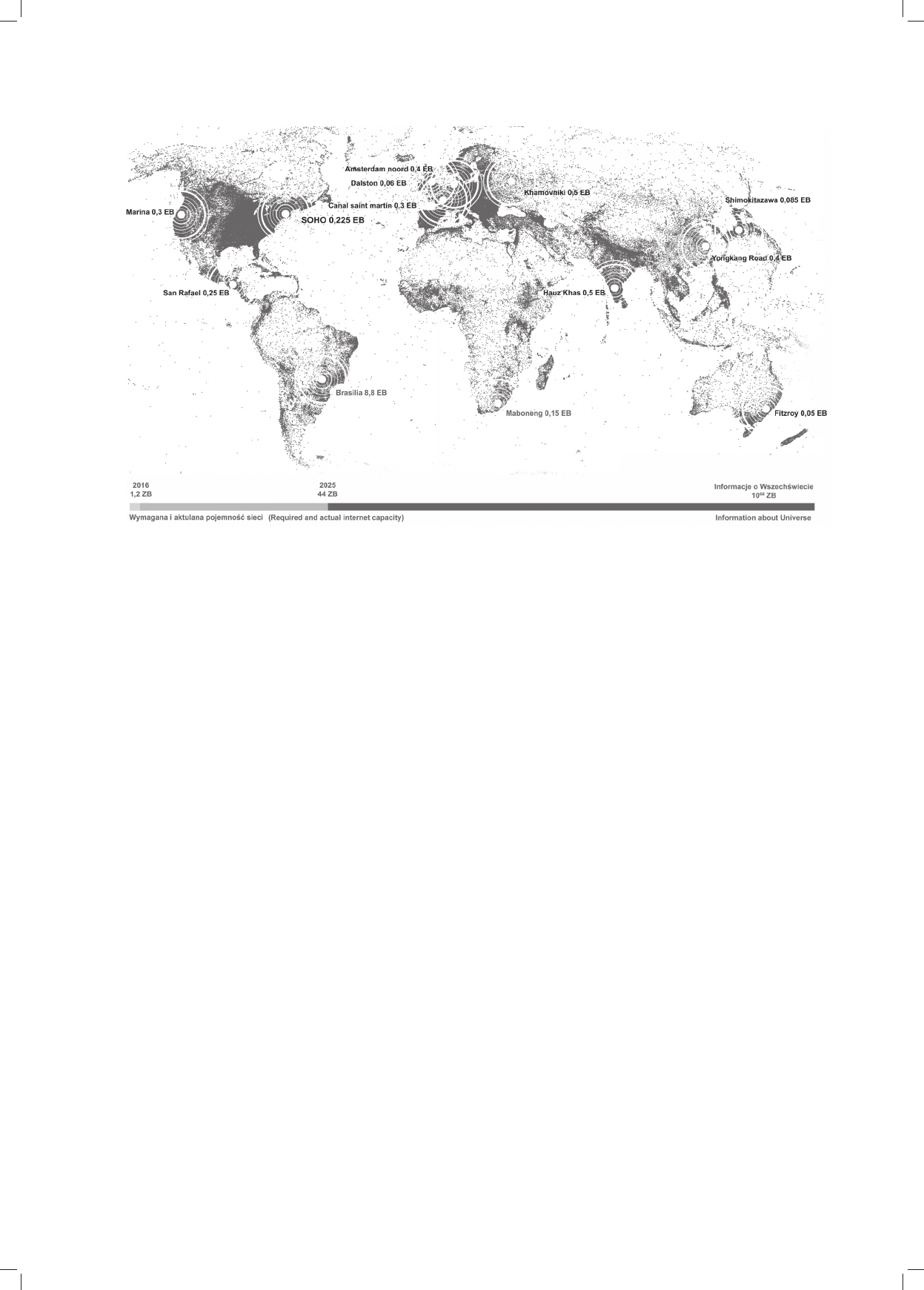
Zaproponowano sieć potencjalnych lokalizacji roz
mieszczonych na całym świecie (il. 1). Działka wybrana
jako przykładowa działa na zasadzie manifestu. System
ma być alternatywą dla kapitalizmu. Głównym czynni
kiem wyboru miasta reprezentującego ten system była licz
ba korporacji z 1000 największych na świecie mających
w nim swoją siedzibę, gdyż to te organizacje są produktem
powyżej wspomnianego systemu. Wybrano Stany Zjedno
czone będące siedzibą ponad 500 z nich. Jako stolicę ka
pitalizmu wskazano Nowy Jork, który ma więcej wielkich
rm niż cała Anglia. Lokalizacja ma uwypuklać kontrast
oraz dawać alternatywę dla pracujących tam ludzi.
Algorytm deep learning: typologia inkubatorów
Aby tworzony budynek mógł podlegać transforma
cji, potrzebna jest baza danych z informacjami na temat
zapotrzebowania na program funkcjonalny oraz trendów
eration, a modern coworking place, where everyone can
cooperate. Because of their public character these objects
are perfect for the sharing society idea.
Internet network nodes: incubators’ localizations
A network of potential localizations was proposed all
around the world (Fig. 1). The site, chosen as an example
acts as a manifesto. The system is supposed to be an alter
native for capitalism. The main element of choosing the
city which represents this system was the number of cor
porations from a 1000 of the biggest in the world, in in
dividual countries and cities, because they are the pro duct
of the above mentioned system. USA was chosen be cause
of being the host of over 500 of them. As the ca pi tal of
capitalism New York was indicated, because it has
more
great firms than the whole of England. The loca lization has
to indicate the contrast and give an alternative for people
working there.
Deep learning algorithm: incubator’s typology
In order the created building could undergo a transforma
tion, database with information on the need for a func tional
program and popularity trends is required. In that case it
is the previously mentioned internet library. The network,
created by all the users is the source of infor mation which
assign trends in the way of social functioning.
First part of the algorithm which controls the develop
ment of the building is the analysis of the structure of par
ticular places, where incubators are to be built. By an ex
t e r
nal
deep learning algorithm (a selflearning algorithm
used recently by Dutch scientists for the purpose of
Il. 1. Potencjalne lokalizacje inkubatorów (oprac. M. Bala)
Fig. 1. Potential incubators’ localizations (by M. Bala)

102 Prezentacje/Presentations
popularności. W tym wypadku jest nią wyżej wspomniana
biblioteka internetowa. Sieć tworzona przez wszystkich
użytkowników jest źródłem informacji, które wyznaczają
trendy w sposobie działania społeczności.
Pierwszym krokiem algorytmu sterującego rozwojem
budynku jest analiza struktury poszczególnych miejsc,
w których mają stanąć inkubatory. Za pomocą zewnętrz
nego algorytmu typu deep learning (algorytm samouczą
cy się użyty niedawno przez holenderskich naukowców
w celach stworzenia zupełnie nowego dzieła Rembrandta)
wyznaczane są charakterystyczne regiony w określonych
kształtach. Program rozpoznaje strukturę urbanistyczną
i zalicza do podstawowych typologii, takich jak układ
kwartałowy, punktowy czy liniowy. Następnie dana dział
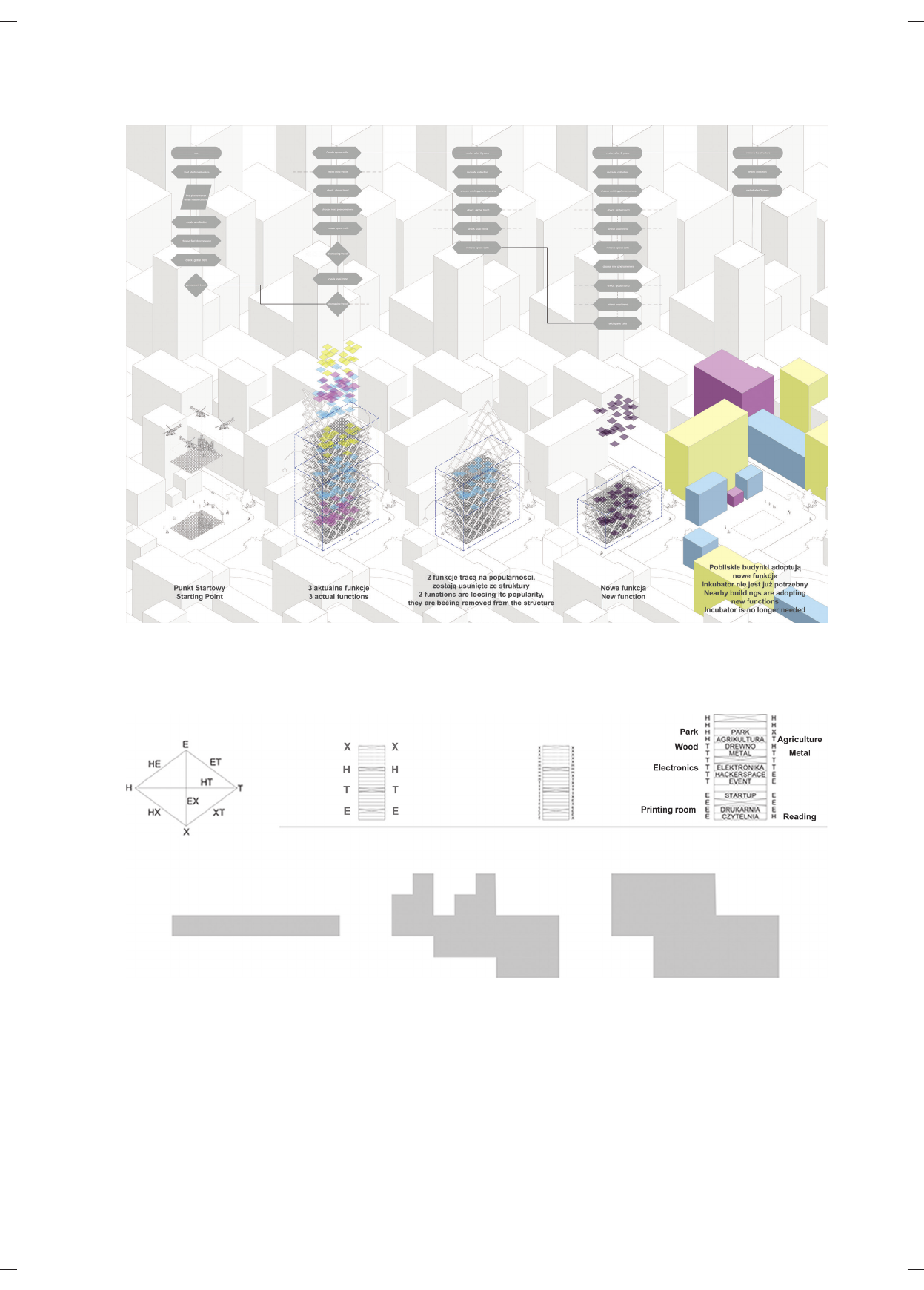
ka przyporządkowana jest do jednego ze schematów przy
gotowanych w projekcie (il. 2).
Inkubator korzysta z pojęcia symulacji społeczeństw.
Symuluje wyidealizowane środowisko dla zjawisk (miejsc
i narzędzi do pracy), które są w tej chwili popularne na
świecie. Następnie powoduje, że albo się one przyjmu
ją i zostają zaimplementowane do struktury miasta i spo
sobu życia mieszkańców, albo zostają zastąpione przez
inne (il. 3).
Algorytm reality mining:
program funkcjonalny inkubatorów
Zjawiska są wyszukiwane w sieci przy wykorzystaniu
informatyki społecznej, a dokładnie reality mining. Na
podstawie danych z bazy, jaką jest Wikipedia (w przy
szłości bardziej zaufanym źródłem mogą być biblioteki
cybernetyczne), algorytm wyszukuje zjawiska w obrębie
wspólnej konsumpcji oraz kultury makerów. Używając
odnośników, analizuje i ustala bazę danych ze zjawiska
mi pojawiającymi się na całym globie. Mogą to być na
przykład makerzy lub ruchy proekologiczne. Następnie
przypisuje im kod na podstawie przynależności do ka
tegorii, które również podlegają modykacjom. Na po
trzeby projektu wybrano trzy aktualne: technologia (T),
ekonomia (E) oraz zjawiska humanistycznoorganiczne
(H). Funkcje dostają kod w zależności od tego, czy do
tyczą jednego ze zjawisk, czy też dwóch (EE – funkcja
ze zjawiska ekonomicznego, ET – funkcja ze zjawiska
ekonomicznego mająca cechy wspólne ze zjawiskiem
technologicznym, ETTE – funkcja mająca podobną liczbę
cech wspólnych z dwoma zjawiskami). Przynależność do
kategorii jest ustalana na podstawie statystyk występo
wania słów kluczowych. Przykładem może być zjawisko
hacker space (z ang. przestrzeń dla hakerów, w której spo
tykają się ludzie o zainteresowaniach technologicznych
i informatycznych). Funkcja ta ma powiązania z kategorią
Il. 2. Typologie zabudowy (oprac. M. Bala)
Fig. 2. Urban typologies (by M. Bala)
creating a new Rembrandt’s painting) characteristic re
gions are defined in designates shapes. The program
recognizes the urban structure and includes it in basic ty
pologies, such as blocks, points or lines. Than the given
plot is assigned to one of the schemes prepared in the
project (Fig. 2).
The incubator uses the notion society simulation. It
simu lates the idealized environment for phenomena (pla
ces and tools for work), which are at this time most po
pu lar in the world. Than it causes that they are either im
plemented in the urban structure or they are replaced by
others (Fig. 3).
Reality mining algorithm:
Incubators’ functional program
The phenomena are searched for in the network by us
ing reality mining, which is a part of social informatics.
Based on database, like Wikipedia (in the future a more
relevant source of information can be cybernetic librar
ies), the algorithm searches for the phenomena related to
the sharing society and the maker movement. By using
references it analyzes and determines the database with
phenomena, than occur on the whole globe. These, for
example, may be makers or proecological movements.
Then they are assigned a code on the base of belonging to
a category which also are subject to modifications. For
need of the project three topics were selected: Technolo gy
(T), Eco no my (E) and Human related (H). The functions
are given a code based on the fact of being a part of one
phenomenon or two (EE – economic function, ET – eco
nomic func tion related also to technology, ETTE – function
having a similar number of phenomena common to two
phenomena). The category assignment is determined on
keywords’ statistics. For example, hackerspace is a func
tion which ranks among technological and economical
fields. Because of the fact that it has more in common
with the second one it has TE code.
Based on the code, functions are assigned to certain
floors of the building. The diagram is shown in Figure 4.
New categories were shown by the letter X. Each catego
ry is placed in node floors. There are located such
phe nomena, with pure marking as, for example, EE, TT.
Be tween those floors mixed functions are located.
Another aspect of the project is the vertical space
which permanently connects the floors visually and com
municationally in certain parts. Places for happenings and
art installations are located there. They are a form of pro
test against some of phenomena or the effect of cooperation
between artists and makers. Because of this space the
structure becomes three dimensional (Fig. 5).
Prezentacje/Presentations 103
Il. 3. Schemat działania inkubatora (oprac. M. Bala)
Fig. 3. Incubator’s lifecycle diagram (by M. Bala)
Il. 4. Schemat umiejscawiania zjawisk w strukturze budynku (oprac. M. Bala)
Fig. 4. Scheme of functions’ locations within the building structure (by M. Bala)
technologiczną i ekonomiczną. Ze względu na większą
liczbę powiązań z tą drugą otrzymuje oznaczenie TE.
Na podstawie kodu funkcje przypisywane są do piętra.
Schemat przedstawiony jest na ilustracji 4. Na potrzeby
diagramu nowe zjawiska zapisano pod nazwą X. Każda
z kategorii umiejscowiona jest na piętrach węzłowych.
Lokowane są tam zjawiska z oznaczeniami czystymi
The building can be expanded at any moment, which is
an answer to changing trends, which are analyzed by an
algorithm based on statistic internet tools like google
trends. At first the global tendency is checked. If it is in
creasing, the phenomenon is added to the base. Than local
tendency is analyzed. A positive result in causes that the
given phenomenon is entered into the building structure.
104 Prezentacje/Presentations
A negative result causes a deconstruction of floors which
are bound with it. A constant decreasing tendency on the
global level results in the fact that the category is removed
from all incubators. Its place can be taken by another.
Incubators’ spatial structure
The Coop Himmelb(l)au office in their new modern art
museum project in Shenzen used a new robotic technol
ogy. In the present project a construction was developed
for the use of automatized erection. Machines together
with construction elements are brought to the place where
the building is supposed to be built. They follow algo
rithm commands by building or dismantling the structure.
The construction’s order is the key to the way the robots
work. The first phase is the exo skeleton’s building, than
a dimensional truss is installed which closes the building
from the top. Then on the ground floor or in the space of
the existing trusses a spatial grid is built, drawn up in the
next stage and installed to the suitable node of the exo
skeleton’s structure.
Conclusion
The time spirit of 20
th
century, called in German Zeit
geist is related to the internet society phenomenon which
should be borne in mind while setting a new direction for
architecture development. The modern architect should
be an active observer of social changes. While architec
ture should take an active part in these changes.
The classic model of a library is outdated for many
reasons, that is why the possibility of further development
in the form of internet database should be provided.
The incubator is a project of modern workspace, which
evolved from coworking spaces in libraries. It is avail
able for everyone and includes basic tools, which, at
np. EE, TT. Pomiędzy tymi piętrami umiejscowione są
funkcje mieszane.
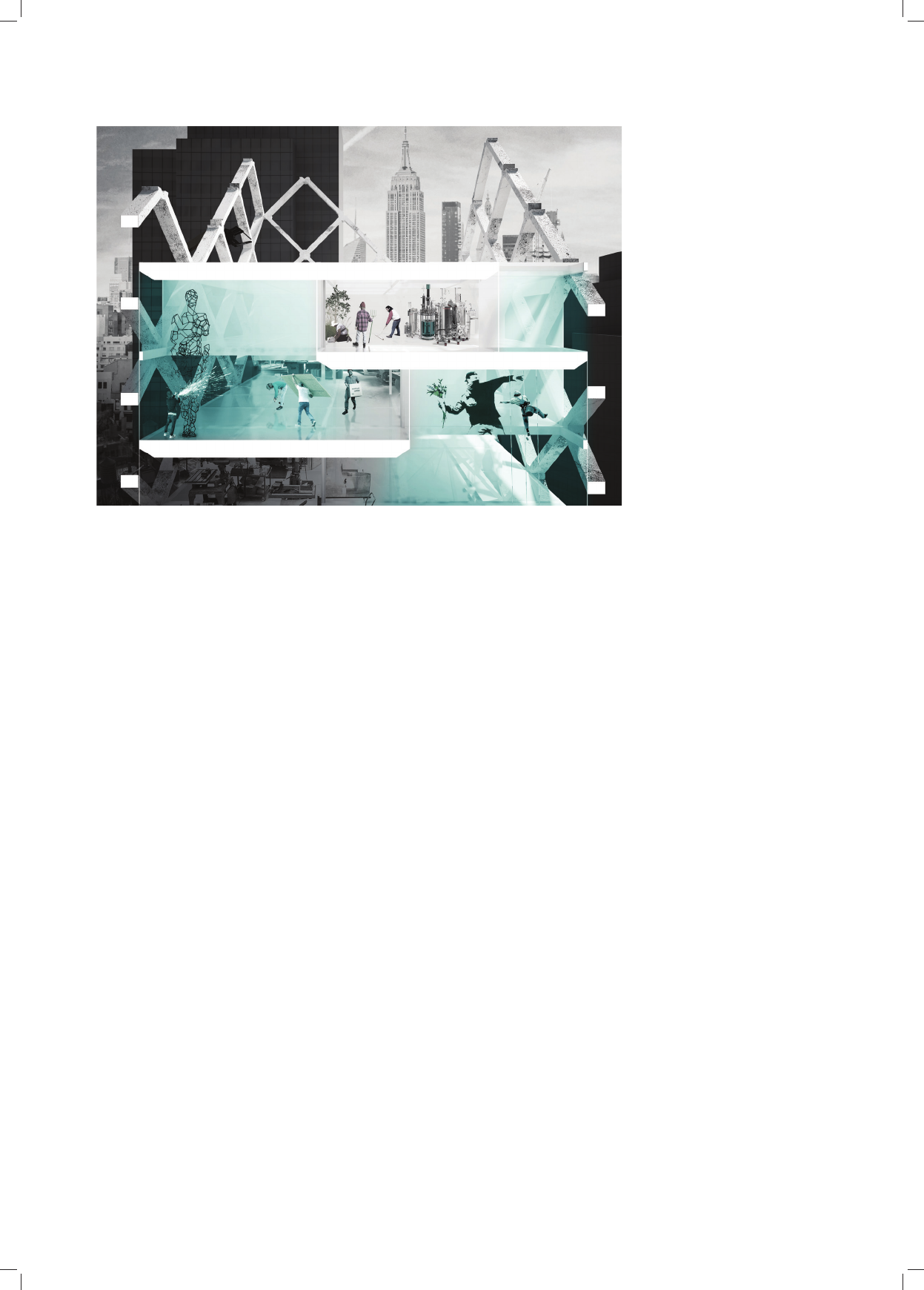
Kolejnym aspektem jest przestrzeń wertykalna na stałe
łącząca piętra wizualnie oraz komunikacyjnie w niektó
rych częściach. Znajdują się w niej miejsca dla happe
ningów oraz instalacji artystycznych. Są one protestem
wobec niektórych zjawisk lub efektem współdziałania ar
tystów z makerami. Dzięki tej przestrzeni struktura staje
się trójwymiarowa (il. 5).
Budynek może być w każdej chwili rozbudowany, co
jest odpowiedzią na zmiany trendów danego zjawiska,
które są analizowane przez algorytm na podstawie sta
tystycznych narzędzi internetowych (np. google trends).
Najpierw sprawdzana jest tendencja globalna. Jeśli to ten
dencja wzrostowa, zjawisko zostanie dodane do bazy. Na
stępnie analizuje się tendencję lokalną. Pozytywny wynik
powoduje, że dane zjawisko wpisywane jest do struktu
ry budynku. Negatywny natomiast sprawia, że zachodzi
dekonstrukcja pięter z nim związanych. Stała tendencja
malejąca na poziomie globalnym skutkuje tym, że katego
ria jest usuwana ze wszystkich inkubatorów. Jej miejsce
może zastąpić inna.
Struktura przestrzenna inkubatorów
Pracownia Coop Himmelb(l)au zastosowała w swoim
nowym projekcie muzeum sztuki nowoczesnej w Shen
zen technologię budowy przez roboty. W niniejszej kon
cepcji przystosowano konstrukcję do zastosowania bu
dowy zautomatyzowanej. Maszyny razem z elementami
konstrukcyjnymi są przywożone na miejsce, w którym
ma stanąć budynek. Wykonują one polecenia algorytmu,
budując lub rozbierając strukturę. Kolejność sposobu
montażu elementów konstrukcyjnych stanowi klucz do
metody pracy robotów. Pierwszym etapem jest postawie
nie egzoszkieletu, następnie montowana jest kratownica
Il. 5. Wizualizacja
przedstawia jąca strukturę
budynku
(oprac. M. Bala)
Fig. 5. Building’s
structure 3D view
(by M. Bala)

Prezentacje/Presentations 105
a given time, are popular and needed. Due to social analy
sis it materializes in the form of buildings in places which
lack the above mentioned accessories, and those which
are best prepared.
Very important is that architecture should have the pos
sibility of transformation and adjustment and hence the
proposal of controlling it through the informatics algo
rithm which utilizes social informatics.
To let this algorithm work we should think about the
structure as about a changing system, that is why the
building consists of prefabricated elements and concen
trates on the method of their evolution.
The spatial structure transformation is a future course
of architecture development which needs interdisciplin
ary researches and cooperation between branches which,
so far, had nothing in common. Nowadays we are in pos
session of proper knowledge and technologies which
allow for continuation of what the Japanese metabolists
and the Archigram group started in the previous century.
Translated by
Michał Bala
przestrzenna zamykająca budynek od góry. Potem na par
terze lub na przestrzeni istniejących kratownic budowa
ny jest ruszt przestrzenny podciągany w następnym etapie
i montowany do odpowiedniego węzła struktury egzo
szkieletu.
Wnioski
Duch czasu, Zeitgeist, w XXI w. wiąże się z fenome
nem społeczeństwa internetowego, które należy brać pod
uwagę w ustalaniu kierunku rozwoju architektury. No
woczesny architekt musi być aktywnym obserwatorem
zmian
społecznych. Natomiast architektura powinna czyn
nie uczest niczyć
w tych zmianach.
Klasyczny model biblioteki przestaje się sprawdzać
z różnych względów. Powinno się zapewnić możliwość
dalszego rozwoju wiedzy w formie systemu sieci infor
macji internetowej.
Inkubator to projekt nowoczesnego miejsca pracy, któ
re wyewoluowało ze wspólnych przestrzeni aktywności
w bibliotekach. Jest on dostępny dla wszystkich i zawiera
podstawowe narzędzia, które są w danym momencie po
pularne i potrzebne. Dzięki analizie społecznej materiali
zuje się on w postaci budynków w miejscach, w których
brakuje wyżej wymienionych akcesoriów, oraz tych, które
są najlepiej przygotowane.
Bardzo ważne jest, aby architektura miała możliwość
transformacji i dostosowywania, stąd propozycja sterowa
nia nią poprzez algorytm informatyczny, który wykorzy
stuje informatykę społeczną. Aby taki algorytm działał,
należy myśleć o strukturze jak o zmieniającym się sys
temie, dlatego budynek składa się z prefabrykatów i kon
centruje się na sposobie ich ewolucji.
Transformacja struktury przestrzennej to przyszłościo
wy kierunek rozwoju architektury, wymagający podjęcia
interdyscyplinarnych badań oraz współpracy między bran
żami, które do tej pory nie miały ze sobą nic wspólnego.
W dzisiejszych czasach dysponujemy już wiedzą i tech
nologiami, które pozwalają na kontynuację tego, co za
częli japońscy metaboliści oraz grupa Archigram w ubie
głym wieku.
Bibliografia /References
[1] Florida R., Narodziny klasy kreatywnej, przekł. T. Krzyżanowski,
M. Penkala, Narodowe Centrum Kultury, Warszawa 2010, 56–64.
[2] Brady T., Makeability: Creating Accesible Makerspace Events in
a pub lic library, „Public Library Quarterly” 2014, No. 33, 12–18.
[3] Clark M., Libraries & makerspaces: A revolution?, http://tascha.
uw.edu/2014/06/librariesmakerspacesarevolution/ [accessed:
25.05.2016].
[4] Bajarin T., Why the Maker Movement Is Important to America’s
Future, http://time.com/104210/makerfairemakermovement/
[accessed: 1.06.2016].
[5] Lloyd S., Programming the Universe: A Quantum Computer
Scientist Takes on the Cosmos, Knopf, New York 2006.
Streszczenie
Artykuł dotyczy problemu dostosowania architektury do dzisiejszych potrzeb człowieka. Głównym jego celem było znalezienie odpowiedzi na
pytanie, jaka jest rola nowoczesnych miejsc pracy. Został on napisany na podstawie pracy dyplomowej o nazwie „Blok 477”. Jest to projekt sieci
inkubatorów zawierających najbardziej popularne w danym czasie i miejscu narzędzia, które pozwalają na wytwarzanie różnych innowacyjnych
produktów w oparciu o najnowsze osiągnięcia naukowotechnologiczne, a także współpracę oraz rozwój osobisty freelancerów. Projekt tworzy
funkcjonalną strukturę, w której mieszają się różne dziedziny nauki, co prowadzi do fuzji i powstawania nowych zjawisk.

106 Prezentacje/Presentations
Lokalizacje dla inkubatorów są wybierane w kluczowych punktach zagęszczenia infrastruktury internetowej na świecie (np. Manhattan, Nowy Jork).
Program użytkowy jest funkcją algorytmu opracowanego na podstawie wybranej dziedziny informatyki społecznej, tzw. reality mining (analizowanie
zjawisk społecznych w internecie). Struktura przestrzenna inkubatora jest powiązana z algorytmem funkcjonalnym, który pozwala na ciągły rozwój
i transformację budynku.
Słowa kluczowe: innowacje, konsumpcja, kultura makerów, algorytm, struktura przestrzenna
Abstract
The article refers to the problem of adapting architecture to today’s needs of man. The main purpose of this paper was to find the answer to the
question of what is the role of modern work places. It is based on the diploma thesis “Block 477”. This is a project of the incubators’ network which
include the most popular tools in the present time and place. Tools which allow making various innovative products based on the newest achieve
ments of science and technology, and also cooperation and selfdevelopment of freelancers’. The project creates a functional structure, in which
different fields of science are mixed, which leads to the merging and creating new phenomena.
The incubators’ locations are set in key places where the internet infrastructure in the world is most dense (e.g. Manhattan, NY). The usable program
is a function of the algorithm elaborated on the basis of a chosen domain of social informatics, the socalled reality mining (analyzing social phe
nomena in the internet). The spatial structure of the incubator is bound with the functional algorithm which allows constant development and
transformation of the building.
Key words: innovations, consumption, maker culture, algorithm, spatial structure