
2017
4(52)
DOI: 10.5277/arc170403
Weronika Lechowska*
Wytrząśnij z siebie dreszcze:
komfort termiczny w strefach buforowych
Shake your shakes off:
thermal comfort in buffer zones
Wstęp
Celem projektu badawczego „Wytrząśnij z siebie dresz
cze: komfort termiczny w strefach buforowych” było
stworzenie metody analizy zależności pomiędzy parame
trami pomieszczeń przyległych do budynku, funkcjonują
cych jako strefy buforowe, oraz ich wpływu na bilans
energetyczny budynku. Przy tworzeniu tej metody anali
zy wykorzystane zostały różne strategie gier, tak aby
osiąg nąć finalną wersję pierwszego modelu gry – efektu
projektu badawczego
1
. Model ma na celu pomóc znaleźć
optymalny zestaw jak najlepszych rozwiązań stref bufo
rowych (takich jak ogrody zimowe czy oszklone weran
dy), spełniających jednocześnie indywidualne oczekiwa
nia mieszkańca.
Projekt składał się z trzech głównych części: opisu teo
retycznego komfortu termicznego i stref buforowych wraz
ze zdefiniowaniem ich użytkowników, opisu scenariu sza
gry, której celem jest jednoczesne zapewnienie zarówno
komfortu cieplnego, jak i poziomu zadowolenia użytkow
nika budynku, oraz prowadzenia symulacji na wstępnym
prototypie gry wraz z późniejszą ewaluacją tego prototy
pu i mechaniki gry.
* Wydział Architektury Politechniki Wrocławskiej/Faculty of Ar
chitecture, Wrocław University of Science and Technology.
1
Ten projekt jest częścią przewodu doktorskiego „Strefy buforo
we w domach jednorodzinnych. Architektura, modelowanie, parametry
energetyczne” i ma na celu umożliwienie dalszej analizy wpływu stref
buforowych w istniejących budynkach.
Introduction
The aim of the research project “Shake your shakes
off: thermal comfort in buffer zones” was to create a meth
odology for analysis of the dependence between parame
ters of a building’s adjacent spaces, functioning as buffer
zones, and their impact on the building’s energy balance.
The method should enable determination of the optimal
parameters of buffer zone in the theoretical, simple model
of the building. During the creation process, different game
strategies were used to achieve the final version of the con
cept model, which in fact became a game scenario
1
. Mo
del aims to find best solutions for buffer zones, such as
sun spaces or winter gardens, simultaneously satisfying
in dividual expectations of the inhabitant.
This research project consists of three main parts: theo
retical description of the buffer zones and definition of
their inhabitants including detailed analyses of thermal
comfort factors; description of scenario for the game,
which aims to solve the problem of satisfying at the same
time both thermal comfort and happiness of buffer zone’s
inhabitant (in this case the player); and conducting case
simulations on initial game’s prototype with latter eva
luation of the game mechanics and created prototype.
1
This project is part of the doctoral dissertation “Buffer zones in
single family houses. Architecture, computer modeling, energy para
meters”, and it facilitates further analysis of the buffer zones impact on
real houses.

34 Weronika Lechowska
Pomieszczenia przyległe do budynku
– termiczne strefy buforowe
Strefa buforowa jest rodzajem pasywnego systemu słu
żącego do akumulowania, magazynowania i rozprowa
dzania po budynku energii solarnej. Jest to zamknięta,
nieogrzewana kubatura, przyległa do ogrzewanych po
miesz czeń, która ogranicza straty ciepła i zmniejsza zapo
trzebowanie budynku na energię [1]. Poza tym, że popra
wia bilans energetyczny budynku, strefa buforowa ma
również inne istotne zalety dla mieszkańców – płynnie
łączy wnętrze budynku z otaczającą naturą, co poprawia
samopoczucie mieszkańców i pozytywnie wpływa na
jakość ich życia.
W XVIII w. zaczęto intensywnie rozwijać badania nad
fizyką termiczną budynków, obliczano zapotrzebowanie
budynku na energię potrzebną do ogrzewania, analizowa
no przepływ ciepła przez przegrody, badano izolacyjność
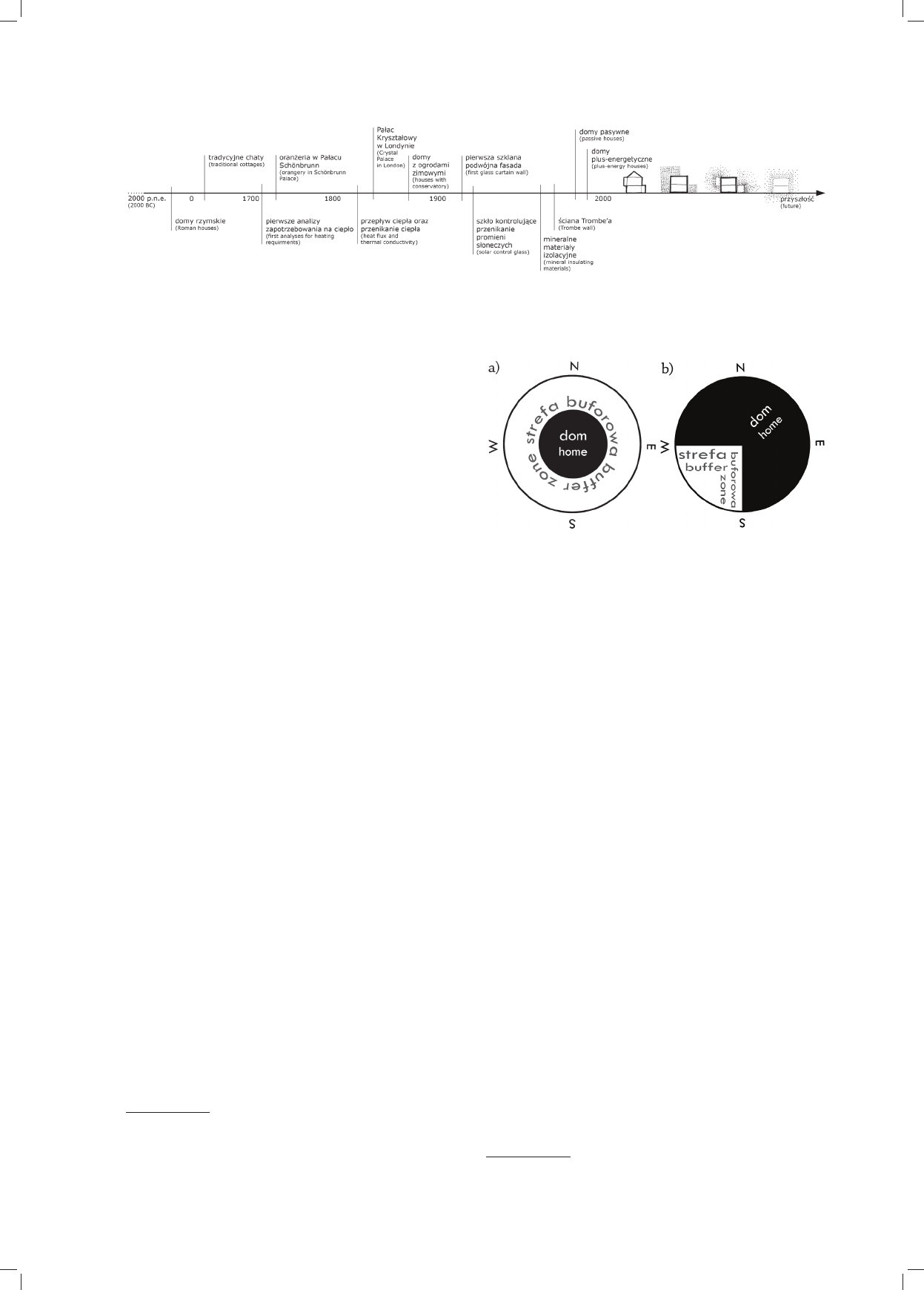
cieplną materiałów. Strefy buforowe powoli ewoluowały
z nieogrzewanych pomieszczeń przydomowych, intuicyj
nie stosowanych np. w tradycyjnych chatach drewnianych,
do doskonale zaprojektowanych pasywnych systemów
solarnych, takich jak podwójne fasady, ściany Trombe’a czy
ogrody zimowe (il. 1). Współcześnie po mieszczenia służą
ce do akumulacji ciepła zlokalizowane są najczęściej przy
salonach i funkcjonują jako ogrody zimowe będące strefą
przejściową pomiędzy bezpiecznym, ciepłym wnętrzem
a zmiennymi warunkami śro dowiska wokół budynku
(il. 2).
W zależności od warunków pogodowych strefy te
mogą służyć jako dodatkowa izolacja przed wiatrem i zim
nem, jako dodatkowe zacienienie salonu czy miejsce na
rośliny, które mogą tam przetrwać cały rok. Obecnie,
z powodu coraz bardziej zaostrzających się regulacji Unii
Euro pej skiej dotyczących zapotrzebowania budynku na
energię, strefy buforowe takie jak ogrody zimowe rzadko
mogą być stosowane w domach niskoenergetycznych, po
nieważ nie mogą rywalizować z coraz lepszymi ma te ria
łami izolacyjnymi stosowanymi w domach pasyw nych czy
zeroenergetycznych. Niestety skutkuje to tym, że domy za
czynają się zamykać przed środowiskiem ze wnętrznym,
co negatywnie wpływa na nasze samopoczucie. Otwiera
to
nowe pole do badań nad strefami buforowymi i poszu
kiwań lepszych rozwiązań umożliwiających spełnienie
os trych
wymogów energetycznych.
Istnieje wiele programów symulacyjnych służących do
analizy i optymalizacji warunków cieplnych w bu dynku
oraz oceny komfortu termicznego jego użytkowników,
wciąż jednak nie ma kompleksowego rozwiązania pozwa
lającego na jednoczesne przewidywanie komfortu ter micz
nego
oraz sa tysfakcji mieszkańców z wybranych roz
wiązań w budynku (lub jego projektu). Gra opisana w tym
artykule umożliwiłaby mieszkańcom dokonanie oceny za
równo komfortu ter micznego, jak i poziomu zadowole
nia, nawet dla kilku graczy na raz.
Mieszkaniec – człowiek w strefie buforowej
Mieszkaniec (gracz) traktowany jest w grze jako stało
cieplny ssak [3], [4] posiadający dużą samoświadomość,
która pozwala mu nie tylko postrzegać zewnętrzne bodź
Ancillary spaces as buffer zones
A buffer zone is one of the passive systems used for
accumulation, storage and redistribution of solar energy.
It is an enclosed, unheated cubature, adjacent to heated
rooms of the building, which decreases heat losses and
the building’s heating energy demand [1]. Next to the
building’s energy balance improvement, buffer zones
have also other important advantage for inhabitants – they
connect inner, enclosed building’s environment with outer
nature. This positively influences our mental health and
therefore increases the quality of life.
Since the 18
th
century, research studies on thermal phy
sics in buildings were intensively developed – building’s
requirments for heating energy were calculated, heat flux
and thermal conductivity was analysed (Fig. 1). Buffer
zones slowly evolved from unheated ancillary spaces, intu
itively located in traditional cottages, to well thoughtout
passive systems of solar energy accumulation and redis
tribution, such as doubleskin facades, Trombe walls or
sun spaces. Contemporary sunspaces are located around
heated living spaces and they are buffers between the safe,
warm inside and changeable outer environment (Fig. 2).
De pend ing on weather conditions, they can serve as addi
tional insulation, airtight coating, winter garden or extra
shading. Nowadays, because of tightening regulations
about the building’s energy demand for heating, sunspac
es might be used less frequently. They cannot compete
with excellent and quite inexpensive insulation materials,
which are used in passive and zero energy houses. How
ever, latterday houses close themselves from the outside
environment, from nature, which is detrimental for our
mental health. We should find new solutions for sunspac
es, which will satisfy strict energy regulations and, at the
same time, our health and mental needs.
Nowadays there are many simulation programs, in
which the building’s thermal conditions may be simulated
and thermal comfort assessed, but still there is no complex
solution of determining both thermal comfort and inhabit
ant’s satisfaction from the designed outcome. The game,
described in this paper, aims to combine both assessments,
which will vary, depending on the different players.
Inhabitant – human being in buffer zone
The inha bitant (i.e. game player) is understood as
a ho meothermic mammal [3], [4], with deep selfaware
ness, which enables him not only to perceive the external
impulses, but also to complain about them. In this project
man will be analysed from the medical point of view, as
a human body.
Man perceives the external impulses through the sense
of sight, hearing, smell, taste and sensor senses: touch,
proprioception
2
, temperature and pain. In this project only
two latter senses will be important for players – the sense
of temperature and pain.
2
Sense of the relative position of neighbouring parts of the body
and strength of effort being employed in movement [5].
Wytrząśnij z siebie dreszcze/Shake your shakes off 35
ce, ale również narzekać na nie. W tym projekcie czło
wiek jest analizowany z fizjologicznego i medycznego
punktu widzenia – jako ludzkie ciało, które odbiera ze w
nętrzne bodźce poprzez zmysł wzroku, słuchu, powonie
nia, smaku oraz zmysły dotyku: bólu, temperatury, rów
nowagi i czucia głębokiego
2
. W tym projekcie skupiono
się przede wszystkim na zmysłach temperatury i bólu.
Ciało odbiera informacje o temperaturze poprzez ter
moreceptory [6], [7]. Dalej informacja wędruje poprzez
rdzeń kręgowy do mózgu, gdzie we wzgórzu (thalamus)
jest rozkodowywana. Termoreceptory rejestrują zmiany
temperatury w ciele człowieka odbierane jako odczucie
ciep ła bądź zimna. Receptory te odgrywają istotną rolę
w reakcjach obronnych organizmu, szczególnie przy utrzy
mywaniu stałej temperatury ciała potrzebnej do prawidło
wej pracy wszystkich tkanek i narządów oraz do pra
widłowego metabolizmu. Receptory zimna, których jest
10 razy więcej niż receptorów ciepła, rejestrują szerszy
za kres temperaturowy (15–35°C); receptory ciepła rejestru
ją tylko zakres między 35 a 43°C. Temperatury poniżej
15°C lub powyżej 43°C odczuwane są jako ból [6], [7].
Komfort termiczny definiowany jest przez ASHRAE
3
jako […] stan umysłu, który wyraża satysfakcję z warun-
ków cieplnych panujących w danym miejscu [8, s. 68].
Komfort termiczny zależy od czynników środowisko
wych, takich jak temperatura powietrza, temperatura pro
mieniowania, wilgotność względna, prędkość i ciśnienie
powietrza, ja kość powietrza, oraz od różnych oddzia
ływań akustycznych i wizualnych. Do czynników indy
widual nych należy m.in. ubranie, poziom aktywności
fizycznej, możliwość indywidualnej kontroli, adaptacji
i akli maty zacji, roczny i dobowy rytm, odżywianie, wa run
ki etniczne, wiek, płeć czy liczba ludzi w pomieszczeniu.
Ostatnim typem czynników decydujących o komforcie
ter
micz nym są czynniki fizjologiczne, takie jak temperatura
skóry, potliwość czy skuteczność termoregulacji [9]–[11].
Zazwyczaj temperatura ciała waha się między 35,8
a 37,3°C. To zapewnia poprawne działanie wszystkich
or ga nów w ciele człowieka. Temperatura ciała człowie
ka jest inna niż temperatura otoczenia, dlatego potrzebu
je ono różnego rodzaju „rozszerzeń” dla ochrony przed
2
Zmysł orientacji ułożenia części własnego ciała względem siebie
oraz napięcia mięśniowego [5].
3
Amerykańskie Stowarzyszenie Inżynierów Ogrzewnictwa, Chłod
nictwa i Klimatyzacji (American Society of Heating, Refrigerating, and
AirConditioning Engineers).
The body receives the information about the tempe
rature through the thermal receptors [6], [7]. Next,
the in for mation is transported by the spinal cord to the
brain, where in the thalamus it is decoded. Thermal re
ceptors register changes in body temperature, felt as sen
sations of heat or cold. These receptors play an im por
tant role in the defence reactions, especially in main taining
a constant body temperature, needed to conduct normal
function of tissues, organs and metabolism. The cold
receptors, which are 10 times more nu merous, receive
a wider range of tem pe ratures (15°C±35°C) than heat re
ceptors, responsive in the range of 35°C±43°C. Ope ration
of low temperature or high above this range is felt as pain
[6], [7].
Thermal comfort is defined by ASHRAE
3
as: […] that
condition of mind which expresses satisfaction with the
thermal environment [8, p. 68]. It depends on environmen
tal factors, such as internal surface temperature, air tem
perature, relative humidity, air movement, air pressure, air
quality, acoustic and visual influences. Individual factors
are clothing, degree of activity, individual control possibil
ity, adaptation and acclimatization, day and annual
rhythm,
nutrition, ethnic influences, age, sex or room occu pancy.
3
American Society of Heating, Refrigerating, and AirConditioning
Engineers.
Il. 2. Schematy funkcjonalne
budynków ze strefami buforowymi:
a) strefa buforowa wokół pomieszczeń ogrzewanych,
b) strefa buforowa wbudowana pomiędzy pomieszczenia ogrzewane
(oprac. W. Lechowska)
Fig. 2. Examples of ideograms for simplified building constructions
with buffer zones: a) buffer zone placed around heated rooms,
b) buffer zone located between heated rooms
(by W. Lechowska)
Il. 1. Historia stref buforowych (oprac. W. Lechowska, na podstawie [2])
Fig. 1. History map of buffer zones (by W. Lechowska, based on [2])
36 Weronika Lechowska
zewnętrznymi warunkami pogodowymi: ubrania, schro
nów, budynków itp. Człowiek żyje w środowisku, w któ
rym panują temperatury między –40 a +60°C [6] i jest
w stanie przeżyć, jeśli temperatura jego ciała wynosi mię
dzy 20 a 41°C. Powyżej 41°C następuje hipertermia, która
skutkuje utratą wody i uszkodzeniem organów. Spadek
temperatury ciała (hipotermia) jest tak samo niebezpiecz
ny – przy temperaturze ciała wynoszącej 35°C nasze funk
cje motoryczne pogarszają się, przy 33°C zaczynamy
majaczyć, a przy 30°C tracimy przytomność. Temperatura
20°C jest granicą, poniżej której serce przestaje bić i nastę
puje zgon [6].
Komfort termiczny w strefie buforowej
Celem symulacji wykonywanych w opisanym projek
cie gry było stworzenie takich warunków w modelowanej
strefie buforowej, aby nawet przy niskiej temperaturze
zapewniony był komfort termiczny mieszkańców, przy
jed noczesnym obniżeniu kosztów i zapotrzebowania bu
dynku na energię do ogrzewania. Pod uwagę wzięto wy bra
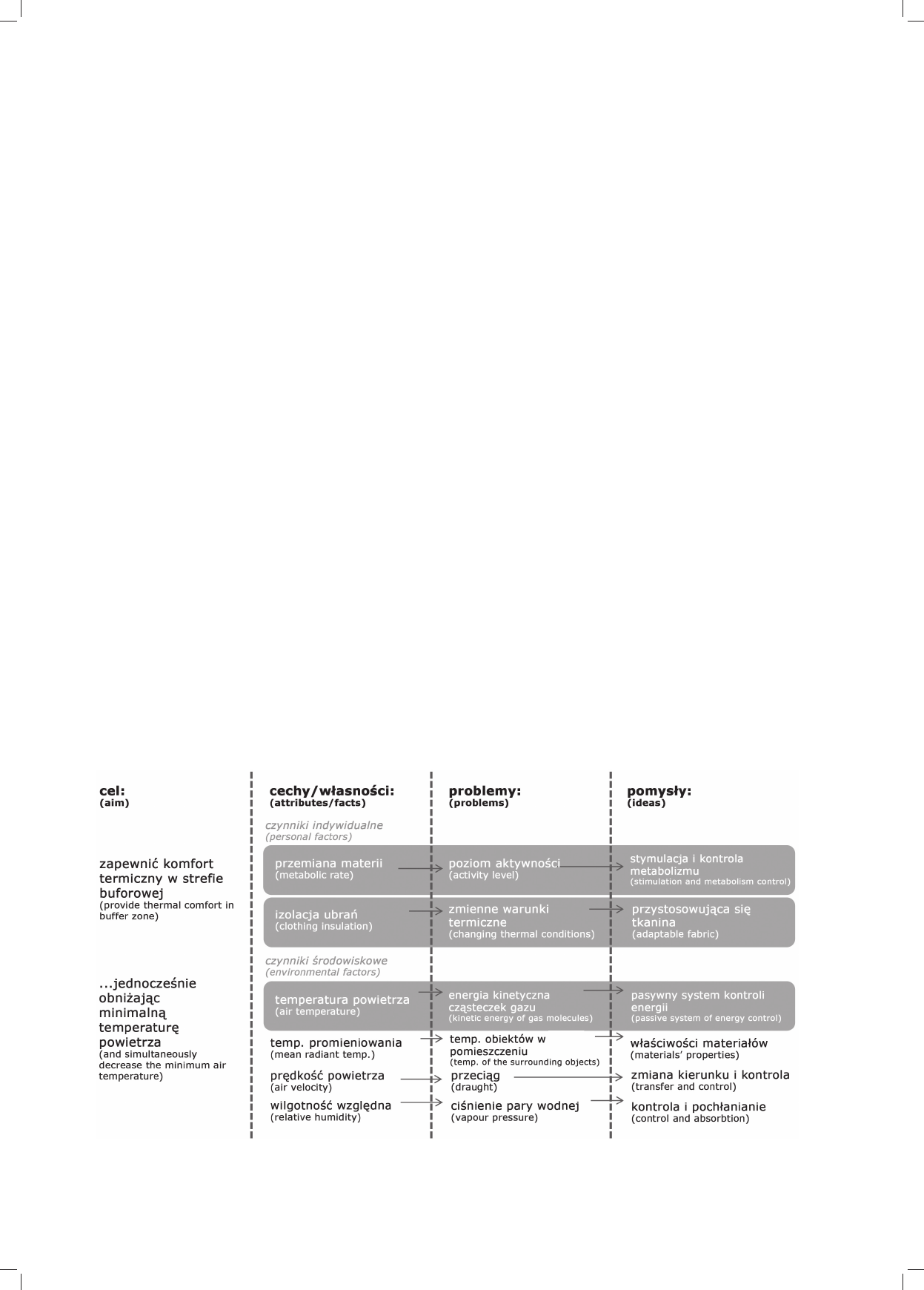
ne sześć elementów wpływających na komfort termiczny
(il. 3) – poziom metabolizmu, izolację ubrań, temperaturę
powietrza, średnią temperaturę promieniowania, pręd
kość powietrza oraz wilgotność względną. We wstępnym
prototypie, dla uproszczenia, uwzględniono tylko dwa
czyn niki indywidualne (poziom metabolizmu i izolacyj
ność ubrań) oraz jeden czynnik środowiskowy – tempera
turę powietrza.
Każdy element wpływający na komfort termiczny ma
przypisany jeden problem z nim powiązany oraz pomysł
na jego rozwiązanie. Poziom metabolizmu zależy m.in.
od poziomu aktywności fizycznej danej osoby – rośnie,
gdy ktoś dużo się przemieszcza, maleje, kiedy odpoczywa.
The last type of factors, which decide on the ther mal com
fort are physiological factors: skin tempera ture,
sweat rate
or effectiveness of thermoregulation [9]–[11].
Usually our temperature ranges from 35.8 to 37.3°C.
That ensures the smooth functioning of all organs. The
temperature of the human body is different than the ambi
ent temperature and this is why the body needs some
“extensions” for protection, depending on the weather
conditions: clothes and shelters, such as houses. Man can
live in an environment with temperature from –40 to +60°C
[6]. The body temperature can vary between 20–41°C. At
temperatures above 41°C (hyperthermia) there is a sig
nificant loss of body fluid drainage and organ damage.
Decrease of the temperature is just as dangerous as its
increase. If we have 35°C, our motor functions worsen, at
33°C we get delirious, and at 30°C, we lose con sciousness.
20°C is the limit below which the heart stops beating and
the person dies [6].
Thermal comfort of buffer zone
Achieving thermal comfort in the buffer zone, with
simultaneous decrease of air temperature needed to satis
fy the inhabitant’s comfort, is the main aim of this project
and it may result in meaningful decrease of the building’s
energy demand for heating and fair cost savings. The aim
consists of six factors mentioned in Figure 3. In initial
prototype, for simplification, only personal factors and
one environmental factor are analysed: metabolic rate,
clothing insulation and air temperature.
Each factor (or attribute) of the aim, has assigned one
problem and one idea of solution. The metabolic rate is
dependent on the person’s activity level; it increases when
the activity level becomes higher and the other way round.
Il. 3. Projekt – cele, czynniki, problemy i pomysły (oprac. W. Lechowska)
Fig. 3. Aim, attributes, problems and ideas of the project (by W. Lechowska)

Wytrząśnij z siebie dreszcze/Shake your shakes off 37
To prowadzi do kolejnego problemu, jakim jest izo lacja
ubrań i zmienna temperatura powietrza. Jego rozwiąza
niem mógłby być nowy rodzaj tkaniny – uczącej się na
szych preferencji temperaturowych i dopasowują cej się
do naszych oczekiwań poprzez zmianę współ czynni ka
izo lacyjności. Przy problemach z temperaturą pro mie
niowania i temperaturą powietrza prostą receptą byłoby
wpro wadzenie pasywnych systemów energetycznych
i systemu kontroli oraz poprawienie właściwości ma te ria
łów budowlanych tak, aby mogły akumulować energię so
larną lub ją odbijać na zewnątrz. Rozwiązanie kwestii prze
ciągów i złej wilgotności wymagałoby za awan so wa ne go
systemu kontroli oraz materiałów, które by łyby w stanie
absorbować nadmiar wilgoci. Naj więk szym pro blemem
jest wzajemna współzależność wszystkich czynników,
przez co bar dzo trudno zapewnić komfort termiczny w bu
dynku i niezbędne jest używanie programów
sy mu la
cyjnych do obliczania i sprawdzania warunków termicz
nych w projektowanych lub istniejących obiektach.
Intuicyjne wyobrażenie komfortu termicznego (il. 4)
pokazuje główny problem gry – jak zdefiniować rów no
wagę pomiędzy wszystkimi czynnikami wpływającymi
na komfort termiczny. Łączy ideę ciała doskonale czarne
go
4
z fenomenem zachowania kota, zwierzęcia o niesa
mowitym talencie do wyszukiwania najcieplejszych miejsc
w mieszkaniu i pochłanianiu energii z grzejników, lapto
pów, żarówek, a najchętniej z ludzi. Koty zawsze potrafią
znaleźć idealne miejsce w pomieszczeniu i to właśnie ma
naśladować gra.
Projekt gry „Wytrząśnij z siebie dreszcze”
Scenariusz gry
Gra „Wytrząśnij z siebie dreszcze” bazuje na symula
cjach i systemie konfliktów, a jej głównym wyzwaniem
jest jednoczesne zagwarantowanie komfortu termicznego
i zapewnienie jak najwyższego poziomu zadowolenia gra
cza. Komfort termiczny zależy od wielu czynników, jednak
na potrzeby gry ograniczono się do sześciu (il. 3). Mimo to
ocena chwilowego komfortu termicznego na dal jest bardzo
trudna ze względu na problem indywi dualnego odczuwa
nia temperatury oraz preferowanych wa runków środowi
skowych, które mogą prowadzić do pewnych paradoksów
i konfliktów. Przykładem jest prze by wająca w jednym po
mieszczeniu grupa ludzi, z których każdy wszystko
odczu
wa inaczej i ma inne oczekiwania. Jeśli jedna osoba chce
zmienić jakiś czynnik, wpłynie to na odczuwanie komfor
tu przez pozostałych. Inny paradoks odnosi się do meta
bolizmu: poziom metabolizmu rośnie, kiedy aktywność
fizyczna wzrasta – wtedy jest nam ciepło. Jednak nie
mo żemy być w ruchu przez cały czas. Kluczowym prob
lemem w tej grze jest symulowanie rzeczywistych, chwi
lowych temperatur panujących w po mieszczeniu jedno
cześnie ze zaktualizowanym poziomem metabolizmu
i innych warunków termicznych. W grze The Sims [13]
4
Wyidealizowane ciało fizyczne, które pochłania całe promieniowa
nie elektromagnetyczne, niezależnie od częstotliwości czy kąta padania [12]
.
This brings us to the next problem of clothes and chang
ing thermal conditions. The solution for them would be
a new type of material, e.g. fabric, which can learn about
our comfort sensations in different temperatures and
adapt to our expectations in the future. For problems with
air and radiant temperatures there would be a simple solu
tion of introducing passive energy systems and a control
system and also improving the materials’ properties, so
that they could accumulate and store solar energy. Solving
problems with draughts and humidity would demand ad
vanced control systems and new materials, which could
ab sorb surplus of vapour. The biggest problem with all
these factors is that they all are dependent on each other
and one slight change can significantly impair thermal
com fort. This is why the use of advanced calculation pro
grams is necessary to assess simulated thermal comfort.
The intuitive image of thermal comfort (Fig. 4) depicts
the main problem of the game – how to find balance
between all factors influencing thermal comfort: meta
bolic rate, clothing, air and radiant temperature, humidity
and air velocity. This picture combines the idea of a black
body
4
and phenomenon of cats’ behaviour – their remark
able talent to find the best spots for them, and absorb heat
energy from heaters, laptops, lamp bulbs, human beings,
etc. They can always find their best spot. So we are trying
to do it in this game.
“Shake your shakes off” game design
Game scenario
The game “Shake your shakes off” is a play of simula
tion and system of conflicts. It is also a challenge game,
which aims to achieve simultaneously the highest thermal
comfort and level of happiness/satisfaction. Thermal
comfort depends on many factors, but for the game pur
poses it was restricted to six factors/attributes (Fig. 3).
Even though, assessing properly momentary thermal
4
An idealized physical body that absorbs all incident electromag
netic radiation, regardless of frequency or angle of incidence [12].
Il. 4. Intuicyjne wyobrażenie komfortu termicznego
(oprac. W. Lechowska)
Fig. 4. Intuitive image of the thermal comfort
(by W. Lechowska)

38 Weronika Lechowska
problem ten jest rozwiązany poprzez wyświetlanie tempe
ratur tylko w pewnych przedziałach – bardzo ciepło, cie
pło, komfortowo, zimno, bardzo zimno – przez co uprosz
czone jest określanie komfortu oraz proces obliczeniowy.
Projektowana gra umożliwia prowadzenie symulacji
zarówno dla budynków w fazie projektu, jak i dla tych już
istniejących. Jest to gra komputerowa z symulacjami prze
prowadzanymi w programie Energy Plus, z możliwością
wy korzystania czuj ników temperatury i wilgotności w bu
dynkach istniejących – pomogą one w kalibra cji mo delu
budynku z prawdziwym obiektem. Pozwoli to na dopaso
wanie strefy buforowej do zmieniających się potrzeb gra
czy/mieszkańców.
Gra jest zaprojektowana dla jednego bądź wielu gra
czy. Jeden gracz (np. mieszkaniec lub projektant budyn
ku) może wybrać wstępne ustawienia, które będą później
rozwijane przez komputer. Może zmieniać różne prefe
rencje, takie jak wielkość rodziny lub rodzaj aktywności
fizycznej w różnych pomieszczeniach. Na początku musi
on zdefiniować lokalizację budynku, porę dnia i roku
(w ten sposób definiowana będzie pogoda na zewnątrz),
lokalizację i kształt strefy buforowej, materiały konstruk
cyjne, typ okien i drzwi oraz czas ich otwierania. Na dal
szym etapie gry może wprowadzać więcej zmian, tak aby
dostosowywać pomieszczenia do własnych potrzeb. W wer
sji
dla wielu graczy scenariusz jest taki sam poza tym, że
uwzględniane będą potrzeby wszystkich graczy (członków
rodziny). Komfort termiczny będzie musiał być zapew
niony dla wszystkich mieszkańców domu jednocześnie,
a dzięki szybkim symulacjom i narzędziom optymaliza
cyjnym możliwe będzie znalezienie takiego kompromisu.
Mechanika gry składa się z różnych elementów, na
które gracz ma bezpośredni wpływ poprzez zmiany usta
wień (kształt i wielkość budynku, rozkład pomieszczeń,
materiały konstrukcyjne, okna) oraz wpływ pośredni –
po przez wprowadzanie pewnych informacji, które pro
gram będzie interpretował, np. zmiany w lokalizacji bu
dyn ku powodują wczytanie danych pogodowych dla
danego miejsca. Gra przewiduje również dodatkowe czyn
niki takie jak funkcjonalność, estetyka czy koszty, które
wpływają na poziom zadowolenia gracza.
Czynniki środowiskowe mogą być zmieniane tylko przez
wykonanie pewnych akcji – zmianę geometrii bu dynku lub
zmianę właściwości elementów strefy buforowej, np. roz
miar okien. Czynniki indywidualne mogą być dostosowa
ne w każdym momencie gry. Dla uproszczenia, we wstęp
nym
prototypie tylko temperatura powietrza, aktywność
fizyczna i izolacyjność ubrań mają wpływ na odczuwanie
komfortu termicznego, jednak docelowo gra przewiduje
wykorzystanie wszystkich czynników do oceny komfortu.
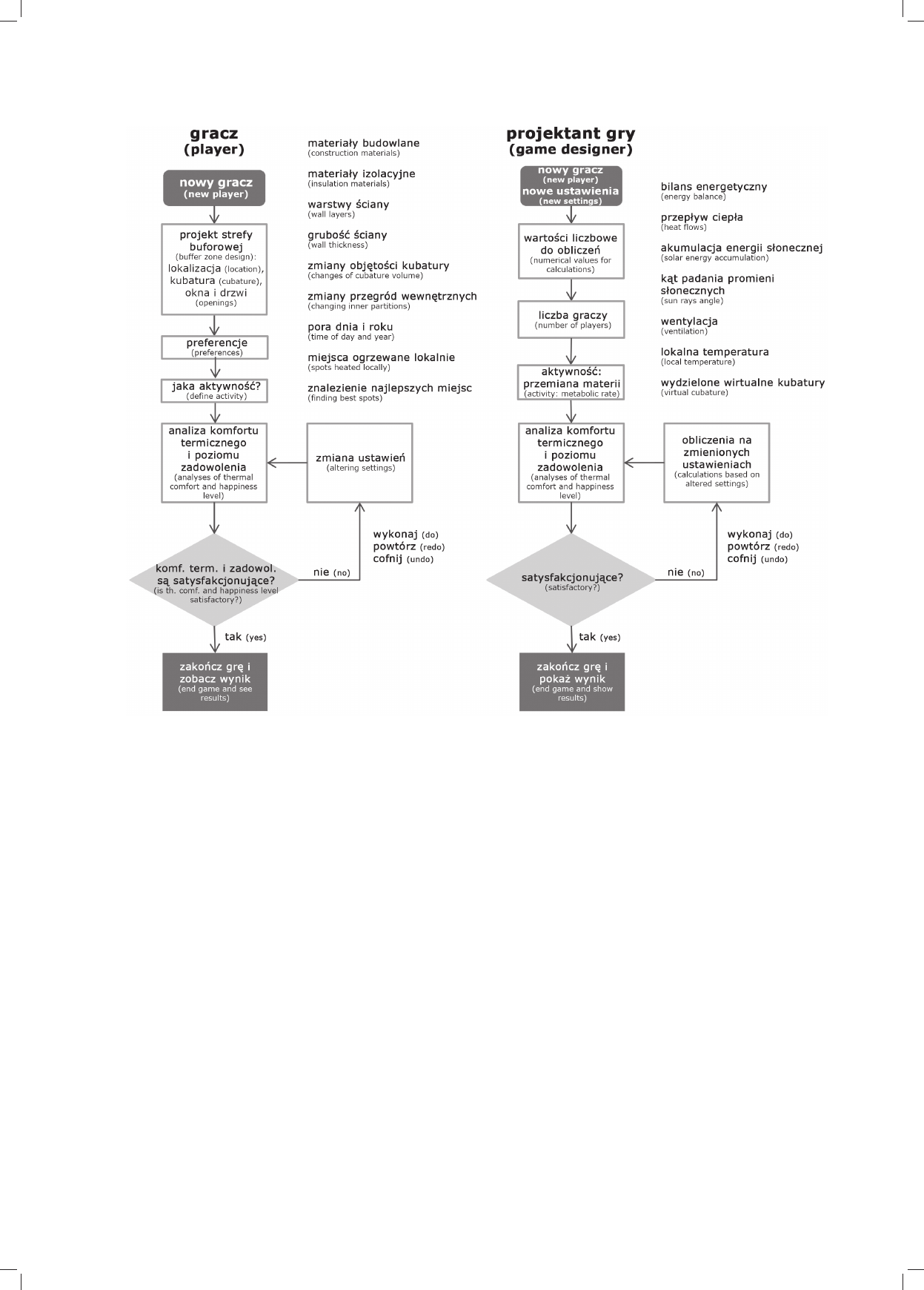
Diagramy sekwencji działań przedstawione na ilustra
cji 5 pokazują algorytm gry z punktu widzenia jej pro
jektanta i użytkownika. Na początku gracz może wybrać
lo kalizację, kształt i ro dzaj materiałów zastosowanych
w modelu budynku, określić pewne preferencje i zdefinio
wać ak tywność fizyczną. Wszystkie te ruchy są widoczne
dla pro jektanta jako zmiany wartości liczbowych używa
nych do obliczeń w programie symulacyjnym. Po wyko
naniu obliczeń komfortu termicznego i poziomu za do wo
le nia gracz może zadecydować, bazując na informacjach
com fort is a very difficult task to perform. There are also
problems of individual sensation of temperatures and
favorable conditions, which cause some paradoxes and
conflicts, for example all environmental factors influence
a group of people, who stay in an enclosed area. If they
want to change one of the factors, it will influence all the
other people. Another paradox relates to the metabolic
rate – metabolism increases, when our activity level gets
higher. But we cannot be moving all the time. The crucial
problem in this game is simulation of the real time tem
perature with updated metabolic rates and thermal condi
tions. In The Sims game [13] this problem is solved by
displaying temperatures only in some ranges, e.g. very
hot, hot, comfort, cold, very cold, which simplifies assess
ing thermal comfort and streamlines this process.
The designed game provides simulations for both
buildings in the concept of design and the existing build
ings. The player is focused, during the game, on finding
the best settings for the buffer zone adjacent to his house.
For building’s design only PC and Energy Plus program
would be used for simulations, but for already built hous
es, also sensors and devices may be used. Temperature
sensors enable calibration of the game’s model with real
conditions in existing building. Due to this solution, the
buffer zone in the real building can be adjusted to chang
ing preferences of players.
The game is designed for one or many players. One
player (e.g. inhabitant or building’s designer) may choose
some initial settings, which are later developed by com
puter. He can change different preferences, such as family
size (influencing heat gains) or activity (influencing per
ceived temperatures). At the beginning of the game he
must define the building’s location, time of day and sea
son (which influences weather), location and geometry of
the buffer zone, construction materials, type of openings
in buffer zone and their schedule. In further stages of the
game the player introduces more changes, so that he can
adjust the buffer zone to his needs. In the multi players
version the game scenario is similar, except that all the
needs of all players (e.g. family members) must be satis
fied at the same time. Due to quick simulation and opti
misation tools it is possible to find a compromise between
expectations of all house residents.
The game’s mechanics consists of different factors that
can be influenced by the player directly – by changing
some settings, or indirectly – by introducing information,
which is interpreted by the program, e.g. changes in loca
tion influence indirectly weather and daily temperatures.
Among those factors there is one environmental factor –
air temperature, and two personal factors – activity level
and clothes; and few satisfaction factors – functionality,
aesthetics and cost.
Environmental factors can be changed only by some
actions, e.g. altering space geometry or changing proper
ties of buffer zone elements, e.g. size of openings. Per
sonal factors can be adjusted in any moment of the game.
In the initial prototype only air temperature, activity and
clothes will affect our thermal comfort, but in further
research also other factors will count, and then playing
will be much more intriguing.
Wytrząśnij z siebie dreszcze/Shake your shakes off 39
wyświetlanych na stronie głównej, czy jest usatysfakcjo
nowany wynikiem czy nie. Jeśli tak, to gra się kończy,
a on może przeanalizować wyniki – finalny kształt budyn
ku oraz jego ustawienia. Jeśli wynik się nie podoba, może
on zmienić kolejne ustawienia i czekać na rezultat –
w wypadku gdy wynik jest gorszy niż poprzedni, gracz
może cofnąć ruch. Wszystkie elementy geometrii budyn
ku lub materiały konstrukcyjne widoczne dla gracza są
w rzeczywistości modelem liczbowym obliczającym
przepływy energii.
Komfort termiczny jest ściśle powiązany ze zmysłem
dotyku: odczuwania temperatury i bólu. Niestety najła
twiejszą metodą pokazania, czy komfort termiczny i po
ziom satysfakcji zostały zagwarantowane, są kontrolki na
głównym ekranie gry. Mogą być postrzegane tylko przez
zmysł wzroku. Przy podejmowaniu decyzji o kształcie bu
dynku również bazujemy na dwuwymiarowym ry sunku mo
delu. Możliwym rozwiązaniem byłoby wprowadzenie pew
nych czujników i stymulatorów, które mogłyby imitować
odczucia termiczne zamodelowane w grze. Gracz mógł by
naprawdę odczuwać zimno i gorąco i na bieżąco sa memu
decydować, kiedy komfort termiczny zostaje zapewniony.
The following flowcharts (Fig. 5) depict the game
algo rithms from the player’s and game designer’s point of
view. At the beginning, the player can choose the loca
tion, cubature and openings in the building’s model, set
some preferences and define activity. These actions are
visible for the game designer as altering numerical values
used for calculations in a special simulation program.
After calculations of thermal comfort and happiness, the
player may decide, based on controls in the game inter
face whether this is a satisfactory result or not. If yes, the
game ends and the player can analyse the outcome – the
building’s final geometry and settings. If not, the player
can change some other settings and wait for the result –
when it is better than previous one, he can leave changes
and play further or end game; in case the new result is
worse, the player may “undo” the action. All settings, that
can be altered, are visible for the player as some geometry
or ma terial change, when in fact, they are energy flow
changes, calculated in the program.
Thermal comfort is strictly tied up with the sense of
touch: sense of temperature and pain. Unfortunately, the
easiest method of showing the achieved thermal comfort
Il. 5. Diagramy sekwencji działań – z punktu widzenia gracza i projektanta gry (oprac. W. Lechowska)
Fig. 5. Flowcharts – player’s and game designer’s point of view (by W. Lechowska)
40 Weronika Lechowska
Symulacje parametrów gry
Mechanika gry zawiera cztery typy symulacji – czasu,
materiałów, przestrzeni oraz energii – które poprzez
wpro wadzanie zmian w modelu budynku pomagają przy
obliczeniach i ocenie komfortu termicznego w strefach
buforowych. Wszystkie symulacje mogą być przeprowa
dzane przy użyciu programu Design Builder
5
v.4.1 [11],
który tworzy środowisko gry w pierwszym prototypie,
natomiast docelowa gra byłaby swego rodzaju interfej
sem dla obliczeń termicznych połączonych z oceną pozio
mu zadowolenia gracza.
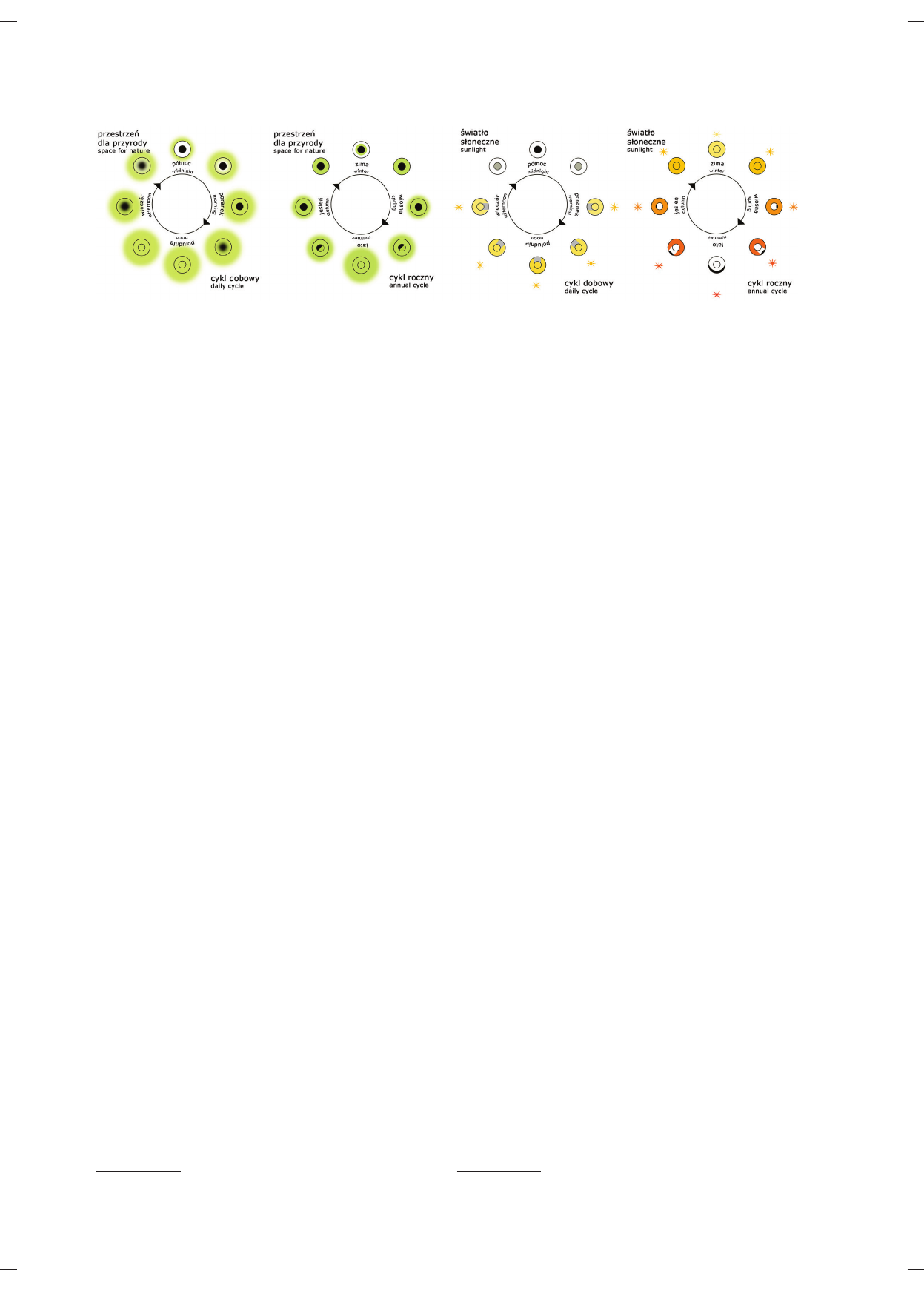
Pierwszym typem symulacji jest zmiana czasu. Istnieje
możliwość modyfikacji pory dnia i roku tak, aby spraw
dzić, jak będzie się zachowywała strefa buforowa przy
różnych warunkach pogodowych. Różne ustawienia cza
su wpływają na zmia
nę temperatury zewnętrznej oraz na
kąt padania promieni słonecznych, a tym samym na tem
peraturę wewnątrz budynku. Na ilustracji 6 pokazano, jak
zmienia się nasłonecznienie oraz zasięg zieleni na zewnątrz
budynku (otwarcie strefy buforowej na zewnątrz) w zależ
ności od pory roku i dnia.
Symulacje prowadzone w dwóch okresach w ciągu
roku, które mają skrajne temperatury (najzimniejszy oraz
najcieplejszy tydzień w roku), umożliwiają sprawdzenie
wewnętrznych warunków w strefie buforowej dla najgor
szych scenariuszy – przegrzania i nadmiernego wychło
dzenia. Te dwa przypadki są najbardziej niebezpieczne
nie tylko dla mieszkańców, ale również zwierząt i roślin,
dlatego gracz musi rozwijać swój model strefy buforowej
w odniesieniu do tych ekstremalnych warunków.
Dla wygody gracza scenariusz gry uwzględnia ruchy
„do”, „redo” i „undo”, które mogą być użyte do zmian tem
peratury w pomieszczeniach ogrzewanych; przy zmia nach
przepływu powietrza pomiędzy środkiem bu dyn ku a stre
fami wokół i środowiskiem zewnętrznym; przy
zmianach
zacienienia, warstw ścian, grubości ścian czy ma teriałów
oraz przy zmianach pór roku i dnia. Te wszystkie działania
umożliwiają szyb ki rozwój modelu w grze i łat we przej
ście między ruchami gracza.
5
Nakładka programu Energy Plus.
and happiness in the game, are the controls. They can be
perceived only by the sense of sight from the game’s in
terface on the screen. The same situation is in the de cision
process about changing the settings – there is a two di
mensional picture of the building’s model, but we cannot
actually enter it. A possible solution would be introducing
some stimuli, which could imitate thermal sen sations
based on thermal conditions modeled in the game’s real
ity. The player could then sense chill or heat and assess
himself, if he actually feels thermal comfort.
Game parameters’ simulations
The game mechanics contains four types of simula
tions – time, material, spatial and energy, which through
introducing changes in the building’s model help with cal
culations and assessment of thermal comfort in the buffer
zone. All simulations might be conducted with the help of
Design Builder
5
v.4.1 program [11] and in case of creat
ing a real game, it should be treated as an interface for
thermal calculations with happiness factor included.
The first type of simulations is the changing of time.
It is possible to change the time of day and season to
check how the buffer zone will behave in different weath
er conditions. Altering the time implicates the change in
out side air temperature and solar radiation, which affect
inner tem
peratures and therefore thermal comfort. Fi
gure 6 de picts how the sunlight changes and the range of
nature outside the house (opening the buffer zone on the
outside environment) depending on the season and time
of the day.
Simulations conducted during two periods in the year
with extreme temperatures (the coldest winter time and
the hottest summer time) enable checking the buffer
zone’s inner conditions for worst case scenarios, namely
over heating and overcooling of inner space. These two
cases are most dangerous not only for the inhabitants, but
also for animals and plants and that is why the player
should develop the design of the buffer zone with refer
ence to those extreme conditions.
5
Interface for Energy Plus.
Il. 6. Osie czasowe – roczne i dzienne cykle zasięgu zieleni i nasłonecznienia
(oprac. W. Lechowska)
Fig. 6. Timelines – annual and daily cycles of nature intrusion and sunlight
(by W. Lechowska)

Wytrząśnij z siebie dreszcze/Shake your shakes off 41
For the player’s convenience the game scenario in
cludes the following actions “do”, “redo” and “undo”,
which can be used during the changing of temperatures
inside the heated part of the building; changing of air
flows between the core of the building, the buffer zone
and outside environment; changing of shading, wall lay
ers, wall thickness, materials; changing of seasons and
time of the day. These actions facilitate fast development
of the game model and smooth moves between different
settings and decisions.
Material simulations focus on altering material types
and their properties, such as thermal conductivity, spe
cific heat or density, and this depends on the location and
function of the particular material. Inner surface ma te rials
should be able to adjust to thermal conditions in the zone
and counteract overheating or overcooling by diff e rent
(maybe changeable) radiant temperatures – warm in win
ter and cold in summer. Materials could also change their
shape, depending on the altering conditions, such as tem
perature or humidity. New “automatically changed” geo
metry could create extra window shading protecting from
direct solar radiation. The game also facilitates introduc
tion of internal thermal mass, constructed of materials
that have high specific heat coefficient and can store heat
for a long time, such as clay. Other materials, that can
store and release large amounts of energy, such as phase
change materials (PCM), and they are used in advanced
systems of the building’s heat circulation.
A different type of simulations is based on spatial
changes, including altering of cubature volume, changing
inner partitions, introducing virtual partitions
6
and divi
sions into smaller buffer spaces (Fig. 7). In these simu
lations, not only different sizes of zone volumes or variants
of inner partitions are checked, but also situations, when
the inhabitant stays in virtual space inside the zone, where
conditions are different from those in neighbouring spaces.
Finally, energy simulations consist of analyses of ener
gy flows between different spaces – heated building’s
core, buffer zone and outside environment. They include
also tests of miscellaneous devises emitting heat in small
er parts of the buffer zone. One of those tests is part of
initial prototype of concept nucleus and it checks, how
much energy should be emitted in this space during one
of the coldest weeks of a year, to meet thermal comfort
requirements.
6
A virtual partition is a partition between 2 zones which exists
purely to subdivide the space up and has no corresponding wall in the
actual building.
Symulacje materiałów polegają na zmianie typu mate
riałów i ich właściwości, takich jak przewodność cieplna,
ciepło właściwe lub gęstość, oraz zależą od lokalizacji i funk
cji danego materiału. Materiały wykorzystane w bu dynku po
winny mieć zdolność adaptacji do warunków termicznych
w strefie buforowej oraz przeciwdziałać prze grzaniu i wyzię
bieniu poprzez zmienne temperatury pro mieniowania – wyso
kie zimą i małe latem. Interesujące by łoby wprowadzenie
materiałów, które potrafiłyby zmieniać swój kształt w zależ
ności od warunków temperaturowych czy wilgotności. Nowy,
„auto ma tycznie zmieniony” kształt mógłby tworzyć do dat
kowe zacienienie okna chroniące przed bezpośrednim pro
mieniowaniem. Gra umożliwiałaby również wpro wa dze nie
wewnętrznej masy ter micznej wykonanej z ma te riałów, które
mają duże ciepło właściwe i mogą ma ga zynować energię
cieplną przez długi czas. Innym rodzajem materiałów mo ż
liwych do wpro wadzenia w grze byłyby ma teriały zmienno
fazowe (Phase Change Materials – PCM), któ re również
potrafią maga zynować ciepło i wykorzystywane są w za
awansowanych systemach cyrkulacji ciepła w budynku.
Kolejnym typem symulacji prowadzonych w trakcie gry
są symulacje przestrzeni, uwzględniające zmiany w kształ
cie budynku, kubaturze oraz przegrodach we wnętrznych
(il. 7). W tych symulacjach analizowane są nie tylko różne
wielkości strefy czy warianty podziałów przestrzeni, ale
również symulacje podziałów wirtualnymi przegrodami
6
.
Ostatnim typem symulacji są symulacje energetyczne,
pozwalające na obserwację przepływu ciepła pomiędzy
trzema obszarami – ogrzewanym wnętrzem budynku,
strefą buforową i środowiskiem zewnętrznym. Symulacje
te uwzględniają również testy wielu rodzajów urządzeń
emitujących ciepło w mniejszych obszarach strefy bufo
rowej. Jeden z takich testów jest częścią prototypu i spraw
dza, ile energii powinno być wyemitowane w danej małej
przestrzeni podczas najzimniejszego tygodnia w roku, tak
aby spełniony został warunek komfortu termicznego.
Kryteria oceny komfortu termicznego
i poziomu zadowolenia z zastosowanych rozwiązań
Po każdej symulacji modelu strefy buforowej przepro
wadzonej przez gracza generowany jest wynik komfortu
termicznego oraz poziomu satysfakcji z otrzymanego
rozwiązania. Oba rezultaty przedstawione są jako graficz
ne symbole i wartości liczbowe – poziom zadowolenia od
6
Przegrody te oddzielają dwie przestrzenie o różnych warunkach
termicznych znajdujące się w jednym pomieszczeniu; przegrody te nie
istnieją w rzeczywistym budynku.
Il. 7. Symulacje przestrzenne
(oprac. W. Lechowska)
Fig. 7. Spatial simulations
(by W. Lechowska)

42 Weronika Lechowska
Criteria of thermal comfort
and happiness assessment
After each simulation performed by the player on the
buffer zone’s model there is an outcome of thermal com
fort and happiness shown on the scale. Both outcomes are
displayed as graphic icons and numerical values – happi
ness from 0 to 1 and thermal comfort has both ends with
values –1 (overcooling) and +1 (overheating), whereas 0
indicates optimal conditions understood as thermal com
fort in balance. Results are based on different evaluation
criteria. For thermal comfort, all criteria are quantitative.
In each criterion, there are points between 1 (too low) and
7 (too much), and the middle range between them satis
fies the player’s requirements and expectations. Evaluation
criteria for happiness are, in turn, qualitative. Points
between 1 (bad) and 4 (good) describe the player’s feel
ings about some aspects. Results from all criteria are
summed up to the final outcome, and they are all visible to
the player, so he can decide what to do in the next move.
SWOT analysis of the game scenario
The main advantage of the game is that all calculations
can be conducted in the simulation program, where all
aspects of thermal comfort can be defined and assessed.
Additionally, the game “Shake your shakes off” facilitates
determining the happiness factors, which help in final
decision about the buffer zone’s construction. Also, this
program for thermal calculations has inbuilt meteorologi
cal data bases from different locations, which enable sim
ulations of different climate and weather conditions.
One of the biggest obstacles to the creation of an indepen
dent game is money. To design and create the game, which
can calculate thermal conditions based on algorithms from
Energy Plus, would require huge resources. That is why the
initial prototype is using the Design Builder Prog ram as
a calculation engine. But if it was possible to create the real
game, it could combine not only PC and programs,
but
also sensors that could imitate reel feelings of tempe
rature. Nevertheless, this game has a huge potential due to
the fact that creating the model of the house and buffer
zone would be easy and intuitive for everyone. Each of us
could design his own winter garden or atrium and play
with it, no matter what educational background he has.
Prototype of the game
Basic model
The buffer zone’s initial prototype of the game “Shake
your shakes off” was created in Design Builder v.4.1 and
all simulations were conducted in this program. The
building’s model has a simplified plan and construction.
It is a one storey house, with a circular plan, where the
inside “core” is the inhabited, heated zone, with the
unheated buffer zone “ring” around it. This game enables
the creation of a more complicated building’s geometry,
but for the first test it was easier to create a simple con
struction with clear space division.
0 do 1 oraz komfort termiczny między –1 (nadmierne
wychłodzenie), a +1 (nadmierne przegrzanie), gdzie zero
oznacza optymalne warunki cieplne. Ocena opiera się na
róż nych kryteriach ewaluacyjnych. Dla komfortu ter
micznego wszystkie kryteria są ilościowe – każde kryte
rium ma skalę punktową pomiędzy 1 (za niski) a 7 (za
wysoki), natomiast przedział pomiędzy tymi wartościa
mi oznacza mniej lub bardziej satysfakcjonujące warun
ki dla gracza. Z kolei kryteria ewaluacyjne dla poziomu
zadowolenia są jakościowe – punkty pomiędzy 1 (źle)
a 4 (do brze) opisują uczucia gracza dotyczące różnych
elementów modelu. Wszystkie wyniki cząstkowe oraz
finalny, będący ich sumą, są widoczne dla gracza i na ich
podstawie może on decydować o następnym kroku.
Analiza SWOT scenariusza gry
Główną zaletą opisywanej gry jest możliwość prowa
dzenia obliczeń w programie symulacyjnym, w którym
wszystkie aspekty komfortu termicznego mogą być zdefi
niowane i ocenione. Dodatkowo gra „Wytrząśnij z siebie
dreszcze” umożliwia określenie poziomu zadowolenia, któ
ry pomaga przy podejmowaniu ostatecznej decyzji co do
konstrukcji strefy buforowej. Kolejną zaletą jest to, że pro
gram symulacyjny ma wbudowaną bazę danych meteoro
l
ogicznych z wielu lokalizacji w Polsce i na świecie, co
umożliwia symulacje w różnych warunkach klimatycz
nych i pogodowych.
Jedną z największych przeszkód do stworzenia nieza
leżnej gry jest brak odpowiednich środków finansowych.
Zaprojektowanie i skonstruowanie gry potrafiącej wyko
nywać obliczenia termiczne bazujące na algorytmach
Energy Plus wymagałoby olbrzymich nakładów. Z tego
względu opisywany prototyp jako narzędzie do obliczeń
wykorzystuje program Design Builder. Gdyby jednak
była możliwość opracowania prawdziwej gry, można by
ją było połączyć nie tylko z programem symulacyjnym
i komputerem, ale również z czujnikami i stymulatorami
imitującymi prawdziwe odczucia temperatury.
Dzięki przejrzystemu interfejsowi gra byłaby dostępna
nie tylko dla projektantów i inżynierów zajmujących się
bilansem cieplnym budynków, ale dla wszystkich osób,
które chciałyby podjąć się przeprojektowania swojego
domu oraz stworzenia poprawnie funkcjonującego prze
szklonego pomieszczenia.
Prototyp gry
Model podstawowy
Pierwszy prototyp strefy buforowej w grze „Wytrząś
nij z siebie dreszcze” został stworzony w programie De
sign Builder v.4.1, w którym były prowadzone wszyst
kie symulacje. Model budynku ma uproszczony rzut
i konstrukcję – jest to dom jednokondygnacyjny na pla
nie koła, gdzie wewnętrzny „rdzeń” jest ogrzewany,
a wo kół niego jest nieogrzewana strefa buforowa w for
mie pierścienia. Gra umożliwia tworzenie również bar
dziej skomplikowanych modeli, odzwierciedlających kon
struk cję istniejących budynków, jednak pierwsze testy

Wytrząśnij z siebie dreszcze/Shake your shakes off 43
przeprowadzono na uproszczonym modelu, aby łatwiej
było uzyskać jasny podział przestrzeni.
Prototyp, dla ułatwienia, wykorzystuje do obliczeń kom
fortu termicznego tylko jeden czynnik środowiskowy – tem
peraturę powietrza wewnątrz budynku. Przyjęto dwie tem
peratury jako graniczne dla spełnienia warunku komfortu
w różnych porach roku: 27°C latem i 18°C zimą, a w każdej
symulacji został zdefiniowany poziom aktywności fi zycz
nej użytkownika danego pomieszczenia; zakłada się rów
nież, że użytkownik ten ma na sobie odpowiednie ubranie.
Środkową częścią modelu budynku jest ogrzewany
„rdzeń” o promieniu 5 m, powierzchni 78,2 m
2
i wysoko
ści 3,17 m oraz „pierścień” strefy buforowej zlokalizowa
ny wokół „rdzenia”; szerokości 3 m, powierzchni 119,5 m
2
i wysokości 3,17 m. Dla obu typów stref zostały wprowa
dzone wstępne założenia dotyczące temperatury, przedzia
łów czasowych włączonego ogrzewania oraz aktywności
fizycznej mieszkańców przebywających w tych po miesz
czeniach. W ogrzewanym „rdzeniu” temperatura została
ustawiona na 21°C, z maksymalnym grzaniem pomiędzy
godziną 14.00 i 23.00. Liczbę osób przebywających w tym
pomieszczeniu określono na 0,0188 os./m
2
, a poziom
metabolizmu na 110 W/osobę. W tym modelu nie uwzględ
niono specjalnego chłodzenia, mechanicznej wentylacji
czy kontroli wilgotności. Strefa buforowa (pierścień) zo
stała zaprojektowana jako na wpół zewnętrzna strefa, nie
ogrzewana i niechłodzona, bez kontroli wilgotności czy
mechanicznej wentylacji. Przyjęto, że strefa buforowa po
winna służyć jako miejsce relaksu, tak aby mieszkańcy
odczuwali w nim komfort termiczny nawet przy niskiej ak
tywności fizycznej, takiej jak stanie czy siedzenie. Dlatego
przyjęto poziom metabolizmu na poziomie 126 W/osobę,
i to jest wartość referencyjna do symulacji dla kom for tu
ter micznego i zys ków ciep ła w po mieszczeniu.
Konstrukcja budynku została uproszczona – ściany
zewnętrzne i dach strefy buforowej są wykonane z drewnia
nych ram i okien z potrójną szybą ze szkła niskoemisyjnego.
Ściany pomiędzy ogrzewanym wnętrzem okręgu a strefą
buforową są wykonane z 24centymetrowej cegły si li ka to
wej
i 12,5centymetrowego styropianu EPS. Po łowa po
wierzchni ścian wypełniona jest oknami tego sa mego typu
co okna zewnętrzne. Dach nad ogrzewaną strefą wykona
ny jest z płyt betonowych (12 cm) i izolacji z EPS (20 cm).
Cały budynek jest posadowiony na płycie betonowej
(10 cm) izolowanej styropianem EPS o grubości 12,5 cm.
Model budynku będzie uwzględniał na początku tylko
naturalną wentylację, ustawioną na 3 ac/h
7
dla okien
po między wnętrzem ogrzewanym a strefą buforową i na
10 ac/h dla okien zewnętrznych. Jako osłona zacieniająca
wykorzystane są zewnętrzne żaluzje ze średnią odblasko
wością, kontrolowane w zależności od intensywności
pro mieniowania słonecznego.
Symulacje
W celu przetestowania prototypu i sprawdzenia warun
ków termicznych w stworzonym modelu wykonano sześć
7
ac/h – ilość wymian powietrza na godzinę.
In this prototype only some factors, from all affecting
the thermal comfort and satisfaction, were analyzed.
Thermal comfort is assessed based only on air tempera
tures. There are different temperatures considered as the
thermal comfort border in different seasons: 27°C in
summer and 18°C in winter. In each simulation the activ
ity level is defined and it is assumed, that the player has
proper clothing.
The building consists of the circular “core” heated zone,
which has a 5 m radius, 78.2 m
2
floor area and inner height
of 3.17 m, and of buffer zone “ring”, placed around the
“core”, with a width of 3 m, 119.5 m
2
floor area and inner
height of 3.17 m. For both zone types there were intro
duced some initial settings for temperatures, heating sched
u les and activity. In the heated “core” the heating setpoint
was set on 21°C, with maximum heating between 14.00
and 23.00. Occupancy was set to 0.0188 people/m
2
and the
metabolic rate to 110 W/person. In this model there was no
special cooling, mechanical ventilation or humidity con
trol. The buffer zone “ring” is designed as a semi exterior,
unconditioned area, without any extra cooling, heating,
humidity control or mechanical ventilation. It is as sumed,
that the buffer zone should serve as a relaxing place, so the
inhabitants should have thermal comfort even with low
activity, such as sitting or standing. This is why the meta
bolic rate was set to 126 W/person and this is the reference
data for thermal comfort and heat gains calculations.
The building’s construction is simplified – the outer
walls and roof in the buffer zone are made of wooden
frames and triple glazed windows with lowe glass. Walls
between the heated core and the buffer zone are construct
ed from sandlime bricks (24 cm) and expanded polysty
rene (EPS) (12.5 cm). Half of the walls’ area is filled with
windows, the same type as in the outer walls of the buffer
zone. The roof above the heated area is made of concrete
slabs (12 cm) and EPS insulation (20 cm). The whole
building stands on a concrete slab (10 cm) insulated with
EPS (12 cm).
The house model will be ventilated by natural ventila
tion, which is initially set to 3 ac/h
7
for the windows
be tween the core and buffer, and to 10 ac/h for exterior
windows. As shading, there are used outside blinds with
me dium reflectivity slats, controlled depending on the in
tensity of solar radiation.
Simulations
In order to explore the prototype and check thermal
conditions in the created model, six simulations were con
ducted. Each simulation checks small changes introduced
to the initial model settings, described above. Simulations
are based on the altering possibilities, mentioned in the
game scenario description, and they start with the initial
model simulation, then time, material, spatial, and finally
energy simulations. Outside temperatures, generated on
the base of the weather files for Wrocław, are average va
lues from the temperatures measured in a ten year period.
7
ac/h – air changes per hour.

44 Weronika Lechowska
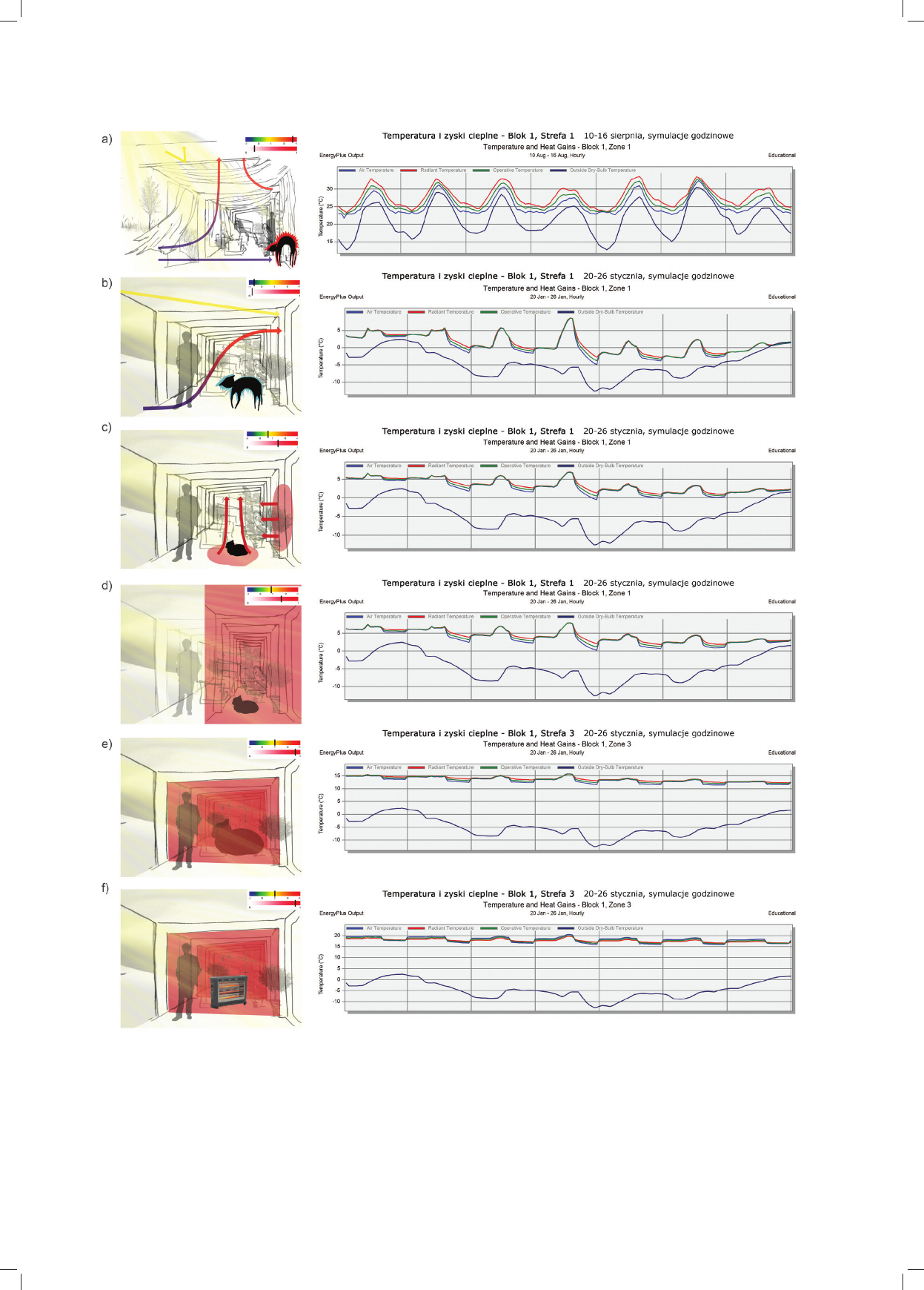
Basic simulations: summer design week 10–16 August
The simulations were conducted on the initial build
ing’s model during the summer design week – the hottest
week during the year. Radiant temperature is proportion
ately higher than air temperature, which is caused by
heated surfaces inside the buffer zone. Thermal comfort is
satisfied (air temperature below 27°C) in the evenings,
nights and mornings. During the day the temperature
often exceeds 30°C, which is too high for spending time
there. We should remember though, that this is an extreme
situation (the warmest week during the year) and some
extra mechanical ventilation (e.g. small fan) would de
crease temperature and solve the problem (Fig. 8a).
Time simulations: winter design week 20–26 January
In these simulations, the period of time was changed
from the hottest summer week to the coldest winter peri
od. The initial model’s construction and settings did not
work during the coldest week in the year. Even with
changed natural ventilation, decreased to almost 0.2 ac/h,
temperatures in the buffer zone were too low for the ther
mal buffer. Air temperatures ranged between –5°C during
night and +7°C during the day. These temperatures are
too low even for keeping plants. With lowered natural
ventilation and without any shading, heating demand for
the building’s core amounts to 153 kWh per winter design
week (Fig. 8b).
Material simulation: winter design week 20–26 January
Material simulations introduce to the buffer zone an
internal thermal mass made of clay, with surface area of
200 m
2
. The internal thermal mass improved thermal con
ditions in the buffer zone. During the design winter week
only once there was a temperature below zero – at night,
when the outside temperature is the lowest (–10°C). In
this situation, the air temperatures range between 0°C and
7°C. While the heating demand for the core zone is
141 kWh during the week which was analysed (Fig. 8c).
Spatial simulations: winter design week 20–26 January
The width of the ring was narrowed from 3 m to 2 m,
so that its floor area and volume decreased. Narrowing of
the buffer zone improves the thermal conditions, but
simultaneously decreases the satisfaction level of the
player – the zone is less spacious. Nevertheless, in this
case the player decided that the space volume is satisfac
tory and the level of happiness is sufficient. The narrowed
ring improves slightly the heating demand of the core –
137 kWh per week (Fig. 8d).
Spatial simulation with smaller inner spaces:
winter design week 20–26 January
Further simulations introduce smaller spaces into the
buffer zone, separated by virtual partitions. The ring is
divided into eight small spaces – northern, southern, east
ern and western (11 m
2
each) and spaces between them
(16 m
2
each). Simulations were conducted for the south
ern space, because of the intense solar radiation and the
greatest probability of overheating. The simulation show,
that for heating reasons, it is more convenient to divide
symulacji. Każda z symulacji sprawdzała małe zmiany
wprowadzone do ustawień modelu wstępnego, które
zostały wypisane powyżej. Symulacje opierają się na
zmianach możliwości wymienionych w opisie scenariu
sza gry i zaczynają się symulacjami wstępnego modelu
oraz kolejno czasu, materiału, przestrzeni i na końcu ener
gii. Zewnętrzne temperatury, wygenerowane na podsta
wie danych pogodowych dla Wrocławia, są średnią war
tością z temperatur mierzonych w ciągu 10 lat.
Symulacje podstawowe: letni tydzień projektowy
10–16 sierpnia
Symulacje zostały przeprowadzone na wstępnym mo
delu budynku w trakcie najcieplejszego tygodnia w ciągu
roku. Temperatura promieniowania jest proporcjonalnie
wyższa niż temperatura powietrza – spowodowane jest to
nagrzewaniem się powierzchni w strefie buforowej. Kom
fort termiczny został spełniony (temp. powietrza po niżej
27°C) wieczorami, nocami oraz porankami. W ciągu dnia
temperatura często przekracza 30°C, co jest zde cy do
wanie zbyt wysoką temperaturą. Należy jednak pamiętać,
że jest to sytuacja ekstremalna (najcieplejszy tydzień w cią
gu roku), dodatkowa wentylacja mechaniczna powinna
obniżyć temperaturę i rozwiązać problem (il. 8a).
Symulacje czasu: zimowy tydzień projektowy
20–26 stycznia
W tym przypadku czas symulacji zmieniany był z naj
cieplejszego na najzimniejszy okresu w roku. Konstrukcja
i ustawienia modelu początkowego nie funkcjonowały pra
widłowo podczas najzimniejszego tygodnia w ciągu roku.
Nawet przy naturalnej wentylacji zmniejszonej do 0,2 ac/h
temperatury w strefie były za niskie jak na bufor termicz
ny. Temperatury powietrza osiągnęły poziom między –5°C
w ciągu nocy, a +7°C w ciągu dnia. Takie temperatury są za
niskie nawet dla większości domowych roślin. Przy zmniej
szonej naturalnej wentylacji i bez zacienie nia za po trze
bowanie na ogrzewanie wewnętrznej części bu dynku się
ga 153 kWh przez najzimniejszy tydzień zimowy (il. 8b).
Symulacje materiałów: zimowy tydzień projektowy
20–26 stycznia
Symulacje materiałów wprowadzają do strefy buforo
wej wewnętrzną masę termiczną wykonaną z gliny
o powierzchni 200 m
2
, poprawiającą warunki termiczne.
Podczas zimowego tygodnia projektowego tylko raz zda
rzyła się temperatura poniżej zera (–10°C). W tej sytuacji
temperatura powietrza wewnątrz pomieszczenia wahała
się od 0 do 7°C, a zapotrzebowanie na ogrzewanie dla
wewnętrznej części budynku wynosiło 141 kWh w anali
zowanym tygodniu (il. 8c).
Symulacje przestrzenne: zimowy tydzień projektowy
20–26 stycznia
Szerokość pierścienia została zwężona z 3 do 2 m,
przez co zmniejszyła się powierzchnia podłogi i kubatura.
Zwężenie strefy buforowej poprawia warunki termiczne,
ale jednocześnie zmniejsza poziom zadowolenia gracza
– strefa jest mniej przestronna. W tym przypadku zadecy
dowano, że kubatura jest satysfakcjonująca, a poziom

Wytrząśnij z siebie dreszcze/Shake your shakes off 45
the buffer zone into smaller spaces. Even without a heat
ing source, the air temperatures in smaller space range
between 11°C and 16°C, which is sufficient for plants to
survive winter, and for the inhabitants to spend short
periods of time in this zone. Designing the buffer zone in
this space improves airtightness of the building and pro
tects from the harsh outer climate. Also it decreases sig
nificantly the core heating demand to 80 kWh per week
(Fig. 8e).
Energy simulations: winter design week 20–26 January
In the last simulation, to the buffer zone were added
some devices that produce heat gains and the average
occupancy in the given accommodation was increased
(0.1 people/m
2
). The device emits 50 W/m
2
and it can
heat the zone to such a level that it is possible to spend
time there during the winter day. This solution enables
spending winter time in the buffer zone and it does not
consume much energy, because the device works only
during short periods of time (Fig. 8f).
The described simulations show, how the player can
influence the building’s model and how he learns about
the thermal conditions. For the circular building and
a simple buffer zone, which were modelled in the initial
prototype, it turned out, that the biggest influence on the
thermal conditions has the change of geometry. Dividing
huge unheated zones into smaller spaces is beneficial for
the heated areas and for the buffer zone. It decreases the
heating demand and improves thermal comfort in unheat
ed areas. These smaller spaces can be connected, but the
heat flow should be controlled in some way. There is also
the possibility of introducing some heating device, which
produces local heat gains only during the time, when
inhabitants spend time in the unheated zone. These devic
es could be powered by green energy, which may come
from, e.g. photovoltaic panels located on the roof and
stored in small storage batteries. Due to these small devic
es, momentary thermal comfort in the buffer zone can be
satisfied, even in the coldest winter week. The danger of
overheating the zone should not be forgotten, which due
to isolation materials accessible today is much more fre
quent than possible chilling, and also the system of shad
ing should be ensured as it will protect the interior from
excessive sun radiation.
Conclusions
The game “Shake your shakes off” was created during
the research project of Ph.D. program’s course e-Archi-
tecture: The Game Strategies in Architectural Design.
The project, which is described in this paper, was aimed
at exploring and developing the topic of thermal comfort
in buffer zones. The buffer zones, such as winter gardens
or sunspaces are interesting, because they serve as a link
between our houses and nature. They add extra space to
our home, where we can find a warm and cozy place dur
ing winter time and cool shade during hot summers, but
only if they are well designed and thoughtout. Whether
we want to spend time there or not depends on thermal
comfort, which consists of a few factors – air and radiant
zadowolenia wystarczający. Zwężony pierścień obniża
nie znacznie zapotrzebowanie na ogrzewanie – 137 kWh
na tydzień (il. 8d).
Symulacje przestrzenne z mniejszymi wewnętrznymi
strefami: zimowy tydzień projektowy 20–26 stycznia
Kolejne symulacje wprowadzają do strefy buforowej
mniejsze przestrzenie, podzielone wirtualnymi przegro
dami – północną, południową, wschodnią i zachodnią
(11 m
2
każda) oraz przestrzenie pomiędzy nimi (16 m
2
każ da). Symulacje wykonano dla południowej strefy, po
nieważ z tamtej strony występuje intensywne promie nio
wanie słoneczne oraz istnieje największe prawdo po do bień
stwo przegrzania. Symulacje pokazują, że ko rzystniejsze
jest podzielenie strefy na mniejsze fragmenty przestrzeni.
Nawet bez źródła ciepła temperatura powietrza w mniej
szej przestrzeni waha się między 11 a 16°C, co jest wy
starczające dla mieszkańców do krótkiego przebywania
w tej strefie, a dla roślin do tego, żeby przetrwać zimę.
Projektowanie strefy buforowej w tym miejscu poprawia
szczelność budynku i chroni przed ostrym klimatem ze
wnętrznym. Zmniejsza również znacząco zapotrzebo wa
nie na ogrzewanie wnętrza do 80 kWh na tydzień (il. 8e).
Symulacje energii: zimowy tydzień projektowy
20–26 stycznia
W ostatniej symulacji, do strefy buforowej zostały do
dane pewne urządzenia, które emitują zyski cieplne, oraz
zwiększono średnią liczbę osób w danym pomieszczeniu
(0,1 osoby/m
2
). Urządzenie emituje 50 W/m
2
i potrafi
ogrzać strefę do takiego poziomu, że można spędzać w niej
czas w ciągu zimowego dnia, a przy okazji nie konsumu
je wiele energii, ponieważ działa tylko w krótkich okre
sach (il. 8f).
Opisane symulacje pokazują, jak gracz może wpływać
na model budynku i jak może się uczyć o warunkach ter
micznych panujących w różnych pomieszczeniach. Dla
okrągłego budynku i prostej strefy buforowej, które były
modelowane w pierwszym prototypie, okazało się, że
największy wpływ na warunki termiczne budynku mają
zmiany geometrii. Podział wielkiej nieogrzewanej strefy
na mniejsze obszary jest korzystny dla przestrzeni ogrze
wanych i dla strefy buforowej, w której poprawia kom
fort termiczny. Te mniejsze strefy mogą być połączone,
jednak przepływ powietrza powinien być w jakiś sposób
kontrolowany. Istnieje również możliwość wprowadze
nia do pomieszczenia urządzenia grzewczego, które pro
dukowałoby lokalne zyski cieplne tylko wtedy, kiedy mie
szkańcy spędzaliby w niej czas. To urządzenie mo głoby
być zasilane zieloną energią pochodzącą np. z paneli foto
woltaicznych zlokalizowanych na dachu i ma ga zy nowa
ną w małych bateriach. Dzięki urządzeniom chwilowy
komfort termiczny w strefie buforowej może być satys
fakcjonujący, nawet w najchłodniejsze dni w roku. Nie
należy jed nak zapominać o niebezpieczeństwie przegrza
nia po mieszczenia, co przy obecnie dostępnych materia
łach izolacyjnych jest dużo częstsze niż ewentualne wy
chłodzenie, i zapewnić system zacieniania, który będzie
chronił wnęt rze przed nadmiernym promieniowaniem
słonecznym.
46 Weronika Lechowska
Il. 8. Wyniki sześciu symulacji prototypu. Symulacje: a) podstawowe, b) czasu, c) materiałów, d) przestrzenne,
e) przestrzenne z mniejszymi wewnętrznymi strefami, f) energii (oprac. W. Lechowska, symulowane w Design Builder Energy Plus)
Fig. 8. Outputs of six prototype simulations: a) basic, b) time, c) material, d) spatial, e) spatial with smaller inner zones, f) energy
(by W. Lechowska, simulated in Design Builder Energy Plus)

Wytrząśnij z siebie dreszcze/Shake your shakes off 47
temperature, humidity, air velocity, person’s activity and
worn clothes. Generally, it is possible to calculate the
ther mal comfort in thermal simulation programs and
assess, if the design of the building or the real one satisfies
the inhabitants’ requirements. Unfortunately, these pro
grams are usually quite expensive, educational licenses
are available only at universities besides the programs are
so complicated and advanced, that they require comple
tion of training courses. Hence the reason of creating
a game, that could be simple and accessible to everyone
who wants to improve his house, design new sunspace, or
just have fun. The game “Shake your shakes off” enables
not only the calculation of thermal comfort but also
assessing the player’s happiness level, which is related to
construction and maintenance costs, architecture aesthet
ics and functionality.
The initial prototype was designed to test the game
scenario and check simplified building’s simulations.
This prototype used simulation program Design Builder
v.4.1 for all the building’s optimization steps. The geom
etry and plan of the building, used in this prototype, was
simplified to a circular, heated inner zone, and encircling
it an unheated buffer space. Six simulations, conducted
for different time, material, spatial and energy settings,
showed, that it is possible to create an unheated buffer
zone in such a way that it will satisfy thermal comfort for
the inhabitants and will give safe shelter for plants during
a long winter.
The initial prototype gives the opportunity to analyse
only air temperatures in context of thermal comfort, but
the final game will enable adding also radiant tempera
tures, humidity and air velocity to the thermal comfort
assessment. This will make the game more interesting and
challenging, because picking the right settings of all the
factors in order to achieve a balanced thermal comfort is
very difficult. The final game will be very educational and
interesting not only for architects, but also other people
and children, who want to experiment with their closest
environment, which is their home.
Translated by
Weronika Lechowska
Wnioski
Gra „Wytrząśnij z siebie dreszcze” została stworzona
jako projekt badawczy w ramach kursu doktoranckiego
e-Architecture: The Game Strategies in Architectural De -
sign. Projekt, który został opisany w tym artykule, miał
na celu zbadanie i rozwinięcie tematu komfortu termicz
nego w strefach buforowych. Strefy buforowe, takie jak
ogrody zi mowe, służą jako łącznik pomiędzy domami
a środo wiskiem zewnętrznym. Tworzą dodatkowe po
miesz czenie w domu, gdzie mo żemy znaleźć ciepłe i wy
godne miejsce w czasie zimy i chłodny cień w lecie, ale
tylko wtedy, gdy są dobrze zaprojektowane i przemyśla
ne. To, czy chcemy spędzać tam czas czy nie, zależy od
komfortu termicznego, na który wpływają różne czynniki
środowiskowe, indywidualne i fizjologiczne. Obliczenie
komfortu termicznego możliwe jest w programach symu
lacyjnych do obliczeń cieplnych. W nich jest też ocenia
ne, czy projekt budynku lub prawdziwy budynek spełnia
wymagania mieszkańców. Niestety te programy nie są
darmowe, a ich wersje edukacyjne są dostępne tylko dla
uczelni. Poza tym programy te są dość skomplikowane
i wymagają doświadczenia użytkownika. Stąd pomysł na
stworzenie gry, która byłaby prosta i dostępna dla wszyst
kich ludzi chcących poprawić warunki cieplne w swoich
domach, zaprojektować ogród zimowy lub po prostu na u
czyć się czegoś nowego. Gra „Wytrząśnij z siebie dresz
cze” umożliwia nie tylko obliczenia komfortu termicz
nego, ale również ocenę poziomu satysfakcji gracza,
zależnego od kosztów konstrukcji i eksploatacji budynku,
estetyki architektury i funkcjonalności.
Prototyp został przygotowany w celu przetestowania
scenariusza gry i sprawdzenia symulacji uproszczonego
budynku. W prototypie wykorzystano program Design
Builder v.4.1 do wszystkich etapów symulacji. Geometria
i plan budynku zostały zaprojektowane jako okrągła,
ogrzewana strefa otoczona pierścieniem nieogrzewanej
strefy buforowej. Sześć symulacji przeprowadzonych dla
różnych okresów, materiałów oraz przestrzeni pokazało,
że możliwe jest stworzenie nieogrzewanej strefy buforo
wej w taki sposób, aby zawsze gwarantowała komfort
termiczny mieszkańcom oraz dawała bezpieczne schro
nienie dla roślin w ciągu zimy.
Opisany prototyp pozwala analizować w kontekście
komfortu termicznego tylko temperatury powietrza, jed
nak docelowa gra umożliwi uwzględnienie w oblicze
niach również temperatury promieniowania, wilgotności
i prędkości powietrza. To spowoduje, że gra będzie bar
dziej interesująca i wymagająca, ponieważ wybór odpo
wiednich ustawień ze wszystkich czynników w taki spo
sób, aby zapewniały jednocześnie komfort termiczny, jest
bardzo trudne. Docelowa gra zainteresuje nie tylko archi
tektów, ale również wszystkich tych, którzy chcieliby
poeksperymentować z najbliższym środowiskiem, jakim
są ich domy.

48 Weronika Lechowska
Streszczenie
W niniejszym artykule zaprezentowano metodę umożliwiającą ocenę komfortu termicznego w pomieszczeniach funkcjonujących jako termiczne
strefy buforowe. Zaproponowano scenariusz gry oraz prototyp pozwalający na symulowanie zmian warunków termicznych w budynku, zachodzą
cych pod wpływem informacji wprowadzanych do modelu przez gracza. Zaprojektowany algorytm umożliwia różne działania gracza, takie jak
definiowanie kształtu i wielkości budynku, ustawianie jednego bądź wielu graczy, dla których budynek musiałby być zoptymalizowany pod kątem
różnych potrzeb, a także określanie aktywności fizycznej wpływającej na metabolizm mieszkańca – tym samym na odczuwanie przez niego
temperatury. Pozwala on również na prowadzenie symulacji różnych pór dnia i roku. Symulacje w programie Design Builder Energy Plus prowadzone
na prototypowym modelu budynku skupiają się na zmianach czasu, przestrzeni oraz energii w teoretycznym budynku, zlokalizowanym we
Wrocławiu. Ich głównym celem było określenie najlepszych ustawień dla strefy buforowej, tak aby możliwe było przebywanie w niej w naj
cieplejsze i najchłodniejsze dni w roku bez potrzeby dodatkowego chłodzenia czy ogrzewania tego pomieszczenia. W artykule przedstawiono
proponowane ulepszenia dla strefy oraz kryteria oceny komfortu termicznego i zadowolenia użytkowników pomieszczenia.
Słowa kluczowe: strefa buforowa, komfort termiczny, bilans energetyczny, odczuwanie temperatury
Abstract
This article presents a methodology for assessing thermal comfort in building’s adjacent spaces, which may function as buffer zones. The game
scenario and prototype model were proposed as the result of the research project. This prototype allows conducting simulations of the changes
introduced by the player to the building’s model and consequences in the building’s thermal conditions. The created game algorithm includes the
player’s actions, such as defining geometry, volume and openings in the building’s model; setting preferences (one or a multi player, members of
the family) and describing the activity (metabolic rate). The algorithm also includes loops with additional changes, namely time of day and seasons,
construction and insulation materials, small heat gains sources, virtual partitions, etc. Prototype analyses, conducted in Design Builder Energy Plus
program, were focused on altering time, material, spatial, and energy settings in a theoretical building, located in Wrocław. The main aim of these
simulations was to define best settings for the buffer zone, so that it will be possible to spend time there in the hottest week in summer and the coldest
in winter. The project description also includes projected improvements and evaluation criteria for satisfying thermal comfort and happiness of
the inhabitants.
Key words: buffer zone, thermal comfort, energy balance, thermic sensation
Bibliografia /References
[1] Lechowska W., Badania empiryczne i symulacje komputerowe wpły-
wu oszklonych stref buforowych na bilans energetyczny budynku,
[w:] J. Nyćkowiak, J. Leśny (red.), Architektura, t. 1, Młodzi Na
ukow cy, Poznań 2015, 113–119.
[2] Hegger M., Fuchs M., Stark T., Zeumer M., Energy Manual. Sus-
tainable Architecture, Birkhäuser, Basel–Boston–Berlin 2008.
[3] Laupland K.B., Fever in the critically ill medical patient, „Critical
Care Medicine” 2009, Vol. 37, Iss. 7, 273–278.
[4] Marx J., Rosen’s emergency medicine: concepts and clinical prac-
tice, Mosby, Elsevier, St. Louis 2006.
[5] Mosby’s Medical, Nursing & Allied Health Dictionary, 4
th
ed., Mosby
Year Book, St. Louis 1994.
[6] Nauka o pracy – bezpieczeństwo, higiena, ergonomia, Centralny
Instytut Ochrony Pracy, nop.ciop.pl/m47/m47_1.htm [accessed:
14.02.2016].
[7] Romanovsky A.A., Thermoregulation: some concepts have changed.
Functional architecture of the thermoregulatory system, „American
Journal of Physiology. Regulatory, Integrative and Comparative
Physiology” 2007, Vol. 292, Iss. 1, 37–46.
[8] ASHRAE Green Guide. The design, Construction and Operation of
Sustainable Buildings, 3
rd
ed., American Society of Heating, Refri
ge rating and AirConditioning Engineers, Atlanta 2010.
[9] Skrzyniowska D., Parametry powietrza wewnątrz pomieszczeń do
stałego przebywania ludzi, „Czasopismo Techniczne. Środowisko”
2012, R. 109, z. 4Ś, 15–35.
[10] Bauer M., Mösle P., Schwarz M., Green Building. Guidebook for
Sustainable Architecture, Springer, Berlin–Heidelberg 2010.
[11] Design Builder Manual, „Design Builder”, http://www.design
buildersoftware.com/docs/designbuilder/DesignBuilder_2.1_
UsersManual_Ltr.pdf [accessed: 22.06.2016].
[12] Planck M., The Theory of Heat Radiation, 2
nd
ed., P. Blakiston’s Son
& Co, 1914, ia902306.us.archive.org/14/items/theheatradiation 00 plan
rich
/theheatradiation00planrich.pdf [accessed: 14.02.2016].
[13] The Sims Wiki. Temperature, sims.wikia.com/wiki/Temperature
[accessed: 14.02.2016].