
2024
4(80)
Agnieszka Adamska-Idzikowska*
The adaptation of historic castles and palaces
of the Lower Silesian Voivodeship into contemporary hotels
DOI: 10.37190/arc240406
Published in open access. CC BY NC ND license
Abstract
The subject of the paper are castles and palaces, entered in the register of monuments and located in the Lower Silesian Voivodeship, that have
been adapted into contemporary hotels. The considerations cover entire residential complexes, including farm and ancillary buildings, as well as
the surrounding parks and gardens. The time criterion was the operation of the hotel during the case studies period, e.g., the years 2019–2022. The
oldest building discussed dates back to the 16
th
century, while the newest one dates to the early 20
th
century. The hotels were launched between 1996
and 2014.
Depending on the stage of the work, appropriate research methods were applied. The most important included the analysis of source materials and
interviews with the owners and employees of the studied hotels. Comparative, critical, and synthesis analyses were conducted to draw conclusions.
The research involved visits to each property, enabling the collection of numerous photographs.
Through a multifaceted analysis of previous adaptations in the Lower Silesian Voivodeship, conclusions were drawn regarding the positive and
negative aspects of converting castles and palaces into hotels. Based on these ndings, recommendations were formulated that may be useful to re-
searchers, conservators, designers, and potential investors. The most signicant element of this study is its contribution to lling the knowledge gap
on this subject. It is worth emphasizing that such actions not only enable successful business ventures but, most importantly, save castles or palaces,
which are testimonies of the past, from destruction.
It has been proven that the existing adaptations are examples of valuable architectural eorts aimed at the reuse of historical buildings along with
their surroundings. They contribute to the creation of unique, multifunctional enterprises, characterised by a specic atmosphere lled with history
and the genius loci of the place, tailored to the needs of contemporary guests.
Key words: hotel, castle, palace, adaptation of historic buildings, Lower Silesian Voivodeship
Introduction
The landscape of Lower Silesia, particularly its southern
part, is distinguished by picturesque physical features, di-
verse natural environments, and valuable, unique architec-
tural heritage. Many castles and palaces were established
in this region, often surrounded by intriguing urban lay-
outs, characterized by original architectural compositions
and valuable detailing. These qualities are clearly visible in
restored structures. Unfortunately, a signicant portion of
this heritage remains in poor technical condition, is devas-
tated, or entirely ruined.
One of the proven methods to protect architectural
monuments from destruction is their adaptation to con-
temporary functions. For castles and palaces, converting
them into hotels is considered particularly benecial
1
.
This is due to several features, including the architecture
of the structures, their scale, surroundings, and location.
At the same time, the growth of tourism as an econom-
ic sector, interest in the so-called historical tourism, and
increasing public awareness of health and well-being cre-
ate favourable conditions for adapting castles and palaces
into hotels.
1
This solution is particularly recommended due to the combination
of the monument’s public accessibility with economic protability
(Konieczna-Domańska 2015; Leśniewska-Napierała, Napierała 2017;
Rouba, Cudny 2010).
*
ORCID: 0000-0002-5959-9316. Faculty of Architecture, Wro cław
University of Science and Technology, Poland, e-mail: agnieszka.
adamska-idzikowska@pwr.edu.pl

54 Agnieszka Adamska-Idzikowska
Richard Penner, Lawrence Adams, and Stephani Robson
(2013).
In the eld of the history and current condition of castles
and palaces, signicant contributions were made by Ro-
muald Łuczyński (2010), Adriana Merta-Staszczak (2018),
and Hubert Mordawski (2015). These studies examined
the situation of the German population and the resettle-
ment process, as well as the attitudes of authorities and lo-
cal residents towards post-German estates and the heritage
conservation policy.
Valuable insights into the theory and processes of heri-
tage adaptation were provided by Władysław Borusiewicz
(1971), Lucyna Czyżniewska (2009), Edmund Małacho-
wicz (2007), and Bogumiła Rouba (2009). Additionally, al-
bums and guides proved useful, including numerous works
by Marek Perzyński (2018), Joanna Lamparska (2019),
Marek Gaworski (2020), and Arne Franke (2007).
It has been observed that, in recent years, the adaptation
of historic buildings is most often considered in the con-
text of heritage protection processes and the development
of conservation thought. Numerous collective studies have
been published, with some of the most renowned works
edited by Ewa Łużyniecka (2018) and Bogusław Szmy-
gin (2009). Prior to conducting the research, various issues
were studied, focusing mainly on the need to preserve au-
thenticity, design challenges in adapting buildings to new
functions, risks associated with unskilled interventions, and
descriptions of undertaken projects. The studies by Małgo-
rzata Chorowska and Roland Mruczek (2023), outlining the
cultural landscape and the origins of residential complexes
in Silesia, were considered particularly valuable.
Scientic research on a similar topic – namely, the ad-
ap
tation of Lower Silesian residential complexes for con -
temporary functions – was conducted by Aleksandra Mar-
cinów (2015) and Renata Gubańska (2014). The adaptation
of historic palaces in the Jelenia Góra Valley for hotel pur-
poses was also explored by Katarzyna Janicka (2014).
During the studies, materials from archives and infor-
mation contained in the architectural and construction her-
itage inventory cards were also used. The work was based
on inventories and adaptation projects made available by
hotel owners retrieved from the archives of the Lower Sile-
sian Provincial Conservation Ocer.
Aim of study
The primary goal of this study is to highlight the po-
tential of castles and palaces as structures suitable for ad-
aptation into hotel ventures. Another aim was to illustrate
the completed adaptation processes, including identifying
potential issues or weaknesses associated with such invest-
ments.
One of the research priorities was to document the cur-
rent state and preserve data on contemporary (2022) ac-
commodation facilities established in buildings entered in
the register of historic monuments as castles and palaces.
The research ndings may serve not only as a record of
the adaptation of historic castles and palaces in the Lower
Silesian Voivodeship at the turn of the 20
th
and 21
st
centu-
ries but also as a foundation and inspiration for designing
The subject of the research comprises castles and palac-
es entered in the register of historical monuments, located
within the Lower Silesian Voivodeship, and adapted for use
as hotels
2
. The study encompasses entire residential com-
plexes, including manor, farm and ancillary buildings, as
well as the surrounding parks and gardens. Due
to the ex-
tensive and multifaceted nature of the topic, the geograph-
ical scope was limited to realizations within the Lower
Silesian Voivodeship.
The analysis included all castles and palaces adapted
into hotels within the specied area. The time criterion
was dened as the operational status of the hotels during
the case studies, covering the years 2019–2022. The oldest
building discussed dates back to the 16
th
century, while the
newest originates from the early 20
th
century. The projects
in the research sample were launched between 1996 and
2014.
It is worth mentioning that, due to unique climatic and
natural conditions, as well as the region’s historical devel-
opment, many residential complexes were established in
what is now the Lower Silesian Voivodeship. However, the
majority of these have been destroyed after World War II
due to a lack of proper care or inappropriate usage.
State of research
The problem of adapting castles and palaces into hotels
represents a broad and interdisciplinary eld comprising
three extensive and specic components:
– the design and programming of contemporary hotels,
– the process of heritage protection, adaptation, and
conservation,
– the history and current status of castles and palaces.
A review of the literature revealed that publications of-
ten focused on only one of these topics, with the others
receiving limited attention. Rarely were these subjects dis-
cussed together within the same work.
Among prominent domestic researchers and practi-
tioners specializing in the design and programming of con-
temporary hotels, notable contributions include works by
Zenon Błądek (2010), Joanna Jabłońska (2018), and Jorg
Wilczyński (2010). Their publications provided valuable
insights into the requirements and emerging trends in the
hospitality industry, as well as guidelines for designing
specic zones and rooms.
The principles gathered during the research were com-
pared with the ndings from case studies to identify dif-
ferences and similarities between newly constructed hotels
and those established in adapted castles and palaces. This
comparison aimed to highlight the distinctive features of
hotels housed in adapted historical monuments.
In terms of hotel operation and organization theory,
the works of Mariola Milewska and Bogdan Włodarczyk
(2018), Marek Turkowski (2010), and Elżbieta Mitura and
Elżbieta Koniuszewska (2008) were considered particu-
larly useful. References were also made to the studies of
2
The research was conducted as part of the preparation for the
doctoral dissertation.

The adaptation of historic castles and palaces of the Lower Silesian Voivodeship into contemporary hotels 55
future hotel investments. A list of elements most frequent-
ly preserved and showcased has also been compiled. The
study aims to assist in decision-making regarding the scope
of adaptations, ensuring a balance between preserving au-
thenticity and introducing new functions.
Methods
The process of selecting monuments was conducted in
three stages, using an elimination approach based on pro-
gressively dened criteria. In the rst stage, all sites classi-
ed as castles or palaces in the heritage register were iden-
tied
3
. Additionally, the buildings had to be located within
the Lower Silesian Voivodeship. Estimating the contem-
porary functions of these sites enabled the initial identi-
cation of projects associated with hospitality services. It is
worth mentioning that the Lower Silesian Voivodeship is
home to 570 castles and palaces recognized as historical
monuments, yet as many as 43% of them remain unused.
Subsequently, based on the premises identied in the
previous step as being associated with hospitality services,
all 66 projects were veried in the Central Registry of Ho-
tel Establishments. At this stage, it became possible to de-
termine which complexes ocially qualify as hotels under
the law
4
. A comprehensive description of the search for
samples meeting the criteria, along with the characteriza-
tion of the research context, was provided in a separate
study (Adamska 2021).
Ultimately, it was established that 16 hotels meeting
the adopted criteria operate in the specied area. From the
perspective of their original function, the criteria were met
by six hotels operating in four castle complexes and nine
3
The naming of the monuments follows the terminology used in
the heritage register.
4
A problem was identied with the overly general use of the term
“hotel”, even by researchers. In common usage, any facility where one
stays overnight is referred to as a hotel. It should be emphasized that
a necessary condition for using the term “hotel” is the classication of the
venture by the regional marshal, after meeting the formal requirements.
hotels located in palaces. Hotels established within the Książ
Castle complex were discussed separately due to the entire-
ly
distinct nature of these projects. In the case of Łagów,
both hotels function as an integral part of the complex. The
schematic map illustrates the distribution of the studied ho-
tels across the territory of the voivodeship (Fig. 1).
The research began with an analysis of hotels located in
castles and palaces based on criteria derived from the au-
thor’s typology. Subsequently, the architectural forms of the
buildings and the characteristics of the residential units were
examined. The next two sections focused on the processes
and extent of adaptation of each historic monument. In the
subsequent phase, the study concentrated on the spatial dis-
tribution of functional zones within the hotels. Following
this, the analysis explored specic functional verticals of
the hotels, including recreational, gastronomic, multifunc-
tional, and auxiliary-technical facilities. During the studies,
we also assessed which properties incorporated owner’s
residences and examined the immediate surroundings of
the hotels. Furthermore, the perception of the analysed
establishments by their guests was investigated. This was
based on reviews published on leading online platforms.
The research concluded by identifying the main strengths
of each establishment and presenting an original, subjec-
tive synthesis of selected features of the hotels. During the
research process, two thesis statements were formulated.
First thesis statement: The existing adaptations of cas-
tles and palaces entered in the heritage register and located
within the Lower Silesian Voivodeship into hotels serve as
exemplary architectural endeavours aimed at reusing his-
toric buildings and their surroundings. These adaptations
contribute to the creation of unique, multifunctional enter-
prises tailored to the needs of contemporary guests.
Second thesis statement: It is possible to establish a ty-
pology of modern hotels designed in historic castles and
palaces based on the adaptations found in the Lower Sile-
sian Voivodeship.
Depending on the stage of the study, appropriate research
methods were employed. The most signicant included
the analysis of source materials (both contemporary and
1
3
2
11
4
5
6
7
8
9
10
15
13
12 14
WAŁBRZYCH
WROCŁAW
KŁODZKO
ZGORZELEC
LUBIN
LEGNICA
1. Uroczysko Siedmiu Stawów Luxury Hotel, 21 Gola Dzierżoniowska, Niemcza 58-217 (4*)
2. Hotel Jedlinka Zespół pałacowo-hotelowy, 2 Zamkowa Street, Jedlina-Zdrój 58-330 (3*)
3. Folwark Książęcy, 15-21D Kliczków, Osiecznica 59-724 (3*)
4. Hotel Pałac Krotoszyce, 3 Parkowa Street, Krotoszyce 59-223 (3*)
5. Hotel Spichlerz, 7 Krzyżowa, Grodziszcze 58-112 (2*)
6. Łagów and Pałac Łagów, 22 Strumykowa Street, Łagów, Zgorzelec 59-900 (2* i 3*)
7. Pałac Łomnica, 3 Karpnicka Street, Łomnica 58-531 (2*)
8. Hotel Pałac Restauracja Spiż, 218 Wiejska Street, Miłków near Karpacz 58-535 (3*)
9. Pałac Pakoszów, 3 Zamkowa Street, Piechowice 58-573 (5*)
10. Hotel SPA Pałac Staniszów, 100 Staniszów, Jelenia Góra 58-500 (2*)
11. Zamek na Skale, 151 Trzebieszowice, Lądek Zdrój 57-540 (4*)
12. Hotel Książ, 1 Piastów Śląskich Street, Wałbrzych 58-306 (3*)
13. Hotel Przy Oślej Bramie, 1 Piastów Śląskich Street, Wałbrzych 58-306 (3*)
14. Hotel Zamkowy, 1 Piastów Śląskich Street, Wałbrzych 58-306 (3*)
15. Hotel Platinum Palace, 204 Powstańców Śląskich Street, Wrocław 53-140 (5*)
The location of the hotels that constitute the research sample in relation to the area of the
Lower Silesian Voivodeship, along with information about their category (number of stars).
Fig. 1. Selected research sample (elaborated by A. Adamska-Idzikowska)
Il. 1. Wyłoniona próbka badawcza (oprac. A. Adamska-Idzikowska)
56 Agnieszka Adamska-Idzikowska
historical) and interviews with the owners and employees
of the studied hotels. To derive conclusions, comparative
and critical analyses as well as a synthesis were conducted.
It should be emphasized that the research involved visits to
each monument, which enabled collecting numerous pho-
tographs.
In the analysis dedicated to the scope of adaptations, the
study examined, among other aspects, whether the original
outlines of buildings were preserved during the adapta-
tion of castles, palaces, and supplementary structures, or
if decisions were made to expand the existing forms. The
investigation also determined whether the modern struc-
tures were contrasted with the historic ones and whether
the hotels were further expanded after their opening. Three
groups of adaptations were identied based on the scope
and degree of preservation of the original buildings:
– adaptation within the existing structures only (rede-
velopment), e.g., Hotel Spichlerz,
– expansion, e.g., Platinum Palace in Wrocław, where
a contemporary, modern architecture pavilion was added
to the main historic structure,
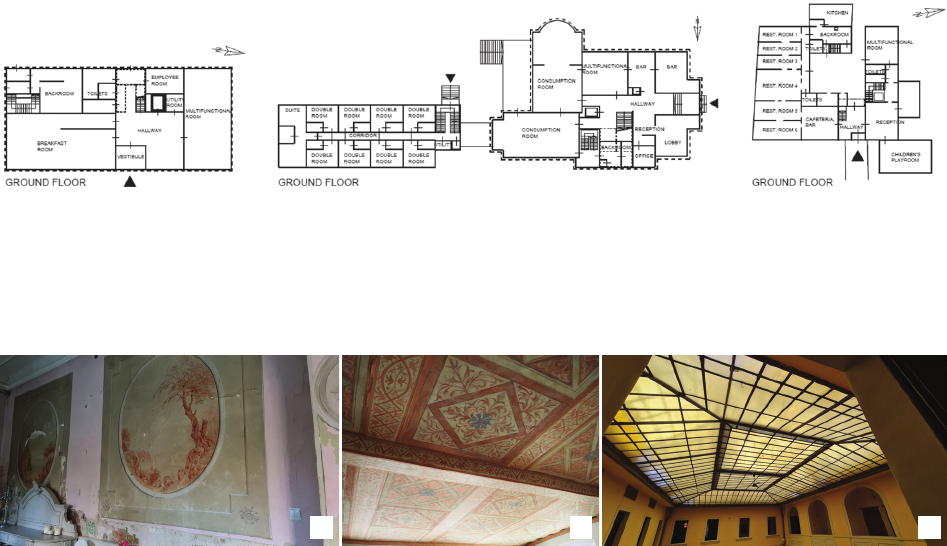
– reconstruction or restoration, e.g., Uroczysko Sied-
miu Stawów in Gola Dzierżoniowska, where the work be-
gan with the reconstruction of the residence (Fig. 2).
An undeniable advantage of adapting a historic building
for contemporary use is the opportunity to showcase the
original construction solutions and building details preserved
in their authentic locations. Occasionally, elements discov-
ered in rubble are displayed in museum spaces or other ar-
eas
open to the public. In every analysed property, historic
architectural elements and decorations were encountered.
Frequently, older elements were retained for purely deco-
rative purposes in modern implementations, such as frag-
ments of walls, chimneys, or equipment like stoves (Fig. 3).
It was observed that the approach to adapting the main
structure – a castle or palace – into a hotel diers from the
methods used for adapting former farm or ancillary build-
ings for the same purpose. Consequently, the facilities were
divided into two groups: those whose adaptation involved
the main structure and those located in complementary
buildings. A list of shared characteristics was developed
based on the original function of the buildings (Table 1).
Hotels located in farm and ancillary buildings required
a broader scope of work due to the necessity of changing
the function and the poor technical condition of the struc-
tures. In contrast, for hotels in residences, eorts were
made to preserve as many original elements as possible.
As a result, rooms in residences vary in size, reecting the
preservation of historical spatial layouts. Additionally, rep-
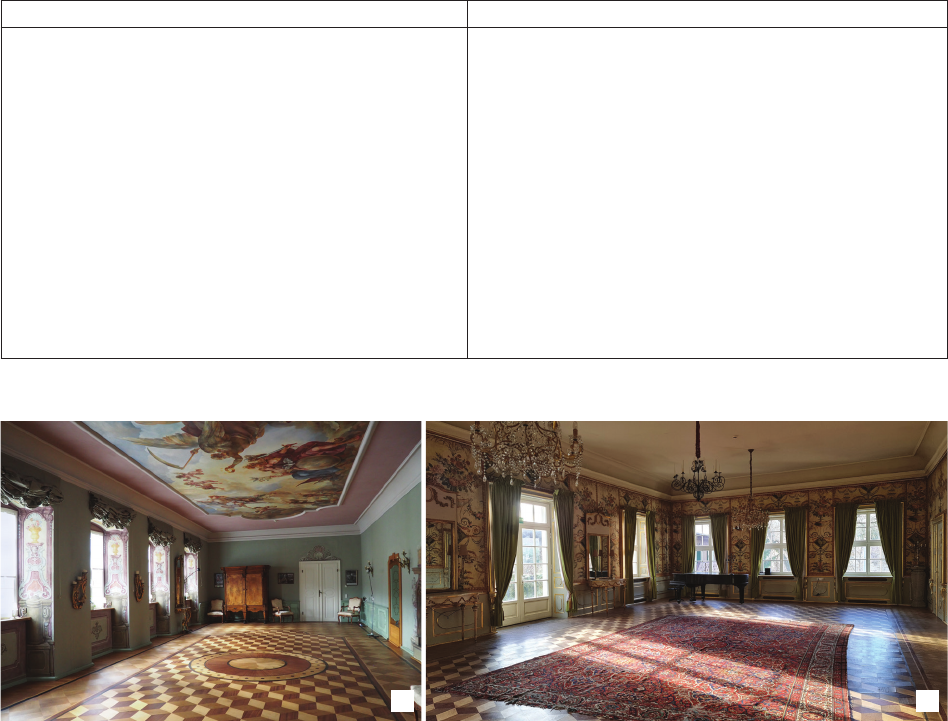
resentative multifunctional halls are maintained and used
for elegant events (Fig. 4).
Regardless of the type, the spaces in the studied ho-
tels were planned and utilized thoughtfully and ecient-
ly. The solutions are characterized by individuality and
Fig. 2. Layout diagrams of individual hotel zones – ground floors of buildings:
a) Hotel Spichlerz, b) Platinum Palace, c) Uroczysko Siedmiu Stawów (elaborated by A. Adamska-Idzikowska)
Il. 2. Schematy rozmieszczenia poszczególnych stref hotelu – partery budynków:
a) Hotel Spichlerz, b) Platinum Palace, c) Uroczysko Siedmiu Stawów (oprac. A. Adamska-Idzikowska)
Fig. 3. Exposed historical elements:
a) in Pałac Staniszów – en grisaille wall paintings from 1934 in the garden salon depicting restored landscape motifs,
b) in Pałac Łagów – hand-painted 400-year-old ceiling panels in the restaurant, c) in Zamek na Skale from the 19
th
century – courtyard roof
(photo by A. Adamska-Idzikowska, 2022)
Il. 3. Wyeksponowane elementy zabytkowe:
a) w Pałacu Staniszów – malowidła ścienne en grisaille z 1934 r. w saloniku ogrodowym przedstawiające odrestaurowane motywy krajobrazowe,
b) w Pałacu Łagów – ręcznie malowane, 400-letnie panele sufitowe w restauracji, c) w Zamku na Skale z XIX w. – zadaszenie dziedzińca
(fot. A. Adamska-Idzikowska, 2022)
a
a
b
b
c
c
The adaptation of historic castles and palaces of the Lower Silesian Voivodeship into contemporary hotels 57
uniqueness, resulting from adopting “tailor-made” spatial
and functional layouts. A list of the most commonly per-
formed construction works was performed. It is worth add-
ing that in residences, the focus was on reinforcing, reno-
vating, or reconstructing certain elements. In contrast, in the
case of other studied buildings, the work more frequently
involved replacing or introducing new elements (Table 2).
During interviews with the owners and managers of the
enterprises, questions were raised about inconveniences
related to the arrangement of hotel zones within historic
walls. The most common problem identied was the ne-
cessity of passing through areas with diering purposes to
transition between functional zones or having to exit the
building and cross the courtyard. These challenges often
compromised hygiene standards and user comfort. Addi-
tional diculties were associated with the gastronomic
verticals, particularly kitchen facilities, including:
–
insucient space within the residence to accommo-
date a full kitchen facility (e.g., Pałac Łagów, Pałac Restau-
racja Spiż),
Table 1. Common features of the realizations depending on the original function of the building
(elaborated by A. Adamska-Idzikowska)
Tabela 1. Cechy wspólne realizacji w zależności od funkcji pierwotnej budynku (oprac. A. Adamska-Idzikowska)
Fig. 4. Representative multifunctional halls: a) in Pałac Pakoszów hotel, b) in Pałac Staniszów hotel
(photo by A. Adamska-Idzikowska, 2022)
Il. 4. Reprezentacyjne sale wielofunkcyjne: a) w hotelu Pałac Pakoszów, b) w hotelu Pałac Staniszów
(fot. A. Adamska-Idzikowska, 2022)
Hotels in castles and palaces Hotels in complementary buildings
Minimal intervention in the historic structure was prioritized
Original building partitions were preserved
Primary architectural elements were showcased
Building volumes with original outlines were retained
Extensions avoided interference with the historic structure
Significant differences were observed between individual residences
Designing hotel zones required considerable compromises
Exemptions from regulations were obtained
Hybrid functional and spatial layouts were introduced
Strict requirements of the heritage conservator were met
The change in primary function and the state of preservation
necessitated significant intervention in the remaining structure
artition walls were added during adaptation, with no significant
collisions between functional zones
Few or no original elements were preserved
Buildings were predominantly elongated rectangles in plan
Orthogonal, corridor-based layouts were dominant
A clear division was introduced: ground floors were public,
while upper floors were reserved for guests
Rooms were generally located across two floors
Heritage conservator requirements were less stringent
compared to residences
– placement of kitchen facilities across two oors, re-
sulting in logistical challenges (e.g., Uroczysko Siedmiu
Stawów, Platinum Palace),
– reliance on pre-made products due to space limita-
tions, such as baked goods in Platinum Palace.
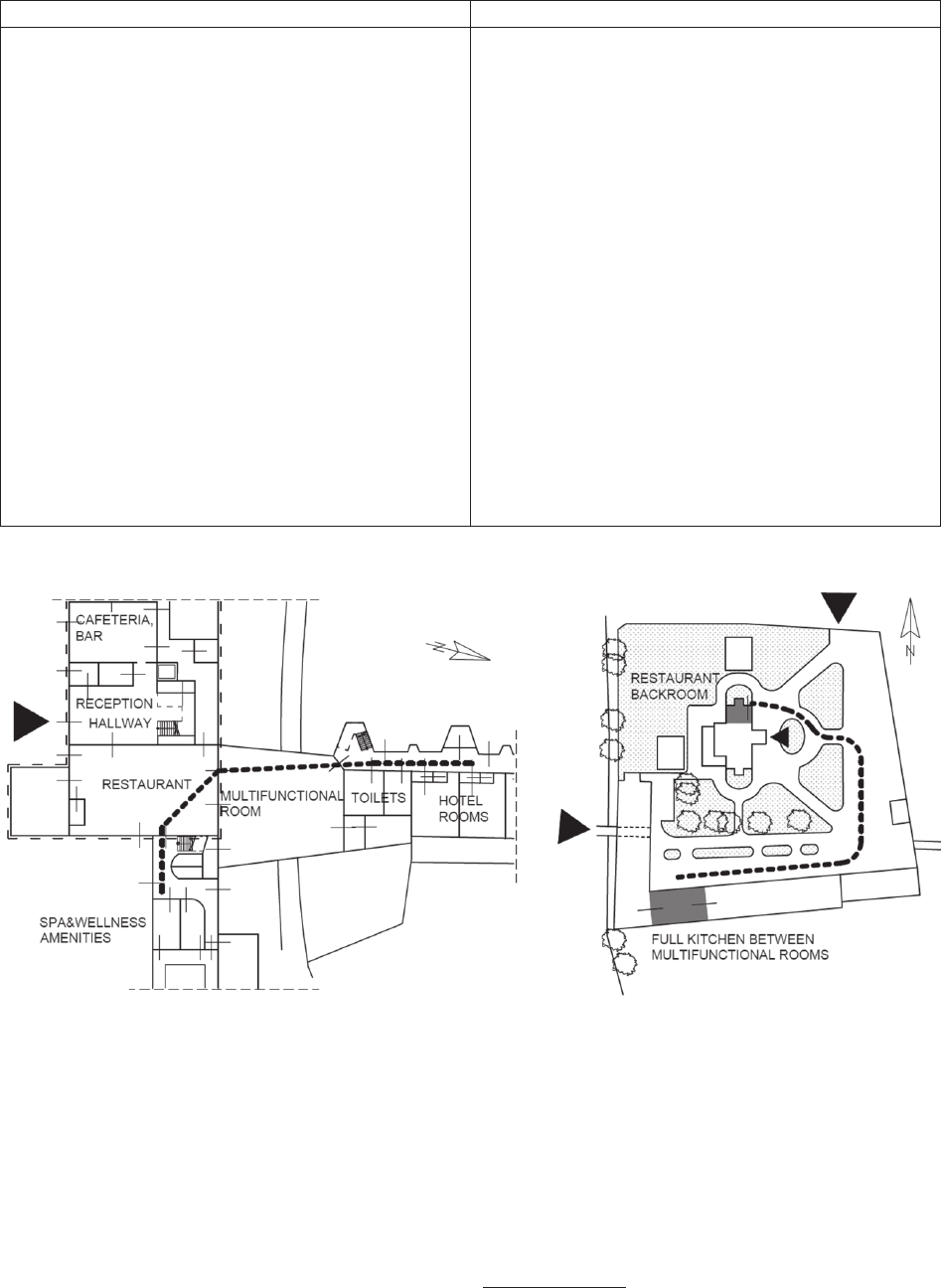
Illustrated diagrams present the discussed challenges:
a) Pałac Pakoszów – transition to rooms and the SPA zone
through the restaurant area, b) Pałac Łagów – schematic of
transporting pre-prepared dishes from a kitchen located in
a farmstead building (Fig. 5).
Conclusions for the analytical part
The study established that there are 16 operational hotels
located within 15 adapted castles, palaces, or within their
premises in the Lower Silesia Voivodeship. These facili-
ties, constituting the research sample, are distributed across
13 historic, castle and palace complexes. Each of the 19
analyses conducted enabled us to draw several conclusions.
Below are a few examples related to the general typology:
a b
58 Agnieszka Adamska-Idzikowska
–
the surveyed hotels have an average of 35 rooms and
70 guest beds, the smallest facility, Pałac Łomnica, oers 12
rooms, while the largest, Pałac Krotoszyce, has 68 rooms,
– the hotels vary in standard, with the majority being of
medium and medium-lower standards, while luxury proj-
ects account for four out of 16 establishments,
– based on location, the hotels are classied into: nine
in rural peripheral locations, one in a central rural location,
and six in urban peripheral areas,
– the most recently opened hotels began operations be-
tween 2014 and 2018,
– all surveyed hotels are individually managed
5
, do not
belong to any hotel chain,
5
Two hotels are managed by descendants of pre-war owners (Pa-
łac Łomnica and Pałac Pakoszów). Additionally, there are intimate esta-
blishments run by families, such as Pałac Staniszów, Łagów, Pałac Ła-
gów, and Pałac Restauracja Spiż.
Table 2. The most common construction works depending on the primary function of the building (elaborated by A. Adamska-Idzikowska)
Tabela 2. Najczęstsze roboty budowlane w zależności od funkcji pierwotnej budynku (oprac. A. Adamska-Idzikowska)
Hotels in castles and palaces Hotels in complementary buildings
Strengthening or replacement of parts of the floors
Construction of additional staircases
Repair of worn structural elements
Construction of new roofs modelled on historical designs
Addition of dormer windows or roof windows
Installation of horizontal and vertical insulation.
New façades were created based on historical models
Installation of contemporary windows and doors modelled
after historical styles
Implementation of modern installations
Addition of partition walls to delineate rooms
Introduction of contemporary architectural solutions,
such as glass vestibules, terraces, or additional corridors
Construction of bathrooms in each unit
Interior finishes with modern building materials
Restoration of elements designated for preservation
Reconstruction of some historic decorations
Replacement of wooden floors with prefabricated systems
Replacement of the roof structure along with the roof covering
Construction of new chimneys and ducts
Installation of contemporary staircases
Introduction of modern partitions for rooms
Conversion of attics into guest rooms
Equipping each unit with a bathroom
Equipping the building with modern installations
Insulating the building and adding waterproof
and damp-proof layers
Modification of window and door sizes and positions,
as well as attic lighting
Construction of new façades modelled on the original design
Interior finishes with modern materials
Fig. 5. Schemes illustrating the necessity of passing through hotels zones with different functions:
a) Pałac Pakoszów, b) Pałac Łagów (elaborated by A. Adamska-Idzikowska)
Il. 5. Schematy przedstawiające konieczność przechodzenia przez strefy o odmiennej funkcji:
a) Pałac Pakoszów, b) Pałac Łagów (oprac. A. Adamska-Idzikowska)
a b

The adaptation of historic castles and palaces of the Lower Silesian Voivodeship into contemporary hotels 59
– the three most common hotel functions are
6
: resi-
dential (ten facilities), event venue (six facilities), SPA &
Wellness (four facilities).
The analysis also revealed that in 15 out of the 16 initia-
tives, the historical structure and former layout of the com-
plexes form the main theme of the investment. Addition-
ally, the following distinctive categories were identied:
ve boutique hotels, two thematic hotels – one featuring
a brewery and another with an equestrian centre, also one
eco-friendly hotel.
The studies of the building volumes revealed the fol-
lowing insights:
– all complexes adapted and changed the previous use
of attic spaces,
– in some projects, two attic oors were constructed,
– it is common to observe the addition of mezzanines
(entresols) above rooms located on the highest attic oors,
– among the surveyed hotels, none are single-story
buildings,
– the highest building adapted into a hotel has ve
above-ground stories,
– none of the buildings were extended upward, histori-
cal forms of the volumes were preserved,
– nine out of 16 hotels have basements or partial under-
ground levels,
– the majority of the hotels are located in free-standing
buildings,
– hotel zones are most frequently arranged in two sep-
arate buildings,
– slightly more projects feature compact building vo-
lu mes,
– due to the diverse styles, scales, forms, and charac-
ters, each project is unique, with no two identical imple-
mentations.
In the process of adapting historical castles and palac-
es to hotels, the eorts of the Provincial Heritage Conser-
vator, designers, and property owners aimed at restoring
pre-war forms and achieving a cohesive appearance of the
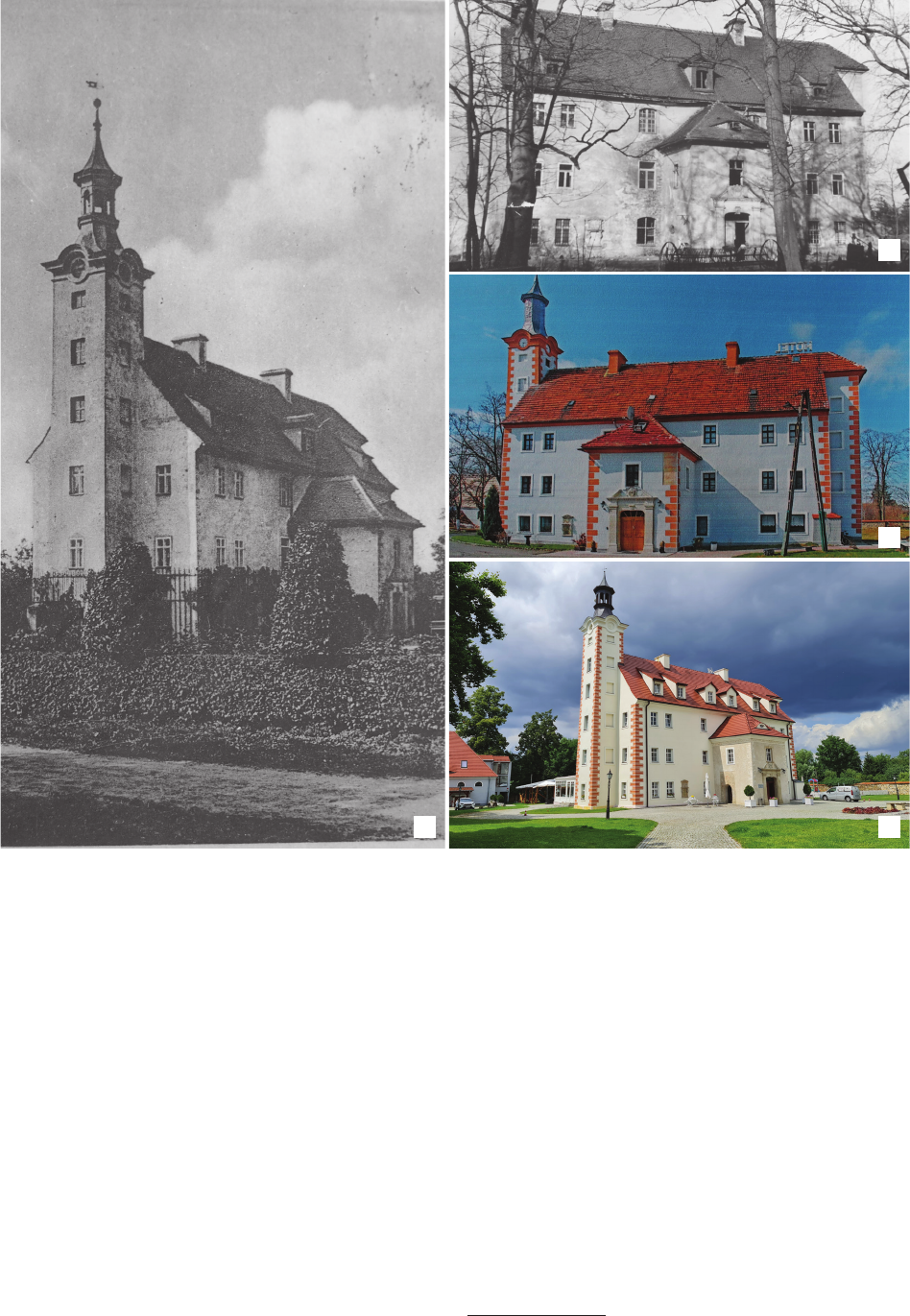
complexes. The original external forms were preserved,
and building volumes underwent minimal modications.
New elements, such as façades, roof slopes, and wood-
work, retained the historical character and were often rec-
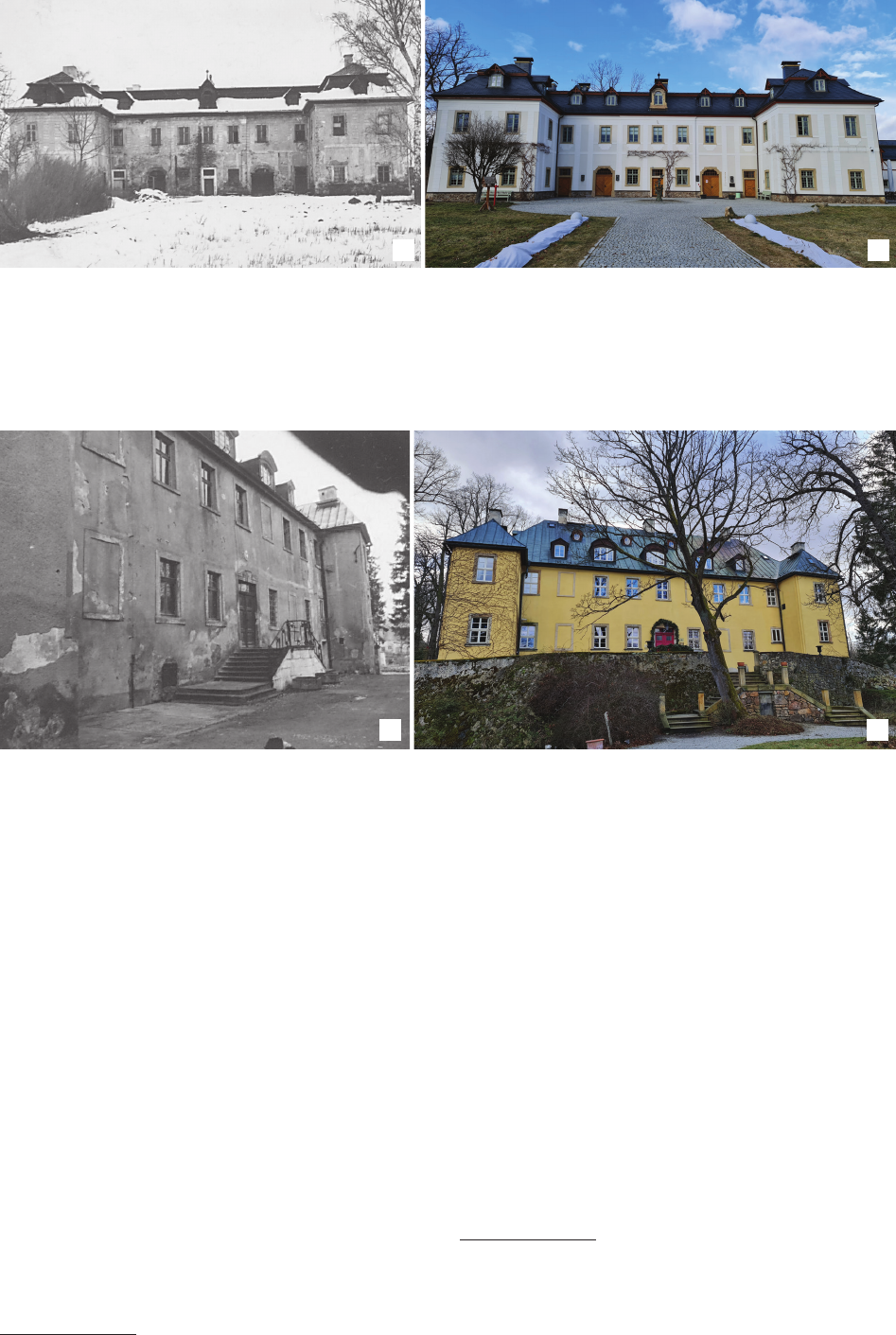
reated based on historical patterns (Figs. 6–8).
Roofs were designed to match the original styles, of-
ten constructed in alignment with prevailing architectural
trends or technical capabilities of the era. Common roof
types include: gable or hipped, jerkinhead, mansard and
irregular, complex structures. Modern pavilion extensions
were designed with at roofs, ensuring they did not com-
pete with the historical slopes. Signicant roof alterations
included the addition of dormer windows, either singular
or in band systems, and skylights. These modications
were driven by the need to ensure sucient natural light-
6
It was observed that the individual functions merged with each
other, and the studied projects were characterized by several distinctive
zones. Key areas include those related to recreation and event organization.
As a result of the analyses, it was determined that most often, the stay at
the hotel was motivated by relaxation and leisure activities, including the
use of the wellness amenities.
ing for newly repurposed attic spaces while respecting the
historical context.
The individual nature of the projects was reinforced
through the preservation or reproduction of specic features
of the building forms, including: risalits and pseudorisalits,
bay windows, porticos, terraces and balconies, cornices,
pilasters, buttresses, attics, side alcoves, and entrances pre-
ceded by stairs. The following were also observed:
– original arrangement of window openings and their
frames,
–
symmetrical façades, those lacking symmetry, or with
a dened rhythm,
– buildings with half-timbered construction,
– massive chimneys and heating ducts,
– glass roong over the courtyard.
The studied monuments diered signicantly from each
other, primarily due to the time of their construction, his-
torical conditions, and the adopted aesthetics. It is worth
emphasizing that most of the aforementioned features are
preserved original elements, which constitute a value and
strength of hotels in adapted castles and palaces.
Another important issue concerned the characteristics
of the residential units. During a detailed analysis, the fol-
lowing conclusions were reached:
– the majority of the hotels oer three types of residen-
tial units – standard rooms, upgraded standard rooms, and
suites; this solution was adopted in six establishments,
– ten of the 16 hotels have only single and double rooms,
– three establishments provide only classic rooms, two
feature styled or stylized rooms, and three others oer ex-
clusively interiors with modern designs,
– the group of hotels with a cohesive style included
those identied as luxury hotels
7
.
In a separate publication, conclusions regarding the stylis-
tics and interior furnishings of the examined hotels were pre-
sented. It is worth noting that the Lower Silesian examples of
adapting palace and castle complexes served as a means of
rescuing historic monuments. Most of these complexes were
unused before renovation work began (seven out of 16),
resulting in signicant deterioration and looting. Instances
of theft of nishing elements, such as ooring, panelling,
or
woodwork, were reported. The research sample included
eight
residences and an equal number of farm and ancillary
buildings. Interestingly, guest rooms already existed in six
out of the 16 undertakings, with the hotels being established
by upgrading the standards of these accommodations. Con-
sequently, restoring utility functions to these buildings or
enhancing the standards of existing establishments was
evaluated positively. It was estimated that the adaptation
process to hotel purposes took an average of 4.8 years.
A notable common feature of seven out of the 16 projects
was the preparation of additional guest rooms unrelated to
the hotel itself. These extra accommodations were provid-
ed in all two- and three-star establishments, conrming
the general intent of owners to increase eciency and prof-
its from their operations.
7
It sometimes occurred that the presence of two types of ar ran-
gements was due to the staged nature of the renovation work.
60 Agnieszka Adamska-Idzikowska
Further considerations were limited to the scope of ad-
aptation. The following patterns were identied:
– when adapting castles and palaces for hotel purposes,
the preserved original structures were utilized as a priority
– 11 out of 16 projects followed this approach,
– in six cases, the opening of a hotel involved the re-
construction or remodelling of historical buildings – all of
these instances pertained to farm and ancillary structures,
– 13 out of the 16 projects were developed within
buildings retaining their original footprints
8
,
– in three cases, decisions to construct entirely new,
separate structures were made during the adaptation pro-
cess, while four additional hotels were expanded after they
began operations,
– among the expanded realizations, three adopted
a “historic-modern” contrast in the architectural design of
the old and new structures,
8
Treating hotels in Łagów as 2 separate ventures.
Fig. 6. The structure of the Pałac Pakoszów hotel:
a) condition as of 1965 (photo from the monument registration card), b) condition as of 2022 (photo by A. Adamska-Idzikowska)
Il. 6. Bryła hotelu Pałac Pakoszów:
a) stan z 1965 r. (fot. z karty ewidencyjnej zabytku), b) stan z 2022 r. (fot. A. Adamska-Idzikowska)
Fig. 7. The structure of the Pałac Staniszów hotel:
a) condition as of 1994 (photo from the monument registration card), b) condition as of 2022 (photo by A. Adamska-Idzikowska)
Il. 7. Bryła hotelu Pałac Staniszów:
a) stan z 1994 r. (fot. z karty ewidencyjnej zabytku), b) stan z 2022 r. (fot. A. Adamska-Idzikowska)
– remnants of the historic substance were highlighted
in 13 out of the 16 hotels
9
(in eight residences and ve
auxiliary buildings
10
),
– preserved original elements were most often located
in publicly accessible spaces.
The next step was to examine the location of the indi-
vidual hotel zones. Several clear trends were identied in
this regard:
– eight hotels are located exclusively in auxiliary build-
ings, such as farm and ancillary buildings or outbuildings,
– seven hotels consist of a main structure surrounded
by auxiliary buildings,
9
Treating hotels in Łagów as 2 separate ventures.
10
The exposed historic substance in the residences most commonly
pertains to the building’s structure, including the roof truss, volumes, and
forms, as well as interior nishes and architectural details. In the context
of farmstead and auxiliary buildings, it typically includes structural
elements of the building and remnants of vaulting.
a b
a b
The adaptation of historic castles and palaces of the Lower Silesian Voivodeship into contemporary hotels 61
Fig. 8. The structure of the Pałac Łagów hotel:
a) condition as of 1931 (photo from the collection of the current property owner),
b) condition during the use by the State Agricultural Farm (photo from the collection of the current property owner),
c) façade in 2013 (photo from the collection of the current property owner), d) condition as of 2022 (photo by A. Adamska-Idzikowska)
Il. 8. Bryła hotelu Pałac Łagów:
a) stan z 1931 r. (fot. ze zbiorów obecnego właściciela nieruchomości),
b) stan z czasów użytkowania przez PGR (fot. ze zbiorów obecnego właściciela nieruchomości),
c) fasada w 2013 r. (fot. ze zbiorów obecnego właściciela nieruchomości), d) stan z 2022 r. (fot. A. Adamska-Idzikowska)
– no projects with all hotel zones located only within
the palace or castle,
– all adapted residences included at least part of the to-
tal number of hotel rooms,
– in six cases, moving between dierent hotel zones
does not require leaving the building, whereas in nine cases,
it is necessary,
– in ten projects, rooms were designed in at least two
buildings,
– gastronomic verticals were designed in both the main
residences and ancillary buildings,
– recreational verticals were primarily located in com-
plementary buildings,
–
support and technical rooms, including storage areas,
were designed in both the residences and auxiliary buildings,
– ve projects served as complementary components
of larger complexes
11
.
During the research on functional verticals, the presence
of characteristic elements was veried. For the gastronomic
vertical, these included services such as a restaurant, café
or bar, and wine cellars. Similarly, for the recreational ver-
tical, the presence of amenities such as swimming pools,
11
That is, coexisting with other ventures, meaning that guests can
enjoy attractions oered in the remaining buildings, even though these
buildings are not part of the hotel.
a
b
c
d
62 Agnieszka Adamska-Idzikowska
jacuzzis, and wellness treatments was examined. Addition-
ally, the analysis identied which services were designed
to be accessible to the general public. These ndings were
documented in a separate study.
Summary
Both formulated thesis statements have been proven. It
has been conrmed that the discussed adaptations of his-
toric castles and palaces into hotels oer a “new life” in
terms of both functionality and technical condition. The
study demonstrated that the historic substance – its form,
structure, selected building partitions, and details – serves
as a foundation and an added value for contemporary proj-
ects, embodying the genius loci. Overnight stays within
historic interiors provide unique experiences unavailable
in newly constructed establishments. In terms of amenities
and the scale of functional verticals, hotels adapted from
castles and palaces are on par with newly built establish-
ments. Furthermore, it is worth noting that the examined
facilities are situated in scenically attractive locations with
good transport accessibility. A typology of contemporary
hotels designed in historic castles and palaces was also de-
veloped based on adaptations within the Lower Silesian
Voivodeship. The analysis further revealed that the com-
pleted projects have been met with a positive reception
from the public.
The primary purpose of this study was to demonstrate
that the architectural building substance and urban sur-
roundings of historic castles and palaces provide signi-
cant potential for creating unique hotels through adaptive
reuse. The discussion of the existing realizations facilitated
the identication of guidelines useful for developing simi-
lar projects while also updating the current state of knowl-
edge on the subject.
Moreover, the conclusions drawn from the analyses
may encourage potential entrepreneurs to undertake fur-
ther initiatives, contributing to the preservation and public
accessibility of the following monuments. This underlines
both the theoretical and practical dimensions of the study.
Importantly, based on the presented analyses, it is pre-
dicted that the trend of adapting heritage buildings for use
as contemporary hotels is developmental and deserves at-
tention in future research by scholars from various disci-
plines, including architecture and urban planning.
Translated by
Agnieszka Adamska-Idzikowska
References
Adamska, Agnieszka. “Tourist accommodation of castles and palaces
located within the Lower Silesian Voivodeship.” Teka Komisji Ar-
chitektury, Urbanistyki i Studiów Krajobrazowych 17, no. 4 (2021):
7–18. https://doi.org/10.35784/teka.2708.
Błądek, Zenon, ed. Nowoczesne hotelarstwo. Od projektowania do wypo-
sażenia. Wydawnictwo Palladium – Architekci Błądek, Manikowski,
2010.
Borusiewicz, Władysław. Konserwacja zabytków budownictwa murowa-
nego. Arkady, 1971.
Chorowska, Małgorzata, and Roland Mruczek. “Silesian landscape with
a castle in the background. A Wrocław donjon of the prince-crusa-
der.” Architectus 73, no. 1 (2023): 3–16. https://doi.org/10.37190/
arc230101.
Czyżniewska, Lucyna. “Uwagi dotyczące problemów adaptacji obiektów
zabytkowych do współczesnych funkcji.” In Adaptacja obiektów
zabytkowych do współczesnych funkcji użytkowych, edited by Bogu-
sław Szmygin. Lubelskie Towarzystwo Naukowe, Międzynarodowa
Rada Ochrony Zabytków ICOMOS, Politechnika Lubelska, 2009.
Franke, Arne. Śląskie Elizjum. Zamki, pałace, dwory i parki w Kotlinie
Jeleniogórskiej. Translated by Elżbieta Blumenbach. Deutsches Kul-
turforum Östliches Europa, 2007.
Gaworski, Marek. Zamki i pałace województwa dolnośląskiego. Matiang,
2020.
Gubańska, Renata. Założenia rezydencjonalno-folwarczne na Dolnym
Śląsku. Możliwości adaptacji do nowej funkcji. Wydawnictwo Uni-
wersytetu Przyrodniczego we Wrocławiu, 2014.
Jabłońska, Joanna. Architektura ogólnodostępnych przestrzeni współcze-
snych hoteli. Ocyna Wydawnicza Politechniki Wrocławskiej, 2018.
Janicka, Katarzyna. “Adaptacja zabytkowych pałaców Kotliny Jelenio-
górskiej na cele hotelowe.” Świat Nieruchomości 88, no. 2 (2014):
39–44.
Konieczna-Domańska, Anna. “Turystyka jako sposób komercjalizacji
kul tury na przykładzie hoteli w obiektach zabytkowych.” Zeszyty
Nau kowe Turystyka i Rekreacja 16, no. 2 (2015): 179–192.
Lamparska, Joanna. Magia dolnośląskich zamków. Rezydencje i ich losy.
Part 1. Asia-Press, 2019.
Leśniewska-Napierała, Katarzyna, and Tomasz Napierała. “Funkcja ho-
telarska w rewitalizacji obszarów wiejskich. Studium przypadków
w województwie pomorskim.” Turyzm/Tourism 27, no. 2 (2017):
65−76. https://doi.org/10.18778/0867-5856.27.2.06.
Łuczyński, Romuald. Losy rezydencji dolnośląskich w latach 1945–1991.
Ocyna Wydawnicza ATUT, 2010.
Łużyniecka, Ewa, ed. Dziedzictwo architektoniczne. Restauracje i adapta-
cje zabytków. Ocyna Wydawnicza Politechniki Wrocławskiej, 2018.
Małachowicz, Edmund. Konserwacja i rewaloryzacja architektury w śro-
do wisku kulturowym. Ocyna Wydawnicza Politechniki Wrocław-
skiej, 2007.
Marcinów, Aleksandra. “Konserwacja i odbudowa zamków, pałaców
i dworów Kotliny Jeleniogórskiej w XIX i XX wieku. Wybrane za-
gadnienia.” Ochrona Zabytków, no. 2 (2015): 41–63.
Merta-Staszczak, Adriana. Niechciane dziedzictwo. Nieruchomości za-
bytkowe na Dolnym Śląsku w latach 1945–1989. Wydawnictwo Na-
ukowe Scholar, 2018.
Milewska, Mariola, and Bogdan Włodarczyk. Hotelarstwo. Organiza-
cja i fun kcjonowanie obiektów noclegowych. Polskie Wydawnictwo
Eko nomiczne, 2018.
Mitura, Elżbieta, and Elżbieta Koniuszewska. Hotelarstwo – organizacja
i tech nika pracy. Din, 2008.
Mordawski, Hubert. Ziemie Odzyskane 1945–1956. Wydawnictwo Po-
ligraf, 2015.
Penner, Richard, Lawrence Adams, and Stephani Robson. Hotel design,
planning, and development. Routledge, 2013.
Perzyński, Marek. Dolnośląskie zamki, dwory i pałace. Przewodnik dla
dociekliwych. Wrocławski Dom Wydawniczy, 2018.
Rouba, Bogumiła. “Dlaczego adaptacje niszczą zabytki i czy tak być
musi?” In Adaptacja obiektów zabytkowych do współczesnych funkcji
użytkowych, edited by Bogusław Szmygin. Lubelskie Towarzystwo
Naukowe, Międzynarodowa Rada Ochrony Zabytków ICOMOS, Po-
litechnika Lubelska, 2009.
Rouba, Rafał, and Waldemar Cudny. “Monitorowanie zabytkowych rezy-
dencji funkcjonujących na rynku usług hotelarskich w Polsce w la-
tach 2002–2011.” Ochrona Zabytków, no. 1–4 (2010): 183–98.
The adaptation of historic castles and palaces of the Lower Silesian Voivodeship into contemporary hotels 63
Szmygin, Bogusław, ed. Adaptacja obiektów zabytkowych do współ-
czesnych funkcji użytkowych. Lubelskie Towarzystwo Naukowe,
Międzynarodowa Rada Ochrony Zabytków ICOMOS, Politechnika
Lubelska, 2009.
Turkowski, Marek. Marketing usług hotelarskich. Polskie Wydawnictwo
Ekonomiczne, 2010.
Wilczyński, Jorg. Hotel i jego infrastruktura. Wyższa Szkoła Turystyki
i Hotelarstwa w Gdańsku, 2010.
Streszczenie
Adaptacje zabytkowych zamków i pałaców województwa dolnośląskiego na współczesne hotele
Tematem niniejszej pracy są wszystkie zaadaptowane na hotele zamki i pałace wpisane do rejestru zabytków i położone na terenie województwa
dolnośląskiego. Rozważaniami objęto całe założenia rezydencjonalne łącznie z zabudową uzupełniającą i folwarczną, a także otaczającymi je par-
kami i ogrodami. Za kryterium czasowe uznano funkcjonowanie przedsięwzięcia w trakcie prowadzenia studiów przypadków, czyli lata 2019–2022.
Najstarszy z omawianych budynków datowany jest na XVI w., a najmłodszy na początek XX w. Przedsięwzięcia należące do próbki badawczej
uruchamiano w latach 1996–2014.
W zależności od etapu prac przyjmowano odpowiednie metody badań, takie jak analiza materiałów źródłowych i wywiady z właścicielami oraz
pracownikami hoteli. Wykonano analizy porównawcze, krytyczne i syntezę w celu uzyskania wniosków. Badania obejmowały kilkukrotne wizyty
w obiektach, dokumentowane zdjęciami. Przeprowadzono wiele analiz związanych z kryteriami typologii, procesem i zasięgiem adaptacji, lokaliza-
cją poszczególnych stref pionów funkcjonalnych, głównymi atutami przedsięwzięć, a także syntezą wybranych cech hoteli.
Poprzez wieloaspektową analizę dotychczasowych realizacji z terenu województwa dolnośląskiego wyciągnięto wnioski dotyczące pozytywnych
i negatywnych aspektów przeprowadzonych adaptacji zamków i pałaców na hotele. Na tej podstawie sformułowano zalecenia, które mogą służyć
badaczom, konserwatorom, projektantom czy potencjalnym inwestorom. Najważniejszym elementem niniejszego opracowania jest jednak wypełnie-
nie luki w wiedzy dotyczącej omawianego tematu. Warto podkreślić, że działania tego typu pozwalają nie tylko na prowadzenie udanej działalności
biznesowej, ale przede wszystkim na uratowanie przed zniszczeniem zamku lub pałacu będącego świadectwem przeszłości.
Udowodniono, że istniejące adaptacje na hotele zamków i pałaców wpisanych do rejestru zabytków oraz zlokalizowanych na terenie wojewódz-
twa dolnośląskiego to przykład wartościowych działań architektonicznych służących ponownemu wykorzystaniu historycznych budynków wraz
z otoczeniem i stworzeniu unikatowych hoteli, o specycznej atmosferze przepełnionej historią i genius loci, dostosowanych do potrzeb współczes-
nych gości.
Słowa kluczowe: hotel, zamek, pałac, adaptacja obiektu zabytkowego, województwo dolnośląskie