
2015
3(43)
DOI: 10.5277/arc150306
Aleksandra Brzozowska*
Park archeologiczny jako element przestrzeni miejskiej
na przykładzie Parku Archeologicznego Nea Pafos na Cyprze
An archaeological park as an element of urban space
exemplified by the Nea Paphos Archaeological Park in Cyprus
W wielu miejscach świata spotkać można wydzieloną
i przystosowaną do zwiedzania przestrzeń stanowiącą
świadectwo działalności człowieka w minionych epokach.
Zwykle takie obszary określa się mianem parków ar cheo-
logicznych, a na ich terenie odnaleźć można relikty ar -
cheo logiczne, pozostałości architektury czy układu ur ba -
nis tycznego. Parki archeologiczne usytuowane w cen trach
miast świadczą o wielowiekowej ciągłości osadniczej
danego obszaru. Coraz częściej stanowią one interesującą
przestrzeń wzbogacającą ofertę kulturalną i turystyczną,
pożądaną zarówno przez samych mieszkańców szczycą-
cych się historią swojego miasta, jak i przez turystów
ciekawych dawnych dziejów.
Park archeologiczny może być atrakcyjnym, choć wy -
ma gającym wyzwaniem dla projektanta na każdym etapie
jego planowania i udostępniania. Jakie są więc cele, zasa-
dy funkcjonowania i zadania, które spełniać ma ta specy-
ficzna przestrzeń? Rozważmy to na przykładzie parku
archeologicznego Nea Pafos na południowo-zachodnim
wybrzeżu Cypru.
Park mieści się na rozległym cyplu i obejmuje obszar
około 0,5 km
2
. Jest to założenie ściśle związane pod
względem lokalizacji i historii ze współczesnym miastem
Pafos. Położenie i obszar Nea Pafos odpowiada zasięgo -
wi antycznego miasta, wyznaczonemu przez relikty mu -
rów miejskich. Jego starożytne dzieje skończyły się wraz
In many places in the world we can encounter a space
that is separated and adapted to sightseeing and which
constitutes a testimony of human activity in the past
epochs. Typically, these areas are referred to as archeo-
logical parks and within them we can find archaeological
relics as well as the remains of architecture and an urban
layout. Archaeo logical parks which are situated in city
centres are a testimony of the many-century settlement
continuity of a given area. They increasingly constitute an
interesting space en rich ing a cultural and tourist offer of
the city which is de sired both by the residents themselves
who are proud of the history of their city and by tourists
who are interested in ancient history.
An archaeological park may be an attractive but
demanding challenge for a designer at every stage of its
planning and sharing. Thus, what are the objectives, prin-
ciples of functioning and tasks that this specific space is
supposed to meet? Let us consider this idea on the exam-
ple of the archaeological park called Nea Paphos on the
southwest coast of Cyprus.
The park is situated on an extensive promontory and
covers an area of about 0.5 km
2
. This layout is closely
connected with the modern city of Paphos in terms of its
location and history. The location and area of Nea Paphos
corresponds to the coverage of the ancient city that was
designated by the relics of the city walls. Its ancient his-
tory ended along with a series of earthquakes that hit and
devastated the island in the 4
th
century
1
[1, pp. 6–12], [2].
1
The capital was then moved to Salamis on the north coast and
Paphos significantly lost its importance.
* Wydział Architektury Politechniki Wrocławskiej/Faculty of
Architecture, Wrocław University of Technology.
64 Aleksandra Brzozowska
z serią trzęsień ziemi, które nawiedziły i zniszczyły wys-
pę w IV w.
1
[1, s. 6–12], [2].
Najważniejsze zabytki Nea Pafos to przede wszystkim
relikty antycznej zabudowy miejskiej: Dom Dionizosa,
Dom Orfeusza, Dom Hellenistyczny, Willa Tezeusza i Dom
Aiona
2
oraz pozostałości agory z odeonem i asklepiejo-
nem. Na terenie parku znajdują się również zabytki z epok
późniejszych – m.in. relikty bizantyńskiego zamku S aran-
da Kolones [1, s. 5–23], [2] (il. 1–3).
Nea Pafos jest jednym z najważniejszych parków
archeologicznych nie tylko w dystrykcie Pafos, ale na ca -
łej wyspie – w 1980 r. został wpisany na Światową Listę
Dziedzictwa UNESCO [1, s. 6]–[3]. Pod względem licz-
by turystów jest to najczęściej odwiedzane stanowisko
archeologiczne na Cyprze
3
. Warto zaznaczyć, że rozkwit
współczesnego Pafos (niegdyś małej wioski rolniczo-
1
Stolica została wtedy przeniesiona do Salaminy na północnym
wybrzeżu, a Pafos znacznie straciło na znaczeniu.
2
Nazwy obiektów odnoszą się do mitologicznych postaci przed-
stawionych na mozaikach.
3
Według najnowszych danych publikowanych przez Departament
Starożytności Cypru w 2005 r. park odwiedziło ponad 300 000 zwiedza-
jących, w 2006 ponad 270 000 [4, s. 15], w 2007 prawie 260 000 [5,
s. 15], a w 2008 prawie 250 000 turystów [6, s. 16]. Spadek liczby od -
wiedzających od 2005 r. zanotowano również w innych parkach archeo lo-
gicznych Cypru. Prawdopodobnie wynika on z ogólnoświatowego kry -
zysu. Cytowane dane odnoszą się tylko do nieokupowanej części Cypru.
The most important monuments of Nea Paphos are
primarily the relics of the ancient urban development, e.g.
House of Dionysus, House of Orpheus, Hellenistic House,
Villa of Theseus and House of Aion
2
as well as the relics
of the agora with Odeon and the Asclepeion. In the park
there are also monuments from later epochs – inter alia,
the remnants of the Byzantine fortress Saranta Kolones
[1, pp. 5–23], [2] (Fig. 1–3).
Nea Paphos is one of the most important archaeological
parks not only in the Paphos district but on the whole island
– in 1980 it was listed by UNESCO as a World Heritage
Site [1, p. 6]–[3]. In terms of the number of tourists, it is
the most frequently visited archaeological site in Cyprus
3
.
It is worth emphasizing that to a large extent the existence
of this well-known and popular archaeological park con-
tributed to the flourishing of modern Paphos (once a small
agricultural and fishing village) as a tourist resort.
2
Names of objects refer to mythological characters presented in
the mosaics.
3
According to the latest data published by the Department of
Antiquities of Cyprus in 2005 the Park was visited by over 300 000
visitors, in 2006 by over 270 000 [4, p. 15], in 2007 by almost 260 000
[5, p. 15], whereas in 2008 almost 250 000 tourists visited the place [6,
p. 16]. A drop in the number of visitors was also noticed in the other
archeological parks of Cyprus. It probably results from a worldwide
crisis. The cited data refer only to the unoccupied part of Cyprus.
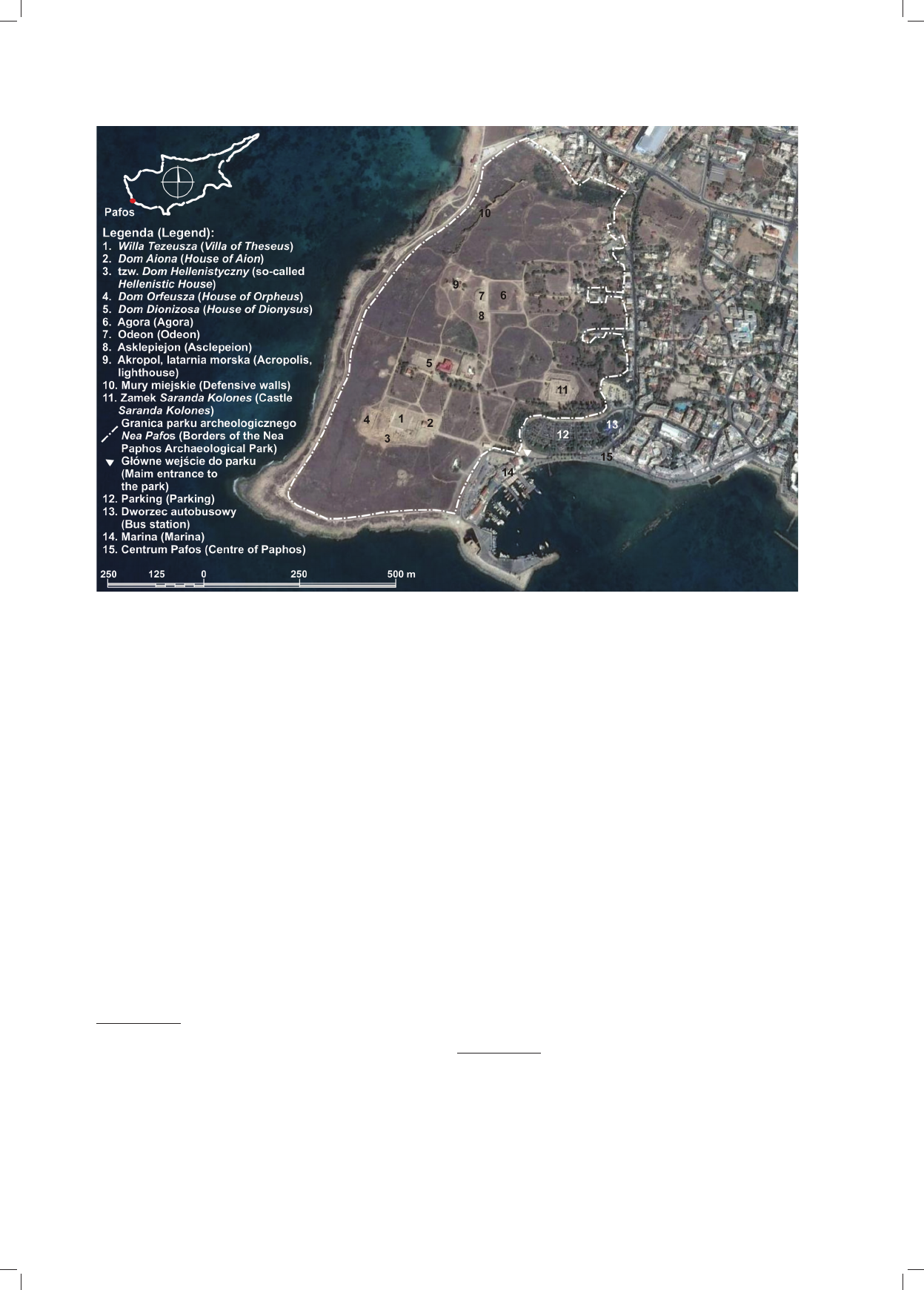
Il. 1. Mapa parku archeologicznego Nea Pafos.
Opracowanie autorki na podstawie
fotografii satelitarnych
(Google Earth, data dostępu: 5.10.2014)
Fig. 1. Map of the archaeological park Nea Paphos. Prepared by the author on the basis of the satellite photographs
(Google Earth, accessed: 5.10.2014)

Park archeologiczny jako element przestrzeni miejskiej /An archaeological park as an element of urban space 65
-rybackiej) jako kurortu turystycznego miasto w dużej
mierze zawdzięcza właśnie istnieniu znanego i popular-
nego parku archeologicznego.
Podstawowym obowiązkiem współczesnego społe-
czeństwa jako spadkobiercy i depozytariusza przeszłości
jest ochrona, również dla przyszłych pokoleń, spuścizny
ludzkości – [...] dziedzictwo archeologiczne nie stanowi
własności poszczególnych narodów czy państw, ale jest
powierzonym nam przez przeszłe pokolenia wspólnym
zasobem kulturowym o wartości ogólnoludzkiej [7, s. 11].
Problem ochrony zabytków, w tym archeologicznych,
znalazł swoje odzwierciedlenie w wielu międzynarodo-
wych aktach prawnych (wybrane z nich: [8]–[14]). Na
m.in. ich podstawie Zbigniew Kobyliński stworzył synte-
tyczny i wyczerpujący zestaw zasad, którymi winne się
kierować osoby zaangażowane w prace wykopaliskowe
na każdym ich etapie – również tworzenia i funkcjono-
wania parków archeologicznych. Wskazał m.in. na ko -
nieczność ochrony zarówno pojedynczych obiektów
archeologicznych, jak i całych fragmentów historycznego
krajobrazu kulturowego w powiązaniu z innymi dobra mi
kultury i środowiska naturalnego oraz planowaniem za -
gos podarowania przestrzennego. Akcentował wielką
wa gę edukacji społeczeństwa oraz potrzebę zachowania
dzie dzictwa archeologicznego dla przyszłych pokoleń
rów nież w kontekście stosowania nieniszczących technik
po z nawczych. Podkreślał wreszcie konieczność połącze-
nia działań wykopaliskowych z konserwacją odsłoniętych
reliktów oraz absolutny prymat ochrony zabytków nad
interesami komercyjnymi [7, s. 12–13].
Fundamentalnym zadaniem, jakie staje przed projek-
tantami parków archeologicznych, jest ochrona zabytków
wedle zasady „przede wszystkim nie szkodzić”. Na tere-
nie stanowiącym zalążek przyszłego parku zazwyczaj
zastają oni pozostałości układu urbanistycznego, archi-
tektury, towarzyszącej jej infrastruktury oraz ewentualnie
wyposażenia budynków. Relikty archeologiczne mogą prze-
trwać w niezmienionym stanie długi okres, dopóki przy kry-
wa
je ziemia. Odsłonięcie ich i związana z tym gwał tow -
na zmiana warunków (dostęp powietrza, inna wil got ność,
tem peratura itd.) mogą powodować szybki i trud ny do
po wstrzymania proces niszczenia. Dlatego waż ne jest,
aby już na etapie przygotowania badań myśleć o za bez-
piecze niu odkrytych zabytków. Zadanie to ciąży na orga-
nizatorach wykopalisk – instytucjach wysyłających misje
ba dawcze, które w związku z tym coraz częś ciej zyskują
profil archeologiczno-konserwatorski. Na tomiast projek-
tanci parków archeologicznych zobowiązani są stworzyć
optymalne warunki, które wyeliminują potencjalne zagro-
żenia dla eksponowanych ruin w przyszłości. Wiąże się to
m.in. z wytyczeniem właściwej trasy zwiedzania gwaran-
tującej komfort i bezpieczeństwo zarówno turystom, jak
i zabytkom oraz odpowiednią ekspozycję tych ostatnich.
Park archeologiczny w większości przypadków obej-
muje otwarty obszar, a trasy zwiedzania prowadzą pomię-
dzy zachowanymi pozostałościami dawnej zabudowy.
Taka sytuacja wymaga odpowiedniego przygotowania
szla ków łączących zabytki oraz towarzyszących im współ-
czesnych budowli. Z jednej strony relikty powinny być
odseparowane od zwiedzających, np. barierką, z drugiej
The primary responsibility of a modern society as the
heir and depositary of the past is the protection – also for
future generations – of mankind’s heritage [...] the arche-
ological heritage does not constitute the property of indi-
vidual nations or states but it is a common cultural re -
source of general human values entrusted to us by past
ge ne rations [7, p. 11]. The problem of protecting monu-
ments, including archaeological sites, is reflected in
a num ber of international legal acts (some of them: [8]–
[14]). It is on this basis that Zbigniew Kobyliński estab-
lished a syn thetic and comprehensive set of rules that
ought to be observed by the people involved in excavation
works during each stage, including the formation and
operation of archaeological parks. Among other things, he
pointed to the necessity of protecting single archaeologi-
cal objects as well as whole fragments of historical cul-
tural landscape in conjunction with other goods of culture
and the environment and spatial development planning.
He emphasized the great importance of educating the
society and the need to preserve the archaeological heri-
tage for future generations also in the context of applying
non-destructive cognitive techniques. Finally, he stressed
the need for the combination of excavations with preser-
vation of discovered relics as well as the absolute primacy
of protecting monuments over commercial businesses [7,
pp. 12–13].
The fundamental task that designers face in terms of
archeological parks is the protection of monuments
according to the principle “first of all do no harm”. On the
land which is the basis for the future park, designers usu-
ally find the remains of the urban layout, architecture, the
accompanying infrastructure and possibly the equipment
of buildings. Archaeological relics can survive intact for
a long time as long as they are covered by earth. Un -
covering them and a rapid change in conditions which
accompanies this process (air access, another kind of hu -
midity, temperature, etc.) can cause the sudden process of
de struction that is difficult to stop. Therefore, it is impor-
tant to think of securing discovered monuments already at
the stage of research organisations. Organisers of excava-
tions are responsible for this task – institutions which
send research missions and in this way they often receive
an archaeological and restoration profile. However,
de signers of archaeological parks are obliged to create
optimal conditions that would eliminate potential threats
to the exposed ruins in the future. This involves, inter
alia, preparing an appropriate sightseeing route which
would provide tourists and monuments with comfort and
safety as well as the appropriate exposure of the latter.
The archaeological park, in most cases, covers an open
area and sightseeing routes run among preserved remains
of ancient buildings. This situation requires the appropri-
ate marking out of routes which connect monuments and
the accompanying modern buildings. On the one hand,
the re lics should be separated from visitors, for example
by means of a railing, while on the other hand, the path
itself should not run too far from the monument (incorrect
perception).
When preparing sightseeing routes it is also worth taking
into account the landscape values of the area. In the case of

66 Aleksandra Brzozowska
– sama ścieżka nie powinna przebiegać w zbyt dużej od -
ległości od zabytku (niewłaściwa percepcja).
Przy wytyczaniu trasy zwiedzania warto również wziąć
pod uwagę walory krajobrazowe terenu. W przy pad ku par-
ków położonych w pagórkowatym terenie wska zane by -
łoby wprowadzenie punktów widokowych, usy tuo wanych
na wzniesieniach pozwalających objąć wzro kiem więk-
szy obszar. Dla parków położonych na pła skim terenie
rozwiązaniem mogą być sztuczne platformy ob serwacyj-
ne wyniesione ponad poziom gruntu, które jed nocześnie
stanowić mogą rodzaj znaku orientacyjnego.
Ważna jest również nawierzchnia tras zwiedzania.
Najczęściej spotyka się jedynie utwardzone ścieżki ziem-
ne. Takie rozwiązanie może powodować utrudnienia
w przy padku deszczu czy śniegu. Konieczne jest wtedy
za stosowanie nawierzchni, która zapewni zwiedzającym
bezpieczeństwo przy niekorzystnych warunkach atmosfe-
rycznych. Nawierzchnia i przebieg tras powinny również
zapewnić w miarę możliwości jak najlepszy dostęp dla
osób niepełnosprawnych.
Interesującym zabiegiem jest wyeksponowanie wnętrz
w taki sposób, by zwiedzający mogli zobaczyć je też od
środka. Wiąże się to również z koniecznością ich odpo-
wiedniego przygotowania, np. wzmocnieniem posadzki,
wykonaniem barierek oddzielających turystów od deli-
katnych elementów wnętrza itd. Istotnym zadaniem jest
wytyczenie trasy zwiedzania ponad zabytkami, co pozwa-
la z bliska przyjrzeć się budowlom. Powoduje jednak
ko nieczność wprowadzenia obcych struktur, zazwyczaj
ażurowych pomostów, pomiędzy lub w same budowle za -
bytkowe i może stanowić pewne wyzwanie projekto we.
Pod względem konserwatorskim takie konstrukcje nie
po winny w żaden sposób zagrażać samym zabytkom.
Tra sy zwiedzania powinny być wyposażone w odpowied-
nią in fra strukturę uzupełniającą (m.in. toalety, dostęp do
wo dy pitnej) oraz elementy małej architektury, np. ławki,
któ re zwłaszcza w parkach archeologicznych o dużym
ob sza rze są niezbędne. Przykładem trasy zwiedzania, któ-
ra znakomicie wykorzystuje atrybuty terenu i umiejętnie
podkreśla walory samej zabudowy, pozwalając turystom
wejść do wnętrz budowli, jest m.in. park archeologiczny
w Knoss os na Krecie.
W parku Nea Pafos trasy są dobrze wytyczone –
w większości bazują na naturalnie powstałych szlakach
łą c z ących najważniejsze zabytki (il. 1–3). Ziemna na -
wierzchnia ścieżek nie wymaga dodatkowych zabiegów.
Przy zabytkach wprowadzono metalowe barierki, które
skutecznie uniemożliwiają turystom wstęp na obszar
chro niony. Jest to istotne zwłaszcza w miejscach, gdzie
wy stępują duże różnice wysokości, np. głębokie wykopy
przy antycznej zabudowie miejskiej czy znaczna różnica
po ziomów pomiędzy zamkiem Saranda Kolones a jego
otoczeniem.
Główny obiekt parku, Willa Tezeusza, jest dobrze udo-
stępniony, łącznie z wprowadzeniem zwiedzających
na wielki dziedziniec wewnętrzny oraz przeprowadze -
niem trasy zwiedzania ponad wschodnim skrzydłem bu -
dowli. Dyskusyjne są natomiast same pomosty przerzuco-
ne nad obiektem (il. 2, 3), a zwłaszcza fakt, że część
z nich stoi bezpośrednio na zachowanych posadzkach
parks located in a hilly area it would be advisable to intro-
duce scenic overlooks which would be located in higher
places in order to view larger parts of the area. Arti ficial
observation platforms which would be elevated above the
ground level might be a solution for parks situated in flat
areas and at the same time they may be a kind of a landmark.
The surface of sightseeing routes is also important.
Most often there are only hardened ground paths. How-
ever, this solution may cause difficulties in case of rain or
snow. It is necessary then to apply a surface which will
provide visitors with safety in adverse weather condi-
tions. The surface and course of routes should also ensure,
if possible, the best access for the disabled.
Exhibiting the interiors in such a way that visitors
could see them also from the inside is a very interesting
method. It is also connected with the necessity of ade-
quate preparation, e.g. strengthening the floor, building
the barriers which would separate tourists from delicate
elements of the interior and so on. A separate issue refers
to the fact of marking out sightseeing routes above monu-
ments, which enables a closer look at buildings. However,
it results in the need to introduce alien structures, most
frequently openwork bridges between or inside monu-
ments and it may be quite a challenge for the designer. In
terms of conservation such structures should not in any
way pose a danger to the monuments themselves. Sight-
seeing routes should be equipped with appropriate com-
plementary infrastructure (e.g. toilets, access to drink ing
water) and elements of street architecture, e.g. benches
which are indispensable especially in large archaeological
parks. The Archaeological Park of Knossos in Crete is an
example of a tour route that uses attributes of the area in
an excellent way and skillfully accentuates the values of
the development itself allowing visitors to enter the inte-
rior of buildings.
In Nea Paphos Park routes are well marked out – in
most cases they are based on naturally occurring routes
which connect the most important monuments (Fig. 1–3).
The ground surface of paths does not require additional
treatments. Metal railings were built near the monuments,
which effectively prevented the tourists from entering the
protected area. This is particularly important in the places
where there are big differences in heights, e.g. deep exca-
vations near the ancient urban development or a signifi-
cant difference in levels between the castle of Saranta
Kolones and its surroundings.
The main object of the park, Villa of Theseus, has good
access for visitors who can enter a large internal courtyard
and a sightseeing route running above the eastern wing of
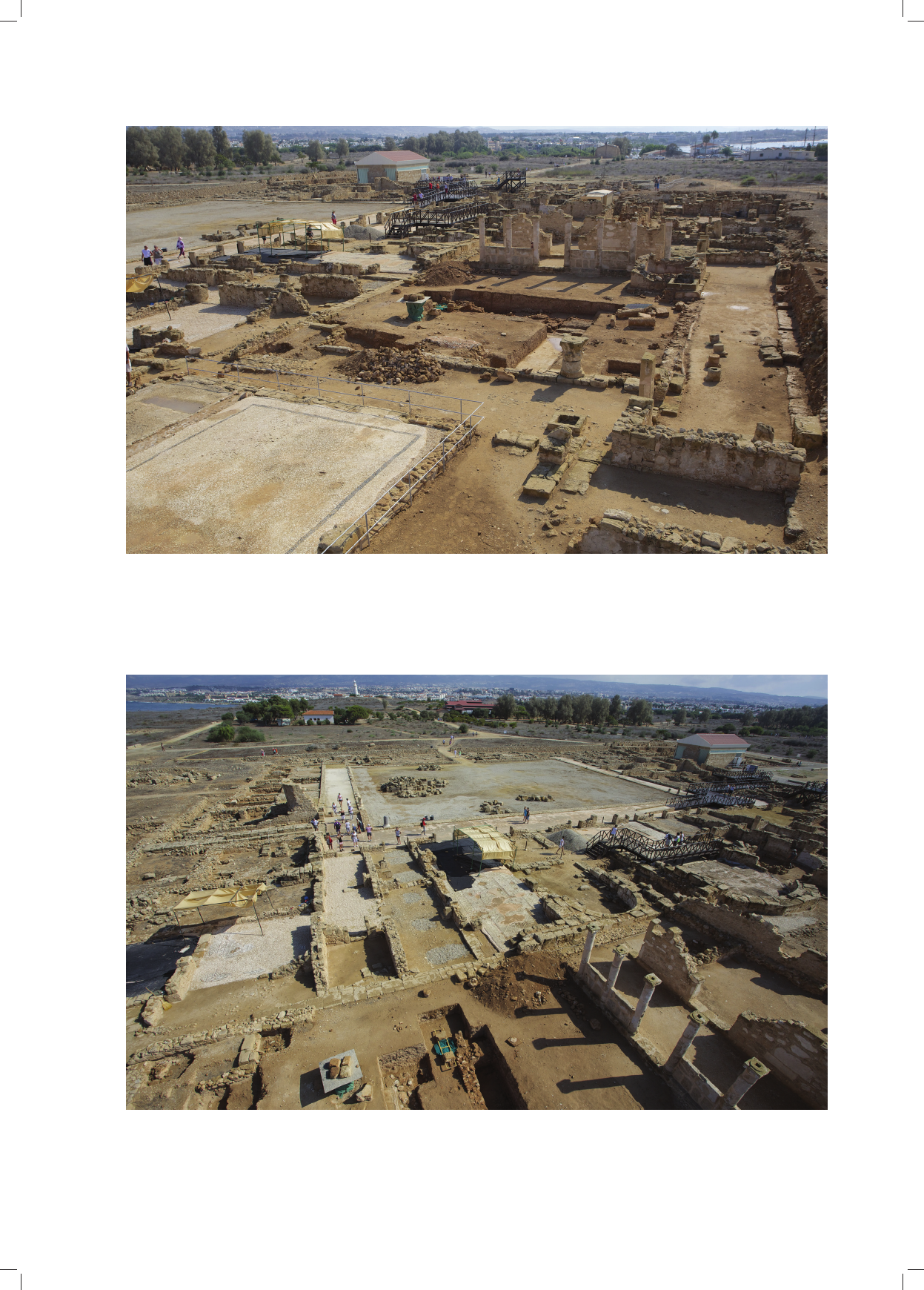
the building. However, bridges above the object are quite
controversial (Fig. 2, 3), in particular the fact that some of
them are situated directly on the preserved mosaic floors.
These are admittedly fairly light footbridges of wooden
construction, nevertheless the fact of the direct destruc-
tion of mosaics by the pressure of load bearing columns
cannot be ignored.
In the park there are many scenic overlooks in the form
of round viewing platforms which are situated on natural
hills of the terrain. The 19
th
-century lighthouse, which is
already closed, creates an extremely grateful dominant of
Park archeologiczny jako element przestrzeni miejskiej /An archaeological park as an element of urban space 67
Il. 2. Nea Pafos: na pierwszym
planie relikty Domu Hellenistycz nego
w trakcie prac wykopaliskowych, dalej Willa Tezeusza i pomosty ponad jej
wschodnim skrzydłem oraz pawilon nad Domem Aiona i główna aleja parku. W tle pafijska marina (fot. M. Jawornicki)
Fig. 2. Nea Paphos: in the foreground relics of the Hellenistic House during excavations, further the Villa of Theseus with platforms above its east
wing and the House of Aion pavilion with the main alley of the park. In the background Paphos harbour (photo by M. Jawornicki)
Il. 3. Nea Pafos: na pierwszym planie relikty Domu Hellenistycznego, dalej centralny dziedziniec Willi Tezeusza.
W tle pawilony nad Domem Aiona i Domem Dionizosa oraz latarnia morska (fot. M. Jawornicki)
Fig. 3. Nea Paphos: in the foreground relics of the Hellenistic House, next the main courtyard of the Villa of Theseus.
In the background pavilions above the House of Aion and the House of Dionysus and the lighthouse (photo by M. Jawornicki)

68 Aleksandra Brzozowska
mozaikowych. Są to wprawdzie kładki o dość lekkiej
kon struk cji drewnianej, ale nie można jednak zignorować
bez po średniego niszczenia mozaik przez nacisk słupów
nośnych.
Na terenie parku znajduje się wiele punktów widoko-
wych w postaci położonych na naturalnych wyniesie-
niach terenu okrągłych platform widokowych. Niezwykle
wdzięczną dominantą Nea Pafos jest nieczynna już XIX-
-wieczna latarnia morska. Usytuowana w najwyższym
punkcie parku niewątpliwie zapewniałaby znakomity wi -
dok na okolicę, nie jest jednak udostępniona dla zwiedza-
jących. Dużą bolączką parku jest dość skąpe wypo sażenie
w infrastrukturę uzupełniającą – nieregularnie roz
miesz-
czone ławki, brak wystarczającej liczby miejsc z do stępem
do wody pitnej oraz toalet.
Osobne zagadnienie stanowi właściwa ekspozycja re -
liktów architektury. Szczególnie przy delikatnych zabyt-
kach właściwym rozwiązaniem jest obudowanie ich pa -
wi lonami odcinającymi szkodliwy wpływ nadmiernego
na słonecznienia, deszczu i wiatru. Jest to zadanie trudne
z wielu powodów. W przypadku pozostałości za budowy
o dużej powierzchni podstawową trudność może spra-
wiać takie rozmieszczenie podpór, które z jednej stro ny
nie niszczy substancji zabytkowej, z drugiej nie zaburza
odbioru samego zabytku – nie zasłania ruin, nie wprowa-
dza do wnętrz budowli sztucznych podziałów. Roz wią-
zaniem wydają się zadaszenia wielkogabarytowe, które
jednak mogą wiązać się z koniecznością stosowania kon-
strukcji o znacznej rozpiętości. Tego rodzaju pawilon
mo że zdominować całe stanowisko archeologiczne. Przy-
kład takiego zadaszenia można zaobserwować w Parku
Archeologicznym w Kourion na Cyprze, gdzie zespół an -
tycznej zabudowy miejskiej przekryto jedną wspólną
kon strukcją opartą na stopach fundamentowych poza za -
sięgiem reliktów architektonicznych.
Inną koncepcją są lekkie pawilony, których struk tura
opiera się na antycznych ścianach budowli. W ta kim
wypadku podział wnętrza pawilonu może po wie lać staro-
żytny układ pomieszczeń, co jest niewątpliwym atutem
proponowanego rozwiązania. Problem może
na tomiast
stanowić zasłanianie przez słupy czy ściany pa wilonu
wi -
doków na dalsze fragmenty reliktów.
W parku Nea Pafos wzniesiono 2 pawilony osłaniające
fragmenty budowli antycznych – Domu Dionizosa
i Do mu Aiona (il. 2, 3). Podstawowym zadaniem była tu
ochro na najcenniejszych mozaik. Pawilony wybudowa-
no, wykorzystując zadaszenie, którego konstrukcja spo-
czywa na oryginalnych murach antycznych. Pawilon nad
fragmentem Domu Aiona obejmuje swoim zasięgiem
m.in. triclinium ze wspaniałą mozaiką przedstawiającą
wyjątkowy zespół scen mitologicznych [1, s. 6– 12], [15].
Dach opiera się na kamiennych ścianach wzniesionych na
reliktach murów oryginalnych. Konstrukcja pawilonu nad
Domem Dionizosa to oparte na starożytnych murach słu -
py podtrzymujące dach i lekkie ściany działowe. W przy-
padku obu pawilonów mozaiki są doskonale wi doczne
dla zwiedzających, co stanowi niewątpliwy walor zasto-
sowanych rozwiązań. Pawilony swoją bryłą, proporcjami,
kątem nachylenia i pokryciem dachu bazują na wzorcach
architektury lokalnej.
Nea Paphos. It is situated at the highest point of the park
and it would certainly ensure an excellent view of the
surrounding countryside, however, it is no longer open to
the public. A big sore point for the park is the quite poor
provision of complementary infrastructure – irregularly
arranged benches, lack of a sufficient number of sites with
access to drinking water and toilets.
A proper way of exhibiting the relics of architecture
constitutes a separate issue. Especially in the case of deli-
cate monuments the idea of enclosing them with pavilions
which would protect them against harmful effects of ex -
cessive sunlight, rain and wind is a reasonable solution.
However, this is a difficult task for many reasons. In the
case of the remains of the large area development the
basic difficulty is to arrange cantilevers in such a way
that, on the one hand, this arrangement does not destroy
the monument substance and on the other hand it does not
disturb the perception of the monument itself – does not
cover the ruins or does not form artificial divisions in the
interiors of monumental buildings. The large-size roofing
seems to be a solution, however, it may be connected with
the necessity to use large-span constructions. This kind of
pavilion can dominate the whole archaeological site. An
example of such roofing can be seen in the Archaeological
Park in Kourion in Cyprus, where the complex of the
ancient development was covered with one common con-
struction supported by spread footings beyond the reach
of the architectural relics.
Another option might be lightweight pavilions whose
construction is based on the ancient walls of the building.
In this case, the division of the interior of the pavilion can
duplicate the ancient layout of rooms, which is an un -
doubted advantage of the suggested solution. However,
the fact that supports or walls of the pavilion will obscure
the views of further fragments of the relics may become
a problem.
Two pavilions protecting the fragments of ancient
buildings were erected in the Nea Paphos Park – the
House of Dionysus and the House of Aion (Fig. 2, 3). The
main task here was to protect the most valuable mosaics.
The pavilions were built with the use of roofing whose
construction is supported by the original ancient walls.
The pavilion above the fragment of the House of Aion
covers, among other things, triclinium with a wonderful
mosaic presenting an exceptional complex of mythologi-
cal scenes [1, pp. 6–12], [15]. The roof is supported by
the stone walls erected on the relics of the original walls.
The construction of the pavilion above the House of Dio-
nysus consists of columns which support the roof and
light partition walls and are based on the ancient walls. In
the case of both pavilions the mosaics are perfectly visible
to visitors, which constitutes an undoubted advantage of
the applied solutions. The form, proportions, the angle of
inclination and the roof cover of the pavilions are based
on the patterns of local architecture.
During the excavations further architectural details are
also discovered (e.g. heads of columns, fragments of
friezes etc.). The best way of exhibiting such elements is
to embed them in the original placement, e.g. by anasty-
losis of parts of destroyed buildings. This is not always

Park archeologiczny jako element przestrzeni miejskiej /An archaeological park as an element of urban space 69
W trakcie wykopalisk odnajdowane są również detale
architektoniczne (np. głowice kolumn, fragmenty fryzów
itd.). Najlepszym sposobem ekspozycji takich elementów
jest osadzenie ich w pierwotnym położeniu, np. poprzez
anastylozę części zniszczonych budowli. Nie zawsze jest
to możliwe, co często prowadzi do nagromadzenia znacz-
nej liczby takich fragmentów. Optymalnym rozwiąza-
niem w takich sytuacjach jest lapidarium – wydzielony
obszar, gdzie detale architektoniczne niewykorzystane
w re kon strukcjach, ale interesujące w swojej formie i cen-
ne dla naukowców są właściwie przechowywane i eks-
ponowane. Przykładem znakomitego lapidarium może
poszczycić się chociażby zespół świątyń w Karnaku
w Egipcie, gdzie ogromna liczba bloków wymagała za -
pewnienia odpowiedniej przestrzeni i ekspozycji na sze -
ro kich ławach separujących bloki od gruntu.
Obecnie w Nea Pafos stworzono tymczasowe lapidaria,
gdzie bloki są dość chaotycznie rozrzucone. Nie jest to
sytuacja korzystna, ponieważ materiału nie za bez pie czono
przed szkodliwym wpływem środowiska oraz nie zadba no
o jego właściwą prezentację. W dalszych planach władz
cypryjskich jest stworzenie odpowiednich la pidariów.
Podczas wykopalisk oprócz pozostałości architektury
wydobywa się również wiele zabytków ruchomych (frag-
menty ceramiki, szkła czy metalu, rzeźby itp.). Większość
z nich zazwyczaj trafia do magazynów misji archeolo-
gicznych, a najcenniejsze znaleziska przekazywane są do
służb publicznych odpowiedzialnych na danym obszarze
za ochronę zabytków (na Cyprze to Departament Staro-
żytności Cypru, a w samym Pafos podległe mu Muzeum
Archeologiczne). Niestety zdecydowana większość za -
byt ków z Nea Pafos tkwi w magazynach miejscowego
mu zeum. Jest to niekorzystne z kilku powodów. Z punktu
widzenia atrakcyjności parku archeologicznego całkowite
ogołocenie go z zabytków ruchomych powoduje znaczne
zubożenie stanowiska archeologicznego i może wprowa-
dzać w błąd zwiedzających, stwarzając nieprawdziwe
wrażenie, jakoby jedynymi odkrytymi reliktami pozosta-
wały budowle i infrastruktura techniczna. Muzeum pafij-
skie znajduje się w odległości około 2,5 km od parku
archeologicznego i zdecydowana większość zwiedzają-
cych Nea Pafos nigdy nie zobaczy najcenniejszych eks-
ponatów pochodzących z tego obszaru. Na samym stano-
wisku brak jest co gorsza wyraźnych informacji na te mat
tego, gdzie znajdują się pozyskane ze stanowiska za byt-
ki. Najlepszym rozwiązaniem byłoby zlokalizowanie na
te renie parku archeologicznego wydzielonych pawilo-
nów, gdzie przynajmniej część znalezisk (mniej cennych
czy bardziej pospolitych) mogłaby być eksponowana
blisko miejsca, sk
ąd je wydobyto. Jest to też lepszy „los”
dla sa mych zabytków, które w magazynach muzealnych
nie zaw sze przechowywane są w odpowiednich warun-
kach. Park Nea Pafos obejmuje swoim zasięgiem tak sze-
roki obszar, że wydzielenie miejsca pod pawilon lub
na wet ze spół pawilonów nie powinno stanowić żadnego
pro blemu.
Drugim podstawowym zadaniem istnienia parków
archeologicznych jest przybliżanie za ich pośrednictwem
historii. Cele dydaktyczne wymagają jednak przygotowa-
nia parku i jego infrastruktury przez wprowadzenie pew-
possible and often leads to the accumulation of a large
number of such fragments.
The optimal solution in these
situations is a lapidarium – a separate area where archi-
tectural details which were not used in reconstructions,
but are interesting in their forms and valuable to scien-
tists, are properly stored and exhibited. An example of the
excellent lapidary is the complex of temples of Karnak in
Egypt, where a huge number of blocks required adequate
space and exhibition on wide benches which separated
blocks from the ground.
Presently, in Nea Paphos temporary lapidaria were
arranged, where the blocks are quite chaotically scattered.
It is not an advantageous situation because the material
was not protected against harmful environmental influ-
ences and its proper presentation was not taken care of.
The authorities of Cyprus are planning to create appropri-
ate lapidaria in the future.
During the excavations, apart from the remains of ar -
chitecture, many historic movable monuments (fragments
of pottery, glass or metal, sculpture, etc.) are also uncov-
ered. Most of them usually end up in the warehouses of
archaeological missions, whereas the most valuable dis-
coveries are transferred to the public services that are
responsible for the protection of monuments in a given
area (in Cyprus it is the Department of Antiquities of
Cyprus and the subordinate Archaeological Museum in
Paphos). Unfortunately, the vast majority of monuments
of Nea Paphos is in the warehouses of the local museum.
It is disadvantageous for several reasons. From the point
of view of the archaeological park attractiveness, depriv-
ing it completely of movable monuments results in sig-
nificant impoverishment of the archaeological site and
may be misleading to the visitors by creating a false
impression that the buildings and technical infrastructure
are the only discovered relics. The Paphos Museum is
located approximately 2.5 km from the archaeological
park and the vast majority of visitors to Nea Paphos will
never see the most valuable exhibits from this area. To
make matters worse, at the site itself there is no clear
information as to where the monuments that were discov-
ered at that site are. The best solution would be to locate
separate pavilions in the archaeological park territory,
where at least some of the discoveries (less valuable or
more common) could be exhibited near the place from
which they were excavated. It is also a better “destiny”
for the monuments which are not always stored in appro-
priate conditions in the museum warehouses. The Nea
Paphos Park covers such a wide area that separating some
space for a pavilion or even a complex of pavilions should
not cause any problem.
The second basic task of the existence of archeological
parks is that they bring history closer to visitors. However,
didactic objectives require the preparation of the park and
its infrastructure through the introduction of certain
facilities that enrich the educational offer – above all,
well-designed information boards which will provide
visitors with the most important information about monu-
ments in a brief form. There is much to be done in this
re gard in Nea Paphos – there are definitely too few infor-
mation boards, the information contained in them is

70 Aleksandra Brzozowska
nych udogodnień wzbogacających ofertę edukacyjną –
przede wszystkim odpowiednio zaprojektowanych tablic
informacyjnych, dostarczających w skondensowanej for-
mie najważniejszych informacji o zabytkach. W Nea
Pafos jest pod tym względem wiele do zrobienia – tablic
in formacyjnych jest zdecydowanie za mało, wiadomości
w nich zawarte są skąpe i niejednokrotnie przedstawiają
nie aktualny już stan wiedzy, a nawet wprowadzają w błąd.
Coraz częściej spotyka się też sale multimedialne.
Dzięki nim zwiedzający mogą zapoznać się z materiałem
od twarzającym pierwotny stan stanowiska archeologicz-
nego, które nierzadko przetrwało do naszych czasów
w stanie znacznie zredukowanym. Takie pokazy filmów,
projekcje czy nawet hologramy wirtualnej rzeczywistości
z epoki pozwalają laikowi znacznie lepiej zapoznać się
z samymi zabytkami i przyswoić sobie szeroki kontekst
ich istnienia. Dostarczają też wielu informacji zwycza-
jowo dostępnych tylko w formie opisowej bądź rysun-
kowej, a zatem z zasady podlegających pewnym uprosz-
czeniom. Współczesne techniki cyfrowe umożliwiają
przed stawienie całego spektrum życia danej społeczności
w postaci wizualizacji odtwarzającej po szczególne etapy
rozwoju obiektów w najdrobniejszych szczegółach, łącz-
nie z rekonstrukcją życia codziennego mieszkańców. Is -
totne przy tym jest zaprezentowanie zwiedzającym infor-
macji naukowych w sposób przystępny i do sto sowany do
ich poziomu wiedzy, co może wiązać się ze zróżnicowa-
niem pokazów multimedialnych w zależności od grupy
zwiedzających. Muzeum Archeo logiczne w Biskupinie
może tutaj posłużyć za dobry przy kład. Prócz rezerwatu
archeologicznego, gdzie można zwiedzić samą osadę,
udo stępnia ono również Centrum Obsługi Ruchu Tu rystycz-
nego – kompleks mieszczący eks po zycję zabytków ru -
chomych, sale multimedialne, księ garnię itd. – wielo-
funkcyjne zaplecze parku archeolo gicznego.
Niestety na razie Nea Pafos nie jest wyposażone
w tego rodzaju udogodnienia. Nie ulega jednak wątpliwoś-
ci, że wartość jego zabytków, czas ich budowy i trwania
oraz ich skala dostarczą materiał niezbędny do stworzenia
zaplecza multimedialnego w przyszłości. Taki obiekt
z sa lami projekcyjnymi mógłby być powiązany z opisa-
nym po wyżej pawilonem wystawienniczym mieszczą-
cym eks po zycję zabytków ruchomych i tworzyłby natu-
ralne dopełnienie kompleksu.
Wszystkie elementy nowe wprowadzone w substancję
zabytkową (pomosty, punkty widokowe, pawilony, ele-
menty małej architektury itd.) powinny uzupełniać pro-
gram parków archeologicznych i tworzyć z ich podstawo-
wą tkanką – zabytkami – spójną całość zarówno pod
względem funkcjonalnym, jak i estetycznym. Elementem
pierwszoplanowym powinny być zawsze zachowane re -
likty archeologiczne, a towarzysząca im współczesna in -
frastruktura winna stanowić tylko i wyłącznie tło uwy-
puklające walory zabytków. W żadnym wypadku nowe
in stalacje nie powinny konkurować z zabytkową tkanką
czy ją przyćmiewać. Wprowadzenie nowego wyposaże-
nia w re lik ty archeologiczne nie jest zadaniem łatwym,
zwłasz cza w przypadku wielkogabarytowych pawilonów
wysta wien niczych, jednak wiele już zrealizowanych tego
ro dza ju obiektów świadczy o tym, że projektanci potra-
scarce and they frequently present an already outdated
state of knowledge or even mislead visitors.
More and more frequently multimedia rooms are used,
in which visitors can get acquainted with the material
presenting the original state of archaeological sites which
often survived to our times in significantly reduced con-
ditions. Such shows, film presentations or even holo-
grams of the virtual reality of a given epoch make it
possi ble for a layman to become acquainted much better
with the monuments and understand a broad context of
their existence. They also provide a much of information
which is usually available only in a written form or in
drawings, and therefore, in principle, subject to certain
simplifications. Moreover, modern digital technologies
enable the presentation of the whole spectrum of life of
a given community in the form of visualization showing
the particu lar stages of development of objects in smallest
details, including the reconstruction of everyday life of
inhabitants. In this case it is really crucial to present the
scientific information to visitors in a way that is accessi-
ble and adapted to their level of knowledge, which may
be connected with a diversity of multimedia presenta-
tions depending on the group of visitors. The Archaeolo-
gi cal Museum in Biskupin can serve as a good example
here. Apart from the archaeological reserve, where it pos-
sible to visit the settlement itself, it also provides the
Tourist Service Centre – a complex which houses the ex -
hibi tion of movable monuments, multimedia rooms,
a book shop etc. – multifunctional facilities of the archaeo-
logical park.
Unfortunately, for the time being Nea Paphos is not
equipped with the facilities of this kind. There is no
doubt, however, that the value of its monuments, the time
of their construction and their duration as well as the scale
will provide the material necessary to build multimedia
facilities in the future. Such an object along with the show
rooms could be associated with the display pavilion
described above which houses a movable monuments ex -
hibition and it would create a natural complement to the
complex.
All new elements which are introduced in the historical
substance (bridges, scenic overlooks, pavilions, street
architecture elements etc.) should complement the archae-
ological park program and create along with their basic
tissue – monuments – a coherent whole, both in terms of
functionality and aesthetics. The preserved archaeological
relics should always be treated as the primary issue and
the accompanying modern infrastructure should be the
only background emphasizing the values of monuments.
Under no circumstances should new installations compete
with the historic tissue or outshine it. The introduction of
new equipment in the archaeological relics is not an easy
task, especially in the case of large-size exhibition pavil-
ions, however, many objects of this kind which have
already been realised provide a testimony that designers
were able to find a balance between a modern form and
respect for relics from the past.
In the case of the Nea Paphos Park the introduction of
new architecture in the historical tissue occurs relatively
on a small scale and actually it is only limited to the above

Park archeologiczny jako element przestrzeni miejskiej /An archaeological park as an element of urban space 71
described pavilions, i.e. the House of Dionysus and the
House of Aion (Fig. 2, 3), the buildings housing the main
entrance and the former excavation home, the bookstore
and the kiosk with drinks. They represent a fairly conser-
vative form which freely corresponds to the Mediterra-
nean architecture. They can be accused of some sort of
“heaviness” but this rather conservative style does not
distract visitors’ attention from the essence of park or the
relics of architecture.
The problem of Nea Paphos is primarily the lack of
a coherent artistic program of the park, including pa -
vilions, bridges above monuments, railings, scenic over-
looks, information boards, graphic sign system or design.
Since the particular elements of the equipment were
introduced in different periods and according to various
concepts, the whole creates a compositional chaos which
needs unification.
An important aspect of the functioning of archaeologi-
cal parks are their relations with the surroundings. The
applied design solutions of the park and its surrounding
should bring benefits to both parties. Proper communica-
tion and accessibility provide an adequate number of
visitors, and therefore funding the park, whereas the city
is enriched by a tourist attraction which extends the offer
addressed to residents and visitors. Encountering archaeo-
logical relics around the city is often connected with the
necessity to exclude a plot of land of a significant value
from the market offer, which may result in some dilem-
mas of a financial nature. Also, the need to keep the
archaeological park infrastructure and, above all, con-
stantly conducted conservation of monuments frequently
generates significant costs that may exceed the profits
from ticket sales. However, we should bear in mind the
fact that the protection of the archaeological heritage is of
a precedent value which should always have its primacy
over commercial interests [7, p. 13].
An important issue of the city-park relations is the
location of the main entrance of the latter. If this is a con-
siderable distance, it is the authorities’ and the city’s as
well as the park’s business to prepare proper communica-
tion with the centre (public transport and car and bus
parking lots). The location of Nea Paphos is excellent –
right next to the main entrance there is a large car park,
bus station and taxi rank, marina as well as the entertain-
ment and hotel centre of the city (Fig. 1, 2). Around the
whole complex, partly along the coast there is a broad and
comfortable route for cyclists and pedestrians at the same
time making it possible to watch the sea and the park.
Providing appropriate work conditions for specialists
independently of making an area accessible for visitors
constitutes an important aspect of functioning of many
ar chaeological parks. Enabling researchers to work in the
long term is important due to one of the key principles of
protection of the archaeological heritage, which implies
the need for its preservation for future generations [7,
p. 13]. This refers both to the continuity of the given mis-
sion work, which often extends for a period of several
decades, and the research carried out by future expedi-
tions offering different from contemporary research tools.
In the context of the continuous development of archaeo-
fili zna leźć złoty środek pomiędzy współczesną formą
a szacunkiem dla reliktów przeszłości.
W przypadku parku Nea Pafos ingerencja nowej archi-
tektury w tkankę zabytkową jest stosunkowo niewielka
i ogranicza się właściwie tylko do opisanych już powy -
żej pawilonów Domu Dionizosa i Domu Aiona (il. 2, 3),
bu dynku mieszczącego główne wejście oraz dawnego
domu wykopaliskowego, księgarni i kiosku z napojami.
Prezentują one dość zachowawczą formę luźno nawiązu-
jącą do architektury śródziemnomorskiej. Zarzucić im
można pewną „ociężałość”, lecz ten dość konserwatywny
styl nie odciąga uwagi zwiedzających od istoty parku,
czyli re liktów architektury.
Problemem Nea Pafos jest przede wszystkim brak
spój nego programu plastycznego parku obejmującego
pawilony, pomosty nad zabytkami, barierki, punkty wido-
kowe, tablice informacyjne, system znaków graficznych
czy wzornictwo. Ponieważ poszczególne elementy wypo-
sażenia wprowadzano w różnych okresach i według róż-
nych koncepcji, całość tworzy chaos kompozycyjny, któ-
ry wymaga ujednolicenia.
Istotnym aspektem funkcjonowania parków archeolo-
gicznych są ich powiązania z okolicą. Zastosowane roz-
wiązania projektowe parku i jego otoczenia powinny obu
stronom przynieść korzyści. Właściwa komunikacja i do -
stępność zapewnia odpowiednią liczbę zwiedzających,
a przez to finansowanie parku, natomiast miasto zyskuje
atrakcję turystyczną rozszerzającą ofertę kierowaną do
mieszkańców i gości. Natrafienie w obrębie miasta na
relikty archeologiczne wiąże się często z koniecznością
wyłączenia z oferty rynkowej gruntu o znacznej wartości,
co może powodować pewne dylematy natury finansowej.
Również utrzymanie infrastruktury parku archeologicz-
nego, a przede wszystkim stale prowadzona konserwacja
zabytków generuje niejednokrotnie znaczne koszty, które
mogą przekraczać wpływy ze sprzedanych biletów. Trze-
ba jednak pamiętać, że ochrona dziedzictwa archeolo-
gicznego stanowi wartość nadrz
ędną i należy zachować
jej prymat nad interesem komercyjnym [7, s. 13].
Ważną sprawą relacji miasto–park jest usytuowanie
głównego wejścia tego ostatniego. Jeśli jest to znaczna
odległość, w interesie władz i miasta, i parku leży jego
odpowiednie skomunikowanie z centrum (transport pub-
liczny i parking dla samochodów oraz autobusów). Poło-
żenie Nea Pafos jest znakomite – zaraz obok głów nego
wejścia znajduje się duży parking, dworzec au tobusowy
i postój taksówek, marina oraz ścisłe centrum rozrywko-
wo-hotelowe miasta (il. 1, 2). Naokoło całego założenia,
po części wzdłuż wybrzeża biegnie szeroki, wygodny
trakt pieszo-rowerowy pozwalający jednocześ nie obser-
wować morze i park.
Istotnym aspektem funkcjonowania wielu parków ar -
cheologicznych jest zabezpieczenie możliwości pracy
specjalistom niezależnie od udostępnienia obszaru dla
zwiedzających. Umożliwienie badaczom pracy w długiej
perspektywie czasu jest istotne ze względu na jedną z klu-
czowych zasad ochrony dziedzictwa archeologicznego,
która zakłada potrzebę jego zachowania dla przyszłych
pokoleń [7, s. 13]. Dotyczy to zarówno ciągłości prac
danej misji, co nierzadko rozciąga się na okres kilkudzie-

72 Aleksandra Brzozowska
logical research methodology, including also non-destruc-
tive techniques, providing research opportunities in the
future constitutes a priority task. The practical side of this
issue often results in leaving certain areas of the park in
the condition that is still not explored and in such design-
ing sightseeing routes that they would not hinder or limit
further works. An example could be Pompeii, where large
areas of the city, which was buried under the ashes, was
left to be further explored. Sometimes it is necessary to
close for tourists a part of the area where research is car-
ried out due to the comfort of specialists and safety of
visitors (e.g. moving sightseeing routes far from deep
excavations).
Material and spatial solutions of infrastructure accom-
panying monuments, which were used in the archaeologi-
cal park, should also be reversible whenever possible
because at the moment it is difficult to predict the scope
and method of research in the future. This may also be
connected with the fact that specialist will have to come
back to the places that have already been researched,
which often leads to completely new discoveries. This
assumption is in accordance with conservation conven-
tions, which assume reversibility of conservation treat-
ments as the absolute foundation.
In Nea Paphos archaeological excavations have been
continuously carried out since 1962 [2] by many interna-
tional expeditions
4
. In fact, in most cases, the excavations
did not meet serious difficulties, however, they were lim-
ited several times due to the course of sightseeing routes.
Necessary and most desirable specialist workshops for
developing and saving the excavation material on a regu-
lar basis are organised near archaeological parks. This
especially refers to conservation workshops where spe-
cialists can deal with movable monuments immediately
after they are excavated, which eliminates the necessity to
keep unsecured objects in conditions that could be harm-
ful. These laboratory ought to be equipped with ware-
houses for monuments which are not qualified to be
exhibited in museums but they still constitute a valuable
research material. The combination of this type of work-
shops with the exhibition pavilions described above
complements a functional program of objects accompa-
nying archaeological parks. The Department of Antiqui-
ties of Cyprus is planning to establish this sort of multi-
functional centre intended for archaeological missions
working in the park in the area of Nea Paphos. However,
it is uncertain when these plans are to be implemented in
the future.
Many aspects of the past and modern world converge
in the idea of an archaeological park which poses high
requirements to designers developing this unique space.
In this context Nea Paphos has all the merits of an archae-
ological park – remarkable monuments, excellent location
in relation to the city and picturesque landscape. A skilful
4
Inter alia, Polish Archaeological Mission in Nea Paphos the
Centre of Mediterranean Archaeology of the University of Warsaw; The
Italian Mission of the University of Catania at Nea Paphos – Toum-
pallos; Paphos Agora Project – Archaeological Expedition of the
Jagiellonian University
.
sięciu lat, jak i badań przyszłych ekspedycji dysponują-
cych innymi od współczesnych narzędziami badawczymi.
W kontekście ciągłego rozwoju metodologii badań arche-
ologicznych, rozciągających się również na techniki nie-
niszczące, zapewnienie możliwości badań w przyszłości
stanowi zadanie priorytetowe. Praktyczna strona tego za -
gadnienia sprowadza się często do pozostawienia pew-
nych obszarów parku w stanie jeszcze niewyeksplorowa-
nym i takiego zaprojektowania tras zwiedzania, aby nie
utrudniały one i nie ograniczały dalszych prac. Przykła-
dem choćby Pompeje, gdzie znaczne obszary pogrzeba-
nego pod popiołami miasta pozostawiono do dalszej eks-
ploracji. Czasem konieczne jest zamknięcie dla ruchu
turystycznego części terenu, na którym prowadzone są
badania, ze względu na wygodę pracy specjalistów i bez-
pieczeństwo zwiedzających (np. odsunięcie tras zwiedza-
nia od głębokich wykopów).
Zastosowane w parku archeologicznym rozwiązania
materiałowe i przestrzenne infrastruktury towarzyszącej
zabytkom powinny również być w miarę możliwości od -
wracalne, ponieważ trudno jest obecnie przewidzieć
zakres i sposób prowadzenia badań w przyszłości. Może
się to też wiązać z powrotem specjalistów do miejsc już
przebadanych, co nierzadko prowadzi do zupełnie nowych
odkryć. Takie założenie jest zgodne z konwencjami za -
kła dającymi jako absolutną podstawę odwracalność za -
biegów konserwatorskich.
W Nea Pafos wykopaliska archeologiczne są stale pro-
wadzone od 1962 r. [2] i to przez wiele międzynarodo-
wych eks pedycji
4
. W zasadzie w większości przypadków
badania nie napotykają większych trudności, choć kilka-
krotnie by wa ły ograniczane ze względu na przebieg tras
zwiedzania.
Przy parkach archeologicznych powstają również ze
wszech miar pożądane pracownie służące studiom i za -
bezpieczaniu materiału wykopaliskowego na bieżąco.
Dotyczy to zwłaszcza warsztatów konserwatorskich,
gdzie specjaliści mogą zająć się zabytkami ruchomymi
zaraz po ich wydobyciu, co eliminuje ko nieczność prze-
trzymywania niezabezpieczonych obiek tów w warun-
kach, które mogłyby im szkodzić. Przy ta kich pracow-
niach powinny znajdować się magazyny dla zabytków,
które nie kwalifikują się do ekspozycji muzealnej, lecz
stanowią cenny materiał badawczy. Połączenie tego ro -
dzaju zaplecza badawczo-konserwatorskiego z opisanymi
powyżej pawilonami wystawienniczymi dopełnia pro-
gram funkcjonalny obiektów towarzyszących parkom
ar cheo logicznym. Departament Starożytności Cypru za -
mie rza stworzyć na terenie Nea Pafos takie właśnie wie-
lofunkcyjne centrum przeznaczone dla misji archeolo-
gicznych pracujących w par ku. Jest to jednak planowane
w bliżej nieokreślonej przy szłości.
Park archeologiczny jak w soczewce skupia wiele as pek-
tów
minionego i współczesnego świata, a także sta wia
4
M.in. Polska Misja Archeologiczna w Nea Pafos Centrum Ar -
cheologii Śródziemnomorskiej Uniwersytetu Warszawskiego; The Ita-
lian Mission of the University of Catania at Nea Pafos – Toumpallos;
Paphos Agora Project – Ekspedycja Archeologiczna Uniwersytetu Ja -
giellońskiego.

Park archeologiczny jako element przestrzeni miejskiej /An archaeological park as an element of urban space 73
Streszczenie
Celem artykułu jest przedstawienie wzajemnych powiązań miast i towarzyszących im parków archeologicznych w kontekście zadań, jakie stoją
przed projektantami tych ostatnich. Za przykład posłużył park Nea Pafos na południowo-zachodnim wybrzeżu Cypru.
Park archeologiczny to wydzielona i przystosowana do zwiedzania przestrzeń stanowiąca świadectwo działalności człowieka w minionych epokach.
Najważniejszym zadaniem parków archeologicznych jest ochrona zabytków. Należy w miarę możliwości wyeliminować potencjalne zagrożenia
reliktów archeologicznych (m.in. nadmierne nasłonecznienie, wiatr, deszcz i wilgotność, zasolenie oraz potencjalne zniszczenie przez zwiedzają-
cych), co wiąże się m.in. z wytyczeniem optymalnej trasy zwiedzania, biorącej pod uwagę zabezpieczenie i ekspozycję zabytków, walory krajobra-
zowe terenu i infrastrukturę towarzyszącą (pomosty, pawilony wystawiennicze, elementy małej architektury). Nowe elementy wprowadzone
w substancję zabytkową powinny uzupełniać program parków archeologicznych i tworzyć z zabytkami spójną całość zarówno pod względem funk-
cjonalnym, jak i estetycznym.
Drugim celem istnienia parków archeologicznych jest przybliżanie za ich pośrednictwem historii. Cele dydaktyczne wymagają wyposażenia parku
w odpowiednią infrastrukturę, jak tablice informacyjne oraz sale multimedialne, w których zwiedzający mogą zapoznać się z materiałem odtwarza-
jącym pierwotny stan stanowiska archeologicznego. Istotne przy tym jest zaprezentowanie zwiedzającym informacji naukowych w sposób przystęp-
ny i ciekawy.
Ważnym aspektem funkcjonowania parków archeologicznych jest zabezpieczenie możliwości pracy specjalistom niezależnie od udostępnienia
obszaru dla zwiedzających. W kontekście ciągłego rozwoju metodologii badań archeologicznych, również technik nieniszczących, zapewnienie
możliwości badań w przyszłości stanowi zadanie priorytetowe.
Park archeologiczny jak w soczewce skupia wiele aspektów minionego i współczesnego świata, a także stawia przed projektantami zagospodaro-
wania tej niezwykłej przestrzeni wysokie wymagania. Taki obszar może stanowić cenny element przestrzeni miasta, wzbogacając ofertę kulturalną,
naukową, dydaktyczną oraz turystyczną.
Słowa kluczowe: park archeologiczny, Nea Pafos, przestrzeń miejska
Abstract
The aim of the article is to show mutual connection between cities and accompanying them archaeological parks in the context of tasks that design-
ers have while planning them. The park Nea Paphos on the south-west coast of Cyprus will serve as an example.
An archaeological park constitutes a separated space adapted to visiting, which bears witness to human activities in the past epochs. Monument
preservation is the main aim of archaeological parks. It is desirable, as far as possible, to eliminate potential threats of archaeological relics (among
Bibliografia /References
[1] Daszewski W.A., Nea Pafos 1965–1995, [w:] W.A. Daszewski,
H. Meyza, Cypr w badaniach polskich, Wydawnictwa Uniwersytetu
Warszawskiego, Warszawa 1998, 5–23.
[2] http://www.mcw.gov.cy/mcw/DA/DA.nsf/All/59FFC9310818070
EC225719B003A2EB8? [accessed: 15.07.2014].
[3] http://whc.unesco.org/en/list/79 [accessed: 23.07.2014].
[4] Flourentzos P., Annual Report of the Department of Antiquities for
the Year 2006, Printing Office of the Republic of Cyprus, Lefkosia
2008.
[5] Flourentzos P., Annual Report of the Department of Antiquities for
the Year 2007, Printing Office of the Republic of Cyprus, Lefkosia
2008.
[6] Hadjicodti M., Annual Report of the Department of Antiquities for
the Year 2008, Printing Office of the Republic of Cyprus, Lefkosia
2010.
[7] Kobyliński Z., Międzynarodowe zasady ochrony i konserwacji
dzie dzictwa archeologicznego, Stowarzyszenie Naukowe Archeo-
logów Polskich – Oddział Warszawski, Warszawa 1998.
[8] Convention Concerning the Protection of the World Cultural and
Natural Heritage, Paris 17 October–21 November 1972, http://
whc.unesco.org/en/conventiontext/ [accessed: 4.10.2014].
[9]
Europejska konwencja o ochronie dziedzictwa archeo lo gicz ne go
(poprawiona), La Valette, 1992 (Dz.U. z dnia 9 października 1996 r.),
http://www.nid.pl/upload/iblock/31e/31e948056a3c34470e800fa5edf
9a0a5.pdf [accessed: 31.05.2014].
[10] ICOMOS Charter for the Protection and Management of the Ar-
chaeological Heritage, 1990, http://www.international.icomos.org/
charters/arch_e.pdf [accessed: 4.10.2014].
[11] ICOMOS International Charter for the Conservation and Re sto-
ration of Monuments and Sites (Karta Wenecka 1964), Wenecja
1964, http://www.nid.pl/upload/iblock/15f/15f3d8201c79013f37d
81be7c64697f5.pdf [accessed: 31.05.2015].
[12] Recommendation concerning the Safeguarding and Contemporary
Role of Historic Areas, UNESCO 19
th
session, Nairobi 1976, http://
portal.unesco.org/en/ev.php-URL_ID=13133&URL_DO=DO_
TOPIC&URL_SECTION=201.html [accessed: 4.10.2014].
[13] Recommendation on International Principles Applicable to Ar-
chaeo logical Excavations, UNESCO 9
th
session, New Delhi
1956, http://portal.unesco.org/en/ev.php-URL_ID=13062&URL_
DO=DO_TOPIC&URL_SECTION=201.html [accessed: 4.10.2014].
[14] The Declaration of San Antonio, 1996, http://www.icomos.org/en/
charters-and-texts/179-articles-en-francais/ressources/charters-
and-
standards/188-the-declaration-of-san-antonio [accessed: 4.10.2014].
[15] Daszewski W.A., Dionysos der Erlöser. Griechische Mythen im
spätantiken Cypern, [w:] G. Grimm (red.), Trierer Beiträge zur
Altertumskunde, Bd. 2, P. v. Zabern, Mainz am Rhein 1985.
przed projektantami zagospodarowania tej niezwyk łej
prze strzeni wysokie wymagania. W tym kontekście Nea
Pa fos ma wszelkie walory parku archeolo gicznego – zna-
komite zabytki, doskonałe położenie względem mia sta,
malowniczy krajobraz. Umiejętne do pełnienie tych na -
turalnych atutów przez brakującą infrastrukturę oraz ujed-
nolicony program plastyczny mogą w przyszłości spra wić,
że stanie się on wzorowym przykładem parku ar cheo lo-
gicznego łączącego spuściznę historyczną z no wo czes-
nymi rozwiązaniami projektowymi.
complementation of these natural values by lacking infra-
structure and a uniform artistic program may contribute to
the creation of a perfect example of an archaeological
park which combines historical heritage with innovative
designing solutions.
Translated by
Bogusław Setkowicz

74 Aleksandra Brzozowska
others: over-exposure to the sunlight, wind, rain, humidity and potential damage from visitors). It is connected with creating an optimal sightseeing
route that would take into account safety of the exhibited monuments, landscape qualities, existing infrastructure (platforms, exhibition pavilions,
elements of small architecture). New elements introduced to already existing relics should supplement the programme of archaeological parks and
create together with monuments a compact unity both functionally and aesthetically.
The second basic aim of archaeological parks is to draw people’s attention to history. Didactic objectives require the park to be provided with
a proper infrastructure such as information plates or multimedia rooms, in which visitors could learn about the primary condition of an archaeo-
logical site. Scientific information should be presented in a way both interesting and easy to understand.
The next aspect of archaeological parks concerns ensuring the possibility of carrying work by specialists independently of opening them to the
public. Due to continuing development of methodology of archaeological studies, also undamaging techniques, securing the possibility of future
excavations becomes the priority.
An archaeological park converges many aspects of the past and present world and so it states high planning requirements for designers of this
unusual area. Such a place may constitute a valuable element of the urban space, enriching cultural, scientific, didactic and touristic offer.
Key words: archaeological park, Nea Paphos, urban space