
2025
3(83)
Patrycja Czubaj*
Analysis of the transformation of the spatial structure
of Silesian Park and its conservation status
DOI: 10.37190/arc250306
Published in open access. CC BY NC ND license
Abstract
The uniqueness of the Voivodeship Park of Culture and Recreation lies in the convergence of many factors that make it an unparalleled element
of Silesian history, urban planning, and culture.
The aim of the study is an in-depth analysis of the state of preservation of the compositional values of Silesian Park, a diagnosis of the condition
of architectural objects/structures, artistic details, garden layouts, and the entire spatial arrangement of the park, as well as an assessment of the eec-
tiveness of the conservation protection measures that have been applied in this area. The motivation for undertaking this work was the desire to save
the park from further transformations, most of which are irreversible in nature.
The conducted research revealed a high level of integrity between the current state of the overall spatial composition of the park and its original
design, while simultaneously showing a signicant degree of degradation of the architectural fabric. This degradation will worsen without appropri-
ate steps towards the conservation protection of the entire complex. This phenomenon is largely due to the insucient and ineective conservation
protection of the site.
Key words: Silesian Park, Voivodeship Park of Culture and Recreation, Chorzów, urban park, degradation, cultural heritage protection
Introduction
After the end of World War II, Poland faced the enor-
mous challenge of rebuilding its devastated infrastructure
and economy. Upper Silesia became one of the country’s
key industrial centers. The dynamic development of min-
ing, metallurgy, and heavy industry in the region triggered
rapid urbanization. The number of people migrating to Up-
per Silesia in search of employment increased sharply, and
growing areas of land were allocated for mines, steelworks,
and industrial plants. In response to these challenges, during
the 1950s and 1960s, the Polish United Workers’ Party
(Polska Zjednoczona Partia Robotnicza, PZPR) undertook
eorts to improve the living conditions of residents by cre-
ating urban parks – more specically, so-called “people’s
parks” [parki ludowe]
1
. It was within this initiative that the
* ORCID: 0009-0007-1142-7623. Faculty of Architecture, Sile-
sian University of Technology, Poland, e-mail: patrycja.czubaj@polsl.pl
1
People’s park – a type of public park established from the 19
th
century onward, intended as a place of Sunday leisure for the lower so -
Voivodeship Park of Culture and Recreation (Wojewódz-
ki Park Kultury i Wypoczynku, WPKiW) in Chorzów was
established – at the time, the largest people’s park and the
most extensive recreational development in Poland
2
.
cial classes, providing them with fresh air, contact with nature, phy si cal
activity, entertainment, and elements of education. Over time, how ever,
the function and programming of such parks evolved under the in uence
of totalitarian ideologies (e.g., culture and recreation parks in communist
states) (Encyklopedia PWN n.d.).
2
For comparison, it is worth mentioning other similar initiatives
in Poland: the older People’s Park named after Marshal Józef Piłsudski
in Łódź (also known as the Park na Zdrowiu), established in 1924, as
well as the people’s parks in Lublin and Bydgoszcz, the construction
of which, like that of Silesian Park, began in the 1950s. The purpose
behind the creation of these sites was consistent with the idea guiding the
establishment of Silesian Park: to create spaces for leisure and recreation
for urban residents. The park in Łódź bears the greatest resemblance to
the Upper Silesian complex: covering an area of approximately 190 ha,
it features similar attractions such as a zoo, thematic gardens (botanical
and Jordan-style gardens), an amusement park, the “Fala” swimming
complex, playgrounds, small water bodies, monuments, and more. In
contrast, the parks in Bydgoszcz and Lublin are much smaller in scale:
60 Patrycja Czubaj
Naturally, the creation of the Voivodeship Park of Cul-
ture and Recreation (WPKiW) was not motivated solely
by concern for the well-being of Silesian residents. The
development of such large-scale recreational complexes
played a signicant role as tool of communist propaganda.
These investments were presented as evidence of the suc-
cess of the socialist model of national development. They
also served to construct a positive image of the commu-
nist authorities, both local and central, by showcasing their
alleged concern for citizens’ well-being and quality of life.
The creation of the WPKiW may also be interpreted as an-
embodiment of the ideals of equality and universal access
to culture and recreation – values that aligned seamlessly
with the communist narrative. It is no coincidence that at
the park’s main entrance stood pylons engraved with two
articles of the Constitution of the Polish People’s Republic.
The site designated for the park’s construction posed
sig nicant challenges – not only was it vast (600 ha), but
ap
proximately three-quarters of the area consisted of post-in-
dustrial wastelands: former mining heaps, illegal mine shafts,
small agricultural plots, landlls, and swamps (Busz man,
Respondek 2016).
In 1951, the Park Construction Committee was estab-
lished, headed by the project’s originator – General Jerzy
Ziętek. This marked the ocial beginning of the park’s de-
velopment, carried out largely by Silesians through volun-
tary civic labour.
only 31 ha (originally, now reduced to 23) and 6,5 ha, respectively,
which also makes them more limited in terms of programmatic elements
(Kamiński, Jaraszkiewicz 2015).
Today, the park is considered an exceptionally valuable
spatial and architectural complex; however, it faces in-
creasing degradation and the threat of ongoing decline.
Subject and aim of the study
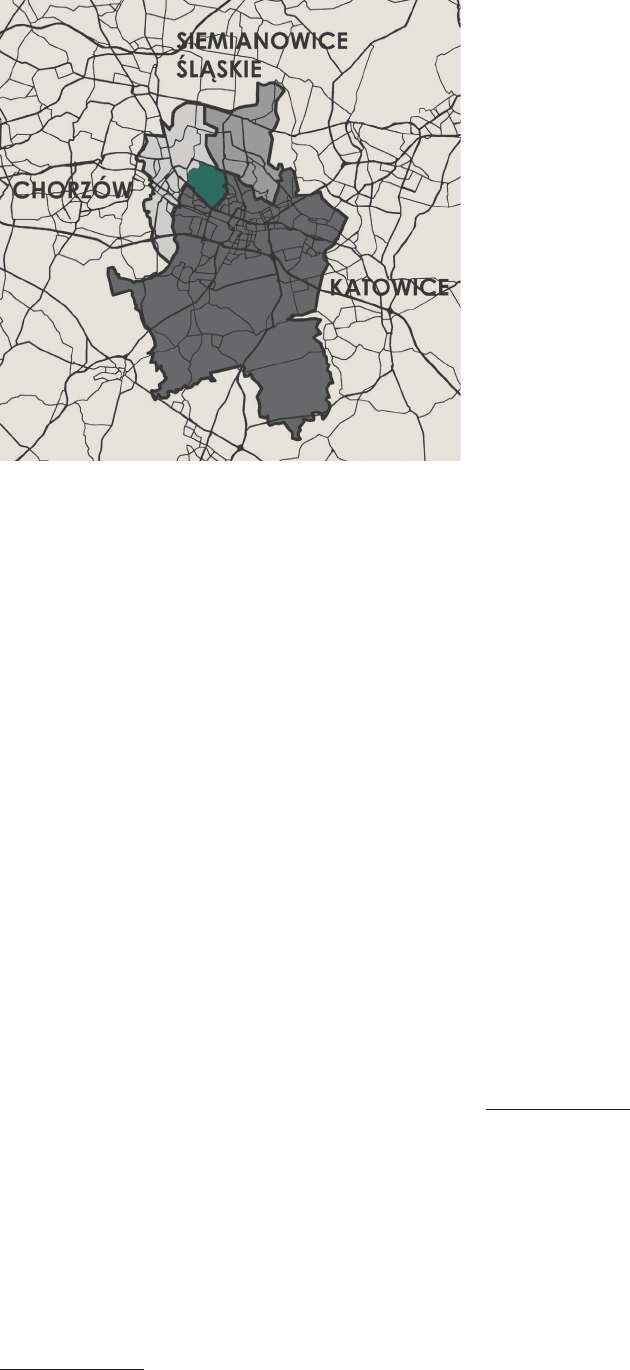
The study focuses on Silesian Park, which is currently
located within the administrative boundaries of the city of
Chorzów (Fig. 1), although it is often more closely associ-
ated with Katowice
3
. Silesian Park is undeniably the most
signicant urban green space in Upper Silesia and one of
the most distinctive of its kind in Europe. According to the
park’s ocial website, it currently covers an area of 535 ha
(“Park w liczbach”, Park Śląski n.d.), making it one of the
largest urban parks on the continent. To provide a scale of
comparison, some of the world’s most iconic urban parks
can be mentioned – Hyde Park in London (159 ha) and Cen-
tral Park in New York City (341 ha). Combined, their total
area is still smaller than the area of Silesian Park.
The aim of this study is to analyze the current condition
of the compositional values of Silesian Park and to assess
the alignment of the overall spatial layout with its original
design, as well as to evaluate the eectiveness of existing
conservation protection measures. The motivation behind
this work is the desire to save the park from further transfor-
mations, most of which are irreversible. As of June 2024
4
,
no documents exist to support a decision to grant the park
comprehensive, area-based conservation protection. The
rst and fundamental step in this direction is to analyze the
extent of degradation of the Silesian Park’s structure, to de-
termine the degree of loss of its authenticity and integrity in
relation to the original design, and to examine the existing
forms of conservation protection and their eectiveness, so
that the park can survive as part of the Upper Silesian cul-
tural, historical, and natural heritage.
Methods
The work was conducted in 2023–2024 in three main
stages:
1. Analysis of existing research and a review of avail-
able sources, as well as planning and strategic documents
related to Silesian Park.
2.
In situ investigations, including the delimitation of the
study area, photographic and cartographic inventory, along
3
When the decision to create the WPKiW was made, the land legally
belonged to the city limits of Katowice. This changed in 1967, when, pursuant
to the Regulation of the Council of Ministers concerning the alteration of
the city boundaries of Chorzów and Katowice, the WPKiW territory was
transferred in exchange for the land needed to build the “Tysiąclecia” housing
estate (Rozporządzenie Rady Ministrów… 1967).
4
Author’s update (2025): Pursuant to Resolution No. XVI/187/2025 of
the Chorzów City Council dated 24 April 2025, concerning the initiation of work
on the establishment of a cultural park in Chorzów under the name “Silesian
Park – Cultural Park”, steps have been taken to place Silesian Park under
conservation protection. This initiative was undertaken, among other reasons,
based on consultations with the author of this article and Professor Magdalena
Żmudzińska-Nowak (supervisor of the author’s master thesis), as well as
the presentation of her master’s thesis entitled Studium architektoniczno-
konserwatorskie Parku Śląskiego [Architectural and Conservation Study of
Silesian Park], which provided the foundation for this publication.
Fig. 1. Location of Silesian Park in relation to cities:
Chorzów, Katowice and Siemianowice Śląskie
(elaborated by P. Czubaj, based on Google Maps, 2024)
Il. 1. Lokalizacja Parku Śląskiego względem Chorzowa, Katowic
i Siemianowic Śląskich
(oprac. P. Czubaj, na podstawie Google Maps, 2024)
Analysis of the transformation of the spatial structure of Silesian Park and its conservation status 61
with functional analyses and an assessment of the condition
of the area and the existing complexes, architectural struc-
tures, and small-scale architecture.
3. Analysis of the collected materials and conclusions,
including the stratigraphy of the park area and its evalua-
tion, as well as an assessment of the legal protection status
in the light of applicable regulations.
State of research
Most of the bibliographic entries concerning Silesian
P
ark consist of collections of photographs of the site from
various years, accompanied by brief, anecdotal descriptions
of events that took place there. However, such publications
do not provide any new information regarding the spatial
layout, architecture, or development of the park. There are
few scholarly studies addressing the park in a scientic man-
ner.
The most important among them are:
– Wojewódzki Park Kultury i Wypoczynku w Chorzowie
(Park Śląski) – Historia obiektu, kompozycja przestrzen-
na [The Voivodeship Park of Culture and Recreation in
Chorzów (Silesian Park) – history and spatial composition]
– which present a simplied history of the site and its spa-
tial development, as well as describe the general spatial
structure of the tree stand (Fortuna-Antoszkiewicz, Łu-
kaszkiewicz and Wiśniewski 2016),
– To, co zrobiłem to nie jest nic wielkiego [What I did is
nothing signicant] – discussing part of Jerzy Gottfried’s
architectural legacy, including structures within the park
(Syska 2017),
– Przyczyny wyburzenia wieży warzywno-ogrodniczej
Othmana Ruthnera w Wojewódzkim Parku Kultury i Wy-
poczynku w Chorzowie – utracone dziedzictwo innowacji
technicznej [The reasons for the demolition of the vegeta-
ble and garden Tower of Othmar Ruthner in the Woivod-
ship Park of Culture and Recreation in Chorzów - the lost
heritage of technical innovation] – describing the issues
related to one of the most iconic structures built within the
park (Kleszcz 2021),
– Park wielu pokoleń [The park of many generations]
– the rst presenting the history of six decades of the park’s
operation (Buszman, Respondek 2016),
– Park Śląski w Chorzowie. Projekty i realizacje z lat
1950–1989 [Silesian Park in Chorzów. Projects and Re-
alizations from 1950 to 1989] – describing the history of
the park’s creation, the design phases, urban planning and
architecture within the park, changes in its structure, and
compiling an extensive collection of archival materials re-
lated to projects in this area (Borowik 2020).
The authors of these publications address architectural
projects, land development, artistic details, and history;
however, they do not refer to the issues of transformations,
degradation, or conservation protection of Silesian Park
and its constituent elements.
The author of this article managed to access rich, pre-
viously unpublished source materials in the archives of
Silesian Park, including archival maps, architectural and
spatial planning designs, original descriptions, tree plant-
ing schemes, and plans for structures that were never built.
A valuable source of information was also the review of
local daily newspapers and industry magazines, such as
archival issues of the monthly journal of the Association
of Polish Architects, Architektura (1951–1989), Trybuna
Robotnicza (1949–1980), Dziennik Zachodni (1951–2014),
and Trybuna Śląska (1951–2003). Additionally, the author
collected planning and strategic documents related to the
subject of the study, as well as documentation concerning
objects/structures listed in the Voivodeship Register of Im
-
movable and Movable Monuments (including decisions of
the Voivodeship Conservator of Monuments regarding en-
tries to the register, object inventory cards, appeals against
the decisions, and decisions concerning the removal of ob-
jects from the register)
5
.
Results
In situ research
• Delimitation of the boundaries of Silesian Park
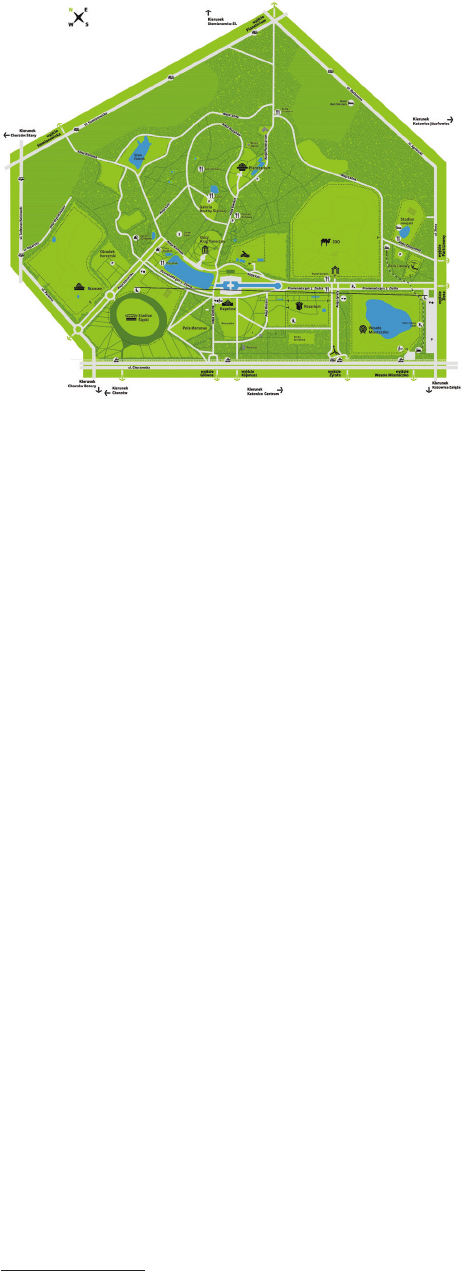
On maps of Silesian Park available online, its area is de-
ned as the territory enclosed by the following streets: Par-
kowa, Tadeusza Kościuszki, Siemianowicka (Chorzów),
Byt kowska, Agnieszki, Złota and Chorzowska (Katowice)
(Fig. 2).
However, there are areas that are not part of the park
– they are neither managed by the park authorities nor as-
signed to the administrative area of the city of Chorzów
(in which the entire territory of Silesian Park is located).
These areas should be excluded from park maps, but due
5
Documents obtained from the Voivodeship Conservator of Mo-
numents in Katowice: Decisions regarding listing of objects/structures
from the Silesian Park in the register of immovable monuments:
K-RD.5130.6.2012.KL, K-RD.5130.7.2012.AK, K-RD.5130.35.2016.PŚ,
K-RD.5140.103.2022.MB including appeals; Decisions regarding listing
of objects/structures from the Silesian Park in the register of movable
monuments: L.dz.PSOZ-53300/B/32/2/92, K-RD-KL/4150/19232/11/10,
K-RD-KL/4150/4182/2/10 and DOZ-OaiK-6700/1528/14-[ML/178/14].
Fig. 2. Map of the park (source: Śląska Organizacja Turystyczna n.d.)
Il. 2. Mapa parku (źródło: Śląska Organizacja Turystyczna n.d.)
62 Patrycja Czubaj
to simplications in the preparation of mostly schematic
maps, they are often articially included within the park’s
boundaries. The park area does not include the following
territories:
– the “Węzłowiec” housing estate (near Siemianowicka
Street),
– the “Kolonia Agnieszki” housing estate (near Bytkow-
ska Street),
– housing estates along Agnieszki Street,
– residential buildings along Tadeusza Kościuszki Street.
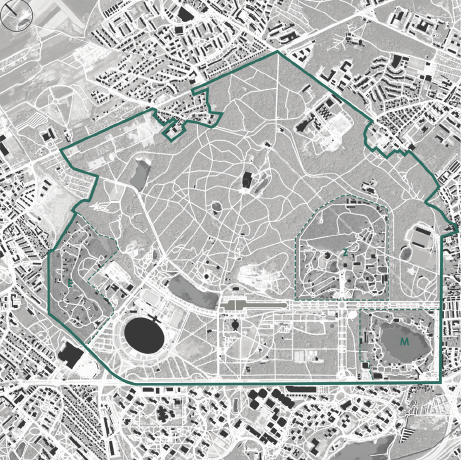
The actual park area is enclosed by the following streets:
Siemianowicka, Bytkowska, Agnieszki, Bukowa, Złota,
Cho rzow ska, Parkowa, Wycieczkowa Avenue, and Klono-
wa Avenue. The northwestern boundary line of the park is
not entirely clear and does not run along the street lines.
Between Parkowa Street and Wycieczkowa and Klonowa
Streets, the park boundary is formed by the borders of the
Upper Silesian Ethnographic Park and the “Elżbieta” Fam-
ily Allotment Gardens. The boundaries excluding the afore-
mentioned housing estates from the park area also do not
follow street lines precisely – they have been delineated
according to plot divisions (Fig. 3).
Silesian Park includes the areas of the Silesian Zoological
Garden, the Upper Silesian Ethnographic Park, and “Legen-
dia” Silesian Amusement Park (Fig. 3: Z, E, M). These
ar-
eas have been excluded from the scope of this study due to:
– their separate management structure,
– their distinct form and design,
– the nature of the activities conducted there.
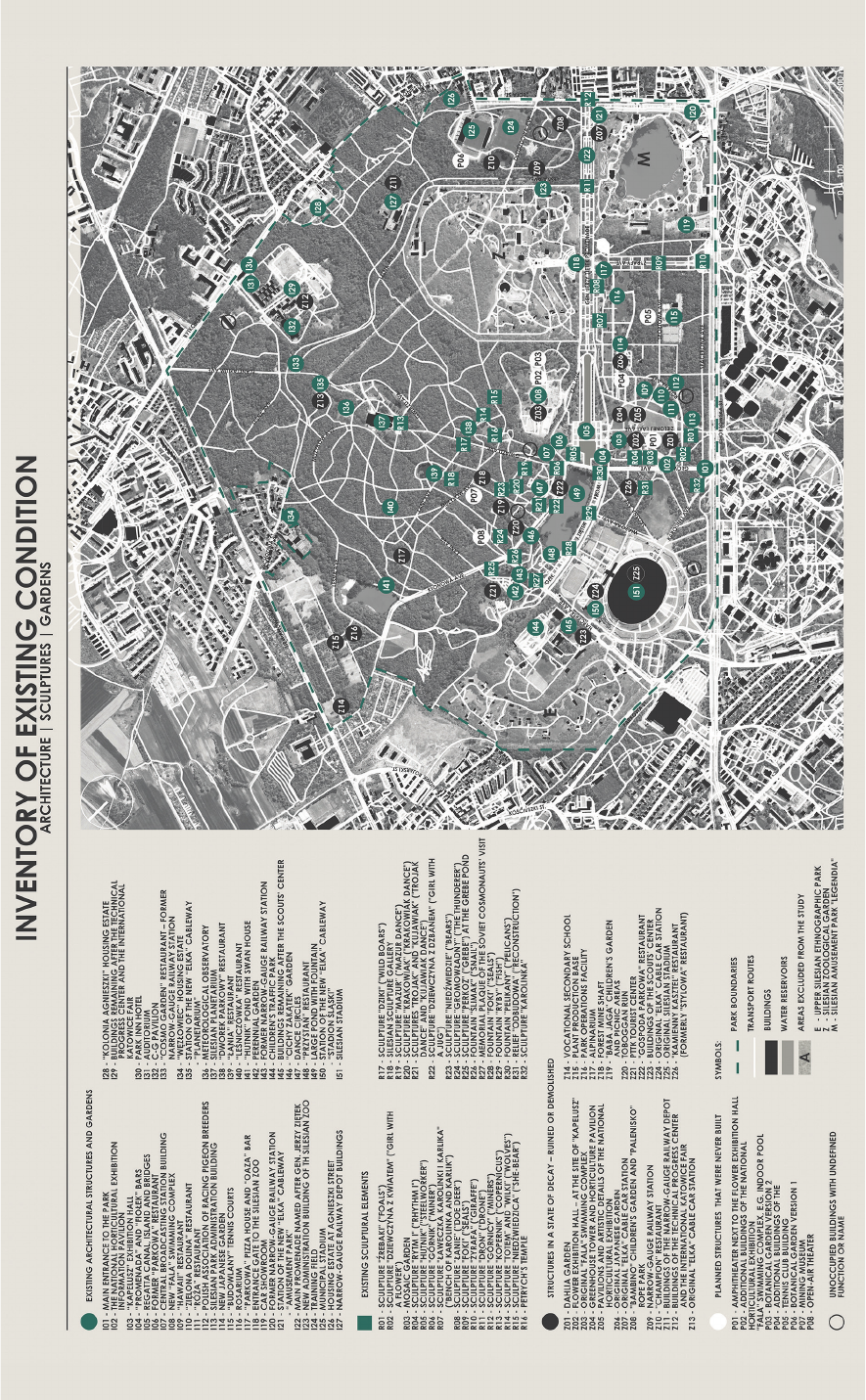
• Inventory of the compositional layout of Silesian
Park, description of the natural environment
The inventory was carried out in the form of a map of
the area, indicating ve groups of elements:
– existing architectural structures and gardens – build-
ings, structures, landscape features, and themed gardens in
good technical condition, approved for use (or under con-
struction, renovation, or modernization),
– existing artistic accents – sculptures, sculpture ensem-
bles, and decorative small architecture,
– devastated buildings – in ruins or demolished – struc-
tures in poor technical condition, not approved for use, par-
tially or completely demolished,
– planned but unrealized structures – buildings, small
ar chitectural objects/structures, landscape features, and
themed areas for which projects were developed and con-
struction was planned but ultimately not realized,
– vacant structures without dened function or name
– architectural objects/structures for which no informa-
tion exists placing them within the park’s timeline, unused,
without a specic name or designated purpose.
The inventory map (Fig. 4) was created to compare the
current state of the park with the conceptual design and ar-
chival maps.
This study does not aim to analyze the greenery, but due
to the nature of the discussed space, it is not possible to
leave this aspect without comment. According to the au-
thors of the study Wojewódzki Park Kultury i Wypoczynku
w Chorzowie (Park Śląski) – historia obiektu, kompozycja
przestrzenna, two parts diering in spatial development
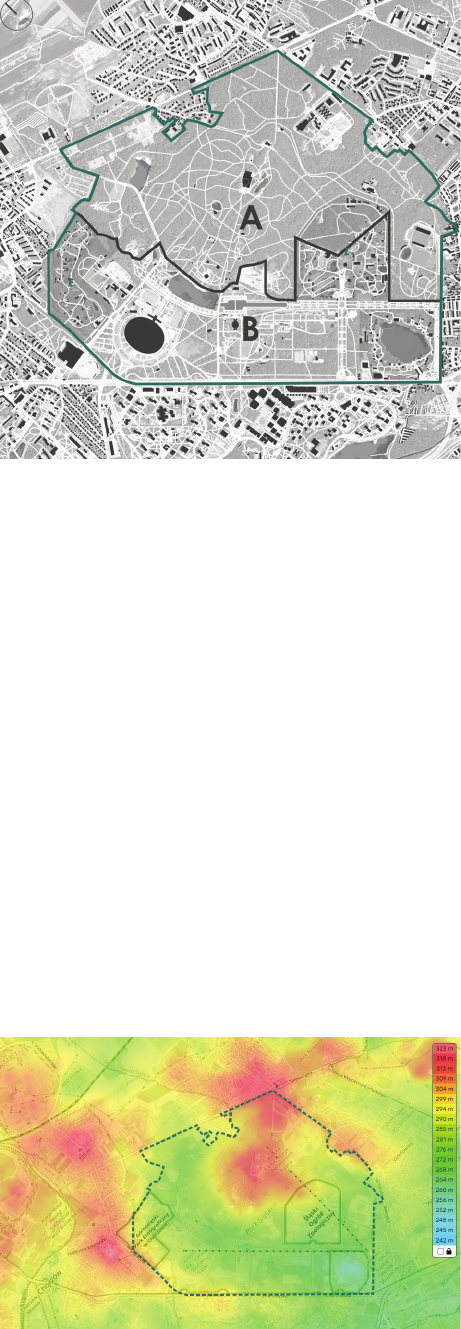
can be distinguished in the park (Fig. 5):
– Part A (intensive) with a rich program of uses and or-
ganized vegetation,
– Part B (extensive) with dense and compact tree stands
characterized by a high degree of species diversity and
mixing (Fortuna-Antoszkiewicz, Łukaszkiewicz and Wiś-
niewski 2016).
The trees in the park, thanks to careful organization, re-
present a wide range of species. The planting of trees was
main ly carried out through community involvement. Over -
all, approximately 3.5 million plants have been planted in
the park area, including 70 dierent species of trees and
shrubs. Initially, the area was aorested with pioneer plants
that grow quickly and are resistant to pollution. Later, more
rened species were added to diversify the park’s appear-
ance. Currently, the area covered by trees and shrubs is
about 260 ha, making it one of the largest collections of
this type in Upper Silesia. Among the exceptional places
related to the park’s vegetation, the Rosarium (the largest
garden of its kind in Poland, covering 7 ha) and the Peren-
nial Garden (a continuation of the former Alpinarium, now
covering 1.6 ha) should be particularly mentioned.
•
Landform
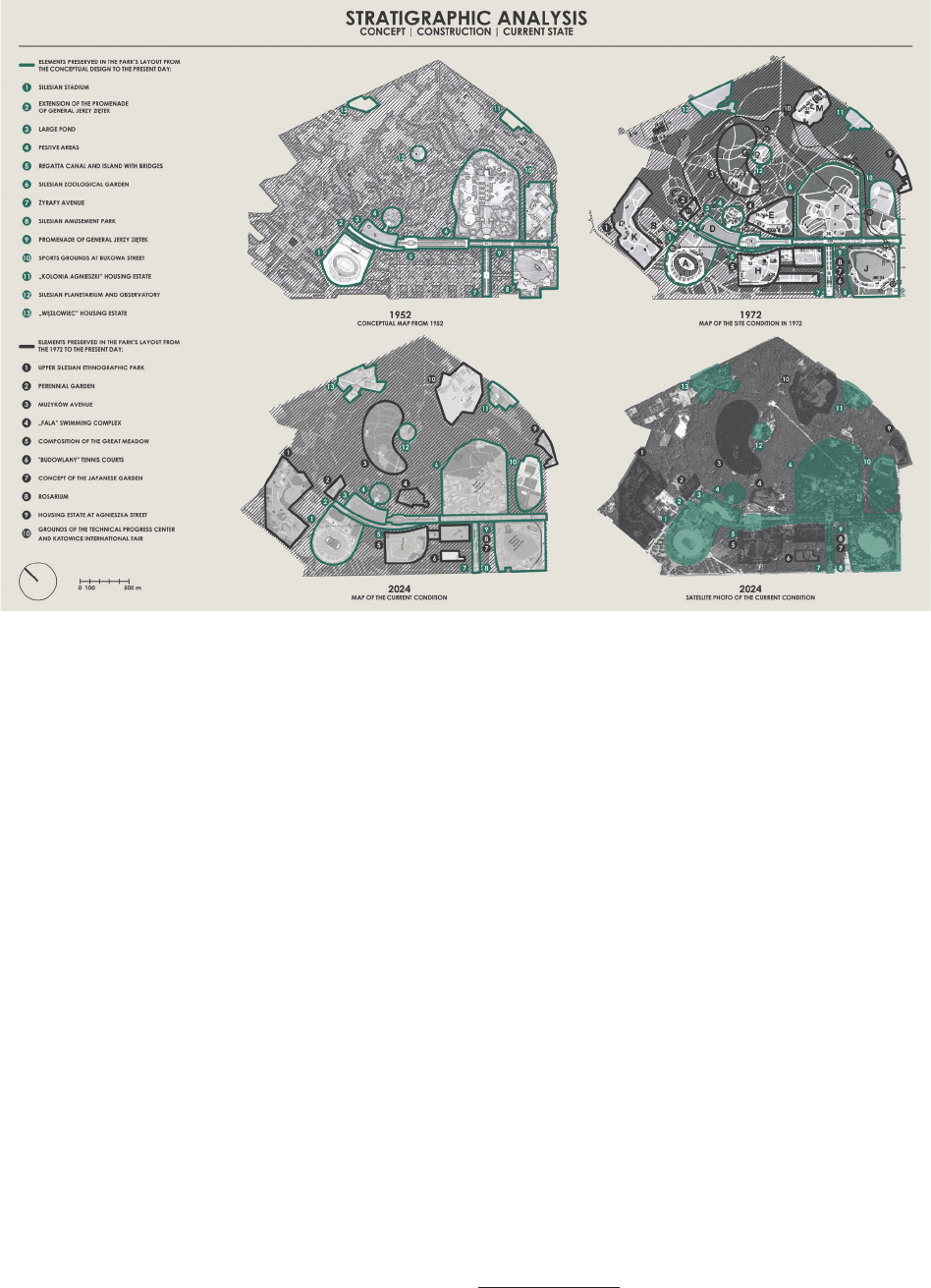
The topography of Silesian Park is clearly divided into
two areas diering signicantly in elevation: a hill in the
Fig. 3. Map of Silesian Park – its boundaries are marked in green,
with dashed lines indicating areas excluded from the study.
Z – Silesian Zoological Garden,
M – “Legendia” Silesian Amusement Park,
E – Upper Silesian Ethnographic Park
(elaborated by P. Czubaj, 2024; base maps: OpenStreetMap, Geoportal,
and the main cartographic map)
Il. 3. Mapa Parku Śląskiego – na zielono oznaczono jego granice,
linią przerywaną – obszary wyłączone z opracowania.
Z – Śląski Ogród Zoologiczny,
M – „Legendia” Śląskie Wesołe Miasteczko,
E – Górnośląski Park Etnograficzny
(oprac. P. Czubaj, 2024, podkład kartograficzny: Open Street Map,
Geoportal oraz mapa zasadnicza)
Analysis of the transformation of the spatial structure of Silesian Park and its conservation status 63
Fig. 4. Inventory of Silesian Park (elaborated by P. Czubaj, 2024; base maps: OpenStreetMap, Geoportal, and the main cartographic map)
Il. 4. Inwentaryzacja Parku Śląskiego (oprac. P. Czubaj, 2024, podkład kartograficzny: Open Street Map, Geoportal oraz mapa zasadnicza)
64 Patrycja Czubaj
central part (which houses, among others, the Silesian Plan-
etarium) and a much lower area surrounding the hill from
the southeast, south, west, and northwest sides (Fig. 6).
• Description of the general spatial and functional
organization of Silesian Park
Silesian Park can be described as a vast entertainment,
recreational, and leisure complex with a highly diverse
cha racter, function, and accessibility. Its layout is centered
around major infrastructural elements and attractions.
Functions carried out in this area include:
– entertainment – Silesian Stadium, “Legendia” Sile
-
sian Amusement Park, GKS sports eld,
– educational – Silesian Planetarium, Silesian Zoolog-
ical Garden, Children’s trac training center, Upper Sile-
sian Ethnographic Park, Silesian Sculpture Gallery,
– recreational and leisure – forested walking areas, the
Rosarium, General Jerzy Ziętek Promenade (Promena da
im. gen. Jerzego Ziętka), all park avenues, “Fala” swimming
com plex, Regatta Canal (under renovation), playgrounds,
– sports – municipal sports eld, training eld, “Budow-
lany” tennis courts, shooting range, skatepark near the
Children’s trac training center, bike path and roller-blade
track along General Jerzy Ziętek Promenade,
– service – all gastronomic points in the park,
– social – scouting center.
Analysis of collected materials
• Stratigraphic analysis of the layout – analysis
of transformations
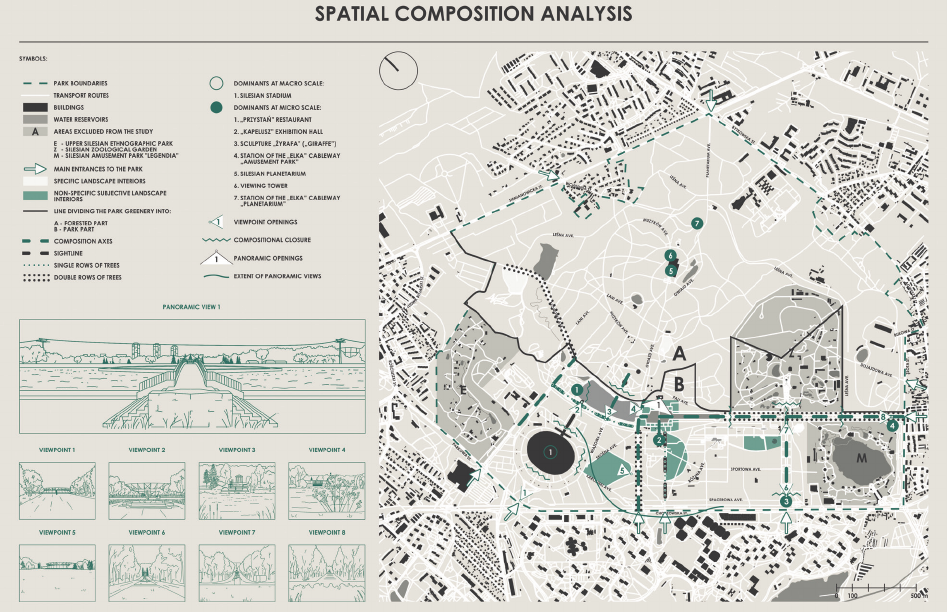
In order to determine the sequence in which the lay-
ers of development were created and to assess the state of
preservation of the spatial composition of the area from the
moment the concept was devised to its present state, three
maps were compared: the conceptual map from 1952, the
map of the existing state in 1972, and the contemporary
map in two versions – a cartographic study and a recent
satellite image.
The compositional assumptions were based on the topo-
graphic conditions of the area and on the programmatic re-
quirements imposed on the designers by the Voivodeship
National Council and the Park Construction Committee.
The architectural and landscape composition was devel-
oped to maximise the emphasis on the site’s scenic qual-
ities. The main axes were closed by the towers and chim-
neys of the industrial plants and mines existing at that time
(Borowik 2020).
The compositional directions were based on two main
assumptions:
1.
The central part of the park was designed on the slopes
of the hill dominating the area as the park’s woodland sec-
tion. At its summit, the Silesian Planetarium was located,
towering over both the park and its wider surroundings.
Paths in this area were laid out organically, in soft curves.
2. The programmatic elements were integrated into the
terrain surrounding the base of the hill. Paths and layouts in
this part of the park were designed in a regular, and in some
places geometric, manner. The compositional backbone was
a promenade running parallel to today’s Chorzowska Street,
intended to connect most of the park’s attractions (Niemiec,
Szpuner 1959).
Following the stratigraphic analysis (Fig. 7), two groups
of elements in the park’s fabric can be distinguished:
– elements preserved in the park’s layout from the con-
ceptual design to the present day,
– elements preserved in the park’s layout from the 1972
state to today.
The rst group of elements consists of structures, lay-
outs, and areas that were planned or already existed at the
Fig. 5. General spatial structure of the tree stand in Park Śląski
– status as of 2014; parts: A – intensive, B – extensive
(elaborated by P. Czubaj, based on Fortuna-Antoszkiewicz,
Łukaszkiewicz and Wiśniewski 2016, base maps: OpenStreetMap,
Geoportal, and the main cartographic map)
Il. 5. Ogólna struktura przestrzenna drzewostanu Parku Śląskiego
– stan na rok 2014; części: A – intensywna, B – ekstensywna
(rys. P. Czubaj, 2025, na podstawie Fortuna-Antoszkiewicz,
Łukaszkiewicz and Wiśniewski, 2016, podkład kartograficzny:
OpenStreetMap, Geoportal oraz mapa zasadnicza)
Fig. 6. Hypsometric map of Silesian Park
(elabroated by P. Czubaj, based on: Topographic maps)
Il. 6. Mapa hipsometryczna Parku Śląskiego
(oprac. P. Czubaj na podstawie Topographic maps)
Analysis of the transformation of the spatial structure of Silesian Park and its conservation status 65
conceptual design stage. They have retained their location,
function, and boundaries, but not necessarily their form. El-
ements that have been partially or completely trans formed
and require additional commentary not included in the gra-
phic section are:
– Silesian Stadium – despite complete transformation,
it has retained the shape planned in the concept,
– extension of the Promenade named after General Je-
rzy Ziętek – a bike path and roller-skating route have been
established parallel to the promenade,
– Regatta Canal and the island with bridges – currently
undergoing modernization,
– “Legendia” Silesian Amusement Park – similar to the
Silesian Zoological Garden, it has been transformed inter-
nally; the main gate has changed its form, but the size and
purpose of the area have not changed,
– sports areas near Bukowa Street – completely trans-
formed and partially privatized, but their function remains
unchanged.
The second group consists of structures, layouts, and ar-
eas that were not planned at the conceptual stage but were
created during later programmatic changes and existed in
the park in 1972. They have retained their location, func-
tion, and boundaries, but not necessarily their form. Ele-
ments that have been partially or completely transformed
and require additional commentary not included in the
graphic section are:
– Upper Silesian Ethnographic Park – internally trans-
formed and slightly enlarged,
– “Fala” swimming complex – the bathing facility was
demolished, and construction of a new facility with the
same function and building boundaries is ongoing,
– Large Meadow composition – a large portion of exhi-
bition facilities on its area was demolished, yet its strong
lay out based on an arc is still visible,
– “Budowlany” tennis courts – the facility was signi
-
cantly expanded,
– Japanese Garden concept – the original garden has
faded, but a new layout based on the same concept was
created in its place, designed completely dierently,
–
OPT and MTK areas
6
– mostly unused; some buildings
remain, and the area is separated from the rest of the park.
This division into two groups of elements is caused by
the abandonment of some projects planned at the concep-
tual stage even before their construction, and their replace-
ment with new functions and projects that appeared later.
•
Spatial composition analysis
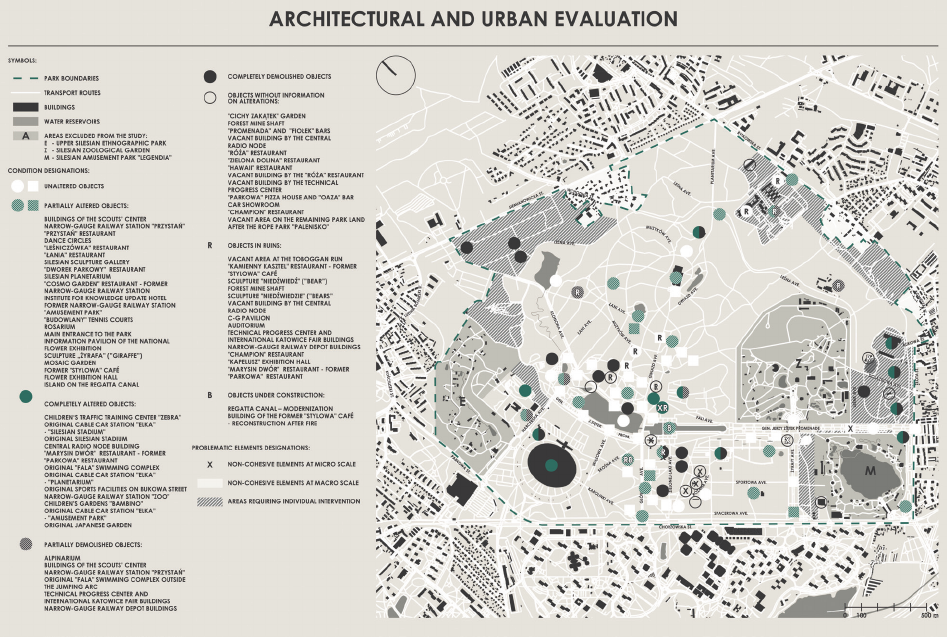
The spatial composition of the park (Fig. 8) is divided
into two distinct parts. Their division corresponds exactly
to the division of greenery in the park (described earlier
6
Technical Progress Center (Ośrodek Postępu Technicznego, OPT)
a scientic and educational institution organizing exhibitions on various
topics within a complex of pavilions. Katowice International Fair (Mię-
dzy na ro dowe Targi Katowickie, MTK) – a defunct enterprise established
in 1992 on whose premises a construction disaster occurred on January
28, 2006.
Fig. 7. Stratigraphic analysis (elaborated by P. Czubaj, 2024; base maps: Open Street Map, Geoportal, and main cartographic map)
Il. 7. Analiza stratygraficzna (oprac. P. Czubaj, 2024, podkład kartograficzny: Open Street Map, Geoportal oraz mapa zasadnicza)
66 Patrycja Czubaj
in the section “Inventory of the Spatial Composition of
Silesian Park, Description of the Natural Environment”).
The forested part of the park does not have a distinct
com positional layout. The communication routes are laid
out organically, with gentle curves. It lacks strongly per-
ceptible elements of spatial composition, such as axes or
view openings. However, it is worth noting that these were
originally created in this part but were lost due to the lack
of maintenance of the tall greenery, which caused its ex-
cessive overgrowth. This area contains few buildings but
is rich in artistic details intended to create a specic accent
contrasting with the greenery.
The park part features clearly dened elements of spa-
tial composition. It is more built-up and architecturally and
spatially diverse – most of Silesian Park attractions are lo-
cated here, and the spatial structure and its urban elements
are clearly legible. Important elements for the spatial com-
position of this part are the view openings and panoramic
openings – these have been developed in the graphic sec-
tion.
Analysis of the current legal protection
of Silesian Park
Legal protection includes both direct conservation pro-
tection and provisions in planning documents related to
protection. Among the former, the following can be distin-
guished:
– The municipal register of monuments
The Oce of the Conservator of Monuments of the Cho -
rzów City Hall included a signicant number of architec-
tural structures, plastic details, and landscaping elements
of Silesian Park on the municipal register of monuments.
However, the list contains many elements that have been
demolished, transformed, and some of which cannot be
found either in the park’s fabric or in archival materials
from this area, which may suggest that the register has not
been updated for many years. Currently, the register in-
cludes 33 objects/structures, including already demolished
ones (e.g., the historic part of the Japanese Garden), trans-
formed ones (e.g., the “Łania” restaurant), and some that no
longer exist either in the park fabric or archival materials
(e.g., the “Na kwadracie” temple).
– The voivodeship register of immovable monuments
The structures listed in the Register of Immovable Mon-
uments maintained by the Voivodeship Conservator of
Monuments in Katowice are:
– The Exhibition Hall “Kapelusz” [Hat],
– The Silesian Planetarium,
– Pavilion C-G (Exhibition Pavilion of the Technical
Progress Center).
The building of the former “Parkowa” restaurant is cur-
rently (June 2024) not included in the register. The facility
has undergone several processes of inclusion and subsequent
removal from the list at the owner’s request. At the moment,
proceedings are ongoing regarding its re-entry on the list.
Fig. 8. Spatial composition analysis of Silesian Park
(elaborated by P. Czubaj, 2024, base maps: Open Street Map, Geoportal, and main cartographic map)
Il. 8. Analiza kompozycji przestrzennej Parku Śląskiego
(oprac. P. Czubaj, 2024, podkład kartograficzny: Open Street Map, Geoportal oraz mapa zasadnicza)
Analysis of the transformation of the spatial structure of Silesian Park and its conservation status 67
The entire area of Silesian Park has never been entered
into the voivodeship register of monuments.
– The voivodeship register of movable monuments
Most of the sculptural details (sculptures, their ensem-
bles, and other elements such as gates or temples) located
within Silesian Park have been entered into the Register of
Movable Monuments maintained by the Voivodeship Con-
servator of Monuments in Katowice. Currently, the register
includes 54 structures.
In the voivodeship’s strategic documents (Uchwała Sej-
mi ku Województwa Śląskiego 2012; 2016; 2020; 2022), the
importance of Silesian Park for the region is repeatedly em-
phasized; however, none of these documents contain specif-
ic legal regulations, protection systems, or support mech-
anisms for the park. The only documents that describe the
park area in more detail and impose legally binding rules are:
The Local Spatial Development Plan of the City of Chorzów
dated January 28, 2021, which denes general principles for
shaping the space related to the park. It divides the park into
areas of nature protection greenery, park-function greenery,
public services, cultural value protection, restrictions on
larger construction due to the occurrence of voids resulting
from shallow, permanent hard coal mining, ood hazard
zones, and sports and recreation services (Obwieszczenie
Rady Miasta Chorzów 2021) and the Local Spatial Devel-
opment Plan for the area within the Voivodeship Park of
Culture and Recreation named after Gen. Jerzy Ziętek S.A.,
near the Gen. Jerzy Ziętek Promenade, Main Avenue, and
Avenue of Stars dated June 24, 2021. This plan sets general
principles for shaping a small section of the park around the
Regatta Canal (Uchwała Rady Miasta Chorzów 2021).
Summary
Assessment of the overall preservation status
of the spatial composition of Silesian Park
The spatial composition principles formulated by Wła-
dysław Niemirski during the creation of the WPKiW con-
cept have largely been preserved. Despite the park’s contin-
ued development and the addition of elements not originally
planned in the program guidelines, the main structural
foundations of the design remain clear. The park’s layout is
still based on the division of the area into a forested part on
the hill in the central part of the layout, and programmatic
elements, attractions, and a more sparsely wooded area sur-
rounding the forested part. The core compositional element
connecting most program elements remains the General Je-
rzy Ziętek Promenade.
However, several elements have faded over time and
are less perceptible in the park’s fabric. The most signi-
cant change is the loss of dominance of the hill, and thus
the Silesian Planetarium, over the rest of the park. This is
caused by insucient maintenance of the vegetation in the
forested area, resulting in its uncontrolled growth. It now
obscures the entire hill along with the Planetarium, dimin-
ishing the prominence of this key feature over the park. Ad-
ditionally, this leads to the loss of clarity in the landscape
interiors and compositional axes in this part (Fortuna-An-
toszkiewicz, Łukaszkiewicz and Wiśniewski 2016).
Another important change compared to Niemirski’s con-
cept is the loss of direct connection between the main WPKiW
entrance and the “Tysiąclecie” housing estate, caused by the
development of Chorzowska Street and the tram line. The
main entrance function has been eectively taken over by
the entrance near the “Girae” sculpture. This is most likely
due to the location of the tram stop and underground passage
leading to the housing estate at this entrance.
Architectural and urban evaluation
of Silesian Park
The architectural evaluation was conducted in two stages.
The rst part involved an individual examination of all in-
ventoried architectural structures, gardens, and sculptural
details (existing, demolished, or in ruins) in terms of three
categories:
– state of preservation,
– conservation protection status,
– degree of transformation.
Next, a visualization was created, serving as a summary
and compilation of the conducted study. As a result, a map
showing the extent of transformations of all inventoried
structures was produced (Fig. 9).
Problematic elements within the spatial layout of Silesian
Park were identied as part of the evaluation process. These
were divided into non-cohesive elements on micro and mac-
ro scales, as well as areas requiring individual intervention.
Non-cohesive elements on the micro scale consist of struc-
tures that conict aesthetically or spatially with the historic
spatial composition or the historic layout of building com-
plexes (Welc-Jędrzejewska 2017). These structures most of-
ten dier in appearance from the park’s historic fabric. Their
additional infrastructure (such as garden terraces or waste
storage areas for restaurants) spreads in a way that causes
spatial chaos or disrupts the visual exposure of more import-
ant structures. Some facilities appear grotesque in form – for
example, the “Hawaii” restaurant or the “Dron” sculpture.
Non-cohesive elements on the macro scale are similar
structures but having an impact on the entire Silesian Park
area. This category includes the housing estates “Węzło-
wiec”, “Kolonia Agnieszki”, and the area along Agnieszki
Street, which lack clear boundaries separating them from
the park. This results in transitional zones treated as no-
man’s-land, where unauthorized constructions, informal al-
lotment gardens, and illegal waste dumping sites arise.
Areas requiring individual intervention are neglected
spaces, often remnants of demolished historic structures.
These areas are very unsightly, unlit, and sometimes even
dangerous. The most urgent problems to be addressed by the
park authorities appear along the boundary line between the
park and “Legendia” Silesian Amusement Park. These zones
resemble technical support area, which negatively aect the
park’s main axis – Promenada im. gen. Jerzego Ziętka.
Conservation protection status
of Silesian Park
A signicant problem aecting Silesian Park is the func-
tioning system of the municipal register of monuments and the
68 Patrycja Czubaj
Fig. 9. Architectural and urban evaluation
(elaborated by P. Czubaj, 2024;
base maps: Open Street Map, Geoportal, and main cartographic map)
Il. 9. Waloryzacja architektoniczno-urbanistyczna
(oprac. P. Czubaj, 2024, podkład kartograficzny: Open Street Map, Geoportal oraz mapa zasadnicza)
voivodeship-level register of monuments. Their imperfection
lies in the lack of a legal obligation to maintain the park in
good technical and aesthetic condition, combined with the
possibility of deregistration when the condition deteriorates.
This creates “facilitations” for owners who are mainly inter-
ested in the potential of the land on which the monument is
located, rather than the monument itself. With a suciently
long period of neglect, the given structure falls into ruin,
which ultimately becomes grounds for its removal from the
register and allows for its demolition.
Symptoms of this phenomenon are clearly visible in
Silesian Park. Two buildings listed in the register are cur-
rently not allowed for use and no conservation or repair
works are being carried out on them – the “Kapelusz” Ex-
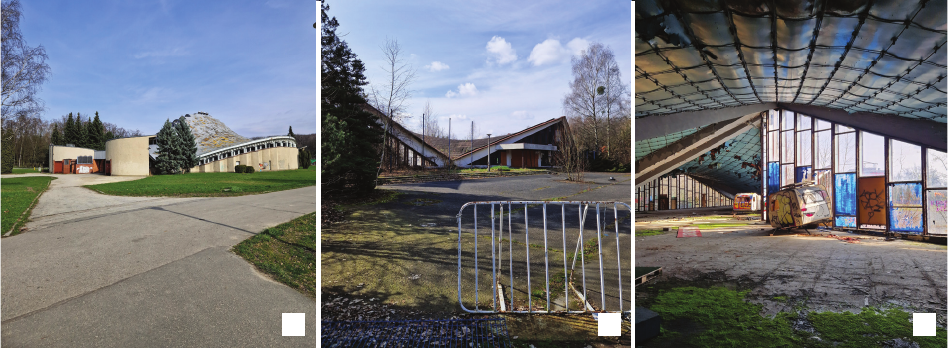
hibition Hall and the C-G Exhibition Pavilion (Fig. 10).
The latter building is in such poor technical condition that
expert evaluation showed it is impossible to restore the
building to its pre-damage state. As a result, the building
may be removed from the register and ultimately demol-
ished.
It is also worth mentioning the facilities whose protec-
tion has been carried out in the most proper manner, even
serving as examples for the rest of the park’s buildings and
the entire area.
In 2022, the complete renovation and expansion of the
Silesian Planetarium building, including the addition of
a new wing, was completed. The building retained its full
authenticity; the renovation respected every detail of the
historic structure, and the expansion was carried out in such
a way that it does not interfere with the original form of the
building’s volume.
The vast majority of sculptures within the park have
been repaired and restored, regaining their original appear
-
ance without any alteration to their forms. Several of them
have been relocated to new sites to highlight their aesthetic
value (as their previous locations became less frequented
by visitors, leading to the sculptures being neglected) and
to protect them from factors that had previously caused
their degradation.
These examples conrm that park structures can be
treated with appropriate respect and preservation of their
heritage, even if changes are needed due to the necessity
of expanding the program of the facility or changing its
function.
An important issue is also the municipal register of mo-
numents maintained by the Oce of the Conservator of
Monuments at the Chorzów City Hall – it raises questions
about the purpose of creating such a list if it is not kept up
to date.
Problems related to documents at the provincial, muni -
cipal, or city levels mainly result from the supercial na-
ture of the provisions contained therein. Most of these doc-
Analysis of the transformation of the spatial structure of Silesian Park and its conservation status 69
Fig. 10. Current condition: a) “Kapelusz” Exhibition Hall, b) exterior of the C-G Exhibition Pavilion, c) interior of the C-G Exhibition Pavilion
(photo by P. Czubaj, 2024)
Il. 10. Obecny stan: a) Hali Wystawowej “Kapelusz”, b) Pawilonu Wystawowego C-G na zewnątrz, c) Pawilonu Wystawowego C-G wewnątrz
(fot. P. Czubaj, 2024)
uments either do not address the topic of Silesian Park or
treat it very generally. These documents tend to focus more
on describing nature and monument protection in the form
of a set of principles concerning the entire area they cover.
They do not specify particular areas or structures nor im-
pose concrete legal requirements.
Although the main beneciaries of the park’s existence
are residents of three cities whose borders meet at the park’s
area, only Chorzów is responsible for its maintenance be-
cause the park lies within its boundaries. The lack of any
support from the neighbouring cities that border and use
the park is striking – especially in the case of Katowice,
which lists Silesian Park among its attractions in its ocial
documents.
The only documents that describe the park area in more
detail and impose legally binding rules are: the Local
Spatial Development Plan of the City of Chorzów dated
January 28, 2021 (Obwieszczenie Rady Miasta Chorzów
2021) and the Local Spatial Development Plan for the area
located within the Wojewódzki Park Kultury i Wypoczyn-
ku im. Gen. Jerzego Ziętka S.A., around the General Jerzy
Ziętek Promenade, Main Avenue, and Alei Gwiazd, dat-
ed June 24, 2021 (Uchwała Rady Miasta Chorzów 2021).
However, the rst document does not put sucient empha-
sis on the conservation protection of the spatial layout and
historically and culturally important structures within the
park, and the second concerns only a very small fragment
of its fabric.
The documents lack the imposition of a systemic pro-
tection that would limit chaotic and non-cohesive devel-
opment and prohibit the expansion of private spaces that
do not belong to the park but which, through uncontrolled
growth, gradually reduce its area step by step.
The urgent problem of lacking a protection system is
highlighted by recent events in the Silesian Park – in the
area of the former Technical Progress Center (OPT), sold
to a private investor, about 1,200 trees were cut down de
-
spite protests from residents and park supporters (Świer-
czek 2024).
Conclusions
The conducted research shows a high level of consisten-
cy between the current overall spatial composition of Sile-
sian Park and its original design assumptions. However,
a high degree of degradation can be observed in the archi-
tectural structure of the park’s components, which ultimate-
ly aects the perception of the entire spatial layout. Without
taking steps to halt further decay of the architectural fabric,
this problem will deepen.
Stratigraphic analysis reveals that changes occur more
frequently in the form and use of the buildings rather than
in their function.
Progressive degradation, disintegration
of the composition, and destruction of architectural struc-
tures lead to the loss of the historical, cultural, and aesthetic
values of the entire complex, as well as to further changes in
the structure – such as the sale of additional park lands and
the emergence of new developments, which are not neces-
sarily needed or appropriate for this space.
The state of conservation protection has long been in-
sucient and ineective. However, following the Chorzów
City Council’s Resolution No. XVI/187/2025 initiating the
establishment of Silesian Park as a cultural park (Uchwała
Rady Miasta Chorzów 2025), steps are now being taken to
place it under area-wide conservation protection, oering
a real chance for a positive outcome and the faithful pres-
ervation of the park’s original conceptual design, which re-
ects the best practices in green space management. The
research conducted may be used in further conservation
analyses and the preparation of eective guidelines for pro-
tecting this valuable area.
Silesian Park is a testament to history and constitutes
a unique element of Silesian cultural heritage. It is of ut-
most importance to maintain it in the best possible condi-
tion, both as a symbol of the times for future generations
and as a green island in an increasingly urbanized region.
This park is not only about attractions, buildings, avenues,
or trees – it is, above all, about the memories of countless
people, a sense of belonging, and social bonds.
cba
70 Patrycja Czubaj
Streszczenie
Analiza przekształceń struktury przestrzennej Parku Śląskiego oraz stanu ochrony konserwatorskiej
Wojewódzki Park Kultury i Wypoczynku to niepowtarzalny element śląskiej historii, urbanistyki oraz kultury. Celem opracowania jest analiza stanu
zachowania wartości kompozycyjnych Parku Śląskiego oraz diagnoza zgodności całości układu przestrzennego parku z pierwotnymi założeniami, a tak-
że ocena skuteczności dotychczasowych form ochrony konserwatorskiej, która pojawia się na tym obszarze. Motywacją do podjęcia niniejszej pracy
była chęć ratowania parku przed dalszymi przekształceniami, z których większość ma charakter nieodwracalny.
Przeprowadzone badania wykazały wysoki poziom integralności obecnego stanu ogólnej kompozycji przestrzennej parku z jego oryginalnymi za-
łożeniami przy jednocześnie daleko posuniętym stopniu degradacji tkanki architektonicznej, co może się pogłębiać przy braku podjęcia odpowiednich
kroków w kierunku ochrony konserwatorskiej całego założenia. Zjawisko to jest w większości spowodowane niewystarczającą i nieskuteczną ochroną
konserwatorską obiektu.
Słowa kluczowe: Park Śląski, Wojewódzki Park Kultury i Wypoczynku, Chorzów, park miejski, degradacja, ochrona dziedzictwa kulturowego
References
Borowik, Aneta. Park Śląski w Chorzowie. Projekty i realizacje z lat
1950–1989. Wydawnictwo Neriton, 2020.
Buszman, Łukasz, and Łukasz Respondek. Park wielu pokoleń. Wydaw-
nictwo Wojewódzkiego Parku Kultury i Wypoczynku, 2016.
Czubaj, Patrycja. “Studium architektoniczno-konserwatorskie Parku Śląs -
kiego.” Master thesis. Wydział Architektury Politechniki Śląs kiej,
2024.
Encyklopedia PWN. “Park ludowy”. Published n.d. Accessed June 25,
2024, at www.encyklopedia.pwn.pl/haslo/park-ludowy;3954402.html.
Fortuna-Antoszkiewicz, Beata, Jan Łukaszkiewicz, and Piotr Wiśniewski.
“Wojewódzki Park Kultury i Wypoczynku w Chorzowie (Park Śląski)
– historia obiektu, kompozycja przestrzenna.” Teka Komisji Urba-
nistyki i Architektury Oddział PAN w Krakowie 44 (2016): 203–13.
Geoportal. Accessed June 20, 2024, at https://mapy.geoportal.gov.pl/
imap/Imgp_2.html?gpmap=gp0.
Google Maps. Accessed June 20, 2024, at www.google.com/maps
Kamiński, Jan, and Krzysztof Jaraszkiewicz. Park Ludowy – Społeczna
koncepcja zagospodarowania Parku Ludowego w Lublinie. Forum
Rozwoju Lublina, Rada i Forum Przestrzeni, 2015.
Kleszcz, Justyna. “Przyczyny wyburzenia wieży warzywno-ogrodniczej
Othmana Ruthnera w Wojewódzkim Parku Kultury i Wypoczynku
w Chorzowie – utracone dziedzictwo innowacji technicznej.” Builder
25, no. 12 (2021): 32–5. https://doi.org/10.5604/01.3001.0015.4807.
Niemiec, Władysław, and Mieczysław Szpuner, eds. Śląski Park Kultu-
ry. Komitet Budowy Wojewódzkiego Parku Kultury i Wypoczynku,
Wydawnictwo Artystyczno-Graczne RSW “Prasa”, 1959.
“Obwieszczenie Rady Miasta Chorzów z dnia 28 stycznia 2021 r.
w sprawie ogłoszenia tekstu jednolitego uchwały XXII/430/04 Rady
Miasta Chorzów z dnia 1 lipca 2004 r. w sprawie miejscowego pla-
nu zagospodarowania przestrzennego Miasta Chorzów.” Dziennik
Urzędowy Województwa Śląskiego, 2021.1100. Published February
10, 2021. Accessed June 15, 2024, at https://dzienniki.slask.eu/le-
galact/2021/1100/.
Open Street Map. Accessed June 25, 2024, at https://www.openstreet-
map.org/#map=12/50.2775/18.9641.
Park Śląski. “Park w liczbach.” Published n.d. Accessed June 24, 2024,
at www.parkslaski.pl/park-w-liczbach.
“Rozporządzenie Rady Ministrów z dnia 12 grudnia 1967 roku w spra-
wie zmiany granic miast Chorzowa i Katowic w województwie
katowickim.” Published December 12, 1967. Accessed June 20,
2024, at https://isap.sejm.gov.pl/isap.nsf/DocDetails.xsp?id=W-
DU19670460229.
Syska, Anna. “To, co zrobiłem to nie jest nic wielkiego – hale Jerzego
Gottfrieda.” In Architektura XX wieku do lat sześćdziesiątych i jej
ochrona w Gdyni i w Europie, edited by Maria Jolanta Sołtysik and
Robert Hirsch. Urząd Miasta Gdyni, 2017.
Śląska Organizacja Turystyczna. “Park Śląski (Wojewódzki Park Kultu-
ry i Wypoczynku w Chorzowie).” Published n.d. Accessed June 15,
2024, at https://slaskie.travel/actively/2272.
Świerczek, Magdalena. “Wielka wycinka drzew przy Parku Śląskim.
Mieszkańcy protestują.” Published April 23, 2024. Accessed June
15, 2024, at https://mojchorzow.pl/i,wielka-wycinka-drzew-przy-
parku-slaskim-mieszkancy-protestuja,200274,948454.html.
Topographic maps. Accessed June 20, 2024, at https://en-gb.topograph-
ic-map.com/map-4h57/Poland/.
“Uchwała nr XXXVII/629/2021 Rady Miasta Chorzów z dnia 24 czerw-
ca 2021 r. w sprawie miejscowego planu zagospodarowania prze-
strzennego dla obszaru położonego na terenie Wojewódzkiego Parku
Kultury i Wypoczynku im. Gen. Jerzego Ziętka S.A. w rejonie Pro-
menady Gen. Jerzego Ziętka, Alei Głównej i Alei Gwiazd.” Dzien -
nik Urzędowy Województwa Śląskiego, 2021.4534. Published July 1,
2021. Accessed June 15, 2024, at https://dzienniki.slask.eu/ egalact/
2021/4534/.
“Uchwała nr XVI/187/2025 Rady Miasta Chorzów z dnia 24 kwietnia
2025 r. w sprawie podjęcia prac nad utworzeniem w Chorzowie
parku kulturowego pod nazwą ‚Park Śląski – Park Kulturowy’.”
Published April 24, 2025. Accessed July 21, 2025, at https://bip.
chorzow.eu/add_www/le/u_187_2025.pdf.
“Uchwała nr IV/28/2/2012 Sejmiku Województwa Śląskiego z dnia 12
listopada 2012 w sprawie przyjęcia Strategii Ochrony Przyrody Wo-
jewództwa Śląskiego do roku 2030.” Published November 12, 2012.
Accessed June 20, 2024, at https://www.slaskie.pl/content/strategia
-ochrony-przyrody.
“Uchwała nr V/26/2/2016 Sejmiku Województwa Śląskiego z dnia 29
sierpnia 2016 r. w sprawie przyjęcia Planu Zagospodarowania Prze-
strzennego Województwa Śląskiego 2020+.” Published August 29,
2016. Accessed June 15, 2024, at https://bip.slaskie.pl/sejmik_wo-
jewodztwa/sesje_sejmiku/uchwaly/uchwala-sejmiku-nr-v2622016 -
z-dnia-2016-08-29.html.
“Uchwała nr VI/24/1/2020 Sejmiku Województwa Śląskiego z dnia 19
października 2020 r.” Published October 19, 2020. Accessed June
20, 2024, at https://www.slaskie.pl/content/strategia-rozwoju-woje-
wodztwa-slaskiego-slaskie-2030.
“Uchwała nr VI/43/9/2022 Sejmiku Województwa Śląskiego z dnia 24
kwiet nia 2022 r. w sprawie przyjęcia Wojewódzkiego Programu Opie-
ki nad Zabytkami w województwie śląskim na lata 2022–2025.” Pu-
blished April 24, 2022. Accessed June 15, 2024, at https://dzienniki.
slask.eu/legalact/2022/3000/.
Welc-Jędrzejewska, Jolanta. “Ochrona krajobrazu kulturowego – słow-
niczek pojęć.” Published October 31, 2017. Accessed June 15, 2024,
at www.samorzad.nid.pl/baza_wiedzy/ochrona-krajobrazu-kulturo-
wego-slowniczek-pojec/.