
Introduction
Architects and persons who are not connected with
professional designing differ substantially in their assess-
ments of the esthetical value of architectural structures,
which fact has been known at least since the 1960
s
[1]–[8].
These differences can be observed quite visibly in the light
of scientifi c studies supported by experiments and sta tistics,
but not only. We know that professionals (archi tects, town
planners) engage in discussions with non-professionals
about aesthetics and a broadly understood value of struc-
tures or spaces created by them. These debates are held in
the mass media or within the framework of social consul-
tations. During these discussions designers frequen tly fi nd
out that non-professionals sometimes have no idea or sim-
ply “do not feel” intentions and messages of professionals.
At the same time, professional designers of space do not al-
ways accept postulates or needs of non-professionals. The
occurrence of such tensions between the two groups is per-
haps inevitable, although at times it can be even desirable
as it may lead to the emergence of a new quality. It seems
nonetheless important that both groups ought to attempt to
understand the character of differences existing between
them. It is possible that due to mutual understanding the
aforementioned discussions shall be carried out with more
ease and will also turn out to be more constructive.
This article constitutes a presentation of selected stu-
dies on the assessment of architectural structures by per-
sons professionally connected with designing and by non-
professionals. It also comprises a piece of research that
consisted in presenting a visualisation of the archi tectural
structure and asking for its assessment carried out in two
groups, i.e. (1) students and employees of the faculty of
2013
4(36)
DOI: 10.5277/arc130406
Michał Dębek*
Architekci i nie-architekci oceniają architekturę
Architects and non-architects assess architecture
Wprowadzenie
Przynajmniej od lat 60. XX w. wiadomo, że architek-
ci i osoby niezwiązane z profesjonalnym projektowaniem
różnią się, nierzadko zasadniczo, w ocenie wartości este-
tycznej obiektów [1]–[8]. Różnice te widać, często wyraź-
nie, nie tylko w świetle naukowych opracowań, popartych
eksperymentami i statystyką. Profesjonaliści (architekci,
urbaniści) prowadzą przecież z laikami dyskusje na temat
estetyki i szeroko rozumianej wartości kreowanych przez
siebie obiektów czy przestrzeni. Debaty te odbywają się
m.in. na łamach mediów lub w ramach konsultacji spo-
łecznych. W trakcie tych dyskusji projektanci wielokrot-
nie przekonują się, że laicy nie zawsze widzą, rozumieją
lub „czują” zamysły i przekazy profesjonalistów. Jedno-
cześnie, zawodowi projektanci przestrzeni nie zawsze ak-
ceptują postulaty czy potrzeby laików. Występowanie tego
rodzaju napięć między obiema grupami jest, być może,
nie uniknione, a niekiedy nawet pożądane – wszak może
z nich wyniknąć nowa jakość. Niemniej wydaje się ważne,
by obie grupy starały się zrozumieć naturę dzielących je
różnic. Być może dzięki wzajemnemu zrozumieniu wspo-
mniane wyżej dyskusje staną się zarówno łatwiejsze, jak
i bardziej konstruktywne.
W poniższym artykule przedstawiono przegląd wyb ra -
nych badań dotyczących oceny obiektów architekto nicz-
nych przez osoby związane z projektowaniem za wo do wo
oraz laików. Omówiono też badanie polegają ce na prezen -
tacji wizualizacji obiektu architektonicznego i prośbie o je-
* Wydział Architektury Politechniki Wrocławskiej/Faculty of
Architecture, Wrocław University of Technology.

68 Michał Dębek
architecture and (2) students and persons by no means
connected with designing. The results of qualitative ex-
ploration of associations connected with certain areas of
experiencing architecture were also presented.
What are architects and non-architects
guided by when assessing architecture?
According to Llinares et al. [7] it can be assumed that
pro fessionals when assessing architectural structures refer
to, inter alia, the quality of design, form, a building’s
style and its historical signifi cance; on the other hand,
non-professionals
1
make their assessments mainly on the
basis of the type of a given structure. The aforementioned
authors [7] emphasise the fact that architects tend to as-
sess on the basis of abstraction and notions, whereas non-
architects are rather guided by emotions in their assess-
ments. Moreover, architects prefer structures classifi ed as
the “high style”
2
, while non-architects go for the “popular
style”
3
. For non-architects popular mass architecture ap-
pearsas coherent, pleasant and clean [7] and that is why
it is preferred, although the research results in this regard
are not completely unambiguous [4].
According to some research results [4], architects and
non-professionals when adopting an emotional attitude
towards the architectural structure take into account its
totally different features. Erdogan et al. [3] proved recent-
ly that architects’ assessments are more connected with
abstract, complex and subjectively constructed features
of architectural objects/structures such as “impression”,
“meaning” or “style”, while the assessment of non-archi-
tects is more connected with physical, objective features
of a structure such as “relation of form to function”, “de-
tails”, “materials” or “context”.
It is sometimes the case that the criteria which profes-
sionals (architects, urban planners, planners) perceive as
signifi cant in the assessment of a given structure, in real-
ity for non-professionals the same criteria turn out to be
of little importance [5], [9] or features of a structure (e.g.
a form, function, historical and urban value) are mentally
processed by architects in a different way than by other
people. For instance, in one of Gifford’s et al. research
[5] architects and non-architects absolutely agreed that
a building “full of meaning” is a building “aesthetically
1
Llinares et al. [7] quote research by Linda Groat carried out in
1982, where opinions of architects and economists were compared.
2
High style – this style can be defined in many ways. According
to Stamps and Nasar [9], houses which belong to the “high (or elitist)
style” are most often shown in magazines for architects contrary to
houses which belong to the “popular style” and are more frequently
presented in popular magazines. This style also includes structures
defined as “strange” or free post-modernistic as well as those in which
more concrete is used than in popular structures, more frequently flat
roofs are employed, there are more frameless windows, more vertical
proportions, asymmetric entrances, and generally more quantity of
whiteness. In the end, these objects are untypical in that they can be
encountered less frequently than the popular ones.
3
Popular style – the reverse of the high or elitist style (connected
with high culture) addressed to the mass recipient, standard, massively
practised, frequently found.
go ocenę w dwóch grupach: (1) studentów i pracowni ków
wydziału architektury oraz (2) studentów i osób nie zwią-
zanych w żaden sposób z projektowaniem. Przed sta wiono
także wyniki jakościowej eksploracji skoja rzeń związa-
nych z niektórymi obszarami doświadczania architektury.
Czym kierują się architekci i nie-architekci,
oceniając architekturę?
Llinares i in. [7] przedstawili badania, z których wyni-
ka między innymi, że profesjonaliści w ocenie obiektów
architektonicznych kierują się: jakością designu, formą,
stylem budowli oraz jej znaczeniem historycznym; z kolei
laicy
1
dokonują oceny głównie na podstawie typu obiek-
tu. Cytowani wyżej autorzy [7] przypominają też, że ar-
chitekci oceniają raczej na podstawie abstrakcji i pojęć,
natomiast nie-architekci częściej kierują się w ocenach
emocjami. Ponadto, architekci preferują obiekty klasyfi -
ko wane jako „styl elitarny”
2
, natomiast nie-architekci wo-
lą „styl popularny”
3
. Dla nie-architektów popularna, ma-
sowa architektura jawi się jako spójna, przyjemna i czysta
[7] i między innymi dlatego jest preferowana, choć wyniki
badań w tym obszarze nie są zupełnie jedno znaczne [4].
Znane są wyniki badań [4] wskazujące, że architek-
ci i laicy, ustosunkowując się emocjonalnie do obiektu
archi tektonicznego, biorą pod uwagę zupełnie inne jego
cechy. Erdogan i in. [3] dowiedli niedawno, że ocena
archi tektów jest związana bardziej z abstrakcyjnymi, zło-
żo nymi, subiektywnie konstruowanymi cechami obiek-
tów, takimi jak „wrażenie”, „znaczenie” czy „styl”, a ocena
nie-architektów jest związana bardziej z fi zyczny mi,
obiek tywnymi cechami obiektu, takimi jak „relacja for my
do funkcji”, „detale”, „materiały” czy „kontekst”.
Bywa tak, że kryteria, które profesjonaliści (architekci,
urbaniści, planiści) uważają za istotne w ocenie este tycz-
nej określonego obiektu, w rzeczywistości, dla nie-profe-
sjonalistów okazują się mało istotne [5], [9] albo cechy
obiektu (np. forma, funkcja, wartość historyczna, ur -
banistyczna) są inaczej mentalnie przetwarzane przez
ar chi tek tów niż przez innych ludzi. Na przykład, w jed-
nym z badań Gifforda i in. [5] architekci i nie-architekci
byli bardzo zgodni, że budynek „pe
łen znaczenia” (oryg.
meaningful) to bu dynek „dobry estetycz nie” (oryg. aes-
1
Llinares i in. [7] przywołują badania Lindy Groat z 1982 r., gdzie
porównywano opinie architektów i ekonomistów.
2
Oryg. high style – styl ten może być definiowany na wiele spo-
sobów. Jak piszą Stamps i Nasar [9], domy należące do „stylu elitarne-
go” są częściej pokazywane w czasopismach przeznaczonych dla
architektów, w przeciwieństwie do domów należących do „stylu popu-
larnego”, pokazywanych częściej w czasopismach popularnych. Do
stylu tego zaliczane są również obiekty „dziwne” lub dowolne postmo -
dernistyczne oraz takie, w których wykorzystuje się więcej betonu niż
w obiektach popularnych, częściej płaskie dachy, więcej bezramowych
okien, bardziej wertykalne proporcje, asymetryczne wejścia, większą
ilość bieli. W końcu są to obiekty nietypowe, w rozumieniu ich rzad-
szego niż obiektów popularnych występowania.
3
Oryg. popular style – odwrotność stylu elitarnego (związanego
z kulturą wysoką), adresowany do odbiorcy masowego, standardowy,
masowo praktykowany, często spotykany.

Architekci i nie-architekci oceniają architekturę /Architects and non-architects assess architecture 69
good”. However, assessing the “meaning”
4
of a structure
each group took into account its other physical features,
which as a consequence led to almost a complete discre-
pancy in the assessment which of the presented structures
is “meaningful” (and therefore, discrepancies in the fi nal
aesthetic judgements as to the particular structures).
According to Erdogan et al. [2], tastes connected with
products of culture (and therefore e.g. with architecture)
are shaped to a large extent by structures and contents
of knowledge constituted in the observer’s mind. These
structures and contents condition perception – they act as
a specifi c “fi lter” through which a sensual impression fl ows
(e.g. visual) before the observer’s mind fi nally builds an
observation, therefore, inter alia, the observer shall under -
stand the structure in a defi nite way and can assess it. To-
day, it is clear that in connection with the particular system
of architects’ education, most probably their structures of
knowledge – no matter how divided in this specifi c group
– statistically differ from structures existing in non-archi-
tects’ minds [2]
5
. According to Wilson [10], architects are
intensively taught, or educated “what they should like”
6
.
Brown and Gifford on the basis of their own research [11]
ascertain that architects wrongly predict negative or posi-
tive public reactions to specifi ed architectural structures
assuming that in the assessment of architecture the gen-
eral public is guided by similar criteria and perceives fea-
tures such as “complexity”, “friendliness”, “uniqueness”,
“cleanness” or “signifi cance” of a given structure in a si -
milar way. In other words, it turns out that architects
have problems with perceiving architecture with non-ar-
chitects’ eyes and measure structures by means of their
“own measure”. Moreover, they assume (perhaps not quite
consciously) that others perceive architecture in the same
way as they do [11]. In the subject literature [12] there
appear even radical statements indicating that architects
not only prefer structures or their features other than non-
architects but they even have problems with understand-
ing what the public likes (including investors and clients).
Summing up, in the light of the research on perceiving
architecture by architects and non-architects which has
been carried out so far, it can be inferred that for architects
completely different features of buildings constitute the
base of their positive assessment than for non-architects
and that there is no signifi cant coherence of aesthetical
assessments between these two groups.
4
For architects a significant physical feature-hint that caused
a given object to be named by them as “meaningful” was how much
metal surfaces it contained (the more metal, the more significant a struc-
ture is). For non-architects structure significance factors are the follow-
ing: existence of roundness, arcs, ornaments and landscape formation
(being picturesque) – all the features were connected with the structure
significance in a positive way.
5
It also refers to students of spatial planning and urban planners [2
].
6
What is interesting, Margaret Wilson [10] on the basis of her own
research claimed that even in a group of persons graduating from archi-
tectural studies some differences in tastes were observed depending on
the particular university they graduated from. Hence it is quite probable
that tastes of future architects are influenced to a large extent by tastes
of the particularly determined academic environment from which they
come from.
the tically good ). Jednak oceniając „znaczenie”
4
obiektu,
każda z grup brała pod uwagę inne jego cechy fi zycz ne,
co w konsekwencji doprowadziło do niemal zu peł nej nie-
zgodności w ocenie, który z prezentowanych obiektów
jest „pełen znaczenia” (a zatem również nie zgodności
w ostatecznych sądach estetycznych na temat konkret-
nych obiektów).
Jak piszą Erdogan i in. [2], gusta związane z wytwo-
rami kultury (a zatem np. architekturą) są kształtowane
w znacznym stopniu przez ukonstytuowane w umyśle ob-
serwatora określone struktury i treści wiedzy. Te struktu-
ry i treści warunkują spostrzeganie – działają jak swoisty
„fi ltr”, przez który przepływa wrażenie zmysłowe (np.
wzrokowe), zanim umysł obserwatora ostatecznie zbudu-
je spostrzeżenie, a więc m.in. zrozumie obiekt w określo-
ny sposób i go oceni. Dziś jest jasne, że w związku ze
szczególnym systemem edukacji architektów ich struktu-
ry wiedzy, jakkolwiek podzielane w tej specyfi cznej gru-
pie, najprawdopodobniej statystycznie różnią się od struk-
tur istniejących w umysłach nie-architektów [2]
5
. Jak
twierdzi Wilson [10], architekci są intensywnie „uczeni,
co ma im się podobać”
6
.
Brown i Gifford na podstawie wyników własnych ba-
dań [11] skonstatowali, że architekci błędnie przewidują
negatywne lub pozytywne reakcje publiczności na okreś-
lone obiekty architektoniczne, zakładając, że w ocenie
architektury szeroka publiczność kieruje się podobnymi
kryteriami jak oni sami i spostrzega podobnie cechy, takie
jak „złożoność”, „przyjazność”, „unikatowość”, „czys tość”
czy „znaczenie” obiektu. Innymi słowy – okazało się, że
architekci mają kłopot z widzeniem architektury oczyma
nie-architektów, mierzą obiekty „swoją miarą”. Zakładają
przy tym (być może nie do końca świadomie), że inni wi-
dzą architekturę tak samo jak oni sami [11]. W literatu rze
przedmiotu [12] pojawiają się nawet stwierdzenia rady-
kalne, wskazujące, że architekci nie tylko preferują inne
niż nie-architekci obiekty czy ich cechy, ale mają kłopoty
ze zrozumieniem, co podoba się publiczności (w tym: in-
westorom, klientom).
Podsumowując, podejmowane do tej pory badania
do ty czące spostrzegania architektury przez architektów
i nie-architektów wskazują, że zupełnie inne cechy bu-
dynków są bazą pozytywnej oceny dla architektów, a in-
ne dla nie-architektów, oraz że nie ma znaczącej spójności
ocen estetycznych między tymi dwiema grupami.
4
Dla architektów istotną fizyczną cechą-wskazówką powodującą,
że obiekt był przez nich określany jako „pełen znaczenia”, była duża
ilość powierzchni metalowych (im więcej metalu, tym bardziej znaczący
obiekt). Dla nie-architektów wskazówkami znaczenia obiektu były:
występowanie krągłości, łuków, ornamentów oraz kształtowanie krajo-
brazu (malowniczość) – wszystkie cechy miały pozytywny związek ze
znaczeniem obiektu.
5
Dotyczy to również studentów planowania przestrzennego
i planistów [2].
6
Co ciekawe, Margaret Wilson [10] na podstawie własnych badań
stwierdziła, że nawet w obrębie grupy ludzi kończących studia architek-
toniczne zaobserwowano różnice gustów, w zależności od tego, którą
konkretnie uczelnię kończą. Istnieje więc prawdopodobieństwo, że na
gust przyszłych architektów wpływają w znaczącym stopniu gusta
bardzo ściśle określonego grona akademickiego, w którym się obracają.

70 Michał Dębek
Architects and the quality of life
Architects shape an enormous part of the visual space
which surrounds “ordinary people” every day, i.e. non-ar-
chi tects. In a certain way they impose defi nite aesthe tics
from which users in fact cannot escape regardless of the fact
whether they consider it attractive and pleasant or quite the
contrary. In a general sense, it is not possible to avoid move-
ment, namely sensual perception of settlements designed
in a specifi c way, housing estates, various public buildings,
commercial buildings (such as shopping centres or offi ce
buildings), residential developments of various intensity and
fi nally elements of street furniture. Therefore, architects are
people who are co-responsible for shaping the world of eve-
ryday visual experiences of modern man and consequently
in a certain sense they probably co-shape the world of hu-
man overall experiences as well. Results of the latest Gif-
ford’s et al. research [13] show that the assessment of the ap-
pearance of a building (residential) is one of the three most
important predictors of perceived satisfaction from the place
of living, which in turn constitutes a signifi cant element of
the quality of life. However, as it was mentioned before, the
assessment of a building’s appearance by an architect does
not often have anything in common with the assessment of
the same building made by a non-professional.
An architect often strives for activating defi nite asso-
ciations, feelings and assessments among future recipients
or users of a given structure. However, it usually happens
that its recipients do not have any training in the domain
of decoding meanings, art, designing or aesthetics. Taking
this into account, we ought to bear in mind that something
which seems to be beautiful, timeless, universal, and aes-
thetic to an architect, may be perceived by an ordinary
recipient as absolutely unattractive [4], [14], [15]. Of
course, many architects are aware of the potential exist-
ence of the aforementioned discrepancies in assessments.
Wiszniowski [16] rightly suggests that the assessment of
the designed environment and discussion about it should
be held not only in a group of professionals, scientists or
journalists dealing with architecture but should also be
shared by users of this environment.
Verification of the hypothesis about differences
in assessing architecture by architects and by non-architects
In the years 2007–2010 a research project was carried
out focused on the issue of relationships of people with
architecture, in particular on their attitudes towards archi-
tectural structures [17]–[19]. This study did not deal with
relations of a practised (or taught) profession with atti-
tudes towards defi nite structures in spite of the fact that
the scheme of attitudes towards structures assumed a sig-
nifi cant infl uence of the widely understood knowledge of
the world, experiences and other cultural conditions on
the assessment of a given structure.
Consequently, in 2012 subsequent research was carried
out aimed at checking whether in Poland people who
are professionally prepared to work as architects and
practising architects differ in assessing architecture
from the people who are not connected with design-
Architekci a jakość życia
Architekci kształtują ogromną część przestrzeni wi-
zual nej codziennie otaczającej „zwykłych ludzi”, nie-
-architektów; w pewien sposób narzucają określoną es-
tetykę, od której użytkownicy przestrzeni faktycznie nie
mogą uciec, bez względu na to, czy uważają ją za atrak-
cyjną i przyjemną, czy wręcz odwrotnie. W sensie ogól-
nym nie da się przecież uniknąć poruszania się, a zatem
zmysłowego odbierania zaprojektowanych w określony
sposób miejscowości, osiedli, rozmaitych obiektów uży-
teczności publicznej, obiektów komercyjnych (takich jak
galerie handlowe czy biurowce), zabudowy mieszkanio-
wej o różnej intensywności i w końcu elementów małej
architektury. Architekci są zatem ludźmi współodpowie-
dzialnymi za kształtowanie świata codziennych przeżyć
wizualnych współczesnego człowieka, a co za tym idzie,
w pewnym sensie prawdopodobnie także współkształtują
świat ludzkich doświadczeń w ogóle. Wyniki najnowszych
badań Gifforda i in. [13] wskazują, że ocena wyglą du bu-
dynku (mieszkalnego) jest jednym z trzech najważniej-
szych predyktorów spostrzeganej satysfakcji z miejs ca
zamieszkania; ta zaś jest istotnym elementem poczucia
jakości życia. Tymczasem, jak zaznaczono wcześniej,
oce na wyglądu obiektu przez architekta często nie ma nic
wspólnego z oceną tego samego obiektu przez laika.
Architekt często dąży do aktywacji określonych skoja-
rzeń, uczuć i ocen wśród przyszłych odbiorców czy użyt-
kowników obiektu. Zwykle jednak jego odbiorcy nie ma-
ją za sobą treningu w dziedzinie dekodowania znaczeń,
sztuki, projektowania czy estetyki. Mając to na uwadze,
trzeba pamiętać, że coś, co architektowi wydaje się pięk-
ne, ponadczasowe, uniwersalne, estetyczne, przeciętnemu
odbiorcy może się wydawać zupełnie nieatrakcyjne [4],
[14], [15]. Wielu architektów ma oczywiście świadomość
potencjalnego zaistnienia wspomnianych rozbieżności
ocen. Wiszniowski [16] słusznie postuluje, by ocena pro-
jektowanego środowiska i dyskusja o nim była prowadzo-
na nie tylko w gronie profesjonalistów, naukowców czy
dziennikarzy zajmujących się architekturą, ale była rów-
nież udziałem użytkowników takiego środowiska.
Weryfikacja hipotezy o różnicach w ocenie
architektury przez architektów i nie-architektów
W latach 2007–2010 zrealizowano projekt badawczy
skoncentrowany na zagadnieniu relacji ludzi z architek-
turą, w szczególności ich postaw wobec obiektów archi-
tektonicznych [17]–[19]. Nie badano wówczas związków
wykonywanej (lub uczonej) profesji z postawami wobec
określonych obiektów, mimo że schemat postaw wobec
obiektów przewidywał istotny wpływ szeroko rozumia-
nej wiedzy o świecie, doświadczeń oraz innych uwarun-
kowań kulturowych na ocenę obiektu.
W 2012 r. przeprowadzono zatem kolejne badanie, któ-
rego celem było sprawdzenie, czy w Polsce ludzie profe-
sjonalnie przygotowywani do zawodu architekta oraz
praktykujący architekci różnią się w ocenie architek-
tury od ludzi niezwiązanych w żaden sposób z projek-
towaniem. Biorąc pod uwagę omówione wcześniej do-
Architekci i nie-architekci oceniają architekturę /Architects and non-architects assess architecture 71
ing whatsoever. Taking into consideration the aforemen-
tioned discussed reports on this issue, it seems probable
to assume the hypothesis on different ways of perceiv-
ing the architectural environment by these two groups.
Additionally, according to this research scenario, the sub-
jects were given a possibility to express their opinions
freely on architecture in open questions. This part of the
research had an explorative character.
Research project and methods
Participants
The subjects constituted 40 students and faculty staff
of the Faculty of Architecture of Wrocław University of
Technology and 36 non-professionals. The group of 40 ar-
chitects (future and practising) included 26 women and 14
men aged from 21 to 60 (Mdn = 23). Further on this group
shall be marked as “architects”. Attitudes towards an ar-
chitectural structure declared in this group were compared
with attitudes of non-architects consisting of students of
the University of Wrocław and Higher School of Pedagogy
TWP in Wałbrzych. This group comprised 36 persons, in-
cluding 26 women and 10 men aged from 19 to 30 (Mdn =
21). This group shall be referred to as “non-architects”.
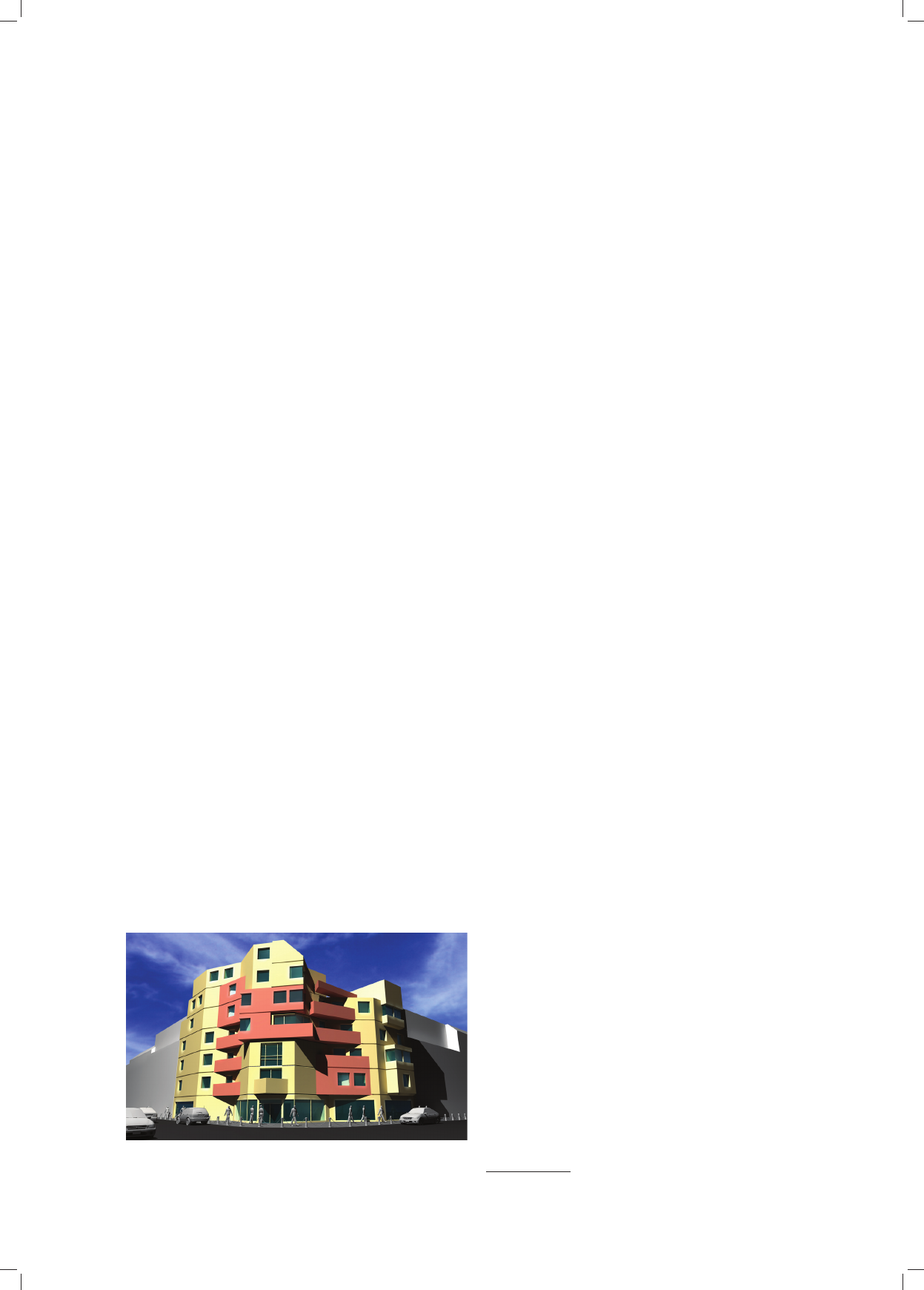
Assessed structure
The assessed structure (Fig. 1) was selected out of 12
models of architectural structures that were used in the
study on attitudes towards architectural objects carried out
in the years 2007–2010.
This model of building was given good assessments
in comparison with the remaining eleven structures (the
subjects rarely declared their negative emotions towards
this building which was associated with something posi-
tive) and it obtained high preference indexes as a possible
place of residence. Moreover, when compared with the re-
maining eleven buildings, it was characterised by average
(but stable) preference indexes as a potential work place,
commercial facility and a structure that could be situated
“somewhere in the town” where the subjects lived.
Procedure and tools
Each subject was shown a photograph of an architec-
tural structure and a Questionnaire of Attitudes Towards
Architectural Structures [6]–[8] along with a request to
express an opinion about some statements referring to this
structure such as When I look at the presented structure
I feel: ..., depressed, sad, angry respectively and I think
that the presented structure is: ..., interesting, nice, attrac-
tive. In each item the respondents were asked to tick their
opinions on a fi ve-section Likert scale from defi nitely no
to defi nitely yes. On the basis of seven items one reliable
scale was established which referred to the emotional and
cognitive attitudes towards a given structure – UDO
7
.
7
Reliability of the scale was measured by Cronbach coefficient α = 0.89.
niesienia dotyczące tego zagadnienia, prawdopodobna
wydawała się hipoteza o różnym spostrzeganiu środo-
wiska architektonicznego przez te dwie grupy.
Dodatkowo, w omawianym poniżej scenariuszu bada-
nia, jego uczestnicy mieli możliwość swobodnej wypo-
wiedzi na temat architektury w pytaniach otwartych. Była
to część badania o charakterze eksploracyjnym.
Projekt badań i zastosowane metody
Uczestnicy
W badaniu uczestniczyło 40 studentów i pracowników
Wydziału Architektury Politechniki Wrocławskiej oraz
36 osób niezajmujących się architekturą. W grupie 40 ar -
chitektów (przyszłych i praktykujących) znalazło się 26
ko biet i 14 mężczyzn, w wieku od 21 do 60 lat (Mdn = 23).
W dalszej części tekstu grupa ta oznaczana będzie jako
„architekci”. Postawy wobec obiektu architektonicznego
zadeklarowane w tej grupie były porównane z postawami
grupy nie-architektów, złożonej ze studentów Uniwersy-
tetu Wrocławskiego oraz Wyższej Szkoły Pedagogicznej
TWP w Wałbrzychu. Grupa ta składała się z 36 osób, 26
kobiet i 10 mężczyzn, w wieku od 19 do 30 lat (Mdn = 21).
W dalszej części tekstu grupa ta będzie oznaczana jako
„nie-architekci”.
Oceniany obiekt
Obiekt będący przedmiotem oceny (il. 1) został wybra-
ny spośród 12 modeli obiektów architektonicznych wyko-
rzystanych w badaniach postaw wobec obiektów architek-
tonicznych w latach 2007–2010.
Był to model budynku oceniany wysoko w porówna-
niu z pozostałymi 11 obiektami (oglądający go badani de-
klarowali wobec niego bardzo mało negatywnych emo-
cji i był on pozytywnie kojarzony) oraz uzyskał wysokie
wskaźniki preferencji jako ewentualne miejsce zamiesz-
kania. Co więcej, w porównaniu z pozostałymi 11 budyn-
kami charakteryzował się przeciętnymi (ale stabilnymi)
wskaźnikami preferencji jako potencjalne miejsce pra-
cy, obiekt handlowy i obiekt, który mógłby się znaleźć
„gdzieś w miejscowości” badanych.
Il. 1. Obiekt poddany ocenie architektów i nie-architektów
Fig. 1. Structure assessed by architects and non-architects

72 Michał Dębek
The questionnaire also included four additional ques-
tions to check to what extent the respondents would be
inclined to accept a particular building if it had a defi -
nite function (my place of residence, my place of doing
the shopping, shopping centre, my work place) or if it
was supposed to be located in a defi nite place (I would
like to have similarly looking buildings in my town). The
respondents could express their preferences using a fi ve-
section scale from defi nitely no to defi nitely yes. These
questions referred to alternative preferences as to a struc-
ture (and putting it in a specifi ed context).
Additionally, the questionnaire was extended as follows:
(1) a possibility to freely express an opinion on the presented
structure (open question), (2) two open questions requesting
us to indicate a favourite and the most disliked architectural
structure (optional and other than the one presented in the
photograph) and to describe associations connected with
this structure and (3) two open questions requesting us to
indicate the most beautiful and ugliest structure (optional
and other than the one presented in the photograph).
The whole trial lasted circa 20 minutes.
Results
Quantitative part
The fi rst verifi ed hypothesis was the following: at-
titudes towards an architectural structure differ de-
pending on whether the observer is an architect (now
or in the future) or non-architect (all other persons).
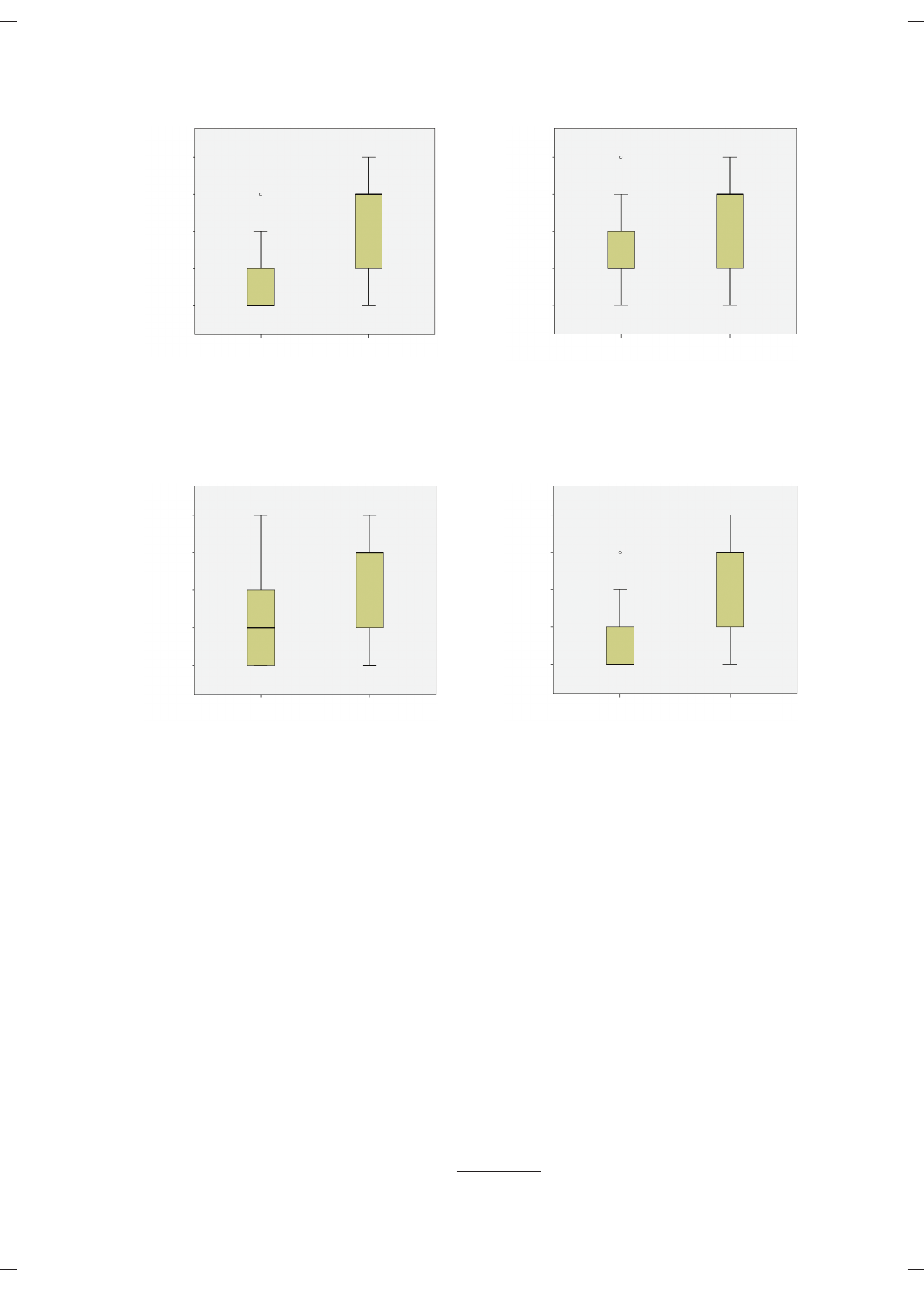
It turned out that in the case of architects a general
attitude towards a structure signifi cantly differed from
the attitude towards the same structure declared by non-
architects. A strong effect of belonging to a group upon
UDO
8
was observed (Fig. 2).
Another stage of the analysis dealt with checking to what
extent the presented structure would be preferred by the sub-
jects in various hypothetical functions (place of residence,
work place, etc.). The hypothesis verifi ed at this stage was
as follows: architects differ from non-architects in their
inclination to accept the presented structure regardless
of the function it could hypothetically perform.
In order to verify this hypothesis Mann-Whitney tests
were carried out where a grouping variable was the fact
of belonging to a group of architects or non-architects,
whereas tested variables – the respective hypothetical
func tions of a structure.
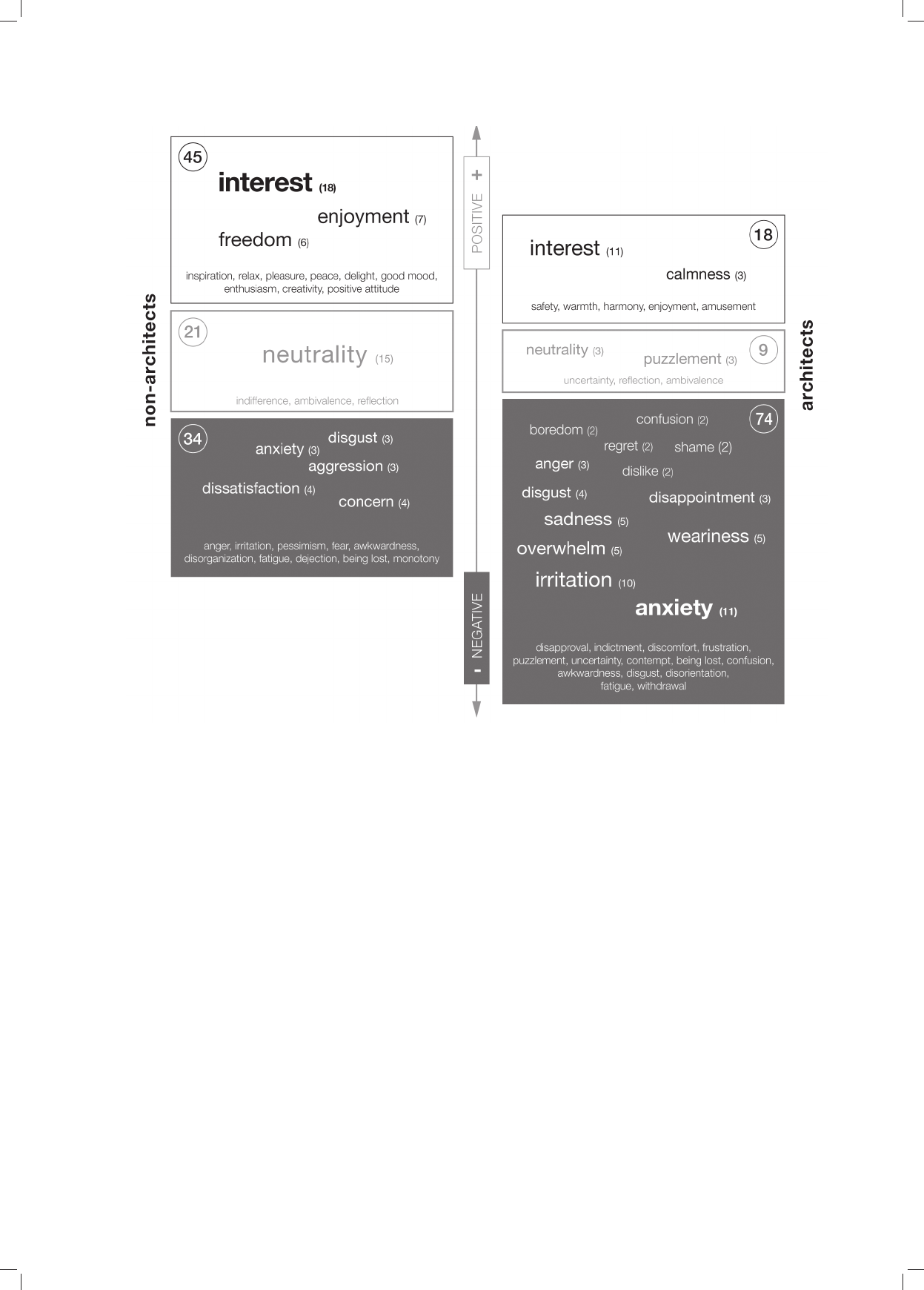
As it turned out, architects substantially differ from non-
architects in their inclination to accept the presented structure
in the case of each respective function that it could perform
9
.
Preferences of both groups are presented in Figures 3–6.
While analysing preferences of a structure in hypotheti-
cal functions, it is worth asking the question of whether
8
F(1, 75) = 34.4; p < 0.01; η
2
= 0.32.
9
Statistics for particular functions of a structure are the following:
structure as: (1) my place of residence U = 262.50, z = –4.97, p < 0.01,
r = –0.56; (2) my place of doing the shopping U = 363, z = –3.85, p < 0.01,
r = –0.44; (3) my work place U = 371, z = –3.77, p < 0.01, r = –0.43; (4)
a building somewhere in my town U = 255, z = –5.06, p < 0.01, r = –0.58.
Procedura i narzędzia
Każdy uczestnik otrzymywał zdjęcie obiektu architek-
tonicznego oraz Kwestionariusz Postaw Wobec Obiek-
tów Architektonicznych [6]–[8] z prośbą o ustosunkowa-
nie się do kilku stwierdzeń dotyczących obiektu, m.in.
Patrząc na zaprezentowany obiekt czuję się: ..., kolejno:
depre syjnie, smutny, zezłoszczony oraz Uważam, że pre-
zentowany obiekt jest: ..., interesujący, ładny, przyciąga-
jący. W każdej pozycji badany miał zaznaczyć swoje usto-
sunkowanie na pięcioprzedziałowej skali typu Likerta, od
zdecydowanie nie do zdecydowanie tak. Z siedmiu pozy-
cji utworzono jedną rzetelną skalę ustosunkowania emo-
cjonalno-poznawczego do obiektu – UDO
7
.
W kwestionariuszu znalazły się także cztery dodat kowe
pytania sprawdzające, na ile badani byliby skłonni zaak-
ceptować określony budynek, gdyby ten miał okreś loną
funkcję (moje miejsce zamieszkania, moje miejsce zaku-
pów, galeria handlowa, moje miejsce pracy) lub miał się
znaleźć w określonym miejscu (chciał(a)bym, aby w mo -
jej miejscowości były podobnie wyglądające budynki).
Również tu badani mogli wyrazić swoje preferencje na
pięcioprzedziałowej skali od zdecydowanie nie do zdecy-
dowanie tak. Były to pytania o alternatywne preferencje
obiektu (i osadzające go w określonym kontekście).
Dodatkowo kwestionariusz został rozszerzony o: (1)
możliwość swobodnego wyrażenia swojej opinii na temat
prezentowanego obiektu (pytanie otwarte), (2) dwa pyta-
nia otwarte z prośbą o wskazanie ulubionego i najbardziej
nielubianego obiektu architektonicznego (dowolnego, in-
nego niż prezentowany na zdjęciu) i opisanie skojarzeń
z nimi związanych oraz (3) dwa pytania otwarte z proś-
bą o wskazanie najpiękniejszego i najbrzydszego obiektu
(dowolnego, innego niż prezentowany na zdjęciu).
Całe badanie trwało około 20 minut.
Wyniki
Część ilościowa
Pierwsza weryfi kowana hipoteza brzmiała: postawy
wobec obiektu architektonicznego różnią się w zależ-
ności od tego, czy obserwator jest architektem (obec-
nym lub przyszłym) czy nie-architektem (wszystkie in-
ne osoby).
Okazało się, że ogólne ustosunkowanie do obiektu
przez architektów znacząco różni się od ustosunkowania
do tego samego obiektu deklarowanego przez nie-archi-
tek tów. Zaobserwowano silny wpływ przynależności do
grupy na UDO
8
(il. 2).
Kolejnym etapem analiz było sprawdzenie, na ile pre-
zentowany badanym obiekt byłby przez nich preferowany
w różnych hipotetycznych funkcjach (miejsce zamiesz-
kania, miejsce pracy itd.). Weryfi kowana na tym etapie
hipo teza brzmiała: architekci różnią się od nie-architek-
tów w skłonności do akceptacji prezentowanego obiek-
7
Rzetelność skali mierzona współczynnikiem Cronbacha α = 0,89
.
8
F(1, 75) = 34,4; p < 0,01; η
2
= 0,32.

Architekci i nie-architekci oceniają architekturę /Architects and non-architects assess architecture 73
there is a statistically signifi cance difference in preferenc-
es towards a structure depending on its functions within
each group. In other words – are architects willing to
accept the presented structure, for example, as a work
place but not as a place of residence or it does not mat-
ter to them – regardless of the hypothetical function
the structure is unacceptable? And what are the corre-
sponding preferences of non-architects like?
Therefore, the verifi ed hypothesis was as follows: pref-
erences towards a structure do not differ depending on
its imagined function within each group. For exam ple, ir-
respective of whether the structure is supposed to be a fl at,
shop or work place, I would not accept it as an architect
anyway. It turned out that architects differen tiate their
preferences towards a structure depending on a func-
tion that this structure would perform
10
. They would
accept it in certain functions more than in other functions.
Analysing closer architects’ declarations we can observe
a particularly big difference in preferences towards a struc-
ture when it was considered to be a work place or a place
of residence
11
; a big difference was also noticed when the
structure was supposed to be a place of residence or a place
of doing the shopping
12
. In fact, architects were not willing
to accept this structure at all (in any function) but they de-
clared their negative attitudes less radically if the structure
was supposed to be a work place or a place of doing the
shopping than if it was to be their place of residence or if
10
χ
2
(3) = 21.9, p < 0.01.
11
T = 41, r = –0.35.
12
T = 42, r = –0.33.
tu bez względu na funkcję, jaką hipotetycznie mógł-
by pełnić.
W celu weryfi kacji tej hipotezy wykonano testy Man-
na-Whitneya, gdzie zmienną grupującą była przynależ-
ność do grupy architektów lub nie-architektów, natomiast
zmiennymi testowanymi – kolejne hipotetyczne funkcje
obiektu.
Okazało się, że architekci znacznie różnią się od nie-
-ar chitektów w skłonności do akceptacji prezentowanego
obiek tu, w przypadku każdej kolejnej funkcji, jaką miał-
by on pełnić
9
. Preferencje obu grup przedstawiają ilustra-
cje 3–6.
Pozostając przy analizie preferencji obiektu w hipote-
tycznych funkcjach, warto zadać pytanie, czy istnieje sta-
tystycznie istotna różnica w preferencjach wobec obiek-
tu w zależności od jego funkcji w obrębie każdej z grup.
Innymi słowy – Czy architekci są skłonni zaakcepto-
wać prezentowany obiekt np. jako miejsce pracy, ale
już nie jako miejsce zamieszkania, czy raczej jest im
wszystko jedno – bez względu na hipotetyczną funk-
cję obiekt jest nieakceptowalny? A jak wyglądają ana-
logiczne preferencje nie-architektów?
Weryfi kowana hipoteza brzmiała zatem następująco:
preferencje wobec obiektu nie różnią się w zależności
od jego wyobrażonej funkcji w obrębie każdej z grup.
Czyli, na przykład: niezależnie od tego, czy obiekt miałby
być mieszkaniem, sklepem czy miejscem pracy jako archi-
tekt i tak bym go nie zaakceptował. Okazało się, że ar-
chitekci różnicuj
ą swoje preferencje wobec obiektu
w zależności od funkcji, jaką miałby ten obiekt peł-
nić
10
. W niektórych funkcjach akceptowaliby go bardziej,
a w innych mniej.
Przyglądając się bliżej deklaracjom architektów, moż-
na zauważyć, że szczególnie duża różnica w preferencjach
wobec obiektu pojawiła się wówczas, gdy miałby on być
miejscem pracy albo miejscem zamieszkania
11
; duża róż-
nica pojawiła się też, gdy obiekt miałby być miejscem za-
mieszkania albo miejscem zakupów
12
. Co prawda archi-
tekci w ogóle nie byliby chętni zaakceptować tego obiektu
(w jakiejkolwiek funkcji), ale deklarowali mniej radykal-
nie negatywne nastawienie, gdyby obiekt miał być miej-
scem pracy albo miejscem zakupów, niż gdyby miał być
ich miejscem zamieszkania lub gdyby mieli oglądać te-
go typu obiekty w ich miejscowości. Te dwa ostatnie sce-
nariusze były przez architektów zdecydowanie odrzucane.
Z kolei dla nie-architektów funkcja prezentowanego
obiektu nie wydawała się mieć kluczowego znaczenia –
we wszystkich hipotetycznych funkcjach obiekt był przez
nich preferowany statystycznie tak samo
13
.
9
Statystyki dla poszczególnych funkcji obiektu przedstawiają się
następująco: obiekt jako: (1) moje miejsce zamieszkania U = 262,50,
z = –4,97, p < 0,01, r = –0,56; (2) moje miejsce zakupów U = 363,
z = –3,85, p < 0,01, r = –0,44; (3) moje miejsce pracy U = 371,
z = –3,77, p < 0,01, r = –0,43; (4) budynek w moim mieście U = 255,
z = –5,06, p < 0,01, r = –0,58.
10
χ
2
(3) = 21,9, p < 0,01.
11
T = 41, r = –0,35.
12
T = 42, r = –0,33.
13
χ
2
(3) = 2,8, n.s.
Il. 2. Ogólne ustosunkowanie do obiektu
deklarowane przez architektów i nie-architektów.
Im wyższy wynik, tym bardziej pozytywna opinia o obiekcie i mniej
negatywnych emocji. Skala od 7 do 35 punktów, gdzie 7 oznacza
bar dzo duże natężenie negatywnych emocji oraz brak pozytywnych
opinii o obiekcie, a 35 oznacza znikome natężenie negatywnych
emocji oraz zdecydowanie pozytywne opinie.
Fig. 2. General attitude towards a structure
declared by architects and non-architects.
The higher the result, the more positive opinion about the structure
and the fewer negative emotions. The scale from 7 to 35 points, where
7 stands for a very high intensity of negative emotions and lack
of positive opinions about the structure, while 35 means a minimum
intensity of negative emotions and definitely positive opinions
architekci
architects
40
30
20
10
0
Ogólne ustosunkowanie do obiektu
General attitude towards a structure
nie-architekci
non-architects
19
74 Michał Dębek
they were to see this type of structures in their town. These
two latter scenarios are defi nitely rejected by architects.
On the other hand, for non-architects the function of
the presented structure did not seem to have a key sig-
nifi cance – in all hypothetical functions the structure was
statistically preferred by them in the same way
13
.
Qualitative part – architects and non-architects
talk about emotions and associations
connected with architecture
In the fi rst part of the qualitative research the subjects
were instructed as follows: Specify three emotions (feel-
ings, moods) which best describe your state of feelings
when you look at the structure presented in the photo-
graph. The analysis of the qualitative data in this part of
13
χ
2
(3) = 2.8, n.s.
Część jakościowa – architekci i nie-architekci
mówią o emocjach i skojarzeniach
związanych z architekturą
W pierwszej części badania jakościowego jego uczest-
nicy otrzyma li następujące polecenie: Wymień trzy emo-
cje (uczucia, nas tro je), które najlepiej opisują Twój stan,
kiedy oglądasz obiekt zaprezentowany na zdjęciu. Analiza
danych jakoś cio wych pochodzących z tej części wskazu-
je, że architekci, omawiając prezentowany obiekt, używa-
ją znacznie więcej okreś leń negatywnych (74% wszyst-
kich ich wypowiedzi) niż pozytywnych lub neutralnych
(odpowiednio 18% i 9%) (il. 7).
Taki wynik nie zaskakuje, jeśli wziąć pod uwagę, że
prezentowany obiekt architektom po prostu się nie podo-
bał i budził w nich sporo negatywnych emocji (na skali
usto sun kowania do obiektu w ilościowej części kwestio-
nariusza). Zasadniczymi odczuciami i nastrojami budzo-
nymi przez obiekt u architektów były (według ich wła-
Il. 3. Skłonność do akceptacji prezentowanego obiektu
w funkcji miejsca zamieszkania
Fig. 3. Inclination to accept the presented structure
in the function of a place of residence
Il. 5. Skłonność do akceptacji prezentowanego obiektu
w funkcji miejsca pracy
Fig. 5. Inclination to accept the presented structure
in the function of a work place
Il. 4. Skłonność do akceptacji prezentowanego obiektu
w funkcji miejsca zakupów
Fig. 4. Inclination to accept the presented structure
in the function of a place of doing the shopping
Il. 6. Skłonność do akceptacji prezentowanego obiektu
jako budynku „gdzieś w mieście”
Fig. 6. Inclination to accept the presented structure
as a building “somewhere in town”
architekci
architects
architekci
architects
architekci
architects
nie-architekci
non-architects
nie-architekci
non-architects
nie-architekci
non-architects
architekci
architects
zdecydowanie nie
definitely no
zdecydowanie nie
definitely no
zdecydowanie nie
definitely no
zdecydowanie nie
definitely no
zdecydowanie tak
definitely yes
zdecydowanie tak
definitely yes
zdecydowanie tak
definitely yes
zdecydowanie tak
definitely yes
Podobałby mi się ten obiekt jako moje miejsce
zamieszkania
I would like this object as my place of residence
Podobałby mi się ten obiekt jako moje miejsce pracy
I would like this object as my work place
Podobałby mi się ten obiekt jako
moje miejsce zakupów, galeria handlowa
I would like this object as my place of
doing the shopping, shopping centre
Chciał(a)bym, żeby w mojej miejscowości
były podobnie wyglądające obiekty
I would like to have similarly looking buildings in my town
raczej tak
relatively yes
raczej tak
relatively yes
raczej tak
relatively yes
raczej tak
relatively yes
raczej nie
relatively no
raczej nie
relatively no
raczej nie
relatively no
raczej nie
relatively no
ani tak, ani nie
neither yes nor no
ani tak, ani nie
neither yes nor no
ani tak, ani nie
neither yes nor no
ani tak, ani nie
neither yes nor no
nie-architekci
non-architects
19
19
20
Architekci i nie-architekci oceniają architekturę /Architects and non-architects assess architecture 75
the research indicates that architects when talking about
the presented structure use considerably more negative
terms (74% of all statements) than positive or neutral ones
(18% and 9% respectively) (Fig. 7).
This result is not surprising if we take into account the
fact that architects simply did not like the presented struc-
ture and it aroused many negative emotions (on the scale
of attitudes towards the structure in the quantitative part
of the questionnaire). The main architects’ feelings and
moods that the structure caused were (according to their
own free declarations) anxiety and exasperation. If posi-
tive answers appeared, they mostly used the term interest.
Interest was also one of the most frequent associations
with the presented structure declared by non-architects.
Non-architects expressed their opinions about a structure
snych, swobodnych deklaracji): niepokój i rozdrażnienie.
Jeśli pojawiały się wypowiedzi pozytywne, najczęstszym
okreś leniem używanym przez architektów było zacieka-
wienie.
Zaciekawienie było z kolei najczęstszym ze wszyst-
kich skojarzeniem deklarowanym przez nie-architek-
tów. Nie-architekci wyrażali się o obiekcie w stosunkowo
wyważony sposób. Liczba pozytywnych i negatywnych
skojarzeń z obiektem była porównywalna (odpowiednio
45% i 34% wszystkich ich wypowiedzi), pojawiła się też
znaczna liczba określeń neutralnych (21%), głównie obo-
jętność.
Kolejne pytania otwarte dotyczyły ulubionego oraz
nielubianego obiektu architektonicznego (Wyobraź sobie
Twój ulubiony/najbardziej przez Ciebie nielubiany obiekt
Il. 7. Wynik analizy eksploracji jakościowej dotyczącej prezentowanego obiektu. Na wykresie przedstawiono swobodne odpowie dzi badanych
na pytanie otwarte Wymień trzy emocje (uczu cia, nastroje), które najlepiej opisują Twój stan, kiedy oglądasz obiekt zaprezentowany na zdjęciu.
W nawiasach znajdują się odsetki wystąpień każdego z określeń w ogóle wypowiedzi określonej grupy. Określenia bez poda nej w nawiasie liczby
oznaczają pojedyncze wystą pienia. W okręgach znajdują się podsumowane odsetki odpowie dzi negatywnych, neutralnych i pozytywnych w ogóle
wypowiedzi każdej z grup
Fig. 7. Result of analysis of quantitative exploration with regard to the presented structure. The graph presents free responses of the subjects
to the following open question: Specify three emotions (feelings, moods)
which best describe your state of feelings when you look at the structure
presented in the photograph. In brackets there are percentages of occurrences of each of the terms in the statements of the particular group
as a whole. The terms which are presented without a number in brackets indicate single occurrences. In the circles there are summed up
percentages of negative, neutral and positive statements in all the statements of each group

76 Michał Dębek
in a relatively balanced way. A number of positive and neg-
ative associations with a structure was comparable (45%
and 34% of all their statements respectively); there were
also numerous neutral terms (21%), mainly indiffe rence.
Further open questions referred to favourite as well
as disliked architectural structures (Imagine your fa-
vourite/most disliked architectural structure. What kind of
structure is it?) and associations connected with it
14
.
Of course the subjects’ opinions comprised numerous
various structures. However, in the course of the analysis it
was possible to distinguish some categories with the great-
est number of indications. Among favourite structures for
architects there were fi rst of all various churches (asso-
cia ted with serenity, refl ection, harmony and warmth) and
museums such as the Warsaw Uprising Museum, Guggen-
heim Museum and the Vatican Museum (inspiring, fas-
cinating, arousing admiration and curiosity). Among the
buildings considered as favourite by non-architects also
churches were dominant (associated with satisfaction and
exultation) followed by two Wrocław shopping centres –
Renoma and Galeria Dominikańska.
On the other hand, structures that were defi nitely the
most often disliked by architects (half of all spontane-
ous declarations) were malls and shopping centres, for
instance, Magnolia, Galeria Dominikańska, Pasaż Grun-
waldzki in Wrocław, Złote Tarasy in Warsaw and the nega-
tive leader of this category – Wrocław Solpol. What is the
reason why architects dislike malls and shopping centres
so much? Of course, it depends on a particular building but
we can distinguish here certain dominants. In the case of
architects shopping centres mainly give rise to a sense of
being overwhelmed, irritation, reluctance and anger
15
. For
architects one of the most frequent associations with the
category of “shopping centre” is crowd
16
. The in famous
leader of this list, i.e. Wrocław Solpol causes aversion,
irritation, shame, sadness, grief and disgust in architects.
Shopping centres and malls were also chosen by non-
architects as disliked structures, although in much fewer
declarations than in the case of architects. For example,
the following Wrocław shopping centres were mentioned:
Magnolia and Pasaż Grunwaldzki. Similarly to the case
of architects, these disliked structures caused impatience,
boredom, irritation and a sense of being overwhelmed.
However, it must be added that non-architects who were
asked for details, unlike architects, as one of the most fre-
quently appearing associations with the general category
of “shopping centre” declare modernity
17
. Along with the
shopping centres, among the structures that were disliked
14
This instruction was as follows: Recall the most recent contact
you had with this object, e.g. visiting, sightseeing, viewing in reality or in
photographs/multimedia. Recall and enumerate three emotions (feelings,
moods) that accompanied your contact with this object most strongly.
15
A number of declarations respectively: 4, 3, 3, 3.
16
Question about open associations with the category – List the
most important three terms that you would use to characterize any shop-
ping centre/shopping mall; the main associations are respectively: spa-
ciousness, then crowd and feeling of being overwhelmed.
17
See above, however, for architects the main associations are
respectively: spaciousness, size and modernity and only further on and
much less frequently crowd.
architektoniczny. Co to za obiekt?) i związanych z nimi
skojarzeń
14
.
W wypowiedziach badanych pojawiły się oczywiście
bardzo różne obiekty. Analiza doprowadziła jednak do
wyodrębnienia kilku kategorii z największą liczbą wska-
zań. Wśród obiektów ulubionych przez architektów do-
minowały rozmaite kościoły (kojarzone ze spokojem, za-
dumą, harmonią i ciepłem) oraz muzea, m.in.: Powstania
Warszawskiego, Guggenheima i watykańskie (inspirują ce,
fascynujące, budzące podziw i ciekawość). Wśród obiek-
tów ulubionych przez nie-architektów również domino-
wały kościoły (kojarzone z zadowoleniem i uniesieniem)
oraz pojawiły się dwie wrocławskie galerie handlowe
– Renoma i Galeria Dominikańska.
Z kolei jako obiekty nielubiane architekci zdecydo-
wa nie najczęściej (połowa wszystkich spontanicznych
de kla racji) wymieniali galerie i centra handlowe, m.in.
wrocławskie: Magnolię, Galerię Dominikańską, Pasaż
Grun waldzki, warszawskie Złote Tarasy oraz negatyw-
nego lidera tej kategorii – wrocławski Solpol. Dlaczego
architekci tak bardzo nie lubią galerii i centrów handlo-
wych? Oczywiście wiele zależy od konkretnego obiek-
tu, ale i tu istnieją pewne dominanty. Obiekty handlowe
budzą w architektach głównie poczucie przytłoczenia,
iryta cję, niechęć i złość
15
. Jednym z najczęściej wystę-
pujących skojarzeń z kategorią „galeria handlowa” jest
też u ar chitektów tłum
16
. Natomiast niechlubny lider te-
go zestawienia, wrocławski Solpol, wzbudza w architek-
tach odrazę, irytację, wstyd, smutek, żal i zdegustowanie.
Galerie i centra handlowe pojawiły się wśród obiek-
tów nielubianych również przez nie-architektów, choć
w znacznie mniejszej liczbie deklaracji niż u architek-
tów. Odnotowano wśród nich m.in. wrocławskie: Magno-
lię i Pasaż Grunwaldzki. Wymienione przez nie-architek-
tów jako nielubiane obiekty wzbudzały w nich – podobnie
jak w architektach – zniecierpliwienie, znudzenie, irytację
i poczucie przytłoczenia. Trzeba jednak dodać, że dopy-
tani nie-architekci – inaczej niż architekci – jako jedno
z najczęściej pojawiających się skojarzeń z ogólną ka-
tegorią „galeria handlowa” deklarują nowoczesność
17
.
Wśród obiektów nielubianych przez nie-architektów ex
aequo z galeriami handlowymi znalazły się natomiast
dworce PKS i PKP. Dworce budzą w badanych wstręt
i różne formy strachu.
Bardzo ciekawe okazały się również deklaracje ba-
danych dotyczące najpiękniejszych i najbrzydszych
obiek tów. Spośród najpiękniejszych, które pojawiły się
w twier dzeniach architektów więcej niż dwukrotnie, znaj-
14
Polecenie brzmiało: Przypomnij sobie swój ostatni kontakt z tym
obiektem, np.: wizyta, zwiedzanie, oglądanie w rzeczywistości lub na
zdjęciach/multimediach. Przypomnij sobie i wymień trzy emocje (uczu-
cia, nastroje), które najsilniej towarzyszyły kontaktowi z tym obiektem.
15
Liczba deklaracji odpowiednio: 4, 3, 3, 3.
16
Pytanie o otwarte skojarzenia z kategorią – Wymień trzy naj waż-
niejsze określenia, którymi scharakteryzował(a)byś dowolne cen trum
handlowe/galerię handlową; głównymi skojarzeniami są kolej no prze-
stronność, następnie tłum i uczucie przytłoczenia.
17
Jak wyżej; z tym że u architektów głównymi skojarzeniami są
kolejno: przestronność, wielkość i nowoczesność, dopiero później, znacz-
nie rzadziej, tłum.

Architekci i nie-architekci oceniają architekturę /Architects and non-architects assess architecture 77
by non-architects there were also bus stations and railway
stations. Railway and bus stations cause disgust and vari-
ous forms of fear.
Also the subjects’ declarations with regard to the most
beautiful and ugliest structures turned out to be very in-
teresting. Architects more than twice mentioned in their
sta tements as the most beautiful structures Catalonian Sa-
grada Família and Japanese Church of the Light by Tadao
Andō. Interestingly enough, Sagrada Família was also cho-
sen as the most beautiful building by two non-architects.
However, most often non-architects pointed to unspecifi ed
small “tenement houses” as the most beautiful buildings.
In predominant opinions of architects the ugliest build-
ing is Wrocław Solpol. Non-architects most often men-
tion unspecifi ed “block housing estates” as the ugliest and
similarly to the category of disliked structures, stations
(most often the central bus station in Wrocław).
Discussion of results
In the light of the conducted research, it was proved that
general attitudes towards an architectural structure prob-
ably depend to a large extent on whether an assessing per-
son is professionally connected with architecture or not.
A particular structure analysed during the quantitative
part was on the whole assessed by architects negatively,
whereas by non-architects it was perceived rather positi-
vely. This structure would be rather preferred by non-archi-
tects as well, regardless of its hypothetical function, where-
as architects defi nitely rejected it in almost every function.
On the other hand, qualitative exploration shows that
quantitative research results do not reveal the “whole
truth” about people’s attitude to a structure. In the case of
architects, the questionnaire results are almost completely
coherent with the results of the analysis of their free state-
ments on the presented structure, while in the case of non-
architects we can see that “enthusiastic” results of quan-
titative research may be misleading in a sense. As it turns
out, non-architects did not assess the presented structure
unambiguously positively at all (however, much more
positively than architects).
The qualitative character of a difference in assessments
of a structure by architects and non-architects involves
the fact that architects mainly had unambiguous negative
associations, while non-architects’ associations were var-
ied, i.e. they were mostly indifferent. Of course, it does
not change the fact that – if we take into account extreme
statements – a structure that is associated with anxiety,
irritation and sadness by architects, in the case of non-
architects causes (in similar proportions) interest, free-
dom, and joy, which may constitute a fundamental differ-
ence in a qualitative aspect of assessments.
Free associations of the subjects with liked, disliked,
beautiful and ugly architecture and spontaneous indica-
tions of the structures that best represent these categories
may constitute an interesting starting point for further dis-
cussion on the nature of differences in perception of archi-
tecture by professionals and persons who are not connect-
ed with designing. Inasmuch as the structures which are
declared as liked by both groups are most often various
dują się: katalońska Sagrada Família oraz japoński Ko-
ściół Światła autorstwa Tadao Andō. Co ciekawe, Sagra-
da Família pojawiła się jako najpiękniejszy obiekt także
w dwóch deklaracjach nie-architektów. Najczęściej jed-
nak jako najpiękniejsze obiekty nie-architekci wskazywa-
li bliżej nieokreślone „kamieniczki”.
Najczęściej wymienianym przez architektów jako
obiekt najbrzydszy jest wrocławski Solpol. Nie-architek-
ci jako najbrzydsze wymieniają najczęściej niedookreślo-
ne „blokowiska” oraz, podobnie jak w przypadku katego-
rii obiektów nielubianych, dworce (najczęściej dworzec
PKS we Wrocławiu).
Omówienie wyników
Badanie pokazało, że ogólne ustosunkowanie wobec
obiektu architektonicznego prawdopodobnie w znacznej
mierze zależy od tego, czy ocenia go osoba związana czy
niezwiązana profesjonalnie z architekturą.
Będący przedmiotem analiz w części ilościowej kon-
kretny obiekt, oceniany przez architektów na ogół nega-
tywnie, przez nie-architektów był odbierany raczej po-
zytywnie. Obiekt ten byłby też raczej preferowany przez
nie-architektów, bez względu na jego hipotetyczną funk-
cję. Architekci natomiast zdecydowanie odrzucali go
w niemal każdej funkcji.
Eksploracja jakościowa pokazuje z kolei, że wyniki ba -
dania ilościowego nie ujawniają „całej prawdy” o usto sun-
kowa niu ludzi do obiektu. O ile u architektów wyniki kwe-
stio nariusza są niemal zupełnie spójne z wyni kami analizy
ich swobodnych wypowiedzi na temat prezentowanego
obiektu, o tyle u nie-architektów widać, że „entu zjastyczne”
wyniki badania ilościowego mogą być w pewnym sensie my -
lące. Okazuje się bowiem, że nie-architekci wcale nie oce-
niali prezentowanego obiektu jednoznacznie pozytywnie
(aczkolwiek znacznie bardziej pozytywnie niż architekci).
Jakościowy charakter różnicy w ocenach obiektu przez
architektów i laików polega na tym, że u architektów
obiekt wzbudzał głównie jednoznacznie negatywne skoja-
rzenia, a u nie-architektów te skojarzenia bywały różne,
w znacznej mierze obojętne. Co oczywiście nie zmie-
nia faktu, że – jeśli wziąć pod uwagę wypowiedzi skraj-
ne – obiekt kojarzony przez architektów ze niepokojem,
rozdrażnieniem i smutkiem, u nie-architektów wywołuje
(w podobnych proporcjach) zaciekawienie, swobodę i ra-
dość, co może stanowić fundamentalną różnicę w jakoś-
ciowym wymiarze ocen.
Swobodne skojarzenia badanych z lubianą, nielubia-
ną, piękną i brzydką architekturą oraz spontaniczne wska-
zania obiektów najlepiej reprezentujących te kategorie
mogą stanowić ciekawy punkt wyjścia dalszych rozwa-
żań o naturze różnic w odbiorze architektury przez profe-
sjonalistów i osoby niezwiązane z projektowaniem. O ile
obiektami lubianymi przez obie grupy są najczęściej roz-
maite kościoły, kojarzące się obu grupom podobnie, o tyle
obiekty wymieniane najczęściej jako nielubiane są róż-
ne w zależności od grupy. Wydaje się, że architekci mo-
gą przejawiać wyjątkową awersję do galerii handlowych
(jako kategorii obiektów). Taka awersja u nie-architektów
występuje bardzo rzadko. Laicy natomiast jako nielubiane

78 Michał Dębek
wyjątkowo często wymieniali dworce PKP i PKS, których
z kolei architekci nie wymieniali w ogóle.
Podstawową przyczyną nielubienia przez architektów
galerii handlowych może być zatłoczenie, będące jednym
z najczęstszych ich skojarzeń z tą kategorią obiektów. Jak
wiadomo, zatłoczenie czy przegęszczenie to jedne z najsil-
niejszych stresorów środowiskowych [20], [21]. Doświad-
czanie przez badanych stresu środowiskowego w przeszło-
ści (prawdopodobnie niejednokrotne) mogło być na tyle
nieprzyjemne, że wytworzyło, w pewien sposób adaptacyj-
ną, silną i dostępną poznawczo, nega tywną konotację z ca-
łą kategorią „galerie handlowe”. W kon sekwencji mog ło to
doprowadzić do silnie afektyw nej oce ny poszczególnych
egzemplarzy tej kategorii (np. kon kretnej, wrocławskiej
galerii handlowej – Pasażu Grun waldzkiego)
18
. Krótko
mówiąc – bez względu na to, czy obiekt jest estetycznie
atrakcyjny, czy nie, jeśli reprezen tuje negatywnie konoto-
waną kategorię poznawczą, jego ocena może być bazowo
niższa, niż gdyby reprezentował kategorię konotowaną po-
zytywnie.
W przypadku architektury kategoryzacja poznawcza
i jej ewaluacja może być ściśle związana nie tylko z for mal-
nym wymiarem spostrzeganego obiektu, czy nawet re lacją
jego formy i funkcji; wyniki prezentowanej w tym artyku-
le eksploracji jakościowej wskazują, że bardzo is tot nymi
czynnikami w ewaluacji obiektu mogą być doświadczo-
ne przez podmiot lub antycypowane zdarzenia, które mia-
ły, mają lub będą miały miejsce wewnątrz całej kategorii
obiektów, do których należy ten oceniany (np. zatłoczenie
w kategorii „galerie handlowe”). W tym sensie ciekawa
konstatacja Alexandra, że […] to, co ma znaczenie w bu-
dynku czy mieście to nie ich zewnętrzny kształt czy sama
fi zyczna geometria, ale zdarzenia, które mają w nich miej-
sce [23, s. 65–66], może być bardzo blis ka prawdy o pod-
stawach naszych sądów dotyczących architektury.
Spontaniczne wskazania dotyczące najpiękniejszych
i najbrzydszych obiektów pokazują oczywiście, że archi-
tekci znacznie częściej niż nie-architekci potrafi ą nazwać
konkretne obiekty, które uważają za piękne lub brzydkie.
Ciekawe jest natomiast, że w świadomości obu grup ja-
ko wyjątkowo piękna często spontanicznie pojawia się
Sagrada Família. Abstrahując od oceny estetycznej te-
go obiektu, można chyba powiedzieć, że dzięki powyż-
szej eksploracji udało się wstępnie zidentyfi kować jedną
z prawdopodobnie najsilniejszych „marek architektonicz-
nych” charakteryzujących się powszechnie podzielanym
pozytywnym wizerunkiem.
Tymczasem „marką architektoniczną” o wyjątkowo
ne gatywnym, choć chyba niepodzielanym powszech-
nie, wi zerunku wydaje się wrocławski Solpol. Architek-
ci bardzo często spontanicznie wymieniają ten obiekt ja-
ko najbrzydszy. Tymczasem nie-architekci nie wskazali
spontanicznie wrocławskiego Solpolu jako obiektu naj-
brzyd szego ani razu. W środowisku architektów Solpol
18
Zgodnie z niektórymi koncepcjami ludzkiego poznania ocena
afektywna – intuicyjna, natychmiastowa – może mieć miejsce, nawet
zanim człowiek dokona pełnej identyfikacji i ewaluacji poznawczej
obiektu [22].
churches which are associated in a similar way by both
groups, the structures which are indicated most often as
disliked differ depending on the group. It seems that archi-
tects may manifest extraordinary aversion towards shop-
ping centres (as the category of structures). This sort of
aversion is very rare with non-architects. Non-profession-
als unusually often mentioned bus and railway stations as
disliked, which were not mentioned by architects at all.
The basic reason why architects dislike shopping cen-
tres
may be their overcrowding which is one of the most
frequent associations with this category of buildings. As
we know, overcrowding or congestion is one of the stron -
gest environmental stressors [20], [21]. The fact that the
subjects experienced an environmental stress in the past
(probably on many occasions) might have been so unplea-
sant that it gave rise to an adaptive, strong and cognitively
accessible, negative connotation with the entire category
of “shopping centres”. As a consequence, it might have led
to a strongly affective assessment of the particular items
of this category (e.g. a specifi c Wrocław shopping centre
– Pasaż Grunwaldzki)
18
. Shortly speaking, regardless of
whether a structure is aesthetically attractive or not, when
it represents a negatively connoted cognitive category, its
assessment may be basically lower than in the case of rep-
resenting a category that is connoted positively.
In the case of architecture, cognitive categorisation
and its evaluation may be strictly connected not only with
a for mal aspect of the perceived structure or even a rela-
tion of its form and function; according to the results of
the qualitative exploration presented in this article, very
im portant factors in assessing a structure may include
events which were experienced or anticipated by a sub-
ject and occurred, occur or will occur within the entire
category of structures, which the assessed one belongs to
(e.g. overcrowding in the category of “shopping centres”).
In this sense an interesting observation by Alexander,
namely [...] that which matters in a building or town is not
their external shape or physical geometry itself but events
that take place inside [23, pp. 65–66] may be very true in
relation to the basis of our judgements about architecture.
Spontaneous indications referring to the most beautiful
and ugliest structures obviously show that architects are
able to name particular buildings which they deem beau-
tiful or ugly much more frequently than non-architects.
Interestingly enough, in the awareness of both groups
the structure that appears spontaneously as exceptionally
beautiful is Sagrada Família. Apart from the aesthetic as-
sessment of this building, we can say that due to this ex-
ploration it was possible to initially identify probably one
of the strongest “architectural brands” which are characte-
rised by a commonly shared positive image.
On the other hand, the “architectural brand” that has
an exceptionally negative image, although perhaps not
commonly shared, seems to be Wrocław Solpol. Very fre-
18
In accordance with certain concepts of human cognition, an
af fec tive assessment – intuitive, instant – may take place even before
making a full identification and cognitive evaluation of a given structure
[22].

Architekci i nie-architekci oceniają architekturę /Architects and non-architects assess architecture 79
jest obiektem kontrowersyjnym, nierzadko pojawia się
w kontekstach negatywnych. Poza tym może być dla wie-
lu architektów nieakceptowalny formalnie. Co więcej, je-
go dominacja w kategorii „najbrzydsze obiekty” może
częściowo wynikać z faktu, że Solpol – poza tym, że cha-
rakteryzuje się określoną formą – jest egzemplarzem ka-
tegorii „galerie handlowe” przez architektów jako całość
kojarzonej negatywnie. Może to dodatkowo obniżać jego
atrakcyjność. Nie-architekci są, być może, wolni od wy-
mienionych wyżej uwarunkowań związanych oceną Sol-
polu. Ponadto obiekt ten prawdopodobnie dawno już
przestał być istotną „marką”, w rozumieniu wrocławskich
centrów handlowych, o których się mówi. Dlatego nie-
-architektom może nie przychodzić na myśl nieco zapom-
niany budynek, stojący w mieście „od zawsze” (trzeba
pamię tać, że w badaniu brali udział głównie ludzie bardzo
młodzi) i niemający dziś właściwie żadnego większego
znaczenia. Co oczywiście nie musi oznaczać, że nie-
-architekci nie uznaliby Solpolu za obiekt brzydki, gdyby
zostali o niego zapytani bezpośrednio.
Podsumowanie
Omawiane w tym artykule autorskie badanie uprawdo-
podobniło dobrze uzasadnioną, ze względu na wcześniej-
sze doniesienia, hipotezę: architekci rzeczywiście, rów-
nież w Polsce, oceniają architekturę znacząco inaczej
niż nie-architekci
19
.
Możliwe, że architekci ogniskują uwagę na innych
niż nie-architekci cechach obiektu. Do postawienia
takiej hipotezy uprawniają omówione wyniki eksplora-
cji jakościowej, gdzie np. galerie handlowe jawią się ja-
ko przede wszystkim zatłoczone albo przede wszystkim
nowoczesne, w zależności od tego, czy są to skojarzenia
architekta czy nie-architekta
20
. Obie grupy mogą różnie
doświadczać środowisk architektonicznych.
Nawiązując do omówionej we wstępie kwestii odpo-
wiedzialności architektów za kształtowanie części świa-
ta codziennych przeżyć współczesnego człowieka, na leży
z całą mocą podkreślić (zwłaszcza w świetle przedstawio-
nych wyników badań), że świadomość znaczących róż-
nic w spostrzeganiu i doświadczaniu architektury powin-
na być udziałem każdego praktykującego architekta oraz
studenta architektury już od najwcześniejszych etapów
edukacji zawodowej. Pamiętajmy, że proponowana przez
krea tora przestrzeni architektura ma przede wszystkim
służyć znaczącemu podnoszeniu jakości życia „zwykłych
ludzi”, a nie wyłącznie projektanta.
19
Jednym z najpoważniejszych ograniczeń ilościowej części oma-
wianego badania, skłaniającym do ostrożności w ekstrapolacji jego
wy ników na całe środowisko polskich architektów z jednej strony i lai-
ków z drugiej, jest oczywiście okolicznościowy dobór próby. Warto
było by powtórzyć eksperyment z udziałem szerszego, reprezentatyw-
nego dla polskiej populacji grona architektów oraz losowo dobranej
pró by laików.
20
Wszystkie rozważania i hipotezy interpretacyjne czynione na
podstawie części jakościowej omawianego badania można traktować
jedynie jako ewentualne inspiracje do dalszych poszukiwań, z wy ko-
rzystaniem metod umożliwiających uzyskanie wyników o określonym
poziomie reprezentatywności.
quently, architects spontaneously point to this building as
the ugliest structure. Meanwhile, non-architects did not
indicate, not even once, the building of Wrocław Solpol
spontaneously as the ugliest one. Solpol is a structure that
causes controversy in the environment of architects and it
often appears in negative contexts. Apart from this, it may
be formally unacceptable for many architects. Moreover,
its dominance in the category of the “ugliest structures”
may partly result from the fact that Solpol – in addition
to its determined form – is an example from the category
“shopping centres” which as a whole is associated by ar-
chitects with something negative. This can additionally
contribute to the decrease of its attractiveness. Perhaps
non-architects are free from the aforementioned condi-
tions connected with assessments of Solpol. Besides,
this building probably ceased to be a signifi cant “brand”
a long time ago against the background of other Wrocław
shopping centres which are the subject of public discus-
sion. Hence non-architects may have forgotten about the
exis tence of this building which has “always” been in the
city (we must bear in mind that most of our respondents
were very young) and basically has lost its signifi cance.
It does not mean of course that non-architects would not
recognise Solpol as an ugly building if they were asked
for their opinions about it directly.
Summary
The original research which was the subject of this ar-
ticle substantiated our hypothesis – well-grounded in the
light of the previous research reports – that architects in-
deed, also in Poland, assess architecture signifi cantly
differently from non-architects
19
.
It is possible that architects focus their attention on
other features of a structure than non-architects. This
hypothesis is verifi ed by the discussed results of quali-
tative exploration where, e.g. shopping malls appear as
places which are fi rstly over-crowded or fi rstly modern,
depending on whether these associations are made by
architects or by non-architects
20
. Both groups can expe-
rience architectural environments in a different way.
With reference to the introductory issue of architects’
responsibility for the formation of a part of the world of
everyday experiences of contemporary man, it must be
strongly emphasised (especially in the light of the pre-
sented research results) that the existence of signifi cant
differences in ways of perceiving and experiencing archi-
tecture ought to be realised by each practicing architect
19
One of the most serious limitations of the quantitative part of the
discussed research which contributes to cautiousness when extrapolat-
ing its results on the entire environment of Polish architects on one side
and non-architects on the other is occasional sampling. It is advisable to
repeat the experiment with a broader group of Polish architects that
would be more representative and a randomly selected group of non-
professionals.
20
All the interpretation conclusions and hypotheses that were
made on the basis of the qualitative part of the discussed research can be
treated as mere inspirations to further research with the use of methods
that would make it possible to obtain results characterised by a specified
level of representativeness.

80 Michał Dębek
Nie znaczy to oczywiście, że architekci powinni jedy-
nie populistycznie schlebiać gustom szerokiej publicz-
ności, tworząc obiekty banalne, pozbawione nowator-
skiej myśli, oryginalności i estetycznego wysmakowania
[24]. Warto natomiast prowadzić ciągły dialog z aktual-
nymi i przyszłymi użytkownikami kreowanych przestrze-
ni architektonicznych. Wystarczy sięgnąć do licznych
opracowań dotyczących wciąż rozwijanej i dookreślanej
idei projektowania partycypacyjnego [25]. Udział przy-
szłych użytkowników we wczesnym stadium projektowa-
nia, pytanie ich o zdanie na temat projektu, wskazywanie
różnych możliwych rozwiązań oraz prezentacja pomy-
słów projektowych w zrozumiałej dla laików formie mo-
gą się pozytywnie przełożyć na ostateczny efekt pracy ar-
chitekta.
Efektem tym powinno być dzieło architekta oraz jego
pozytywne oddziaływanie na szeroko rozumianą jakość
życia ludzi, dla których projektuje.
and student of architecture since the earliest stages of their
professional education. We must not forget that the main
task of architecture that is proposed by a space creator
is to signifi cantly increase the quality of life of “ordinary
people” and not exclusively its designer.
Of course, that is not to say that architects ought to fl at-
ter the tastes of the general public only by designing ba-
nal structures devoid of innovative ideas, originality and
aesthetical sophistication [24]. Nevertheless, a permanent
dialogue should be continued with current and future us-
ers of designed architectural spaces. It is enough to con-
sult numerous studies concerning the idea of participatory
designing which is still developing and further explained
[25]. Participation of future users in early stages of the
design process, asking for their opinions about the de-
sign, indicating various possible solutions and presenting
design ideas in a manner that is understandable for non-
professionals may positively infl uence the fi nal effect of
the architect’s work.
This effect ought to constitute the architect’s work and
its positive impingement on the broadly understood qua-
lity of life of people for whom he or she designs.
Translated by
Bogusław Setkowicz
Bibliografia /References
[1] Akalin A., Yildirim K., Wilson C., Kilicoglu O., Architecture and
engineering students’ evaluations of house façades: Preference,
complexity and impressiveness, „Journal of Environmental Psy-
chology” 2009, No. 1 (29), 124–132.
[2] Erdogan E., Akalin A., Yildirim K., Erdogan A., Aesthetic diffe-
rences between freshmen and pre-architects, „Gazi University
Journal of Science” 2010, No. 4 (23), 501–509.
[3] Erdogan E., Akalin A., Yildirim K., Erdogan H.A., Students’
evalua tions of different architectural styles, „Procedia – Social and
Behavioral Sciences” 2010, Vol. 5, 875–881.
[4] Gifford R., Hine D.W., Muller-Clemm W., Reynolds D.J., Shaw
K.T., Decoding Modern Architecture: A Lens Model Approach for
Understanding the Aesthetic Differences of Architects and Layper-
sons, „Environment and Behavior” 2000, No. 2 (32), 163–187.
[5] Gifford R., Hine D., Muller-Clemm W., Shaw K., Why Architects
And Laypersons Judge Buildings Differently: Cognitive Proper-
ties And Physical Bases, „Journal of Architectural and Planning
Research” 2002, No. 2 (19), 131–148.
[6] Lewicka M., Bańka A., Psychologia środowiskowa, [w:] J. Stre-
lau, D. Doliński (red.), Psychologia akademicka. Podręcznik, t. 2,
GWP, Gdańsk 2011, 497–544.
[7]
Llinares C., Montañana A., Navarro E., Differences in Architects and
Nonarchitects’ Perception of Urban Design: An Application of Kan-
sei Engineering Techniques, „Urban Studies Research” 2011, 1–13.
[8] Nasar J.L., Urban Design Aesthetics: The Evaluative Qualities of
Building Exteriors, „Environment and Behavior” 1994, No. 3 (26),
377–401.
[9] Stamps III A., Nasar J., Design Review and Public Preferences:
Effects of Geographic Location, Public Consensus, Sensation
Seek ing, and Architectural Styles, „Journal of Environmental Psy-
chology” 1997, No. 17, 11–32.
[10] Wilson M.A., The Socialization of Architectural Preference, „Jour-
nal of Environmental Psychology” 1996, No. 1 (16), 33–44.
[11] Brown G., Gifford R., Architects Predict Lay Evaluations of Large
Contemporary Buildings: Whose Conceptual Properties?, „Journal
of Environmental Psychology” 2001, No. 1 (21), 93–99.
[12] Gifford R., Environmental psychology. Principles and practice,
Optimal Books, [b.m.] 2007.
[13]
Gifford R., Kormos C., Scannell L., Lacombe C., Revitalizing Down -
towns with Family Residents: Challenges and Benefi ts, mpis, 2012.
[14]
Duffy M., Bailey S., Beck B., Barker D.G., Preferences in Nurs-
ing Home Design: A Comparison of Residents, Administrators, and
Designers, „Environment and Behavior” 1986, No. 2 (18), 246–257.
[15] Nasar J.L., Symbolic Meanings of House Styles, „Environment and
Behavior” 1989, No. 3 (21), 235–257.
[16] Wiszniowski J., Responsibility of the architect to the local commu-
nity. Infl uence of a design on health and life of residents, „Architec-
tus” 2011, No. 30 (2), 65–69.
[17] Dębek M., Uwarunkowania postaw wobec obiektów architekto-
nicznych, praca doktorska, UWr, Wrocław 2011.
[18] Dębek M., Are assessment and emotions connected with a build-
ing conditioned by its external appearance? Attitudes towards
formally differentiated architectural objects, „Architectus” 2012,
No. 31, 83–94.
[19] Dębek M., Janda-Dębek B., Temperament and perceived attrac-
tiveness of architectural objects, „Polish Journal of Applied Psy-
chology” 2012, No. 1 (10), 123–146.
[20] Bilotta E., Evans G.W., Environmental stress, [w:] L. Steg, A. van
Berg, J. Groot de (ed.), Environmental psychology. An introduction,
Wiley-Blackwell, Chichester 2012, 27–35.
[21] Lawrence R.J., Healthy Residential Environments, [w:] R. Bechtel,
A. Churchman (ed.), Handbook of environmental psychology,
J. Wiley & Sons, New York 2002, 394–412.
[22]
Doliński D., Emocje, poznanie i zachowanie, [w:] Strelau J. (red.), Psy -
chologia. Podręcznik akademicki, t. 2, GWP, Gdańsk 2002, 369–394.
[23] Alexander C., The timeless way of building, Oxford University
Press, New York 1979.
[24] Bell P.A., Greene T., Fisher J., Baum A., Psychologia środowis-
kowa, GWP, Gdańsk 2004.
[25] Horelli L., A Methodology of Participatory Planning, [w:]
R. Bechtel, A. Churchman (ed.), Handbook of environmental psy-
chology, J. Wiley & Sons, New York 2002, 607–628.

Architekci i nie-architekci oceniają architekturę /Architects and non-architects assess architecture 81
Streszczenie
Wyniki podejmowanych w minionych latach badań prowadzonych m.in. przez psychologów środowiskowych wskazują, że architekci i nie-architek-
ci często różnią się w ocenach architektury. To, co podoba się architektom, niekoniecznie podoba się tysiącom odbiorców kształtowanej przez tych-
że architektów codziennej rzeczywistości. Architekci i nie-architekci inaczej myślą o architekturze, tworzą swoje spostrzeżenia obiektów architekto-
nicznych na bazie różnych wskazówek, w końcu różnią się m.in. w ocenie estetyki spostrzeganych obiektów.
W artykule przedstawiono autorskie, ilościowe i jakościowe, badania postaw wobec obiektu architektonicznego przeprowadzone wśród 40 studen-
tów wydziału architektury i praktykujących architektów oraz 36 studentów i osób niezwiązanych w żaden sposób z projektowaniem. Wyniki omó-
wionych tu badań potwierdzają wcześniejsze doniesienia publikowane w literaturze przedmiotu, wskazują bowiem, że różnica w spostrzeganiu
i ocenach architektury między osobami wykształconymi w projektowaniu architektonicznym i osobami niezwiązanymi profesjonalnie z architektu-
rą może być znacząca.
Słowa kluczowe: ewaluacja budynków, spostrzeganie architektury, preferowana architektura, doświadczanie architektury, psychologia środowiskowa
Abstract
The results of the research that has been carried out recently by, e.g. environmental psychologists, indicate that architects and non-architects fre-
quently differ in their assessments of architecture. Things which are liked by architects are not necessarily liked by thousands of recipients of the
everyday reality that is shaped by these architects. Architects and non-architects think about architecture in a different way, they make their percep-
tions of architectural structures on the basis of different indications, fi nally they also differ, e.g. in assessing aesthetics of the observed buildings.
The article constitutes original quantitative and qualitative studies on attitudes towards architectural structures carried out among 40 students of the
faculty of architecture and practicing architects as well as 36 students and persons who were not connected with designing in any way. The results
of the discussed research confi rm earlier reports published in the literature of the subject on this issue, namely that differences in perceiving and as-
sessing architecture between persons who are educated in architectural design and persons who are not professionally connected with architecture
may be signifi cant.
Key words: assessment of buildings, perception of architecture, preferred architecture, experiencing architecture, environmental psychology
Maison Pfister w Colmar
– przykład niemieckiego renesansu
(fot. D. Kowalska)
Maison Pfister in Colmar
– an example of German Renaissance
(photo by D. Kowalska)