
2017
2(50)
DOI: 10.5277/arc170204
Michał Dębek*
Architektoniczne i mentalne podstawy wizerunku
głównej ulicy handlowej. Przypadek ulicy Świdnickiej we Wrocławiu
Architectural and mental background of the high street.
The case of Świdnicka Street in Wrocław
Wstęp
Sieć ulic to krwiobieg miast. Ulice to przestrzenie
o kapitalnym znaczeniu nie tylko urbanistycznym, ale
i społecznym [1]. W sieci ulic arteriami szczególnie waż-
nymi są ulice handlowe. Stanowią one bowiem jednocze-
śnie zjawiska urbanistyczne, społeczne i ekonomiczne.
Ich kondycja odzwierciedla między innymi zasobność,
kreatywność oraz style funkcjonowania mieszkańców
i przedsiębiorców [1], [2]. Szczegółowa inwentaryzacja
tych przestrzeni – w postaci przeglądu urbanistycznego,
architektonicznego, plastycznego, a także badań narra-
cji i postaw rozmaitych interesariuszy pozwala zoriento-
wać się w przeszłej i aktualnej polityce władz dowolnego
miasta. Krótko mówiąc – ulice handlowe są w każdym
mieście papierkiem lakmusowym jego kondycji, szeroko
rozumianej kultury zamieszkującej je społeczności oraz
założeń i efektów polityki (społecznej, gospodarczej,
przestrzennej) jego władz.
W naukach o marketingu i zarządzaniu zauważa się
od pewnego czasu problemy ulic handlowych – w wielu
przy padkach obserwowano społeczno-ekonomiczną de -
walua cję lub co najmniej ich istotne przeobrażenia,
a także, szczególnie w Polsce, „rywalizację” o popular-
ność z centrami handlowymi [3]–[5]. Co ciekawe poja-
wiają się także obiektywne raporty wskazujące na odra-
dzanie się i zwiększanie atrakcyjności ekonomicznej
Introduction
The network of streets is the circulatory system of the
city. Streets are areas of major importance not only
because of their urban, but also social functions [1]. High
streets are particularly important in the network of streets.
They constitute urban, social and economic phenomena.
Their condition is a reflection of the richness, creativity,
and the functioning of the residents and businesses in
a city [1], [2]. A detailed inventory of such spaces – in the
form of an urban, architectural, visual review, and analy-
ses of the narratives and attitudes of their stakeholders –
can be valuable in the context of past and current policy
of the authorities of any city. In short – shopping streets
in every city are a litmus test of its condition, of the wider
cultural communities inhabiting them, and the assump-
tions and the effects of the policy (social, economic and
spatial) of its authorities.
Recent teachings of marketing and management
increasingly touch upon the problems of shopping streets.
Many cases confirm a socio-economic devaluation, or at
least significant transformation of these places, as well as
a “battle for popularity” with shopping centres, particu-
larly evident in Poland [3]–[5]. Interestingly, there are
also objective reports indicating a rebirth and increasing
economic attractiveness of at least some of such spaces in
Europe [6], [7]. For these reasons, and because of the
aforementioned importance of high streets in urban envi-
ronments, there is a common belief that they require spe-
cial attention from all the creators of urban spaces [3].
Media, municipal activists, space development specialists,
* Instytut Psychologii Uniwersytetu Wrocławskiego/Institute of
Psychology, University of Wrocław.

42 Michał Dębek
przynajmniej niektórych tego typu przestrzeni w Europie
[6], [7]. Z tych względów oraz z powodu wspom nianego
wyżej znaczenia ulic handlowych w debacie publicznej
pojawia się przekonanie, że wymagają one specjalnej tro-
ski ze strony wszystkich kreatorów miejskich przestrzeni
[3]. Media, miejscy aktywiści, specjaliści w kształto wa-
niu przestrzeni, ekonomiści, a nawet (w bardzo niewiel-
kim stopniu) lokalne społeczności od dawna już chcieli
rozmawiać o życiu i (ewentualnej) śmierci ulic handlo-
wych [8]–[10].
Oczywiście nie sposób w jednym artykule dokonać
analizy wszystkich aspektów związanych ze złożony-
mi problemami ulic handlowych. Aby w pełni zrozu-
mieć rozmaite uwarunkowania ulicy handlowej jako
typu przestrzeni miejskiej, jej historię, teraźniejszość
i perspektywy, należałoby opracować co najmniej kilka
raportów branżowych. Jednym z oryginalniejszych ujęć
problematyki związanej z ulicami handlowymi, niemal
nieobecnym we współczesnym piśmiennictwie, może
być analiza związków pomiędzy cechami formalnymi
ulic (urbanistycznych, architektonicznych i plastycznych)
a ich odbiorem społecznym, czyli ważnym aspektem ich
funkcjonowania. Takie podejście zostanie zaprezentowa-
ne w tym artykule. Przedmiotem analiz jest tu – popular-
na i notowana w branżowych raportach o stanie ulic han-
dlowych w Polsce [11] – Świdnicka – główna i centralna
ulica handlowa we Wrocławiu.
Pomiar społecznego odbioru przestrzeni (handlowych)
może być bardzo złożony. Cathy Hart et al. [12], chcąc
zbadać wizerunki i doświadczenia konsumenckie cen-
trów sześciu brytyjskich miast, zaprojektowali wieloeta-
powe studium składające się z wywiadów fokusowych,
śledzenia zachowań ludzi, analiz specjalnie na tę okazję
prowadzonych pamiętników konsumenckich, kwestiona-
riuszy oraz wywiadów telefonicznych. Na podstawie tego
projektu oraz badań wcześniejszych [13] stworzono m.in.
mapę krytycznych punktów styku konsumentów ze śród-
miejskimi przestrzeniami handlowymi, do których nale-
żą m.in. oferta komercyjna, dostępność, parkingi, obsłu-
ga klienta, interakcje społeczne i atmosfera [12, s. 21].
Między innymi te wyniki inspirowały mnie do ustalenia
najważniejszych wymiarów miejskich przestrzeni han-
dlowo-usługowych; ich werykacja na przykładzie Świd-
nickiej była przedmiotem analiz opisanych w niniejszym
artykule.
Najogólniejsze pytanie, będące podstawą omawianych
w tym artykule badań, brzmi: jak spostrzegana jest ulica
Świdnicka we Wrocławiu przez jej codziennych, względ-
nie częstych użytkowników? Pytania szczególne – wyni-
kające z nakreślonych w dalszej części artykułu koncepcji
Kevina Lyncha i zespołu badawczego Christophera Ale-
xandra – brzmią:
1. Czy w odzwierciedleniu społecznym Świdnickiej
rezydują kanoniczne elementy miasta zdeniowane przez
Lyncha, tj.: (a) ścieżki, (b) węzły, (c) punkty orientacyjne,
(d) obszary i (e) krawędzie. Jeżeli tak, to które z faktycz-
nie istniejących elementów ulicy są ich desygnatami i jak
są oceniane?
2. Czy w odzwierciedleniu społecznym ulicy Świd-
nickiej znajdują się elementy porównywalne ze wzorcem
economists, and even (to a limited extent) local communi-
ties, have long wanted to speak up about the life and (pos-
sible) demise of the high street [8]–[10].
Of course, due to the complexity of the issue, there is
no way to analyse all the aspects of shopping streets in
one article. A couple of industry reports shall be needed to
fully understand the various aspects of the high street, its
history, its present condition and prospects. One of the
most original approaches to the issues related to the high
street, almost absent from contemporary literature on the
subject, may be an analysis of the relationships between
the formal features of streets (urban, architectural and
artistic) and their social acceptance, which are vital to
their functioning. Such an approach will be presented in
this article. The subject under analysis is Świdnicka Street
– the main shopping street in the centre of Wrocław, pop-
ular and commonly cited in various industry reports on
the state of streets in Poland [11].
The assessment of the image of the space can be very
complex. It may, for example, include a comprehensive
exploratory research of human experience with these spac-
es. Cathy Hart et al. [12], wanting to explore the images
and the consumer experience of the centres of six British
cities, designed a multi-study consisting of focus group
interviews, tracking people’s behaviour, analyses of con-
sumer diaries specifically written for this purpose, ques-
tionnaires and telephone interviews. On the basis of this
project and earlier studies [13] a map of critical points of
consumer contact with central shopping areas was created,
including, among others, commercial offer, accessibility,
parking, customer service, social interaction and at -
mosphere [12, p. 21]. Among other things, these findings
inspired in the efforts to determine the most important
dimensions of urban commercial spaces; the verification
of these dimension with the image of Świdnicka Street,
was the subject of the research described in this article.
The most general research question underlying the
studies described in this article is: how is Świdnicka Street
in Wrocław perceived by its daily, relatively frequent users.
Specific questions, resulting primarily from the
Lynchean concept and pattern language and the findings
of Alexander and his team mentioned above, are:
1.
Does the social reflection of Świdnicka Street include
canonical elements of the city as defined by Lynch, i.e.:
(a) paths, (b) nodes, (c) landmarks, (d) districts and (e)
edges. If so, which of the existing elements of the street
do they refer to and how are they evaluated?
2. Does the social reflection of Świdnicka Street con-
tain elements comparable to the pattern 32. “shopping
street” as defined by Alexander and his team? If so, which
of the existing elements of the street seem to be primary
in its social perception and how are they evaluated?
3. Does the social reflection of Świdnicka Street include
elements comparable to equivalent or lower order pat-
terns defined by Alexander and his team, associated with
a shopping street? If so, which of the existing elements of
the street do they refer to and how are they evaluated?
Secondly, specific questions arising from the practice
and theory of the studies on the image of city centres
(including shopping areas) are:

WizerunekulicyŚwidnickiejweWrocławiu/TheimageofŚwidnickaStreetinWrocław 43
„32. Ulica handlowa” zdeniowanym przez zespół Ale-
xandra? Jeżeli tak, to które z faktycznie istniejących ele-
mentów ulicy wydają się pierwszorzędne w społecznym
odbiorze oraz jak są oceniane?
3. Czy w odzwierciedleniu społecznym ulicy Świd-
nickiej przez jej użytkowników znajdują się elementy
porównywalne ze zdeniowanymi przez zespół Alexan-
dra wzorcami równorzędnymi lub niższego rzędu, zwią-
zanymi z ulicą handlową? Jeżeli tak, to które z faktycznie
istniejących elementów ulicy są ich desygnatami i jak są
oceniane?
Pytania szczególne wynikające z praktyki i teorii ba -
dań wizerunku centrów miast (w tym ulic handlowych)
warto natomiast sformułować następująco:
4. Jakie emocje wzbudza ulica Świdnicka?
5. Jakie skojarzenia i sądy wzbudza ulica Świdnicka?
6. Czy użytkownicy ulicy Świdnickiej poleciliby ją
znajomym?
7. Które wymiary funkcjonowania ulicy Świdnickiej
są oceniane wysoko, a które nisko?
Charakterystyka ulicy Świdnickiej
Ulica Świdnicka bywa nazywana „najsławniejszą pro-
menadą i aleją handlową Wrocławia” [14]. Faktycznie
jest to jedna z najstarszych, chyba najbardziej znanych
i atrakcyjnych (szczególnie pod względem architektu-
ry) przestrzeni miasta [15]. Ulica ma nieco ponad kilo-
metr długości. Zaczyna się na północy w bezpośrednim
sąsiedztwie Rynku – aktualnie jedynego rzeczywistego
centrum handlowo-usługowego Wrocławia (poza centra-
mi handlowymi), a kończy na południu wiaduktem kole-
jowym (ul. Bogusławskiego), mającym być w przyszłości
bramą do centralnej dzielnicy biznesowej [16]. W biegu
ulicy znajduje się wiele wartościowych formalnie i funk-
cjonalnie obiektów, w tym między innymi wyjątkowo
cha rakterystyczne dla pejzażu Wrocławia: Opera, DH
Renoma i hotel Monopol.
Świdnicka, podobnie jak większość słynnych ulic
handlowych Europy, zyskała wielkomiejski i prestiżo-
wy charakter w XIX w. [17]. Wówczas stała się centrum
handlu, ówczesnego szyku i mody. Niestety jej rozwój
został brutalnie zatrzymany w czasie II wojny światowej,
gdy Wrocław ogłoszono twierdzą (FestungBreslau). Po
wojnie ulica została podniesiona z ruin i częściowo odre-
staurowana. Nigdy jednak nie odzyskała takiego blasku
i porównywalności z handlowymi traktami miast europej-
skich, jak ten w niemieckim, przedwojennym Wrocławiu.
Największe kłopoty wizerunkowo-ekonomiczne ulicy
zaczęły się jednak nie w PRL-u, a w pierwszej dekadzie
XXI w. Jak pisał jeden z wrocławskich dziennikarzy: […]
kiedyśgłównytrakthandlowymiasta,dzisiajconajwyżej
spacerniak.NaŚwidnickiej zamykanesąkolejnesklepy
ilokale. […] Szukamypomysłunaratunekdlareprezen-
tacyjnejwrocławskiejulicy [9]. Ulica była bardzo niechęt-
nie wybierana przez operatorów punktów handlowo-usłu-
gowych o uznanej renomie; lokalizowały się tam głównie
sklepy z używaną odzieżą, kasyna, kluby go-go oraz pla-
cówki bankowe. W związku z tym od początku bieżą-
cej dekady, między innymi w Urzędzie Miasta, powstało
4. What emotions does Świdnicka Street evoke?
5. What associations and opinions does Świdnicka
Street evoke?
6. Would the users of Świdnicka Street recommend it
to friends?
7. Which dimensions of the functioning of Świdnicka
Street are rated highly, and which are not?
Characteristics of Świdnicka Street
Świdnicka Street is sometimes called “the most famous
promenade and shopping avenue of Wrocław” [14].
Indeed, the street is one of the oldest, perhaps the most
distinctive and attractive (especially in terms of architec-
ture) areas of the city [15]. Świdnicka is just over one
kilometre in length. It runs from the north in the immedi-
ate vicinity of the Wrocław market square – currently the
only non-shopping retail and service area of the city – and
ends in the south at the railway bridge (Bogusławskiego
St.), intended to be a gateway to the central business dis-
trict in the near future [16]. The street includes many for-
mally and functionally important objects, including some
of the landmarks of Wrocław: Wrocław Opera, Renoma
shopping centre and Hotel Monopoly.
Świdnicka, like other most prominent high streets in
Europe, gained its unique metropolitan and prestigious
character in the 19
th
century [17]. This was when it be -
came the centre of trade, the style and fashion of that
time. Unfortunately, its development was brutally stopped
during the World War II, when Wrocław was dubbed
a fortress (FestungBreslau). After the war the street was
raised from ruins and partially restored. However, it has
never regained the splendour and comparability of the
commercial streets of other European cities that it enjoyed
in the pre-war German Wrocław.
The biggest image and economic problems of the street
did not start in the post-war communist period, but in the
first decade of the 21
st
century. To quote one of Wrocław
journalists: [...] oncethemaincommercialareaofthecity,
todaypedestrianareaatmost.Successiveshopsandres-
taurantsofthestreetaregettingclosed. […] Wearelook-
ingforanideatosavethisgreatstreetofWrocław [9].
The street was very reluctantly chosen by renowned
brands and service providers; it became dominated by
thrift shops, casinos, go-go clubs, and bank branches.
Therefore, since the beginning of the decade the City Hall
and many other entities, have provided many ideas for
changes and restoring the former glory of the street [18].
And so – in part thanks to the efforts of officials and urban
activists, and partly through natural processes – Świdnicka
about two years ago began regaining its original image of
interesting recreational and commercial space [19].
Formal exploration based on
the Kevin Lynch’s and Christopher Alexander’s
theoretical frameworks
In the history of urban thought there are two complete
points of view of the analysis and formal description of
urban structures, such as cities, districts or settlements.

44 Michał Dębek
wiele pomysłów na zmiany i przywrócenie ulicy daw-
nej świetności [18]. I tak – częściowo dzięki działaniom
urzędników i miejskich aktywistów, częściowo przez
normalne procesy rynkowe – Świdnicka od mniej więcej
dwóch lat odzyskuje wizerunek interesującej przestrzeni
rekreacyjnej i handlowo-usługowej [19].
Eksploracja formalna w ramach koncepcji
Kevina Lyncha oraz
zespołu Christophera Alexandra
Istnieją w historii myśli urbanistycznej dwa komplet-
ne spojrzenia na analizę i formalny opis struktur urbani-
stycznych, takich jak miasta, dzielnice lub osiedla. Pierw-
szy wywodzi się z „Obrazu miasta” Kevina Lyncha [20].
Drugi to język wzorców zespołu Christophera Alexan-
dra [21]. Obie pozycje nie tylko opisują niemal dowolne
rzeczywistości urbanistyczno-architektoniczne, ale też
postulują stosowanie pewnych – zdaniem autorów sku-
tecznych – rozwiązań problemów w codziennej praktyce
projektowania ludzkich przestrzeni.
ObrazmiastawedleKevinaLyncha
Oglądając i opisując przestrzeń miejską, w szczegól-
ności ulice, z perspektywy kanonicznych odkryć Lyncha,
należy zwrócić uwagę na następujące elementy prze-
strzeni, znane chyba każdemu absolwentowi urbanistyki:
ścieżki, węzły, punkty orientacyjne, obszary i krawędzie.
Z ustaleń Lyncha wynika między innymi, że przestrzenie
zaprojektowane w sposób umożliwiający użytkownikom
bezproblemową identykację mentalną wspomnianych
pięciu elementów są czytelne, niezależnie od ich obiek-
tywnych form. Czytelność jest natomiast jedną z naj-
ważniejszych cech przestrzeni miejskich [22]. Obszary
czytelne są przez ludzi łatwiej pojmowane i użytkowane,
a zatem prawdopodobnie przez zdecydowaną większość
ludzi preferowane bardziej niż nieczytelne.
Hipotezy związku (nie)czytelności z preferencją (lub
awersją) wobec środowiska stawiali już w latach 80. na
przykład Rachel i Steven Kaplanowie [23]. W ich modelu
preferencji wobec przestrzeni ludzkie sądy są zależne od
czterech wymiarów środowiska: spójności, złożoności,
tajemniczości i właśnie czytelności. Późniejsze weryka-
cje empiryczne tych założeń pokazały, że związki wspo-
mnianych czterech wymiarów przestrzeni z preferencja-
mi są co najmniej krzywoliniowe, a z pewnością różne
w zależności od typu badanego środowiska [24]. Nie
zmienia to faktu, że warto przyglądać się czytelności jako
cesze przestrzeni mogącej mieć związek z jej mentalnym
odzwierciedleniem oraz jej wizerunkiem.
WzorcewedlezespołuChristopheraAlexandra
Perspektywa zespołu Christophera Alexandra jest
inna niż Lynchowska, aczkolwiek postulaty i przemy-
ślenia zawarte w obu koncepcjach nie wykluczają się
wzajemnie. W Języku wzorców [21] Alexander wraz ze
współpracownikami próbował w pewnym sensie nauczyć
architektów i urbanistów, jak projektować niemal wszyst-
The first derives from the TheImageoftheCity by Kevin
Lynch [20]. The second is the pattern language authored
by Christopher Alexander and his team [21]. Both posi-
tions not only describe almost any urban planning reality,
but also postulate the use of certain – effective, according
to the authors – solutions to problems in everyday design
practice of human spaces.
TheimageofthecityaccordingtoKevinLynch
In observations and descriptions of the urban space, in
particular streets, from the perspective of the canonical
discoveries of Lynch, the following spaces, known to
every urban planning graduate, deserve special attention:
paths, nodes, landmarks, districts and edges. The findings
of Lynch show, among other things, that the spaces
designed in a way that allows users to mentally identify
these five elements are clear, regardless of their objective
forms. Legibility is, however, one of the most important
features of urban spaces [22]. Areas easily legible tend to
be more easily identified and used by people, and there-
fore, probably, preferred over illegible areas.
Hypotheses of the relation of (il)legibility with prefer-
ence (or aversion) in the context of environment were
already made in the 1980s by, for example, Rachel and
Stephen Kaplan [23]. In their model of environmental
preference, the opinions of people are dependent on the
four dimensions of the environment: coherence, complex-
ity, mystery and legibility. Subsequent empirical verifica-
tions of these assumptions show that the relations of these
four dimensions of space with preferences are at least
curvilinear, and certainly vary depending on the type of
the assessed environment [24]. Nonetheless, it is still
worthwhile to consider legibility as a trait which could be
related to the mental reflection and image of the area.
PatternsaccordingtoChristopherAlexander
andhisteam
The perspective adopted by Christopher Alexander and
his team is different than that of Lynch, although the pos-
tulates and considerations contained in the two concepts
are not mutually exclusive. In the APatternLanguage
[21] Alexander and his colleagues attempted to teach
architects and urban planners to design almost all imagin-
able spaces. To do this, the specialists are given 253 ready
to use “patterns”. Each of them was defined on the basis of
long-term studies of cities and architecture by Alexander
and his colleagues. They constitute ready urban planning,
architectural and artistic “modules” that the creators of
urban spaces may (or rather should) arrange in various com-
binations to create a good, friendly and functional spaces.
And so, while from the perspective of the Lynchean
TheImageoftheCity it is worth observing paths, nodes,
landmarks, districts and edges, APatternLanguage pres-
ents a perspective where the shopping street is worth ana-
lysing primarily through the prism of the pattern “32.
Shopping street”.
Within the pattern 32 the research team [21, p. 182]
suggested that the shopping street was a pedestrian street

WizerunekulicyŚwidnickiejweWrocławiu/TheimageofŚwidnickaStreetinWrocław 45
kie wyobrażalne przestrzenie. W rezultacie specjaliści
otrzymali do dyspozycji 253 gotowe do wykorzystania
„wzorce”. Każdy z nich został zdeniowany na podstawie
wieloletnich studiów miast i architektury przez Alexandra
i jego zespół. Stanowią one jakby gotowe „moduły” urba-
nistyczne, architektoniczne i plastyczne, które kreatorzy
przestrzeni miejskich mogą (a właściwie powinni) łączyć
w rozmaitych kombinacjach, aby tworzyć dobre, przyja-
zne, funkcjonalne przestrzenie.
I tak, jeśli z perspektywy Lynchowskiego „Obrazu
miasta” warto przyglądać się ścieżkom, węzłom, punktom
orientacyjnym, obszarom i krawędziom, tak z perspektywy
Językawzorców ulicę handlową warto analizować przede
wszystkim przez pryzmat wzorca „32. Ulica handlowa”.
Zespół badawczy Alexandra w ramach wzorca 32. [21,
s. 182] sugerował, by ulica handlowa miała charakter
deptaku w sieci ciągów pieszych, przebiegającego pod
kątem prostym do głównych równoległych dróg, a także
by znalazły się tam lokalne sklepy. Ulice z ruchem koło-
wym (tnące ulicę handlową) powinny być przecinane
szerokimi przejściami dla przechodniów. Przy ulicy han-
dlowej muszą się oczywiście znajdować parkingi. Każda
ulica handlowa powinna też mieć rodzaj rynku z wieloma
sklepami i trochę domów mieszkalnych pomiędzy innymi
budynkami. Eksplorując zarówno wyobrażenia ulicy, jak
i jej faktyczne cechy, warto też zwrócić uwagę na wystę-
powanie w jej ciągu i bezpośredniej okolicy węzłów
aktywności, zieleni, publicznych placyków, podcieni,
kieszeni aktywności oraz atrakcyjnych celów. Współwy-
stępowanie w ramach ulicy handlowej powyższych wzor-
ców (zarówno w sensie obiektywnym, jak i w subiektyw-
nych jej odzwierciedleniach) teoretycznie prowadzi do jej
prosperity oraz pozytywnego odbioru.
Cechy formalne przestrzeni prawdopodobnie warun-
kują również mentalną organizację wizerunku miejsca
(por. np. [25], [26]), o którym piszę poniżej.
Ramy teoretyczne sposobów eksploracji
odbioru społecznego
W przeciwieństwie do wizerunku całych miast, który
jest popularnym tematem analiz marketingu miejskie-
go [27], [28], wizerunek konkretnie miejskich centrów,
a szczególnie ulic handlowych badano dotychczas bardzo
rzadko [13]. W badaniach tych czasem przyjmowało się
założenie o porównywalności odbioru społecznego ulic
handlowych z odbiorem centrów i galerii handlowych.
Zakładano, że odzwierciedlenia mentalne obu typów
przestrzeni bazują na podobnych ich czynnikach, takich
jak atmosfera, dostępność, obsługa [13]. Dziś wiadomo,
że czynniki te są niekoniecznie porównywalne, a jeśli
nawet, to warunkują wizerunki ulic i galerii handlowych
w odmienny sposób [13].
Literatura dotycząca społecznego odbioru ulic han-
dlowych jest zatem uboga. Tymczasem wizerunek ulicy
handlowej (jak każdego miejsca, ang. placeimage) jest
jednym z wielu istotnych elementów choćby planowania
jej marketingu. Ten z kolei jest fundamentalny dla podno-
szenia atrakcyjności i konkurencyjności ulic dla potencjal-
nych inwestorów (producentów, twórców i usługodawców,
in a network of pedestrian paths, with parallel roads run-
ning across it and individually owned shops; streets with
vehicular traffic (running across the shopping street)
should have wide pedestrian crossings. A shopping street
should obviously have parking lots (though not necessar-
ily in front of shops). Each shopping street should also
have a market of many shops and some housing in between.
Exploring both the idea of the street and its actual charac-
teristics also involves acknowledging the presence of
activity nodes, accessible greenery, small public squares,
arcades, paths and goals and activity pockets. Coexistence
of these patterns within the shopping street (both in the
objective sense as in its subjective representation) should,
in theory, lead to its prosperity and positive reception.
Formal features probably condition also the mental
image of the organization of space (see e.g. [25], [26]),
which I write about in the further part of this work.
Theoretical framework of social reception
In contrast to the image of entire cities, which is a pop-
ular topic of urban marketing analyses [27], [28], the
image of urban centres, especially shopping streets, was
rarely studied [13]. Such studies sometimes assumed the
comparability of social reception of shopping streets with
reception of shopping centres and malls. It was hypothe-
sised that mental reflection for both spaces bases on simi-
lar dimensions, e.g. the atmosphere, accessibility, service
etc. [13]. Today it is known that such dimensions are not
necessarily comparable. And even if they are, they condi-
tion the images of the shopping streets and shopping
malls in different ways [13].
The literature on public perception of shopping streets
alone is therefore poor. Meanwhile, the place image of the
shopping street (like every place) is one of many impor-
tant elements of designing its marketing. This, in turn, is
fundamental for enhancing the attractiveness and competi-
tiveness of the streets to potential investors (manufacturers,
developers, service providers, retailers, financial entities),
residents and tourists. In contrast, attractiveness of a street,
translates among other measurable things, into increasing
of the associated financial transfers and the local profit.
These, ultimately, can translate into improving the quality
of life of residents and other visitors to these places.
There are many definitions of the place image (spaces
that may be relevant). The image is operationalized and
measured in many ways (see e.g. [29], [30]). To keep con-
ceptual order, in the later part of the article, the image of
the place, especially the street, will be understood as [...]
relatively intersubjective, dynamic mental construct –
aresultofselectiveperceptionandinterpretationofreal-
ity–builtwithactivatedemotionalassociations,impres-
sions and behavioural intentions associated with the
place [31, p. 7].
The public perception of space is commonly assessed
with very simple social research methods. Users of the
places are requested to provide declarations of their con-
scious emotions to these places (“I like it”, “I’m afraid
of”, “it irritates me”, “it’s satisfactory”, etc.), their cogni-
tive assessment (“this is nice”, “interesting”, “consistent”,

46 Michał Dębek
handlu, podmiotów świata finansów), mieszkańców
oraz turystów. Natomiast atrakcyjność ulic przekłada się
w praktyce między innymi na zwiększenie przepływów
nansowych między wyżej wymienionymi interesariu-
szami i wzrost lokalnych zysków. Te, w końcu, mogą być
przełożone na polepszanie jakości życia mieszkańców
i innych osób odwiedzających wspomniane miejsca.
Istnieje wiele denicji wizerunku miejsc. Wizerunek
jest operacjonalizowany i mierzony na wiele sposo-
bów (por. np. [29], [30]). Aby wprowadzić ład pojęcio-
wy, w dalszej części artykułu przez wizerunek miejsca,
w szczególności ulicy, rozumiem […] względnieinter-
subiektywny,dynamiczny konstruktmentalny –rezultat
selektywnejpercepcjiiinterpretacjirzeczywistości–zbu-
dowanyzaktywowanychskojarzeńemocjonalnych,wra-
żeń,przekonańorazintencjibehawioralnychzwiązanych
ztymmiejscem [31, s. 7].
Odbiór społeczny przestrzeni bada się najczęściej na
podstawie deklaracji ich użytkowników. Kolekcjonuje
się deklaracje dotyczące uświadomionych emocji ludzi
wobec tych miejsc („lubię to”, „boję się tego”, „irytuje
mnie to”, „satysfakcjonuje mnie” itp.), ich ocen poznaw-
czych („to jest ładne”, „interesujące”, „spójne”, „cieka-
we”, „nudne” itp.) oraz związanych z nimi intencji beha-
wio ralnych (np. „chciałbym tam być”, „poszedłbym tam
na zakupy”, „spędziłbym tam czas”). Stosuje się w tym
celu wywiady i rozmaite kwestionariusze [np. 32] diag-
no zujące społeczne mentalne odzwierciedlenie różnych
wy miarów przestrzeni. Między innymi takie metody
zastosowałem w badaniach opisanych poniżej.
Projekt i realizacja badań
W artykule omówiłem dwa projekty badawcze zaaran-
żowane zgodnie z przyjętą powszechnie metodologią
badania wizerunków centrów (ulic) handlowych. Po
pierwsze, przedstawiłem wyniki badań jakościowych –
narracji dotyczących ulicy Świdnickiej – zrealizowanych
na przełomie lat 2014 i 2015 przez zespół studentów Poli-
techniki Wrocławskiej
1
pod moim kierunkiem.
Po drugie, zreferowałem wyniki wieloetapowego au -
torskiego projektu badawczego, zrealizowanego w la tach
2015–2016, dotyczącego m.in. wizerunku ulicy Świd nickiej.
W ramach tego projektu przeprowadziłem typowe dla tego
rodzaju zadań studia jakościowe i ilościowe. Sprawdzałem
również reprezentacje wiedzy przestrzennej użytkowników
ulicy metodą map szkicowych, zwaną także kartowaniem
poznawczym lub mentalnym (podobne jak we wspomina-
nych wyżej opracowaniach Lyncha). Jest jasne, że sama
mapa szkicowa zwykle nie ujawnia ustosunkowania bada-
nego do rysowanych miejsc. Zdawał sobie z tego sprawę
przede wszystkim sam Lynch [33]. Kartowanie poznawcze
połączyłem zatem z kwestionariuszowym badaniem jako-
ściowo-ilościowym, w którym respondenci mogli wyra zić
swoje opinie na temat szkicowanego fragmentu miasta.
1
Zespół studentów Wydziału Architektury Politechniki Wro cław-
skiej: Kalina Bludów, Katarzyna Mierzejewska, Jakub Krupa i Anna
Oziębła.
“boring”, etc.) and related behavioural intent (e.g. “I’d
like to be there”, “I would go there for shopping”, “would
spend some time there”, etc.). Various questionnaires and
interviews are used for this purpose [e.g. 32], assessing
social reflection of the greatest possible number of dimen-
sions of the space. Such methods, among others, were
applied in the research described below.
Design and execution of research
The two research designs presented below were creat-
ed in accordance with a generally agreed methodology for
the assessment of the image of shopping centres (streets).
Firstly, I presented the results of qualitative research –
a narrative on Świdnicka Street – completed at the turn of
2014 and 2015 by a team of students of the Wrocław Uni-
versity of Science and Technology
1
under my supervision.
Secondly, I aggregated the results of a multi-stage
research project, realized by me in the years 2015–2016,
concerning, among others, the image of Świdnicka Street.
In this project, I conducted qualitative and quantitative
research typical for this kind of task. I also researched the
representations of spatial knowledge of the users of the
street using map sketching, also called cognitive or men-
tal mapping (similar to the above-mentioned studies by
Lynch). Naturally, a sketch map alone does not provide
full information about the attitude of respondents to the
sketched space. It was primarily Lynch who acknowl-
edged this [33]. I thus included cognitive mapping with
survey qualitative and quantitative study in which respon-
dents could express their opinions on the sketched space.
In qualitative research, apart from cognitive mapping
implemented in the form of free interviews and question-
naires, I also assessed emotions, associations, cognitive
appraisals and objectives of the visits of the users of
Świdnicka Street. I examined not only Poles, but also for-
eigners living permanently or temporarily in Wrocław.
In quantitative research, I included eight key, socially
reflected dimensions of the street that may be associated
with the formation of its image, which were mentioned in
the section on the theory of research of the image. They
were: atmosphere, commercial offer, entertainment poten-
tial, service quality, perceived safety and social environ-
ment, stored stressors and perceived quality of mainte-
nance. In both the qualitative and quantitative research
I measured the frequency of use and intentions of behav-
iour – potential recommendations of Świdnicka Street to
friends of respondents.
Study1
Method
As part of the search for the most general answers to
questions 4 and 5, between 09.12.2014–01.07.2015
24 structured interviews were conducted with residents of
1
The team of students of the Faculty of Architecture, Wrocław
Uni versity of Science and Technology: Kalina Bludów, Katarzyna Mie-
rze jewska, Jakub Krupa and Anna Oziębła.

WizerunekulicyŚwidnickiejweWrocławiu/TheimageofŚwidnickaStreetinWrocław 47
Wrocław. Residents were chosen accidentally, purposive-
ly with regard to gender and age.
Respondents
The study involved 12 women and 12 men living in
Wrocław, visiting Świdnicka Street at least a few times
a year.
Results
1. Objectives of visits and uses of the street
Świdnicka Street, according to the respondents, served
primarily as a way of communication or was used as
a walking space. While the commercial function of the
street occurred in the narratives, it was associated mainly
with the Renoma shopping centre.
2. Free associations with the street
Respondents associated Świdnicka Street mainly with
its iconic underpass (located at Świdnicka–Kazimierza
Wielkiego crossing) and the pedestrians walking in the
direction of the market. According to respondents:
[Świdnicka is used by]alotofpeoplewhoareinahurry.
Italwayslooks niceintheevening (male, 50–59 years
old, secondary education).
Świdnicka was also associated with a shopping street
(contemporary or historical):
Well, this is a kind of main promenade of Wrocław.
Well,it’snear theMarket;averyimportantshoppingstreet
insomesense (female, 25–29 years old, higher edu cation).
In the narratives of the respondents there were also
associations with specific objects, for example: KFC,
SOLPOL and Renoma shopping centre.
3. Feelings about the street
The interviewees associated Świdnicka Street with
positive feelings, moods and atmosphere. There were
occasional negative connotations associated with crowds
or high prices. According to respondents:
ŚwidnickaStreetisaveryniceplace.Itcertainlyevokes
positiveemotions.Unfortunately,itiscrowded,whichcan
bealittlestressfulattimes(male, 40–49 years old, higher
education).
4. Attractive elements of Świdnicka
The respondents pointed primarily to the spaciousness
and interesting viewing axis of the street. The narratives
show that the attractiveness of the street is also associated
with its neat and tidy character (from about 2014), resto-
ration of buildings and partial restoration of the pedestrian
zone. For example the respondents said:
[its appeal consists in the fact]thatpeoplecanalsosit,
relax.Andgenerally,thatthestreetisreallywell-main-
tained;that is,well,the elevations wererestored.Well,
youcansayitisatrademarkofthecity(female, 25–29
years old, higher education).
Respondents mentioned churches, Wrocław Opera,
and Renoma as attractive buildings.
5. Unattractive elements of Świdnicka
Solpol (shopping mall), recurring in the narratives of
respondents, was considered the least attractive part of the
street. The reason why this object is unpopular is probably
his aesthetic incompatibility with surrounding buildings.
Idonotlikeit,simplybecause[...]therearefewplaces
formetostopat.AndIdonotlikeSolpol,either(male,
25–29 years old, secondary education).
W studiach jakościowych, poza kartowaniem poznaw-
czym realizowanym w formie swobodnych wywiadów
i ankiet, diagnozowałem związane z ulicą Świdnicką,
uświadomione przez jej użytkowników emocje, skojarze-
nia, oceny poznawcze oraz cele odwiedzin. Zbadałem nie
tylko Polaków, ale również obcokrajowców mieszkają-
cych na stałe lub czasowo we Wrocławiu.
W studiach ilościowych uwzględniłem dziewięć klu-
czowych wymiarów przestrzeni ulicy mogących mieć
związek z kształtowaniem jej wizerunku, o których była
mowa w części dotyczącej teorii badań wizerunku miejsc.
Były to: atmosfera, czytelność, oferta handlowo-usłu-
go wa, potencjał rozrywki, jakość obsługi, spostrzegane
bez pie czeństwo i otoczenie społeczne, zapamiętane stre-
sory oraz spostrzegana jakość utrzymania przestrzeni.
Zarówno w badaniach jakościowych, jak i ilościowych
mierzyłem częstotliwość korzystania z ulicy oraz intencje
zachowania – potencjalnej rekomendacji ulicy Świdnic-
kiej znajomym przez respondentów.
Badanie1
Metoda
W ramach poszukiwania najogólniejszych odpowie-
dzi na pytania 4 i 5 przedstawione w pierwszych partiach
artykułu, w dniach 9.12.2014–7.01.2015 przeprowadzono
24 ustrukturyzowane wywiady z mieszkańcami Wrocła-
wia. Mieszkańców dobrano okolicznościowo, celowo ze
względu na płeć i wiek.
Uczestnicy
W badaniu wzięło udział 12 kobiet i 12 mężczyzn
miesz kających we Wrocławiu, bywających na ulicy
Świdnickiej co najmniej kilka razy w roku.
Wyniki
1. Cele odwiedzin i sposoby użytkowania ulicy
Ulica Świdnicka pełniła, wedle respondentów, głównie
funkcję ciągu komunikacyjnego do Rynku albo przestrze-
ni spacerowej. Jeśli w wypowiedziach pojawiała się funk-
cja handlowa ulicy, to była związana głównie z Domem
Handlowym Renoma.
2. Swobodne skojarzenia z ulicą
Ulica Świdnicka kojarzyła się badanym głównie
z przejściem podziemnym (skrzyżowanie ulic Świdnicka
–Kazimierza Wielkiego) oraz ludźmi przemieszczającymi
się w stronę Rynku. Jak twierdzili respondenci:
[Na Świdnickiej]widzędużoludzi,którzysięspieszą.
Izawszeładniewyglądawieczorem(kobieta, 50–59 lat,
wykształcenie średnie).
Świdnicka była także kojarzona z ulicą handlową (dzi-
siejszą lub dawną):
Notojest takijakbygłównydeptak Wrocławia.No,
bliskoRynku;bardzoważna ulicahandlowa można by
powiedziećtojest wjakimśsensie (kobieta, 25–29 lat,
wykształcenie wyższe).
W narracjach pojawiały się także skojarzenia z kon-
kretnymi obiektami, np. KFC, Solpolem i DH Renoma.
3. Odczucia względem ulicy
W wypowiedziach badanych ulica Świdnicka koja-
rzyła się z pozytywnymi odczuciami, nastrojami i atmos-
ferą. Czasami pojawiały się negatywne skojarzenia

48 Michał Dębek
związane z tłumem lub wysokimi cenami. Zdaniem res -
pon dentów:
Ulica Świdnickajest bardzo fajnym miejscemtakże
emocjezdecydowanie pozytywne.Niestetyjest tambar-
dzodużytłumtakżeczasemmożnasiętrochęzestresować
(mężczyzna, 40–49 lat, wykształcenie wyższe).
4. Atrakcyjne elementy Świdnickiej
Badani zwracali uwagę głównie na przestronność oraz
ciekawie domknięte osie widokowe ulicy. W narracjach
respondentów atrakcyjność ulicy wiązała się także z jej
zadbaniem (od około 2014 r.), regeneracją budynków
oraz częścią deptakową. Badani mówili na przykład tak:
[atrakcyjność polega na tym] żemogąludziesobieteż
usiąść,odpocząć.Noigeneralnieto,że troszkęzaczęto
dbaćotęulicę;czyli,no,poodnawianoelewacje.Noijest
to taka wizytówka miasta można powiedzieć (kobieta,
25–29 lat, wykształcenie wyższe).
Poza tym badani jako obiekty atrakcyjne wskazywali
kościoły, Operę Wrocławską oraz DH Renoma.
5. Nieatrakcyjne elementy Świdnickiej
Najmniej atrakcyjnym, powtarzającym się w wypo-
wiedziach badanych, elementem ulicy był Solpol. Powo-
dem, dla którego obiekt ten jest nielubiany, jest praw-
dopodobnie jego estetyczna odrębność, kontrast wobec
reszty otaczającej zabudowy.
Niepodobamisięoczywiście[…] żemałojestrze-
czy,przyktórychbymsięzatrzymał.Niepodobamisię
równieżSolpol(mężczyzna, 25–29 lat, wykształcenie
średnie).
Nieatrakcyjne, wedle respondentów, były także nie-
este tyczne reklamy i nachalna promocja rozmaitych
rm przez ulotkarzy (wywiady były prowadzone przed
usta no wieniem na tym obszarze parku kulturowego,
por. [34]). Badani wskazywali również na przykry hałas
i zanieczyszczenie powietrza powodowane dużym ru -
chem komunikacyjnym poza częścią deptakową. Jedna
z res pondentek zdecydowanie skrytykowała przebudowę
przejścia podziemnego (wówczas na etapie projektu).
6. Najważniejsze obiekty w biegu ulicy
Obiekty spostrzegane przez badanych jako najważniej-
sze pokrywały się częściowo z tymi, które deklarowano
jako pierwsze skojarzenia z ulicą. Były to: DH Renoma,
hotel Monopol, Opera Wrocławska, przejście podziemne
Świdnicka–Kazimierza Wielkiego oraz kościół św. św.
Stanisława, Wacława i Doroty. W narracjach responden-
tów pojawił się także DH Feniks, wrocławskie krasnale
(charakterystyczne uliczne gurki). Ciekawe, że waż-
nym miejscem okazał się południowo-wschodni naroż-
nik Rynku, który w miejscu połączenia z ulicą Świdnic-
ką tworzy w pewnym sensie mały publiczny placyk. Tak
mówił jeden z respondentów:
[…] dlamnienajbardziejcharakterystycznejestmiej-
sce gdzie Świdnicka tak jakby wpada na Rynek. Tam
zaczynasię... Tamjest takakamienicajakby zkoroną,
tamgdziepotemjestFeniks(mężczyzna, powyżej 60 lat,
wykształcenie wyższe).
7. Osobowość ulicy Świdnickiej
Badani poproszeni o wyobrażenie sobie ulicy Świd-
nickiej jako osoby, mieli w zasadzie dwa wyobrażenia.
Świdnicka byłaby albo osobą młodą, energiczną i będącą
The respondents also cited unsightly and intrusive out-
door advertising and intrusive leaflet distribution (the sur-
vey was conducted before the culture park designation for
this area, cf. [34]). Respondents also pointed to the annoy-
ing noise and air pollution caused by heavy traffic outside
the pedestrian zone. One of the respondents strongly crit-
icized the reconstruction of the underpass (then still at the
design stage).
6. The most important objects in the profile of the
street
Objects perceived by respondents as the most impor-
tant partially overlapped with those that were cited as first
associations with the street. They were: Renoma shopping
mall, the Monopol Hotel, Wrocław Opera, Świdnicka–
Kazimierza Wielkiego underpass, and church of Ss
Stanislaus, Wenceslas and Dorothy. The narratives of the
respondents also cited Feniks department store, Wrocław’s
dwarfs (characteristic small street figures). Interestingly,
the south-eastern corner of the market was considered an
important place, which at the junction with Świdnicka
Street creates a small public square. According to one of
the respondents:
For me the most characteristic is the place where
Świdnickaasif connectstothemarket. Thisis where...
Thereisthehousewithsomethinglikeacrown,andthen
thereisFeniks (male, over 60 years old, higher educa-
tion).
7. Individuality of Świdnicka Street
Respondents, when asked to imagine Świdnicka Street
as a person, had basically two ideas. Świdnicka would
either be a young, energetic person in constant motion, or
a senior, open to changes and still active.
Ithinkitwouldbeapleasantperson,positive,opento
people,opentochanges(male, 50–59 years old, higher
education).
There are also laconic, but meaningful indications that
this could be a dirty, dull and grumpy man, or a young
person “with dreadlocks and a cigarette”, “rock musi-
cian”, extrovert, busy, “walker”. If an older person, then
“not dead yet and vigorous”, modern or striving for
modernity. One of the surveyed men said that Świdnicka
[...] issomeonewhousedtobeaveryelegantpersonbut
nowwearsthrift-shopclothes
2
.
Study2A
Method
In search for answers to questions 1, 2 and 3 – and fur-
ther exploration of the emotions and associations and
opinions evoked by Świdnicka Street (questions 4, 5 and 6)
– a two-stage qualitative research was conducted between
March and May 2016. The respondents of the study were
asked to perform three tasks. The first task was to make
a sketch drawing of Świdnicka Street on a clean sheet of
A4 paper. In the second task the subjects were asked to
complete a questionnaire consisting of open and closed
2
At the time this study was conducted there were many second-
hand clothing stores, some of them operating in sell-by-weight model.

WizerunekulicyŚwidnickiejweWrocławiu/TheimageofŚwidnickaStreetinWrocław 49
w ciągłym ruchu, albo seniorem otwartym na zmiany
i aktywnym.
Wydaje mi się, że [Świdnicka byłaby] kimś starym,
pomarszczonym,aleteż aktywnymienergicznym(męż-
czyzna, 50–59 lat, wykształcenie wyższe).
Pojawiły się także lakoniczne, aczkolwiek wymow-
ne wskazania, że mógłby to być człowiek brudny, nudny
i marudny albo młody „z dredami i papierosem”, „muzyk
rockowy”, ekstrawertywny, zabiegany, „wędrowniczek”.
Jeśli starszy, to „jeszcze nie obumarły i z wigorem”, nowo-
czesny lub dążący do nowoczesności. Jeden z badanych męż-
czyzn stwierdził, że Świdnicka Powinnabyćjakąśeleganc-
kąbardzoosobą,awtejchwiliubierasięwciuch-landach
2
.
Badanie2A
Metoda
W ramach poszukiwania odpowiedzi na pytania 1, 2
i 3
– oraz dalszej eksploracji budzonych przez Świdnic-
ką emocji, skojarzeń i prowokowanych przez nią sądów
(pytania 4, 5 i 6) – między marcem a majem 2016 r.
przeprowadzono dwuetapowe studia jakościowe. Bada-
ni byli proszeni o wykonanie trzech zadań. Pierwszym
było naszkicowanie ulicy Świdnickiej na czystej kart-
ce papieru formatu A4. W drugim zadaniu respondenci
mieli wypełnić kwestionariusz składający się z otwartych
i zamkniętych pytań o ulicę. W zadaniu trzecim respon-
denci byli proszeni o wybranie jednego z 11 emotikonów
przedstawiających różne odczucia. Metoda ta – niestoso-
wana wcześniej w Polsce do pomiarów ustosunkowania
do miejsc i obiektów architektury – została zainspirowana
holenderskim narzędziem do pomiaru emocji: LEMtool
(Layered Emotion Measurement tool) [35], wzbogaco-
nym o dodatkowe emotikony. Zadaniem każdego z bada-
nych było wskazanie, który z przedstawionych obrazków
wyraża stan najbliższy odczuciom respondenta wobec
Świdnickiej. Szczegóły instrukcji, brzmienie pytań kwe-
stionariusza oraz wykaz emotikon znajdują się na końcu
artykułu. Badanie trwało przeciętnie około 20 minut.
Uczestnicy
W badaniu wzięło udział 62 mieszkańców Wrocławia
– 34 kobiety i 28 mężczyzn – w wieku od 18 do 85 lat.
Wyniki
1. Swobodne wypowiedzi
Ulica Świdnicka była przestrzenią odwiedzaną przez
badanych często. Ponad 60% respondentów deklarowało,
że odwiedza tę ulicę co najmniej raz w miesiącu, a 28% całej
próby co najmniej raz w tygodniu. Tylko 5% osób wska-
zało, że nie odwiedza Świdnickiej prawie nigdy lub wcale.
Kategoriami, do których dało się sprowadzić skoja rze-
nia badanych ze Świdnicką, okazały się przede wszyst -
kim: handel (12%), kultura (8%) oraz przejście podziemne
(6%). Łącznie uzyskano 160 spontanicznych skojarzeń.
W tym i prezentowanych dalej wynikach kategoryzowa-
no jedynie te, które powtarzały się w co najmniej trzech
ankietach.
2
W czasie, gdy prowadzone było to badanie, przy ulicy Świdnickiej
działało wiele sklepów z używaną odzieżą, również na wagę.
questions about the street. In the third task, respondents
were asked to select one of 11 different emoticons depict-
ing various feelings. This method, never used in Poland
before for the assessment of responses to places and
architecture – was inspired by the Dutch instrument for
the measurement of emotions – LEMtool (Layered
Emotion Measurement tool), [35] enriched with addition-
al ones. The task of each of the respondents was to iden-
tify which of the emoticons best expresses the attitudes to
Świdnicka Street. Detailed instructions, wording of the
questionnaire and the list of emoticons can be found in
Tables at the end of the article. The procedure took about
20 minutes on average.
Respondents
The study involved 62 residents of Wrocław – 34 wo -
men and 28 men – aged 18 to 85.
Results
1. Free-minded opinions
Świdnicka was a space frequently visited by the re -
spondents. Over 60% of respondents declared that they
visit this street at least once a month, and 28% of the total
sample visited it at least once a week. Only 5% of people
said they had almost never visited Świdnicka.
The categories which allowed a verification of com-
parison of associations provided by the respondents for
Świdnicka Street were primarily: trade (12%), culture
(8%) and underpass (6%). In total, there were 160 spon-
taneous associations. In this and further results presented
only those that were repeated in at least three surveys
were categorized.
The street evoked positive emotions among the vast
majority of respondents. Three affective states most fre-
quently indicated by respondents – as closest to their feel-
ings in relation to Świdnicka – were: joy (34%), satisfac-
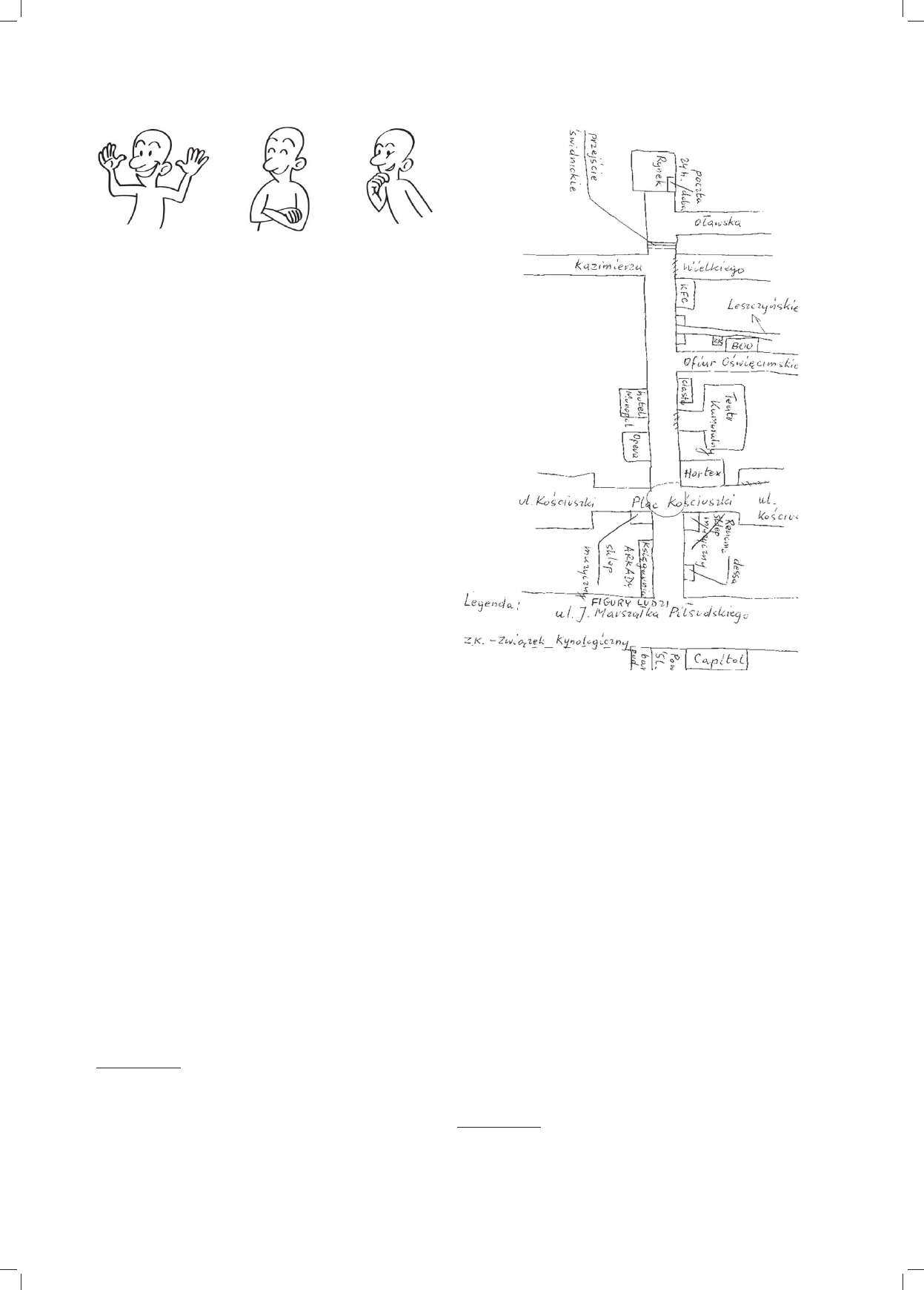
tion (18%) or intrigue (13%) (Fig. 1).
The respondents recognized the following aspects of
the street as particularly attractive: culture (12%), specific
architectural objects or iconic buildings (10%), for exam-
ple. KDM along with its arcade, the buildings of Wrocław
Opera and Renoma shopping centre, and the architecture
of the street in general (10%). The architectural dimen-
sion of Świdnicka Street therefore constitutes the attrac-
tiveness of the street (a total of 20% of spontaneous
responses). What is interesting – even though Świdnicka
was associated mainly with trade, a total of 10% of the
respondents cited restaurants and shops as attractive ele-
ments of the street; which is less than the architectural
dimension, or even culture. In total, there were 130 spon-
taneous associations.
As particularly unattractive part of Świdnicka Street
the respondents cited: the new underpass (12%), crowd
(11%) and social pathologies
3
(10%). In total, there were
89 spontaneous associations.
The respondents would recommend the street to friends
as a place worth visiting – on a scale of 0 to 10, the most
3
The term “social pathologies” was used by the respondents in
reference to pathologies expressis verbis, such as begging, drunkenness,
vandalism, etc.
50 Michał Dębek
frequent likelihood of recommendation was 8 (Mdn = 7).
Net Promoter Score (NPS)
4
, considered as one of the
important indicators of brand image, for Świdnicka Street
[36] was –20. For comparison: average, recently pub-
lished NPS for US hotels in 2016 was +37 (min. +4, max.
+55), for supermarkets +39 (min. +20, max. +59) and +35
other stores (min. +1, max. +59) [37].
2. Content of sketch maps
Respondents spontaneously sketched maps of different
parts of Świdnicka Street, with varying levels of detail,
containing a variety of information on the drawings.
Some of the maps were very small and poor in content
while others involved only a small area, but contained
great deal of very personal content; covered a larger por-
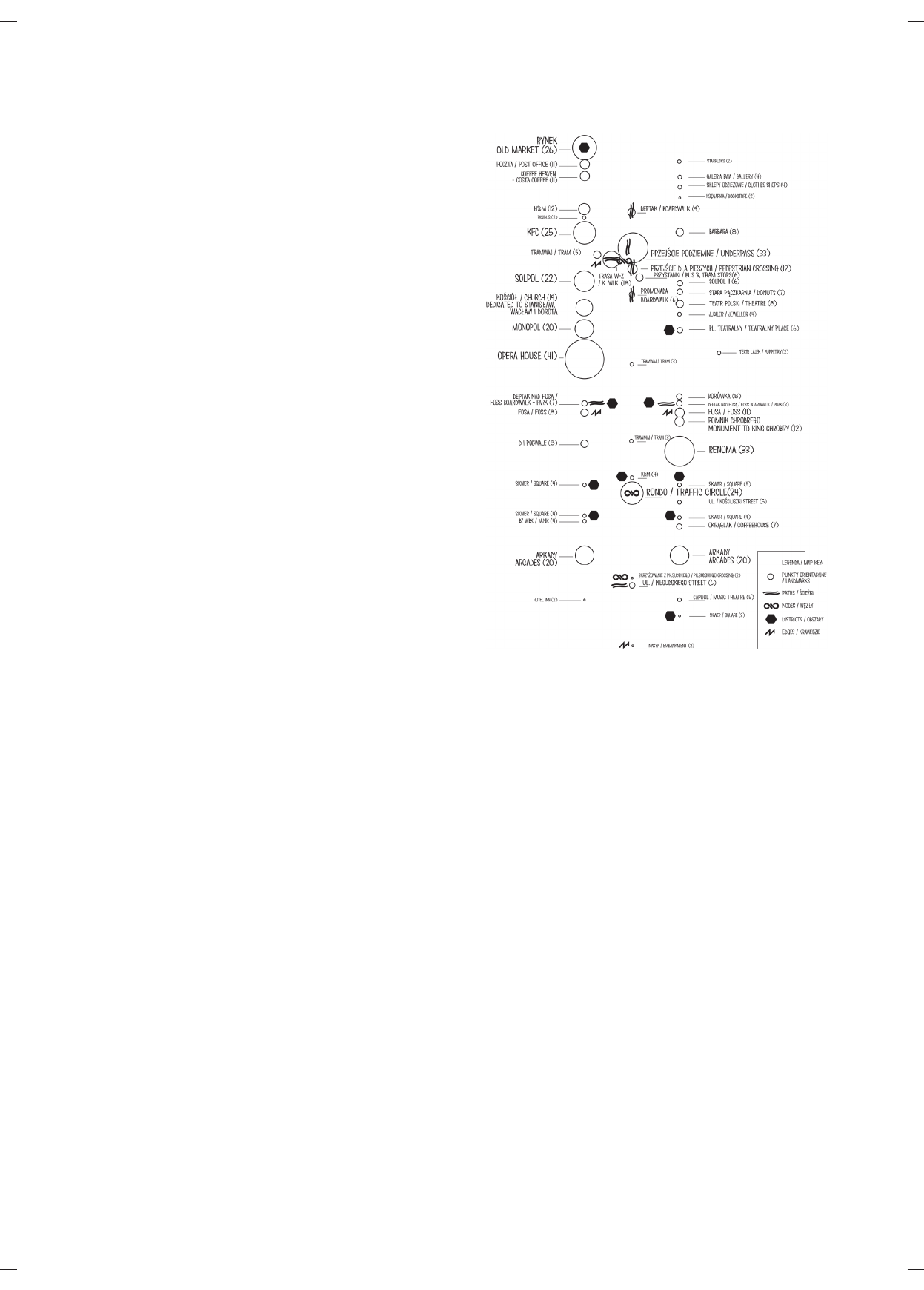
tion, or even the entire street (e.g. Fig. 2).
Regardless of the differences in the presentation of
Świdnicka Street, and the uniqueness of each sketch map,
4
Net Promoter Score (NPS) is a single-number index of consumer
loyalty to a brand, sometimes regarded as a key and a sufficient indicator
of brand health. NPS, and Net Promoter Score are protected trademarks
of Satmetrix Systems company, Bain & Company, and Fred Reichheld.
Ulica budziła pozytywne emocje wśród znakomitej
większości badanych. Trzy stany afektywne wskazywane
najczęściej przez badanych – jako bliskie ich odczuciom
względem Świdnickiej – przedstawiały radość (34%),
zadowolenie (18%) lub zaintrygowanie (13%) (il. 1).
Za szczególnie atrakcyjne aspekty ulicy badani uzna-
li: kulturę (12%), konkretne obiekty architektoniczne
lub budynki-marki (10%), np. KDM wraz z jej arkada-
mi, Operę i DH Renoma, a także ogólnie architekturę
(10%). Wymiar architektoniczny Świdnickiej wydawał
się zatem stanowić fundament atrakcyjności ulicy (łącz-
nie 20% spontanicznych wskazań). Co ciekawe, mimo
że Świdnicka kojarzyła się badanym przede wszystkim
z handlem, gastronomię i sklepy jako atrakcyjne elementy
Świdnickiej wymieniło łącznie 10% respondentów, czyli
mniej niż architekturę, a nawet kulturę. Łącznie uzyskano
130 spontanicznych skojarzeń.
Za szczególnie nieatrakcyjne badani uważali na Świd-
nickiej: nowe przejście podziemne (12%), tłum (11%)
oraz patologie społeczne
3
(10%). Łącznie uzyskano 89
spontanicznych skojarzeń.
Badani raczej poleciliby ulicę Świdnicką znajomym
jako miejsce warte odwiedzenia – najczęściej wskazywa-
nym przez respondentów prawdopodobieństwem polece-
nia ulicy w skali od 0 do 10 było 8 (Mdn = 7). Tymczasem
uważany za jeden z istotnych wskaźników wizerunku
marki – Net Promoter Score (NPS)
4
[36] – dla Świdnic-
kiej wyniósł w tym badaniu –20. Dla porównania: prze-
ciętny, opublikowany niedawno wskaźnik NPS dla hoteli
w 2016 r. w USA wynosił +37 (min. +4, maks. +55), dla
supermarketów +39 (min. +20, maks. +59), a innych skle-
pów +35 (min. +1, maks. +59) [37].
2. Zawartość map szkicowych
Respondenci szkicowali spontanicznie mapy różnych
fragmentów Świdnickiej, z różnym poziomem szczegó-
łowości, zawierając na rysunkach rozmaite informacje.
Niektóre mapy były bardzo niewielkie i ubogie w treści,
inne obejmowały niewielki obszar, ale zawierały wiele
3
Pod pojęciem „patologii społecznych” skategoryzowano wy ra-
żane przez badanych expressisverbis patologie, jak żebractwo, pijań-
stwo, wandalizm itp.
4
Net Promoter Score (NPS) to jednoliczbowy wskaźnik lojalności
konsu menta wobec marki, uważany niekiedy za kluczowy i wystarczający
wskaźnik kondycji marki. NPS oraz Net Promoter Score to zastrzeżone
znaki handlowe firm Satmetrix Systems, Bain & Company oraz Freda
Reichhelda.
Il. 2. Świdnicka naszkicowana przez kobietę, 60 lat, wykształcenie wyższe
Fig. 2. Świdnicka sketched by a female, 60 years old, higher education
Il. 1. Emotikony wybrane przez uczestników badania
jako najbliższe odczuciom wobec ulicy Świdnickiej
Fig. 1. Emoticons selected by survey participants
as closest representations of their feelings towards Świdnicka Street
WizerunekulicyŚwidnickiejweWrocławiu/TheimageofŚwidnickaStreetinWrocław 51
bardzo osobistych odnośników, albo obejmowały większe
fragmenty lub nawet całą Świdnicką (np. il. 2).
Niezależnie od różnic w przedstawianiu Świdnickiej
przez badanych oraz unikatowości każdej z map szki-
cowych elementami rysowanymi przez badanych naj-
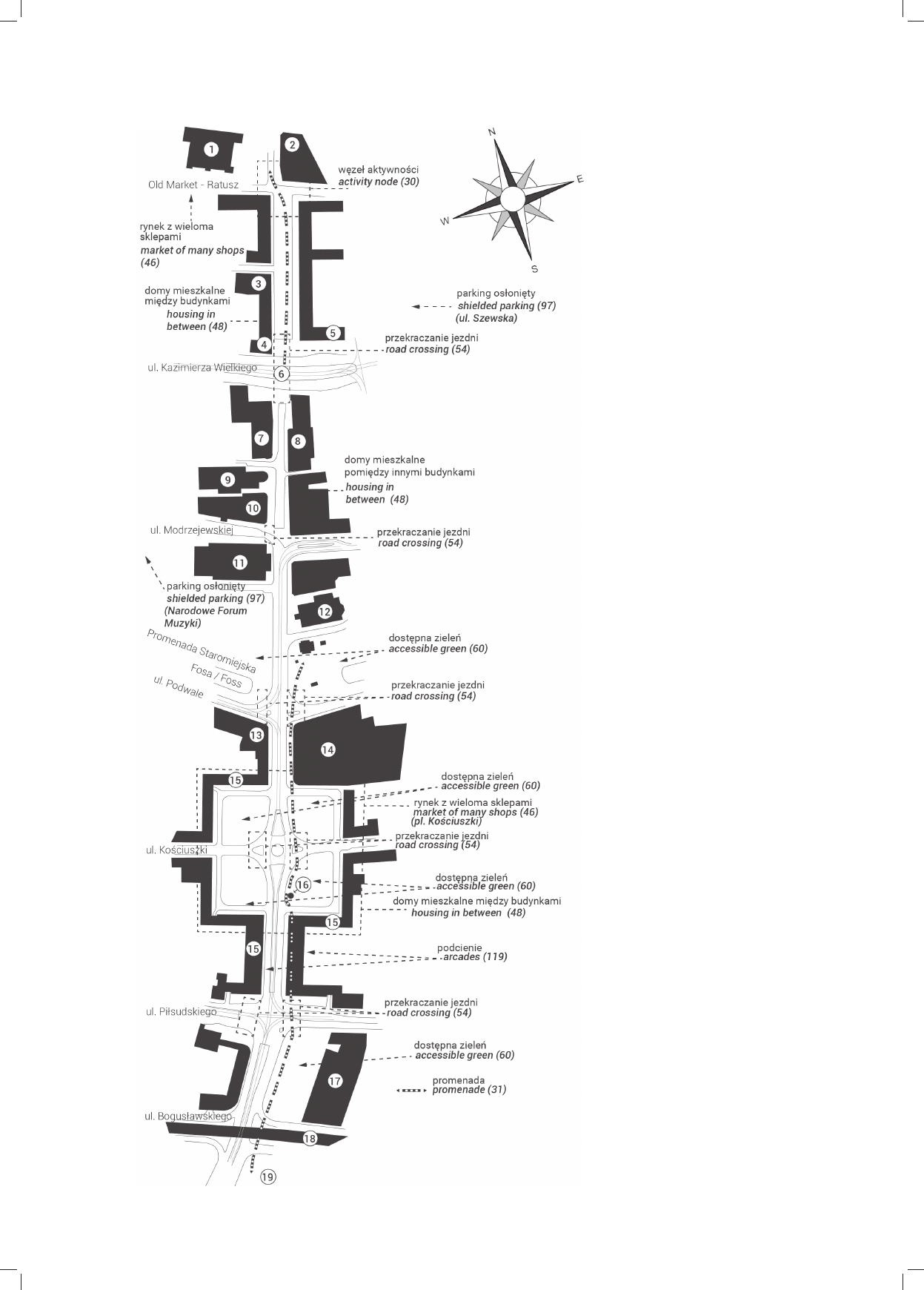
częściej były: Opera Wrocławska (pojawiła się na 41
mapach), DH Renoma (33 mapy) oraz przejście podziem-
ne (33 mapy). Schematyczne przedstawienie wyników
analizy wraz z pięcioma klasycznymi elementami obrazu
miasta Lyncha znajduje się na ilustracji 3.
Wśród elementów zbieżnych z wzorcami Alexandra
i jego zespołu, na mapach szkicowych zidentykowano
głównie: przekraczanie jezdni (skrzyżowanie ulicy Świd -
nickiej z Kazimierza Wielkiego, pojawiające się na 50
z 61 map), domy mieszkalne między budynkami (po ja -
wia jące się na 40 mapach) oraz dostępną zieleń (32 mapy).
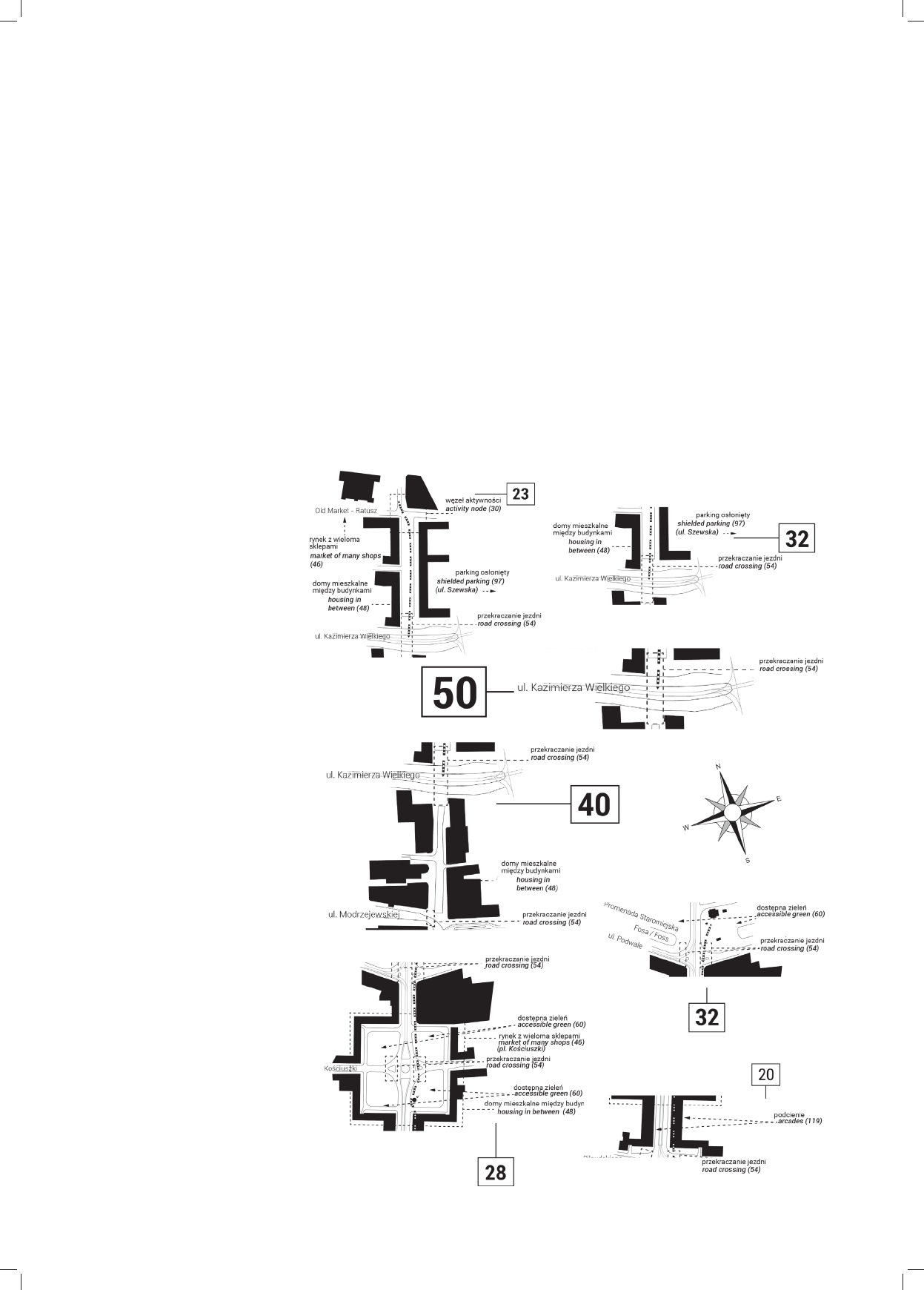
Schematyczne przedstawienie hipotetycznie wy stę pu ją-
cych na Świdnickiej wzorców znajduje się na ilustracji 4.
Natomiast wyniki analizy wzorców pojawiających się na
rysunkach respondentów przedstawiłem na ilustracji 5.
Wzorce, których na mapach Świdnickiej brakowało
do wypełnienia wzorca nadrzędnego – „idealnej” ulicy
handlowej – to przede wszystkim: węzły aktywności
(u Alexan dra et al. [21] wzorzec nr 30), publiczne placyki
(wzorzec 61), kształt ciągu pieszego (wzorzec 121) oraz
kieszenie aktywności (wzorzec 124).
Badanie2B
Metoda
Aby dodatkowo poszerzyć wiedzę na temat wzbudza-
nych przez Świdnicką wśród jej użytkowników emocji
i skojarzeń, między październikiem a grudniem 2016 r.
przeprowadzono badanie jakościowe z respondentami
pochodzącymi spoza Polski. Były to osoby mieszkające
we Wrocławiu czasowo lub na stałe, rekrutowane przez
studentów UWr przebywających we Wrocławiu w ramach
programu Erasmus oraz przez stronę „Wrocław Expats”
w serwisie Facebook. Badani byli proszeni o wypełnienie
anglojęzycznego kwestionariusza internetowego składa-
jącego się z otwartych i zamkniętych pytań o ulicę Świd-
nicką. Wypełnienie kwestionariusza zajmowało badanym
przeciętnie 9 minut.
Uczestnicy
W badaniu wzięło udział 30 obcokrajowców mieszka-
jących we Wrocławiu – 21 kobiet i 9 mężczyzn – w wieku
od 18 do 59 lat.
Wyniki
Ulica Świdnicka była odwiedzana przez obcokrajow-
ców bardzo często. 93% całej próby bywało tam co naj-
mniej raz, dwa w miesiącu, a 56% – raz w tygodniu lub
częściej; celem odwiedzin ulicy było przede wszystkim
głównie przemieszczanie się i nic poza tym (34%). Obco-
krajowcy bywali na Świdnickiej głównie ze względu na
tamtejszą gastronomię (17%) lub na rekreacyjnym spa-
cerze (15%).
Świdnicka osobom z zagranicy kojarzyła się ze żwa-
wością (15%), długością i przestrzennością (11%) oraz
centralnością w mieście (8%). Łącznie uzyskano 75 spon-
tanicznych skojarzeń.
the elements frequently drawn by the respondents were:
Wrocław Opera (appeared on 41 maps), Renoma (33
maps), and underpass (33 maps). Schematic representa-
tion of the results of the analysis, along with five classical
elements of the image of the city by Lynch is presented on
Figure 3.
Among the elements sketched on the maps that over-
lapped with patterns of Alexander and his team were
mainly: road crossing (Świdnicka–Kazimierza Wielkiego
intersection, appearing in 50 of 61 maps), housing in
between (40 appearing on maps), and accessible green
(32 maps). Figure 4 presents schematic representation of
the hypothesized patterns occurring in Świdnicka Street.
Figure 5 presents results of the analysis of the patterns
appearing in the drawings of respondents.
Patterns that were missing from the sketch maps
of Świdnicka Street, constituents of the higher order
Il. 3. Elementy pojawiające się w mapach szkicowych
ulicy Świd nickiej rysowanych przez mieszkańców Wrocławia,
przeana lizowane przez pryzmat koncepcji Lyncha.
W nawiasach podano częstość występowania każdego elementu.
Na schemacie pokazano jedynie elementy, które pojawiły się
na co najmniej dwóch rysunkach (oprac. M. Dębek)
Fig. 3. Elements appearing in sketch maps of Świdnicka Street
drawn by inhabitants of Wrocław and the surrounding area,
analysed in the light of the Lynch’s typology.
Frequency of each element provided in parentheses.
The figure presents only elements
that appeared in at least two drawings (by M. Dębek)
52 Michał Dębek
Il. 4. Ulica Świdnicka widziana
teoretycznie przez pryzmat
języka wzorców Alexandra et al.
Numery w kółkach oznaczają:
1 – Ratusz, 2 – DH Feniks,
3 – H&M (DH Merkury),
4 – KFC, 5 – „Barbara”,
6 – przejście podziemne/naziemne,
7 – Solpol I, 8 – Solpol II,
9 – kościół pw. św. św. Stanisława,
Wacława i Doroty, 10 – hotel
Mo no pol, 11 – Opera Wroc ław ska,
12 – kościół pw. Bożego Ciała,
13 – DH Podwale, 14 – DH
Renoma, 15 – Koś ciusz kowska
Dzielnica Miesz ka niowa (KDM),
16 – Okrąglak/ETNO Cafe,
17 – teatr Capitol, 18 – nasyp
ko lejowy, 19 – galeria Arkady
Wrocławskie (oprac. M. Dębek)
Fig. 4. Świdnicka Street as seen
theoretically through the prism of
pattern language developed by
Christopher Alexander and his
team. Numbers in circles denote:
1 – Town Hall, 2 – Feniks (shop-
ping mall),
3 – H&M (former
Mer kury department store),
4 – KFC, 5 – “Barbara”,
6 – underpass/road crossing,
7 – Solpol I, 8 – Solpol II,
9 – Church of Ss Stanislaus, Wen-
ceslas and Dorothy, 10 – the Mo no-
pol Hotel, 11 – Wro cław Opera,
12 – Corpus Christi Church,
13 – Podwale shopping mall,
14 – Renoma, 15 – KDM,
16 – The Rounded Kiosk/ETNO
Cafe, 17 – Capitol
Theatre,
18 – railway embankment,
19 – Arkady Wrocławskie
shopping centre (by M. Dębek)
WizerunekulicyŚwidnickiejweWrocławiu/TheimageofŚwidnickaStreetinWrocław 53
Il. 5. Fragmenty ulicy Świdnickiej
pojawiające się najczęściej
na mapach szkicowa nych przez
mieszkańców Wrocławia.
Liczby w prostokątach oznaczają
częstotliwość pojawiania się
określonego fragmentu.
Kursywą wskazano oryginalne
nazwy wzorców opisane
przez zespół Alexandra
(oprac. M. Dębek)
Fig. 5. Fragments of Świdnicka
Street most commonly appearing
on the sketch maps created by
the inhabitants of Wrocław.
Numbers in squares indicate
the frequency of occurrence of
a particular element.
Names of respective patterns
described by the team of
Alexander are provided in italics
(by M. Dębek)
Ulica budziła wśród obcokrajowców raczej pozytyw-
ne emocje. Niemal połowa badanych wykazała wobec
Świdnickiej zadowolenie (40%), 16% zaintrygowanie,
a 13% znudzenie (il. 6).
Za najbardziej atrakcyjne elementy ulicy obcokrajow-
cy uważali: Operę Wrocławską (12%), ogólnie sklepy
(8%), oraz – ex aequo – Barbarę, jarmarki, restauracje
(po 6%). Łącznie uzyskano 65 spontanicznych skojarzeń.
Za najsłabsze elementy ulicy obcokrajowcy uzna-
li jej zatłoczenie (13%) oraz Solpol I i nowe przejście
podziemne (po 10%). Przy czym negatywne skojarzenia
z ulicą były w mniejszości – zebrano ich zaledwie 39.
Świdnicka byłaby przez obcokrajowców rekomendo-
wana najczęściej jako przestrzeń rekreacji – respondenci
poleciliby ulicę w tym sensie z prawdopodobieństwem 8
(w skali od 0 do 10, Mdn = 8). NPS dla pytania o reko-
mendację Świdnickiej w tym wymiarze wynosił 6,67.
pattern – the “ideal” shopping street – were: nodes of
activity (in Alexander et al. [21] pattern 30), public
squares (pattern 61), path shape (pattern 121) and activity
pockets (pattern 124).
Study2B
Method
To further enhance the knowledge on the emotions and
associations evoked by Świdnicka Street in its users, qua-
litative research with respondents coming from outside
Poland was conducted between October and December
2016. The study involved people living in Wrocław, either
temporarily or permanently, recruited by students
ofWrocław University under the Erasmus program, as
well via the “Wrocław Expats” Facebook page. The re -
spondents were asked to fill out an English-language

54 Michał Dębek
Mniej entuzjastyczni byli respondenci w potencjalnych
rekomendacjach Świdnickiej jako przestrzeni handlowo-
-usługowej (Mo = 8, Mdn = 7, NPS = –24).
Badanie2C
Metoda
W wrześniu 2016 r. przeprowadzono kolejne bada-
nie ja kościowe dotyczące wizerunku Świdnickiej ze
szczegól ną grupą jej użytkowników. Respondentami byli
przed siębiorcy prowadzący sklepy i lokale usługowe przy
tej ulicy. Ankieta odbyła się w infopunkcie-kawiarni Bar-
bara przy okazji konsultacji społecznych dotyczących
przyszłości ulicy, organizowanych przez Biuro Rozwoju
Gospodarczego Urzędu Miasta Wrocławia. Badani byli
proszeni o wypełnienie papierowej ankiety składającej się
z otwartych i zamkniętych pytań o ulicę Świdnic ką. Wypeł-
nienie kwestionariusza zajmowało przeciętnie 10 minut.
Uczestnicy
Respondentami było 22 przedsiębiorców, 5 kobiet i 17
mężczyzn, zwerykowanych jako faktycznie prowadzący
sklepy i punkty usługowe przy analizowanej ulicy. Nie
gromadzono szczegółów demogracznych badanych, ze
względu na konieczność zachowania maksimum anoni-
mowości – w części ankiety niereferowanej w tym arty-
kule przedsiębiorcy mogli zgłaszać zażalenia do Urzędu
Miasta oraz pisać o swoich negatywnych doświadcze-
niach w kontaktach z wrocławskimi urzędnikami.
Wyniki
Według przedsiębiorców Świdnicka jest przede
wszystkim ciągiem komunikacyjnym (63% opinii). Przy-
puszczenie, że celem odwiedzin ulicy mogą być zakupy,
wyrażono tylko w dwóch ankietach. Zebrano łącznie 31
opinii na temat celów odwiedzin.
Świdnicka kojarzyła się przedsiębiorcom najczęściej
z konkretnymi budynkami lub markami (30% opinii),
wśród których dominowały: Opera Wrocławska, hotel
Monopol oraz DH Renoma. Kolejnym skojarzeniem
był deptak lub szeroko rozumiana komunikacja (14%),
a następnym główna ulica miasta (9%). Łącznie zebrano
55 skojarzeń.
Ulica budziła wśród przedsiębiorców mieszane uczu-
cia. Najczęściej wybierali emotikon oznaczający zain-
trygowanie (40%), ale porównywalna część wybierała
także podejrzliwość-czujność (30%), a także zmartwienie
(27%) (il. 7).
online questionnaire consisting of open and closed ques-
tions about Świdnicka Street. The questionnaire took on
average 9 minutes to complete.
Respondents
The study involved 30 residents of Wrocław – 21 wo -
men and 9 men – aged 18 to 59.
Results
The respondents were frequent visitors of Świdnicka
Street. 93% of the respondents visited it at least once or
twice per month, and 56% of the whole sample visited it
at least once a week. The aim of the visits was mainly
movement and nothing else (34%). Secondly, foreign
respondents visited Świdnicka because of its restaurants
(17%) or during recreational walks (15%).
Foreigners associated Świdnicka Street with its liveliness
(15%), length and spaciousness (11%), and centrality in the
city (8%). In total, there were 75 spontaneous associations.
The street evoked rather positive emotions in foreign-
ers. Almost half of the respondents indicated satisfaction
(40%), 16% intrigue, and 13% boredom (Fig. 6).
Foreigners believed the most attractive elements of the
street were: Wrocław Opera (12%), stores in general
(8%), and – ex aequo – Barbara, holiday fairs, restaurants
(6%). In total, there were 65 spontaneous associations.
As the weakest elements of the street foreigners recog-
nized its congestion (13%), and – ex aequo – Solpol I and
the new underpass (10%). The negative connotations of
the street (only 39) were a minority.
Foreigners would recommend Świdnicka Street as a space
for recreation. The respondents most frequently indicated
that they would recommend Świdnicka as a space for recre-
ation with the probability of 8 (on a scale of 0 to 10, Mdn = 8).
NPS for the questions about the recommendation of
Świdnicka Street was 6.67. Respondents were less enthusi-
astic in potential recommendations of Świdnicka Street as
a shopping and service space (Mo = 8, Mdn = 7, NPS = –24).
Study2C
Method
In September 2016, another qualitative study was con-
ducted on the image of Świdnicka Street in a specific
group of users. The respondents were independent owners
of shops and businesses located on the street. The survey
was conducted in cafe Barbara on the occasion of the
public consultation on the future of the street, organized
by the Office of Economic Development of the City of
Wrocław. The respondents were asked to fill out a paper
questionnaire consisting of open and closed questions
about Świdnicka Street. The questionnaire took on aver-
age 10 minutes to complete.
Respondents
The respondents included 22 entrepreneurs: 5 women
and 17 men verified as actually providing services or run-
ning shops located on the street. No demographic infor-
mation was collected of the respondents due to the need
to maintain maximum anonymity – in the part of the sur-
vey (not cited in this article) entrepreneurs could submit
complaints to the city hall of Wrocław including their
negative experiences in dealing with Wrocław officials.
Il. 6. Emotikony wybrane przez obcokrajowców
jako najbliższe odczuciom wobec ulicy Świdnickiej
Fig. 6. Emoticons selected by foreign survey participants
as closest representations of their feelings towards Świdnicka Street

WizerunekulicyŚwidnickiejweWrocławiu/TheimageofŚwidnickaStreetinWrocław 55
Za najbardziej pozytywne elementy Świdnickiej
przedsiębiorcy uważali Operę Wrocławską, hotel Mono-
pol i DH Renoma (łącznie 36% wskazań) oraz części
wyłączone z ruchu samochodowego (łącznie 9%). Łącz-
nie zebrano 44 deklaracje.
Najbardziej negatywnymi elementami ulicy, według
przed siębiorców, były: problematyczne rozwiązania ko mu -
ni kacyjne
, szczególnie w obszarze komunikacji in -
dywidualnej i parkowania (30%), słaba oferta handlowo-
-usługowa (25%), a także – ex aequo – Solpol I i nowe
przejście podziemne (po 7%). Zebrano łącznie 40 deklaracji.
Przedsiębiorcy uważali przy tym, że Świdnickiej brakuje
także jasnej wizji przyszłości oraz spójności wizerunkowej.
Świdnicka zdecydowanie nie byłaby rekomendowa-
na przez przedsiębiorców ich znajomym. Respondenci
wskazywali najczęściej, że poleciliby Świdnicką jako
przestrzeń rekreacji z prawdopodobieństwem 3 (w skali
od 0 do 10, Mdn = 4). NPS dla pytania o rekomenda-
cję Świdnickiej w tym wymiarze wynosił –59. Absolutny
brak entuzjazmu wykazywali przedsiębiorcy w potencjal-
nych rekomendacjach Świdnickiej jako przestrzeni han-
dlowo-usługowej (Mo = 0, Mdn = 3, NPS = –68).
Badanie3
Metoda
To ilościowe badanie kwestionariuszowe prowadzone
od marca do maja 2015 r. miało na celu diagnozę spo-
strzegania przez wrocławian ulicy Świdnickiej i gale-
rii handlowej Pasaż Grunwaldzki we Wrocławiu. Są to
dwie jakościowo różne, ale istotne przestrzenie komercji
w mieście. Ze względu na tematykę niniejszego tekstu
wątek porównawczy z galerią handlową będzie tu jedynie
sygnalizowany, a nie omawiany w całości.
Badani wypełniali internetowy kwestionariusz składa-
jący się z pytań o częstotliwość i cele odwiedzin na Świd-
nickiej oraz w Pasażu Grunwaldzkim, szczegółową ocenę
kluczowych wymiarów obu przestrzeni, ich wartość sym-
boliczną, a także intencje ich polecania.
Uczestnicy
W badaniu wzięły udział 52 osoby: 42 kobiety i 10
mężczyzn w wieku od 19 do 40 lat, mieszkające we Wro-
cławiu, bywające na ulicy Świdnickiej co najmniej kilka
razy w roku.
Wyniki
Podobnie jak w poprzednich badaniach ulica Świd-
nicka okazała się przestrzenią odwiedzaną często. Trzy
czwarte respondentów (73%) bywały tam co najmniej raz
w miesiącu, a blisko połowa próby (46%) co najmniej raz
w tygodniu. Jedynie 7% badanych deklarowało, że jest
na Świdnickiej rza dziej niż raz w roku. Badani twierdzili,
że Pasaż Grun waldz ki odwiedzają zdecydowanie rzadziej
(32% co naj mniej raz w miesiącu, a tylko 6% co najmniej
raz w tygodniu).
Celami odwiedzin Świdnickiej były, według badanych,
głównie: spotkanie ze znajomymi lub rodziną (21%),
przemieszczanie się (przechodzenie przy okazji, żaden
konkretny cel w ramach ulicy, 20%) albo gastronomia
(15%). Ponieważ badani mogli wskazać maksymalnie
trzy cele, zebrano 125 deklaracji.
Results
According to entrepreneurs Świdnicka is primarily
a passageway (63% of opinions). Only two surveys ex -
pressed the belief that the purpose of visits to the street
can be shopping. A total of 31 comments on the objectives
of visits were collected.
Entrepreneurs associated Świdnicka usually with con-
crete buildings or brands (30% of opinions), among which
the most frequent were: Wrocław Opera, the Monopol
Hotel and Renoma shopping mall. Another association
was a promenade or widely understood transportation
(14%), followed by main street (9%). In total, there were
55 associations.
The street evoked rather positive emotions in shop own-
ers. The most often used emoticon describing Świdnicka
Street was the one indicating intrigue (40%), almost on par
with suspicion-vigilance (30%) and concern (27%) (Fig. 7).
Entrepreneurs believed the most attractive elements of
street were: Wrocław Opera, the Monopol hotel and
Renoma shopping mall (36% of responses in total) and
parts excluded from traffic (9% in total). In total, 44 dec-
larations were collected.
The most negative elements of the street, according to
entrepreneurs, were: problematic transportation, especial-
ly in the area of individual transport and parking (30%),
limited retail offer and services (25%) and – ex aequo –
Solpol I and the new underpass (7% each). In total, 40
de clarations were collected. Business owners considered
that Świdnicka was lacking a clear vision of the future
and a cohesive image.
Entrepreneurs would definitely not recommend Świd-
nicka to their friends. The respondents most frequently
indicated that they would recommend Świdnicka as
a space for recreation with the probability of 3 (on a scale
of 0 to 10, Mdn = 4). NPS for the questions about the
recommendation of Świdnicka Street was 59. Respondents
showed complete lack of enthusiasm for potential recom-
mendations of Świdnicka Street as a shopping and service
space (Mo = 0, Mdn = 3, NPS = –68).
Study3
Method
A quantitative questionnaire survey conducted from
March to May 2015 was intended to diagnose the percep-
tion of Świdnicka Street and Pasaż Grunwaldzki shopp -
ing
centre in Wrocław. These are two qualitatively different
Il. 7. Emotikony wybrane przez przedsiębiorców
jako najbliższe odczuciom wobec ulicy Świdnickiej
Fig. 7. Emoticons selected by entrepreneur survey participants
as closest representations of their feelings towards Świdnicka Street

56 Michał Dębek
Spośród analizowanych kluczowych wymiarów miej-
skich przestrzeni handlowo-usługowych najwyższe oceny
i zgodność respondentów uzyskała atmosfera Świdnic-
kiej (Mdn = 4,25 w skali 0–6, IQR = 0,88). Najsłabszy
okazał się wymiar związany ze stresem (Mdn = 4, IQR
= 1,25, przy czym w tym indeksie im większa wartość,
tym bardziej stresujące środowisko). Przeciętne okaza-
ły się wymiary: rozrywkowy (Mdn = 3,67, IQR = 1,50)
i komercyjny (Mdn = 3, IQR = 1,25).
Dobrze oceniana była dostępność ulicy. Przy czym
wyraźnie najłatwiej można było się tam dostać komuni-
kacją publiczną – 88% badanych podało, że w taki sposób
„raczej” lub „zdecydowanie” łatwo dotrzeć na Świdnicką.
57% respondentów uważało, że łatwo się na Świdnicką
dostać pieszo lub rowerem, a tylko 15% uznało ulicę za
łatwo dostępną samochodem.
Świdnicka ma w mieście wysoką wartość symboliczną.
Blisko trzy czwarte badanych (71%) uznały, że „raczej”
lub „zdecydowanie” trudno wyobrazić sobie Wrocław bez
tej przestrzeni. To diametralnie odróżnia Świdnicką od
Pa sażu Grunwaldzkiego, bez którego stolicę Dolnego Ślą-
ska wyobrażają sobie blisko dwie trzecie respondentów.
Badani raczej poleciliby ulicę Świdnicką znajomym
– najczęściej wskazywanym przez respondentów prawdo-
podobieństwem polecenia ulicy w skali od 0 do 10 było 8
(Mdn = 7). Mimo to NPS wyniósł w tym studium –31,15.
Chęć rekomendowania Pasażu Grunwaldzkiego była wśród
respondentów jeszcze niższa – Mo = 6, Mdn = 6, NPS = –51.
Badanie4
Metoda
Podobnie jak w badaniu 3, także i to ilościowe stu-
dium kwestionariuszowe miało na celu porównanie ulicy
Świdnickiej i galerii handlowej. Badanie było prowadzo-
ne między styczniem i kwietniem 2016 r., przestrzenią
porównywaną z ulicą była Galeria Dominikańska we
Wrocławiu. Dodatkowo diagnozowano tu stopień dopa-
sowania tych dwóch szczególnych środowisk do osób
o różnych cechach osobowości i kierujących się różny-
mi wartościami (aspekt nieraportowany w tym artykule).
Tak jak w przypadku badania 3 wątek porównania ulicy
z galerią handlową będzie tu jedynie sygnalizowany, a nie
omawiany w całości.
Respondenci byli podzieleni na dwie grupy. Jedna oce-
niała ulicę Świdnicką, druga Galerię Dominikańską. Obie
grupy wypełniały internetowy kwestionariusz składający
się m.in. z pytań o częstotliwość odwiedzin w określonej
przestrzeni, szczegółową ocenę jej kluczowych wymia-
rów, a także intencje jej polecenia.
Uczestnicy
W badaniu wzięły udział łącznie 204 osoby, w tym 102
oceniały ulicę Świdnicką, a pozostałe 102 osoby Galerię
Dominikańską. Wśród respondentów oceniających Świd-
nicką były 54 kobiety i 48 mężczyzn w wieku od 16 do 85
lat. Struktura próby odzwierciedlała strukturę populacji
Wrocławia pod względem płci i wieku.
Wyniki
Podobnie jak w poprzednich badaniach potwierdzono
wysoką częstotliwość wizyt respondentów na ulicy Świdnic-
but
important areas of commerce in the city. Due to the
subject matter of this text, the comparison with the shopp-
ing gallery will be only indicated, but not discussed in full.
Respondents filled out an online questionnaire con-
sisting of questions about the frequency of visits to
Świdnicka and Pasaż Grunwaldzki and their purpose, and
a detailed assessment of the key dimensions of both spac-
es and their symbolic value, as well as probability of
recommen dation.
Respondents
The study was attended by 52 people: 42 women and
10 men aged from 19 to 40, living in Wrocław, and visit-
ing Świdnicka Street at least a few times a year.
Results
As in previous surveys Świdnicka, street was a space
often visited. Three-quarters (73%) of respondents de -
clared that they visited the street at least once a month, and
almost a half of them (46%) visited it at least once a week.
Only 7% of respondents declared that they visited Świd-
nicka less than once a year. Respondents declared that they
visited Pasaż Grunwaldzki much less frequently (32% at
least once a month, and only 6% at least once a week).
The purposes of the visits to Świdnicka Street, accord-
ing to respondents, were mainly: meeting with friends or
family (21%), movement (passing by, with no specific
purpose within the street, 20%) or restaurants (15%).
Because respondents could indicate up to three targets of
visits, 125 declarations were collected.
Among the key dimensions, the atmosphere of Świd-
nicka Street received the highest assessment and concur-
rence of opinions (Mdn = 4.25 on a scale 0–6, IQR = 0.88).
The weakest was the stress dimension (Mdn = 4, IQR = 1.25,
wherein in the index, the higher the value, the more stress-
ful the environment). Dimensions that proved average:
entertainment (Mdn = 3.67, IQR = 1.50) and commercial
(Mdn = 3, IQR = 1.25).
Accessibility of the street was highly assessed. Clearly
the easiest way to the street was by public transport – 88%
of respondents thought it made it “rather” or “definitely”
easy to reach Świdnicka Street. 57% of respondents found
it easy to get to Świdnicka Street on foot or by bicycle, and
only 15% thought the street was easily accessible by car.
Świdnicka has a high symbolic value in the city. Nearly
three-quarters of respondents (71%) found that it was
“rather” or “definitely” hard to imagine Wrocław without
it. This radically distinguishes Świdnicka from Pasaż
Grun waldzki, as nearly two-thirds of respondents can
imagine Wrocław without it.
The respondents would recommend the street to friends
– on a scale of 0 to 10, the most frequent likelihood of
recommendation was 8 (Mdn = 7). Nonetheless, NPS in
this study was –31.15. Willingness among respondents to
recommend Pasaż Grunwaldzki was even lower – Mo = 6,
Mdn = 6, NPS = –51.
Study4
Method
Like Study 3, the goal of this quantitative questionnaire
survey was a comparison of Świdnicka Street with a shop-

WizerunekulicyŚwidnickiejweWrocławiu/TheimageofŚwidnickaStreetinWrocław 57
kiej. Ponad połowa (56%) deklarowała, że odwiedza Świd-
nicką przynajmniej raz w miesiącu, a 18% próby co naj mniej
raz w tygodniu. Rzadziej niż raz do roku bywało na Świdnic-
kiej, wedle deklaracji w ankietach, mniej niż 2% badanych.
Ulica budziła wśród respondentów raczej pozytyw-
ne odczucia. Niemal co czwarty wskazywał satysfakcję
(23%), niemal co piąty zaintrygowanie (18%), a 13%
zmartwienie (il. 8).
Pośród kluczowych wymiarów przestrzeni handlo-
wych najwyższe oceny i zgodność badanych uzyskała
czytelność Świdnickiej – przeciętnie 3,33 w skali od 1 do 4
(IQR = 0,67). Kolejne były: pracownicy obsługi (Mdn = 3,
IQR = 0,33), atmosfera (Mdn = 3, IQR = 0,50) oraz bezpie-
czeństwo (Mdn = 3, IQR = 0,50). Relatywnie najsła biej oce-
niany był wymiar społeczny ulicy (Mdn = 2,50, IQR = 0,75).
Świdnic ka różniła się od Galerii Dominikańskiej tylko pod jed-
nym względem (in plus) – respondenci wyżej oceniali poten -
cjał rozrywkowy ulicy niż galerii. W pozostałych wymia-
rach rozkłady ocen obu środowisk były niemal identyczne.
Podobnie jak w badaniu 3. respondenci raczej poleci-
liby ulicę Świdnicką znajomym – najczęściej wskazywa-
nym prawdopodobieństwem polecenia ulicy w skali od 0
do 10 było 7 (Mdn = 7). NPS wyniósł w tym studium –22.
Chęć rekomendowania Galerii Dominikańskiej była wśród
respondentów nieco niższa: Mo = 7, Mdn = 6,5, NPS = –35.
Podsumowanie
Wyniki omówionych powyżej studiów pokazały, że
w mentalnym odzwierciedleniu ulicy przez badanych ist-
nieją wyraźne ścieżki, węzły, punkty orientacyjne, obsza-
ry i krawędzie. Może to wskazywać na wysoką czytel-
ność przestrzeni ulicy (potwierdzoną w ilościowej części
badań) i prawdopodobnie działa na korzyść jej ogólnego
wizerunku. Odzwierciedlenie społeczne elementów typo-
logii Lyncha kształtuje się następująco: po pierwsze, naj-
wyżej ocenianą ścieżką wydaje się część deptakowa od
Rynku do hotelu Monopol, ale z wyłączeniem przebudo-
wanego na przełomie lat 2015 i 2016 przejścia podziem-
nego. Nowe przejście – w przeciwieństwie do starego,
niewątpliwego symbolu tej ulicy – było spontanicznie
wskazywane jako negatywna zmiana i nieatrakcyjny
element ulicy. Ponadto zdecydowanie najczęściej odtwa-
rzanym przez badanych węzłem było skrzyżowanie Świd-
nicka–Kazimierza Wielkiego. Z węzłem tym kojarzone
było pozytywnie (stare) przejście podziemne. Punktami
orientacyjnymi stanowiącymi najczęściej fundamenty
mentalnych wyobrażeń ulicy były: Opera, DH Renoma
i wspomniane wyżej przejście podziemne. Nowym, atrak-
cyjnym punktem orientacyjnym i symbolem Świdnickiej
wydaje się też stawać zrewitalizowana Barbara. Czytel-
nymi krawędziami były fosa i Promenada Staromiejska
oraz trasa W-Z (Kazimierza Wielkiego). Często wskazy-
wanym przez użytkowników ulicy obszarem był silnie
związany ze Świdnicką wrocławski Rynek.
Część wzorców zdeniowanych przez Alexandra et al.
[21] była w biegu Świdnickiej rzeczywiście odzwiercie-
dlana. Niestety, w reprezentacjach mentalnych badanych
nie pojawiły się węzły aktywności, publiczne placyki oraz
kieszenie aktywności. To bardzo ważne wzorce – wszyst-
ping centre. The study was conducted between January
and
April 2016 and the centre in question was Galeria Do -
minikańska in Wrocław. Additionally, the study diagnosed
the degree of matching of those two specific environments
to people with different personality traits and personal val-
ues (an aspect not reported in this article). Like in the
description of Study 3, the comparison with shopping gal-
lery will only be indicated, but not discussed in full.
The respondents were divided into two groups. One
group assessed the Świdnicka Street, while the other
assessed Galeria Dominikańska. Both groups filled in an
online questionnaire consisting of, among others, ques-
tions about the frequency of visits to the respective space,
a detailed assessment of its key dimensions, as well as the
likelihood of recommendation.
Respondents
The study was attended by a total of 204 people. One
hundred and two of them evaluated Świdnicka Street, and
the remaining 102 people evaluated Galeria Domini kań-
ska. The study involved 54 women and 48 men aged 16
to 85. Structure of the sample reflected the population
structure of Wrocław in terms of gender and age.
Results
As in previous studies, we have confirmed a high fre-
quency of visits of the respondents to Świdnicka Street.
Over a half of the respondents (56%) declared that they
visited the street at least once a month, and 18% of the
sample visited it at least once a week. According to the
declarations, 2% of respondents visited it less frequently
than once a year.
The street evoked rather positive emotions in foreign-
ers. Almost every fourth respondent indicated satisfaction
(23%), almost one in five puzzlement (18%), and 13%
worry (Fig. 8).
Among the key dimensions of commercial space, the le -
gibility of Świdnicka Street received the highest assess-
ment and concurrence of opinions (Mdn = 3.33 on a scale 1–4,
IQR = 0.67). It was followed by: service staff (Mdn = 3,
IQR = 0.33), atmosphere (Mdn = 3, IQR = 0.50) and safety
(Mdn = 3, IQR = 0.50). Social dimension of the street
received the lowest assessment (Mdn = 2.50, IQR = 0.75).
Świdnicka Street differed from Galeria Domi ni kań ska in
one (positive) respect only – respondents assessed the
entertainment potential of the street more highly. In other
dimensions the distributions of the ratings of both envi-
ronments were almost identical.
Il. 8. Emotikony wybrane przez respondentów w badaniu 4
jako najbliższe odczuciom wobec ulicy Świdnickiej
Fig. 8. Emoticons selected by survey participants in study 4
as closest representations of their feelings towards Świdnicka Street

58 Michał Dębek
kie są związane z kreowaniem unikatowego ży cia społecz-
nego ulicy. Bez nich każda ulica pozostaje w głównej mie-
rze ciągiem komunikacyjnym, pełni funkcję tranzytową.
Zdecydowanie najczęściej rekonstruowanym men-
talnie wzorcem urbanistyczno-architektonicznym Świd-
nickiej jest „przekraczanie jezdni” (skrzyżowanie Świd-
nicka–Kazimierza Wielkiego oraz przejście podziemne).
Fundamentem wizerunku i w ogóle mentalnego odzwier-
ciedlenia tej ulicy jest dziś funkcja tranzytowa. Poważ-
nym mankamentem ulicy, z perspektywy jej historii
i potencjalnej rangi w mieście, było stosunkowo rzadko
wzbudzane przez nią skojarzenie z handlem. Nawet jeśli
badani kojarzyli ulicę z handlem, to jako najbardziej atrak-
cyjne jej elementy wymieniali te związane z architekturą
i kulturą. Może to oznaczać, że w wizerunku Świdnickiej
istnieje handel, ale jest on „słaby”, niecharakterystyczny
i niewart szczegółowego wspomnienia.
Świdnicka budziła u większości badanych pozytywne
lub umiarkowanie negatywne deklaracje emocjonalne (znu-
dzenie, zmartwienie). Grupą wyróżniającą się w oświad-
czeniach na temat emocji byli przedsiębiorcy. Ich częściej
negatywne deklaracje mogły być rezultatem frustracji po
wieloletnich konsultacjach społecznych i planach zwią-
zanych z ożywianiem ulicy, które – według części przedsię-
biorców – nie były ostatecznie brane pod uwagę i realizowa-
ne. Mimo to, raczej pozytywne emocje nie-przedsiębiorców
(w tym obcokrajowców, mogących przecież łatwo porów-
nać ulicę Świdnicką do rozmaitych przestrzeni handlowo-
-usługowych w innych krajach) w połączeniu z wyso-
ką wartością symboliczną, bardzo dobrą dostępnością
i frekwencją, czynią ze Świdnickiej przestrzeń o niezłym
wizerunku i potencjale sukcesu ekonomicznego.
Przy całej niejednoznaczności wizerunku Świdnickiej,
braku jego wyrazistości i wspomnianych ważnych bra-
kach funkcjonalno-przestrzennych ulicy, niewiele było
jednak wyraźnie negatywnych konotacji w jej mentalnych
wyobrażeniach. Najłatwiej dostępnymi w umysłach bada-
nych słabymi stronami wizerunku ulicy, oprócz nowego
przejścia podziemnego, były głównie ogólnie rozumia-
ne przez badanych „patologie społeczne”, czyli przede
wszystkim obserwowane w ramach ulicy: żebractwo, za -
śmiecanie, wandalizm i bezdomność.
Warto też przy okazji wspomnieć, że „czas wielkiej
zapaści” Świdnickiej oraz jej ostateczny koniec jako wiel-
komiejskiej ulicy handlowej w okolicach przełomu wie-
ków zbiegł się m.in. z jej wyłączeniem z ruchu kołowego.
Wątek ruchu kołowego w ramach ulicy Świdnickiej jest
wart dalszego zgłębiania nie tylko ze względu na prefe-
rencje i wymagania przedsiębiorców, ale także dlatego, że
jego brak – choć stosunkowo pozytywnie oceniany przez
bardzo wielu respondentów – może skutkować dalszą
zmianą wizerunku Świdnickiej z bliskiego europejskiej
ulicy handlowej w rekreacyjny deptak.
Konkludując, wymienione powyżej mentalne i archi-
tektoniczne fundamenty wizerunku Świdnickiej zdają się
nie tworzyć powszechnej, spójnej i jednoznacznej całości.
Wydaje się, że największym kłopotem tej ulicy, jeśli mia-
łaby ona odgrywać pierwszoplanową rolę w miejskim sys-
temie przestrzeni komercji, jest dziś jej oddalanie się od
wizerunku ulicy handlowej. Mimo zauważalnych, pozy-
Similarly as in Study 3, the respondents would be
likely to recommend the street to friends – on a scale of
0 to 10, the most frequent likelihood of recommendation
was 7 (Mdn = 7). NPS in this study was –22. Willingness
to recommend was slightly lower in the case of Galeria
Dominikańska: Mo = 7, Mdn = 6.5, NPS = –35.
Summary
It turned out that in the respondents’ mental reflections
of the street clear paths, nodes, landmarks, areas and
edges were evident. It may indicate the high legibility of
the street (confirmed in the quantitative part of the study),
and probably works in favour of its overall image. The
image of Lynch’s elements is as follows: first, the path
with the highest assessment seems to be the part of the
pedestrian area stretching from the market square to the
Monopol hotel, excluding the newly rebuilt underpass
(in the years 2015–2016). The new underpass, unlike
the previous one, was spontaneously indicated by the
respondents as a negative change and an unattractive part
of the street. Moreover, the node most frequently rec-
reated by respondents in their sketch maps and statements
was the Świdnicka–Kazimierza Wielkiego intersection.
The node was associated positively with the (old) under-
pass. The landmarks that were most commonly referenced
in mental imagery of the street were: Opera, Renoma
and the above-mentioned underpass. The revitalized Bar-
bara bar was seen as an attractive landmark, increasingly
considered as an iconic part of Świdnicka. The legible
edges included the moat and Promenada Staromiej ska
(Old Town Prome nade) as well as the WZ route (Kazimie-
rza Wielkiego street). Often indicated by the users, the
Market Square was considered as inseparably tied to
Świdnicka Street.
Some of the patterns defined by Alexander et al. [21]
were actually represented in Świdnicka Street. Un for tu-
nately, mental representations of the respondents did not
include hubs of activity, public squares, and pockets of
activity. They are very important patterns associated with
creating unique social life of the street. Without them, the
role of every street is limited to transportation, almost
exclusively serving as passageway.
By far the most mentally reconstructed urban planning
and architectural pattern of Świdnicka Street is the “road
crossing” (Świdnicka–Kazimierza Wielkiego intersection
and underpass). A serious shortcoming of the street, con-
sidering its history and potential importance in the city,
was its relatively rare association with trade. Even if the
respondents associated the street with trade, elements of
the street related to architecture and culture were consid-
ered the most attractive. This may indicate that trade may
partially constitute the image of Świdnicka Street, but
only to a very limited extent, making it uncharacteristic
and unworthy of remembering in detail.
An interesting, and somewhat edifying, is the observa-
tion of declared emotions induced by Świdnicka Street in
respondents. Their emotions were mostly positive or
moderately negative (boredom, worry). Entrepreneurs
constituted a distinguishing group in terms of emotional
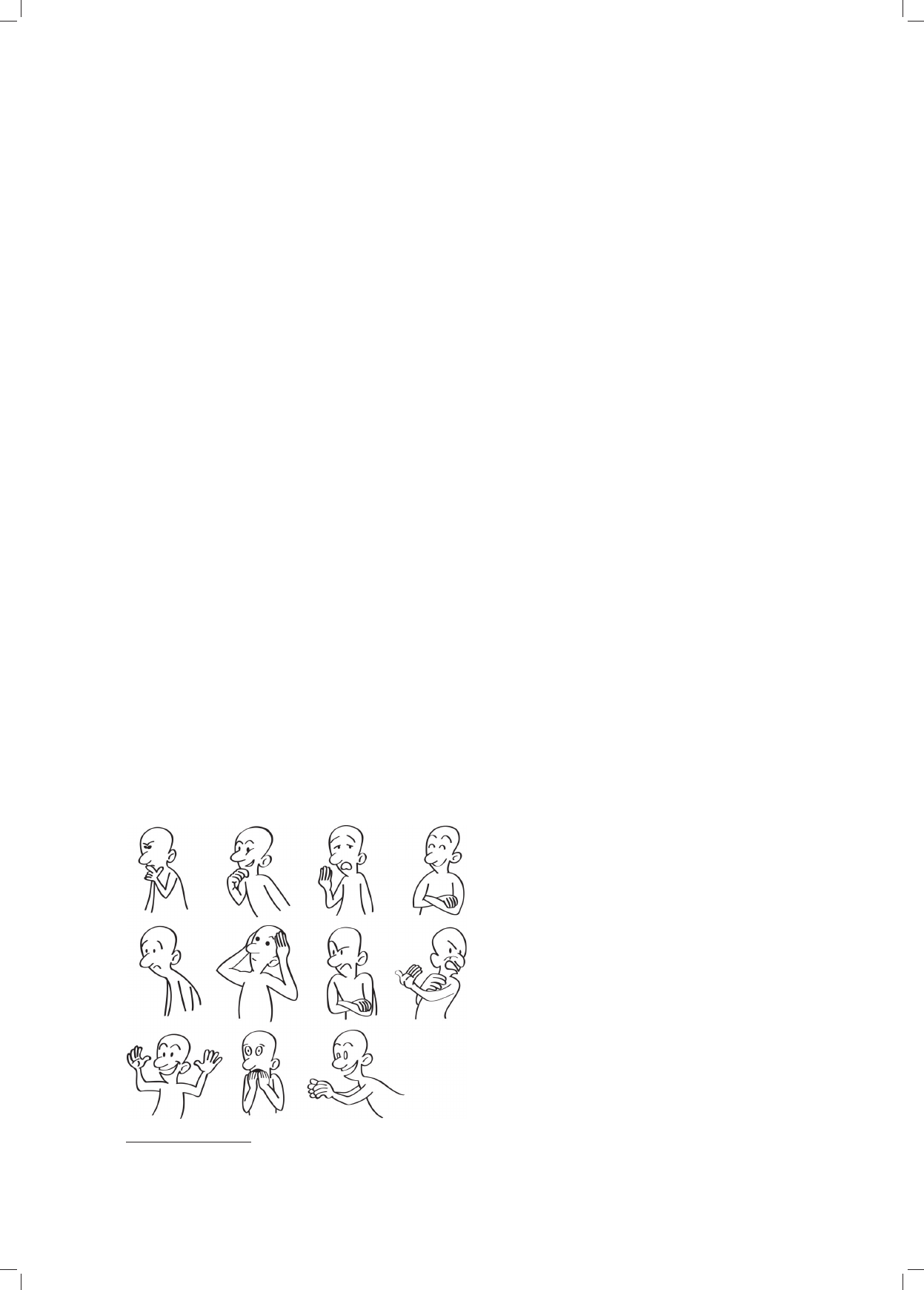
WizerunekulicyŚwidnickiejweWrocławiu/TheimageofŚwidnickaStreetinWrocław 59
Załącznik:
Przykładowe instrukcje i brzmienie pytań
Badanie 2A:
Instrukcja rysowania mapy ulicy Świdnickiej
ProszęnarysowaćnatejkartcemapęulicyŚwidnickiej,uwzględ-
niającwniejwszystkieważne Pana (Pani) zdaniem elementy
tejulicy (badany miał przed sobą czystą kartkę formatu A4).
Badanie 2A:
Pytania w kwestionariuszu
JakczęstoodwiedzaszulicęŚwidnickąweWrocławiu?
Poco–najczęściej–odwiedzaPan(i)ulicęŚwidnickąweWro-
cławiu?(pytanie otwarte)
CowulicyŚwidnickiejpodobasięPanu(Pani)najbardziej?
(pytanie otwarte)
Jakbardzoprawdopodobnejest,żepoleciPan(Pani)odwiedze-
nieŚwidnickiejswoimznajomym?Proszęocenićprawdopodo-
bieństwona skali 0–10, gdzie0 oznacza„zdecydowanienie
polecę”,a10oznacza„zdecydowaniepolecę”.
Badanie 2A, 2B, 2C i 4:
Emotikony do wyboru przez badanych
*
JaksięPan(i)czuje,gdymyślioGalerii…?Proszęwybraćmak-
symalnie trzy obrazki najlepiej przedstawiające Pana(Pani)
odczucia.Chodziogólnieocałąprzestrzeń,atmosferę,projekt,
sklepy,marki,obsługę,rozrywkę,obecnychtaminnychludzi...
tywnych zmian w sferze oferty handlowo-usługowej ulicy
oraz raczej pozytywnych wzbudzanych przez nią emocji
Świdnicka zaczyna być kojarzona bardziej z (względ-
nie atrakcyjną) przestrzenią kulturalno-rekreacyjną oraz
tranzytową niż komercyjną. W ramach takiego wize-
runku elementem kojarzonym stricte z wielkomiejskim
handlem, stosunkowo powszechnie i raczej pozytywnie,
jest jedynie DH Renoma. Ocena tego stanu rzeczy zależy
zapewne głównie od przynależności do określonej grupy
interesariuszy oraz oczekiwań i wyobrażeń względem
funkcjonowania Świdnickiej w przyszłości Wrocławia.
reactions to the street. Their frequent negative reactions
may be a result of frustration following many years of
consultations and social plans for reviving the street,
which – according to some of the business owners – were
ultimately never taken into account and implemented.
Nonetheless, it is rather the positive emotional reactions
of non-entrepreneurs (including foreigners, capable of
easy comparisons of Świdnicka Street to other commer-
cial spaces in their countries) – in conjunction with great
symbolic value, very good accessibility and attendance –
which make Świdnicka Street a space with a relatively
good image and untapped economic potential.
With all the ambiguity of the image of Świdnicka
Street, its lack of clarity and the abovementioned
functional and spatial shortcomings, there were few defi-
nitely negative connotations in its mental representations.
In the minds of respondents, the most evident weaknesses
in the image of the street, apart from the new underpass,
were the generally understood by the respondents “social
pathologies”, mainly those seen in the context of the
street: begging, littering, vandalism and homelessness.
What is also worth mentioning here is that the “time of
great collapse” of Świdnicka Street, and its ultimate de -
mise as a shopping street at the turn of the century, coin-
cided with, among others, its closure to vehicle traffic.
The problem of vehicular traffic in the context of Świd -
nicka Street is worth further exploration, not only because
of the preferences and requirements of entrepreneurs, but
also because its absence – although relatively positively
evaluated by many respondents – may result in further
transformation of the image of Świdnicka Street – from
a European shopping street to a recreational pro menade.
In conclusion – the above-mentioned mental and archi-
tectural context of the image of Świdnicka Street does not
seem to create a coherent and unequivocal whole. It seems
that the biggest problem of the street, if it was to play a prom-
inent role in the city as a commercial area, today is
its
departure from the shopping street image. In spite of all the
noticeable, positive changes in the commercial offer of
the street, and mostly positive emotions evoked in its
users, Świdnicka is increasingly associated with (albeit
attrac tive) space of cultural and recreational activities as
well as transit rather than its commercial function. The
only element of the street immediately associated with ur -
ban commerce is Renoma, a shopping centre that is gener-
ally positively assessed. Judgement of the situation largely
depends on belonging to a particular group of stake holders,
and individual expectations and perceptions in re lation to
the functioning of Świdnicka in the future of Wrocław.
Translatedby
MichałWłosik
*
Emotikony przerysowane częściowo z holenderskiej metody
LEMTool [35]; w polskiej wersji metody dodałem emotikony wyobra-
ża jące czujność, zmartwienie i strach (rys. P. Pa liński).
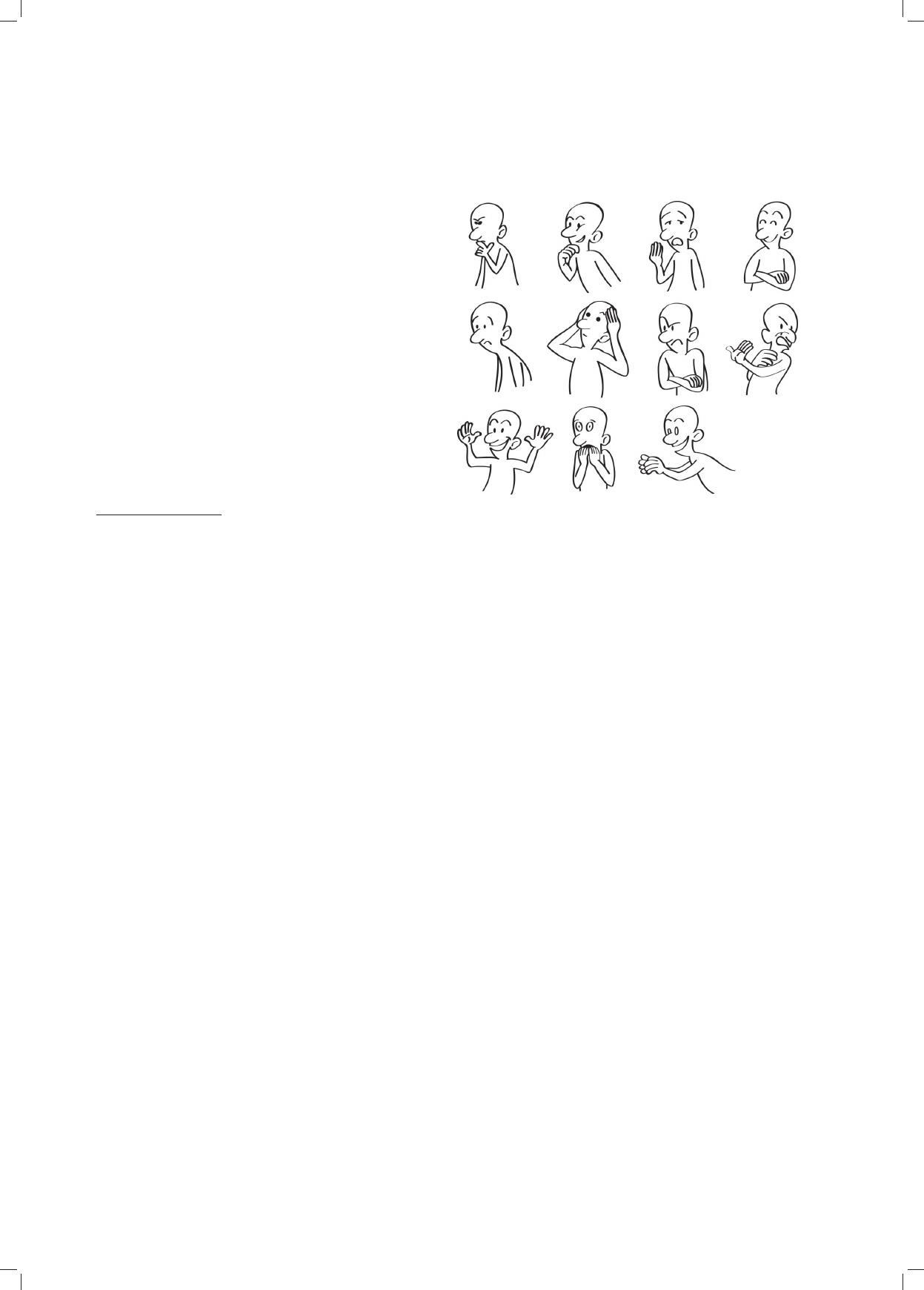
60 Michał Dębek
Consideringtheentirespace,theatmosphere,design,shopping,
brands,service,entertainment,andotherpeople visiting this
place...
Bibliografia /References
[1] Kotus J., Współczesnywymiarulicydużegomiasta, [w:] M. Szmyt-
kowska, I. Sagan (red.), Miastowdobieneoliberalnegourbanizmu,
Wydawnictwo Uniwersytetu Gdańskiego, Gdańsk 2012, 106–119.
[2] Wojdylak P., Rola ulicyśródmiejskiej wstrukturze funkcjonalno-
-przestrzennejPrzemyśla.Tożsamośćulicyajejfizjonomia,morfo-
logia i fizjologia, „Zeszyty Naukowe Politechniki Poznańskiej.
Architektura i Urbanistyka” 2014, z. 30, 247–255.
[3] Hughes C., Jackson C., Deathofthehighstreet:Identification,pre-
vention,reinvention, „Regional Studies, Regional Science” 2015,
No. 1(2), 237–256.
[4] Staniszewska A., Ulice handlowe: co przyspieszy ich rozwój?,
http://nf.pl/przedsiebiorca/ulice-handlowe-co-przyspieszy-ich-roz-
woj,,46903,226 [accessed: 21.10.2016].
[5] Witek J., Grzesiuk A., Karwowski J., Ulice handlowe wcentrum
miasta–nowespojrzeniewobeckonkurencjicentrówhandlowych,
„Handel Wewnętrzny” 2008, No. 3, 9–16.
[6] Cushman & Wakefield, HighStreetRenaissanceinEurope,http://
www.cushmanwakefield.pl/pl-pl/research-and-insight/2016/high-
street-renessance-in-europe/ [accessed: 5.05.2016].
[7] Knight F., RynekulichandlowychwPolscewfazierozwoju, http://
www.knightfrank.com.pl/aktualnosci/rynek-ulic-handlowych-w-
polsce-w-fazie-rozwoju---raport-knight-frank-06935.aspx [acces-
sed: 21.10.2016].
[8] Sawka N., UlicaŚwidnickaodzyskujeblask.Czypowinnabyćzam-
knięta dla samochodów?, http://wroclaw.wyborcza.pl/wroclaw/
1,35771, 20367368,ulica-swidnicka-odzyskuje-blask-czy-powinna-
byc-zamknieta-dla.html [accessed: 27.02.2017].
[9] Pawłowski S., Świdnickaumiera.Czy ktośjąuratuje?, GW Wro-
cław, wydanie nr 274, z dnia 25.11.2011, www.archiwum.wyborcza.
pl/Archiwum/2029040,0,7511370,20111125WRDLO [accessed:
12.04.2016].
[10] Gołębiowska-Szuchta M., Wzięlinawarsztat Świdnicką, www.
archiwum.wyborcza.pl/Archiwum/2029040,0,7869767,20140411
WRDLO [accessed: 12.04.2016].
[11] Polska Rada Centrów Handlowych, Ulicehandlowe:Analiza,sta-
tegia,potencjał–perspektywyrozwojuulichandlowychw8naj-
większychmiastach w Polsce, http://www.prch.org.pl/baza-wie-
dzy/raporty/polska [accessed: 10.06.2015].
[12] Hart C., Stachow G., Rafiq M., Laing A., The Customer Expe-
rience of Town Centres, Loughborough University, London
2014.
[13] Hart C., Stachow G., Cadogan J.W., Conceptualisingtowncentre
imageandthecustomerexperience, „Journal of Marketing Man-
agement” 2013, Vol. 29, No. 15/16, 1753–1781.
[14] PoznajulicęŚwidnicką, http://www.wroclaw.pl/poznaj-ulice-swid-
nicka [accessed: 10.10.2016].
[15] Oczak D., Świdnicka.Jedna znajstarszychulic weWrocławiu,
http://wroclaw.wyborcza.pl/wroclaw/56,90005,16712350,Swid-
nicka__Jedna_z_najstarszych_ulic_we_Wroclawiu.html [acces-
sed: 21.10.2016].
[16] Biuro Rozwoju Wrocławia, Studium uwarunkowańi kierunków
zagospodarowaniaprzestrzennegoWrocławia:RadaMiejskaWro-
cławiaUchwałanrL/1467/102010, www.wroclaw.pl.
[17] Gajny I., Dębek M., ŚwidnickaA.D. 2056: handlowy kręgosłup
metropolii, [w:] I. Gajny (red.), Miastopięknaicharakteru, Strategie
dla Miasta Przyszłości – Foresight Społeczny Wrocław 2036/2056,
Biuro Festiwalowe IMPART 2016, Wrocław 2016, 136–168.
[18] Pawłowski S., SzykujesięrewolucjawokółŚwidnickiej, GW Wro-
cław, wydanie nr 287 z dnia 10.12.2011, www.archiwum.wybor-
cza.pl/Archiwum/2029040,0,7520030,20111210WRDLO [acces-
sed: 12.04.2016].
[19] Karbowiak M., Świdnicka–reaktywacja?, GW Wrocław, wydanie
nr 49 z dnia 29.02.2016, www.archiwum.wyborcza.pl/Archiwum/
2029040,0,8126100,20160229WRDLO [accessed: 12.04.2016].
[20] Lynch K., TheImageoftheCity, Publications of the Joint Center
for Urban studies, MIT Press, Cambridge 1960.
[21] Alexander C., Ishikawa S., Silverstein M., Jacobson M., Fiksdahl-
-King I., Angel S., Językwzorców:Apatternlanguage: miasta,
budynki, konstrukcja, Gdańskie Wydawnictwo Psychologiczne,
Gdańsk 2008.
[22] Gifford R., Environmentalpsychology:Principlesandpractice,
Optimal Books, Colville 2007.
*
Emoticons taken partly from the Dutch method LEMTool [35];
I added vigilance, worry and fear in the Polish version (sketch by P. Pa -
liński).
Annex:
Exemplary instructions and wording of questions
Study 2A:
Instructions for map sketching
Pleasedrawonthispieceofpapera map of Świdnicka Street,
takingintoaccountalltheimportant,inyouropinion,elementsof
thestreet (the respondent was given a clean sheet of A4 paper).
Study 2A:
Questionnaire
HowoftendoyouvisitŚwidnickaStreetinWrocław?
Whatis–usually–thepurposeofyourvisitstoŚwidnickaStreet
inWrocław?(open question)
WhatdoyoulikethemostaboutŚwidnickaStreet? (open question)
HowlikelyareyoutorecommendŚwidnicka to your friends?
Ratetheprobabilityonascaleof0–10,where0is“notatall
likely”and10means“extremelylikely”.
Study 2A, 2B, 2C and 4:
Emoticons to be selected by the respondents
*
How do you feel when thinking about … shopping centre?
Pleaseselectuptothreepicturesbestillustratingyourfeelings.

WizerunekulicyŚwidnickiejweWrocławiu/TheimageofŚwidnickaStreetinWrocław 61
[23] Kaplan R., Kaplan S., Brown T., Environmental Preference:
AComparisonofFourDomainsofPredictors, „Environment and
Behavior” 1989, No. 5(21), 509–530.
[24] Stamps III A.E., Mystery, complexity, legibilityand coherence:
Ameta-analysis, „Journal of Environmental Psychology” 2004,
No. 24, 1–16.
[25] Dudek-Mańkowska S., Koncepcjawizerunkumiasta, [w:] A. Grze-
gorczyk, A. Kochaniec (red.), Kreowaniewizerunkumiast, Wyższa
Szkoła Promocji, Warszawa 2011, 42–67.
[26] Dębek M., Towardspeople’sexperiences andbehaviourswithin
theirworlds:Theintegrative-transactionalframeworkforstudying
complexpeople-environmentinteractions, „Social Space” 2014,
No. 2(8), 1–55.
[27] Wycisk A., Miastaznaczeń:wizerunkipolskichmiastorazspołecz-
narecepcjaich promocji, praca doktorska, Uniwersytet Śląski,
Katowice 2014.
[28] Kotler P., Haider D.H., Rein I., Marketingplaces:Attracting in-
vestment,industrie,andtourismtocities,statesandnations, Free
Press, New York 1993.
[29] San Martín H., Rodríguez del Bosque I.A., Exploringthecogni-
tive–affectivenatureofdestinationimageandtheroleofpsycho-
logical factors in itsformation, „Tourism Management” 2008,
No. 2(29), 263–277.
[30] Damurski Ł., Re-miasto.ScenariuszerozwojuurbanizacjiwXXIw.,
Oficyna Wydawnicza PWr, Wrocław 2016.
[31] Dębek M., Olejniczak P., WizerunekwrocławskiegoNadodrzapo
działaniachrewitalizacyjnych2009–2013, „Social Space” 2015,
No. 1(9), 1–47.
[32] Glińska E., Sposobybadaniawizerunkumiejsca,„Samorząd Tery-
torialny” 2011, No. 11, 33–44.
[33] Lynch K., Reconsideringtheimageofthecity, [w:] T. Banerjee,
M. Southworth (eds.), City senseand citydesign:Writingsand
projectsofKevinLynch, MIT Press, Cambridge 1995, 247–258.
[34] Rada Miejska Wrocławia, UchwałanrLVI/1465/14RadyMiejskiej
Wrocławiazdnia10kwietnia2014r.wsprawieutworzeniaParku
Kulturowego„StareMiasto”2014, www.wroclaw.pl.
[35] Huisman G., van Hout M., van Dijk E., van der Geest T., Hey-
len D., LEMtool, [w:] W.E. Mackay, S. Brewster, S. Bødker, Inter-
action, ACM Special Interest Group on Computer-Human (eds.),
theSIGCHIConference//ProceedingsoftheSIGCHIConference
onHumanFactorsinComputingSystems, ACM, New York 2013,
351–360.
[36] Grisaffe D.B., Questionsabouttheultimatequestion:Conceptual
considerations in evaluating Reichheld’s Net Promoter Score
(nps), „Journal of Consumer Satisfaction, Dissatisfaction and
Complaining Behavior” 2007, No. 20, 36–53.
[37] Temkin Group, NetPromoterScoreBenchmarkStudy, http://temk-
ingroup.com/research-reports/net-promoter-score-benchmark-
study-2016/ [accessed: 20.02.2017].
Podziękowania
Analizętreściwywiadówswobodnychprowadzonychwramachtychba-
dańpomagałamiprzeprowadzićPaulinaOlejniczak,którejniniejszym
bardzodziękujęzawsparcieprzypanowaniunadobszernymmateriałem
źródłowym.
Acknowledgment
Analysisofthecontentoffree-forminterviewsconductedinthisstudy
wascarriedoutwiththehelpofPaulinaOlejniczakfromtheInstituteof
Sociology,UniversityofWrocław,whoseinvaluablesupportmadethe
vastsourceofmaterialmoremanageable.
Streszczenie
W artykule przedstawiłem wyniki sześciu badań wizerunku oraz społecznego funkcjonowania ulicy Świdnickiej. W przekrojowych, jakościowych
i ilościowych badaniach, włącznie z metodą kartowania poznawczego, wzięło udział 292 respondentów. Byli to mieszkańcy Wrocławia, obcokra-
jowcy mieszkający czasowo we Wrocławiu oraz przedsiębiorcy prowadzący sklepy i lokale usługowe w ramach tej ulicy. Eksplorując źródła i praw-
dopodobne zyczne fundamenty wizerunku ulicy inspirowałem się koncepcją obrazu miasta Kevina Lyncha oraz językiem wzorców Christophera
Alexandra i jego współpracowników. Okazało się, między innymi, że ulicy Świdnickiej brakuje niektórych struktur urbanistyczno-architektonicz-
nych kluczowych dla prawidłowego funkcjonowania społecznego ulicy handlowej, a także że jej niezły wizerunek raczej nie jest silnie związany
z funkcją handlowo-usługową. Tylko jeden z najbardziej atrakcyjnych i najczęściej przywoływanych przez badanych punktów orientacyjnych,
DH Renoma, stanowi w wizerunku ulicy element o jednoznacznie wielkomiejsko-handlowym charakterze.
Słowa kluczowe: ulica, handel, wizerunek, język wzorców, mapy poznawcze, Wrocław
Abstract
This article presents the results of six image and social function studies of Świdnicka Street. Cross-sectional, qualitative and quantitative studies,
including the method of cognitive mapping, were attended by 292 respondents. The group included the inhabitants of Wrocław, temporary residents
of the city and entrepreneurs associated with the street, running shops and providing services. My exploration of the sources and probable physical
foundations of the image of the street was inspired by the concept of the image of the city developed by Kevin Lynch, and pattern language of
Christopher Alexander and his team. It turned out, among other things, that Świdnicka Street is lacking particular urban and architectural structures
that are prerequisite for the proper functioning of a high street, and that the good image of the street is not strongly associated with trade and
services. Renoma, the leading and most attractive shopping mall and ex-department store of Świdnicka Street, was also most frequently cited by
respondents as the only element of the street unambiguously metropolitan and commercial in character.
Key words: street, trade, image, pattern language, cognitive maps, Wrocław
Miejski internet w parku Szczytnickim
we Wrocławiu.
Przenikanie się świata realnego i wirtualnego
jest znakiem naszych czasów
(fot. Ł. Damurski, 2016)
Urban internet in the Szczytnicki Park
in Wrocław. Penetration of the real and
virtual worlds is the sign of our times
(photo by Ł. Damurski, 2016)