
2017
1(49)
DOI: 10.5277/arc170104
Magdalena Baborska-Narożny*
Ocena funkcjonowania budynku –
rozumienie korzyści i ryzyka dla zaangażowanych stron.
Lekcje dla Polski płynące z doświadczeń brytyjskich
Building performance evaluation –
understanding the benefits and risks for the stakeholders involved.
Lessons for Poland based on the UK experience
Wstęp
Prawa fizyki budowli wyznaczające podstawowe wy
zwania przy projektowaniu są uniwersalne, a jednak sam
proces projektowy, budowlany, czy też zasady utrzyma
nia budynków są zróżnicowane i odzwierciedlają kon
kretne uwarunkowania danego środowiska kulturalnego,
ekonomicznego i prawnego [1]. Podobnie fizjologia czy
psychologia opisują uniwersalne ramy funkcjonowania
ludzi, a szczegółowe zasady, na przykład sposoby ubiera
nia się (tzw. dress code) lub oczekiwania względem bu
dynków w zakresie komfortu są ściśle powiązane z lo kal
nym kontekstem. Oznacza to, że przyczyny problemów
związanych z użytkowaniem budynków mogą być zarów
no uniwersalne, jak i uwarunkowane lokalnie. Na przy
kład, gdy mieszkańcy uznają dźwięk związany z dzia ła
niem wentylacji mechanicznej za dokuczliwy, to za zwy czaj
dążą do jego zlikwidowania poprzez wyłączenie wen
tylatorów, jeśli tylko jest to możliwe. Takie zachowania
zostały potwierdzone badaniami prowadzonymi w za miesz
kanych budynkach w różnych krajach [2], [3]. W celu
zmi nimalizowania ryzyka wystąpienia takich niepożąda
nych działań decydenci mogą przygotować ogólne wy
tyczne dotyczące maksymalnego poziomu hałasu wytwa
rzanego przez wentylatory. Skuteczne wdrożenie takich
Introduction
While the principles of building physics defining core
challenges for building design are ubiquitous, the design
itself and subsequent stages of construction or mainte
nance are context specific. They are part of distinct cul
tural, economic and legal environments [1]. Similarly,
while human physiology and psychology are universal,
dressing codes, expectations or tacit knowledge related to
indoor microclimate regulation are not. This implies that
common and singular causes underpin issues observed in
occupied buildings. For example, inhabitants tend to
reduce fanrelated noise nuisance in a domestic context
by switching the mechanical ventilation off where possi
ble. This finding has been confirmed by a few studies
looking at building performance in different countries [2],
[3]. To minimise the generic risk of undesirable occupant
behaviour as far as building performance is concerned
policy makers may set guidance on maximum recom
mended noise levels from ventilation. However an effec
tive implementation of such policy requires addressing of
the numerous context specific factors that can only be
identified through local building performance evaluations
(BPE). BPE brings the rich context into play and gives
fine grained recommendations to those involved in pro
curement through to the users [4]. These include aspects
such as: identifying what needs to be changed or improved
to reduce noise in the future, devising a product or process
or a policy associated with noise abatement, evaluating
* Wydział Architektury Politechniki Wrocławskiej/Faculty of Ar
chitecture, Wrocław University of Science and Technology.

48 Magdalena BaborskaNarożny
wytycznych wymaga jednak uwzględnienia wielu czynni
ków charakterystycznych dla danego kontekstu. Można je
ustalić jedynie przy zrozumieniu, które elementy procesu
projektowego, wykonawczego czy użytkowego złożyły
się na powstanie hałasu. Rozumienie takie buduje się
poprzez tzw. badania funkcjonowania budynków (ang.
Build ing Performance Evaluation – BPE). Badania BPE,
wiążąc szeroki wachlarz zagadnień związanych z proce
sem in westycyjnym i użytkowaniem budynków, umożli
wiają sfor mułowanie szczegółowych zaleceń na przy
szłość [4]. Obejmują one na przykład zidentyfikowanie
elementów wymagających poprawy w celu obniżenia
poziomu hałasu w przyszłości: czy udoskonalenia wyma
ga produkt (wentylator) czy proces jego montażu lub
przepisy dotyczące dopuszczalnych poziomów szumu
z urządzeń. Kluczowa jest też ocena wpływu wyłączenia
systemu wentylacji na pogorszenie się jakości powietrza
we wnętrzach i związane z tym ryzyko dla zdrowia użyt
kowników. Badania BPE dostarczają wiedzy na temat
doskonalenia środowiska zbudowanego, koniecznej do
spełnienia rosnących oczekiwań względem budynków
w zakresie oszczędności energii, komfortu użytkowania
czy tak zwanego dobrostanu.
Istnieje potrzeba powtarzania badań dotyczących funk
cjonowania budynków powstających i użytkowanych
w róż nych lokalizacjach i kontekstach kulturowych w celu
zdiagnozowania źródeł ewen tual nych problemów i sku
tecznego ich wyelimino wa nia oraz w celu rozpoznania
udanych rozwiązań i ich po wielania. Bardzo ważna jest
umiejętność wyciągania wniosków z funkcjonowania już
istniejących budynków w celu realizacji coraz lepszych
obiektów w przyszłości. Należy przy tym pamiętać, że
działanie obecnie użytkowanych budynków jest zwykle,
choć nie zawsze, poniżej oczekiwań założonych w fazie
projektowania [5], [6]. Tak zwane luki efektywności są
przyczyną obniżenia wiarygodności branży i polityki bu
do wlanej [7]. Takie zjawisko wskazuje też na pilną po
trzebę poprawy wiarygodności modelowania zużycia
energii budynków oraz kosztów powiązanych, a także –
co najważniejsze – zapewnienia odpowiedniej jakości
powietrza wewnątrz budynków. Niska wiarygodność wy
ni ków modelowania oznacza podwyższone ryzyko dla in
westycji w rozwiązania wspomagające wydajność ener
getyczną budynków, jak też ryzyko pojawienia się zagro
żeń dla zdrowia użytkowników [8], [9]. Idealnie byłoby,
gdyby badania przeprowadzane w różnych obiektach
i kontekstach bazowały na tych samych metodach, tak
aby można porównać uzyskane wyniki. Pomimo trudno
ści przeprowadzano już takie metabadania [10], [11].
Ponadto w różnych krajach wykonano wiele mniejszych
badań terenowych dotyczących podobnych aspektów,
przyczyniając się do wzbogacenia wiedzy dotyczącej eta
pu użytkowania budynków oraz informowania decyden
tów, projektantów i użytkowników budynków o tych
wynikach [12], [13]. W Wielkiej Brytanii już od lat 80.
XX w. wkłada się wiele wysiłku w opracowanie metod
i narzędzi odpowiednich do badania użytkowanych bu
dynków w celu eliminowania pojawiających się proble
mów i rozpowszechniania dobrych praktyk [14]. Wysiłki te
zapoczątkowane w formie POE, czyli oceny jakości po
how serious is the impact of switching the system off in
a specific situation, such as whether or not it requires an
intervention due to the health risks involved. BPE allows
the context based learning and improvement of the built
environment necessary at a time of rapidly increasing
expectations towards buildings in terms of energy effi
ciency, user comfort and wellbeing.
There is a need to repeat research into how buildings
work in different contexts to diagnose sources of prob
lems or successes and meaningfully address or reinforce
them. The process of drawing lessons from existing build
ings to improve the future ones is crucial given that occu
pied buildings typically, but not always, underperform
compared to design stage assumptions [5], [6]. The so
called “performance gap” causes a “credibility gap” for
the building industry and policy [7]. It undermines the
reliability of building energy use modelling and the asso
ciated costs and most importantly securing satisfactory
indoor air quality. Undermining trust in modelling results
means an increased risk in terms of occupant health haz
ards or investment in energy efficiency measures [8], [9].
Ideally in the process of verification same methods would
be used for the results to be crosscomparable. Despite
difficulties such metastudies have already been carried
out [10], [11]. Also numerous smaller field studies in dif
ferent countries focused on similar objectives added to
our understanding of the occupancy stage, informing pol
icy makers, industry actors and building users [12], [13].
The UK has put substantial research effort, dating back to
the 1980s, into developing methods and tools applicable
to occupied buildings in order to tackle issues experi
enced, disseminate best practice designs and learn from
them [14]. This effort had started as Post Occupancy
Evaluation (POE) and evolved into building performance
evaluation (BPE) that included the whole procurement,
construction and occupancy stages into analysis. The
BPE, though far from being limited to an exploration of
energy use issues, has a proven capacity to facilitate the
transformation towards energy efficient goals for build
ings’ operational stage. This is achieved through provid
ing actionable feedback to key stakeholders diagnosing
where in the process the source of future issues was. This
seems vital in the Polish context given that Poland, like
all the EU member states, approved the Energy Per
formance in Buildings Directive (EPBD) [15] but has
gained little experience with nearly zero energy buildings
to date. Ratified in 2010, the EPBD epitomises the high
expectations towards the potential of diminished energy
use in buildings achieved without compromising user
needs. It set an obligation on the building industry and
policy makers to trigger a major transition towards zero
energy goals for all the new built and retrofit buildings,
focusing so far on the occupancy stage. The fundamental
rationale behind this challenge derives from the EU cli
mate change mitigation policies. Once it was established
that ca. 40% of the current global energy is used in build
ings, mainly for heating or cooling, cutting down this fig
ure became a clear objective. Technically this is feasible
and there are best practice examples of the ambitious tar
gets being met in practice. However as the repeatedly
Ocena funkcjonowania budynku/Building performance evaluation 49
oddaniu do użytkowania (ang. Post Occupancy Evaluation),
wyewoluowały w tzw. BPE, czyli ocenę funkcjonowania
budynku, która włączyła do analizy cały proces inwesty
cyjny. Badań BPE nie ogranicza się do kwestii zużycia
energii, ale udowodniły swą szczególną przydatność w pro
cesie przekształcania budownictwa w kierunku zwiększo
nej wydajności energetycznej. Pomoc w tym zakresie
wydaje się obecnie szczególnie potrzebna w Polsce, gdzie
podobnie jak we wszystkich innych krajach członkow
skich Unii Europejskiej przyjęto dyrektywę dotyczącą
charakterystyki energetycznej budynków (EPBD) [15],
a przy tym – jak dotąd – zgromadzono niewielkie do
świadczenie praktyczne z tzw. budynkami niemal zero-
energetycznymi. Dyrektywa EPBD ratyfikowana w 2010 r.
wyznacza wysokie oczekiwania dotyczące obniżenia po
ziomu zużycia energii w budynkach bez ograniczania
potrzeb ich użytkowników. Nakłada ona na branżę bu
dowlaną i decydentów obowiązek inicjowania dążeń do
osiągnięcia celów niemal zeroenergetycznych wobec
wszystkich nowo budowanych i remontowanych budyn
ków, skupiając się na chwilę obecną na etapie użytko
wym, z pomi nięciem np. problematyki tzw. energii wbu
dowanej. Pod stawową przesłanką dla wyznaczania celów
w zakresie oszczędności energetycznej jest polityka Unii
Europejskiej dotycząca ograniczania skali zmiany klima
tu. W chwili kiedy ustalono, że obecnie około 40% ener
gii zużywanej globalnie jest zużywane głównie na ogrze
wanie czy też chłodzenie budynków, obniżenie poziomu
tego zużycia stało się bardzo ważnym zadaniem. Teo re
tycznie jest to możliwe i w praktyce istnieją przykłady
dobrych praktyk w tym zakresie. Jednak powtarzające się
wyraźne luki efektywności wskazują, że nie jest to takie
proste. Wy eli minowanie tych luk wymaga systematycz
nej analizy procesów, produktów i przepisów dotyczą
cych kształtowania budynków oraz sprawdzania, czy ich
wdrażanie przynosi oczekiwane skutki. W pierwszych 10
la tach XXI w. Wielka Brytania odgrywała wiodącą rolę
w systematycznym badaniu wydajności energetycznej bu
dynków użytkowanych. W ramach programu „Ocena Dzia
łania Bu dynków (2010–2014)” (ang. TSB Building Per -
formance Evaluation) finansowanego rządowymi środ kami
na po ziomie 8,5 miliona funtów przeanalizowano, przy
użyciu zalecanych metod, 150 studiów przypadku do ty
czących budynków mieszkalnych i niemieszkalnych
[16],
[17]
. Ciągle trwa rozpowszechnianie wyników tych badań:
stop nio wo pu blikowane są najważniejsze raporty oraz og
rom na liczba zanonimizowanych danych zebranych po
realizacji programu poprzez specjalną platformę wymiany
danych Building Data Exchange, która jest częścią Digi -
tal Ca tapult (www.buildingdataexchange.org.uk). Two
rzo na jest cenna baza źródłowa, która pozwoli na dalsze
analizy rze telnych danych, informująca o stanie obecnym
bu downictwa niskoenergetycznego Wielkiej Brytanii.
Cele i zakres pracy
Jak dotąd wkład Polski w wyżej wspomniany interdy
scyplinarny dyskurs dotyczący wzajemnego wpływu bu
dynków i ich użytkowników oraz daleko idących konse
kwencji tej relacji jest niewielki. Niektóre z wniosków
observed “performance gap” suggests this is far from
being simple. Challenging that gap involves a systematic
insight into processes, products, practices and regulations
shaping how buildings are delivered and whether they are
fit for purpose. In the first decade of the 21
st
century the UK
has taken an internationally leading role in methodically
exploring energy efficient buildings at work. An 8.5m GBP
government funded Innovate UK Building Performance
Evaluation programme (2010–2014) looked at 150 case
study domestic and nondomestic buildings using a pre
scribed portfolio of methods [16], [17]. The dissemination
stage is an ongoing process: highlight reports as well as a vast
amount of anonymised data resulting from the programme
is being gradually released for further research through
Building Data Exchange platform – part of Digital Cata
pult (www.buildingdataexchange.org.uk). A valuable re
source is being created with the objective to draw evidence
based lessons informing the UK policy and practice.
Aims and scope
So far Poland’s contribution to the above highlighted
interdisciplinary discourse on building – user mutual im
pact and its wide reaching consequences has been limited.
Some of the UK based findings might match the Polish
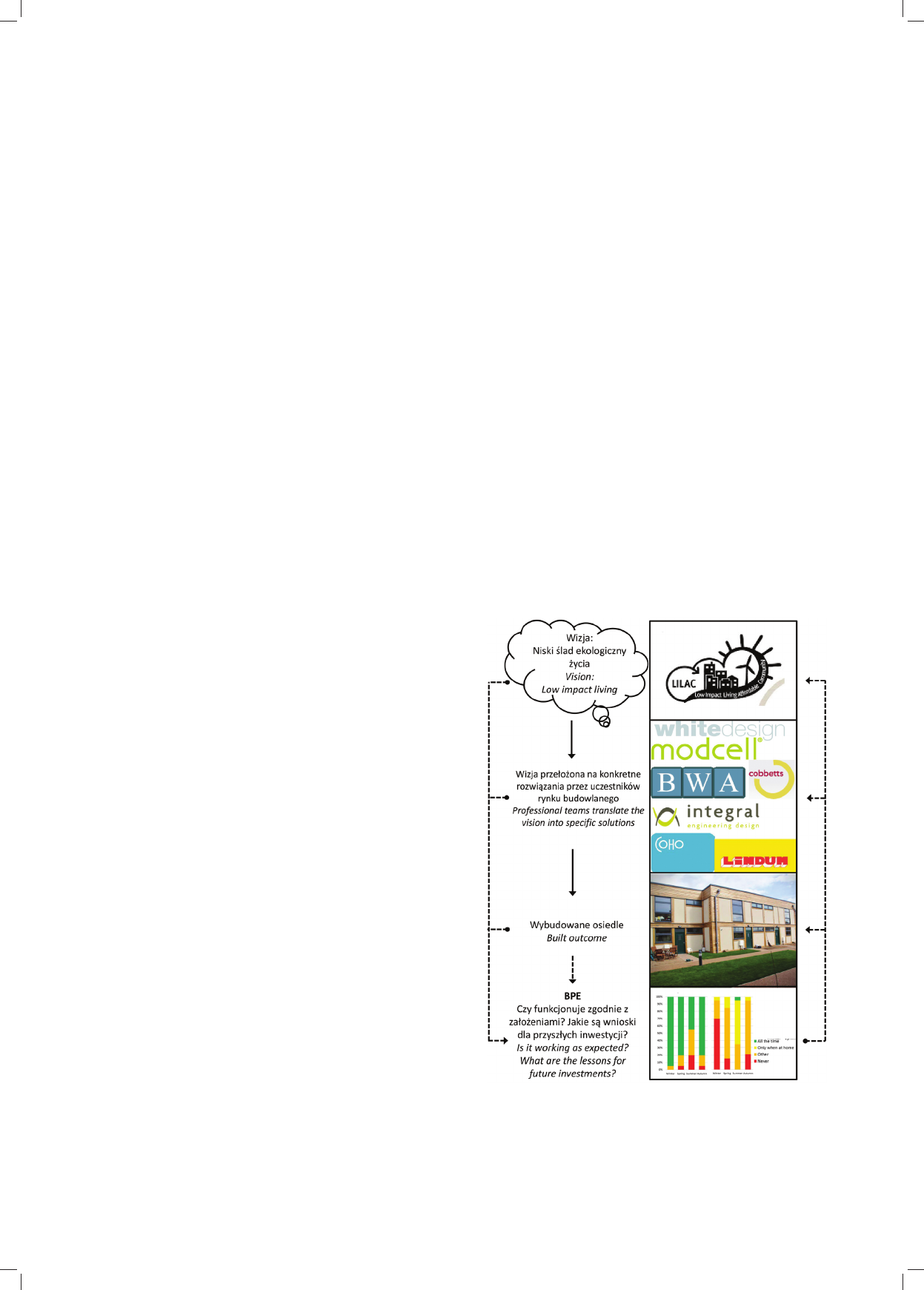
Il. 1. Rola BPE w tworzeniu informacji zwrotnej
dla uczestników procesu inwestycyjnego na przykładzie osiedla LILAC
(oprac. M. BaborskaNarożny)
Fig. 1. BPE’s role as a feedback tool for all the stakeholders of
the planning, design and construction process based on LILAC casestudy
(by M. BaborskaNarożny)

50 Magdalena BaborskaNarożny
uzyskanych w Wielkiej Brytanii mogą pomóc polskiemu
budownictwu, jednak wszędzie tam, gdzie sukcesy lub
ewentualne problemy mają lokalne podłoże, odpowiednie
wytyczne muszą być opracowane na podstawie lokalnych
badań terenowych. Niniejszy artykuł ma na celu posze
rzenie wiedzy na te mat strategii rozwoju badań BPE
w Polsce poprzez wydobycie istoty kluczowych wyzwań,
które początkowo utrudniały rozwój tych badań w Wielkiej
Brytanii, ale w dużym stopniu zostały tam już pokonane.
Wyzwania te skupiają się głównie wokół złożonego i deli
katnego charakteru współpracy z wieloma interesariusza
mi, którzy mogą mieć sprzeczne interesy, a mimo to ich
dobrowolny udział jest konieczny do uzyskania badań na
tyle rzetelnych, by mogły przynieść oczekiwane korzyści.
Autorka uważa, że ten właśnie aspekt wymaga na wstępie
dobrego zrozumienia, które warunkuje podjęcie koniecz
nych działań poprzedzających faktyczne wprowadzenie
badań BPE w krąg zainteresowania branży budowlanej
oraz środowiska decydentów w Polsce. Najpierw przed
stawiono tło niniejszej pracy w celu wyjaśnienia przyjętej
metody krytycznej refleksji. Następnie omówiono klu
czowe grupy interesariuszy zaangażowanych w badania
BPE w Wielkiej Brytanii. Odczuwane przez nich korzyści
i stojące przed nimi ryzyko są analizowane odrębnie
w odniesieniu do każdej grupy. Służą one do opracowania
mapy drogowej koniecznych działań wstępnych.
Metody
Niniejsza praca jest krytyczną refleksją nad procesem
wprowadzenia badań BPE do strefy zainteresowania
głów nych interesariuszy z branży budowlanej w Wielkiej
Bry tanii. Refleksja ta oparta jest na wymianie wiedzy do
tyczącej badań BPE między Wielką Brytanią a Polską
umo żliwionej dzięki programowi Marie Curie Fellowship
BuPESA (ang. Building Performance Evaluation for Sus-
tainable Architecture) finansowanemu ze środków Unii
Europejskiej. Projekt realizowany w Sheffield School of
Architecture, University of Sheffield, trwał po nad dwa
lata od marca 2013 do czerwca 2015. Objął on wszyst kie
etapy badań BPE i umożliwił zdobycie doświadczenia
przez jego uczestniczkę (autorkę) przy współpracy eks
perta – profesor Fionny Stevenson. W jego ramach autor
ka przeprowadziła dogłębną ocenę dwóch osiedli miesz
kaniowych w Wielkiej Brytanii w Leeds (jednego nowo
wybudowanego, a drugiego po remoncie kapitalnym). Na
etapie przygotowawczym zapoznała się z literaturą przed
miotu oraz z etycznymi aspektami badań. Następnie roz
poczęła szeroko zakrojone badanie terenowe zaprojekto
wane jako studium przypadku z wykorzystaniem metod
mieszanych. Samo zbieranie danych trwało 15 miesięcy
(od marca 2013 do czerwca 2014). W trakcie trwania pro
jektu wykonano jedynie wstępne analizy pozwalające na
opracowanie informacji zwrotnej zawierającej rekomen
dacje płynące z badań dla zaangażowanych interesariuszy
oraz szerszej publiczności (www.bupesa.co.uk).
W niniejszej pracy ukazano refleksję uczestniczki pro
jektu nad badaniami BPE stosowanymi w Wielkiej Bry tanii
na tle wiedzy dotyczącej procesu inwestycyjnego w Pol
sce, zdobytej w praktyce architektonicznej, jak również
context however wherever the contextual differences are in
place bespoke guidance needs to be developed through
local implementation of BPE field studies. This paper aims
to build an understanding of possible strategies for BPE
development in Poland by distilling key challenges that
were successfully overcome in the UK. These challenges
involve the complex and sensitive nature of working with
multiple stakeholders that may have conflicting agendas
and nevertheless all need to voluntarily contribute to the
BPE process to make it meaningful. However, all stake
holders have something to gain in the process, which if
presented correctly can negate the conflicting agendas. The
positives are more robust working relationships (trust)
which can lead to repeat work, more efficient and effective
project delivery (less rework because right first time) and,
midterm, a differentiated business proposition (can build
nearly zero energy buildings while others in the industry,
not exposed to BPE, are delivering substandard prod
ucts). It is believed by the author that both challenges and
positives need to be well understood and addressed before
the methodological aspects of BPE are introduced.
The background for this paper is first presented to jus
tify the adopted method of critical reflection. The next
section introduces key groups of stakeholders involved in
the evaluation in the UK. The perceived benefits and risks
they face are analysed in relation to each group. These
inform an action roadmap proposed here to facilitate
embedding the BPE approach into the Polish building
industry and policy making environment.
Methods
The paper is a critical reflection on the process of intro
ducing BPE into the scope of interest of the mainstream
building industry stakeholders in the UK. The reflection
is based on a stateoftheart BPE knowledge exchange
between the UK and Poland enabled by an EU funded
Marie Curie Fellowship BuPESA and is supported by lit
erature review. The Fellowship lasting over two years
between March 2013 and June 2015 allowed the author
mentored by Prof. Fionn Stevenson to acquire handson
experience encompassing all the BPE stages. The project
was carried out at the Sheffield School of Architecture,
University of Sheffield, UK. It involved in depth evalua
tion of two housing developments in Leeds, UK (one new
build, one retrofit). It started with a preparatory stage
involving literature review and gaining an understanding
of the ethical aspects of the research. This was followed
by extensive field work designed as a mixedmethods
case study approach covering 15 months of data collec
tion from March 2013 until June 2014. Within the dura
tion of the project initial analysis were completed and
provided actionable feedback to the stakeholders involved
and wider dissemination of key findings to different audi
ences (www.bupesa.co.uk).
For the purpose of this paper the Fellow’s engagement
and reflection on the BPE process as applied in the UK
has been overlaid onto the background of familiarity with
the delivery process in Poland gained through architec
tural practice as well as opinions gathered through coop

Ocena funkcjonowania budynku/Building performance evaluation 51
na podstawie opinii zebranych podczas współpracy z aka
demickimi i rynkowymi interesariuszami z branży bu
dowlanej. Kluczowym składnikiem praktyki BPE oprócz
usta lonych i spisanych zasad i procedur są nieobecne
w li teraturze przedmiotu tzw. miękkie umiejętności ze
społu badawczego, który musi być w stanie rozwiązywać
nieprzewidziane problemy oraz łagodzić napięcia poja
wiające się w związku z tym, że proces ten opiera się na
do browolnej zgodzie wielu stron w nim uczestniczących.
Trudno wska zać w literaturze poświęconej BPE ten istot
ny wed ług autorki aspekt badań. Z tego powodu poniższe
wnioski opierają się na refleksji bazującej na tzw. obser-
wacji uczestniczącej autorki, zaproszonej przez eksper
tów BPE z Wielkiej Brytanii do włączenia się do ich śro
dowiska badawczego w charakterze aktywnego członka.
Obser wacja uczestnicząca obejmowała pełne zaangażo
wanie w organizowanie i realizację wszystkich etapów
badań BPE, cotygodniowe trwające pół dnia dyskusje na
temat szczegółów projektu z czołowym specjalistą w dzie
dzinie badań BPE w Wielkiej Brytanii, profesjonalne
szkolenia dotyczące konkretnych metod takich jak Build
ing Usa bi lity Survey (BUS), obliczanie mostków termicz
nych czy badania termowizyjne budynków. Zdobywane
doświadczenie obejmowało spotkania z wieloma specja
listami w zakresie BPE, a także uczestnictwo oraz współ
organizowanie wydarzeń naukowych i branżowych doty
czących badań BPE.
W pracy wykorzystano doświadczenia Wielkiej Bry
tanii dla określenia warunków wstępnych wprowadzania
badań BPE do praktyki branży budowlanej.
Badania BPE – wytyczna „odgórna”
czy też inicjatywa „oddolna”
Obecnie w Wielkiej Brytanii badania BPE wychodzą
z dotychczasowej roli niszowej i są promowane przez naj
ważniejsze organizacje zawodowe branży budowlanej.
Od 2008 r. stowarzyszenie inżynierów CIBSE (ang.
Chartered Institution of British Engineers) wyróżnia spe
cjalną nagrodą Building Performance Award […] ludzi,
produkty i projekty, które przedstawiają najwyższe stan-
dardy inżynieryjne w środowisku zbudowanym w opar
ciu o rzeczywistą i zmierzoną wydajność, a nie zamysł
pro jektowy ani specyfikacje (www.cibse.org). Od 2014 r.
CIBSE oga nizuje dwudniowe konferencje o nazwie CIBSE
Build2Perform, poświęcone wyłącznie ocenie funkcj o no
wania budynków. W 2013 r. Kró lewskie Zrze sze nie Ar
chitektów w Wielkiej Brytanii RIBA (ang. Royal Institute
of British Architects) wprowadziło badania BPE do tzw.
Plan of Work, a w 2016 r. wydało odpowiednie wytycz ne
szczegółowe. W ten sposób badania BPE stały się zale
caną częścią usług architektonicznych świadczonych
w Wielkiej Brytanii. Ponadto coraz częściej rozważa się
tam potrzebę stopniowego odejścia od przepisów budow
lanych poprzestających na modelowaniu, a pomijających
rzeczywistą sprawność budynków. Takie opinie popar
te są wynikami zorganizowanego od górnie programu
ba dawczego TSB BPE finansowanego przez rząd [16],
[17]. Początki badań były jednak zdecydowanie inicja
tywą oddolną wychodzącą od ekspertów budowlanych
eration with academic and professional building industry
stakeholders. Core part of the BPE besides the explicit
procedures is the tacit knowledge of the research team
capable of addressing the unforeseen issues arising and
managing any tensions as the process is based throughout
on the voluntary consent of its participants. The tacit
ingredient of the BPE is difficult to pinpoint in the litera
ture on the subject and is gained with experience.
Therefore the findings are based on reflection on partici
pative observation by the Fellow invited by the UK BPE
experts to become an active member of their research
community. The participative observation included full
involvement in organising and conducting all the BPE
stages, weekly half a day discussions on the details of the
project with the mentor – top UK specialist in domestic
BPE, professional trainings on specific methods like the
BUS survey, thermal bridges calculation or thermal imag
ing in buildings. The experience also involved shadowing
meetings with other BPE specialists, attending and co
organising BPE focused scientific and industrial events.
The paper uses the UK experience to distil the prereq
uisites for introducing BPE research into the building
industry practice and the related policy shaping in Poland.
BPE – a top down guidance
or a bottom up initiative
Currently in the UK the BPE is slowly gaining momen
tum to become incorporated into the mainstream building
industry practice and is being endorsed by key profes
sional organisations. The Chartered Institution of British
Engineers (CIBSE) has introduced Building Performance
Award in 2008 to [...] recognise the people, products and
projects that demonstrate engineering excellence in the
built environment based on actual, measured perfor-
mance, not design intent or performance specifications
(www.cibse.org). Since 2014 CIBSE have also held a two
day conference solely on building performance now
called CIBSE Build2Perform. The Royal Institute of Bri
tish Architects (RIBA) has introduced the elements of
BPE into their “Plan of Work” in 2013 and issued guid
ance on the process in 2016. Thereby BPE became a rec
ommended part of an architectural service in the UK.
Also there is a vocal BPE related community who believes
building regulations in the UK should shift from a model
based approach towards a performance based evaluation
[16], [17]. However the beginnings were clearly a bottom
up initiative of building consultants with mechanical
engineering background concerned about quality of the
internal environment in buildings [14]. The “sick building
syndrome” diagnosed as a result of early investigations
was one of key findings that grabbed public attention and
secured an increasing support for field studies evaluating
occupied buildings. Wider support for BPE is vital to
enable achievement of its aims, i.e. to learn from what has
been built to do it even better in the future, to improve the
guidance and building regulations and check their impact
and validity of the objectives. The assumed long term key
benefits: for the economy and society of having better
performing buildings [18] but also for the industry of

52 Magdalena BaborskaNarożny
specjalizujących się w inżynierii sanitarnej, którzy przy
kładali dużą wagę do jakości środowiska wewnątrz
budynków [14]. Tak zwany syndrom chorego budynku
zdiagnozowany w wyniku wczesnych badań był jednym
z kluczowych odkryć, które przyciągnęło uwagę opinii
publicznej i dzięki któremu wzrosła popularność badań
terenowych, oceniających budynki użytkowane. Szersze
zainteresowanie i wsparcie BPE są warunkami koniecz
nymi osiągnięcia celów, takich jak: upowszechnienie
wniosków badań, by kształtowały one przyszłe inwesty
cje, poprawa wytycznych oraz przepisów budowlanych
poprzez sprawdzenie efektów ich wdrażania i we ryfikację
sformułowanych celów. Zakładane ko rzyś ci długofalowe
prowadzenia badań BPE: dla gospodar ki i społeczeństwa
(lepsze budynki), czy też dla interesariuszy rynkowych
(lepszy produkt) [18], zależą całkowicie od tego, czy sfor
mułowane w wyniku badań wnioski zostaną wykorzysta
ne w praktyce [19]. Jako że spełnienie ambicji BPE
w postaci wywołania zmiany w zakresie procesów
i zachowań zależy od wielu osób i organizacji, ich punkt
widzenia i aspiracje muszą być w procesie oceny zrozu
miane i uwzględnione. W rzeczywistości oso by czy orga
nizacje, na które badania BPE mają bezpośred ni wpływ,
narażone są na pewne ryzyko. Powinno ono być równo
ważone wymiernymi korzyściami. By można było je
osiągnąć, wskazane powyżej ogólne uzasadnienie prowa
dzenia badań BPE musi być każdorazowo osadzone
w kontekście lokalnych potrzeb. Tylko wtedy wnioski
będą na tyle znaczące dla uczestników, by byli oni gotowi
do wprowadzania sugerowanych zmian.
Zaangażowanie w badania BPE
W badania BPE może być bezpośrednio zaangażowa
nych pięć grup interesariuszy:
– zamawiający (deweloperzy, właściciele budynków,
pośrednicy w obrocie nieruchomościami),
– usługodawcy w procesie inwestycyjnym (zespoły
projektowe, konsultanci, wykonawcy i dostawcy),
– ustawodawca i władze lokalne (odpowiedzialni za
kształtowanie polityki i przepisów budowlanych),
– użytkownicy budynków,
– środowisko akademickie (naukowcy).
Każda z tych grup ma swoją własną agendę i odgrywa
konkretne role w badaniach BPE. Poniżej przedstawiono
główne rodzaje ryzyka dla każdej z tych grup w trakcie
prowadzenia badań BPE oraz korzyści, których mogą się
spodziewać z własnego w nie zaangażowania (tab. 1).
Perspektywa zamawiającego
Zamawiający, zwłaszcza tacy jak np. deweloperzy,
którzy mają powtarzalny model biznesowy, powinni,
przynajmniej teoretycznie, być najbardziej zainteresowa
ni zaangażowaniem się w badania BPE [20]. Konkretna
wiedza na temat tego, co z perspektywy użytkowników
naprawdę w budynku się sprawdza, a co nie, ułatwiłaby
planowanie przyszłych inwestycji oraz obniżała związane
z nimi ryzyko. Ponadto potencjał marketingowy gwaran-
cji jakości mógłby przyczynić się do uzyskania przewagi
delivering better products, depend on whether any evi
dence based guidelines BPE generates are implemented
in practice [19]. As meeting BPE’s ambition to trigger
behavioural change depends on the multiple individual
and organisational actors their aspirations and position
need to be well understood and addressed within the eva
luation process. There are in fact various risks involved for
those directly affected by the BPE. To counterbalance these
risks with tangible benefits the generic high level ratio nale
for BPE highlighted here needs to be carefully contextual
ised locally for each BPE project. Only then it can resonate
with the actual needs and provide results meaningful and
specific enough to trigger change if need be.
Engaging in BPE
Five different groups may be directly involved or
affected by the BPE:
– Clients (developers, building owners, real estate ma
nagers),
– Construction stakeholders (design team, consul
tants, contractors and supply chain actors),
– Policy makers (government and local level),
– Building occupants,
– Academia (researchers).
Each of these groups has its own agenda and a specific
role within the BPE. The key risks each group faces in the
process and benefits they can expect from engagement in
the BPE are identified and elaborated on in the following
sections (Table 1).
Client’s perspective
Clients, in particular those with repeated business situa
tions, should be in theory those most interested in engaging
in the BPE [20]. Knowing exactly what works well in
buildings and what doesn’t from the occupants’ perspec
tive would facilitate formation of objectives for future
investments and lower the risks involved in buildings’
procurement. Also the marketing potential of “quality
assurance” could provide a competitive advantage. Indeed
the most future oriented clients introduce elements of the
BPE into their routine for internal learning to take place.
This approach is taken in industry led evaluations of the
US corporate offices when a refurbishment is planned and
its outcomes assessed [21]. However BPE may be per
ceived as a risk by the clients if it is driven externally, i.e.
to check effectiveness of a policy implementation and
conducted in a completed property. This situation has
arisen in the UK where detailed BPE is usually initiated
by academia or government [14], [16], [17]. In such cases
any significant faults revealed would most likely be
resolved or else they might affect value if disseminated.
The less significant faults identified would often not be
rectified but would inform the learning. To allow the time
for corrections and the learning to happen several key
measures have been adopted: “no blame policy”, report
ing procedures and agreements allowing the clients to
comment and ask for anonymity before any results are
published or disseminated in any way. These measures

Ocena funkcjonowania budynku/Building performance evaluation 53
Grupa
interesariuszy
BPE stakeholder
group
Oczekiwane korzyści
(perspektywa interesariuszy)
Key benefits expected
(stakeholders perspective)
Korzyści zapewnione
przez:
BPE feature relevant to
secure the benefit:
Ryzyko
(perspektywa interesariuszy)
Key risks
(stakeholders perspective)
Ryzyko niwelowane
przez:
BPE feature addressing
a risk:
Zamawiający
Clients
– lepsze działanie budynków
przyjaznych dla użytkownika
better performing
“user friendly”
buildings
– niższe ryzyko inwestycyjne
lower investment risk
– potencjał marketingowy
gwarancji jakości
marketing potential of
quality assurance
– trwalsze budynki o niższych
kosztach remontów
longer lasting buildings reducing
expensive replacement rates
– informację zwrotną opartą
na rzeczywistym
funkcjo
nowaniu budynków
(prowadzącą do pełnego
wykorzystania zasobów
i zwiększenia dobrostanu
użytkowników)
evidence based feedback
from both the building
(maximising asset
operation) and occupant
(maximising well-being/
productivity), focused on
performance
– spadek cen nieru cho mości
ze względu na powią zanie
z niedostateczną
wydajnością
property price drop due to
link with underperfor-
mance and company valu-
ation based on systematic
underperformance
– zasadę nieobwiniania
no blame policy
– opcję zachowania
anonimowości na etapie
roz powszechniania
wyników
anonymity option at
disse mi nation stage
– uzgodnienie procedury
sprawozdań
reporting procedures
– obowiązujące umowy
z głównymi
interesa riuszami
agreement with key
stakeholders in place
Usługodawcy
procesu
inwestycyjnego
Construction
–
lepsze usługi
(proces, praktyka i produkt)
improved service
(process, practice and product)
– niższe ryzyko roszczeń
z tytułu odpowiedzialności
w przyszłości
lower liability claims risk
in the future
– potencjał marketingowy
gwarancji jakości
marketing potential of
quality assurance
– dopasowaną do potrzeb
informację zwrotną
(konkretne zalecenia na
przyszłość)
quality feedback
(actionable bespoke
recommendations)
–
obniżenie konkuren cyjności
ze względu na powiązanie
z niedostateczną
wydajnością
competitive loss due to
link with underperfor-
mance
– ujawnione wady powodu
jące składanie roszczeń
flaws revealed prompting
claims being made
Ustawodawca
i władze lokalne
Policy makers
– poprawa jakości i efektów
wdrażania przepisów
evidence based policy
making (formulation and
implementation)
– systematyczne badania
i dopasowaną do potrzeb
informację zwrotną
systematic research
and targeted feedback
delivered
–
rozpowszechnienie złych
wia
domości –
koszt polityczny
“bad news” disseminated –
political cost
– uzgodnione procedury
sprawozdawczości
reporting procedures
– umowa z głównymi
interesariuszami
agreement with key
stakeholders in place
Użytkownicy
budynków
Building
occupants
– lepiej funkcjonujące budynki
i wyższe umiejętności
użytkowników dotyczące
korzystania z nich
improved buildings and higher
occupant skills to use them
– wyższy dobrostan
i pro duk tywność
prowadzące do po prawy
sytuacji ekonomicznej
increased well-being and
productivity leading to
improved economic situations
– dopasowaną do potrzeb
informację zwrotną
(konkretne zalecenia na
przyszłość)
quality feedback
(actionable bespoke
recommendations)
– zakłócanie prywatności
privacy breach
– uciążliwość spowodowana
badaniami
disturbance
– procedury etyczne
ethical procedures
– zapewnioną
anonimowość
anonymity secured
– minimalizowanie
uciąż li wości
disturbance kept to
minimum though the use
of technology
Środowisko
akademickie
Academia
– potencjał ważnych badań
podstawowych i stosowanych
quality basic and applied
research potential
– proces recenzji na etapie
wniosku o finansowanie
i rozpowszechniania
wyni ków
i
ndependent verification
and academic rigour
– społeczność praktyków
doskonalącą badania
community of Practice
enhancing BPE expertise
– trudności charakterystycz
ne dla badań terenowych
z udziałem ludzi
“real world” research
challenges
– czasochłonność podejścia
naukowego dającego
szczegółowe wnioski
nieprzekładalne na
działania praktyczne
academic approach
somewhat time
consuming with detailed
outputs that are not
operationally optimised
–
dogłębną ocenę ryzyka oraz
gotowe plany awaryjne
thorough risk assessment
with contingency plans in
place
– dobre umiejętności
komunikacyjne
good communication
skills required
– przeznaczenie czasu
i środków na wypraco wa
nie praktycznych wska
zówek z rezultatów badań
time and resources needed
to re-work the results into
practical information
Tabela 1. Kluczowe korzyści i ryzyko z perspektywy interesariuszy badań BPE (oprac. M. BaborskaNarożny)
Table 1. Key benefits and risks perceived by the stakeholders and the relevant BPE features (by M. BaborskaNarożny)
54 Magdalena BaborskaNarożny
konkurencyjnej. Rzeczywiście najbardziej zorientowani
na przyszły rozwój zamawiający wprowadzają elementy
badań BPE do swojej rutyny wewnętrznego procesu
uczenia się. Takie podejście realizowane jest przez ame
rykańskie korporacje, które wykorzystują BPE przy pla
nowaniu i ocenie efektów renowacji własnych przestrzeni
biurowych [21]. Badania BPE mogą być jednak postrze
gane w kategoriach ryzyka, jeśli są inicjowane przez
instytucje czy osoby spoza własnej organizacji, tzn. jeśli
ich celem jest np. sprawdzenie skuteczności wdrożenia
przepisów w skończonej inwestycji. Taka sytuacja zaist
niała w Wielkiej Brytanii, gdzie badania BPE są często
inicjowane przez środowisko akademickie lub organy
rządowe [14], [16], [17]. W takich przypadkach niektóre
z ujawnionych usterek mogą być od razu poprawione, ale
inne prawdopodobnie pozostaną i jeśli informacja o nich
się rozprzestrzeni, może to niekorzystnie wpłynąć np. na
wartość nieruchomości lub łatwość jej wynajmu. W celu
wyeliminowania takiego ryzyka, które działałoby odstra
szająco na właścicieli, którym proponuje się zbadanie ich
nieruchomości, przyjęto pewne sposoby postępowania,
takie jak np. zasada nieobwiniania, wyrażająca się w uz
godnionych procedurach sprawozdawczości i porozumie
niu umożliwiającym zamawiającym opiniowanie i anoni
mowość przy wszelkich formach rozpowszechnienia
informacji o badaniach. Zasady te zapewniają klientom
bezpieczeństwo ich pozycji biznesowej, a zarazem po
zwa lają na rozpowszechnienie najważniejszych wyników
badań zarówno pozytywnych, jak i negatywnych w celu
ułatwienia innym osobom zapoznania się z nimi. Wa run
kiem koniecznym podjęcia współpracy jest zaufanie po
między zamawiającymi a osobami odpowiedzialnymi za
realizację badań BPE w kwestii ścisłego przestrzegania
tych zasad w praktyce.
Perspektywa usługodawcy w procesie inwestycyjnym
Usługodawcy, tzn. projektanci i wykonawcy oraz
dostawcy to osoby i firmy, które mogą dowiedzieć się
najwięcej z badań BPE i które są jednocześnie narażone
na największe ryzyko. Ich zaangażowanie w badania BPE
powinno skutkować zwiększoną możliwością realizacji
lepszych budynków, czyli świadczenia lepszych usług
[22], [23]. Główne ryzyko polega na tym, że problemy
zdiagnozowane na etapie użytkowania mogą zostać połą
czone z błędami przypisanymi konkretnej stronie procesu
inwestycyjnego. To z kolei może powodować bezpośred
nie straty finansowe czy też ogólne obniżenie konkuren
cyjności. Popularne powiedzenie funkcjonujące zarówno
w Polsce, jak i w Wielkiej Brytanii, że ten się nie myli,
kto nic nie robi, trafnie wyraża powszechną w obu kra
jach świadomość występowania błędu ludzkiego. Dla
czego którakolwiek strona miałaby dobrowolnie angażo
wać się w badania mogące wykazać popełnione przez nią
ewentualne błędy? To fundamentalne pytanie nie może
pozostać bez odpowiedzi, jeśli BPE ma się rozwijać.
Autorka obserwowała oznaki niechęci wobec zaangażo
wania się w badania zarówno wśród polskich, jak i bry tyj
skich przedsiębiorców. Jednak przekonanie o tym, że pew
ne ryzyko warto ponieść, by uzyskać dopasowaną do
secure a safe environment for the clients while allowing
dissemination of key findings, both favourable and unfa
vourable to facilitate learning by others. However the key
prerequisite for the cooperation to happen is trust between
a client and those responsible for BPE execution that the
measures will be followed in practice.
Construction stakeholder’ perspective
The procurement stakeholders i.e. designers and con
tractors, supply chain actors are those to whom most of
the learning is addressed and also who are exposed to
highest risks. Their involvement in BPE should result in
an increased capacity to deliver better buildings and pro
viding better service with higher credibility, thereby
improving their business proposition [22], [23]. This
could ideally have a cascade effect: better business propo
sition leading to new clients leading to further opportuni
ties to get organisations involved with the BPE process
resulting in more rapid growth in better buildings. The
main risk is that occupancy stage issues may be associat
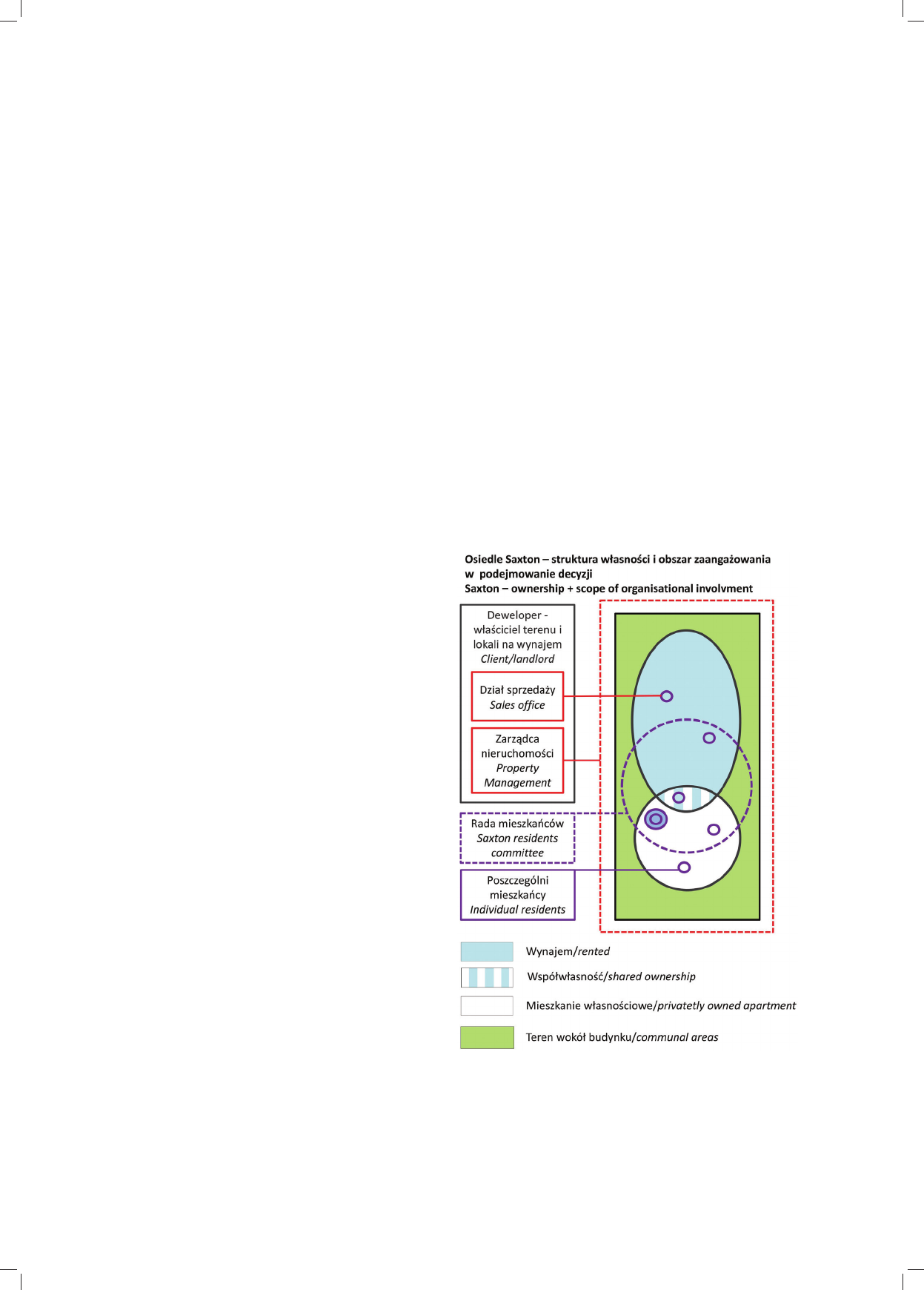
Il. 2. Przykład wstępnej analizy pogłębionego BPE:
schemat własności i obszaru decyzyjnego interesariuszy osiedla Saxton
pozwalający określić ich zakres odpowiedzialności
(oprac. M. BaborskaNarożny)
Fig. 2. An example of indepth BPE preliminary analysis:
diagram of ownership and scope of organisational involvment
allowing to understand stakeholders’ responsibilities
(by M. BaborskaNarożny)

Ocena funkcjonowania budynku/Building performance evaluation 55
ed with a fault attributed to a specific actor. This may
result in direct financial loss or a broader loss in competi
tiveness. A proverb present in both languages Polish and
English “he who makes no mistakes makes nothing” epit
omises the shared awareness of the omnipresence of the
risk of “human error”. Therefore why should any procure
ment stage actor voluntarily engage in external checks
that might expose their errors? Another proverb i.e. “you
learn through your mistakes” also present in both lan
guages addresses this question and epitomises the ration
ale for BPE. The author has observed reluctance to engage
among the industrial partners both in the UK and Poland.
However counterbalancing any underlying risks with a ben
efit of tailored feedback allowing informed i.e. better
decisions seems easier to accept for industry stakeholders
in the UK where culture of evidence based decisions mak
ing is present in real estate sector [20], [24]. Also the BPE
procedures protecting interests of all involved as men
tioned earlier are in place and are trusted. In Poland the
empirical research other than marketing oriented rarely
informs industry (or policy) and more heuristic decision
making seems to prevail
1
. An emerging exception comes
from Polish Developers Association (PZFD) who com
missioned first scientific report in 2016 [25] to support
their stance in relation to changes proposed in housing
policy (narodowyprogram.pl). The precedent could create
a good environment to implement BPE approach. How
ever this can only be achieved by building trust of indi
vidual businesses that involvement in research can result
in useful insights.
Policy maker’s perspective
BPE is used in the UK to enhance the critical capacity
of buildings related policy making by providing evidence
based feedback on the objectives and implementation.
Such approach follows best practice in responsible policy
making [26]. Through repeated studies it enables setting
benchmarks – a key measure to put any building’s perfor
mance into context. The main risk for policy makers is
a potential political cost of abandoning a policy due to
proven lack of reaching the intended goals. The decision
needs to be justified and transparently communicated to
the public and the BPE research is capable to support this
step. The Green Deal is an example of a policy abandoned
as a result of extensive feedback on its implementation
three years after its introduction [24], [27], [28].
Building occupant’s perspective
The occupants, typically spending most of their lives
inside, are key witnesses of any building’s performance:
both the bright and the dark side of it. Their involvement
is instrumental for the process of seeking improvement
and gives credibility to bestpractice dissemination.
1
However there is no systematic research known to the author that
would explicitly support this claim for the Polish context contrasting
with an extensive literature looking at the British situation.
pot rzeb, popartą analizą empirycznych danych informację
zwrotną, jest już obecne w brytyjskiej kulturze bizneso
wej rynku nieruchomości [20], [24], a w polskiej jeszcze
nie w tym stopniu. W Wielkiej Brytanii istnieje zaufanie
do procesu oceny i przestrzegania przez stronę badawczą
wspomnianych powyżej procedur, chroniących interesy
wszystkich uczestników. Istnieje klimat przyjazny bada
niom, których „nie wypada” odmówić, jeśli aspiruje się
do kategorii najlepszych w branży. W Polsce takie zaufa
nie musiałoby dopiero być zbudowane. Nieliczne badania
prowadzone w budynkach użytkowanych przez naukow
ców nie są punktem odniesienia dla praktyków spoza
grona badaczy, którzy kierują się raczej własnym do
świadczeniem przy podejmowaniu decyzji projektowych
czy wykonawczych
1
. Pewnym znakiem zmiany w zakre
sie współpracy pomiędzy podmiotami rynkowymi a nauką
był raport dotyczący stanu polskiego mieszkalnictwa
zamówiony po raz pierwszy przez Polski Związek Firm
Deweloperskich (PZFD) [25]. Wychodząc od statystyk
opisujących aktualną i prognozowaną sytuację mieszka
niową, uzasadniał on stanowisko PZFD w kwestii zmian
prawnych proponowanych przez rząd. Odwo łanie się do
rzetelnego opisu rzeczywistej sytuacji jako podstawy for
mułowania zaleceń wskazuje na dobry klimat dla im
plementacji podejścia BPE. Warunkiem wstępnym jest
zbudowanie zaufania osób i firm co do rzeczywistych
korzyści płynących z ich zaangażowania w badania.
Perspektywa ustawodawcy i władz lokalnych
Badania BPE bywają wykorzystywane w Wielkiej
Brytanii do podniesienia wiedzy ustawodawców i władz
lokalnych w zakresie stopnia wdrażania regulacji praw
nych dotyczących budownictwa i ich skuteczności w osią
ganiu wyznaczonych celów. Podejście takie jest uznawa
ne za wzorcowe [26]. Dzięki powtarzalnym badaniom
możliwe jest opracowanie list budynków referencyjnych,
które są kluczowe dla zrozumienia funkcjonowania
poszczególnych obiektów na tle innych w danej kategorii.
Główne ryzyko dla ustawodawców dotyczy kosztów poli
tycznych związanych z koniecznością modyfikacji lub
porzucenia danej polityki pod wpływem dowodów na jej
nieskuteczność w praktyce. W Wielkiej Brytanii tzw.
Green Deal był przykładem polityki państwa niewywie
dzionej z badań nad zachowaniami konsumentów, a raczej
programem wypracowanym odgórnie. Po wprowadzeniu
okazał się on nieskuteczny i został wycofany pod napo
rem wyników krytyki umocowanej w dogłębnych bada
niach emiprycznych [24], [27], [28]. Podobne bada nia
byłyby w Polsce pomocne w kształtowaniu kolej nych
programów rządowych mających na celu wspieranie
1
Trzeba zaznaczyć, że autorka nie dotarła do badań na temat źró
deł decyzji w procesie inwestycyjnym w Polsce i powyższe twierdzenia
są opinią wynikającą z doświadczeń własnych oraz z prezentacji archi
tektów, instalatorów i przedstawiciela lokalnych władz, wygłoszonych
na seminarium naukowym na Wydziale Architektury PWr w listopadzie
2016 (transkrypt z seminarium w Załączniku Nr 1 do Raportu Serii SPR
Nr W1A/S041/2016). Dla kontrastu wyniki takich badań dla Wielkiej
Brytanii są dostępne i przywołane w bibliografii.

56 Magdalena BaborskaNarożny
Understanding risks and benefits of the occupants engaged
in a BPE project is generally depends on a building’s
function, ownership type and last but not least who com
missions the study. It needs to be considered on a project
basis. Generally the risks are biggest in the domestic sec
tor and unsurprisingly domestic BPE was the last one to
be developed [29]. To strike a balance between getting all
the data necessary for meaningful diagnosis of a building
performance but with least hassle for the occupants
a staged approach has been proposed for the domestic
BPE: to start with a general overview and only if a perfor
mance issue is identified a focused research follows to
understand its causes [29]. That way in return for engage
ment the occupants may expect bespoke feedback given
as well as trouble shooting needs list where duty of care
calls for an immediate action. The price for that feedback
is giving up some privacy to allow data collection about
their homes, habits or other topic depending on a project’s
aims and scope. To protect any abuse of privacy and any
sensitive information the process is regulated by agree
ments developed as a part of ethical procedures approved
before data collection stage by a relevant research body.
The key occupant rights are:
– To get information of the context of research,
– To refuse engaging in any specific task at any point
in the study, e.g. to answer a question,
– To ask the research team to withdraw from the study
all data collected in relation to their home at any time
without the need to justify own decision.
These basic rights secure the position of an occupant in
the process. However as with the other stakeholder groups
mutual trust between an occupant and the research team
is the prerequisite of the voluntary agreement to engage.
Researcher’s perspective
BPE is an emerging field prone to “real life” research
challenges [30]. Its empirical approach and objectives rel
evant for the society, economy and environment bring
results valued both within and beyond academia. In an
environment where external impact matters for funding
bodies and research institutions the BPE provides excel
lent research opportunities. British universities increas
ingly seek for ways to prove and quantify wider impact of
their research activities. However an impact resulting
from tailored feedback delivered through reports or meet
ings with different stakeholders groups requires skills and
significant time allocation within a project. Overall BPE
requires excellent communication skills from the research
team and robust procedures that minimise the impact of
unforeseen difficulties, e.g. loss of a temperature sensor
with monthly monitoring data. The voluntary cooperation
of all the stakeholder groups is what makes the BPE both
interesting and challenging for a research team. There is
an ongoing need throughout the duration of the project to
manage expectations and respond to emerging problems
for a project to be successful. Intensive data collection
time of around one year for indepth projects is another
challenge given timescales and funding limitations of
many funding opportunities.
rozwoju budownictwa, zwłaszcza nisko lub niemal zero
energetycznego.
Perspektywa użytkownika budynku
Użytkownicy, spędzający większość swojego życia
w budynkach, mogą zwykle dużo powiedzieć na temat
ich funkcjonowania: zarówno ich jasnej, jak i ciemnej
strony. Ich zaangażowanie w badania jest kluczowe
w procesie poszukiwania usprawnień i uwiarygodnia
opublikowane przykłady najlepszych praktyk. Identyfika
cja zagrożeń i korzyści wypływających z zaangażowania
użytkowników w proces BPE uwarunkowana jest funkcją
budynku, typem własności oraz, co istotne, sposobem
finansowania badania. Zagrożenia i korzyści należy za
tem rozpatrywać za każdym razem w kontekście danego
projektu. Ogólnie rzecz biorąc, największy poziom zagro
żeń występuje w budownictwie mieszkaniowym i ten
segment BPE rozwinął się najpóźniej [29]. Aby zminima
lizować uciążliwości wynikające z procesu badań dla
użytkownika, przy jednoczesnym zabezpieczeniu odpo
wiedniej ilości danych, które pozwolą prawidłowo prze
analizować funkcjonowanie budynku, proponuje się sys
tem etapowy: w pierwszej kolejności przeprowadza się
ogólny przegląd, który pozwala zidentyfikować ewentu
alne problemy, i dopiero wtedy przeprowadza się dodat
kowe badania pozwalające wyjaśnić ich przyczyny [29].
W ten sposób, w zamian za udział w badaniu, użytkowni
cy mogą oczekiwać konkretnych informacji zwrotnych,
jak również listy spraw wymagających interwencji, jeśli
prowadzący będzie poczuwał się do obowiązku poinfor
mowania użytkowników ze względu na ich zdrowie lub
bezpieczeństwo. Ceną za tak zindywidualizowaną infor
mację jest udostępnienie danych uznawanych za prywat
ne, dotyczących domów, zwyczajów i innych cech użyt
kowników, w zależności od celu i zakresu badań. Umowy
chroniące prywatność użytkowników i ich wrażliwe dane
przygotowuje się w ramach procedur kontroli etycznej
badań. Procedury te aprobowane są przez odpowiednie
komisje przed rozpoczęciem zbierania danych. Do naj
ważniejszych praw użytkownika należą:
– prawo do poznania kontekstu badań,
– prawo do wycofania się z uczestnictwa w każdym
momencie badań, np. odmowy odpowiedzi na pytanie,
– prawo do zażądania usunięcia wszystkich danych
zebranych podczas badań odnoszących się do jego osoby,
bez potrzeby uzasadniania decyzji.
Te podstawowe zasady zabezpieczają pozycję użyt
kownika w procesie badań. Niemniej jednak, podobnie
jak w przypadku innych grup interesów, obustronne za u
fanie pomiędzy użytkownikiem a zespołem badawczym
jest pierwszym krokiem w kierunku decyzji o do bro wol
nym udziale w badaniu.
Perspektywa badacza
BPE jest rozwijającą się dziedziną bazującą na bada
niach terenowych, dotykają ją więc wszystkie wyzwania
pojawiające się na styku laboratorium badacza ze świa
tem zewnętrznym [30]. Wyniki dostarczane przez BPE ze

Ocena funkcjonowania budynku/Building performance evaluation 57
Despite the above difficulties an academic discourse
around BPE is thriving internationally and is supported by
high impact journals like Building Research & Infor ma
tion, Energy Policy or Energy Research & Social Science.
Their common theme is bridging technical and social sci
ence disciplines to address the built environment issues.
Discussion – action points for Poland
The potential benefits and risks highlighted earlier
generally apply to BPE implementation both in the UK
and Poland. There are contextual differences between the
two countries that require preparatory steps to be taken in
Poland before the implementation of the BPE approach is
likely. Only scares literature is available on cultural dif
ferences between the two counties [31], [32] and further
research would be needed to address this gap. The key
cultural difference has been mentioned in “building pro
curement stakeholders perspective” section: an evidence
based vs. heuristic decision making in the UK and Poland
respectively. The first creates a supportive environment
for BPE the latter is more challenging.
Policy and client focus and funding opportunities
The significant raise of interest in BPE across the UK
in the recent decade has been driven by government poli
cies and funding focusing on climate change mitigation
and carbon emissions targets for the British building sec
tor. These challenges informed BPE evaluation tools
development. However according to Mat Colmer, who
managed the Innovate UK BPE project and gained an in
depth understanding of the UK industry perspective
towards BPE the “emissions focus” proved to be chal
lenging. In correspondence with the author he argues that
[...] as the British building regulations (Part L) are
focused on energy and carbon, and not on performance in
the round (carbon reduction, internal environmental con-
ditions, occupant wellbeing and low running costs) the
climate change argument is difficult to get motivate
behind. Industry states it will cost more for little return
and doing this through climate/CO
2
mitigation in regula-
tion is perceived as a pecuniary measure for the devel-
oper. He sees the opportunity for Poland in focusing on
the occupant: Making homes better so that the occupant
has an improved sense of wellbeing / reducing fuel pov-
erty is a more engaging argument. This is particularly so
as, so I believe, Poland has far greater engagement from
the developer post completion. So it is in their interest for
the building to work well. In the UK the developer is very
rarely the landlord unless it is social housing. Indeed in
the UK the recent shift in government stance towards low
energy buildings corresponds with current shift in BPE
towards increased interest in health and wellbeing of
building occupants. The evolving approach of the UK
BPE illustrates its capacity to incorporate varied research
questions perceived as vital for a specific context. The
relevant policies and funding opportunities for BPE in
Poland need to be established in dialog with the relevant
stakeholders.
względu na ich aspekt empiryczny oraz aspiracje metody
jako służącej społeczeństwu, gospodarce i środowisku
sprawiają, że jest ona ceniona zarówno w środowisku
naukowym, jak i poza nim. W środowiskach, gdzie apli
kacyjny charakter odgrywa rolę podczas przyznawania
funduszy na badania, BPE sprawdza się doskonale. Na
uczelniach brytyjskich coraz większe znaczenie przypisu
je się wszelkim wskaźnikom pozwalającym udowodnić
i sklasyfikować zewnętrzne oddziaływanie danych badań.
Zewnętrzne oddziaływanie będące wynikiem zindywidu
alizowanego przekazu mającego formę raportów i spo
tkań z różnymi grupami interesów wymaga umiejętności
i zarezerwowania odpowiednio dużych nakładów czasu
w projekcie. BPE wymaga od zespołu badawczego świet
nych umiejętności komunikacyjnych i wypróbowanych
procedur na wypadek nieprzewidzianych okoliczności,
np. utraty sensora z zapisem danych pomiarowych z całe
go miesiąca. Dobrowolny charakter uczestnictwa w BPE
sprawia, że metoda ta jest dla badaczy interesująca i sta
wiająca wiele wyzwań. Aby doprowadzić projekt do uda
nego końca, trzeba na bieżąco modyfikować oczekiwania
i reagować na pojawiające się problemy. Kolejnym aspek
tem BPE, utrudniającym korzystanie z wielu funduszy na
badania ze względu na czas i wymagania finansowe, jest
sam okres intensywnego zbierania danych, który na po
trzeby dogłębnej analizy wynosi około 12 miesięcy.
Pomimo powyższych trudności międzynarodowy dys
kurs naukowy dotyczący BPE ma się świetnie i stale
gości na łamach takich liczących się periodyków jak
„Building Research & Information”, „Energy Policy” czy
„Energy Research & Social Science”, a jego motywem
przewodnim jest współdziałanie technicznych i społecz
nych dziedzin nauki w rozwiązywaniu problemów środo
wiska zbudowanego.
Dyskusja – proponowane kroki w kontekście polskim
Naświetlone powyżej potencjalne korzyści oraz ryzy
ko dotyczą wprowadzania BPE zarówno w Polsce, jak
i Wielkiej Brytanii. Ze względu na różnice kontekstualne
po między oboma krajami niezbędne jest podjęcie pew
nych kroków poprzedzających ewentualne wprowadze
nie BPE w Polsce. Literatura dotycząca różnic kulturo
wych po między Polską i Wielką Brytanią jest dość uboga
[31], [32] i wymagane byłyby dodatkowe badania w tym
kierunku. Najważniejszą różnicą kulturową w kontekś
cie BPE, wspomnianą w części poświęconej perspekty
wie uczestników procesu inwestycyjnego, jest sposób
podejmowania decyzji: heurystyczny w Polsce i w opar
ciu o dowody w Wielkiej Brytanii. Drugi z nich sprzyja
implemen tacji BPE, pierwszy jest bardziej problematycz
ny w tej kwestii.
Polityka i możliwości finansowania
Znaczący wzrost zainteresowania BPE w Wielkiej Bry
tanii w ostatnim dziesięcioleciu był wynikiem poli tyki
rządu wspierającej inicjatywy mające na celu zła godze
nie skut ków zmian klimatu i skupiające się na zmniej
szeniu emisji CO
2
w sektorze budowlanym. Wymienione

58 Magdalena BaborskaNarożny
Industrial stakeholders’ engagement
Several recommendations are suggested in order to
facilitate the engagement of procurement stage actors:
1. The specific questions that procurement stage actors
in Poland perceive as relevant need to be identified as
they do not necessarily overlap with the British context.
For example despite similar international obligations of
both countries the climate change mitigation discourse is
niche in Poland [33] and building industry gets little sus
tained state support to facilitate transition towards low
carbon goals. However fuel poverty and a projected
increase in coal price due to carbon allowances are recog
nised challenges [34]. This implies that the framing of
research would need to be adapted and the focus on ener
gy efficiency would need to support establishing the eco
nomically viable solutions.
2. Trust building in the BPE process is key and action
research approach might be useful to consider for pilot
studies. These would need well managed dissemination
of results to become showcases of the process.
3. “No blame policy” promotion is a vital element of
trust building. The term “evaluation” itself suggests there
may be a negative outcome which may be inhibiting in
terms of marketing purposes. BREEAM and such like
voluntary systems have a clearly positive approach and
“nega tive certificates” do not exist. With BPE there may
be a fear that needs to be mitigated of becoming the “fail
ure example”. Information disclosure procedures for dif
ferent audiences need to be implemented for externally
driven evaluations. Another possibility is to adopt “Soft
landings” approach of inward driven proactive evaluation
process [35].
Academic engagement
To facilitate engagement of the academia the following
action points are advised based on the UK experience:
1. Skills provision – a programme to develop BPE
skills among academics in Poland through postgraduate
taught modules in higher education institutions. Spe ci
fically “soft” people skills are needed, including good
communication and mediation skills, to put people at ease
in relation to BPE process and reports generation for
effective communication of findings and guidance to
industrial partners. BPE should not be understood as
scaremongering related to potential building failures but
rather diagnosing causes of issues and advising on im
provement areas across building life cycle, i.e. from early
planning stage to occupancy. These skills are needed to
avoid falling into unconstructive and judgmental approach
of a researcher towards those involved in the eva lua
tion i.e. a developer, designer, contractor, facility mana
ger etc.
2. Acknowledgement of the “beyond academia” con
tribution in an academic career path would justify the
additional substantial effort needed for meaningful coop
eration with the industrial partners.
3. Broader access to data needed for BPE analysis i.e.
meteorological data or energy consumption data.
cele miały wpływ na ukierunkowanie narzędzi ewaluacyj
nych w ramach BPE na zagadnienia oszczędzania energii
podczas użytkowania obiektów. Jednak według Mata
Col mera, który przez zarządzanie programem Innovate
UK BPE zyskał bezpośredni wgląd w nastawienie przed
stawicieli przemysłu budowlanego i rządu do BPE, sku
pienie się tego programu na kwestii emisji stanowiło pro
blem. W korespondencji mailowej z autorką stwierdził
on: Jako że brytyjskie przepisy budowlane (część L) sku-
piają się na energii i CO
2
, a nie na szerzej rozumianym
kontekście funkcjonowania budynków (redukcja emisji
wraz z poprawą jakości środowiska wewnętrznego, do
brostanem użytkowników i niskimi kosztami utrzymania),
sama kwestia zmiany klimatu nie stanowi wystarczającej
motywacji. Przemysł twierdzi, że wysokie koszty przyniosą
niewielkie zyski, a kontekst emisji i klimatu w regulacjach
prawnych postrzegany jest przez deweloperów wy łącznie
w kategoriach finansowych. Szansę dla polskiego budow
nictwa upatruje on w skupieniu się na użytkowniku: Two-
rzenie lepszych budynków z myślą o dobrostanie użytkow-
ników czy ograniczaniu ubóstwa energetycznego jest
bardziej angażujące dla deweloperów. Szczególnie dla
tego, że – jak sądzę – polscy deweloperzy są bardziej za
angażowani w kontakt z mieszkańcami po oddaniu bu dyn-
ków do użytku. W ich interesie leży więc to, by bu dynki
dobrze funkcjo nowały. W Wielkiej Brytanii też zdarza się,
że deweloper pozostaje właścicielem budynku i go wynaj-
muje. W istocie ostatni odwrót polityki rządu od dotych
czasowych metod wspierania budownictwa niskoenerge
tycznego od powiada przesunięciu spektrum zainteresowań
BPE w kierunku zdrowia i dobrostanu użytkowników.
Ewolucja BPE w Wielkiej Brytanii dob rze ilu struje możli
wości modyfikacji ram metody w celu włączenia do niej
kwestii uznanych za najistotniejsze w danym kontekście
badawczym. Niezbędne byłoby wy pracowanie od po wied
niej polityki oraz programów finansowania BPE w Polsce.
Zaangażowanie uczestników procesu inwestycyjnego
Zalecane kroki, które mogą ułatwić wciągnięcie
uczest ników procesu inwestycyjnego:
1. Identyfikacja zagadnień, które są postrzegane przez
uczestników procesu inwestycyjnego jako istotne ze
względu na możliwe rozbieżności w porównaniu z kon
tekstem brytyjskim. Na przykład, mimo że oba kraje są
podobnie zobligowane do przeciwdziałania zmianom kli
matu, dyskusja na ten temat jest bardzo ograniczona [33],
a wsparcie przemysłu ze strony rządu, które ułatwiłoby
obniżenie emisji CO
2
, nie ma charakteru stałego. Jedno
cześnie problem ubóstwa energetycznego [34] i przewi
dywany wzrost cen paliw stałych ze względu na limity
emisji CO
2
są znanymi wyzwaniami. Wynika z tego ko
nieczność dostosowania ram badań i położenie nacisku na
aspekt ekonomiczny rozwiązań mających na celu oszczęd
ność energii.
2. Budowanie zaufania jest kluczowym kompo nen
tem BPE, więc w badaniach pilotażowych zasadne wyda
je się przyjęcie podejścia badań aktywnych (ang. action
rese arch). Konieczne byłoby kontrolowane upub licz nienie
wyników, tak by stały się one wizytówką ba dań BPE.

Ocena funkcjonowania budynku/Building performance evaluation 59
4. Development of a dissemination strategy that maxi
mises the outreach impact of findings and guidance at
national level.
5. Development of ethical procedures and the related
do cuments e.g. information sheets for the participants and
agreements between academia and industrial partners.
Ethi cal committees capable of advising and assessing
ethical procedures need to be introduced at technical uni
versities.
Conclusions
Polish building sector faces two key challenges. The
first is urgent and is a novelty related to the agreed EU
regulatory pressures on rapid increase in energy efficiency
of buildings at occupancy stage. The second is an on
going and always valid challenge of understanding and
adequately addressing the changing occupant expecta
tions towards buildings. Well embedded BPE approach
has the capacity proven in the UK to help to respond to
both of these challenges. It has been advocated in this
paper that to release that potential in Poland the risks and
benefits for all the different stakeholders contributing to
the evaluation process need to be carefully considered
within the local context. The process needs to create a safe
learning environment for the industry to win their volun
tary engagement.
The findings of this study are preliminary and the rec
ommendations can only be validated by successfully
embedding BPE projects in Poland. The contribution to
the literature is in providing a deeper understanding of the
many shared challenges facing BPE stakeholders both in
Poland and the UK. The significant overlap of risks and
benefits indicates an opportunity to adapt to the Polish
context solutions developed through decades of BPE fine
tuning in the UK. Based on the UK experience and under
standing of the Polish context action points are suggested
to facilitate implementation of the BPE approach in
Poland. The “soft”, less pronounced in literature aspects
of BPE process are highlighted. They are perceived by the
author as fundamental for winning trust of the key stake
holders, securing their engagement and subsequent con
sideration of implementing the tailored guidelines into
own processes or practices. The latter is the core objective
of introducing BPE approach.
3. Promowanie podejścia nieszukającego winnych
(ang. no blame policy) jest fundamentalnym składnikiem
budowania zaufania. Sam termin „ocena” sugeruje, że
może być ona negatywna, co może nie sprzyjać promocji
metody BPE. BREEAM i inne podobne systemy dobro
wolne mają czytelny pozytywny aspekt – certyfikaty
negatywne nie istnieją. W przypadku BPE może istnieć
obawa, że badany obiekt stanie się przykładem złych roz
wiązań. Niezbędne jest wprowadzenie procedur określa
jących zasady ujawniania informacji poszczególnym
odbiorcom dla badań inicjowanych z zewnątrz. Innym
rozwiązaniem może być zastosowanie metody „Softlan
dings” – proaktywnej ewaluacji wewnętrznej [35].
Zaangażowanie środowisk naukowych
Rekomendacje oparte na doświadczeniach brytyjskich:
1. Stworzenie programu nauczania metod BPE skiero
wanego do naukowców w Polsce w formie studiów pody
plomowych na wyższych uczelniach. Szczególnie istotne
są „miękkie” umiejętności takie jak dobra komunikacja
i umiejętność mediacji, by nie powodować napięć zwią
zanych z procesem oceny i formułowania wniosków
z badań – tylko wtedy transfer wiedzy i rekomendacji na
przyszłość skierowany do współpartnerów w branży
prze
mysłowej będzie efektywny. BPE nie powinno być rozu
miane jako wytykanie błędów, ale raczej jako szukanie
przyczyn usterek i wskazywanie pól rozwoju i ulepszeń
w kontekście pełnego cyklu życiowego budynku: od wczes
nych faz projektowania do użytkowania. Dobra komunika
cja i mediacja są potrzebne, by uniknąć niekonstruktywnej
sytuacji, w której badacz występuje z pozycji osądzające
go w stosunku do innych uczestników procesu: dewelope
ra, projektanta, wykonawcy czy zarządcy budynku.
2. Sensowna współpraca z partnerami przemysłowy
mi wymaga poważnych, dodatkowych nakładów pracy –
uwzględnienie zaangażowania w projekty wykraczające
poza uczelnie w dorobku naukowym badacza ułatwiłoby
podjęcie decyzji o kooperacji.
3. Zapewnienie szerszej dostępności danych niezbęd
nych do przeprowadzania BPE, takich jak dane pogodo
we czy dane o zużyciu energii.
4. Wypracowanie strategii upubliczniania wyników
badań i wypływających z nich zaleceń, maksymalizującej
ich zasięg w całym kraju.
5.
Wprowadzenie procedur weryfikacji projektów nau
kowych pod kątem etyki badań. Wypracowanie wzorów
dokumentów takich jak np. informatory dla uczestni
ków badań czy wzory umów pomiędzy uczelnią a partne
rami komercyjnymi. Konieczne jest zorganizowanie ko
misji etyki jako ciał doradczych i oceniających projekty
badań.
Wnioski
Polski sektor budowlany czekają dwa podstawo
we wy zwania. Pierwsze jest pilne i nowe, a wynika z uz
godnionych na poziomie Unii Europejskiej wymagań
dotyczących wzrostu wydajności energetycznej budyn
ków na etapie użytkowania.

60 Magdalena BaborskaNarożny
Bibliografia /References
[1] Cole R.J., Lorch R. (eds.), Buildings, Culture and Environment:
In forming local and global practices, WileyBlackwell, Oxford
2003.
[2] Balvers J., Bogers R. et al., Mechanical ventilation in recently built
Dutch homes: technical shortcomings, possibilities for improve-
ment, perceived indoor environment and health effects,
„Architectural Science Review” 2012, Vol. 55, Iss. 1, 4–14.
[3] BaborskaNarozny M., Stevenson F., Mechanical ventilation in
housing: understanding in-use issues, „ICE Engineering Sus taina
bility” 2017, Vol. 170, Iss. 1, 33–46.
[4] Mallory Hill S., Preiser W.F.E., Watson C., Enhancing building
performance, WileyBlackwell, Oxford 2012.
[5] SunikkaBlank M., Galvin R., Introducing the prebound effect: the
gap between performance and actual energy consumption,
„Building Research and Information” 2012, Vol. 40(3), 260–273.
[6] van Dronkelaar Ch., Dowson M., Burman E., Spataru C., Mumo
vic D., A Review of the Energy Performance Gap and Its Under -
lying Causes in Non-Domestic Buildings, „Frontiers in Me cha ni cal
Engi neering” 2016, No. 1(17).
[7] Newsham G., Mancini S., Birt B., Do LEED-certified buildings
save energy? Yes, but..., „Energy and Buildings” 2009, Vol. 41, Iss.
8, 897–905.
[8] Galvin R., Why German homeowners are reluctant to retrofit,
„Building Research and Information” 2014, Vol. 42, Iss. 4, 398–408.
[9] Coulsting S., Insurance-backed warranty for whole life housing
energy performance, Encraft, Leamington Spa 2015, http://www.
sustainabilitywestmidlands.org.uk/wpcontent/uploads/5.Steven
Coulsting.pdf [accessed: February, 2017].
[10] Baird G., Sustainable Buildings in Practice – What the Users
Think, Routledge, Abingdon 2010.
[11] BPIE (Building Performance Institute Europe), Europe’s building
under a microscope, BPIE, 2011, http://bpie.eu/publication/europes
buildingsunderthemicroscope [accessed: February, 2017].
[12] Derbez M., Berthineau B., Cochet V., Lethrosne M., Pignon C.,
Riberon J., Kirchner S., Indoor air quality and comfort in seven
newly built, energy-efficient houses in France, „Building and En
vironment” 2014, Vol. 72, 173–187.
[13] Stevenson F., Rijal H.B., Developing Occupancy feedback from
a prototype to improve housing production, „Building Research
and Information” 2010, Vol. 38, Iss. 5, 555–564.
[14] Bordass B., Leaman A., Ruyssevelt P., Assessing building perfor-
mance in use 5: conclusions and implications, „Building Research
and Information” 2001, Vol. 29(2), 154, 144–157.
[15] Directive 2010/31/EU of the European Parliament and of the
Council of 19 May 2010 on the energy performance of buildings
(recast), „Official Journal of the European Union” 2010, No.
53(13), http://eurlex.europa.eu/legalcontent/EN/TXT/?uri=OJ:L:
2010:153:TOC [accessed: February, 2017].
[16] Palmer J., Terry N., Armitage P., Building Performance Evaluation
Programme: Findings from non-domestic projects, Innovate UK,
London 2016.
[17] Palmer J., GodoyShimizu D., Tillson A., Mawditt I., Building
Performance Evaluation Programme: Findings from domestic pro-
jects, Innovate UK, London 2016.
[18] Thompson M., Cooper I., Gething B., The business case for adapt-
ing buildings to climate change: Niche or mainstream?, Innovate
UK, London 2015, https://connect.innovateuk.org/web/designfor
futureclimate [accessed: February, 2017].
[19] Michie S., Johnston M., Abraham C., Lawton R., Parker D., Wal
ker A., Making psychological theory useful for implementing evi-
dence based practice: a consensus approach, „Quality & Safety in
Health Care” 2005, Vol. 14, 26–33.
[20] Green S.D., Moss G.W., Value Management and Post-Occupancy
Evaluation: Closing the Loop, „Facilities” 2000, Vol. 16, Iss. 1/2,
34–39.
[21] Hua Y., Loftness V., Heerwagen J.H., Powell K.M., Relationship
Between Workplace Spatial Settings and Occupant-Perceived
Support for Collaboration, „Environment and Behaviour” 2011,
Vol. 43, Iss. 6, 807–826.
[22] Preiser W.F., Improving Building Performance, NCARB Mono
graph Series, Washington, D.C. 2003.
[23] Frankel M., Edelson J., Colker R., Getting to outcome-based build-
ing performance; Report from a Seattle Summit on Performance
Outcomes, National Institute of Building Sciences, Seattle 2015,
https://newbuildings.org/sites/default/files/Performance_
Outcomes_Summit_Report_515.pdf [accessed: February, 2017].
[24] Pettifor H., Wilson C., Chryssochoidis G., The appeal of the green
deal: Empirical evidence for the influence of energy efficiency
policy on renovating homeowners, „Energy Policy” 2015, Vol. 79,
161–176.
[25] Bryx M., Raport o stanie mieszkalnictwa w Polsce, Polski Związek
Firm Deweloperskich, Wrocław 2016.
[26] Quality of public administration: A practitioners Toolbox, Euro
pean Commission, Brussels 2015, ec.europa.eu [accessed:
February, 2017].
[27] Gooding M., Gul M., Energy efficiency retrofitting services supply
chains: A review of evolving demands from housing policy, „Energy
Strategy Reviews” 2016, Vol. 11–12, 29–40.
[28] Morse A., Green Deal and Energy Company Obligation, National
Audit Office, London 2016, https://www.nao.org.uk/wpcontent/
uploads/2016/04/GreenDealandEnergyCompanyObligation.
pdf [accessed: February, 2017].
[29] Stevenson F., Leaman A., Evaluating housing performance in rela-
tion to human behaviour: New challenges, „Building Research and
Information” 2010, Vol. 38(5), 437–441.
[30] Robson C., Real world research, Blackwell, London 1993.
[31] Chapman M., GajewskaDe Mattos H., Clegg J., Buckley P.J.,
Close neighbours and distant friends – perceptions of cultural dis-
tance, „International Business Review” 2008, Vol. 17, Iss. 3, 217–234.
[32] Todeva E., Models for comparative analysis of culture: the case of
Poland, „International Journal of Human Resource Management”
1999, Vol. 10, Iss. 4, 606–623.
Wnioski wypływające z tej analizy są niewątpliwie
wstępne i do oceny zaproponowanych tutaj rekomendacji
niezbędne jest zakorzenienie się metody BPE w polskich
warunkach. Wkładem w literaturę przedmiotu jest po
głębiona znajomość występowania wielu podobnych
wyz wań stojących przed interesariuszami BPE w Polsce
i Wielkiej Brytanii. Dzięki dużej zbieżności zagrożeń
i korzyści płynących ze stosowania tej metody w obu kra
jach można zaadaptować rozwiązania brytyjskie, do pra
cowane w ciągu kilkudziesięciu lat ich stosowania, do
polskich warunków. W analizie podkreślono również
wagę „miękkich”, a pomijanych w literaturze, aspektów
pro cesu BPE. Te „miękkie” aspekty są według autorki
fun damentalne w procesie zdobywania zaufania kluczo
wych inte resariuszy, podtrzymania ich zaangażowania
i przekonania ich do zastosowania zaproponowanych
wytycznych we własnych działaniach lub projektach.
Element wdrażania wytycznych płynących z szerokie
go stosowania metody BPE jest nadrzędnym celem jej
wprowadzenia w Polsce.
Tłumaczenie
Tadeusz Szałamacha
Magdalena BaborskaNarożny

Ocena funkcjonowania budynku/Building performance evaluation 61
Streszczenie
Ocena funkcjonowania budynków (BPE) jest przedsięwzięciem zespołowym. Badania takie potencjalnie mogą dostarczyć wiedzę ułatwiającą
doskonalenie środowiska zbudowanego, co jest ważne w czasie szybko rosnących oczekiwań względem budynków. Jednak ich potencjał może
zostać uwolniony, tylko jeśli uda się zapewnić dobrowolne zaangażowanie kluczowych grup interesariuszy, a ich potrzeby i oczekiwania są odzwier
ciedlone w prowadzonych badaniach. Ten artykuł jest krytyczną reeksją na procesem wprowadzania BPE do kręgu zainteresowania przemysłu
budowlanego w Wielkiej Brytanii. Autorka jest przekonana, że wnioski wyciągnięte z tamtego kontekstu stanowią cenny wzorzec, który może być
wykorzystany w Polsce, pomimo wszelkich różnic pomiędzy oboma krajami. Określiła więc podstawowe korzyści i ryzyko, jakie poszczególni
interesariusze mogą łączyć z własnym udziałem w badaniach. Wymieniła odpowiednie elementy badań BPE zabezpieczające uzyskanie korzyści
i ograniczające wystąpienie ryzyka. Ich nazwanie uzasadnia konieczność rozumienia badań jako procesu całościowego, którego wszystkie elementy
mają ważną rolę do odegrania.
Słowa kluczowe: ocena funkcjonowania budynków, sprawność budynków, rynek budowlany, uczestnicy procesu budowlanego
Abstract
Building performance evaluation (BPE) is a group endeavour. It has the potential to enable context based learning and improvement of the built
environment necessary at a time of rapidly increasing expectations towards buildings. This potential can only be released however if voluntary en
gagement of key stakeholders is secured and their needs and expectations are carefully considered. The paper is a critical reection on the process of
introducing BPE into the scope of interest of the mainstream building industry stakeholders in the UK. It is believed that these lessons provide useful
precedent applicable in the Polish context despite any differences between the two countries. Key benets and risks different stakeholder groups may
link with their engagement in BPE are identied. BPE process elements securing specic benets and addressing relevant risks are named in order to
justify the necessity of thinking of BPE holistically.
Key words: building performance evaluation, building performance, building industry, construction process stakeholders
[33] Kundzewicz Z.W., Matczak P., Climate change regional review:
Poland, „WIREs Climate Change” 2012, Vol. 3, 297–311.
[34] Miazga A., Owczarek D., Dom zimny, dom ciemny – czyli ubóstwo
energetyczne w Polsce, „IBS Working Paper” 2015, 16, http://ibs.
org.pl/app/uploads/2015/12/IBS_Working_Paper_162015.pdf
[accessed: February, 2017].
[35] “Soft Landings” BSRIA, https://www.bsria.co.uk/services/design/
softlandings/ [accessed: February, 2017].
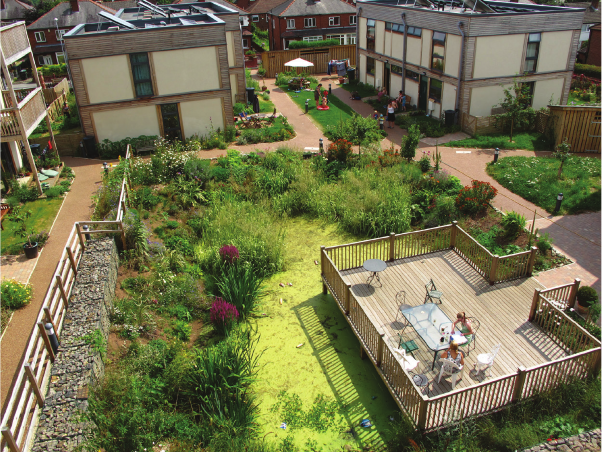
Osiedle LILAC cohousing w Leeds,
w Wielkiej Brytanii, gdzie przeprowadzono
dogłębną ocenę funkcjonowania budynków
w ramach projektu badawczego BuPESA
(więcej na www.bupesa.co.uk)
(fot. M. BaborskaNarożny, 2015)
LILAC cohousing in Leeds, UK, where in
depth building performance evaluation was
conducted as a part of BuPESA research
project (see www.bupesa.co.uk)
(photo by M. BaborskaNarożny, 2015)