
2016
3(47)
DOI: 10.5277/arc160306
Maria Kamińska-Zabierowska*, Maciej Kamiński**
Porównywanie modeli kontaktów
metodą porządkowania stochastycznego
Comparison of contact distribution models
with a stochastic ordering approach
Wstęp
Obecne w literaturze przedmiotu porównania mo-
deli kontaktów czy dystrybucji przestrzennej koncentru-
ją się głównie na przedstawieniach, w jakim zakresie
jeden model jest różny od drugiego [1]. Zwykle opisuje
się ich podstawy, sposoby zachowania i brane pod uwagę
czynniki. Często wskazuje się zakres obszarów czy przy-
padków użycia, w których dany model sprawdza się le
piej niż inne. Opis ludzkiego zachowania, ujęty w postaci
zwartego wzoru, pozwala na zastosowanie w mode lach
symulacji. Model taki może być użyty przy planowa
niu nowej magistrali komunikacyjnej, nowego osiedla,
a także w modelowaniu ludzkich oddziaływań społecz-
nych.
W niniejszej pracy pragniemy wykazać, że nawet istot-
ne różnice w podejściu, które stoją za powstaniem modeli,
mogą przełożyć się na podobne ich działanie. Dodatkowo
zastosowana autorska metoda może być użyta do porów-
nywania ze sobą dowolnych modeli kontaktów i ukazy-
wania różnic w ich sposobie działania.
Introduction
Comparisons of contact distribution models or a spa-
tial distribution, which at present exist in literature, focus
mainly on presentations of the extent to which one model
is different from another [1]. Usually their bases, ways
of behaviours and considered factors are described. The
range of areas or cases of uses in which a given model
works better than others are often indicated. A description
of human behaviour presented in the form of a coherent
scheme allows the application of simulation models. This
model can be used when planning a new road network,
a new housing estate as well as when modelling human
social interactions.
In this paper we wish to show that even signicant dif-
ferences in the approach, which are behind the origins of
models, can be reected in their similar actions. Moreover,
the author’s method, which is applied here, can be used to
compare any contact distribution models and show differ-
ences in their mode of action.
Contact distribution models
Literature of the subject [1]–[3] formulates a variety of
contact exchange models. In this study, special attention
will be paid to models which are described by means of
concise mathematical formulas giving the number of con-
tacts exchanged between the source and the destination.
Exchanged contacts can be understood as the number of
people travelling from a source to a destination, e.g. from
* Wydział Nauk o Bezpieczeństwie Wyższej Szkoły Ocer skiej
Wojsk Lądowych imienia generała Tadeusza Kościuszki we Wroc ła wiu/
Faculty of Security Affairs, The General Tadeusz Kościuszko Mili tary
Academy of Land Forces.
** Wydział Architektury Politechniki Wrocławskiej/Faculty of Ar
chitecture, Wrocław University of Science and Technology.

74 Maria KamińskaZabierowska, Maciej Kamiński
Modele kontaktów
W literaturze przedmiotu [1]–[3] formułuje się różne
modele wymiany kontaktów. W niniejszej pracy szcze-
gólną uwagę poświęcimy modelom opisanym zwięzłymi
matematycznymi formułami podającymi liczbę kontak-
tów wymienianych między źródłem i celem. Wymieniane
kontakty mogą być rozumiane jako liczba osób podróżu-
jących od źródła do celu, np. od miejsca zamieszkania
do pracy. Jednak kontakt może mieć szersze znaczenie
i ukazywać inne relacje pomiędzy obiektami. Modele
odpowiadają na pytanie o liczbę kontaktów źródło–cel,
biorąc pod uwagę takie czynniki jak: wielkość źródła,
wielkość celu, wzajemną odległość między źródłem
a celem, wzajemne relacje pomiędzy celami. Wszystkie
te czynniki modeli wpływają na wynik i wybór celów
przez podróżnych ze źródła. Relacje źródło–cel są prak-
tycznie zawsze zależne od wielkości źródła kontaktu,
czyli potencjału wyjściowego. W niniejszej pracy pomi-
niemy jednak wpływ wielkości źródeł na liczbę kontak-
tów. Wpływ ten jest przeważnie liniowy, a więc zamiast
wyliczać dokładną liczbę realizowanych kontaktów źró-
dła w celu, wystarczające tu będzie korzystanie jedynie
z jego frakcji. Liczbę kontaktów można w prosty spo-
sób odzyskać, mnożąc frakcję przez wielkość potencjału
źródłowego.
Pierwszym modelem, który przedstawimy, będzie mo-
del production constrained [1]. Używany jest, gdy odle-
głość pełni kluczową funkcję dla liczby kontaktów (im
dalej, tym mniej kontaktów), a liczba celów przekłada
się bardziej na atrakcyjność niż na liczbę podróży, któ-
re faktycznie się w nich kończą [2]. Liczba kontaktów T
ij
między źródłem i oraz celem j w tym modelu opisana jest
wzorem (1). Jak widać, odległość znajduje się w wykład-
niku, więc atrakcyjność celu spada wykładniczo (szybko)
w zależności od odległości.
gdzie:
d
ij
– odległość (opór) pomiędzy i i j,
D
j
– liczba celów (atrakcyjność) w j,
O
i
– liczba źródeł w i,
β – parametr kalibrujący modelu.
Model ten w liczniku ułamka określa atrakcyjność
celu j. Mianownik jest elementem normalizującym (suma
wszystkich atrakcyjności). W ten sposób atrakcyjność po-
jedynczego celu przekłada się na procent podróży koń-
czonych w celu j od źródła i.
Innym modelem spotykanym w literaturze [1], [2], [4],
[5] jest model pośrednich możliwości (intervening op-
portunity). Zasadniczą jego cechą jest to, że ograniczenie
kontaktu między źródłem i celem nie wynika bezpośred-
nio z odległości pomiędzy nimi, lecz jedynie z liczby (i ja-
kości) celów pośrednich. Model uznaje, że każdy podróż-
ny układa możliwe cele swojej podróży kolejno w miarę
rosnącej ich odległości od źródła. Następnie podróżny,
kolejno, rzuca monetą (losuje) z prawdopodobieństwem
the place of residence to the workplace. However, a con-
tact may have a broader meaning and reveal other rela-
tionships between objects. Models respond to the question
about the number of source–destination contacts taking
into account such factors as the source size, the destina-
tion size, a mutual distance between the source and the
destination, and relationships between destinations. All
these factors of models inuence the result and choice of
destinations by travellers from the source. Source–desti-
nation relations are practically always dependent on the
size of the contact source, i.e. the initial potential. In this
study, however, we will ignore the inuence of the size
of sources on the number of contacts. This inuence is
mostly linear, therefore instead of calculating the exact
number of ongoing source contacts in the destination, it
is sufcient here to use its fractions only. The number of
contacts can be easily regained by multiplying the fraction
by the source potential size.
The rst model to be introduced is production con-
strained model [1]. It is used when a distance performs
a key function for the number of contacts (the farther,
the fewer contacts) and the number of destinations refers
more to attractiveness than to the number of travels which
actually end in them [2]. In this model the number of con-
tacts T
ij
between source i and destination j is described by
formula (1). As it can be seen, the distance is in the expo-
nent, therefore the attractiveness of a destination exponen-
tially (quickly) decreases depending on the distance.
k
d
k
d
j
iij
ik
ij
eD
eD
OT
where:
d
ij
– distance (resistance) between i and j,
D
j
– number of destinations (attractiveness) in j,
O
i
– number of sources in i,
β – model calibration parameter.
This model in the fraction numerator determines the
attractiveness of destination j. The denominator is a nor-
malizing element (the sum of all types of attractiveness).
In this way, the attractiveness of a single destination re-
ects a percentage of travels nished in destination j from
source i.
Another model which can be found in literature [1],
[2], [4], [5] is intervening opportunity model. An essential
feature of this model is that a contact limitation between
a source and a destination does not result directly from the
distance between them, but only from the number (and
quality) of indirect destinations. The model recognizes
that all travellers plan possible destinations of their travels
in succession as their distance from the source increases
respectively. Then a traveller, respectively, throws a coin
(draws) with the probability of success λ – at each of the
destinations. The travel is made to the rst destination at
which the coin showed success. The probability distribu-
tion of travels from the source to kone in the order of the
arrangement of the destination has therefore a geometric
distribution with parameter λ, i.e. λ(1-λ)
k-1
. Of course, in
the area of our interests there are regions (e.g. cities, hous-
(1)
(1)
k
d
k
d
j
iij
ik
ij
eD
eD
OT

Porównywanie modeli kontaktów/Comparison of contact distribution models 75
sukcesu λ – przy każdym z celów. Podróż odbywana jest
do pierwszego celu, przy którym moneta pokazała sukces.
Rozkład prawdopodobieństw podróży od źródła do ktego
w kolejności ułożenia celu ma zatem rozkład geometrycz-
ny z parametrem λ, tj. λ(1-λ)
k-1
. Oczywiście w obszarze
naszych zainteresowań leżą rejony (np. miasta, osiedla,
kwartały), w których zajmowanie się każdym pojedyn-
czym celem byłoby niepraktyczne. Dlatego też w modelu
pośrednich możliwości [2], [5] rozkład geometryczny zo-
staje uciąglony (potraktowany jako ciągły, a nie dyskret-
ny) do rozkładu wykładniczego z parametrem λ, a na osi
odciętych przedstawiane są nie poszczególne cele, lecz
zakresy (przedziały) odpowiadające wielkości poszcze-
gólnych rejonów.
Podejście takie symuluje swoisty chaos związany z lo-
sową niemożnością zaspokojenia potrzeb we wcześniej-
szych – bliższych – celach, jednocześnie odcinając się
od odległości jako wiążącego parametru. Odległość, jako
kryterium do realizowania potrzeby blisko, nie zawsze
jest uzasadniona (np. pobliski sklep może nie oferować
odpowiedniego asortymentu).
Liczba H
ij
zaspokojonych kontaktów rejonu i w celach
leżących nie dalej niż rejon j w modelu pośrednich możli-
wości opisana jest wzorem:
G
iij
eO
H
1
gdzie
gdzie:
d
ij
– odległość (opór) pomiędzy i i j,
D
k
– liczba celów (atrakcyjność) w k,
O
i
– liczba źródeł w i,
λ – prawdopodobieństwo zaakceptowania celu.
W realnym użyciu każdego modelu wymagana jest
jego kalibracja, tj. odpowiednie dobranie parametrów
mo delu. Omawiane w niniejszej pracy modele mają po
jed nym parametrze. Parametry w obydwu modelach
mają róż ną naturę i działanie. W modelu production con -
strained parametr β, będący czynnikiem wykładnika,
ska luje to, jak bardzo odległość negatywnie wpływa na
chęć kontaktu. Im większy będzie ten parametr, tym wy
raźniej zaznaczany jest fakt, że podróżny jest niechętny
do realizowania dalekich kontaktów. Oczywiście, dla
różnych obszarów i skal modelowania wartości tego pa
ramet ru będą się wahać. W skali miasta czy regionu spo-
dziewalibyśmy się, że model najlepiej odtworzy istnie-
jące już kontakty, gdy parametr będzie dodatni. Będzie
to wytłumaczalne naturalną niechęcią do podróżowania
do np. bardzo odległego sklepu. Dla odróżnienia, w pra-
cy [1] podróże w skali kraju (przeprowadzki) wykazy-
wały zgodność, gdy wartość parametru była nieznacznie
ujemna, a więc odległość była wręcz pobudzająca. Sytu-
acja, w której im większa odległość, tym większa licz ba
kontaktów, przeczy intuicji. Wyjaśnieniem takiego zja-
wiska może być szukanie miejsc pracy dla specjalistów
ing estates, quarters), where dealing with every single
destination would be impractical. Therefore, in the model
of intervening opportunities [2], [5] the geometric distri-
bution is made constant (treated as continuous rather than
discrete) for the exponential distribution with parameter λ,
whereas on the abscissa axis the ranges (sections) which
correspond to the size of individual regions are presented
rather than specic destinations.
This approach simulates peculiar chaos which is asso-
ciated with a random inability to meet the needs in ear-
lier – closer – destinations and at the same time cutting
off the distance as a binding parameter. The distance, as
a criterion for implementing a need of “to be close”, is not
always justied (e.g. a nearby shop may not offer an ap-
propriate assortment).
Number H
ij
of satised contacts of region i in desti-
nations situated no further than region j in the model of
intervening opportunities is described by the following
formula:
where
where:
d
ij
– distance (resistance) between i and j,
D
k
– number of destinations (attractiveness) in k,
O
i
– number of sources in i,
λ – probability of accepting a destination.
In the real use of each model its calibration is required,
namely an appropriate choice of model parameters. The
models, which are discussed in this paper, have one pa-
rameter each. The parameters in two models have a dif-
ferent nature and operation. In the production constrained
model parameter β, which is a factor of the exponent, scales
how much the distance negatively affects the willingness
to contact. The bigger this parameter is, the more clearly
the fact is pointed out that a traveller is reluctant to realise
distant contacts. Of course, for various areas and scales
of modelling the values of this parameter will vary. In the
scale of a city or region we would expect that the model
will bring back already existing contacts when the param-
eter is positive. It will be explainable in terms of natural
reluctance to travel to, for example, a very distant store. In
contrast, the business [1] travels on a national scale (mov-
ing) showed a compliance when the parameter value was
insignicantly negative, so the distance was quite stimu-
lating. The situation in which the greater the distance, the
greater the number of contacts, denies intuition. The expla-
nation of this phenomenon can be found in the search for
jobs for specialists (in distant branches of companies out-
side the area of training) or the psychological back ground
(e.g. cases of escapes from the place of residence).
The model of intervening opportunities has the selec
tivity parameter λ (which can be transferred from the
ana logy to the parameter of exponential distribution) be-
(2)
(2)
(3)
(3)
}:{
ijik
ddk
k
D
G
}:{
ijik
ddk
k
D
G
G
iij
eOH
1

76 Maria KamińskaZabierowska, Maciej Kamiński
(w odległych liach rm, poza obszarem ich szkolenia),
lub podłoże psychologiczne (np. ucieczki z miejsca za
mieszkania).
Model pośrednich możliwości ma parametr selektyw-
ności λ będący (co można przenieść z analogii do parame-
tru rozkładu wykładniczego) odwrotnością średniej liczby
celów, po której następuje akceptacja. Wraz ze spadkiem
parametru podróżni stają się mniej chętni, aby zakończyć
podróże szybko. Rośnie średnia odległość kontaktu, rozu-
miana tu bardziej jako liczba pomijanych celów niż jako
dystans geograczny.
Parametry modeli mogą być wybrane na podstawie wie
dzy eksperckiej i uwzględniać takie aspekty jak koszt po
dróży, stopień zaopatrzenia punktów usługowych itp. [4].
W przypadku dowolnego modelu opisującego liczbę
kontaktów można tak dobrać parametr modelu, aby jak
najlepiej oddać kontakty realizowane pomiędzy źródłami
i celami w modelowanym obszarze. Można w ten sposób
badać jakość modeli, sprawdzając, czy i jak odpowiedni
dobór parametrów potra odzwierciedlić rzeczywisty, ist-
niejący układ kontaktów [1]. W pracy będziemy się starali
znaleźć i wykazać, że istnieją dobory parametrów takie,
przy których modele się zbliżają i zgadzają – nie tyle
z rzeczywistością, ile ze sobą wzajemnie.
Dodatkowym aspektem jest ocena wyników same-
go modelu i rozwianie pojawiających się wątpliwości.
Należy pamiętać, że w modelu pośrednich możliwości
zakończenie wszystkich podróży (zaspokojenie wszyst-
kich kontaktów od źródła) jest gwarantowane dopiero po
rozpatrzeniu nieograniczonego (nieskończonego) zbioru
celów. Zauważmy, że wzór (2) daje 1 dla G → ∞. Jest
to dlatego kłopotliwe, że nigdy nie spotykamy się z nie-
skończoną (w matematycznym sensie) liczbą możliwych
celów. Nawet dla obszaru całego świata jest to zawsze
liczba skończona. Korygowane jest to najczęściej poprzez
zewnętrzną (sztuczną) normalizację, która uwzględnia
jednak ograniczoną liczbę celów w obszarze modelowa-
nia. Bez takiej poprawki frakcja źródeł znajdujących swój
cel nigdy nie osiągnęłaby jedności, sprawiając, że część
podróżnych donikąd by nie docierała.
Porównanie modeli
Podejmowanym przez nas problemem jest porówna-
nie modeli kontaktów na przykładzie modeli: production
constrained i pośrednich możliwości. Wzory (1) i (2) nie
ukazują praktycznego działania ani nie niosą wprost in-
formacji (obrazu), jak rozkładany jest ruch. Należy za-
uważyć, że powyższe wzory nie opisują nawet tej samej
wartości. W jednym przypadku jest to konkretna liczba
podróży źródło–cel, a w drugim zrealizowane kontakty
„wcześniej niż”. Zasadniczo różnią się również założenia
stojące u podstaw sformułowania modeli. Chcąc porów-
nywać ich działanie, należy wybrać wspólne kryterium.
Możliwym sposobem porównania działania modeli jest
obliczenie wymiany kontaktów dla obydwu wariantów na
konkretnym przykładzie, np. w wybranym mieście czy
kraju. Takie porównania [1] są wykonywane, aby zobra-
zować różnice pomiędzy modelami i aby ocenić, który
jest lepszy na potrzeby danych zastosowań. Ocena róż-
ing the reciprocal of the average number of destinations
followed by acceptance. Along with the decrease of the
parameter travellers become less willing to end the travels
quickly. The average contact distance grows and it is un-
derstood here more as the number of skipped destinations
than as a geographical distance.
Model parameters can be selected on the basis of the
expert knowledge and take into account aspects such as
travel costs or a degree of service points’ supply, etc. [4].
In the case of any model which describes the number
of contacts, the model parameter can be chosen in such
a way so that the contacts between sources and destina-
tions will be carried out in the best way in the modelled
area. It is possible to examine the quality of models in
this way and to check if and how an appropriate selection
of parameters can reect the actual and existing system
of contacts [1]. In this study we will try to nd and dem-
onstrate that there are selections of parameters at which
models come together and agree – not so much with the
reality but more with each other.
Another aspect is to evaluate the results of the model
itself and to dispel any doubts. It should be noted that in
the model of intervening opportunities the completion of
all travels (satisfying all of the contacts from the source)
is guaranteed only after taking into consideration an un-
limited (innite) set of destinations. We must bear in mind
that formula (2) provides 1 for G → ∞. It is confusing be-
cause we never encounter the innite (in the mathematical
sense) number of possible destinations. Even for the area
of the whole world this number is always nite. It is most
often corrected through external (articial) normalization
which, however, takes into account a limited number of
destinations in the area of modelling. Without this correc-
tion the fraction of sources which nd their destination
would never have achieved unity and would have made
part of the travellers reach nowhere.
Comparison of models
The purpose of this study is to compare contact mod-
els on the example of models of production constrained
and intervening opportunities. Formulas (1) and (2) do
not show practical action and they do not carry direct
information (image) about how motion is distributed. It
must be noted that the above mentioned formulas do not
even describe the same value. In one case, it is a particular
number of source–destination travels, whereas in the sec-
ond case contacts are realised as “earlier than”. Basically,
the assumptions which constitute the basis of model for-
mulation also differ from one another. In order to compare
their performance, a common criterion must be chosen.
A possible method of comparing the performance of
models is to calculate the exchange of contacts for both
variants on a specic example, e.g. in a given city or coun-
try. Such comparisons [1] are performed to illustrate the
differences between models and to evaluate which one is
better for the needs of particular applications. The assess-
ment of differences in the results of these types of mod-
elling is, however, burdened with consequences of the
choice of initial conditions – a designated area of a city,
Porównywanie modeli kontaktów/Comparison of contact distribution models 77
nic w wynikach tych modelowań jest jednak obciążona
konsekwencjami wyboru warunków wstępnych – wska-
zanego obszaru miasta, regionu, państwa, czy też określo-
nych typów interakcji źródła i celu, tj. wybór ruchów do
handlu czy pracy. W pracy zaproponujemy alternatywną
metodę porównania modeli, poprzez zadanie właściwego
rozmieszczenia celów, które odpowiada pewnej koncepcji
rzeczywistości, jednocześnie konkretną rzeczywistością
nie będąc. Wybierzemy ciągłe rozkłady naśladujące bada-
ne obszary i na nich uruchomimy modele. Ciągłość roz-
kładów indukuje konieczność uciąglenia samych modeli,
czyli zmianę ich tak, aby operowały na danych ciągłych.
Nie jest to wadą, wręcz przeciwnie, poprawia ogólność
rozwiązania. Aby umożliwić porównanie i zestawienie,
uzależnimy od odległości frakcję zaspokojonych kontak-
tów. Jednym słowem, na osi odciętych będzie znajdowała
się odległość od źródła, a na osi rzędnych znajdować się
będzie frakcja podróży zaspokojonych wcześniej niż ta
odległość. Używając terminologii statystycznej, można
powiedzieć, że będziemy porównywali dystrybuanty (po-
rządek stochastyczny) zakończonych podróży.
Dla uproszczenia, źródło kontaktów będzie znajdowa-
ło się w początku układu współrzędnych. Takie zabiegi
pozwolą nam analitycznie i ogólnie porównać modele
wymiany kontaktów.
Wykładniczy związek liczby celów i odległości
W pierwszym badanym przez nas rozkładzie celów
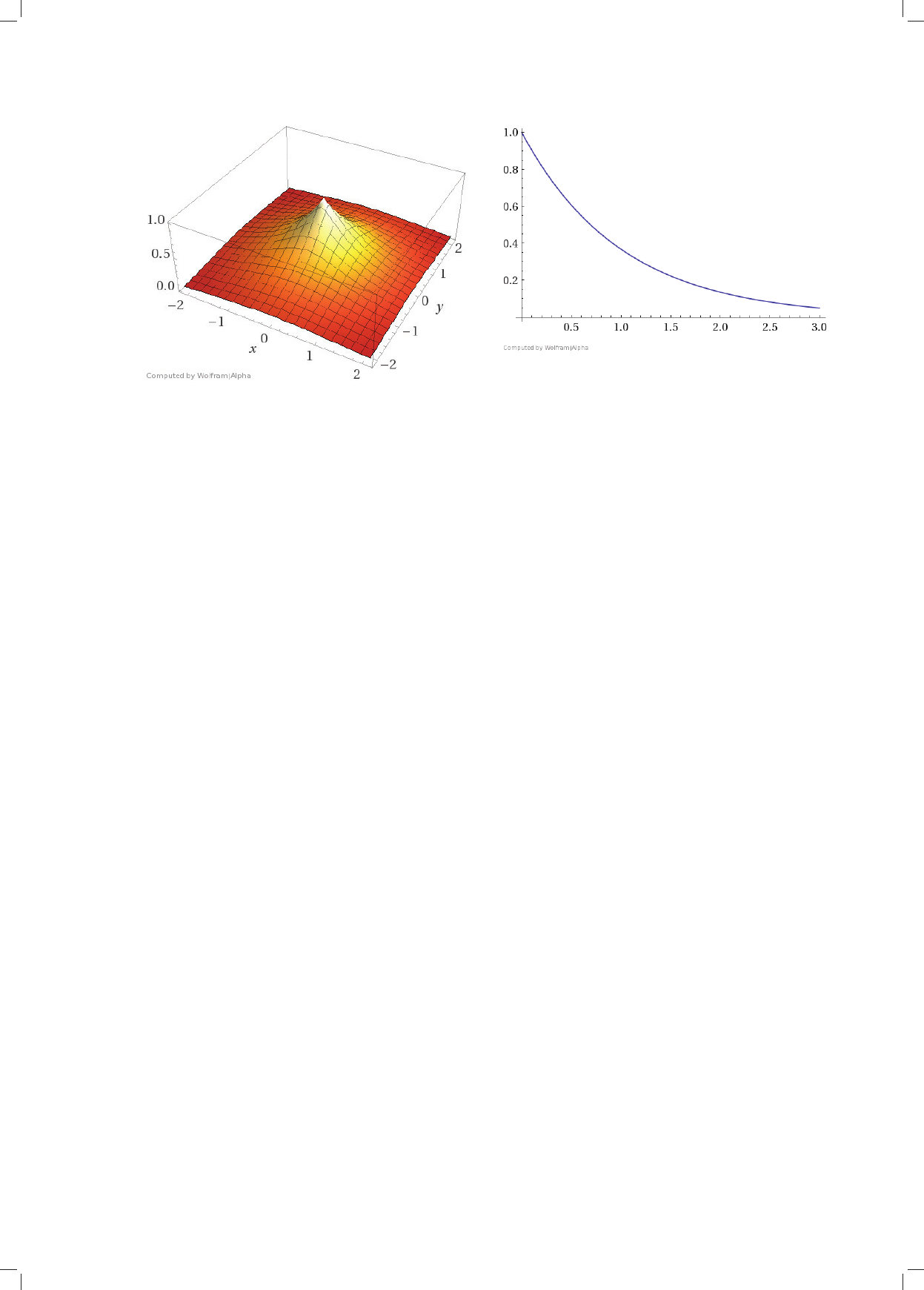
(il. 1) gęstość ρ spada wykładniczo wraz z odległością r
od źródła, tj. ρ(r) = ρ
0
e
–θr
dla pewnych parametrów ρ
0
, θ
(il. 2). Rozkład ten został opisany przez H. Bleichera i po-
twierdzony przez C. Clarka [6] dla struktury zaludnienia
w mieście, która może być liniowo zależna od rozmiesz-
czenia celów. Inaczej mówiąc, rozkładu udowodnionego
dla gęstości zaludnienia używamy jako podstawy do przy-
jęcia rozkładu gęstości celów. Należy jednak w tym miej-
scu podkreślić, że odpowiedniość ta nie musi być w ogól-
nym przypadku prawdziwa.
region, state, or specic types of source and destination
interactions, namely the choice of movements to work
or trade. In this paper we propose an alternative method
of a model comparison by means of the task consisting
in proper distribution of destinations, which corresponds
to a certain conception of reality and at the same time is
not a concrete reality. We will choose continuous distri-
butions which imitate the researched areas and we will
start models on them. Continuity of distributions induces
the necessity to continue the models themselves so that the
change will make them operate on continuous data. This is
not a disadvantage, on the contrary, it improves the gener-
ality of the solution. In order to make the comparison and
juxtaposition possible, we will make the fraction of
satis-
ed contacts dependent on the distance. In short, on the ab-
scissa axis there will be a distance from the source, whereas
on the axis of ordinates there will be a fraction of satised
travels earlier than this distance. Using the statistical
termino logy, it can be concluded that we will compare dis-
tribution functions (stochastic order) of completed travels.
To simplify, the contact source will be located at the
beginning of the coordinate system. This will allow us to
compare the contact exchange models analytically and
generally.
Exponential connection of the number of
destinations and distances
In the rst studied distribution of destinations (Fig. 1),
density ρ decreases exponentially along with distance r
from source, i.e. ρ(r) = ρ
0
e
–θr
for some parameters ρ
0
, θ
(Fig. 2). This distribution was described by H. Bleicher
and conrmed by C. Clark [6] for population structure in
the city which might be linearly dependent upon distribu-
tion of destinations. In other words, we use a distribution
that is proved for population density as a base for accept-
ing a destination density distribution. It must be empha-
sized at this point, however, that this appropriateness does
not have to be true in the general case.
With the above distribution, the number of destinations
which are within distance r from the source is proportion-
al to a value that is expressed by the following formula:
Il. 2. Gęstość rozkładu celów w zależności od odległości
Fig. 2. Destinations distribution density as a function of a distance
Il. 1. Gęstość rozkładu celów w ujęciu 3D. W początku układu
współrzędnych znajduje się źródło kontaktów (centrum)
Fig. 1. Destinations distribution density in 3D. The contact source is
in point (0,0) of the coordinate system (centre)
Gęstość celów/Destinations density
Gęstość celów/Destinations density
Odległość od źródła/Distance from source

78 Maria KamińskaZabierowska, Maciej Kamiński
Przy takim rozkładzie liczba celów, które znajdują się
w odległości r od źródła, jest proporcjonalna do wartości
wyrażonej wzorem:
))1(1(π2π2)(
0
rt
r
erdtetrG
Dla omawianej metody porównania istotny jest w tym
wypadku kształt rozkładu gęstości celów, a nie jego kon-
kretne wartości w punkcie i dokładne wyskalowanie, więc
we wzorze (4) przyjęliśmy θ = 1. Wielkości odległości r
oraz gęstości można traktować symbolicznie jako wyra-
żone w pewnych niedookreślonych jednostkach, które nie
mają znaczenia dla obliczeń i rozumowania.
Wartość funkcji (4) jest analogonem liczby G ze wzoru
(3), zatem – przy modelu pośrednich możliwości – frakcja
podróży zakończonych w odległości od źródła nie więk-
szej niż r jest proporcjonalna do wartości:
Natomiast przy modelu production constrained frakcja
ta jest proporcjonalna do wartości:
r
r
kk
tt
PC
errdt
dkete
ete
rF
)1(
0
0
)1(1
π2
2π
)(
Warto zwrócić uwagę, że model production con strained
został w tym momencie uciąglony, tj. suma (po celach)
z mianownika została zamieniona na całkę (po całym ob-
szarze modelowania), tworząc w ten sposób ana logiczny
parametr normalizujący jak we wzorze (1). Druga z całek
od 0 do r (do pewnej odległości od źródła) jest konieczna,
aby uciąglony rozkład zakończonych podróży przedstawić
jako zależną od odległości dystrybuantę, którą następnie
można porównywać. Na początku pracy pominięty został
wpływ wielkości źródła na wynik (parametr O
i
). Przyjmu-
jąc go jako jednostkowy i pomijając we wzorach, możemy
skupić się na sednie, czyli frakcji zakończonych podróży.
Frakcja podróży wyrażona wzorem (4) zamyka obszar
modelowania w zaledwie 2π celów (granica funkcji G dla
r → ∞), nie dając możliwości na zakończenie wszystkich
kontaktów. Lukę tę warto uzupełnić, odpowiednio skalu-
jąc (bez utraty ogólności) funkcję ze wzoru (5) poprzez
normalizację wartością granicy tej funkcji dla r → ∞. Po-
zwoli to na traktowanie zbioru celów jako pełnego (ska-
luje wynik modelu). Takie normalizacje są praktykowane
przy używaniu tego modelu [4]. Korekta prowadzi do na-
stępującego wzoru (7) na frakcję podróży zakończonych
w odległości od źródła nie większej niż r:
π2
))1(1(π2
1
1
)(
λ
λ
−
+−−
−
−
=
−
e
e
rF
r
er
IO
Podobnie jak postąpiliśmy przy formułowaniu wzo-
ru (4), z chęci uproszczenia obliczeń, nie zajmujemy
się skalowaniem jednostek parametrów odległości czy
liczby celów. Nie należy zatem dziwić się wielkościom
takim jak 2π celów, gdyż może ona oznaczać i być wy-
))1(1(π2π2)(
0
rt
r
erdtetr
G
For purposes of the discussed method of comparison,
the shape of a destination density distribution is signicant
rather than its particular values in the point and accurate
scaling, hence in formula (4) we assumed θ = 1. Numbers
of distance r and density can be treated symbolically as
expressed in some undened units which are irrelevant for
calculations and reasoning.
Value of function (4) is an analogue of number G from
formula (3), therefore – within the intervening opportu-
nity model – the fraction of travels ended in the distance
from the source not greater than r is proportional to the
following value:
))1(1(π2)(
1
1
r
errG
ee
−
+−−−
−=−
λλ
Whereas with production constrained model, this frac-
tion is proportional to the following value:
r
r
kk
tt
PC
errdt
dkete
ete
rF
)1(
0
0
)1(1
π2
2π
)(
We must bear in mind that production constrained
model was made constant in this case, i.e. the sum (after
destinations) from a denominator was changed into an in-
tegral (within the whole modelling area), in this way form-
ing an analogous normalising parameter as in formula (1).
It is necessary to introduce another integral from 0 to r (up
to a certain distance from the source) so that a constant
distribution of nished travels could be presented as a cu-
mulative distribution dependant on a distance which can
subsequently be used for comparison. At the beginning of
the study we ignored the inuence of the source size on
the result (parameter O
i
). By accepting this as individual
and ignoring it in formulas, we can focus on the essence,
i.e. a fraction of the nished travels.
The fraction of travels expressed by formula (4) closes
the area of modelling in only 2π of destinations (function
limit G for r → ∞), without yielding a possibility to nish
all contacts. This gap ought to be supplemented by the
adequate scaling (without losing generality) of the func-
tion using normalization of the value of this function limit
for r → ∞. This shall enable us to treat the collection of
destinations as a full unit (it scales the model result). Such
normalizations are often used in practice when applying
this model [4]. The correction leads us to the following
formula (7) pertaining to the fraction of travels ended
within the distance from the source not greater than r:
π2
))1(1(π2
1
1
)(
λ
λ
−
+−−
−
−
=
−
e
e
rF
r
er
IO
Similarly to the procedures taken when creating formu
la (4), for the sake of simplifying calculations, we are
not concerned with scaling units of distance parameters
or the num ber of destinations. Hence, we should not be
sur
prised at values such as 2π of destinations, as they may
(4)
(5)
(5)
(6)
(7)
(7)
(6)
(4)
))1(1(π2)(
11
r
errG
ee
−
+−−−
−=−
λλ

Porównywanie modeli kontaktów/Comparison of contact distribution models 79
skalowana (przyjmować jednostki) jako setki tysięcy
miejsc pracy czy połówki hektarów powierzchni handlo
wych.
Skonstruowaliśmy zatem dwie funkcje – dystrybuanty
– F
IO
oraz F
PC
, które reprezentują odpowiednio modele
pośrednich możliwości i production constrained.
Porównywanie modeli zaczniemy od analizy przy-
padków najprostszych. Gdy β = 0, wzór (6) upraszcza
się do:
r
PC
errF
−
+−= )1(1)(
Jednocześnie, gdy obliczymy F
IO
ze wzoru (7), a para-
metr λ dąży do 0, otrzymamy:
r
er
IO
er
e
e
rF
r
−
−
+−−
→
+−=
−
−
=
−
)1(1
1
1
lim)(
π2
))1(1(π2
0
λ
λ
λ
zatem modele te (dla wybranych parametrów) są równo-
ważne pod względem frakcji kontaktów zakończonych
w konkretnej odległości od źródła.
W tym miejscu warto zawrzeć pewne wyjaśnienia. Po-
równanie dla λ → 0 kłóci się w pierwszej chwili z ogól-
ną ideą przyjęcia parametru jako oczekiwanej wartości
odwrotności średniej liczby celów, po której następuje
akceptacja. Jednak nie jest to błędne, gdyż normalizacja
sprawia, że parametr działa teraz jako skala koncentracji
zakończonych kontaktów i dla parametru λ → 0 rozkład
jest identyczny z rozkładem celów. Sprawdzenie zacho-
wania się wzorów przy takich wartościach, choć czysto
akademickie i bynajmniej niewymagające wiedzy eks-
perckiej, jest jednak warte przedstawienia. Badany roz-
kład (4) (il. 1) zawiera w przedziale [0,6] około 98,2%
wszystkich swoich celów, co może być utożsamiane
z granicami zurbanizowanego obszaru funkcjonalnego
(functional urban area – FUA), np. wielkości aglomeracji
występującej w kontekście regionu. Modelowanie takich
spójnych funkcjonalnie obszarów wydaje się uzasadnione
i jest praktykowane [4]. W tym obszarze znormalizowany
model pośrednich możliwości dla parametru λ → 0 przy-
dziela (kończy) około 98,2% kontaktów, a dla λ = 0,1 oko-
ło 98,7%. Są to standardowe wartości spotykane w opra-
cowaniach i modelowaniach (por. [4]). Dla porównania,
przy parametrze λ = 1 w obszarze [0,6] realizowane jest
99,97% kontaktów, a maksymalnym stosowanym w opra-
cowaniach jest 99,9% (por. [4]).
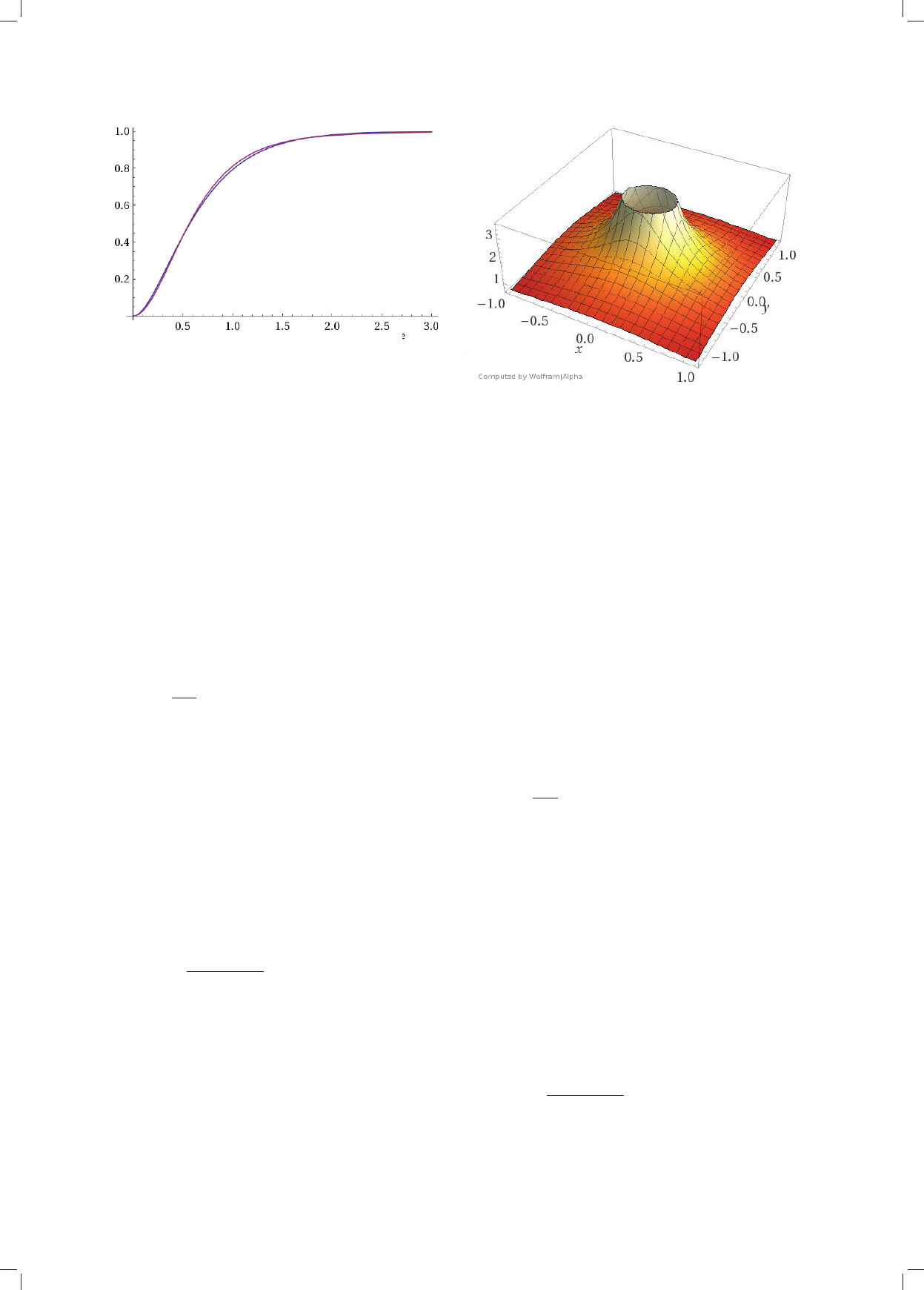
Wyniki kolejnego porównania, przeprowadzonego
dla λ = 1 oraz β = 1,95, zostały przedstawione na ilustra-
cji 3. Jak widać, nawet dla takich parametrów wykresy
te są niemal identyczne. Supremum bezwzględnej różnicy
badanych funkcji wynosi nieco ponad 0,015, co oznacza
1,5% różnicy we frakcji przydzielanych kontaktów. Oczy-
wiście z ciągłości obydwu funkcji (7)(8) można wywnio-
skować, że dla każdego λ w przedziale [0,1] istnieje takie
β w przedziale [0,1.95], żeby wykresy wykazywały dopa-
sowanie. Dla większych wartości λ, przekładających się
na mocną (a więc i niespotykaną w rzeczywistości) kon-
centrację zaspokojonych kontaktów wokół źródła, różnice
pomiędzy (7) i (8) rosną, choć nie jest to wzrost mogą-
cy przekreślać względnie dobre dopasowanie wykresów
tych funkcji.
mean and be scaled (assume units) as hundreds of thousands
of workplaces of halves of hectares of commercial space.
Therefore, we constructed two functions – distribution
functions – F
IO
and F
PC
, which represent models of in-
tervening opportunities and the production constrained,
respectively.
We will start comparing models with the analysis of
the simplest cases. When β = 0, formula (6) simplies to:
r
PC
errF
−
+−= )1(1)(
At the same time, when we calculate formula F
IO
from
formula (7), and parameter λ tends to achieve 0, we ob-
tain:
r
er
IO
er
e
e
rF
r
−
−
+−−
→
+−=
−
−
=
−
)1(1
1
1
lim)(
π2
))1(1(π2
0
λ
λ
λ
thus, these models (for selected parameters) are equiva-
lent in terms of fractions of completed contacts at the par-
ticular distance from the source.
It is worth including some explanations here. A com-
parison for λ → 0 is at odds, at rst, with a general idea
of accepting the parameter as the expected value of
the inverse of the mean number of destinations which
are followed by acceptance. However, it is not wrong
because now the normalization makes the parameter
work as a concentration scale of terminated contacts
and for parameter λ → 0 the distribution is identical
to the destination distribution. Checking the behaviour
of formulas at such values, although purely academic
and not requiring any expert knowledge, is worth pre-
senting. The researched distribution (4) (Fig. 1) con-
tains about 98.2% of all of its destinations in range [0,6],
which can be identied with boundaries of the functional
urban area (FUA), for example, sizes of agglome ra tion oc-
curring in the context of a region. Modelling such function-
ally coherent areas seems reasonable and is put into prac-
tice [4]. In this area, a standardized model of intervening
opportunities for parameter λ → 0 assigns (ends) approxi-
mately 98.2% of contacts and for λ = 0.1 approximately
98.7%. These are standard values found in studies and
modelling (cf. [4]). For comparison, with parameter λ = 1
in [0,6], 99.97% of contacts is realised and the maximum
used in studies is 99.9% (cf. [4]).
The results of another comparison which was carried
out for λ = 1 and β = 1.95 have been presented in Figure
3. As it can be seen, even for such parameters these
graphs are almost identical. Upper and lower bounds
of the absolute difference of the researched functions
are slightly more than 0.015, which means 1.5% of the
difference in the fraction of the assigned contacts. Of
course, from the continuity of both functions (7) (8)
it can be concluded that for each λ in range [0,1] there
exists such β in range [0,1.95] so that the graphs show
compatibility. For larger values of λ reected in strong
(and thus not experienced in the reality) concentration
of satised contacts around the source, the differences
between (7) and (8) grow although it is not an increase
which could eliminate relatively good compatibility of
these functions’ graphs.
(8)
(8)
(9)
(9)
80 Maria KamińskaZabierowska, Maciej Kamiński
Ustalony związek liczby celów i odległości
Podobnie jak poprzednio, celem rozważań jest sfor-
mułowanie wzorów na frakcje zrealizowanych kontaktów
w zależności od odległości od źródła. Jednak w tej części
przyjmiemy taki rozkład celów (il. 4), że na każdym okrę-
gu (o środku w źródle) jest ta sama liczba celów. Wów-
czas gęstość ρ w zadanej odległości r jest równa ρ(r) = θ/r
dla pewnego parametru θ, a liczba celów, które znajdu-
ją się w odległości r od źródła, jest proporcjonalna do
wartości:
rdx
x
x
r
G
r
π2
π2
)(
0
==
∫
Taki rozkład celów może być rozumiany np. jako
istniejący tylko w percepcji podróżnego, a wynikający
z ograniczonej wiedzy lub ograniczonej możliwości po-
znania całego otoczenia. Rozkład taki można również
uzasadnić faktem, że wielkości skupisk ludności na pew-
nym obszarze spełnia prawo Zipfa [7]. Dla przyjętego
rozkładu celów frakcje realizowanych kontaktów w oby-
dwu modelach są wyrażone przez:
rrG
IO
eerF
π2)(
11)(
λλ
−−
−=−=
oraz
∫
∫
−
∞
−
−
−==
r
r
k
t
PC
edt
dke
te
rF
0
0
1
π2
π2
)(
β
β
β
Oba modele będą działały identycznie wtedy, gdy
β = 2πλ. Dla innych wartości parametrów jedna z funkcji
F
IO
lub F
PC
dominuje nad drugą w każdym punkcie, za-
tem jeden z modeli zawsze realizuje większą frakcję za-
kończonych podróży: model pośrednich możliwości dla
β > 2πλ, a model production constrained w pozostałych
przypadkach. Kierując się wzorem (10), można zauwa-
żyć, że liczba celów nie jest tutaj ograniczona (roś nie wraz
z odległością od źródła). Nie jest zatem konieczna do-
Established relation of the destination
and distance number
As before, the purpose of this study is to create for-
mulas for the fractions of realized contacts depending
on the distance from the source. However, in this part of
the paper we will assume the distribution of destinations
(Fig. 4) that will have the same number of destinations
(with a centre in the source) on each circle. Then, density
ρ in predetermined distance r is equal to ρ(r) = θ/r for cer-
tain parameter θ and the number of destinations which are
located at distance r from the source is proportional to the
value of:
This distribution of destinations can be understood, for
example, as existing only in the perception of a traveller
and resulting from a limited knowledge or a limited op-
portunity of getting to know the entire surrounding. This
distribution can also be justied by the fact that the size
of the population concentrations in a certain area obeys
Zipf’s law [7]. For the adopted distribution of destinations
the fractions of realised contacts in both models are ex-
pressed by:
rrG
IO
eerF
π2)(
11)(
λλ
−−
−=−=
and
∫
∫
−
∞
−
−
−==
r
r
k
t
PC
edt
dke
te
rF
0
0
1
π2
π2
)(
β
β
β
Both models will work identically when β = 2πλ. For
other parameter values one of the functions F
IO
or F
PC
Il. 3. Porównanie modeli pośrednich możliwości
i production constrained dla λ = 1 oraz β = 1,95
Fig. 3. Intervening opportunity and production constrained
comparison of models for λ = 1 and β = 1.95 parameters
Il. 4. Gęstość rozkładu celów w ujęciu 3D.
W początku układu współrzędnych znajduje się
źródło kontaktów (centrum)
Fig. 4. Destinations distribution density in 3D.
The contact source is in point (0,0)
of the coordinate system (centre)
Frakcja zaspokojenia/Satisfaction fraction
Odległość od źródła/Distance from source
Gęstość celów/Destinations density
(10)
(11)
(11)
(12)
(12)
(10)
rdx
x
x
r
G
r
π2
π2
)(
0
==
∫
Porównywanie modeli kontaktów/Comparison of contact distribution models 81
dominates over the other at each point, therefore one of
the models always pursues a bigger fraction of completed
travels, namely a model of intervening opportunities for
β > 2πλ and the production constrained model in other
cases. According to formula (10), it can be noticed that
the number of destinations is not limited here (it increases
along with the distance from the source). That is why the
further normalisation of the result for the model of inter-
vening opportunities is not necessary, unlike in the previ-
ous section (formula 7).
The number of destinations does not depend
on the distance
The last distribution on which we will compare the
models is a uniform distribution characterized by the pres-
ence of the same number (density) of destinations at each
point. As a consequence, the distribution of destinations
is a plane. Assuming unit density of the destination distri-
bution, i.e. ρ(r) = 1, the number of destinations which are
located at distance r from the source is expressed by the
following formula:
Describing fractions of completed contacts for both
models, we receive the following formulas:
2
π)(
11)(
rrG
IO
eerF
λλ
−−
−=−=
for intervening opportunities model and
∫
∫
−
∞
−
−
+−==
r
r
k
t
PC
erdt
dkke
te
r
F
0
0
)1(1
π2
π2
)(
β
β
β
β
for production constrained model.
Also in this case, the number of destinations is unlim-
ited, therefore normalisation for the model of intervening
opportunities is not required (14).
For comparison purposes, we will choose parameter
λ = 1. It turns out that the model of intervening opportuni-
ties allocates almost 99% of all contacts for r from range
[0,1.2]. Therefore, we will assume this range as referen-
tial for comparisons with production constrained model.
Due to the intersection of fraction graphs (14) and (15),
a criterion for model comparisons became upper and low-
er bounds of absolute difference of functions F
IO
i F
PC
in the abovementioned range. We analyzed the value of
these upper and lower bounds depending on parameter β.
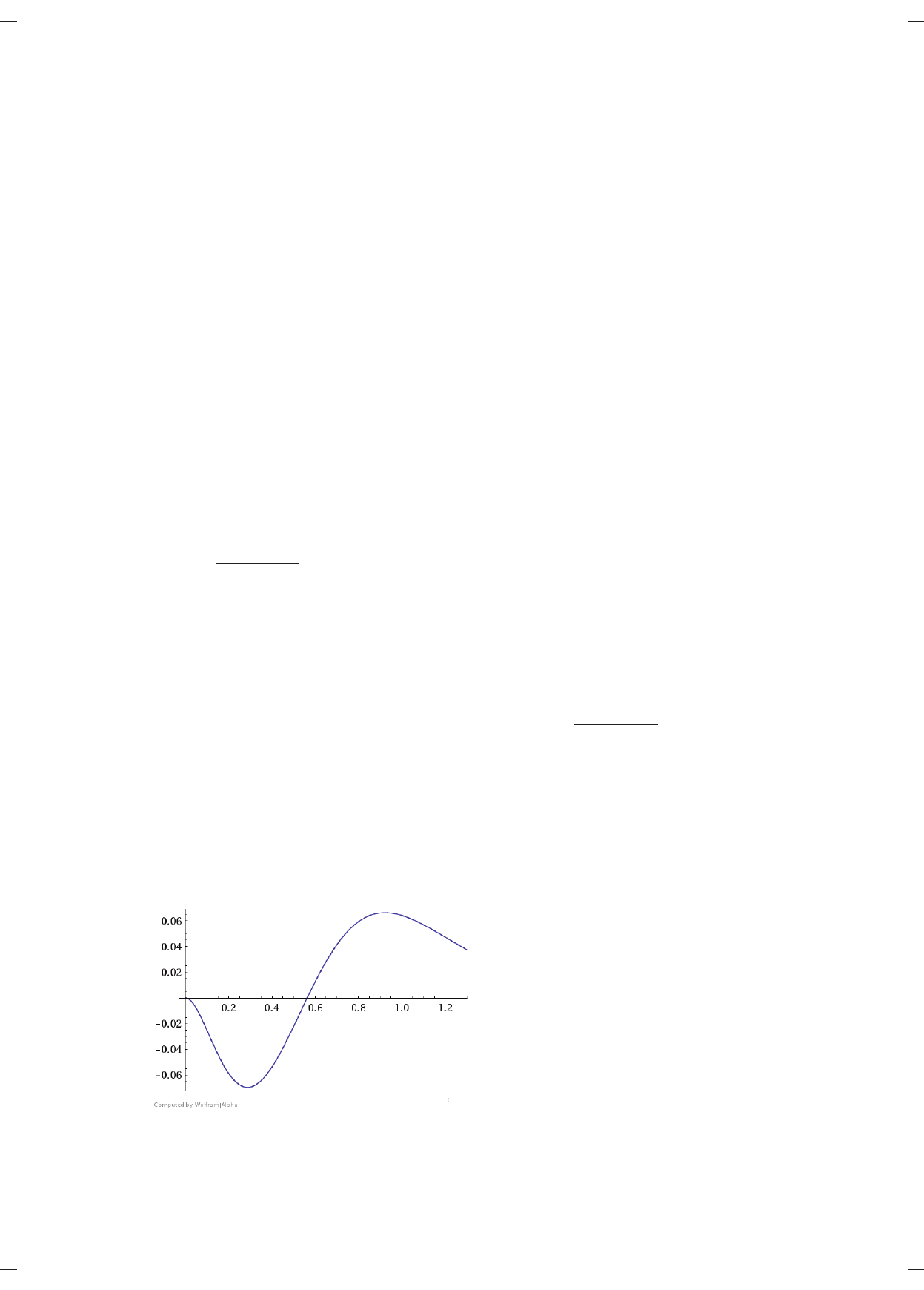
As a result, we selected parameter β equal to about 3.8 as
the one to minimize the value of the considered criterion.
It is claimed that for β = 3.8 there appears approximately
four times larger discrepancy of models (circa 6%) than
in the case of the exponential relation of destinations and
distances. The analysis of the difference fraction (Fig. 5)
shows that the production constrained model, which pre-
fers shorter travels, assigns a greater contact fraction clos-
er to the source.
datkowa normalizacja wyniku dla modelu pośrednich
możli wości, inaczej niż w poprzednim podrozdziale
(wzór 7).
Liczebność celów nie zależy od odległości
Ostatnim rozkładem, na którym porównamy modele,
jest rozkład równomierny, cechujący się występowaniem
tej samej liczby (gęstości) celów w każdym punkcie.
Dzięki temu rozkład celów jest płaszczyzną. Przyjmując
jednostkową gęstość rozłożenia celów, tzn. ρ(r) = 1, liczba
celów, które znajdują się w odległości r od źródła, wyraża
się wzorem:
∫
==
r
rxdxr
G
0
2
ππ2)(
Opisując frakcje zrealizowanych kontaktów dla oby-
dwu modeli, otrzymujemy następujące wzory:
2
π)(
11)(
rrG
IO
eerF
λλ
−−
−=−=
dla modelu pośrednich możliwości oraz
∫
∫
−
∞
−
−
+−==
r
r
k
t
PC
erdt
dkke
te
rF
0
0
)1(1
π2
π2
)(
β
β
β
β
dla modelu production constrained.
Również w tym przypadku liczba celów jest nieogra-
niczona, dlatego nie jest wymagana normalizacja dla mo
delu pośrednich możliwości (14).
Do przeprowadzenia porównania wybierzemy parametr
λ = 1. Okazuje się, że wówczas model pośrednich możli-
wości przydziela niemal 99% wszystkich kontak tów dla
r z przedziału [0,1.2]. W związku z tym przyj miemy ten
przedział jako referencyjny dla porównań z modelem pro -
duction constrained. Ze względu na przecinanie się wy
kresów frakcji (14) i (15) kryterium porównań modeli
stało się supremum bezwzględnej różnicy funkcji F
IO
i F
PC
we wskazanym wyżej przedziale. Przeprowadziliś
my analizę wartości tego supremum w zależności od pa-
Różnica frakcji zaspokojenia
Satisfaction fraction difference
Odległość od źródła/Distance from source
(13)
(13)
(14)
(14)
(15)
(15)
Il. 5. Różnica pomiędzy wzorami (14) i (15)
dla parametrów λ = 1 i β = 3,8
Fig. 5. Difference between formulas (14) and (15)
for λ parameters = 1 and β = 3.8
∫
==
r
rxdxr
G
0
2
ππ2)(

82 Maria KamińskaZabierowska, Maciej Kamiński
Conclusions
The characteristics of the realised contacts which were
described by two models, including in this case produc-
tion constrained and intervening opportunities in formulas
(1) and (2), cannot be directly comparable. The method,
which is proposed by the authors, consists in the task of
continuous destination distribution and deriving formulas
for contact fractions realised at a predetermined distance
from the source in such conditions. The adopted desti-
nation distribution on the plane can be described by the
density of destination distribution at distance r from the
source marked by ρ(r). Then the fractions of realized con-
tacts are proportional, respectively, for models of produc-
tion constrained and intervening opportunities, to
∫
∫
∞
∞
−
−
0
0
)(π2
)(π2
dt
ek
ett
k
t
β
β
ρ
ρ
and
⎟
⎟
⎠
⎞
⎜
⎜
⎝
⎛
−−
∫
r
dttt
0
)(π2exp
1
ρλ
The fractions were reduced to a function which can be
interpreted as a cumulative distribution, therefore they
can be compared in terms of stochastic orders. For our
purposes, the fractions were compared at each point (e.g.
Fig. 3), namely in the ordinary stochastic order (cf. [8]
Chapter 17).
The comparison results which were described in detail
show a signicant inuence of the chosen distribution of
destinations on the models’ operation. Although for the pro-
posed distributions it is not possible to clearly indicate in
which model travels end more quickly, however, the differ-
ences between the fractions in both models were calculated.
The presented comparisons can be carried out for differ-
ent models of contact exchange and other distributions of
destinations. The purpose of this work is therefore to de-
ne and demonstrate a different method of comparing mo
dels, which abstracts from the concrete implementations.
A comparison of models leads to the observation that
the considered models do not show signicant differences
on such distributions. At the same time, the existence of
contact exchange models is connected with a desire to
reect reality in the best way. Reality and distribution of
contacts must be as close as possible, i.e. it must corre-
spond to the results of each model, regardless of the fact in
which reality (at which point) it will start. It is not surpris-
ing, therefore, that for distributions which are close to ideal
ones (Fig. 1 and 4), the models show a high compatibility.
If the models were incompatible, it would mean that one
of them reects the reality signicantly and qualitatively
in a different way (better or worse) even for such a simple
case as the one discussed in this study. Eventually, this
would result in the lack of popularity of one of the models.
Translated by
Bogusław Setkowicz
rametru β. W jej wyniku wyłoniliśmy parametr β równy
około 3,8 jako minimalizujący wartość rozważanego
kryterium. Dla β = 3,8 stwierdza się około czterokrotnie
większą rozbieżność modeli (ok. 6%) niż w przypadku
wykładniczego związku liczby celów i odległości. Ana-
liza przebiegu różnicy frakcji (il. 5) pozwala stwierdzić,
że model production constrained, preferując krótsze
podróże, przydziela większą frakcję kontaktów bliżej
źródła.
Wnioski
Charakterystyki realizowanych kontaktów opisywane
przez dwa modele, w tym przypadku production constra-
ined i pośrednich możliwości we wzorach (1) i (2), mogą
nie być wprost porównywalne. Zaproponowana przez
autorów metoda polega na zadaniu ciągłego rozkładu ce
lów i wyprowadzeniu dla takich warunków wzorów na
frakcje kontaktów realizowanych w zadanej odległości
od źródła. Przyjęty rozkład celów na płaszczyźnie może
być opisany poprzez gęstość rozkładu celów w odległości
r od źródła, oznaczaną przez ρ(r). Wówczas frakcje zre-
alizowanych kontaktów są proporcjonalne, odpowiednio
dla modeli production constrained i pośrednich możli
wości, do
∫
∫
∞
∞
−
−
0
0
)(π2
)(π2
dt
ek
ett
k
t
β
β
ρ
ρ
oraz
⎟
⎟
⎠
⎞
⎜
⎜
⎝
⎛
−−
∫
r
dttt
0
)(π2exp
1
ρλ
Frakcje zostały doprowadzone do postaci funkcji, które
mogą być interpretowane jako dystrybuanty, a więc po-
równywane w kategoriach porządków stochastycznych.
Do naszych celów frakcje porównywane były w każdym
punkcie (m.in. il. 3), tj. w zwykłym porządku stochastycz-
nym (por. [8] rozdz. 17).
Opisane szczegółowe wyniki porównań świadczą
o znaczącym wpływie obranego rozkładu celów na dzia-
łanie modeli. Chociaż dla zaproponowanych rozkładów
nie jest możliwe jednoznaczne wskazanie, w którym mo-
delu podróże szybciej się kończą, jednak obliczono, jakie
są różnice między frakcjami w obydwu modelach.
Przedstawione porównania można przeprowadzić dla
różnych modeli wymiany kontaktów i innych rozkładów
celów. Zadaniem tej pracy jest zatem zdeniowanie i po-
kazanie odmiennej metody porównywania modeli, abstra-
hującej od konkretnych realizacji.
Porównanie modeli prowadzi do spostrzeżenia, że
rozważane modele nie wykazują na takich rozkładach
znaczących różnic. Jednocześnie istnienie modeli wy-
miany kontaktów jest związane z chęcią jak najlepsze-
go oddania rzeczywistości. Rzeczywistość i rozkładanie
kontaktów musi być możliwie bliskie, tj. musi odpo-
wiadać wynikom każdego modelu niezależnie od tego,
w jakiej rzeczywistości (na jakim wejściu) zostanie uru-
(16)
(16)
(17)
(17)

Porównywanie modeli kontaktów/Comparison of contact distribution models 83
chomione. Nie dziwi zatem, że dla rozkładów, które zbli-
żone są do idealnych (il. 1 i 4), modele wykazują dużą
zgodność. Gdyby modele były niezgodne, oznaczałoby
to, że jeden z nich oddaje rzeczywistość znacząco i ja-
kościowo inaczej (lepiej lub gorzej) nawet dla tak pro-
stego przypadku, jak rozważany w niniejszej pracy. Os-
tatecznie skutkowałoby to brakiem popularności jednego
z modeli.
Bibliografia /References
[1] Akwawua S., Pool J.A., The development of an intervening opportu-
nity model with spatial dominance effects, „Journal of Geographical
Systems” 2001, No. 3, 69–86.
[2] Wilson A.G., A statistical theory of spatial distribution models,
„Transportation Research” 1967, Vol. 1, 253–269.
[3] Zipser T., Modele symulacyjne w rozwoju sieci osadniczej, Raporty
Instytutu Architektury i Urbanistyki PWr, Wrocław 1975.
[4] Zipser T., Sławski J., Modele procesów urbanizacji – teoria i jej wy-
korzystanie w praktyce planowania, PWE, Warszawa 1988.
[5] Stouffer S., Intervening Opportunities: a theory relating mobility
and distance, „American Sociological Review” 1940, Vol. 5, 845–
867.
[6] Clark C., Urban population densities, „Bulletin de Insitute Interna-
tionale de Statistique” 1958, Vol. 36, 60–68.
[7] Auerbach F., Das Gesetz der Bevölkerungskonzentration, „Peter-
mann’s Geographische Mitteilungen” 1913, Vol. 59, 74–76.
[8] Marshall A.W., Olkin I., Inequalities: theory of majorization and its
applications, Academic Press, New York 1979.
Streszczenie
Nie jest znana uniwersalna metoda porównywania modeli kontaktów. Modele spotykane w literaturze są najczęściej zadane wzorem matematycz-
nym, który opisuje swoistą charakterystykę modelu, ale niewiele mówi o jego działaniu. W niniejszej pracy zaproponowano sposób porównywa-
nia modeli kontaktów. Dzięki analitycznemu uruchomieniu modeli na idealnych, teoretycznych rozkładach porównano, jakie typy podróży pre-
feruje model, jak rozkłada ruch oraz jak przedstawiają się te cechy w zestawieniu z innymi modelami. Kryterium porównawczym uczyniliśmy
stochastyczne porządkowanie frakcji zrealizowanych kontaktów. Pomysł ten wydaje się dobrą alternatywą dla porównywania modeli na
konkretnych miastach. Porównania dokonano dla modeli production constrained oraz intervening opportunity (modelu pośrednich możliwości).
Wyniki otrzymane dla przyjętych rozkładów celów ukazują, że choć obydwa modele bardzo się różnią w swoich założeniach, w szczególnych
przypadkach mogą podobnie realizować kontakty.
Słowa kluczowe: planowanie przestrzenne, modele kontaktów, model pośrednich możliwości, porządek stochastyczny
Abstract
No universal method for comparing contact models is known. Models we met in literature are usually stated by a complicated mathematical formula,
which does not provide any information about the model’s specic behaviour, although it characterizes the model. In this paper the authors present
their own way of comparing contact models. We run models in analytic theory on ideal theoretical distributions. Thanks to this we are able to compare
multiple models and their behaviour in terms of arriving distribution or short/long trips preferences. We use stochastic ordering approach for fractions
of completed contacts as the criterion for comparing models. The presented idea seems to be a good alternative to a comparison based on the model’s
output for xed city instances. Comparison is made for production constrained and intervening opportunity models. The results for chosen distribu-
tions show that, even if both models differ much in their assumptions, they can give very similar outputs.
Key words: spatial planning, contact models, intervening opportunity model, stochastic order
Wynik modelowania samosterującego dla konty-
nentu azjatyckiego, porównanie wyniku 250 ite-
racji z rzeczywistą wielkością miast w ramach
funkcjo nalnych obszarów zurbanizowanych (FUA)
Result of a selflearning model for the Asian
con tinent, comparison of the results of 250 itera-
tions with the actual size of the cities within the
frame work of functional urban areas (FUA)
Źródło/Source: Zipser W., Wpływ determinant geogra-
ficznych na tworzenie się poza Europą ponadregional-
nych struktur osadniczych w skali kontynentalnej,
raport serii SPR. NR I12/S018/11