
2024
4(80)
Dominika Pazder*
Designation of creative syntax
as a tool for revitalizing downtown area
in spatial and socio-economic aspects
DOI: 10.37190/arc240411
Published in open access. CC BY NC ND license
Abstract
The research addresses issues related to the role of creativity in revitalizing downtown areas. The author attempts to identify the relationship
between creativity and spatial and social development. The key element of the work is the study of the importance of designated creative syntax
areas with the use of the author’s original adopted method. The analysis is conducted in order to identify their role in the context of stimulating social
activity, revitalizing the downtown space, as well as providing a basis for developing the innovative idea of the experience economy. The research
focuses on the spatial and semantic layer of creating high-quality and attractive downtown public spaces. The research used a multi-criteria, author’s
research method, capturing the addressed issues in spatial-compositional, semantic-perceptual, as well as socio-economic aspects.
Key words: creativity, socio-spatial attractiveness, downtown, public space
Introduction
The article presents studies focused on identifying re-
lationships between spatial activities at the stage of devel-
oping and designing downtown space (engineering hard-
ware) and attainable social eects (software) in the context
of its revitalization. For that purpose, the author has made
an attempt to dene creative syntax using her own, orig-
inal method of identication, assessment and promotion
of downtown creative capacity. In spatial terms, creative
capacity demonstrated via concentration of creative busi-
nesses is a potential to harness opportunities, which can
increase attractiveness of the downtown space by furnish-
ing it with various cultural and artistic functions. “Cre-
ativity” was dened, following the concept propagated by
Charles Landry (Landry 2013; Green 2013), as a process
of changing concepts and perceptions of the environment.
Adhering to that view, it is important to ensure that the
downtown space is open for new and revitalizing com-
ponents. This can be achieved by designing solutions of
dened useful life for specic places, to activate and en-
gage local communities
1
. The proposed herein concept of
creative syntax refers to the space syntax theory proposed
among others by Jean Doulliez (1983, 198–218), who
compared the built environment creation to the forma-
tion of a specic architectural and urban planning spatial
syntax, governed by specic rules and principles of in-
tegration of a network of units into one coherent whole.
Space syntax can be dened as a set of interconnected
principles organizing interrelated units, relationships and
processes into a relevant spatial arrangement, reecting
the morphic language syntax (Hillier et al. 1976; Space
Syntax… 2024). Mahshid Shokouhi (2003) similarly per-
ceives space syntax in his research. He proves that space
syntax in urban practice will render more enhanced and
recognizable spatial patterns. Space syntax facilitates syn-
tactic hierarchy of spatial layouts by ordering units of lev-
1
The concept incorporates selected assumptions of design inter-
ven tion, intended to individuate spaces in the space-time function – the
changing space users have dierent needs and perceptions, thus, morphic
units of space should be able respectively respond thereto in the dened
time span and scope.
*
ORCID:
0000-0002-0071-3540. Faculty of Architecture, Po znan
Uni versity of Technology, Poland, e-mail: dominika.pazder@put.poznan.pl
110 Dominika Pazder
3. Delineating – within the creative syntax – a sequen-
tial system of road oer in the three case studies, to be fol-
lowed by a rating in view of spatial and emotional values
in reference to the adopted indicators of visual composi-
tion and user/visitor experiences and by rating the road at-
tractiveness in view of quality assessment categories such
as instrumental, sensual and semantic quality referred to
as AIDAS quality components (attention, interest, desire,
action, satisfaction) (Steinecke 1999, 58).
Territorial and time scope of the research
The research focuses on downtown areas in three cities
– Poznan, Cracow and Wrocław, which have been selected
based on a rating of the European Commission “Cultural
and Creative Cities Monitor” (2024) (Pazder 2018; 2019).
These cities obtained the highest “C3-Index”, which means
the highest Cultural Vibrancy and Creative Economy rat-
ing in the group of cities populated by at least 500,000.00
up to 1,000,000.00 inhabitants. The research included
a comparative analysis of designated downtown creative
syntax intended to identify similarities and dierences of
cultural and economic scores allocated to the ratios of cre-
ativity to quality of the downtown space. The research was
conducted in the period from 2016 to 2018. The results
were published in a scientic monograph (Pazder 2018).
Purpose of the research
The research aims to highlight the importance of cre-
ating places revitalizing social life within the downtown
public space, and thus, to promote urban planning as a tool
facilitating spatial development of social structures, going
beyond the role of mere art of spatial and functional urban
arrangement. In view of the foregoing, two basic goals can
be proposed for the research:
1. Identication of current tendencies and criteria un-
derlying the role of creativity in shaping, stimulating and
revitalizing the downtown space.
2.
Development of the author’s original research meth-
od
for the following purposes:
– identication of topology of the existing functional
and spatial downtown resources to be used and qualied as
capable of designating creative syntax and relevant spatial
connectivity,
– identication of the sequential system of road oer
and its multi-criteria assessment, taking into account crea
-
tive public spaces of high quality and attractiveness and
delineation of focal points of spatio-social activity within
the functional and spatial decit places.
Research hypotheses
The following research hypotheses have been proposed
by the author on the basis of a thorough analysis of the
eld specic literary references, observations of Polish and
European practices and her own experience:
– spatial decits stimulate development of creativity
and may contribute to vibrancy and vitality of downtown
areas,
els on a scale of importance or subordination and thus, by
rendering a harmonious composition.
Identification of the research problem
The research aims to study the relationships between
downtown areas with creative capacity and social and eco-
nomic eects of spatial activities undertaken to enhance
spatial attractiveness by making it inspiring, inclusive and
revitalizing. The concept of creative space is connected
with another term, i.e., “the experience economy”, rst used
by the economists Joseph Pine and James Gilmore (1998),
who noticed that customers were willing to pay more if
a sales transaction became a memorable experience for
them (or in order to have extraordinary experiences).
This work adheres to the creative economy model as
proposed by John Howkins (2013), based on intangible
capitals, people’s use of their talents, imagination, skills,
knowledge and creativity. This perception of economy is
shared by Michael Hutter (2011), who notes that in the
sector of culture, economy plays no major role, however,
combination of culture and the experience economy ren-
ders new opportunities. Economy of goods is prot driven,
while creative economy is based on the potential of cre-
ative assets. The model of experience economy proposed
by Hutter is demand driven but in an interactive way (Naro-
dowy Instytut Kultury…). Demand for creativity is viewed
as sparking the consumer interest and supply – as an oer
of intangible capitals; at the same time prot attains other
than nancial dimension, since it additionally allows peo-
ple to use their creative potential and satisfy social needs
in the downtown space. In this sense, vibrancy and vitality
play a key role. Owing to relevant activities, re sources can
be applied towards cultural development (sti mulation of
creativity of the inhabitants), spatial transfor mation (de-
velopment and design of public spaces) and towards har-
nessing the semantic potential (enhancement of the local
character and genius loci) to shape to a large extent the
unique nature of downtown.
Architectural scenery and spatial oer create specic
conditions for orchestrating the urban stage open to human
creativity. The work shall focus on the study of the role of
designated – by means of the author’s original method – cre-
ative syntax areas to identify their importance in stimulating
social activity and revitalizing the downtown space. It shall,
moreover, provide reasons justifying the use of the experi-
ence economy model (Waitt, Gibson 2009; Hutter 2011), in
order to obtain measurable economic benets for the city.
Researched topics
The studies concern three topics:
1. Identication and designation of creative syntax in
downtown areas of the analysed cities according to the ad-
opted by the author criteria of creativity. Creative syntax
areas will then enable us to delineate a sequential system
of road oer.
2. Comparative analysis of the designated creative syn-
tax and its relationships to assess and benchmark the three
analysed cities (case studies).
Designation of creative syntax as a tool for revitalizing downtown area in spatial and socio-economic aspects 111
– formation of creative syntax may facilitate social ac-
cessibility to creative activities (from elitist to egalitarian),
– creative public spaces and focal points of spatio-so-
cial activity marked within creative syntax induce creative
activities, foster a friendly environment for development
of creative functions and facilitate social interactions and
contacts,
– accumulated creative capacity of space and aggrega-
tion of creative functions underlie a synergy of social ac-
tivities within creative syntax, which may in eect increase
visual and business attractiveness of downtown.
Case study
– Poznan downtown
The study employs a multi-criteria, original research
method
which enables the analysis of the following aspects:
spatio-compositional, semantic-perceptive, and socio-eco-
nomic. Creative syntax areas are dened by the author as
composed of trump and decit spaces. Trump spaces repre-
sent those areas in public space, which are connected with
creative functions, and which are conductive to cultural ac-
tivities and a creative business sector. Decit spaces
are de-
ned as degraded buildings or building complexes, which
can potentially serve new functions related to culture and
creativity or as undeveloped spaces visually perceived as
urban voids in the otherwise compact downtown fabric,
whether privately or publicly owned.
Identification of creative milieu
In accordance with the adopted for this research meth-
odology, the case study of the city of Poznan started with
identication of creative milieu within the area of down-
town designated in the “Study of Land Use Conditions and
Directions of Spatial Development of the city of Poznan”.
The area of Poznan downtown is 1,672 ha, which represents
6.4% of the entire surface area of the city (26,200.00 ha).
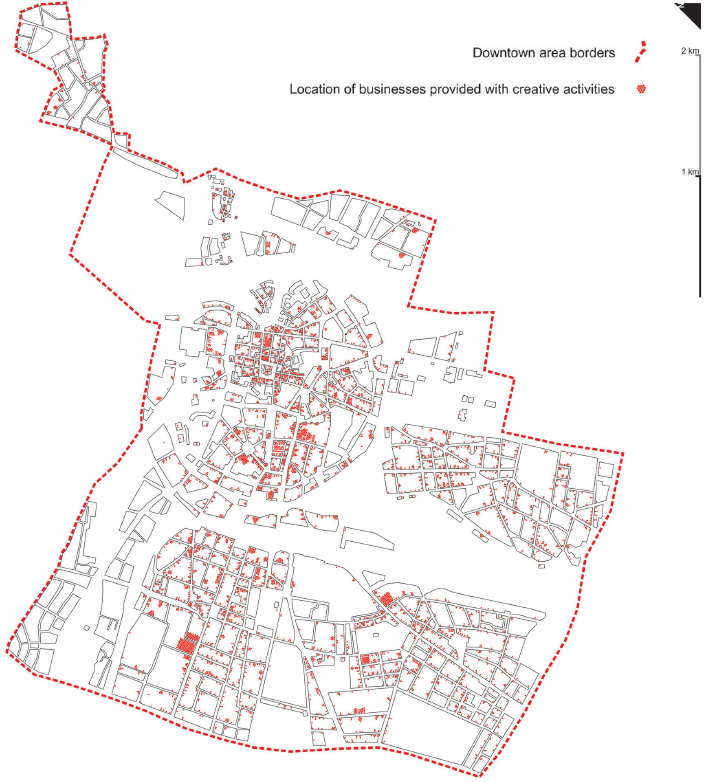
Relevant graphic markings (points) were made on the map
of the downtown area to show spatial distribution of cre-
ative businesses. 4,623.00 businesses registered in the cre-
ative sector have been identied within 812 ha, i.e., within
46.6% of the entire downtown area. Distribution of busi-
nesses shows that areas within the boundary of central and
north-western part of downtown (Fig. 1) demonstrate the
highest creative capacity.
Fig. 1. Identification of creative
capacity understood as creative
milieu, conductive
to development of creative
functions in the downtown
of Poznan
(elaborated by D. Pazder
based on Google Maps)
Il. 1. Identyfikacja potencjału
kreatywnego rozumianego jako
milieu sprzyjające rozwojowi
funkcji kreatywnych
w śródmieściu Poznania
(oprac. D. Pazder na podstawie
Google Maps)
112 Dominika Pazder
Delineation of spatial concentration
of creative capacity
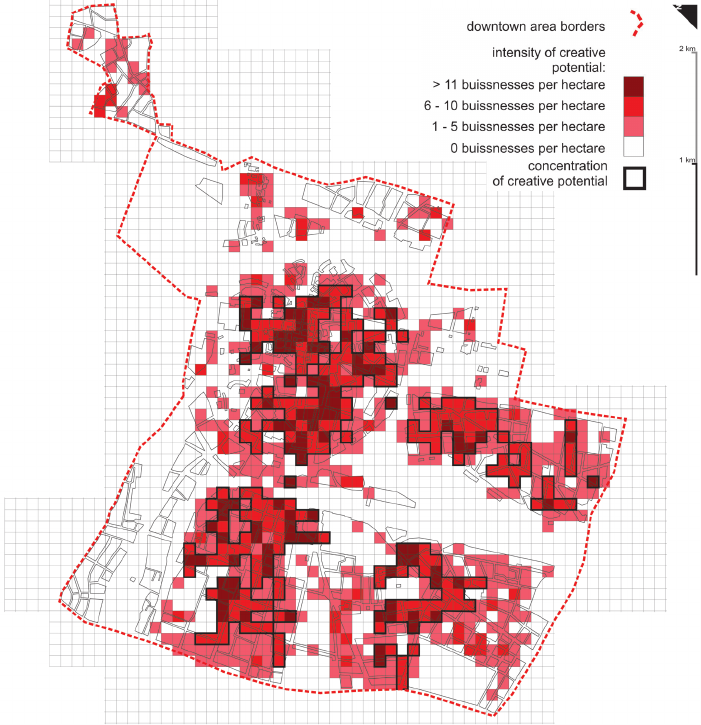
Spatial concentration of creative capacity (Fig. 2) was
represented by a modular grid (100 ×100 m). The grid al-
lowed for the visualization of intensity of creative busi-
nesses via marking their number per 1 hectare surface area.
Six was assumed to represent the average value of con-
centration of creative businesses per 1 ha. It has been cal-
culated in accordance with the formula: i/p ~ 5,79, where
I – is the total number of marked points, p – area of iden-
tied creative capacity in the downtown area (calculated
in ha).
Next, based on the number of points scored per 1 hect-
are of area, creative capacity was classied according to
intensity of concentration:
– 0 points – no creative capacity,
– 1–5 points – low intensity of creative capacity,
– 6–10 points – moderate intensity of creative capacity,
– over 11 points – high intensity of creative capacity.
In eect of identication of concentration of creative
capacity, downtown area in Poznan was found to com-
prise:
– 98 ha of high intensity creative capacity (over 11
points per 1 ha),
– 319 ha of moderate intensity creative capacity (6–10
points per 1 ha),
– 395 ha of low intensity creative capacity (1–5 points
per 1 ha).
The aforementioned identication of concentration of
creative capacity underlay delineation of creative syntax
boundaries in areas characterized with over average (mod-
erate 6–10 points) and very high (over 11 points – almost
twice the average score) intensity.
Designation of creative syntax
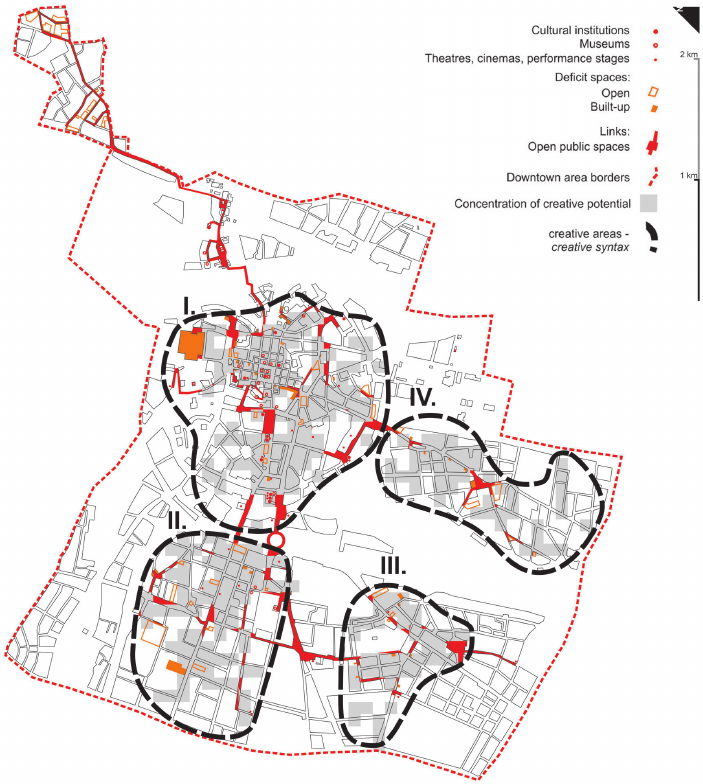
Current spatial status quo was analysed in terms of trump
and decit spaces in order to delineate creative syntax
(Fig. 3).
Trump areas were dened to contain developed
land (facilities serving various creative functions, such as
institutions of culture, museums, theatres, cinemas, audi-
torium rooms) and undeveloped land (open spaces located
nearby facilities serving creative functions) connected with
creative functions. On the other hand, impoverished parts
of developed and undeveloped urban fabric were classied
as decit spaces. The study also found a system of con-
nectivity (relationships) between trump and decit spaces
within creative syntax demonstrated via nodes (squares or
parks) that retain the social ow and linear spaces (streets,
avenues) that linearly lead the social ow.
Four areas of creative syntax were designated in the
downtown area of Poznan (Fig. 4). Areas I, II and IV of cre-
ative syntax were found to be located within close vicinity
Fig. 2. Delineation of the spatial
concentration of creative
capacity on a modular grid
(100 × 100 m)
(elaborated by D. Pazder
based on Google Maps)
Il. 2. Wyznaczenie przestrzennej
koncentracji potencjału
kreatywnego na siatce
modularnej 100 × 100 m
w śródmieściu Poznania
(oprac. D. Pazder na podstawie
Google Maps)
Designation of creative syntax as a tool for revitalizing downtown area in spatial and socio-economic aspects 113
Fig. 3. Designation of creative
syntax in reference to spatial
concentration of moderate and
high creative capacity in Poznan
downtown (elaborated by
D. Pazder based on Google Maps)
Il. 3. Wyznaczenie obszarów
kreatywności w odniesieniu do
przestrzennej koncentracji
średniego i wysokiego potencjału
kreatywnego w śródmieściu
Poznania (oprac. D. Pazder
na podstawie Google Maps)
of the Old Town and to form a legible and well-connect-
ed system. Area III showed the lowest connectivity with
Area I. Creative syntax I, which encompasses the Old
Market Square, best facilitates the creative functions. High
numbers of trump and decit areas were identied within
its boundary, thus, according to the adopted methodology,
this area oers the best opportunities for the development
of creativity. Areas II and III contained fewer trump areas
but showed a higher development potential for temporary
use of spaces due to identied decit spaces. In Area IV,
only decit spaces were identied, which poses a chance
for development of creativity. Particular recommendations
were formulated in the course of the research on the select-
ed sequential system of road oer.
Delineation of the sequential system
of road offer within creative syntax areas
in the analysed cities
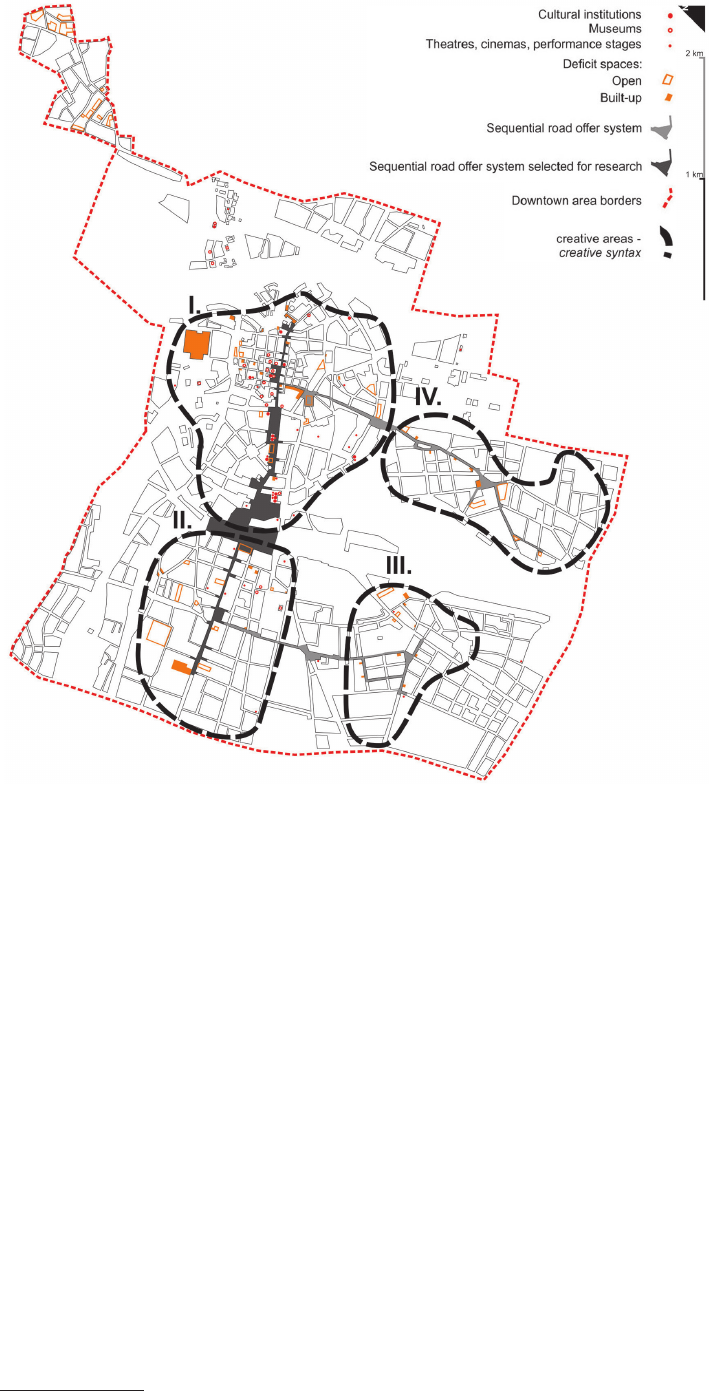
In the process of designation of creative syntax areas and
in eect of identication of a connectivity system between
them, we selected a relevant sequential system of road oer.
The system is demonstrated by an arrangement of nodes and
linear spaces that optimally connect creative syntax areas,
taking into account walking distances. The ultimate
visual
experience of a walking pedestrian increases the apprecia-
tion of space and enhances the interactive experience qual-
ity. A sequential system of road oer, composed of a linear
east-west oriented layout (approx. 3,000.00 m long)
was
selected within the designated creative syntax in Poznan
downtown. It was next subjected to thorough analyses
(Fig. 4).
Analysis
of scenic sequential continuity
To assess attractiveness of a selected fragment of the
sequential system of road oer, it was rst analysed in
view of scenic sequential continuity and major indicators
underlying perception of the quality of spatial relation-
ships (Fig. 5).
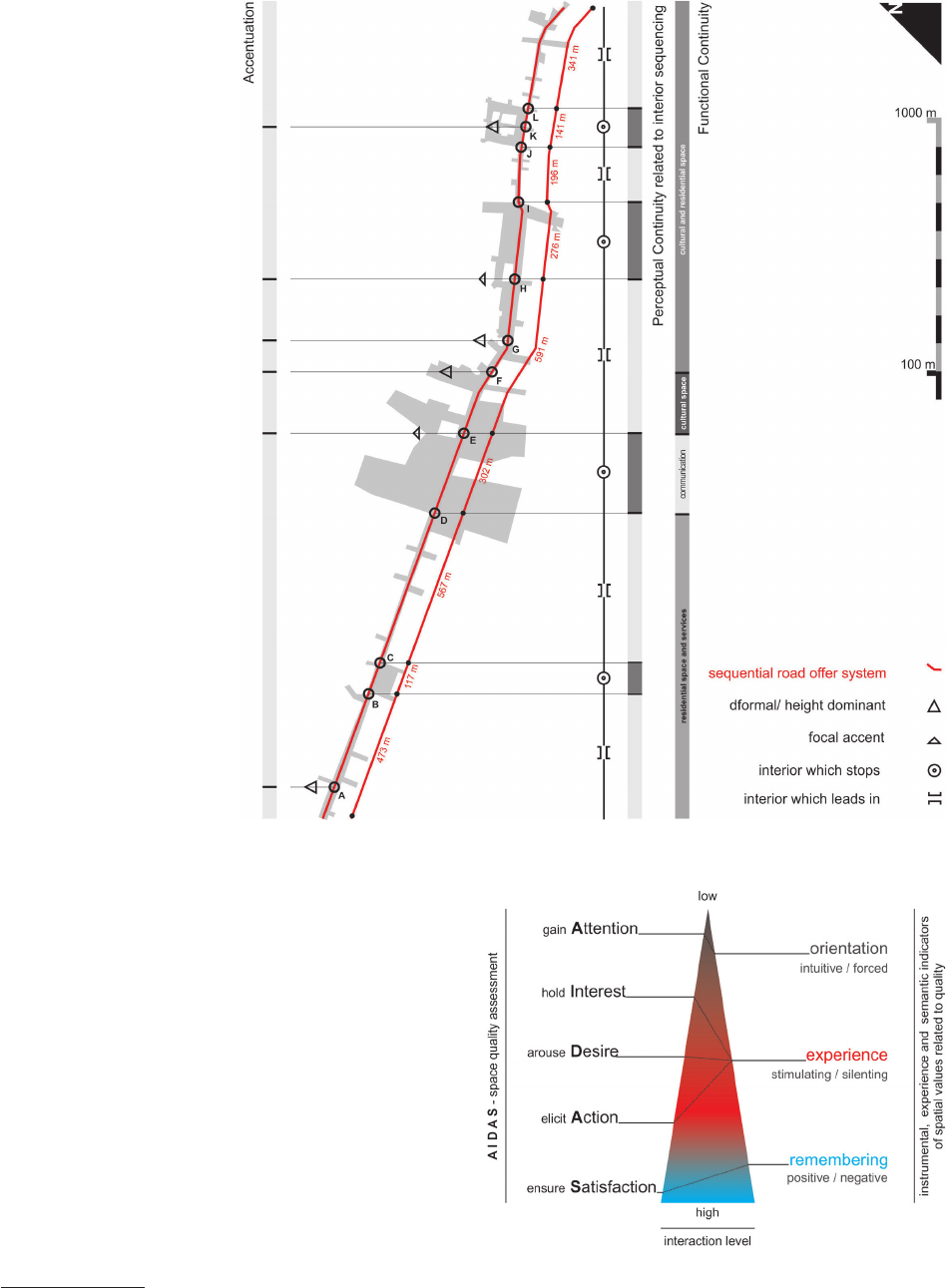
The analysis of the selected sequential system of road
oer concerned accentuation and rhythm of a continui-
ty (dominants, accentuated elements, directions), rhythm
of a sequence (urban interiors in the form of nodes and
linear spaces), perceptual continuity and functional con-
tinuity. The results of our research on a scenic sequential
continuity rendered the following perceptual indicators
aecting the quality of experienced spatial relations: four
114 Dominika Pazder
dominants and two accentuated elements. For the reason
that visual attractiveness and legibility of spatial layout in
some sections diered depending on the direction of the
social ow, the analysis was carried out for two oppos-
ing directions. Perceptual continuity refers to a rhythmic
arrangement of internal sequences (square-street). This
rhythm is best observed at the points of connection be-
tween sequences.
Assessment of spatial value indicators
The research next moved on to assess the space quality
indicators following the adopted scheme of orientation/ex-
perience/memorization with the use of the semantic dier-
ential (SD) method. The selected sequential system of road
oer was rated for quality in the following three categories:
instrumental quality (orientation), sensual quality (experi-
ence) and semantic quality (memorization) in reference to
AIDAS assessment components (attention, interest, desire,
action, satisfaction)
2
. Indicators of spatial value were an-
alysed for each point from A to L, marked on the selected
2
AIDAS: “A” – gain attention, “I” – hold interest, “D” – arouse
desire, “A” – elicit action and “S” – ensure satisfaction.
sequential system of road oer, in two opposite directions,
following the adopted scheme of orientation/experience/
memorization with the use of the semantic dierential
(SD) method referenced to components of AIDAS market-
ing tool, which method represents an emotional model of
generating demand for creativity and supply of creativity
(Fig. 6).
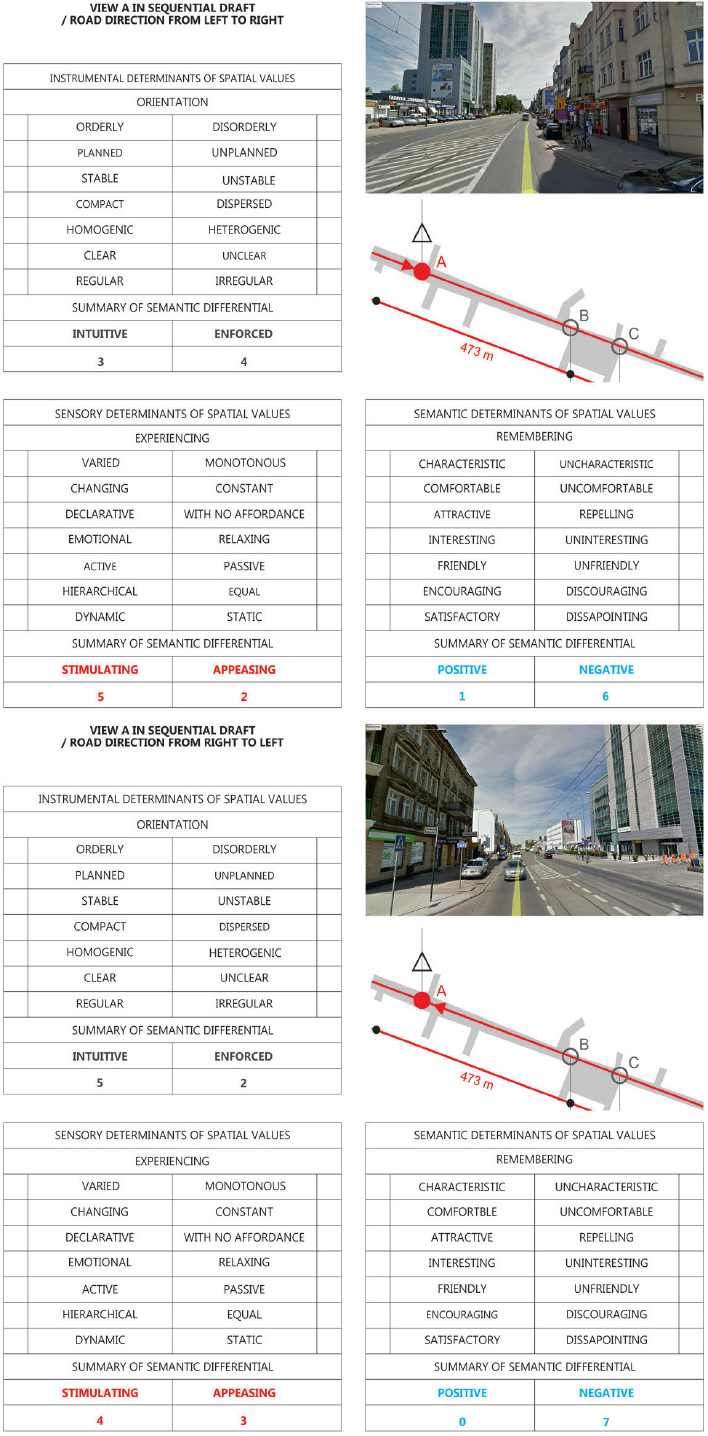
Marketing assessment with the use of AIDAS is com-
posed of valuation of attractiveness factors during the
customer purchase process: gaining attention, holding in-
terest, arousing desire, eliciting action and ensuring satis-
faction. In this article, assessment components of AIDAS
marketing tool have been transposed to evaluation of in-
dicators aecting spatial quality perception in such cate-
gories as instrumental quality (orientation)/sensual quality
(experience)/semantic quality (memorization) of space.
The level of orientation assessed for spatial quality, ranged
from intuitive to non-intuitive, has been correlated with the
rst level of AIDAS marketing tool – gaining attention.
The three mid-levels of AIDAS: holding interest, arousing
desire and eliciting action have been referenced to the ex-
perience of space rated as stimulating or suppressing. The
highest level of customer satisfaction has been assumed
to correspond to the memorization level, evaluated ei-
ther positively or negatively. Correlated levels have been
Fig. 4. Delineation of the
sequential system of road offer
within marked creative syntax
in Poznan downtown
(elaborated by D. Pazder
based on Google Maps)
Il. 4. Wyznaczenie sekwencyjnego
systemu oferty drogi w obrębie
wyznaczonych obszarów
kreatywności w śródmieściu
Poznania (oprac. D. Pazder
na podstawie Google Maps)
Designation of creative syntax as a tool for revitalizing downtown area in spatial and socio-economic aspects 115
additionally referenced to the levels of social interaction
– the lowest is connected with indicators of orientation
and attention, the highest – with memorization and satis-
faction in relations with space and other users.
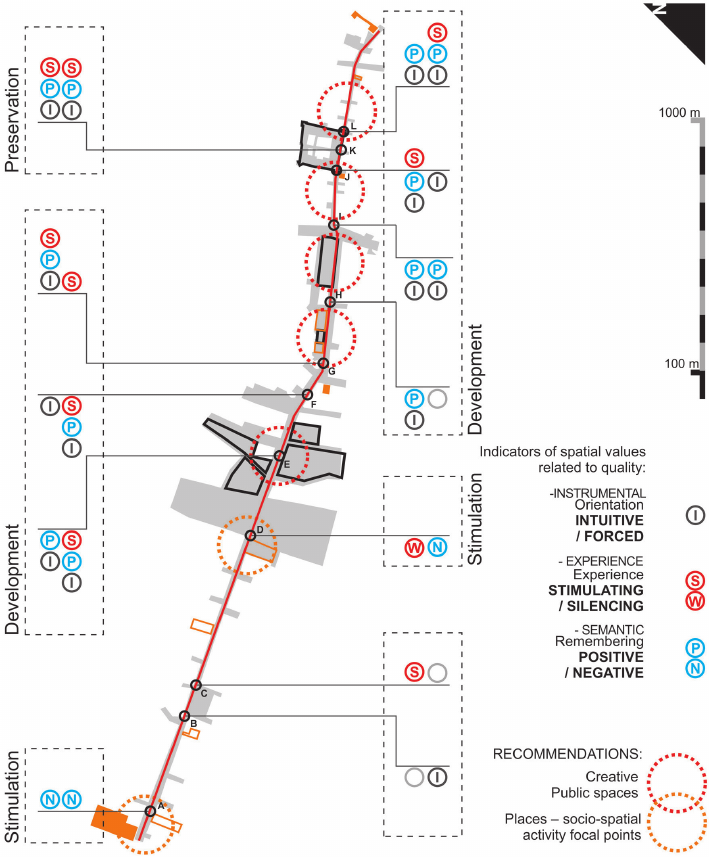
Detailed analysis was carried out in the seven adopted
semantic dierentials in reference to quality in the follow-
ing categories: instrumental quality (orientation)/sensual
quality (experience)/semantic quality (memorization) of
space
3
. In eect of expert’s evaluation of spatial value in-
dicators, orientation was assigned with intuitive or non-in-
tuitive value. As regards spatial value indicators of percep-
tual quality measuring the sensual experience of a walking
pedestrian, such indicators were rated as stimulating or
suppressing. Semantic indicators related to memorization
of space were assessed as positive or negative (Fig. 7).
3
In the tables presenting the research conducted with the semantic
dierential method (Fig. 7), the three quality categories were marked with
dierent colours: black marked the instrumental quality, red – the per
ceptual quality, blue – the semantic quality. (The aforementioned colour
markings were consistently used in further research, in the summarising
charts prepared to graphically represent connectivity between individual
components at the dierent stages of our studies).
Fig. 5. The study of scenic
sequential continuity and
identification of major perceptual
indicators affecting the quality of
experienced spatial relationships
on the example of the selected
fragment of the sequential
system of road offer
in Poznan downtown
(elaborated by D. Pazder
based on Google Maps)
Il. 5. Badanie ciągłości
sekwencji malowniczych
i identyfikacja głównych
wyróżników wrażeń
wpływających na jakość
związków przestrzennych
na przykładzie wybranego
fragmentu sekwencyjnego
systemu oferty drogi
w śródmieściu Poznania
(oprac. D. Pazder
na podstawie Google Maps)
Fig. 6. A chart presenting relationships between categories
of spatial value assessment of indicators according to the scheme of
orientation/experience/memorization and components assessed
with AIDAS marketing tool (elaborated by D. Pazder)
Il. 6. Schemat graficzny ilustrujący zależności między elementami
oceny wyznaczników wartości przestrzennych według schematu
orientacja/doświadczanie/zapamiętywanie a komponentami narzędzia
oceny marketingowej AIDAS (oprac. D. Pazder)
116 Dominika Pazder
Fig. 7. An exemplary table
presenting detailed analysis
carried out in seven adopted
semantic differentials in
reference to quality: instrumental
quality (orientation), sensual
quality (experience) and
semantic quality (memorization);
A view of a sequential continuity
(elaborated by D. Pazder
based on Google Maps
and Google Earth Pro)
Il. 7. Przykład tabeli badania
szczegółowego w siedmiu
zakresach dyferencjału
semantycznego w odniesieniu
do jakości: instrumentalnej
(orientacja), doznaniowej
(doświadczanie) i semantycznej
(zapamiętywanie);
widok w ciągu sekwencyjnym
(oprac. D. Pazder na podstawie
Google Maps i Google Earth Pro)

Designation of creative syntax as a tool for revitalizing downtown area in spatial and socio-economic aspects 117
Research summary
The summary of the research focused on the assessment
of indicators of spatial values in respective points marked
on the selected sequential system of road oer has been
made in the form of charts presenting the results obtained in
the road evaluation from point A to point L, and next in the
opposite direction, from point L to point A. The research has
facilitated the assessment of quality at relevant sections of
the road, broken down by indicators of instrumental quality
(orientation – intuitive and non-intuitive), sen sual quality
(experience – stimulating/suppressing) and semantic qual-
ity (memorization – positive/negative). Based thereon,
spatial quality indicators of the sequential system of road
oer were evaluated in the researched points (A–L) in the
three quality categories: instrumental, sensual and seman-
tic for the opposite categories of the semantic dierentials.
Following the same rules of assessment for all the analysed
areas, upper points on the graph represented the follow-
ing results obtained in respective categories: instrumental
quality – intuitive, sensual quality – stimulating and seman-
tic quality – positive. Lower points on the graph represent-
ed the opposite rating in the said categories: instrumental
quality – non-intuitive, sensual quality – suppressing and
semantic quality – negative. The summary chart (Fig. 8)
represents a synthetic graphic presentation of the results
of detailed analyses carried out for the selected sequential
system of road oer, i.e., from point A to point L and in the
reverse direction, from point L to point A. Creative syntax
areas and focal points of spatio-social activity were desig
-
nated within the selected sequential system of road oer in
the downtown area of Poznan on the basis of the highest
and lowest rated spaces: above the average (over 5–7 points
in the assessment with the semantic dierential method),
rated as intuitive/stimulating/positive and those below the
average (5–7 points in the assessment with the semantic
dierential method), rated as nonintuitive/suppressing/
negative. The author aimed to observe opposing features
of space, rather than to describe the aforementioned assess-
ment ranges in the context of evaluation. The purpose was
to identify the key feature for the research, i.e., stimulating
potential. In compliance with such an assumption, stimulat-
ing spaces, which scored the highest rating, and the spaces
which scored the lowest result in a relevant category, i.e.,
those which were evaluated as non-intuitive, suppressing
and negative, were selected for further research. The selec-
tion of opposites stemmed from the conception proposed
herein that decit spaces stimulate creativity and show the
highest development potential.
The results were synthesized to designate creative syn -
tax areas and focal points of spatio-social activity. The re -
sults of the assessment have enabled the author to de signate
the most attractive sections of the sequential sys tem of
road oer in view of the research purpose. The map with
marked trump and decit spaces located nearby the ana
lysed road fragment was overlaid with areas that scored the
Fig. 8. Summary of the detailed road analysis from point A to point L (results represented by a continuous line)
and from point L to point A (results represented by a broken line) with designated white squares at the top and bottom of the chart,
(the highest and lowest scores), i.e., over 5 points in the opposite categories of the semantic differentials
(elaborated by D. Pazder)
Il. 8. Podsumowanie badania szczegółowego dla drogi od A do L (wyniki oceny linia ciągła)
i od L do A (wyniki oceny linia przerywana) z zaznaczeniem białymi polami u góry i u dołu wykresu przestrzeni,
które uzyskały skrajne oceny, czyli powyżej 5 punktów w przeciwstawnych kategoriach dyferencjału semantycznego
(oprac. D. Pazder)
118 Dominika Pazder
extreme results in the assessment of spatial value indicators
in the categories: orientation ( intuitive and non-intuitive),
experience (stimulating/sup pressing) and semantic (mem-
orization – positive/negative) (Fig. 9).
Conclusions and recommendations
Concluding the research, it is vital to present recom-
mendations for activities that can facilitate development
of creativity in the selected spaces of the highest develop-
ment potential in view of opportunities posed for develop-
ment of creative syntax areas and focal points of spatio-so-
cial activity, crucial for the revival of the downtown area
in Poznan. The proposed activities shall address the issues
of preservation, development and stimulation of local val-
ues (Fig. 9). The selected trump spaces were allocated to-
wards the preservation or development of the said values
(marked with black outline on Fig. 9). The most highly
rated spaces within the quality categories: instrumental,
sensual and semantic were qualied for preservation. This
means they were evaluated as follows: orientation – intu-
itive, experience – stimulating, memorization – positive.
On the other hand, trump spaces that encompassed the
identied decit areas in one of the aforementioned three
categories of quality were qualied for development. It is
recommended to introduce new interior design elements
into public spaces in those areas that show connectivity
with the existing creative functions. By their artistic and
creative value, such new elements may contribute to the
arousal of new stimuli increasing the level of spatial ac-
tivation. They may further ensure positive experiences of
the space, which will be permanently memorized. Decit
spaces were qualied for stimulation (marked with orange
outline on Figure 9 in the case of spatial voids and with
orange coloured geometric forms in the case of developed
areas) if they scored the lowest rating in the quality ca-
te gories: instrumental (orientation)/sensual (experience)/
semantic (memorization). These spaces were also evaluat-
Fig. 9. Development
recommendations for
the selected sequential system
of road offer
(elaborated by D. Pazder
based on Google Maps
and Google Earth Pro)
Il. 9. Rekomendacje w zakresie
rozwoju dla wybranego
fragmentu sekwencyjnego
systemu oferty drogi
(oprac. D. Pazder na podstawie
Google Maps i Google Earth Pro)
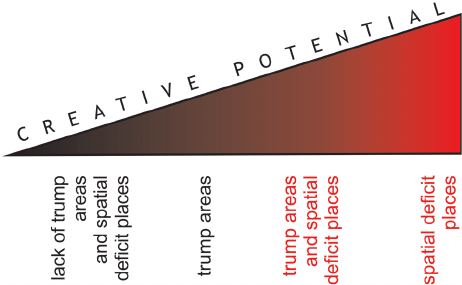
Designation of creative syntax as a tool for revitalizing downtown area in spatial and socio-economic aspects 119
ed as posing the highest creativity development potential.
It is recommended to create community activating plac-
es within their boundaries in the context of functions and
t out.
The degree of creativity development potential within
the analysed downtown is the resultant of identication
and evaluation of trump and decit spaces (key compo-
nents of development opportunities). In accordance with
the adopted research methodology, the more decit spaces
there are, which pose opportunities for implementation of
desired development processes and activities, the higher
the creativity development potential is. The following rule
governed the selection process: spaces were qualied for
detailed analyses, provided that only decit spaces were
identied therein or provided that they encompassed both
trump and decit areas. Areas that contained no trump and
no decit spaces or that contained only trump spaces were
disqualied (Fig. 10).
The performed multi-criteria assessment has enabled
the author hereof to select decit spaces for temporary
creative use in accordance with the needs of the inhabi-
tants; in the opinion of the author, this is an important
aspect of social life revival. Furthermore, certain desired
development directions were formulated in the context
of utilization of trump spaces for the purpose of creative
syntax stimulating the revitalization of public spaces via
creativity, culture and art. Designated decit spaces may
be temporarily arranged and used for the satisfaction of
needs of local communities before they are reclaimed for
the purposes of investment projects, the commencement of
which may take several or even several dozen years, on the
condition that proper organizational and nancial support
is granted by the city or non-governmental organizations
(NGOs). Spaces characterized by the highest creativity
development potential may – if the space is appropriately
used – improve the quality of spatial oer and aect social
and economic revitalization of downtown.
According to the adopted methodology, homeostasis,
understood as the state of internal balance of social, cultur-
al and economic driving forces, is a material aspect of the
desired development direction. In this sense, development
and protection shall be respectively balanced and shall
underlie stimulating and inspiring characteristics derived
from decits.
Translated by
Barbara Marszałek Words24
Fig. 10. The scheme, which represents relationships
between the existence of trump and deficit spaces
and creativity development opportunities
in the analysed downtown areas of the researched cities
(elaborated by D. Pazder)
Il. 10. Schemat ilustrujący zależność między występowaniem
przestrzeni atutowych i deficytowych a możliwościami rozwojowymi
w zakresie kreatywności analizowanych przestrzeni w obrębie
śródmieść badanych miast (oprac. D. Pazder)
References
Doulliez, Jean. Caractérisation architecturale et système de critères.
Université de Liège, 1983.
European Commission. “Cultural and Creative Cities Monitor.” Ac-
cessed March 20, 2024, at https://composite-indicators.jrc.ec.euro-
pa.eu/cultural-creative-cities-monitor/.
Green, Bournes. “Przedmowa. Trajektoria przemian urbanistycznych.” In
Charles Landry, Kreatywne miasto. Zestaw narzędzi dla miejskich inno
wa torów. Translated by Olga Siara. Narodowe Centrum Kultury, 2013.
Hillier, Bill, Adrian Leaman, Paul Stansall, and Michael Bedford. “Space
Syntax.” Environment and Planning B 3 (1976): 29–66.
Howkins, John. The Creative Economy. How people make money from
ideas. Penguin Books, 2013.
Hutter, Michael. “Experience goods.” In A Handbook of cultural eco-
nomics, edited by Ruth Towse. Edward Elgar Publishing, 2011.
Landry, Charles. Kreatywne miasto. Zestaw narzędzi dla miejskich inno
watorów. Translated by Olga Siara. Narodowe Centrum Kultury, 2013.
Narodowy Instytut Kultury. “Obserwatorium Kultury.” Accessed March
25, 2024, at https://www.nck.pl/badania/projekty-badawcze/obser -
wa torium-kultury.
Pazder, Dominika. “Applying the idea of creativity – creative syntax as
a tool of placemaking. Case study of the downtown area of Poznan
in Poland. Czasopismo Techniczne 116, no. 6 (2019): 63–80. https://
doi.org/10.4467/2353737XCT.19.061.10614.
Pazder, Dominika. Obszary kreatywności – creative syntax jako czyn-
nik ożywiania śródmieść. Wydawnictwo Politechniki Poznańskiej,
2018.
Pine, Joseph, and James Gilmore. “Welcome to the experience econo-
my.” Harvard Business Review, no. 4 (1998): 97–105.
Shokouhi, Mahshid. “Legible cities: The role of visual clues and path-
way conguration in legibility of cities.” In Proceedings 4
th
Interna-
tional Space Syntax Symposium, 2003.
“Space Syntax”. Accessed April 1, 2024, at www.spacesyntax.com.
Steinecke, André. “Turystyka w miastach historycznych. Szanse i ry-
zyko. Spojrzenie niemieckie.” In Dziedzictwo a turystyka, edited by
Jacek Purchla. Międzynarodowe Centrum Kultury, 1999.
Waitt, Gordon, and Chris Gibson. “Creative Small Cities: Rethinking the
creative economy in place.” Urban Studies 46, no. 5–6 (2009): 5, 6.
https://doi.org/10.1177/0042098009103862.
120 Dominika Pazder
Streszczenie
Wyznaczanie obszarów kreatywności – creative syntax – jako narzędzie ożywiania przestrzeni śródmiejskiej
w aspekcie przestrzennym i społeczno-ekonomicznym
W artykule poruszone zostały zagadnienia związane z rolą kreatywności w ożywianiu obszarów śródmiejskich. Autorka podjęła próbę zidentyko-
wania związków między rozwojem kreatywności a zachodzącymi w śródmieściu zmianami przestrzennospołecznymi. Kluczowym elementem pracy
jest badanie wyznaczonych przestrzennie za pomocą przyjętej autorskiej metody obszarów kreatywności (creative syntax) w celu zidentykowania ich
roli w kontekście pobudzenia aktywności społecznej, ożywiania przestrzeni śródmiejskiej, a także zapewnienia podstaw do rozwijania innowacyjnej
idei ekonomii doznań i gospodarki przeżyć. W badaniach skoncentrowano się na warstwie przestrzennej i znaczeniowej kreacji wysokiej jakości
i atrakcyjności przestrzeni publicznych śródmieścia. Zastosowano wielokryterialną autorską metodę badawczą ujmującą poruszaną problematykę
w aspektach: przestrzennokompozycyjnym, semantycznopercepcyjnym oraz społecznoekonomicznym.
Słowa kluczowe: kreatywność, atrakcyjność społecznoprzestrzenna, śródmieście, przestrzeń publiczna