2020
2(62)
DOI: 10.37190/arc200207
Introduction
Digital image processing techniques have been de-
veloping since the beginning of this century, resulting in
more and more uses for them. For documenting and ana-
lysing rock art heritage, two groups of techniques deserve
special attention. Both of them help to identify items that
are not visible to the naked eye.
The rst group are applications based on the transfor-
mation of a single digital image. Among them, ImageJ [1]
deserves special attention. This is an open-source Java ap-
plication commonly used by many rock art researchers. It
allows simple geometric transformations to be made (for
example, cropping, scaling, resizing and rotating, ipping
vertically or horizontally) as well as much more advanced
image enhancement (for example, smoothing, sharpening,
edge detection, median ltering, thresholding on grayscale
Jacek Kościuk*, Małgorzata Telesińska**, Maciej Nisztuk***,
Marta Pakowska****
Documentation of the most important petroglyphs
by structured light scanning and analysis
of the most damaged petroglyphs by vPTM and vRTI methods
Dokumentacja najważniejszych petroglifów
za pomocą skanowania światłem strukturalnym
oraz analiza najbardziej zniszczonych petroglifów metodami vPTM i vRTI
* ORCID: 0000-0003-0623-8071. Faculty of Architecture,
Wro cław University of Science and Technology, e-mail: jacek.kosciuk@
pwr.edu.pl
** ORCID: 0000-0002-1100-642X. Faculty of Architecture,
Wrocław University of Science and Technology.
*** ORCID: 0000-0001-6520-5128. Faculty of Architecture,
Wrocław University of Science and Technology.
**** ORCID: 0000-0003-0857-2700. Faculty of Architecture,
Wroc ław University of Science and Technology.
and RGB images, and adjusting the brightness and con-
trast of 8, 16 and 32-bit images) and colour processing (for
example, splitting 32-bit colour images into RGB or HSV
components, merging 8-bit components into a colour im-
age, converting RGB images to 8-bit indexed colour, and
applying pseudo-colour palettes to grayscale images) [2].
From the more than 500 more advanced plugins avail-
able for ImageJ, DStretch [3] stands out. It is particularly
useful for documenting and analysing rock art. To rein-
force hue dierences of neighbouring pixels, Dstretch
algorithms use decorrelation stretch in the image colour
space and manipulate the hue and saturation of the image
[4]. ImageJ and the DStretch plugin are used extensively
in the documentation and analysis of rock paintings (par-
ticularly pictographs) and shallow rock engravings.
The second group of applications process series of im-
ages of the same object taken in dierent lighting condi-
tions. The rst algorithm of this type dedicated to docu ment
-
ing and analysing cultural heritage was surface reectance
transformation, developed in 2000 at Hew lett-Packard
Laboratories [5]. One year later, the same team from
Hewlett-Packard Laboratories developed another method
for picture enhancement – polynomial texture map ping
(PTM) [6]. Since then, surface reectance transformation
was further developed by Cultural Heritage Imaging and
today is commonly known as reectance transformation
imaging (RTI) [7]. In the traditional approach, as an
input,
44 Jacek Kościuk, Małgorzata Telesińska, Maciej Nisztuk, Marta Pakowska
RTI needs photos taken on the eld with the help of a tri-
pod, strong portable light source, two black balls that lat-
er on help to calculate angles of illumination, measuring
tape, and string. Usually, 40–90 images are collected, each
with dierent vertical and horizontal angles of illumina-
tion. This method is mainly used when the distinguish-
ing feature of an artefact is not the colour itself but rather
its spatial shape, or both. In this last case, an interesting
implementation of the method described here is the use
of RTI on images enhanced with DStretch algorithms [8].
Purpose of research
The presented research is part of the larger project
“Architectural examination and complex documentation
of Samaipata (Fuerte de Samaipata/Bolivia) site from the
World Heritage List”. One of the main aims of this pro-
ject was to document and analyse vanishing examples of
pre-Inca and Inca petroglyphs
1
.
Due to the rapid erosion of the rock at Samaipata, some
petroglyphs, still well recognisable two hundred years ago
[9], are now entirely unidentiable, and in some cases,
it is dicult to nd any traces of them. Thus, documen-
tation of the current condition of the rock itself and the
most important petroglyphs was an urgent priority. The
second goal of the research was to recognise and interpret
what is depicted on each petroglyph (as far as their current
1
Cf. J. Kościuk, M. Ziółkowski, B. Ćmielewski, D. Ulloa Vi-
daurre, Samaipata project – aim of the research, methodology, and meth-
ods of documentation, in the same issue of “Architectus”.
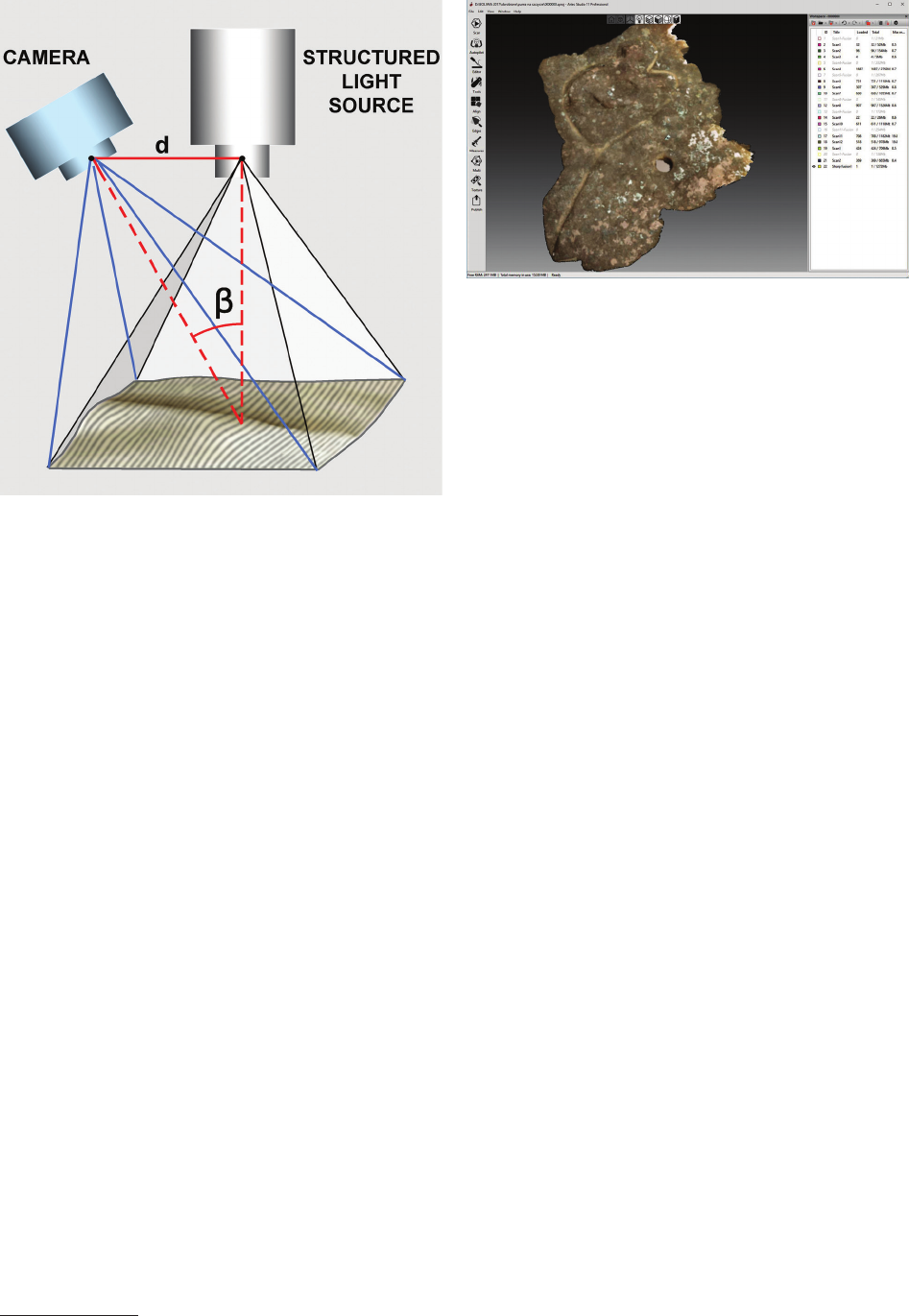
Fig. 2. Screenshot from the Artec Studio user interface
(elaborated by M. Pakowska)
Fig. 1. Schematic idea of structured light scanning
(d – the distance between the camera and the structured light source;
β – the angle between the axis of the camera and the axis
of the structured light source) (elaborated by M. Pakowska)
stage of preservation permitted). We were also aware that
for some of the most damaged petroglyphs, this could be
the last opportunity to document their quickly disappear-
ing traces. Therefore, the proper selection of equipment,
software, and analytical methods was fundamental to the
success of the entire project.
Methods, equipment, software,
and general workflow
Of the most advanced documentation methods availa-
ble to us, structured light scanning and short-range digital
photogrammetry were chosen as the most appropriate for
detailed documentation of the petroglyphs.
Structured light scanning
One of the methods selected to collect data on the shape
of the petroglyphs is structured light 3D scanning (Fig. 1).
Due to the portability of the equipment, as well as its
technical parameters, an Artec Eva scanner was used for
work. With an Artec Eva, the whole process of scanning
is controlled by a computer, or more precisely, the Artec
Studio software. It not only supports the scanner, but also
aids the post-production of data. During the work, the
Artec Eva scanner emits white strips of light that are de-
formed on the surface of the object according to its shape.
The camera records them on the matrix. Knowing the mu-
tual position of the light emitter and the camera and map-
ping the strips on the matrix makes it possible to calculate
the distance of the examined point from the scanner. This
results in getting the x, y, and z coordinates of each of
the points. This is therefore a triangulation method using
white light.
According to the manufacturer’s technical specica-
tions, the Artec Eva scanner oers 0.5 mm resolution of
scanning with 0.1 mm accuracy [10]. The recommended
optimal depth range for this scanner of between 40 and
100 cm was observed while registering to the common co-
ordinate system. The registration algorithm based on com-
paring both, the geometry of the surface and the texture.
It must be noted that this scanner, like virtually all
structured light scanners, is not particularly suitable for
Documentationofthemostimportantpetroglyphs / Dokumentacjanajważniejszychpetroglifów 45
Preliminary observations on 3D models
The red-brown colour of the Samaipata rock makes it
dicult to observe the delicate shadows cast by shallow,
strongly eroded petroglyphs. This applies to observations
in the eld as well as on textured virtual 3D models. The
numerous lichens, mosses, and algae covering the rock
cause additional diculty. They create multi-coloured
mosaics against which faint traces of petroglyphs and
even inscriptions carved by modern tourists are practical-
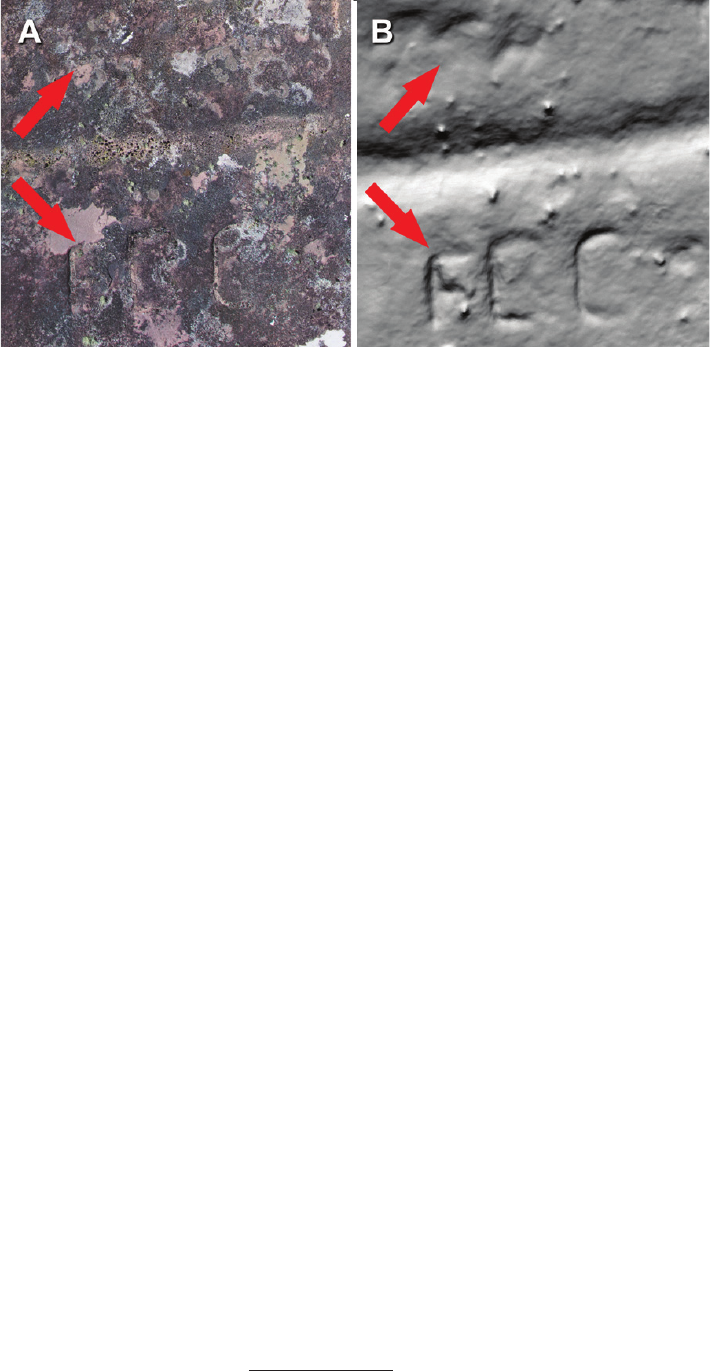
ly invisible. Observation of virtual 3D models in grayscale
with the texture preview turned o dramatically improved
the readability of all these traces (Fig. 3).
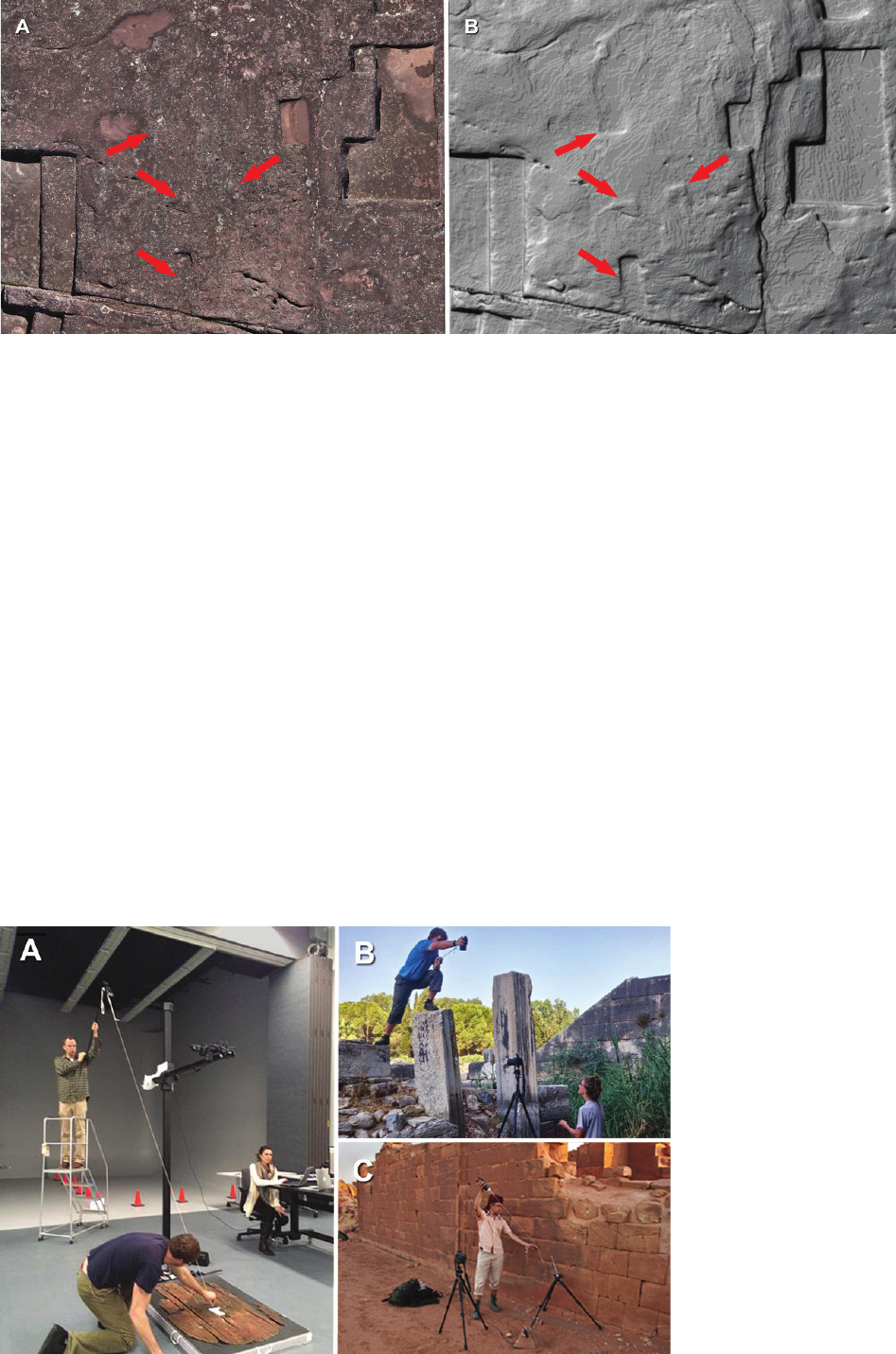
It is worth noting that similar results were obtained
from the observation of a much less detailed virtual 3D
model of the whole rock delivered from 3D terrestrial
scanning
2
. Additionally, in this case, turning o the tex-
ture preview showed many traces that were not visible
either in the eld or on the textured 3D model (Fig. 4).
The use of hill shading algorithms known from many
practical applications in remote sensing [12]–[14] turned
out to be particularly helpful in both cases. Further, previ-
ously invisible details were revealed when the lighting an-
gle changed. This gave us the idea of using PTM and RTI
techniques for detailed analysis of the most eroded petro-
glyphs. In our case, however, these techniques were used
on virtual models and not on real objects. Therefore, un-
like traditional applications, we will refer to them as vir-
tual PTM (vPTM) and virtual RTI (vRTI).
Using vPTM and vRTI
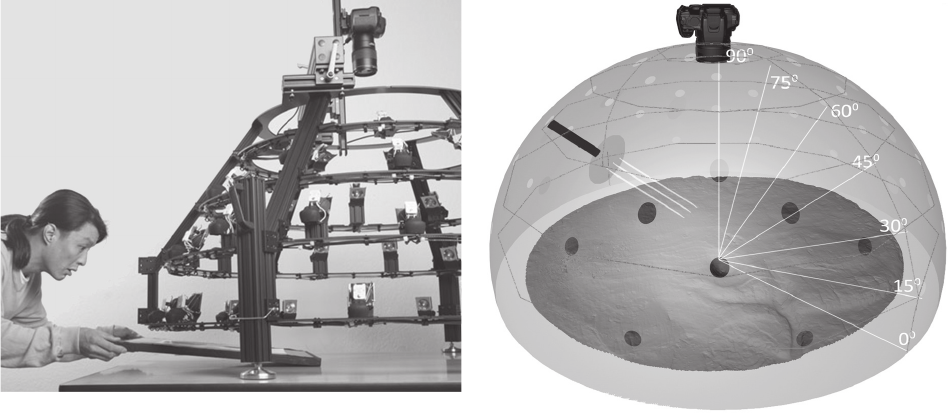
While traditional PTM and RTI techniques are rela-
tively easy to use in laboratory conditions where special
rigging provides lighting at predened angles, their use
outdoors for large objects poses many problems (Fig. 5).
One of the basic issues is taking a sucient number
of photos with the camera in a xed position and with
2
Cf. J. Kościuk, B. Ćmielewski, M. Telesińska, A. Kubicka, 3D
terrestrial laser scanning of El Fuerte de Samaipata, in the same issue
of “Architectus”.
outdoor use. Direct sunlight falling on the scanned object
competes too much with the light strips emitted by the
scanner. Scanning in such conditions is practically impos-
sible. This problem was overcome with the help of a big
tarpaulin sheet that shaded each petroglyph from the sun.
It also protected the scanner against gusts of wind par-
ticularly troublesome at noon. We noticed that gusts of
wind in the afternoon signicantly hindered scanning. Al-
though this nding has been challenged by the manufac-
turer’s representatives, it seems to us that diering density
streams of hot and cold air disturb the strips of light pro-
jected by the scanner.
The scan data collected in the eld were further pro-
cessed with dedicated software – Artec Studio Professional
(version 11, build 11.2.2.16) (Fig. 2). The nal results
were 3D mesh models with an average density of 7 trian-
gles/cm
2
. Documentation of four petroglyphs was created
this way. The size of the models when stored as *.obj les
ranged from 1500 to 3500 MB. The maximum resolution
of the accompanying texture les was 16 384 × 16 384
pixels.
Close-range photogrammetry
Close-range digital photogrammetry was used for the
largest petroglyphs. Digital photos were collected with
a Sony Alpha STL-A65 camera with an APS-C sensor
matrix of 24 megapixels. The Sony 18-55mm f/3.5-5.6
standard lens typically sold with a Sony Alpha camera
was attached. The camera was set to 400 ASA in aper-
ture priority mode, while the aperture itself was perma-
nently xed to f = 11. The focal length of the lens was set
to 18 mm and locked. We determined that these settings
were optimal when using this camera for digital photo-
grammetry. The problem of scaling individual photogram-
metric projects was solved by placing a few measuring
sticks (each 2 m long) around petroglyphs. Depending on
the size of the petroglyph, 100 to 500 photos were taken,
which were then processed by the AgiSoft PhotoScan Pro-
fessional software (version 1.4.4, build 6848) [11]. As in
the case of structured light scanning, the nal results were
3D mesh models stored together with the corresponding
texture as *.obj les.
Fig. 3. Impact of multi-coloured
texture on surface detail visibility:
A – textured 3D model;
B – same fragment
after turning texture off
(elaborated by J. Kościuk)
46 Jacek Kościuk, Małgorzata Telesińska, Maciej Nisztuk, Marta Pakowska
dierent angles of lighting. The horizontal and vertical
angles at which the object is photographed, as well as
the angles of illuminating light, must be determined quite
precisely. Hence, when using the traditional PTM or RTI
method in the eld, sophisticated procedures (Fig. 5) are
used, with inclinometers, strings, and black, shiny spheres
allowing the angle of incidence of light to be determined
at the post-processing phase. In addition, canvas sheets
are used to eliminate direct sunlight competing with arti-
cial directional lighting. The work is tedious, time-con-
suming, and requires a lot of equipment to be brought to
the site. However, since we have virtual 3D models, why
not use them for this purpose instead of taking pictures in
the eld? Computer visualisations of virtual 3D models
in pre-set lighting conditions and viewing angles evenly
covering the entire hemisphere around the object may be
equivalent to the lighting arrays used in laboratory condi-
tions (Figs. 6, 7).
Fig. 4. Impact of multi-coloured texture on surface detail visibility: A – textured 3D model; B – same fragment after turning texture off
(elaborated by J. Kościuk)
Fig. 5. Examples of using
the RTI technique
to document larger artefacts
(sources:
A – https://ipch.yale.edu/news/
rti-training-ipch-digitization-lab;
B, C – https://raan.hypotheses.
org/1326)
[accessed: 17.10.2018]
Virtual rig and computer visualisation of 3D models
The laboratory rules of creating photographs for PTM
were applied to a computer program, and the photos were
substituted with renderings prepared in Cinema 4D [15]
software (version R15.008). The scanned and compiled
model was moved to a virtual rig studio with 54 prede-
ned positions of light equally spread over the virtual
hemisphere at 15, 30, 45, 60, and 75 vertical degrees. On
top of the dome, a virtual camera was placed (Fig. 7).
For particularly big and detailed 3D models, the mesh
grid was decimated to 1 million triangles and 600 thou-
sand points. The mesh le size was optimised for the ren-
dering time of one frame as well as for sucient resolu-
tion of the resulting le. The physical dimensions of the
model had no relevance in the virtual environment.
The software provides the possibility to align the
lights to the normal plane of the object. The selected
Documentationofthemostimportantpetroglyphs / Dokumentacjanajważniejszychpetroglifów 47
type of lighting was a surface emitting parallel rays of
light. This eliminated the problem of a direct spotlight,
which can disturb the shape of the shading. Additional-
ly, a second diuse light was also used to illuminate the
scene evenly from all directions, assuring that details in
the deepest shadows were lit up. This issue was also dis-
cussed and solved during consultations with Piotr Wit-
kowski, who had pre viously used the traditional PTM and
RTI methods [16].
Adequate material parameters were also selected to
simulate light absorption and reection properties of the
sandstone rock. The chosen settings were neutral grey
(RGB: 232, 232, 232, 232), 80% diuse, and rough sur-
face. The environment lighting was switched o, and the
Phong rendering model was chosen. The aperture size was
set to f = 8, and exposure time for the virtual camera was
constant and equal to 1/30 sec. Thanks to these settings,
the problem of overexposure was eliminated. For ex-
tremely eroded petroglyphs, to highlight small dierences
on almost at surfaces, the 3D models were scaled twice
according to the vertical axis.
Near each rendered petroglyph 3D model, at least one
shiny black ball was placed. Its position did not change
for each of 54 rendered images, and later, one black ball
was used in the RTIBuilder software for computing the
horizontal and vertical angles of the light source. The user
marks the location of the shiny black balls, and the soft-
ware calculates light angles for each respective image.
All the visualisation calculations were executed on
a desktop computer equipped with an Intel
®
Core™ i7-
4790 CPU and 16 GB RAM, running a 64-bit operating
system. The graphics card was 2x NVIDIA GeForce
GTX 970 4 GB. The time to calculate rendering for each
scene depended on the lighting orientation and was vari-
able. The maximum timing for one frame was 30 sec for
an image 2000 × 2000 pixels at 200 dpi resolution. The total
time to generate 54 renderings of one 3D model was ap-
proximately 20 min. The rendering process was automated
Fig. 6. RTI lighting array used in the laboratory
(source: http://culturalheritageimaging.org/
What_We_Offer/Gear/Lighting_Array/) [accessed: 17.10.2018]
Fig. 7. Schematic idea of a “virtual rig”
(elaborated by M. Budlewska)
by applying the Winparrot (version 2.1.3) macro script,
which took care of automatically adjusting the light po-
sition for each of the 54 images, queuing all tasks, and
saving nal results.
Processing of images from the “virtual rig”
The series of renderings delivered from our “virtual rig”
were processed with RTIBuilder [17] (version 2.0.2). Based
on the input images from our virtual rig, the software cal-
culated data for light angles and stored it internally.
All the renderings were processed and combined into
a single le containing the mathematical model of the in-
spected surface. The RTIViewer (version 1.1) attached in
the software bundle [18] allows the object to be interac-
tively re-lit from any angle, permitting accurate examina-
tion of all its parts. In addition, it allows for various dis-
play enhancement (for PTM les: Diuse Gain, Specular
Enhancement, Normal Unsharp Masking, Image Unsharp
Masking, Luminance Unsharp Masking, Coecient Un-
sharp Masking, Static Multi Light, Dynamic Multi Light,
Normals Visualisation; for RTI les: Specular Enhance-
ment, Normals Visualisation) enabling details invisible in
the standard viewing mode to be revealed (Fig. 8). Thanks
to these various lighting and preview options, it was pos-
sible to examine the object in detail, especially with the
PTM method.
In order to use all the possibilities oered by both vis-
ualisation techniques, an RTIBuilder-compatible PTM
Fitter [19] plug-in from Hewlett-Packard was also used.
The PTM Fitter extends the functionality of the RTI soft-
ware and is operated via the host-software interface.
When the CGI input data are ready, they can be pro-
cessed into RTI or PTM images via the tting action.
Fitting is the process of matching together the lighting
data from input photos in order to produce a nal RTI/
PTM image. Each image type has a particular tting meth-
od. Workow with the RTIBuilder is straightforward.

48 Jacek Kościuk, Małgorzata Telesińska, Maciej Nisztuk, Marta Pakowska
Using a wizard-like interface, the software guides the
user through the following steps:
– Selecting input images from the folder data source.
The les should be named sequentially using only alphanu-
meric text without spaces and should be organised accord-
ing to the RTIBuilder software manual [20] suggestions;
– Choosing the RTI or PTM tting method;
– Pre-processing the input data set. The user selects
the black glossy ball model location on the images;
– When the computing of light source directions is
completed, the software is ready to process the series of
images and produce the nal RTI or PTM le.
Although the workow is relatively simple, it is neces-
sary to observe some basic rules regarding the preparation
of the les and the structure of the folders. The prepara-
tion process is explained in the software user manual [20].
The RTIBuilder provides two computational methods
of images processing: RTI and PTM. In order to create
PTM images, we used the PTM Fitter method from Hew-
lett-Packard. For RTI images, the Hemispheric Harmonics
(HSH) Fitter method was chosen. Each method has sev-
eral settings responsible for the accuracy of the computed
mathematical model. For PTM, two options are available:
LRGB (medium accuracy) and RGB (high accuracy). For
the RTI method, lighting mapping accuracy should be
set up – a higher numerical value of lighting mapping ac-
curacy creates a more accurate model at the cost of big-
ger les.
Based on experience gathered during this project, the
PTM method gives more options for displaying the nal
model le. According to RTIBuilder software developers
[21], RTI produces a more accurate model of the exam-
ined object at the cost of fewer model display options.
In the case of eroded bas-relief petroglyphs, we did not
nd any evidence that the quality of the produced RTI
images in corresponding display modes was higher than
in PTM images. It is possible that better results from the
RTI method could be revealed when using a higher quality
input, for example, images with higher colour depth or
with non-compressed le formats. As the input, we used
renderings saved in JPEG format with 24-bit colour depth
and compression level set to 95%.
During the project, we encountered some software
limitations. Apparently, tters are single-threaded and are
limited to a 2 GB RAM usage limit. A software crash can
occur when RAM usage exceeds 2 GB. This limits the
processing of images with a resolution above 4k pixels.
The RAM usage depends on the software settings and se-
lected method, with the RTI tter generally better han-
dling higher resolution input data. For example, we pro-
cessed RTI tter images with resolutions of 4000 × 4000
pixels and with third-level accuracy in 385 sec with a le
size of 411 MB. The PTM Fitter did not manage to nalise
the process with the 4k resolution images when the RGB
option was enabled.
Results and discussion
In total, using alternatively short-range digital photo-
grammetry and structured light scanning tools, 11 petro-
glyphs of varying sizes and dierent stages of preser-
vation were documented in detail. For many of them, it
was almost the last moment when their traces could still
be captured. However, in a few cases, despite using the
vPTM technique, it was already too late to unambiguously
reconstruct their original shape.
However, it should be borne in mind that only a small
group of petroglyphs was selected for this study – those
for which there was a theoretical chance that the applica-
tion of the methods proposed by us could give satisfac-
tory results. On the Samaipata rock, more than 200 other
places were identied where once there were undoubtedly
other glyphs (zoomorphic or geometrical), today com-
pletely indistinguishable.
Petroglyph from sector W06 – “Jaguar?”
As it is one of the best-preserved petroglyphs, we used
it to test various documentation methods. Structured light
scanning, TLS scanning, and short-range digital photo-
grammetry were used.
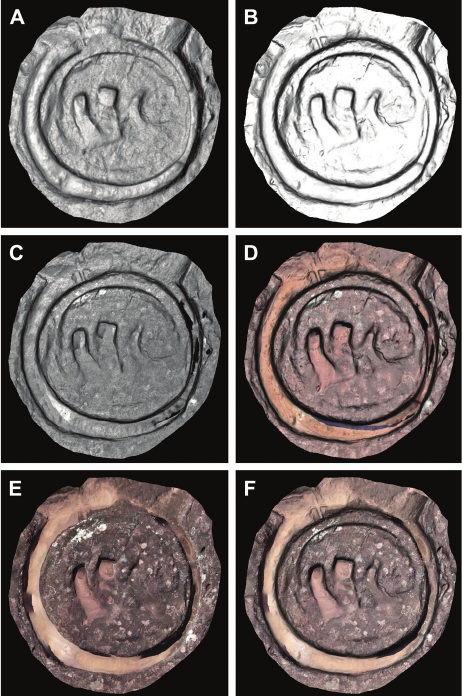
The gural representation of a sning feline is easy
to recognise, so there was no need to use PTM or RTI.
Instead, the possibility of using alternative methods to
visualise the results of 3D laser scanning and digital pho-
togrammetry were tested. The documentation made with
a structured light scanner (Fig. 9A), as theoretically the
most accurate, served as comparative material.
The petroglyph and its immediate surroundings were
scanned with a Leica P40 scanner from six positions with
distances from the centre of the gural representation
of 5 to 10 m. The scanning density was set to 6 mm @
10 m. Overlapping 3D point clouds guaranteed coverage
and points were measured every 3 mm in the worst case.
The results were presented in the visualisation mode that
Fig. 8. Examples of RTIViewer display modes of PTM files:
A – default; B – normal visualisation; C – specular enhancement;
D – static multi-light (elaborated by J. Kościuk)
Documentationofthemostimportantpetroglyphs / Dokumentacjanajważniejszychpetroglifów 49
highlighted all slopes (Fig. 9B), referred to in Leica Cy-
clone as “Cloud Silhouette” (CS). The results, although
not as detailed as in structured light scanning due to scan-
ning resolution, proved to be satisfactory. This method of
visualising the 3D point cloud was used to enhance the
legibility of subsequent analyses. The combination of the
CS with the standard visualisation mode of the 3D point
cloud (greyscale reection intensity) oered in Leica Cy-
clone turned out to be a better representation of all sur-
face details than the “Cloud Shaded” option implemented
by Leica (Fig. 9C). An analogous eect was obtained by
combining the CS with an RGB-coloured 3D point cloud
image (Fig. 9D).
Photogrammetric documentation consisting of 48 pho-
tos with resolutions of 24 million pixels each was com-
piled with the AgiSoft PhotoScan Professional software.
By applying a CS layer, a at orthoimage that was devoid
of spatial depth (Fig. 9E) obtained the third dimension
(Fig. 9F). This method proved to be particularly useful
when the high accuracy and sampling density guaranteed
by structured light scanners were not needed, and at the
same time, texture details and the high resolution of an
RGB image was important.
A detailed analysis of the obtained images indicated an
alternation of the earlier original petroglyph. The channel
surrounding the gure might have been a later addition
or at least have been recut. More clear images (especially
Figs. 9B, D), in which not only outlines but also details
are visible much better than in nature, also allowed to pro-
pose the identication of the feline as possibly a jaguar.
Petroglyph from sector W05 – “Puma(?)”
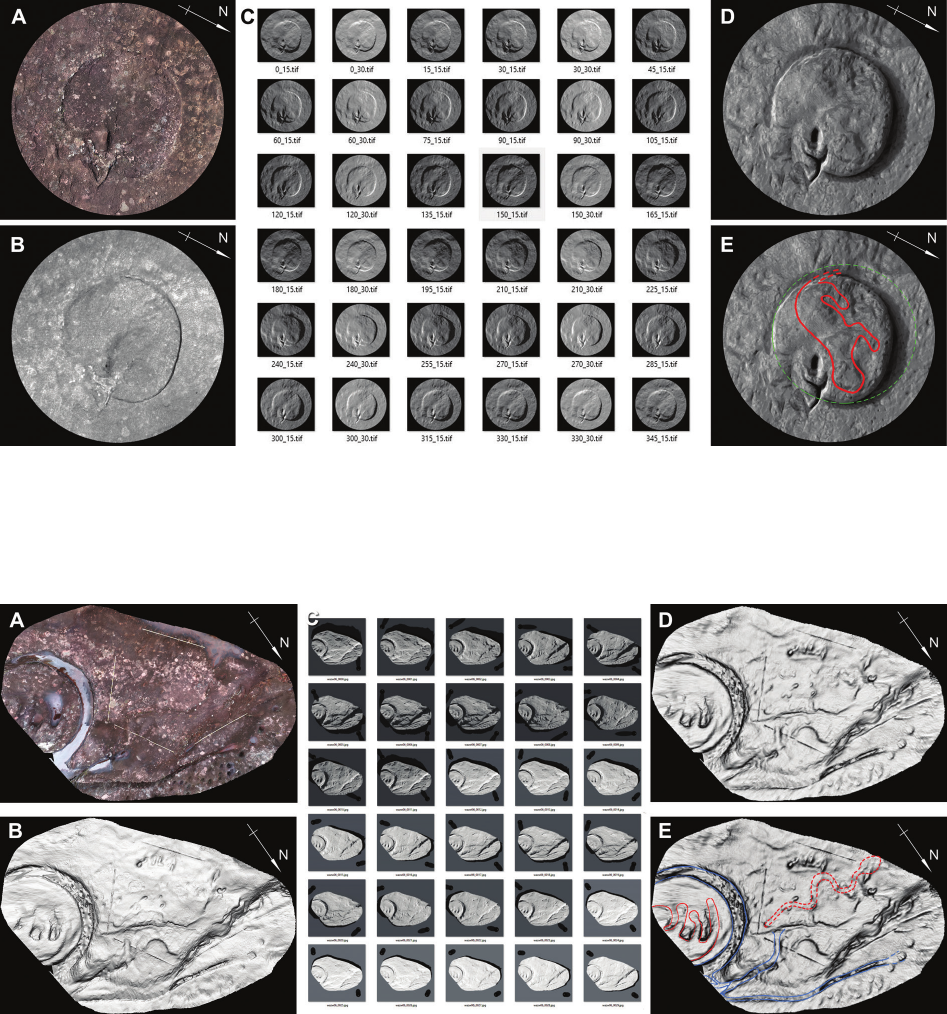
Only very weather-beaten traces of this gural petro-
glyph were extant. Earlier research described it as a rep-
resentation of a puma or jaguar [22], but today it is di-
cult to determine the shape of the gure, not to mention
the particular species.
To document the last traces that will soon be gone for-
ever, the petroglyph and its closest vicinity were scanned
with a structured light Artec Eva handheld scanner. Both
the analysis of the 3D model in the textured version (Fig.
10A) and the one without colour information (Fig. 10B)
did not reveal new details enabling the identication of
the petroglyph shape.
In this situation, the vPTM and vRTI techniques pro-
posed above were used. By putting together 54 renderings
from our virtual rig, each with a dierent lighting direc-
tion (Fig. 10C), it was possible to recognise a shape which
might suggest the representation of puma (Fig. 10D). How-
ever, this reconstruction (Fig. 10D) must be treated with
great caution since the surface is highly eroded and addi-
tionally disturbed by mosses and lichens. Further doubts
can be raised when comparing this reconstruction with
the drawing by Alcide d’Orbigny and Ponce from 1832
[23]. There, the schematic representation of the feline is
turned 180 degrees. Additionally, the map of the rock of
Samaipata drawn by Leo Pucher in 1936 [22] shows this
petroglyph in an inverted orientation. It is dicult to un-
equivocally determine the reliability of either drawing,
especially since, for example, rhea representations are
presented in a dierent orientation by both authors. The
presented reconstruction (Fig. 10E) should therefore be
treated only as one of the possible interpretations of the
traces that have survived to this day.
Fragments of the rough rock surface, especially around
the north-western edge of the oval, were detected on the
images obtained with the vPTM technique. This suggests
that the gure has been intentionally recut (and perhaps
also erased) by the latest occupants of the site. This obser-
vation may point to the pre-Inca origin of this petroglyph.
PetroglyphfromsectorW06–“CrawlingSnake”
This petroglyph, or more precisely, the place where it
once was, is one of the worst preserved among the ex-
amples analysed. It is even dicult to identify exactly
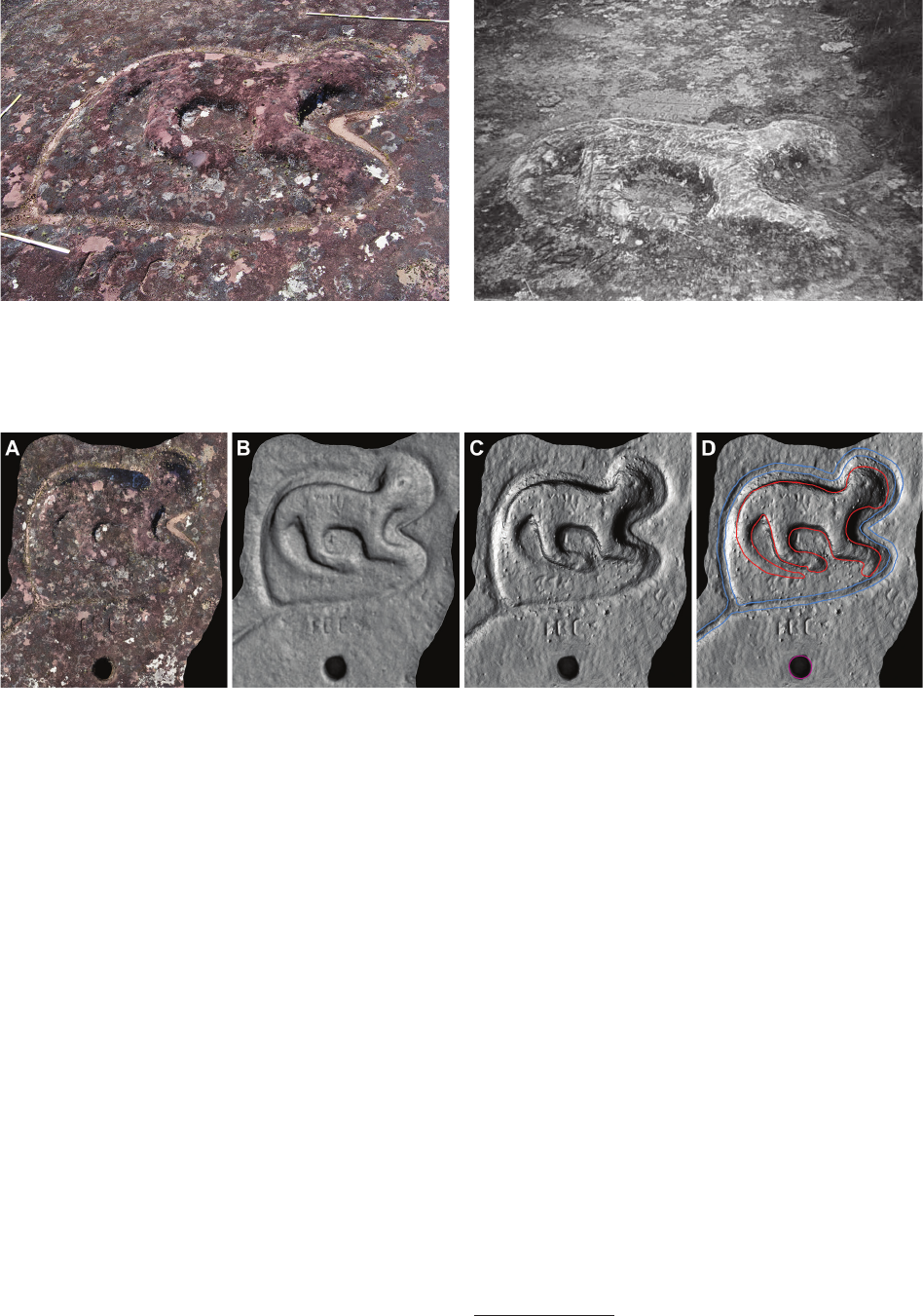
where to look for traces of it. Analysis of the drawings
by d’Orbigny and Pucher [22], [23] only indicates the
area north of the petroglyph probably depicting the jaguar
– more precisely, between it and the steep rock fault in
the north-west (Fig. 11A).
Fig. 9. Petroglyph from sector W06 – “Jaguar(?)”.
Comparison of documentation and methods of visualising results:
A – structured light scanning (image without texture);
B – TLS (slope gradient); C – TLS (reflection intensity and slope gradient);
D – TLS (RGB image and slope gradient); E – digital photogrammetry
(RGB image); F – digital photogrammetry (RGB image)
and TLS (slope gradient) (elaborated by J. Kościuk)
50 Jacek Kościuk, Małgorzata Telesińska, Maciej Nisztuk, Marta Pakowska
As the area where one should look for traces of the lost
petroglyph was much larger (approx. 5 × 10 m), structured
light laser scanning was replaced in this case by short-
range digital photogrammetry. Based on 74 photos, each
with a resolution of 24 million pixels, a 3D model was
built consisting of over 15 million triangles (Fig. 11B).
Using vPTM and vRTI techniques (Fig. 11D), we were
able again to identify at most a vague outline of a snake
crawling towards the north-west (Fig. 11D). However, ac-
cording to some earlier investigators, this petroglyph was
interpreted a coiled snake representation – at least, that is
how Leo Pucher depicts it on his map of Samaipata rock
from 1936 [22]. We did not nd any archival photographs
that indisputably conrm that there was a representation of
a coiled snake, rather the opposite – Alcide d’Orbigny on
the drawing from 1834 [23] shows, although schematical-
ly, the snake crawling towards the north-west. This might
be perhaps a random coincidence that does not prejudge
the correctness of our reconstruction. The preserved traces
are so indistinguishable that they also allow for several
other interpretations, but in the light of collected data, this
one seems to be the most reliable.
Fig. 10. The “Puma(?)” petroglyph from sector W05:
A – RGB image (photo by J. Kościuk); B – greyscale image without texture information (elaborated by M. Pakowska);
C – samples of renderings with different lighting directions (elaborated by M. Budlewska);
D – multidirectional light vPTM image (elaborated by M. Nisztuk); E – tentative interpretation (elaborated by J. Kościuk)
Fig. 11. Petroglyph from sector W06 interpreted as “Crawling Snake”:
A – RGB image (photo by J. Kościuk); B – greyscale image without texture information (elaborated by M. Pakowska);
C – samples of renderings with different lighting directions (elaborated by M. Budlewska);
D – multidirectional light vPTM image (elaborated by M. Nisztuk); E – tentative interpretation (elaborated by J. Kościuk)
Documentationofthemostimportantpetroglyphs / Dokumentacjanajważniejszychpetroglifów 51
Petroglyph from sector W09 – “Feline (Puma?)”
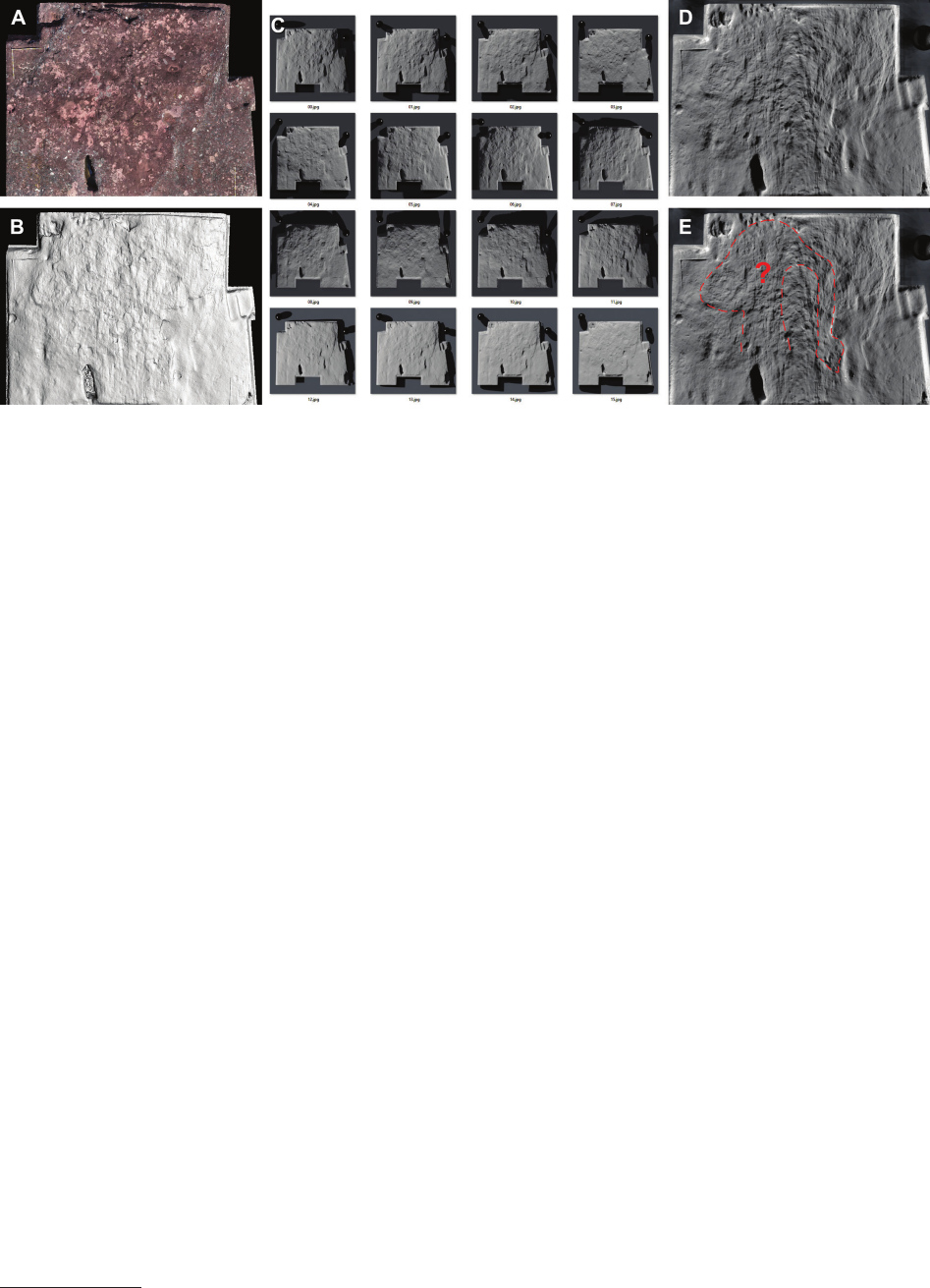
This petroglyph is the best preserved in the whole an-
alysed group. However, comparing its current condition
(Fig. 12) with photos published by Hermann Trimborn [22],
it can be seen that the surface has eroded signicantly in
the last 50 years. Numerous inscriptions scratched by tour-
ists on the surface of this petroglyph (Fig. 13), which were
still clearly visible 50 years ago, are now barely noticeable.
Given the rapidly progressing erosion, it was decided,
even though the puma drawing is still distinguishable, to
scan the entire petroglyph using a structured light scanner
in the highest resolution available to us (Figs. 14A, B). In
the future, this may be the only source documenting this
petroglyph.
In addition, vPTM analyses were compiled. The few
inscriptions that are still legible (Fig. 14C) clearly show
how far the surface of the petroglyph has eroded relative
to the situation of the late 1960s.
The representation of the puma is carved in bas-relief,
and a at water channel surrounds it (Fig. 14D). A round-
ed hole (ca. 25 cm in diameter) drilled into the rock in
front of this petroglyph might have been used as an of-
fering hole. It seems that the petroglyph was made at the
same time as the platform arranged around it. Observation
of the sculpting sequence of the surrounding platforms
leads to the conclusion that puma representation could be
attributed to the period of Inca occupation of the site
3
.
Petroglyph from sector W09 – “Rhea (Ñandú)”
This petroglyph, known nowadays only from historical
sources, is an entirely dierent case. One can easily iden-
tify the place where this petroglyph was once located, but
the gure is completely indistinguishable.
The size of the area (ca. 6 × 7 m) excluded structured
light scanning, so again digital close-range photogramme-
try was used. More than 300 photos resulted in a dense
cloud of ca. 21 million points, which was reduced to a 3D
model of 4 million faces (triangles). It proved to be fully
sucient to reproduce all the details of the examined sur-
face (Fig. 15A). An orthoimage of 0.5 mm/pixel resolution
also met our requirements (Fig. 15B).
However, attempts to nd any traces of the rhea (ñandú)
ended only with a suggestion about the size and orienta-
3
J. Kościuk, G. Oreci, M. Ziółkowski, A. Kubicka, R. Muñóz
Risolazo, Description and analysis of El Fuerte de Samaipata in the
lightofnewresearch,and a proposaloftherelative chronologyofits
main elements, in the same issue of “Architectus”.
Fig. 12. The “Puma(?)” petroglyph from sector W09.
Condition as in July 2016
(photo by J. Kościuk)
Fig. 13. The “Puma(?)” petroglyph from sector W09.
Condition as in 1967
(source: [22])
Fig. 14. Petroglyph from sector W09 – “Puma(?)”:
A – RGB image (photo by J. Kościuk); B – greyscale image without texture information (elaborated by M. Pakowska);
C – vPTM image (multidirectional light) (elaborated by M. Nisztuk); D – tentative interpretation (elaborated by J. Kościuk)
52 Jacek Kościuk, Małgorzata Telesińska, Maciej Nisztuk, Marta Pakowska
tion of the gure. Generally, it agrees with the schemat-
ic “icon” on d’Orbigny’s drawing [23]. There, however,
the gure is shown in an entirely dierent manner than
all other petroglyphs, which, as we can see today, are of
bas-relief type. Can this dierence in the way of depicting
the rhea (ñandú) on d’Orbigny’s drawing mean that it was
executed as a sunken relief? This dierence might be one
of the reasons that it has disappeared utterly
4
, or it might
have been intentionally hammered out.
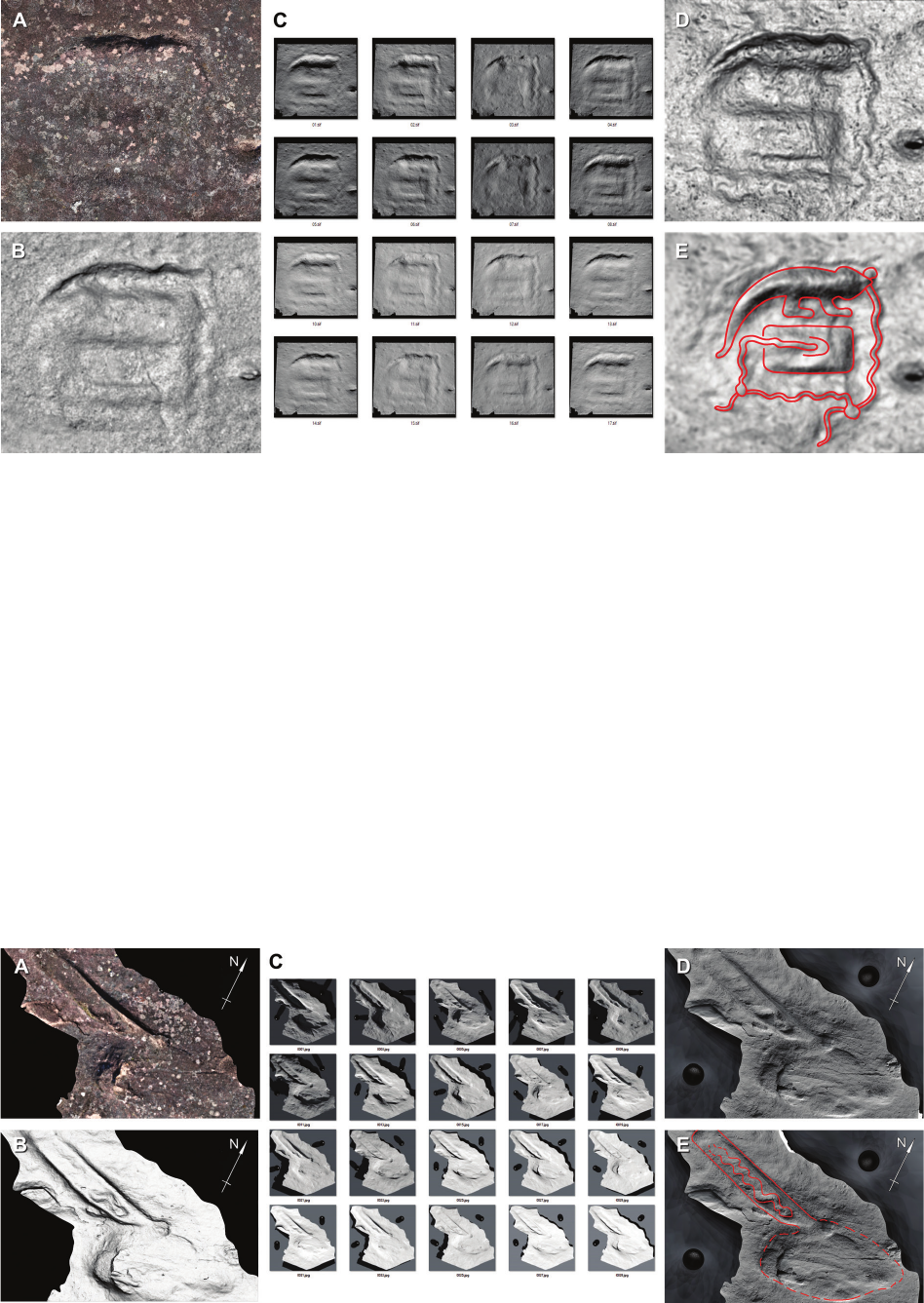
Using vPTM and vRTI techniques, we ended up with
a problematic reconstruction (Fig. 15E). Even attempts to
scale the virtual 3D model twice alongside the z-axis did
not bring clear results. One must admit at this point, that
the reconstruction proposed there (with head down) has
no analogies in pre-Columbian art in the whole region, so
it can not be treated as a right interpretation. It should be
also emphasized that this reconstruction is based solely
on the technical analysis of preserved traces with no ref-
erence to possible analogies in Inca or pre-Inca iconog-
raphy. Further iconographical studies may still indicate
another direction of interpretation, but this interesting ex-
ample of pre-Columbian rock art is anyhow lost forever
5
.
Petroglyph from sector W10
–“Snake-catchingAnimal”
Small bulges on the surface of the rock in the central
part of the W10 sector suggested that this could be another
very blurred petroglyph (Fig. 16A). Structured light scan-
4
Marta Pakowska brought this possibility to our attention.
5
For alternative reconstruction cf. J. Kościuk, G. Oreci, M. Ziół-
kowski, A. Kubicka, R. Muñóz Risolazo, Description and analysis of
El Fuerte de Samaipata in the light of new research,and a proposal
of the relative chronology of its main elements, in the same issue of
“
Architectus”.
ning conrmed this assumption, but still, a clear interpre-
tation was not possible (Fig. 16B).
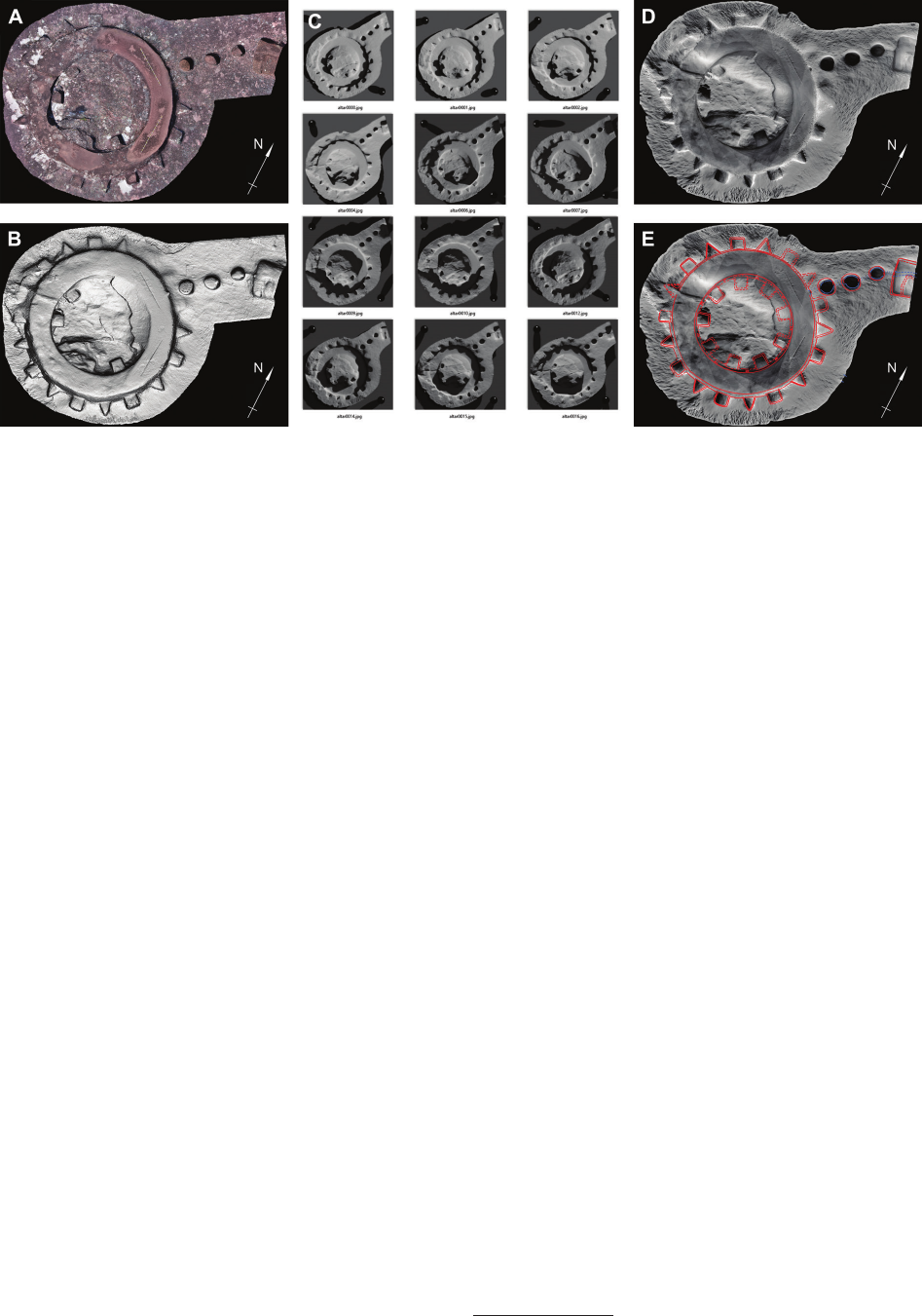
It was only after scaling the virtual 3D model two times
along the z-axis and using vPTM techniques that a more
explicit identication was made – an animal catching
a snake’s head with its snout (Figs. 16D, E). The second
snake is grabbing the tail of the rst one, and the third
snake catches the tail of the second snake. This compli-
cated layout of four interacting animals covers approxi-
mately 1 m sq. It has no other parallels on the Samaipata
rock. Additionally, the representation of the snake-catcher
looks untypical. It does not resemble pumas or jaguars
known from other petroglyphs in Samaipata. Attempts
to identify the species lead towards the white-nosed coati
(lat.: Nasua narica; local names: pizote, antoon, tejón), the
only similar animal from this part of South America, which
are known as snake catchers [24]. Consultations with spe-
cialists from the Wroclaw Zoological Garden have not
ruled out such a possibility. Further studies on possible
analogies in the Inca and pre-Inca rock art of Bolivia may
conrm or exclude this preliminary interpretation.
Thanks to the exact virtual copy of this petroglyph,
even if it erodes completely, additional research and iden-
tication attempts will be still possible.
Petroglyph from sector W10
–“MeanderingSnake”
About 2 m northwest of the above-described petro-
glyph, an elongated twisting shape was observed at the
bottom of the 25 cm wide channel draining rainwater
down the slope (Fig. 17A). Due to the progressing ero-
sion, additionally intensied by the rainwater owing
abundantly here, structured light scanning was used at
the highest resolution available to us for this petroglyph
(Fig. 17B).
Fig. 15. Petroglyph from sector W09 interpreted as “Rhea (Ñandú)”:
A – RGB image (photo by J. Kościuk); B – greyscale image without texture information (elaborated by M. Pakowska);
C – samples of renderings with different lighting directions (elaborated by M. Budlewska);
D – multidirectional light vPTM image (elaborated by M. Nisztuk); E – tentative interpretation (elaborated by J. Kościuk)
Documentationofthemostimportantpetroglyphs / Dokumentacjanajważniejszychpetroglifów 53
After computing the vPTM analysis (Fig. 17C), a clear
image of a snake meandering up the slope in the middle of
the channel was shown (Figs. 17D, E).
The degree of erosion, proximity to the petroglyph rep-
resenting a snake-catching animal, and the similar way of
carving suggest that both petroglyphs form one panel.
The iconography of the crawling snake is often found
in both Inca and pre-Inca rock art. On the Samaipata rock,
this type of glyph occurs in three other places: in sector
W05, along a long ramp in sector S12 (this petroglyph is
over 20 m long), and in the channel draining water from
the pool in sector N10.
Petroglyph from sector C05
–“ChoirofthePriests”or“Altar”
On the central part of sector C05, one of the most im-
portant sculpted parts of the Samaipata rock can be iden-
tied: it is what was called the “Choir of the Priests” or
the “Altar”.
Due to the large size of this sculpture (roughly 9 × 13 m
when measured together with the leading north-east water
channel), digital short-range photogrammetry was used
as the documentation method. Based on 83 photos, each
with a resolution of 24 million pixels, a 3D point cloud of
Fig. 16. Petroglyph from sector W10 – “Snake-catching Animal”:
A – RGB image (photo by J. Kościuk); B – greyscale image without texture information (elaborated by M. Pakowska);
C – samples of renderings with different lighting directions (elaborated by M. Budlewska);
D – multidirectional light vPTM image (elaborated by M. Nisztuk); E – tentative interpretation (elaborated by J. Kościuk)
Fig. 17. Petroglyph from sector W10 – “Meandering Snake”:
A – RGB image (photo by J. Kościuk); B – greyscale image without texture information (elaborated by M. Pakowska);
C – samples of renderings with different lighting directions (elaborated by M. Budlewska);
D – multidirectional light vPTM image (elaborated by M. Nisztuk); E – tentative interpretation (elaborated by J. Kościuk)
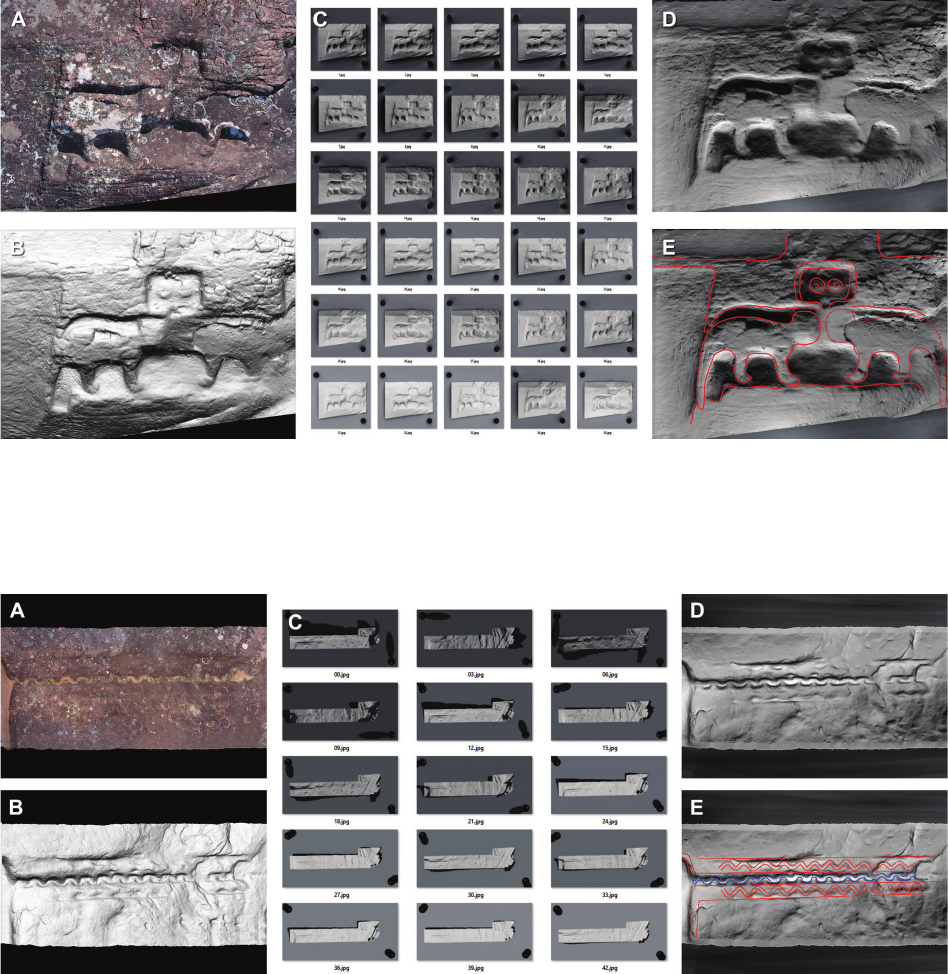
54 Jacek Kościuk, Małgorzata Telesińska, Maciej Nisztuk, Marta Pakowska
over 15 million instances was built. Due to the size of the
le, when converting to the mesh model, it was decimat-
ed to 3.5 million triangles (Figs. 18A, B). This resolution
proved to be sucient for interpretation of its main parts.
Special attention was devoted to the central part sur-
rounded by a nearly 1-meter wide water-channel. Beside
nine rectangular “seats”, most of them very eroded, trac-
es of small (ca. 14 × 14 cm) double-recessed niches were
found on the vertical surfaces between sitting places.
Further studies included vPTM analysis (Fig. 18C) in the
hope that the top of the central part would reveal traces
of another petroglyph (Fig. 18D). Unfortunately, no such
traces were observed. Even if such a petroglyph exist-
ed here once, it has been completely eroded or has been
intentionally damaged. Additionally, no indication was
found for Giuseppe Oreci’s suggestion of a representa-
tion of a feline preceding a circular channel with radiating
triangular and rectangular niches. This does not exclude
the hypothesis made by Oreci based on his observations
in the eld. At most, it can be said that the use of vPTM
did not conrm his direct observations. However, vPTM
analyses yielded data that allow for a more detailed recon-
struction of all rectangular and triangular niches.
Petroglyph from sector S14
– “Double Puma(?)”
On the southern slope of the Samaipata rock, in a very
prominent position, two images of felines (possibly pu-
mas?) attract the attention of many visitors. The animals
are facing each other, and a narrow gap is left between
their heads. Only the animal on the western side is pre-
served in full. Of the other one, only the general outline
remains. The main part of its torso has vanished and traces
of its head are no longer visible.
Since the continued existence of this petroglyph is
endangered by both the expanding lithic surface and the
strongly inclined slope, digital photogrammetry and struc-
tured light scanning were used to document its current
state. Due to the very dicult access, only 34 photos were
collected. They were, however, sucient to produce ortho-
images of 1 mm/pixel resolution (Fig. 19A) and a detailed
3D mesh model consisting of 8 million triangles. The last,
when inspected with textural information switched o
(Fig. 19B), revealed interesting details. A small rectangu-
lar depression (ca. 45 × 70 cm) above the heads of both
animals might have been meant as a reservoir from which
water owed between the two pumas below.
More detailed structured light scanning shows two
circular protrusions inside this depression (Fig. 19D).
Small cavities in the centre of each protrusion were also
detected. The whole, together with the water drain locat-
ed below, looks a bit like a stylised mask of a mythical
creature.
Since no traces have been preserved to undoubtedly re-
construct the head of the eastern animal, our interpretation
reproduces the outline of the feline preserved next to it
(Fig. 19E).
PetroglyphfromsectorN10–“TripleSnake”
This petroglyph is a very elaborate, nearly 4 m-long
channel through which water ows to the east from a set
of three cascading reservoirs located up the hill on the
western side
6
.
6
Cf. J. Kościuk, G. Oreci, M. Ziółkowski, A. Kubicka, R. Muñóz
Risolazo, Description and analysis of El Fuerte de Samaipata in the
lightofnewresearch,and a proposaloftherelative chronologyofits
main elements, in the same issue of “Architectus”.
Fig. 18. The “Altar” petroglyph from sector C05:
A – RGB image (photo by J. Kościuk); B – greyscale image without texture information (elaborated by M. Pakowska);
C – samples of renderings with different lighting directions (elaborated by M. Budlewska);
D – multidirectional light vPTM image (elaborated by M. Nisztuk); E – tentative interpretation (elaborated by J. Kościuk)
Documentationofthemostimportantpetroglyphs / Dokumentacjanajważniejszychpetroglifów 55
The bottom of the channel has the form of a meander-
ing snake, although some details of its easternmost part
cannot be clearly seen. Two parallel shelves are also vis-
ible on both sides of this meandering channel, but their
edges are not easily identiable. The colourful mosaic of
lichen and algae covering the rock surface makes it very
dicult to observe this petroglyph directly in the eld
(Fig. 20A).
Since this site was lacking small details as well as high-
ly eroded areas, only close-range digital photogrammetry
was used as the documenting technique. More than 160
photos were shot to cover the area extending for a further
7 m to the east in the hope of nding traces of the contin-
uation of this canal. This resulted in a 3D cloud of 20 mil-
lion points, which was converted to a 30 million-triangle
mesh model (Fig. 20B).
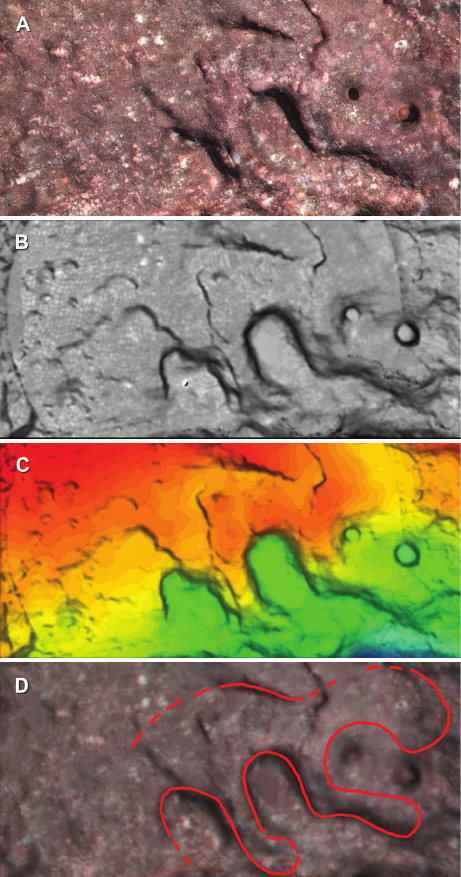
The 3D model did not demonstrate the existence of
a continuation of the meandering channel (Fig. 21D). In-
stead, it clearly dened the northern and southern edges
of the shelves on both sides of the channel. Further details
were observed on the vPTM image (Figs. 21C, D). On
both 25 cm-wide shelves, a similar meandering pattern
has been carved, but this time as a bas-relief (Fig. 21E).
This “Triple Snake” glyph with sunken relief and bas-
reliefs used together has no parallel on the Samaipata
rock.
Fig. 19. The “Double Puma(?)” petroglyph from sector S14:
A – RGB image (photo by J. Kościuk); B – greyscale image without texture information (elaborated by M. Pakowska);
C – samples of renderings with different lighting directions (elaborated by M. Budlewska);
D – multidirectional light vPTM image (elaborated by M. Nisztuk); E – tentative interpretation (elaborated by J. Kościuk)
Fig. 20. Petroglyph from sector N10 – “Triple Snake”:
A – RGB image (photo by J. Kościuk); B – greyscale image without texture information (elaborated by M. Pakowska);
C – samples of renderings with different lighting directions (elaborated by M. Budlewska);
D – multidirectional light vPTM image (elaborated by M. Nisztuk); E – tentative interpretation (elaborated by J. Kościuk)
56 Jacek Kościuk, Małgorzata Telesińska, Maciej Nisztuk, Marta Pakowska
Zoomorphic petroglyph from sector N10
Traces of this petroglyph were identied by Rolando
Marulanda [25]. Some irregularities of the surface of the
central terrace of this sector may suggest another zoomor-
phic representation, unfortunately in an advanced state of
erosion.
Unfortunately, this particular place was not recorded
by us with either detailed photogrammetry or structured
light scanning. The only data available for further inter-
pretation were those from the general photogrammetry
and TLS projects covering the entire site.
The last proved to be sucient to render interpretation
possible. Generally, TLS data are not particularly suitable
as a source for detailed 3D models reproducing all the nu-
ances of the surface. However, the mere observation of the
3D point cloud using dierent imaging methods proved
sucient for this task. Three dierent 3D point cloud vis-
ualisation modes were used in this case: RGB coloured,
greyscale representation of reection intensity, and an el-
evation map with hill shading (Figs. 21A–D). All of them
are available in Leica Cyclone as basic colour schemes for
point cloud representation.
Although our tentative interpretation (Fig. 21D) is
slightly dierent from the one proposed by Rolando Maru-
landa [25], it has conrmed that a zoomorphic petroglyph
could once have existed in this place. Its exact shape can
no longer be reproduced. At most, one can venture to say
that the petroglyph could represent an animal belonging to
the felidae family. However, a shadow of doubt remains
as to whether this is not the result of natural erosion of
heterogeneously stratied sandstone.
Conclusions and project limitations
The obtained results conrmed the correctness of the
assumption that with an accurate 3D artefact model, the
process of collecting photos at the dierent lighting an-
gles necessary for PTM and RTI techniques can be suc-
cessfully transferred from the physical environment to the
virtual space. The project also resulted in many indica-
tions as to the correct and eective application of all the
technologies used. The following discussion is divided
into three areas: documentation techniques, rendering im-
ages in a virtual environment, and the use of existing PTM
and RTI software.
In general, somewhat predictably, the outdoor use of
structured light scanners presents many technical prob-
lems. The main one is poor visibility of structured light
strips emitted by the scanner in daylight, and even more so
in full sunlight. Scanning after sunset would be a natural
solution, but for archaeological sites, this is usually not
authorised or involves obtaining special permits and em-
ploying additional personnel (inspectors, guards, techni-
cal employees). Additional problems arise when the scan-
ner and the associated laptop cannot be powered directly
from the network. If powered by batteries, both work with
much lower eciency, which signicantly hinders the
correct completion of the scan of the entire object.
As the experience gained during this project shows, in
most cases, structured light scanning can be replaced with
short-range digital photogrammetry. The key to success
is the use of a camera (full-frame cameras being highly
recommended) with a resolution above 16 million pixels
and a professional, xed, focal length lens that complies
with the basic principles of photography for digital pho-
togrammetry purposes. The latter include the following in
particular:
– The images should be as much as possible taken per-
pendicularly to the documented surface;
– The images must be sharp and devoid of reections;
– The camera should work in aperture priority mode
while the lens aperture should be permanently xed at the
value that will guarantee an optimal depth of eld (usually
f = 8÷11 – depending on lens model and dimensions of the
object);
Fig. 21. Zoomorphic petroglyph from sector N10.
3D cloud from TLS representations:
A – RGB image; B – reflection intensity in greyscale;
C – elevation map with hill shading;
D – tentative interpretation (elaborated by J. Kościuk)
Documentationofthemostimportantpetroglyphs / Dokumentacjanajważniejszychpetroglifów 57
– The focus should be permanently xed at a distance
that will guarantee sharpness for all the images at the giv-
en aperture size;
– To avoid the eect of vibrations, the shutter speed
should be high, so good lighting conditions are necessary
since raising the ASA value to high will result in grainy
images;
– There should be a minimum of 75% vertical and
horizontal overlap between adjacent images;
– Too many photos may result in a blurry and noisy 3D
model, so good planning of camera positions is advisable.
The additional benet of using the photogrammetric
method is exibility during the acquisition phase, which
enables data collection in places not directly accessible to
hand-held scanners.
When the 3D model of the inspected artefact is ready
(at this point the scanner or photogrammetry obtained
do not matter), the phase of rendering images in a vir-
tual lighting-array will start. The lesson we learned from
our virtual rig prototype includes the following observa-
tions:
– In some cases, the 54 predened lighting positions
of our virtual rig were not sucient, so an additional set
of rigs should be dened;
– In order to assure good reproduction of all details,
the script automating successive renderings should in-
clude adjusting the size of the frame according to the real
size and proportions of the 3D model (the “Triple Snake”
petroglyph is a good example where the rendered object
occupied less than 50% of the image);
– More studies are necessary to establish light de-
nitions and material properties optimal for the proposed
vRTI and vPTM techniques.
Further studies will show if the proposed workow is
also adequate for documenting and analysing artefacts
other than bas-relief petroglyphs.
References /Bibliografia
[1] http://rsb.info.nih.gov/ij/index.html [accessed: 15.07.2019].
[2] https://imagej.nih.gov/ij/features.html [accessed: 19.07.2019].
[3] www.dstretch.com [accessed: 11.07.2019].
[4] Harman J., DStretchAlgorithm Description, http://www.dstretch.
com/Algorithm Description.html [accessed: 3.07.2019].
[5] Malzbender T., Gelb D., Wolters H., Zuckerman B., Enhancement of
ShapePerceptionbySurfaceReectanceTransformation, “Hewlett-
Packard Technical Report 2000-38R1”, https://www.hpl.hp.com/
techreports/2000/HPL-2000-38R1.pdf [accessed: 17.08.2019].
[6] Malzbender T., Gelb D., Wolters H., Polynomial Texture Maps,
“Hewlett-Packard Technical Report 2001-33 (R.1)”, 16.05.2001,
http://www.hpl.hp.com/ptm [accessed: 17.08.2019].
[7] ReectanceTransformationImaging(RTI), http://culturalheritage-
imaging.org/Technologies/RTI/index.html [accessed: 17.08.2019].
[8] Witkowski P., Chyla J.M., Ejsmond W., Combination of RTIand
decorrelation – an approach to the examination of badly preserved
rockinscriptionsandrockartatGebelein(Egypt), [in:] S. Campa-
na, R. Scopigno, G. Carpentiero, M. Cirillo (eds.), CAA2015:Keep
the revolution going. Proceedings of the 43rd annual Conference
onComputerApplicationsandQuantitativeMethodsinArchaeol-
ogy, Archaeopress Archaeology, Oxford 2016, 939–944.
[9] D’Orbigny A., ViajealaAméricameridional(realizadode1826
a1833), Vol. 4, 1466, Buenos Aires 1945.
[10] Technical specication, Eva, https://www.artec3d.com/portable-
3d-scanners/artec-eva-v2#specication [accessed: 19.08.2019].
[11] Agisoft Photoscan professional edition, https://www.agisoft.com/
features/professional-edition/ [accessed: 31.02.2019].
[12]
Horn B.K., Hillshadingandthereectancemap, “Proceedings of the
IEEE” 1981, Vol. 69, Iss. 1, 14–47, doi: 10.1109/PROC. 1981.11918.
[13] Kennelly P.J., Hill-Shading Techniques to Enhance Terrain Maps,
2009, https://pdfs.semanticscholar.org/26fc/7b5fbad0e3692d2040b
59530add6d87215d3.pdf?_ga=2.140942640.329251785.1567283612-
1142592307.1532500819 [accessed: 18.08.2019].
[14] Kennelly P.J., Terrain maps displaying hill-shading with curva-
ture, “Geomorphology” 2008, Vol. 102, Iss. 3–4, 567–577, doi:
10.1016/j.geomorph.2008.05.046.
[15] https://www.maxon.net/en/products/cinema-4d/overview/ [ac-
cessed: 11.07.2019].
[16] Witkowski P., Polkowski P., Reectance transformation imaging
about a photographic method for documentation and analysis of
historical artefacts, “Muzealnictwo” 2018, Vol. 59, 54–62.
[17] CulturalHeritageImaging,ReectanceTransformationImaging.
Guide to Highlight Image Processing, Version 1.4., 2013, http://
CulturalHeritageImaging.org/downloads/ [accessed: 8.08.2019].
[18] CulturalHeritageImaging,ReectanceTransformationImaging.
GuidetoRTIViewer,Version1.1., 2013, http://CulturalHeritageIm-
aging.org/downloads/ [accessed: 8.08.2019].
[19] HP Labs, PTM Fitter, 2001, https://www.dropbox.com/sh/jfsy0l-
hxu6zv4i4/AADJpq6E_GJmNw_s5C8r94CVa?dl=0 [accessed:
8.08.2019].
[20] CulturalHeritageImaging,ReectanceTransformationImaging.
Guide to Highlight Image Processing, Version 1.4., 2013, http://
CulturalHeritageImaging.org/downloads/ [accessed: 8.08.2019].
[21] Graichen T., RTI–accuracytests, 2019, http://www.tgraichen.de/
?page_id=542 [accessed: 16.08.2019].
[22] Trimborn H., Der skulptierte Berg von Samaipata, “Archäolo gi-
sche Studien in den Kordilleren Boliviens”, Bd. 3, “Baessler Archiv,
Beiträge zur Völkerkunde” 1967, NF 5.
[23] Ponce Sanginés C., Alcidesd’Orbignyysuviajea Samaipataen
1832, [in:] R.D. Arze Aguirre (dir.), El naturalista francés, Al-
cide Dessaline d’Orbigny en la visión de los bolivianos, Institut
Français d’Études Andines, Plural editores, Lima–La Paz 2002
[1975], 307–315.
[24] https://en.m.wikipedia.org/wiki/White-nosed_coati [accessed:
15.03.2019].
[25] Marulanda R., LarocaesculpidadelFuertedeSamaipata:elemen-
tosdediscusiónparaunenfoqueinterpretativo, [in:] A. Meyers,
I. Combès (comp.), ElFuertedeSamaipata.Estudiosarqueológi-
cos, Biblioteca del Museo de Historia, Universidad Autónoma Ga-
briel René Moreno, Santa Cruz de la Sierra 2015, 34–51.
Acknowledgements /Podziękowania
Thepresentedworkis a partof the research sponsored bythe grant given
totheWrocławUniversityofScienceandTechnologybythePolishNa-
tional Science Centre (grant No. 2014/15/B/HS2/01108). Additionally,
themunicipalityofSamaipata,representedbyMayorFalvioLópesEs-
calera, contributed to this research by providing the accommodation
duringtheeldworkinJuneandJuly2016,aswellasinJuly2017.The
MinistryofCultureandTourismofBoliviakindlygrantedallnecessary
permits(UDAMNo.014/2016;UDAMNo.060/2017).Theresearchwas
conductedinclosecooperationwiththeCentreforPre-ColumbianStud-
iesoftheUniversityofWarsawinCusco.
58 Jacek Kościuk, Małgorzata Telesińska, Maciej Nisztuk, Marta Pakowska
Abstract
The case being studied is one of Bolivia’s most important monuments – El Fuerte de Samaipata, a UNESCO World Heritage Site. This paper pro-
poses a new workow for the two most important aspects of studies on cultural heritage – detailed documentation and analysis. The former includes
the well-known techniques of digital photogrammetry and structured light scanning. The latter comprises polynomial texture mapping (PTM) and
reectance transformation imaging (RTI), both of which have been used since the beginning of this century. The novelty proposed by the authors is
the transfer of part of the data collection process from the physical environment to the virtual space.
Despite some technical problems, by eliminating the tedious and time-consuming process of shooting photos in the eld using specic lighting
angles, this new workow proved to be very ecient, particularly in documenting and interpreting badly preserved examples of bas-relief rock art.
Key words: Samaipata, rock art, UNESCO World Heritage, PTM and RTI, 3D scanning
Streszczenie
El Fuerte de Samaipata to jeden z najważniejszych zabytków Boliwii wpisanych na Listę Światowego Dziedzictwa UNESCO. W artykule przedsta-
wiono dwa sposoby dokumentacji, szczególnie istotne zarówno dla badań, jak i ochrony dziedzictwa kulturowego. Pierwszy obejmuje dobrze znane
techniki cyfrowej fotogrametrii i skanowania światłem strukturalnym. Drugi dotyczy zastosowania technik polynomial texture mapping (PTM) oraz
reectance transformation imaging (RTI). Obie techniki są wprawdzie stosowane już od początku tego wieku, ale nowością zaproponowaną przez
autorów jest przeniesienie części procesu zbierania danych ze środowiska zycznego do przestrzeni wirtualnej.
Mimo pewnych problemów technicznych, dzięki wyeliminowaniu żmudnego i czasochłonnego etapu fotografowania w terenie przy użyciu dokład-
nie zdeniowanych kątów oświetlenia, zaproponowana metoda okazała się bardzo wydajna, szczególnie w dokumentowaniu i interpretacji silnie
zniszczonych przykładów rytów naskalnych.
Słowa kluczowe: Samaipata, sztuka naskalna, Lista Światowego Dziedzictwa UNESCO, PTM i RTI, skanowanie 3D