
2025
3(83)
Dominika Cenda*, Justyna Kobylarczyk**,
Karolina Dudzic-Gyurkovich***
Exploring residential developments built from 1960 to 1980 in Kraków
in the context of the 15-minute city concept
DOI: 10.37190/arc250307
Published in open access. CC BY NC ND license
Abstract
The 15-minute city concept is gaining traction as urban planners worldwide seek solutions to combat climate change and create more pedestrian-
friendly environments. Its core idea is that residents should have access to essential services within a short walking distance – typically 15 minutes.
During the communist era, many residential developments were designed as “structural housing units” – self-contained residential areas that included all
basic facilities (such as services, leisure, and transport) within a 500-meter radius. This research aims to compare these two visions.
The study examines pedestrian accessibility to selected services in three residential developments in Kraków, Poland, built between 1960 and 1980,
and evaluates whether these developments meet the requirements of the 15-minute city.
First, amenities from selected categories were mapped. Then, access paths were analyzed to determine the longest routes from residential buildings
to the nearest facility of each type. Combining these two aspects provided insights into the spatial and functional characteristics of each development.
The results indicate that most of the amenities are accessible within a 15-minute walk, suggesting that these developments share many features of
15-minute city components. This nding reframes the legacy of communist-era housing estates, positioning them as valuable elements of modern urban
structures. The analysis could serve as a useful guideline for city planners engaged in complex modernization projects or for private investors seeking to
identify and address gaps in urban functionality.
Key words: 15-minute city, urban planning, walkability, communism, residential developments
Introduction
Research problem
A 15-minute city is an urban planning concept rooted in
“chrono-urbanism”, whose main assumption is that every in-
habitant should have access to facilities meeting their basic
needs within a short walking distance (typically 15 mi nutes)
(Moreno et al. 2021). During the communist era in Poland,
many residential developments in large and medium-sized
cities were designed as structural housing units (Pol. struk-
turalna jednostka mieszkaniowa): […] self-contained resi-
dential developments with all the basic facilities (such as
services, leisure and transport) within a 500-meter radius
(Szafrańska 2016, 33).
This study aims to compare these two visions. It exam-
ines pedestrian accessibility to selected services in three
residential developments located in Kraków (Poland) and
seeks to determine whether they align with the principles
of the 15-minute city.
Current relevance and purpose of the research
The estates selected for analysis exhibit typical charac-
teristics of architecture and urban planning from the com-
munist era. They are multi-family housing complexes com -
posed of repetitive apartment blocks, accompanied by a basic
range of services. Similar developments from the commu-
nist pe riod can be found throughout urban landscapes across
* ORCID:
0009-0002-5666-1732. Faculty of Architecture, Cra-
cow University of Technology, Poland, e-mail: dominika.cenda@ doktorant.
pk.edu.pl
** ORCID: 0000-0002-3358-3762. Faculty of Architecture, Cra-
cow University of Technology, Poland.
*** ORCID: 0000-0002-9610-7288. Faculty of Architecture, Cra-
cow University of Technology, Poland.
72 Dominika Cenda, Justyna Kobylarczyk, Karolina Dudzic-Gyurkovich
Poland. At the beginning of the 21
st
century, seven to eight
million Poles lived in such neighbourhoods, accounting for
approximately one-fth of the country’s population (Basista
2001).
Today, although still habitable, these estates face an un-
certain future. After 1989, with the emergence of new res-
idential areas shaped by the free market, the perception of
post-communist housing estates has signicantly declined,
despite their many advantages (Szafrańska 2016). This could
represent the rst step towards degradation, similar to what
has occurred with comparable developments in Western Eu-
rope. Are the housing estates from the 1960s, 1970s, and
1980s
a problematic legacy or a place of great potential?
One key characteristic that distinguishes developments
built between the 1960s and 1980s from modern ones is their
multi-functionality. These developments were designed as
structural housing units (a concept derived from Clarence
Perry’s neighbourhood unit model) and were intended to
meet all the basic needs of their residents. This is particularly
relevant today, as the ideas of walkability and pedestrian ac-
cessibility are experiencing a signicant resurgence through
the rise of the 15-minute city concept and its derivatives.
The purpose of this research is to examine selected res-
idential developments in the context of the 15-minute city
concept. We aim to assess their potential by closely eval-
uating their functionality and walkability. Do these devel-
opments oer all the amenities necessary to meet the basic
needs of their residents? If so, are these facilities within
a 15-minute walking distance? Perhaps the 15-minute city
and the structural housing unit are simply dierent realiza-
tions of the same fundamental idea – that a well-designed
city should allow its inhabitants to complete their daily
tasks without leaving their neighbourhood.
Theoretical background and state of the art
15-minute city – its origins, historical connotations
and implementations
The 15-minute city is a concept rst introduced in 2016
by Carlos Moreno, a professor of urban planning at the
Sorbonne. The main principle behind this idea is that res-
idents should have access to all essential amenities within
a 15-minute walk (or bike ride). The goal of this concept is
to create more sustainable and user-friendly cities by reduc-
ing trac, air pollution, and carbon emissions, while pro-
moting pedestrian and bicycle mobility. The key features of
the 15-minute city are:
– Proximity – Short distances between homes and es-
sential amenities encourage physical activity and social
interaction.
– Diversity – A wide range of cultural and recreational
opportunities motivates residents to stay active and engage
with their community.
– Density – High population density supports more e-
cient land use and encourages walking as the primary mode
of transportation.
– Digitalization – Online services such as e-commerce
and telemedicine further reduce the need for commuting
(Fronczak 2023).
The concept of the 15-minute city draws from various
urban theories, including the garden city, eco-urbanism,
and the neighbourhood unit introduced by Clarence Perry
in 1923 (Khavarian-Garmsir et al. 2023). Known by dier
-
ent names, this similar idea is currently being implemented
in cities worldwide, from the “city of a quarter of an hour”
in Paris to the “20-minute neighbourhood” in Melbourne
and the “15-minute community-life circle” in Shanghai.
Several researchers have examined dierent implemen-
tations of the 15-minute city concept or its derivatives.
Denise Capasso Da Silva, David A. King, and Shea Le-
mar studied the case of Tempe, Arizona, where city plan-
ners prioritized accessibility using a 20-minute threshold
(2020). Luis A. Guzman et al. measured the geographical
proximity of services and facilities in Bogotá, Colombia,
and described how the 15-minute city concept impacts so-
cial and spatial inequalities (2021). Lee-Anne Khor et al.
proposed the 20-minute city as a key element in the future
plans for metropolitan Melbourne, discussing the benets
and challenges of such a model (2013). In our research, we
use the 15-minute city framework to assess the existing ur-
ban fabric, focusing on residential developments from the
1960s to 1980s.
Structural housing unit
The housing developments analyzed in this research were
designed and constructed during the period of the People’s
Republic of Poland (Polska Rzeczpospolita Ludowa), the
communist era in Polish history that lasted from 1944 to
1989. During this time, the construction of multifamily
housing was exclusively managed by the public sector and
organized by the central government through housing coop-
eratives (Basista 2001). In the 1970s, new housing develop-
ments in Poland began to be planned as structural housing
units (strukturalna jednostka mieszkaniowa) – functionally
and spatially distinct multi-family residential estates with
basic services, recreational facilities, and transportation in-
frastructure within a 500-meter radius. The term was rst
introduced in 1974 as part of the urban planning norm and
became an ocial guideline for residential development
across Poland (Szafrańska 2016).
Assessing walkability and proximity of services
Dierent approaches to assessing walkability are currently
being developed. Alexandros Bartzokas-Tsiompras and Ef thi-
mios Ba kogiannis created a 15-Minute-Walking-City
index,
which they used to evaluate the walkability of 121 me t-
ropo litan areas in Europe (2022). Min Weng et al. proposed
a method for measuring walkable neighbourhoods based on
the Walk Score metric and applied it to Shanghai (2019).
Dongh wan Ki et al. developed a novel walkability index that,
using Google Street View and computer vision algorithms,
focuses on pedestrians’ walking satisfaction (2023).
Few studies have been conducted on the concept of the
15-minute city in the Polish context, especially when com-
pared to the volume of research from Western Europe or
Asia. However, there are some notable exceptions. Alek-
sander Noworól et al. analyzed the proximity of services in
Exploring residential developments built from 1960 to 1980 in Kraków in the context of the 15-minute city concept 73
Kraków (2022). Aleksander Małachowski, Maciej Dąbski
and Waldemar Wilk examined whether the availability of
public services aects property prices, using Warsaw as
a case study (2020). Wojciech Bartoszczuk, Agnieszka
Cieś la and Katarzyna Rędzińska assessed selected neigh-
bourhoods in Warsaw in terms of access to basic public ser-
vices and green spaces (2024). Damian Poklewski-Koziełł,
Karolina Dudzic-Gyurkovich and Carlos Marmolejo Duar-
te investigated walkability measures, comparing the newly
built Garnizon development in Gdańsk with urban districts
in Western Europe (2023).
This research diers from the studies presented above
in its approach to assessing walkability. Instead of relying
on straight-line distances to facilities, we based our results
on actual access routes, taking into account urban barriers.
Methods
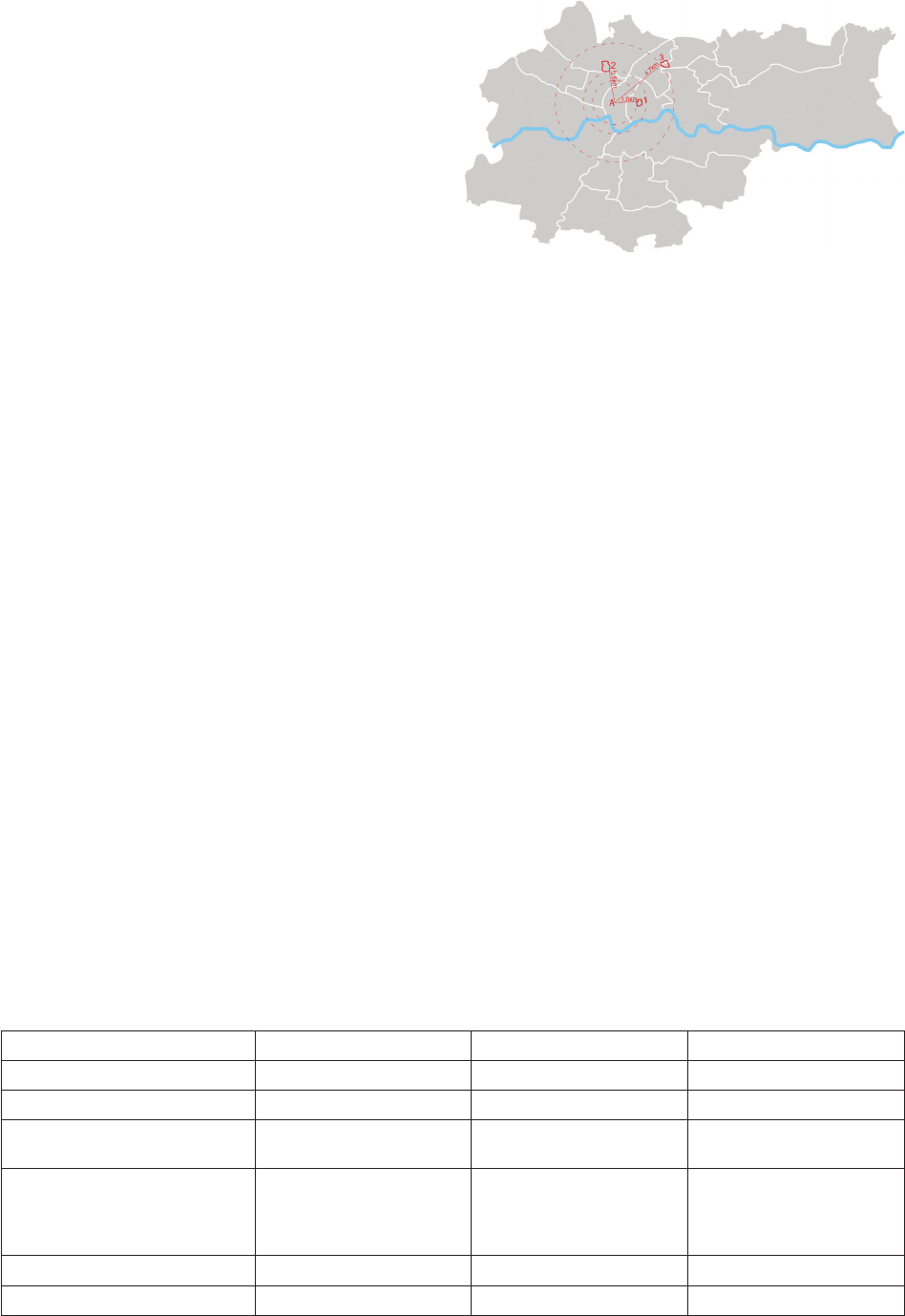
The analysis included three residential developments in
Kraków: Nowogrzegórzecka, Krowodrza Górka, and Oś-
wiecenia (Fig. 1). The table below presents key data for the
housing estates analyzed (Table 1).
To determine whether residents of the analyzed neigh-
bourhoods can meet their basic needs within a 15-minute
walk, it was necessary to rst dene what is meant by “basic
needs”. For this, we used the “essential urban social func-
tions” outlined by Moreno, the creator of the 15-minute city
concept: living, working, commerce, healthcare, education,
and entertainment (Moreno et al. 2021). However, some ad-
justments were made. In this study, “living” serves as our
reference point, rather than being categorized as a specic
facility. The category of “working” was excluded, as these
developments were planned during a time when large in-
dustrial plants were the primary sources of employment.
Thus, it was not ideal to place work and residential areas in
close proximity. Additionally, analyzing workplace proxim-
ity would have required surveying residents to identify their
places of employment – an interesting direction for future
research. However, this aspect was not included in the cur-
Development Nowogrzegórzecka Krowodrza Górka Oświecenia
Time of design and construction 1957–1969 1968–1976 1985–1988
Area [ha] 15.9 42.2 22.8
Number of residential buildings
in the original layout*
22 36 27
Residential buildings’ height
distribution [stories]
9 × 5
3 × 7
3 × 11
7 × 12
10 × 5
26 × 11
5 × 419 × 5
3 × 12
Distance to city centre [km] 1.8 2.5 4.7
Dimensions [m] 400 × 450 630 × 830 × 730
Fig. 1. Location of chosen developments:
1 – Nowogrzegórzecka, 2 – Krowodrza Górka
and 3 – Oświecenia in relation to the city centre (A)
(elaborated by D. Cenda)
Il. 1. Lokalizacja wybranych osiedli:
1 – Nowogrzegórzecka, 2 – Krowodrza Górka
i 3 – Oświecenia względem centrum miasta (A)
(oprac. D. Cenda)
Table 1. Developments’ specification and comparison
(elaborated by D. Cenda based on own measurements and archival design documentation; Włodarczyk 2014)
Tabela 1. Charakterystyka i porównanie osiedli
(oprac. D. Cenda na podstawie własnych pomiarów oraz archiwalnej dokumentacji projektowej; Włodarczyk 2014)
* Buildings constructed later, filling in the gaps in the original development, were not considered.
Note: The rest of the data comes from visual inspection or measuring dimensions on developments’ maps.
rent study. “Entertainment” was divided into two categories:
“Community and Culture” and “Recreation”. Facilities in
these categories share the role of fostering community en-
gagement, social well-being, and, respectively, cultural or
physical development.
After these adjustments, we decided to map amenities in
the following categories:
– Education – nurseries, kindergartens, primary schools,
high schools.
– Commerce – general stores, restaurants.
– Community and culture – churches, libraries, seniors’
clubs, culture houses.
– Healthcare – health centres.
– Recreation – sports facilities, parks and playgrounds,
allotment gardens.
Nurseries and kindergartens were analyzed twice: rst,
including all facilities, and second, focusing only on pub-
lic institutions. This decision was made because private
74 Dominika Cenda, Justyna Kobylarczyk, Karolina Dudzic-Gyurkovich
institutions in Poland are often costly and not aordable for
the majority of the population. In the commerce category,
small or specialized shops (e.g., bakeries, greengrocers) were
excluded. Only large and medium-sized general stores were
considered. A “culture house” refers to a public facility where
various activities (e.g., dance classes, arts and crafts, language
lessons) are organized, typically for youth and children. In
the health category, only general health clinics oering spe-
cialists in various elds were analyzed. Individual medical
practices were excluded. Re garding playgrounds, only larger
facilities, often linked to parks, were considered; smaller or
private playgrounds were not included in the analysis.
It is important to note that what is considered basic or
secondary amenities can vary from person to person, par-
ticularly when taking into account dierent age groups and
lifestyles (Kobylarczyk 2018). This research makes a gen-
eralization in this regard, assuming that all inhabitants re-
quire the same facilities to the same extent.
The facilities were identied through onsite visits and on-
line research (primarily using Google Maps). They were lo-
cated within the development and its surrounding area (rang-
ing from 300 to 500 m from the development’s boundaries,
depending on the density of available amenities and urban
barriers). The analysis was conducted in the second quarter
of 2023, reecting the actual situation during that period.
Next, each type of facility was analyzed, and the longest
access paths to any residential building within the devel-
opment were identied and marked. These paths were de-
scribed both in terms of distance (in meters) and travel time
(in minutes). The same analysis was repeated for each type
of facility across all the analyzed developments. The de-
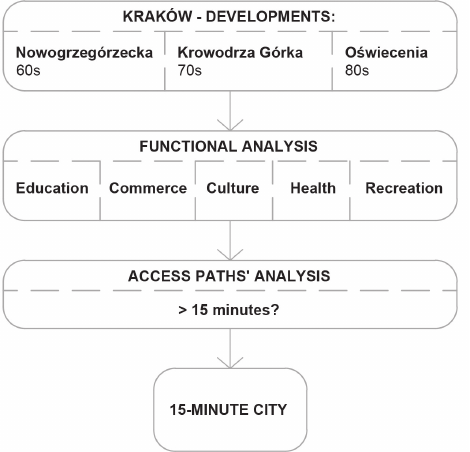
scribed methodology is illustrated in Figure 2.
The lengths of the routes were determined by measur-
ing the polylines marking the walking paths on the map.
Travel time was calculated based on onsite visits and map
analysis in AutoCAD, with the assistance of Google Maps
(using the “Walking” tool). In our analysis, we assumed an
average walking speed of 5 km/h (as used by Google Maps)
and basic mobility to navigate urban barriers such as stairs
and high curbs. However, it is important to note that these
parameters may pose challenges for certain groups of res-
idents, such as the elderly, disabled individuals, or parents
with young children (particularly those in strollers). Re-
search indicates that dierent groups of residents – adults,
children, seniors, and individuals with impaired mobility
– exhibit signicant variations in their walking capabilities
and accessibility needs (Moura, Cambra and Gonçalves
2017). For these groups, further mapping of the analyzed
developments would be necessary to assess how these ob-
stacles impact the length of access routes.
Results
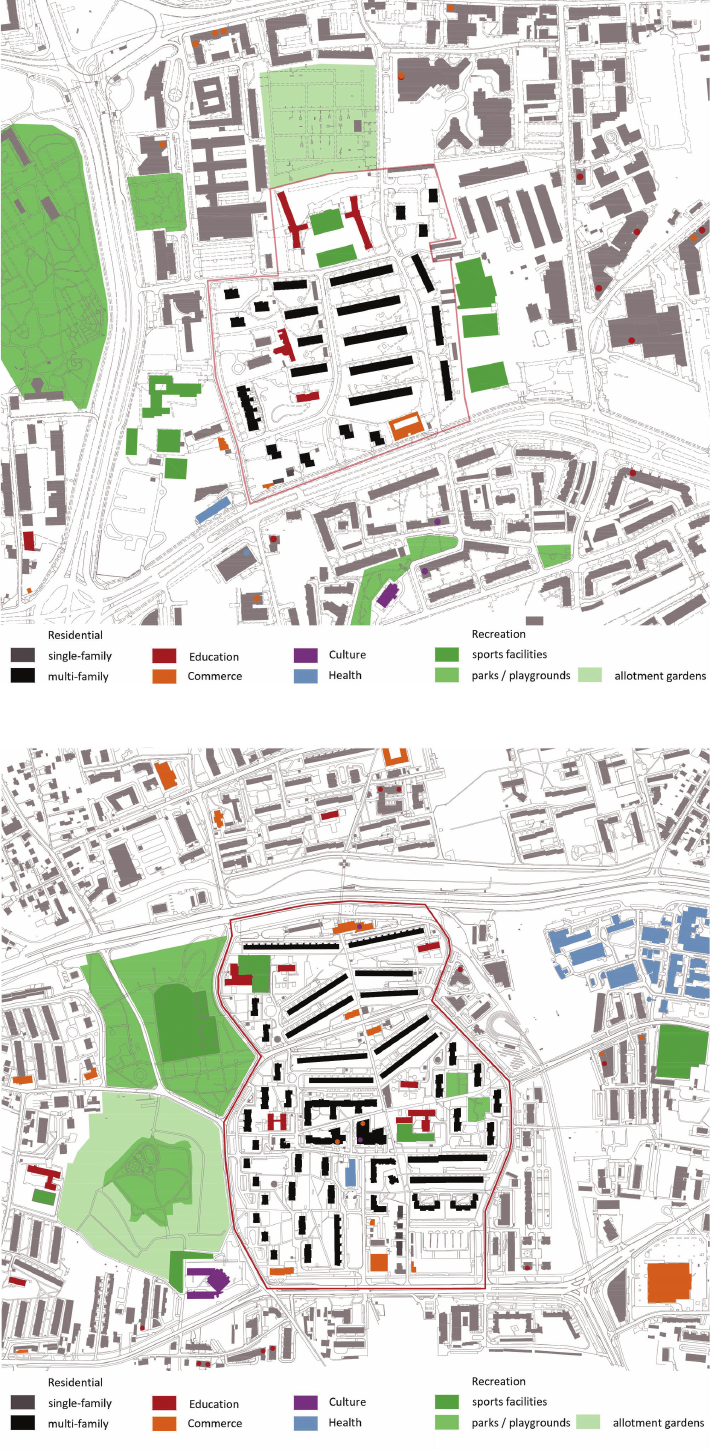
Below we present the results of the functional analysis of
the housing estates. The maps show the existing amenities
within these areas, as well as in their surroundings, cate-
gorized according to the previously dened groups. Each
housing estate is presented in a separate diagram (Figs. 3–5).
The furthest access paths were measured for 16 types
of facilities across 3 developments, resulting in a total of
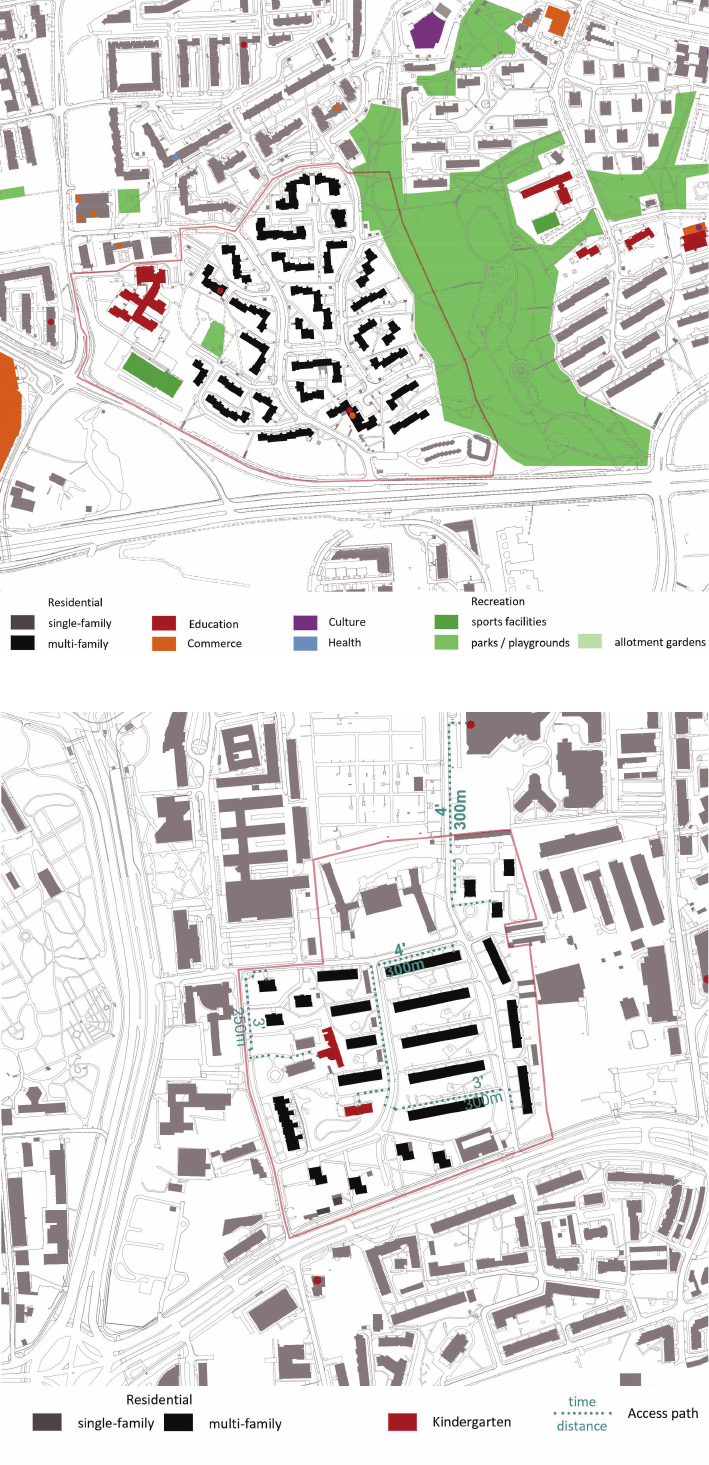
48 analyses. Below, we present a graphical example of one
of these analyses (Fig. 6), along with a summary of all the
results (Table 2).
Results exceeding the 15-minute limit are highlighted
and underlined. Facilities that could not be reached with-
in a 25-minute walk were marked with a “–” as this was
considered the maximum acceptable walking distance. As
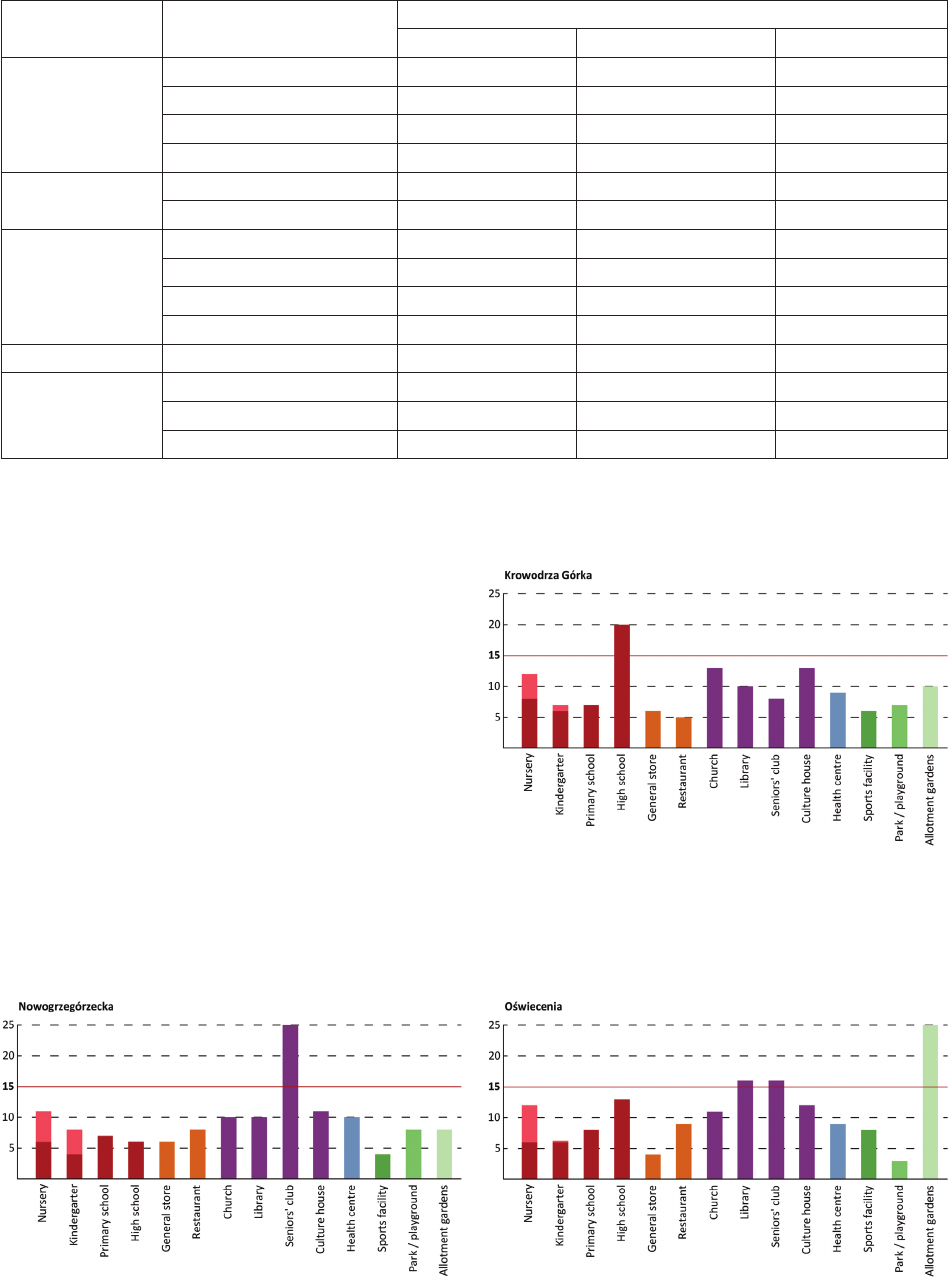
shown, most results fall within the 15-minute limit – 35 out
of 42 (83%). Interestingly, even when we set a 10-minute
limit, the majority of facilities still fall below it – 74% of
all facilities and 67% of public ones. Only three results ex-
ceeded the 15-minute threshold, and just two were marked
as inaccessible within the given range.
Regarding specic categories, 100% of commercial and
healthcare facilities are within a 15-minute walk, 92% of
educational facilities, and 89% of recreational ones. The low-
est results were found in the “Community and Culture” cate-
gory, where only 75% of facilities were within the 15-minute
limit, and only 33% were within 10 minutes. The shortest
walk was to reach a general store: 6 minutes for both the
Nowogrzegórzecka and Krowodrza Górka developments,
and just 4 minutes for the Oświecenia development.
Each development has its strengths and weaknesses in
terms of the results achieved. Nowogrzegórzecka (Fig. 7)
has the lowest average time (8.87 minutes), with consis-
tently short access times, except for one missing facility
(the seniors’ club). Sports facilities and kindergartens are
particularly well-located, being accessible in under 5 min-
utes. The “Community and Culture” category is the most
poorly represented, with all facilities located more than 10
minutes away, outside the development.
Krowodrza Górka (Fig. 8) also has a relatively low
aver age access time (9.18 minutes), with only one facility
(high school) located beyond the 15-minute reach. The best
Fig. 2. Research structure and methods
(elaborated by D. Cenda)
Il. 2. Metodyka i struktura badań
(oprac. D. Cenda)
Exploring residential developments built from 1960 to 1980 in Kraków in the context of the 15-minute city concept 75
Fig. 3. Map of amenities
– Nowogrzegórzecka development
(elaborated by D. Cenda)
Il. 3. Mapa dostępności usług
– osiedle Nowogrzegórzecka
(oprac. D. Cenda)
Fig. 4. Map of amenities
– Krowodrza Górka development
(elaborated by D. Cenda)
Il. 4. Mapa dostępności usług
– osiedle Krowodrza Górka
(oprac. D. Cenda)
76 Dominika Cenda, Justyna Kobylarczyk, Karolina Dudzic-Gyurkovich
Fig. 5. Map of amenities
– Oświecenia development
(elaborated by D. Cenda)
Il. 5. Mapa dostępności usług
– osiedle Oświecenia
(oprac. D. Cenda)
Fig. 6. Exemplary access path
analysis – kindergartens in
Nowogrzegórzecka development
(elaborated by D. Cenda)
Il. 6. Przykładowa analiza
dróg dojścia – przedszkola
na osiedlu Nowogrzegórzecka
(oprac. D. Cenda)
Exploring residential developments built from 1960 to 1980 in Kraków in the context of the 15-minute city concept 77
Table 2. The furthest walk to each type of facility, in minutes (elaborated by D. Cenda)
Tabela 2. Najdłuższe drogi dojścia dla poszczególnych obiektów, w minutach (oprac. D. Cenda)
Category Facility
Development
Francesco Nullo Krowodrza Górka Oświecenia
Education
nursery 6/11* 8/12* 6/12*
kindergarten 4/8* 6/7* 7/7*
primary school 7 7 8
high school 6
20
13
Commerce
general store 6 6 4
restaurant 8 5 9
Community
and culture
church 10 13 11
library 10 10
16
seniors’ club – 8
16
culture house 11 13 12
Healthcare health centre 10 9 9
Recreation
sports facility 4 6 8
park and playground 8 7 3
allotment gardens 8 10 –
* Only public facilities.
Note: Results exceeding the 15-minute limit are shown in bold font.
Fig. 8. The furthest walk to each type of facility – Krowodrza Górka
(elaborated by D. Cenda)
Il. 8. Najdłuższe drogi dojścia dla poszczególnych obiektów
– osiedle Krowodrza Górka (oprac. D. Cenda)
Fig. 7. The furthest walk to each type of facility – Nowogrzegórzecka
(elaborated by D. Cenda)
Il. 7. Najdłuższe drogi dojścia dla poszczególnych obiektów
– osiedle Nowogrzegórzecka (oprac. D. Cenda)
result was observed for gastronomy, with a restaurant with-
in a 5-minute walk from every point in the development.
There is a slight shortage of public nurseries, and only one
church and one cultural center, which resulted in relatively
higher access times for these facilities. It’s worth noting that
Krowodrza Górka is the largest of the analyzed develop-
ments, meaning that it takes time to even travel from one
end to the other. Nevertheless, in most cases, at least one
facility from each category is located within the develop-
ment itself.
Of all the developments, Oświecenia (Fig. 9) has the
most missing facilities – it takes 16 minutes to reach the
library or seniors’ club, and allotment gardens are absent. It
also has the highest average access time, at 10.37 minutes.
However, two types of facilities stand out with exception-
ally good results: a general store is just 4 minutes away,
Fig. 9. The furthest walk to each type of facility – Oświecenia
(elaborated by D. Cenda)
Il. 9. Najdłuższe drogi dojścia dla poszczególnych obiektów
– osiedle Oświecenia (oprac. D. Cenda)
78 Dominika Cenda, Justyna Kobylarczyk, Karolina Dudzic-Gyurkovich
and a park or playground is only 3 minutes away. It’s worth
noting that this development benets from its proximity to
the nearby Mistrzejowice, which is rich in public amenities,
particularly in terms of cultural and educational facilities.
Conclusions
The results indicate that the analyzed developments
could be considered components of a 15-minute city, with
only minor adjustments needed. Most of the access times are
within 15 minutes. Additionally, it is important to note that
the missing facilities (seniors’ clubs, library, high school,
and allotment gardens) are not considered basic necessities.
One could argue that these amenities may not be used daily
by residents (e.g., library), or they may only be needed by
specic age groups (e.g., high school or seniors’ club). More
essential amenities, such as general stores, parks, and kin-
dergartens, are all within a 15-minute walk, with the average
access times for these facilities closer to the 5-minute range.
These results appear optimal, as research indicates that
only 50% of people are comfortable walking 400 m for gro-
cery shopping, and this gure drops to just 20% at a distance
of 600 m (Kesarovski, Hernández-Palacio 2023). Even
among Nordic populations, generally considered to be phys-
ically active, research has shown that the majority (68%) are
only willing to walk distances of up to 1 km, equivalent to
approximately 12 minutes (Hjorthol, Engebretsen and Uteng
2014). The concepts of 10-, 15-, or 20-minute cities often
assume uniform maximum distances for all facilities. How-
ever, this is an oversimplication. Studies suggest that some
amenities, such as grocery stores, should be within a 5-min-
ute walk, while others, like educational facilities, can reason-
ably be located up to 15 minutes away (Logan et al. 2022).
Although e
ach development has an average result well
under the 15-minute threshold, an interesting pattern emerg-
es: the older the development, the better the results. This
may be because older neighbourhoods are situated more
centrally, in areas that are already well-equipped with ame-
nities. Another, perhaps simpler, explanation is that older
developments have had more time to improve their func-
tionality, even if they initially faced some deciencies.
Given the favourable results, one might question whether
the 15-minute city standard is ambitious enough for a mid-
sized European city. The analyzed developments demon-
strate potential to provide an even higher level of conve-
nience for their residents. With an average access time
of 9.47 minutes and only 26% of facilities exceeding the
10-minute threshold, these neighborhoods could realistical-
ly aim to meet the criteria of a 10-minute city. Achieving
this would require only minor enhancements to their func-
tionality.
Summary
This research reveals a striking similarity between the
design of developments built in the 1960s–1980s and the
principles of the 15-minute city concept. This connection
holds signicant potential, particularly today, as the im-
portance of proximity and walkability is once again at the
forefront of urban planning. These developments could be
considered early examples of 15-minute city components,
oering valuable opportunities for exploration and exper-
imentation. By studying them, we can rene the concept
further and establish guidelines for future implementations.
This is especially relevant in Poland, where the 15-minute
city concept has yet to be fully embraced.
The presented methodology serves as a replicable assess-
ment tool that can be applied to other areas. It is suitable for
evaluating both existing urban structures and planned de-
velopments. However, its eectiveness relies on a detailed
analysis of existing urban barriers and pedestrian pathways.
The multifunctionality of the analyzed developments
oers a signicant advantage over their modern counter-
parts. This characteristic highlights their potential as areas
deserving complex modernization eorts aimed at enhanc-
ing their strengths (such as urban layout and functionality)
while addressing their weaknesses (such as monotonous
architecture, aging infrastructure, and lower technical stan-
dards). This research could serve as a guideline for aug-
menting functionality in these neighbourhoods in cases of
planned modernization initiated by public entities or hous-
ing cooperatives.
For better or worse, the era of centrally planned resi-
dential developments is long past. Today, most of the ana-
lyzed areas are either fully developed or in private owner-
ship. The construction of public facilities has become more
complex and less common. However, the private sector can
also benet from this research, as such analyses highlight
areas lacking specic amenities (such as private nurseries
or restaurants), presenting potential opportunities for prof-
itable investments.
Future research could be expanded by analyzing a larger
number of developments across various cities or countries.
It would also be valuable to compare developments built be-
tween 1960–1980 with more recent ones. How do the func-
tions oered in modern residential areas compare to those
from the communist era, both in terms of scope and quanti-
ty? Has the shift from centrally managed to privately devel-
oped housing resulted in better functionality for residents?
This research conrms that the analyzed developments
can be interpreted as components of a 15-minute city. They
were built with a similar principle in mind – that residents
should have access to all the facilities they use daily within
a short distance. In communist-era urban planning, this was
dened by physical distance; today, it is framed by the time
of the journey. At the time of their construction, car-orient-
ed design seemed impractical, as few people owned cars.
In today’s world, pedestrian accessibility has once again
become crucial and warrants further study.
Translated by
Dominika Cenda
Exploring residential developments built from 1960 to 1980 in Kraków in the context of the 15-minute city concept 79
References
Bartoszczuk, Wojciech, Agnieszka Cieśla, and Katarzyna Rędzińska. “Ac-
cessibility to Public Services and Green Areas in Warsaw Housing
Estates in the Context of the Covid-19 Pandemic and the 10-Minute
Neighbourhood Concept.” Środowisko Mieszkaniowe/Housing Envi-
ronment 45, no. 4 (2024): 19–32. https://doi.org/10.4467/25438700
SM.23.026.19126.
Bartzokas-Tsiompras, Alexandros, and Efthimios Bakogiannis. “Quanti-
fying and Visualizing the 15-Minute Walkable City Concept across
Europe: A Multicriteria Approach.” Journal of Maps 19, no. 1 (2022):
1–9. https://doi.org/10.1080/17445647.2022.2141143.
Basista, Andrzej. Betonowe dziedzictwo. Architektura w Polsce czasów
komunizmu. Wydawnictwo Naukowe PWN, 2001.
Capasso Da Silva, Denise, David A. King, and Shea Lemar. “Accessi bi lity
in Practice: 20-Minute City as a Sustainability Planning Goal.” Sus-
tainability 12 (1) (2020): 129. https://doi.org/10.3390/su 12010129.
Fronczak, Monika. “15-Minute City – Genesis – Inspiration – Realisation.
Introduction to Research in a Form of Overview.” Przestrzeń Ur-
banistyka Architektura 1, (2023): 139–55. https://doi.org/10.37705/
PUA/1/2023/10.
Guzman, Luis A., Julian Arellana, Daniel Oviedo, and Carlos Alberto
Moncada Aristizábal. “COVID-19, Activity and Mobility Patterns in
Bogotá. Are We Ready for a ‘15-Minute City’?” Travel Behaviour and
Society 24, (2021): 245–56. https://doi.org/10.1016/j.tbs.2021.04.008.
Hjorthol, Randi, Øystein Engebretsen, and Tanu Priya Uteng. “Den na sjo -
nale reisevaneundersøkelsen 2013/14 – nøkkelrapport.” Institute of
Transport Economics, Norwegian Centre of Transport Research, 2014.
Accessed March 3, 2023, at https://www.toi.no/getle.php?mmleid
=
39511.
Kesarovski, Todor, and Fabio Hernández-Palacio. “Time, the Other Di-
mension of Urban Form: Measuring the Relationship between Urban
Density and Accessibility to Grocery Shops in the 10-Minute City.”
Environment and Planning B: Urban Analytics and City Science 50,
no. 1 (2023): 44–59. https://doi.org/10.1177/23998083221103259.
Khavarian-Garmsir, Amir Reza, Ayyoob Shari, Mohammad Hajian Hos-
sein Abadi, and Zahra Moradi. “From Garden City to 15-Minute City:
A Historical Perspective and Critical Assessment.” Land 12, (2023):
1–15. https://doi.org/10.3390/land12020512.
Khor, Lee-Anne, Shane Murray, Kim Dovey, Ian Woodcock, and Rutger
Pasman. “New Urban Territories: Spatial Assemblies for the 20-Mi-
nu te City.” In 6th State of Australian Cities Conference, 26–29 No-
vember 2013, Sydney, Australia. Published November 29, 2013. Ac-
cessed March 15, 2023, at https://apo.org.au/node/59859.
Ki, Donghwan, Zhenhua Chen, Sugie Lee, and Seungjae Lieu. “A Novel
Walkability Index Using Google Street View and Deep Learning.”
Sustainable Cities and Society 99, (2023): 104896. https://doi.org/
10.1016/j.scs.2023.104896.
Kobylarczyk, Justyna. Uwarunkowania środowiskowe w projektowaniu
obszarów mieszkaniowych. Wydawnictwo PK, 2018.
Logan, Tom, Matthew Hobbs, Lindsey Conrow, Nick Reid, R.A. Young, and
Mitchell Anderson. “The X-Minute City: Measuring the 10, 15, 20-Min-
ute City and an Evaluation of Its Use for Sustainable Urban Design.”
Cities 131, (2022): 1–15. https://doi.org/10.1016/j.cities.2022.103924.
Małachowski, Aleksander, Maciej Dąbski, and Waldemar Wilk. “Acces-
sibility of Public Services in Districts of Warsaw: A Comparative
Study.” Miscellanea Geographica 24, no. 3 (2020): 176–82. https://
doi.org/10.2478/mgrsd-2020-0019.
Moreno, Carlos, Zaheer Allam, Didier Chabaud, Catherine Gall, and Flo-
rent Pratlong. “Introducing the ‘15-Minute City’: Sustainability, Re-
silience and Place Identity in Future Post-Pandemic Cities.” Smart
Cities 4, (2021): 93–111. https://doi.org/10.3390/smartcities4010006.
Moura, Filipe, Paulo Cambra, and Alexandre B. Gonçalves. “Measuring
Walkability for Distinct Pedestrian Groups with a Participatory Assess-
ment Method: A Case Study in Lisbon.” Landscape and Urban Planning
157, (2017): 282–96. https://doi.org/10.1016/j.landurbplan. 2016.07.002.
Noworól, Aleksander, Piotr Kopyciński, Paweł Hałat, Jeremiasz Sala -
mon, and Artur Hołuj. “The 15-Minute City – The Geographical
Pro xi mity of Services in Krakow.” Sustainability 14, (2022): 1–34.
https://doi.org/10.3390/su14127103.
Poklewski-Koziełł, Damian, Karolina Dudzic-Gyurkovich, and Carlos Mar -
molejo Duarte. “Investigating Urban Form, and Walkability Mea su res
in the New Developments. The Case Study of Garnizon in Gdansk.”
Land Use Policy 125, (2023): 1–19. https://doi.org/ 10.1016/j.landuse-
pol.2022.106471.
Szafrańska, Ewa. Wielkie osiedla mieszkaniowe w mieście postsocjali-
stycznym. Geneza, rozwój, przemiany, percepcja. Wydawnictwo Uni-
wersytetu Łódzkiego, 2016.
Weng, Min, Ning Ding, Jing Li, Xianfeng Jin, He Xiao, Zhiming He, and
Shiliang Su. “The 15-Minute Walkable Neighborhoods: Measure-
ment, Social Inequalities and Implications for Building Healthy Com-
munities in Urban China.” Journal of Transport & Health 13, (2019):
259–73. https://doi.org/10.1016/j.jth.2019.05.005.
Włodarczyk, Małgorzata, ed. Krakowskie osiedla modernizmu lat 1945–
1990. Wybrane przykłady: lista obiektów architektonicznych i urbani-
stycznych SARP Oddział Kraków. SARP Kraków, 2014.
Streszczenie
Krakowskie osiedla mieszkaniowe z lat 1960–1980 w kontekście koncepcji miasta 15-minutowego
Urbaniści z całego świata poszukują sposobów walki ze zmianami klimatycznymi oraz tworzenia otoczenia przyjaznego dla pieszych. Jednym z nich
może być zyskująca na popularności idea miasta 15-minutowego. Jej głównym założeniem jest dostępność podstawowych udogodnień w zasięgu krót-
kiego spaceru (najczęściej do 15 minut). W okresie komunizmu w Polsce wiele inwestycji mieszkaniowych miało być projektowanych jako jednostki
mieszkaniowe – wydzielone strukturalnie osiedla mieszkaniowe ze wszystkimi podstawowymi udogodnieniami (usługi, rekreacja i transport) dostępny-
mi w promieniu 500 metrów. Celem niniejszych badań jest porównanie tych dwóch wizji.
Przeprowadzone badania skoncentrowano na dostępności pieszej wybranych usług w trzech osiedlach mieszkaniowych położonych w Krakowie,
zbudowanych w latach 1960–1980. Miały na celu sprawdzenie, czy analizowane obszary spełniają wymagania komponentów miasta 15-minutowego.
W trakcie prac przeprowadzono analizę funkcjonalną w celu zlokalizowania udogodnień z wybranych kategorii. Następnie wykonano analizę ście-
żek dostępu, aby określić najdłuższe trasy pomiędzy budynkami mieszkalnymi a najbliższym obiektem danego rodzaju. Połączenie tych dwóch analiz
dało wiedzę na temat właściwości przestrzennych i funkcjonalnych każdego osiedla.
Na podstawie otrzymanych wyników można stwierdzić, że większość analizowanych udogodnień jest dostępna w zasięgu 15-minutowego spaceru.
Dowodzi to, że przedmiotowe obszary mają wiele cech wspólnych z komponentami miasta 15-minutowego. Pozwala to spojrzeć na komunistyczne osie-
dla z innego punktu widzenia – jako na cenne elementy współczesnej struktury miejskiej. Ten rodzaj analizy może służyć jako wytyczne dla urbanistów
w przypadku kompleksowych modernizacji lub dla inwestorów prywatnych do identykacji funkcjonalnych braków.
Słowa kluczowe: miasto 15-minutowe, urbanistyka, miasto przyjazne dla pieszych, komunizm, osiedla mieszkaniowe