
2025
4(84)
Magdalena Muszyńska-Łanowy*, Magdalena Baborska-Narożny**
Industrial building façades as a showcase
of changes in building-integrated photovoltaics (BIPV) aesthetics
DOI: 10.37190/arc250415
Published in open access. CC BY NC ND license
Abstract
The article analyzes the evolution of the aesthetics of opaque Building-Integrated Photovoltaic (BIPV) systems in industrial architecture. Pho-
tovoltaics (PV), as a key element in the energy transformation of buildings, are gaining signicance – particularly due to their potential for façade
integration. However, BIPV solutions remain a niche, mainly due to high costs, technical complexity, and limited awareness among designers.
The aim of the study is to show how the technological evolution of opaque PV modules has inuenced changes in the aesthetics of industrial
building façades. The research is based on an analysis of academic literature, technical documentation, and eld observations of selected buildings
in Germany and Poland. Four case studies were examined, representing key stages in the development of BIPV: from early silicon-based modules,
through glass thin-lm technologies, exible laminates, to advanced aesthetic solutions with interference coatings.
The results indicate a clear shift in BIPV design approach – from emphasizing PV technology as a feature of futuristic design, to seeking visual
harmony and “aesthetic camouage” of PV modules. BIPV aesthetics are becoming increasingly customized thanks to growing possibilities for per-
sonalizing the color, format, and texture of modules. Despite technological advancements, BIPV-integrated façades remain rarely used in industrial
buildings, where rooftop-mounted Building-Applied Photovoltaics (BAPV) systems still dominate.
Further development of BIPV in industrial architecture requires greater awareness among designers and the promotion of successful implemen-
tations that combine energy generation with high architectural quality.
Key words: industrial architecture, building-integrated photovoltaics (BIPV), photovoltaic aesthetics, BIPV façades, opaque photovoltaics
Introduction
Photovoltaics (PV) play an important role in the building
sector’s transition to clean and sustainable energy (Constan-
tinou et al. 2024; Van Noord et al. 2025). Specically, PV
systems have become integral to redening the function of
building envelopes (Bonomo, Frontini 2024). This shift is
driven by the EU’s Energy Performance of Buildings Direc-
tive (EPBD), reinforced by the Green Deal and “Fit for 55”
package, aiming for a 55% reduction in greenhouse gas
emissions by 2030. The industrial sector poses unique chal-
lenges (Neuwirth, Fleiter and Hofmann 2024); however, PV
is still regarded as having potential to support the transition
of less energy-intensive industries towards a carbon-neutral
future.
Among all renewable energy options, PV are unique in
their capacity to be integrated into the building envelope.
Since the rst rooftop installations on industrial buildings
in the 1980s, PV technologies have evolved to enable fa-
çade integration. Building-Applied Photovoltaics (BAPV)
– stan dard panels mounted onto existing structures – have
become the mainstream solution for industrial buildings due
to their cost-eectiveness and ease of installation. However,
while eective in terms of energy generation, such solutions
proved insucient in terms of aesthetic expectations (Van
Noord et al. 2025). To address these concerns, Building-
Integrated Photovoltaics (BIPV) have gained prominence
by replacing traditional construction materials and trans
-
forming building envelopes into active, multifunctional
skins that not only generate energy and provide weather
protection, but also contribute meaningfully to architectural
design.
* ORCID: 0000-0003-4951-2034. Faculty of Architecture, Wro -
cław University of Science and Technology, Poland, e-mail: magdalena.
muszynska@pwr.edu.pl
** ORCID: 0000-0001-6860-5186. Faculty of Architecture, Wro-
cław University of Science and Technology, Poland.
158 Magdalena Muszyńska-Łanowy, Magdalena Baborska-Narożny
This article examines the evolution of opaque photo-
voltaic technologies applied to industrial building façades,
with particular emphasis on their aesthetic transformation.
Drawing on selected case studies, it demonstrates how key
technological milestones have inuenced design strategies
in this eld. Although the main focus is on BIPV systems,
the study also considers hybrid BAPV/BIPV applications
that reect broader trends in the visual and material inte-
gration of photovoltaics within industrial contexts. For the
purpose of this research, the term industrial buildings refers
to production, research, and environmental infrastructure
facilities characterized by large façades, modular struc-
tures, and high potential for photovoltaic integration. Such
buildings, oering good solar exposure, extensive surfaces,
design exibility, and strong association with technological
innovation, provide particularly suitable conditions for ex-
ploring the aesthetic evolution of BIPV.
The adoption of BIPV façades in industrial contexts re-
mains limited. Key barriers to broader uptake across build-
ing typologies include higher costs, technical complexity,
and a lack of awareness or knowledge among stakehold
ers
(Bonomo et al. 2024; Smith et al. 2024; Parolini et al. 2024).
Studies on architects’ attitudes toward PV have shown
that
aesthetic considerations are the primary factor for over 85%
of respondents when selecting BIPV – ranking higher than
cost or performance (Basher et al. 2023). Nonetheless,
aware ness of available design options remains low, under-
scoring the need for reliable databases, accessible refer-
ences, and broader dissemination of technical and design
information. Early academic studies on BIPV men tioned
industrial buildings among other typologies (Ha ge mann
2002; Marchwiński 2005). Later research that focused more
specically on this eld (Muszyńska-Łanowy 2009) did not
yet capture the broader aesthetic development of BIPV, as
the technology was then at an early stage of its architectur-
al implementation. Contemporary literature still discusses
mostly isolated cases of BIPV façade applications in in-
dustrial settings without tracing their evolution. This arti-
cle seeks to address that gap by providing insight into how
the changing properties of opaque PV have transformed the
aesthetics of industrial facilities.
Methods
This study employs a multi-source research approach,
in tegrating both primary and secondary data. A comprehen-
sive literature review was undertaken, drawing on published
books related to BIPV and peer-reviewed articles accessed
through Google Scholar and ResearchGate databases. Due
to research focus on industry standards and specic prod-
ucts also grey literature was considered. Reports published
by the International Energy Agency Photovoltaic Power
Sys tems Programme (IEA PVPS) were examined to pro-
vide up-to-date insights and an overview of the current state
of BIPV technologies and their international deployment.
Technical data sheets and handbooks from manufacturers
of construction materials and PV modules were reviewed
to assess the physical characteristics of BIPV systems.
First- hand knowledge on state-of-the-art of technology was
ob tained during the Intersolar trade fair in Munich, where
direct engagement with industry professionals, product de-
mon strations, and expert lectures provided insight into cur-
rent trends and market innovations.
Following the in-depth understanding of the technology
development stages, the case studies were selected as rep-
resentative examples of signicant BIPV applications and
design solutions in industrial buildings. The selected sites
include two manufacturing plants, one research and labo-
ratory facility and a waste treatment plant. The geographic
scope is limited to projects located in Germany and Poland,
reecting the spatial dissemination of the technology. Site
visits were conducted to allow for direct observation and
photographic documentation of the façade systems and the
architectural integration of BIPV. The photographic docu-
mentation was collected over several years: 2007 (Gelsen-
kirchen); 2014, 2025 (Berlin Adlershof).
BIPV: Definition and challenges
of opaque façade integration
Integrating PV into the building envelope creates a mul-
tifunctional system that serves both as an energy generator
and a construction element (Kuhn et al. 2021). This dual role
requires an interdisciplinary approach – combining archi-
tectural design, structural engineering, and solar technolo-
gy. According to IEC 63092 and EN 50583, BIPV systems
must comply with both electrical and construction standards.
A PV module qualies as “building-integrated” when it re-
places conventional materials and contributes structurally to
the envelope; its removal necessitates a substitute construc-
tion element. Beyond electricity generation, it must ensure,
e.g., structural integrity, re and noise protection, environ-
mental separation, and safety – thus becoming an integral
part of the façade (Berger et al. 2018; Bonomo et al. 2021).
Various industrial building façade systems are suitable
for opaque BIPV integration; yet each presents challenges.
Achieving a balance between energy performance and aes-
thetic quality is particularly important (Smith et al. 2024;
Parolini et al. 2024).
Façades often face suboptimal solar exposure due to their
90° tilt, shading, and variable irradiance, requiring careful
material selection and system conguration to ensure su-
cient energy yield. PV modules integrated into façades are
exposed to elevated temperatures, leading to thermal stress,
reduced energy eciency and durability. Cold façades – with
layered construction and ventilation cavities – are well-suit-
ed for BIPV, enabling passive cooling and concealed wiring
without compromising structural integrity. In such systems,
standard or customized BIPV modules can replace opaque
cladding. Their modular nature simplies in stalla tion and
maintenance. Warm façades without venti lation require spe-
cic PV material solutions capable of withstanding higher
operating temperatures.
A wide range of PV module types, typically with a 30-year
service life, is suitable for both new and retrot projects. Over
200 commercial BIPV products are currently available in the
European Union (Bonomo, Frontini 2024; Basher et al. 2023).
Façade-integrated PV systems must meet high aesthetic
standards (Li et al. 2025; Borja Block et al. 2024). To ensure
architectural coherence, opaque BIPV often require proj-

Industrial building façades as a showcase of changes in building-integrated photovoltaics (BIPV) aesthetics 159
ect-specic adaptations in module colour, texture, shape,
size, and cell layout (Kuhn et al. 2021). The increasing va-
riety of materials with diverse visual and technical proper-
ties and potential for customization, supports integration in
industrial architectural contexts. This design exibility is
essential to evolving the formal language of PV façades.
The evolution of BIPV in industrial architecture
Over the past 30 years, the evolution of BIPV in industrial
architecture has been driven by technological progress, en-
vironmental concerns, and architects’ ambitions to integrate
solar energy into building envelopes. As technologies ad-
vanced, PV systems became more ecient and diversied in
terms of materials and design. These improvements enabled
more seamless integration of PV components into building
structures. What began with the use of standard, o-the-shelf
modules has gradually evolved into project-specic solu-
tions tailored to architectural and functional requirements.
The following section presents four milestone buildings
showcasing opaque BIPV (Table 1).
Early integration – from BAPV to BIPV
In the late 1980s and 1990s, façade-mounted PV mod-
ules evolved from standard BAPV to more integrated BIPV
solutions. Early opaque PV solutions used crystalline silicon
(c-Si) solar cells in glass–foil laminates. Glass–glass mod-
ules, heavier and more expensive, were used less frequently.
Designs featured rectangular shapes, blue or black cells ar-
ranged in grids with visible busbars and aluminum frames.
Frameless modules oered a more seamless look but posed
delamination and mounting issues. Polycrystalline silicon
(p-Si) stood out for its shimmering, textured surface, rein-
forcing a high-tech aesthetic of building envelopes. Colorful
and geometric variations remained rare due to high costs
and eciency trade-os (Weller et al. 2010; Borja Block
et al. 2024).
A landmark project from this era is the Scheuten Solar
facility in Gelsenkirchen (1999). The most advanced solar
cell plant in Europe at the time combined high-performance
production with striking architecture, serving as both a fac-
tory and demonstration center to showcase cutting-edge PV
Case study building Scheuten Solar Soltecture Eco-incinerator
Helmholtz-Zentrum Berlin
(HZB)
Year constr./BIPV 1999 2009 2011-2015 /2019 2016 / 2021
Adress
Am Dahlbusch 23,
Gelsenkirchen
Groβ-Berliner Damm 152,
Berlin-Adlershof
Giedroyc Street 23,
Krakow
Albert-Einstein-Straße 15,
Berlin-Adlershof
Architectural office Hohaus & Partner Rainer Girke
Manufaktura Nr 1, Teller
Architekci, Łapiński
Architekci, PROCHEM
S.A.
DGI Bauwerk Gesellschaft
von Architekten mbH
Building function
Solar cells manufacturing
plant
PV modules
manufacturing plant
Waste incineration plant Research building
BIPV orientation SW SW, SE S N, W, S
BIPV tilt Variable 900 Variable 900
BIPV size 264 m
2
578 m
2
116 m
2
380 m
2
Cell technology Polycrystalline (p-Si)
Copper-Indium-Diselenide
(CIS)
Monocrystalline (m-Si)
Copper-Indium-Gallium-
Selenide (CIGS)
Module type Shell S115-C Soltecture SCG-HV-F DAS Energy 12x2M Avancis Skala 7003
Module construction Glass-Tedlar
®
Glass–glass ETFE / PET Glass–glass
Encapsulant E VA E VA
Patented fiberglass-
reinforced plastic
Polymer
Frame Framed Frameless Frameless Frameless
Module dimensions 1220 × 850 × 25 mm 1250 × 650 × 7 mm 2035 × 377 × 2 mm 1587 × 664 × 38 mm
Module weight 14 kg 12.6 kg 2.8 kg 17 kg
Module nominal
power
115 W 90 W 120 W 135 W
Module quantity 240 700 152 360/N 56, W 56, S 248
Mounting system
Mounted on
Kalzip
®
SolarClad
Concealed
Custom façade cassette
Direct bonding
Kalzip
®
AluPlus
Concealed
Metal curtain wall
Installed power 26.4 kWp 39 kWp 17.5 kWp 48.6 kWp
Annual yield n.d. 35 MWh/a 12 MWh/a 30 MWh/a
Table 1. The Evolution of BIPV in Industrial Architecture – technical characteristics of opaque PV façade systems implemented
in case study examples (elaborated by M. Muszyńska-Łanowy)
Tabela 1. Ewolucja BIPV w architekturze przemysłowej – charakterystyka techniczna nieprzezroczystych systemów fasad PV w analizowanych
przykładach (oprac. M. Muszyńska-Łanowy)
160 Magdalena Muszyńska-Łanowy, Magdalena Baborska-Narożny
integration in industrial architecture (Deutsche Shell 1999).
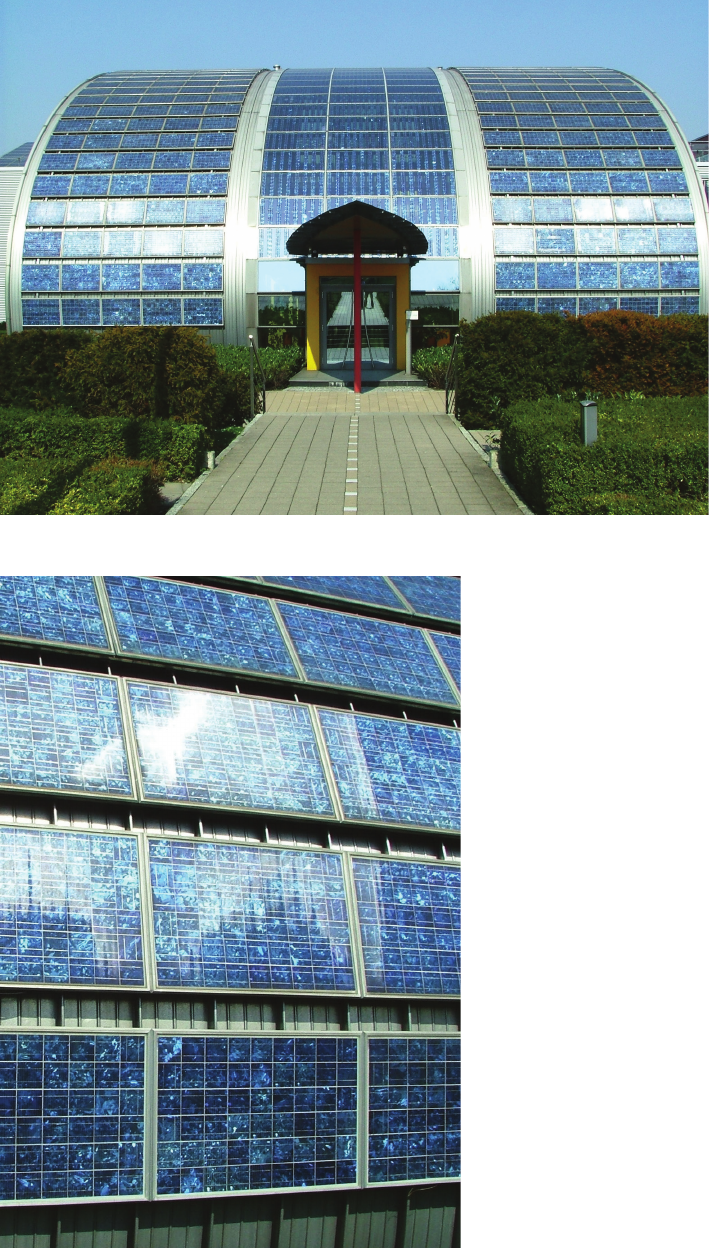
The building’s iconic feature is its elliptical, south-facing
oce façade, which merges uidly with the roof, with
a bold yellow-red canopy marking the entrance. Its dynamic
form reects the innovative spirit of PV technology (Fig. 1).
Two BIPV systems were used: a now-decommissioned
semi-transparent c-Si curtain wall and an opaque aluminum
façade with surface-mounted PV modules, attached via non-
penetrative clips to the standing seams of Kalzip
®
aluminum
sheets (Corus Bausysteme 2001). Framed modules were
arranged in rhythmic horizontal bands – ve per segment
– symmetrically anking the central glazed strip across sec-
tions. The modules feature a visible cell grid, with irregular
crystalline structure of the p-Si creating a shimmering eect
(Fig. 2). The interplay between the blue-silver tones of the
PV modules and the aluminum cladding reinforces the in-
dustrial aesthetic. The Kalzip
®
’s exibility enabled curved
proles, concealed electrical integration, and allowed mod-
ules to be elevated for rear ventilation. This produced a co-
hesive, expressive façade, reecting the era’s technological
ambition.
Thin-Film technologies
In the early 2000s, second-generation thin-lm techno-
logies – amorphous silicon (a-Si), copper indium selenide
(CIS), copper indium gallium selenide (CIGS), and cadmi-
um telluride (CdTe) – signicantly advanced PV integration
into industrial building façades. In addition to environmen-
tal benets – such as reduced semiconductor use and low-
er-energy production –thin-lm oered notable architectural
advantages. Their slim proles and compatibility with glass,
metal and polymer substrates have enabled seamless inte-
gration into diverse façade systems, supporting both con-
structability and aesthetic exibility. Better performance un-
der shading, high temperatures, and diuse light compared
Fig. 1. Scheuten Solar,
Gelsenkirchen (1999).
A pioneering example of PV
integration in an industrial
building façade
(photo by M. Muszyńska-Łanowy)
Il. 1. Scheuten Solar,
Gelsenkirchen (1999). Pionierski
przykład integracji fotowoltaiki
w elewacji budynku
przemysłowego
(fot. M. Muszyńska-Łanowy)
Fig. 2. Scheuten Solar, Gelsenkirchen (1999). PV modules with
a visible crystalline cell structure and a regular grid pattern,
mounted on standing seam aluminium cladding
(photo by M. Muszyńska-Łanowy)
Il. 2. Scheuten Solar, Gelsenkirchen (1999). Moduły PV o widocznej
strukturze krystalicznych ogniw i regularnym układzie siatki,
zamontowane na aluminiowej blasze na rąbek stojący
(fot. M. Muszyńska-Łanowy)
Industrial building façades as a showcase of changes in building-integrated photovoltaics (BIPV) aesthetics 161
to c-Si made them particularly suitable for façade applica-
tions (Weller et al. 2010).
Thin-lm PV expanded the color palette: brownish a-Si;
graphite-black CIS and CIGS; greenish-black CdTe. Smooth,
monochromatic surfaces complemented the minimalist aes-
thetic typical of industrial architecture. Notably, black CIS
modules with subtle pinstripes attracted architectural interest
(S
ulfurcell Solartechnik n.d. c). Rened visual strategies – in-
cluding tinted or patterned glass – have enabled BIPV façades
to convey visual patterns, inscriptions, or branding. These ap-
proaches have proven especially relevant in showcase build-
ings, where technological demonstration plays a central role,
as well as in retrotted projects that require visual harmony
with the existing architectural context (Peharz et al. 2019).
A combination of declining costs, material adaptability, and
aesthetic versatility has contributed to the growing imple-
mentation of thin-lm BIPV in industrial architecture.
The Soltecture facility in Berlin-Adlershof represents one
of the most notable early applications of CIS in industrial
architecture, awarded a German Solar Prize in 2010 for its
“exemplary combination of an ecologically sound building
concept and aesthetically appealing design” (Krehl Girke
Architekten, n.d.). The project marked a strategic shift from
PV manufacturing to BIPV solutions, emphasizing architec-
tural collaboration. To reect this design focus, the company
rebranded from Sulfurcell to Soltecture.
Alongside a rooftop PV array, the building featured a ful-
ly integrated façade system: CIS modules formed seamless
cladding across the southwest and southeast elevations of the
administrative and production buildings (Sulfurcell Solar -
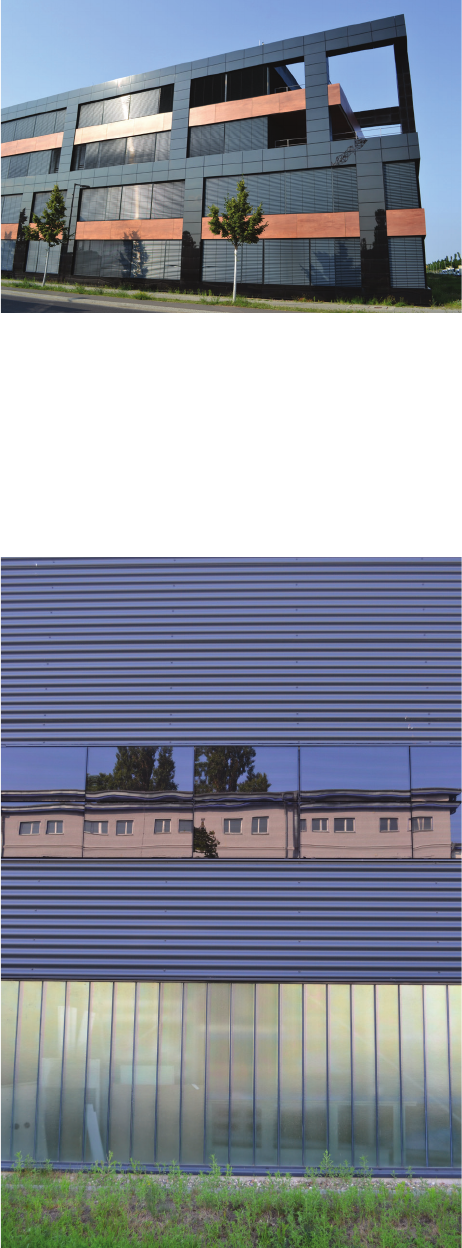
technik n.d. c). The frameless glass modules were mounted
horizontally in rhythmic bands – some inactive to maintain
visual consistency – creating a rened, monolithic appear-
ance (Sulfurcell Solartechnik n.d. b). The panels resembled
plain black glass, their glossy surface and deep color con-
trasting sharply with the adjacent matte, wood-toned HPL
cladding (Fig. 3). On the production hall, the modules were
arranged in irregular horizontal stripes, positioned alongside
anthracite-colored proled metal panels (Fig. 4).
For seamless integration, a custom cassette system based
on ventilated metal façade principles was developed. The
modules were bonded to anodized aluminum frames us-
ing silicone adhesive and mounted with concealed clips,
stabilized by hooks at the lower edge. Prefabricated units
allowed for ecient on-site installation, and the ventilated
cavity provided passive cooling, controlled water drainage,
and protected the underlying insulation. As a pilot project,
the façade required special permits. Since silicone bond-
ing lacked general approval in Germany, additional wind-
load tests were carried out (Sulfurcell Solartechnik n.d. a;
DETAIL Architecture 2010).
Following company’s insolvency, the building was dis-
mantled, yet its minimalist black façade remains a landmark
in thin-lm BIPV design, renowned for its rened aesthetic
and material clarity.
Flexible and lightweight BIPV
The development of glass-free PV laminates has expand-
ed the architectural potential of BIPV. Thin-lm solar cells
Fig. 3. Soltecture facility, Berlin-Adlershof (2009).
Black thin-film CIS modules form a sleek, monolithic surface
with strong architectural coherence
(photo by M. Muszyńska-Łanowy)
Il. 3. Zakład Soltecture, Berlin-Adlershof (2009).
Czarne, cienkowarstwowe moduły CIS tworzą gładką, monolityczną
powierzchnię o wysokiej spójności architektonicznej
(fot. M. Muszyńska-Łanowy)
Fig. 4. Soltecture, Berlin-Adlershof (2009). BIPV CIS modules with
a reflective surface, seamlessly aligned with the corrugated metal
cladding; the dark, mirror-like finish visually conceals the solar
function (photo by M. Muszyńska-Łanowy)
Il. 4. Soltecture, Berlin-Adlershof (2009). Moduły BIPV typu CIS
o refleksyjnej powierzchni, płynnie zintegrowane z falistą okładziną
metalową; ciemne, lustrzane wykończenie wizualnie maskuje
funkcję solarną (fot. M. Muszyńska-Łanowy)
162 Magdalena Muszyńska-Łanowy, Magdalena Baborska-Narożny
embedded on lightweight metallic or polymer substrates
– stainless steel, ETFE (ethylene tetrauoroethylene), or TPE
(thermoplastic elastomers) – are encapsulated in multi-layer
polymers. Their reduced weight, mechanical
exibility, and
adaptability to complex surfaces enable direct application
onto at, concave, or convex geometries without the need
for secondary substructures.
Early implementations in the 2000s explored triple-junc-
tion a-Si cells laminated onto stainless steel foils, optimized
for high performance under diuse light and elevated tem-
peratures. Although these systems faced long-term dura-
bility issues – such as delamination, corrosion, and envi-
ronmental degradation – they laid the foundation for the
credibility of exible BIPV in architectural practice (Call
et al. 2008).
Contemporary exible modules are based on CIGS or
thin-lm silicon technologies. Textured ETFE front sheets
enhance light trapping, UV stability, hydrophobicity, and
weather resistance, while EVA encapsulants ensure optical
clarity and structural cohesion. The modules are available
in graphite, dark-blue or other hues, depending on absorber
material and surface nish. They feature smooth, matte or
semi-gloss textures and a ribbon-like format, cut from rolls
for customizable widths, lengths, and shapes to suit specic
design needs (DAS Energy 2021; Call et al. 2008).
With a weight up to ten times lower than conventional
glass-based PV panels, exible laminates are particularly
suited for industrial façades, where load-bearing constraints,
simplied installation, and aesthetic cohesion with metal
cladding systems are key considerations.
The Eco-Incinerator in Kraków is the rst facility in Po-
land to incorporate exible modules. Characterized by ex-
pressive architecture with owing forms and vivid colors,
the building resembles a multicolored ribbon inspired by
local landscapes and folk motifs (Czernek 2024). Clad in
green and red aluminum panels, the structure exemplies
contemporary industrial design merging function, symbol-
ism, and environmental responsibility (Fundació Mies van
der Rohe 2025).
The facility features an educational path showcasing key
technologies, with PV emphasizing its environmental and
educational roles as a model of sustainable industrial infra-
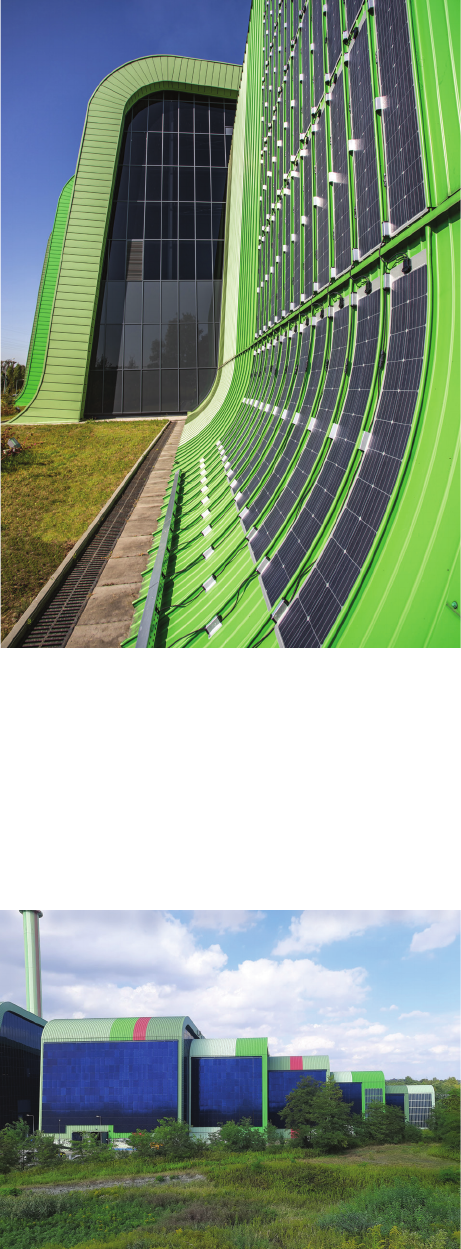
structure. Following a rooftop array, a exible PV system
was added in 2019 on the southern elevation of the main hall
(Krakowski Holding Komunalny 2020). Two façade sec-
tions were clad with exible modules, featuring monocrys-
talline (m-Si) cells embedded in berglass-reinforced poly-
mer with non-reective ETFE front sheet (Kalzip 2019;
DAS Energy 2021). The modules were directly glued to
Kalzip
®
standing seam aluminum cladding, eliminating
the need for substructures and allowing seamless integra-
tion with the curvilinear façade (Fig. 5). Their ribbon-like
format follows the envelope’s sinuous lines, aligning with
vertical seams to preserve visual rhythm and reinforce the
building’s identity. Though visually seamless, the laminates
are added to an existing façade and therefore do not meet
the true denition of BIPV.
Initially, an extension with green-tinted modules was
considered to better match the façade’s colors, however, due
to cost and energy performance considerations, glass m-Si
Fig. 5. Eco-incinerator, Kraków (2019). Flexible m-Si PV modules
following the curved geometry of the green metal façade; the exposed
and rhythmically repeated layout emphasizes the expressive character
of the industrial building (source: courtesy of KHK SA Archives)
Il. 5. Spalarnia odpadów, Kraków (2019). Elastyczne moduły
fotowoltaiczne m-Si dopasowane do zakrzywionej geometrii zielonej
metalowej elewacji; wyeksponowany i rytmicznie powtarzalny układ
podkreśla ekspresyjny charakter budynku przemysłowego
(źródło: fot. z archiwum KHK SA)
Fig. 6. Eco-incinerator, Kraków (2019). Two different PV technologies
on the building façades. The vivid blue of the rigid glass BAPV creates
a striking visual effect against the original envelope
(source: courtesy of KHK SA Archives)
Il. 6. Eco-incinerator, Kraków (2019). Dwie różne technologie PV
na elewacjach budynku. Intensywny niebieski kolor sztywnych
modułów szklanych BAPV tworzy wyrazisty efekt wizualny
na tle oryginalnej powłoki (fot. z archiwum KHK SA)
Industrial building façades as a showcase of changes in building-integrated photovoltaics (BIPV) aesthetics 163
panels were applied as BAPV in 2024 (Krakowski Holding
Komunalny 2020). Mounted on subframes aligned with the
wall’s angle, the rigid, reective surfaces contrast sharply
with the earlier, more sculptural system, disrupting its chro-
matic and volumetric coherence (Fig. 6).
Aesthetic camouflage
As Peharz et al. (2019, 12) observe, “the main value of
BIPV products is now becoming invisibility”. The seamless
integration both visually and constructively reects a funda-
mental shift in how PV is perceived within contemporary ar-
chitectural practice: from a visible symbol of energy gener-
ation to a discreet, integrated part of the façade. This reects
trends identied by Chivelet, Kapsis and Frontini (2025),
highlighting two key directions for future BIPV façades:
personalized PV modules adapted to specic geometries
and grids, and visual camouage through color modulation
or masking patterns.
Colour remains a key factor in enhancing architectural
expression and ensuring visual coherence with surround-
ing materials and building identities (Bonomo et al. 2021).
However, such aesthetic customization often reduces energy
eciency, increases production complexity and cost (Peharz
et al. 2019; Basher et al. 2023). These trade-os are particu-
larly signicant in the context of industrial building façades,
which must balance technical performance and durability
with corporate branding, visual consistency, and economic
feasibility.
To address these challenges, non-pigmented optical tech-
nologies like interference coatings have emerged as promis-
ing alternatives. Based on the principle of selective light re-
ection in nanometric multilayer structures with alternating
refractive indices, these coatings applied to the inner surface
of the front glass generate durable, uniform colours through
optical interference, without aecting the performance of
the active layer. A wide range of colours is achievable – in-
cluding light grey and white – while concealing the underly-
ing cells and ensuring a smooth, homogeneous appearance
(Basher et al. 2023; Borja Block et al. 2024).
The Helmholtz-Zentrum Berlin (HZB) Living Lab Fa-
çade in Berlin-Adlershof (2021) exemplies this approach,
serving as both a research platform and architectural show-
case that demonstrates the technical feasibility of façade-in-
tegrated PV and its potential for architectural aesthetics (Al-
binius et al. 2025).
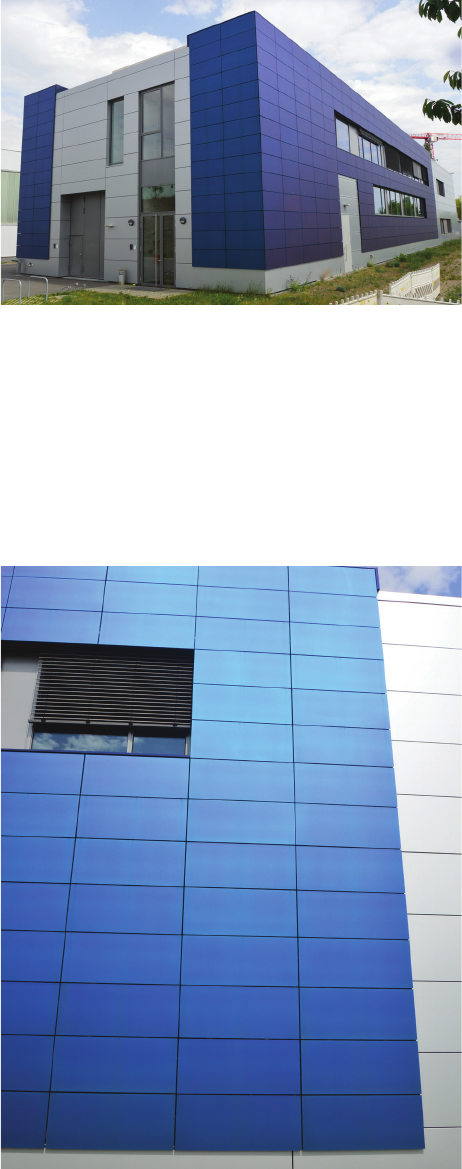
The building features ventilated curtain wall façades clad
with frameless CIGS thin-lm modules, installed across
three elevations (Fig. 7). Special attention was paid to the
design of the BIPV façade to ensure both technical and vi-
sual integration (Energie n.d.). Homogeneously coloured
modules were precisely matched in size, shape, and n-
ish to the adjacent aluminium cladding. A concealed rear-
rail system enabled seamless integration without visible
clamps, preserving visual continuity and ensuring compati -
bility with various substructures.
The blue front glass, free of visible cells or interconnec-
tions, creates a surface akin to continuous tinted glazing.
Depending on light and viewing angle, the hue shifts from
light blue to violet to dark blue (Fig. 8), enhancing chromat-
Fig. 7. Helmholtz-Zentrum Berlin (HZB), Berlin-Adlershof (2021).
The Living Lab BIPV façades serve as a testing platform
and showcase the aesthetic potential of innovative thin-film materials
in architectural integration (photo by M. Muszyńska-Łanowy)
Il. 7. Helmholtz-Zentrum Berlin (HZB), Berlin-Adlershof (2021).
Elewacje BIPV Living Lab pełnią funkcję platformy badawczej,
jednocześnie prezentując estetyczny potencjał innowacyjnych
materiałów cienkowarstwowych w integracji architektonicznej
(fot. M. Muszyńska-Łanowy)
Fig. 8. Helmholtz-Zentrum Berlin (HZB), Berlin-Adlershof (2021).
Blue CIGS modules seamlessly integrated into the curtain wall using
concealed brackets and flexible profiles. The interference coating
masks the cell structure, creating intense colour and light-dependent
gradients, while the matte glass finish adds an elegant appearance
(photo by M. Muszyńska-Łanowy)
Il. 8. Helmholtz-Zentrum Berlin (HZB), Berlin-Adlershof (2021).
Niebieskie moduły CIGS płynnie zintegrowane ze ścianą osłonową
przy użyciu ukrytych uchwytów i elastycznych profili. Powłoka
interferencyjna maskuje strukturę ogniw, tworząc intensywny kolor
i zależne od światła przejścia tonalne, matowe szkło nadaje elewacji
elegancki wygląd (fot. M. Muszyńska-Łanowy)
164 Magdalena Muszyńska-Łanowy, Magdalena Baborska-Narożny
ic modulation while preserving visual harmony. The matte
nish further reduces reectivity, reinforcing the façade’s
aesthetic.
The Living Lab provides long-term, real-world perfor-
mance data on the behaviour of BIPV under varying weather
and seasonal conditions. A dense sensor network monitors
electrical and building physics parameters. Disseminating
data via a dedicated platform supports knowledge transfer.
Tests showed that deeper ventilation cavities improved rear-
side cooling, with limited impact on energy yield, and con-
rmed the energy potential of non-optimal orientations to
produce energy under diuse and reected light (Albinius
et al. 2025; Energie n.d.).
Although twice as costly as a conventional façade (Al-
binius et al. 2025), the BIPV Living Lab façade demonstrates
how innovative PV can be eectively integrated into indus-
trial buildings – supporting sustainability goals, serving as
a research and demonstration platform, and reinforcing ar-
chitectural identity without compromising design integrity.
Conclusions
The analysis of the evolution of opaque BIPV façades
in industrial buildings – based on four case study examples
– high lights how technological advances have directly inu-
enced both the materiality and visual language of industrial
architecture. The comparative approach revealed a gradual
transition from functional, technically driven applications
toward increasingly expressive and design-conscious solu-
tions. This conrms the study’s main assumption that the
aesthetic transformation of industrial building façades is
closely linked to the technological maturation and diversi-
cation of BIPV materials.
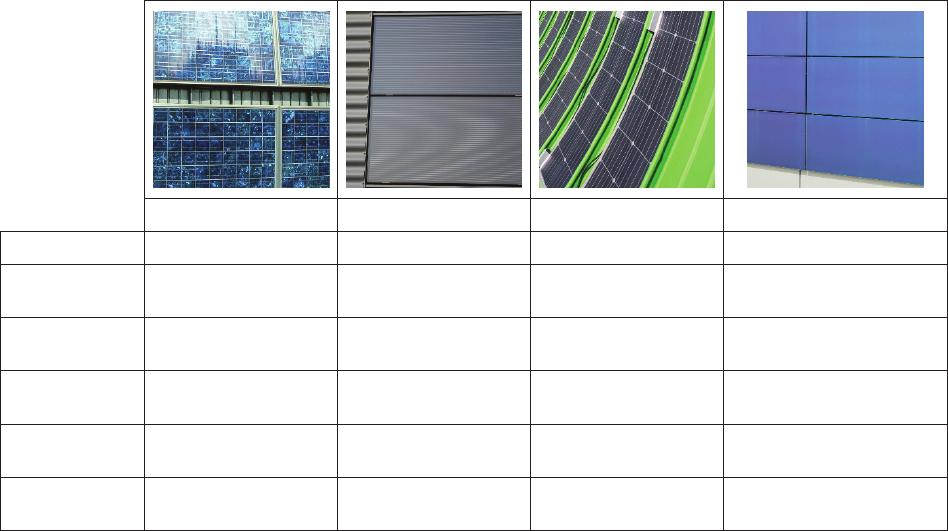
Table 2. The visual properties of BIPV technologies in selected case studies (elaborated by M. Muszyńska-Łanowy)
Tabela. 2. Właściwości wizualne technologii BIPV w wybranych studiach przypadków (oprac. M. Muszyńska-Łanowy)
p-Si glass-foil CIS glass-glass m-Si polymer CIGS glass-glass
Cell visibility High Very low Medium None
Surface texture
Crystalline pattern
(p-Si properties)
Smooth, uniform, stripped
(visible close up)
Textured
(front ETFE properties)
Smooth, uniform
(refined front glass quality)
Color tone Light to dark blue + silver Graphite/black Graphite
Gradient blue-violet-dark blue
(tonal shifts)
Gloss level
Semi-gloss
(front glass properties)
Gloss
(front glass properties)
Low-gloss
(front ETFE properties)
Semi-matte, satin
(treated glass surface)
Visual uniformity
Low – grain boundaries,
cell pattern
High – homogeneous
appearance
Medium – subtle cell
outlines
Very high – no visible cell
or contact pattern
Light interaction
Non-uniform reflection
Shimmering effect
Diffuse reflection,
low-chromatic tonal shifts
Minimal reflectivity
Low tone variation
Light-dependent
chromatic shifts
Over the past three decades, design strategies for PV inte-
gration have evolved from emphasizing the visibility of so-
lar modules to approaches prioritizing visual coherence and
material continuity (Table 2). This transformation has been
driven by signicant technological progress, enabling BIPV
materials to mimic or complement conventional cladding
systems in form, texture, and colour. Early crystalline silicon
systems, with their clearly visible cell grids, reective sur-
faces, and metallic frames, expressed the technological es-
sence of solar architecture and conveyed an explicitly “high-
tech” aesthetic. The subsequent development of thin-lm
and exible technologies enabled a more seamless façade
integration, oering homogeneous surfaces, dark tones, and
customizable formats aligned with the minimalist logic of
industrial architecture. The latest generation of BIPV moves
beyond mere surface treatment toward a deeper architectural
synthesis – where PV elements merge optically and materi-
ally with the building envelope itself. Through interference
coatings, selective light reection, and advanced laminates,
the energy-active façade blurs the boundaries between con-
struction, technology and architectural expression.
Industrial buildings have proven particularly relevant
for the implementation of BIPV, as their large, expressive
fa çades not only accommodate energy generation but also
serve as communicative surfaces for technology branding
and corporate identity. In some cases, they operate as “living
la boratories”, where pilot systems are tested and monitored
under real-world conditions, reinforcing the educational and
promotional roles of such facilities within the broader dis-
course on sustainable architecture. Furthermore, full-scale
demonstrators are essential for validating both the technical
and visual performance of innovative technologies, acceler-
ating their adoption in the industrial building sector.
Industrial building façades as a showcase of changes in building-integrated photovoltaics (BIPV) aesthetics 165
References
Albinius, Niklas, Björn Rau, Maximilian Riedel, and Carolin Ulbrich.
“A Comprehensive Case Study of a Full-Size BIPV Facade.” Ener-
gies 18, no. 5 (2025): 1293. https://doi.org/10.3390/en18051293.
Basher, Mohammad Khairul, Mohammad Nur-E-Alam, Md Momtazur Rah-
man, Kamal Alameh, and Steven Hinckley. “Aesthetically Appealing
Building Integrated Photovoltaic Systems for Net-Zero Energy Buildings:
Current Status, Challenges, and Future Developments – A Review.” Build-
ings 13, no. 4 (2023): 863. https://doi.org/10.3390/buildings13040863.
Berger, Karl, Ana Belén Cueli, Simon Boddaert, et al. International De-
nitions of “BIPV”. Report IEA-PVPS T15-04:2018. International En-
ergy Agency Photovoltaic Power Systems Programme, August 2018.
https://iea-pvps.org/key-topics/international-denitions-of-bipv/.
Bonomo, Pierluigi, and Francesco Frontini. “Building Integrated Photo-
voltaics (BIPV): Analysis of the Technological Transfer Process and
Innovation Dynamics in the Swiss Building Sector.” Buildings 14,
no. 6 (2024): 1510. https://doi.org/10.3390/buildings14061510.
Bonomo, Pierluigi, Gabriele Eder, Nuría Martín Chivelet, et al. Catego-
rization of BIPV Applications. Breakdown and classication of main
individual parts of building skin including BIPV elements. Report
IEA-PVPS T15-12:2021. International Energy Agency Photovoltaic
Power Systems Programme (IEA-PVPS). August 2021. https://iea-
pvps. org/key-topics/categorization-of-bipv-applications/.
Bonomo, Pierluigi, Francesco Frontini, Rudi Loonen, and Arno H.M.E.
Reinders. “Comprehensive Review and State of Play in the Use of
Photovoltaics in Buildings.” Energy and Buildings 323 (2024):
114737. https://doi.org/10.1016/j.enbuild.2024.114737.
Borja Block, Alejandro, Jordi Escarré Palou, Marie Courtant, et al. “Co-
louring Solutions for Building Integrated Photovoltaic Modules:
A Review.” Energy and Buildings 314 (2024): 114253. https://doi.
org/10.1016/j.enbuild.2024.114253.
Call, Jon, Uday Varde, Alla Konson, Mike Walters, Chad Kotarba III, Tim
Kraft, and Subhendu Guha. “Methodology and systems to ensure re-
liable thin-lm PV modules.” In: Reliability of Photovoltaic Cells,
Modules, Components, and Systems, edited by Neelkanth G. Dhere.
Proc. SPIE 7048, 70480S, 2008. https://doi.org/10.1117/12.797103.
Chivelet, Nuria Martín, Costa Kapsis, and Francesco Frontini. Build-
ing-Integrated Photovoltaics: A Technical Guidebook. Routledge,
2025.
https://iea-pvps.org/key-topics/book-building-integrated-photo-
voltaics-a-technical-guidebook/.
Constantinou, Stephanos, Faris Al‐Naemi, Hameed Alrashidi, Tapas Mal-
lick, and Walid Issa. “A Review on Technological and Urban Sustain-
ability Perspectives of Advanced Building‐Integrated Photovoltaics.”
Energy Science and Engineering 12, no. 3 (2024): 1265–93. https://
doi.org/10.1002/ese3.1639.
Corus Bausysteme. Kalzip® Report: New Solar Cell Plant, Deutsche Shell
AG. Corus Bausysteme, 2001.
Czernek, Dorota. “Fotowoltaika w obiekcie przemysłowym. Zakład Termicz-
nego Przekształcania Odpadów w Krakowie.” Published June 2024.
Accessed May 10, 2025, at https://haleprzemyslowe.muratorplus.pl/in -
wes tycje/fotowoltaika-w-obiekcie-przemyslowym-zaklad-termicznego-
prze ksztalcania-odpadow-w-krakowie-aa-WTjF-5f1x-CnJP.html.
DAS Energy. “DAS Energy News – Waste Incineration Plant Becomes
Solar Power Plant.” Published March 2021. Accessed May 10, 2025,
at https://das-energy.com/en/news/181.
DETAIL Architecture. “Solarkleid in Schwarz.” Published February 2010.
Accessed May 4, 2025. https://www.detail.de/de_de/solarkleid-in-
schwarz-833.
Deutsche Shell. 1999. “Produktionsstart in Shell Solarzellenfabrik / Vision
vom europäischen ‘Solar Valley’ nimmt Gestalt an.” OTS (Original-
text-Service), APA, 1999. Accessed May 10, 2025. http://www.new-
saktuell.de/4d.acgi$SendPICS?A.
Energie, Helmholtz-Zentrum Berlin für Materialien und. ‘Living Lab for
BIPV’. HZB Website. Accessed May 4, 2025. www-helmholtz-ber-
lin.de/projects/pvcomb/forschen/living-lab-bipv/index_en.html.
Fundació Mies van der Rohe. “Waste Thermal Treatment Plant.” Fun-
dació Mies van der Rohe, 2025. Accessed May 9, 2025. https://mie-
sarch.com/work/3283.
Hagemann, Ingo B. Gebäudeintegrierte Photovoltaik: Architektonische In-
tegration Der Photovoltaik in Die Gebäudehülle. Rudolf Müller, 2002.
Kalzip. Kalzip® Systeme Handbuch für Technik, Planung und Konstruk-
tion. Published 2019. Accessed May 6, 2025, at https://www.kalzip.
com/wp-content/uploads/2019/12/Kalzip-Technikbroschuere- Dach-
systeme-1.pdf.
Krakowski Holding Komunalny. “Innowacyjne folie fotowoltaiczne na
elewacji Ekospalarni.” Published September 2020. Accessed May 2,
2025, at https://khk.krakow.pl/pl/aktualnosci/innowacyjne-folie-fo-
towoltaiczne-na-elewacji-ekospalarni/.
Krehl Girke Architekten. “Sulfurcell Solarfabrik Berlin.” Published n.d.
Accessed May 9, 2025, at https://www.krehlgirke.de/sulfurcell-solar-
technik-berlin.
Kuhn, Tilmann E., Christof Erban, Martin Heinrich, Johannes Eisenlohr,
Frank Ensslen, and Dirk Holger Neuhaus. “Review of Technological
Design Options for Building Integrated Photovoltaics (BIPV).” En-
ergy and Buildings 231 (2021): 110381. https://doi.org/10.1016/j.
enbuild.2020.110381.
Li, Zhenpeng, Sinan Li, Jinyue Yan, Jinqing Peng, and Tao Ma. “Balanc-
ing Aesthetics and Eciency of Coloured Opaque Photovoltaics.”
Nature Reviews Clean Technology, no. 1 (2025), 216–26. https://doi.
org/10.1038/s44359-025-00032-6.
Marchwiński, Janusz. Rola pasywnych i aktywnych rozwiązań słonecz-
nych w kształtowaniu architektury budynków biurowych i biurowo
-przemysłowych. PhD diss., Politechnika Warszawska, 2005.
Muszyńska-Łanowy, Magdalena. Fotowoltaika w kształtowaniu elewacji
budynków przemysłowych na przełomie XX/XXI wieku. PhD diss., Po-
litechnika Wrocławska, 2009.
Neuwirth, Marius, Tobias Fleiter, and René Hofmann. “Modelling the
Transformation of Energy-Intensive Industries Based on Site-Specic
Investment Decisions.” Scientic Reports 14, (2024): 30552. https://
doi.org/10.1038/s41598-024-78881-7.
Parolini, Fabio, Pierluigi Bonomo, Francesco Frontini, et al. Advancing BIPV
Standardization: Addressing Regulatory Gaps and Performance Chal-
lenges. Report IEA-PVPS T15-24:2024. International Ener gy Agen-
cy Photovoltaic Power Systems Programme (IEA-PVPS). December
2024. https://iea-pvps.org/key-topics/advancing- bipv- standardi za-
tion- addressing-regulatory-gaps-and-performance-challenges/.
Peharz, Gerhard, Pierluigi Bonomo, Erika Saretta, et al. Coloured BIPV:
Market, Research and Development. Report IEA-PVPS T15-07:2019.
International Energy Agency Photovoltaic Power Systems Prog ramme
However, despite advances in both technical and visual
integration, BIPV remains a niche segment, and rooftop-
mounted BAPV systems continue to dominate. Expanding
the knowledge base and design literacy among architects,
engineers, and investors is crucial for unlocking the archi-
tectural potential of BIPV façades. The current moment
represents a critical phase in the wider adoption of the tech-
nology – one that requires aligning architectural ambition,
technical capability, and economic feasibility. Real progress
will depend not only on continued material innovation but
also on the dissemination of practical knowledge, interdisci-
plinary collaboration, and policy support that recognizes the
aesthetic dimension of solar architecture.
Future research should continue to explore how emerg-
ing BIPV technologies – such as coloured coatings, exible
laminates, and novel photovoltaic materials – can further
enhance the expressive and communicative capacities of
industrial envelopes, strengthening their role within sustain-
able architectural practice.
166 Magdalena Muszyńska-Łanowy, Magdalena Baborska-Narożny
Streszczenie
Elewacje budynków przemysłowych jako wyraz zmian w estetyce fotowoltaiki zintegrowanej z budynkiem (BIPV)
Tematem artykułu jest ewolucja estetyki nieprzezroczystych systemów fotowoltaicznych zintegrowanych z budynkiem (BIPV) w architekturze prze-
mysłowej. Fotowoltaika, jako kluczowy element transformacji energetycznej budynków, zyskuje na znaczeniu – szczególnie dzięki możliwości integracji
z elewacjami. Rozwiązania BIPV nadal pozostają jednak niszowe, głównie z powodu wysokich kosztów, złożoności technicznej oraz ograniczonej świa-
domości wśród projektantów.
Celem badania było ukazanie, w jaki sposób ewolucja technologiczna nieprzezroczystych modułów fotowoltaicznych wpłynęła na zmiany w estetyce
elewacji przemysłowych. Analiza została oparta na literaturze naukowej i specjalistycznej, dokumentacji technicznej oraz obserwacjach terenowych
wybranych obiektów w Niemczech i Polsce. Przeanalizowano cztery przykłady reprezentujące kluczowe etapy rozwoju technologii BIPV: od wczesnych
modułów krzemowych, przez cienkowarstwowe technologie na szkle, elastyczne laminaty, aż po zaawansowane rozwiązania estetyczne z zastosowaniem
powłok interferencyjnych.
Uzyskane wyniki wskazują na wyraźną zmianę podejścia do projektowania systemów BIPV – od akcentowania technologii fotowoltaicznej jako
elementu futurystycznego designu, w kierunku poszukiwania wizualnej harmonii i „estetycznego kamuażu” modułów PV. Estetyka BIPV staje się coraz
bardziej zindywidualizowana dzięki rosnącym możliwościom personalizacji koloru, formatu i faktury modułów. Pomimo postępu technologicznego
elewacje zintegrowane z BIPV wciąż rzadko są stosowane w budynkach przemysłowych, gdzie dominują systemy fotowoltaiki aplikowanej na budynku
(BAPV) montowane na dachach. Dalszy rozwój BIPV w architekturze przemysłowej wymaga zwiększenia świadomości projektantów oraz promowania
udanych realizacji, które łączą efektywne wytwarzanie energii z wysoką jakością architektoniczną.
Słowa kluczowe: architektura przemysłowa, fotowoltaika zintegrowana z budynkiem (BIPV), estetyka fotowoltaiki, fasady BIPV, nieprzezroczysta
fotowoltaika
(IEA-PVPS). February 2019. https://iea-pvps.org/key- topics/iea-
pvps-15-r07-coloured-bipv-report/.
Smith, Andrew R., Mehrdad Ghamari, Sasireka Velusamy, and Senthilara-
su Sundaram. “Thin-Film Technologies for Sustainable Building-In-
tegrated Photovoltaics.” Energies 17, no. 24 (2024): 6363. https://doi.
org/10.3390/en17246363.
Sulfurcell Solartechnik. Product information: Solar Facade Cassettes.
Sulfurcell (n.d. a). Accessed May 10, 2025, at https://www.soltecture.
de/uploads/media/Data_sheet_cassette_03.pdf.
Sulfurcell Solartechnik. Solar Construction with Sulfurcell: Groundbreak-
ing Industrial Architecture. Soltecture (n.d. b). Accessed May 10,
2025, at https://www.yumpu.com/en/document/read/29139188/solar-
con struction-with-sulfurcell-groundbreaking-soltecture.
Sulfurcell Solartechnik. Solar Construction with Sulfurcell: New Solutions
with Style. Thin-Film Solar Modules Based on CIS Semiconductors.
Sulfurcell (n.d. c). Accessed May 10, 2025, at https://www.soltecture.
de/uploads/media/Sulfurcell_Image_Brochure_engl_03.pdf.
Van Noord, Michiel, Nuría Martin Chivelet, Nanduni Weerasinghe, et al.
Analysis of Technological Innovation Systems for BIPV in Dierent
IEA Countries. Report IEA-PVPS T15-23:2025. International Ener-
gy Agency Photovoltaic Power Systems Programme (IEA-PVPS).
March 2025. https://doi.org/10.69766/FCQP1359.
Weller, Bernhard, Claudia Hemmerle, Sven Jakubetz, and Stefan Unne -
wehr. Detail Practice: Photovoltaics: Technology, Architecture, In-
stalla tion. Birkhäuser, 2010.