
2025
4(84)
Blanka Melania Ciężka*
From a Residential Garden to an Inner-City Square:
Transformations of the Space
of the Saxon Garden in Warsaw
DOI: 10.37190/arc250409
Published in open access. CC BY NC ND license
Abstract
A large proportion of today’s European inner-city parks are former residential gardens that have been gradually incorporated into the public realm
of cities. The Saxon Garden in Warsaw is an example of a park that has undergone a dierent evolution from most similar ensembles – instead of
becoming an enclosed space, it has been transformed into an inner-city square accessible around the clock and traversed by numerous circulation
routes. Its location next to Piłsudski Square, a place marked by a dicult history, means that the Garden remains a space that has never been fully
conceptually resolved, entangled from the outset in a permanent state of spatial and functional tension resulting from the unstable urban fabric of its
surroundings.
This article is based on an analysis of archival sources and the scholarly literature, as well as a detailed comparative analysis of the form, layout
and furnishings of the Saxon Garden and its setting, which makes it possible to capture the specicity of its development against the background of
transformations of public spaces in European city centres.
Keywords: Saxon Garden, public space, urban greenery, urban planning, park
Introduction
Many contemporary public city parks are former resi-
dential gardens which, due to their location within growing
urban boundaries or in their immediate vicinity, were grad-
ually integrated with the city and now form part of its green
inner-city public spaces. An interesting case of such a park
is the Saxon Garden in Warsaw, laid out under Augustus II
as the residential garden of the Saxon Axis. Today it func-
tions more as a transitory inner-city square, woven into the
city’s circulation network.
The aim of this article is to answer the question of which
elements in the changing accessibility of the Saxon Garden
in Warsaw determined that a residential space of such out-
standing historical signicance transformed into an inner-city
square with only a partially preserved structure. The time-
frame of the research spans from the creation of the garden in
the 1720s to the present day.
State of Research
Although the Saxon Garden has a relatively extensive
literature – it appears both in publications on the forms of
Polish historic gardens (Bobrowski 1954; Ciołek 1954) and
in studies on the Saxon Axis (Bernatowicz 1995; Bie niecki
1960; Kłosek-Kozłowska 2017) – no one has so far attempt-
ed to answer why it turned into an inner-city square and
which events determined this. The Saxon Garden appears
partly in the context of the urbanism of Pił suds ki Square
and of the history directly related to the former Sa xon
Palace building (Zieliński 2019; Wójtowicz 2019; Rot ter -
mund 1969; Jonkajtys-Luba 1995; Trybuś 2012; Stę piński
1988). All these works focus primarily on the space of the
square itself, the sources of its decomposition, its trans-
port value and buildings; the space of the Saxon Garden
is treated marginally. The only monographic work devoted
* ORCID: 0009-0008-9982-9383. Muzeum Warszawy (Museum
of Warsaw), e-mail: blanka.ciezka@muzeumwarszawy.pl
100 Blanka Melania Ciężka
specically to the Garden remains Elżbieta Charazińska’s
book (1979).
Description of the Research Method
The applied research method consists in analysing how
the function of the Saxon Garden has changed since its in-
ception and what relationship the garden has had with the
surrounding urban space, with particular attention to the
built urban fabric, public spaces (their function and signif-
icance for the city) and the transport network. Equally im-
portant is a comparative analysis of the layout and forms
of the Saxon Garden and its immediate setting. To this end,
historical studies, city plans, iconographic materials and ur-
ban design projects (including unrealised ones) were anal-
ysed, as they reveal ways of thinking about this space – and
the evolution thereof.
A Private Court Garden within the Saxon Axis
The Saxon Garden was created as one element of the late
Ba roque urban composition of the Saxon Axis, which ini-
tially served three functions: residential, military and trans-
port (Bie niecki 1960, 484). In its early form it was a typical
for mal residential garden, functionally connected with the
palace itself. As a private space it had no links with the urban
public realm, even though it was already surrounded on all
sides by the expanding city. This resulted from two factors.
First, the Saxon Axis began to be implemented in an area
of pre-existing urban structures, which entailed extensive
demolitions and expropriations and, above all, condemned
the Saxon Garden from the moment of its creation to a spa-
tial and functional deadlock in relation to an unstable urban
fabric.
Second, the transport function of the Saxon Axis meant
that the composition contained within its boundaries both
routes serving the royal residence and public roads (Bie-
niecki 1960, 486–487). Their location in the immediate vi-
cinity of the Saxon Garden posed no problem in the early
18
th
century, but the situation changed dramatically once the
decision was made not to develop the Saxon complex any
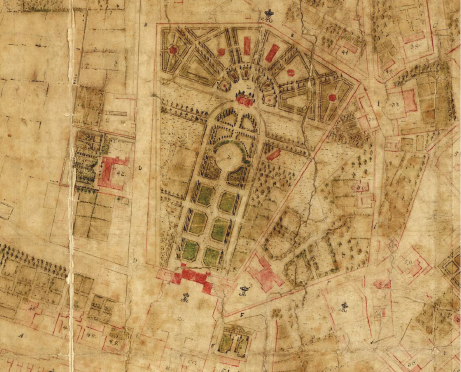
further while urban trac continued to grow (Fig. 1).
According to Tadeusz Tołwiński, a series of city squares
formed around the central mass of the Garden on a shared
com munication orbit in a later period: Teatralny, Bankowy,
Pił sud skiego and Małachowskiego Squares (Tołwiński 1963,
159–160). Already in the early period, on the western side,
the interior of the Garden was linked to the marketplace of
Wielopole. From the east the palace forecourt was connect-
ed to the busy Krakowskie Przedmieście street. Kró lew ska
Street, bordering the Saxon Garden to the south, was re gu-
lated symmetrically to the existing northern road along the
city walls, where private estates belonging to the Sanguszko
family and later to Heinrich Brühl were also located
(Bieniecki 1960, 473).
From 1735 the Garden was enclosed to the south by a brick
wall with bastions; from the west access was provided by
the Iron Gate (Żelazna Brama), to which guardhouses were
later added (Charazińska 1979, 34). In social terms it was
also an isolated space, although here certain changes can be
observed. In many studies, 27 May 1727 is cited as the date
on which the Saxon Garden was opened to the “inhabitants
of the capital” or made accessible “to the public” (Cha ra ziń-
ska 1979, 44). This aspect seems to require deeper study,
since other examples of opening residential gardens to the
public in Europe suggest that these could not have been the
“inhabitants of the city” at large, but only selected represen-
tatives of the higher social strata. Paul Keenan (2010) oers
a good analysis of the social structure of visitors to the Sum-
mer Garden in Saint Petersburg in the mid-18
th
cen tury, cit-
ing decrees that specied who could enter the gar den and
when, and that set strict requirements for visitors’ attire – it
had to be “neat and European”. This alone meant that the
visitors could only be a very narrow group of the better-born.
The Garden in the Context
of the Abandonment of the Saxon Axis
The year 1763 brought a fundamental change in the di -
rection of development for the Saxon Garden. At that time
the Saxon Palace ceased to be a royal residence. The Garden
therefore lost its function as a residential garden, and the
funds allocated for its upkeep diminished, while the formu-
la of its use became more relaxed. This is evidenced by
facts cited by Charazińska (1979, 47–49): ower beds and
parterres were replaced with lawns, benches appeared along
the alleys, and Baroque structures were gradually replaced
with rows of trees providing shade for walkers. Small
kiosks selling beer were set up by the Iron Gate, at the
entrance to the Garden. The water reservoir in the central
part of the Garden, which had previously supplied the royal
fountains, was turned into a place where cold drinks were
sold, while baked goods from the bakery operating in a side
wing of the former royal palace were carried through the
alleys and sold to visitors. In 1804 the Grand Salon was
con verted into a dining pavilion (Charazińska 1979, 50–51).
Fig. 1. C.F. von Werneck, plan of Warsaw (fragment),
scale approx. 1:2500–1:4200, 1732
(source: AGAD, Cartographic Collection, 86–21)
Il. 1. C.F. von Werneck, plan Warszawy (fragment),
skala ok. 1 : 2500 – 1: 4200, 1732
(źródło: AGAD, Zbiór Kartograficzny, 86–21)
From a Residential Garden to an Inner-City Square: Transformations of the Space of the Saxon Garden in Warsaw 101
During this period the Saxon Garden became surrounded
by new streets and blocks of buildings developed without
an overarching plan. The development of the Baroque axis
had from the outset required excessive nancial outlays and
had already slowed down in the Saxon period (Bieniecki
1960, 490). When Stanisław August Poniatowski came to
the throne, work on the Axis was entirely abandoned. In
1757 the Bielino jurisdiction was created, but it was not in -
tegrated into the transport network of the Saxon complex
from the west, which meant that the development of its
structure – including the main artery, later Marszałkowska
Street – proceeded independently of the Saxon complex
(Bie niecki 1960, 489). In the western part of the complex,
around Chłodna Street, a network of new streets also
emerged, including Grzybowska Street. However, it was
not connected to Królewska Street, which could have creat-
ed an east–west transport axis leading all the way to Kra-
kow skie Przedmieście. Thus the eastern part, with the Gar-
den, and the western part lost their connection.
This transitional period was also the time when the con-
text of Saxon Square began to gain importance for the Gar-
den. The former palace courtyard, which had served as yet
another buer for the Garden on the side of Krakowskie
Przed mieście, began to evolve into a public square once the
gates located on its northern and southern sides were re -
moved in 1791 (Bieniecki 1960, 490). Indirectly this also
brought the Saxon Garden closer to the city’s public life
– this time from the east. At the same time – a fact of great
importance for the later period – removing the gates made it
possible to create a transport route linking Wierzbowa Street
with Ewangelicki (now Małachowskiego) Square, running
directly along the western frontage of the Saxon Palace.
The period of the Duchy of Warsaw was a time of stagna-
tion for the Garden: devastated and degraded, it ceased to be
frequently visited; public life shifted to the Krasiński Gar den,
opened to the public in 1768. As in the case of the 18
th
-cen-
tury Saxon Garden, the social structure of visitors to the
Krasiński Garden in this period requires study. When in 1816
Prince Konstanty, the viceroy of War saw, moved into the
Brühl Palace, the Saxon Garden was reduced to a technical
backyard – horses were grazed there and preparations for
military parades were carried out (Cha razińska 1979, 58).
Transformation into a City Park
In terms of integration with the urban space, the period
of the Congress Kingdom of Poland was the most dynamic
for the Saxon Garden. Jarosław Zieliński notes that it was
then that “the Saxon Garden (…) became more of an urban
interior than a part of a palace complex” (Zieliński 2019,
117). In my view, at that time it was not part of a palace
complex at all, as such a complex no longer existed. The
building of the former palace, handed over to government
administration at the end of the 18
th
century, became a lycée
in 1802, its wings were rented out as housing, and after
being remodelled to a design by Wacław Ritschel / Adam
Idźkowski it was turned into a commercial tenement house
(Bieniecki 1960, 492–493).
Tadeusz Bernatowicz writes that this was the time when
“the process of incorporating the Saxon Garden into the
structure of the modern city” occurred (1995, 96); however,
he does not add that this was part of a broader concept of
regulating inner-city squares and ordering public spaces.
This process, initiated by the Construction Council (Rada
Budownicza), included the construction or reconstruction
of representative squares: Zamkowy, Teatralny, Ewangelicki,
Trzech Krzyży and Bankowy (Pietrzak-Pawłowska 1973,
25). Because of its location, the Saxon Garden had to be
in cluded in this process: to implement these plans, its ad -
ministrative status had to be changed. In 1815 the Ministry
of the Interior approached the Treasury Commission with
a request to prepare a project for transforming the Saxon
Garden into a public city park (Charazińska 1979, 58). This
led to changes within the Garden (1815–1827) and its
adapta tion to the landscape style. The design was prepared
by James Savage, succeeded after his death by gardener Jan
Stro bel (Bieniecki 1960, 493–494).
The Garden was considered in the context of creating
a representative and functional sequence of urban interiors
(Kło sek-Kozłowska 2017). This seems to be conrmed by
seemingly minor yet important facts: when regulating
Żelaznej Bramy Square, the Grand Salon was demolished
in order to obtain a visual connection with the square, and
the new entrance was set back deeper into the park (eec-
tively at the cost of reducing its area); on the side facing
Ewan gelicki Square, the greenery was composed so that the
body of the Evangelical church would be visible from the
Gar den; new gates were created (from Marszałkowska, Ża -
bia, Niecała and Królewska Streets); the brick wall was
replaced with an openwork fence. In this way the space of
the Saxon Garden interpenetrated the surrounding urban
space and together with it formed public spaces.
As part of the reconstruction of the former Saxon Palace
in 1839–1842, the Garden received its most spectacular
visual and transport connection with Saxon Square, created
by piercing the central part of the palace body with a col-
onnaded passage (Zieliński 2019, 156). The Saxon Garden
certainly took over the function of a well-performing and
– in contemporary terms – engaging public space, which
Saxon Square itself did not possess. This is evidenced by
the rich service and entertainment infrastructure with which
it was equipped throughout the 19
th
century. In this respect
it did not dier from other former residential gardens in
Europe adapted to public use, such as Hyde Park in London,
the Summer Garden in Saint Petersburg or the Tui le ries in
Paris. Yet one may ask whether this socially oriented role
of the Saxon Garden did not also stem from a deliberate
policy on the part of the authorities and whether it did not
serve as a kind of “lightning rod” for the problematic space
of Saxon Square, intended as a place for manifesting power
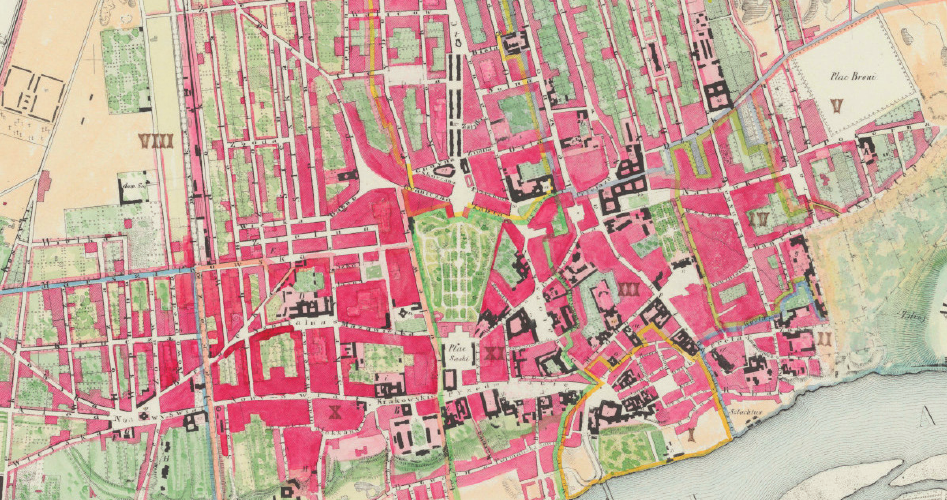
(Fig. 2).
The Neighbourhood of Piłsudski Square
The formula of the Saxon Garden as the exclusive “Sa-
lon of Warsaw” began to be exhausted at the end of the 19
th
century. The causes of this phenomenon have not yet been
clearly identied. Social transformations and new needs of
the urban community inhabiting adjacent areas, which the
Garden was no longer able to satisfy at that stage, most like-
102 Blanka Melania Ciężka
views and public demonstrations (Hübner-Wojciechowska
1991). It still did not provide a public function that would
meet the everyday needs of residents.
Clash with the Transport Factor
The urban development of Warsaw made the transport
fac tor increasingly strongly aect the Saxon Garden, lo-
cated across the main direction of the city’s growth, which
progressed largely on the north–south axis, parallel to the
Vi stula. With the growing importance of southern districts
and the need to connect them with northern ones, a project
to extend Marszałkowska Street through the Saxon Garden
was already proposed in 1888, bu t public opposition halted
its implementation (Bieniecki 1960, 510). The seven gates
to the Garden at the end of the 19
th
century testied not only
to the park’s popularity but also to the fact that it was sur-
rounded, from many sides, by a living urban organism clam-
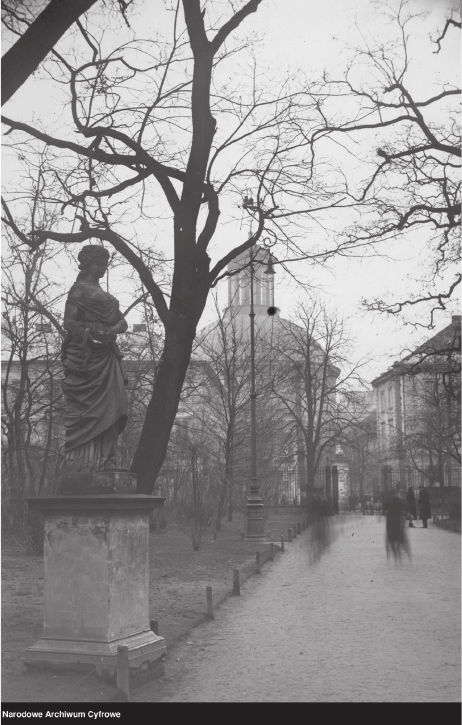
ouring for new routes (Fig. 3).
In 1904 the municipal authorities presented a concept for
a vehicular connection through the Garden from the gate at
Marszałkowska to the gate at Niecała (Charazińska 1979,
124). Before the First World War, a proposal was made to
unblock trac on the northern side – to connect Kotzebue
Street (now Fredry) at the Garden’s boundary with Saxon
Square through the Brühl Palace site (Charazińska 1979,
130, 131). Although neither of these ideas was realised, the
internal structures of the park were adapted – the number of
owerbeds and lawns was reduced in favour of new alleys,
which testied to the need to create a miniature network of
routes within the Saxon Garden to link the parts of the city
lying on its opposing sides.
ly played a part. The eastern side was becoming a grand,
representative area of the city, with services aimed at
a high-status clientele, the residences of the urban elite and
a carefully conceived architectural setting. To the west of the
Garden, by contrast, the district acquired a clearly industri-
al and commercial character, with marketplaces and dense
residential development (Kłosek-Kozłowska 2017, 13–14).
The Saxon Garden was not helped in maintaining its
prestige by the problematic proximity of Saxon Square
which, instead of serving residents, was used by the occu-
pying authorities to manifest their dominance. A symbol of
this was the obelisk-monument to the Fallen Poles (ocers
loyal to the tsar) erected on the axis of the square in 1841
(Zieliński 2019, 144–150). Sold in 1864 by the heirs of Sk-
warcow to the Russian authorities, the Saxon Palace lost its
commercial function – controversial from the perspective of
its original use, but contributing to the animation of the sur-
rounding space, including the Garden – and became the seat
of military authorities. The ultimate dismantling of the spa-
tial composition of Saxon Square came with the construc-
tion, in 1894–1912, of the Orthodox cathedral of St Alexan-
der Nevsky, whose massive Byzantine-style body did not
cor respond to any of the existing buildings and dominated
the Garden (Zieliński 2019, 176–183).
Surprisingly, the situation of the Saxon Garden in this re-
spect did not improve after Poland regained independence.
Saxon Square, marked by its dicult history, began to be
treated as a space of memory, with a strong patriotic and
representative dimension, with patriotic symbols placed
there – the monument to Prince Józef Poniatowski and the
Tomb of the Unknown Soldier (Zieliński 2019, 222, 223).
The square again became a place for parades, military re-
Fig. 2. Plan of Warsaw by officers of the General Staff of the Russian army, officers of the Corps of Military Engineers and Józef Koriot (fragment),
scale approx. 1:4200, 1846 (source: Museum of Warsaw, ref. MHW 17386)
Il. 2. Plan Warszawy oficerów Sztabu Generalnego armii rosyjskiej, oficerów Korpusu Inżynierów Wojskowych i Józefa Koriota (fragment),
skala ok. 1:4200, 1846 (źródło: Muzeum Warszawy, sygn. MHW 17386)
From a Residential Garden to an Inner-City Square: Transformations of the Space of the Saxon Garden in Warsaw 103
Modernism in urbanism – to put it briey and syntheti-
cally – was characterised by privileging motorised trac
in cities and simultaneously abandoning the values of tra-
ditional urbanism in the creation of multifunctional public
spaces (Stangel 2013, 29–39). A park located in the very
city centre occupied an area where new arterial roads could
be routed. In 1917 Tołwiński revived the idea of a thorough-
fare through the western part of the Garden – i.e., extend-
ing Marszałkowska Street to Bankowy Square (Tołwiński
1917). The Saxon Garden was entered into the national
re gister of monuments in 1921 (Kłosek-Kozłowska 2017,
20), yet at the same time it found itself, as a result of com-
prehensive urban studies and development plans for the in-
ner city drawn up in the 1920s, in the heart of the so-called
“city” – its geometric centre was dened as the intersection
of Mar szałkowska Street and the Saxon Axis (Tomaszew-
ski 1965, 96–97), which at that time did not exist. This was
analogous to the situation of the Congress Kingdom peri-
od – the Garden again found itself at the centre of planned
regulatory works, except that this time they conicted with
the Garden’s space and could not inuence it favourably.
Planners treated the streets surrounding the Garden primari-
ly as elements of transport infrastructure, not as spaces with
a social dimension.
In 1934 a competition was announced for the functional
and transport design of Piłsudski Square. Concepts emerged
to connect the square with Powiśle and to design bold so-
lutions such as a tunnel under the entire Garden running
from Że laznej Bramy Square to Aleja na Skarpie, leading
to a bridge over the Vistula (Architektura i Budownictwo
1935). The authors of this idea and winners of the rst prize,
Kazimierz Tołłoczko and Jan Kukulski, proposed what at
rst glance appeared drastic – a two-level metro station un-
der Piłsudski Square and a tunnel under the Garden. How-
ever, the project did not interfere with the Garden’s space;
it envisaged pedestrian trac along the main park alley,
which was to serve as a link between the areas adjoining
the Garden from the east and west. In a way, the planners
continued the urban thinking behind the Saxon Axis; this
solution would also have made it possible to avoid routing
Marszałkowska Street through the western part of the park
(though it must be noted that these were only paper schemes
– the implementation of such a technically advanced project
could have critically aected the Garden’s space and eco-
system). The design was not executed, and in 1935 Mar-
szał kowska Street was extended to Żelaznej Bramy Square,
thereby severing the south-western part of the park with
a motor trac strip. In 1941, the German occupation author-
ities extended Marszałkowska further from Żelaznej Bra my
Square to Bankowy Square, completely cutting o the west-
ern part of the Garden.
After the war, the space surrounding the Saxon Garden
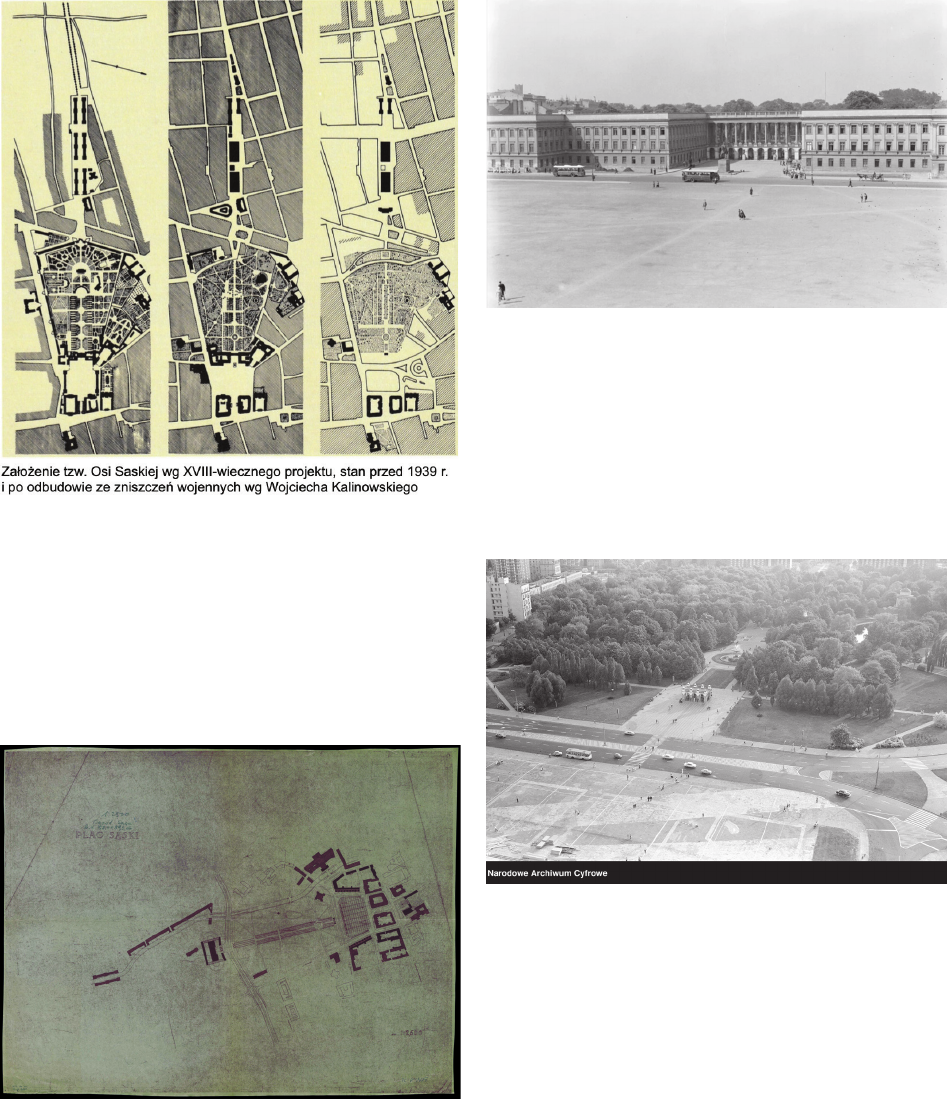
was further subordinated to transport arrangements (Fig. 4).
The route of Marszałkowska Street was eventually adjusted
to the surviving old tree stands in the western part of the
Garden (Fig. 5), and from 1948 tram trac ran along it. Be-
fore 1950 the damaged Garden fence was removed. A low
concrete wall was built in its place, with gaps which seam-
lessly linked the Garden – now in fact a square – with the
surrounding urban space. This is clearly visible at the en-
trance from Królewska Street, which forms a clear connec-
tion between the green space and the pedestrian crossing.
War damage (including the demolition of the General
Sta building) to some extent reopened the Saxon Garden to
the city – the townhouses on Królewska Street and the Sax-
on Palace disappeared. The square became directly linked
with the Garden. The former route connecting Wierz bowa
Street with Ewangelicki Square, used in the 19
th
century by
pedestrians and horse-drawn trac, had already turned into
an arterial road for cars in the interwar period (Fig. 6). In
the 1980s this route consisted of two three-lane carriage-
ways in each direction. In the late 1960s, in connection with
the reconstruction of the Grand Theatre, a road interchange
linking the areas of Teatralny and Victory (Zwycięstwa)
Squares was created on the former Brühl Palace site, direct-
ly adjacent to the Garden (Fig. 7). The surface of Victory
Square was used as a car park.
The urban composition of the Saxon Axis was entered
into the national register of monuments in 1965. Subsequent
design competitions for the regulation of this area in the
1970s and 1980s began to include proposals for rebuilding
the Saxon and Brühl palaces (Kłosek-Kozłowska 2017, 17).
However, planners’ attention focused on architecture and
Fig. 3. Southern part of the Saxon Garden, view of the entrance
from Królewska Street, 1926 (source: NAC, ref. 3/1/0/9/7361)
Il. 3. Południowa część Ogrodu Saskiego, widok na wejście
od strony ulicy Królewskiej, 1926 (źródło: NAC, sygn. 3/1/0/9/7361)
104 Blanka Melania Ciężka
the immediate arrangements around it, with particular em-
phasis on the area of Piłsudski Square. No interventions in
the Garden itself were envisaged. Nor was this space con-
sidered in terms of its links with other urban interiors of the
former Saxon complex.
New Perspectives on Inner-City Spaces
Towards the end of the twentieth century, planners’ think -
ing about the space of the Saxon Garden began to change. In
1998, as part of the Local Spatial Development Plan for the
Saxon Axis, a concept for the Garden’s restoration was pre-
pared by landscape architects Wojciech Trzópek and Marek
Szeniawski – alongside the reconstructed build ings of the
Saxon Palace, Brühl Palace and the townhouses on Królews-
ka Street, the 19
th
-century structure of the Saxon Garden as
an enclosed space was to be restored. This can be linked to
a turn in urban planning towards landscape-oriented design,
which favours green infrastructure and the historical tradi-
tions of a given area. The concept referred to the formula
of the garden as an element of an architectural and urban
layout, closely linked to it and dependent on it.
Fig. 4. Saxon Garden – transformations of surrounding
transport systems in three phases: 2
nd
half of the 18
th
century,
before 1939, after 1955
(source: Kalinowski 1986, 554)
Il. 4. Ogród Saski – przemiany okolicznych układów
komunikacyjnych w trzech fazach:
2. poł. XVIII w., przed 1939 r., po 1955 r.
(źródło: Kalinowski 1986, 554)
Fig. 5. Gerard Ciołek, site plan of the Saxon Garden
with the extended Marszałkowska Street, after 1950
(source: NID, “Teki Gerarda Ciołka” – TC.pl.6161)
Il. 5. Gerard Ciołek, Plan sytuacyjny Ogrodu Saskiego
z przeprowadzoną ul. Marszałkowską, po 1950
(źródło: NID, „Teki Gerarda Ciołka” – TC.pl.6161)
Fig. 6. Willem van de Poll, Saxon Square with a visible road in front
of the Saxon Palace, 1934 (source: “Światowid” 1933,
via: https://pl.wikipedia.org/wiki/Plik:Warszawa_-_Plac_Saski_z_lotu_
ptaka_(1919).jpg)
Il. 6. Willem van de Poll, Plac Saski z widoczną jezdnią przed pałacem
Saskim, 1934 (źródło: „Światowid” 1933,
za: https://pl.wikipedia.org/wiki/Plik:Warszawa_-_Plac_Saski_z_lotu_
ptaka_(1919).jpg)
Fig. 7. Aerial view of Victory Square with the then transport system,
1979 (source: NAC, ref. 53–1782)
Il. 7.Widok z lotu ptaka na plac Zwycięstwa wraz z ówczesnym
układem komunikacyjnym, 1979 (źródło: NAC, sygn. 53–1782)
From a Residential Garden to an Inner-City Square: Transformations of the Space of the Saxon Garden in Warsaw 105
This project is cited with regard to the Saxon Garden in
a much later work, the 2016 diploma project by Krzysztof
Moskała (Moskała 2016), supervised by Prof. Danuta Kło-
sek-Kozłowska and Dr. Ewa Pachowska. Its advantage is
that it approaches the space of the Saxon Axis in a compre-
hensive manner – it does not limit itself to the three elements
of the eastern part but also considers the interiors west of the
Garden, such as Żelaznej Bramy Square. This clearly illus-
trates the shift in urban design towards creating connected
public spaces understood as sequences of interiors within
the city. It should be noted, however, that this approach does
not characterise all proposals for this area. Other projects by
planning oces produced in the 21
st
century, such as that of
the FAAB studio (FAAB 2019), focused on the arrangement
of Piłsudski Square itself, even introducing greenery there,
but ignored the space of the Saxon Garden.
A new perspective on Warsaw’s inner-city spaces was
opened by the debate on the quality of public spaces, con-
solidated in Europe through the New Athens Charter and the
practices of the New Urbanism, and gradually permeating
into Polish urban planning, as shown by the 2006 Devel-
opment Study for Warsaw and the most recent Spatial Con-
stitution (“Konstytucja przestrzenna” 2024), prepared since
2018. The idea of restoring compact inner cities, creating
high-quality public spaces and emphasizing the historical
continuity of places has inuenced a number of urban initia-
tives such as “Nowe Centrum Warszawy” (“Nowe Centrum
Warszawy” 2024) – and although the project’s plans do not
include Piłsudski Square and the Saxon Garden themselves,
they reveal a general approach: a striving to create smooth
connections between individual greened urban interiors. In
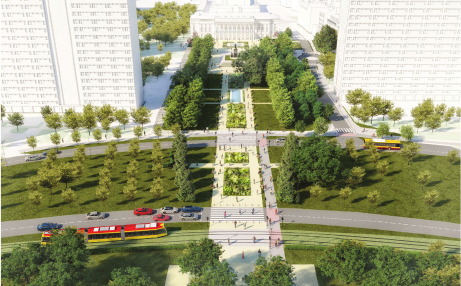
the context of the concept for the revitalisation of Żelaznej
Bramy Square, a proposal emerged to restore the transport
link between the square and the Saxon Garden in the form
of a pedestrian crossing and a bicycle crossing running
across this stretch of Marszałkowska Street (“Plac Żelaznej
Bramy” 2024) (Fig. 8). The aim was to emphasise the his-
torical layout of the Saxon Axis.
Following the Act adopted by the Polish Parliament in
2021 on the reconstruction of the Saxon Palace, Brühl Pal-
ace and three townhouses on Królewska Street in Warsaw,
another architectural-urban design competition was an-
nounced. Once again, all attention focused on the architec-
tural fabric and its future use. A very conservative position
was taken with regard to the Saxon Garden – there are no
specic proposals as to the nature of its use programme, nor
is there any reection on the role the Garden is to play in
the urban space. The competition brief stated that its current
shape should be respected – which is in fact at odds with
the plans, since rebuilding the buildings listed in the com-
petition would aect the park area. If they are to be erected
there, a portion of the trees (approx. 150) will have to be
removed, eectively destroying the dense mass of greenery
that now provides a backdrop to the Tomb of the Unknown
Soldier. Press reports (TVN Warszawa 2022) indicate that
some of the trees are to be transplanted to form rows fram-
ing Piłsudski Square on both sides (from Królewska and
Wierzbowa Streets), but this requirement does not appear
in the competition brief. The brief contains only individu-
al suggestions, such as creating a pedestrian link with the
restored Beck Garden or opening the gastronomy complex
onto the Saxon Garden, but these do not amount to a co
-
herent overarching concept for the area. According to the
competition guidelines, the Garden is to remain unfenced
(SARP 2024).
Today the Saxon Garden has the character of a space that
is a kind of hybrid between a historicising green enclave
and a transitory inner-city square (Fig. 9). Well-maintained
fragments coexist with worn-out elements. In the central
part, the preserved wide, regular alley, a remnant of the Ba-
roque garden, is anked by carefully designed ower par-
terres and rows of well-kept statues – 19
th
-century copies of
Baroque sculptures by Johann Georg Plersch – and ow
er
beds. The surface of the alley is concrete, in places paved
with slightly sunken stone slabs. The fountain on the main
axis attracts onlookers, while small mobile kiosks oering
snacks cluster around it. By contrast, severely degraded
small
architectural elements – rubbish bins covered in graf-
ti in the southern part or a peeling information board in
the northern part – give an impression of neglect. On the
northern side the Saxon Garden is neighboured by the emp-
ty Blue Palace, a primary school and an apartment house.
To the east it opens onto the space of Piłsudski Square and,
more recently, fenced-o excavations associated with the
Saxon Palace reconstruction project. To the south it adjoins
Królewska Street, used as a coach park. To the west, apart
from the entrance from Marszałkowska Street, the view is
of a six-lane carriageway of this arterial road and, in the fur-
ther perspective, the architecture of Warsaw’s inner centre.
On the other hand, as an inner-city public space the Sax-
on Garden is a place of high accessibility. Its greenery, due
to the slow process of urban and social transformations act-
ing upon this space, is very intuitively embedded in the city.
Users feel at ease there – this is related to the fact that it
is an inclusive, open, informal space, one that can be en-
tered accidentally when moving from one point in Warsaw
to another, while being green, friendly and characterised by
a harmonious structure of alleys, thanks to its architectural
Fig. 8. Visualisation of the pedestrian link between Żelaznej Bramy
Square and the Saxon Garden, MAU studio, 2021
(source: archives of the Office of Architecture and Spatial Planning
of the City of Warsaw)
Il. 8. Wizualizacja połączenia pieszego pomiędzy
placem Żelaznej Bramy a Ogrodem Saskim, pracownia MAU, 2021
(źródło: archiwum Biura Architektury i Planowania Przestrzennego
m.st. Warszawy)
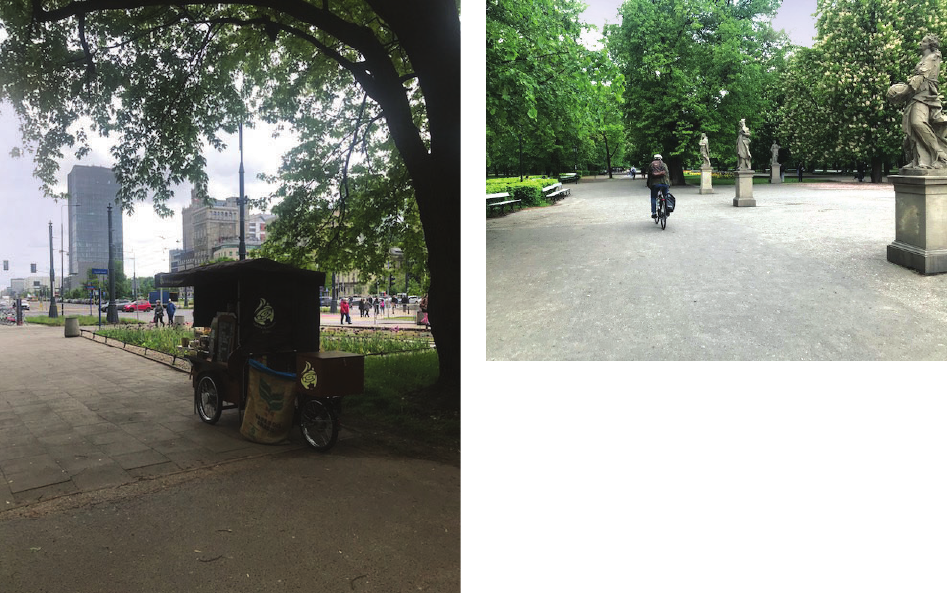
106 Blanka Melania Ciężka
layout. The Garden’s space is functional and serves local
residents who walk their dogs there, spend time on the park
lawns or engage in physical activities – from jogging and
yoga to cycling (Fig. 10).
Conclusions and Proposals for the Future
There were several reasons why the Saxon Garden trans-
formed from a residential garden into an inner-city square.
The rst was the abandonment of the development of the
Saxon Axis, which caused each of its components to evolve
independently of the others. The Garden’s location directly
adjacent to the routes designed for the complex, combined
with the abandonment of the complex’s further develop-
ment, had a destructive eect on the park. Public roads, es-
pecially in the western part, gradually became part of the
street network of Warsaw’s inner city and were used for
increasingly large-scale transport projects – at the expense
of the Garden’s territory. The abandonment of the develop-
ment of the east–west-oriented Saxon Axis, combined with
the growth of the urban network, led to the eastern and west-
ern parts of the complex (originally two sections meant to
form a unied whole) diverging in terms of building type,
social structure and, nally, transport network. These areas
ceased to form a whole, and their urban interiors gradual-
ly lost their mutual links – there was no coherent plan for
them. As a result, the Saxon Garden, situated in the centre of
the former Axis, adapted to the surrounding areas in a spon
-
taneous manner, depending on immediate needs, which in
turn led to the degradation of its historic forms.
The transformation of the Garden into an inner-city square
was also inuenced by events of the partition period: con-
scious decisions by the Russian authorities to convert the
Garden into a public park and to downgrade the former ro-
yal residence into a commercial tenement house. The po -
licy of spatially linking the Garden with the rest of the city,
pursued through much of the 19
th
century, accustomed the
inhabitants of Warsaw to the accessibility of this space and
certainly, to some extent, trivialised it – although this is not
necessarily a negative phenomenon. It represents a departure
from the Garden’s original residential function, but does not
mean that such a space cannot have value for the city. The
domination of the Saxon Garden by transport infrastructure
was also partly a consequence of modernist thinking about
the city, in which functionalism – understood as the number
of connections and the privileging of motorised trac – was
highly important.
Above all, however, the Saxon Garden became an inner-
city square because for a long time there was no concept for
it, nor was any attempt made to subject it to a concrete plan.
The few projects that addressed its space envisaged revit-
alisation in the context of the Saxon Palace reconstruction
and treated the Garden as part of a square–palace–garden
ensemble, which meant that reconstructing the architectural
fabric was seen as a prerequisite for properly taking care of
the Garden.
Inner-city parks originating from former residential gar-
dens, such as Łazienki Królewskie in Warsaw, the Summer
Garden in Saint Petersburg or the Tuileries in Paris, are com-
plexes with a dominant historic edice in their structure,
usually converted into a museum, which means that the sur-
rounding space is protected under dierent legal principles.
These are usually enclosed gardens, closed after dusk and
governed by internal rules of use (excluding bicycles, scoot-
ers or, for example, dogs). The Saxon Garden has not so far
Fig. 10. Main alley of the Saxon Garden open to bicycle traffic, 2023
(source: author’s private archive)
Il. 10. Główna aleja Ogrodu Saskiego dostępna dla komunikacji
rowerowej, 2023 (źródło: archiwum prywatne autorki)
Fig. 9. View towards Warsaw’s inner centre from the Saxon Garden,
showing the interpenetration of the park zone
with the inner-city space, 2023 (source: author’s private archive)
Il. 9. Widok na ścisłe centrum Warszawy z Ogrodu Saskiego,
obrazujący przenikanie się strefy parku
z przestrzenią śródmiejską, 2023 (źródło: archiwum prywatne autorki)
From a Residential Garden to an Inner-City Square: Transformations of the Space of the Saxon Garden in Warsaw 107
been viewed as an autonomous unit deserving of a dened
function and contemporary form, and above all a dened
role within the urban space. The dicult space of Piłsud-
ski Square, historically determined, which has eectively
absorbed attention, has stood in the way. Many designers,
experts and decision-makers have long been engaged in the
struggle over the square, to which the Saxon Palace recon-
struction project was eventually added. It is worth noting
that neither Piłsudski Square nor the Saxon Garden has been
covered by conceptual work within the framework of in-
ner-city revitalisation under the “New Centre of Warsaw”
project, despite the inclusion of three neighbouring squares:
Teatralny, Bankowy and Żelaznej Bramy.
As a place of historical origin and an element of an out-
standing urban composition, and – perhaps most importantly
– as part of Warsaw’s representative areas that shapes the at-
mosphere of the capital’s inner city, the Saxon Garden should
become the subject of a competition for revitalisation. Above
all, this space should be considered in terms of its function
and form within the entire network of urban interiors in this
part of Warsaw, and the role of the Saxon Garden
in contem-
porary Warsaw should be dened. The focus should not be
only on the Garden’s eastern side; its links with the urban
space on the other sides should also be reconsidered. A plan
is needed for connections to the north and south. Rather than
uncompromising reconstruction, a com bination of historical
elements with modern solutions in small architecture and
park infrastructure is advisable, in line with contemporary
principles of public space res toration.
A good idea would be to zone the park and emphasise the
dierent, historically accumulated functions of the areas on
the eastern and western sides of the Garden – which, once
an attractive urban interior has been created in the future
at Żelaznej Bramy Square, could provide a coherent and
natural link between these two places. Furthermore, once
the winning project (whose implementation is currently un-
certain) has been carried out, the Saxon Garden should be
placed under active care, since the shape of this inner-city
area directly aects the perception of Warsaw not only lo-
cally but also globally.
References
Architektura i Budownictwo 4 (1935).
Bernatowicz, Tadeusz. “Ogród i miasto. Z dziejów kształtowania się prze-
strzeni publicznej Osi Saskiej w XIX w.” In Historyczne place War-
szawy. Urbanistyka, architektura, problemy konserwatorskie. Mate-
riały sesji naukowej, Warszawa, 3–4 listopada 1994, edited by Bożena
Wierzbicka, 96–104. Towarzystwo Opieki nad Zabytkami, 1995.
Bieniecki, Zbigniew. Oś barokowa Warszawy. Państwowe Wydawnictwo
Naukowe, 1960.
Bobrowski, Zygmunt. “Analiza przemian Ogrodu Saskiego.” Prace Insty-
tutu Urbanistyki i Architektury 4, No. 2 (1954): 14–30.
Charazińska, Elżbieta. Ogród Saski w Warszawie. Państwowe Wydawnic-
two Naukowe, 1979.
Ciołek, Gerard. Ogrody polskie. 1: Przemiany treści i formy. Budownictwo
i Architektura, 1954.
FAAB. “ Plac Piłsudskiego: Projekt Polska 2118.” Accessed January 24,
2025. https://faab.pl/project/plac-pilsudskiego/.
Hübner-Wojciechowska, Joanna. Grób Nieznanego Żołnierza. Państwowe
Wydawnictwo Naukowe, 1991.
Jonkajtys-Luba, Grażyna. “Konkursy architektoniczne na projekt zagospo-
darowania przestrzennego placu Saskiego (kształty architektoniczne
placu Józefa Piłsudskiego).” In Historyczne place Warszawy. Urba-
nistyka, architektura, problemy konserwatorskie. Materiały sesji na-
ukowej, Warszawa, 3–4 listopada 1994, edited by Bożena Wierzbicka,
59–78. Towarzystwo Opieki nad Zabytkami, 1995.
Kalinowski, Wojciech, ed. Zabytki urbanistyki i architektury w Polsce.
Odbudowa i konserwacja. 1. Miasta historyczne. Arkady, 1986.
Keenan, Paul. “The Summer Gardens in the Social Life of St. Petersburg,
1725–61.” The Slavonic and East European Review 88, No. 1–2
(2010): 134–155. https://doi.org/10.1353/see.2010.0082.
Kłosek-Kozłowska, Danuta. “O wartościach przestrzennych Osi Saskiej
Warszawy.” Kwartalnik Architektury i Urbanistyki. Teoria i historia
62, No. 3 (2017): 5–42.
Moskała, Krzysztof. “Zagospodarowanie funkcjonalno-przestrzenne re-
jonu Osi Saskiej w Warszawie.” Excerpt from master’s thesis, War-
saw University of Technology, 2016. Accessed December 12, 2024.
https://traktpraski.pl/wp-content/uploads/2016/07/O%C5%9A-SAS-
KA_OPIS-KONCEPCJI-02.pdf.
Pietrzak-Pawłowska, Irena, ed. Wielkomiejski rozwój Warszawy do 1918 r.
Książka i Wiedza, 1973.
Rottermund, Andrzej. “Zwycięstwo i porażka historyzmu. Konkurs a prze-
budowa pałacu Saskiego w Warszawie.” In Muzeum i twórca. Studia
z historii sztuki i kultury ku czci prof. dr. Stanisława Lorentza, edited
by Kazimierz Michałowski: 433–441. Państwowe Wydawnictwo Nau -
kowe, 1969.
SARP. 2024. “Informacje, założenia i wytyczne ogólne do konkursu ar-
chitektoniczno-urbanistycznego na opracowanie koncepcji architekto-
nicznej wraz z zagospodarowaniem terenu dla inwestycji dotyczącej
odbudowy Pałacu Saskiego, Pałacu Brühla oraz kamienic przy ulicy
Królewskiej w Warszawie.” Accessed December 12, 2024. https://1040.
konkurs.sarp.pl/pliki/o_konkursie.pdf.
Stangel, Michał. Kształtowanie współczesnych obszarów miejskich w kon -
t ekście zrównoważonego rozwoju. Wydawnictwo Politechniki Ślą-
skiej, 2013.
Stępiński, Zbigniew. Siedem placów Warszawy. Państwowe Wydawnictwo
Naukowe, 1988.
Tołwiński, Tadeusz. “O szkicowym projekcie zabudowania Wielkiej War-
szawy.” Przegląd Techniczny 21–22 (1917): 211–214.
Tołwiński, Tadeusz. Zieleń w urbanistyce. Państwowe Wydawnictwo Nau-
kowe, 1963.
Tomaszewski, Leonard. Studia nad układem i komunikacją dzielnic śród-
miejskich na tle rozwoju motoryzacji. Instytut Urbanistyki i Architek-
tury, 1965.
Trybuś, Jarosław. Warszawa niezaistniała. Niezrealizowane projekty urba-
nistyczne i architektoniczne Warszawy dwudziestolecia międzywo-
jennego. Muzeum Powstania Warszawskiego, Muzeum Narodowe
w Warszawie, Fundacja Bęc Zmiana, 2012.
TVN Warszawa. 2022. “Warszawa: prezes spółki Pałac Saski proponu-
je miastu rewitalizację Ogrodu Saskiego.” Accessed December 12,
2024. https://tvn24.pl/tvnwarszawa/srodmiescie/warszawa-pre zes-
spolki- palac-saski-proponuje-miastu-rewitalizacje-ogrodu-sas kie-
go- 6223849.
Urząd m.st. Warszawy. February 2024. “Plac Żelaznej Bramy. Koncep cja
funkcjonalno-przestrzenna placu Żelaznej Bramy.” Accessed January
19, 2024. https://architektura.um.warszawa.pl/do cu ments /12025039/
104964655 / Plac_ Zelaznej_Bramy_opracowanie_końcowe.pdf.
Urząd m.st. Warszawy. “Nowe Studium dla Warszawy.” Accessed Decem-
ber 2, 2024. https://um.warszawa.pl/-/konstytucja-przestrzenna.
Urząd m.st. Warszawy. “Nowe Centrum Warszawy.” Accessed January 19,
2024. https://um.warszawa.pl/waw/nowe-centrum-warszawy.
Wójtowicz, Aleksandra, ed. Miejsca trudne – transdyscyplinarny model
badań. O przestrzeni placu Piłsudskiego i placu Delad. Wydawnic-
two Instytut Badań Literackich PAN, 2019.
Zieliński, Jarosław. Plac. Warszawski plac Piłsudskiego jako zwierciadło
losów i duchowej kondycji narodu. Ekbin, 2019.
108 Blanka Melania Ciężka
Streszczenie
Od ogrodu rezydencjonalnego do śródmiejskiego skweru: przekształcenia przestrzeni Ogrodu Saskiego w Warszawie
Duża część dzisiejszych europejskich parków śródmiejskich to dawne ogrody rezydencjonalne, włączane stopniowo w przestrzeń publiczną miast.
Ogród Saski w Warszawie jest przykładem parku, który przeszedł inną ewolucję niż większość podobnych założeń – zamiast stać się przestrzenią za-
mkniętą przekształcił się w dostępny całą dobę śródmiejski skwer z licznymi trasami komunikacyjnymi. Jego położenie przy placu Piłsudskiego, miejscu
o trudnej historii, sprawia, że Ogród pozostaje przestrzenią nie do końca przemyślaną, uwikłaną od początku w trwały stan napięcia przestrzennego
i funkcjonalnego wynikającego z niestabilnej tkanki urbanistycznej otoczenia.
Artykuł opiera się na analizie źródeł archiwalnych i literatury przedmiotu oraz szczegółowej analizie porównawczej formy, układu i wyposażenia
Ogrodu Saskiego oraz jego otoczenia, co pozwala uchwycić specykę jego rozwoju na tle przekształceń przestrzeni publicznych w europejskich centrach
miast.
Słowa kluczowe: Ogród Saski, przestrzeń publiczna, zieleń, urbanistyka, park