
2024
4(80)
Daria Jagiełło*
History of Toruń’s New Bielany pump station (1916–1917)
in the light of archival records
DOI: 10.37190/arc240402
Published in open access. CC BY NC ND license
Abstract
In the years 2022–2023, the adaptation of one of the former Toruń pumping stations – the so-called Nowe Bielany – was carried out (the comple-
tion of its construction is dated at 1917). For many years the plant supported the nearby Stare Bielany main station in supplying the city with water.
In the 1980s it was taken out of service and remained unused for the following years. Preparations related to the adaptation project revealed that the
history of the station was poorly understood and that the facility had not been the subject of research so far.
The article presents an interesting history of the construction and operation of the Nowe Bielany plant. The reasons that ultimately caused its
closure are also given. The circumstances of its construction, equipment, architecture, and the realities of the times in which it operated are presented,
while the importance of archival research for a better understanding of the facility is highlighted. The text was prepared mainly on the basis of the re-
sults of extensive archival research, sometimes confronted with the results of the analysis of the existing facility (before and after the adaptation work).
Nowe Bielany, as can be seen from the materials that have been obtained, was a plant built eciently and with great care (this is also conrmed
by the preserved correspondence). Owing to the recurring problems of water shortages in Toruń, great hopes were placed in its construction. Unfor-
tunately, the station did not meet these expectations (very high production costs, rapidly decreasing pump eciency and too little water in the wells),
which is why in the 1930s the search for a location for a new intake began.
Although the history presented is not a success story, the Nowe Bielany pumping station complex has turned out to be an interesting and valuable
witness to the development of the water and sewage infrastructure in Toruń.
Key words: waterworks, Toruń, technical heritage, history, industry in the 20
th
century
Introduction
Clean, running water is one of the basic human needs,
and the methods of its delivery have determined the di-
rections of development of urban centres for centuries. As
a result, extensive water supply networks with associated
above-ground facilities, often associated with the wide-
spread modernizations of the 19
th
and 20
th
centuries, have
become a permanent part of the urban fabric. The utilitar-
ian nature, the frequent economy of architecture, its value
dened mainly through the prisms of usefulness, ecien-
cy, and importance for meeting basic needs, often eec-
tively blend water supply buildings into the background of
everyday life leading to their presence being almost unreg-
istered by the city’s residents.
One of such overlooked objects was the former Toruń
pumping station, the so-called Nowe Bielany, built in the
second decade of the 20
th
century and intended to support
the main station supplying water to Toruń – Stare Bielany,
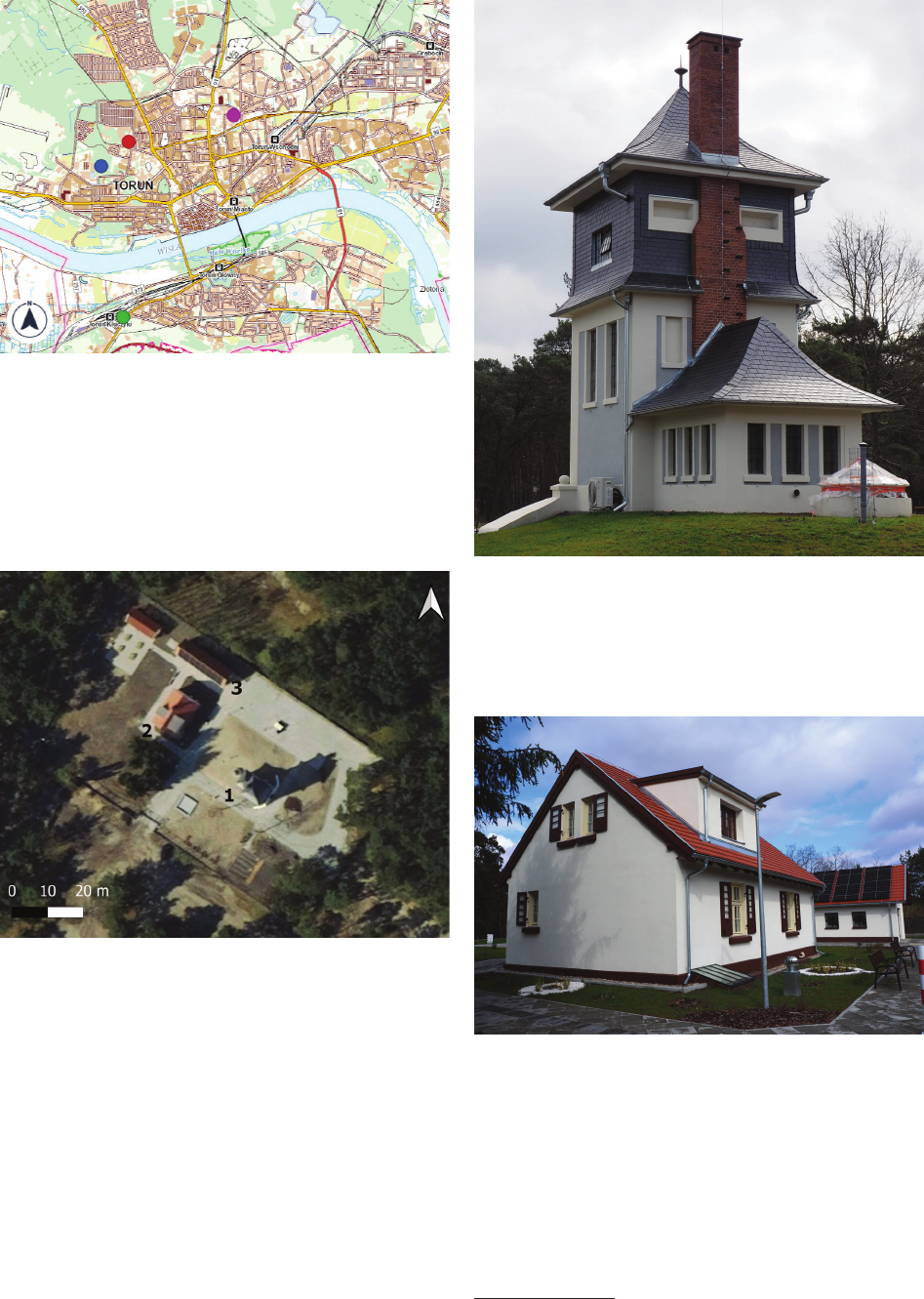
while also serving as an emergency intake (Fig. 1).
The complex is located in the north-western part of the
city, amidst a pine forest, on the campus of Nicolaus Co-
pernicus University. It consists of the main station building
(machine room), residential and utility buildings, and the
underground infrastructure. The facilities are located on
a large rectangular plot covered with greenery (Fig. 2).
The machine room is a two-element, symmetrical build-
ing with the southern part on a square plan, in the form
of a two-story tower covered with a hipped roof, and the
northern part on a rectangular plan, single-story, with
a high, three-slope roof. A skylight is located on the build-
ing’s axis, providing light to the extended underground
part extending beyond the above-ground perimeter walls.
* ORCID: 0000-0002-4437-0551. Faculty of Fine Arts, Nicolaus
Copernicus University in Toruń, Poland, e-mail: dar.jag@umk.pl
12 Daria Jagiełło
– pump hall (Fig. 3). To the north-west of it there is the
former motor driver’s house, built on a rectangular plan,
single-storey, covered with a gable roof with single exten-
sions on both slopes. The building has a basement and is
connected to the pump hall by an underground tunnel. To
the north of it there is a farm building with a simple, sin-
gle-story structure and a gable roof (Fig. 4).
The complex, although appreciated in many respects
from a monumental perspective and largely unchanged
Fig. 3. Toruń – the former Nowe Bielany pumping station:
machine room building (photo by D. Jagiełło, 2024)
Il. 3. Toruń – dawna stacja pomp Nowe Bielany:
budynek maszynowni (fot. D. Jagiełło, 2024)
Fig. 1. Toruń – location of historic pumping stations:
Stare Bielany (red), Mokre (purple), Podgórz (green), Nowe Bielany (blue)
(elaborated by D. Jagiełło, based on: www.geoportal.gov.pl 2024)
Il. 1. Toruń – lokalizacja historycznych stacji pomp:
Stare Bielany (czerwony), Mokre (purpurowy), Podgórz (zielony),
Nowe Bielany (niebieski)
(oprac. D. Jagiełło, na podstawie: www.geoportal.gov.pl 2024)
Fig. 2. Toruń – site plan of the former Nowe Bielany
pumping station complex:
1) machine room building, 2) residential building, 3) utility building
(elaborated by D. Jagiełło, based on: www.geoportal.gov.pl 2024)
Il. 2. Toruń – plan sytuacyjny zespołu
dawnej stacji pomp Nowe Bielany:
1) budynek maszynowni, 2) budynek mieszkalny,
3) budynek gospodarczy
(oprac. D. Jagiełło, na podstawie: www.geoportal.gov.pl 2024)
Fig. 4. Toruń – the former Nowe Bielany pumping station:
residential and utility building (photo by D. Jagiełło, 2024)
Il. 4. Toruń – dawna stacja pomp Nowe Bielany:
budynek mieszkalny i gospodarczy (fot. D. Jagiełło, 2024)
since its construction
1
, is subject to conservatory protec-
tion only because of the area entry of the university cam-
pus (Historyczny układ urbanistyczny… 2020). It is not
1
This was revealed by analyses conducted in order to formulate
conservation guidelines for the planned adaptation project [see: (Jagiełło
et al. 2022)]; this was the author’s rst contact with the facility and the
main impulse that resulted in the currently conducted research on the
water and sewage infrastructure of Toruń.

History of Toruń’s New Bielany pump station (1916–1917) in the light of archival records 13
individually entered in the register of monuments or even
included in the municipal or provincial records
2
. Currently,
the station is not performing its original function. In the
years 2021–2023, after a period of disuse, it was adapted to
house the Copernican Integration Centre of Nicolaus Co-
pernicus University.
The article presents the history of the construction and
functioning of Nowe Bielany, reconstructed on the basis of
preserved archival materials. The topic under discussion is
also an opportunity to illustrate the importance of archival
research, not only in terms of basic factual information,
but also as a source of valuable information that builds the
background and explains the circumstances and conditions.
The scope under consideration also includes the station
buildings and the area of the complex within the historic
boundaries that have been maintained to this day, with the
initial caesura designated for the period shortly before the
construction of the station, when the construction of a new
water supply infrastructure began in Toruń.
The adopted research method has been an archival
query conducted in several institutions in Toruń, e.g., in
the branches of the State Archives and in the archives of
the Pro vincial Oce for the Protection of Monuments, the
Municipal Conservator of Monuments, the National Heri-
tage Institute, and the Archives of the Toruń Waterworks.
The context for the results of oce research is the archi-
tectural analysis (in this case presented in its basic range).
State of research
The history of the Nowe Bielany pumping station, in-
cluding its construction, has not been the subject of in-
depth research so far. The complex was mentioned in the
form of a short note in a 20-page publication issued in 1993
on the occasion of the 100
th
anniversary of the Toruń wa-
terworks (Felski et al. 1993)
3
, and mentioned in articles by
Kazimierz Przybyszewski (1980) and Anna Świercz-Pru-
sicka (2005). The only study that presents facts concerning
the Nowe Bielany station in more detail is the unpublished
documentation of Szczuczko (Szczuczko, Wieczorkiewicz
1982). Our text expands the state of knowledge by numer-
ous additional information items.
Waterworks in Toruń
The rst real actions of the city authorities aimed at build-
ing “modern waterworks” in Toruń should be dated to 1868,
when the construction counsellor Henoch from Al ten burg
4
undertook to prepare a comprehensive design of supplying
the city with water from ground intakes (APT, AmT
5
C,
ref. no. 5976, 3).
It was a natural reaction to population
2
Status as at 11/06/2024.
3
This is the only comprehensive study concerning the Toruń water-
works in the 19
th
and 20
th
centuries. Robert Kola and Leszek Kotlewski
(2003) wrote a paper on the subject of mediaeval and modern waterworks.
4
At a similar time, he was also the author of a design for, among
others, Gdańsk [see: (Gerlach 1884, 8)].
5
Abbreviations consistently used throughout this article: APT
– State Archives in Toruń, AmT – Records of the city of Toruń.
growth, expansion, and developing industry. Although the
design was rejected, eorts did not cease. In April 1891,
after preliminary studies and negotiations with the au-
thorities of the Toruń Fortress, work began on the design,
which in the years 1892–1894 resulted in the construc-
tion of the impressive Stare Bielany station in the area of
Bielany (a former manor farm), which received water from
the “Barbarka” and “Fort Chodkiewicza” intakes located
north of the city (APT, AmT D, ref. no. 6180). The sta-
tion was equipped with steam engines driving two pumps
(APT, AmT D, ref. no. 6212; APT, AmT D, ref. no. 1648,
10)
6
. The engineer responsible for the technical design
was Heinrich Metzger, the author of the architectural part
was the construction counsellor Rudolph Schmidt (APT,
AmT D, ref. no. 6227, 293). In the year of construction
completion, the Municipal Water and Sewage Plant was
established (APT, AmT D, ref. no. 6180). At that time,
Toruń had over 27,000 inhabitants (Zielińska 2019, 40),
and Stare Bielany supplied it with water within its then ad-
ministrative borders, which did not include Podgórz (then
a separate city) or Mokre (at that time a village with subur-
ban functions), which had had their own pumping stations
since 1904. Both plants were built together with gasworks
and were powered by gas engines (Szczuczko, Wieczor-
kiewicz 1982)
7
.
In internal letters and specialist opinions from the turn
of the 1
st
and 2
nd
quarter of the 20
th
century, it was estimat-
ed that the average daily water consumption per person in
Toruń in the early 1990s was 40 litres. Interestingly, after
the waterworks were launched, it was supposed to be 170
litres, but after the introduction of water meters in 1894,
it dropped again to 41 litres per day. Any system leaks or
other faults could also be signicant at this initial stage of
use. In the following years, however, there was an obvious
gradual increase in consumption, which almost doubled in
1918: 79 litres (APT, AmT D, ref. no. 6212).
The Bielany waterworks draw water from a layer of
diluvial sands of small thickness (from a few to a dozen
or so meters). The amount of water owing through them
is relatively small and varies greatly depending on the
amount and frequency of rainfall. This geological struc-
ture often caused water problems in Toruń (APT, AmT D,
ref. 1648, 9). An additional unfavourable factor was the
progressively decreasing level of the groundwater table,
which, among other things, forced the construction of fur-
ther wells for Stare Bielany at the beginning of the 20
th
century
8
. All this, in addition to the constant population
growth intensied by the presence of the army stationed in
Toruń (especially numerous during World War I), result-
ed in water shortages – the subject was considered urgent
6
In the late 1920s, a third pump was purchased – an electric one
[see: (APT, AmT D, ref. no. 6252)].
7
See also, among others: (Akta miasta Podgórza…, ref. no 773,
774, 775; APT, Dokumentacja techniczna…, ref. no. 2807; APT, Doku-
mentacja techniczna…, ref. no. 3229).
8
Initially, the “Barbarka” intake was built with four wells, but too
little water was extracted which forced the construction of another intake
and more wells. In 1927 the station was already operating at 20 wells
(APT, AmT D, ref. no. 6212; APT, AmT D, ref. no. 3299).
14 Daria Jagiełło
both in internal ocial and plant correspondence
9
, as well
as in the local press
10
(APT, AmT C, ref. no. 5976, 61).
Construction
The minutes of the meeting of the Water Supply Deputa-
tion of the City Council on 8 December, 1915 indicated that
the existing intakes were insucient to meet the demand
for water, so a decision was made to build a new station
for Toruń operating on its own wells (APT, AmT C,
ref.
no. 5990, 69)
11
.
According to plans based on drilling analyses conduct-
ed by Prof. Konrad Keilhack from the Geological Institute
in Berlin, nine wells were planned to to be built to guar-
antee a daily water supply of at least 6,000 m
3
, with the
demand at that time being 3,000 m
3
(APT, AmT C, ref.
no. 19687, 2; APT, AmT C, ref. no. 5990, 8–10, 66–74).
The estimated cost of the investment was 160,000 marks,
of which 50,000 was covered by the city reserve fund. The
remaining 110,000 marks was a loan from the Municipal
Insurance Company (APT, AmT C, ref. no. 19687, 2, 4–6;
APT, AmT C, ref. no. 5990, 27).
The station was located less than a kilometre south-west
of Stare Bielany. Construction began in 1916 and was com-
pleted in May 1917. It was headed by city councillor Karl
Walter. Councillor Klingendorf was responsible for coop-
eration with companies supplying machines and devices
(APT, AmT C, ref. no. 5990, 79). The work was carried
out by Toruń workshops: M. Bartel, P. Borkowski, O. Bart-
lewski, J. Freder, F. Konkolewski, E. Pidun, G. Soppart,
R. Lod ke, E. Preuss (APT, AmT C, ref. no. 5976, 61).
9
In November 1916, Stare Bielany produced only 1,300 m
3
water,
which was partly explained by design aws (pumps located too high
above the water level) (APT, AmT C, ref. no. 5990, 1; Der neue Thorn-
er… 1917; APT, AmT D, ref. no. 3220a).
10
The water shortages in 1916 were caused by the fact that a peri-
od of severe drought coincided with a period of increased consumption
by war hospitals and a large garrison (Der neue Thorner… 1917). In the
pages of Gazeta Toruńska from 1915, the Municipal Oce called for
careful handling of water (Toruń i okolica 1915, 3).
11
The possible expansion of the existing intakes was assessed as
impractical owing to the probable adverse impact on their eciency
(APT, AmT C, ref. no. 5990, 69).
Despite the initial plans, seven brick wells
12
with a di-
ameter of 2 m each were built, located to the north and
south of the plant, at intervals of 95 m, with an average
depth of approximately 12 m (owing to hydrological con-
ditions and terrain topography, contrary to expectations,
the northern wells yielded the most water, the southern
ones – surprisingly little). Water was drawn from them
using a siphon with a diameter of 150–300 mm and deliv-
ered to the lowest collection well (the eighth) with a depth
of 7.95 m, located in the machine room (APT, AmT D,
ref. no. 6212; Der neue Thorner… 1917).
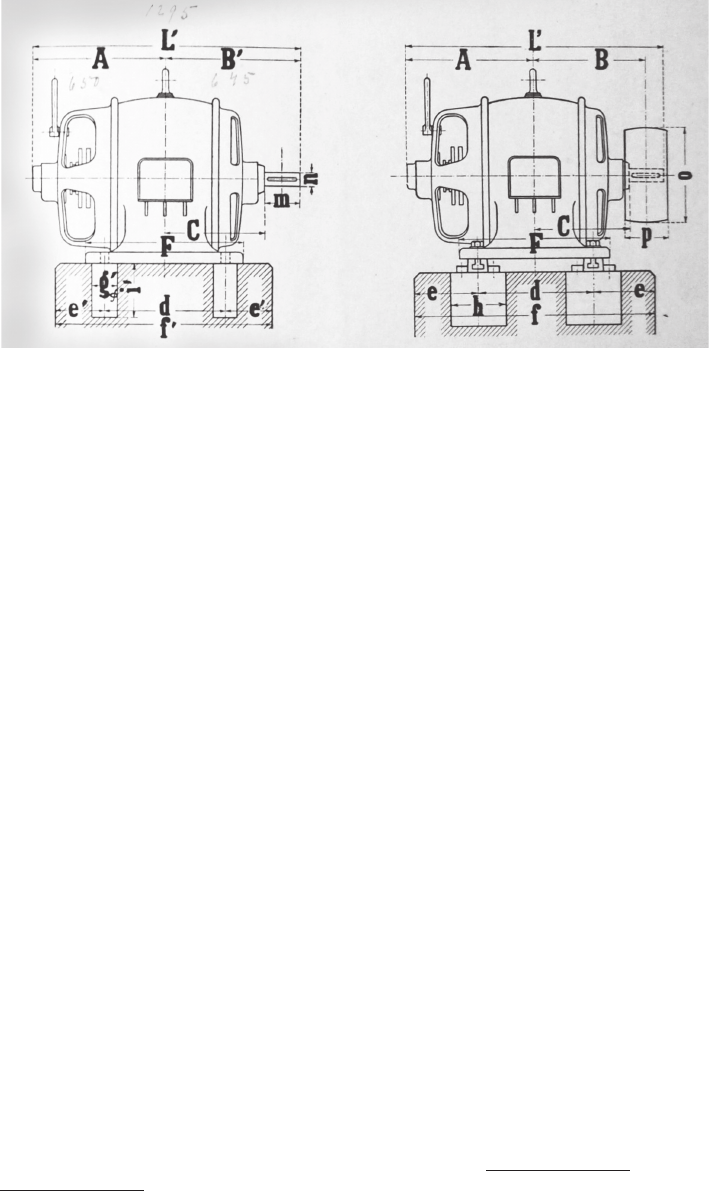
The machine room was equipped with two high-pres-
sure centrifugal pumps operated by 380 V, 50 HP three-
phase motors
13
supplied, like almost the entire machinery
from 1916, by Maei-Schwartzkop-Werke GmbH based
in Berlin (APT, AmT C, ref. no. 5990, 231) (Fig. 5). The
station’s equipment included, among other items, a vacu-
um pump, a three-phase current reducing transformer with
a voltage of 6,000–380 V and an electrical switchboard
(APT, AmT C, ref. no. 5990, 192–198, 234, 236).
The water obtained was of good quality and did not
require treatment (Der neue Thorner… 1917)
14
. It was
pumped directly from the collection well into the city net-
work, and any surplus was directed to the tank in the water
tower in Stare Bielany (APT, AmT C, ref. no. 5990, 77). In
theory, the capacity of the pumps at the Nowe Bielany sta-
tion made independent supply of water to the city possible
(Der neue Thorner… 1917)
15
.
The station was connected directly by telephone to the
Stare Bielany water tower: its employee communicated
12
In later materials, eight wells and one collective well most often
appeared.
13
T
he motors (Dr. type) were redesigned at the order stage at the
request of the Toruń plant from 220 V to 380 V, which was overlooked
by the contractor who, after delivery and verication, was forced to con-
vert them at his own expense and with compensation to versions with the
appropriate parameters (APT, AmT C, ref. no. 5990, 286). Pumps: Zentri-
fugalpumpe Type LX, 3 stug, vacuum pump Vacum (APT, AmT D,
ref.
no. 1648, 10; APT, AmT C, ref. no. 5990, 318).
14
The composition of water is presented, among others, in the de-
scription of Toruń intakes from 1927 (APT, AmT D, ref. no. 6212).
15
Water was measured at the station with a Ventury water meter
(APT, AmT D, ref. no. 1648, 10).
Fig. 5. Excerpt from the technical
specification sheet of
the Dr. type motor
(source: APT, AmT C, ref. no. 5990)
Il. 5. Fragment karty specyfikacji
technicznej silnika typu Dr.
(źródło: APT, AmT C, ref. no. 5990)
History of Toruń’s New Bielany pump station (1916–1917) in the light of archival records 15
the stoppage or resumption of pumping (the area of the
main station could have been ooded if too much water
had been pumped into the water supply network)
16
(APT,
AmT D, ref. no. 6183). The complex was also connected
to the sewage system, and the machine room had a heating
system that protected the pumps from freezing (Der neue
Thorner… 1917).
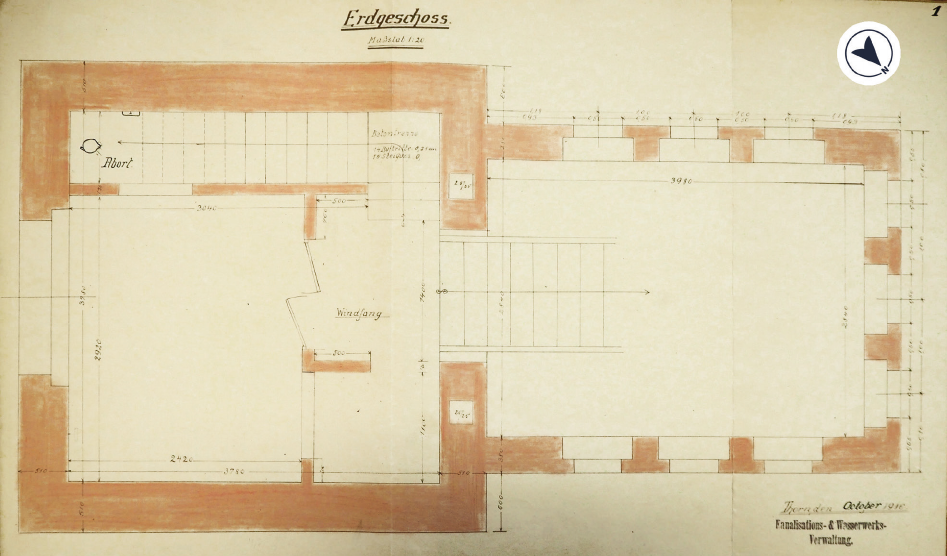
The machine room building was built on the basis of
a design from October 1916 (drawings from March of that
year included a dierent shape of the staircase and size
of window openings). Unfortunately, the design of the
basement where the pumps were placed has not been pre-
served. The entrance to the tower was located on the axis
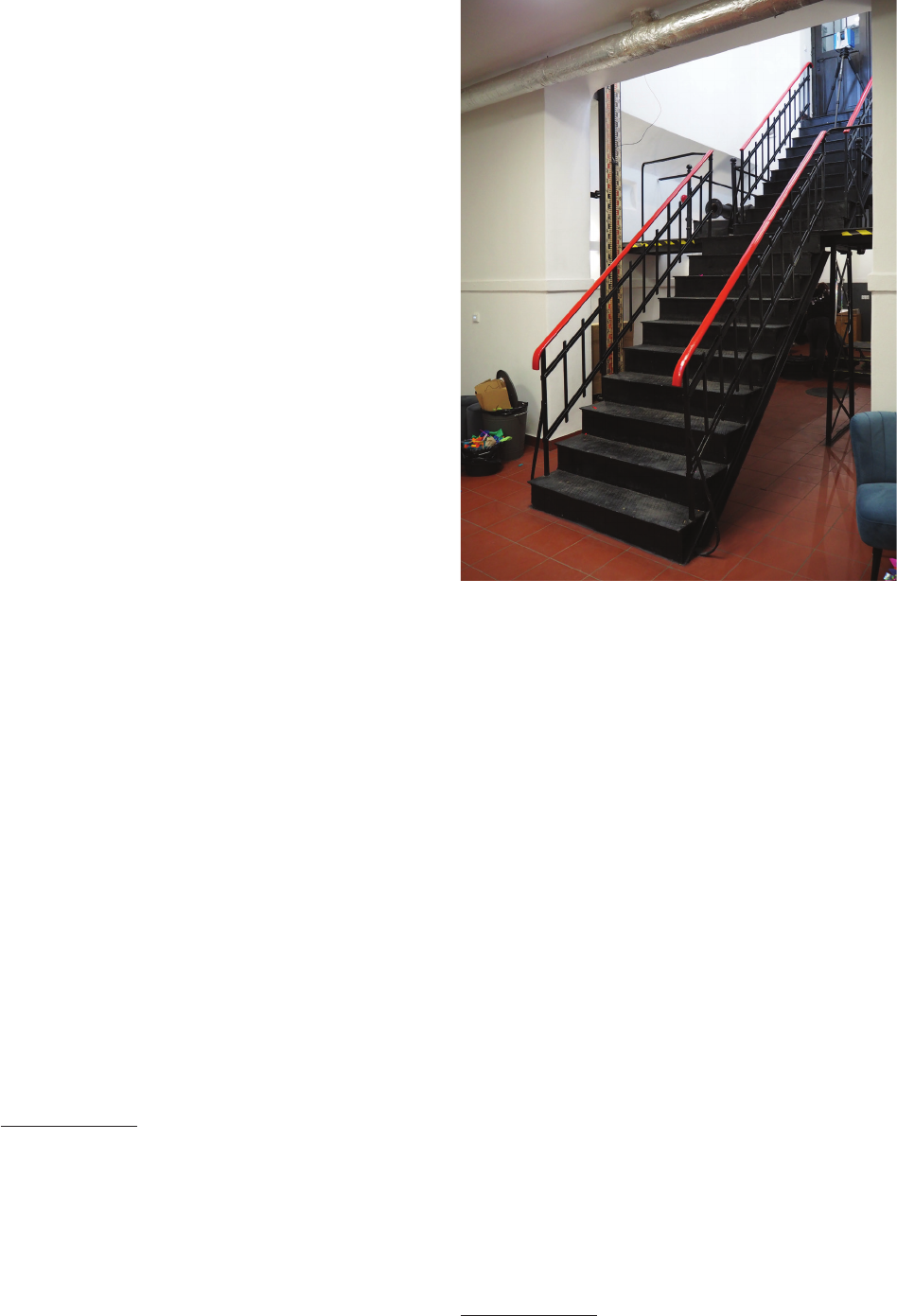
of the southern wall. On the axis of the northern wall, how-
ever, extended steel stairs leading to the lower level of the
machine hall were located (Fig. 6). The passage from the
ground oor antechamber to the pump hall was preceded
by a shallow vestibule. The tower’s vertical communica-
tion was placed at the western wall (straight concrete stairs
with a grate impressed in the tread
17
). A toilet was planned
under the rst full ight of stairs (the tower still has the
original steel door with remnants of the “vacant”/“occu-
pied” sign). The location of the switchboard is marked
in the south-eastern corner of the rst oor of the tower
(Schaltschrank). Drawings of the above-ground oors
document the building in an almost unchanged form today
(Fig. 7). They are not signed with any name (APT, AmT D,
ref. no. 6226, 104–106).
The design documentation for the single-family house
for the machine operator built as part of the complex has
not been preserved. It is known that it was occupied in
December 1917 by the machinist Hohlfeldt, former man-
ager of the Mokre pumping station (closed on 21 May
1916
18
). At that stage, only minor work remained to be
done, such as fencing, levelling the ground, and planting.
The house (without garden) cost over 10,000 marks (Der
neue Thorner… 1917). In 1918 a stable building was erect-
ed. It was noted that thus […] the accommodation of the
machine operator is now complete (APT, AmT D, ref. no.
6240). Almost everything went according to plan except
for one thing: in the autumn, wild rabbits ran rampant in
the complex and caused a lot of damage to the new plant-
ings – a large part of Hohlfeld’s garden was destroyed, so
an urgent reduction in the number of rabbits was ordered
(APT, AmT D, ref. no. 6226, 69).
The station was opened at the end of August 1917 and
was extensively reported in the Toruń daily Die Presse
from September 2, however, it was noted that the celebra-
16
The importance of the connection is conrmed by internal reg-
ulations requiring, among other things, constant control of its quality
and synchronization of the clocks in both stations (APT, AmT D, ref.
3220a). In Księga adresowa miasta Torunia wraz z Podgórzem i powia-
tem Toruń-Wieś (1923) the Nowe Bielany waterworks station was listed
as number 1715.
17
It was intended to prevent slipping, similar to the pea-grain tex-
ture of the tiles on the ground oor of the tower and in the pump hall.
18
As can be seen from press reports, among others, this was due
to high operating costs related to the high iron content, rising gas prices,
and falling eciency of the station (Der neue Thorner… 1917; APT,
AmT D, ref. no. 6240).
Fig. 6. Toruń – the former Nowe Bielany pumping station:
stairs leading from the pump hall
to the ground floor of the machine room building
(photo by D. Jagiełło, 2024)
Il. 6. Toruń – dawna stacja pomp Nowe Bielany:
schody prowadzące z hali pomp
na parter budynku budynku maszynowni
(fot. D. Jagiełło, 2024)
tions were quite modest, with only a few representatives
of the City Council present. The complex itself, owing
to the inevitable comparison to nearby Stare Bielany and
its 30-meter water tower towering over the surroundings,
was characterized as […] little more than a delicate Chi-
nese-style tower (Der neue Thorner… 1917)
19
.
In the article about the opening of the station, it was
poetically compared to a living organism whose work is
almost invisible (it takes place beneath the skin) and could
be carried out continuously, without human intervention,
until old age. The only obstacle is that stopping and resum-
ing pumping does not happen automatically. This obser-
vation was accompanied by the opinion that the operator
working there […] does not have much to do at the station
(Der neue Thorner… 1917).
The construction costs of Nowe Bielany amounted to
169,000 marks and exceeded the planned budget by only
9,000 (mainly owing to ination), and Stare Bielany, also
compared artistically, cost 1.3 million marks (Der neue
Thorner… 1917; APT, AmT D, ref. no. 6240).
19
The actual height of the tower is approximately 40.5 m (from
ground level to the top of the roof).
16 Daria Jagiełło
As highlighted in Die Presse, Walter […] managed to
complete the construction in a short time despite the hard-
ships of war, taking care to obtain the most suitable ma-
chines. His name will always be associated with the Nowe
Bielany waterworks (Der neue Thorner… 1917).
The interwar period
In the water supply system, the basic operation was to
be at Stare Bielany, and when water stopped owing to the
underground reservoir through the gravity pipeline, it was
assumed that Nowe Bielany would be launched, which
proved to be very successful in the rst years of operation
(APT, AmT D, ref. no. 6212). In 1918, the operation of the
station was reported as excellent and fully meeting the de-
mand for water, although the main station was periodically
closed (annual consumption of the main station: 866 073
m
3
, the Nowe Bielany station: 745 405 m
3
) (APT, AmT D,
ref. no. 6240).
Despite the construction of a new intake, water short-
ages were still felt at times. In 1919 this was caused by
problems with coal shortages and the basic water level
continued to fall. From June 13 to November 1 it was de -
livered only between 9 a.m. and 9 p.m. The situation was
saved by the withdrawal of the army, the closure of mili-
tary hospitals, and the emigration of many families (APT,
AmT D, ref. no. 6240). After November 1, earlier water
supply hours were restored. At that time, a two-shift sys-
tem operated at both stations: Nowe Bielany worked from
8:00 a.m. to 4:00 p.m. (1
st
shift) and from 9:00 p.m. to
5:00 a.m. (2
nd
shift). On Sundays and public holidays
there was a continuous 12-hour shift (APT, AmT D, ref.
no. 6239, 137–138). In 1919, the main station produced
690,119 m
3
, and Nowe Bielany: 741 123 m
3
of water (APT,
AmT D, ref. no. 6240). In 1920, Toruń had 37,000 inhabi-
tants (APT, AmT C, ref. no. 5990, 45), and in 1932 58,000
(APT, AmT D, ref. no. 1648, 9).
The mechanical parts of the Nowe Bielany pumps wore
out quickly (this was one of the explanations for their de-
creasing eciency: the amount of pumped water dropped
from 61,813 m
3
in 1920, 32,652 m
3
in 1921, 36,366 m
3
in 1922, and 7,954 m
3
in 1923; Wykaz statystyczny…
1924). According to the data from the administrative year
1931/1932, the pump eciency was estimated at 0.47%
compared to 1918 (APT, AmT D, ref. no. 1648, 10).
However, machine wear and tear was not the primary
problem. Nowe Bielany was expensive to maintain owing
to high energy prices. Owing to cost savings, the station
was closed in March and June 1923, April and May, August,
and then from October to December 1926 (APT, AmT D,
ref. no. 6241; APT, AmT D, ref. no. 6228). That
situation
repeated itself several times. According to the data for the
years 1928–1930, the cost of 1 m
3
of water pumped out
in Stare Bielany was 2 groszes, in Nowe Bielany – 9 gro-
szes, and in 1930 as much as 12 groszes (APT, AmT D,
ref. no. 6212). More importantly, the intake the station was
Fig. 7. Toruń – the former Nowe Bielany pumping station: plan of the machine room building (ground floor);
original scale 1:20 (October 1916)
(source: APT, AmT D, ref. no. 6226)
Il. 7. Toruń – dawna stacja pomp Nowe Bielany: rzut budynku maszynowni (parter);
skala oryginału 1:20 (październik 1916)
(źródło: APT, AmT D, ref. no. 6226)
History of Toruń’s New Bielany pump station (1916–1917) in the light of archival records 17
operating on was estimated to be depleted within 24 hours
(according to sta)
20
. In later assessments, Keilhack was
even accused of making a mistake in assessing its quali-
ty, as a result of which Nowe Bielany, although classically
furnished in terms of equipment, did not provide […] even
approximate expected results. In 1927 the plant was de-
scribed as […] operated sporadically
21
.
The waterworks did not have a good press either. In Jan-
uary 1928, a mocking article appeared in Bydgoszcz news-
paper “Toruń-les-Bains” on the quality of Toruń water,
which praised the health properties of the city’s mud baths
([…] recommended in severe cases of atherosclerosis,
brain softening, and xenophobia). This medicinal sludge
of questionable quality was supposed to ow through the
city pipes at least once a month (Toruń-les-Bains… 1928).
In 1930, in Nowe Bielany, it was planned to deepen the
three southern wells by 2 m, which was to increase their
eciency (it was estimated that one well would take up to
3 weeks of work and the maximum cost would be 458.32
zlotys) (APT, AmT D, ref. no. 6212). The problem of wa-
ter shortages and the poor assessment of the water supply
network, which was growing in a chaotic manner and was
not adapted to further expansion, were constantly recurring
(APT, AmT D, ref. no. 6213, 1).
In his opinion, Krajewski drew attention to possible
problems related to the electric motor. He wrote: […]
when Germany was preparing for war, the City was se-
cretly advised in 1911 and 1912, owing to the probable
20
Engineer Krajewski, the author of the 1927 report on the Toruń
waterworks, called on the authorities, among other things, to examine
the actual condition and operational capabilities of Nowe Bielany (APT,
AmT D, ref. no. 6212).
21
According to Krajewski, Keilhack’s advice exposed the city to
signicant costs, with absolutely no benet (APT, AmT D, ref. no. 6212,
APT, AmT D, ref. no. 6252).
expected longer siege, internal combustion engines, for
which fuel can be easily stored in large quantities, the
electric drive was strongly discouraged [sic!] and so were
power plant cables (APT, AmT D, ref. no. 6212). During
the construction of Nowe Bielany, such fears seemed un-
founded (a weakened Russia, a strong Germany, and Toruń
no longer being a border fortress). After World War I, the
political conditions changed radically (APT, AmT D, ref.
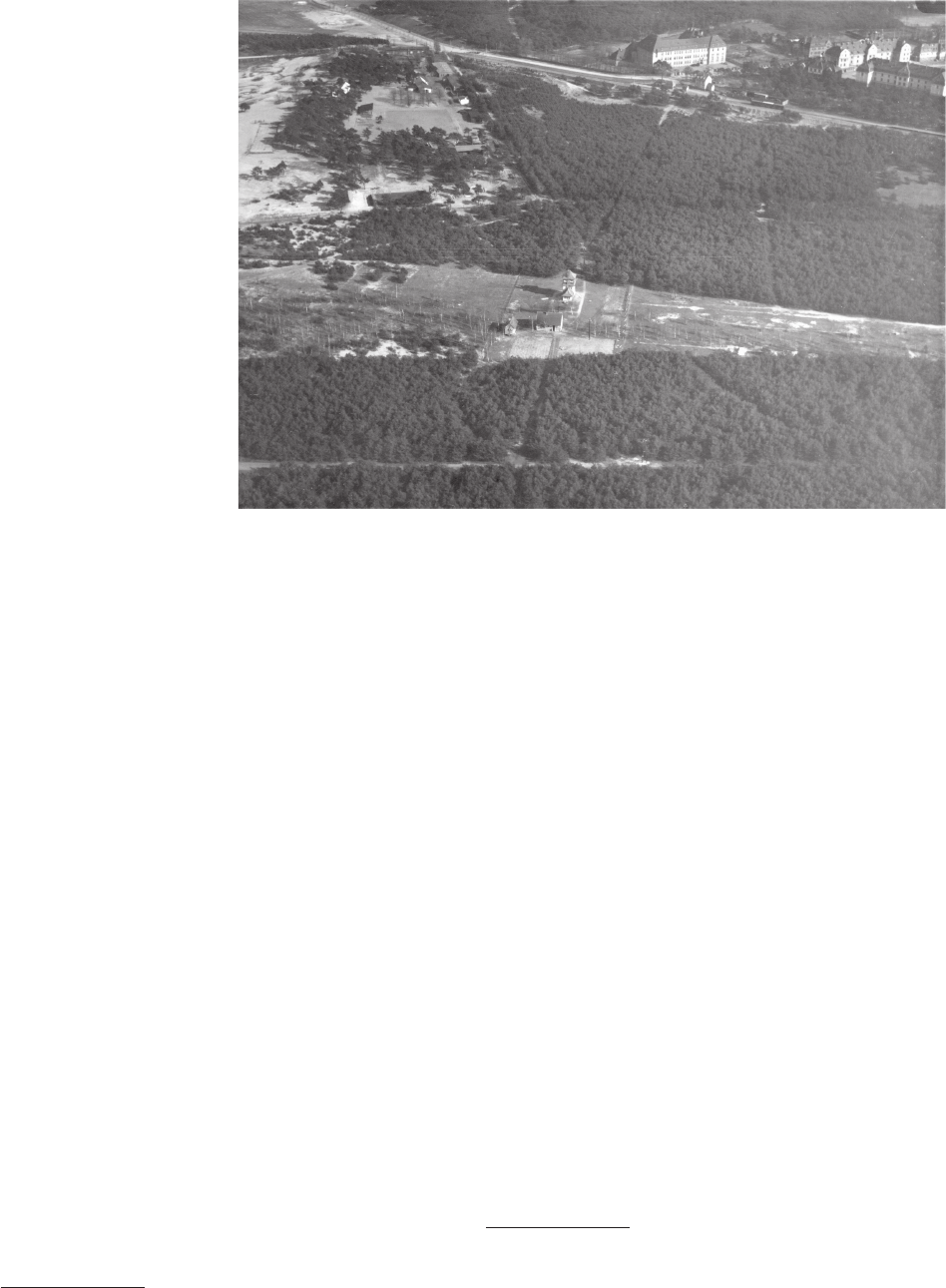
no. 6212) (Fig. 8).
The wartime atmosphere thickened in the following
years. This can be seen in the preserved documentation
from that period – it consists of numerous circulars and
internal correspondence, which draw attention to the
need for reliable preparation of anti-aircraft and anti-gas
defence in peacetime, including determining the person-
nel of individual teams and proper maintenance of their
Anti-aircraft Defence and Gas Defence equipment and
clothing
22
, the requirements to supply the plant with a de-
tector or tube radio with its own power source, and to have
spare parts of machines, apparatus and devices (1937)
(APT, AmT D, ref. no. 6183)
23
. Additional activities were
to include, among others:
3. Masking of terrain, buildings, roads, water towers,
tanks, etc. on the factory premises by:
a) appropriate planting of trees in the area (pines, rs,
poplars, etc.),
22
Equipment such as breathing apparatus, anemometers, and hand
sprayers. The Anti-aircraft Defence and Gas Defence organization con-
sisted of, among others, the alarm service, messengers, sanitary, re and
disinfection services, and included large plants – in the case of the Toruń
waterworks, these were the sewage treatment plants in Rybaki and Stare
Bielany. Nowe Bielany was subordinated to Klemens Lewandowski,
commander of the Anti-aircraft Defence and Gas Defence main station
(APT, AmT D, ref. no. 6183).
23
The expense was to be covered from the account intended for
well maintenance (APT, AmT D, ref. no. 6183).
Fig. 8. Toruń – aerial photo
with the Nowe Bielany pumping
station visible (1933)
(source: APT, AmT D,
ref. no. 1648)
Il. 8. Toruń – zdjęcie lotnicze
z widoczną stacją pomp
Nowe Bielany (1933)
(źródło: APT, AmT D,
ref. no. 1648)

18 Daria Jagiełło
b) protective painting or its preparation /with splashes
of background and surrounding colours/ (APT AmT D,
ref. no. 6183).
In a letter dated April 1939, the director of the Municipal
Water and Sewage Works, Orłowski, asked for the consent
of the District Oce for the guards of waterworks plants
(Stare and Nowe Bielany and Podgórz) to carry short re-
arms. Such a permit for a rearm with seven rounds was is-
sued to Nowe Bielany in May (APT, AmT D, ref. no. 6183).
The preserved documentation shows that the rst op-
erator, Hohlfeldt, was replaced by semi-skilled operator
Józef Brzozowski, and after his dismissal in 1921, this
function was taken over by Albin Kołaczyński
24
. In the
same year, a storm tore o the roof tiles of a residential
building (12 m
2
) and broke 10 windows (APT, AmT D,
ref. no. 6226, 74). In 1935, the operator’s house, which
was renovated (including work on the roof truss, plaster-
ing, painting, removing the linoleum), was inhabited by
Antoni Grabowski (APT, AmT D, ref. no. 1648, 148–149).
After 1939
There is no information about any signicant transfor-
mations or changes in the machine room building after
the war. According to the 1959 inventory, the station was
equipped with two centrifugal pumps Maei-Szchwarz-
kop-Werke GmbH
25
(Maei-Schwartzkop-Werke GmbH)
and the vertical piston pump “Vakum” by ALG Dechne
Halle O.S.
26
(“Vacum”, A.L.G. Dehne Maschinenfabrik)
with electric drive, centrifugal pump
27
(made by A. Bo-
rung) with electric drive, switchboard
28
, central heating
furnace
29
, high-voltage full-oil switch with manual drive,
two current transformers: oil transformer and dry-type
oil transformer (APT, Miejskie Przedsiębiorstwo…, ref.
no. 143, 15).
Henryk Zimny’s design for a chlorination plant locat-
ed in the former fuel room, at the pump hall level, at the
southern end of the storey, comes from 1967 (Zimny 1967)
(Fig. 9). After 1980, the original slate roong was replaced
with sheet metal (roofs) and roof tiles (wall cladding of
the top oor of the tower) (Szczuczko, Wieczorkiewicz
1982). The original solution was restored during adapta-
tion work.
24
In later years, Kołaczyński was moved to the waterworks’ ser-
vice apartment at 16 Szosa Chełmińska (?) (APT, AmT D, ref. no. 6180;
APT, AmT D, ref. no. 6183; APT, AmT D, ref. no. 6240).
25
Technical specications: 1) pump serial number 1321, N 1450,
Q 20000l/min, pumping height 65 m, outlet diameter 125 mm, motor
type: Dr. 50/1500, serial number 13176; 2) pump serial number: 1322,
pumping height 60 m, motor serial no. 13177; other parameters as above
(APT, Miejskie Przedsiębiorstwo…, ref. no. 143, 5, 7). The data is con-
sistent with the order from 1916 [see extensive correspondence (APT,
AmT C, ref. no. 5990)].
26
Pump serial number 2177, motor type N 1350, serial number
30913 (APT, Miejskie Przedsiębiorstwo…, ref. no. 143, 11).
27
Pump type Na 10-26, serial number 4939, motor type 2850, se-
rial number 1232 (APT, Miejskie Przedsiębiorstwo…, ref. no. 143, 3).
28
Serial number 54273 (APT, Miejskie Przedsiębiorstwo…, ref.
no. 143, 9).
29
Specication – type RV III Ż(or Z)R, serial number 10648 (APT,
Miej skie Przedsiębiorstwo…, ref. no. 143, 17).
Much greater changes took place within the residential
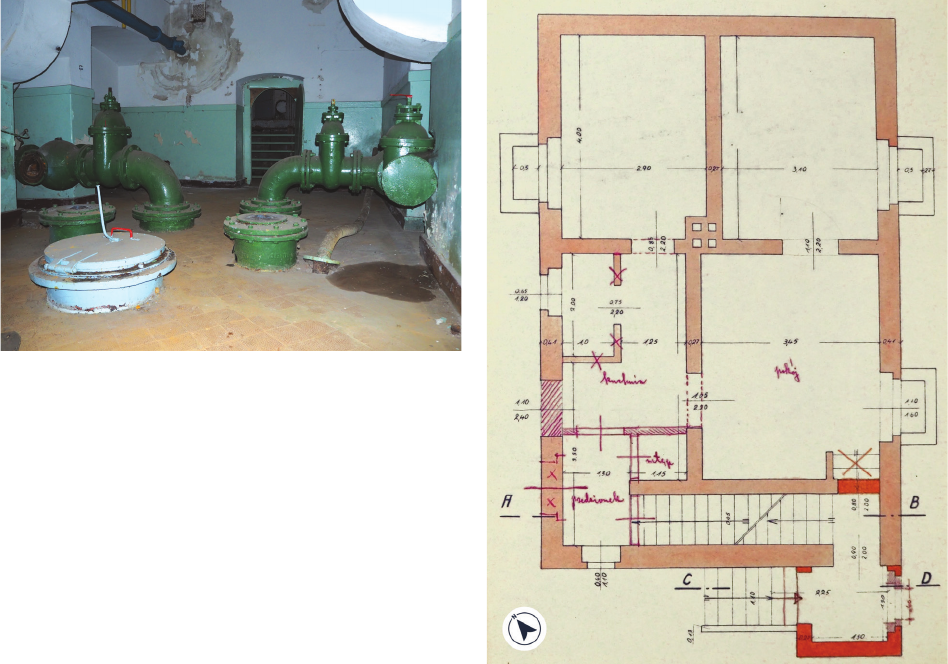
building. In 1949, a reconstruction project was submitted
for approval, which envisaged the addition of a vestibule
to the western gable wall, providing direct access to the
stairs leading to the attic, and partial reconstruction of
the ground oor. In the attic there is a rectangular living
room (?). The changes on the ground oor were limited to
the north-western part of the building (Fig. 10). The draw-
ings are signed with the name M. Lewandowski. The ac-
ceptance of the work carried out was made on November
24, 1950. The then address of the pumping station complex
was Projektowana Street 106 (APT, AmT G, ref. no. 1227,
1–14). In later years, the attic was fully adapted: a sepa-
rate apartment with a separate entrance was created there.
Extensions were introduced in the roof areas in order to
enlarge the interiors and provide more light; it is also pos-
sible that the eastern gable was pierced at that time and one
large window was placed in place of a pair of narrow win-
dows (as in the western elevation). Two families lived in
the building for the following years (Teczka oso bowa…).
The utility building was also expanded and extended to-
wards the south. On the basis of historic photos and plans,
it can be concluded that this must have happened after
1949 and before 1980 (Szczuczko, Wieczorkiewicz 1982;
APT, AmT G, ref. no. 1227). Before the adaptation, a seam
was still visible on the façade where part of the longitudi-
nal wall had been added
30
.
Both in earlier aerial photos from the 1930s and in the
site plan of 1949, the area of the plot on which the complex
was located was not divided by a fence into the northern
part (residential and utility buildings with a garden) and
the southern part (machine room building). The division
in force in later years was introduced before 1980 (APT,
AmT G, ref. no. 1227) (Szczuczko, Wieczorkiewicz 1982,
Fig. 90). During the adaptation, the original solution was
restored.
In the years 1952–1953 the intake wells were modern-
ized (lters were replaced). The development of municipal
housing in their immediate vicinity (including the planned
construction of a university campus), the construction of an
intake in Mała Nieszawka and the impossibility of provid-
ing protection zones were (according to a study from 1966)
the main reasons for the planned disconnection of Nowe
Bielany from the city network (Wilczyńska 1966, 2–3). In
the years 1973–1974 four replacement wells were drilled
(at that time the intake consisted of a total of 12 wells);
the old ones served as piezometers (Zimny 1967, 2).
In 1983 the intake was decommissioned. Some of the
wells belonging to the complex served as emergency in-
takes, which could be connected to the city network at any
time in the event of failure of other municipal intakes
31
. In
30
The building was marked with a dierent colour in the 1949
documentation (APT, AmT G, ref. no. 1227). Perhaps the creation of
an additional living space in the attic was connected with the expansion
of the building and the allocation of additional utility rooms to the new
tenant. Another possibility is that the facility was built in 1949, e.g., on
the site of a former stable, which was not characterized in any way in the
archives, and it was expanded in later years.
31
According to the documentation, in 1990, four of the eight wells
were inactive [see, among others: (Karta rejestracyjna…)].
History of Toruń’s New Bielany pump station (1916–1917) in the light of archival records 19
2002, the Nowe Bielany intake was the fth largest in terms
of water production in cubic metres per day in Toruń (ca-
pacity and production: 1680 m
3
). Its quality was still within
the norm for drinking water, and the wells were still marked
as emergency intakes (Świerszcz-Prusicka 2005, 46). The
last resident of the building at today’s 16 Ol szew skiego
Street (an employee of Toruńskie Wodociągi Sp. z o.o.)
left it in 2020 (Teczka osobowa…).
Summary
Even though the Nowe Bielany station operated for
many years, supplying water to Toruń, it never attracted
much interest (either from researchers or the city residents
themselves). Hidden in a forest on the university campus,
it slowly fell into oblivion. This situation has changed only
recently thanks to the adaptation of its buildings (initially
the plans included the possibility of demolishing the com-
plex, which was opposed by the Municipal Conservator of
Monuments).
On the basis of the analysis of archival documentation,
historic iconography, and excerpts from texts published in
the local press, it was possible not only to trace the history
of the station from the moment of its construction to its
decommissioning, but also to build a broader context, i.e.,
to indicate its role in the city’s water supply system and to
show the realities of the times when it was in operation.
This approach to the topic makes it possible for us to both
get to know the facility itself and to understand better its
functioning. The station, which was built in 1916–1917,
turned out to be, on the one hand, a facility built, despite
external adversities, in an ecient and well-thought-out
manner – a station with a (projected) signicant role for
the ecient operation of the waterworks, and on the other
hand, a quickly realized disappointment, perhaps resulting
from the overestimated capacity of the intake, or perhaps
the geology of the terrain, or an unfortunate type of drive
for the conditions at that time, or perhaps something com-
pletely dierent. It is signicant that after the 1930s, a new
location was sought for another urban intake.
Nowe Bielany, however, still remains a potential re-
search subject owing to the quite unusual architecture of
the station at the time of its construction (not discussed in
more detail in this text), as well as the need for a more de-
tailed analysis of the plant’s operation from the technolog-
ical perspective, and relating the obtained results to other
facilities with a similar role.
Translated by
Edward Maliszewski
Fig. 9. Toruń – the former Nowe Bielany pumping station:
machine room, in the lower left corner the casing of the collecting
well, in the background the passage to the chlorination plant
(photo by D. Jagiełło, 2024)
Il. 9. Toruń – dawna stacja pomp Nowe Bielany:
maszynownia, w lewym dolnym rogu
obudowa studni zbiorczej,
na dalszym planie przejście do chlorowni
(fot. D. Jagiełło, 2024)
Fig. 10. Toruń – residential building in the complex
of the former Nowe Bielany pumping station,
reconstruction design: building plan (ground floor);
original scale 1:50 (1949)
(source: APT, AmT G, ref. no. 1227)
Il. 10. Toruń – budynek mieszkalny
w zespole dawnej stacji pomp Nowe Bielany,
projekt przebudowy: rzut budynku (parter);
skala oryginału 1:50 (1949)
(źródło: APT, AmT G, ref. no. 1227)
20 Daria Jagiełło
Streszczenie
Historia niewielkiego zespołu stacji pomp Nowe Bielany (1916–1917) w świetle źródeł archiwalnych
W latach 2022–2023 przeprowadzona została adaptacja zespołu jednej z dawnych toruńskich stacji pomp – tzw. Nowych Bielan (zakończenie jej
budowy datowane jest na 1917). Zakład przez wiele lat wspomagał pobliską stację główną Stare Bielany w zaopatrywaniu miasta w wodę. W latach
80. XX w. został wyłączony z eksploatacji i przez kolejne pozostawał nieużytkowany. Przygotowania związane z projektem adaptacji uświadomiły,
że historia stacji jest słabo rozpoznana, a obiekt nie był dotychczas przedmiotem badań.
W artykule przedstawiono interesującą historię budowy i działania nowobielańskiego zakładu. Podano także powody, które ostatecznie zadecy-
dowały o jego zamknięciu. Zaprezentowano okoliczności budowy, wyposażenie, architekturę, a także realia czasów, w których pracowała, równo-
cześnie uwypuklono znaczenie badań archiwalnych dla lepszego rozpoznania obiektu. Tekst przygotowano głównie na podstawie wyników szeroko
zakrojonej kwerendy archiwalnej, niekiedy dokonując konfrontacji z wynikami analizy istniejącego obiektu (przed pracami adaptacyjnymi i po tych
pracach).
Nowe Bielany, jak wynika z materiałów, do których udało się dotrzeć, były zakładem budowanym sprawnie i z dużą dbałością (potwierdza to
również zachowana korespondencja). W związku z powracającymi problemami niedoborów wody w Toruniu pokładano w ich budowie duże na-
dzieje. Stacja niestety nie sprostała tym oczekiwaniom (bardzo wysokie koszty produkcji, szybko spadająca wydajność pomp oraz zbyt mało wody
w studniach), dlatego już w latach 30. XX w. rozpoczęto poszukiwania lokalizacji dla nowego ujęcia.
Mimo że przedstawiona historia nie jest historią sukcesu, zespół stacji pomp Nowe Bielany okazał się interesującym i cennym świadkiem rozwo-
ju infrastruktury wodociągowo-kanalizacyjnej w Toruniu.
Słowa kluczowe: wodociągi, Toruń, dziedzictwo techniki, dzieje, przemysł w XX w.
References
Akta miasta Podgórza, ref. no. 774.
Akta miasta Podgórza, ref. no. 776.
Archiwum Państwowe w Toruniu [APT], Akta miasta Torunia.
APT, AmT C, ref. no. 5976.
APT, AmT C, ref. no. 5990.
APT, AmT C, ref. no. 19687.
APT, AmT D, ref. no. 1648.
APT, AmT D, ref. no. 3220a, no pagination.
APT, AmT D, ref. no. 6180, no pagination.
APT, AmT D, ref. no. 6183, no pagination.
APT, AmT D, ref. no. 6212, no pagination.
APT, AmT D, ref. no. 6213.
APT, AmT D, ref. no. 6226.
APT, AmT D, ref. no. 6227.
APT, AmT D, ref. no. 6228, no pagination.
APT, AmT D, ref. no. 6239.
APT, AmT D, ref. no. 6240, no pagination.
APT, AmT D, ref. no. 6241, no pagination.
APT, AmT D, ref. no. 6252, no pagination.
APT, AmT G, ref. no. 1227.
APT, Dokumentacja techniczna miasta Torunia, ref. no. 2807.
APT, Dokumentacja techniczna miasta Torunia, ref. no. 3229.
APT, Dokumentacja techniczna miasta Torunia, Vol. 105, ref. no. 3299.
APT, Miejskie Przedsiębiorstwo Wodociągów i Kanalizacji w Toruniu,
ref. no. 143.
“Der neue Thorner Wasserwerk.” Die Presse, no. 205 (September 1917): 3.
Felski, Tadeusz, Marian Hejnowicz, and Henryk Pawluk. “Wodociągi
i kanalizacja w ostatnim stuleciu (1893–1993).” In 100-lecie nowo-
czes nych wodociągów toruńskich: 1893– 1993. WPWiK, 1993,
10–12.
geoportal.gov.pl. “Toruń”. Accessed June 11, 2024.
Gerlach, Friedrich. Eine Bautechnische Studienreise nach West- und Ost-
preussen. Bericht über eine unter Leitung des Geheimen Ober-Bau-
rath. Verlag von Julius Springer, 1884, 8.
“Historyczny układ urbanistyczny kampusu uniwersyteckiego UMK
na Bielanach.” Record number: A/1770 by decision of 20 January
2020. Accessed June 11, 2024, at http://www.torun.wkz.gov.pl/bip/
art/les/27.
Jagiełło, Daria, Joanna Kucharzewska, and Paulina Szczurek. “Doku-
mentacja historyczno-konserwatorska. Dawna stacja pomp ‘Nowe
Bie lany’.” Toruń, 2022. [Manuscript in: Archiwum MKZ w Toruniu].
“Karta rejestracyjna studni nr 2a.” Toruń 1990. [Manuscript in: Archi-
wum Wodociągów Sp z o.o.].
Kola, Robert, and Leszek Kotlewski. Drewniane wodociągi Torunia (1.
poł. XIV w.–pocz. XIX w.). Regionalny Ośrodek Badań i Dokumen-
tacji Zabytków, 2003.
Księga adresowa miasta Torunia wraz z Podgórzem i powiatem Toruń-
Wieś. Wydaw. Księgi Adresowej, 1923.
Przybyszewski, Kazimierz. “Przedsiębiorstwa miejskie Torunia w dwu-
dziestoleciu międzywojennym.” Rocznik Toruński, vol. 15 (1980):
117–146.
Szczuczko, Witold, and Hanna Wieczorkiewicz. Toruń Zespół Wodocią-
gów, vol. 2: Zespół wodociągów stacji pomp Podgórz, Mokre i Nowe
Bielany. Archive of the K-P WKZ in Toruń , ref. nos. 1126, 1982.
Świercz-Prusicka, Anna. “Gospodarka wodno-ściekowa miasta Toru-
nia.” Acta Universitatis Nicolai Copernici. Nauki Matematyczno-
Przy rodnicze. Geograa, no. 111 (2005): 41–59.
“Teczka osobowa pracownika.” Toruń. [Manuscript in: Archiwum Wo-
dociągów Sp z o.o.].
“Toruń i okolica.” Gazeta Toruńska, no. 207 (September 1915): 3.
“Toruń-les-Bains.” Deutsche Rundschau, no. 1 (January 1928).
Wilczyńska, Teresa. Dokumentacja hydrogeologiczna ujęcia wód pod-
ziemnych z utworów czwartorzędowych w rejonie ujęcia miejskiego
Toruń – Nowe Bielany. Toruń 1966. [Manuscript in: Archiwum Wo-
dociągów Sp z o.o.].
Wykaz statystyczny miasta Torunia za czas od 18 stycznia 1920 do 31
grudnia 1923. Drukarnia S. Buszczyński, 1924.
Zielińska, Agnieszka. “Okres rządów pruskich (1793–1920).” In Atlas
historyczny miast polskich, edited by Robert Czaja. Towarzystwo
Naukowe w Toruniu, 2019.
Zimny, Henryk. Projekt chlorowni stacji pomp Nowe Bielany. Toruń
1967. [Manuscript in: Archiwum Wodociągów Sp z o.o.].
Acknowledgements
The materials used in the article were mostly obtained during archival
research conducted as part of the MINIATURA 7 grant: “Historic water
supply and sewage infrastructure of larger Polish cities on the example of
Toruń […] – archival query” and nanced by the National Science Centre
(2023/07/X/HS2/01129). Contemporary photos and characteristics come
from the documentation prepared as part of the Scholarship of the Mini-
ster of Culture and National Heritage: “Toruń’s water and sewage infra-
structure […] – common heritage” (88/2024).