
2017
2(50)
DOI: 10.5277/arc170201
Patrycja Grzyś*
Wizerunek miasta a jego tożsamość – współczesne zależności
Image of the city and its identity – contemporary relations
Wprowadzenie
Nasilające się tempo przemian współczesnych miast
powoduje, iż są one często zmuszone do poszukiwania
nowych dróg rozwoju oraz przyjmowania strategii, które
pozwolą im na przystosowanie się do nowych sytuacji
gospodarczo-społecznych, tak by odpowiadać coraz bar-
dziej zaawansowanym potrzebom coraz szerszej grupy
odbiorców. Owo przystosowanie do nowych warunków
przez jednostki miejskie zachodzi często poprzez prze-
wartościowywanie zasad swojego funkcjonowania w ten
sposób, by mogły spełniać one warunki umożliwiające im
stanie się (lub pozostanie) konkurencyjnymi podmiotami
na globalnym rynku miejskim.
W ramach zwiększającego się znaczenia konkurencyj-
ności ośrodków miejskich coraz większego znaczenia na -
biera umiejętność kreowania wizerunku miasta przez lo -
kalne władze samorządowe [1]. Podejście marketin go we
w zarządzaniu rozwojem jednostek miejskich w wa run -
kach polskich obecne jest od blisko 30 lat dzięki funkcjo-
nującym zasadom gospodarki rynkowej. Niemniej jednak
idea marketingu terytorialnego i pierwsze faktyczne pró by
jego wykorzystania w krajowej polityce miejskiej datuje
się na pierwsze lata XXI w. [2], [3].
Wraz z adaptacją i wdrażaniem idei marketingu tery-
torialnego w zarządzaniu miastem staje się ono elemen-
tem globalnej konkurencji miast opartej na prawach ryn-
kowych [4]. Miasto więc jako swoistego rodzaju produkt
rynkowy wymaga również odpowiedniej promocji.
Introduction
The increasing pace of contemporary cities’ transfor-
mations and the forces that impact them are responsible
for the fact that cities are forced to look for new ways of
development and adopting strategies that will allow them
to acclimatize with the new economic and social situation
so as to comply with increasingly advanced needs of the
growing group of urban stakeholders. This adaptation to
new settings by urban units is often done by re-evaluating
the principles of their functioning so that they can meet
the conditions for them to become (or remain) competi-
tive in the global market of cities.
In the context of increasing importance of competition
between cities the ability of the local government authori-
ties to influence on the image of the city is becoming
increasingly important [1]. Marketing approach in the city
management is possible in Polish conditions from nearly
30 years thanks to market economy principles. Ne ver-
theless, the idea of territorial marketing and the first real
attempts to use it in urban strategies date back to the first
years of the 21
st
century [2], [3].
Along with the adaptation and implementation of the
idea of territorial marketing in city management it becomes
a part of global competitiveness based on the market laws
[4]. The city, then, as a kind of product also requires
a proper promotion. In that specific competitive struggle
a positive and vibrant image of the city is often the one that
decides on its advantage over other units [2]. In the recent
years, along with facing the ongoing process of globaliza-
tion elements permanently connected to the city, such as
its history or unique resources are becoming less important
in shaping urban images. What can be seen
more and
* Wydział Oceanograi i Geograi Uniwersytetu Gdańskiego/
Faculty of Oceanography and Geography, University of Gdansk.

4 Patrycja Grzyś
W owej specyficznej walce konkurencyjnej to właśnie
pozytywny i wyrazisty wizerunek miasta stanowi często
o jego przewadze nad innymi ośrodkami [2]. W ostatnich
latach jednak, wraz z postępującym procesem globaliza-
cji, coraz mniejsze znaczenie w kreowaniu wizerunku
miasta odgrywają elementy wynikające z jego tożsamo-
ści. Coraz częściej natomiast miasta poszukują, a wręcz
implementują do swojego wizerunku elementy niezwią-
zane z jego tożsamością, uznając, iż dotychczasowe zaso-
by miasta były niewystarczające bądź zbyt negatywnie
nacechowane, by móc na ich podstawie wykreować wize-
runek, dzięki któremu będzie mogło ono pretendować do
miana „globalnego miasta”
1
. Sytuacja taka ma nierzadko
miejsce w przypadku ośrodków poprzemysłowych, które
chcąc niejako zatrzeć często „niewygodne” fakty histo-
ryczne, kreują nowy wizerunek miasta w całkowitym
oderwaniu od jego tożsamości.
Celem niniejszego artykułu jest zwrócenie uwagi na
zależność, jaka zachodzi pomiędzy pojęciami „wizerunek”
i „tożsamość miejska”, a następnie wskazanie, czy zależ-
ność ta znajduje odniesienie w ramach zarządzania prze-
strzeniami miejskimi we współczesnych uwarunkowaniach.
Wyzwania wobec miast współczesnych
Współczesne przemiany miejskie są skutkiem procesów,
jakie zachodzą na świecie. Owe procesy, związane z prze-
mia nami zarówno politycznymi, gospodarczymi, przestrzen-
nymi, jak i społecznymi, wpływają w znaczącym sto pniu
na
ośrodki miejskie. Miasto ponadto jako jednostka prze -
strzen
na staje się obecnie szczególnie ważnym elementem
w sie ci globalnej, co związane jest z jednym z najistotniej-
szych i najbardziej wieloaspektowych procesów do mi-
nujących w dzisiejszych czasach, czyli globalizacją [6].
Globalizacja nie jest zjawiskiem nowym. Analogicznie
do pojęcia „zmiana”, z którym zresztą globalizacja jest
ściśle powiązana, proces ten towarzyszył już człowieko -
wi od wielu lat, aczkolwiek nigdy dotąd nie obejmował
tak szerokiego zakresu dziedzin i nie skutkował tak szero-
kim zakresem przemian. Globalizacja wiąże się przede
wszystkim z przemianami gospodarczymi, choć pozostałe
jej aspekty, takie jak przemiany przestrzenne czy społecz-
ne w równie istotny sposób wpływają na kształt współ-
czesnych miast i sposoby ich funkcjonowania. Jednym
ze znaczących jej przejawów jest proces zmniejszania się
roli struktur państwowych spowodowany ich nieefektyw-
nością, a jednocześnie zwiększanie się roli miast oraz
regionów [7], [8]. Jednakże proces ten oznacza również
zwiększoną konkurencję między ośrodkami o podobnej
wielkości. Miasta, rywalizując o dostęp do ograniczonych
zasobów kapitału, o inwestorów, mieszkańców czy pra-
cowników, poszukują przewagi konkurencyjnej w nowych
obszarach funkcjonowania, co stanowi obecnie jedno z naj-
istotniejszych dla nich wyzwań [9].
1
Rossi oraz Vanolo [5, s. 38] opisują w swojej pracy zjawisko
wannabe global cities jako proces, w którym w dobie gospodarki rynko-
wej i nasilonej konkurencji między miastami większość ośrodków
miejskich pretenduje do pozycji ośrodków globalnych, chociaż ich
warunki nie są do tego celu wystarczające.
more often in the urban strategies, local authorities are
seeking or even implementing to their images external
components previously unrelated to the city, recognizing
that the existing resources of the city were insufficient or
too negatively marked to be able to create a basis of their
image that will enable them to be claimed as a “global
city”
1
. The described situation repeatedly takes place main-
ly in the case of post-industrial cities, which struggle with
“uncomfortable” historical facts that they want to exclude
from their identity and keep in isolation from their image.
The purpose of this article is therefore an indication of
the relationship which exists between the concepts of
image and identity of the city and then to indicate whether
this relationship finds a reference in the contemporary
urban management.
Challenges of contemporary cities
Modern urban transformations are the result of a series
of processes occurring in today’s world. These processes
associated both with political, economic, spatial and
social changes significantly impact on urban centers.
Moreover, the city as a spatial unit is now becoming a par-
ticularly important element in the global network, which
relates to the most important and most multi-featured pro-
cess dominating in 21
st
century. This process is obviously
the globalization [6].
Globalization is not a new phenomenon. Similarly, to
the concept of “change” which globalization is closely
linked to, this process was already accompanied by man
for many years, but has never included such a wide range
of areas and does not result in such a wide range of trans-
formations. Globalization is associated primarily with
economic changes, although its other aspects, such as spa-
tial or social transformations are equally important in
influencing the shape of contemporary cities and their
functioning. One of its major manifestations, which was
mentioned above is the process of reducing the role of
state structures, due to their inefficiency, while increasing
the role of cities and regions [7], [8]. However, this pro-
cess is also the motive of increased competition between
these centers. Cities competing for limited capital resourc-
es, for new investors, residents or employees are seeking
new competitive advantages in the new areas of function-
ing, which is now one of the most important challenges of
contemporary cities [9].
In addition to increasing competition between urban
centers another significant contemporary urban challenge
is the process of uniformity, the spread of western culture
as the dominant cultural pattern as well as regression of
local cultures, which is the reason for intense disputes
among scientists
2
. However, apart from the controversial
1
Rossi and Vanolo [5, p. 38] are describing in their work a phe-
nomenon called “wannabe global cities” as a process in which in the era
of global market domination and increased competitiveness most of the
urban units are pretending to the role of global centers even though they
have no efficient resources or conditions to be able to face this goal.
2
In the literature, two opposite approaches to the significance of
local cultures can be observed. One approach is based on the acknow-

Wizerunek miasta a jego tożsamość /Image of the city and its identity 5
Oprócz zwiększającej się konkurencji między ośrodka-
mi miejskimi kolejnym istotnym wyzwaniem dla współ-
czesnych miast są procesy uniformizacji, rozprzestrzenia-
nia się kultury zachodniej jako dominującego wzorca
kulturowego, a także regres kultur lokalnych. Definicja
tego zjawiska wywołuje przy tym intensywne spory
wśród naukowców
2
. Abstrahując jednak od dyskusyjnej
kwestii, jaką jest regres kultur lokalnych, fakt rozpow-
szechniania się zachodnich wzorców kulturowych nie
ulega wątpliwości. Jednym z najbardziej widocznych
przejawów globalizacji jest jej aspekt przestrzenny.
Niezwykle istotne w niniejszych rozważaniach jest zagad-
nienie kontekstu, a właściwe dekontekstualizacji. Skut-
kiem globalizacji rynku usług architektonicznych – jak
zauważają Gajny i Jeleński [13] – jest powierzchowne
traktowanie, a wręcz momentami całkowite ignorowanie
lokalnych kontekstów kulturowych. Za taki kontekst
w mieście uznać można tytułową tożsamość, która tym
sa mym
traci na znaczeniu bądź jest całkowicie pomijana,
ulegając aspiracjom architektów czy też marketingowej
potrzebie wykreowania nowego wizerunku miejsca. Oczy-
wiście,
w praktyce wykazać można przykłady miast, które
rzeczywiście osiągnęły rozpoznawalność dzięki niekon-
wencjonalnym projektom architektonicznym. Całkowite
oderwanie od tożsamości lokalnej wskazuje jed nakże
na oparcie sukcesu na sztucznie wykreowanym wi ze run-
ku, co Dąbrowska-Milewska nazywa „firmowym stem-
plem stawianym w różnych miejscach globu” [14, s. 11].
Poza globalizacją kluczowym procesem dla zrozumie-
nia przemian współczesnych miast jest dezindustrializa-
cja. Koniec ery industrialnej dla wielu ośrodków, w któ-
rych to właśnie przemysł stanowił bazę rozwojową, jest
wciąż niezwykle trudnym wyzwaniem. Z powodu wyga-
śnięcia dominującej przez kilkadziesiąt lat funkcji, jaką
był przemysł, miasta borykały się, a niektóre wciąż się
borykają z kryzysem ekonomicznym. Ten z kolei często
pociąga za sobą masywny odpływ ludności, a także budo-
wę negatywnego wizerunku miasta. Ośrodki miejskie,
znajdując się w momencie kryzysowym, w chwili pod-
jęcia istotnych decyzji dotyczących dalszego ich funkcjo-
nowania są szczególnie narażone na wspomniane po wyżej
powielanie wzorców kulturowych poprzez wykorzysty-
wanie doświadczeń innych miast, nie zawsze dostosowu-
jąc je do lokalnych uwarunkowań. Przykłady polskie
(m.in. Łódź, Katowice) udowadniają jednak, iż skupienie
się na produktach lokalnych i wykorzystanie – być może
2
W literaturze przedmiotu zaobserwować można dwa zupełnie
od mienne spo soby podejścia do istotności kultur lokalnych. Jednym
z nich jest podejście związane z uznaniem procesów globalizacji, a tym
samym faktu, iż zmiany cywilizacyjne negatywnie wpływają na postrze-
ganie historii i tradycji, iż obniża się poziom identyfikacji mieszkańców
z miejscem ich pracy i życia, redukcji ulega poziom więzi społecznych.
Stanowisko takie reprezentuje między innymi Walicki [10]. Drugie
podejście związane jest natomiast z procesem nazwanym przez Ro -
bertsona [11] glokalizacją, czyli procesem zakładającym istnienie glo-
balnych struktur, które powinny być adaptowane do kultur lokalnych, co
zapewnia im większą efektywność. Tezę tę popiera również Giddens
[12], wspominając o powrocie „kultur wypartych”, co oznacza, iż para-
doksalnie dopiero w dobie gospodarki globalnej kultury lokalne coraz
silniej się identyfikują, określając swą odrębność.
discussion about the regression of local cultures it is
undeniable that the western cultural patterns are spread-
ing and consequently some cultural impoverishment
through its reproduction, can be noticed. One of the most
visible manifestations of globalization is its spatial aspect.
Enormously important in these considerations is the mat-
ter of context and decontextualization. The effect of glo-
balization of architectural services as noted by Gajny and
Jeleński [13] is the superficial treatment of local culture
context or even completely ignoring it in some situations.
The urban identity is treated as a context in the described
matter. It nowadays loses its meaning, or is entirely
excluded, yielding to the aspirations of architects or the
marketing need to create a new image of the place.
Obviously, in practice there are few examples of cities
that have actually achieved recognition through uncon-
ventional architectural projects. Nevertheless, it is diffi-
cult to speak in this case of any kind of local identity, but
rather about a bought image, or global identity which
Dąbrowska-Milewska [14, p. 11] calls a “corporate stamp
posed in different places of the globe”.
Besides globalization, the key to recognize the trans-
formations of contemporary cities is the process of de-
industrialization. The end of the industrial era for many
cities in which the industry was a main development trig-
ger, is still an extremely difficult challenge. Many cities
are still struggling with the expiry of their dominant func-
tion which was the industry, faced nowadays primarily
with the economic crisis. The economic crisis entails
a massive outflow of population which is related specifi-
cally to the topic of this paper, the construction of the
negative image of this space. These cities, at the time of
crisis when taking important decisions regarding their
further functioning are particularly vulnerable to the
above-mentioned reproduction of cultural patterns
through using the experience of other cities but do not
always conform them to local conditions. Examples of
Polish cities (Lodz, Katowice) prove, however, that focus-
ing on local products and using their own identity, some-
times not so positive in the right, new way, allows the city
to develop without foresaking its identity and achieving
greater success than by removing the traces of history and
the creation of a prosthesis of an urban image.
Apart from those urban challenges stated above, it is
worth including the aspect of social life in this considera-
tion. All activities undertaken in the urban environments
have an impact on the lives of their communities. These
communities are increasingly interested in the life of their
cities. Democratization, computerization, and several
ledgement of the processes of globalization, and thus, the fact that civi-
lization changes negatively affect the perception of history and tradition,
lowers the level of identification with the place and reduces the level of
social ties, which represents, i.e. Walicki [10]. The second approach is
associated with the process called by Robertson [11] the glocalisation. It
is the process of assuming the existence of global structures with the
obligation to adapt them to local cultures, which provides greater effi-
ciency. This thesis is also supported by Giddens [12], who mentioned
the return of “repressed cultures”, which means that, paradoxically, in
the era of the global economy, local cultures increasingly identify them-
selves by presenting their distinctiveness.

6 Patrycja Grzyś
nie do końca pozytywnej, lecz własnej – tożsamości
w od powiedni, nowy sposób pozwala na rozwój miasta
bez porzucania jego autentyczności i umożliwia osiąg-
nięcie większego sukcesu aniżeli poprzez zacieranie śla-
dów historii i tworzenie wizerunkowej protezy.
Poza wymienionymi wyzwaniami, jakim sprostać
muszą dzisiejsze ośrodki miejskie, warto wspomnieć
dodatkowo o niezwykle istotnym aspekcie społecznym.
Wszystkie działania podejmowane w miastach mają
bowiem wpływ na życie ich społeczności. Społeczności
te natomiast wykazują coraz większe zainteresowanie
życiem swoich miast. Demokratyzacja, informatyzacja,
a także wiele innych procesów związanych z przemia -
nami warstwy społecznej miasta spowodowały ogromny
wzrost samoświadomości mieszkańców jako głównych
odbiorców działań administracji samorządowej, instytu -
cji oraz przedsiębiorstw komunalnych funkcjonują cych
w mie
ście. Proces ten, co jest szczególnie interesujące, za -
chodzi zarówno odgórnie, jak i oddolnie. Niestety więk-
szość działań mających zapewnić współpracę pomiędzy
różnymi interesariuszami miejskimi wciąż ma charakter
wymuszony przepisami prawnymi. Niemniej jednak,
szczególnie w większych ośrodkach, można zaobserwo-
wać pozytywną tendencję przemiany tego zjawiska pole-
gającą na wdra żaniu nieobligatoryjnych metod partycypa-
cji społecznej.
Miasta stanowią konglomeraty ogromu osób, intere-
sów, celów oraz dążeń, które zależne są od niezliczonej
masy uwarunkowań oraz czynników wpływających na
ich funkcjonowanie. Wszystkie te elementy składają się
na definicję danego ośrodka miejskiego, natomiast jego
obraz budowany jest ze składników wybiórczych zależ-
nych od podmiotu postrzegającego, jego wiedzy, doświad-
czeń i innych przyczyn odpowiedzialnych za kształtowa-
nie wizerunku danej jednostki w jego świadomości.
Zadaniem władz miasta jest zatem prawidłowe określenie
roli wizerunku miejskiego w działaniach strategicznych,
tak by finalny efekt był zadowalający zarówno dla adre-
sata, jak i odbiorcy działań, zachowując przy tym odnie-
sienie do autentycznych zasobów miejskich.
Współczesna rola wizerunku miasta
We współczesnej gospodarce wizerunek miasta staje
się jednym ze sposobów tworzenia przewagi konkuren-
cyjnej wobec innych ośrodków miejskich [15]. Wizeru-
nek, wskazując za Kotlerem et al., stanowi […] sumę
wierzeń, idei i wrażeń, jakie ludzie mają na temat miasta
[4, s. 141]. Odnosi się do emocji i sposobu postrzegania,
czyli przymiotów niematerialnych i subiektywnych,
o których wspominał już Lynch [16], prowadząc badania
nad percepcją miejską. Jednakże wizerunek, co podkreśla
Szromnik [2], obecnie nie stanowi jedynie wyniku per-
cepcji człowieka. Jest on bowiem poddany silnemu
oddziaływaniu środków przekazu medialnego oraz nie-
formalnych przekazów informacji. Taki pogląd wydaje
się uzupełniać dotychczasowe rozważania dotyczące
wizerunku jednostki terytorialnej, zwracając uwagę na
elementy w znaczącym stopniu wpływające na postrzega-
nie danego ośrodka.
other processes associated with the social change result in
a huge increase in self-awareness of citizens as the main
recipients of local government, institutions and municipal
companies operating in the city. This process, what is par-
ticularly interesting, occurs both from the bottom (has it
roots in social movements and self-awareness) and simul-
taneously from the top (change in local strategies that
encourages society in co-creating the city). Unfortunately,
many of the efforts to build cooperation between the
administration and the recipients of its activities has
a forced character which relies upon a legal basis and the
nature of these operations differ from exemplary.
However, especially in the big cities unconventional
attempts to engage citizens in the life of the city can be
noticed and what is reassuring they are not based on man-
datory nature.
Cities are conglomerates of enormity of people, inter-
ests, goals and aspirations, which are dependent on innu-
merable amount of conditions and factors affecting their
functioning. All of these elements contribute to the defini-
tion of an urban unit, but its image is built from selective
elements dependenting on the perceiver, his knowledge,
experience and other reasons based on his consciousness.
The main concern of the local authorities should be there-
fore to thoughtfully define the role of the image of the city
in their policies, so that the final result of their activities
will be satisfactory for both the addressee and the recipi-
ent, while retaining the reference to the authentic urban
resources.
The role of the image of the city
In today’s economy, the image of the city becomes one
of the dominant ways of creating a competitive advantage
over other urban centers [15]. The image, as Kotler et al.
claims, constitutes: [...] the sum of beliefs, ideas, and
impressions that people have about the city [4, p. 141].
This refers to the emotions and perceptions, in other
words to the intangible and subjective qualities, which
were already mentioned by Lynch [16] who conducted
research on urban perception. But what is important in
contemporary conditions, and is highlighted mainly by
Szromnik is the fact that [2] now, the image is not only the
effect of human perception, but is the subject of the influ-
ence of media and informal information exchanges. This
view seems to be complementary to the current discussion
of the image of the territorial unit, paying attention to the
elements significantly affecting the perception of the par-
ticular urban unit.
As a result, cities are not only competing for the desired
opinions and feelings, as noticed by Glińska, Florek and
Kowalewska [17], but also for the ways and channels
through which they can transmit relevant information
to the relevant stakeholders, both current and potential.
It is vital because of the fact that the image more and
more often replaces the objective information about the
city becoming a more accessible and acquirable collec-
tion of information which an entity wishes to obtain.
Thus, creating a positive and vibrant image of the city
becomes one of the fundamental objectives of urban poli-

Wizerunek miasta a jego tożsamość /Image of the city and its identity 7
W konsekwencji miasta nie konkurują jedynie o pożą-
dane opinie i odczucia, jak zauważają Glińska, Florek
i Kowalewska [17], lecz również o sposoby i kanały prze-
kazywania odpowiednich informacji do odpowiednich
interesariuszy zarówno aktualnych, jak i potencjalnych.
Wizerunek bowiem coraz częściej zastępuje obiektywne
informacje o danej jednostce terytorialnej, stając się
łatwiej dostępnym i przyswajalnym zbiorem wiadomości
na jej temat. Często więc wykształcenie pozytywnego
oraz wyraźnego wizerunku miasta staje się jednym z pod-
stawowych celów polityki miejskiej, co zaobserwować
można na podstawie zwiększonego zainteresowania
władz w tworzeniu dokumentów strategicznych stricte
wizerunkowych (tj. strategie marki, strategie wizerunko-
we, strategie promocji) tudzież umiesz czania elementów
tych strategii lub kładzenia na nie szczególnego nacisku
w podstawowych dokumentach miasta.
Wizerunek stanowi zatem ustaloną wartość dodaną
jednostki określającą jej pozycję na rynku miast. Jed-
nakże proces kształtowania tego wizerunku jest często
wspomagany i modyfikowany przez włodarzy. Owo
kształtowanie odbywa się najczęściej na drodze promo-
cji i kreowania marki miasta, która określana jest w doku-
mentach strategicznych wspomnianych powyżej. Nie-
stety w bardzo wielu przypadkach twórcy wspomnianych
dokumentów strategicznych nie są w żaden sposób
zwią zani z danym miastem, co powoduje, iż są oni nie-
świadomi elementów składających się na tożsamość da -
nej jednostki. Jak słusznie zauważył Kiszluk: Miasta nie
są szczególnie interesującym klientem dla dużych, dob
rych agencji reklamowych. Zbyt dużo jest w tego typu
współpracy biurokracji, procedur, przepisów, przetar
gów […] tę niszę na rynku zajęły więc firmy, które wy
specjalizowały się we współpracy z władzami samorzą
dowymi i mówiąc wprost wykonują sztampową robotę
[18, s. 62]. Pomijanie charakterystycznych dla miasta
elementów tożsamości danej jednostki powoduje za -
angażowanie w proces fikcjonalizacji, który zamiast
działać na korzyść miasta, może całkowicie pozbawić je
charakteru.
Współczesna rola tożsamości miejskiej
Współczesne problemy z dookreśleniem pojęcia wize-
runku miasta, jego cech oraz sposobów jego kształtowa-
nia wynikać mogą poniekąd z trudności związanych z poję-
ciem tożsamości miasta. Wymóg oparcia strategii miasta
na czymś, co jest nie do końca sprecyzowane, płynne,
a wręcz problematyczne, stanowi jedną z podstawowych
przeszkód w jasnej i spójnej polityce skupionej na promo-
cji. Termin tożsamość przez ostatnie kilkanaście lat stano-
wi jeden z podstawowych tematów rozważań w ramach
wielu dyscyplin naukowych, takich jak psychologia,
socjologia, antropologia, lecz również geografia, archi-
tektura czy nauki o polityce. Pojęcie to zyskało również
szeroką popularnosć w publicystyce i w życiu codzien-
nym. Jego zwiększająca się, wręcz niekontrolowana
pojemność semantyczna spowodowała, iż w literaturze
naukowej pisze się o kryzysie tożsamości [19], określając
tożsamość „pojęciem wytrychem” [20, s. 8].
cy, which can be observed on the basis of the increased
interest of municipalities in the development of strategic
documents relating strictly to the urban image (i.e. City
Brand Development Strategies or City Promotion Stra-
tegies) likewise by placing or putting a special emphasis
on those elements in the basic strategic documents of the
urban unit.
The urban image while representing a certain added
value to the city indicating its position in the global (or
even regional or national) level. However the process of
its formation is often supported and modified by the local
government and other powerful stakeholders. This forma-
tion is most often carried out through the way of promo-
tion and city branding, which are defined in the strategic
documents mentioned above. The act of creation of this
kind of documents that should be treated as a signpost for
local government, unfortunately, in very few cases is
drawn up by the institutions or companies in any way
connected with this city, and thus by the people that are
not conscious of the real elements of its identity. As right-
ly pointed out by Kiszluk: Cities are not particularly
interesting customers for large, good advertising agen
cies. There is too much of bureaucracy in this kind of
cooperation, too much procedures, regulations, tenders
[...] this market niche is occupied by companies special
ized in cooperation with local authorities and to put it
bluntly, they are doing a superficial work [18, p. 62].
Skipping characteristic elements of urban identity creates
an involvement in the process of the fictionalization that
instead of acting in favor of the city, can completely
deprive it of its character.
The role of identity in the city
Contemporary problems with the notion of the urban
image, its features and ways of its formulation may be
caused to some extent by the difficulties inherent in the
concept of urban identity. The requirement to support the
strategy of the city with something that is not fully
defined, smooth and even problematic is one of the main
obstacles in creating a clear and coherent policy focused
on promoting the city. The term identity for the past
se veral years is one of the major issues contemplated in
the many scientific disciplines, such as psychology, soci-
ology, anthropology, but also geography, architecture or
politics. This concept also gained wide popularity in jour-
nalism and in everyday life. Its increasing, almost un -
controlled semantic capacity has resulted in fact that there
occurres the term of “identity crisis” in the scientific lit-
erature [19], specifying the notion of identity as the “pass-
key concept” [20, p. 8].
This concept constitutes a research construct, which
recently began to cause problems for scientists. So far,
identity was related mainly to the individual, or group,
considering its psychological, social, or cultural-ethnic
character. However, with progressive changes, which
included both new variables and new conditions (in -
creased significance of certain territories, changing life-
styles, increased ability to communicate) identity has be -
come even more complex than before.

8 Patrycja Grzyś
Pojęcie to stanowi konstrukt badawczy, który tak
naprawdę dopiero niedawno zaczął być problematyczny.
Dotychczas bowiem odnoszono je głównie do jednostki
bądź grupy, rozważając jego podłoże psychologiczne,
społeczne czy kulturowo-etniczne. Natomiast wraz postę-
pującymi przemianami, które włączyły zarówno nowe
zmienne, jak i nowe uwarunkowania rozważań (zwięk-
szenie istotności określonych terytoriów, zmiana stylów
życia, zwiększone możliwości komunikowania się jedno-
stek), tożsamość stała się jeszcze bardziej złożona niż
dotychczas.
W ramach niniejszej pracy autorka skupia się jedynie
na tożsamości terytorialnej, a uściślając – na tożsamości
miejskiej. Pomimo wyjątkowej złożoności pojęcia moż-
liwe jest wykazanie jego konkretnych, powtarzalnych
cech ujętych w naukową definicję. Jedną z najbardziej
popularnych definicji tożsamości miasta w literaturze
polskiej jest definicja Łuczak, określająca tożsamość
miejską jako […] zbiór cech charakterystycznych, które
wyróżniają miasto spośród innych i wyrażają się wszel
kimi działaniami, jakie są podejmowane, tworząc jego
swoistą osobowość i charakter [21, s. 48]. Definicja ta
w prosty i zwięzły sposób wskazuje na najważniejsze
przymioty tożsamości, czyli jej złożoność i odrębność.
Co jest jednak równie istotne, a w samej definicji nie
wybrzmiewa tak mocno, to charakterystyka owych cech,
czyli wskazanie na fakt, iż na tożsamość miasta składają
się zarówno cechy materialne, jak i te niematerialne, oraz
fakt, iż nie są to wyłącznie cechy uwarunkowane histo-
rycznie, lecz także współczesne wydarzenia, identyfi-
kacje, doświadczenia czy symbole, na co zwraca uwagę
m.in. Wrana [22].
Tożsamość miejska, będąc zatem z mniejszą lub więk-
szą trudnością zdefiniowanym zbiorem cech zależnym od
wielu wewnętrznych oraz zewnętrznych czynników, pod-
legającym współczesnym przemianom, stanowi przy-
miot, który można poddać kreowaniu. Pojawienie się
nowych interesariuszy przestrzennych, nowych środków
oraz form przekazu powoduje, iż coraz częściej niedoce-
niana jest możliwość samoistnego kształtowania się toż-
samości na rzecz jej sztucznego kreowania jako intratne-
go produktu strategii miejskiej.
Biorąc pod uwagę specyfikę współczesnego zarządza-
nia miastem, wynikającą z wymogów dostosowania jej do
warunków gospodarki rynkowej, jak słusznie zauważa
Glińska [3], to w interesie miasta powinna leżeć troska
o eksponowanie własnej tożsamości, tak by wykreowany
na jej podstawie wizerunek stanowił autentyczne jego
odbicie, tak by nie zawieść oczekiwań potencjalnych jego
odbiorców. Procesem budowania tożsamości można
nazwać zatem jej odszukiwanie oraz definiowanie, które
wcale nie musi oznaczać jej wytworzenia na potrzeby
marketingowe. Miasto stanowi swoistego rodzaju palimp-
sest. Stanowi ciągłą nadbudowę sensów, nakładających
się i przenikających pokładów wydarzeń, emocji, oraz
historii [23]. Warunkiem tworzenia mechanizmów kre-
owania pozytywnego wyobrażenia o mieście jest więc
rozpoznanie pełnej tożsamości owego ośrodka w celu
aktywnej polityki strategicznej, która odpowiada faktycz-
nym elementom tożsamości miejskiej.
Due to the nature of this paper the author focuses only
on the identities related to territorial identity, and specify-
ing – to the urban identity. Despite the extraordinary com-
plexity of the concept it is possible to demonstrate its spe-
cific, repeatable characteristics embraced by a scientific
definition. One of the most popular definitions of urban
identity in Polish literature is the definition of Łuczak
that specifies urban identity as [...] a set of characteristic
that distinguish the city from other cities and express
themselves by all the actions that are undertaken to create
its specific personality and character [21, p. 48]. This
definition in a simple and concise way presents the most
important qualities of urban identity that is its complexity
and individuality. What is equally important, and is not
emphasized by the mentioned definition are the character-
istics of described attributes of the city. The city does not
consist only of tangible attributes, but also those which
are intangible like history, contemporary events, identifi-
cation, experiences, or symbols, which Wrana points out
in his paper [22].
The identity thus, while being more or less difficult to
define by a set of characteristics depending on many
internal and external factors affected by the contemporary
changes, is the attribute that could be a subject of crea-
tion. The emergence of new urban stakeholders, new
channels of transmitting information and their forms
makes the process of spontaneous acquisition of identity
often more and more negated. Instead of this the creation
of identity is becoming a lucrative business, as identity
becomes one of the most profitable products in the global
market of cities.
Taking into consideration the form of modern city
management, resulting from the requirements to adapt
it to the conditions of market economy, as is rightly
observed by Glinska [3] it should lie in the interest of the
city to be concerned about exposing its identity, so that
the urban image created on its basis will be the authentic
reflection of its identity and will not disappoint the expec-
tations of its potential audience. The process of building
the identity can be defined by its retrieval, defining within
the city, which does not necessarily mean its production
for marketing purposes. The city is a kind of palimpsest.
It is a continuous superstructure of meanings, overlapping
and interpenetrating past events, emotions, and history
[23]. The condition for the proper formation of mecha-
nisms to create a positive image of the city is full recog-
nition of its identity to formulate an active strategic poli-
cy, which corresponds with the current elements of urban
identity.
Identity – image – brand
Completing the considerations made in this paper by
the issue concerning the level of dependency of shaping
the image of modern cities from their identity, which is
included in this paper, the author presents a table (Table 1),
which systematizes the undertaken reflections. The table
presents three concepts related to the subject of the work
defining them in five criteria. Apart from the image and
identity, which were widely discussed in this paper, the

Wizerunek miasta a jego tożsamość /Image of the city and its identity 9
Tożsamość – wizerunek – marka
Uzupełniając rozważania podjęte w niniejszym opra-
cowaniu o kwestię poziomu zależności kształtowania
wizerunku miast współczesnych od ich tożsamości, co
ujęte zostało w celu pracy, autorka przygotowała tabelę
(tab. 1) systematyzującą podjęte refleksje. Tabela prezen-
tuje trzy pojęcia związane z tematem artykułu, określając
je w pięciu kryteriach. Poza wizerunkiem i tożsamością,
które zostały już szerzej omówione, tabelę uzupełniono
o markę miasta. Ze względu na podstawową tematykę
opracowania oraz jego ograniczoną objętość nie włączo-
no aspektu marki do części tekstowej pracy, lecz w ujęciu
tabelarycznym stanowi zwięzłe uzupełnienie pozostałych
dwóch charakterystyk.
Rozumiejąc zatem zarówno rolę tożsamości, jak
i wizerunku we współczesnym mieście, można ustalić ich
wzajemne, prawidłowe zależności, do jakich miasto
powinno dążyć, by móc wykreować silny, wyraźny, pozy-
tywny wizerunek, który będzie odpowiadał jego tożsamo-
ści i stanowił będzie autentyczny obraz miasta. Ponadto
taka świadomość umożliwi pomoc w identyfikacji wyróż-
ników tożsamości miasta i – w dalszej kolejności – odpo-
wiedni dobór instrumentów oraz sposobów kształtowania
wizerunku jednostki miejskiej.
Zarówno tożsamość, wizerunek, jak i marka miasta
stanowią jego przymioty, które współcześnie podlegają
procesom kreacji. Należy jednak podkreślić, iż to marka
table was supplemented also by the aspect of the city
brand. Due to the basic theme of this paper and its limited
length the brand aspect was not included in the text part of
the work, but it complements two other characteristics in
a concise table.
Understanding, therefore, both the role of identity and
image in the modern city, it is possible to determine their
mutual, proper dependences to which the city should
strive to be able to create a strong, vibrant, positive image
which will suit its identity and will constitute an authentic
picture of the city appropriate for everyone. Moreover,
such an awareness will allow both helping to identify the
traits of identity of the city, and subsequently the proper
selection of instruments and methods of shaping the reli-
able image of the urban unit.
Both identity, image and brand of the city are its quali-
ties, which today are subjects of creation processes. It
should be noted, however, that this city brand as an ele-
ment most subjective and inherently created is a part with
the greatest possibilities of transformation. Whereas iden-
tity as the most objective part should be the least suscepti-
ble to change due to urban politics.
The criterion of variability is similar to the criterion of
creating susceptibility but it assumes processes that
occurs automatically, those dependent on external factors.
While in the case of identity, it is relatively stable over
time, so much the image, or brand may be subject to fre-
quent changes. It should be noted, however, that too
Kryterium/Criterions Tożsamość miasta/Urban identity Wizerunek miasta/Urban image Marka miasta/Urban brand
Możliwość kreowania
Creating susceptibility
• jest słabo podatna na kreowanie/
identity is poorly susceptible
to creation
• jest bardziej podatny na kreowanie niż
tożsamość, mniej jednak niż marka/
is more strongly susceptible to creation
but less than brand
• jest zależny od odbiorcy/
it is dependent on the recipient
• markę można i należy kreować/
brand can be and should be created
• wpływa na odbiorcę/
influences the recipient
Zmienność
Variability
• jest mało podatna na zmiany
(w zależności od warunków
otoczenia)/is not very susceptible
to any modification (depending on
ambient conditions)
• powinien być względnie odporny
na zmiany/
should be relatively resistant to change,
• powinien podążać
za zmianami tożsamości/
it should follow the changes of identity
• może być zmienna/
can be variable
Powiązania z efektem
końcowym działań
Relationship with
the final result
• powinna być bazą jakichkolwiek
działań/should be the basis of
any actions
• jest konsekwencją
bycia postrzeganym/
is the consequence of being perceived
• jest narzędziem poprawiającym
sposób postrzegania danego
miejsca/is a tool which improves
the perception of a given place
Odporność na
manipulację
Tamperresistance
• stanowi wartość obiektywną/
is an objective value,
• nie jest podatna na manipulację/
it is not susceptible to manipulation
• jest podatny na manipulację, powinien
jednak być na nią odporny/
is susceptible to manipulation, however,
it should be resistant to it
• jest narzędziem manipulacji
marketingowej/is a tool of
marketing manipulation
Wzajemne relacje
Mutual relations
• wpływa na wizerunek/
influences the image
• powinna stanowić podstawę
dla budowy marki miasta/
identity should form the basis for
the construction of urban brand
• zależy od tożsamości/
should depend on the identity
• może być wspomagany przez markę/
may be supported by brand
• podstawy budowy marki miasta
powinny opierać się na tożsamości
miasta/basis of the urban brand
creation should rely on urban identity
• powinna podkreślać pozytywny
wizerunek lub łagodzić negatywny/
should emphasize the positive
image or mitigate the negative one
Tabela 1. Współzależność tożsamości, wizerunku oraz marki miasta (oprac. P. Grzyś na podst. [24])
Table 1. Correlation between identity, image and brand of the city (by P. Grzyś based on [24])

10 Patrycja Grzyś
miasta jako element najbardziej subiektywny i z natury
rzeczy wykreowany podlega największym możliwościom
przekształceń. Tożsamość bowiem jako element najbar-
dziej obiektywny powinna być najsłabiej podatna na
zmiany wywołane decyzjami strategicznymi miast.
Kryterium zmienności zbliżone jest do kryterium moż-
liwości kreacji, lecz uwzględnia procesy zachodzące
samoczynnie, zależne od zewnętrznych czynników. O ile
tożsamość jest relatywnie trwała w czasie, o tyle wizeru-
nek czy marka cechują się większą zmiennością. Należy
jednak pamiętać, iż zbyt częste zmiany w wizerunku czy
marce miasta mogą spowodować niejasności w przekazie
i trudności w odbiorze zmian przez docelowych adresa-
tów. Trzeci wiersz w tabeli określa powiązania, które
powinny mieć wymienione przymioty z docelowym efek-
tem działań miasta. Po raz kolejny podkreślony jest fakt,
iż to właśnie tożsamość powinna stanowić bazę wszel-
kich działań, do czego również odnosi się wiersz podsu-
mowujący, określający wzajemne relacje między tożsa-
mością, wizerunkiem i marką miasta.
Zdaniem autorki kształtowanie wizerunku miasta
współczesnego nie powinno opierać się na „nowych”,
wykreowanych przez władze na cele marketingowe pseu-
dotożsamościach. To autentyczna tożsamość miasta sta-
nowić powinna bazę wszystkich działań podejmowanych
w mieście, co potwierdzają również badania z zakresu
marketingu terytorialnego [2]. Tak więc relacja ta powin-
na zaczynać swój przekaz od tożsamości, która wpływa
w znaczący sposób na wizerunek, a ten stworzony na jej
podstawie może zostać wzmocniony bądź złagodzony
w postaci planu marki miasta, w zależności od jego cha-
rakteru. To tożsamość powinna być wizerunkotwórcza,
a nie wizerunek tożsamotwórczy, co wciąż niestety
występuje w niektórych jednostkach miejskich.
Czy rozwój wyklucza zachowanie tożsamości?
Często przy rozważaniach dotyczących elementów
trwale związanych z miastem, z jego historią, tradycją,
zarówno w dyskursie publicznym, nieprofesjonalnym, jak
i w dociekaniach naukowych pojawiają się niepewność
oraz zapytania dotyczące możliwości zachowania warto-
ści historycznych we współczesnym świecie. Często
bowiem termin „rozwój” błędnie konotowany jest bezpo-
średnio z odrzuceniem dotychczasowych wartości oraz
przyjmowaniem nowych. Podczas gdy próba ochrony tra-
dycyjnych wartości oraz elementów z nimi związanych
traktowana jest jako hamowanie możliwości rozwojo-
wych i nadmierny historycyzm.
Prawidłowo rozumiany rozwój absolutnie nie wyklu-
cza zachowania tożsamości, a wręcz ją wspiera. Termin
„rozwój” można rozważać w porównaniu ze wspomnia-
nym pojęciem palimpsestu, gdyż również odnosi się do
pewnego rodzaju nadbudowy. Określa on proces zmian,
nadbudowy sensów, wzbogacania dotychczasowego zło-
żonego systemu, który w tym przypadku stanowi miasto.
Nie ma więc sensu, aby z procesu zmian, które ukształto-
wały ten system, eliminować elementy odpowiedzialne za
jego stworzenie. Spuścizna historyczna determinuje
bowiem tożsamość wielu miast i w znaczący sposób
frequent changes in image or city brand may cause confu-
sion in the transmission and difficulties in perception of
these changes by the targeted audience. The third row in
the table defines the desired relationship between these
qualities to the destined effect of the local government
actions. Once again, the fact that it is the identity that
should form the basis of any action is underlined. Last
row is summarizing. It also refers to the relationship
between identity, image and brand of the city.
According to the author’s conviction the formation of
the modern image of the city should not be based on
“new”, pseudo identities created by the authorities for
marketing purposes. It is authentic urban identity that
should be the basis of any action taken in the city, which
is also confirmed by research in the field of territorial
marketing [2]. So, this relationship should begin its trans-
mitting from the identity, which affects in a significant
way the on the urban image, and this one created on the
proper basis can be reinforced or mitigated in the form of
a city branding plan. Identity should be image-formative,
not the image identity-formative, what unfortunately still
have a place in some urban units.
Does development exclude the preservation
of identity?
Often, considering the elements permanently linked
with the city, its history, traditions, both in the public and
scientific discourse there appears uncertainty and ques-
tions relating to the issue of a conclusion of the proverbial
“old” and “new”. These questions concern the possibility
of preserving historical values in the modern world. The
term development is often mistakenly connoted directly
with the rejection of the current values and the adoption
of new ones. Whereas the attempt to protect the tradition-
al values and elements related to them are treated as
impeding development opportunities and as an excessive
historicism.
The properly understood development absolutely does
not preclude the preservation of identity, and even sup-
ports it. The qualitative character of the identity notion
can be considered in comparison to the palimpsest con-
cept mentioned above, since it refers as well to a certain
type of superstructure. Development refers to the process
of changes, the superstructure of meanings, enriching the
existing complex system, which in this case is the city. So,
there is no sense in eliminating or hiding these elements
responsible for the current shape of this system. Historical
legacy determines the identity of many cities and signifi-
cantly affects the development of not only the identity of
the territorial units, but also of communities living in
these territories, and as well the personal identity of these
social groups.
However, despite the huge value that the history and
the tradition is carrying, it should be considered that cities
are not able to maintain the identity by themselves, espe-
cially in an era of such rapid changes. Cities in fact should
not be considered as open-air museums of history, as
opponents of the introduction of new forms in the cities
are often accused of. Changes are an undeniable part of

Wizerunek miasta a jego tożsamość /Image of the city and its identity 11
the definition of the urban environment. Skarga states
that: All that has a finished identity, which has wiped out
the right to change, is something unyielding, closed, inac
cessible, is something that perhaps can be contemplated,
however, something with which a dialogue cannot be
established [...] identity understood as such [...] is only
nothingness [25, p. 76]. The city is never a finished struc-
ture, so changes of its form and the way of its functioning
are the processes required for its development. Urban
centers, to be able to fulfill their functions have to adapt
them to the local, and now also global conditions. Identity
in this context does not have to constitute an obstacle,
because conscious urban development should be based on
recognition of local identity and usage in the creation of
new forms and methods of operation by new technologies
and taking into account new conditions.
Reaching a compromise in this “dispute” is possible,
and even desirable. The development of the city does not
have to mean the loss of its identity. Attempts to maintain
the identity of the city therefore do not have to necessarily
exclude development-oriented urban policy. One of the
examples of cities that struggle with that misconception,
that development excludes the preservation of identity is
the city of Lodz. The beauty of this city is not obvious and
its public image had so far rather a pejorative connotation.
However, the authorities and other actors linked with the
city are trying to fight with this negative image. They are
doing it not by rejecting the existing historical heritage,
but by using it in a new, often innovative way. Although
Lodz does not have a beautiful, stereotypical market or
the old town, (there were ideas to create this nowadays,
which would completely ruin the unique industrial fabric
of the city, but thankfully was never realized) it has the
elements that are absolutely unique – the factory teams of
industrial-residential buildings, palaces with a high degree
of preservation that tell the true story of this city. Perhaps
this is not a story with a happy ending, however, certainly
exceptional on a national scale and one of the few in
Europe. The use of this resource in the new urban devel-
opment policy, which devotes much attention to the issue
of creativity corresponds with local needs and aspirations.
Summary
Polish cities are still struggling with adjusting their
development strategies to dynamically changing global
conditions. At this point it is precisely in accordance with
the right decision that the quality of life of the city’s
inhabitants will depend. Hence, it is important to properly
recognize and use the attributes of urban identity in devel-
opment strategies which should be the basis for effective
creation of the image of modern cities in a market econo-
my. This is a long-term process. Naturally, there are still
such images that are created in a few moments on the
desks of specialists responsible for the growth of develop-
ment or promotion strategies. Undoubtedly, the way in
which modern cities are perceived by an expanding circle
of stakeholders is now one of the greatest potentials that
an urban entity can possess. The perception of the city is
the basis for evaluation in the choice of the place of
wpływa na wykształcenie nie tylko tożsamości jednos -
tek terytorialnych, ale również tożsamości zbiorowości
zamieszkujących owe terytoria.
Miasta jednak nie powinny być traktowane jako skan-
seny historii, o co bardzo często oskarża się przeciwni-
ków wprowadzania nowych form. W definicję pojęcia
miasta wpisane są zmiany, co podkreśla Skarga, pisząc,
iż: Wszystko, co ma tożsamość pełną, co unicestwiło
w sobie zmianę, jest czymś niewzruszonym, zamkniętym,
niedostępnym, co być może daje się kontemplować, z czym
jednak nie daje się nawiązać dialogu […] tożsamość tak
pojęta […] jest jedynie nicością [25, s. 76]. Miasto nigdy
nie jest tworem skończonym, tak więc przemiany jego
formy i sposób jego funkcjonowania są procesami nie-
zbędnymi dla jego rozwoju. Ośrodki miejskie, by mogły
spełniać swoje funkcje, muszą dostosowywać je do lokal-
nych, a obecnie również i globalnych uwarunkowań.
Tożsamość nie musi jednak w tym kontekście stanowić
żadnej przeszkody, albowiem świadomy rozwój miast
powinien opierać się na rozpoznaniu lokalnej tożsamości
i wykorzystaniu jej w ramach tworzenia nowych form
i sposobów funkcjonowania przy użyciu nowych techno-
logii i braniu pod uwagę nowych uwarunkowań.
Osiągnięcie kompromisu w niniejszym „sporze” jest
możliwe, a wręcz wskazane. Rozwój miasta nie musi
zatem oznaczać utraty jego tożsamości. Próby jej pod-
trzymania natomiast nie muszą wykluczać prorozwojo-
wej polityki. Jednym z przykładów miasta, które walczy
z owym błędnym przekonaniem, iż rozwój wyklucza za -
chowanie tożsamości, jest Łódź. Jej piękno nie jest pięk-
nem oczywistym, a jej powszechny odbiór do tej pory był
raczej negatywny. Władze i inni aktorzy miejscy starają
się jednak walczyć z takim obrazem miasta. Robią to jed-
nak nie poprzez odrzucanie dotychczasowej spuścizny
historycznej, lecz wykorzystując ją w nowy, często nowa-
torski sposób. Chociaż Łódź nie ma urokliwego, stereoty-
powego rynku ani starówki, chociaż pojawiały się pomysły
stworzenia takowych, co zupełnie zburzyłoby wyjątkową
,
industrialną tkankę miasta, to posiada elementy absolut-
nie unikatowe – fabryki, zespoły fabryczno-rezydencjo-
nalne, pałace o wysokim stopniu zachowania, które opo-
wiadają autentyczną historię tego miasta. Być może nie
jest to historia o szczęśliwym zakończeniu, niemniej jed-
nak z pewnością jest wyjątkowa – na skalę krajową, a nawet
na skalę europejską. Wykorzystanie tego zasobu w nowej
polityce rozwoju miasta, w której wiele uwagi poświęco-
no zagadnieniu kreatywności, odpowiada w dużym stop-
niu na lokalne potrzeby i aspiracje.
Podsumowanie
Polskie miasta wciąż borykają się z problemem dosto-
sowywania swoich strategii rozwoju do dynamicznie
zmieniających się warunków globalnych. W tym momen-
cie to właśnie od prawidłowo podjętych decyzji zależeć
będzie jakość życia mieszkańców tych ośrodków. Stąd też
tak istotne jest właściwe rozpoznanie i wykorzystanie
atrybutów miejskiej tożsamości, która powinna stanowić
podstawę do skutecznego kreowania wizerunku miast
współczesnych w warunkach gospodarki rynkowej. Jest

12 Patrycja Grzyś
residence, education, work or location of the enterprise.
In the context of increasing competition between urban
centers, having a clear, positive image of the city seems to
be obligatory to be a part of this competition.
At the time when the process of shaping the image of
contemporary cities is less and less naturally occurring
and increasingly supported by actions undertaken mainly
by the local authorities, the basis of its functioning should
remain unchanged. Recognizing both the role of the city’s
identity and the role of its image, it is still possible,
according to the author, to establish their mutual depend-
ence. The image of the city should be based on its identity,
which means that it should be optimally coincident with
its objective characteristics and resources. The urban
image shaped in this way has a chance to remain authentic
and does not restrict itself to the promotion of the city
outside, but also supports its inhabitants. Unfortunately,
contemporary urban image creations still paradoxically
endanger the identity of the city. Nevertheless, with
increasing recognition of the importance of localization in
geography and the return of the displaced content [12], it
is increasingly possible to realize the return of urban
development strategies based on local resources and local
development opportunities. However, this is still the ini-
tial stage of this road which along with the increasing
importance of the voice of the city’s inhabitants in its
operation will most likely lead in the right direction.
Translated by
Patrycja Grzyś
to jednak proces dość długotrwały. Naturalnie, istnieją
wciąż takie wizerunki, które zostają wykreowane w kil -
ka chwil na biurkach specjalistów odpowiedzialnych za
powstawanie strategii rozwoju bądź promocji miast.
Niewątpliwie sposób, w jaki współczesne miasta są po -
strze gane przez poszerzające się grono interesariuszy, sta-
nowi obecnie jeden z największych potencjałów, jakie
jednostka miejska może mieć. Sposób postrzegania mia-
sta stanowi podstawę oceny w ramach wyboru miejsca
za mieszkania, nauki, pracy czy lokalizacji przedsiębior-
stwa. W okolicznościach zwiększającej się konkurencji
mię dzy ośrodkami miejskimi posiadanie wyraźnego,
po zy tywnie nacechowanego wizerunku jest warunkiem
obligatoryjnym.
W momencie gdy proces kształtowania wizerunku
współczesnych miast coraz rzadziej zachodzi w sposób
naturalny, a coraz częściej jest wspomagany działaniami
podejmowanymi głównie ze strony władz miasta, podsta-
wy jego funkcjonowania powinny pozostać niezmienne.
Zdając sobie sprawę zarówno z roli tożsamości miasta,
jak i z roli jego wizerunku, wciąż możliwe jest, zdaniem
autorki, ustalenie ich wzajemnych, prawidłowych zależ-
ności. Wizerunek miasta powinien wynikać z jego tożsa-
mości, co oznacza, iż powinien być optymalnie zbieżny
z jego obiektywnymi cechami oraz zasobami. Dopiero
bowiem tak ukształtowany wizerunek jest autentyczny
i nie zawęża się do promocji miasta na zewnątrz. Niestety
współczesne miejskie kreacje wizerunkowe wciąż para-
doksalnie stanowią zagrożenie dla tożsamości miasta.
Niemniej jednak, wraz ze wzrostem uznania dla istotności
lokalizacji w geografii i powrotem do treści wypartych,
o których pisał Giddens [12], coraz częściej zaobserwo-
wać można powrót tworzenia strategii rozwoju miasta
opartej na lokalnych zasobach i lokalnych możliwościach
rozwojowych. Jest to jednak wciąż początkowy etap tej
drogi, która wraz ze wzrostem istotności głosu mieszkań-
ców miasta w jego funkcjonowaniu najprawdopodobniej
będzie prowadzić we właściwą stronę.
Bibliografia /References
[1] Stanowicka-Traczyk A., Instrumenty strategii kształtowania wize
runku na przykładzie miast polskich, „Studia Regionalne i Lokalne”
2007, Nr 3(29), 53–70.
[2] Szromnik A., Marketing terytorialny. Miasto i region na rynku,
Wolters Kluwer, Gdańsk 2012.
[3] Glińska E., Zarządzanie procesem kształtowania wizerunku miasta
wśród jego mieszkańców na przykładzie Zambrowa, Wydawnictwo
Adam Marszałek, Toruń 2008.
[4] Kotler P., Asplun C., Rein I., Haider D., Marketing Places Europe.
How to attract investments, industries, residents and vistors to
cities, communities, regions and nations in Europe, Pearson Educa-
tion, London 1999.
[5] Rossi U., Vanolo A., Urban Political Geographies. A Global Per
spective, Sage Publications, London 2011.
[6] Sztompka P., Socjologia. Analiza społeczeństwa, Znak, Kraków
2002.
[7] Khanna P., Connectography: Mapping the Future of Global Civili
zation, Random House, New York 2016.
[8] Barber B., If Mayors Ruled the World: Dysfunctional Nations,
Rising Cities, Yale University Press, Yale 2014.
[9] Boryczka E., Sulikowski T., Wizerunek miasta w oczach studentów
łodzkich uczelni publicznych – podstawy teoretyczne, [w:] Z. Przy-
grodzki, M.E. Sokołowicz (red.), Nowoczesne miasto. Badania,
instrumenty, analizy, Wydawnictwo Uniwesytetu Łódzkiego, Łódź
2008, 231–236.
[10] Walicki A., Szkoła miejscem tworzenia tożsamości miasta i jego
przyszłości, http://ksztalceniezawodowe.bialystok.pl/pliki/6.pdf
[accessed: 16.12.2016].
[11] Robertson R., Glocalization: TimeSpace and Homogeneity
Heterogeneity, [w:] M. Featherstone, S. Lash, R. Robertson (ed.),
Global Modernities, Sage Publications, London 1995, 25–44.
[12] Giddens A., Socjologia, Wydawnictwo Naukowe PWN, Warszawa
2006.
[13] Gajny I., Jeleński T., Globalizacja i tożsamość: narzędzia zacho
wania tożsamości miejsca na wybranych przykładach brytyjskich,
„Zeszyty Naukowe Politechniki Poznańskiej. Architektura i Ur ba-
nistyka” 2013, Nr 29, 117–125.
[14] Dąbrowska-Milewska G., Architektura w kontekście tożsamości
miasta, „Zeszyty Naukowe Politechniki Poznańskiej. Architektura
i Urbanistyka” 2009, Nr 19, 5–11.

Wizerunek miasta a jego tożsamość /Image of the city and its identity 13
Streszczenie
Problematyka tożsamości, a w tym szczególnie tożsamości miast oraz miejsc, stała się w ciągu ostatnich kilkunastu lat bardzo interesującym tema-
tem badawczym. Stanowi ona jeden z głównych parametrów opisu przestrzeni miejskiej. Niemniej jednak nasilająca się konkurencja pomiędzy
ośrodkami miejskimi oraz rywalizacja wynikająca z rosnących potrzeb odbiorców oferty miejskiej powoduje, iż miasta poszukują nowych dróg ku
osiągnięciu przewagi konkurencyjnej i to właśnie tożsamość miejska zostaje zmaterializowana do roli zasobu – jednego z najistotniejszych narzędzi
tworzenia przewagi konkurencyjnej.
Celem niniejszego artykułu jest zwrócenie uwagi na zależność, jaka zachodzi pomiędzy pojęciami „wizerunek” i „tożsamość miejska”, a następnie
wskazanie, czy zależność ta znajduje odniesienie w ramach zarządzania przestrzeniami miejskimi we współczesnych uwarunkowaniach.
Słowa kluczowe: przemiany miejskie, gospodarka rynkowa, wizerunek miasta, tożsamość miejska
Abstract
The issue of the identity, and in particular the identity of cities and places, has become an especially interesting research topic over the last years.
Identity is one of the main parameters of urban space description. Nevertheless, the growing competition between urban units and the rivalry
resulting from the growing needs of urban stakeholders means that cities are looking for new ways to achieve competitive advantage and that urban
identity is materialized as an urban resource – one of the most important tools for creating competitive advantage.
The purpose of this article is to draw attention to the relationship between the terms “image” and “identity” and then to indicate whether this
relationship is relevant in the management of urban spaces in contemporary contexts.
Key words: urban transformations, market economy, urban image, urban identity
[15] Łuczak A., Wizerunek jako element strategii marketingowej mia
sta, [w:] T. Markowski (red.), Marketing terytorialny, PAN KPZK,
Warszawa 2006.
[16] Lynch K., Image of the city, MIT Press, Cambridge–London 1960.
[17] Glińska E., Florek M., Kowalewska A., Wizerunek miasta. Od kon
cepcji do wdrożenia, Wolters Kluwer, Gdańsk 2009.
[18] Kiszluk G., Miastomarka, [w:] B. Świątkowska (red.), Chwała
Miasta, Fundacja Bęc Zmiana, Warszawa 2012, 61–64.
[19] Hall S., Who needs „identity”?, [w:] P. Gay, P. Redman (ed.),
Identity: A reader, Sage, London 2000, 15–30.
[20] Świątkiewicz-Mosny M., Konstruowanie nowych tożsamości
w wa runkach globalizacji, Wydawnictwo Uniwersytetu Jagielloń-
skiego, Kraków 2015.
[21] Łuczak A., Istota tożsamości miasta, „Samorząd Terytorialny”
2005, Nr 1, 46–53.
[22] Wrana J., „Nowa” tożsamość w przestrzeni miasta, [w:] J. Wrana
(red.), Eseje o tożsamości miasta, Wydawnictwo Politechniki Lu -
bel skiej, Lublin 2012, 11–22.
[23] Dolistowska M., Miasta wielokrotnego zapisu – ikonosfera nowych
przestrzeni tożsamości, „Czasopismo Techniczne. Architektura”
2010, R. 107, z. 7-A/2, 57–60.
[24] Sokołowicz M.E., Boryczka E., Marka Łodzi jako czynnik budują
cy tożsamość Łódzkiego Obszaru Metropolitalnego, [w:] A. Suli-
borski, Z. Przygrodzki (red.), Łódzka Metropolia. Problemy inte
gracji społecznej i przestrzennej, Wydawnictwo Biblioteka Łódź,
2010, 71–108.
[25] Skarga B., Tożsamość i różnica. Eseje metafizyczne, Znak, Kraków
1997.
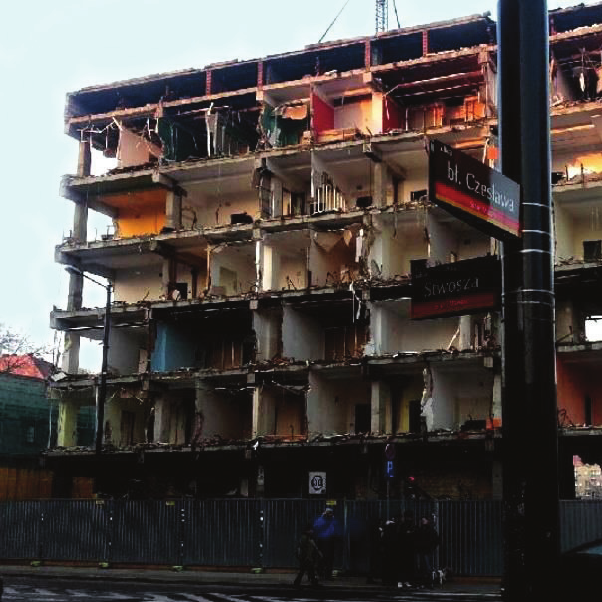
Rozbiórka biurowca z lat 60. XX w.
przy ul. Wita Stwosza we Wrocławiu.
Wymiana tkanki miejskiej w centrum
wpływa na wize runek całego Wrocławia
(fot. K. Damurska, 2016)
Demolision of an office building from
the 1960s at the Wita Stwosza Street
in Wrocław. Replacent of the urban
structure in the centre of the city influences
the image of the whole Wrocław
(photo by K. Damurska, 2016)