
2025
4(84)
Beata Makowska*, Maciej Motak**
Jakub Jan Spira
– genealogy and works, including the years 1939–1945
DOI: 10.37190/arc250405
Published in open access. CC BY NC ND license
Abstract
The article discusses the genealogy and work of Jakub Jan Spira (1902–1979) with special emphasis placed on the years 1930–1945.
The study is based on historical and photographic documentation of the buildings, in situ research, analysis of available academic studies and other
sources (including urban space value assessment studies and building inventory cards), as well as information from genealogical portals and microhistor-
ical sources. The research provided grounds for concluding that Jakub Spira’s works constitute an architectural heritage of considerable signicance and
that his activity contributed to shaping high-quality urban space in Kraków. The civil engineer worked successfully in both the design and construction
sectors, both independently and in collaboration with numerous architects, builders, and other specialists. The projects in which he participated are dis-
tinguished by an innovative approach, manifested in the use of modern materials, forms, and building structures. In Kraków, he created – or signicantly
contributed to the creation, as a construction manager or designer – of several dozen buildings, mostly residential tenements, but also other structures,
including a care home, a day camp pavilion for children, and a water tower.
Documenting the history of outstanding individuals and their work under the particularly dicult conditions of World War II seems crucial for pre-
serving their memory. The collected data, photographic documentation, information and archival materials provided by descendants can support eorts to
protect Jakub Spira’s architectural legacy and expand knowledge of Kraków’s architecture during the discussed period.
Key words: Jakub Spira, architecture 1939–1945, Krakow, architectural heritage, Krakow tenement
Introduction
Jakub Jan Spira (1902–1979) was a prominent civil engi-
neer of Jewish origin who worked primarily in Kraków. The
subject of this article is his professional activity, with partic-
ular emphasis on the years 1939–1945. The text is enriched
with the genealogy of the Spira family residing in Kraków
for many generations.
The chronological scope of the article covers Jakub Spi-
ra’s professional activity from 1931 until his death in 1979.
It presents the architect’s most important works from 1930–
1939, as well as all his Kraków projects realised in the years
1939–1945 that could be located. His post-war work is pre-
sented in a concise manner. Based on the discovered doc-
uments, a family tree has also been compiled, tracing his
lineage back to the early 18
th
century.
The territorial scope of the research includes existing
and non-existent projects carried out in Kraków within the
city’s districts as they were in the 1930s: District III – Nowy
Świat, IV – Piasek, V – Kleparz, VI – Wesoła, VIII – Ka-
zimierz, XV – Nowa Wieś, XIX – Grzegórzki, and XXII
– Podgórze.
The aim of the article is to present the works of Jakub Spi-
ra, including the period of 1939–1945. The legacy of Jewish
architects and builders in Kraków is signicant. Commem-
orating and analysing the work of a prominent member of
this professional group seems particularly important in view
of the signicance of his oeuvre. A publication that discuss-
es Spira’s work through the lens of his origins and person-
al history may contribute to a deeper understanding of this
valuable architectural heritage.
The following research hypothesis has been formulated
in the article: the works of Spira constitute an architectural
* ORCID:
0000-0002-1221-9216. Faculty of Architecture, Cracow
University of Technology, Poland, e-mail: beata.makowska@pk.edu.pl
** ORCID: 0000-0002-5223-9895. Faculty of Architecture, Cra-
cow University of Technology, Poland.

50
Beata Makowska, Maciej Motak
legacy of considerable signicance, and his professional ac-
tivity contributed to the creation of high-quality urban space
of Kraków.
The analysis is based on a selection of 19 major designs
authored or co-authored by him, as well as building proj-
ects in which he served as construction manager. A detailed
analysis was conducted for four buildings from 1930–1939
and six from the time of World War II. In the interwar years,
architects of Jewish origin formed a signicant group of
educated and experienced professionals (about 90 individu-
als) who played an active role in the construction and shap-
ing of the city’s space. During the war, most of them lost
their lives, and some were forced to emigrate.
State of research
The fate of architects and builders in Kraków during
World War II has been discussed in several publications
(Agat stein-Dormontowa 1957; Motak 2024), as has the sit-
uation of the Jewish population in this period (Agat stein-
Dor mon towa 1957; Rączy 2014; Zajączkowska-Drożdż
2020; Kotarba 2022). The versatile professional activity
of Spira has also been described in several works, includ-
ing books by Barbara Zbroja on architects and builders of
Jewish origin based and active in Krakow (2023, 216–218)
and on the public utility architecture they designed (2005,
142, 143, 169). A concise overview of selected projects by
Spira can be found in published texts (Spira 1932; Dyba,
Brzoskwinia 2007, 492; Zbroja 2017) and in unpublished
typescripts (Beiersdorf 1979–1981; Krasnowolski 1998;
Da nilczyk et al. 2004; Danilczyk, Kasprzyk 2005). Kraków
te ne ment houses from the interwar period – including se-
lected buildings designed by Spira – have been discussed in
a number of publications (Purchla 1997; Makowska 2009;
2014; Zbroja 2013).
There is, however, no study presenting the entirety of
Spi ra’s
professional output. Therefore, a detailed analysis
of his work – particularly from the most dicult period of
World War II – will contribute to a better understanding and
preservation of this valuable heritage.
Description of the authors’ own research
Research methods
The adopted traditional research methods (literature re -
view, archival research in the Archiwum Narodowe w Kra -
kowie [National Archives in Kra ków] (ANK), in situ re-
search – documentation and analysis of photographs of
existing buildings) enabled presentation of the work and
professional activity of Jakub Spira. The ar ticle also em-
ploys the method of microhistorical analysis (Mo tak 2024).
This approach is based on research that preserves the in-
dividual element of the narrative while aiming at general-
ization of the results. Presenting Spira’s work within the
broader context of the genealogy of his family residing in
Kraków for many years, as well as his fate during World
War II, makes it possible to show how dicult the situation
of Jewish architects and builders was at that time and how
great were the losses that this creative community suered.
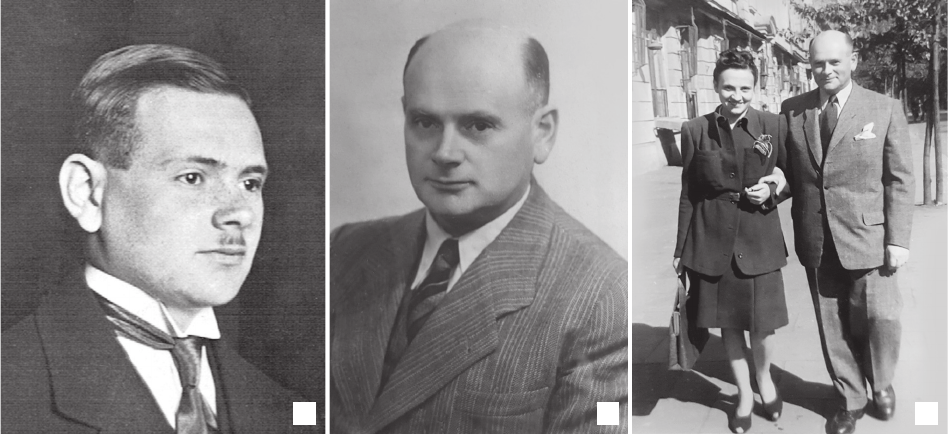
The analysis of Spira’s ancestors and family history
was based on genealogical research and documents pre-
served in the collections of the ANK. Particularly useful
for reconstructing the six-generation family tree of Spira’s
ancestors were Dan Hirschberg’s studies on Jewish fami-
lies in Kraków (Jewish Krakow… 2023) and data found on
genealogical websites (Geni 2022; My Heritage 2025a, b).
The information contained therein (some of it, unfortunate-
ly, incorrect) was veried by locating 41 vital data records
(birth, marriage, and death certicates) concerning 51 an-
cestors. The genealogical website Geni includes only 26
of Spira’s ancestors in its family tree (2022). Documents
from the ANK Akta stanu cywilnego Izraelickiego Okręgu
Metrykalnego w Krakowie [Civil Registry Records of the
Israelite Vital Records District in Kraków] also enabled
tracking down changes in the addresses of the Spira family
in Kraków.
Jan Jakub Spira – genealogy
Jakub Jan Spira
1
came from a Jewish family with roots in
Kraków and Wodzisław
2
(near Jędrzejów). He was born in
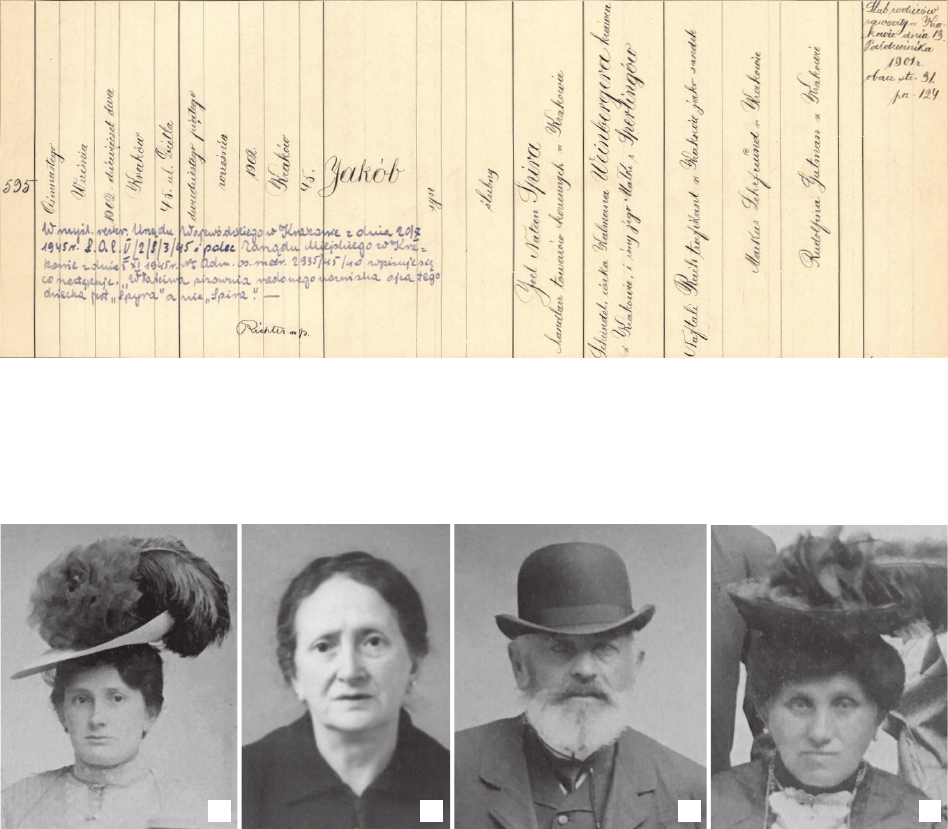
Kraków on 18 September 1902 (Fig. 1) and died on 30 Au-
gust 1979 in Manchester, United Kingdom (Zbroja 2023).
In 1945, the spelling of his surname was changed to Spyra
3
.
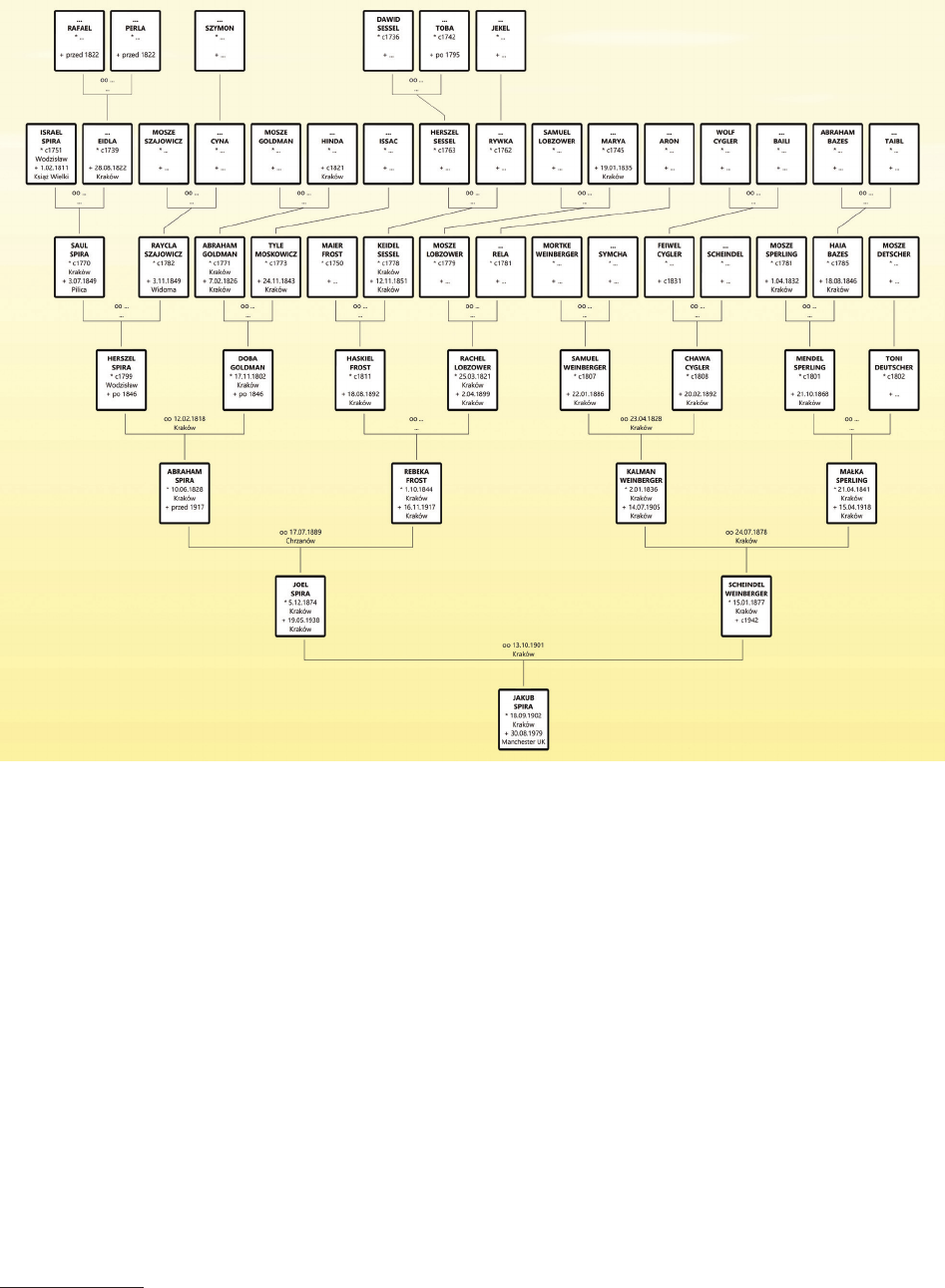
Jakub’s parents were the spice/mixed goods merchant Joel
Natan (Juliusz) Spira (born 5 December 1874 in Kraków,
died 19 May 1938 in Kraków) and Scheindel
4
Salomea
Weinberger (born 15 January 1877 in Kraków, died around
1942 as a result of the Holocaust) (Figs. 2a, b). Jakub had an
older brother, Albert (born 26 December 1899 in Kraków,
died around 1947 in Wandsworth), and two younger broth-
ers: Karol (born 24 February 1908 in Kraków, died between
1942 and 1944 as a result of the Holocaust) and Mercel
(born 12 January 1912 in Kraków, died 28 July 1913 in
Kraków). Joel and Scheindel’s family lived in Kraków,
rst at 9 Miodowa Street (in 1899), and later at 45 Dietla
Street (1902), 4 Koletek Street (1908), 71 Grodzka Street
(1912/1913), 8 Św. Sebastiana Street, and in the 1930s at
19 Sarego Street (until 1932: Zielona Street) (Centralna Bi-
blioteka Judaistyczna).
Jakub’s grandfather was the merchant Abraham Spira
(born 10 June 1828 in Kraków, died before 1917) (Fig. 2c),
and his grandmother was Rebeka Ryfka née Frost (born
1 October 1844 in Kraków, died 16 November 1917 in
Kraków) (Fig. 2d). His great-grandfather, Herszel Saul
Spira, was a “market speculator” and Talmudist in 1828.
Jakub’s great-great-grandfather was Saul
5
Spira, the son of
Israel Spira
6
.
The architect’s ancestors (Fig. 3) belonged to well-known
Kraków families. They pursued various professions: Saul
1
Another version of the names: Jacov/Yaakov Yan/Yanik.
2
Saul and Raycla Spira lived in Wodzisław in a house at no. 22
(in 1818).
3
The modication of the surname is visible on Jakub Spira’s birth cer-
ticate – a note by the Voivodeship Oce in Kraków dated 20 July 1945.
4
Another version of the name: Szejndel.
5
The article uses the Hebrew version of the names.
6
Another version of the name: Kahana-Shapira. The surname most
likely originates from the city of Speyer (Spira).
Jakub Jan Spira – genealogy and works, including the years 1939–1945
51
Fig. 1. Jakub Spira’s birth certificate
(source: ANK, Civil Registry Records of the Israelite Vital Records District in Krakow, ref. no. 29/1472/488, record 595, p. 199)
Il. 1. Akt urodzenia Jakuba Spiry
(źródło: ANK, Akta stanu cywilnego Izraelickiego Okręgu Metrykalnego w Krakowie, sygn. 29/1472/488, akt 595, s. 199)
Fig. 2. Jakub Spira’s family: a) Mother Scheindel as a young woman, 1906 (source: A. Bennett’s archives),
b) Mother in 1940 (source: Central Jewish Library, Archives of the Emanuel Ringelblum Jewish Historical Institute, ref. no. 218/34/215/60,
“Personal questionnaires of persons designated for resettlement from Kraków, 20.08.1940”, https://cbj.jhi.pl/documents/899353/0/),
c) Grandfather Abraham Spira, 1906 (source: A. Bennett’s archives), d) grandmother Rebeka, 1906 (source: A. Bennett’s archives)
Il. 2. Rodzina Jakuba Spiry: a) matka Scheindel w młodości, 1906 (źródło: zbiory A. Bennett),
b) matka, 1940 (źródło: Centralna Biblioteka Judaistyczna. Zbiory Żydowskiego Instytutu Historycznego im. E. Ringelbluma,
sygn. 218/34/215/60, “Ankiety personalne osób skierowanych do wysiedlenia z Krakowa. 20.08.1940” https://cbj.jhi.pl/documents/899353/0/),
c) dziadek Abraham Spira, 1906 (źródło: zbiory A. Bennett), d) babcia Rebeka, 1906 (źródło: zbiory A. Bennett)
Spira and Israel Spira were rabbis in Wodzisław (AGAD);
Kalman Weinberger and Samuel Weinberger were tailors;
Mendel Lazar Sperling was a trade agent; Mosze Hirsz Jo-
sef Sperling worked as a hospital orderly; Mosze Lobzower
was a shopkeeper; and Abraham Goldman was a trader.
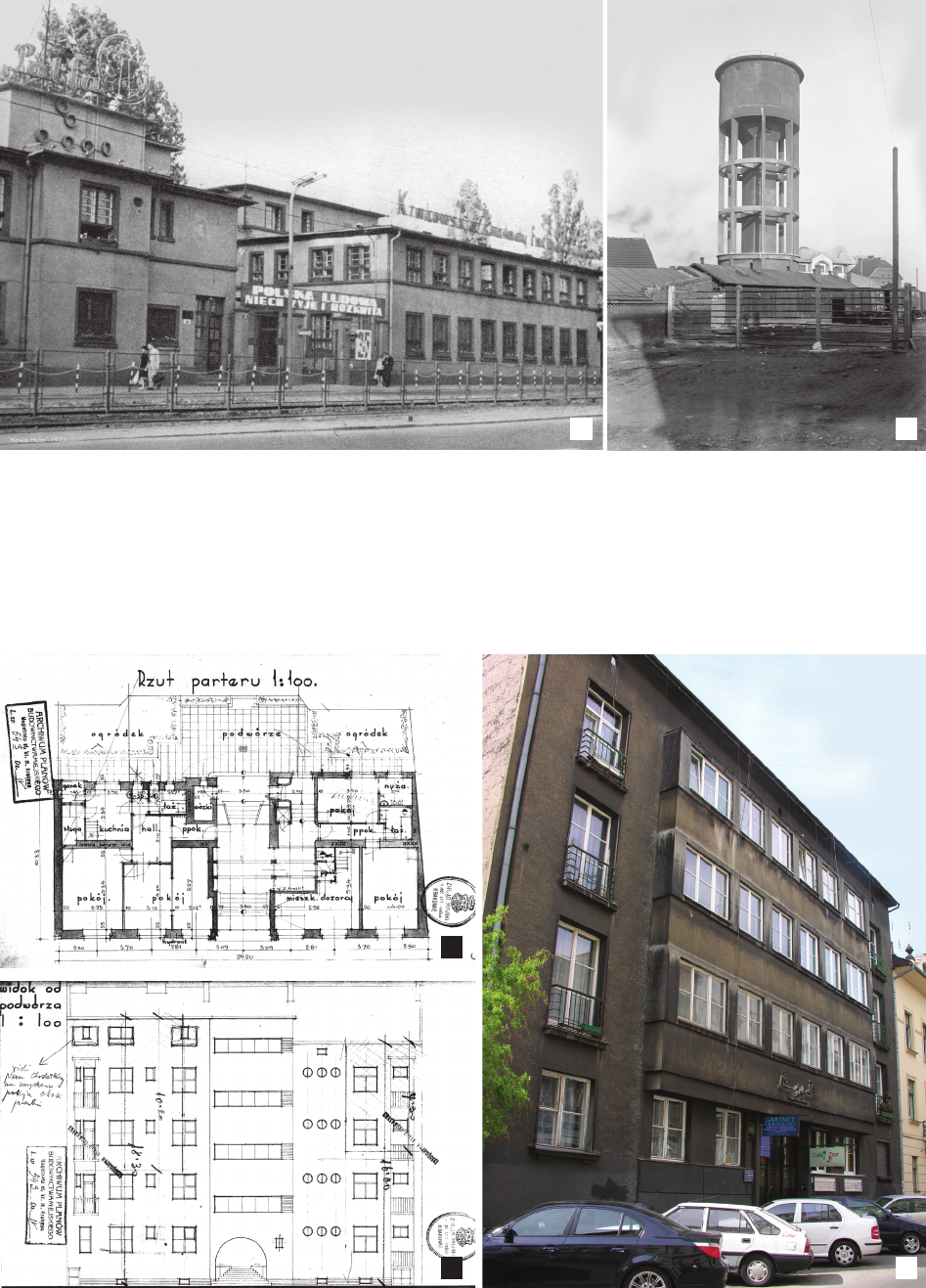
Jakub Spira (Figs. 4a, b) completed his studies in German
at the Faculty of Civil Engineering of the Technical Univer-
sity in Brno, Moravia, in 1924. He obtained his professional
licence, issued by the Directorate of Public Works of the
Voivodeship Oce in Kraków, in 1932 (Zbroja 2023,
216).
Until the outbreak of World War II, he lived and worked in
Kraków, following in the footsteps of many generations of
his ancestors. During the war, he moved to Lviv, where – on
3 October 1940 – he married Maryla Halina (Chaja)
Lang-
berg (Fig. 4c).
Jakub Spira’s more important works
from the years 1930–1939
Jakub Spira was a member of numerous professional
organizations, including the Kraków branch of the Polish
Association of Civil Engineers, the Association of Jewish
Engineers in Kraków, and the Professional Association of
Builders, Construction Managers, Technicians, and Build-
ing Industrialists in Kraków (Zbroja 2023, 217). In the
1930s, Spira was a highly-valued and respected designer
and structural engineer in the Kraków professional com-
munity – he worked as […] a sworn court expert in civil
engineering, reinforced concrete, and steel struct.[ures].
Kraków, Zielona 19, Tel. 101-40 (ANK, AMK, ref. no.
29/ 33/Kr 3759). In 1932, he founded his own design stu-
a b c d
52
Beata Makowska, Maciej Motak
Fig. 3. Genealogical tree of Jakub Spira’s ancestors, elaborated by B. Makowska
(source: ANK, Civil Registry Records of the Israelite Vital Records District in Krakow, ref. no. 29/1472/488; Jewish Krakow… 2023)
Il. 3. Drzewo genealogiczne Jakuba Spiry, oprac. B. Makowska
(źródło: ANK, Akta stanu cywilnego Izraelickiego Okręgu Metrykalnego w Krakowie, sygn. 29/1472/488; Jewish Krakow… 2023)
dio.
An example of his work are the static calculations for
the reinforced concrete frame of the Artists’ House [Dom
Plastyków] (designed by Adolf Szyszko-Bohusz, 1934–
1939) at 3 Łobzowska Street, which he did in 1934 (ANK,
Municipal Construction Archives [ABM], 3 Łobzowska
Street, fasc. 534). Spira was a licenced construction ma-
nager and probably sometimes signed o designs by his
architect colleagues
7
, which is why authorship is not al-
ways easy to verify. He probably obtained a licence to pre-
pare plans (designs) for construction works under cer tain
conditions (Rozporządzenie Prezydenta Rze czy pos poli-
tej 1928, 394). During this period, he collaborated with
notable architects and builders, such as: Edward Kreisler,
7
The Kraków building authority (the Building Department in the
City Hall, and from 1934 the Building Department of the Municipal
Board, often tacitly accepted such informal arrangements, but always
required that the project meet the relevant criteria (Motak 2021, 52–58).
This is conrmed by numerous accounts and conjectures of many re-
searchers. However, such situations were rarely fully reected in the
ocial documentation; and most often, they were not reected at all.
Adolf Szyszko-Bohusz, Józef Wetzstein, Alfred Dün-
tuch, Rudolf Hand, Ignacy Bierer, Stanisław Zydroń, and
Samu el Nebenzahl.
Thanks to his versatile professional competencies, Jakub
Spira was able to partially circumvent the restrictions in
practising his profession that aected Jewish architects and
builders in Kraków (Motak 2021, 52–58). His works from
1930–1939 include:
– rebuilding of Fabryka Kabli [Cable Factory] at 114
Wielicka Street, District XXII (designed by Spira, 1930)
(Zbroja 2023, 218),
– buildings of Fabryka Chemiczno-Farmaceutyczna Dr
A. Wan der S.A. [Dr. A. Wander Chemical-Pharmaceu tical
Fac tory] at 80 Mogilska Street, District XIX (designed by
Spi ra, 1930–1931) (ANK, ABM, 80 Mogilska Street, fasc.
621 and 622) (Fig. 5a),
– the tenement of
Przedsiębiorstwo dla Budowli
Żel be-
towych E. Uderski i Ska [Reinforced Concrete Construction
Company E. Uderski & Co.
] at 25 Lubelska Street, District
XV (designed by Spira, 1930–1935) (ANK, ABM, 25 Lu-
belska Street, fasc. 515),
Jakub Jan Spira – genealogy and works, including the years 1939–1945
53
– the tenement at 43 Łobzowska Street / 1 Szlak Street,
District IV (designed by Düntuch, Spira, 1934) (ANK, ABM,
43 Łobzowska Street, fasc. 539),
– the tenement at 2a Józeńska Street, District XXII (de-
signed by Spira, Bierer, 1936) (ANK, ABM, 2a Józeń ska
Street, fasc. 338),
– the tenement at 20b Lea Street, District XV (designed
by Spira, Kreisler?, 1935–1936) (ANK, ABM, 2a Józeń ska
Street, fasc. 197a),
– the tenement at 72 Krowoderska Street, District IV
(de-
signed by Spira, 1936) (ANK, ABM, 72 Krowoderska Street,
fasc. 458),
– the tenement at 1 Bujwida/8 Łazarza Street, District VI
(designed by Spira, Zydroń, 1936) (ANK, ABM, 1 Bujwida
Street, fasc. 89), and
– expansion of Fabryka Chemiczno-Farmaceutyczna
Dr A. Wander S.A. [Dr. A. Wander Chemical-Pharmaceu-
tical Factory] at 80 Mogilska Street, District XIX (designed
by Spira, 1930–1931) (ANK, ABM, 80 Mogilska Street,
fasc. 621 and 622).
Other works by Spira from the period 1930–1939 in-
clude:
• Water tower at 28 Rzeźnicza Street, District XIX
(designed by Spira, 1931)
The old water tower was located on the site of the former
municipal slaughterhouse (designed by Maciej Moraczews-
ki, 1878), which was dismantled during the redevelopment
of the complex around 1911, as the facility had by then been
connected to the municipal water supply. However, water
consumption at the slaughterhouse was so high that, in 1931,
a new water tower was constructed using reinforced con-
crete, which was designed by Spira (Fig. 5b). It was built by
Przedsiębiorstwo dla Budowli Żelbetowych E. Uderski i Ska
[Reinforced Concrete Construction Company E. Uderski &
Co.] (Spira 1932; Zbroja 2013, 170). It featured a modern,
partially openwork form mounted on an octagonal plinth.
The tower was demolished in 2003 in connection with the
construction of the Galeria Kazimierz shopping mall.
• Tenement house at 10 Asnyka Street, District IV
(designed by Spira, Kreisler?, 1936–1937)
The four-story tenement with a wide (24.2 m) frontage
was designed in 1936. The design was probably authored
by Edward Kreisler (Zbroja 2023, 218), with Spira serving
as construction manager. At the time, the owners of the ten-
ement were Izrael, Jozue, Józef, Szulem, and Herman Abra-
hamer, as well as Helena Horowitz. The building, construct-
ed on an approximately rectangular plan, forms a continuous
street frontage and is made of brick and reinforced concrete,
with a plastered nish. It is a two-bay building with a cen-
tral corridor passage (Dreścik 1978; Beiersdorf 1979–1981;
Danilczyk, Kasprzyk 2005, 9–10). A hall running through
the whole building was designed along the central axis, and
a staircase at the rear axis. The Building Department ordered
placing a decorative emblem above the entrance gate (ANK,
ABM, 10 Asnyka Street, fasc. 9). The bas-relief He and She
with a Fawn was created by the sculptor Joanna Grabowska
(original surname: Roma Szereszewska), the daughter-in-
law of the investor Izrael Abrahamer (Grabowska 2021).
The front façade is seven bays wide on the ground oor and
eight bays on the upper oors (Fig. 6). It features prominent
bay windows spanning the six central bays, suspended above
a partially uted ground oor. The horizontal articulation is
emphasized by the wide windows of the bay and their pro-
truding surrounds, while the vertical articulation is highlight-
ed by the porte-fenêtres in the outermost bays. The decorative
emblem above the wide entrance portal with a
geometrically
stylized grille depicts two women with a fawn. Each oor
contains two ats. The ground oor includes two two-room
ats and a caretaker’s at. A spacious hall runs along the
Fig. 4. Jakub Jan Spira: a) circa 1920, b) circa 1939, c) with his wife, the photo taken in Dunajewskiego Street in Krakow probably in the summer
of 1945 (according to the caption on the photograph, taken in Lviv circa 1942) (source: A. Bennett’s archives)
Il. 4. Jakub Jan Spira: a) około 1920, b) około 1939, c) z żoną, zdjęcie wykonane na ul. Dunajewskiego w Krakowie, prawdopodobnie latem 1945
(według podpisu na fotografii wykonane we Lwowie około 1942) (źródło: zbiory A. Bennett)
a b c
54
Beata Makowska, Maciej Motak
Fig. 5. Spira’s works from the years 1930–1939: a) the building of the Dr. A. Wander Chemical-Pharmaceutical Factory at 80 Mogilska Street, 1964
(photo by Jerzy Suberlak, source: https://fotopolska.eu/1424286,foto.html?o=b197525&p=1), b) the water tower in Rzeźnicza Street, 28 Jan. 1932
(source: NAC sygn. 3/1/0/8/6583)
Il. 5. Dzieła Spiry z okresu 1930–1939: a) budynek Fabryki Chemiczno-Farmaceutycznej Dr A. Wander S.A. przy ul. Mogilskiej 80, 1964
(fot. Jerzy Suberlak, źródło: https://fotopolska.eu/1424286,foto.html?o=b197525&p=1), b) wieża ciśnień przy ul. Rzeźniczej, 28.01.1932
(źródło: NAC, sygn. 3/1/0/8/6583)
Fig. 6. Tenement at 10 Asnyka Street: a) the ground floor plan (source: ANK, ABM, 10 Asnyka Street, fasc. 9), b) façade (source: ANK, ABM,
10 Asnyka Street, fasc. 9), c) front façade (photo by B. Makowska)
Il. 6. Kamienica przy ul. Asnyka 10: a) rzut parteru (źródło: ANK, ABM, ul. Asnyka 10, fasc. 9), b) elewacja (źródło: ANK, ABM,
ul. Asnyka 10, fasc. 9), c) elewacja frontowa (fot. B. Makowska)
a
a
b
b
c
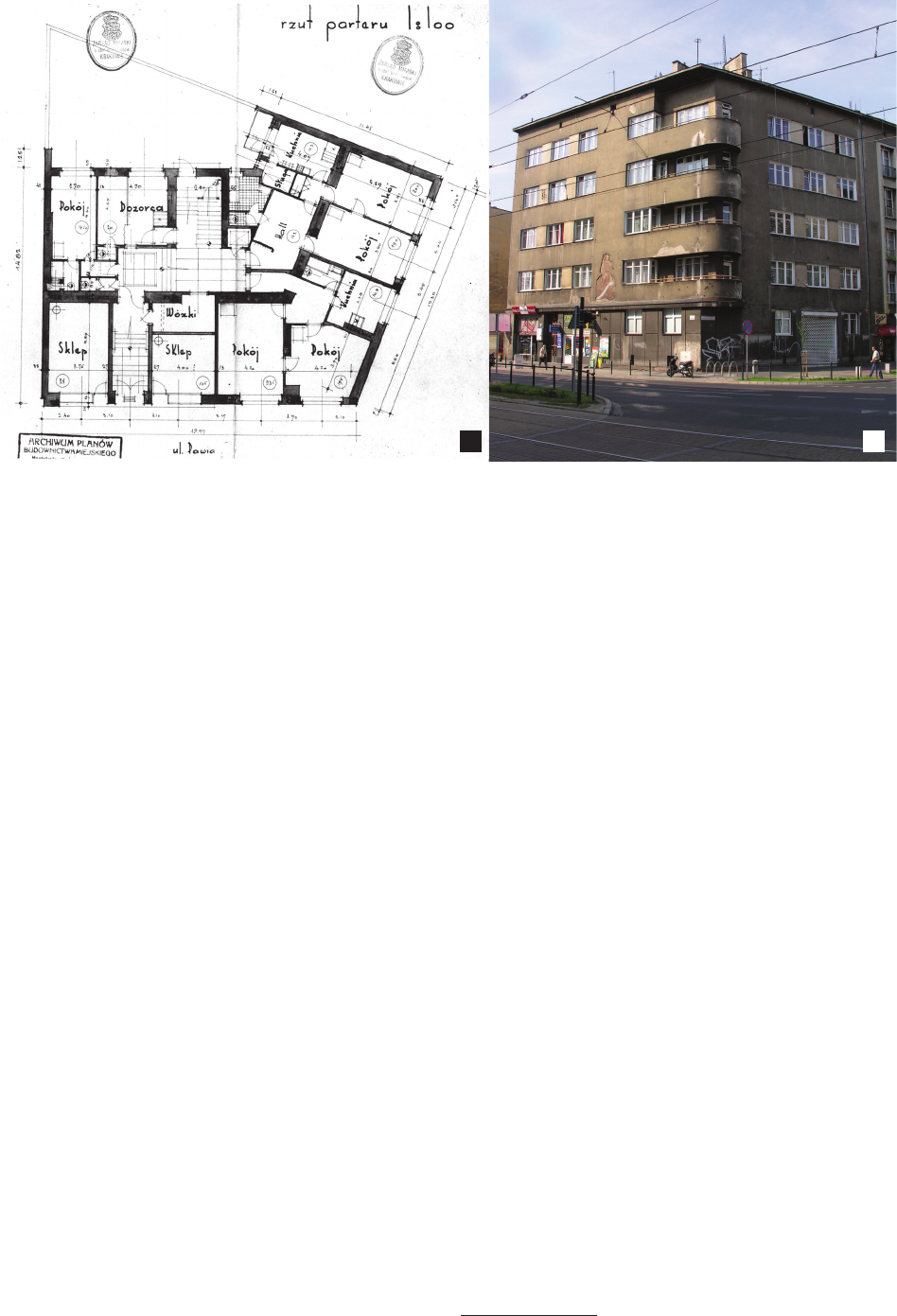
Jakub Jan Spira – genealogy and works, including the years 1939–1945
55
central axis of the building, with the staircase located in the
adjacent right-hand axis. The garden-facing façade features
a slight risalit with characteristic round bathroom windows
and an oval portal (Makowska 2014, 174).
• Tenement at 12 Pawia Street / 11 Worcella Street,
District V (designed by Spira, 1937–1938)
The ve-storey corner tenement house was designed and
built in 1937–1938 (Makowska 2014, 184). Spira served as
the construction manager. The owners of the building were
Marian Rozmaryn, Antoni Jasiński, and Ignacy Halpern. It
was built of brick and reinforced concrete, and it is plastered.
The Building Department ordered placing a decorative em-
blem above the entrance gate (ANK, ABM, 12 Pawia Street,
fasc. 668). Executed in the sgrato technique, it depicts
a highlander with a peacock sitting on a branch (a reference
to the street’s name); it is located at the level of the rst oor.
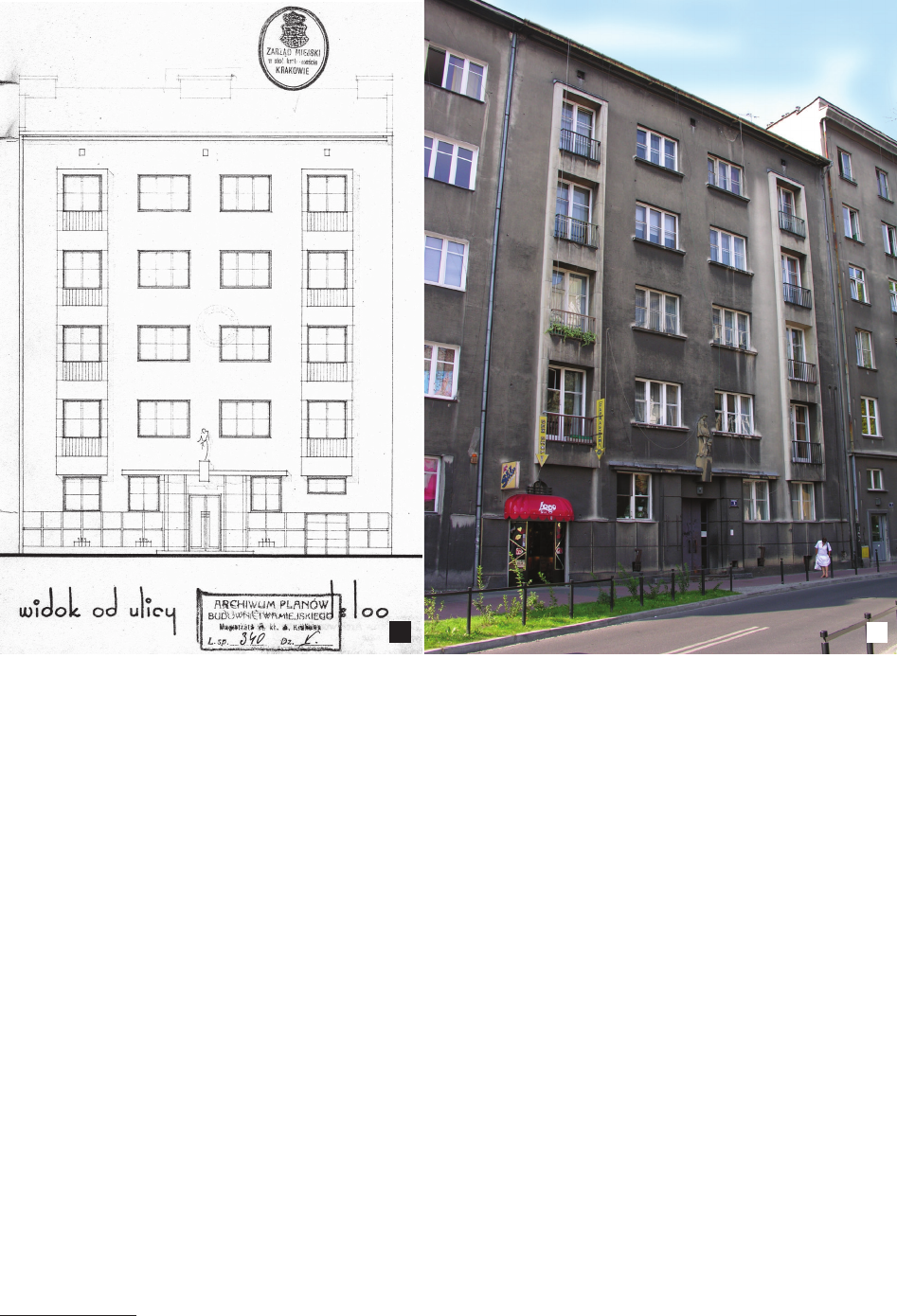
The front façade in Pawia Street is ve bays wide, while
the one in Worcella Street has four bays (Fig. 7). A dynamic
corner was designed, composed of four-storey loggias with
balconies featuring solid, rounded, plastered balustrades.
An interesting detail is the horizontal agpole. The entrance
portal, with shopfronts planned next to it, is adorned with
doors incorporating semicircular motifs harmonized with the
shape of the balconies. The spandrel panels are rendered in
lighter-coloured plaster, accentuating the horizontal articula-
tion of the façade. The tenement is a two-bay building with
a corridor between the bays (Danilczyk, Kasprzyk 2005,
323, 324). In the second axis from the southern wing, the
front bay contains a vestibule with a short ight of stairs,
while the rear bay includes a hall leading to the staircase
located in the adjacent axis, as well as a lift. The irregular,
corner-shaped plot aected the plan layout, resulting in po-
Fig. 7. Tenement at 12 Pawia Street / 11 Worcella Street:
a) the ground floor plan (source: ANK, ABM, 12 Pawia Street, fasc. 668), b) front façade (photo by B. Makowska)
Il. 7. Kamienica przy ul. Pawiej 12 / Worcella 11:
a) rzut parteru (źródło: ANK, ABM ul. Pawia 12, fasc. 668), b) elewacja frontowa (fot. B. Makowska)
lygonal rooms at the intersection of oblique directions and
a staircase shifted o the entrance axis.
• Tenement at 9 Worcella Street, District V
(designed by Spira, 1937–1938)
The ve-storey tenement house was designed and erect-
ed in 1937–1938 in the former Pawia Boczna Street. The
construction manager was Jakub Spira
8
. In 1938, additional
plans were submitted for internal alterations (Makowska
2014, 190). The owner of the building was Waleria Rydlew-
ska. The Building Department required that a decorative
emblem be placed above the entrance gate (ANK, ABM, 6
Worcella Street, fasc. 991); it depicts a woman with a child
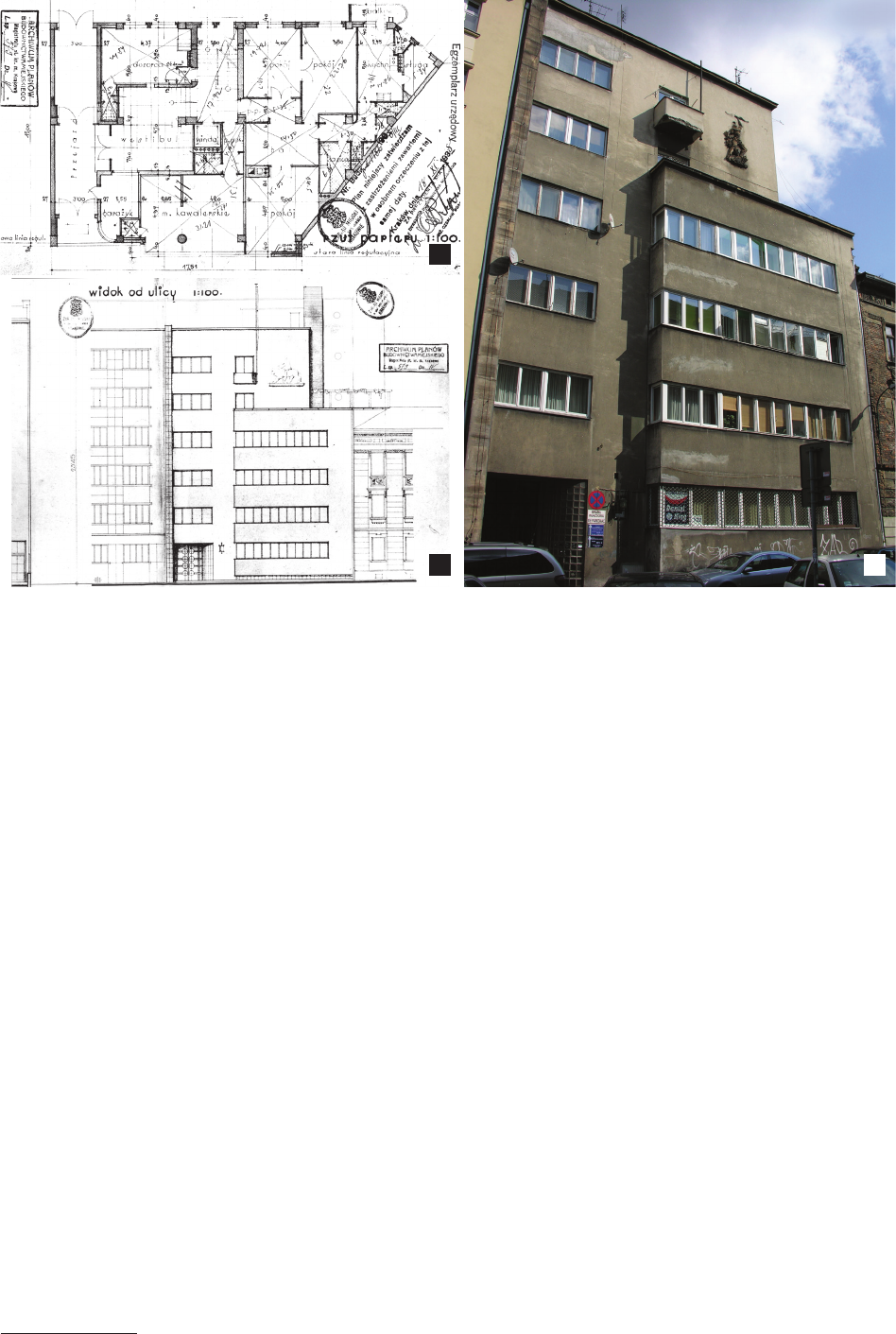
and a tray of fruit. The front façade is ve bays wide on the
ground oor and four bays on the upper storeys (Fig. 8). The
outer bays are accentuated by shallow loggias framed with-
in a common surround. A horizontal accent on the façade
is formed by the continuous framing of the entrance and
the adjacent windows. The tenement is two-bay with an in-
ter-bay corridor, built of brick and reinforced concrete, and
plastered. Along the central axis in the front bay, a vestibule
with a short ight of stairs was designed, while in the rear
bay there is a two-ight staircase (Dayczak-Domanasiewicz
1976; Danilczyk, Kasprzyk 2005, 571, 572).
Works by Jakub Spira from the years 1939–1945
After the deportations of the Jewish population from
Kraków in 1940 and the establishment of the ghetto in the
8
The fact is conrmed by a stamp: construction management – Eng.
Jakub Jan Spira.
a b
56
Beata Makowska, Maciej Motak
Podgórze district in 1941, architects of Jewish origin had
increasingly limited opportunities to work. Spira probably
stayed in Lviv from the autumn of 1939, where he worked
for some time at the construction company Johann Pontess
Bau konstruktionen (Reiss 1993, 84). In September 1942,
Dr. Ta deusz Niesielski arranged identication documents
for him under the name Jan Sysak, which enabled his survi-
val (Zbroja 2023, 217, 218). Later, the architect went into
hiding in Warsaw, and after the war – probably in 1945 – he
returned to Kraków.
The works attributed to him from this period include:
• Tenement at 13 Lenartowicz Street, District IV
(designed by Spira, Kreisler, 1938 – 1940)
The tenement was designed by Edward Kreisler (Zbroja
2017; 2023, 218) for the Dr A. Wander Chemical and Phar-
maceutical Factory and built between 1938 and 1940. Spira
served as the construction manager
9
. According to the site
log, he worked on this project until 29 August 1939, after
which, from 30 October of the same year, it was supervised
by Diana Reiter (representing Kazimierz Kulczyński’s com -
pany). The tenement is two-bay, with segments of an inter-
9
The fact is conrmed by a stamp: construction management – Eng.
Jakub Jan Spira.
Fig. 8. Tenement at 9 Worcella Street;
a) façade (source: ANK, ABM, 9 Worcella Street, fasc. 991), b) front façade (photo by B. Makowska)
Il. 8. Kamienica przy ul. Worcella 9: a) elewacja (źródło: ANK, ABM, ul. Worcella 9, fasc. 991), b) elewacja frontowa (fot. B. Makowska)
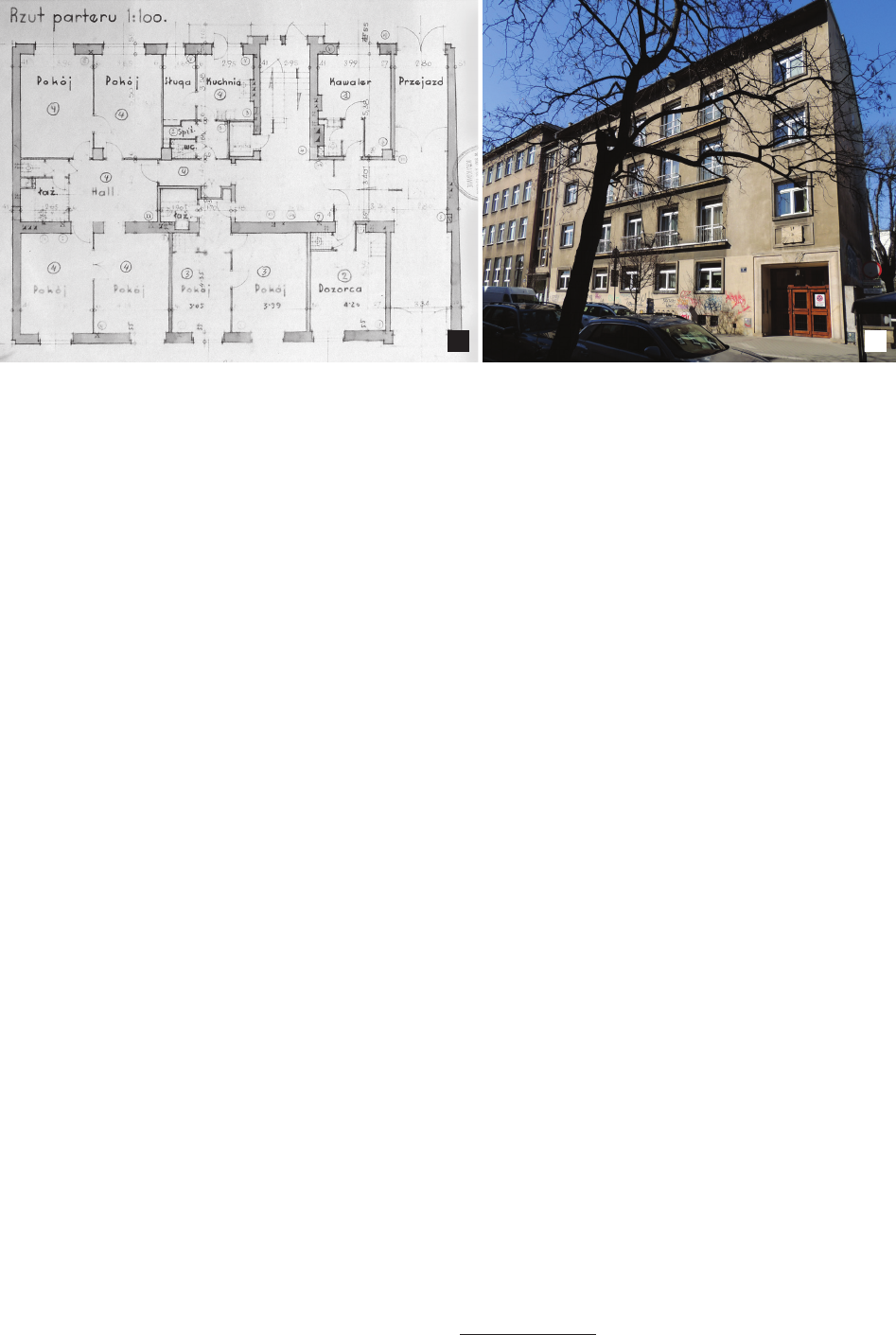
bay corridor (Danilczyk, Kasprzyk 2005, 255). The asym-
metrical, two-part volume features distinct horizontal win-
dow bands that continue around the corner (Fig. 9). The di -
vision of the façade into a four-storey and a six-storey sec-
tion creates a gradual transition between the three-storey
building anking it on the right and the six-storey building
on the left. The front façade of the southern section projects
forward in a shallow risalit in relation to the two-axis north-
ern section. The entrance portal, with a rounded right corner
made of glass blocks, features doors decorated with a geo-
metric grille and is placed in the northernmost axis. It leads
to a carriage passageway and a spacious vestibule with a lift
and a staircase located in the rear bay along the adjacent axis.
The building is an example of functionalism, uncommon in
Kraków’s modernist residential architecture (Purchla 1997,
175). On the right side, the plot ends with an oblique wall,
along which the sanitary facilities and servants’ quarters
were placed. In this building, Spira and Kreisler used new
materials – the recess of the entrance portal was made of
glass blocks, providing daylight to the cart storage area and
the entrance hall – as well as an innovative skeletal structure,
which allowed for more exible interior layouts. The terrace
serves as a decorative element enhancing the plasticity of
the façade. The Building Department required a decorative
emblem to be placed above the entrance gate (ANK, ABM,
a
b
Jakub Jan Spira – genealogy and works, including the years 1939–1945
57
13 Lenartowicza Street, fasc. 491); it depicts an archer
10
, in
some sources interpreted as a representation of Saint George
(Danilczyk, Kasprzyk 2005, 255). The emblem is now locat-
ed on the top oor.
• Tenement at 3 Smoleńsk Street, District III
(designed by Nebenzahl, Spira, 1938–1940)
The tenement was designed by Eng. Samuel Neben-
zahl, with the signicant involvement of Jakub Spira, who,
among other things, prepared an alternative design and de -
signs for a free-standing garage, as well as supervised the
entire construction process. The documentation bears the
stamps of the licenced civil engineers Nebenzahl and Spira.
The client was Dr. Kazimierz Karelus, an ophthalmo logist
and the owner of the property. The 1935 design, prepared
for the previous owner, had expired; the new design by
Nebenzahl and Spira (dated 13 September 1938) featured
modications to the internal layout and façades. It was sub-
mitted on 25 April and approved on 13 May 1939 (ANK,
ABM, 3 Smoleńsk Street, fasc. 834), at a time when con-
struction was likely already underway. The outbreak of the
war did not stop the building works (or only interrupted
them briey). However, from September 1939, correspon-
dence from the Building Department to the owner was no
10
In the design documentation, it depicted a child riding a lion.
Fig. 9. Tenement at 13 Lenartowicza Street: a) the ground floor plan (source: ANK, ABM, 13 Lenartowicza Street, fasc. 491),
b) façade (source: ANK, ABM, 13 Lenartowicza Street, fasc. 491), c) front façade (photo by B. Makowska)
Il. 9. Kamienica przy ul. Lenartowicza 13: a) rzut parteru (źródło: ANK, ABM, ul. Lenartowicza 13, fasc. 491),
b) elewacja (źródło: ANK, ABM, ul. Lenartowicza 13, fasc. 491), c) elewacja frontowa (fot. B. Makowska)
longer addressed to Eng. Spira, as before, but directly to
Karelus. Most probably, Spira was no longer involved in the
construction (or he was – for a short period – but only infor-
mally). It is impossible to determine whether this resulted
primarily from restrictions imposed by the occupation or
from Spira’s departure to Lviv. Both before and after the
outbreak of the war, the authorities conrmed the comple-
tion of successive stages of construction in accordance with
the architectural and engineering designs, with only minor
reservations. The occupancy permit for the tenement house
was granted on 3 October 1940.
The building was designed in a modern style, typical
of Kraków designs from the late 1930s. In addition to the
standard residential programme, it is worth noting that it
included a part designated for the medical practice on the
rst oor and a “gas shelter” in the basement. The revised
design also introduced a number of changes: the free-stand-
ing garage in the courtyard was enlarged from three to four
spaces, and a new, alternative form of the emblem above
the entrance was included in the form of a sketch (Fig. 10).
The three-storey building with a lift still exists today in its
original form. The façade has six axes, with the four central
ones visually unied by horizontal cornices placed beneath
the windows. The window and portal frames, as well as the
ground-oor plinth, were made of sandstone. Above the en-
trance portal is a geometric oral decoration and an emblem
– added later – depicting the Eye of Providence. The shape
a
b c
58
Beata Makowska, Maciej Motak
of it does not t the dimensions of the space originally in-
tended for the emblem. The balcony railings are decorated
with nautical knot motifs, and a agpole, set at an angle of
about 20°, was placed on the façade’s central axis.
• The Old People’s Home of the “Asyfas Skeinim”
Society at 6 Chmielowskiego Street, District VIII
(designed by Kreisler, Spira, 1937–1940)
The building of the “Asyfas Skeinim” Society for the
Pro tection of Jewish Old People was erected between 1937
and 1940 thanks to a bequest from Adolf Arber. It was de-
signed by the architect Edward Kreisler (Zbroja 2005, 142,
146; 2013, 276). Spira served as the technical advisor to the
board of the “Asyfas Skeinim” Society (Krakowski Zakład
Starców Żydowskich 1937, 15). He was also the construc-
tion manager for the project and executed the static calcula-
tions for the structure (ANK, ABM, 1 Augustiańska Street,
ref. no 29/1410/1617; ANK, ABM, Augustiańska Boczna
Street, ref. no 29/1410/1642). The building was erected as
a corner structure in the then Augustiańska Boczna Street
(now 6 Chmielowskiego Street). Documents preserved in
the ANK archives refer to it as the Zakład Starców Żydows-
kich (ANK, ABM, TAU, BUP, 6 Chmielowskiego Street,
fasc. 24, 2213–2216). They refer to several nishing works,
including carpentry, metalwork, glazing, and painting. They
were recorded on tracing sheets of the original project plans
and are only briey described, but they help in a closer un-
derstanding of the building. Additionally, a number of oth-
er documents have survived, such as: the plans from 1938,
supplementary plans from 1939, and several ocial doc-
uments including the approval of the sewage system plan
(ANK, ABM, 1 Augustiańska Street, ref. no 29/1410/1617)
and a hot water heating system design (ANK, ABM, Augus-
tiańska Boczna Street, ref. no 29/1410/1642).
The building has an L-shaped plan. Residents’ rooms
were located on the four above-ground oors of the south-
ern wing and the two upper oors of the eastern wing. The
eastern wing also contained administrative oces (on the
ground oor) and common rooms (on the rst oor), while
the basement housed the kitchen facilities, technical rooms,
and a mortuary, ominously referred to as the “corpse room
/trupiarnia/.” The entrance complex, located at the corner,
was designed to be both impressive and clear: a spacious hall
was highlighted by wide internal stairs and round columns
dening the space. All rooms and corridors were well lit with
natural daylight. The building’s style was fully modernist.
Based on undated documentation, it can be assumed that
the building was almost complete at the time of the war out-
break. It has survived to this day, although it never served
the function it was originally intended for. The free-stand-
ing building is three storeys high, with the eastern wing one
storey taller. It features typical functionalist elements, such
as extensive glazing and linear façades created by cornices
linking the windows (Fig. 11). The entrance is located at the
corner and emphasized by a projecting bay.
•
Design for the reconstruction of the day-care building
for Jewish children run by the Society for the Care of
Jewish Orphans at 35 Krzemionki Street (designed by
Spira, 1939)
The day-care building was designed for the Society for
the Care of Jewish Orphans. Spira served as the construc-
tion manager
11
. It was likely built in 1935, although it may
be assumed that the building itself (perhaps in a dierent
form) had already existed earlier, from the 1920s. A 1926
record contains information that day camps at Krzemion-
ki, attended by 460 children, ended on 20 August. On rainy
days, activities were organized in the classrooms of the J. I.
Kraszewski Primary School (Brzoza 2023, 454) – which
would suggest that the day-care building probably did not
yet exist at that time. In the summer of 1939, designs for
its expansion were prepared – in fact, it was a minor adjust-
ment of the internal layout. However, thanks to this design,
11
The fact is conrmed by the stamp: Eng. Jan Jakub Spira.
Fig. 10. Tenement at 3 Smoleńsk Street: a) the ground floor plan (source: ANK, ABM, 3 Smoleńsk Streeet, ssc. 834),
b) the tenement façade (photo by B. Makowska)
Il. 10. Kamienica przy ul. Smoleńsk 3: a) rzut parteru (źródło: ANK, ABM, ul. Smoleńsk 3, fasc. 834), b) elewacja kamienicy (fot. B. Makowska)
ba
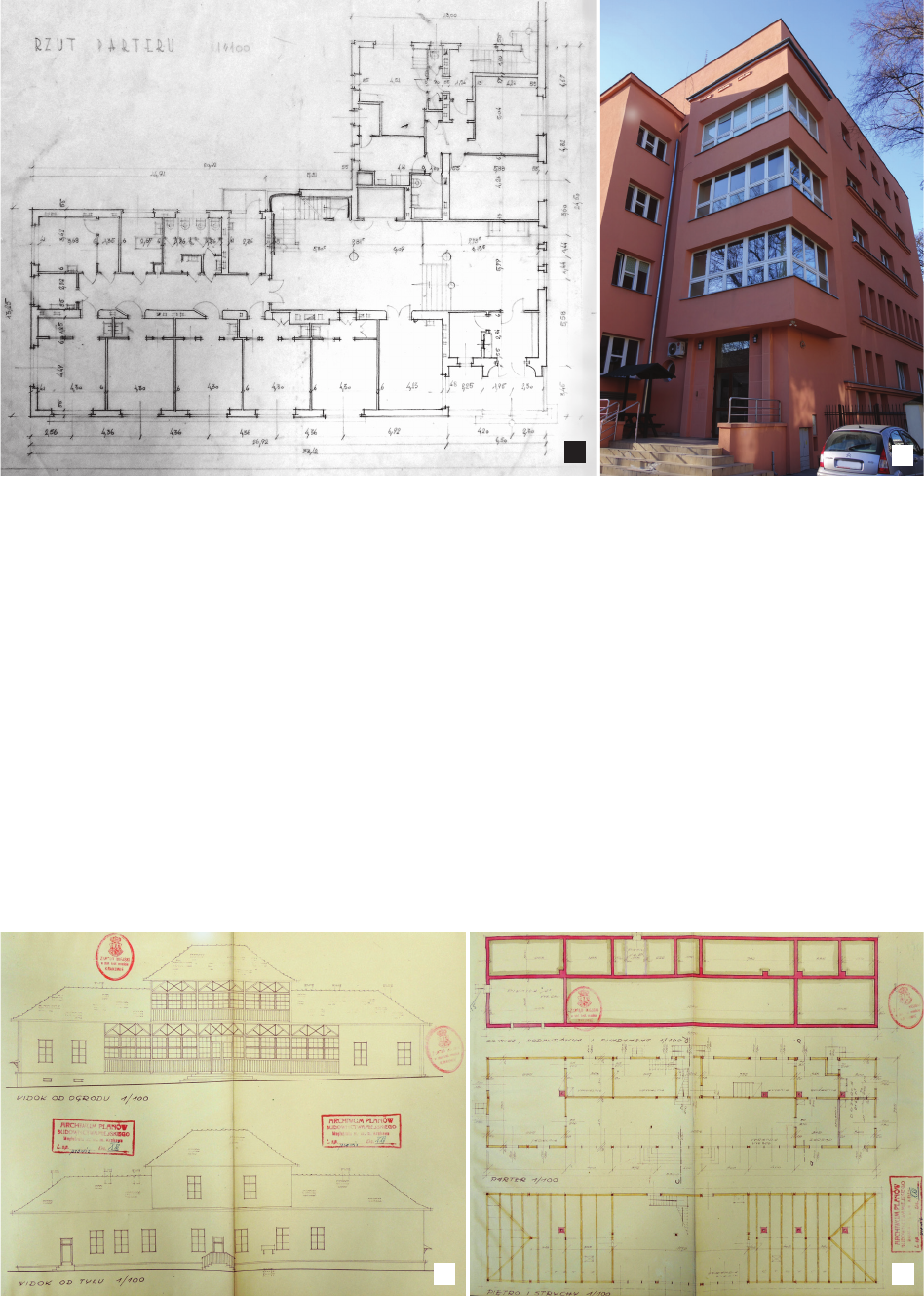
Jakub Jan Spira – genealogy and works, including the years 1939–1945
59
Fig. 11. Building at 6 Chmielowskiego Street: a) the ground floor plan (source: ANK, ABM, TAU, BUP, 6 Chmielowskiego Street, Fasc. 24P2214),
b) the tenement corner (photo by M. Motak)
Il. 11. Budynek przy ul. Chmielowskiego 6: a) rzut parteru (źródło: ANK, ABM, TAU, BUP, ul. Chmielowskiego 6, fasc. 24P2214),
b) narożnik kamienicy (fot. M. Motak)
preserved in the ANK archives (ANK, ABM, Krzemionki
Street, fasc. 475a), we know the functional-spatial layout
and architectural appearance of the building that had al-
ready been built at that time (Fig. 12).
It was a large, elongated pavilion (33.75 × 7.85 m) with
a timber superstructure, concrete strip foundation, and brick
foundation walls, with basement under a part of the building.
It had a hipped roof, with the higher central part to accommo-
date a spacious, bright veranda. The building was equipped
with a kitchen with pantry, two washrooms, a classroom, and
Fig. 12. Designs for the reconstruction of the day-care building for Jewish children run by the Society for the Care of Jewish Orphans
at 35 Krzemionki Street: a) façade, b) the ground floor plan (source: ANK, ABM, 35 Krzemionki Street, fasc. 475a)
Il. 12. Projekt przebudowy budynku półkolonii dla dzieci żydowskich Towarzystwa Opieki nad Sierotami Żydowskimi przy ul. Krzemionki 35:
a) elewacja, b) rzut parteru (źródło: ANK, ABM, ul. Krzemionki 35, fasc. 475a)
administrative rooms. According to annotations from the au -
thorities, it was intended as a temporary
building, to be de-
molished after ten years. When and why this actually oc-
curred is unknown. It is possible that it did not survive the
war; although it was shown on the “Detailed Plan of Kraków
with Adjacent Communes, 1947”, it is uncertain whether it
still in fact existed at that time (the plan – although very pre-
cise – contained some inaccurate or outdated information,
see Motak 2020, 361). The building was beautifully situated
on a long, elevated plot of nearly half a hectare, which also
b
a b
a

60
Beata Makowska, Maciej Motak
contained free-standing sanitary facilities and roofed shel-
ters. Today, there are no traces of the former day-care com-
plex, yet the boundaries of the undeveloped plot are still
largely discernible.
• Tenement at 3 Czarnowiejska Street
/ 19 Michałow skiego Street (designed by Spira, 1939)
The documentation of the unbuilt house contains only
two sketches of the structure from an earlier, unexecuted
design of unknown authorship (ANK, ABM, 3 Czarno-
wiej ska Street, fasc. 121). More information is available in
the documentation of the neighbouring, also unbuilt house
at 5 Czarnowiejska Street. The corner house at No. 3 was
planned to include eight apartments and a caretaker’s room
with a bathroom. On the design sheet, there is a stamp:
Construction management: Eng. Jakub Jan Spira, govern-
ment-licenced civil engineer (ANK, ABM, 5 Czarnowiejska
Street, fasc. 121) dated 22 August 1939.
• Design for a tenement at 5 Czarnowiejska Street
(designed by Spira, 1939)
The unbuilt three-storey residential building was de-
signed for Antoni Jasiński, Marian Rozmaryn, and Ignacy
and Ida Halpern. It was planned to include eight apartments
and a caretaker’s room with a bathroom. On the design sheet,
there is a stamp: Construction management: Eng. Jakub Jan
Spira, government-licenced civil engineer (ANK, ABM, 5
Czarnowiejska Street, fasc. 121) dated 22 August 1939.
Spira’s activities after 1945
In 1947, the Spiras moved to England
12
, where they set-
tled permanently with their daughters Anne and Shirley. The
Krakow-born builder initially collaborated with Messrs. Hus-
band and Company, and in October 1950 he became a partner
in the rm Taylor, Whalley and Spyra
13
, which still operates
today (bearing his name). At that time, the company’s oces
were located in Manchester and London. Among the proj-
ects completed with Spira’s involvement were: the post oce
tower in London (with a revolving restaurant at the top), the
Chemistry Building in Manchester, Access Bridge Water-
sheddles Reservoir in Howarth (designed in 1956), St Mary’s
Church in Liverpool (designed by Weightman and Bullen,
1957–1959), and Ciba Geigy in Schahausen, Switzerland.
In addition to designing, Spira also participated in interna-
tional conferences related to civil engineering
14
.
Conclusions
Jakub Spira came from one of the most well-known and
distinguished Jewish families of Krakow. During the inter-
war period, he belonged to the group of prominent Krakow
architectural creators. In a relatively short time, he estab-
lished a solid reputation and a stable position in a demand-
12
In England, they lived in Sheeld, and then in Manchester;
source of information: Anne Bennett
13
Based on information provided by Anne Bennett.
14
Among others, in the 7
th
Congress of the International Associ-
ation for Bridge and Structural Engineering in Rio de Janeiro in 1964.
ing professional environment. He was highly successful
in both the design and construction sectors, working in-
dependently as well as in collaboration with numerous ar-
chitects, builders, and other specialists. It is likely that the
author of several tenement houses whose construction was
supervised by Spira was in fact Edward Kreisler was (in-
cluding those at 13 Lenartowicza Street, 72 Krowoderska
Street, 10 Asnyka Street, 12 Pawia Street, 9 Worcella Street,
and 20b Lea Street – Zbroja 2023, 218). These buildings
stood out in comparison with other contemporary buildings
because of the designer’s innovative approach, reected in
the use of modern materials, forms, and construction tech-
niques. Spira played a signicant role in creating dozens
of buildings, mostly residential tenements, but also a care
home and a water tower.
Information about the life and work of the Krakow-born
architect during World War II is limited, which is under-
standable given the circumstances of the period. Neverthe-
less, the conducted research and available data indicate that,
during the war, Jakub Spira continued his excellent profes-
sional practice started in the interwar period, inasmuch as it
was possible in the situation of dramatically restricted op-
portunities and extremely dicult conditions. For a short
time, he continued previously started projects; later, he was
forced to hide his identity, yet even then he sought to remain
active in his trained profession.
Jakub Spira made a substantial contribution to shaping
the urban space of Krakow through his projects, both those
he was able to complete before the outbreak of the war and
those nished in the subsequent months and years. Most
of these buildings have survided unit the present day and
constitute an important part of the currently highly valued
legacy of Krakow’s architectural and urban thought.
After the war, Spira continued to work in his trained and
beloved profession. However, a signicant portion of his
later creative output was produced outside Poland – like
many other survivors, the architect left his homeland after
the tragedy that befell his family and community.
List of characteristic features
of Spira’s tenement houses
The tenement houses designed or co-designed by Spira
feature elements of functionalism and characteristics typi-
cally associated with the International Style (Table 1). They
are characterized by a modular form – typical of modern-
ism, rounded corners, ribbon windows, and simplied de-
tailing, including emblems. During this period, decorative
emblems were most often created by sculptors who were
graduates of the Academy of Fine Arts or the State School
of Decorative Arts and Artistic Industry.
Influence of World War II on Spira’s works
Because of the war, tenement houses owned by people
of Jewish origin had to change ownership. After the war,
many members of this community made eorts to reclaim
the buildings that had previously belonged to them and their
families – for example, Spira recovered his shares in the ten-
ement houses at 43 Łobzowska Street and 9 Straszewskiego

Jakub Jan Spira – genealogy and works, including the years 1939–1945
61
Street (ANK, Okręgowy Urząd Likwidacyjny w Krakowie/
District Liquidation Oce in Kraków/, le no. 29/1052/32).
The occupation authorities interfered with the designs of
buildings constructed during the war, and the war itself led
to damage or destruction of buildings and to changes in their
function. It is worth noting several characteristic examples
of such – usually adverse, though varying – eects:
– bullet marks are still visible on the façade of the ten-
ement house at 12 Pawia Street (located near the railway
station),
– the Jewish Old People’s Home at 6 Chmielowskiego
Street was never used for its intended purpose,
– the building and the entire summer day-care centre
complex at Krzemionki ceased to exist,
– a bomb attack took place in the tenement house at 25
Lubelska Street, commemorated by a plaque on its front
façade bearing the inscription: On 28 January 1943, a com-
bat unit of the Polish Socialist Party carried out a bomb
attack on the Arbaitsamnt /Labour Oce/ located in this
building, destroying all its records and saving thousands of
Poles from being deported for forced labour in Germany,
– the use of antennas was prohibited – on 10 Octo-
ber 1939, the occupation authorities banned listening
to foreign radio stations, and the conscation of ra-
dio sets was ordered on 15 December 1939 (Czocher
2007, 20; Motak 2020, 137),
– agpoles were not used in the way originally intended
by the designers.
The construction of tenement houses designed by Spira,
as well as by other architects and builders, was hindered
during the occupation, among other reasons due to a short-
age of materials (Broński 1987, 181).
Summary
Jakub Jan Spira was a talented designer with a substantial
and diverse body of work from the years 1930–1939, and an
equally signicant one from 1939–1945 – his designs con-
tinued to be carried out even in his absence. His profession-
al activity took various forms: from designing residential
buildings (as author or co-author), through structural de-
sign, to supervising or managing construction. He success-
fully continued his creative work in exile in England. Spira
was one of the few members of Kraków’s Jewish communi-
ty who survived the war – thanks to the help of non-Jewish
people (providing documents under a false name, escape
from Lviv) and, certainly, to the more substantial nancial
means he had accumulated through his professional work.
His brother Karol (Jewish Krakow… 2023), also an engi-
neer, and his mother, Scheindel Salomea, did not survive the
war (his mother was shot on a train
15
).
Documenting the history of outstanding individuals and
their work under the extremely dicult conditions of World
War II seems particularly important for preserving their
memory. The collected data, photographic documentation,
archival information, and photographs shared by descen-
dants can help support eorts to protect Spira’s architectur-
al legacy and expand knowledge of Kraków’s architecture
from the period under consideration.
In the authors’ opinion, based on the research conducted
so far, there is no doubt that Jakub Spira and his works de-
serve further study and a comprehensive book monograph.
Translated by
Alicja Półtorak-Filipowska
15
Based on information provided by Anne Bennett.
Characteristic features
Tenements from the years 1930–1945 built with the participation of Jakub Spira
(in the role of the construction manager or designer)
Façade composition
– compositional and aesthetic relationship between the exterior and interior of the buildings
– frequent asymmetry in the division of architectural elements (13 Lenartowicza Street, 12 Pawia Street)
– dynamic horizontal intersections of surfaces: ribbon windows (13 Lenartowicza Street), oval balconies
(12 Pawia Street), rounded entrance corners (13 Lenartowicza Street)
Façade surface – smooth and flat surface of the walls enriched with horizontal or vertical rythmic patterns
Interiors
– clear relationship between the floor plans and the building façades
– mostly high interior standards, with spacious staircases and halls
Windows and doors
– rectangular windows, often emphasizing their horizontal arrangement
– “band” windows, sometimes wrapping around corners
– window/balcony recesses grouped vertically
– individually designed details of entrance portals
Details and decorations
– details treated as structural elements, rather than applied independently of the surface layout
– decorative emblems on tenement houses added at the request of the Building Department and placed
above entrances (9 Worcella Street, 72 Krowoderska Street), on the top floor along the axis of a risalit
(13 Lenartowicza Street), or above the ground floor near the entrance portal (12 Pawia Street)
Materials
– high-quality decorative plasters (terrabona), variety of materials used in the design of entrance portals
and window surrounds (cherry-coloured clinker brick, stone, glazed tiles, metal grilles on entrance doors)
– mostly monochromatic compositions; interiors made use of, among other things, glass blocks/luxfers,
terrazzo floors, and wall cladding (13 Lenartowicza Street)
Table 1. List of characteristic features of Spira’s tenement houses (elaborated by B. Makowska)
Tabela 1. Zestawienie charakterystycznych cech kamienic Spiry (oprac. B. Makowska)
62
Beata Makowska, Maciej Motak
Acknowledgements
This publication was funded by the research project titled Jewish Architects
and Builders in Krakow during World War II (1939–1945): Professional
Activity, Fates, and Legacy, NCN Reg. no 2024/53/B/HS2/02010.
We would like to express our sincere thanks to Ms. Anne Bennett for shar
-
ing photographs from her archives and valuable information on her father
Jakub Spira.
References
Agatstein-Dormontowa, Dora. “Żydzi w Krakowie w okresie okupacji nie-
mieckiej.” Rocznik Krakowski, 31 (1957): 183–224.
Archiwum Główne Akt Dawnych [AGAD]. Centralne Władze Wyznaniowe
Królestwa Polskiego, sygn. 1/190/0: A. t. s. gminy żydowskiej w mieście
Wodzisławiu w guberni radomskiej. Accessed March 31, 2025, at https://
www.szukajwarchiwach.gov.pl/en/jednostka/-/jednostka/17738578.
Archiwum Narodowe w Krakowie [ANK]:
Archiwum Budownictwa Miejskiego [ABM], zespół 29/1410: ul. Asnyka
10, fasc. 9; ul. Augustiańska 1, sygn. 29/1410/1617; ul. Augustiań-
ska Boczna, sygn. 29/1410/1642; ul. Bujwida 1, fasc. 89; ul. Czarno-
wiejska 3 / Michałowskiego, fasc. 121; ul. Czarnowiejska 5, fasc. 121;
ul. Józeńska 2a, fasc. 338; ul. Krowoderska 72, fasc. 458; ul. Krze-
mionki 35, fasc. 475a; ul. Lea 20b, fasc. 197a; ul. Lenartowicza 13,
fasc. 491; ul. Lubelska 25, fasc. 515; ul. Łobzowska 3, fasc. 534;
ul. Ło bzowska 43, fasc. 539; ul. Mogilska 80, fasc. 621 i 622; ul. Pa -
wia 12, fasc. 668; ul. Worcella 9, fasc. 991; ul. Rzeźnicza 28, fasc.
786; ul. Smo leńsk 3, fasc. 834.
Archiwum Budownictwa Miejskiego [ABM], zespół 29/1410. Teki Ar-
chitektury i Urbanistyki [TAU]. Budynki Użyteczności Publicznej
[BUP]: ul. Chmielowskiego 6, fasc. 24P2213, 24P2214, 24P2215
i 24P2216.
Akta Miasta Krakowa [AMK], Files concerning various matters related
to construction, ref no. 29/33/Kr 3759.
Akta Stanu cywilnego Izraelickiego Okręgu Metrykalnego w Krakowie,
ref no. 29/1472/488, record 595. Accessed March 17, 2025, at https://
www.szukajwarchiwach.gov.pl/jednostka/-/jednostka/ 9719850?_
Jednostka_delta=20&_Jednostka_resetCur=false&_Jednostka _
cur=6&_Jednostka_id_jednostki=9719850.
Okręgowy Urząd Likwidacyjny w Krakowie, ref. no. 29/1052/32.
Beiersdorf, Zbigniew. “Kraków. Stary i Nowy Kleparz oraz Nowa Wesoła
i Lubicz. Studium historyczno-urbanistyczne. T. 1.” Kraków, 1979–1981.
[Manuscript in: Pracownie Konserwacji Zabytków „Arkona”, Kraków].
Broński, Krzysztof. “Ruch budowlany w Krakowie pod okupacją hitle-
rowską”. Rocznik Krakowski 53 (1987): 161–82. Accessed March 21,
2025, at http://old.mbc.malopolska.pl/dlibra/docmetadata?id= 61488-
& from=publication.
Brzoza, Czesław. Żydzi Krakowa międzywojennego. Kalendarium. Auste-
ria, 2023.
Centralna Biblioteka Judaistyczna. Zbiory Żydowskiego Instytutu Histo-
rycznego im. E. Ringelbluma, ref. no. 218/34/215/60. “Ankiety per-
sonalne osób skierowanych do wysiedlenia z Krakowa. Scheindel
Salomea Spira 20.08.1940.” Accessed March 17, 2025, at https://cbj.
jhi.pl/documents/899353/0/.
Czocher, Anna. “ ‘Gadzinówki’ i ‘szczekaczki’. Ze wspomnień o okupowa-
nym Krakowie.” Biuletyn IPN 12 (2007): 14–22.
Danilczyk, Leszek, Grażyna Dreścik, Maria Kasprzyk, Waldemar Komo-
rowski, Bogusław Krasnowolski, Aldona Sudacka, and Ewa Goras.
“Kraków. Studium waloryzacji przestrzeni publicznych dawnych
dzielnic Nowy Świat i Piasek. T. 2.” Kraków, 2004. [Manuscript in:
Pracownie Konserwacji Zabytków „Arkona”, Kraków].
Danilczyk, Leszek, and Maria Kasprzyk. “Kraków. Studium waloryzacji
przestrzeni publicznych Miasto pomnik część północna obszar daw-
nych dzielnic Piasek i Kleparz. T. 2.” Kraków 2005. [Manuscript in:
Pracownie Konserwacji Zabytków „Arkona”, Kraków].
Dayczak-Domanasiewicz, Maria. “Karta ewidencyjna zabytków architek-
tury i budownictwa: ul. Worcella 9.” Kraków, 1976 [Manuscript in:
Pracownie Konserwacji Zabytków „Arkona”, Kraków].
Dreścik, Grażyna. “Karta ewidencyjna zabytków architektury i budownic-
twa: ul. Asnyka 10.” Kraków, 1978 [Manuscript in: Pracownie Kon-
serwacji Zabytków „Arkona”, Kraków].
Dyba, Olga, and Waldemar Brzoskwinia, ed., Zabytki architektury i bu-
dow nictwa w Polsce. Kraków. Krajowy Ośrodek Badań i Dokumen-
tacji Zabytków, 2007.
Geni. Jakob Yanik Spira (1902–1979). Last modied April 28, 2022. Ac
-
cessed April 11, 2025, at https://www.geni.com/people/Jakob-Spira
/ 6000000018027591939.
Grabowska, Urszula. “Roma Szereszewska – Joanna Grabowska. Dwa życia
artystki.” In Rok Kobiet z ASP. Jubileusz 100-letniej obecności kobiet
w krakowskiej Akademii Sztuk Pięknych, edited by Iwona Demko and
Agnieszka Marecka. Wydawnictwo Akademii Sztuk Pięknych, 2021.
“Jewish Krakow genealogical documents.” Last modied August 2, 2023.
Accessed March 17, 2025, at https://ics.uci.edu/~dhirschb/genealogy/
Krakow.
Kotarba, Ryszard. Żydzi Krakowa w dobie zagłady (ZAL/KL Plaszow). In-
stytut Pamięci Narodowej, 2022.
“Krakowski Zakład Starców żydowskich otrzyma nowy własny gmach.”
Nowy Dziennik 302 (1937): 15. Accessed July 7, 2025, at https://jbc.
bj.uj.edu.pl/dlibra/publication/113485.
Krasnowolski, Bogusław. “Kraków. Dzielnica II Grzegórzki. Aktualizacja
części konserwatorskiej studium urbanistyczno-historycznego Kra-
kowskiego Zespołu Miejskiego.” Kraków, 1998 [Manuscript in: Pra-
cownie Konserwacji Zabytków „Arkona”, Kraków].
Makowska, Beata. “Façades of modernist Krakow townhouses designed
by selected architects.” Architecture Civil Engineering Environment 2,
no. 2 (2009): 7–17.
Makowska, Beata. Kamienice krakowskie z przełomu XIX i XX wieku
i okresu międzywojennego położone na obszarze pomiędzy pierwszą
a drugą obwodnicą. Charakterystyka form i ich ewolucja. Wydawnic-
two Politechniki Krakowskiej, 2014.
Motak, Maciej. “Architekci czy rzemieślnicy? O budowniczych krakow-
skich okresu międzywojennego.” In Studia nad architekturą i urbani-
styką polski międzywojennej, t. 6: Planowanie, budowanie i ulepszanie
Wielkiego Krakowa w odrodzonym państwie, edited by Maciej Motak.
Wydawnictwo Politechniki Krakowskiej, 2021.
Motak, Maciej. “The fate of Krakow’s builders and architects of Jewish or-
igin in the face of World War II. Possibilities of applying the microhis-
torical method in research on architecture and urbanism.” Architectus
79, no. 3 (2024): 13–24. https://doi.org/10.37190/arc240302.
Motak, Maciej. Osiedle Urzędnicze w Krakowie. Urbanistyka i architektu-
ra 1924–1942. Wydawnictwo Politechniki Krakowskiej, 2020.
My Heritage (a). “Jakob Yan Yanik Spira.” Web administrator: Esther Kling.
Last modied March 16, 2025. Accessed April 11, 2025, at https://
www.myheritage.pl/research/collection-1/drzewa-genealogiczne-my-
heritage?itemId=379224271-1-500255&action=showRecord&record-
Title=Jakob+Yan+Yanik+Spira.
My Heritage (b). “Jakob Yan Yanik Spira.” Web administrator: Michael
Bennett. Last modied April 10, 2025. Accessed April 11, 2025, at
https://www.myheritage.pl/research/collection-1/drzewa-genealogicz-
ne-myheritage?itemId=650888271-3-500255&action=showRecord.
Narodowe Archiwum Cyfrowe [NAC], sygn. 3/1/0/8/6583. “Wieża ciśnień przy
ulicy Rzeźnickiej w Krakowie. Styczeń 1932.” Accessed April 9, 2025.
https://www.szukajwarchiwach.gov.pl/jednostka/-/jednostka/5949647.
Purchla, Jacek. “Urbanistyka, architektura, budownictwo.” In Kraków w la -
tach 1918–1939, edited by Janina Bieniarzówna and Jan M. Małecki.
Wydawnictwo Literackie, 1997.
Rączy, Elżbieta. Zagłada Żydów w dystrykcie krakowskim w latach 1939–
1945. Uniwersytet Rzeszowski – Instytut Pamięci Narodowej, 2014.
Reiss, Henryk. Z deszczu pod rynnę… Wspomnienia polskiego Żyda. Wy-
dawnictwo Polonia, 1993.
“Rozporządzenie Prezydenta Rzeczypospolitej z dnia 16 lutego 1928 r.
o prawie budowlanem i zabudowaniu osiedli.” Dz.U. 1928, nr 23,
poz. 202. Accessed April 10, 2025, at https://isap.sejm.gov.pl/isap.nsf/
download.xsp/WDU19280230202/O/D19280202.pdf.
Spira, Jakub. “Budowa żelbetowej wieży wodnej w rzeźni miejskiej w Kra-
kowie.” Cement. Organ Związku Polskich Fabryk Portland-Cementu
7/8 (1932): 171–73.
Jakub Jan Spira – genealogy and works, including the years 1939–1945
63
Zajączkowska-Drożdż, Agnieszka. Od dyskryminacji do eksterminacji.
Polityka Trzeciej Rzeszy wobec Żydów w Krakowie (1939–1943). Wy-
dawnictwo Uniwersytetu Jagiellońskiego, 2020.
Zbroja, Barbara. Architektura międzywojennego Krakowa 1918–1939. Bu-
dynki, ludzie, historie. Wysoki Zamek, 2013.
Zbroja, Barbara. Leksykon architektów i budowniczych pochodzenia ży-
dowskiego w Krakowie w latach 1868–1939. Wysoki Zamek, 2023.
Zbroja, Barbara. Miasto umarłych. Architektura publiczna Żydowskiej
Gminy Wyznaniowej w Krakowie w latach 1868–1939. Wydawnictwo
WAM, 2005.
Zbroja, Barbara. “Żydowscy architekci w międzywojennym Krakowie.
Spacerownik.” 2017. Accessed March 17, 2025, at https://mck.kra-
kow.pl/images/upload/wystawy/Awangarda/Multimedia/spacerown-
ik_www.pdf.
Streszczenie
Jakub Jan Spira – genealogia i dzieła z uwzględnieniem okresu 1939–1945
W artykule omówiono genealogię i twórczość Jakuba Jana Spiry (1902–1979) ze szczególnym uwzględnieniem okresu 1930–1945.
Praca oparta została na dokumentacji historycznej i fotogracznej budynków, badaniach in situ, analizie dostępnych opracowań naukowych
i innych źródeł (studia waloryzacji przestrzeni, karty ewidencyjne obiektów), a także na informacjach zamieszczonych na portalach genealogicznych
oraz mikrohistorii. W wyniku badań wyciągnięto wnioski, że dzieła Jakuba Spiry są dziedzictwem architektonicznym o znaczącej randze, a jego
działalność przyczyniła się do kształtowania wysokiej jakości przestrzeni miejskiej Krakowa. Inżynier budownictwa działał z dużym powodzeniem
w branżach: projektowej i wykonawczej, zarówno samodzielnie, jak i z licznymi architektami, budowniczymi oraz innymi specjalistami. Projekty
powstałe przy jego udziale wyróżniają się nowatorskim podejściem, które przejawiało się stosowaniem nowoczesnych materiałów, form i konstrukcji
budowlanych. Stworzył w Krakowie (bądź istotnie przyczynił się do stworzenia jako kierownik budowy czy projektant) kilkadziesiąt budynków
– w większości kamienic mieszkalnych, ale także innych, m.in. domu opieki, pawilonu półkolonijnego dla dzieci, wieży ciśnień.
Zapis historii wybitnych ludzi i ich działalności w szczególnie trudnych warunkach II wojny światowej wydaje się bardzo ważny dla zachowania
pamięci o nich. Zebrane dane, dokumentacja fotograczna, informacje i archiwalne zdjęcia przekazane przez potomków mogą wesprzeć działania na
rzecz ochrony dziedzictwa architektonicznego Jakuba Spiry i wzbogacić wiedzę o architekturze Krakowa omawianego okresu.
Słowa kluczowe:
Jakub Spira, architektura 1939–1945, Kraków, dziedzictwo architektoniczne, krakowskie kamienice
