
Introduction
This is a paper on the immovable possessions of Bohe-
mian Cistercian monasteries during the Middle Ages,
from their earliest origins to the epoch of Hussite wars
(1419–1485), which resulted in a deep transformation of
the property situation of the Cistercian regular houses of
Bohemia. I am seeking answers to the questions of the
character of endowments of Bohemian Cistercian houses,
and of the development of landed property of the daughter
abbeys of Cîteaux and Morimond in Bohemia over the
centuries of the Order’s existence there.
Endowments of Bohemian Cistercian houses
The first houses of white monks in Bohemia saw the
light of day in the course of the 40’s of the twelfth century,
much as was the case of other lands of central Europe, in
the greatest floruit period of the Order when abbott Bernard
of Clairvaux campaigned for the ideals of the new monastic
congregation. The impact of Bernard’s activities might
have resulted in the establishment of the three first Bohe-
mian abbeys of the Order (1142–1145)
1
. Two other houses
were founded before the year 1200
2
, and four others fol-
1
The earliest Bohemian plants of the Cistercian order were the
abbeys of Sedlec (established in 1142 by a nobilis named Miroslav),
Plasy (established 1144 by duke Vladislav II), and Pomuk (established
1145 probably by Henry, younger brother of duke Vladislav II). The
Pomuk abbey lost its archive, and thus we cannot provide any more
precise answers to questions of its landed property.
2
The abbey of Hradiště-nad-Jizerou, founded before 1184 by an
unknown member of the noble lineage of Markvartici, belongs to the
2013
3(35)
DOI: 10.5277/arc130301
Kateřina Charvátová*
Pozemková držba českých cisterciáckých klášterů 1142–1420
Landed property of the Cistercian houses of Bohemia 1142–1420
Úvod
Předkládaná studie si klade za cíl poznání pozemkové
držby českých cisterciáckých klášterů v období středověku,
a to od jejich počátků až do doby husitských válek, které
majetkové poměry českých klášterů zcela proměnily. Stu-
die hledá odpovědi na otázky, jak vypadalo obvěnění cis-
terciáckých klášterů v Čechách a jak se pozemkový maje tek
českých cisterciáckých opatství v průběhu staletí vyvíjel.
Cisterciácký řád přišel do Čech obdobně jako do něk-
terých dalších zemí střední Evropy v průběhu čtyřicátých
let 12. století,v době největšího rozvoje řádu, kdy cister-
ciácké ideály široce propagoval opat Bernard z Clairvaux.
Pravděpodobně pod vlivem jeho působení byla v Čechách
založena tři první opatství (1142–1145)
1
. Do konce 12.
sto letí vznikly další dva kláštery řádu
2
a ve 13. věku nás-
le dovaly další čtyři fi liace
3
. Čtrnácté století završilo síť
* Katedra dějin a didaktiky dějepisu UK, Praha / History and His-
tory Didactics Department, UK, Prague.
1
Nejstaršími českými fundacemi cisterciáckého řádu v Čechách se
stala opatství v Sedlci (založeno 1142 šlechticem Miroslavem), v Plasech
(založeno 1144 knížetem Vladislavem II.) a v Pomuku (založeno 1145
pravděpodobně mladším bratrem knížete Vladislava II., Jindřichem).
2
Ve druhé polovině 12. století vznikl klášter Hradiště (nad Jizerou)
založený před 1184 členem rodu Markvarticů a klášter v Oseku (založen
cca 1199 rodem Slávkem z rodu Hrabišiců). Předchůdcem oseckého
kláštera byl řádový dům v Mašťově, který zanikl krátce před rokem
1200. Mašťovský konvent přešel po zániku kláštera do Oseka, kde
založil nové opatství.
3
Klášter ve Vyšším Brodu založený roku 1259 Vokem z Rožmberka
z rozrodu Vítkovců, Zlatá Koruna, fundace krále Přemysla Otakara II.
z roku 1263, klášter Svaté Pole založený 1272 neznámým šlechticem
a opatství Aula Regia na Zbraslavi, založení krále Václava II. z roku 1292.

4 Kateřina Charvátová
lowed suit in the 13
th
century
3
. The very last regular house
for white monks saw the light of day in the 14
th
century
4
.
All in all, Bohemia numbered ten Cistercian monasteries
5
.
At the time around 1150, when the first Cistercian mo -
na steries took root in Bohemia, the land’s occupation was
thinly spread, and irregularly clustered. The main phase
of medieval assarting, which brought about a fundamental
transformation of Bohemian landscapes, had started a few
decades later, before the end of the 12
th
century, and las-
ted until the beginning of 14
th
century. Though the earliest
Cistercian abbeys emerged prior to the onset of this up -
surge of assarting activities, most of the houses were born
in its course while the Order’s latest plant sprang to life
after the end of this intense colonization wave, which gra-
dually covered all Bohemia
6
. The relation towards the
main phase of medieval assarting enterprise constitutes
a major factor in terms of development of monastic
landed property. Unlike the territories of traditional settle-
ment, freshly deforested landscapes offered relatively good
chances of endowment of new institutions with land, and
gave good promise of developments in the future.
The very first abbey of the Order in Bohemia – that of
Sed lec – sprang up within the traditional settlement zone,
offe ring, by that time, better conditions for landed-proper ty
transactions than most of the outlying regions covered by
woodland. Unfortunately, most of the possessions do na -
ted to the abbey were dispersed over a wide area, and the
prospects of future development of the monastic holdings
were not particularly promising due to the fact that this
region’s settlement pattern was almost closed. Upon the
foundation of their house, the white monks of Sedlec
received the eponymous site together with eight villages
situated within a broad zone between the present-day ci ties
of Kolín and Pardubice. They were also given a ma nor farm
at the site of Poboří cum terra Odolen et terra Donati
7
.
The second house, that of Plasy established by the so -
vereign duke of the land, emerged at a place which was
relatively freshly settled. The landed-property complex
with which the founder endowed the Plasy institution was
compact but small. The donation of the eponymous site,
be longing originally to the duke, was accompanied by gifts
second half of 12
th
century. Its monastic archive has also perished, and
all we have is a fragment of the abbey´s estate book dating around 1400.
The other foundation of the second half of 12
th
century is that of Osek,
preceded by a short-lived house at Mašťov (1192–1198).
3
The abbey of Vyšší-Brod (Hohenfurt, Altovadum) was estab-
lished in 1259 by Vok of Rožmberk of the Vítkovci lineage. The house
of Zlatá-Koruna (Goldenkron, Sancta Spinea Corona) emerged in 1263
thanks to king Přemysl Otakar II, that of Svaté-Pole (Sacer Campus) in
1272 thanks to an unknown aristocrat, and that of Zbraslav (Königssaal,
Aula Regia) in 1292 thanks to king Václav II.
4
The last plant of the Order was founded in 1357 by the initiative
of Theodoric (Dětřich) of Portitz, bishop of Minden.
5
Much attention has been paid to Cistercian houses of Bohemia
over the last decades. For a sample of the reference works see K. Char-
vátová [1]–[3] citing most of the relevant preceding studies; [4]–[6].
6
The medieval assarting of the Czech-speaking lands has been
aptly characterized by J. Klápště [7, pp. 170–189].
7
Codex diplomaticus et epistolaris regni Bohemiae I–V [8, I, No.
155, p. 156]. The Poboří site is situated in the Kouřim region. Com po-
nent sites of the Sedlec endowment were dispersed over a wide region.
cisterciáckých klášterů v Čechách vznikem posledního
opatství
4
. Úhrnem se ve středověkých Čechách etablova-
lo deset cisterciáckých klášterů
5
.
Obvěnění českých cisterciáckých klášterů
České země představovaly v polovině 12. století, v do-
bě, kdy se zde začaly usazovat první konventy cisterciá-
ků, zemi dosud jen řídce a navíc nerovnoměrně osídle-
nou. Hlavní vlna středověké kolonizace, jež zásadním
způsobem proměnila českou krajinu, započala až o ně-
ko lik desetiletí později, před koncem 12. věku, a trvala
do začátku 14. století. Nejstarší kláštery cisterciáckého
řádu byly založeny ještě před jejím nástupem, většina pak
vznikla v jejím průběhu, pouze nejmladší výhonek řádu
povstal až po skončení tohoto intenzivního osídlovacího
procesu, jenž postupně zasáhl celé Čechy
6
. Vztah k hlavní
vlně středověké kolonizace se ukazuje jako dosti zásadní
pro vývoj pozemkové držby klášterů. Kolonizační krajina
totiž nabízela na rozdíl od území s dlouhou tradicí osídle-
ní relativně snadné pozemkové vybavení nových institucí
a i do budoucna skýtala naději na jejich dobrý rozvoj.
Nejstarší klášter řádu v Čechách, totiž sedlecký, vznikl
v oblasti staré sídelní oikumeny, kde byly v té době mož-
nosti dispozice nemovitým majetkem lepší než v dosud
většinově zalesněných regionech; nevýhodou pro klášter
však byla poměrně velká rozptýlenost získaných lokalit
a do budoucna jen malá naděje na další sídelní rozkvět
regionu, neboť osídlovací proces v této oblasti byl již
téměř ukončen. Cisterciáci dostali při založení opatství
lokalitu Sedlec a osm vesnic ležících v širokém pásmu
mezi Kolínem a Pardubicemi, dále pak dvůr v Poboří cum
terra Odolen et terra Donati
7
.
Druhý klášter, knížecí Plasy, povstal v místech, která
začala být osídlována teprve relativně nedávno. Od svého
zakladatele získal sice kompaktní, avšak jen malou nada-
ci. Cisterciáci obdrželi knížecí statek Plasy spolu se čtyř-
mi vesnicemi, a dále pak podíl na solném cle v Děčíně,
dvě vinice u Prahy na vrchu Petříně spolu se dvěma vinaři
a jejich majetkem a ještě několik osob s jejich pozemky.
Další ves věnoval plaskému klášteru pražský biskup Oto
[8, I, č. 396, s. 408–409]. Věno plaského kláštera bylo
na panovnickou fundaci velmi malé, oblast, kde klášter
vznikl, však měla dobré perspektivy rozvoje.
Obdarování obou nejstarších klášterů představova-
ly většinou vesnice, z nichž cisterciáci pobírali poddans-
ké dávky, jež se staly základem jejich příjmů; k výbavě
patřil také hospodářský dvorec a plat (podíl z cla). V lis-
4
Nejmladší český klášter cisterciáckého řádu vznikl roku 1357
z vůle mindenského biskupa Dětřicha z Portic.
5
Cisterciáckým klášterům v Čechách byla v posledních desetile-
tích věnována velká pozornost. Ze základní literatury výběrově: [1]–[3]
v těchto knihách uvedena většina starší literatury; [4]–[6].
6
K charakteristice středověké kolonizace v českých zemí srv.
J. Klápště [7, s. 170–189].
7
Codex diplomaticus et epistolaris regni Bohemiae I–V [8, I,
č. 155, s. 156]. Lokalita Poboří se nachází na Kouřimsku. Do listiny
byly rukou pozdního 12. století vepsány ještě další dvě lokality z okolí
kláštera (Hlízov a Kačín).

Pozemková držba českých cisterciáckých klášterů 1142–1420 /Landed property of the Cistercian houses of Bohemia 1142–1420 5
tinách se opakovaně uvádí, že součást daru pro klášter
tvořili lidé. Naopak, což je překvapující, nejsou v nej -
starších donacích zmínky o tom, že by kláštery obdržely
lesní půdu.
Obdobně jako věno nejstarších klášterů lze charakteri-
zovat i obvěnění dalších českých opatství z konce 12. sto-
letí. Jejich pozemková výbava se opět skládala především
z vesnic, vedle nich pak zakládací listiny hovoří o růz-
ných druzích platů. Ani v případně klášterů založených
na konci 12. století nejsou žádné zprávy o předání les-
ní nebo jiné neosídlené půdy. Mašťovská fundace (zlis -
tině ní 1196), obdržela území, který právě prošlo koloni -
zací. Její věno tvořilo patnáct nově založených vesnic,
klášter však nedostal žádnou neosídlenou půdu [8, I,
č. 355, s. 319–320]
8
. Původní majetek oseckého klášte-
ra založeného na samém konci 12. století sice neznáme,
víme však, že necelých deset let po fundaci ústavu patřilo
čtrnáct vesnic, statky ve dvou dalších osadách a desátky
různého typu v osmi lokalitách [8, II, č. 64, s. 59–60]
9
.
Obvěnění českých řádových domů 12. století jas-
ně ukazují, že se kláštery ve věci majetku, který přijí-
maly, nevázaly předpisy cisterciáckého řádu. Ne půda
obdělávaná vlastníma rukama, ale census z jednotlivých
vsí představoval základ všech nadačních darů. Ne půda
nekultivovaná, ale již osedlé vesnice přicházely do rukou
cisterciáků, a to již od první poloviny 12. století.
Na příkladu obvěnění klášterů je jasně vidět, nakolik
se při hmotném zabezpečování nových fundací projevo-
valy zvyky země, jež cisterciáky přijímala. Cisterciácké
kláštery byly obvěňovány stejným způsobem jako jiné
cír kevní instituce v Čechách, nikoliv jako cisterciácké
kláštery v řádovém centru či obecněji v západní Evropě
10
.
Ptáme-li se, proč se prosazovaly především lokální
zvyky, můžeme za hlavní důvod označit silnou roli zakla-
datele, jenž měl při fundaci hlavní slovo. Na zakladateli
a jeho rodině kláštery závisely, a proto byly nuceny při jí-
mat jeho vůli. Pokud si cisterciáci přáli, aby vznikla další
řádová fi liace, nemohli odmítnout věno, i když neod po-
vídalo řádovým předpisům. Vedení řádu s jejich jednáním
zjevně souhlasilo, neboť stejný postup, tj. přijímání osed-
lé půdy a platů, nacházíme v celé střední Evropě. Souhlas
řádu dotvrzují i kontroly plánovaných fundací (inspec tio
loci), které jsou v českých zemích doloženy od raného
13. století. Pro řádovou kontrolu byla zásadní otázka, zda
bude hmotné zabezpečení budoucího konventu dostateč-
né a nikoliv, zda klášter získá osídlenou nebo neosídlenou
půdu
11
.
8
K rozboru majetku T. Velímský [9, s. 156–169].
9
Listina zmiňuje různé druhy desátků, např. decimam vini, deci-
mam frumenti, decimam vini cum decicmis allii.
10
Zcela jiný obraz darů, jež tvořily základ klášterního hospodář-
ství, skýtá například kopiář kláštera Obazine [10].
11
První známá inspekce se vztahuje k moravskému Velehradu, při
níž jako budoucí pater-abbas vystupoval plaský opat a jedním z inspek-
torů byl opat z Pomuku [11, I, 1204, č. 44, s. 305]. Řádová kontrola před
založením kláštera je doložena pro české ústavy v Nížkově [11, II, 1237,
č. 62, s. 180]; opakovaná výzva [11, II, 1238, č. 48, s. 194–195], ve
Vyšším Brodě [11, II, 1259, č. 50, s. 459], pro Zlatou Korunu [11, II,
1259, č. 52, s. 459] a pro Svaté Pole [11, III, 1272, č. 38, s. 112].
of four villages, of a share in the ducal toll collected from
salt deliveries at the site of Děčín, of two vineyards on the
Petřín hill of Prague with two vintners and their property,
and of still other servile personnel with their landholdings.
Otto, bishop of Prague, contributed another village [8, I,
No. 396, pp. 408–409]. Though the extent of the Plasy
endowment was rather limited in terms of foundations of
the land’s sovereigns, its regional siting gave great pro-
mise in terms of development of the monastic domain.
The endowment of the first two abbeys consisted
almost entirely of villages from which the Cistercians col-
lected servile rents, constituting the base of their reve-
nues. They also received a manor farm and a rent in kind
(share in a toll). The charters repeatedly note that human
persons made up components of the monastic endow-
ments. Surprisingly, the earliest donations lack any refe-
rences to Cistercian holdings of woodland.
The provisions for other Bohemian plants of the Order
founded before 1200 do not differ from those of the ear-
liest houses. They received mostly villages and, in addi-
tion to them, the foundation charters mention various
rents and revenues. Here also we hear nothing of any pos-
sible donations of woodland, or other kinds of waste land,
to the white monks. In the Mašťov foundation (charter of
1196), the future house received a freshly assarted seg-
ment of territory. The endowment consisted of fifteen new-
ly
established villages but of no waste land [8, I, No. 355,
pp. 319–320]
8
. Though we do not know the extent of the
original property of the Osek monastery established at the
very end of 12
th
century, it can be established that the
house held fourteen villages, property in two other settle-
ments, and various types of tithes in eight sites some ten
years after its foundations [8, II, No. 64, pp. 59–60]
9
.
Twelfth-century donations to Cistercian abbeys show
beyond all doubt that in terms of the property transferred
to them, they fell short of complying with economic
demands of the Order. All the foundations were based not
on landholdings cultivated by manual labor of the monas-
tery incumbents, but on the perception of revenues from
singular villages. This related even to the earliest founda-
tions of the Order which sprang up in the lifetime of
Bernard of Clairvaux. The example of donations to the
abbeys shows clearly to what extent the customs and hab-
its of the land hosting the Order establishments influenced
the material sustenance of the new foundations. Cistercian
monks received the same kind of material support as other
ecclesiastical institutions of Bohemia, not that enjoyed by
the Order houses in western Europe
10
.
Why was this so? The main reason behind the rent-
village endowments seems to be the major role of the
mo nastery’s “founding fathers” who had a great say in the
foundation process. The monasteries fully depended on
8
On the analysis of the property complex see T. Velímský [9,
pp. 156–169].
9
The charter refers to various tithe types, e.g. decimam vini,
decimam frumenti, decimam vini cum decimis alliis.
10
A completely different account of donations making up the base
of monastic economy may be found, for instance, in cartulary of the
Obazine abbey in France [10].

6 Kateřina Charvátová
Ve 13. století se složení věna nových cisterciáckých
klášterů v Čechách poněkud proměnilo. Poprvé se sou-
částí klášterní výbavy začala stávat i neosídlená krajina.
Nezdařená fundace fi liace v Nížkově (existovala ve 30.
letech 13. století) byla kromě trhové vsi a příjmu v peně-
zích i naturáliích vybavena rozsáhlým lesem určeným ke
kolonizaci [8, III/1, č. 100, s. 115–117]. Poněkud odliš-
ná skladba věna kláštera v Nížkově, kde významnou část
daru představoval klášterní les, vycházela ze skutečnos-
ti, že oblast Českomoravské vysočiny stála v té době na
samém počátku odlesňování. Osedlá půda nebyla dosud
ve větší míře k dispozici, zakladatel proto nemohl kláš-
teru dát již hotové vsi, jak bývalo zvykem. Proto klášter
vybavil půdou určenou ke kolonizaci, na níž, jak předpo-
kládal, se měl klášter aktivně podílet.
Podobná výchozí situace se dotkla i Vyššího Brodu,
neboť ani nejjižnější cíp Čech, kde Vyšší Brod leží, v době
založení kláštera kolonizací dosud neprošel, repsekti-
ve kolonizace zde právě začínala. Vyšší Brod dostal při
svém založení v roce 1259 stejnojmennou tržní osadu,
dále pět vesnic značného rozptylu včetně jedné lokality
na rakouském území a jedné ve Slezsku. Značnou část
věna představoval tzv. Klášterní les, jenž se rozkládal na
jih a jihozápad od Vyššího Brodu v horském terénu při
dnešní hranici s Rakouskem [8, V/1, č. 187, s. 298–300].
Vyšebrodská nadace se od předchozích obdarování
lišila především tím, že její fi nančně nejdůležitější složku
tvořila práva ke třem patronátním kostelům spolu s podíly
na desátcích četných vsí včetně lokalit teprve plánova-
ných. Vysvětlení, proč byla počáteční držba vyšebrod-
ských cisterciáků natolik rozptýlená, můžeme hledat
i v tom, že si fundátor hodlal ponechat území kolem hradu
Rožmberka pro rodové potřeby. Teprve vymřením krum-
lovské větve Vítkovců (1302) a přenesením ústředí rožm-
berského panství na Krumlov, přestal mít zakladatelský
rod zásadní zájem na této oblasti a její část postupně pře-
šla do rukou kláštera.
Opatství ve Zlaté Koruně založené králem Přemyslem
Otakarem II. bylo na rozdíl od všech českých cisterciác-
kých klášterů obdarováno převážně lesní půdou. Základ
jeho věna tvořil tzv. boletický statek, většinou dosud ne-
kolonizované lesní území jehož rozsah se odhaduje na
880 km [8, V/1, č. 391, s. 581–582]. Způsob tohoto v čes-
kých poměrech neobvyklého majetkového věna byl dán
politickými příčinami, snahou panovníka zabránit rodu
Vítkovců, aby si podmanil další část území jižních Čech.
Od cisterciáků se očekávalo, že předanou oblast budou
kolonizovat, což klášter v následujícím století skutečně
učinil. Boletický statek však nebyl jedinou částí věna klá-
štera Zlatá Koruna. Vedle něj opatství získalo i oblasti již
osídlené - část Netolicka a rájovskou rychtu.
Obdarování
kláštera doplňovaly dvě vinice v Rakousku a další drobné
statky [8, V/1, č. 391, s. 581–582].
Poněkud jinak než kláštery založené v polovině 13.
století byla obdarována nejmladší česká založení, kláštery
na Zbraslavi a ve Skalici. Oba ústavy vznikly v době, kdy
již většina českého území byla kolonizována a pro nový
klášter nebylo snadné získat rozsáhlejší ucelený nemovitý
majetek. S tímto problémem se potýkal i král Václav II. při
fundaci opatství Aula Regia na Zbraslavi. V blízkosti Pra-
the “founding fathers”, and their families, and had to be
mindful of their will and initiatives. If the Order desired
establishment of new plants, it could hardly refuse en -
dow ments including those not complying with its rules.
Such practices apparently met with acknowledgment of
the Order’s direction, as we observe the same phenome-
non, i.e. acceptance of occupied ground and rents, all over
central Europe. Consent of the Order is confirmed by
controls of proposed foundations (inspectio loci), attested
to in Czech-speaking lands from the early 13
th
century on.
It seems that the Order was much more interested in
kno-
wing whether the material provisions of the monastery
-
-to-be sufficed, than in the information whether the abbey
will get occupied or waste land
11
.
A measure of transformation of endowments of new
monasteries is perceptible in the 13
th
century. Waste land
appeared for the first time as a component of provisions for
new regular houses. In addition to a market village and to
rent both in cash and in kind, the failed Nížkov foundation
of the thirties of the 13
th
century received a large tract of
woodland for assarting [8, III/1, No. 100, pp. 115–117]. The
reason for this may be found in the fact that deforestation
of the Českomoravská-vrchovina (Bohemian-Moravian
high land), where the abbey site was situated, had only just
begun by then. No cultivated arable soil was simply avail-
able here, and this induced the founder to provide the
abbey with a tract of woodland to be assarted in the future.
A similar situation pertained to the abbey of Vyšší-
-Brod (Altovadum, Hohenfurt). In fact, the southernmost
part of Bohemia where this abbey lies had not undergone
colonization in the foundation time of the abbey, or rather,
the assarting of this region had just started. Upon its foun-
dation in 1259, the regular house obtained the eponymous
site, a market village, and five villages dispersed over
a wide area including one site in Austrian territory, and
one as far as Silesia. A considerable part of the endow-
ment consisted of the Abbey Wood (Klášterní-les, Kloster-
wald), situated south and southwest of Vyšší-Brod, in the
highlands by the present-day Czech-Austrian border [8,
V/1, No. 187, pp. 298–300].
The Vyšší-Brod endowment differed from the previous
cases by the fact that its component most interesting from
the financial point of view was represented by rights to
nominate parochial priests in three churches, together
with shares in tithes from numerous villages including
sites yet to be established. The explanation for the mar-
ked ly dispersed character of holdings of the white monks
of Vyšší-Brod may be sought in the fact that maybe the
founder wished to keep the territory around the Rožmberk
castle for his own lineage. It was only with the extinction
of the Krumlov branch of the Vítkovci lineage (1302),
11
The first inspectio loci known to us relates to Velehrad in
Moravia. The procedure involved the abbott of Plasy as the future pater-
abbas and the abbott of Pomuk as one of the inspectors [11, I, 1204, No.
44, p. 305]. Order controls carried out prior to the foundation of an
abbey took place in the Bohemian houses of Nížkov [11, II, 1237, No.
62, p. 180]; a repeated call in [11, II, 1238, No. 48, pp. 194–195], Vyšší-
Brod [11, II, 1259, No. 50, p. 459], Zlatá-Koruna [11, II, 1259, No. 52,
p. 459] and Svaté-Pole [11, III, 1272, No. 38, p. 112].

Pozemková držba českých cisterciáckých klášterů 1142–1420 /Landed property of the Cistercian houses of Bohemia 1142–1420 7
and transfer of the centre of the Rožmberk-lineage hold-
ings to the site of Český-Krumlov, that the founding fami-
ly lost its fundamental interest in this region, and parts of
it fell to the monastic possessions.
Unlike most of the other Cistercian houses of Bohemia,
the abbey of Zlatá-Koruna (Sancta Corona, Goldenkron),
established by King Přemysl Otakar II, received a consid-
erable amount of woodland. The backbone of its endow-
ment represented the so-called Boletice estate, an area of
waste land the extent of which is estimated at 880 km [8,
V/1, No. 391, pp. 581–582]. The character of this endow-
ment, highly unusual in the Bohemian situation, followed
out of the political situation. The sovereign intended to
bar the way of the Vítkovci lineage towards annexation of
another part of southern Bohemia. Here the Cistercians
were expected to carry out cultivation of the land, as it
duly happened in the following century. However, the
Boletice estate did not constitute the only part of the
Zlatá-Koruna endowment. The abbey obtained land that
had already been settled – part of the Netolice region and
the Rájov-bailiff precinct. In addition to this, the abbey
was given two vineyards in Austria and other minor pos-
sessions [8, V/1, No. 391, pp. 581–582].
The latest Bohemian plants, those of Zbraslav (Aula
Regia, Königssaal) and Skalice, differed again in the form
of their endowments from houses established in the first
half of 13
th
century. Both of them emerged in a time when
most of Bohemia had already been assarted and occupied,
and it was difficult to find more extensive and compact
complexes of landed property. Providing for the Aula Regia
abbey at Zbraslav, king Václav (Wenceslas) II divi ded its
endowment in two parts. First and foremost, he gave the
Cistercians a minor complex of property in the closest
proxi mity of the abbey, in central Bohemia not far from
Prague. A major cluster of Zbraslav landholdings was situ-
ated in east Bohemia. In 1292, the entire endowment con-
sisted of three towns and boroughs, and of some fifty vil-
lages. This property underwent some changes in 1304 when
king Wenceslas added other estates so that finally, Zbraslav
received five towns and boroughs and, by and large, seven-
ty villages [12, No. 1, pp. 1–2, No. 15, pp. 8–10].
It goes
without saying that the monks found some difficulty in
managing both property complexes, some 200 km apart.
In comparison with royal magnanimity exhibited
towards Zbraslav, the latest Bohemian plant of the Order
– the abbey at Skalice – received but a modest landed-
property gift. The landholding situation within Bohemia
of the second half of 14
th
century reached such a degree
of consolidation and compactness that a creation of
a major complex of immovable property presented con-
siderable difficulties, even for an exceedingly able finan-
cial expert like the founder of Skalice, Dětřich (Theodoric)
of Portitz
12
.
All he could give to the white monks were
three villages and a wood called Kozí-Hřbet (Goat Back).
In order to compensate for this shortcoming, he provided
12
It was commonly assumed that Dětřich of Portitz fell very short
of a financial genius. The emperor, Charles IV, frequently availed him-
self of Dětřich’s services.
hy, kde měl klášter stát, nebyl k dispozici dostatečně roz-
sáhlý majetek. Proto panovník věno rozdělil a cisterciákům
věnoval dvě panství, menší v okolí kláštera, rozsáhlejší ve
východních Čechách, jež však bylo od toho prvního značně
vzdálené (cca 200 km). Rozsah věna činil v roce 1292 tři
města a městečka a cca padesát vsí; roku 1304 král svou
nadaci obměnil a rozšířil, takže čítala pět měst a městeček
a cca sedmdesát vesnic [12, č. 1, s. 1–2; č. 15, s. 8–10].
Ve srovnání s rozsáhlým zbraslavským obdarováním,
získala nejmladší česká fundce- klášter ve Skalici, pouze
skromný nemovitý majetek. Ve druhé polovině 14. století,
v době, kdy již osídlování země bylo ukončeno, bylo již
obtížné vytvořit větší panství. Tento úkol se nepodařil ani
tak zdatnému fi nančníkovi, jakým byl fundátor skalické-
ho opatství, Dětřich z Portic
12
, jenž nový ústav obdaroval
pouze třemi vesnicemi spolu s lesem zvaným Kozí Hřbet.
Vzhledem k tomu, že klášter nemohl vybavit dostatečným
množstvím půdy, doplnil své nadání o peněžitou sumu ve
výši 200 kop grošů, za niž si mniši sami měli další zdroje
příjmů opatřit [13, č. 1, s. 381–382].
Obvěnění českých cisterciáckých klášterů dokládá,
že většina opatství od nejstarších dob působení řádu v Če-
chách až po nejmladší lokace dostávala při svém založení
především osedlou půdu
13
, jejíž výnos tvořil zá klad kláš-
terních příjmů. Tento jev, ač v rozporu s tím, co by se dalo
v případě klášterů cisterciáckého řádu očekávat, nebyl žá-
d ným specifi kem českých zemí, ale můžeme se s ním set -
kat i v dalších oblastech střední Evropy
14
.
Vedle vesnického majetku získávaly české cisterciácké
kláštery ve 13. století také lesy. Přesněji řečeno, lesnatá
půda tvořila součást věna těch klášterů, jež se nacházely
v oblastech, kde probíhalo nebo bylo v plánu osídlování.
Zalesněná území se stala místem vlastní klášterní kolo-
nizace, jež s výjimkou opatství Zlatá Koruna nedosáhla
významnějších výsledků
15
.
Rozsah panství cisterciáckých klášterů v Čechách
Pozemková držba cisterciáckých klášterů v Čechách
procházela od založení jednotlivých ústavů vývojem, kte-
rý měl přes četné peripetie v zásadě až do druhé poloviny
12
Dětřich z Portic byl pokládán za neobyčejně šikovného ve
finanč ních otázkách. Tento svůj talent uplatňoval i ve službách císaře
Karla IV.
13
Výjimkou se stalo obvěnění kláštera Zlatá Koruna, který získal
kromě vesnického osídlení také rozsáhlé lesní území určené ke koloni-
zaci. Zlatokorunskému založení se do jisté míry podobala nezdařená
fundace v Nížkově, která ač mnohem skromnější, se též skládala přede-
vším z neosídlené krajiny.
14
Pro polské kláštery srv. například pasáže týkající se pozemové
držby jednotlivých opatství in: [14, s. 273–349]. K rané pozemkové
držbě uherských řádových domů např. [15, s. 48, 63]. Stejný obraz ob -
vě n ění vykazují také kláštery v Braniborech [16], Meklenbursku a Před-
ních Pomořanech [17, s. 85–86], [18, s. 283].
15
Zlatokorunští cisterciáci dali založit celkem 97 vsí [19,
s. 56–60]. Sedlecký klášter založil 2–3 vesnice [20, s. 1]. Počet lokalit
založených plaským klášterem lze odhadovat nejméně na čtyři; nejvíce
kolem dvaceti [21, s. 73–83], [22, s. 223–232]. Kolonizace oseckého
kláštera čítala asi 8–15 vesnic [23, s. 235–288], vyšebrodského kláštera
maximálně kolem dvaceti vsí, zbraslavský klášter založil pravděpodob-
ně tři vesnice [2, s. 38–43, 227].

8 Kateřina Charvátová
14. století stoupající tendenci. Díky tomu klášterní držba
postupně rostla.Svého maxima dosáhla většinou před ro-
kem 1400, kdy stoupající trend defi nitivně zastavila hlu-
boká hospodářská krize.
Sedlecký klášter vybavený majetkem svého zaklada-
tele Miroslava, jen postupně rozvíjel svůj majetek. Pra-
menná základna nedovoluje tento proces blíže sledovat.
Vzhledem k tomu, že původní donace byla značně roz-
ptýlená, předpokládáme, že opatství postupně směňovalo
vzdálené vsi za statky blíže položené a zaokrouhlovalo
svůj majetek v okolí kláštera. Po polovině 13. století pat-
řila sedleckým cisterciákům většina území, na němž poz-
ději vznikla Kutná Hora. Kromě majetku v bezprostřední
blízkosti opatství si mniši ponechávali i některé statky
vzdálenější.
Zásadní průlom do vývoje sedleckého majetku zname-
nal objev velkých ložisek stříbra v jeho bezprostředním
okolí. Velké fi nanční zisky, které sedleckému klášteru
při nesl rozvoj důlního podnikání a vznik města Kutné
Hory, se vbrzku odrazil i v rozšiřování klášterní domé-
ny. Sedlecký klášter, nyní bohatý a schopný investovat
do pozemkového nákupu, začal skupovat volné statky
v šir ším Kutnohorsku a zejména se zaměřil na oblast
při Labi, kde zakoupil řadu vesnic. V prvních desetile-
tích 14. století již opatství patřilo na 50 vesnic a také dvě
městečka, sousední Malín, vzdálený od Sedlce jen cca
2 km, a o něco vzdálenější Malešice ležící cca 15 km od
kláštera. Ve stejné době klášter již také vlastnil zhruba
15 hospodářských dvorů. Většina sedleckého majetku se
nacházela v okolí kláštera a tvořila souvislý pás od Kutné
Hory na sever do Polabí; klášterní statky zasahovaly též
na Kolínsko a Kouřimsko. Od počátku 14. století vlastnili
sedlečtí cisterciáci i drobný majetek v Rakousku, v oblas-
ti Klosterneuburgu. Po velkém vzepětí na přelomu 13.
a 14. století se růst pozemkové držby sedleckého opatství
zpomalil, nicméně pokračoval až do druhé poloviny 14.
věku. Na konci předhusitské doby čítala sedlecká država
na 70 vsí. Tehdy klášteru patřilo již jediné městečko,
neboť Malešov v roce 1364 klášter prodal. Počet hospo-
dářských dvorů se do počátku 15. století patrně rozrostl
na dvě desítky
16
.
Plaský klášter založený stejně jako sedlecký klášter
před polovinou 12. věku, vznikl v oblasti severního Plzeň -
s ka, které tehdy bylo ještě jen velmi řídce osídleno.
Založení cisterciáckého kláštera představovalo součást
širšího kolonizačního projektu zakladatele, knížete a poz-
ději krále Vladislava I. Poloha v kolonizačním území
při ne sla cisterciákům dvojí výhodu. Na jedné straně
opat ství těžilo z kolonizace jako příjemce pozemkových
darů, na straně druhé samo dostalo příležitost se na kolo-
ni zaci aktivně podílet. Během prvního století vývoje se
majetek plaského opatství značně rozšířil. V roce 1250
již opatství patřilo na 50 vsí, z nichž valnou část získal
jako dary a jen menšinu sám založil [8, IV, č. 192 a,
16
Detailně rozebírá vývoj pozemkové držby práce J. Čelakovského
[20]. Podrobně se vývojem sedleckého klášterství zabývá také studie
J. Nuhlíčka [24, s. 226–272]. Sedleckému panství se také věnují články
J. Čechury [25, s. 2–72], [26, s. 39–72].
a sum of cash amounting to 200 sexagens of grossi,
intended to provide a chance for the monks to secure
alternative revenue sources [13, No. 1, pp. 381–382].
It may be plainly seen from the review of endowments
of Bohemian Cistercian houses that ever since the origins
of the Order, and up to the time of its latest foundations,
the founders of our monasteries gave the monks first and
foremost settled ground, the outcome of which supplied
the bulk of monastic revenues
13
. Though this fact flatly
contradicted whatever may be expected for plants of the
Cistercian order, it hardly represented a feature specific to
the Czech-speaking lands, which shared a situation com-
mon to other regions of central Europe
14
.
In the 13
th
cen-
tury, Bohemian houses frequently obtained woods in ad -
di tion to village possessions. Tracts of woodland made up
for endowment parts of monasteries situated in regions with
incipient, or planned, assarts. Such woodland complexes
then became theatres of monastic assarting operations
15
.
Extent of domains of Cistercian monasteries
in Bohemia
Ever since the establishment of particular Order hous-
es, landed property of Bohemian Cistercians followed an
essentially cumulative development trajectory until the
second half of 14
th
century, regardless of minor vacilla-
tions. Monastic landed-property complexes thus gradu-
ally grew in extent. In most cases, they reached the cul-
mination points prior to the year 1400, when a deep
economic crisis put a halt to this well-being.
We do not know much about the development of landed
property of the Sedlec abbey until the half of 13
th
cen tury.
In terms of the Sedlec landholdings, the turning point was
reached with the discovery of large deposits of silver ore
in its closest proximity. Unheard-of riches which flowed
in from the mining enterprise and establishment of the city
of Kutná-Hora (Kuttenberg) soon resulted in the enlarge-
ment of the monastic holdings. The Sedlec abbey, rich in
money and in chances of acquisition of landed property,
set forth to purchase estates around Kutná-Hora, and espe-
cially along the Labe-river course where it became master
of a number of villages. In the first decades of the 14
th
13
An exception was constituted by the endowment of the Zlatá-
Koruna house. In addition to village sites, it received extensive tracks of
woodland for assarting. To a certain extent, the Zlatá-Koruna endow-
ment approximated that of the failed Nížkov house, which also consisted
of settlement-free land, albeit of a much more limited extent.
14
For the Polish monasteries see e. g. passages concerning landed
property of singular abbeys in: [14, pp. 273–349]. On the early landed
property of Hungarian houses see, for instance [15, pp. 48, 63]. The
same picture is yielded by monasteries in the regions of Brandenburg
[16], Mecklenburg and Vorpommern [17, pp. 85–86], [18, p. 283].
15
The most important assarting agency, the Zlatá-Koruna abbey,
established ninety-seven villages [19, pp. 56–60]. Other abbeys fell
much below this figure in the colonization of Bohemia. The house of
Sedlec founded two to three villages [20, p. 1]. For the Plasy abbey, our
estimates vary between at least four and at most twenty [21, pp. 73–83],
[22, pp. 223–232]. The Osek house provided for establishment of eight
to fifteen village sites [23, pp. 235–288], that of Vyšší-Brod for twenty
at most, Zbraslav most likely for three villages [2, pp. 38–43, 227].

Pozemková držba českých cisterciáckých klášterů 1142–1420 /Landed property of the Cistercian houses of Bohemia 1142–1420 9
s. 352]. Většina plaského majetku se nacházela v okolí
Plas a tvořila téměř uzavřenou klášterní doménu. Vedle
tohoto panství vlastnili plasští cisterciáci také panství
v okolí Prahy. Rozvoj plaské držby pokračoval až do
konce 14. století. Přibývání statků po roce 1300 však ve
srovnání s předchozím stoletím výrazně zvolnilo tempo.
Opatství samo fi nancovalo nákup části statků a v malé
míře k rozvoji domény přispělo i další kolonizační
činností. Dary vesnic, tak důležité ve 12. a 13. století, se
staly ve 14. věku méně početné. Od poloviny 14. století
však začala nová vlna štědrosti vůči opatství; v této době
však již nešlo o dary vesnic, které vzhledem k ukončené
kolonizaci kraje nebyly nadále snadným předmětem
donace, ale většinou o dary platů. Na počátku 15. století,
kdy rozsah plaských dosáhl svého vrcholu, se plaská
doména na Plzeňsku skládala ze dvou městeček, dále
k ní patřilo na 70 vesnic a asi 13 hospodářských dvorů.
Ma jetek v zázemí Prahy zahrnoval cca pět vesnic, čtyři
hospodářské dvory, vinice a další drobné majetky [27,
s. 62–72].
Pozemková držba pomuckého kláštera patřila podob-
ně jako držba plaského kláštera v rámci Čech k větším
klášterním majetkům. Pro pomucký klášter nejsou sice
k dispozici originální prameny, jeho majetkovou držbu
však jde do jisté míry rekonstruovat na základě mladších
písemností
17
. Podle rekonstrukce mohlo pomucké pan-
ství v době těsně předhusitské zahrnovat tři městečka, asi
80 vesnic a deset hospodářských dvorů. Panství se roz-
kládalo v širším okolí Pomuka v pásu táhnoucím se od
Bílovic jihozápadním směrem ke Klatovsku až do před-
hůří Šumavy. Opatství neleželo v centru državy, ale v její
severovýchodní části.
Stejně jako klášter v Pomuku ani opatství v Hradiš-
ti nad Jizerou nemá k dispozici listinný archiv. Zůstal
však zachován zlomek urbáře z doby kolem roku 1400,
který umožňuje alespoň do jisté míry rekonstruovat hra-
dišťskou držbu. Na jeho základě lze říci, že hradišťský
klášter vlastnil v době před husitskými válkami majetek
ve 112 různých vesnicích a městech. Z toho tvořilo sou-
vislé panství kolem kláštera jedno město, asi 80 vesnic
a čtyři dvory, držba na Poděbradsku a Nymbursku cca
čtyři vesnice a dva dvory, majetek na Čáslavsku jednu
ves a dvůr. Kromě toho ke klášteru patřila různá drobnější
zboží roztroušená severozápadně od Hradiště až po zem-
skou hranici. Zbytek připadl menším skupinám majetku
a platům ze vsí, kde měl klášter pouze dílčí vlastnictví
18
.
Osecký klášter v severozápadních Čechách vznikl
v oblasti začínající kolonizace. Ta umožnila, aby se ma-
jetek kláštera již od počátku relativně rychle rozvíjel.
V první polovině 13. století rostlo klášterství především
dary mecenášů, od druhé půle století začali cisterciáci
17
Rekonstrukce pomuckého majetku se opírá o zápis v zemských
deskách z roku 1558, kdy Adam ze Šternberka získal do dědičné držby
zelenohorské panství, které se skládalo převážně z bývalých pomuckých
statků (Státní ústřední archiv v Praze, sign. DZ 13 A 17–18) a jiný zápis,
jímž týž Adam zapsal své choti část někdejšího pomuckého panství jako
věno (Státní ústřední archiv v Praze, sign. DZ 10 D 30).
18
Urbář již v minulém století vydal J. Emler [28] a ve své vy čer-
pávající práci o hradišťském klášteře zpracoval J.V. Šimák [29].
century the possessions of the abbey included some fifty
villages and two boroughs, those of Malín adjacent to the
eponymous site at a distance of some 2 km, and Malešov,
situated at a distance of some 15 km from Sedlec. In the
same time the abbey held some 15 manor farms. Most of
the Sedlec possessions were situated in the vicinity of the
abbey, making up a continuous belt zone from Kutná-
Hora northwards to the Labe-river region; some monastic
estates could have been found in the surroundings of the
cities of Kolín-nad-Labem and Kouřim. From the begin-
ning of 14
th
century the Sedlec Cistercians held a minor
property complex in Austria, in the Klosterneuburg
region. After the floruit of the turn of 13
th
and 14
th
centu-
ries the growth of the Sedlec domain slowed down, but
nevertheless continued until the second half of 14
th
cen-
tury. Prior to 1420 the Sedlec possessions numbered some
seventy villages. At that time the abbey held but one sin-
gle borough, as Malešov was sold in 1364. The number of
Sedlec manor farms grew then to some twenty sites
16
.
The abbey of Plasy emerged north of the present-day
city of Plzeň (Pilsen), an area of scanty settlement in the
earlier Middle Ages. The establishment of a Cistercian mo -
nastery represented a component of a major coloni za tion
project of its founder, duke and later king Vladis lav I. The
choice of the site brought a twofold advantage to the Cister-
cians. On one hand, the abbey received donations of freshly
as sarted land; on the other hand, this brought it the op -
portunity to engage actively in colonization enterprise. The
Plasy possessions expanded considerably throughout the
first century of existence of the house. In 1250, the abbey
held some fifty villages, most of which it received as gifts
and founded but a few of them [8, IV, No. 192 a, p. 352].
Most of the Plasy estates lied close to the abbey, making up
a nearly compact monastic domain. In addition to this, the
white monks of Plasy also kept estates in the vicinity of
Prague. Development of the Plasy property continued
until the end of 14
th
century. However, ac qui sition of land
slowed down considerably after 1300. The abbey kept
pur chasing estates, and, to a certain ex tent, also founded
villages on freshly assarted ground. Gifts of villages, so
im
portant in the 12
th
and 13
th
century, de crea sed in number
over the 14
th
century. The influx of dona tions renewed after
1350, but these did not include whole villages, hard to come
by after the consolidation of the landed-property structure
in the 14
th
century, but rather revenues. At the beginning of
the 15
th
century, when the Plasy domain assumed its largest
extent, it included two bo roughs, seventy villages and some
13 manor farms around the city of Plzeň. The Prague
enclave numbered some five villages, four manor farms,
vineyards and other minor possessions [27, pp. 62–72].
Much as those of Plasy, the possessions of Nepomuk
belonged to major monastic property complexes of Bo -
hemia. Though original sources for Pomuk history have
perished, we may catch a glimpse of its possessions ac -
16
For detailed analysis of the landed-property development see
J. Čelakovský [20], as well as J. Nuhlíček [24, pp. 226–272]. On the
Sedlec domain see also J. Čechura [25, pp. 2–72], [26, pp. 39–72].

10 Kateřina Charvátová
rozšiřovat své panství také nákupem statků. Ke zhodno-
cení držby přispěla vlastní osecká kolonizace, jejíž větší
část proběhla na konci 13. století. Nedlouho po roce 1300
se územní rozvoj kláštera zpomalil a kolem poloviny 14.
století téměř ustal. Před husitskými válkami klášteru pat-
řilo jedno poddanské město, asi 50 vesnic a 10 klášterních
dvorů
19
. Přes úpornost ve scelování statků, kterou odráže-
jí písemné prameny, se oseckým cisterciákům nepodařilo
vytvořit koncentrované panství. Kompaktní država v šir-
ším okolí kláštera zahrnovala jen asi polovinu majetku,
zbytek tvořily větší či menší enklávy majetku na Loun-
sku, Chomutovsku a též ve vzdálené oblasti dnešního
Karlovarska, kde oseckým cisterciákům patřil šemnický
újezd.
Bohaté písemné prameny vyšebrodského kláštera
dovolují sledovat vývoj pozemkové držby, jak se utvářela
od poloviny 13. století až po první desetiletí 15. věku.
Panství v okolí kláštera se začalo rozšiřovat po roce 1275,
spolu s postupující kolonizací kraje. Velký význam pro
vývoj vyšebrodské državy měl zisk hořického zboží
(severozápadně od Vyššího Brodu), které cisterciáci zís-
kali v roce 1290. Vedle těchto dvou panství postupně
vznikalo třetí, na východ od Vyššího Brodu mezi kláš-
terem a Krumlovem. Kromě toho mniši vlastnili menší
enklávu majetků v okolí Českých Budějovic a rozptýlené
statky za česko-rakouskou hranicí. K rozvoji svých statků
klášter přispěl kolonizací v Klášterním lese a na Hořicku.
Vyšší Brod rozšiřoval svou doménu plynule až do pře-
lomu 14. a 15. století. Na počátku 15. století zahrnovala
česká držba vyšebrodského kláštera dvě městečka ,více
než 70 vesnic a asi 12 hospodářských dvorů. V Rakousku
patřilo vyšebrodským cisterciáků
m několik vinic a někte-
ré další pozemky. Jejich rozsah však nebyl velký a netvo-
řil ucelenější panství [2, s. 37–44].
Klášter Zlatá Koruna byl při svém vzniku vybaven pře-
devším neosídlenou lesní půdou určenou ke kolonizaci.
Klášter svůj kolonizační úkol splnil a v průběhu posled-
ní čtvrtiny 13. a první poloviny 14. století dal vzniknout
téměř stovce vesnic. Další statky získal dílem od šlechtic-
kých mecenášů, dílem si je cisterciáci, v době kdy jejich
hospodářství prosperovalo, zakoupili z vlastních prostřed-
ků. V době před husitskými válkami tvořilo zlatokorun-
ské panství se 150 vesnicemi, 20 hospodářskými dvory
a třemi městečky největší cisterciácký majetek v Čechách
[19, s. 56–91].
Klášter ve Svatém Poli přišel o svůj archiv patrně
v husitských válkách. Informace o svatopolských statcích
pocházejí většinou až z 15. a 16. století, v době, kdy něk-
dejší majetek cisterciáků už přešel do šlechtické držby. Na
základě těchto zpráv můžeme soudit, že na prahu husitské
epochy zahrnoval rozptýlený klášterní velkostatek, jenž
se rozkládal ve východních Čechách v okolí Dobrušky,
přinejmenším jedno klášterní městečko a 13 vesnic.
Kro-
mě toho klášteru patřil blíže nepopsaný újezd v okolí
Deštného ve vysoko položeném prostředí Orlických hor
a nejméně dva hospodářské dvory [2, s. 163–167].
19
Podrobný popis klášterního panství podává konfirmace Jana
Lucemburského z roku 1341 (RBM IV, č. 883, s. 351).
cor ding to later information
17
. Prior to 1420, the Pomuk
holdings could have consisted of three boroughs, some
eighty villages and ten manor farms. The domain occu-
pied a wider proximity of Pomuk within a belt zone
extending from Bílovice towards the southwest, in the
di rection of the city of Klatovy and the Šumava (Böhmer-
wald) submontane tracts. The abbey itself avoided the
centre of its estate, lying in its northeastern part instead.
Much as that of Pomuk, the archive of the Hradiště-
nad-Jizerou monastery does not exist. All we have is
a fragment of an estate book dating to around 1400,
allowing at least a partial reconstruction of the Hradiště
property. It seems that the Hradiště abbey held property in
112 various village- and town sites prior to 1420. The
compact estate surrounding the monastery included one
town, some eighty villages and four manor farms. The
Hradiště possessions in the Poděbrady and Nymburk
regions numbered four villages and two manor farms; the
abbey held one village, and one manor farm, in the
Čáslav-city region. Other dispersed estates could be
found northwest of Hradiště as far as the land’s border.
Finally, there were minor pieces of property and rents
from villages in which the abbey held property shares
18
.
The Osek abbey in northwest Bohemia emerged in
a region of incipient colonization. This opened the way
towards rapid expansion of monastic property ever since
the beginning of its existence. In the first half of 13
th
cen-
tury, monastic possessions grew by donations of mecenes;
purchases of estate are attested to from the second half of
the same century. The Osek assarting campaigns, which
took place mostly at the end of the 13
th
century, enhanced
the value of the monastic estates. The pace of the growth
of monastic property slowed down not long after 1300,
coming to a near-standstill around the half of 14
th
century.
Prior to 1420, one servile borough, some fifty villages and
ten manor farms belonged to the monastery
19
. In spite of
the persistence with which the Osek Cistercians streamed
to acquire landed property, as it follows out of written
sources, they failed to create a compact domain. Estates
adjacent to the abbey included some one-half of the com-
plete property unit, the rest composed of larger or smaller
holdings around the cities of Louny, Chomutov and as far
the the present-day city of Karlovy-Vary property where
the white monks of Osek held the Šemnice circuitus.
The abundant written sources on the history of the
Vyšší-Brod abbey throw light on the development of its
lan ded property between half of the 13
th
century and the
17
The reconstruction of the Pomuk property leans on an entry in
the Land register of Bohemia (zemské desky) of 1558, when Sire Adam
of Štern
berk obtained, as a hereditary possession, the Zelená-Hora
domain com posed mostly of the one-time Pomuk estates (Státní ústřední
archiv v Praze, sign. DZ 13 A 17-18), and on another entry by which the
same Sire Adam registered his wife as holder of a part of the one-time
Pomuk do main in the form of dowry (Státní ústřední archiv v Praze,
sign. DZ 10 D 30).
18
The estate book was published in the 19
th
century by J. Emler [28]
and extensively analyzed in an exhaustive treatise on the Hradiště abbey
by J.V. Šimák [29].
19
For a detailed description of the monastic holdings see the confir-
mation by king John of Luxemburg of 1341 (RBM IV, No. 883, p. 351).

Pozemková držba českých cisterciáckých klášterů 1142–1420 /Landed property of the Cistercian houses of Bohemia 1142–1420 11
Zbraslavské panství se od počátku své existence sklá-
dalo ze dvou od sebe značně vzdálených celků. Z území
v okolí kláštera a z oblasti mezi Ústím nad Orlicí
a Lanšperkem.
Rozvoj klášterní domény převzali po Václavovi II. čle-
no vé lucemburského vládnoucího rodu, na které přešla
za kladatelská práva
20
. Kromě korunovaných hlav se jako
mecenáši projevovali příslušníci patriciátu, výjimečně
také drobná šlechta a církevní hodnostáři.
Dlouhodobá nízká rentabilita lanšperského panství
vedla klášterer ke snaze nahradit tento problemati-
cký majetek jistějším zdrojem příjmů. Proto zbraslavští
cis terciáci většinu lanšperského panství v roce 1358
smě nili s nově vznikajícím biskupstvím v Litomyšli
za několik vsí a plat 100 kop gr. ročně
21
. V době před -
husitské se zbra slavské panství skládalo z městeček
Řevnic a Klínce, dále k němu patřilo více než 50 vesnic
a asi 12 dvorů. Klá šterství netvořilo uzavřený celek,
jeho hlavní část se roz kládala na jih od Prahy podél
řek Vltavy a Berounky. Klášterní majetky se rozkládaly
většinou na vltavském levobřeží a zasahovaly na jih
až za Slapy, ke vsím Buš a Krámy. K vltavskému le-
vobřeží patřila i oblast Klášterního lesa, místo nevelké
cisterciácké kolonizace [12, č. 18, s. 11; č. 30, s. 16–17;
č. 45, s. 24–26].
Pozemková držba kláštera ve Skalici byla od samého
počátku rozdělena do dvou částí, jedné v okolí kláštera,
druhé v okolí lesa Kozí hřbety na Černokostelecku.
Obě enklávy dělila vzdálenost cca 15 km. Devět osad,
tři hospodářské dvory mimo dvůr u kláštera a komplex
v lese Kozí Hřbety včetně hrádku Šumber představovaly
celé skalické klášterství. Většinu vesnic získali skaličtí
cisterciáci od zakladatele opatství, Dětřicha z Portic [2,
s. 284–287].
Největší državu vybudoval dům zlatokorunský,
jemuž se podařilo vytvořit panství čítající tři poddan-
ská městečka, zhruba 150 vesnic a 20 hospodářských
dvorů. O výjimečném postavení Zlaté Koruny, která
měla možnost rozšiřovat své panství rozsáhlou koloni-
zací, byla již opakovaně řeč. Kolonizaci čítající kolem
sta založených osad si vysvětlujeme mimořádný rozsah
majetku, jímž klášter disponoval. Další v pořadí velikos-
ti svých panství byly ústavy Hradiště s cca 90 vesnice-
mi, dále Pomuk vlastnící přibližně kolem 80 vsí a Plasy
s přibližně 75 vesnicemi. Všechny tři uvedené řádové
domy byly založeny v oblasti, kde začínala koloniza-
ce, a z osídlovacích aktivit vytěžily řadu pozemkových
zisků, jež většinou získaly pravděpodobně jako dary.
S ohledem na nedostatek písemných pramenů lze sle-
dovat vlastní kolonizaci jen v případě plaského panství,
kde však byla rozhodně méně významná než obdarování
ze strany panovníka a šlechty.
20
Klášter výrazně podporovala královna Eliška Přemyslovna,
manželka Jana Lucemburského [30, s. 274, 307]; [12, č. 33, s. 17–18;
č. 34, s. 18–19; č. 38, s. 21, č. 47; s. 26–27; č. 50, s. 28].
21
Průběh jednání i uzavření smlouvy s litomyšlským biskupstvím
provází velké množství pramenů. Výběrově: [12, č. 128, s. 77; č. 129,
s. 78; č. 130, s. 78–80; č. 136, s. 87–90; č. 146, s. 99–100; č. 147, s. 101;
č. 148, s. 101–102]. Podstatu směny vysvětluje Z. Nejedlý [31, s. 131–135].
first de cade of the 15
th
century. In connection with the
onset of the local colonization, the holdings adjacent to
Vyšší-Brod un derwent expansion after 1275. The acquisi-
tion of the Ho řice estate northwest of Vyšší-Brod in 1290
represented an event of great importance for further devel-
opment of the monastic landholdings. Soon these two
property clusters were joined by a third one, east of Vyšší-
-Brod between the abbey and the city of Český-Krumlov.
Minor property complexes included an estate by the city
of České-Budě jo vice, and dispersed holdings beyond the
Bohemian-Au strian border. The monks themselves lent
a hand to the de ve lopment of their estates by colonization in
the Kláš ter ní-les (Klosterwald) and around the site of Hořice.
The abbey of Vyšší-Brod continuously expanded its land-
holdings until the turn of the 14
th
and 15
th
centuries. At the
be gin ning of 15
th
century, the abbey possessed two bor-
oughs, more than seventy villages and some 12 manor farms.
In addition to this, the white monks held vineyards in Au stria
and some other possessions; these were small in extent,
and they did not make up a compact domain [2, pp. 37–44].
Unassarted woodland assigned for colonization made
up a major part of endowment of the Zlatá-Koruna abbey.
The task was duly carried out, and almost one hundred
villages sprang up on this estate, in the course of the last
quarter of 13
th
, and first half of 14
th
century. Other posses-
sions came from aristocratic sponsors, or were purchased
by the Cistercians themselves in the then prosperous
times. Prior to 1420, the Zlatá-Koruna domain, number-
ing one hundred and fifty villages, 20 manor farms and
three boroughs, represented the largest Cistercian holding
in Bohemia [19, pp. 56–91].
The Svaté-Pole monastery lost its archive presumably
in the Hussite wars. All we can go by are later information
of the 15
th
and 16
th
centuries, when the one-time Cistercian
possessions became aristocratic estates. These meagre
data imply that prior to 1420, the monastic property, dis-
persed over East Bohemia in the vicinity of the town of
Dobruška, comprised at least one monastic borough and
thirteen villages. In addition to this, the abbey held a cir-
cuitus in the vicinity of the present-day town of Deštné in
the montane tracts of Orlické-Hory, not described in
detail, and at least two manor farms [2, pp. 163–167].
From its very inception, the Zbraslav domain consisted
of two property complexes at a considerable distance
from each other: one in the vicinity of the abbey itself,
and the other in east Bohemia between the towns of Ústí-
nad-Orlicí and Lanšperk. The responsibility for further
de velopment of the Zbraslav holdings fell to the Lu xem-
burg dynasty, succeeding the Přemyslid kings and espe-
cially Wenceslas II, founder of Zbraslav, who as sumed
the founder’s rights after 1310
20
. In addition to ro yal mu -
nificence, the abbey profited from the generosity of rich
burgesses, and exceptionally also from that of minor gen-
try and of dignitaries of the Church. The long-term low
rentability of the Lanšperk estate induced the Cistercians
20
The abbey received support from queen Elizabeth (Eliška) Pře-
myslid, consort of John of Luxemburg
[30, pp. 274, 307], [12, No. 33,
pp. 17–18; No. 34, pp. 18–19; No. 38, pp. 21; No. 47, pp. 26–27; No. 50, p. 28].

12 Kateřina Charvátová
Na druhém pólu v rozsahu klášterství stojí panství ska -
lické, které zahrnovalo jen devět osad. Opatství ve
Ska-
lici, nejmladší z českých řádových domů, jenž vznikl
až po polovině 14. století, neměl pro rozvoj panství dob-
ré výchozí podmínky, neboť ve středních Čechách, kde
se nacházel, byla pozemková držba již dlouho rozděle-
na a mož nosti tvorby většího pozemkového celku velmi
omezené.
Celkem vlastnily cisterciácké kláštery v Čechách více
než 600 vesnic. Kromě mužských opatství, jejichž pozem-
kovou držbu jsme sledovali, držely v Čechách statky
také dva ústavy cisterciáckých jeptišek a menší panství
patřila i cisteciáckým řádovým domům zah raničním,
totiž opatstvím Waldsassen, Altzelle, Grün hain a Zwettl.
Cisterciácký řád tak představoval v rámci Českého krá-
lovství jednoho z nejvýznamnějších držitelů půdy
22
.
Struktura panství cisterciáckých klášterů
v Čechách
O raném vývoji klášterů založených ve 12. století má-
me jen málo zpráv. Patrně již ve 12. věku se jejich maje-
tek dále rozvíjel, nejspíše zbožnými dary, které představo-
valy významný zdroj přírůstků i ve 13. století.
Pozemková držba rostla nejvíce v období 1200–1300,
v době nejintenzivnější kolonizace. Množství nových vsí,
které kolonizací vznikalo, dovolovalo jejich vlastníkům
relativně snadno některé z nich věnovat církevním insti-
tucím. Od 13. století se na rozvoji svých panství začínaly
podílet také kláštery samy, a to jak koupí statků, tak také
vlastní kolonizací. Vzhledem k tomu, že nekultivované
území tvořilo u většiny opatství jen malou část klášter-
ního majetku, nedosáhla klášterní kolonizace s výjim-
kou zlatokorunské državy většího měřítka.
Ve 14. století pokračoval nárůst pozemkové držby kláš-
terů pomaleji než v předchozím období. Ubylo darů půdy.
Místo vesnic, jež představovaly obvyklou donaci staršího
období, začaly kláštery od svých mecenášů mnohem čas-
těji dostávat tzv. platy – příjmy z výnosu osídlené půdy
nebo z hospodářských provozů. Růst panství zajišťovaly
většinou kláštery samy, nejčastěji nákupem nových vsí
a dvorů, v malé míře též pokračující vlastní kolonizací.
Rozvoj jednotlivých klášterních držav nebyl ve 14. století
již plynulý a skončil většinou před rokem 1400.
První velká krize postihla cisterciácké kláštery ve 30.
a 40. letech 14. století za vlády Jana Lucemburského. Zna-
čnou vinu na jejich stavu měla tvrdá ekonomická politika
vládce, který zatížil panovnické kláštery do té míry, že
se jejich hospodářství pod touto tíží začalo hroutit. Záro-
veň se však již zde začal projevovat ekonomický efekt
typický pro 14. a 15. století, malá fi nanční výnosnost
ze mě d ělského podnikání a obecné chudnutí majitelů
vel kostatků.
Tato krize se značně podobala podobným
projevům úpadku klášterní ekonomiky, jaké známe ze zá-
padní Evropy již ze století třináctého.
22
K pozemkové držbě ženských klášterů cisterciáckého řádu
K. Charvátová [2, s. 321–326, 354–355]; k držbě zahraničních řádových
domů [3, s. 157–239].
to attempts to replace this problematic holding with ano-
ther, more secure source of revenue. In 1358, the white
monks of Zbraslav exchanged most of the Lanšperk estate
with the newly founded bishopric at Litomyšl for several
villages and an annual rent of 100 sexagens of grossi
21
.
Prior to 1420, the Zbraslav domain consisted of the bo -
roughs of Řevnice and Klínec, of more than fifty villages
and some 12 manor farms. The estate was not compact,
and its main part extended south of Prague along the
Vltava and Berounka rivers, with most po s sessions situa-
ted on the left bank of Vltava, reaching as far south as the
sites of Slapy, Buš and Krámy. The area of the Klášterní-
les, theatre of a minor assarting operation by the Cister-
cians, also lied on the left bank of Vltava [12, No. 18,
p. 11; No. 30, p. 16–17; No. 45, pp. 24–26].
Much the same can be said about the holdings of the
Skalice monastery. These, too, fell into two components,
one adjacent to the abbey, and the other in the vicinity of
the Kozí-Hřbety woodland complex around the town of
Kostelec-nad-Černými-Lesy, at a distance of some 15 km.
The abbey could boast of nine villages, of three manor
farms in addition to the farm adjacent to the monastery,
and of a complex within the Kozí-Hřbety wood including
the Šumber fortification. Most of the villages were con-
tributed by the founder of the monastery, Theodoric (Dě -
třich) of Portitz [2, pp. 284–287].
The most extensive holding belonged to the Zlatá-Ko-
runa abbey. This comprised three servile boroughs, some
one hundred and fifty villages, and 20 manor farms. The
exceptional position of Zlatá-Koruna, capable of expan-
sion of its estates by extensive assarting activities, has
repeatedly been mentioned here. This exceptionally large
domain is likely to have come into being by colonization
activities, thanks to which some one hundred villages
sprang into existence. In terms of domain size, Zlatá-
-Koruna was followed by Hradiště (some ninety villages),
Pomuk (some eighty sites), and Plasy (roughly seventy-
-five settlements). All of these regular houses saw the
light of day in regions of incipient colonization, and are
likely to have profited from assarting activities to obtain
landed property, most probably in the form of gifts. Only
the assarts of the Plasy abbey can be followed in detail
due to the lack of written sources; in this particular case,
they assumed a more limited extent than donations of the
sovereigns and of nobility.
As against this, the Skalice holdings numbered no
more than nine villages. The Skalice abbey, latest plant of
the Order founded after the half of 14
th
century, lacked
fa vorable conditions for development of its domain, as
the property structures of central Bohemia, where it was
situated, had consolidated long ago, and chances for buil-
ding up a major landed-property complex ran low.
21
Both negotiations with, and concluding the final treaty with, the
Litomyšl bishopric are illuminated by a host of sources (at least a selec-
tion: [12, No. 128, p. 77; No. 129, p. 78; No. 130, pp. 78–80; No. 136,
pp. 87–90; No. 146, pp. 99–100; No. 147, p. 101; No. 148, pp. 101–
102]). Basic data of the Exchange may be found in Z. Nejedlý [31,
pp. 131–135].

Pozemková držba českých cisterciáckých klášterů 1142–1420 /Landed property of the Cistercian houses of Bohemia 1142–1420 13
All in all, Cistercian domains in Bohemia comprised
more than six hundred villages. In addition to male houses
under consideration here, two Cistercian nunneries also held
possessions in Bohemia, and the land contained a few en -
claves of foreign Cistercian establishments, namely the ab -
beys of Waldsassen, Altzelle, Grünhain and Zwettl. In terms
of the kingdom of Bohemia, the Cistercian order be longed
to one of the most important landholding overlords
22
.
Conclusion
Sources pertaining to the development of landhold ings
of particular abbeys allow the construction of a general
de velopment trajectory. In individual abbeys, this differs
according to the date by which the houses entered
the
historical scene. Few records shed light on the develop
-
ment of early institutions founded in the 12
th
century. We
may surmise that as early as this time, their landhold ings
grew, most probably due to pious donations continu ing, as
a major source of new acquisitions, into the 13
th
century.
The 13
th
century saw a considerable growth of the ex tent
of landed property of all monasteries, surpassing in its scale
that of the earlier and later epochs. All abbeys acquired new
landholdings, frequently as gifts of their benefactors. The
quantitati
ve growth of donations was conditioned by the
landscape-assarting processes. The emergence of a num-
ber of new settlements allowed the landlords considerable
generosity in endowing ecclesiastical institutions. From
the 13
th
century, the monasteries themselves took an ac -
tive hand in the development of their estates, both through
purchases and through their own assarting activities. In
view of the fact that the ma jori ty of abbeys had at their
disposal but a few tracts of uncultivated landscapes, mo -
nastic colonization usually remained on a low scale.
In the 14
th
century, donations to monasteries underwent
a substantial change. Instead of tracts of arable land, typi-
cally singular villages constituting a usual endowment form
of preceding periods, regular houses frequently received
so-called census (platy), revenues from the contributions of
set tled land or from economic undertakings. The sources of
such revenues nonetheless remained property of individual
be nefactors of the monasteries. The same period also wit-
nessed first contributions coming from well-to-do burgesses.
Though the expansion of particular monastic landhold-
ings continued until the Hussite wars, all regular houses had
to cope with an economic crisis beginning in the forties of
14
th
century, and climaxing at the beginning of 15
th
century.
All domains of Cistercian monasteries of Bohemia
derived their sustenance from contributions of servile vil-
lages as the chief source of revenue of each and every
house, and that for the entire period of their existence. The
second most frequent component of monastic landholdings
was represented by manor farms. Such farms, called curia,
could assume different forms, from servile farmsteads with
a minimum of arable up to monastic granges with field
22
On landed property of Cistercian nunneries see K. Charvátová
[2, pp. 321–326, 354–355]; on the holdings of foreign Cistercian houses
[3, pp. 157–239].
Hospodářsky pozitivní vláda Karla IV. dokázala na
určitý čas úpadek zastavit, stalo se tak však jen na krát-
ký časový úsek. Po císařově smrti krize vypukla znovu.
A s mno hem větší silou, než v první polovině století.
Konec 14. století a první desetiletí 15. století přinesly
hospodářský rozvrat většině Českého království. Také
většině cisterciáckých klášterů Ekonomické obtíže něk-
terých z nich dosáhly takových rozměrů, že byly nuceny
k odprodeji části svých majetků.
Ve dvacátých letech 15. století, během husitských
válek byla většina cisterciáckých klášterů v Čechách
husity dobyta a zapálena. Sekularizace církevních statků,
jež na mnohých državách cisterciáckých klášterů začala
ještě před vypuknutím husitské revoluce, připravila cis-
terciáky o většinu jejich majetku.
Vzhledem k tomu, že
sekularizaci stvrdil král Zikmund, ztratily kláštery většinu
svého někdejšího majetku
.
Většině klášterů zůstaly jen nepatrné pozůstatky z jej-
ich bývalých držav. Za této situace část klášterů zcela
zanikla. Pomuk, Hradiště nad Jizerou, Svaté Pole, Skali-
ce, plných čtyřicet procent mužských klášterů defi nitivně
odešlo z historické scény. Nestalo se tak ihned, vlastní
dobytí klášterů nepřineslo ještě zánik opatství jako insti-
tucí. Oslabené organismy cisterciáckých ústavů však
nepřežily další staletí a v průběhu 15. a 16. století defi ni-
tivně zanikly.

14 Kateřina Charvátová
systems counting as much as 18 manses (lanei, mansi).
The quantities of manorial farms held by the abbeys were
not in direct proportion to the numbers of villages held.
The general rule, that richer houses possessing more ser-
vile villages also disposed of more numerous manorial
farms, does not apply to all institutions, as some of them
clearly concentrated on the establishment of manorial
farms which could even compensate for the lack of census-
bearing villages. For instance, the abbey of Skalice pos-
sessed four manorial farms in addition to nine villages.
Unlike the villages and farms of which the Cistercians
held many, they displayed less interest in urban sites. At
most, the abbeys held three boroughs, with the average
amounting to one to two boroughs.
During the twenties of the 15
th
century, most of the
Cistercian monasteries of Bohemia were conquered by the
Hussites and went up in flames. The following seculariza-
tion, acknowledged by King Sigismund mostly in 1420 and
1421, and confirmed in writing in 1436–1437, deprived the
Cistercians of most of their possessions, leasing them but
tiny remnants of their former landholdings. In this situation,
some monasteries ceased to exist. Those of Pomuk, Hradiště-
nad-Jizerou, Svaté-Pole and Skalice, that is, full forty per-
cent of male houses, left the stage of history. This did not
happen at once. The occupation of monastic precincts did
not bring about the extinction of the regular houses as insti-
tutions. The shattered organisms of Cistercian plants did
nonetheless not survive into the following centuries, and
finally perished in the course of 15
th
and 16
th
centuries.
Translated by
Petr Charvát
Bibliografie /References
[1] Charvátová K., Dějiny cisterckého řádu v Čechách 1142–1420,
1. Svazek: Fundace 12. soletí, Praha 1998.
[2] Charvátová K., Dějiny cisterckého řádu v Čechách 1142–1420,
2. Svazek: Kláštery založené ve 13. a 14. století, Praha 2002.
[3] Charvátová K., Dějiny cisterckého řádu v Čechách 1142–1420,
3. Svazek: Kláštery na hranicích a za hranicemi Čech, Praha 2009.
[4] Klášter Zlatá Koruna. Dějiny, památky, lidé, ed. M. Gaži, České
Budějovice 2002.
[5] Sedlec. Historie, architektura a umělecká tvorba sedleckého kláš-
tera ve středoevropském kontextu kolem roku 1300 a 1700. Sedletz/
Geschichte, Architektur und Kunstschaffen im Sedletzer Klos-
ter im mitteleuropäischen Kontext um die Jahre 1300 und 1700,
ed. R. Lomičková, Praha 2009.
[6] Za zdmi kláštera. Cisterciáci v českých dějinách, ed. D. Dvořáč-
ková-Malá, P. Charvát, B. Němec, Praha 2010.
[7] Klápště J., Proměna českých zemí ve středověku, Praha 2005.
[8] Codex diplomaticus et epistolaris regni Bohemiae I–V, edd.
G. Fried rich et alii, Pragae 1904 sqq.
[9] Velímský T., Ke vzniku mašťovského územního a majetkového
celku
, „Musejní a vlastivědná práce 30, Časopis společnosti přátel
starožitností“ 1992, 100, 156–169.
[10] Le Cartulaire de l’abbaye cistercienne d’Obazine: XII
e
–XIII
e
s.,
ed. B. Barrière, Clermont-Ferrand 1989.
[11] Statuta Capitulorum generalium Ordinis Cisterciensis ab anno
1116 ad annum 1784, ed. J.M. Canivez, Louvain 1933–1941.
[12] Listy kláštera zbraslavského, ed. R. Tadra, Historický archiv č. 23,
Praha 1904.
[13] Listiny klášterů sedleckého a skalického, ed. J. Kalousek, AČ 14,
Praha 1895.
[14] Monasticon Cisterciense Poloniae. T. 2: Katalog męskich klasz-
torów cysterskich na ziemiach polskich i dawnej Rzeczypospolitej,
ed. A.M. Wyrwa, J. Strzelczyk, K. Kaczmarek, Poznań 1999.
[15] Hervay F.L., Repertorium historicum ordinis Cisterciensis in Hun-
garia, Romae 1984.
[16] Creuz U., Bibliographie der ehemaligen Klöster und Stifte im
Bereich des Bistums Berlin, des Bischöfl ichen Amtes Schwerin
und angrenzende Gebiete, Leipzig 1983.
[17] Bulach D., Zisterzienser und Stadt. Die städtischen Beziehungen
der Vorpommerischen klöster Edlena, Neuenkamp und Hiden-
see, [in:] Zisterziensische Klosterwirtschaft zwischen Ostsee und
Erzgebirge. Studein zu Klöstern in Vorpommern, zu Himmelpfort
in Brandenburg und Grünhain in Brandenburg und Grünhain in
Sachsen. Studien zu Geschichte, Kunst und Kultur der Zisterzien-
sern 19, ed. W. Schich, Berlin 2004.
[18] Schich W., Zum Wirken der Zisterzienser im östlichen Mitteleuro-
pa im 12. und 13. Jahrhundert, [in:] Zisterziensische Spiritualität,
St. Ottilien 1994, 269–294.
[19] Kadlec J., Dějiny kláštera Svaté Koruny, České Budějovice 1949.
[20] Čelakovský J., Klášter sedlecký jeho statky a práva v době před
válkami husitskými, Praha 1916.
[21] Charvátová K., Kolonizace plaského kláštera 1145–1250, „Musej-
ní a vlastivědná práce 30. Časopis společnosti přátel starožitností“
1992, 100, 73–83.
[22] Charvátová K., Kolonizace plaského kláštera 1250–1420, „Musej-
ní a vlastivědná práce 30. Časopis společnosti přátel starožitností“
1992, 100, 223–232.
[23] Charvátová K., Kolonizace oseckého kláštera ve 13. a 14. století,
„Folia historica Bohemica“ 1984, 6, 235–288.
[24] Nuhlíčka J., Zlomek urbáře kláštera sedleckého z třicátých let 14.
století, „Sborník archivních prací“ 1957, 7, 226–272.
[25] Čechura J., Dvě studie k sociálněekonomickému vývoji klášterního
velkostatku v předhusitských Čechách, „Sborník Národního muzea
v Praze“ 1988, řada A, sv. 42, 2–72.
[26] Čechura J., Hospodářský vývoj sedleckého kláštera do roku 1346,
„Muzeum a současnost“ 1982, 5, 39–72.
[27] Čechura J., Příspěvek k dějinám Menšího města Pražského, „Docu-
menta Pragensia“ 1984, 4, 62–72.
[28] Zlomek urbáře kláštera hradišťského, ed. J. Emler, Praha 1881.
[29] Šimák J.V., Dějinné paměti okresu mnichovohradišťského, I, Mni-
chovo Hradiště 1917.
[30] Chronicon Aulae Regiae, ed. J. Emler, Fontes rerum Bohemicarum
IV, Praha 1884.
[31] Nejedlý Z., Dějiny města Litomyšle I, Litomyšl 1903.
Streszczenie
Praca dotyczy posiadłości ziemskich czeskich klasztorów cysterskich w średniowieczu, od ich początku do czasów wojen husyckich, które zupełnie
zmieniły sytuację własności czeskich zakonów. Między 1142 a 1357 w królestwie Czech ufundowano dziesięć opactw białych mnichów. W tym
kontekście nader ważne okazują się ramy czasowe powstawania indywidualnych domów klasztornych w relacji do głównych średniowiecznych
przeobrażeń krajobrazowych (karczowanie) i działalności kultywacyjnej. W Czechach, proces ten, który znacznie zmienił krajobraz księstwa
i późniejszego królestwa, nastąpił pomiędzy ostatnimi dziesięcioleciami XII a pierwszymi XIV w. Założenie najwcześniejszych opactw wyprzedziło

Pozemková držba českých cisterciáckých klášterů 1142–1420 /Landed property of the Cistercian houses of Bohemia 1142–1420 15
ten wzrost aktywności, ale większość cysterskich klasztorów stanowiła, w taki czy inny sposób, jej integralny komponent. Tylko najpóźniej powstałe
cenobium białych mnichów wyłoniło się po zakończeniu tego intensywnego procesu osiedlania się. Dwunastowieczne darowizny dla opactw cys-
terskich bez wątpienia nie pokrywały ekonomicznych potrzeb klasztorów. Wszystkie fundacje opierały się nie na gospodarstwach uprawianych pracą
ręczną beneficjentów zakonu, ale na pobieraniu dochodów poszczególnych wsi. To dotyczyło nawet najwcześniejszych fundacji, które powstawały
za życia Bernarda z Clairvaux. Przykład darowizn dla opactw jasno wskazuje, do jakiego stopnia zwyczaje i przyzwyczajenia kraju goszczącego
formacje zakonu wpływały na materialne środki nowych fundacji. Zakonnicy cysterscy otrzymywali taką samą materialną pomoc jak inne kościelne
instytucje w Czechach, a nie takie, jakimi cieszyły się zakony w Europie Zachodniej. W XIII w. nastąpił znaczny wzrost własności ziemskiej wszyst-
kich klasztorów, większy niż ten z wcześniejszych i późniejszych epok. Choć rozwój poszczególnych klasztornych posiadłości ziemskich trwał aż
do wojen husyckich, wszystkie regularne domy musiały poradzić sobie z kryzysem gospodarczym, który rozpoczął się na początku lat 40. XIV w.,
a szczyt osiągnął na początku kolejnego stulecia. W latach 20. XV w. większość klasztorów cysterskich Czech została podbita przez husytów i sta-
nęła w płomieniach. Po sekularyzacji pozbawiono cystersów większości z ich własności ziemskich i dzierżaw.
Słowa kluczowe: cystersi, klasztor, Czechy, średniowiecze
Abstract
This is a paper on landed property of Bohemian monasteries of the Cistercian order in the Middle Ages, from their beginnings up to the epoch of the
Hussite wars which completely changed the property situation of the Bohemian houses. Between 1142 and 1357, the kingdom of Bohemia saw the
foundation of ten abbeys of the white monks. In view of the emergence and development of monastic landholdings, a major role apparently fell to the
chronological range of establishment of individual houses in relation to the main phase of medieval landscape-assarting and -cultivation activities. In
Bohemia, this process, which substantially changed the landscapes of the duchy and later kingdom, was situated between the last decades of the 12
th
and the fi rst decades of the 14
th
century. Foundations of the earliest houses of the Order preceded this upsurge of activities, but most of the Cistercian
abbeys constituted, in one way or another, its integral component. Only the very latest house of the white monks emerged after the termination of
this intensive settlement process, which, in the course of the “long 13
th
century”, covered the entire Bohemia. 12
th
-century donations to Cistercian
abbeys show beyond all doubt that in terms of the property transferred to them, they fell short of complying with economic demands of the Order. All
the foundations were based not on landholdings cultivated by manual labour of the monastery incumbents, but on the perception of revenues from
singular villages. This related even to the earliest foundations of the Order which sprang up in the lifetime of Bernard of Clairvaux. The example
of donations to the abbeys shows clearly to what extent the customs and habits of the land hosting the Order establishments infl uenced the material
sustenance of the new foundations. Cistercian monks received the same kind of material support as other ecclesiastical institutions of Bohemia, not
that enjoyed by the Order houses in western Europe. The 13
th
century saw a considerable growth of the extent of landed property of all monasteries,
surpassing in its scale that of the earlier and later epochs. Though the expansion of particular monastic landholdings continued until the Hussite wars,
all regular houses had to cope with an economic crisis beginning in the forties of 14
th
century, and climaxing at the beginning of 15
th
century. During
the twenties of the 15
th
century, most of the Cistercian monasteries of Bohemia were conquered by the Hussites and went up in fl ames. The following
secularization, acknowledged by king Sigismund mostly in 1420 and 1421, and confi rmed in writing in 1436–1437, deprived the Cistercians of most
of their possessions, leasing them but tiny vestiges of their former landholdings.
Key words: Cistercian, monastery, Bohemia, Middle Ages
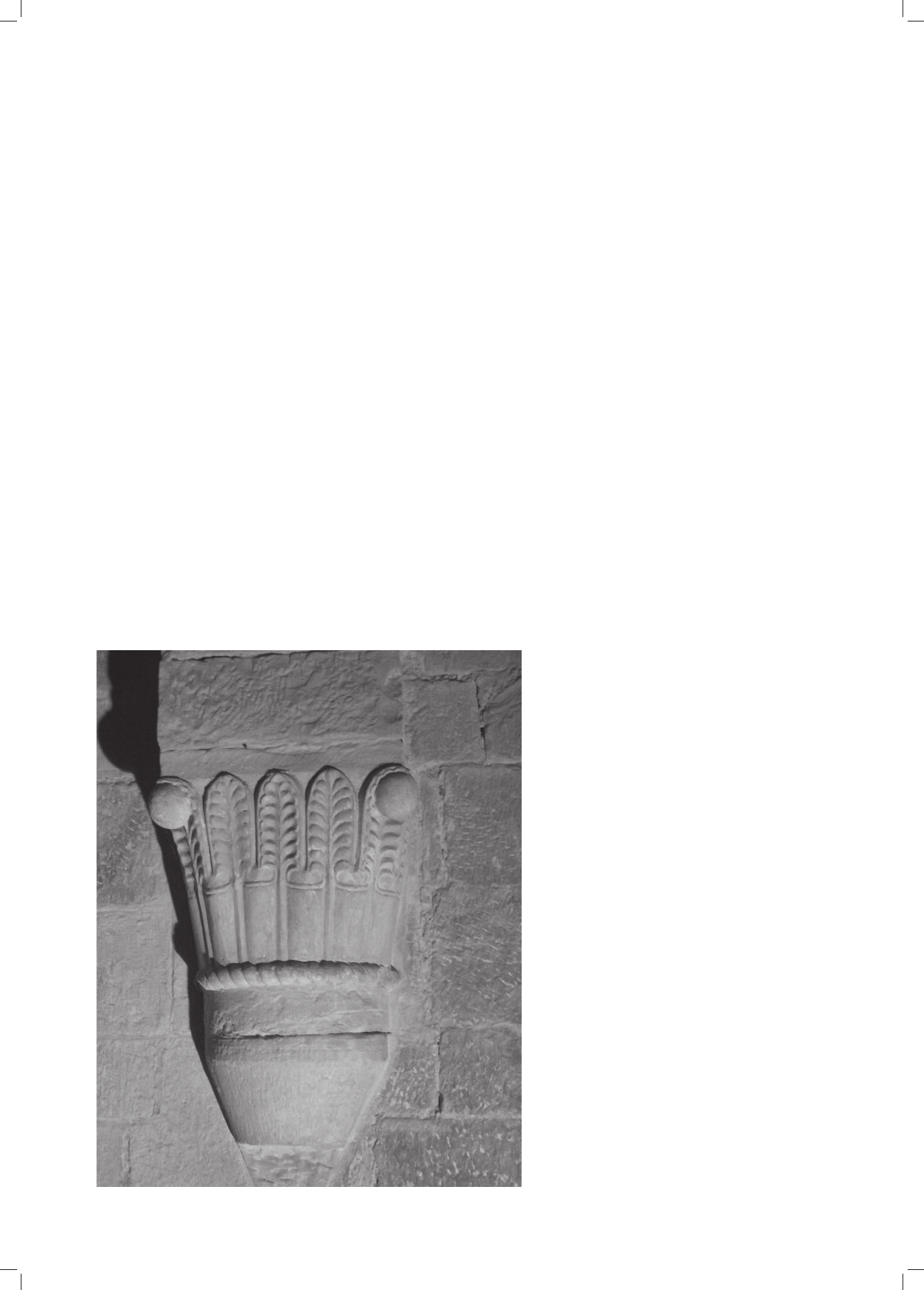
16 Kateřina Charvátová
Opactwo cystersów w Wąchocku,
wspornik w kapitularzu (fot. E. Łużyniecka)
Cistercian Abbey in Wąchock, the cantilever
in the chapterhouse (photo by E. Łużyniecka)