
2024
4(80)
Magdalena Żmudzińska-Nowak*, Assunta Pelliccio**
Lazio Region Paper Mills vs. Upper Silesia Brownfields:
Industrial heritage as a subject of research, projects
and international exchange of experience
DOI: 10.37190/arc240407
Published in open access. CC BY NC ND license
Abstract
The subject of the research is the sites of former paper mills in the Liri river valley in the Lazio region, which represent a valuable cultural heritage
in need of preservation and design intervention, as well as activation involving the authorities, institutions and local communities.
The main objective of the inter-university international collaboration, which started back in 2014, is research and didactic design activities based
on the exchange of experiences and good practices that we have developed in the Upper Silesia region when revitalising post-industrial sites. The
method combines research and design/conceptual work (research by design). The proposed conceptual designs play the role of hypotheses, which are
veried at each stage through consultations and discussions with partners, including experts, decision-makers, facility managers and owners and the
local resident community.
The results of the project, in the form of more than 300 design concepts produced over 10 years with the participation of students from both uni-
versities, formed the basis for a public debate on the industrial heritage of the Lazio region. The projects showed that despite the conditions common
to post-industrial sites, specic conditions play a key role in the revitalisation process, constituting the distinctiveness of individual examples and
their contexts. It is precisely this specicity that is crucial for the proper guidance of the site adaptation process and the success of these activities.
Key words: industrial heritage, revitalisation, Lazio, Upper Silesia
Introduction
The collaboration between the Department of Architec-
ture of the Silesian University of Technology and the Uni-
versity of Cassino and Southern Lazio dates back to 2014
and encompasses various activities, including research,
teaching and popularisation. It is worth noting that this
year we are celebrating the tenth anniversary while the col-
laboration continues to develop.
The genesis was our common fascination with industri-
al heritage. The projects focus on areas and objects of
industrial heritage, which are very numerous in both
regions, i.e., Upper Silesia and Lazio. Just as in the case of
Upper Silesia, where the presence of industry has contrib-
uted to the visual identity of the region since the 19
th
cen-
tury, in Lazio the presence of industry is not exposed and
the industrial heritage has been forgotten.
The rich experience of Upper Silesia in adapting and
revitalising the heritage of post-industrial areas and sites,
and iconic examples such as the “Axis of Culture” at the
former coal mine in Katowice and the historic silver mine
in Tarnowskie Góry – a UNESCO World Heritage Site
– proved extremely attractive to the Italian partners. The
research and design competence and experience in the
revitalisation of post-industrial areas and the sites that the
Silesian University of Technology represents, as well as the
personal involvement of its employees in numerous indus-
trial heritage activities, meant that initial discussions with
representatives of the University of Cassino and Southern
Lazio quickly turned into a long-term and fruitful venture.
This article describes the joint activities, focussing on
the method that links the various projects carried out over
* ORCID: 0000-0002-9323-0272.
Faculty of Architecture of the Si -
le sian University of Technology, Poland, e-mail: magdalena.zmudzinska-
nowak@polsl.pl
** ORCID: 0000-0002-0365-6094. Department of Literature and
Philosophy (DLF), University of Cassino and Southern Lazio, Italy.
66 Magdalena Żmudzińska-Nowak, Assunta Pelliccio
ten years. At the outset, we provide background on the
research area of Southern Lazio and its industrial heritage
and, as a point of reference, selected post-industrial sites of
Upper Silesia.
The collaborative research process followed the model
adopted by the authors, which will be described in detail
later in the text. It consisted of several stages: general
research, comparative analysis, preliminary recommenda-
tions, detailed research and case studies, detailed recom-
mendations and proposals for functional and spatial solu-
tions and the presentation and discussion of the results.
Industrial heritage as a subject of research
Although the subject of industrial heritage research
does not have a very long history, the state of research in
this area is extremely extensive. It includes surveys, re-
source inventories, documentation, a review of preserva-
tion approaches and references for adaptation and mod-
ernisation, as well as assessments of potential opportunities
and threats arising from the revitalisation process. The
substance of post-industrial sites varies in terms of type of
industry, time of construction or state of preservation.
Crucial to the state of knowledge of industrial heritage
on a global scale are the research papers and annual National
Reports published by the International Committee for the
Conservation of Industrial Heritage (TICCIH). They pro-
vide data on the state of eorts to protect and promote
post-industrial sites in dozens of countries around the world.
Another group of publications are studies that shaped
the approach to industrial heritage in their time and which
today constitute the literary canon in this eld. These include
fundamental writings on the issue – such as Binney (1984)
and Eley and Worthington (1984) – guides to the conserva-
tion of industrial heritage, reviews of procedures and theo-
retical assumptions (Douet 2012). In turn, the aspect of
identity preservation in the face of transforming post-indus-
trial areas is extensively discussed by Wicke et al. (2018).
Also, publications that provide an overview of the
achievements of the industrial heritage approach in indi-
vidual countries and regions are very relevant to the state
of research. A synthetic summary of the achievements of
the UK’s leading industrial heritage preservation eorts
can be found in a study by Keith Falconer (2006). The
book by Bart Zwegers (2022) oers a multifaceted synthe-
sis of the transformations of industrial heritage with a focus
on Germany and the UK. Likewise, more than 30 years of
Italy’s experience is described in a publication by Massimo
Preite and Gabriella Maciocco (2022), among others. On
the other hand, the Polish experience, the state of research
and the perspectives and research needs have been exten-
sively analysed by Monika Murzyn-Kupisz, Dominika
Hołuj and Jarosław Działek (2022).
Characteristics of the study area in terms
of industrial heritage: Lazio versus Upper Silesia
Southern Lazio is a region with a signicant hydrogra-
phic basin, which – combined with the innovativeness and
hard work of the local population – led to the ourishing of
industrial activity between the 19
th
century and the 2
nd
half
of the 20
th
century (Arcese et al. 2014). The Liri, Gari, Fi -
breno and Sacco rivers and their various tributaries played
a signicant role in the industrialisation of the region, trans-
forming it from a rural area into one of the most industri-
alised centres in the country. Paper mills, textile factories
and various other industrial facilities, powered by hydraulic
mills, sprang up mainly along the river routes of the Liri
Valley, using water as a source of energy. The water of the
Liri Valley rivers is characterised by low temperatures and
properties that prevent the growth of microorganisms, thus
ensuring very high-quality end products. This important
industrial district of the valley transformed rural towns into
proto-industrial “factory towns” (Pelliccio 2020).
Traditional rural houses were also used for industrial
activities, such as weaving, and even castles or noble pal-
aces were often transformed and expanded to accommo-
date industrial activities, e.g., the Boncompagni Viscogliosi
Castle in Isola del Liri (Jadecola 2019). The cultural land-
scape changed, with small mediaeval historic villages
being transformed into factory towns. Within a few
decades, 15 large wool spinning mills were built in the val-
ley, such as in Polsinelli, Zino, Ciccodicola and Manna, as
well as many other medium and small ones, more or less
mechanised. Numerous paper mills – Bartolomucci in
Picinisco, Visocchi brothers in Atina, Lanni brothers in
Sant’Elia, Courrier, Servillo, and Mazzetti in Isola and
Pelagalli paper mills in Arpino and Ceprano (Monti et al.
2020) – employed hundreds of workers, such as Count
Lefrèbre’s paper mill in Isola del Liri, which managed to
provide employment for more than 500 workers. Emilio
Boimond’s paper mill, located on the banks of the Liri
River in Valdurso, is one of the few mills that has preserved
antique machinery, including the so-called endless machine
introduced in the industrial triangle of Arpino, Sora and
Isola for the production of large sheets of paper (Dell’Ore-
ce
1984; Mancini 2016).
Most of these factories could not withstand the devasta-
tion caused by World War II and the market demand for
technological innovation. They gradually ceased opera-
tions until eventually closing. Today, most of them, many
of which are still privately owned, are completely aban-
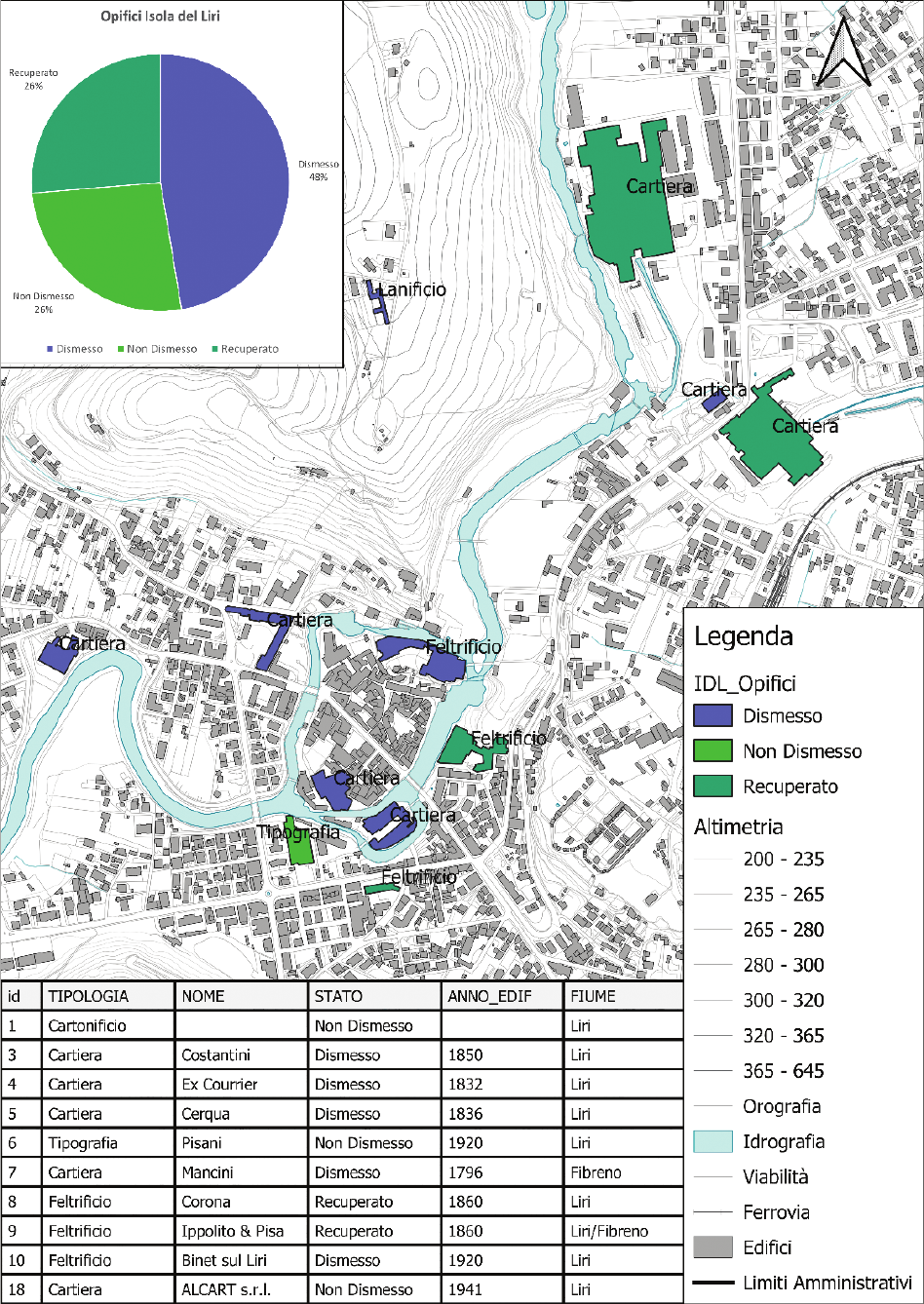
doned. For example, in the small village of Isola del Liri,
once highly industrialised, four large paper mills and three
felt factories are housed on an area of just 0.06 km
2
, all of
which are now abandoned, except for one that has been
converted into a multipurpose building (APAT 2006)
(Fig. 1).
Thus, the industrial identity of the region has been almost
completely obliterated. While the remaining unused facili-
ties still hold signicant cultural and architectural value,
they have not been the subject of wider interest to date.
Upper Silesia is one of Europe’s largest regions of heavy
industry; it developed strongly starting in the 19
th
century’s
great industrialisation. After World War II, the Upper
Silesian Industrial District (GOP) formed the largest min-
ing and metallurgical operations area in Poland and one of
the largest in Europe. More than 50 coal mines, 43 of them
in urban areas, operated on the basis of complexes of his-
torical facilities that were constantly modernised and
Lazio Region Paper Mills vs. Upper Silesia Brownfields 67
Fig. 1. Isola del Liri paper mills’ contemporary condition – GIS (Geographic Information System) representation
(Pelliccio 2020, 142)
Il. 1. Aktualny stan zachowania papierni w Isola del Liri – według danych GIS (Geographic Information System) (Pelliccio 2020, 142)
68 Magdalena Żmudzińska-Nowak, Assunta Pelliccio
expanded. Similarly, the metallurgical industry comprised
25 steel mills, dozens of manufacturing plants, power
plants and rail transportation centres (Jędrysiak 2011).
Poland’s period of transition in the 1990s resulted in
a signicant liquidation of heavy industry, which in Upper
Silesia resulted in a huge number of unused plants and
post-industrial areas. They posed a signicant problem,
and those located in urban centres were especially subject
to arbitrary demolition. This process was slowed down to
some extent when the value of the facilities, their adapta-
tion potential and the fact that they represent the essence of
the uniqueness of the region began to be noticed.
Some sites were adapted for new functions, although
the choice of functions was not always successful, degrad-
ing the modernised structures to varying degrees. Such
examples are the “Silesia City Center” in the area of the
former Gottwald Mine in Katowice or the Platan shopping
centre on the site of the Donnersmarck Steelworks in
Zabrze, which cannot be counted as successful in terms of
the principles of conservation protection, as most of the
historic substance was removed.
Among the good examples of adaptation and use of
post-industrial facilities in Silesia, we nd the New Silesian
Museum on the site of the Katowice coal mine, the Maciej
shaft in Zabrze, the facilities of the Wilson coal mine shaft
in Katowice-Giszowiec and the highly prestigious com-
plex of 28 post-mining facilities of the historic silver and
lead ore mine in Tarnowskie Góry, which in 2017 was
inscribed on the UNESCO World Heritage List (Żmu-
dzińska-Nowak, Radziewicz-Winnicki 2017).
An example of a Silesian city which has been relatively
quick to appreciate its potential for post-industrial monu-
ments, above- and below-ground infrastructure and work-
ers’ buildings is Zabrze. Several sites, such as the Mining
Open-Air Museum and the museum in the buildings of the
former Queen Luisa Mine and Guido Mine, the Key
Hereditary Adit and the historic Water Tower (Carboneum),
have been adapted for touristic and educational purposes.
The city has been included in the European Route of
Industrial Heritage (ERIH).
One of the ways to save post-industrial sites has been
for the Board of the Silesian Voivodeship to create tourist
routes: the Trail of the Beginnings of Metallurgy, the Trail
of Mining History, the Trail of Patronage Estates and the
Trail of Monuments of Technology are some examples.
This form of activity is nancially supported by the voi vo-
deship self-government. The Silesian Industrial Monu-
ments Route has also been included in the prestigious
Euro pean Route of Industrial Heritage (Kaczmarska, Przy-
byłka 2010).
However, there are also many examples of neglected
areas and sites in Upper Silesia where valuable historical
substance is deteriorating or being demolished, such as the
former Gliwice steelworks, the neglected facilities of the
Mikulczyce coal mine in Zabrze and the Szombierki power
plant, which was under threat until recently.
Assumptions and purpose of the study
As the above comparison has shown, both Upper Silesia
and Lazio have an industrial past. Although it is difficult to
compare the scale and type of the Silesian industry with
that found in the Lazio area, both have a significant num-
ber of post-industrial facilities. Upper Silesia, unlike the
Lazio region, already has extensive experience in the revit-
alisation of post-industrial sites and areas, so the research
premise of this collaboration was to exchange experience
in this area.
Therefore, the objective of the project was to develop
recommendations for the revitalisation of brownfield sites
in Lazio on the basis of analyses of selected post-industrial
sites in Silesia. Sample proposals for functional and spatial
concepts for sites in the Lazio region were prepared jointly
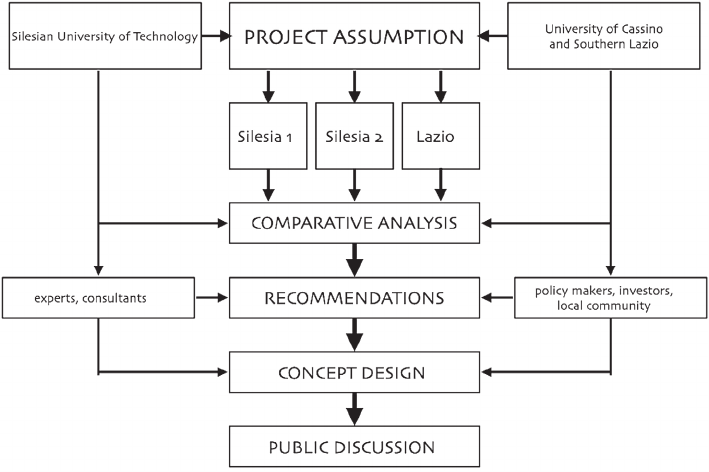
in line with the recommendations (Fig. 2).
There is no doubt that modernising and adapting
post-industrial sites to new purposes, in accordance with
Fig. 2. Research flow diagram
(elaborated by
M. Żmudzińska-Nowak
and A. Pelliccio)
Il. 2. Schemat procesu
badawczego
(oprac. M. Żmudzińska-Nowak
i A. Pelliccio)
Lazio Region Paper Mills vs. Upper Silesia Brownfields 69
conservation guidelines, is an effective way to protect and
revitalise them. The design process was preceded by
a detailed analysis of selected reference sites, i.e., those
sites where modernisation has been successful (or not) can
provide valuable insights for formulating guidelines for
sites awaiting revitalisation.
A list of research questions was also formulated:
– What are the determinants of the revitalisation pro-
cess: historical, social, legal, ownership, economic and
cultural?
– What could be the potential obstacles or facilitators of
this process?
– Which conservation approaches and adaptation meth-
ods are preferred and most effective?
– Which sites can be evaluated as good examples of
revitalisation and which cannot, and what evaluation crite-
ria should be adopted?
Based on the characteristics of the two regions, we pre-
pared the assumptions for the project. The conclusions of the
research made it possible to formulate guidelines. The role of
the working hypotheses was fulfilled by conceptual designs,
which were verified and discussed during the project.
Methods
The research method included three main stages:
1. General research: analysis of post-industrial areas
(Lazio and Silesia); selection of examples and comparative
analysis; conclusions and preliminary recommendations
(Fig. 3).
2. Detailed research: case studies and detailed recom-
mendations – proposals for functional and spatial solu-
tions; the selected working methodology, based on the
“research by design” approach.
3. Presentation of results and public discussion.
General research
The general research focus was on the analysis of the
conditions existing in both study areas (Lazio and Silesia)
in terms of the industrial development process, its pecu-
liarities for both regions and the current condition of the
post-industrial sites. Subsequently, an analysis of the
post-industrial historical substance in both regions was
carried out on the basis of the available literature and
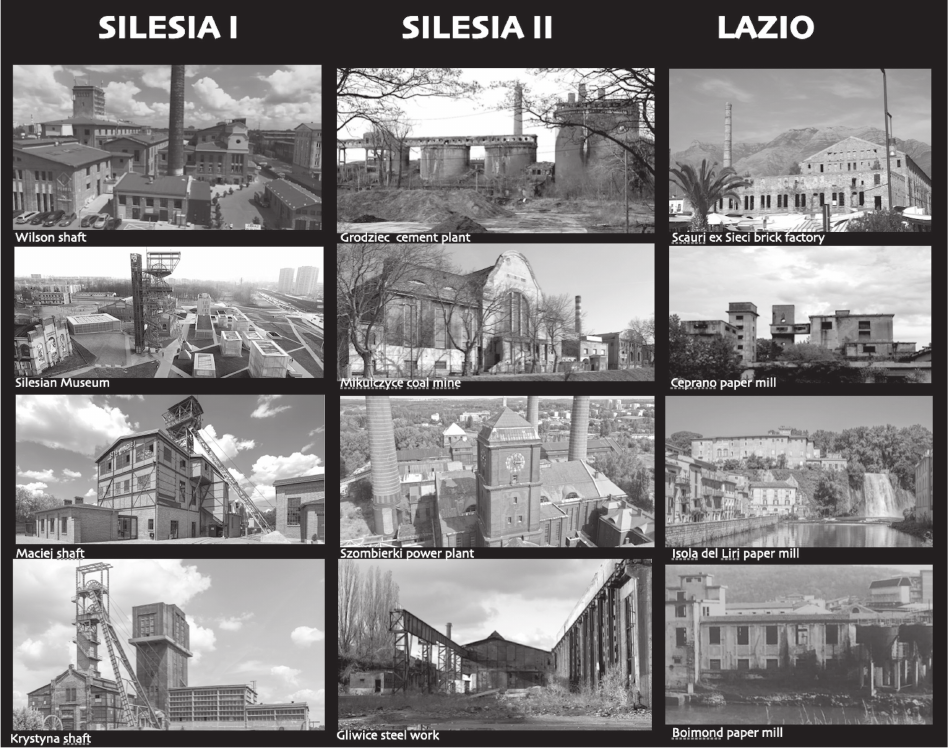
Fig. 3. Comparative analysis
(elaborated by M. Żmudzińska-Nowak and A. Pelliccio)
Il. 3. Analiza porównawcza
(oprac. M. Żmudzińska-Nowak i A. Pelliccio)
70 Magdalena Żmudzińska-Nowak, Assunta Pelliccio
statistical and GIS data. Based on the collected informa-
tion, sites were selected for further comparative analysis.
The comparative analysis included three groups of sites,
two from Silesia (I and II) and one from Lazio. The histor-
ical, economic, legal and social conditions in the three
groups of examples were analysed comparatively.
Additionally, the architectural values, physical condition
and adaptive potential of the sites were also compared.
The following criteria were adopted for the selection of
examples:
Silesia I Group. These are selected sites and post-in-
dustrial areas that have been successfully revitalised, both
in terms of conservation and adaptation to new functions.
The image and economic success of the revitalisation, the
widespread social acceptance of the revitalised site, the
availability of materials for analysis and the possibility of
in situ research were used as selection criteria. Thus, the
selected facilities included the former “Katowice” coal
mine, converted into the Silesian Museum in Katowice,
the Guido and Luiza coal mines as an open-air mining
museum, the Maciej Shaft in Zabrze, the Wilson Shaft in
Katowice, the former Gliwice coal mine as the New
Gliwice economic zone and others.
Silesia II Group. These are selected sites and post-in-
dustrial areas that are undeveloped or degraded or whose
revitalisation is controversial. The following were used as
criteria for selection: a high degree of degradation of the
site or its liquidation and conversion to a new unsuitable
form, an inappropriate conservation approach to revitalisa-
tion or an ill-chosen function destroying the image of the
site. As in the previous group, the availability of materials
for analysis and the possibility of in situ research were
important in the selection. The selected examples included
the degraded area of the former Gliwice steelworks, the
facilities of the Mikulczyce coal mine, the facilities of the
Szombierki power plant, the former wire factory in Gliwice,
the Grodziec cement plant, the facilities of the former
Gottwald coal mine converted into the “Silesia City Center”
shopping centre in Katowice and the former Zabrze steel-
works demolished for the Platan shopping centre.
The Lazio Group. This included abandoned and par-
tially degraded facilities from the Lazio area, such as the
paper mill in Ceprano, paper mills in Isola del Liri, the
former Ex Sieci ceramic factory in Scauri and others.
Detailed research
Detailed studies included detailed analysis, conclusions
and conservation and design guidelines for selected post-in-
dustrial
sites in the Lazio area, as well as the development
of design concepts with respect to their conservation, mod-
ernisation and adaptation for new functions. The sites were
selected from the Lazio list, where they had already been
initially analysed as part of the general research.
Detailed studies of the sites included:
– a
nalysis of documentation: archival records, maps,
architectural documentation, applicable planning and strate-
gic documents and demographic, economic and social data;
– in situ research: site visits, surveys (photographic,
photogrammetry and laser scanning);
– interviews with inhabitants and local experts;
– conservation and design conclusions and guidelines;
– a draft functional and spatial concept for adaptation
and modernisation.
This phase of the project is based on the “research by
design” method, in which an architectural project acts as
a research process during which new hypotheses (Fig. 1),
discussions, conclusions and final proposals are formed. It
is a process of critical thinking using the tools of graphic
notation, idea sketch and variant solutions. Research by
design creates a form of open discourse that makes it dis-
cussable, accessible and useful to others. This form of
research assumes flexibility and variability rather than
definitive results. The method assumes complete harmony
between creative architectural practice and the research
process (of architecture). Therefore, it can be treated as
both basic and applied research. It is a kind of experiment
subject to verification.
We chose this method because it proved very attractive
to both students and project partners.
Presentation of the results and discussion
Presentation of the results and discussion were the final
stage of the project. It consisted of organising exhibitions,
presenting design concepts and holding discussions with
the local municipal authorities, the owner or potential
investor, representatives of the local community and media
participation.
Project flow and results
The implementation of the project involves scientists
affiliated with the two partner universities and graduate
students in the research process. Therefore, the project is
research and didactic in nature and open, which means that
it is not limited by a time frame. Ten years of cooperation
and experience have shown that at any time it is possible to
start a new (parallel) research process based on a prepared
scheme of conduct. Therefore, several project cycles have
been successfully implemented within the framework of
problem-based learning (PBL) works or master’s theses,
and even summer schools. The projects were always car-
ried out under the supervision of researchers from both
partner universities.
The general research made it possible to create a list of
general conclusions indicating the main problems versus
enablers of the revitalisation process, as well as favourable
versus erroneous approaches to adaptation. These served to
verify the research hypothesis. Among other
observations,
the study has found that all the determinants that accompa-
ny the process of revitalising post-industrial sites can be
divided into two types:
– “Hard” determinants, such as legal conditions, eco-
nomic conditions or the physical condition of the site.
– “Soft” determinants, or the values of the site, e.g.,
architectural, cultural, historical or social capital working
for it – local communities or non-government or ga-
nisations. An important conclusion is that while so cial
activity is essential in the revitalisation process as a “fly -
Lazio Region Paper Mills vs. Upper Silesia Brownfields 71
wheel”, it does not have enough power to carry it out on
its own.
The lessons from the analysis of examples can provide
a valuable set of recommendations for undertaking further
revitalisation activities. However, it is not possible to copy
patterns. Therefore, it is not possible to create universal
recommendations, but only certain models of conduct that
are adapted to the local conditions.
At the stage of detailed research, the joint Polish and
Italian partners allowed each other to supplement and
exchange the necessary data. For example, the partners
from the University of Cassino made a lot of materials
helpful for conceptual designs, such as survey measure-
ments of paper mill facilities, photogrammetry of the site
and 3D models.
A very important element of the project’s implementa-
tion and evaluation was the participation of experts directly
related to the sites under development (to include owners,
investors and local authorities) and also the local communi-
ty, which joined the debate on the proposals. Finished con-
ceptual projects for specific post-industrial areas in Lazio
were presented in the form of exhibitions, accompanied by
academic debates at both universities. For example, the
presentations “Lazio–Silesia Brownfields” in Gliwice and
Cassino in 2015, the exhibitions of the project (to which the
University of Pisa was also invited), “Lazio–Tuscany–
Silesia” was held in Gliwice, Cassino and Pisa in 2019 and
the final exhibition, “Lazio Region Paper Mills”, was in
2021 in Gliwice and Isola del Liri, together with a debate
involving the city authorities and residents (Fig. 4).
Summary of the project results
The project described above, initiated in 2014, has been
ongoing for ten years and is constantly being developed. It
consists of a series of activities carried out according to the
presented methodology. The project is a very successful
attempt to conduct research in cooperation with a foreign
partner. The clear definition of the topic, purpose and
scope of the study, as well as the joint implementation of
the study, translated into high-quality individual outcomes.
The project is a valuable experience in terms of both meth-
odology and content. In both these dimensions, it should
be evaluated very positively, given both the significant
scope of the study and the complex process of implemen-
tation, including data acquisition, analysis and verification
of the results, with continuous engagement with the for-
eign partners and the preparation of project concepts.
The methodology of “research by design” develops valu-
able skills of working in international groups, jointly
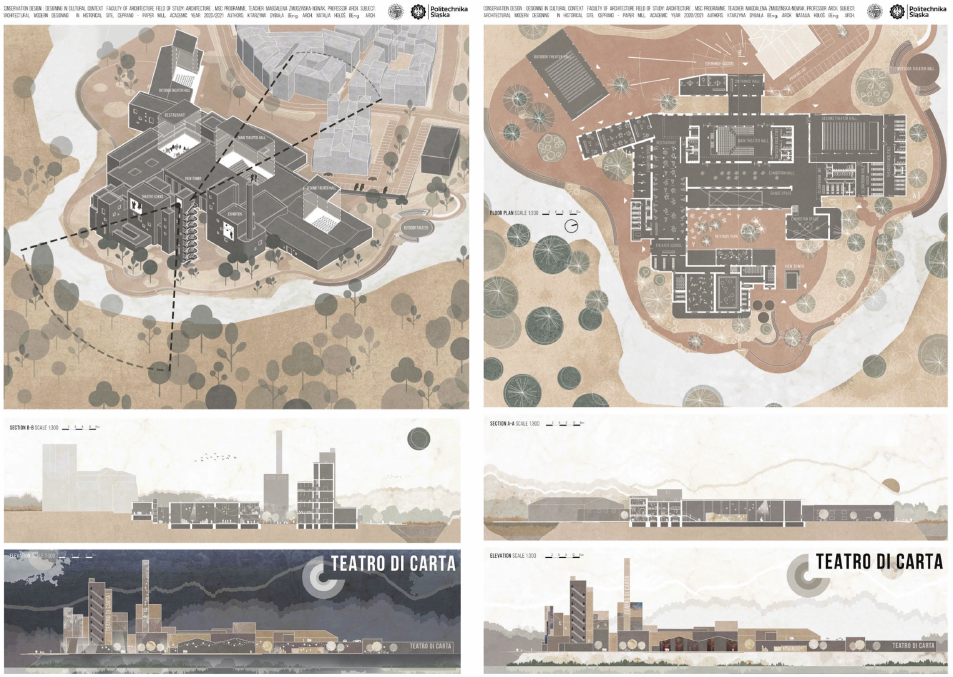
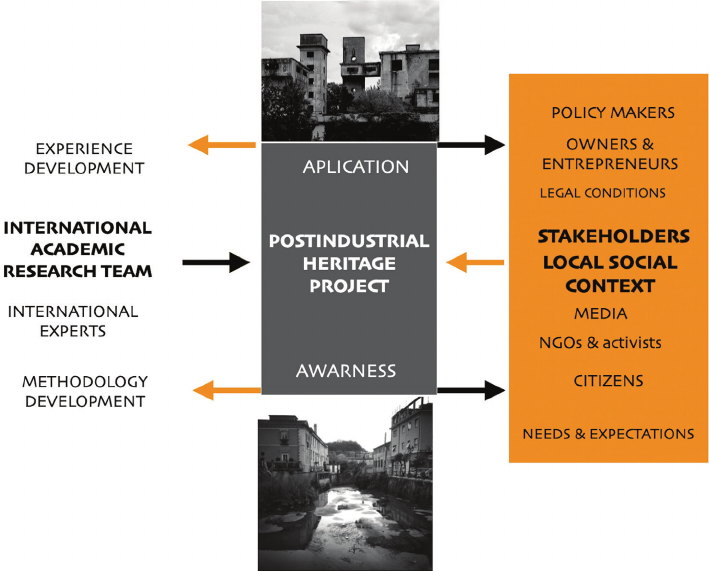
Fig. 4. Example of the students’ concept project: Ceprano Paper Mill “Teatro di Carta”
(elaborated by K. Dybała and N. Hołoś)
Il. 4. Przykład studenckiej koncepcji projektowej papierni w Ceprano: “Teatro di Carta”
(oprac. K. Dybała i N. Hołoś)
72 Magdalena Żmudzińska-Nowak, Assunta Pelliccio
formulating conclusions and presenting the results of the
work. During the ten-year span of the project, we carried
out more than 300 conceptual designs based on research,
with the participation of students.
The research contributed to a better understanding of
the mechanics of the complexity of the conditions and the
revitalisation process of post-industrial areas and sites in
both Silesia and Lazio. The recommendations made it pos-
sible to present valuable design concepts for selected sites
in Lazio. The concepts were highly appreciated during
subsequent presentations and debates. They can provide
practical material for further studies. In addition to proj-
ects, workshops and exhibitions, the cooperation has
resulted in joint scientific publications and monographs
(Pelliccio, Żmudzińska-Nowak 2015; Żmudzińska-Nowak
2019; Żmudzińska-Nowak et al. 2020).
The critical analysis of reference sites from the Silesia
region yielded a number of conclusions which could be
implemented into the Lazio projects, and which were sub-
ject to verification in the course of the work. In addition to
the most obvious ones (described above), there were also
very important threads:
– the special role of industrial sites for preserving the
identity of a place;
– the role of the former industrial function in the revital-
ised sites as an important narrative thread building histori-
cal continuity of the places;
– the role of public awareness and acceptance of trans-
formations at every stage of revitalisation projects;
– inappropriate approaches to a post-industrial site (e.g.,
extreme commercialisation, profound transformations
leading to disintegration of sites) negatively affect not only
the site itself, but also its broader context (Fig. 5).
Despite the differences in the post-industrial substance
resources of Silesia and Lazio, many conclusions are sur-
prisingly convergent.
An important final point to emphasise is that during the
course of the project we have steadily observed an increase
in interest in post-industrial sites in the Lazio area. We are
very pleased that during debates and joint discussions, the
term “post-industrial sites” is being replaced with “indus-
trial heritage”, as it is a record of history with its techno-
logical and spatial processes finding its representation in
the landscape and thus is worth protecting.
Translated by
Magdalena Żmudzińska-Nowak,
Assunta Pelliccio
Fig. 5. Diagram of
the project results
(elaborated by M. Żmudzińska-
Nowak and A. Pelliccio)
Il. 5. Schemat przedstawiający
wyniki projektu
(oprac. M. Żmudzińska-Nowak
i A. Pelliccio)
Lazio Region Paper Mills vs. Upper Silesia Brownfields 73
References
APAT. Report for the Agency for Environmental Protection and Techni-
cal Services, Proposal of guidelines for environmental recovery and
economic valorization of brownfields. I.G.E.R. s.r.l. Editore, 2006.
Arcese, Francesco, Mauro Martini, Pier G. Monti, and Onoriana Ru ggie-
ri. Immaginando Ceprano – Memorie, Mappe e Rappresen ta zioni.
Edizioni Museo Archeologico di Fregellae, 2014.
Binney, Marcus. Our Vanishing Heritage. Arlington Books, 1984.
Dell’Orefice, Anna. L’industria della carta in Italia (1861–1914). Inno-
va zioni tecnologiche e sviluppo industriale. Giannini, 1984.
Douet, James, ed. Industrial Heritage Re-tooled: The TICCIH guide to
in dustrial heritage conservation. Routledge, 2012.
Eley, Peter, and Worthington John. Industrial Rehabilitation: The use of re-
dundant buildings for small enterprises. The Architectural Press, 1984.
Falconer, Keith. “The Industrial Heritage in Britain – the first fifty
years.” La revue pour l’histoire du CNRS 14 (2006): 1–12. https://
doi.org/10.4000/histoire-cnrs.1778.
Jadecola, Constantino. C’era una volta un Castello. Anzi, c’e ancora:
L’anti ca dimora dei Boncompagni ad Isola del Liri. Quaderni della
ferro via della valle del Liri, 2019.
Jędrysiak, Tadeusz. “Turystyka kulturowa w obiektach poprzemysłowych
– zagadnienia ogólne.” Turystyka Kulturowa, no. 6 (2011): 17–35.
Kaczmarska, Anna, and Arkadiusz Przybyłka, “Wykorzystanie potenc-
jału przemysłowego i poprzemysłowego na potrzeby turystyki.
Przykład szlaku zabytków techniki województwa śląskiego.” Prace
Komisji Krajobrazu Kulturowego, no. 14 (2010): 207–28.
Mancini, Stefano. “Le cartiere del Liri.” In Delli Aspetti de Paesi. Vecchi
e nuovi Media per l’Immagine del Paesaggio. Cirice, 2016.
Monti, Pier G., Francesco Arcese, Aldo Cagnacci, Rocco Cassandri, and
Mauro Martini. Storie di Ceprano. Archeologia, ferrovia e me morie
urbane. Il Passo di Ceprano Edizioni, 2020.
Murzyn-Kupisz, Monika, Dominika Hołuj, and Jarosław Działek. Spo-
łeczno-ekonomiczne oddziaływanie dziedzictwa kulturowego. Stan
badań oraz perspektywy i potrzeby badawcze w kontekście polskim.
NID, Uniwersytet Jagielloński, 2022.
Pelliccio, Assunta. I luoghi delle industrie dismesse. GIS & HBIM per la
loro valorizzazione. Edizioni Efesto, 2020.
Pelliccio, Assunta, and Magdalena Żmudzińska-Nowak. “Representation
for the revitalization of brownfields: a comparison between Italian
and Polish experience.” In Disegno & Città. Cultura – Scienza –
Arte – Informazione, edited by Anna Marotta, Giuseppa Novello.
Gan ge mi Editore, 2015.
Preite, Massimo, and Gabriella Maciocco. Rediscovered Factories In du-
strial Heritage and Architectural Project in Italy. Edizioni Effigi,
2022.
Wicke, Christian, Stefan Berger, and Jana Golombek, eds. Industrial
Heritage and Regional Identities. Routledge, 2018.
Zwegers, Bart. Cultural Heritage in Transition: A Multi-Level Per spec-
tive on World Heritage in Germany and the United Kingdom, 1970–
2020. Springer, 2022.
Żmudzińska-Nowak, Magdalena. Local Heritage in the Integrated
Approach
– research, protection, education. Wydawnictwo Po li tech-
niki Śląskiej, 2019.
Żmudzińska-Nowak, Magdalena, Assunta Pelliccio, and Rafał Ra dzie-
wicz-Winnicki. Lazio–Tuscany–Silesia: Heritage Sites in Conser -
vation Perspective. Wydawnictwo Politechniki Śląskiej, 2020.
Żmudzińska-Nowak, Magdalena, and Rafał Radziewicz-Winnicki. About
Industrial Heritage of Tarnowskie Góry Land. Wydawnictwo Poli-
techniki Śląskiej, 2017.
Streszczenie
Dawne papiernie regionu Lacjum vs. poprzemysłowe obiekty Górnego Śląska: dziedzictwo przemysłowe
jako przedmiot badań, projektów oraz międzynarodowej wymiany doświadczeń
Przedmiotem badań są obiekty dawnych papierni w dolinie rzeki Liri, w regionie Lacjum, stanowiące cenne dziedzictwo kulturowe wymagające
interwencji konserwatorskiej i projektowej, a także aktywizacji przy wsparciu władz lokalnych i instytucji społecznych.
Głównym celem międzyuczelnianej współpracy międzynarodowej, rozpoczętej już w 2014 r., są działania badawcze i dydaktyczno-projektowe
oparte na wymianie doświadczeń i dobrych praktyk, które wypracowaliśmy w regionie Górnego Śląska w zakresie rewitalizacji obiektów poprzemy-
słowych. Zastosowana metoda oparta jest na łączeniu badań z pracą projektową – koncepcyjną (research by design). Przygotowywane projekty kon-
cepcyjne spełniają funkcję hipotez, które są weryfikowane na każdym etapie pracy przez konsultacje i dyskusje z partnerami – ekspertami, decydent-
ami, zarządcami i właścicielami obiektów, a także lokalną społecznością mieszkańców.
Rezultaty projektu w postaci ponad 300 koncepcji projektowych wykonanych w ciągu 10 lat z udziałem studentów z obu uczelni stały się podstawą
do debaty publicznej na temat dziedzictwa przemysłowego regionu Lacjum. W ramach projektów wykazano, że mimo występowania uwarunkowań
wspólnych dla obiektów poprzemysłowych kluczową rolę w procesie rewitalizacji odgrywają uwarunkowania szczegółowe stanowiące o specyfice
i odmienności poszczególnych przykładów i ich kontekstów. Właśnie ta specyfika jest kluczowa dla właściwego poprowadzenia procesu adaptacji
obiektu i sukcesu działań.
Słowa kluczowe: dziedzictwo przemysłowe, rewitalizacja, Lacjum, Górny Śląsk