
2024
4(80)
Piotr Marciniak*, Ireneusz Wyczałek**, Zdzisław Pawlak***
Methods for measuring and evaluating deformation
in conservation work on wooden structures:
an interdisciplinary case study
of the parish church in Domachowo
DOI: 10.37190/arc240403
Published in open access. CC BY NC ND license
Abstract
Wooden architecture is not widely represented in the Polish material heritage of culture. An interesting preserved wooden building is the parish
church in Domachowo situated in the south part of the Greater Poland Voivodeship. As a result of numerous alterations and modernizations, it is
currently a composite structure showing obvious signs of damage to the original geometry. For this reason, a project was initiated to measure the
stability of a structure that has been exposed to extreme outdoor forces: mainly gusts of wind and uneven exposure to sunlight. The paper presents
the outcomes of an interdisciplinary study on the stability of the structure of the church. The project required the implementation of two measurement
methods: a static method at xed intervals and a dynamic one with continuously recorded readings during the operation of variable loads.
The paper also describes the methodology of the implemented static-dynamic measurements and interprets the outcomes with a focus on the
precision and stability of long-term readings of inertia sensors, and on the basic evaluation of the structure. The text also looks at the problem of
organizing diagnostic procedures in the process of preparing work on a historic building.
The outcomes conrm that the combination of the two methods and the unconventional use of precision inclinometers for measuring wooden
constructions opens new possibilities for the analysis of the structural deformation in wooden buildings in real-time and, for continuous monitoring
of their technical condition. The dynamic-static method can also be used for analyzing structural displacements not only in wooden churches, but also
in other historic buildings that are exposed to dynamic deformation. The research project and its outcomes have inspired wider reection of the role
of experimental research in diagnosing historic buildings.
Key words: displacement, heritage protection, wooden church, monitoring conditions of structures
Introduction
Polish sacral wooden architecture from the Middle Ages
to the late 14
th
century is a considerably uncharted research
area comprising a whole range of problems. These are re-
lated to the identication of carpentry techniques, structur-
al systems, and architectural solutions, as well as details,
decorations, and interior furnishings (Kornecki 1992, 8).
In Poland, relatively few wooden historic buildings have
survived. The Church of St. Michael the Archangel in
Domachowo in the south of the Greater Poland Voivode-
ship, is an interesting example of a wooden church with
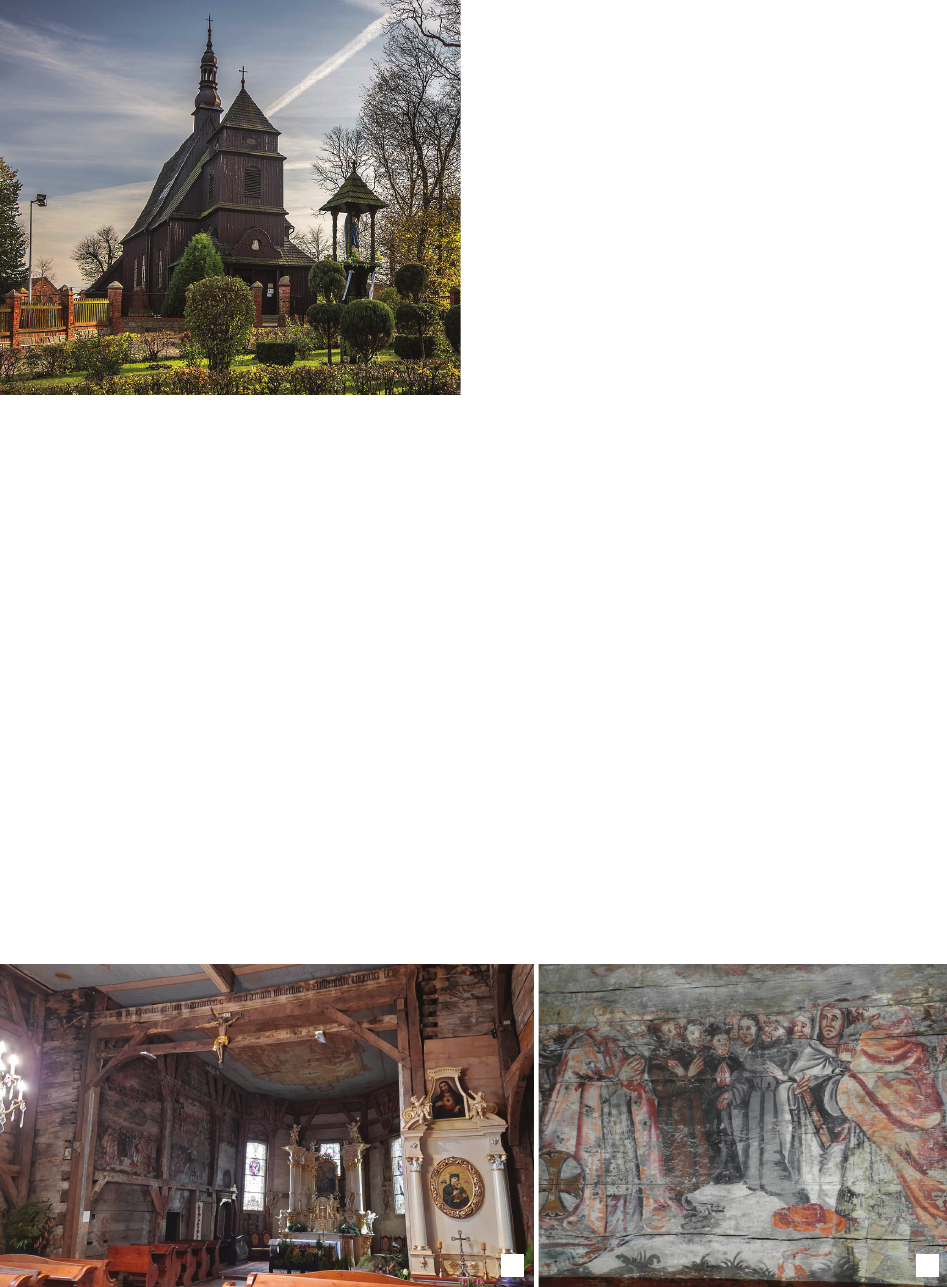
a double-wall structure (Fig. 1). It is an oriented church
of a complex architectural and structural form. Its central
part is a single nave with a narrow, elongated chancel ter-
minating in three sides to the east. The nave consists of
two sections, both on a near square plan, with the west part
slightly narrower than the east one. Adjoining the chancel
to the north, is a sacristy set on a rectangular plan, as well
as a rectangular chapel terminating in three sides to the
south. A rectangular aisle terminating in a vestibule adjoins
the south side of the nave. The entire building on its west
* ORCID: 0000-0002-4404-1184. Institute of Architecture and He-
ritage Protection, Poznan University of Technology, Poland, e-mail: piotr.
marciniak@put.poznan.pl
** ORCID: 0000-0003-3963-8186. Faculty of Civil and Environ-
mental Engineering and Architecture, Bydgoszcz University of Science and
Technology, Poland.
*** ORCID: 0000-0003-2851-3433. Institute of Structural Analysis,
Poznan University of Technology, Poland.
22 Piotr Marciniak, Ireneusz Wyczałek, Zdzisław Pawlak
quoins by half laps with mortice and tenon, which made
it impossible to replace entire single logs. Additional ran-
dom dendrochronological examination also showed that
some of the logs in the chancel and roof framework dated
from the 1360s (1368/1369), and some from the early 16
th
century (1502/1503) (Krąpiec 2020). None of these dates
coincided with the dating proposed in the reference litera-
ture concerning the building to date (Różański et al. 2020).
Later conservation and construction work commencing in
the 1930s, designed by Lucjan Michałowski, contributed
to the church’s nal architectural form (Tej szerska 2023).
Currently the main load-bearing system is a wooden frame-
work connected to oak log walls, which are preserved in the
oldest part of the building, namely in the chancel and the
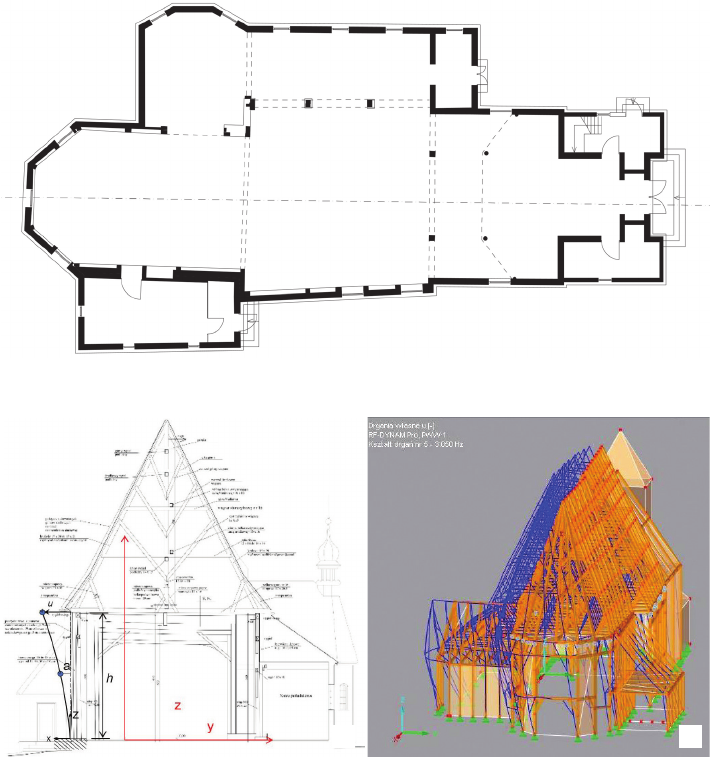
nave (Fig. 3). All these considerations show that the church
in Domachowo is a valuable example of historic wooden
architecture in Poland and requires in-depth observation.
The results of geodetic measurements suggest a signi-
cant tilting of the structure of the church and its elements,
both in the chancel and in the nave. The inclines are of
dierent values, depending on direction. It can be assumed
that the entire structure of the chancel tilts evenly towards
the west by about 16 to 21 cm, and in the transverse direc-
tion the pillars of the north and south walls tilt towards the
interior of the building. According to information from the
1920s concerning the condition of the structure, the build-
ing was already leaning to the west at the time. This is con-
rmed by, for example, windows that were installed under
a dierent angle in relation to the pillars of the load-bear-
ing structure. Moreover, the bases of the wooden columns
were undercut with brick llings (Różański et al. 2020).
Conservation work launched in 2019 revealed a number of
weakened points in the structure (mainly those mentioned
above), as well as joints at the junction of the chancel and
the nave carpentry, notches and nests left by removed ele-
ments, and a number of undercuts or cutouts. Observations
also indicated that the structure was exposed to external
factors, in particular strong wind (Fig. 4).
side is complemented by a square tower with a porch on
the ground oor, as well as two annexes on both sides
(Różański et al. 2020, 177, 178).
During a conservation project between 2019 and 2020,
the church’s inner frame was uncovered to reveal the exis-
tence of paintings on the log structure (Fig. 2). The form
and style of the paintings cast doubt on the previous dating
of the church. The uncovered paintings, which also fea-
tured descriptions of the particular representations, were
made on the log section with timber framing. In the begin-
ning, the authors assumed that the additional framing was
built simultaneously with the formwork during renovation
in 1775 (Jankowski 2009, 193). The discovery led to an
initial examination of both the structural systems. Among
other things, it showed that the logs were connected at the
Fig. 1. Church of St Michael the Archangel in Domachowo
(photo by S. Milejski, source: SM Domachowo…)
Il. 1. Budynek kościoła św. Michała Archanioła w Domachowie
(fot. S. Milejski, źródło: SM Domachowo…)
Fig. 2. Uncovered interior of the church with visible paintings on the wooden structure showing clear figural and ornamental themes:
a) view of the nave towards the chancel (photo by P. Marciniak),
b) figure detail of the paintings in the chancel (source: http://parafia-domachowo.pl/wp-content/uploads/2020/10/SAM_6014.jpg)
Il. 2. Odsłonięte wnętrze kościoła z widocznymi polichromiami na konstrukcji drewnianej, o czytelnych motywach figuralno-ornamentalnych:
a) widok z nawy w kierunku prezbiterium (fot. P. Marciniak),
b) fragment polichromii w prezbiterium (źródło: http://parafia-domachowo.pl/wp-content/uploads/2020/10/SAM_6014.jpg)
a b
Methods for measuring and evaluating deformation in conservation work on wooden structures 23
The main goal of the research project, inspired by the
permanent deformation of the structure system, was to
conduct measurements and analyze the deformation, in ad-
dition to diagnosing the actual condition of the building.
Furthermore, the authors planned to analyze the structure
based on a mathematical model, which made it possible to
identify the weakest structural elements and, subsequently,
to validate the numerical model used to conduct a compar-
ative analysis, and to compare the geodetic measurements
with a dynamic-static analysis of the structure (Pawlak
et al. 2024).
The next objective of the project was to develop a method
for diagnosing historic buildings of complex structure and
problematic technical condition. An important element of
the project was to determine the position of experimental
architectural studies in a complex, interdisciplinary process
related to the conservation and restoration of historic build-
ings. This may be of key importance for the proper orga-
nization of work, their sequence and ultimate schedule.
Current state of research
The research conducted in Domachowo falls within the
broad range of research on the behavior of complex sys-
tems. Its origins are related to identifying damage in wide-
ly understood infrastructures: in aviation systems, and civil
and mechanical engineering. The system is called Structur-
al Health Monitoring (SHM) and is based on identifying
and detecting damage and changes in materials or entire
complex systems. The vast majority of recent SHM proj-
ects have aimed to identify damage in a broad scope of en-
gineering structures (Farrar, Worden 2007). SHM is an au-
tomated process that combines precise data from networks
of sensors with engineering information. The method is
also important in preventive conservation and proper res-
toration of historic buildings. A signicant feature of such
systems is that they provide continuous monitoring of the
observed structures with minimum interference into their
authentic historic fabric (Clementi et al. 2021).
Current trends in the application of SHM in historic
buildings include continuous unattended observation com -
bined with modal analysis procedures using digital mod-
els. In recent years, there has been a large number of proj-
ects implementing the abovementioned methods to assess
the behavior of historic constructions (Gopinath, Rama-
doss 2021). In practice, SHM has been used for long-term
assessments of wall structure behavior (Dal Cin, Russo
2019), for assessments of the general conservation of
buildings (Kilic 2015), and for monitoring their condi-
tion (Lima et al. 2008). This has also included collecting
data for comprehensive evaluations of the behavior of
buildings, including monitoring their dynamic behavior
Fig. 4. Church of St. Michael
the Archangel:
a) diagram of existing
inclinations (elaborated by
P. Marciniak,
b) digital model (elaborated by
Z. Pawlak)
Il. 4. Kościół św. Michała
Archanioła w Domachowie:
a) odchylenia rzeczywiste
– schemat (oprac. P. Marciniak)
b) model cyfrowy
(oprac. Z. Pawlak)
Fig. 3. Ground plan
of the Church of St. Michael
the Archangel in Domachowo
(drawing by J. Jura, A. Rosa)
Il. 3. Rzut przyziemia kościoła
św. Michała Archanioła
w Domachowie
(rys. J. Jura, A. Rosa)
a b

24 Piotr Marciniak, Ireneusz Wyczałek, Zdzisław Pawlak
( Boscato et al. 2016; Anastasi, Lo Re and Ortolani 2009;
Ye, Su and Han 2014; Lorenzoni et al. 2016). The vast ma-
jority of such measurements use integrated sensor systems
that enable a comprehensive assessment of the observed
parameters (Noel, Badway 2017).
During the structural assessment of the church in Doma-
chowo, the authors decided to combine various methods.
Usually, to assess the stability of buildings geodetic meth-
ods are applied, including precision tachymetry (Barsoc-
chi et al. 2021). Such methods enable precise observations
of displacements not only in engineering structures, but
also in historic buildings (Gil et al. 2021; Petrovič et al.
2021). In order to increase the precision and frequency of
measurements, the authors used hybrid solutions that com-
bined tachymetry with a system of remote sensors installed
on the building and in its vicinity.
Description
of the research project
To fully diagnose the physical behavior of and to moni-
tor the building, the authors used a combined measurement
method featuring both static and dynamic measurements
(tachymetry and inclinometers, respectively). Long-term
studies were made monthly comprising three constituents
related to two reference points that were considered stable.
This was conducted using the tachymetric method. Short-
term measurements used one of the typical monitoring
techniques based on inertial tilt sensors (inclinometers).
The authors called this combination the “Dynamic-Static
Method” (DSM), which can be useful for analyses of both
structural displacements of buildings, including wooden
churches, and of other structures that are susceptible to
dynamic deformation (Marciniak, Pawlak and Wyczałek
2023; Pawlak, Wyczałek and Marciniak 2023)
1
.
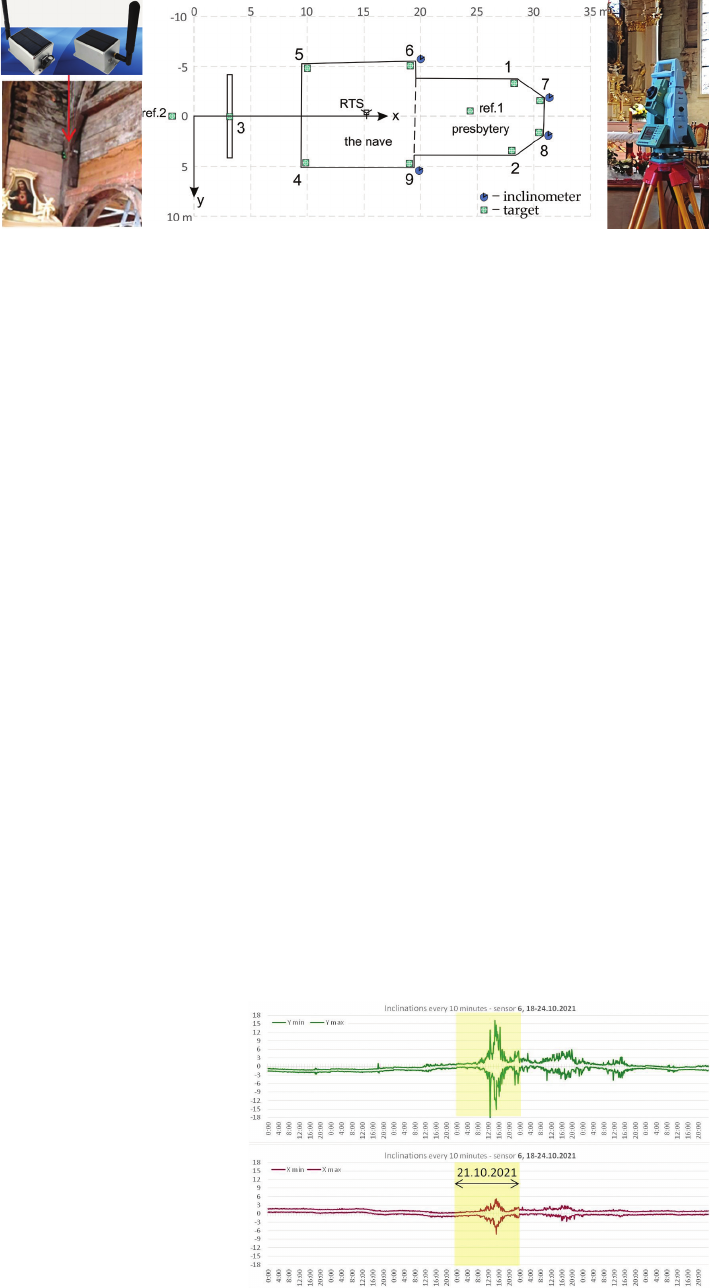
The authors used a measurement grid containing six xed
measurement points and four bi-axial inclinometers. To
con trol the accurateness of the static tachymetric measure-
ments, they set an additional point, and to control the read-
ings of the inclinometers, they installed two additional sen-
sors. To assess both the dynamics and statics of the building
at the examined points, they designed a diagram of com-
plementary measurements using tilt sensors and a weather
station. The thus collected data made it possible to evaluate
the correlation of the tilt readings with the indications of
wind gusts and the temperature on both sides of the church.
The static measurements were made using the tachy-
metric method with a 1-sceond Leica TCRP 1201+ and
reective foil targets. Based on the results of 15 double
series of measurements, discrepancies between the series
in the range of –1 mm to +1 mm were revealed, albeit the
most common values were in the range of ±0.2 mm. This
analysis illustrates the technical and accuracy capabil-
ities of the tachymetric method in evaluating the stabili-
ty of a structure exposed to periodic dynamic pressures.
1
A detailed description of the research and its outcomes were pre-
sented at conferences and in publications which provided the basis for
the present text (Marciniak, Pawlak and Wyczałek 2023; Pawlak, Wy-
czałek and Marciniak 2023; Wyczałek 2022).
The obtained accuracy parameters are consistent with the
results of similar measurements and guarantee accurate
spatial resolution of the stability assessment of the studied
structure. The actual results prove that specic features of
wooden structures, even very old ones, do not undergo per-
manent deformation despite intensive pressures.
Dynamic monitoring requires continuous or quasi con -
tinuous monitoring of vibrations and inclinations or chang-
es in other physical parameters. Earlier studies successfully
used POSITAL FRABA ASG15 inclinometers with wire
data transmission in the CANOPEN standard. In the dis-
cussed case, two such inclinometers were applied to ver-
ify
the readings of a new set of wireless BWSENSING
WF-WM400 inclinometers made using MEMS technolo-
gy. Such sensors can be powered by solar energy or DC
chargers. They can measure inclinations in very high fre-
quency (up to 50 Hz) and then transmit the signals remote-
ly via a Wi-Fi network.
In the basic version, four inclinometers powered from
the power grid were installed on the site. The readings were
collected synchronously every 2 seconds via a local Wi-Fi
server, saved to disc and then remotely downloaded via the
Internet. After an initial test, the authors set the frequency
of recording the readings at every 10 seconds. Based on the
analysis of the observations, the authors concluded that the
records of inclinations in one point changed up to ±15 mm
during intense winds in October 2021, taking into account
the adjustments resulting from the absence of plastic trans-
formations within the investigated structure (Fig. 5).
In order to compare the results of the inclination mea-
surements with the weather conditions, the latter were re-
corded. To do so, a SENCOR 12500 Wi-Fi weather station
was set up near the buildings. This comprised a base with
a thermometer (inside the building) and a set of sensors:
two thermometers, a barometer, an anemometer, and a rain-
fall meter. With access to the Weathercloud website, it was
possible to remotely view the measurements of the station
in a 10-minute cycle. The measured data was also collected
within the same cycle. It was then remotely downloaded to
a *.csv le and subsequently processed and analyzed using
the authors’ own methods and software. Afterwards, this
data was compared to the inclinometer readings.
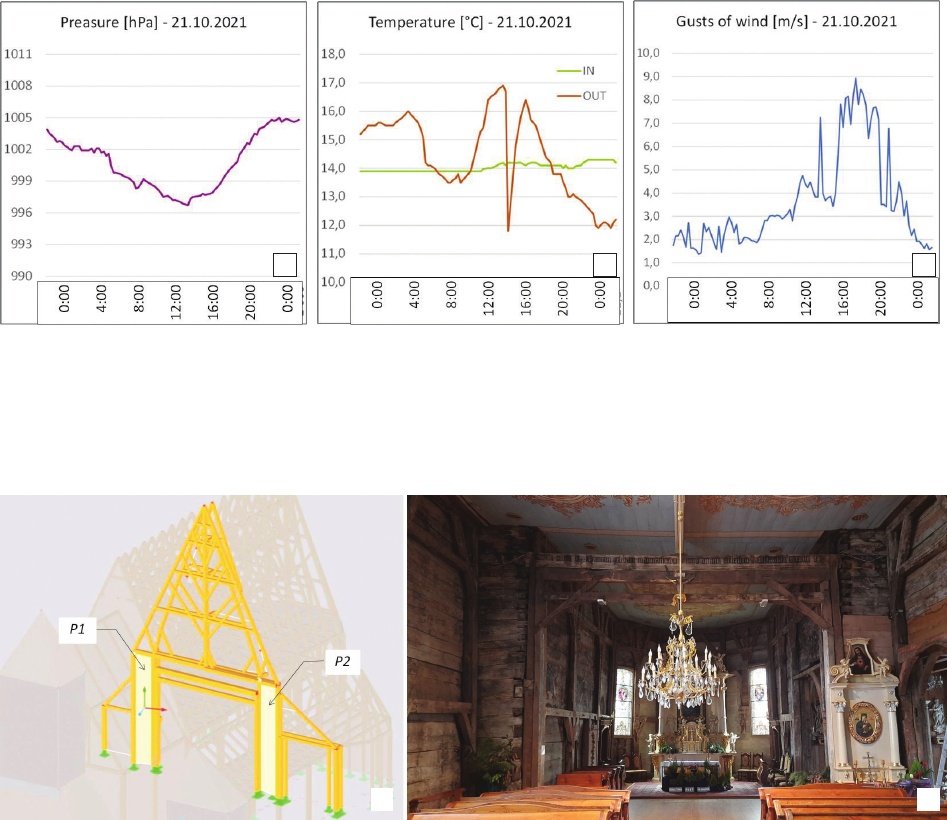
An important issue was to synchronize the data. Due
to the available frequency of the data collected from the
weather station, the authors assumed that all the readings
would be processed into 10-minute cycles for further anal-
ysis. For the purpose of a joint examination of the results,
the authors decided that the results of a single tachymet-
ric reading would be grouped into one-month blocks that
would include readings of the weather conditions, readings
from the four WF/WM400 inclinometers and a maximum
of two readings from the WGS15 control inclinometer for
both axes.
The church in Domachowo was monitored for 24 months
simultaneously with the wide-ranging conservation work
inside the building. Some of the measurements were taken
during a very quiet time in spring and summer, whereas
some in winter when relatively strong gusts of wind had
a signicant impact on the characteristics of the readings.
During the latter period, the authors obtained an interesting
Methods for measuring and evaluating deformation in conservation work on wooden structures 25
set of data which provided a point of departure for further
assessment of the building’s condition and the necessity to
provide protection measures, as required. This disrupted
the order of works, for which the monitoring of the struc-
ture was of key signicance. Figure 6 shows changes in
the displacements across and along the building (axis Y and
axis X, respectively) determined from readings of incli-
nometers situated in the higher part of a pillar in the corner
of the nave, at its junction with the chancel (Fig. 5, point 6).
Earlier experience in combining tachymeters with incli-
nation sensors provided a solid basis for using this type of
solution to measure displacements of the discussed build-
ing. The authors thus obtained an image of its response
to signicant wind pressure and heating from sunlight.
Electronic tachymetry was used for static measurements,
whereas using remote inclinometers provided an image
of the building’s sensitivity in various places to pressures
caused by the weather, in particular by gusts of wind.
With regard to the research on the church in Doma-
chowo, the authors reached the following conclusions:
– due to the considerable pressure of gusts of wind, in
some places the uneven vibrations in the structure of the
building reached ±20 mm; this made it possible to identify
the most sensitive places for the numerical analysis and to
take potential protective measures,
– there were no inclinations caused by changes in heat-
ing from sunlight,
– the results refer to a specic building, however every-
thing points to the conclusion that the methods could, or
even should, be implemented in other historic buildings or
wooden constructions,
– thanks to the implementation of remote data trans-
mission, proven in other monitoring applications, such
research can be supervised on a remote basis, whilst the
participation of a surveyor can be limited to several tachy-
metric measurements.
The monitoring of historic buildings that are susceptib-
le to dynamic deformation is of particular importance. The
aforementioned DSM can be useful for analyzing struc-
tural deformations not only in wooden churches, but also
in other historic buildings that are exposed to this type
of deformation during, for example, vibrations or minor
earthquakes. DSM can also be used in particular applica-
tions of the Internet of Things and in transmitting data in
real-time (Fig. 7).
Based on the results, it is possible to conclude that
wooden constructions, even very old ones, are not sus-
ceptible to permanent deformation, despite intensive pres-
sures. However, it is particularly important to monitor his-
toric buildings that are exposed to dynamic deformations.
The numerical model of the structure conrmed the
measurement results, in addition to identifying a consid-
erable inclination within the structure of the church and its
elements. The authors also conducted comparative analy-
ses to investigate the impact of stiening plates, namely
oors, ceilings and wall cladding on the structure’s static
and dynamic response. The analyses showed that the struc-
ture of the building had insucient lateral rigidity. The
weakest element was the lateral system at the junction of
the nave and the chancel (Fig. 8).
The junction was the point where the greatest lateral
displacement occurred during windy weather, in both the
numerical model and in the actual building. Especially
weakened was the wall on the right side, where the rood
beam connecting the opposite walls was broken. The au-
thors also analyzed the impact of impairments in the struc-
tural elements, as well as the impact of the specic inter-
connections of post branches, on the behavior of the entire
system. In addition, they conducted a dynamic analysis of
the structure during both high and extreme climatic pres-
sure (including strong gusts of wind). The objective of the
dynamic analysis was to validate the calculation model and
to determine if strong gusts of wind caused excess vibra-
tion in the building’s specic elements. In a modal analysis
of part of the structure the authors compared its dynamic
parameters with and without the impairments in the nodes,
Fig. 6. Section of inclinometer readings
with displacements of the wooden structure (18–24.10.2021)
(elaborated by I. Wyczałek)
Il. 6. Wycinek odczytów z inklinometrów
z widocznymi odchyleniami drewnianej konstrukcji (18–24.10.2021)
(oprac. I. Wyczałek)
Fig. 5. Measurement diagram
using a tachymeter
and inclinometers
(elaborated by I. Wyczałek)
Il. 5. Schemat pomiarowy wraz
z wykorzystanym tachimetrem
oraz inklinometrami
(oprac. I. Wyczałek)
26 Piotr Marciniak, Ireneusz Wyczałek, Zdzisław Pawlak
in order to determine the degree of connection between the
examined elements. This, however, is the subject of a sepa-
rate publication (Pawlak et al. 2024).
Prospects and discussion
The unusual application of wireless inclinometers pro-
vided an image of the building’s susceptibility to consid-
erable force caused by weather conditions, mainly gusts of
wind. The Dynamic-Static Method (DSM) can be useful
not only for analyses of structural displacements in wood-
en churches, but also of other historic buildings that are
sensitive to dynamic deformation (Marciniak, Pawlak and
Wyczałek 2023). Using sensors that work in dispersed
networks will make it possible to monitor the most valu-
able historic buildings threatened by external factors (e.g.,
weather, natural disasters, military conicts, etc.). The de-
veloped measurement method of static and oscillating dis-
placements of wooden structures can also be used in stud-
ies of many other types of buildings exposed to variable
loads, including climatic and seismic pressures. Constant
monitoring makes it possible to identify dangerous condi-
tions or emergencies. As already noted, the method can be
used in the practical application of the Internet of Things
(IoT) and in real-time data transmission.
The research project and its outcomes have inspired
further reections on the role of experimental research in
diagnosing historic buildings. The complex process of or-
ganizing conservation and restoration work, as well as the
entire funding process, requires improvement in terms of
both methods and planning. The scope of required docu-
mentation has already been developed by the conservation
environment over many years of practical research and ac-
ademic analyses (Tajchman 1995; Brykowska 2007).
Fig. 8. View of transverse wall at the junction of the nave and the chancel:
a) numeric model o the structure – diagram (elaborated by Z. Pawlak),
b) view towards the interior of the chancel (photo by Z. Pawlak)
Il. 8. Ściana poprzeczna na styku nawy głównej z prezbiterium:
a) numeryczny model konstrukcji – schemat (oprac. Z. Pawlak),
b) widok do wnętrza prezbiterium (fot. Z. Pawlak)
a b
Fig. 7. Recording weather conditions and synchronization of data: parameters of weather station readings on 21 October 2021:
a) pressure, b) air temperature and c) gusts of wind (elaborated by I. Wyczałek)
Il. 7. Rejestracja warunków pogodowych i synchronizacja danych – parametry z odczytów stacji pogodowej wykonanych 21.10.2021 r.:
a) ciśnienie, b) temperatura powietrza, c) porywy wiatru (oprac. I. Wyczałek)
a b c

Methods for measuring and evaluating deformation in conservation work on wooden structures 27
Observations of many years ago concerning the coher-
ence and logical organization of the working process on
historic buildings have lost none of their relevance: The
conservation of a complex or single monument of historic
architecture […] is and should always be a uniform pro-
cess, constituting a whole: from the moment of diagno-
sis, through research, design and implementation, to the
post-implementation documents
(Tajchman 1985, 157). In-
deed, it is crucial to ensure a cohesive and logical conser-
vation process, which arises from […] the need to subject
all the activities to the historic building, and thus to the
main protection objective, which is the survival of earlier
architectural work and to pass it on in its proper form to
the next generations (Tajchman 1985, 157).
The goals of managing a survey process of historic
buildings are and will continue to vary, both from the point
of view of identication (research) practice and imple-
mentation (business) practice. There is no precisely de-
ned methodology of dealing with historic buildings, nor
is there a standard for historic and conservation research.
Such research should become the foundation of all studies
and analyses of cultural property (Kwaśniewski 2019). For
many years, researchers have advocated the development
of cohesive standards for planning work on architectural
heritage. Such voices result from the recommendations
of major conservation documents and doctrine (Tajchman
2008).
The role of experimental research should be clearly spe -
cied. Apart from recognizing the obvious value of diag nos-
tic procedures, they should also be properly programmed
and set in a logical sequence. Based on earlier method-
ological recommendations (Tajchman 2008), it is possible
to propose the organization of pre-project activities for his-
toric buildings as in the table below (Table 1).
Naturally, the dynamics of changes arising from emerg-
ing discoveries may, to an extent, disrupt the process. Still,
proper programming is key to achieving a nal, positive
outcome. In the case of historic buildings, it is crucial to
plan pre-project work in order to ultimately design an op-
timal project in all its phases. Also important is the proper
Table 1. Pre-project work (elaborated by P. Marciniak)
Tabela 1. Prace przedprojektowe (oprac. P. Marciniak)
Scope of competence Scope of activities Formal requirements
Investor, architect/conservator Initial identification of the building in situ – on-site inspections –
Architect Thorough measurement and drawing inventory, including details –
Geologist Geological ground survey (geotechnical opinion, as needed)
Regional conservator’s
approval
Archaeologist
Archaeological survey (as needed), including:
– identification, documentation and securing of the archaeological site;
– geological supervision during work
Regional conservator’s
approval
Architect
Comprehensive historic and architectural study with conclusions
(as needed), including:
– historic study (mandatory);
– analysis of building techniques, including chronological stratification
and valuation;
– diagnostic study of architectural elements;
identification of factors influencing technical conditions
(humidity, temperature, salinity, biological hazards, other);
conclusions and recommendations
Regional conservator’s
approval
(connected with
architectural research)
Structural engineer
– Evaluation of technical condition of the building
(expert’s opinion regarding structure) with conclusions (as needed),
including:
– diagnostic study of structural elements;
– laboratory testing of strength of construction elements;
– other testing in connection with architectural inspection
Regional conservator’s
approval
(connected to
architectural research)
Art conservator
art historian
– Comprehensive conservation analysis of preservation of the historic
material of the building with elements of interior furnishings, including:
– identification of structure and technological properties
(laboratory testing);
– detailed conclusions and conservation recommendations
for the entire building and its spatial arrangement
Regional conservator’s
approval
Architect/conservator
structural engineer
art conservator
archaeologist
art historian
Detailed conclusions and conservation recommendations
(interdisciplinary study)
As arranged
with regional conservator
Art conservator
Conservation work program taking into account previous diagnosis
of technical condition and preservation of the historic building
–
28 Piotr Marciniak, Ireneusz Wyczałek, Zdzisław Pawlak
organization of the funding process, which has a funda-
mental impact on costs and eectiveness. In the entire pro-
cess, the primary role belongs to the architect/conservator,
who should coordinate all the pre-project work and orga-
nize the work of the whole interdisciplinary team of ex-
perts. As shown in Table 1 above, some scopes of activities
may overlap and this requires strict cooperation, in par-
ticular in the architect–conservator–structural engineer–art
conservator team.
Conclusion
Contemporary conservation research on historic build-
ings, especially in the context of unusual situations, mixed-
structure systems exposed to deformation, etc., requires an
unconventional methodological approach that enables the
use of experimental investigation methods. Developing
a methodology of diagnostic procedures for structurally
complex wooden historic buildings in a problematic techni-
cal state creates opportunities for fuller control of their phys-
ical condition. Combining real-time measurements with nu-
merical analysis makes it possible to conduct appropriate
conservation and restoration work (securing and strength-
ening, respectively), whilst preserving the most important
architectural and aesthetical value of such buildings.
In the Polish legal system, there is a considerable short-
age of standards for dealing with historic buildings during
the preparation phase of projects, as well as during the de-
velopment of relevant documentation. In this situation, it is
also important to create a needs scenario to enable the use
of experimental methods. Such methods may play a signif-
icant role in conservation practice providing full control of
the preservation status of buildings.
Departing from established methodological models and
designing surveys tailored to current conservation needs
requires adapting methods to changing conditions. It also
necessitates the cooperation of interdisciplinary teams led
by suitably trained architects/conservators. Today, this is
a signicant shortcoming of the heritage protection system,
which needs to be remedied. In some situations, extended di-
agnostic surveys should also become a mandatory practice.
Translated by
Marta Walkowiak
Acknowledgements
This research was funded by His Excellency Rector of the Poznań Uni-
versity of Technology, grant number: 0112/SIGR/0193. This support is
gratefully acknowledged.
References
Anastasi, Giuseppe, Giuseppe Lo Re, and Marco Ortolani. “WSNs for
Structural Health Monitoring of Historical Buildings.” In 2
nd
Con-
ference on Human System Interactions. IEEE, (May 2009): 574–9.
Boscato, Giosuè, Alessandra Dal Cin, Silvia Ientile, and Salvatore Rus-
so. “Optimized procedures and strategies for the dynamic moni-
toring of historical structures.” Journal of Civil Structural Health
Monitoring 6 (March 2016): 265–89. https://doi.org/10.1007/
s13349-016-0164-9.
Barsocchi, Paolo, Gianni Bartoli, Michele Betti, Maria Girardi, Stefano
Mammolito, Daniele Pellegrini, and Giacomo Zini. “Wireless sen-
sor networks for continuous structural health monitoring of historic
masonry towers.” International Journal of Architectural Heritage
15, no. 1 (2021): 22–44. https://doi.org/10.1080/15583058.2020.1
719229.
Brykowska, Maria. “Dokumentacja naukowa niezbędna dla ochrony
i kon serwacji zabytków architektury.” Roczniki Geomatyki 5, no. 8
(2007): 115–28.
Clementi, Francesco, Antonio Formisano, Gabriele Milani, and Filippo
Uber tini. “Structural health monitoring of architectural heritage:
From the past to the future advances.” International Journal of Ar-
chitectural Heritage 15, no. 1 (2021): 1–4. https://doi.org/10.1080/
15583058.2021.1879499.
Dal Cin, Alessandra, and Salvatore Russo. “Evaluation of static and
dynamic long term structural monitoring for monumental masonry
structure.” Journal of Civil Structural Health Monitoring 9 (2019):
169–92. https://doi.org/10.1007/s13349-019-00324-z.
Farrar, Charles R., and Keith Worden. “An introduction to structural
health monitoring.” Philosophical Transactions of the Royal Soci-
ety A: Mathematical, Physical and Engineering Sciences, no. 365
(2007): 303–15. http://doi.org/10.1098/rsta.2006.1928.
Gil, Enrique, Ángeles Mas, Carlos Lerma, M Eugenia Torner, and Jose
Vercher. “Non-destructive techniques methodologies for the detec-
tion of ancient structures under heritage buildings.” Internation-
al Journal of Architectural Heritage 15, no. 10 (2021): 1457–73.
https://doi.org/10.1080/15583058.2019.1700320.
Gopinath, Vinoth Kanna, and Ragi Ramadoss. “Review on structur-
al health monitoring for restoration of heritage buildings.” Mate-
rials Today: Proceed ings 43, p. 2 (2021): 1534–38. https://doi.
org/10.1016/j.matpr.2020.09.318.
Jankowski, Aleksander. Kościoły drewniane o zdwojonej konstrukcji
ścian w Wielkopolsce. Wydawnictwo Uniwersytetu Kazimierza Wiel -
kiego, 2009.
Kilic, Gokhan. “Using advanced NDT for historic buildings: Towards
an integrated multidisciplinary health assessment strategy.” Jour-
nal of Cultural Heritage 16, no. 4 (2015): 526–35. https://doi.
org/10.1016/j.culher.2014.09.010.
Kornecki, Marian. ”Drewniana architektura sakralna w Polsce: zagad-
nienie typów i form regionalnych w rozwoju historycznym.” Ochro-
na Zabytków 45, no. 1–2(176–177) (1992): 7–39.
Krąpiec, Marek. Wyniki analizy dendrochronologicznej prób drewna
z kościoła pw. Michała Archanioła w Domachowie. Kraków, 2020
[Manuscript in: Paraa pw. św. Michała Archanioła w Domachowie].
Kwaśniewski, Artur. “Why research – how to research. Comments
on the methodology of contemporary historical and architectural
studies and on their application in the adaptation of historic build-
ings.” Architectus 57, no. 1 (2019): 3–20. https://doi.org/10.37190/
arc230110.
Lima, Hugo F., Romeu da Silva Vicente, Rogrio N. Nogueira, Ilda Abe,
Paulo Sérgio de Brito André, Catarina Fernandes, et al. “Structural
health Monitoring of the church of santa casa da Misericórdia of
Aveiro using FBG sensors.” IEEE Sensors Journal 8, no. 7 (2008):
1236–42. https://doi.org/10.1109/JSEN.2008.926177.
Lorenzoni, Filippo, Filippo Casarin, Mauro Caldon, Kleidi Islami, and
Claudio Modena. “Uncertainty quantication in structural health
Methods for measuring and evaluating deformation in conservation work on wooden structures 29
monitoring: Applications on cultural heritage buildings.” Mechan-
ical Systems and Signal Processing 66–67 (2016): 268–81. https://
doi.org/10.1016/j.ymssp.2015.04.032.
Marciniak, Piotr, Zdzisław Pawlak, and Ireneusz Wyczałek. “The Dy-
namic-Static Method (DSM) for Structural Displacement Analy-
sis Using the Example of a Wooden Church in Domachowo (Po-
land).” The International Archives of the Photogrammetry, Remote
Sensing and Spatial Information Sciences, vol. XLVIII-M-2-2023
(2023): 1001–6. https://doi.org/10.5194/isprs-archives-XLVIII-
M -2-2023-1001-2023.
Noel, Adam, Abderrazak Abdaoui, Tarek M. Elfouly, Mohamed Hossam
Ahmed, Ahmed A Badawy, and Mohamed S. Shehata. “Structural
Health Monitoring Using Wireless Sensor Networks: A Comprehen-
sive Survey.” IEEE Communications Surveys & Tutorials 19 (2017):
1403–23. https://doi.org/10.1109/COMST.2017.2691551
Pawlak, Zdzisław M., Ireneusz Wyczałek, and Piotr Marciniak. “Two
Complementary Approaches toward Geodetic Monitoring of a His-
toric Wooden Church to Inspect Its Static and Dynamic Behavior”,
Sensors 23, 8392 (2023). https://doi.org/10.3390/s23208392.
Pawlak, Zdzisław M., Piotr Marciniak, Ireneusz Wyczałek, and Martyna
Żak-Sawiak. “Extended Monitoring as Support in Numerical Mod-
elling of Complex Historical Timber Structure with Respect to its
Weaknesses and Imperfections.” International Journal of Conser-
vation Science 15, no. 3 (2024): 1259–86. https://doi.org/10.36868/
ijcs.2024.03.08.
Petrovič, Dušan, Dejan Grigillo, Mojca Kosmatin Fras, Tilen Urbančič,
and Kozmus Trajkovski. “Geodetic Methods for Documenting and
Modelling Cultural Heritage Objects.” International Journal of Ar-
chitectural Heritage 15, no. 6 (2021): 885–96. https://doi.org/10.10
80/15583058.2019.1683779.
Różański, Artur, Tomasz Jurek, Piotr Marciniak, Patrycja Łobodzińska,
and Urlich Schaaf. “Interdisciplinary Research on Wooden Archi-
tecture in Poland. A Case Study of the Wooden Church in Doma-
chowo.” Archaeologia Historica Polona 28 (2020): 175–97. https://
doi.org/10.12775/AHP.2020.007.
SM Domachowo Kościół św. Michała Archanioła 2017 (8). ID 650491.
jpg. Accessed December 15, 2024, at https://pl.wikipedia.org/wiki/
Ko%C5%9Bci%C3%B3%C5%82_%C5%9Bw._Micha%C5%82a_
Archanio%C5%82a_w_Domachowie#/media/Plik:SM_Doma-
chowo_Ko%C5%9Bci%C3%B3%C5%82_%C5%9Bw_Mi-
cha%C5%82a_Archanio%C5%82a_2017_(8)_ID_650491.jpg.
Szymanowski, Przemysław. Ekspertyza techniczna – I etap dotycząca
stanu technicznego konstrukcji kościoła pw. św. Michała Archanioła
w Domachowie. Kościan, 2020 [Manuscript in: Paraa pw. św. Mi-
chała Archanioła w Domachowie].
Tajchman, Jan. “Badania i prace projektowe w zabytkach architektury
w świetle ogólnej problematyki ochrony i konserwacji zabytków.”
Ochrona Zabytków 38, no. 3–4(150–151) (1985): 157–63.
Tajchman, Jan. “Konserwacja zabytków architektury – uwagi o meto-
dzie.” Ochrona Zabytków 48, no. 2(189) (1995): 150–9.
Tajchman, Jan. “W sprawie konieczności ustanowienia standardów wy-
konywania projektów dotyczących prac planowanych w zabytkach
architektury.” Wiadomości Konserwatorskie, no. 24 (2008): 17–45.
Tejszerska, Anna. “Przebudowa kościoła w Domachowie według projek-
tu Lucjana Michałowskiego jako przykład działań konserwatorskich
z okresu międzywojennego.” Wiadomości Konserwatorskie, no. 74
(2023): 36–50.
Wyczałek, Ireneusz. “Volunteering for the future – Geospatial excellence
for a better living.” In FIG Congress 2022. Warsaw, 11–15 Septem-
ber 2022.
Ye, Xiao-Wei, You-Hua Su, and Jin-Ping Han. “Structural health moni-
toring of civil infrastructure using optical ber sensing technology:
A comprehensive review.” The Scientic World Journal, 652329
(2014). https://doi.org/10.1155/2014/652329.
Streszczenie
Metody pomiaru i oceny deformacji konstrukcji drewnianych w praktyce konserwatorskiej.
Interdyscyplinarne studium przypadku kościoła w Domachowie
Architektura drewniana nie jest szeroko reprezentowana w materialnym dziedzictwie kulturowym Polski. Jednym z interesujących zachowanych
obiektów jest kościół paraalny w Domachowie położonym w południowej Wielkopolsce. W wyniku licznych przeróbek i modernizacji jest to obecnie
konstrukcja złożona, wykazująca wyraźne oznaki uszkodzenia pierwotnej geometrii. Z tego powodu rozpoczęto projekt mający na celu pomiary sta-
bilności konstrukcji narażonej na wpływ ekstremalnych czynników zewnętrznych: głównie podmuchów wiatru i nierównomiernego nasłonecznienia.
W artykule przedstawiono wyniki interdyscyplinarnych badań stateczności konstrukcji tego kościoła. Realizacja projektu wymagała zastosowania
dwóch metod pomiarowych: statycznej w ustalonych odstępach czasu oraz dynamicznej rejestrowanej na bieżąco podczas pracy zmiennych obciążeń.
Zaprezentowano również metodyki prowadzonych pomiarów statyczno-dynamicznych i zinterpretowano uzyskane wyniki, głównie w kontekście
oceny dokładności, stabilności odczytów wieloletnich czujnikami inercyjnymi oraz podstawowej oceny konstrukcji. W tekście podjęto także problem
organizacji badań diagnostycznych w procesie prac przygotowawczych dla zabytku.
Uzyskane wyniki stanowią dowód, że połączenie obu metod oraz niekonwencjonalne zastosowanie precyzyjnych inklinometrów do pomiarów kon-
strukcji drewnianych otwiera nowe możliwości analizy odkształceń konstrukcji w czasie rzeczywistym i bieżącego monitorowania stanu technicznego.
Metoda dynamiczno-statyczna może być przydatna do analizy przemieszczeń konstrukcji nie tylko w kościołach drewnianych, ale także w innych
obiektach zabytkowych podatnych na odkształcenia dynamiczne. Przeprowadzone badania i uzyskane wyniki stały się również przyczynkiem do
szerszej reeksji dotyczącej ich roli i miejsca badań eksperymentalnych w rozpoznaniu zabytku.
Słowa kluczowe: przemieszczenia, ochrona zabytków, kościół drewniany, monitorowanie stanu konstrukcji