
2025
4(84)
Przemysław Andrzej Stobiecki*
Mobile vertical photovoltaic system
DOI: 10.37190/arc250414
Published in open access. CC BY NC ND license
Abstract
The aim of the article is to present an original alternative technical solution enabling the multiplication of solar energy receiving stations processed by
photovoltaic panels or solar collectors, with minimal involvement of the plot or roof area intended for this purpose. The new proposal makes it possible
to use and arrange solar energy panels not only in a way that absorbs the surface of the plot for panel development as little as possible, but at the same
time in an aesthetic and optimal way by using the structure of movable panels placed in a specic order. The proposed technical solution presented by the
author allows the panels to track the movement of the Sun in the sky at dierent latitudes in dierent seasons of the year, which is of particular importance
in the temperate zone. The proposed solution will also enable the possible cooling of photovoltaic panels, with the forced air movement of installations
operated in conditions of extremely high temperatures during summer days. The technical solution is to be a cheap alternative to the existing solutions that
absorb costs, space, and prevent proper maintenance and upkeep of above-ground or roof installations. Thanks to it, it will be possible to further increase
the eciency of modern installations drawing energy from sunlight. In order to validate the designed solution, the dependence of the inclination of the
selected photovoltaic panel in relation to the Sun and its power was tested.
Key words: photovoltaics, solar panels, two-axis solar tracker, moderate zone, municipal installations
Introduction
The Sun is a gigantic thermonuclear reactor. It is of course
a trivial simplication and unfair pigeonholing of a gor-
geous space phenomenon which is the Sun and the planets
circling around it. We owe our life to this star. Similarly, all
the energy comes from it. In the past and today, it was pro-
duced from minerals, and all forms of renewable energy ob-
tained come from solar energy – it was trapped millions of
years ago indirectly, in various forms, such as coal or hydro-
carbons from the prehistoric world of plants and animals.
Trapped solar energy can be obtained on ad hoc basis
from fuels processed from plants that are currently living
and cultivated. Energy sources can come from the sun’s en-
ergy transferred to water and atmospheric air, manifesting
in the form of sea currents and tides, river water ow, and
wind. Finally, since the 2
nd
half of the 20
th
century, it can be
obtained directly from solar heat and light radiation. This
is the purest and simplest form of solar energy – the plant
world has been using it since the dawn of life on Earth. In
the 20
th
century, attempts were also made to use geothermal
and nuclear energy. Work is also underway to ignite a local
energy source: a “miniature sun” trapped in a thermonuclear
reactor. However, the use of the latter three sources is still
associated with technological shortcomings, risks caused
by the unreliability of modern technologies, and extreme-
ly costly environmental consequences of possible failures.
Today, electricity is the most ecient carrier of energy. And
photovoltaics is the most interesting and cleanest option for
obtaining it directly from the sunlight.
Current state of the development
of solar power engineering
Over the last 10 years, we have seen steady development
in photovoltaic cells (often referred to using the PV abbre-
viation). They are no longer a scientic curiosity used in
space exploration research programs and are becoming in-
creasingly popular as components of terrestrial solar power
plants. In small formats, they are used as a tourist, cheap,
and increasingly ecient source of electricity during va-
cation trips through the wilderness. They are also used in
* ORCID:
0000-0002-1767-8737. Faculty of Architecture, Wrocław
University of Science and Technology, Poland, e-mail: przemyslaw.stobiecki
@
pwr.edu.pl
146
Przemysław Andrzej Stobiecki
households. Photovoltaic cells are produced in increasingly
larger numbers in handy kits and modules installed on the
roofs of single family homes, set up in orchards and gardens.
More and more often they are incorporated in the national
energy network. They are slowly appearing in larger cities
as roof installations or as a source of energy for individual
street lamps, electronic measuring devices, and electronic
municipal equipment.
Cells are still being developed and are becoming increas-
ingly ecient. Currently, cells with eciencies above 40%
are already in use; these that are industrially manufactured
and popular have the eciency of around 20%. Research is
also being conducted on polymer and organic cells or the
cells with structures similar to the mineral ones called per-
ovskites (“Wikipedia: Ogniwo słoneczne” 2024). Solutions
in the form of double-sided cells using reected and dif-
fracted light are also being used (Szymański 2023).
In order to increase the eciency of the systems, the
programs tracking the Sun’s movement across the sky and
rotate the photovoltaic panels are also being developed to
get the optimal position for harvesting solar energy through-
out the year. Mechanical devices called solar trackers which
rotate the panels on one or two axes constitute additional
equipment for solar panel systems but due to the addition-
al costs associated they are not very popular. Their man-
ufacturers report an expected increase in energy yields on
an annual basis. Single-axis solar tracker – an installation
moving along a single axis, vertical or horizontal – accord-
ing to manufacturers’ data, provides up to 20–30% high-
er yields than those recorded for stationary photovoltaics.
dual-axis solar tracker allows photovoltaic panels to move
in two axes, horizontal and vertical, which makes it much
easier to position them perpendicularly to the axis of the
sunlight. The greater range of movement means that energy
production can be increased by up to approximately 40%
compared to a traditional, static structure (Biernaciak 2024).
The development of photovoltaic cell technology should
be accompanied by the simultaneous development of the
most appropriate methods of exposing them to the sunlight.
Panel rotation systems should be popularized and their de-
sign modied in order to reduce costs continuously.
State of research
The latest publications in the international specialist liter-
ature on solar energy harvesting focus on the properties and
eciency of photovoltaic panels themselves, as well as their
construction and chemical composition (Zobaa, Bansal 2011)
and electrical instrumentation (Szymański 2023; Zobaa,
Bansal 2011; Luque, Hegedus 2011; Dubey, Sarvaiya, and
Seshadri 2013). They also discuss alternative ways of ob-
taining energy from the sun (Prinsloo, Dobson 2015). They
describe the optimal exposure conditions for solar energy de-
vices, building on previously acquired knowledge and veri-
fying long-term experience in the operation of solar farms.
A review of several well-known publications from inter-
national literature and online sources leads to the following
conclusion: while we are seeing the progress in the devel-
opment of increasingly ecient and durable photovoltaic
cells, there is virtually no progress in terms of methods of
exposing them to the sunlight and the results achieved so far
seem to be generally satisfying. In this situation, it is neces-
sary to propose renewed attempts to develop systems for ex-
posing photovoltaic panels to the Sun in order to reduce their
costs and increase the eciency of the installations used.
Below there is a brief overview of selected current biblio-
graphic items on renewable energy sources (hereinafter: RES).
They present advanced solar technologies, state-of- the-art
achie vements driving solar innovation and techniques for op-
ti mizing the eciency and eectiveness of energy harvesting.
In the publication by the Częstochowa University of Tech -
nology, Kierunki i perspektywy rozwoju odnawialnych źró
deł energii. Wybrane aspekty [Directions and Prospects for
the Development of Renewable Energy Sources. Selected
Aspects] (Gawlak 2022), it was pointed out that it was the
European Union’s consistent policy on curbing adverse cli -
mate changes related to carbon dioxide emissions that forced
member states to take various measures, including the devel-
opment of the renewable energy sector. The current geopo-
litical situation is causing raw material prices to rise sharply
and energy independence is becoming a key ob jective for
Europe. There is no doubt that renewable ener gy sources
play a key role in this energy transition. Eco-energy solu-
tions guarantee zero carbon dioxide emissions which is usu-
ally seen as the main advantage of renewable energy. Cur-
rently, energy-importing countries attach great importance
to locally sourced renewable energy.
Among the new publications addressing the issue of re-
newable energy sources and their development in Poland, an
important place is occupied by a unique publication devoted
to technical and organizational issues related to photovolta-
ic installations, including descriptions of their potential uses
and integration into the country’s power system: Instalacje
fotowoltaiczne w systemie elektroenergetycznym [Photovol-
taic Installations in the Power System] (Piątek, Hanzelka
2023). It focuses on the problems of photovoltaic (PV) in-
stallations working with the power grid, especially on the
impact of these sources on the quality of electricity supply
in power systems. The theoretical basis for the operation of
both solar installations (PV cells, inverters) and the issue
of connecting PV installations to the distribution network
were also discussed. The technical conditions for connect-
ing PV installations in Poland and abroad were compared
and the principles of forecasting energy generation by solar
power plants were explained. The book contains numerous
examples and references to the practical use of renewable
energy sources. In addition, the appendix presents a sample
functional and utility program for a 500 kW PV installation.
Similar issues are discussed in a more recent publica-
tion: Podstawy elektroenergetyki [Fundamentals of Electri-
cal Power Engineering] (Kacejko, Pijarski 2024), which is
a compendium of electrical power engineering knowledge
with a particular focus on photovoltaics and wind energy. It
also describes important issues related to the energy transi-
tion and electrical power security in Poland. The paragraphs
devoted to the basics of protection automation and the con-
trol and management of power systems, as well as the qual-
ity of the electricity obtained are noteworthy. Examples of
computer software currently used in the power industry are
cited and described here.
Mobile vertical photovoltaic system 147
The book Designing and Installing Solar PV Systems
(Warm ke 2022) is a guide to designing commercial installa-
tions and large residential solar systems – at an advanced lev-
el. It extends the knowledge of photovoltaic installations in
homes to the eld of commercial project installations. It also
addresses project management issues. The guide has been up-
dated in accordance with the changes introduced in NFPA 70:
National Electrical Code 2020, binding in the United States.
In turn, the publication Fundamentals of Solar Cells and
Photovoltaic Systems Engineering (Victoria 2024) covers all
topics relevant to understanding of photovoltaic technology,
including: the principles of solar cell operation, modelling
and measurement of solar radiation, the manufacturing pro-
cesses of solar cells and photovoltaic modules, the design
and operation of rooftop installations and large-scale power
plants, the economics of such systems, and the role of photo-
voltaic solar energy in the ongoing energy transition. It also
examines innovative PV system designs, including agrivol-
taics and energy communities based on PV installa tions on
shared roofs. This outstanding publication is intend ed to
serve as a guide and handbook on photovoltaic solar energy
and is addressed to engineers and engineering students at
university level in Spain and around the world.
Solar Energy (Botwright 2024), a book promoting the use
of solar energy, addresses extremely important issues related
to photovoltaics in several chapters. It is an ideal starting
point for anyone ready to use renewable energy, as well as
for those who want to minimize costs and reduce their car-
bon footprint.
Inspirations from the world of plants
When it comes to industrial energy harvesting from sun-
light, it is worth emulating the solutions tested and invented by
the plant world, which draws its life energy from photosynthe-
sis – this is undoubtedly the most eective solution possible.
In the world of plants originating from temperate zones
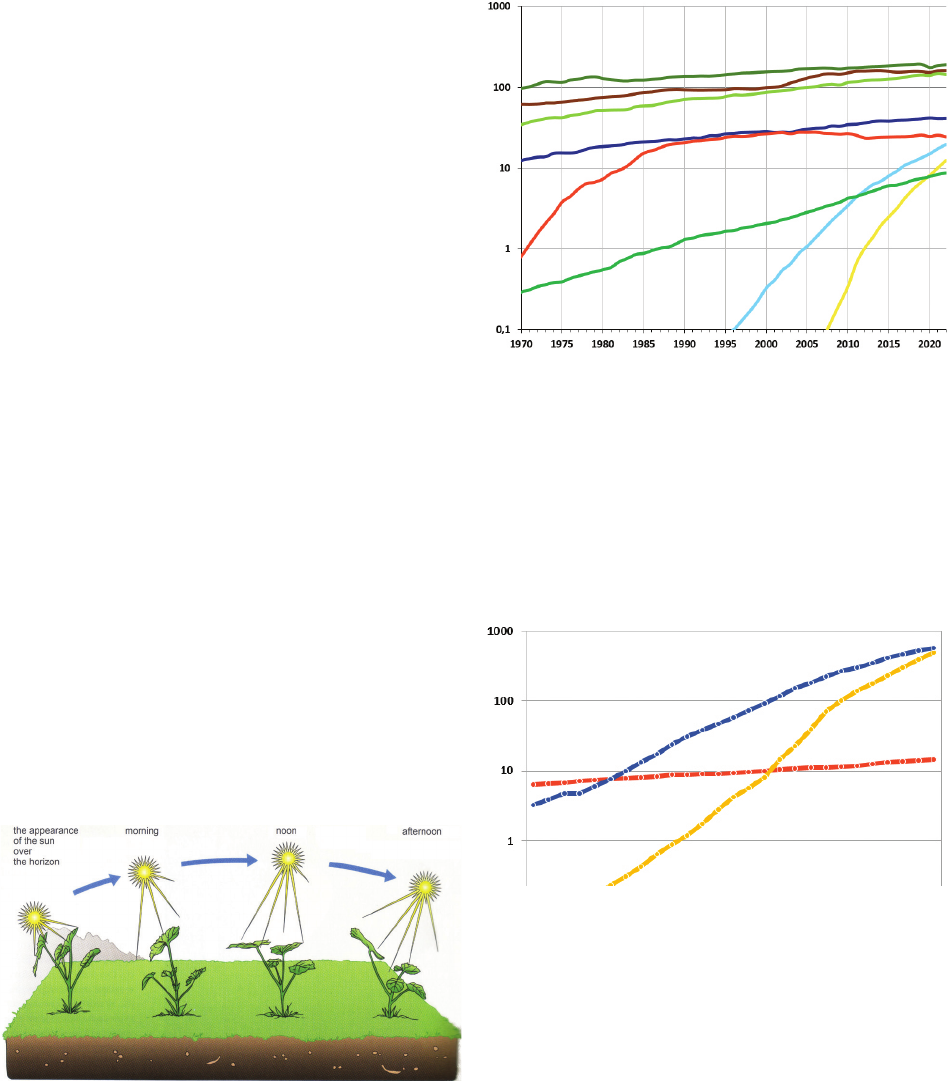
(e.g., sunowers, soybeans, cotton), heliotropism is a pop-
ular ability is (Fig. 1), it is sometimes called sun tracking
– the ability of leaves or owers to change their orientation
in response to the Sun’s position. Often, plant’s leaves po-
sition themselves so that the sun’s rays fall perpendicularly
on them, regardless of the time of the day, which increases
the absorption of sunlight energy.
Fig. 1. Plant heliotropism (Salomon, Berg, and Martin 2007, 696)
Il. 1. Heliotropizm roślin (Salomon, Berg i Martin 2007, 696)
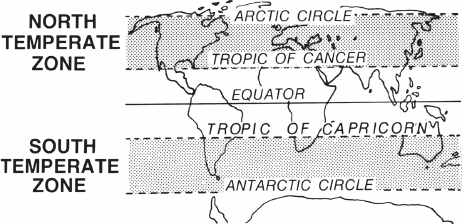
Fig. 2. Energy [Mtoe] obtained from various sources worldwide
between 1970 and 2022. Logarithmic scale
(source: Wikimedia Foundation. “Wikipedia: Odnawialne źródła energii.”
Accessed September 13, 2024, https://pl.wikipedia.org/wiki/
Odnawialne_%C5%BAr%C3%B3d%C5%82a_energii#cite_note-bp19-7)
Il. 2. Energia [Mtoe] uzyskana z różnych źródeł na świecie
w latach 1970–2022. Skala logarytmiczna
(źródło: Wikimedia Foundation. “Wikipedia: Odnawialne źródła energii.”
Dostęp 13 września 2024, https://pl.wikipedia.org/wiki/
Odnawialne_%C5%BAr%C3%B3d%C5%82a_energii#cite_note-bp19-7)
Crude oil
Nuclear energy
Remaining preventable: bio-fuels,
geothermal energy and other
Hydropower
Natural gas
Coal
Wind energy
Sun energy
Fig. 3. Capacity [GW] of wind (blue), solar (yellow)
and geothermal (red) wind farms in the world in 1992–2018.
Logarithmic scale (source: Wikimedia Foundation.
“Wikipedia: Odnawialne źródła energii.” Accessed September 13, 2024,
https://pl.wikipedia.org/wiki/
Odnawialne_%C5%BAr%C3%B3d%C5%82a_energii#cite_note-bp19-7)
Il. 3. Moc [GW] elektrowni wiatrowych (niebieski),
słonecznych (żółty) i geotermalnych (czerwony) na świecie
w latach 1992–2018. Skala logarytmiczna
(źródło: Wikimedia Foundation. “Wikipedia: Odnawialne źródła energii.”
Dostęp 13 września 2024, https://pl.wikipedia.org/wiki/
Odnawialne_%C5%BAr%C3%B3d%C5%82a_energii#cite_note-bp19-7)
Designing the ways of photovoltaic panels exposition we
should be inspired by the solutions from the world of nature.
Development of power engineering in recent years
The statistical data showing the actual degree of utiliza-
tion of solar photovoltaic cells in the global energy balance
are worth reviewing. The charts below allow you to assess
possible trends in the development of modern energy sourc-
es in the coming years (Figs. 2, 3).
148
Przemysław Andrzej Stobiecki
consists of over 150,000 Jinko Solar polycrystalline mod-
ules with a maximum eciency of 20.13%. The cables have
a total length of 900 km. The farm’s annual eciency is
68 GWh, which corresponds to the annual electricity con-
sum ption of approximately 22,500 average households in
Po land. Currently, the Witnica solar farm belongs to the Irish
c
ompany Alternus Energy Group.
PV powerplant in Wielbark
In October 2022, the construction of a 62 MW photovol-
taic farm located near Wielbark (Warmian-Masurian Voi vo-
deship) was completed. It will supply energy to over 30,000
households. Approximately, it consists of a total of 140,000
panels with a unit capacity of up to 530 W. The installations
are operated by 337 inverters. The construction of the farm
required 56 permits and the use of almost 2,500 tons of
steel. The farm was built on an area of 119 ha, mainly low-
grade arable land. The project was implemented by Ener-
ga Wytwarzanie, a subsidiary of Energa from the ORLEN
Group. Wielbark solar farm began operating at full capac-
ity in the rst quarter of 2023. There are plans to expand it
with additional transformer stations, increasing its connec-
tion capacity and enabling the safe reception of the energy
generated. At an earlier stage of the investment in the farm,
commercial production was carried out using 12 MW panels
connected to the transmission grid.
PV powerplant in Stepień
In October 2022, the construction of a 58 MW photo-
voltaic farm in Stępień (Warmian-Masurian Voivodeship)
was completed. The investment was carried out and will be
managed by Wento, a company owned by Equinor (former-
ly Statoil). The solar farm consists of 100,000 solar panels
spread over an area of 65 ha. It will produce 61 GWh of
energy per year, which corresponds to the demand of ap-
proximately 31,000 Polish households.
PV powerplant in Czerników
The solar power plant in Czerników near Toruń has an
installed capacity of 3.77 MW. The PV power plant covers
an area of approx. 7.7 ha. The installation consists of nearly
16,000 panels, with the capacity of 240 W each, covering
an area of over 22,500 m
2
, which corresponds to the size
of several football elds. The annual electricity production
in Czerników is estimated at 3,500 MWh, which is su-
cient to meet the needs of approx. 1,600 households. The
power plant has a container transformer station consisting
of a low-voltage switchgear, a transformer chamber, and
a medium-voltage switchgear with a control room and an
underground cable connection to the 15 kV MV line.
Sun powerplant in Bierutów
The solar farm in Bierutów (Lower Silesian Voivode-
ship) was built in the second half of 2018. Its installed ca-
pacity is 2.059 MW. The installation consists of 7,920 pho-
tovoltaic panels, with a capacity of 260 Weach. The owner
Mtoe is a megaton of oil equivalent, toe is the energy
equivalent of one metric ton of crude oil with a caloric value
of 10,000 kcal/kg. This unit is used in the energy sector to
describe large amounts of energy (“Wikipedia: Ton of oil
equivalent”).
The charts from recent years show the most dynamic
growth in solar energy sources.
The state of photovoltaic solar power engineering
in Poland
The installed capacity of photovoltaics in Poland at the
end of September 2022 amounted to over 11 GW (Urząd
Regulacji Energetyki 2024). On April 30, 2024, the Presi-
dent of the Energy Regulatory Oce published an annual
report on electricity generation in small renewable ener-
gy installations in 2023. According to the report, approx.
3.5 GW was obtained from so-called small photovoltaic
installations (Energy Regulatory Oce). Currently, photo-
voltaics in Poland accounts for more than half of the total
installed capacity of renewable energy sources. The exam-
ples of some of the largest Polish photovoltaic farms are
presented below (Urząd Regulacji Energetyki 2024).
PV Sun farm in Zwartowo
The power plant in Zwartowo (West Pomeranian Voi-
vodeship is the largest solar farm in Poland. Its capacity
is 204 MW. It is also the largest solar installation in Cen-
tral-Eastern Europe. The farm covers the area of 300 ha
(equivalent to 422 full-size soccer elds). It was built by
Respect Energy S.A. in cooperation with the German com-
pany Goldbeck Solar. The rst stage of the farm, with a ca-
pacity of 204 MW, was completed in September 2022. The
planned second stage aims to increase the total capacity to
290 MWp, which will allow the farm to maintain its leading
position. The Zwartowo farm will produce approximately
230 GWh of green energy per year. This will power 153,000
households – the total number of households in Gdańsk.
PV powerplant in Brudzewo
The Brudzewo power plant (Wielkopolskie Voivodeship)
with a capacity of 70 MW was built by the ESOLEO consor-
tium for the ZE PAK group. The construction was complet-
ed in October 2021. The farm consists of 155,554 photovol-
taic modules with a capacity of 450 Wp (this abbreviation
refers to the amount of electricity at peak production) each
and covers the area of approximately 100 ha. Previously,
the area was used by the Adamów mine for opencast lignite
mining. In addition to the modules, 306 inverters and over
900 km of cables and bre optics were used to build the
power plant. There are 31 transformer stations on the power
plant premises, each with a capacity of 2 MVA.
PV powerplant in Witnica
A 64 MW solar power plant is located in Witnica (Lubus-
kie Voivodeship). The facility was built by BayWa r.e. Elec-
tricity production began in early 2021. The Witnica farm
Mobile vertical photovoltaic system 149
has been granted a license to generate electricity until the
end of 2030.
Sun powerplant in Cieszanów
In 2014, a solar power plant was built in Cieszanów near
Lubaczów (Podkarpackie Voivodeship). The solar power
plant, located on a 4.5-hectare plot, has 8,333 polycrystal-
line photovoltaic panels, each with a rated power of 240 Wp
(kWp kilowatt-peak). The total power of the plant is 2 MW.
Sun powerplant in Ostrzeszów
The solar farm in Ostrzeszów has a capacity of 2 MWp.
It was built on an area of 3.33 ha. The surface area of the
photovoltaic modules is 11,155 m
2
. The farm consists of
8,064 monocrystalline photovoltaic modules with a peak
capacity of 250 Wp.
None of the above-mentioned power plants uses rotating
sun-tracking systems and occupies a large area of poor soil
with high bonitation value.
The description of own research
Materials and methods
The measurement tests were limited to examining the
impact of the inclination of solar panels on the direct current
values appearing in them. No tests were conducted on sets
converting direct current into alternating current. When de-
scribing the illumination conditions for the panels, the focus
was on European conditions. Particular attention was paid
to the latitude of the author’s hometown, Wrocław (Lower
Silesian Voivodeship). Wrocław is located at approximately
+51°06′0′′ north latitude (N+, S–) and –16°46′0′′, in a time
zone with an UTC oset of –1. The calculations and dia-
grams do not take into account daylight saving time chang-
es. The measuring station was set up at a height of 7 m above
ground level in Wrocław, at an elevation of 119.55 m above
sea level. On December 21, 2020, between 11:45 a.m. and
12:15 p.m., i.e., during outdoor measurements, the ambient
temperature was +4°C. Weather conditions were favour-
able: it was a sunny day with visibility exceeding 10 km.
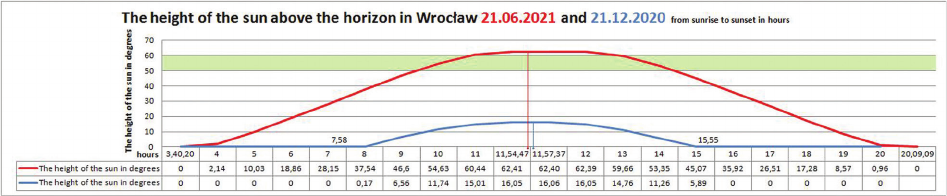
Atmospheric pressure was 1046.4 hPa. The temperate illu-
mination zones of the Earth almost coincide with the geo-
graphical temperate zones, or rather the temperate latitudes
(Fig. 4). They are located in areas in both hemispheres, be-
tween the tropics and the polar circles. They are adjacent to
the polar zones and the inter-tropical zone. The intensity of
solar radiation throughout the year varies at dierent lati-
tudes on Earth. The northern and southern temperate zones
receive the most radiation when the days are long, i.e., in the
spring and summer months.
In the areas of moderate illumination there is no polar
day or polar night and the sun never reaches its zenith. On
the summer solstice the sun reaches an altitude of almost
90° above the horizon near the Tropic of Cancer. At this
time near the Antarctic Circle the Sun reaches just over 0°.
In Wrocław the Sun reaches an altitude of 62°40′1″. During
the winter solstice the Sun is at the Tropic of Capricorn.
Fig. 4. Zones of moderate illumination of the globe and zones
of temperate zones latitude (source: https://commons.wikimedia.org/
wiki/File:Temperate_zone_(PSF).png)
Il. 4. Strefy umiarkowanego oświetlenia kuli ziemskiej oraz strefy
umiarkowane szerokości geograficznych (źródło: https://commons.
wikimedia.org/wiki/File:Temperate_zone_(PSF).png)
At this time, it shines almost 43° above the horizon at the
Tropic of Cancer and only 16°0′6″ in Wrocław. This causes
a large variation in the length of day and night. In Poland
the longest day (the rst calendar day of summer) lasts from
4:10 p.m. in the south to 5:20 p.m. in the north. The shortest
day (the rst day of calendar winter) in the north is more
than 10 hours shorter and in the south of Poland – almost
8 hours shorter. Additionally, regardless of the season, on
sunny days from dawn to dusk, the sun “wanders” across
the sky from a position of 0° above the horizon at dawn to
0° above the horizon at dusk. At noon it reaches its maxi-
mum height above the horizon. Every day (in one of the two
halves of the year) this height is always dierent.
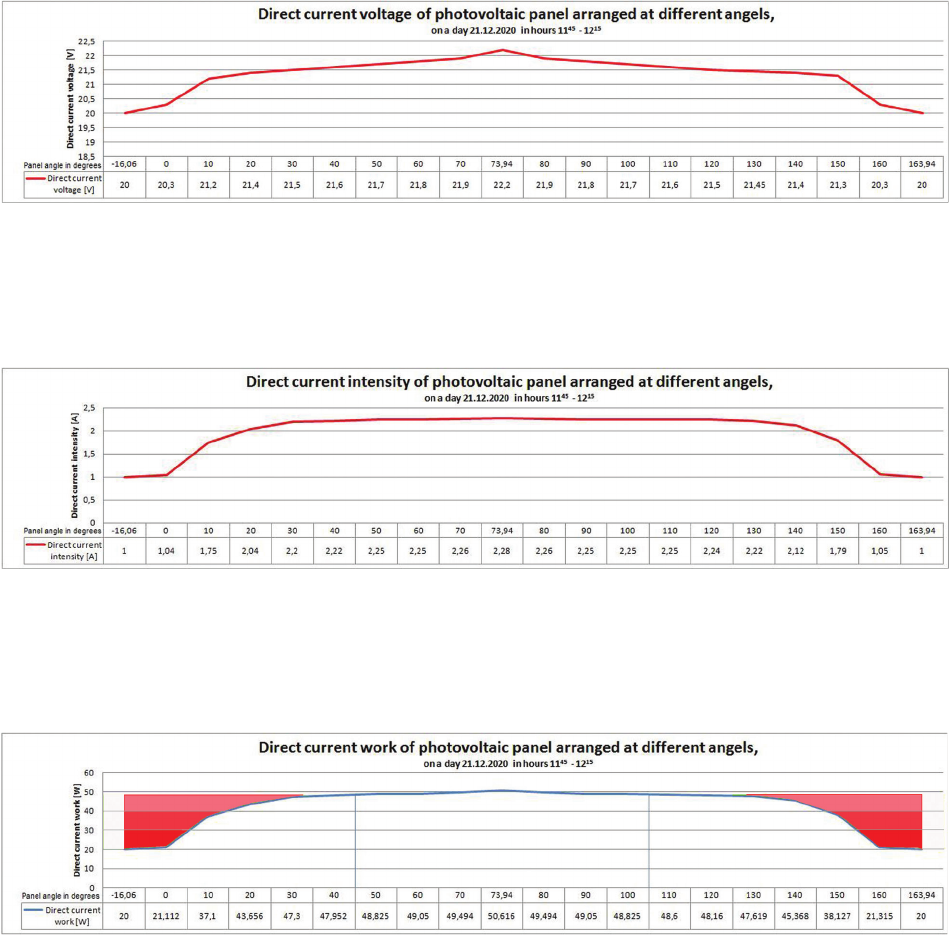
Based on data collected from the Sun position calculator
(Global Monitoring Laboratory) curves of its position in the
sky above Wrocław were determined on the days of measu-
rement: December 21, 2020, and June 21, 2021. These are
the days of the lowest and highest position of the sun at
noon above the horizon as seen from Wrocław.
When preparing analyses for other illumination zones
and locations with dierent geographical coordinates dier-
ent measurement results and sun positions in the sky should
be expected.
When looking for the best placement and tilt of the panels
for known sun positions above the horizon the angle of the
sun above the horizon from 90° should be subtracted. For
the most common photovoltaic installations in Poland, i.e.,
those mounted on roofs or on xed pedestals in gardens and
elds, the recommended angle of the panels, measured from
the ground level, should range from 30° to 40° (according
to companies installing stationary photovoltaic
panels; Byś
2023), which translates into the optimal positioning of pho-
tovoltaic panels for the sun at an altitude of 50° to 60° above
the horizon. As shown in Figure 5 for the latitude of Wrocław
this is the correct inclination in the middle of the day at the
end of spring, summer, and the rst weeks of autumn. Un-
fortunately, for the rest of the year – when the days become
shorter, colder, and cloudier – the recommended panel set-
ting does not allow for the full power of the photovoltaic
installation to be achieved, even during sunny spells. These
panels occupy a relatively large area – to achieve 1 kW of
peak power the required cell area is approx. 7 m
2
(Byś 2023).
150
Przemysław Andrzej Stobiecki
On December 21, 2020, between 11:45 a.m. and 12:15 p.m.,
tests were conducted in Wrocław to measure the direct cur-
rents occurring in a new photovoltaic panel manufactured and
sold in 2020, constructed from monocrystalline cells (4 pcs.
× 9 pcs. = 36 pcs.).
The panel manufacturer provided the following speci-
cations:
– exible solar module,
– module type: HNPV-100M,
– peak power (PMP): 100 W,
– manufacturing tolerance: ±3%,
– open circuit voltage (VOC): 21.6 V,
– maximum power current (MP): 6.05 A,
– maximum power voltage (VMP): 18.00 V,
– short-circuit current (Isc): 5.56 A,
– maximum system voltage: 1000 V,
– product dimensions: 1200 × 550 × 2.5 mm,
– all technical data under standard test conditions,
– AM = 1.5 E = 1000 W/M
2
TC = 25°C,
– CE ISO 9001 – 2008 ROHS.
The study was designed to determine the eciency of the
tested panel which is exposed to sunlight at various angles
and the characteristics of these relationships as well as to
assess the values of the obtained voltages, intensities, and
DC currents when changing the position of its plane in rela-
tion to the light source, i.e., the Sun. A voltmeter was used
to measure the DC voltage while an ammeter and a sys-
tem with a light bulb drawing current from the photovolta-
ic panel were used to measure the DC current. The results
obtained do not exceed the maximum values, taking into
account the ±3% tolerance guaranteed by the manufacturer.
Results
The results obtained are presented in the graphs (Figs.
6–8). The y-axes (vertical) show the measured and calculat-
ed values: DC voltage, DC current, DC power. The x-axes
(horizontal) show the slope of the tested photovoltaic panel
during the measurements in degrees and tenths of degrees.
The inclination of 163.94° means that the panel is facing
downwards with its photovoltaic plane lying in the plane de-
termined by the position of the Sun on December 21, 2020,
at 12:00 p.m. in Wrocław. Similarly, the angle of inclination
is –16.06° but for the panel facing upwards. On that day and
at that time in Wrocław, the Sun’s rays fell perpendicularly
on the plane panel positioned at an angle of 73.94°. Detailed
values are also listed below the graphs.
The recorded results allow for the calculation of the
direct current generated in the photovoltaic panel.
The red colour indicates the levels of direct current pro-
duced by the panel and lost due to poor orientation of the
panel relative to the Sun. The total amount of lost energy
reaches 22–35%.
Conclusions
The actual levels of prot or loss generated by xed pan-
els and sun-tracking panels can be determined by compar-
ing installations with identical parameters installed close to
each other, in an identical environment over a longer period
of time, e.g., a year or several years. The results of research
and analyses clearly indicate the advantage of sun-tracking
panels throughout the year. As already mentioned, research
shows that immobilizing modern photovoltaic panels leads
to unnecessary losses. Not only the further development of
photovoltaic cells is necessary but also is the widespread use
of dual-axis devices that move the panels commonly known
in Poland as trackers. All this aims at making fuller use of the
Sun’s energy reaching the Earth.
The analyses carried out enable us to propose new, origi-
nal solutions which are presented below.
Reduction of costs of rotating systems that track the
sun’s movement across the sky should be the main goal of
designers. Stacking photovoltaic panels on a single rotating
device may be an interesting method of reducing the costs of
planned installations. Detaching photovoltaic farms from the
ground and placing them on poles will free up between one-
third and two-thirds of the space they currently occupy. One
can imagine multi-story installations spaced at certain dis-
tances from each other in such a way that the shadow of the
high-placed panels wandering across the Earth’s surface will
not interfere with the vegetation of low and medium-sized
plants growing around them. This makes it possible to build
photovoltaic farms not only on wasteland but also on farm-
land. Such solutions erected in sunny locations on lawns,
squares or along existing streets, may become a popular al-
ternative to urban rooftop photovoltaic installations.
When correctly positioned, rotating systems can not only
provide solar energy but also provide welcome shade on
summer days in urban areas and streets. By creating screens
Fig. 5. The height of the Sun above the horizon in Wrocław, from sunrise to sunset in hours. The slope of fixed photovoltaic panels recommended
by producers in Poland is marked in green (elaborated by P. Stobiecki)
Il. 5. Wysokość słońca nad horyzontem we Wrocławiu od wschodu do zachodu słońca co godzinę; na zielono zaznaczono nachylenie stałych
paneli fotowoltaicznych rekomendowane przez producentów w Polsce (oprac. P. Stobiecki)
Mobile vertical photovoltaic system 151
Fig. 6. The voltage of direct current, a photovoltaic panel laid at different angles, on a day 21.12.2020, in hours 11.45–12.15
(elaborated by P. Stobiecki)
Il. 6. Napięcie prądu stałego, panel fotowoltaiczny ułożony pod różnymi kątami, 21 grudnia 2020 r., godz. 11.45–12.15
(oprac. P. Stobiecki)
Fig. 7. The intensity of direct current, a photovoltaic panel laid at different angles, on a day 21.12.2020, in hours 11.45–12.15
(elaborated by P. Stobiecki)
Il. 7. Natężenie prądu stałego, panel fotowoltaiczny ułożony pod różnymi kątami, 21 grudnia 2020 r., godz. 11.45–12.15
(oprac. P. Stobiecki)
Fig. 8. The work of direct current, a photovoltaic panel arranged at different angles, on a day 21.12.2020, in hours 11.45–12.15
(elaborated by P. Stobiecki)
Il. 8. Praca prądu stałego, panel fotowoltaiczny ułożony pod różnymi kątami, 21 grudnia 2020 r., godz. 11.45–12.15
(oprac. P. Stobiecki)
from photovoltaic panels placed high on rotating poles an
additional cooling eect can be expected in urban areas du-
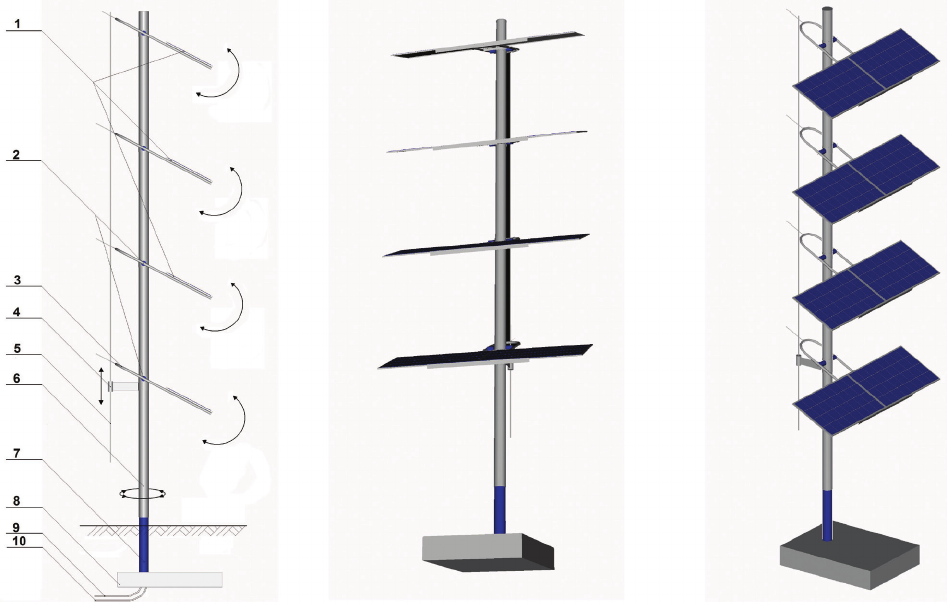
ring the summer months. Figure 9 shows the author’s pro -
posal for a new type of tracker solution.
The proposed solution is equipped with additional sprin-
kler and cooling systems for the panels during the summer
months. Placing several panels vertically above each other
on a single rotating pole makes this solution more economi-
cal ly viable. The panels in the lowest position should be
located approximately 2.5 m above the ground. They are
arranged in such a way that at no time of the day or year
do they obscure those located above and below. The total
height of the solution shown is approximately 10.5 m. The
presented variant, provisionally named type “A”, consists of
8 identical photovoltaic panels with an example power of
280 W. The total power of such an installation is 2.24 kW.
Solutions for a larger number of panels attached to the same
mast are in preparation:
– “B” for installations with 12 panels with a total power
of 3.36 kW,
– “C” for installations with 17 panels with a total power
of 4.76 kW,
– “D” for installations with 18 panels with a total power
of 5.04 kW,
– “E” for installations with 22 panels with a total power
of 6.16 kW,
– and a slightly larger “F” for installations with 36 panels
with a total power of 10.08 kW.
152
Przemysław Andrzej Stobiecki
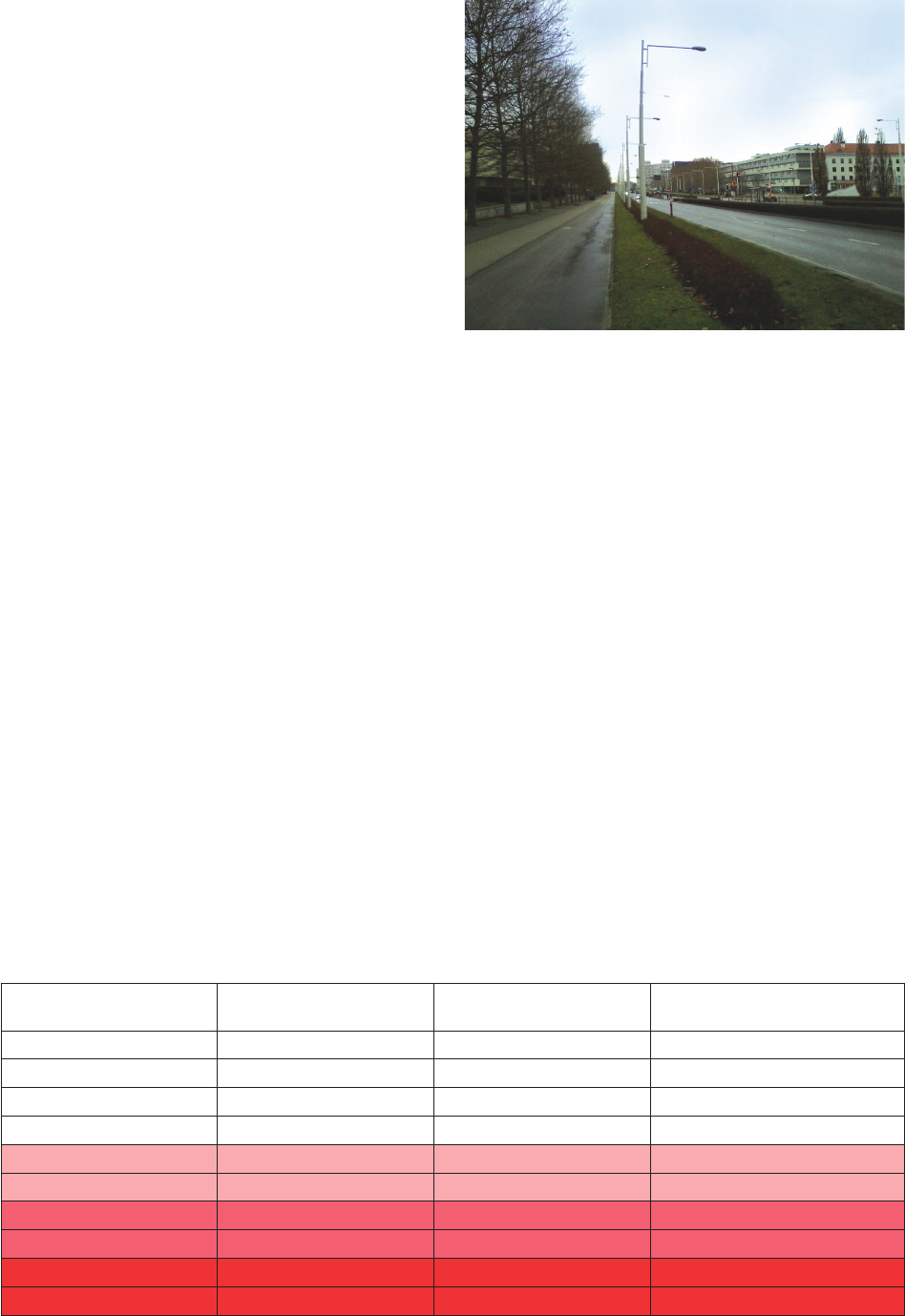
In urban areas such as Wrocław, there are streets that are
almost ready for the installation of photovoltaic panels in
vertical arrays. Plac Grunwaldzki is a spectacular example.
It extends from southwest to northeast. Existing street lamp
posts, approximately 12 m high and spaced every 25 m, can
be used to install suitably adapted vertical rotating panel in-
stallations. Separate new-type tracker poles with panels can
also be added.
The northern side of this street (on the right in Fig. 10)
seems to be particularly well suited for the installation of
vertical photovoltaic systems. This is due to the shape of the
low and high greenery, the appropriate urban development,
and the favourable solar exposure.
Advantages of the proposed solution
The new type of dual-axis tracker has several signicant
advantages. Some of them are the advantages of all dual-ax-
is low trackers used to date. However, the proposed solution
will save more costs, space, and energy losses. Among the
advantages, the following are worth mentioning:
– increasing the eciency of sunlight capture, leading
directly to improved performance of the photovoltaic instal-
Fig. 9. A proposal for a new type of vertical, rotating, biaxial photovoltaic system solution: a) side view; b) frontal perspective; c) axonometry side.
1 – photovoltaic panels, 2 – axis of rotation of panel hangers, 3 – panel hanger, 4 – hanger tie rod motor, 5 – main rigid tie rod of hangers,
6 – steel tube of the rotating column structure, 7 – steel foundation tube with a motor rotating the pole, 8 – reinforced concrete footing,
9 – sprinkler water system, 10 – cooling air supply system (designed by P. Stobiecki)
Il. 9. Propozycja rozwiązania wertykalnego, obrotowego, dwuosiowego układu fotowoltaicznego nowego typu: a) widok boczny,
b) perspektywa od przodu, c) aksonometria boczna. 1 – panele fotowoltaiczne, 2 – osie obrotu wieszaków paneli, 3 – wieszak panelu,
4 – silnik cięgna wieszaków, 5 – sztywne cięgno główne wieszaków, 6 – stalowa rura konstrukcji obrotowego słupa,
7 – stalowa rura fundamentowa z silnikiem obracającym słup, 8 – żelbetowa stopa fundamentowa, 9 – instalacja wody do tryskaczy,
10 – instalacja nawiewu chłodzącego (projekt: P. Stobiecki)
lation (average annual energy production is by 29% higher
compared to traditional photovoltaic installations; Energe -
tyka-Sloneczna.Net),
– installation is an important step towards energy self-suf-
ciency, but also serves the environment protection,
–
movement of solar panels reducing the likelihood of dust
and other contaminants settling on them (Biernaciak 2024),
– support for the system with sprinkler and ventilation
installations,
– more convenient access to the panels (e.g., if cleaning,
repair, or maintenance is required, a photovoltaic installa-
tion with a tracker can be easily positioned in a convenient
location, which is a great convenience, especially in the case
of panel failure inside the installation; Biernaciak 2024),
– movable panels enabling automatic snow removal in
winter,
– benets and savings arising from the reduction of land
and acreage occupied,
– vertical arrangement of panels on a single rotating
pole resulting in reduced costs compared to previously used
solutions in the form of single-story trackers,
– the function of shading selected urban areas leading to
lowering the temperatures in summer.
Mobile vertical photovoltaic system 153
The advantages listed above can signicantly reduce the
costs associated with planned investments.
The costs as well as a certain sensitivity to damage to the
drive systems are the main disadvantages of the proposed
sun tracking systems which are exposed to weather condi-
tions. Final decision on the cost-eectiveness of the pro-
posed solutions must be preceded with appropriate research
in this area. Without it is dicult to estimate how protable
will be the proposed solution compared to less complicated
immobile systems. However, the economic aspect was not
the focus of this study. Such research needs to be conducted
as part of a separate project.
Nevertheless, there is hope that this study will encourage
solar system designers and all those interested in this topic
to work hard to promote inexpensive, eective vertical pho-
tovoltaic systems in urban and rural areas.
Summary
The study conducted and the results obtained are of a ge-
neral nature. The conclusions drawn from them may be ap -
plicable to other positions of the Sun in the sky or other
days of the year for the selected location. The losses shown
are actually multiplied and translated into the annual perfor-
mance of photovoltaic panels, which are traditionally xed
on pedestals without the possibility of changing their posi-
tion in relation to the Sun. With various poor panel settings
electricity is lost according to the percentage breakdown
shown in Table 1.
The percentages in the table cells at the border between
the white and red rows reach the level of value loss measured
in the range of 3–5%. They can be considered the margin of
error of the measurements obtained in the experiment. The
area of obvious losses resulting from the mismatch between
the inclination of the photovoltaic panels and the maximum,
optimal sunlight conditions is marked in red. The colour code
also corresponds to the data obtained in the scheme in Figure
8. At photovoltaic panel inclinations of –16.06° and 163.94°,
voltages of 20 V and currents of 1 A were recorded.
These inclinations are extremely unfavourable for the
operation of the photovoltaic panel on December 21, 2020,
at 12:00 p.m. and prevent the absorption of direct sunlight.
Nevertheless, the recorded voltage and current values are
dierent from zero and indicate the appearance of current
values in the system caused by light reected from the envi-
ronment and scattered water vapor in the atmosphere during
the test. Currents from scattered light nearly always appear.
The energy generated by sunlight reections is used in
double-sided photovoltaic panels. Their eciency can be
Fig. 10. The perspective of Plac Grunwaldzki street in Wrocław
and its favourable arrangement for municipal vertical photovoltaic
installations (photo by P. Stobiecki)
Il. 10. Perspektywa ulicy Plac Grunwaldzki we Wrocławiu
i jej korzystne ułożenie dla miejskich pionowych instalacji
fotowoltaicznych (fot. P. Stobiecki)
Panel tilt downward from
73.94
o
Panel tilt upward from
73.94
o
% work related to maximum
% decrease of efficiency related to
maximum
73.94 73.94 100.00 0.00
70 80 97.78 2.22
60 90 96.91 3.09
50 100 96.46 3.54
40 110 94.74 5.26
30 120 93.45 6.55
20 130 86.25 13.75
10 140 73.30 26.70
0 150 41.71 58.29
–16.06 163.94 39.51 60.49
Table 1. Percentage loss of direct current work, photovoltaic panel laid at different angles,
on a day 21.12.2020, in hours 11.45–12.15*
(elaborated by P. Stobiecki)
Tabela 1. Procentowa strata pracy prądu stałego, panel fotowoltaiczny ułożony pod różnymi kątami,
21 grudnia 2020 r., godz. 11.45–12.15* (oprac. P. Stobiecki)
* The optimal angle of the panel on December 21, 2020, at 12:00 p.m. from the horizon: 73.94°; it allows sunlight to fall perpendicularly to the panel
surface. Position of the Sun in Wrocław: 16.06° above the horizon.
154
Przemysław Andrzej Stobiecki
increased by up to 25% (Szymański 2023). To fully utilize
the eects of reected light double-sided panels should be
placed at considerable heights above the ground or roofs.
In the experiment the eciency losses of the tested sys-
tem for angles ranging from –16.06° to 40° and from 110°
to 163.94° correspond to the losses that occur in permanent-
ly installed photovoltaic panel systems in the morning and
evening hours. Such losses are particularly severe in the
sum mer months when the normal operation of photovol-
taic panels is disrupted by high ambient temperatures and
the heating of the panel. According to experiment, losses
caused by temperature increases in the daily energy balance
reach 0.4% per 1°C (Dubey 2013). The balance can be im-
proved by tracking the position of the Sun with a dual-axis
tracker which will ensure maximum power supply in the
mor ning and evening on a summer day (with moderate tem-
peratures).
Research shows that the immobilization of modern pho-
tovoltaic panels leads to losses. These losses, regardless of
the level of atmospheric light, are a year-round, common and
unnecessary phenomenon. Given the current popularity
of solar energy which draws energy from photovoltaics as
well as the trends in the development of this type of energy
production every eort should be made to reduce the cost
of devices that track the Sun’s movement in the sky which
will allow for their widespread use. This, in turn, will elim-
inate energy losses resulting from the misalignment of the
panels.
Numerous studies on the intensity of sunlight show that
during the winter months and in the early morning and late
afternoon hours in summer, the intensity of sunlight is only
seemingly lower. The intensity of sunlight can be around 60%
of its maximum value when the Sun is 15° above the horizon,
around 50% at 10°, and 25% at just 5° above the horizon.
Therefore, if trackers can follow the Sun from sunrise to sun-
set their rotating solar panels can collect a signicant amount
of additional energy (“Wikipedia: Solar tracker”).
Translated by
Agata Haglauer
References
Biernaciak, Emilia. “Tracker – fotowoltaika. Co trzeba wiedzieć?.” Pub-
lished August 9, 2024. Accessed August 9, 2024, at https://enerad.pl/
aktualnosci/fotowoltaika-na-trackerach/.
Botwright, Rob. Solar Energy. Sun Power Unleashed. Pastor Publishing,
2024.
Byś, Monika. “Wybór miejsca pod montaż paneli fotowoltaicznych, jak się
przygotować.” Published June 2, 2023. Accessed October 27, 2024, at
https://blog.ongeo.pl/montaz-paneli-fotowoltaicznych.
Dubey, Swapnil, Jatin Narotam Sarvaiya, and Bharath Seshadri. “Tempera-
ture dependent photovoltaic (PV) eciency and its eect on PV pro-
duction in the world – a review.” Energy Procedia 33 (2013): 311–21.
https://doi.org/10.1016/j.egypro.2013.05.072.
Energetyka-Sloneczna.Net. “System nadążny PV – solar tracker – budowa
i zasada działania.” Published 2018. Accessed October 27, 2024, at
https://energetyka-sloneczna.net/wiadomosci/pokaz/11,system-nadaz-
ny-pv-solar-tracker-budowa-i-zasada-dzialania.
Gawlak, Anna, ed. Kierunki i perspektywy rozwoju odnawialnych źródeł
energii. Wybrane aspekty. Politechnika Częstochowska, 2022.
Global Monitoring Laboratory. “Global Monitoring Laboratory: NOAA
Solar Calculator.” Accessed October 27, 2024, https://gml.noaa.gov/
grad/solcalc/.
Kacejko, Piotr, and Paweł Pijarski. Podstawy elektroenergetyki. Wydaw-
nictwo Naukowe PWN, 2024. https://doi.org/10.53271/2024.110.
Luque, Antonio, and Steven Hegedus, eds. Handbook of Photovoltaic
Science and Engineering. John Wiley and Sons, 2011. https://doi.org/
10. 1002/9780470974704.
Piątek, Krzysztof, and Zbigniew Hanzelka, eds. Instalacje fotowoltaiczne
w systemie elektroenergetycznym. Wydawnictwo Naukowe PWN, 2023.
Prinsloo, Gerro J., and Robert Thomas Dobson. Solar Tracking. Solar-
Books, 2015. https://doi.org/10.13140/2.1.2748.3201.
Rynek elektryczny. “Rynek elektryczny: Pięć największych elektrowni fo-
towoltaicznych w Polsce.” Published November 14, 2022. Ac cessed
October 27, 2024, https://www.rynekelektryczny.pl/naj wieksze-far-
my-fotowoltaiczne-w-polsce/.
Salomon, Eldra P., Linda R. Berg, and Diana W. Martin. “Wzrost i rozwój
roślin.” In Eldra P. Salomon, Linda R. Berg, and Diana W. Martin,
Biologia. Multico, 2007.
Szymański, Bogdan. Instalacje fotowoltaiczne. Globenergia, 2023.
Urząd Regulacji Energetyki. “Urząd Regulacji Energetyki: Raport-URE
-w-2023.” Published April 30, 2024. Accessed October 27, 2024, at
https://www.ure.gov.pl/pl/urzad/informacje-ogolne/aktualnosci/11940,-
Raport-URE-w-2023-r-w-malych-instalacjach-OZE-wyprodukowano-
4-TWh-energii.html.
Victoria, Marta, ed. Fundamentals of Solar Cells and Photovoltaic Systems
Engineering. Academic Press, 2024.
Warmke, Jay. Designing and Installing Solar PV Systems. Commercial and
Large Residential Systems. Blue Rock Station LLC, 2022.
Wikimedia Foundation. “Wikipedia: Ogniwo słoneczne.” Accessed October
9, 2024, at https://pl.wikipedia.org/wiki/Ogniwo_s%C5%82oneczne.
Wikimedia Foundation. “Wikipedia: Solar tracker.” Accessed October 27,
2024, at https://en.wikipedia.org/wiki/Solar_tracker.
Wikimedia Foundation. “Wikipedia: Tona oleju ekwiwalentnego.” Ac-
cessed October 27, 2024, at https://pl.wikipedia.org/wiki/Tona_oleju_
ekwiwalentnego.
Zobaa, Ahmed, and Ramesh Bansal. Handbook of Renewable Energy Tech
nology. World Scientic, 2011. https://doi.org/10.1142/ 9789814289078.
Patents
Patents for the abovementioned designs of vertical dualaxis trackers of
types “B”, “C”, “D”, “E”, and “F” are planned to obtain.
Mobile vertical photovoltaic system 155
Streszczenie
Ruchomy pionowy system fotowoltaiczny
Celem autora artykułu było przedstawienie oryginalnego alternatywnego rozwiązania technicznego umożliwiającego multiplikację stanowisk odbioru
energii słonecznej przetwarzanej przez panele fotowoltaiczne lub kolektory słoneczne, przy minimalnym zaangażowaniu powierzchni przeznaczonej na
ten cel działki lub powierzchni dachowej. Nowa propozycja pozwala na wykorzystanie i ułożenie paneli gromadzących energię słoneczną równocześnie
w sposób estetyczny i optymalny poprzez wykorzystanie konstrukcji ruchomych paneli umieszczanych według określonego porządku. Rozwiązanie to
może być alternatywą także dla połaciowych dachowych przydomowych instalacji fotowoltaicznych lub kolektorów słonecznych.
Propozycja rozwiązania technicznego przedstawiona przez autora pozwala na śledzenie przez panele ruchu słońca na nieboskłonie pod różnymi szero-
kościami geogracznymi w różnych porach roku, co ma szczególne znaczenie w stree umiarkowanej. Możliwe są także obrót paneli i optymalizacja ich
położenia w trakcie każdego dnia roku, od świtu do zmierzchu. Proponowane rozwiązanie umożliwi ponadto ewentualne chłodzenie paneli fotowoltaicz-
nych wymuszonym ruchem powietrza instalacji eksploatowanych w warunkach ekstremalnie dużych temperatur podczas dni letnich.
Proponowane rozwiązanie ma być tanią alternatywą dla dotychczasowych instalacji naziemnych lub dachowych, absorbujących koszty i powierzchnię
oraz uniemożliwiających należyte utrzymanie i konserwację. Dzięki niemu możliwe będzie dalsze zwiększanie efektywności nowoczesnych instalacji
pobierających energię ze światła słonecznego.
W celu uwiarygodnienia projektowanego rozwiązania przeprowadzono badania zależności nachylenia wybranego panelu fotowoltaicznego względem
słońca i jego uzyskiwanych mocy.
Słowa kluczowe: fotowoltaika, panele solarne, tracker słoneczny dwuosiowy, strefa umiarkowana, instalacje miejskie