
2025
3(83)
Daria Bręczewska-Kulesza*
Neo-Gothic in the residential architecture of Toruń
– a building tradition or a fashion for historicism?
DOI: 10.37190/arc250303
Published in open access. CC BY NC ND license
Abstract
The article addresses the problem of sources and patterns for Neo-Gothic in residential architecture of the 19
th
and early 20
th
centuries, using the
example of Toruń. Was the Gothic building tradition used here and the aesthetics of the façades of bourgeois tenements applied, or did they rather refer
to the patterns developed in the 19
th
-century “centres of Neo-Gothic”?
The subject of this study are examples of tenement houses and villas in Toruń in the spirit of Neo-Gothic. The aim of the considerations was to de-
termine the inuence of the local building tradition and 19
th
century Neo-Gothic patterns on the Toruń realisations of that period. A stylistic comparative
analysis of Toruń’s residential buildings of the 19
th
century with the Gothic town houses of the city and the Neo-Gothic buildings of the Hanoverian
school, the most inuential in the area, was carried out. An analysis of the historical context was also carried out. The investigations were based on the
author’s in situ research in Toruń and Hanover.
The research led to the conclusion that external inuences predominated. Local housing patterns from the Gothic period were not functionally suit-
able for transformation into a new language of forms, so motifs were rather taken from monumental buildings by tting them into the massing of a 19
th
-
century townhouse or villa, using ready-made designs from the Hanoverian school.
Key words: Toruń, Neo-Gothic, residential architecture in the 19
th
century
Introduction
The tenement houses and villas dating from the 19
th
and
early 20
th
centuries are valuable witnesses to social trans-
for mation. The choice of stylistic form was linked not only
to current fashion, but also reected the building owners’
ideology, attitude towards history and desire for prestige
1
.
Renaissance or Baroque models were the most common
in housing construction. Gothic forms were used less fre-
quently, typically in sacred or ocial architecture. However,
* ORCID: 0000-0002-9281-0312. Faculty of Civil and Environ-
mental Engineering and Architecture, Bydgoszcz University of Science
and Technology, Poland, e-mail: daria.breczewska-kulesza@pbs.edu.pl
1
The author is conducting comparative research into the stylistics
of the façades of tenement houses from the 2
nd
half of the 19
th
and early
20
th
centuries in Poland, a project entitled “The façade as the showcase
of the tenement house – trends in the design of front elevations of ten-
ement houses in Poland from the mid-19
th
to the early 20
th
century”,
funded by the Lanckoroński Foundation and Bydgoszcz University of
Science and Technology.
townhouses and villas built in the Neo-Gothic style were of-
ten highly original creations that enriched the housing stock.
One question that arises is: In towns with a rich medieval
building tradition, were local models of bourgeois tenement
houses used, or were models from well-known architectural
schools promoting Neo-Gothicism adopted?
The article presents a contextual analysis of this issue
using the example of residential buildings in Toruń, a city
with strong Gothic architectural traditions, a provincial, me-
dium-sized centre in the 19
th
century, located far from major
artistic hubs. Although examples of Neo-Gothic tenements
and villas are relatively few, they clearly enrich the urban
fabric with their distinctive forms. This raises questions: To
what extent has tradition been used here, and how close-
ly have the aesthetics of Gothic townhouse façades been
replicated? Or were they referring to models developed in
19
th
-century German “centres of Neo-Gothic”, such as the
Hanoverian School? This investigation aims to examine
the relationship between Toruń’s 19
th
-century residential
buildings in the Neo-Gothic style and the Goth
ic townhous-

28 Daria Bręczewska-Kulesza
es in the city. It also explores the Neo-Gothic trends that
emerged from the centres of this historicist movement, as
documented in the professional literature and periodicals of
the time. Hanover’s residential architecture has been cho-
sen as a model for comparison, as it was an inuential cen-
tre of Neo-Gothicism for more than half a century. Several
generations of outstanding architects were associated with
the Hanoverian School, inuencing not only the architec-
ture of Lower Saxony, but also that of northern Germany
and the Prussian partitioned areas.
The dierent historical and social context of the 19
th
- and
early 20
th
-century tenement and single-family houses and
the 14
th
- and 15
th
-century bourgeois tenements, the dierent
functional aspects and the dierent sizes of the properties
and building masses allow us to hypothesise that the main
source of inspiration for the architects of the 19
th
-century
realisations was the Neo-Gothic patterns of residential ar -
chitecture fashionable at the time and their decorative forms.
In an attempt to solve the posed problem, research was
carried out on Toruń’s Gothic-style buildings and Gothic
town houses. In situ research was also conducted in Hano-
ver to identify forms related to Toruń’s realisations. Addi tio -
nally, the historical and social context was analysed by com -
paring the status of medieval and 19
th
-century Toruń, as well
as the role of medieval townhouses for the city’s in habitants
during these periods. Professional literature from the 19
th
and early 20
th
centuries was examined from the perspec-
tive of pattern penetration. Finally, the distinctive features
of Toruń’s Gothic-inspired developments were compared
with Gothic tenements in Toruń and Hanoverian patterns.
State of research
So far, only a few studies have been conducted on tene -
ment houses in Toruń. Bożena Zimnowoda-Kra jew ska
(2001) conducted a fragmentary study of a block of build-
ings in the Wilhelmstadt district (erected in 1896–1910).
The author emphasised the pursuit of “pictures queness”
and individualism in the design of the façade, but failed
to mention the few details referring to Gothic architecture
details incorporated into this design. Joanna Kucharzews-
ka’s (2004) wide-ranging study of Toruń’s architecture from
1871 to 1920 presented a number of buildings constructed
in the Neo-Gothic style, but these were intended for public
use, not residential use. The rst comprehensive account
of Toruń’s tenement houses is a monograph by Michał
Pszczółkowski (2021). In it, the author discusses examples
of tenements erected in the spirit of Neo-Gothic, brief-
ly considering the genesis of the style of their elevations.
An unrealised project for a Neo-Gothic-inspired tenement
house commissioned by Toruń winemaker Johann Schwartz
from architect Johannes Otzen, a pupil of Conrad Wilhelm
Hase, is also worth mentioning. This project was published
in the Deutsche Bauzeitung (Otzen 1881).
The Gothic tenement house attracted much greater inter-
est from researchers, with a number of studies having been
written on the subject. These include works by Bohdan Ry-
maszewski (1966; 1969; 1984), Jan Tajchman (2013) and
Zbigniew Nawrocki (2016). These publications attempt
to establish the typologies of Toruń’s bourgeois tenement
houses from the 14
th
and 15
th
centuries on the basis of con-
servation research. An interesting paper on the conservation
and reconstruction of Gothic tenements was published by
Ma ciej Prarat and Karolina Zimna-Kawecka (2020), who
raised, among other things, the question of the study of these
build ings
in Prussian times and the possibility of preserving
them. Joanna Szot (2007) published research on the devel-
opment of Nowomiejski Square and its transformation.
The most comprehensive publication on the Hanoveri-
an architectural school is Günther Kokkelink and Monika
Lem ke-Kokkelink’s work (1998). Among the more recent
studies, Markus Jäger’s (2019) contribution to a mono-
graph on Conrad Wilhelm Hase is noteworthy. The study
by Wolf gang Neß, Ilse Rüttgerodt-Riechmann, Gerd Weiß
and Ma rianne Zehnpfennig (1983) contains much infor-
mation on Neo-Gothic architecture in Hanover. Regarding
Toruń architecture in the Hanoverian Neo-Gothic style, Jo-
anna Kucharzewska’s (2002) article on the new Toruń post
oce building is relevant. Erected at the beginning of the
1880s in the Neo-Gothic style and designed by Otzen, the
build ing aroused great interest in the Toruń community.
Description of research and methods
The research was divided into three stages. The rst
stage focused on Neo-Gothic residential buildings in Toruń
from the 2
nd
half of the 19
th
century and the early 20
th
cen-
tury. In situ research, archive documentation queries and
literature analysis were conducted. The second stage fo-
cused on bourgeois Gothic tenements in Toruń. This stage
was based mainly on in situ research and literature analysis.
The nal stage involved conducting research in Hanover
and analysing studies on the Hanoverian school of archi-
tecture. The following research methods were employed:
stylistic comparative analysis, contextual analysis, archival
research, and the historical-interpretative method.
Townhouses and villas in the spirit of Neo-Gothic
in Toruń
The successive fashions of styles of past eras used in the
development of tenement house facades in Toruń paid little
attention to the Neo-Gothic style. Although it was popu-
lar in religious, ocial and other public buildings, it was
rarely used in residential construction. Several groups can
be distinguished here. The rst group, which is the most
important for this research
2
, consists of buildings that com-
prehensively reference Gothic patterns through the use of
many architectural elements or details modelled on Gothic
or Neo-Gothic styles. The second group comprises houses
in which a few Gothic elements were combined with de-
tails from other styles, forming “picturesque” ar chi tectural
features on the façades. The third group com prises modest
brick-faced buildings with a brick frieze featuring medieval
motifs.
2
Research on tenements and villas in Toruń in the spirit of Neo-
Gothic was conducted by the author in 2022 during a research internship
at the Nicolaus Copernicus University, under the direction of Joanna
Kucharzewska, PhD, Professor at UMK.
Neo-Gothic in the residential architecture of Toruń – a building tradition or a fashion for historicism? 29
The rst group comprises four buildings: two town-
houses (15 Sienkiewicz Street and 36 Szeroka Street) and
two villas (84 Krasiński Street and 4 Sienkiewicz Street).
All were built in the nal decade of the 19
th
century or the
early years of the 20
th
century
3
. The tenement on Szeroka
Street was built on the city’s most prominent street. The
other buildings are located in the district of Przedmieście
Byd goskie, which was a rapidly expanding and fashionable
area of Toruń in the late 19
th
century. Interestingly, neither
the townhouses nor the villa on Sienkiewicz Street were
originally designed in the Neo-Gothic style; this only ap-
peared in subsequent drawings. Only one drawing show ing
the elevation of the villa on Krasiński Street has survived
4
.
Although the two townhouses were designed by peo-
ple from dierent architectural backgrounds
5
, they share
com mon features. Both are clad in red bricks and feature
glazed green bricks around the windowsills and as decora-
tive elements. They also have brick openwork cornices and
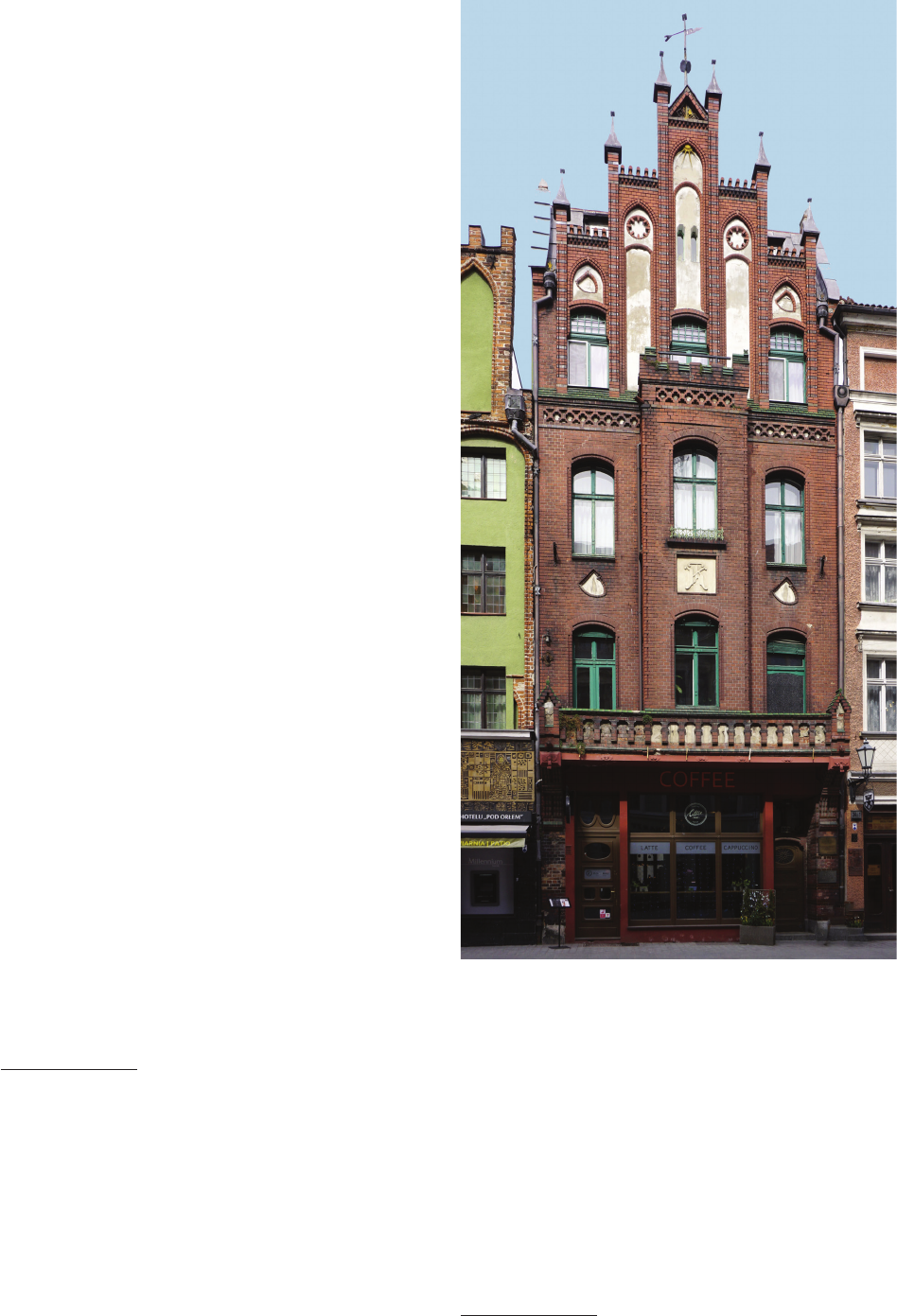
stepped gables. Apart from this, however, the townhouses
dier signicantly from each other. The house on Sze ro ka
Street is situated on a plot with medieval origins and has
a narrow, triaxial façade. Its four storeys give it very slender
proportions. The shop window and entrance to the building
were located on the ground oor. The rst-oor area fea-
tures a wide balcony that clearly separates the storeys. The
second and third storeys have an evenly distributed window
arrangement, with an oriel window designed on the central
axis that protrudes slightly from the façade. An openwork
brick frieze and a band of glazed green brick top o the
entire façade. Between the windows on the rst and second
oors, there are shields surrounded by brick moulding and
a plastered eld. The topmost storey features a three-storey
gable, the central part of which is decorated with closed ogi-
val blendes in plaster. The gable is adorned with pinnacles,
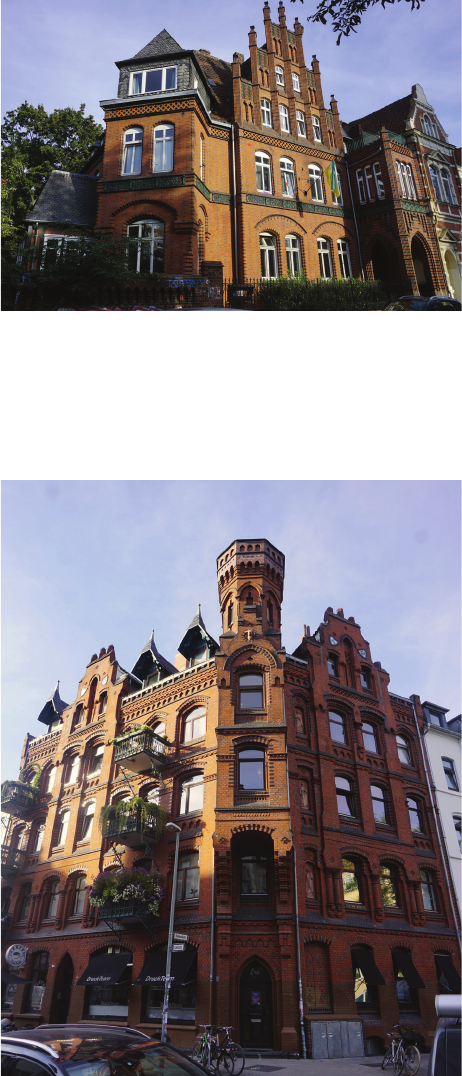
friezes of set brick and solar motifs (Fig. 1).
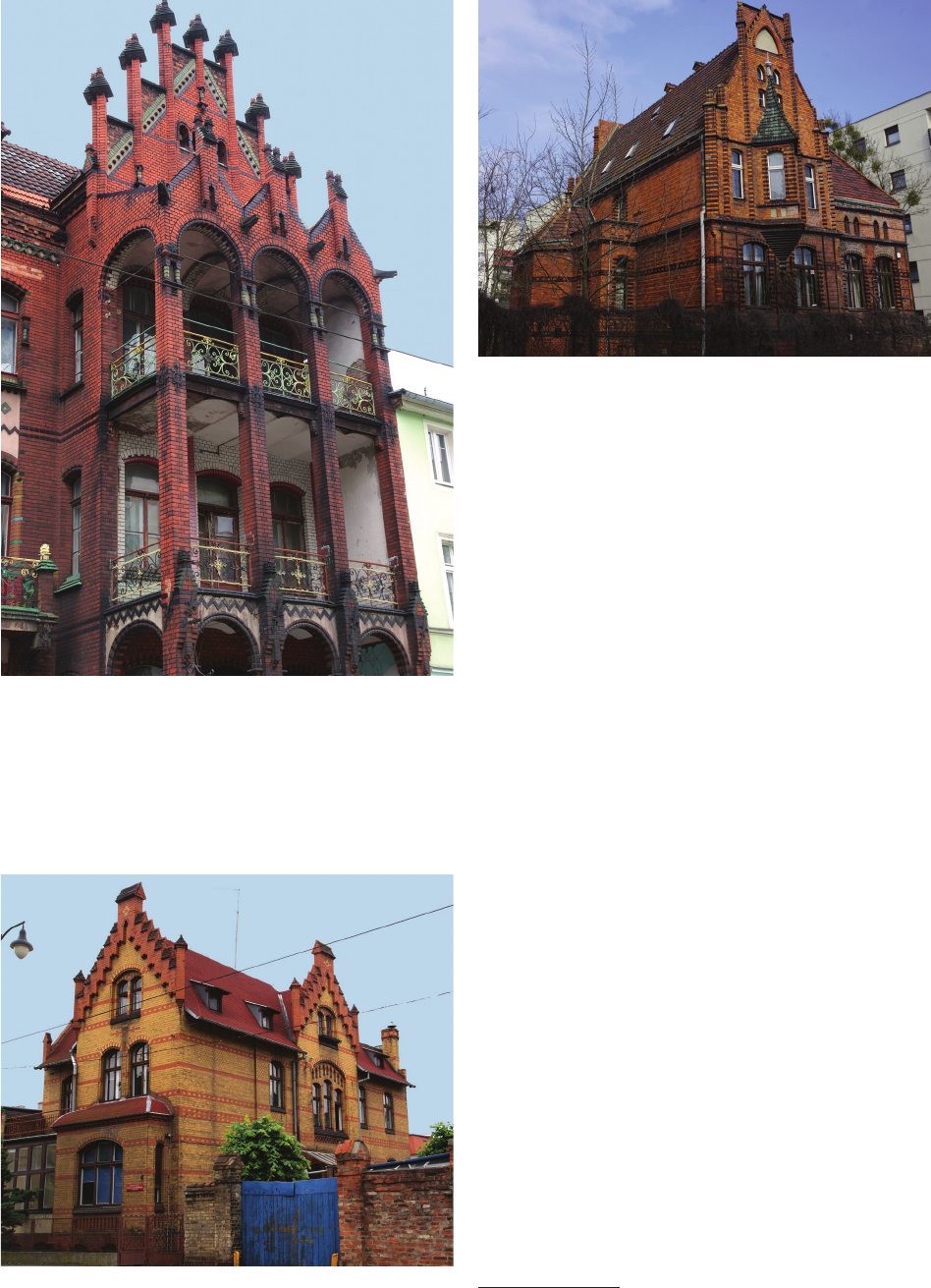
The second house was located in Bydgoskie Przedmieś-
cie on a plot of land typical of subdivisions in the 2
nd
half
of the 19
th
century. The designer planned the house to have
a “picturesque”, asymmetrical façade, which was enriched
with many original decorative and architectural elements.
The northern triaxial risalit is particularly striking, contain-
ing a terrace on the ground oor and balconies in the upper
storeys. Each axis is topped with a small triangular gable
featuring a pinnacle, and the entire structure is capped with
a high stepped gable adorned with stylised pinnacles. The
second risalit, located on the southern side, features a trian-
3
15 Sienkiewicz Street – start of construction: 1894 (State Archive
in Toruń, Records of the City of Toruń [hereinafter: APT, A.m.T.], ref.
G 4541); 36 Szeroka Street – design: 1896, start of construction: 1897
(APT, A.m.T., ref. G 4521); 84 Krasiński Street – start of construction:
1899 (Register of Monuments of Toruń); 4 Sienkiewicz Street – start of
construction: 1900 (APT, A.m.T., ref. G 4066).
4
Investor: master mason Georg Plehwe, the building was erected
around 1899 (Architectural and Construction Monument Registration
Card, copy from the collection of the Municipal Conservator’s Oce
in Toruń).
5
36 Szeroka Street – designed by Berlin architect and Regency
master builder Max Fraenkel, for the merchant Daniel Strenberg (APT,
A.m.T., ref. G 4521); 15 Sienkiewicz Street – investor and contractor:
master mason Georg Soppart (APT, A.m.T., ref. G 4078). Soppart was
a thriving construction entrepreneur in Toruń.
gular bay and is topped with a stepped gable (Fig. 2). The
tenement house at 46 Szeroka Street, which also belonged
to Georg Soppart
6
, exhibits similar features. Apart from the
brick facing and glazed brick used in a more fanciful way,
however, this building features few Neo-Gothic elements,
except for the windows in the third and fourth storeys,
which are stylised as triforiums.
6
APT, A.m.T., ref. G 4541; Pszczółkowski pointed to the building
as an example of Neo-Gothic (2021, 275).
Fig. 1. Toruń, tenement house at 36 Szeroka Street,
erected around 1896 (photo by D. Bręczewska-Kulesza)
Il. 1. Toruń, kamienica przy ul. Szerokiej 36, wzniesiona około 1896 r.
(fot. D. Bręczewska-Kulesza)
30 Daria Bręczewska-Kulesza
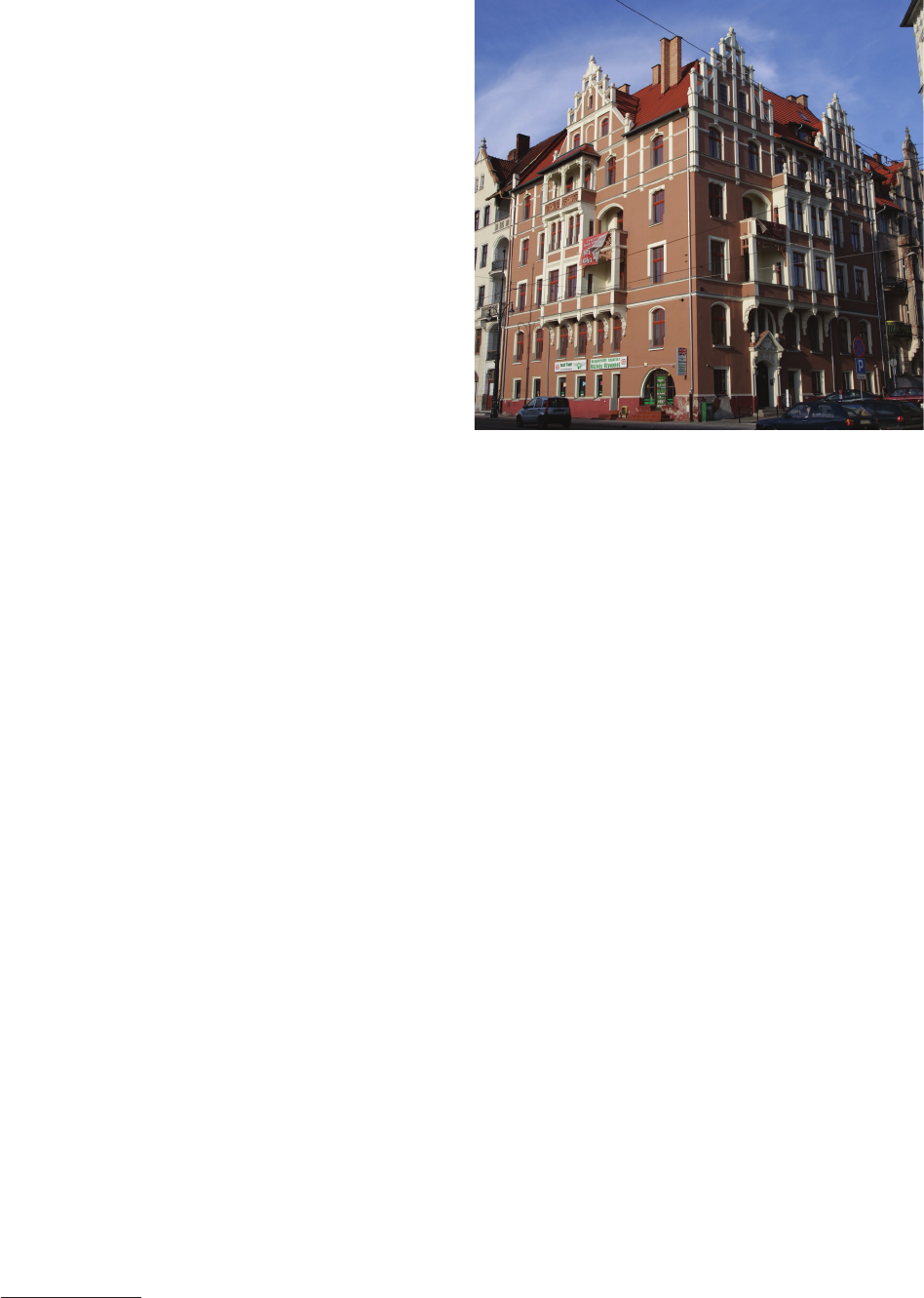
Two villas in the spirit of Neo-Gothic were built in the
Bydgoskie Przedmieście district. The villa at 4 Sienkiewicz
Street combines stylised Neo-Gothic and Art Nouveau
elements in its façade design
7
. Its elevations are faced with
light yellow bricks and enriched with contrasting bands
of red brick friezes. The southern and western elevations
feature risalits with triangular, stepped gables and bifori-
um-type windows. The southern risalit features a large tri-
forium window, which is preceded by an openwork brick
belt course and surmounted by a frieze of small blends
closed with a trillium. Art Nouveau elements include
stained glass windows and a wrought iron canopy over the
entrance (Fig. 3).
The last building in this group is the villa at 84 Krasiński
Street. Its body is varied by numerous asymmetrically ar-
ranged architectural elements, including risalits of dierent
sections and heights, oriels, high roofs, a porch and fancy
gables. The red brick façades are embellished with glazed
cherry brick and green tiles, which cover the high roof of
oriel. Shaped bricks of various forms were used to nish
the window openings, risalit’s pinnacles, and parts of the
corners. Due to its irregular and asymmetrical shape, the
villa also ts into the trend of “picturesque” historicist ar-
chitecture, which often references the Gothic style (Fig. 4).
The second group of tenements comprises buildings
with single Neo-Gothic elements, composed with details
taken from other historical styles. Examples include the
tenement at the junction of 10 Warszawska Street and 8
Kazimierz Jagiellończyk Street in the St. Catherine Suburb
(formerly Wilhelmstadt)
8
, and the tenement at 8 St. Cather-
7
Designer: Konrad Schwartz, Investor: Town Councillor Emil Diet-
rich
(APT, A.m.T., ref. G 4066).
8
Construction work: Ulmer and Kaun building company from To-
ruń, building erected around 1898. (APT, A.m.T., ref. G 1525), designed
by Berlin architects Hermann Solf and Franz Wichards (Pszczółkowski
2021, 83).
Fig. 2. Toruń, tenement house at 15 Sienkiewicz Street,
upper part of the northern risalit, erected around 1894
(photo by D. Bręczewska-Kulesza)
Il. 2. Toruń, kamienica przy ul. Sienkiewicza 15,
górna partia północnego ryzalitu, wzniesiona około 1894 r.
(fot. D. Bręczewska-Kulesza)
Fig. 3. Toruń, villa at 4 Sienkiewicz Street,
built around 1900
(photo by D. Bręczewska-Kulesza)
Il. 3. Toruń, willa przy ul. Sienkiewicza 4,
wzniesiona około 1900 r.
(fot. D. Bręczewska-Kulesza)
Fig. 4. Toruń, villa at 84 Krasiński Street, built in 1899
(photo by D. Bręczewska-Kulesza)
Il. 4. Toruń, willa przy ul. Krasińskiego 84,
wzniesiona w 1899 r.
(fot. D. Bręczewska-Kulesza)
Neo-Gothic in the residential architecture of Toruń – a building tradition or a fashion for historicism? 31
ine Street in the New Town
9
. Both buildings feature “Goth-
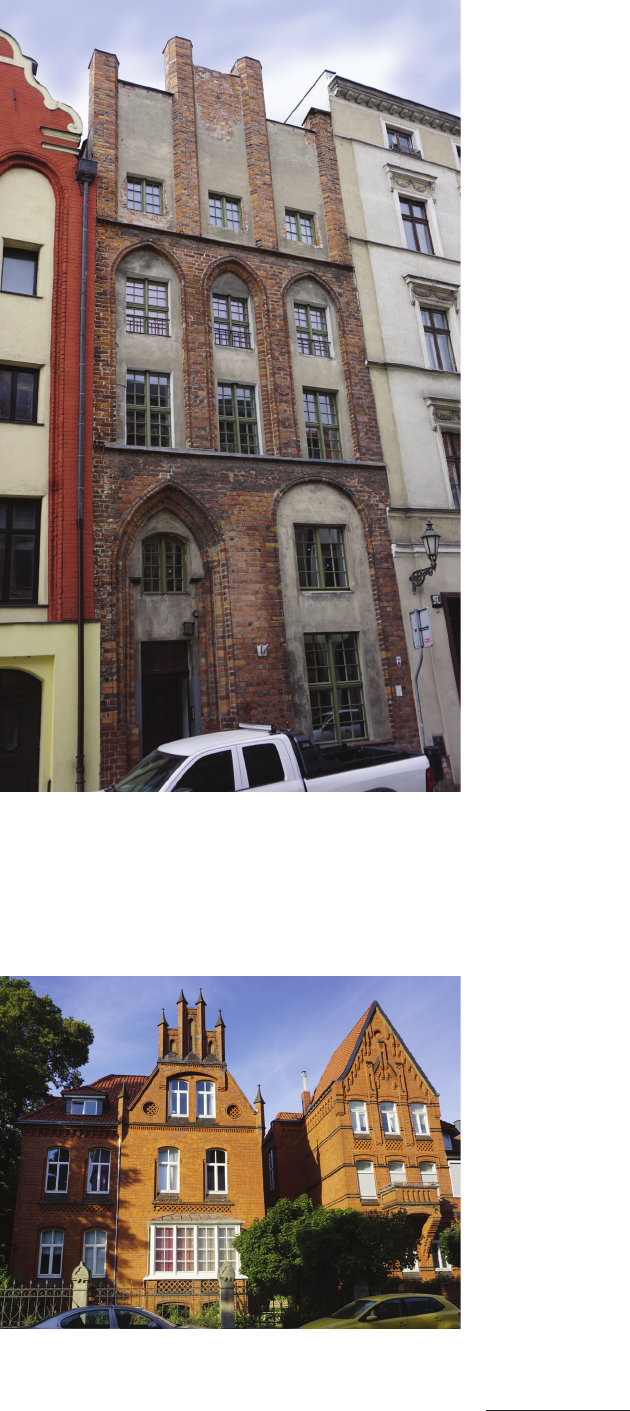
ic” stepped gables, albeit in dierent forms. The corner
building on Warszawska Street has a façade decorated with
ornaments of various origins. The elevations were enriched
with three tall, openwork and plastered, Gothic-style ga-
bles (one on the side of Warszawska Street and two on the
side of Kazimierz Jagiellończyk Street). In addition, sev-
eral window openings were closed with kotar arches. The
façades were asymmetrically composed, with bay windows
and balconies occupying a signicant part of the elevation.
The whole is maintained in the spirit of “picturesque” his-
toricist architecture (Fig. 5). The façade of the smaller sec-
ond, building, at 8 St. Catherine Street, was also composed
asymmetrically, with stylistic forms referring to the Renais-
sance, with a visually rusticated ground oor zone. On the
extreme axis from the north, there is a slightly protruding
risalit with a massive bay window, crowned with a highly
stylised stepped gable.
Elements referring to Gothic architecture can be found
in some of the townhouses located in the medieval town,
built on the site of Gothic houses and rebuilt in subsequent
periods. This group includes the buildings at 6 Sukiennicza
Street and 14 Szczytna Street, the rst of which was rebuilt
in 1878, when the façade was rearranged and the building
was elevated. The façade was divided by at lisens into
four vertical niches containing windows and topped with
an arch in the form of a donkey’s back
10
. A similar solution
was used during the extension of the tenement house at 14
Szczytna Street in 1863
11
. The seven-axial front elevation,
occupying the width of two or even three original plots,
was articulated with vertical recesses covering all residen-
tial storeys. They were separated by proled bands and
closed with curtain arches. On the axis, there is a slightly
protruding risalit, containing the entrance to the building in
the ground oor, over which a wide panel imitating a bal-
cony was introduced.
Examples of the latter group can be found in the mod-
estly decorated tenements of Podgórze, a suburban district
of Toruń, from the 19
th
century. Along the main street,
quite a number of dark red, brick-faced tenements were
built in a modest style, decorated only with friezes of stag-
gered bricks and rows of brick pseudo-consoles under the
eaves. Examples of such designs can be seen at 84 and 105
Poznańska Street. The small tenement house at 30 Parkowa
Street has an interesting form: the façade is articulated with
recesses containing window and entrance openings, closed
with sharp arches. The storeys were separated by a frieze
of staggered bricks, and the entire building was clad in
light-coloured brick.
Townhouses from the 14
th
and 15
th
centuries in Toruń
Gothic architecture developed in Toruń in the 14
th
and
15
th
centuries when the city became a major commercial
9
The building was erected around 1898, designed by H. Rosenau
(Register Card of Architectural and Construction Monuments, from the
collection of the Municipal Conservator in Toruń).
10
APT, A.m.T., ref. G 4414.
11
APT, A.m.T., ref. G 4452.
centre with a population of up to 20,000 (Atlas historyczny
2019, 5, 6). Along the streets of the Old Town, rows of bur-
gher tenements were built to house merchant families. These
three- or four-storey houses were positioned g able-rst
to
wards the street on narrow, deep plots of land. The façades
were elaborately designed to emphasise the owners’ pres-
tige: they featured coloured polychromes, glazed coloured
bricks, mouldings, and articial stone. The high recesses
that articulated the façades were framed by proled bricks
and decorated with geometric patterns reminiscent of those
found on urban buildings. These compositions were paint-
ed in red, white and black (Rymaszewski 1966, 24–30).
A signicant proportion of houses in the present-day Old
Town were made of brick in the late 15
th
century.
Conservation research has identied groups of buildings
with common features, and has even revealed local trends
in façade composition in Toruń around 1400 (Tajchman
2013, 134). The developed tenement type had a façade
divided into three horizontal zones. The rst zone, which
corresponded to a high vestibule, was usually two-axis and
featured a portal containing the entrance, which was topped
with a pointed arch. There was also a window placed in
a niche, which was topped with an arch that resembled
a full arch, and sometimes a segmental arch. The central
zone featured three recesses running through the two sto-
reys and closed with segmental or full arches. Window
openings were placed in the lateral recesses, while blends
were placed on the axis. The nal zone, which crowned the
façade, usually took the form of a stepped gable divided by
blends (Tajchman 2013, 131, 132). While not all tenements
corresponded exactly to this type – some were crowned
with blends or gables closed with an arch – the general
scheme of façade divisions remained similar (Fig. 6).
Fig. 5. Toruń, tenement house at the corner of 10 Warszawska Street
and 8 Kazimierz Jagiellończyk Street, erected around 1898
(photo by D. Bręczewska-Kulesza)
Il. 5. Toruń, kamienica u zbiegu ul. Warszawskiej 10
i ul. Kazimierza Jagiellończyka 8, wzniesiona ok. 1898 r.
(fot. D. Bręczewska-Kulesza)
32 Daria Bręczewska-Kulesza
The Neo-Gothic residential architecture
of the Hanoverian School
Including the architectural centres inuencing the north-
ern regions of the German states, where the Neo-Gothic
style was consistently developed (also in residential archi-
tecture), Hanover comes to the fore
12
. This style emerged
in the mid-19
th
century and had specic characteristics, pri-
marily associated with the work of Conrad Wilhelm Hase.
The master trained generations of architects at the Hanover
Polytechnic School and the later Royal Technical School.
During his long creative period spanning more than half
a century, Hague and his pupils designed many buildings
in northern Germany. Hanover itself saw a particular popu-
larity of Neo-Gothic residential construction (Jäger 2019).
Among Hase’s pupils and followers were architects
spann ing several generations. They constructed numerous
build ings with brick façades adorned with various Gothic-
inspired features, including pointed windows, blends, but-
tresses, vaults, stepped gables, pinnacles, and turrets. They
also used coloured glazed bricks, brick mouldings in var-
ious shapes and sizes, and decorative terracotta elements.
In the spirit of Neo-Gothic, they built many villas, one- or
two-family houses, and tenement houses. Depending on the
investor’s wealth and ambitions, original designs were cre -
ated featuring complex masses with many stylistic and de-
co rative elements, or simple, modest buildings faced with
brick and featuring ascetic medieval-style friezes. This style
originated in Hanover but has spread far beyond the city.
Among the numerous surviving residential buildings in
the Hanoverian School style, many are ne examples of
the genre. Notably, the Hase’s project, completed between
1864 and 1865 for the von Strauß family at Georgstraße
5 in Bückeburg, is one of the most important villas (Kok-
kelink, Lem ke-Kokkelink 1998, 532). Built on a corner
plot, the house has an asymmetrical design and complex
massing, incorporating various architectural features such
as a t errace to the west and a prestigious entrance in the
northern wing. All façades were decorated with proled
and glazed bricks. Of particular interest is the, slender
openwork gable on the Georg straße side, which is decorat-
ed with blind arches, rosettes, and pinnacles.
A complex of similar villas with ornate gables and point-
ed spires, as well as more intricate massing, was built at
Callinstraße 50/48, 46 and 44 in Hanover (Fig. 7), designed
by Otto Goetze in 1890 (Kokkelink, Lemke-Kokkelink
1998, 169; Ness et al. 1983, 111).
Many imposing red-brick townhouses were constructed
in Hanover in the late 19
th
and early 20
th
centuries, lling
the street frontages. A number of smaller, multi-apartment
houses with similar stylistic features were also built during
this period. These buildings, which usually have asymmet-
rical façades, are adorned with numerous architectural ele-
ments and decorations.
The corner house at Bödekerstraße 58, designed by Jo-
hannes Franziskus Klomp (Kokkelink, Lemke-Kokkelink
1998, 193), stands out with its many architectural details
12
The author conducted in-situ research in Hanover in 2023.
Fig. 6. Toruń, Gothic tenement house at 5 Łazienna Street,
erected in the 2
nd
half of the 15
th
century
(photo by D. Bręczewska-Kulesza)
Il. 6. Toruń, gotycka kamienica przy ul. Łaziennej 5,
wzniesiona w 2. połowie XV w. (fot. D. Bręczewska-Kulesza)
Fig. 7. Hanover, villas at Callinstraße 44 and 46, built in 1890
(photo by D. Bręczewska-Kulesza)
Il. 7. Hanower, wille przy Callinstraße 44 i 46, wzniesione w 1890 r.
(fot. D. Bręczewska-Kulesza)
Neo-Gothic in the residential architecture of Toruń – a building tradition or a fashion for historicism? 33
and two high stepped gables. The façade is decorated with
bay windows and balconies, brick openwork ornaments
of specially moulded bricks and glazed brown bricks and
mouldings. These decorate and frame the pointed and seg-
mental windows, cornices and parapets, and above all the
delicate openwork gables.
Another interesting development is the relatively small,
two-storey house at Wilhelm-Busch-Straße 24. Built in
1886 to a design by Ludwig Frühling for Schwarz, the
owner of the factory, it occupies a large corner plot (Neß
et al. 1983, 112). Openwork brick friezes, glazed brown
bricks and green decorative elements with oral motifs
were also employed here. A delicate, high, stepped gable
towers over the entire building (Fig. 8).
An example of a large corner house is the four-storey
building on the corner of Callinstraße and Rehbockstraße.
The building is richly decorated with glazed brick orna-
ments and full-length sculptures representing allegories of
art, placed in niches (Fig. 9). The corner is emphasised by
a large bay window, which is topped by a tall tower. Con-
struction of the building was completed between 1894 and
1895 and it was designed by Friedrich Wedel (Neß et al.
1983, 108).
Hanover also saw the construction of a number of brick-
faced townhouses with simple facades, with evenly spaced
windows, varied only by modest brick friezes in forms remi-
niscent of the Middle Ages and narrow bands of glazed brick.
Conclusions
A comparative stylistic analysis of the composition of
the façades of the rst group of Neo-Gothic townhouses
and villas, which made comprehensive reference to Gothic
patterns, with Toruń’s medieval townhouses and with resi-
dential buildings in Hanover, has shown that similar forms
and motifs to those used by the Hanoverian School were
employed in Toruń. The façades of Toruń’s Gothic houses
were clearly divided into three zones with simpler deco-
rative forms. The composition of the façades of the rst
group of Neo-Gothic buildings was asymmetrical (with the
exception of the tenement in Szeroka Street) and incorpo-
rated many architectural elements, such as bays, risalits,
balconies and turrets. Common to Gothic and Neo-Gothic
townhouses was the nishing of the façade with red bricks
(in the case of one villa with yellow bricks), the use of co-
loured glazed bricks (in Gothic buildings this was done
sporadically) and a variety of proled bricks. In the Gothic
façades these were mainly found in the framing of openings
and recesses, in the Neo-Gothic façades also to emphasise
architectural elements, cornices and decoration. The ni-
als with stepped gables were also solved dierently than
in Gothic buildings. The Gothic gables were more austere
with painted recesses, while the Neo-Gothic ones featured
pinnacles, glazed bricks, and were openwork and spacious.
In addition, façades from the 19
th
century featured open-
work friezes made of shaped bricks, brick arcade friezes
and cube friezes – elements characteristic of architecture
inuenced by the Hanoverian School.
Nineteenth-century tenement houses were built on wide
plots, resulting in a dierent façade composition to that of
Fig. 9. Hanover, townhouse at Callinstraße 4/Rehbockstraße,
erected in 1894–1895 (photo by D. Bręczewska-Kulesza)
Il. 9. Hanower, kamienica przy Callinstraße 4/Rehbockstraße,
wzniesiona w latach 1894–1895 (fot. D. Bręczewska-Kulesza)
Fig. 8. Hanover, house at Wilhelm-Busch-Straße 24, erected in 1886
(photo by D. Bręczewska-Kulesza)
Il. 8. Hanower, dom przy Wilhelm-Busch-Straße 24,
wzniesiony w 1886 r. (fot. D. Bręczewska-Kulesza)
narrow medieval houses. Of these houses, only the one in
Szeroka Street, which was built on a narrow plot corre-
sponding to medieval parcel divisions, retained the general
features of Gothic compositions, such as a tripartite divi-
sion of the façade with a two-storey central part, a predomi-
nance of vertical lines, and a symmetrical design. However,
the addition of balconies, bay windows and Neo-Gothic
styling reects new trends.
34 Daria Bręczewska-Kulesza
The second group of buildings, featuring elements rem-
iniscent of Gothic architecture, reected the contemporary
fashion for “picturesqueness”. The design of the building
at the intersection of Warszawska and Kazimierz Jagiel-
lończyk Streets was created by Berlin architects Hermann
Solf and Franz Wichards, who also designed almost the
entire western frontage of Kazimierz Jagiellończyk Street.
This type of solution can be found in the work of other
leading Berlin architects, such as Alfred Messel (Berlin und
seine Bauten, 1896, 216–217).
Other forms were used in the tenements on Sukienni-
cza and Szczytna Streets. The division into vertical panels
may have referred to burgher houses in Toruń, where it oc-
curred, but from the second storey onwards. However, the
“donkey’s back” or curtain arch nials used here are not
known from Toruń. Whether this is a deliberate reference
to late Gothic architecture or merely a coincidental stylisa-
tion is dicult to determine at present. This is a subject for
a separate, detailed study.
The third group comprises buildings with modest and
unremarkable designs, which can be found in many cities.
Such designs were often recommended to less auent cli-
ents in pattern books and architecture textbooks.
Analysing the historical context has enabled us to
study how the importance of Gothic tenements changed
in Toruń’s residential development in the 19
th
century. The
city was a large, prosperous centre in the Middle Ages,
wealthy enough for independent local housing trends to
emerge, as research has shown. Wealthy merchants built
residences here to demonstrate their wealth and the reliabil-
ity of their businesses. Subsequent eras have left their mark
on Toruń’s Gothic tenements, with many of them being
rebuilt. In the 16
th
century, the upper storeys were no lon-
ger used for storage and the façade decoration was altered.
During the Baroque period, Toruń’s tenement façades were
enriched with stucco decorations featuring oral motifs and
Italian stylistic elements.
In the 19
th
century, Toruń was a medium-sized provincial
town. Although it developed slowly, demographic growth
continued to create an increased demand for housing. Fur-
thermore, the city was enclosed by fortications for a long
time, which hindered urban development. Many dilapidat-
ed buildings were demolished. New, larger houses were
then built on connected plots of land in their place. A lack
of legal protection for townhouses, coupled with economic
factors, led to the conversion of numerous buildings with
Gothic origins. The demand for rental housing and com-
mercial premises led to conversions and alterations. Of the
few surviving tenements, some made distant references
to their medieval predecessors (Prarat, Zimna-Kawecka
2020, 19–21). According to Rymaszew ski (1966, 112),
several dozen historic tenements were signicantly rebuilt
at this time. In terms of functionality, the Gothic tenements
were not suitable for conversion into comfortable, modern
dwellings that met 19
th
-century standards. Consequently,
the historic bourgeois tenement houses in Toruń were not
valued by the city’s residents at the time. They were not
particularly suited to modernisation, and most were in poor
condition. Unsurprisingly, Neo-Gothic was not popular in
the town that is now considered a centre of Gothic archi-
tecture. In the eyes of its 19
th
-century inhabitants, it can
be assumed that the rebuilt and dilapidated townhouses
were not attractive models to follow, unlike the works of
the Hanoverian school. Today, after years of research and
ongoing restoration work, the town presents a very dier-
ent image.
The following questions remain: what were the reasons
behind investors choosing Neo-Gothic stylisations and
where did these patterns come from? As previously men-
tioned, original Neo-Gothic designs among Toruń’s resi-
dential buildings were few and far between. Both Gothic
and 19
th
-century buildings served a representative function,
but other stylistic forms were considered more represen-
tative in both periods, hence the Neo-Gothic inspirations.
The investor who opted for this style probably wanted to
make his house stand out from the surrounding buildings.
This was successful, as evidenced by the reaction of the
local press (Pszczółkowski 2021, 274, 275).
Who were the investors? The tenement house at 15 Sien-
kiewicz Street belonged to Georg Soppart, a master mason
and construction entrepreneur who was active in Toruń.
It undoubtedly served as a showcase for his company.
Georg Plehwe, also a master mason, owned the villa at 85
Krasiński Street. The building’s original form showcased
the contractor’s skills. The most subdued of the described
properties, the villa at 4 Sienkiewicz Street, belonged to
Emil Dietrich, a town councillor and owner of a large
family trading company. The last property was owned by
Daniel Sternberg, a merchant. The building, with its exten-
sive shop and warehouse spanning the entire ground oor,
was a striking feature of the Szeroka Street development,
attracting customers with its unusual façade. All of the in-
dividuals mentioned were active participants in public life,
embracing a broad-minded approach, and were likely to
have recognised attractive architectural trends. Residents
of Toruń maintained close ties with Berlin, which, as the
capital at the time and a thriving architectural centre, was
a place where emerging trends intersected and compet-
ed. They probably travelled there “on business”, viewing
buildings and occasionally commissioning projects. Local
architects and builders were also members of nationwide
associations of engineers, architects, and builders. This al-
lowed them to follow the works of their colleagues in other
cities and regions.
In addition, the new Toruń post oce building was con-
structed in the early 1880s, on the market frontage. The
building’s design was created by Johannes Otzen, an ar-
chitect who was already working in Berlin at the time. He
was a graduate of the Hanoverian School and a pupil of
Hase (Kucharzewska 2002, 90). The post oce building
aroused great interest and could have inspired Neo-Gothic
designs. One such unrealised project was a tenement house
commissioned from Otzen by winemaker Johann Schwartz
and planned for Chełmińska Street (Pszczółkowski 2021,
275; Kucharzewska 2002, 89). As the architect wrote in the
Deutsche Bauzeitung (Otzen 1881, 580), the tenement’s
layout was designed in the Hanoverian style, analogous to
the forms of the post oce building.
The other most common route of pattern penetration
was through the professional press and building hand-
Neo-Gothic in the residential architecture of Toruń – a building tradition or a fashion for historicism? 35
books
13
. One example of the dissemination of brick ar-
chitecture patterns is Bernhard Liebold’s manual Ziegel-
rohbau (1891), containing examples of both elements and
architectural details commonly used in private Neo-Gothic
developments. A number of architectural and building mag-
azines also reached Toruń, such as the Berlin-based Zentr-
alblatt der Bauverwaltung and the Zeitschrift für Bauwesen
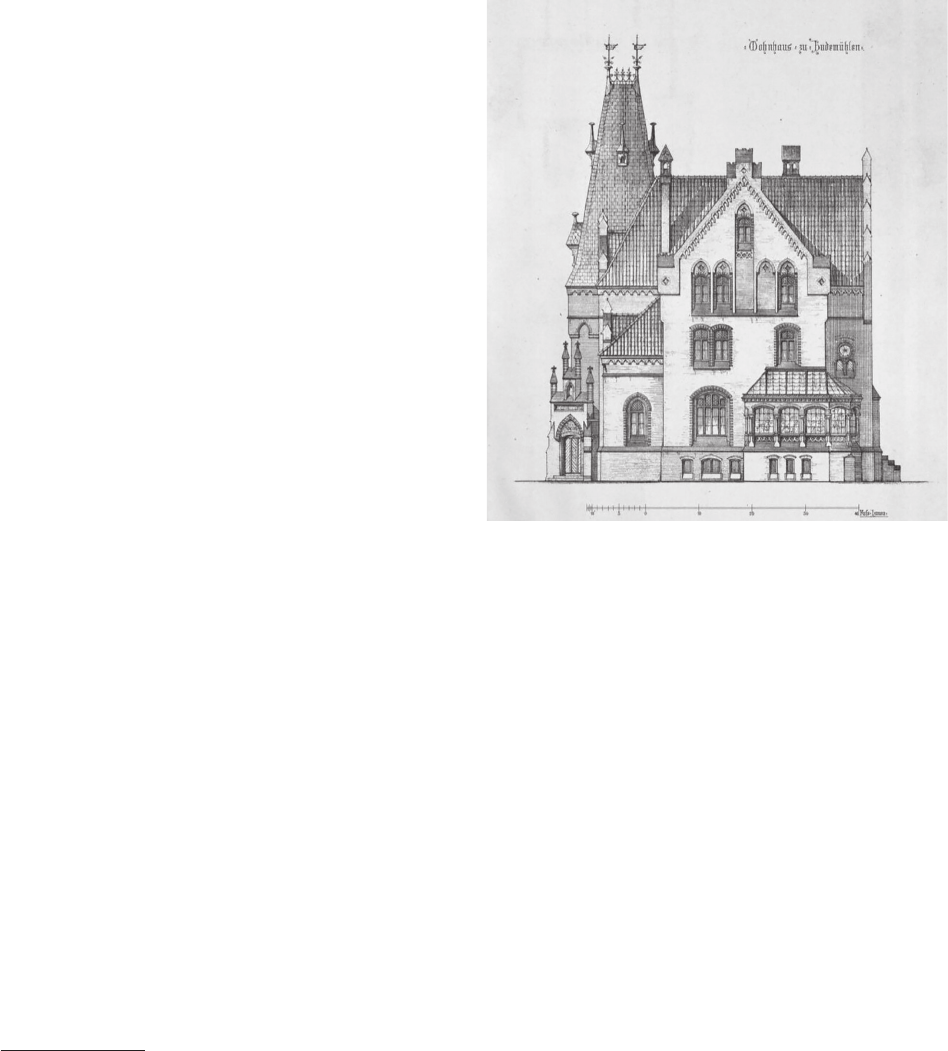
published by the Ministry of Public Works. Two Hannover
titles were also well known in the building community: the
Zeitschrift des Architekten- und Ingenieur-Vereins zu Han-
nover (Fig. 10), published between 1851 and 1921
14
, and
the Deutsche Bauhütte, published between 1897 and 1942,
showing various Neo-Gothic realisations.
It is unlikely that patterns from the Hanoverian Neo-
Goth ic school reached Toruń directly through personal
con tacts between architects, builders and investors. Instead,
the press and publications promoting this style, which was
in teresting and unique in Toruń and its neighbouring cit-
ies, were used. It should also be noted that architects and
builders working in the 2
nd
half of the 19
th
century were
highly educated and familiar with various forms of historic
ar chitecture. This meant they could design façades in die -
rent styles depending on investors’ needs. The Toruń reali-
sa tions feature a variety of details and architectural forms
in spired by the Hanoverian school, which were translated
into the architects’ own designs thanks to the multiplicity of
forms and variety of compositions available.
Summary
Considered the German national style, Neo-Gothic was
mainly used in public architecture and was not very popu-
lar in residential architecture. There were fewer realisations
of this style than of Neo-Renaissance or Neo-Baroque. In
Toruń, a city with a tradition of Gothic buildings, there were
only a few Neo-Gothic buildings, but they stood out from
the more typical architecture. These buildings required
more work and were probably more expensive to construct.
Local residential buildings from the Gothic period of the
19
th
century were often in poor condition due to numerous
alterations, and many had lost their distinctive Gothic char-
acteristics. Additionally, the dimensions of buildings, the
13
E.g., Handbuch der Architektur, 1880–1943, Technische Uni-
versität Darmstadt; L. Klasen, Gebäude für Kunst und Wissenschaft:
Handbuch für Baubehörden, Bauherren, Architekten, Ingenieure, Bau-
meister, Bauunturnehmer, Bauhandwerker und technische Lehranstal-
ten, Leipzig 1887.
14
Since 1896 Zeitschrift für Architektur und Ingenieurwesen.
shapes of blocks and the proportions of façades from that
time were dicult to translate into a new formal language.
Therefore, motifs from monumental buildings were used
instead, incorporating them into the massing of 19
th
-cen-
tury townhouses or villas and drawing inspiration from the
details and architectural elements promoted by the Hanove-
rian school.
Toruń’s examples of tenement houses and villas in the
spirit of Neo-Gothic were constructed at the turn of the 19
th
and 20
th
centuries, and were thus associated with the fash-
ionable “picturesque” historicist style of the time. While
they are certainly interesting examples of architectural
trends, which were numerous at the turn of the century,
they are also important for the history of the city and its
society. Perhaps because of the relatively small number of
realisations, Neo-Gothic in residential architecture has not
received much attention from researchers. It is a shame, as
an analysis of this topic carried out in dierent urban cen-
tres would probably yield interesting results.
Fig. 10. Conrad Wilhelm Hase. “Wohnhaus zu Hudemülen”,
building design, façade (source: Zeitschrift des Architekten-
und Ingenieur-Vereins zu Hannover, t. 17 (1871): 501)
Il. 10. Conrad Wilhelm Hase. “Wohnhaus zu Hudemülen”,
projekt budynku, fasada (źródło: Zeitschrift des Architekten-
und Ingenieur-Vereins zu Hannover, t. 17 (1871): 501)
Acknowledgements
This article was realised with funding from the Lanckoronski Foundation,
project no. 307, and Bydgoszcz University of Science and Technology.
36 Daria Bręczewska-Kulesza
Streszczenie
Neogotyk w architekturze mieszkalnej Torunia – tradycja budowlana czy moda na historyzm?
W artykule poruszono problem źródeł i wzorców dla neogotyku w architekturze mieszkalnej XIX i początku XX w. na przykładzie Torunia. Przed-
miotem badań były nieliczne przykłady kamienic i willi toruńskich w duchu neogotyku. Celem rozważań było ustalenie wpływów lokalnej tradycji
budowalnej i XIX-wiecznych wzorów neogotyckich na realizacje toruńskie z tego okresu. Przeprowadzono stylistyczną analizę porównawczą toruńs-
kich budynków mieszkalnych z XIX w. z kamienicami mieszczańskimi w tym mieście oraz neogotyckimi budynkami szkoły hanowerskiej, najbardziej
wpływowej na tych terenach. Przeanalizowano również kontekst historyczny. Dociekania zostały oparte na przeprowadzonych przez autorkę badaniach
in situ w Toruniu i Hanowerze.
Badania doprowadziły do wniosku o dominacji zewnętrznych wpływów. Wzorce lokalnego budownictwa mieszkalnego z okresu gotyku nie nada-
wały się funkcjonalnie do przetworzenia na nowy język form, dlatego raczej wykorzystywano motywy z budowli monumentalnych, wpasowując je
w bryły XIX-wiecznych kamienic czy willi przy użyciu gotowych wzorów szkoły hanowerskiej.
Słowa kluczowe: Toruń, neogotyk, architektura mieszkalna w XIX w.
References
Atlas historyczny miast polskich, t. 1: Prusy Królewskie i Warmia, z. 8
Toruń, edited by Roman Czaja and Radosław Golba. Towarzystwo
Naukowe w Toruniu, 2019.
Berlin und seine Bauten. Vol. 3: Bauwerke für Regierung und Verwaltung,
edited by Ernst Heinrich and Klaus Konrad Weber. Ernst & Sohn,
1896.
Jäger, Markus. “Hannoversche Schule und/oder Hase-Schule? Akade-
mische Selbstbehauptung in Zeiten preußischer Annexion.” In Con -
rad Wilhelm Hase (1818–1902). Architekt, Hochschullehrer, Konsis-
torialbaumeister, Denkmalpeger, edited by Markus Jäger, Thorsten
Albrecht and Jan Willem Huntebrinker. Michael Imhof Verlag, 2019.
Kokkelink, Günther, and Monika Lemke-Kokkelink. Baukunst in Nord-
deutschland. Architektur und Kunsthandwerk der Hannoverschen
Schule 1850–1900. Schlüteresche, 1998.
Kucharzewska, Joanna. Architektura i urbanistyka Torunia w latach
1871–1920. Neriton, 2004.
Kucharzewska, Joanna. “Budynek poczty głównej w Toruniu jako przy -
kład architektury historyzmu.” Acta Universitatis Nicolai Copernici.
Nauki Humanistyczno-Społeczne. Zabytkoznawstwo i Konserwator-
stwo, z. 33 (2002): 79–112.
Liebold, Bernhard. Ziegelrohbau. Taschenbuch für Bauhandwerker.
C.C. Müller, 1891, cz. 1.
Nawrocki, Zbigniew. Historyczne kamienice w Toruniu. Gotyk. Firma Fo-
tograczno-Wydawnicza Photo Studio WM, 2016.
Neß, Wolfgang, Ilse Rüttgerodt-Riechmann, Gerd Weiß, and Marianne
Zehn pfennig. Denkmaltopographie Bundesrepublik Deutschland.
Bau denkmale in Niedersachsen. Stadt Hannover. Friedr. Vieweg
&Sohn, 1983, vol. 10/1.
Otzen, Johannes. “Haus Schwartz in Thorn.” Deutsche Bauzeitung 15,
no. 103 (1881): 580–1.
Prarat, Maciej, and Karolina Zimna-Kawecka. “Ochrona konserwa torska
kamienic w Toruniu – analiza 100 lat doświadczeń i prog nozy.” Wia-
domości Konserwatorskie, nr 63 (2020): 17–32. https://doi.org/
10.48234/WK63TORUN
Pszczółkowski, Michał. Toruńska kamienica czynszowa w latach 1850–
1914. Towarzystwo Naukowe w Toruniu, 2021.
Rymaszewski, Bohdan. O przetrwanie dawnych miast. Arkady, 1984.
Rymaszewski, Bohdan. “Problematyka konserwatorska toruńskich ka-
mienic mieszczańskich.” Zeszyty Naukowe UMK. Zabytkoznawstwo
i Konserwatorstwo 1, z. 16 (1966): 111–49.
Rymaszewski, Bohdan. Toruń w czasach Kopernika. Urbanistyka, ar-
chitektura, sztuka. Towarzystwo Naukowe w Toruniu, 1969.
Szot, Joanna. “Pierzeje Rynku Nowomiejskiego w Toruniu – historia
przekształceń.” Rocznik Toruński, nr 34 (2007): 7–40. Accessed May
19, 2024, at https://bazhum.muzhp.pl/media/les/Rocznik_Torunski/
Rocznik_Torunski-r2007-t34/Rocznik_Torunski-r2007-t34-s7-40/
Rocznik_Torunski-r2007-t34-s7-40.pdf.
Tajchman, Jan. “Toruńskie elewacje w typie tzw. Domu Kopernika.” In
Stare i nowe dziedzictwo Torunia, edited by Juliusz Raczkowski. Wy-
dział Sztuk Pięknych UMK, 2013.
Zeitschrift des Architekten – und Ingenieur- Vereins zu Hannover, t. 17
(1871): 501, Münchener DigitalisierungsZentrum, https://www.digi-
tale-sammlungen.de/en/view/bsb10933658?page=,1.
Zimnowoda-Krajewska, Bożena. “Toruńska kamienica czynszowa prze-
łomu XIX–XX wieku na wybranych przykładach.” Materiały do
Dzie jów Kultury i Sztuki Bydgoszczy i Regionu, z. 6 (2001): 192–201.