
2019
2(58)
DOI: 10.5277/arc190212
Julia Wronkowska*
Pozawzrokowe doświadczanie przestrzeni
a problem deprywacji sensorycznej
współczesnego środowiska zurbanizowanego
Non-visual experience of space
and the problem of sensory deprivation
in contemporary urbanized environment
Wprowadzenie
Przybliżając tematykę niniejszych rozważań, należy
wyjaśnić, czym jest tytułowa deprywacja sensoryczna
i jaki jest jej zakres w przedstawianych badaniach. Ter
min deprywacja wywodzi się z łacińskiego słowa d e-
priva re, co dosłownie oznacza pozbawiać. W aspekcie
psy chologicznym deprywacja to stan psychiczny wyni
kający z bra ku zaspokojenia jakiejś istotnej potrzeby
człowieka – biologicznej, sensorycznej, emocjonalnej,
kulturowej czy społecznej [1]. Współczesna kul tura
opar ta na wizualnych doznaniach sprawia, że nasza natu
ralna, wielo zmy słowa percepcja zostaje przytłumiona.
Okulo cen tryczna postawa została tak silnie zakorzenio
na w naszej świadomości, że nawet nie zastanawiamy się
nad bogactwem doznań pozawzrokowych. Problem po
głębia się z powodu negatywnych bodźców doświadcza
nych w środowisku miejskim. Miasto często staje się op
resyjne wobec mieszkańców, czego skutkiem jest izolacja
i stłu mienie doz nań este tycznych. Przykłady można mno
żyć – zanieczyszczenie hałasem ulicznym, spalinami,
nadjeżdżające zewsząd
samochody, krzykliwe reklamy
bombardujące naszą wraż li wość estetyczną. Współ czes ne
Introduction
In order to introduce the subject of these considera
tions, we need to explain the significance of sensory depri
vation as it is mentioned in the title and what its scope is
in the presented study. Etymology of the term depri va tion
derives from the Latin word deprivare, which lite rally
means to deprive. In the psychological aspect, de privation
is a mental state resulting from the lack of sa tisfaction of
an essential human need, i.e. biological, sensory, emoti o
nal, cultural or social [1]. Modern culture which is based
on visual experience makes our natural and multisensory
perception subdued. The oculocentric attitude has taken
root in our consciousness so deeply that we do not even
consider the richness of beyond visual experiences. This
is even getting more problematic due to negative stimuli
experienced in the urban environment. The city often be
comes oppressive towards its inhabitants, which results in
isolation and suppression of aesthetic experiences.
Examples can be multiplied – pollution from street noise,
exhaust fumes, cars coming from every side and all over
the place, flashy billboard advertisements bombarding
our aesthetic sensitivity. A modern city is a city of alien
ation rather than an integral one with which we can iden
tify as people. Nowadays, in the flood of irritating stimu
li, man withdraws from the world, instead of being its
continuum. Subconsciously, man learns to be beyond all
this and not to hear the noise, does not see an excess of
* ORCID: 0000000332280978. Wydział Architektury Poli
techniki Gdańskiej/Faculty of Architecture, Gdańsk University of Tech
nology.

148 Julia Wronkowska
miasto jest raczej miastem alienacji niż miastem integ
ralnym, z którym możemy utożsamiać się jako ludzie.
Obec nie w natłoku drażniących bodźców człowiek wyco
fuje się ze świata, zamiast być jego continuum. Pod
świadomie uczy się wyłączać i nie słyszeć hałasu, nie
widzi nadmiaru kon sumpcyjnych środków wyrazu i staje
się zwyczajnie obo jętny na doznania estetyczne. Ten wła
śnie brak integralnoś ci z przestrzenią za pomocą zmy słów
został przez autorkę określony deprywacją sensoryczną.
W opozycji do takiego zjawiska stoi wielozmysłowe,
emocjonalne doświadczanie świata. Jest ono możliwe
w mieście haptycznym – jak nazwał je Juhani Pallasmaa
– mieście wnętrza i bliskości. W swojej książce Oczy skó-
ry zestawił on miasto uczestnictwa (zaangażowania sen
sorycznego) i miasto alienacji (współczesne miasto de
prywacji sensorycznej) [2].
Wartość pozawzrokowego – a co za tym idzie emocjo
nalnego – odbioru przestrzeni szczególnie ujawnia się
w przypadku osób niewidomych i osób z dysfunkcją
wzroku. Osoby te szczególnie odbierają wszystkie po
zawzrokowe wyróżniki miasta. Nawet częściowa utrata
wzroku pociąga za sobą wiele konsekwencji, które szcze
gólnie wyróżniają się w sferze fizycznej, społecznej i psy
chicznej. Tyflorehabilitacja to szeroko pojęta dziedzina,
której celem jest rozwiązywanie problemów, jakie towa
rzyszą osobom niewidomym. Jak zauważa Agnieszka
Kłopotowska, na przebieg i postęp terapii bardzo duży
wpływ ma przyjazne środowisko życia. W proces tyflore
habilitacji włączają się interdyscyplinarne zespoły ofe
rujące swoją wiedzę i poszukujące narzędzi rozwijają
cych tę dziedzinę. Zdaniem Kłopotowskiej architektura,
jak żadna inna dziedzina […] uczy dostrzegać, rozumieć
i wra żliwie przeżywać złożoną naturę przestrzeni [3,
s. 12]. Nie ma wątpliwości, iż jest to dyscy plina, która
może przyczynić się do rozwiązania wielu problemów
natury tyflologicznej. Należy zwrócić uwagę, że działal
ność artystyczna, a także odbiór estetyczny przestrze
ni ma ogromne znaczenie w kształtowaniu prawidłowej
postawy społecznej i walkę z poczuciem wykluczenia.
Nie mniej jednak problem deprywacji sen sorycznej we
współczesnej architekturze i przestrzeni ma negatywny
wpływ na jakość życia wszystkich jej użytkowników.
Warto zatem nakreślić tło okulocentrycz nej kultury
w ponowoczes nym świecie, a następnie znaleźć rozwią
zanie współczes nej deprywacji sensorycznej, definiując
źródła emocjonalnego doświadczania przestrzeni.
Deprywacja sensoryczna
w ponowoczesnej rzeczywistości
Homogenizacja środowiska przestrzennego
w okresie modernizmu
Analizując czasy modernizmu, należy pamiętać, że
mo dernizm nie był stylem architektonicznym. Nowo
czesność była zmianą sposobu myślenia o konotacji nor
matywnej, czyli mówiącej, jak należy postępować. Od jej
nastania dyskurs architektoniczny nie dotyczy już samej
formy, ale bardziej zjawisk społecznych, jakie generuje.
Moderniści, projektując miasto i architekturę, projekto
consumerist means of expression and becomes simply in
different to the aesthetic experiences. This lack of integ
rity with space by means of senses was defined by the
author as sensory deprivation. In opposition to such a phe
nomenon, there is a multisensory and emotional expe
rience of the world. It is possible in a haptic city – as
Juha ni Pallasmaa called it – a city of interior and close
ness. In his book Oczy skóry (The Eyes of the Skin), he
compared the city of participation (sensory involvement
or engagement) and the city of alienation (a modern city
of sensory deprivation) [2].
The value of beyond visual – and thus emotional – per
ception of space is particularly evident in the case of blind
people and people with sight dysfunctions. These people
especially receive all nonvisual distinguishing features
of the city. Even a partial loss of sight entails many con
sequences which are particularly prominent in the physi
cal, social and mental spheres. Typhlorehabilitation is
a widely understood field of study the purpose of which
is to solve problems that accompany blind people. As
Agnieszka Kłopotowska notices, the course and progress
of the therapy is strongly influenced by a friendly living
environment. In the process of typhlorehabilitation, inter
disciplinary teams that offer their knowledge and seek
tools developing this field of study are involved.
According to Kłopotowska, architecture, like any other
field […] teaches us to perceive, understand and sensi-
tively experience the complex nature of space [3, p. 12].
There is no doubt that this is a discipline that can contrib
ute to the solution of many problems of a typhlologic
type. Attention should be drawn to the fact that artistic
activity as well as aesthetic perception of space is of great
importance in shaping the right social attitude and fight
ing the sense of exclusion. Nevertheless, the problem of
sensory deprivation in modern architecture and space has
a negative impact on the quality of life of all its users. It
is therefore worth presenting the background of oculocen
tric culture in the postmodern world and then finding
a solution to contemporary sensory deprivation, defining
the sources of the emotional experience of space.
Sensory deprivation in postmodern reality
Homogenization of the spatial environment
in the period of modernism
When analyzing the times of modernism, it should be
remembered that modernism was not an architectural
style. Modernity was a change in the way of thinking
about normative connotation, that is, how to proceed.
Since its occurrence, an architectural discourse has not
been concerned with the form itself, but it is more about
the social phenomena it generates. By designing a city
and architecture, modernists designed the human life. It
was an attempt at creating conditions for the development
of a modern and democratic society. According to Jürgen
Habermas, the modernism project in this sense is an un
finished project and it should be continued. It should be
critically assessed and reconstructed, but not aban
doned (after: [4]). The author’s intention is not to criticize
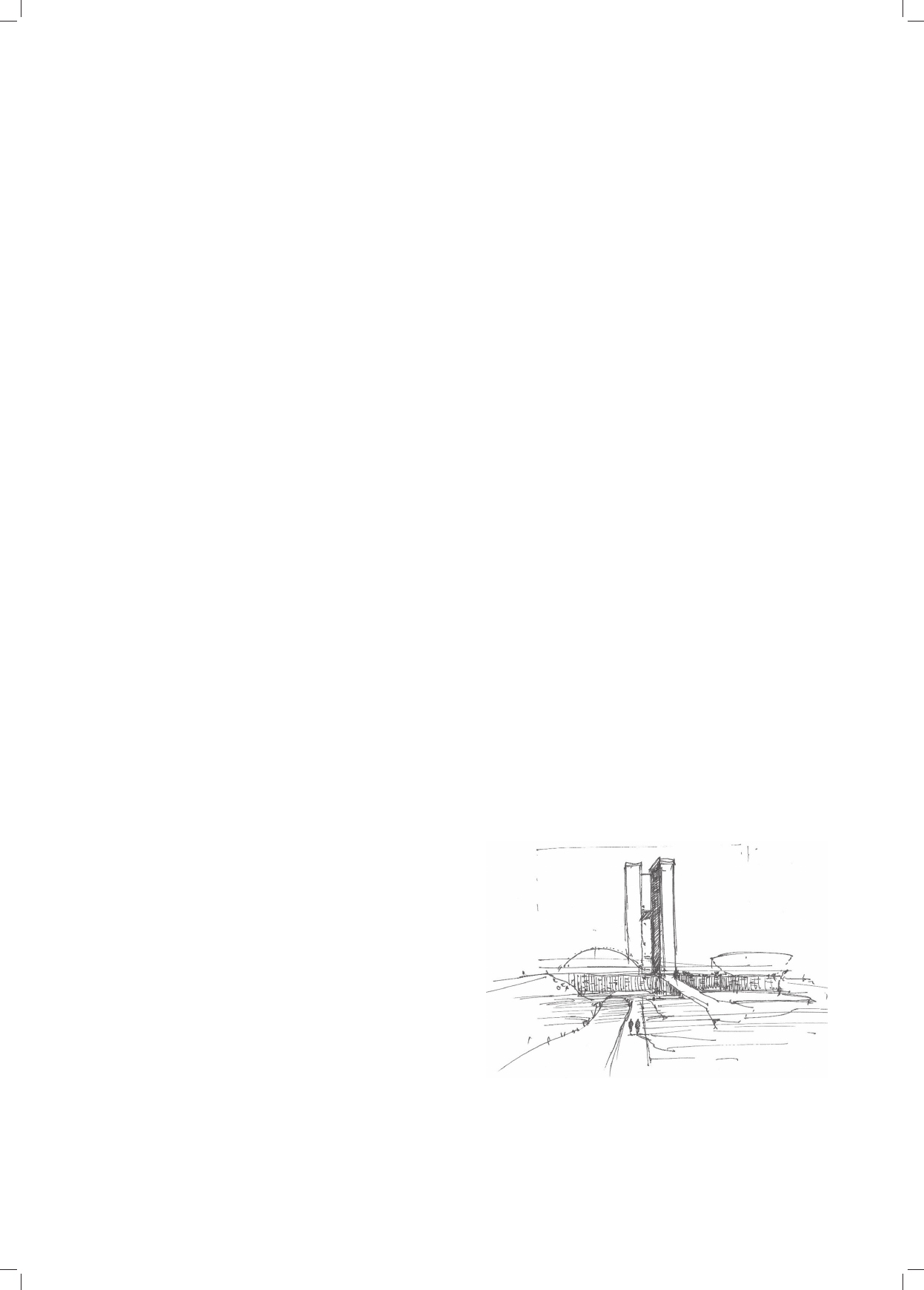
Pozawzrokowe doświadczanie przestrzeni /Non-visual experience of space 149
wali ludzkie życie. Była to próba stworzenia warunków
do rozwoju nowoczesnego i demokratycznego społeczeń
stwa. Zdaniem Jürgena Habermasa projekt moderniz
mu w tym znaczeniu jest projektem niedokończonym
i należy go kontynuować. Należy go krytycznie oceniać
i rekonstruować, ale nie porzucać (za: [4]). Intencją autor
ki nie jest krytyka bądź pochwała architektury tego okre
su, a jedynie próba zbadania współczesnej architektury
pod kątem deprywacji sensorycznej, której podłoża moż
na upatrywać w instrumentalnym podejściu do potrzeb
człowieka w XX w.
Ówczesne zasady projektowania urbanistycznego mia
ły być odpowiedzią na coraz gorsze warunki sanitarne.
Postulaty Karty Ateńskiej z 1933 r. zakładały przede
wszystkim strefowanie funkcjonalne planów miast. Strefy
te miały być połączone osiami komunikacyjnymi, oddzie
lonymi od nich pasami zieleni. Zbyt ortodoksyjne stoso
wanie się do powyższych zaleceń doprowadziło do dys
persji struktury miejskiej, wzmożonych przemieszczeń
ludności pomiędzy strefami oraz dezintegracji społecznej
mieszkańców. Skrajnym przykładem jest Brasilia, miasto
zaprojektowane dla samochodów, a nie dla ludzi. W mie
ście tym najlepiej żyje się niewielkiej liczbie mieszkań
ców w centrum, pozostała zaś część ludności wegetuje
w slumsach. Przestrzenie zielone między przeskalowany
mi budynkami odstraszają i nikt w nich nie spędza wolne
go czasu. Zbyt duże odległości między poszczególnymi
strefami powodują wzmożony ruch samochodowy. Bra
silia jest więc miastem pustki w kontekście przestrzeni
publicznych i parków. Jedynie ulice są pełne samocho
dów. Architektura modernizmu miała bardzo wzniosłe
cele. Można jednak powiedzieć, że zapomniano w niej
o ludzkiej wrażliwości i o subtelnych wrażeniach wielo
zmysłowych. Zbytni monumentalizm niezgodny z ludzką
skalą oraz duże odległości pomiędzy budynkami skutkują
poczuciem izolacji i pustki (il. 1). Dodatkowo, całkowicie
porzucając ornament, zrezygnowano z pewnego rodzaju
taktylności wzrokowej. Kiedy ściana nie jest zupełnie
płaska i pokryta tynkiem, możemy w pewien sposób „do
tykać” jej wzrokiem i doświadczać za po mocą pamięci
mięśniowej. Nasza skóra bowiem od dzieciństwa pamięta
dotyk kształtów i faktur. Jeżeli brakuje połączenia archi
tektury także z ciałem (nie z samym wzrokiem), to zaczy
na ona źle oddziaływać na naszą psychikę.
Modernizm był projektem, w którym wierzono, że za
pomocą nauki można odpowiedzieć na wszystkie ludzkie
potrzeby. Założenie to było jednak utopią. Każdy jest bo
wiem inny. Moderniści natomiast chcieli odpowiedzieć
na potrzeby wszystkich ludzi, co w konsekwencji wiązało
się z uprzedmiotowieniem człowieka, sprowadzeniem go
do fizjologicznych procesów i standaryzacji. W swoim
studium o przestrzeni architektonicznej Augustyn Bańka
zwraca na to uwagę, opisując „Modulora Le Corbusie
ra”. Był to uniwersalny wzorzec człowieka pozbawiony
oso bo wości oraz uwarunkowań kulturowych [5]. Projek
to wanie według takich założeń – wedle „człowieka prze
ciętnego” – doprowadziło w architekturze do daleko idą
cego racjonalizmu technologicznego i funkcjonalnego, do
standaryzacji, umasowienia i homogenizacji środowiska
przestrzennego.
or praise the architecture of this period, but to attempt
to study modern architecture in terms of sensory depri
vation, the foundation for which can be seen in the instru
mental approach to the needs of the 20
th
century hu
man being.
The then principles of urban design were supposed to
be a response to the increasingly poor sanitary conditions.
The demands of the Athens Charter of 1933 primarily in
volved functional zoning of city plans. These zones were
to be connected by communication axes and separated
from them by green belts. Strict orthodox compliance
with the abovementioned recommendations led to the
dispersion of the urban structure, increased population
displacement between zones and social disintegration of
inhabitants. An extreme example here is Brasilia, a city
designed for cars, not for people. In this city, a small num
ber of residents live comfortably in the centre, whereas
the remaining part of the population vegetate in slums.
Green spaces between overscaled buildings deter people
from spending their free time there. Too large distances
between particular zones result in increased car traffic.
Brasilia is therefore a city of emptiness in the context of
public spaces and parks. Only streets are full of cars. The
architecture of modernism had very lofty goals, however,
it can be said that human sensitivity and subtle multisen
sory impressions were forgotten. Excessive monumental
ism which is incompatible with a human scale and long
distances between buildings result in the sense of isola
tion and emptiness (Fig. 1). Moreover, by completely de
parting from the ornament, some kind of visual touch (or
tactileness) was abandoned. When the wall is not com
pletely flat but is covered with plaster, we can in some
way “touch” it with our eyes and experience it by means
of the muscle memory. Our skin has remembered the
touch of shapes and textures since childhood. If there is
no connection between architecture and the body (not
only with the sight itself), then architecture begins to have
a bad influence on our psyche.
Il. 1. Brazylijski parlament autorstwa architekta Oscara Niemeyera
– szkic pokazujący ludzką skalę w architekturze modernizmu
(rys. J. Wronkowska)
Fig. 1. Brazilian parliament by architect Oscar Niemeyer
– a sketch showing the human scale in the architecture of modernism
(drawing by J. Wronkowska)

150 Julia Wronkowska
Przesyt wizualny w kulturze postmodernistycznej
i potrzeba poszukiwania
pozawzrokowych wyróżników architektury
W odpowiedzi na negatywne skutki modernizmu i na
ukowego podejścia do architektury ponowoczesność
przyniosła całkowity odwrót od racjonalizmu w projekto
waniu. Postmodernizm jest okresem pluralizmu archi
tektonicznego i wolności twórczej architektów, których
teorie i realizacje są często sprzeczne same z sobą. Post
modernistyczny świat przepełniony konsumpcjonizmem
obrazuje raczej hiperrzeczywistość niż realne wartości.
Przesyt dotyczy nie tylko wrażeń wzrokowych, ale i słu
chowych. Miasta zostały zaprojektowane dla samocho
dów, to jednak nie niweluje korków, nie zmniejsza liczby
aut. Zanieczyszczenie hałasem, reklamą, smogiem to co
dzienność ludzi żyjących w mieście. Natłok negatywnych
bodźców prowadzi do izolacji i wycofania. Deprywacja
sensoryczna w tym ujęciu jest więc odcięciem się czło
wieka od bodźców, jakie oferuje współczesne środowisko
zurbanizowane przesycone informacją. Tym samym mia
sto staje się opresyjne wobec jego mieszkańców i nie jest
już jego naturalnym continuum.
W ponowoczesnej rzeczywistości, gdzie wizualność
architektury jest jej podstawowym wyznacznikiem, ist
nieje potrzeba powrotu i skupienia większej uwagi na
pozostałych zmysłach. Myśląc o projektowaniu prze
strzeni architektonicznej, warto zastanowić się nad każ
dym elementem i nad wartościami, jakie wnosi w kate
goriach odczucia, życia w niej, przeżywania, które
w znaczący sposób mogłyby wzbogacić jej odbiór i de
cydować o jej jakości. Mowa tu o przeżywaniu dogłęb
nym, a nie powierzchownym, zdystansowanym, tak jak
jest w przypadku oceny budynku na podstawie widzenia
i rozumienia go jako obrazu. Dość wymowną oznaką dą
żenia do poszukiwania w architekturze piękna pozawzro
kowego są różnego rodzaju artystyczne interwencje,
a w szczególności tzw. architektura nieobecna. Przy kła
dem takiej architektury jest Blur Building nad szwaj
carskim jeziorem Neu châtel zaprojektowany przez no
wojorskie biuro pro jek towe Diller Scofidio + Renfro
z okazji wystawy Expo w 2002 r. Jest to stalowy pawilon
unoszący się nad taflą jeziora. Granice budynku zostają
zatarte w chmurze pary wodnej. Doświadczający go nie
widzi architektury, a jedynie odbiera ją innymi zmysła
mi, odczuwa temperaturę, wilgotność, bardziej skupia się
na dźwię ku. Sam pawilon stanowi protest przeciw kon
sum pcyjnym tendencjom, które w XXI w. są silniejsze
niż kiedykolwiek wcześniej. Jest to sprzeciw wobec ar
chitektury przepełnionej konsumpcjonizmem, która krzy
czy w jaskrawych kolo rach oś wiet lona światłem neo
nów.
Według architekta Mar ka War choła współczes na kultura
osiągnęła stan przesytu. Roz wiązaniem, jakie wiedzie do
równowagi, jest jego zda niem strategia odejmowania
i nieobecności [6]. Po dob nym językiem co Blur Build
ing mówił trzydzieści lat wcześ niej Robert Morris i jego
Steam Cloud. Był to jednak bardziej krajobrazowy feno
men. Dziełem była chmura pary wodnej doprowadzana
z podziemnych instalacji. Było to dzieło, które żyło włas
nym życiem, zależnie od wiatru, ciśnienia i wilgotności.
Modernism was a project in which it was believed that
all human needs can be addressed by means of science.
However, this assumption was a utopia because everyone
is different. Modernists wanted to respond to the needs of
all people, which consequently involved the objectifica
tion of man, limiting him to physiological processes and
standardization. In his study on architectural space,
Augustyn Bańka draws attention to this by describing “Le
Corbusier’s Modulor”. It was a universal model of man
deprived of the personality and cultural conditions [5].
A designing process according to such assumptions – ac
cording to the “average man” – led to farreaching tech
nological and functional rationalism, standardization,
massification and homogenization of the spatial environ
ment in architecture.
Visual excess in postmodern culture
and the need to search for
beyond the visual characteristics of architecture
In response to the negative effects of modernism and
the scientific approach to architecture, postmodernism
brought a complete retreat from rationalism in design.
Postmodernism is a period of architectural pluralism and
creative freedom for architects whose theories and imple
mentations are often in conflict with each other. The post
modernist world which is filled with consumerism re
flects hyperreality rather than real values. This excess
refers not only to visual but also auditory sensations.
Although cities were designed for cars, this does not re
duce traffic jams or a number of cars. Noise, advertising,
and smog pollutions constitute the everyday life of people
living in the city. A flood of negative stimuli leads to iso
lation and withdrawal. In this approach, sensory depriva
tion is, therefore, the cutoff of a human being from the
stimuli offered by the modern urbanized environment
saturated with information. Thus, the city becomes op
pressive towards its inhabitants and it is no longer its
natural continuum.
In the postmodern reality, where the visuality of archi
tecture constitutes its basic determinant, there is a need to
return to other senses and focus more attention on them.
Thinking about designing architectural space, it is worth
considering each element and the values it brings in the
categories of feelings, living in it, experiencing, which
could significantly enrich its perception and decide about
its quality. This is about deep experiencing, not superfi
cial or distant, as it is in the case of assessing a building
on the basis of seeing and understanding it as an image.
A rather meaningful sign of striving to search for nonvi
sual beauty in architecture is presented by various kinds
of artistic interventions, in particular the socalled absent
architecture. An example of this architecture is the Blur
Building by the Swiss lake Neuchâtel which was designed
by the New York design Office Diller Scofidio + Renfro
on the occasion of the Expo Exhibition in 2002. It is
a steel pavilion hovering over the surface of a lake. The
building’s boundaries are obliterated in a cloud of water
vapour. People experiencing the building do not see archi
tecture, but perceive it only with other senses, feel the

Pozawzrokowe doświadczanie przestrzeni /Non-visual experience of space 151
Nie można było go kupić ani sprzedać, ale można było
odbierać jego artystyczny przekaz.
Mówiąc w uproszczeniu, kryzys modernizmu objawił
się w bezosobowej przestrzeni, zimnej i powierzchownej,
zamieszkanej przez technologicznie wyszkolonych ludzi.
W postmodernizmie natomiast konsumpcjonizm przybrał
na sile i spotęgował pogoń za fałszywie pojmowanym ob
razem dobrobytu. Dodatkowo brak estetycznej wrażliwo
ści spowodował ogromny chaos przestrzenny, zaśmiece
nie dźwiękami, światłem i przejaskrawionymi obrazami.
Z tego powodu w opinii autorki jest to jedna z wielu przy
czyn, dla której warto o dogłębną analizę wszystkich do
znań zmysłowych, jakie generuje przestrzeń architekto
niczna i urbanistyczna.
Rola zmysłów w estetycznej teorii percepcji
Antropologia architektury i psychologia percepcji
W latach 60. XX w. na sile przybrała krytyka tak rady
kalnie pojmowanego racjonalizmu, jaki wystąpił w okre
sie modernizmu. W tym samym czasie pojawiła się nowa
dziedzina badawcza – antropologia architektury, zajmują
ca się dostosowaniem formalnych wzorców architektury
do nieposiadających ograniczonych wzorców uwarunko
wanych biologicznie i kulturowo przestrzeni behawioral
nych i zmysłowych człowieka. Jeżeli projektowanie nie
bierze pod uwagę tychże uwarunkowań, może się okazać,
że przed człowiekiem stawiane są zbyt wysokie wymaga
nia przystosowawcze. Wówczas przestrzeń kreowana
przez architektów poprzez swoją formę, kolor, światło,
dźwięki może stać się źródłem opresji dla tych, którzy
w niej przebywają. Przeciążenie urbanistyczne, skala bu
dynków oraz nadmiar bodźców mogą prowadzić do stra
chu lub zmęczenia. Zdarza się, że charakter przestrzeni
sprzyja zachowaniom patologicznym i przestępczości [7].
Natomiast przykładami pozytywnych efektów uwzględ
nienia antropologicznych badań nad architekturą są czę
sto realizacje powstałe z inspiracji lokalną tradycją bu
dowlaną.
Inną dziedziną, która zajmuje się badaniem doświad
czania przestrzeni zurbanizowanej, jest psychologia per
cepcji. Osiągnięcia z jej zakresu pomagają architektom
prawidłowo operować kolorem, formą czy światłem.
Architektura jest przez psychologów percepcji analizo
wana pod względem zależności zachodzących między
środkami kształtowania przestrzeni a jej psychologicz
nym odbiorem. Kryzys architektury w okresie moderniz
mu spowodował wzrost zainteresowania tą dziedziną
przez psychologów percepcji. Po modernizmie, w którym
projektowano wedle „człowieka przeciętnego”, niezwy
kłej wartości nabrały badania uwzględnianiające biolo
giczne uwarunkowania człowieka do projektowania.
Mówi się o psychologicznych kontaktach z prze strze
nią zbudowaną, a także o tworzeniu architektury nie
dopowiedzianej, inspirującej użytkowników do urucha
miania wyobraźni i tworzenia własnych przestrzeni.
Alek sandra SatkiewiczParczewska, zajmująca się zależ
nością między kompozycją architektoniczną a jej per
cepcją, zwraca uwagę na analogię pomiędzy percepcją
temperature, humidity, and focus more on the sound. The
pavilion itself is a protest against consumption trends
which in the 21
st
century are stronger than ever before. It
is an objection to architecture crowded with consumerism
which shouts in bright colours illuminated with neon
lights. According to architect Marek Warchoł, modern
culture has reached the state of excess. In his opinion,
a solution which leads to balance is the strategy of sub
traction and absence [after: 6]. Robert Morris and his
Steam Cloud used a similar language to Blur Building
thirty years earlier. However, it was a more landscaped
phenomenon. The work was a cloud of water vapour
which was supplied from underground installations. It
was the work that lived its own life, depending on the
wind, pressure and humidity. It was impossible to buy or
sell it, but it was possible to receive its artistic message.
To put it briefly, the crisis of modernism manifested it
self in an impersonal space, cold and superficial, inhabited
by technologically trained people. In postmodernism,
however, consumerism grew stronger and intensified the
pursuit of a falsely understood image of wellbeing.
Moreover, the lack of aesthetic sensitivity resulted in huge
space chaos, littered with sounds, light and exaggerated
images. In the author’s opinion, this is one of many rea
sons why an indepth analysis of all sensory expe riences
generated by architectural and urban space is worthwhile.
The role of senses
in the aesthetic theory of perception
Anthropology of architecture and psychology
of perception
In the 1960s, the criticism of such radically understood
rationalism, which occurred during the modern period,
became stronger. At the same time, a new field of research
appeared, i.e. architectural anthropology which dealt with
the adaptation of formal architecture patterns to the non
limited patterns of biologically and culturally conditioned
behavioural and sensory spaces of man. If design does not
take into account these conditions, it may turn out that too
high adaptation requirements are posed before a human
being. Then the space created by architects can become
a source of oppression for those who stay in it through its
form, colour, light, and sounds. Urban congestion, the scale
of buildings and an excess of stimuli might lead to fear or
fatigue. It is often the case that the character of space is
con ducive to pathological behaviours and crime [7]. How
ever, implementations inspired by the local construction
tradition often constitute examples of positive effects of
including anthropological research on architecture.
Another area that explores experiencing urbanized
space is psychology of perception. Its achievements help
architects to properly operate with colour, form or light.
Architecture is analysed by psychologists of perception
in terms of dependencies between the means of shaping
space and its psychological perception. The crisis of ar
chitecture in the period of modernism resulted in the in
crease in the interest in this field by psychologists of per
ception. After modernism, when architects designed

152 Julia Wronkowska
kompozycji architektonicznej i muzycznej. Zapewnie nie
właś
ciwego przebiegu gry percepcyjnej jest odpowiedzial
nym zadaniem architekta obdarzonego intuicją i wraż
liwością (za: [7]). Warstwa subiektywna odbioru prze s
trzeni związana jest przede wszyst kim z emocjonalnością
człowieka. Zdaniem Sat kie wiczParczewskiej znaczenie
emocji w percepcji przestrzeni zbudowanej nie zostało
jeszcze dostatecznie zbadane, […] a rozwój takich badań
może przyczynić się do kreacji nowego paradygmatu per-
cepcji architektury i mieć podstawowe znaczenie w jej
synchronizacji z kompozycją [8, s. 149].
Przykładem architektury angażującej emocjonalnie są
projekty Petera Zumthora, a w szczególności Terme di
Vals w Szwajcarii. Forma kompozycyjna, dobór materia
łów, gra światłem zostały zakomponowane w sposób tak
subtelny i wrażliwy, że sama architektura zdaje się wyco
fywać, a na jej miejsce wchodzą znaczenia, jakie chce
nam przekazać, emocje i uczucia – w tym przypadku po
czucie spokoju i harmonii. Architektura daje nam szansę
na swoiste doświadczenie „bycia w świecie”, do którego
nawołuje Martin Heidegger. Szczególnym środkiem, któ
ry mógłby dać takie poczucie, jest dźwięk. Może on bo
wiem przekazać olbrzymie dawki energii, które wywołują
w ciele wewnętrzne drgania i wibracje. Dźwięk może być
nośnikiem pozytywnych bądź negatywnych emocji. Może
uspokajać, pobudzać do działania bądź drażnić. Para fra
zując to, co powiedział Pallasmaa: dźwięk ma charakter
włączający, podczas gdy wzrok oddziałuje zewnętrznie
i izoluje [2].
Zaangażowanie estetyczne według Arnolda Berleanta
Współczesny filozof Arnold Berleant w swojej pracy
Wrażliwość i zmysły zwraca uwagę na powrót zaintereso
wania doświadczeniem zmysłowym w ostatnim czasie
zarówno w praktyce artystycznej, jak i teorii estetyki.
Współcześnie przyznaje się, że doświadczanie ma cha
rakter synestezyjny – w odróżnieniu od tradycji starożyt
nej Grecji traktującej wzrok i słuch jako zmysły wiodące
w percepcji piękna [9, s. 100]. Doświadczenie estetyczne
stało się więc pojęciem szerszym, w którym nacisk kła
dzie się na percepcję zmysłową i cielesne odczuwanie.
Współcześnie w praktykach artystycznych odbiorca sztu
ki odgrywa kluczową rolę, jego odczucia i emocje są jak
by przedłużeniem dzieła. Czasami zaangażowanie w jego
odbiór jest tak silne, że odbiorca traci poczucie swej od
rębności. Takie zaangażowane wartościowanie w różnych
artystycznych sytuacjach Berleant nazywa „zaangażowa
niem estetycznym”. Filozof udowadnia, że estetyka może
stać się narzędziem służącym poprawie jakości życia lu
dzi. W tej wizji świata to artysta miałby być przewodni
kiem. W swoim naukowym wywodzie cytowany autor
opisuje model estetycznej ekologii miejskiej. Miasto ro
zumie jako ekosystem, którego cechy, takie jak np. dźwię
ki, zapachy, faktury, kolory to ważne czynniki środowis
kowego planowania [9]. W tym rozumieniu można by
było likwidować obecność negatywnych doświadczeń per
cepcyjnych na korzyść doświadczeń ułatwiających ży cie
człowieka. Przykładem jest eliminacja skażenia dźwię
kiem, zanieczyszczenia powietrza i wody czy nieprzyjem
according to the “average man”, what was given great
significance was the research in which, apart from taking
into account biological determinants of man towards de
sign, psychological contacts with built environment were
also mentioned as well as creating the architecture of un
derstatement, i.e. one that inspires users to activate their
imagination and create their own spaces. Aleksandra
SatkiewiczParczewska, who deals with the relationship
between the architectural composition and its perception,
draws attention to the analogy between the perception of
architectural and musical composition. The course of the
perceptual game is a responsible task of an architect en
dowed with intuition and sensitivity (after: [7]). A subjec
tive layer of the perception of space is connected first of
all with the emotionality of a human being. According to
SatkiewiczParczewska, the significance of emotions in
the perception of built environment has not been suffi
ciently researched yet, […] and the development of such
research may contribute to the creation of a new paradigm
of architectural perception and have a fundamental mean-
ing in its synchronization with composition [8, p. 149].
Peter Zumthor’s projects and in particular Terme di
Vals in Switzerland constitute examples of architecture
that involve people emotionally. A compositional form,
selection of materials, play with light were composed in
such a subtle and sensitive way that architecture itself
seems to withdraw, and in its place there appear meanings
it wants to show us, emotions and feelings – in this case,
a sense of peace and harmony. Architecture gives us the
opportunity to experience the so called “being in the
world” that Martin Heidegger calls for. A particular me
dium that could give this feeling is sound. It can give huge
amounts of energy which cause internal trembles and vi
brations in the body. Sound can be a carrier of posi
tive or negative emotions. It can calm down, stimulate or
irritate. Paraphrasing what Pallasmaa said: sound is of
an inclusive nature, whereas sight influences externally
and isolates [2].
Aesthetic engagement according to Arnold Berleant
Contemporary philosopher Arnold Berleant, in his
work Sensibility and Sense draws attention to the return of
interest in the aesthetic experience in recent times in both
artistic practice and the theory of aesthetics. Today, it is
admitted that experience is of a synesthetic character – in
contrast to the tradition of ancient Greece that distin
guished vision and auditory perception as the leading
senses in the perception of beauty [after: 9, p. 100]. Aes
the tic experience thus became a broader concept in which
emphasis is put on sensory perception and bodily sensa
tion. Nowadays, in artistic
practices, recipients of art play
a key role, their feelings and emotions are somehow an
extension of a given work of art. Sometimes involvement
in its perception is so strong that recipients lose their
sense of being separate individuals
.
Berleant defines such
involved (or engaged) evaluation in various artistic situa
tions as “aesthetic engagement”. The philosopher proves
that aesthetics can become a tool to improve the quality of
people’s lives. In this vision of the world, the artist would

Pozawzrokowe doświadczanie przestrzeni /Non-visual experience of space 153
nych zapachów na rzecz przestrzeni dającej zmysłowe
odprężenie i estetyczny rozwój.
Dotykowa percepcja architektury
Haptyczne poznawanie świata
W bardzo emocjonalnych stanach bądź stanach zamy
ślenia wzrok jest zazwyczaj wypierany. Wówczas do gło
su dochodzą inne zmysły. Pallasmaa uważa dotyk za naj
starszy i najbardziej czuły zmysł. Nawet wzrok jest
przedłużeniem zmysłu dotyku. Wszystkie doświadczenia
sensoryczne są na swój sposób związane z taktylnością.
Dziecko, poznając świat, uczy się poprzez dotyk. Oglą
dając przedmioty, nieświadomie dotykamy ich wzrokiem,
ponieważ z doświadczenia znana nam jest ich faktura.
Genealogia deprecjonowania znaczenia dotyku w kul
turze europejskiej sięga greckiej starożytności. Wówczas
Arystoteles uzupełniając filozofię Platona uznał, iż dotyk
znajduje się najniżej w hierarchii zmysłów (za: [7, s. 199]).
Pallasmaa uważa, iż zainicjowało to dwa tysiące lat wy
paczonych poglądów na temat dotyku, którym kres przy
niosły nowe prądy filozoficzne i psychologiczne w 2. po
łowie XX w. (za: [7]).
Wszystkie zmysły, włącznie ze wzrokiem, są – jak
twierdzi Pallasmaa – zbiorem doświadczania taktyl ne go.
Są to bowiem wyspecjalizowane części tkanki skór nej,
a doświadczenia sensoryczne są przedłużeniem do tyku.
Autor ten często powołuje się na poczucie związania
czło wieka ze światem za pośrednictwem tychże per
cepcyjnych doświadczeń. W tej postawie można znaleźć
wiele wspólnego z filozoficznym rozumieniem sztuki
Heideggera.
Dotyk jako substytut wzroku
osób niewidomych i słabowidzących
W przypadku utraty wzroku to właśnie zmysł dotyku
staje się przedłużeniem zmysłu widzenia. Według współ
czesnej tyflopsychologii organizm charakteryzuje się
pewną zdolnością do adaptacji w przypadku utraty jedne
go ze zmysłów. Ma również rezerwy mogące wyrównać
uszkodzoną funkcję wzroku. Nie polega to na samoist
nym usprawnieniu aparatów sensorycznych, ale na wy
ćwiczeniu analizowania dochodzących informacji, umie
jętności ich selekcji i prawidłowej interpretacji. Mimo że
dotyk jest podstawowym narzędziem poznawczym zastę
pującym wzrok, istnieją duże różnice pomiędzy tymi
zmysłami. Przede wszystkim wzrok reaguje na bodźce
pochodzące ze znacznych odległości. Poznanie poprzez
do tyk wymaga bezpośredniego kontaktu z obiektem. Oso
ba niewidoma postrzega tylko taką przestrzeń, która w da
nej chwili znajduje się w zasięgu rąk. Stąd osoby niewido
me od urodzenia mają często problem ze zrozumieniem
przestrzeni jako całości. Przestrzeń odbierana jest raczej
czasowo przez osoby niewidome – przedmioty następują
po sobie. Czasami trudno jest zrozumieć osobie niewido
mej, szczególnie dzieciom, że wszystkie te elementy nie
pojawiają się, a są na swoim miejscu jednocześnie. Jest to
jedynie wierzchołek góry lodowej problemów, z jakimi
be a guide. In his scientific argument, the above quoted
author describes a model of aesthetic urban ecology. He
understands the city as an ecosystem whose aesthetic fea
tures such as sounds, smells, textures, and colours are im
portant factors of environmental planning [9]. In this
sense, the presence of negative perceptual experiences
could be eliminated in favour of experiences facilitating
human life. An example is the elimination of sound con
tamination, air and water pollution or unpleasant odours
in favour of a space that gives sensual relaxation and aes
thetic development.
Tactile perception of architecture
Haptic cognition of the world
In very emotional states or states of reflection, sight is
usually superseded by other senses, which then come to the
fore. Pallasmaa considers touch to be the oldest and most
sensitive sense. Even vision is an extension of a sense of
touch. All sensory experiences are connected with haptic
perception in their own way. A child learning about the
world learns through haptic perception. When we look at
objects, we unconsciously touch them with our eyes be
cause we know their texture from our experience.
The genealogy of depreciating the importance of hap
tic perception in European culture dates back to Greek
antiquity. At that time, Aristotle, complementing Plato’s
philosophy, found that haptic perception was lowest in the
hierarchy of senses (after: [7, p. 199]). Pallasmaa believes
that this initiated two thousand years of distortional views
on the subject of haptic perception, which was ended by
new philosophical and psychological trends in the 2
nd
half
of the 20
th
century (after: [7]).
According to Pallasmaa, all senses, including visual
perception (or vision), constitute a set of tactile experi
ence. They are specialized parts of the skin tissue and sen
sory experiences are an extension of haptic perception.
Pallasmaa often refers to a sense of connection between
a person and the world through these perceptual experi
ences. In this attitude, it is possible to find much in common
with the philosophical understanding of Heidegger’s art.
Haptic perception as a substitute for vision of
blind and partially sighted people
In the case of losing sight, it is the sense of haptic per
ception that becomes an extension of visual perception.
According to contemporary typhlopsychology, our organ
ism (body) is characterized by a certain ability to adapt in
the event of losing one of the senses. It also has reserves
that can compensate for the damaged sight function. This
does not consist in spontaneous improvement of the sen
sory apparatus, but in training of analyzing incoming
kinds of information, the ability to select them and their
correct interpretation. Although haptic perception is a ba
sic cognitive tool replacing sight, there are big differences
between these two senses. First of all, eyes react to stim
uli coming from significant distances. Getting to know by
touching requires direct contact with an object. A blind
154 Julia Wronkowska
muszą uporać się niewidomi. Ktoś, kto nigdy nie zoba
czył świata, nie rozumie, czym jest skala, nie wie, jak
wysokie są budynki, bo nie może ich dotknąć. Czasami
jednak wystarczy makieta, by wytłumaczyć od podstaw
rzeczy, które dla osób widzących są oczywiste.
Pozawzrokowa orientacja w przestrzeni publicznej
na przykładzie Dworca Centralnego w Warszawie
Tytułowy problem deprywacji sensorycznej współcze
snego miasta można by było błędnie odczytać jako brak
bodźców zmysłowych w mieście. W rzeczywistości jest
wręcz odwrotnie – doświadczamy przesycenia informacją
w kontakcie z przestrzenią zurbanizowaną. Bodźce te są
bardzo często męczące zarówno dla osób widzących, jak
i osób z dysfunkcją widzenia. Pozawzrokowe zmierze nie
się z przestrzenią miejską pełną samochodów, z nieupo
rządkowanymi ścieżkami, ogólnym chaosem i nieprzy
stosowaniem przestrzeni do potrzeb osób nie peł no spraw
nych jest ogromnym wysiłkiem intelektualnym. Dlate go
przesyt bodźców jest dla osób niewidomych dodatkowo
męczący i dezorientujący. Przestrzenie, w których osoby
nie widome czują się dobrze, to przede wszystkim prze strze
nie o prostym, linearnym układzie kompozycyjnym, bez
pieczne – z dala od ruchliwej ulicy, o dużej liczbie bodź
ców ułatwiających orientację, lecz nie przebodźcowanych.
Przykładem takiej przestrzeni są podziemia Dworca
Centralnego w Warszawie. Układ przestrzenny stanowią
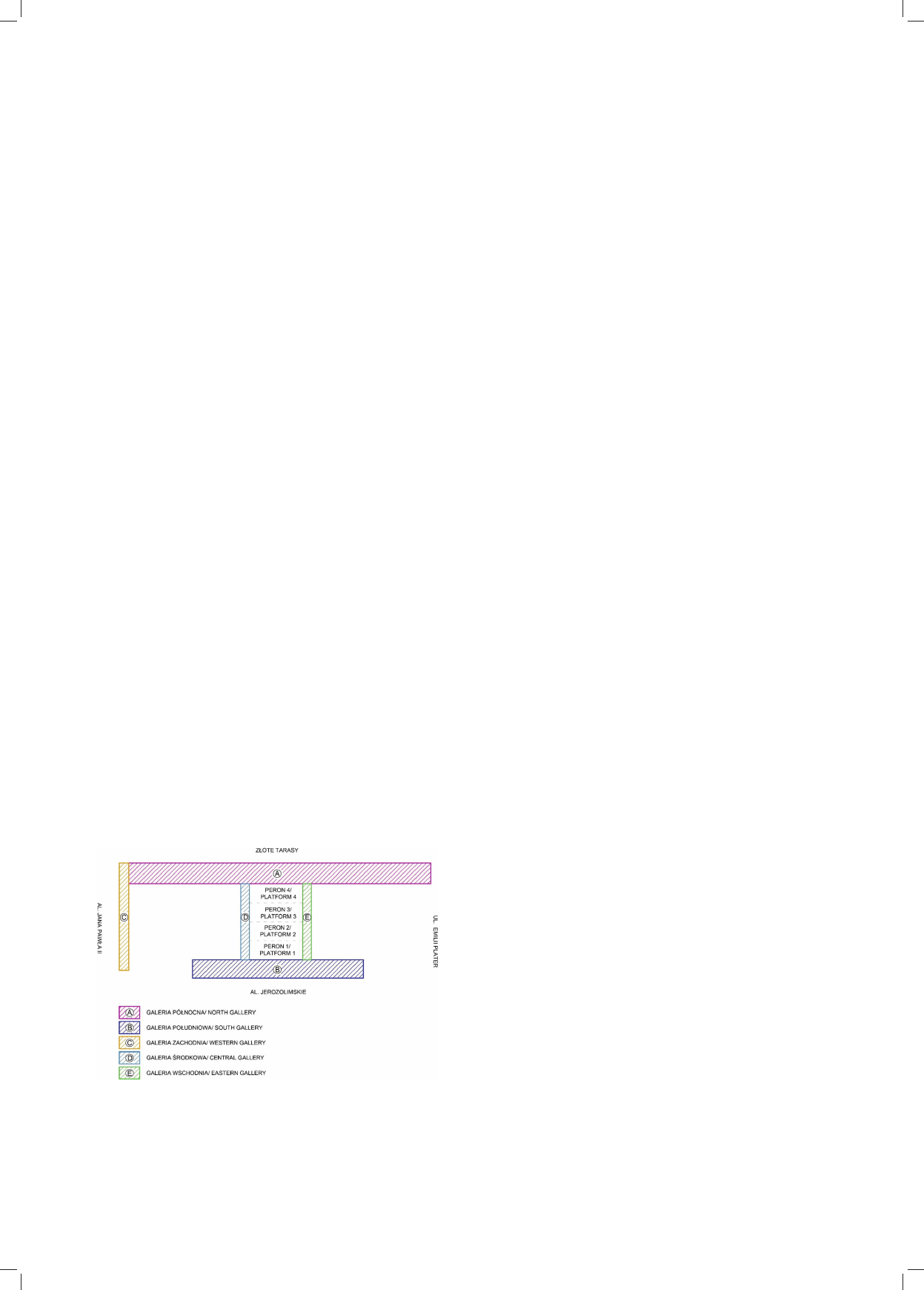
krzyżujące się korytarze galerii handlowych (il. 2). Są to
trzy korytarze w układzie północ–południe: Galeria
Zachodnia, Środkowa i Wschodnia, oraz dwa korytarze
w ukła dzie wschód–zachód: Galeria Północna i Galeria
Południowa. Pierwszym silnym bodźcem pozawzroko
wym po wejściu do podziemi są bodźce zapachowe. Po
zapachu można rozpoznać poszczególne lokale gastrono
miczne, po rozmowach zorientować się, gdzie znajduje się
kasa biletowa. Przechodząc przez Galerię Północną, bar
dzo szybko można zlokalizować wyjścia na przystanki
person perceives only the space that is currently within
reach. Therefore, people who were born blind often have
problems with understanding space as a whole. Space is
perceived rather temporarily by blind people – objects
follow each other. Sometimes it is difficult for a blind
person, especially for children, to understand that all these
elements do not appear, but they are in their place at the
same time. This is just the tip of the iceberg as for the
problems that blind people have to deal with. Someone
who has never seen the world does not understand what
a scale is and does not know how high buildings are be
cause she/he cannot touch them. Sometimes, however,
a mockup is enough to explain from scratch things that
are obvious to sighted people.
Beyond the visual perception orientation
in the public space on the example of
the Central Railway Station in Warsaw
The title problem of sensory deprivation of the con
temporary city could be misinterpreted as the lack of sen
sory stimuli in the city. In fact, it is quite the opposite – we
experience being saturated with information in contact
with urbanized space. These stimuli are very often tiring
both for sighted persons and people with sight dysfunc
tions. Beyond visual perception confrontation with an ur
ban space full of cars, with disordered paths, general
chaos and inadequate space for the needs of disabled
people is a huge intellectual effort. Therefore, the over
load of stimuli is additionally exhausting and confusing
for the blind. Spaces in which blind people feel good are
above all spaces with a simple, linear composition system
and safe – away from a busy street, with a large number
of stimuli to facilitate orientation, but with no excessive
amount of stimuli.
An example of this type of space is the underground of
the Central Railway Station in Warsaw. The spatial layout
consists of the intersecting corridors of shopping centres
(Fig. 2). These are three corridors in a north–south sys
tem: Western, Central and Eastern Gallery (or shopping
mall) as well as two corridors in the east–west layout:
Northern Gallery and Southern Gallery. The first strong
nonvisual stimulus after entering the underworld are
aroma stimuli. Following the smell, we can recognize in
dividual restaurants and by listening to conversations, we
can find out where the ticket office is located. Passing
through the Northern Gallery, we can quickly locate exits
to the tram stops by means of sound impressions and
a stronger air flow from the outside. Linearmotion slides
on the floor which serve orientation are, however, consid
ered to be unhelpful by many blind people. This is per
haps another “landmark” in space, nevertheless, it does
not pave the way because the corridor itself is linear in
nature. More over, during autumn and winter periods these
slides constitute a danger to all pedestrians because they
are made of metal. An important element is, however, the
signs in front of the stairs in the form of a textured surface
and a yellow distinguishing feature (yellow is the last co
lour that people who lose sight can see) (Fig. 3). In some
places at the railway station, however, these types of signs
Il. 2. Schematyczny układ przestrzenny podziemnych galerii
Dworca Centralnego w Warszawie
(oprac. J. Wronkowska)
Fig. 2. Schematic spatial arrangement of the underground gallery
of the Central Railway Station in Warsaw
(by J. Wronkowska)
Pozawzrokowe doświadczanie przestrzeni /Non-visual experience of space 155
tramwajowe poprzez wrażenia dźwiękowe oraz silniejszy
przepływ powietrza z zewnątrz. Prowadnice na posadz ce
służące orientacji są natomiast przez wielu niewidomych
uznawane za nieprzydatne. Jest to być może kolejny „punkt
orientacyjny” w przestrzeni, natomiast nie toruje drogi,
gdyż korytarz sam w sobie ma charakter liniowy. Dodat
kowo w okresie jesiennozimowym prowadnice te sta no
wią zagrożenie dla wszystkich pieszych, gdyż wykonane
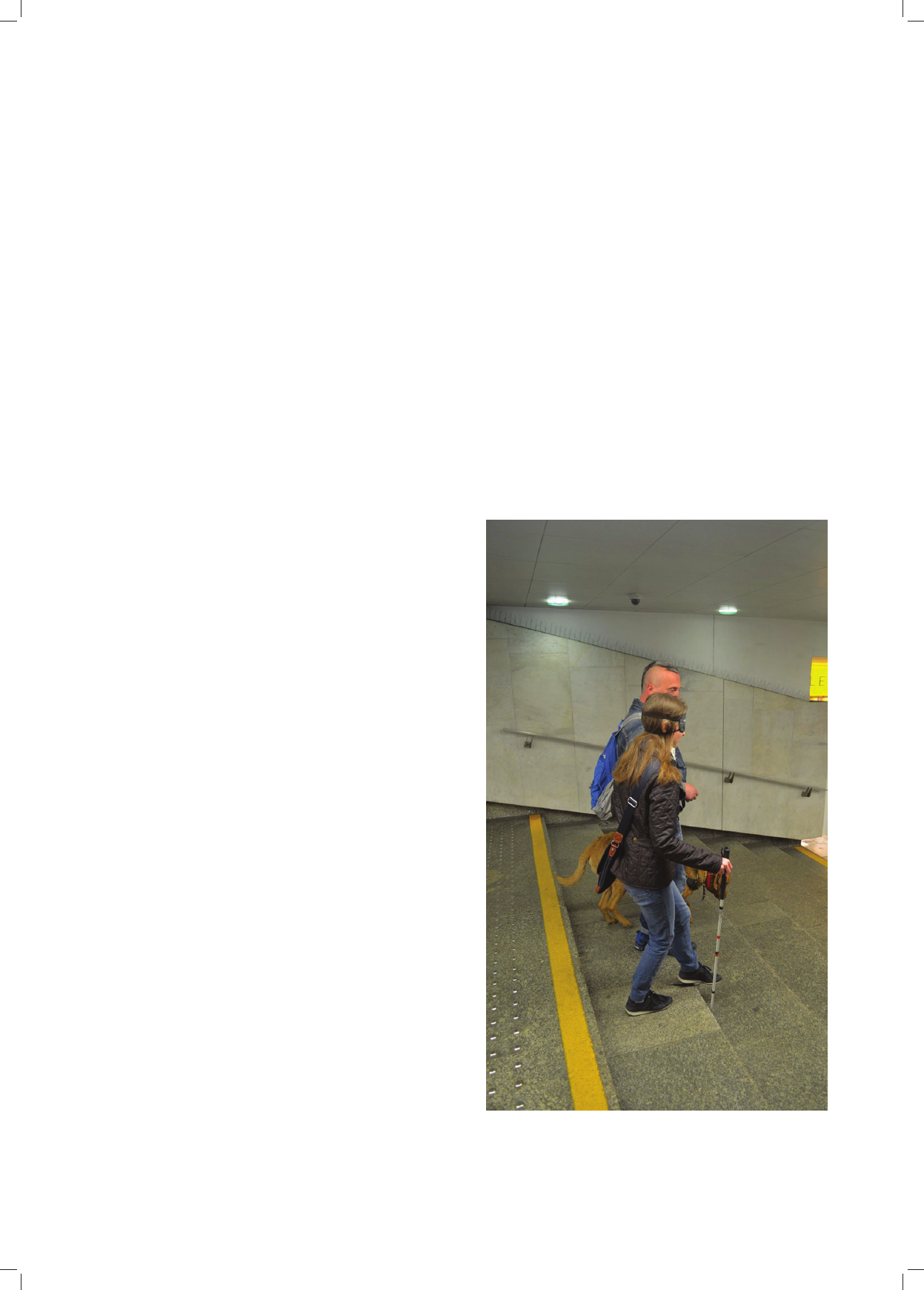
są z metalu. Ważny element stanowią natomiast ozna cze
nia przed schodami w postaci fakturowanej nawierzchni
oraz żółtego wyróżnika (żółty to ostat ni kolor, jaki widzą
osoby tracące wzrok) (il. 3). W nie których miejscach na
dworcu brakuje jednak tego typu oznaczeń – wówczas
osoba niewidoma poruszająca się bez psa asystującego
może spaść ze schodów lub potknąć się o stopień.
O ile w podziemiach można czuć się bezpiecznie, o tyle
dojście do nich np. z budynków przy Al. Jerozolimskich
jest zadaniem bardzo trudnym i często niemożliwym bez
pomocy osób widzących. Przejście przez jezdnię przy
Placu Zawiszy jest bardzo niebezpieczne ze względu na
brak sygnalizacji dźwiękowej. Osoby niewidome muszą
sugerować się odgłosem samochodów, a jest to miejsce
często zakorkowane. W takiej sytuacji nietrudno o błędną
interpretację dźwięków.
Piękno w pozawzrokowej percepcji
przestrzeni architektonicznej
Projektowanie środowiska dostępnego dla wszystkich,
zgodnie z duchem projektowania uniwersalnego, jest chy
ba jedynym słusznym rozwiązaniem i to nie budzi dzisiaj
żadnych wątpliwości. Niemniej jednak Kłopotowska za
uważa, że o ile opowiadamy się za przestrzenią bez barier,
za racjonalnym projektowaniem bezpiecznych i funkcjo
nalnych przestrzeni, o tyle kwestia pozawzrokowego
prze kazu piękna architektury jest już dyskusyjna. Do stęp
ność przestrzeni architektonicznej nie oznacza jedynie
mobilności odbiorcy, dającej podstawowe poczucie god
ności, ale również odbiór estetyczny budynku. Do stęp
ność oznacza także wgląd do języka subtelnych znaczeń,
do kodu estetycznego architektury. W przypadku osób
niewidomych kody te mogą być odczytane jedynie za po
mocą zmysłów kompensujących. Pierwszym z nich jest
dotyk. Percepcja architektury z pozycji osoby niewidomej
„widzącej” elementy znajdujące się na wyciągnięcie ręki
jest w praktyce niemożliwa. Problem ten jest częściowo
rekompensowany przez modele przestrzenne, makiety,
wypukłe rysunki, dotykowe mapy i plany. Takie rozwią
zanie nie zawsze jest łatwe w realizacji. Percepcja ry sun
ku odbieranego za pomocą opuszków palców nie jest tak
prosta jak w przypadku wzroku. Rysunki i makiety muszą
być wykonywane w odpowiedniej wielkości, w przeciw
nym razie osoba niewidoma nie jest w stanie odczytać
zapisu przestrzeni za pomocą dotyku (il. 4).
Makiety nie mogą być zbyt małe ani zbyt duże, by
człowiek mógł „objąć” cały teren w tym samym czasie
(tak jak to się dzieje za pomocą wzroku). Im obiekt jest
bardziej złożony, tym większy musi być model. Do dat
kowo technologia wykonywania dotykowych rysunków
jest bardzo kosztowna. Należy też ponownie podkreślić,
are missing – then a blind person moving without an as
sisting dog may fall off the stairs or trip over a step.
While it is possible to feel safe underground, getting to
that place, for example, from the buildings in Al. Je ro zo
limskie is a very difficult task and often impossible with
out the help of sighted people. Crossing the road at Za
wiszy Square is very dangerous due to the lack of sound
signalling. Blind people must follow sounds of cars and
this place is often jammed. In such a situation it is easy to
interpret sounds in an incorrect way.
Beauty of beyond visual perception of
architectural space
Designing an environment that is accessible to every
body, according to the spirit of universal design, is prob
ably the only right solution, which does not raise any
doubts today. Nevertheless, Kłopotowska believes that
while we support space without barriers, for the rational
designing of safe and functional spaces, the question of
Il. 3. Kadr ze spaceru z niewidomym przewodnikiem po podziemiach
Dworca Centralnego w Warszawie (fot. K. Szumiński)
Fig. 3. A frame from a walk with a blind guide in the underground
Central Station in Warsaw (photo by K. Szumiński)

156 Julia Wronkowska
a beyond visual perception message of beauty of architec
ture is still debatable. The accessibility of architectural
space does not only mean mobility of a recipient giving
the basic sense of dignity, but also aesthetic perception of
a building. Accessibility also means access to the lan
guage of subtle meanings and to the aesthetic code of ar
chitecture. In the case of blind people, these codes can be
legible only by means of compensating senses. The first
of them is haptic perception. The perception of architec
ture from the position of a blind person who “sees” ele
ments situated within reach is practically impossible. This
problem is partially compensated by spatial models,
mockups, convex drawings, tactile maps and plans. This
solution is not always easy to implement. The perception
of a drawing perceived with fingertips is not as simple as
in the case of visual perception. Drawings and mockups
must be made in the appropriate size, otherwise a blind
person will not able to “read” the space record by means
of haptic perception (Fig. 4).
Mockups cannot be either too small or too large for
a person to “cover” the whole area at the same time (as it
happens with the help of vision). The more complex the
object, the larger the model must be. Moreover, the tech
nology of making tactile drawings is very expensive. It
should also be emphasized that visual perception belongs
to the sense of simultaneous sensations, whereas haptic
perception is the sense of successive impressions. This
means that visual perception allows us to register a very
large amount of information about the surrounding space.
The sense of haptic perception allows us to gradually dis
cover further information about an object. Moreover, vi
sual perception enables involuntary reception of space.
On the other hand, haptic perception requires a lot of
effort and attention from a recipient to be able to recog
nize the space, simultaneously resigning from performing
other activities at the same time. Nevertheless, haptic per
ception has a big advantage over visual perception in dis
tinguishing and receiving information about a texture.
The second very important sense compensating for the
loss of sight is a sense of hearing. Intuitively analyzing
sound parameters, it is possible to identify and locate ob
jects in space [10]. The sense of hearing perception
significantly complements haptic perception by the pos
sibility of imagining an extensive area. It is impossible,
however, to visualize entire threedimensional structures
by means of auditory stimuli. Nevertheless, for the blind
hearing perception is their basic connection with art. This
sense constitutes in a special way the source of aesthetic
experiences because it makes contact with music, singing,
poetry or prose possible. Attributes of art received by
means of hearing perception such as rhythm, tension or
mood can be a substitute for the visual beauty of architec
ture. Verbal messages are an invaluable tool for the trans
mission of information about visual contents. A verbal
description gives a very precise instruction which makes
it possible to move around an object and make an aes
thetic evaluation. It is important that a verbal description
of the space or an object consist of sensory experiences
available to a blind person so that the content of the mes
sage gives as much information as possible about the
Il. 4. Model Wieży Torre de Belém wykonany z brązu,
uzupełniony o informacje w piśmie Braille’a
– wyeksponowany przed wieżą w Lizbonie (fot. J. Wronkowska)
Fig. 4. Model of Torre de Belem made of bronze,
supplemented with information in the Braille writing
– displayed in front of the torre in Lisbon
(photo by J. Wronkowska)
że wzrok należy do zmysłu wrażeń symultanicznych,
pod czas gdy dotyk to zmysł wrażeń sukcesywnych. Ozna
cza to, że wzrok pozwala jednym spojrzeniem zarejestro
wać bardzo dużą ilość informacji o otaczającej przestrze
ni. Zmysł dotyku zaś umożliwia stopniowe od kry wa nie
kolejnych informacji o obiekcie. Ponadto wzrok umoż li
wia mimowolny odbiór przestrzeni. Natomiast dotyk wy
maga od odbiorcy wiele wysiłku i skupienia uwagi, aby
móc rozpoznać przestrzeń, równocześnie rezygnując z wy
konywania
innych czynności w tym samym czasie. Nie
mniej dotyk ma nad wzrokiem dużą przewagę w odróż
nianiu i odbieraniu informacji o fakturze.
Drugim bardzo ważnym zmysłem kompensującym
utratę wzroku jest zmysł słuchu. Intuicyjnie analizując
parametry dźwięku, można identyfikować oraz lokalizo
wać obiekty w przestrzeni [10]. Zmysł słuchu w znaczący
sposób uzupełnia dotyk poprzez możliwość wyobrażenia
przestrzeni roz ległej. Nie jest natomiast możliwe wyobra
żenie całych struktur trójwymiarowych za pomocą bodź
ców słuchowych. Niemniej słuch stanowi dla osób nie
widomych podstawowy łącznik ze sztuką. Zmysł ten
w szczególny sposób stanowi źródło przeżyć estetycz
nych, umożliwia bowiem kontakt z muzyką, śpiewem,
poezją czy prozą. Atrybuty sztuki odbieranej za pomocą
słuchu, takie jak rytm, napięcie czy nastrój mogą być sub
stytutem wizualnego piękna architektury. Nieocenionym
narzędziem przekazu informacji o treściach wizualnych
są werbalne komunikaty. Opis słowny daje bardzo precy
zyjny instruktaż umożliwiający poruszanie się po obiek
cie oraz wydanie oceny estetycznej. Ważne jest, aby wer
balny opis prze strzeni bądź obiektu składał się z doznań
zmysłowych dostępnych dla osoby niewidzącej, tak aby
treść komunikatu dawała jak najwięcej informacji o rze
czywistym obrazie. W przeciwnym razie komunikat bę
dzie nieczytelny i stanie się jedynie zbiorem pustych słów.
Ko lejnym ważnym zmysłem, choć często pomijanym,
jest węch. Dla osób widzących węch stanowi jedynie do
pełnienie pozostałych zmysłów. Dla osób niewidomych,
które w swojej podświadomości tworzą tzw. mapy men
talne, zapach jest bardzo istotnym drogowskazem. Osoby

Pozawzrokowe doświadczanie przestrzeni /Non-visual experience of space 157
actual image. Otherwise the message will be unreadable
and will only become a collection of empty words.
Another im portant sense, though often overlooked, is
olfaction (smell). For sighted people a sense of smell
complements other senses only. In the case of blind peo
ple, who in their subconscious mind make up the socalled
mental maps, smell is a very important signpost. Blind
people instinctively encode smells associated with a giv
en object or place. It should be understood that the world
seen through the eyes of blind people is the same world as
the world of a healthy person but only seen from a differ
ent perspective. It happens that night dreams of blind
people are associated with a smell. Moreover, smell can
perform not only an improving function in terms of spa
tial orientation, but it also is a source of aesthetic experi
ence. It is worth emphasizing that the senses discussed do
not work in isolation. Only a combination of all sensory
experiences can give the fullest possible image of reality.
Receiving stimuli from space by means of all senses at the
same time leads to the formation of the socalled dynamic
structural systems, i.e. the creation of a multifaceted “im
age” of rea l ity [10]. It is connected with the socalled phe
nomenon of transposition, i.e. associating a given object
as a result of stimulating one of the senses.
An important method which explains to people who
are blind some difficult to describe phenomena is a de
scription by analogy. Then, to present visual phenomena,
the terms available in nonvisual perception are applied.
In the book Projektowanie uniwersalne. Udostęp nia-
nie otoczenia osobom niepełnosprawnym (Universal De-
sign. Providing access to the surroundings for disabled
people) by Ewa Kuryłowicz, we can find examples de
scribing that there are many architectural possibilities
available using beyond visual perception experiences.
A beyond visual perception substitute of rhythmically or
ganized space may be rhythmically bulleted places per
ceived by beyond visual perception senses, e.g., a repeti
tive arrangement of fountains [11]. As it has been pointed
out, there are many possibilities of beyond visual percep
tion transmissions of beauty. The only limitation is ima
gination of designers, their creati vity and sensitivity.
niewidome instynktownie kodują zapach związany z da
nym obiektem bądź miejscem. Należy zrozumieć, iż świat
widziany oczami osób niewidomych to ten sam świat, co
świat osoby zdrowej, tyle że widziany z innej perspekty
wy. Zdarza się, iż marzenia senne osób niewidzących
związane są właśnie z zapachem. Ponadto zapach nie tyl
ko może pełnić funkcję usprawniającą orientację prze
strzenną, ale jest również źródłem doznań estetycznych.
Warto podkreślić, że omówione zmysły nie działają
w izolacji. Dopiero połączenie wszystkich doznań zmy
słowych pozwala uzyskać możliwie najpełniejszy obraz
rzeczywistości. Odbieranie bodźców z przestrzeni za po
mocą wszystkich zmysłów równocześnie prowadzi do
wy kształcenia tzw. dynamicznych układów struktural
nych, czyli stworzenia pamięciowego wielopłaszczyz no
we go „obrazu” rzeczywistości [10]. Wiąże się z tym tzw.
zjawisko transpozycji, czyli kojarzenie danego obiektu
w wyniku pobudzenia jednego ze zmysłów.
Istotną metodą wyjaśniającą osobom niewidomym
pewne trudne do opisania zjawiska jest opis przez analo
gię. Wówczas do przedstawienia wizualnych zjawisk
używa się terminów dostępnych w percepcji pozawzroko
wej. W książce Projektowanie uniwersalne. Udostęp nia-
nie otoczenia osobom niepełnosprawnym Ewy Kury ło
wicz znaleźć można przykłady opisujące, jak wiele jest
możliwości przekazu architektonicznego wykorzystują
cych doznania pozawzrokowe. Substytutem pozawzroko
wym rytmicznie zorganizowanej przestrzeni mogą być
rytmicznie wypunktowane miejsca odbierane zmysłami
pozawzrokowymi, np. powtarzalny układ fontann [11].
Jak zaznaczono, możliwości pozawzrokowego przekazu
piękna jest bardzo wiele. Ograniczenie stanowi jedynie
wyobraźnia projektanta, jego kreatywność i wrażliwość.
Pozytywne przykłady przestrzeni sensorycznej
w środowisku zurbanizowanym
Jednym z najlepszych sposobów na stworzenie prze
strzeni sensorycznej w mieście jest rekreacyjne wykorzy
stanie wody, jak np. w realizacji budynku obsługującego
parking podziemny na Plaza del Pilar w Saragossie. Zo
stał on zaprojektowany w taki sposób, że jego wystającą
częścią jest wodospad. Szum wody jest silnym sygnałem
dźwiękowym, jednocześnie przynoszącym ukojenie
(il. 5). Innym sposobem na wprowadzenie wody w prze
strzeń miejską są płytkie sadzawki i fontanny na placach
miejskich, z których chętnie korzystają dzieci do zabaw
w okresie letnim, np. „Wodne lustro” w Bordeaux we
Francji. Delikatna mgiełka wody jest bodźcem temperatu
rowym i dotykowym będącym kolejnym elementem na
mapie mentalnej osoby niewidomej, ale jednocześnie sta
nowi o bardzo ulotnym, wręcz poetyckim charakterze
tego miejsca.
Dobrym przykładem przestrzeni stymulującej zmysły
jest ul. Chłodna w Warszawie. Poprzez swoją burzliwą
historię Chłodna stała się ulicą różnorodną pod względem
formalnym. Posadzka ukazująca historyczną parcelację
ulic, różnorodna nawierzchnia, w tym przedwojenna
kostka brukowa, zachowane tory tramwajowe czy pagór
kowaty teren w części skweru to nie tylko pozawzroko we
Il. 5. Plaza del Pilar, Saragossa (rys. J. Wronkowska)
Fig. 5. Plaza del Pilar, Saragossa (drawing by J. Wronkowska)

158 Julia Wronkowska
wyróżniki przestrzeni ułatwiające orientację osobom nie
widomym, ale również pozytywne doznania estetyczne
zarówno dla osób widzących, jak i niewidomych. Na uli
cy znajduje się skwer pełen zieleni i miejsc do siedzenia.
Ruch samochodowy został ograniczony do części połud
niowej, więc ludzie chętnie przebywają w og ródkach re
stauracyjnych na słońcu lub w cieniu w pobliżu skweru.
Przestrzeń ta sprzyja wyciszeniu – słychać szum wiatru
i śpiew ptaków. Głównym akcentem dźwiękowym jest
natomiast bicie dzwonów kościelnych (il. 6).
Innym sposobem kreacji przestrzeni wielozmysłowej
są różnego rodzaju interwencje wpływające na akustyczny
obraz przestrzeni miejskiej. Przykładem jest projekt miej
skiego systemu designu fonicznego autorstwa E. Ni shiny
i N. Kawai. Projekt ten został zaprezentowany podczas
Światowego Forum Ekologii Akustycznej. Wyko rzys tano
w nim naturalne odgłosy lasów tropikalnych w przestrze
niach publicznych miast japońskich [12, s. 195].
Projekt adaptacji Fortu Bema
jako przykład przestrzeni multisensorycznej
W opinii autorki istnieje potrzeba stworzenia przestrze
ni eksperymentalnej, w której możliwe byłoby badanie
multisensorycznego odbioru przestrzeni, a także sztuki.
Miejsce to mogłoby służyć poszukiwaniom pozy tywnych
rozwiązań z punktu widzenia urbanistyki sensorycznej
(sensorial urbanism), jak również łamaniu różnego ro
dzaju stereotypów związanych z niepełnosprawnością. Na
bazie tych założeń powstała magisterska praca dyplomo
wa pt. Ośrodek integracji osób niewidomych i osób widzą-
cych w Forcie Bema w Warszawie. Emocjonalne doświad-
czanie przestrzeni przez osoby z dysfunkcją wzroku
1
. Fort
Bema jako historyczne założenie, gdzie budynki ukryte
pod nasypami ziemnymi tworzą jedność z krajobrazem,
może być z punktu widzenia antropologii architektury
miejscem sprzyjającym dobremu samopoczuciu.
1
Praca dyplomowa obroniona w roku 2017 na Wydziale Archi
tektury Politechniki Gdańskiej pod kierunkiem prof. dr. hab. inż. arch.
A. Baranowskiego.
Positive examples of
sensory space in the urbanized environment
One of the best ways to create a sensory space in the
city is the recreational use of water such as, for example,
the implementation of a building serving as an under
ground car park at Plaza del Pilar in Zaragoza. It was de
signed in such a way that its protruding part is a waterfall.
The sound of water is a strong sound signal, at the same
time providing relief (Fig. 5). Another way to introduce
water into the urban space are shallow ponds and fountains
in city squares, which are willingly used by children to
play in the summer period, e.g. “Water mirror” in Bordeaux
in France. A delicate mist of water is a temperature and
tactile stimulus which is another element on the mental
map of a blind person, but at the same time it constitutes
a very volatile and almost poetic character of this place.
A good example of space that stimulates senses is
Chłod na Street in Warsaw. Through its turbulent history,
Chłodna Street has become a diverse street in terms of its
formal character. The flooring which shows the historical
subdivision of streets, the miscellaneous surface, including
the prewar paving stones, preserved tram rails or the hilly
terrain in one part of the square are not only beyond visual
perception distinguishers of space, but they also facilitate
spatial orientation for blind people and provide positive
aesthetic experiences for the sighted and the blind alike. In
the street there is a square full of greenery and places to sit.
The car traffic was limited to the southern part, so people
willingly stay in restaurant gardens in the sun or in the
shade near the square. This space favours silence – we can
hear the sound of wind and birds singing. The main sound
accent is the ringing of the church bells (Fig. 6).
Other ways to create a multisensory space are various
types of interventions affecting the acoustic image of the
urban space. An example is the project of an urban phonic
design system by E. Nishina and N. Kawai. This project
was presented during the World Forum on Acoustic
Ecology. It used natural sounds of tropical forests in pub
lic spaces of Japanese cities [12, p. 195].
Project of adaptation of Bema Fort
as an example of multi-sensory space
In the author’s opinion, there is a need to create an ex
perimental space in which it would be possible to study
the multisensory perception of space as well as art. This
place could be used to search for positive solutions from the
point of view of sensorial urbanism and breaking all kinds
of stereotypes related to disability as well. On the basis of
these assumptions, Master’s thesis entitled Oś ro dek integ-
ra cji osób niewidomych i osób widzących w For cie Bema
w Warszawie. Emocjonalne doświadczanie prze strzeni przez
osoby z dysfunkcją wzroku (The integ ration centre for blind
and sighted people in Bema Fort in War saw. Emotional
experience of space by people with a sight dysfunction)
1
1
Master’s thesis defended in 2017 at the Faculty of Architecture of
Gdańsk University of Technology under the supervision of Prof. dr hab.
eng. arch. A. Baranowski.
Il. 6. Ulica Chłodna w Warszawie, widok ze skweru
(fot. J. Wronkowska)
Fig. 6. Chłodna Street in Warsaw, view from the square
(photo by J. Wronkowska)
Pozawzrokowe doświadczanie przestrzeni /Non-visual experience of space 159
Zapewnione jest także niezbędne poczucie bezpieczeń
stwa poprzez naturalne wyodrębnienie historycznego za
łożenia przez nasypy ziemne i fosę ograniczające prze
strzeń wewnątrz. Bezpieczeństwo to rozumiane jest jako
możliwość doświadczania przestrzeni otwartej w bez
piecznych warunkach, z dala od pędzących samochodów
i ulicznego zgiełku. Oddzielne budynki i przestrzeń zielo
na pomiędzy nimi daje możliwość adaptacji każdego
z obiektów na różne funkcje sprzyjające integracji i swo
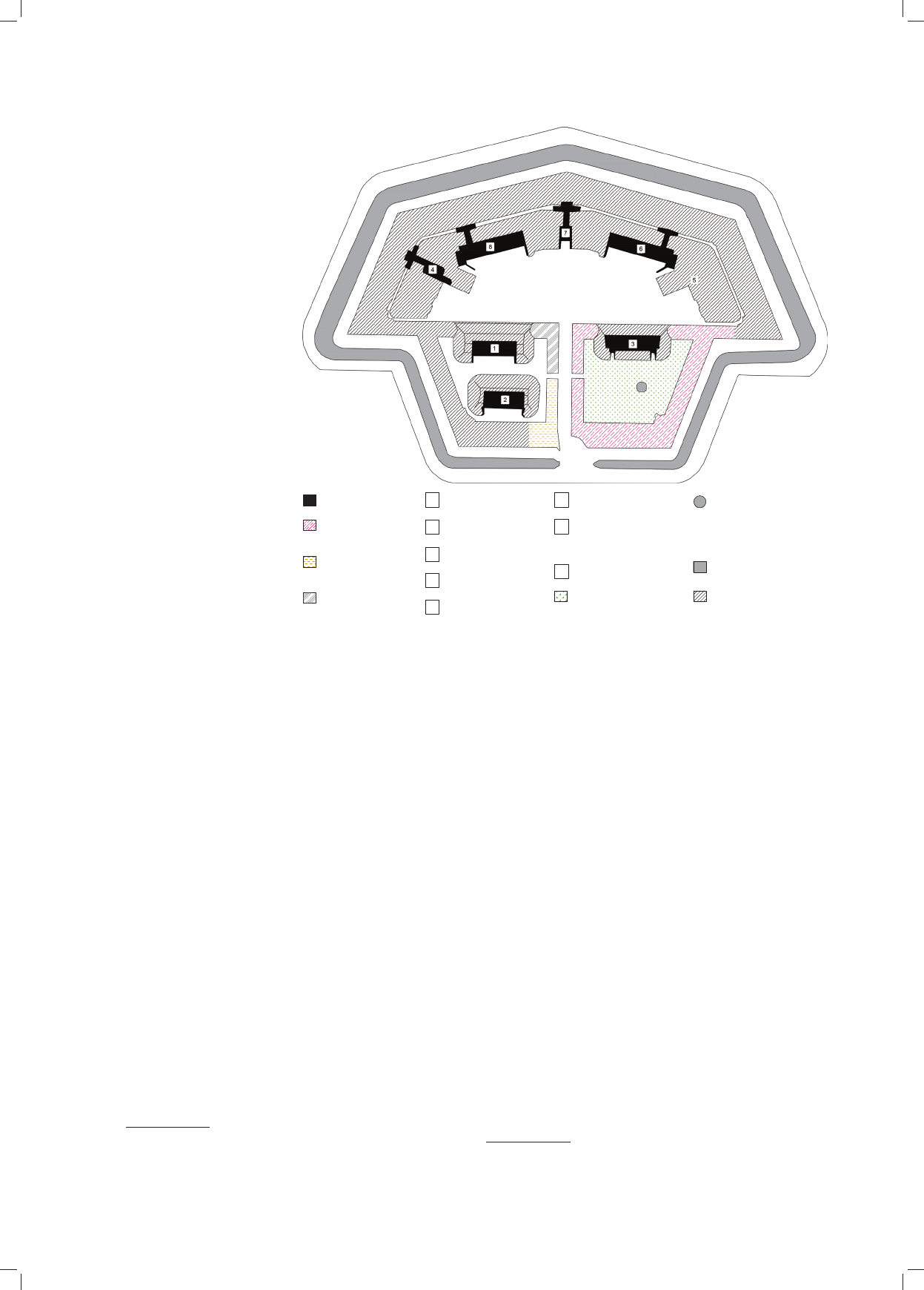
iste poczucie „miasta w mieście” (il. 7).
Dodatkowo Fort Bema znajduje się blisko centrum,
a jednocześnie jest miejscem spokojnym i cichym dzięki
zlokalizowaniu w środku parku. Większość adaptowa
nych budowli w forcie nastawiona została na odbiór po
zawzrokowy, jak np. wystawa „w ciemnościach” czy re
stauracja „w ciemnościach”. Układ tychże budowli ma
charakter liniowy, co ułatwia orientację pozawzroko
wą. Ada pto wane obiekty zostały umownie podzielone na
odbiór różnymi zmysłami, np. w budynku makieciarni
i este zjote rapii
2
użyt kow nicy bardziej skupią się na od
bie raniu sztuki lub ma kiet architektonicznych za pomo
cą do tyku, a w budyn ku restauracji „w ciemnościach” lub
og ro dzie sensorycznym na smaku i zapachu. Wystawa
„w ciemnościach” daje na to miast mo żliwość badania
2
Estezjoterapia jest terapią m.in. poprzez rysunek, malarstwo
i rzeźbę. W opisywanym projekcie przewidziano przestrzenie przygoto
wane do prowadzenia w nich wszystkich rodzajów arteterapii, czyli te
rapii poprzez sztukę.
was written. Bema Fort as a histori cal layout, where
buildings hidden under earth embankments form a unity
with the landscape, can be a place conducive to wellbe
ing from the point of view of anthropology of architec
ture. An essential sense of security is also ensured through
natural separation of the historical layout by earth em
bankments and a moat limiting the space inside. This
safety is understood as the possibility of experiencing an
open space in safe conditions away from rushing cars and
street noise. The separate build ings and green space be
tween them give the opportuni ty to adapt each of the ob
jects to various functions conducive to integration and
a specific sense of “city in the city” (Fig. 7).
Moreover, Bema Fort is situated near the centre and at
the same time it is a quiet and peaceful place thanks to its
location in the middle of the park. Most of the adapted
buildings in the Fort were focused on beyond visual per
ception such as, for example, exhibition “in the dark” or
restaurant “in the dark”. The layout of these buildings is
linear, which facilitates beyond visual orientation. The
adapted buildings were conventionally divided into per
ception with various senses, e.g., in the building of mock
ups and art therapy
2
users will focus more on perceiving art
or architectural mockups by means of haptic perception
and in the building of restaurant “in the dark” or sen
sory
2
Art therapy (aesthetherapy) is a therapy carried out by drawing,
painting and sculpture. The described project provides spaces which are
prepared for conducting all types of art therapy, i.e. a therapy through art.
Il. 7. Układ funkcjonalno
przestrzenny projektu adaptacji
Fortu Bema w Warszawie
(oprac. J. Wronkowska)
Fig. 7. Functional and spatial
arrangement of the adaptation
project of the Bema Fort
in Warsaw (by J. Wronkowska)
budowle istniejące/
existing buildings
współczesne
uzupełnienie/contemporary
complement building
odrestaurowany wał grodzący
(parking rowerowy wraz z pom.
ochrony)/restored embankment
shaft (bicycle parking with the
guard room)
odrestaurowany wał grodzący
(odtworzenie historycznego
układu)/restored embankment
shaft (reconstruction of the
historical plan)
1
2
3
4
biblioterapia i filmoterapia
/bibliotherapy and filmotherapy
makieciarnia i estezjoterapia/
space for models and art therapy
przestrzeń wystawiennicza/
exhibition space
przestrzeń magazynowa/
storage space
ruiny dawnego schronu
z poterną/the ruins
of the former shelter
restauracja "w ciemnościach"/
restaurant "in the dark"
punkt informacyjny dot. historii
Fortu Bema wraz z małym pom.
konferencyjnym/information point
on history of Fort Bema with
a small conference room
wystawa "w ciemnościach"/
exhibition "in the dark"
5
6
7
8
ogród sensoryczny/sensory garden
zbiornik wodny z fontanną
i generatorem mgły
(poniżej pom. podziemne służące
medytacji)/water reservoir with
a fountain and fog generator
(below the underground room
for meditation)
fosa/moat
nasypy ziemne/earth embankments
160 Julia Wronkowska
powiązań pomiędzy wy ko rzystaniem różnego rodzaju na
wierzchni oraz fak tur okładzin ścien nych a ich właściwo
ściami akustycz nymi. Ośrodek ten miałby być miejscem
łą czącym ludzi, w którym można wzajemnie od siebie
czerpać, dostępnym dla osób niewidomych chcących
uczyć się orientacji przestrzennej w bez piecznych warun
kach lub aktywnie uczest niczyć w sztuce, np. uczęszczać
na zajęcia teatroterapii lub muzykoterapii, jak również dla
osób widzących, których przewodnikami po wystawie lub
kelnerami są osoby niewidome. W projekcie przewidzia
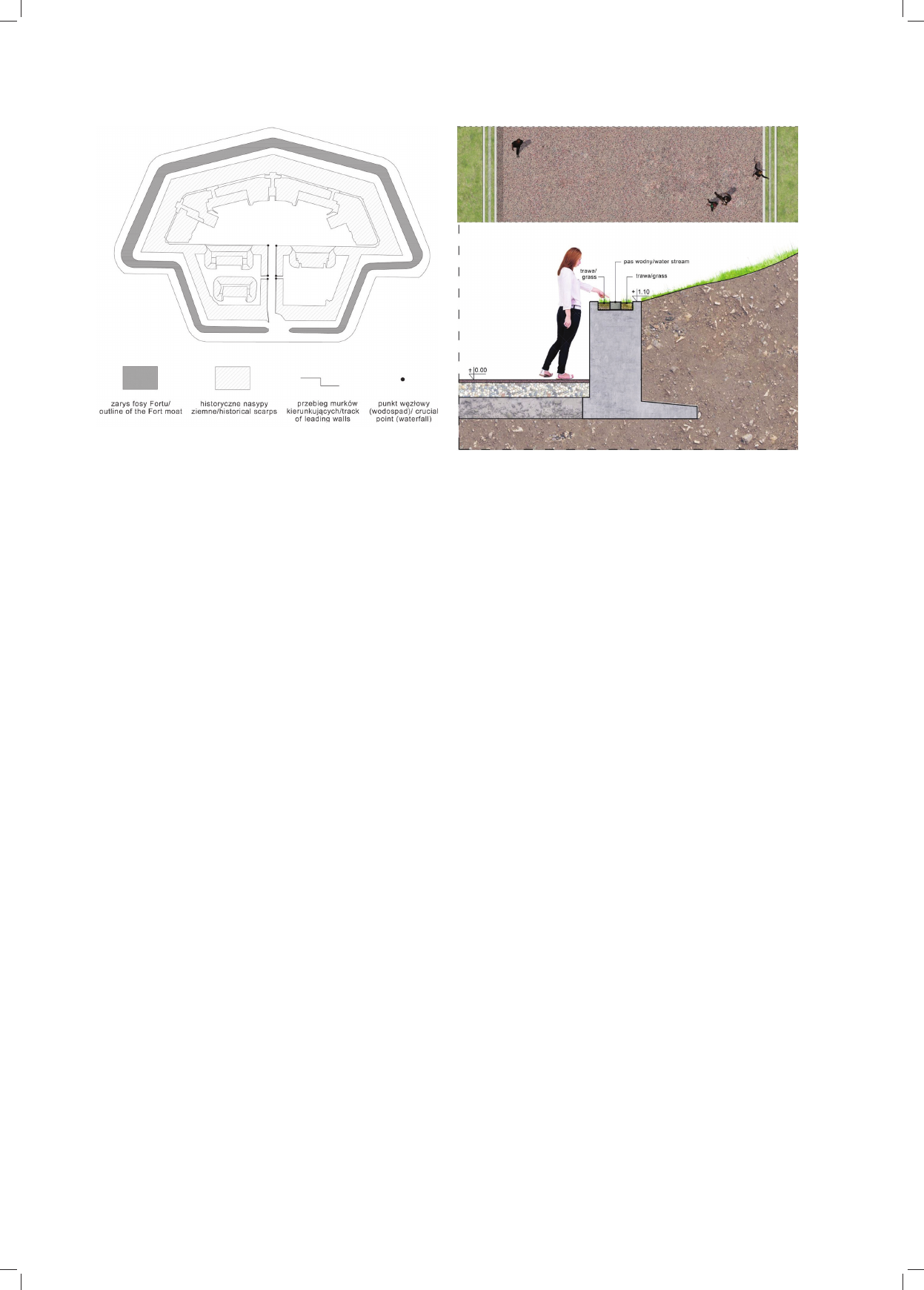
no różnego rodzaju elementy wspomagające orientację
przestrzenną, będące jednocześnie elementami wzboga
cającymi estetycznie przestrzeń, jak np. murki kierunku
jące z wodą wzdłuż głównej drogi z małymi wodospada
mi w miejs cach charakterystycznych (il. 8).
Na murkach oporowych przeznaczono miejsca na na
pisy w piśmie Braille’a informujące o miejscu lub kierun
ku, w którym zmierzamy. Tego typu „prowadnice” są
zarówno sygnałem dźwiękowym, taktylnym, jak i zapa
chowym (il. 9).
Podsumowanie
Współcześnie nie wypracowano jeszcze holistycznej
metody projektowania będącej kluczem służącym znale
zieniu odpowiedzi na problemy przedstawione w niniej
szej pracy. Z jednej strony brakuje pozawzrokowych wy
różników prze strze ni, a z drugiej jest ich zbyt dużo
– wprowadzają one poczucie zagubienia i chaos. Coraz
więcej współczesnych badaczy podkreśla potrzebę zwró
cenia się ku wielozmysłowemu doświadczaniu przestrze
ni, podkreślając, że zmysły nie wyznaczają odrębnych
ka nałów percepcyjnych, lecz pozwalają na doświadcze nie
synestezyjne. W końcu lat 80. XX w. powstała koncep cja
miasta kreatywnego (creative city) stworzona przez Char
lesa Landry’ego. Koncepcja ta wzywa urbanistów, aby
garden by virtue of taste and smell. Exhibition “in the
dark” gives the opportunity to study the relations between
the use of various types of surfaces and textures of wall
lining and their acoustic properties. This centre is sup
posed to be the place connecting people where they can
learn from one another and available for blind people who
want to learn spatial orientation in safe conditions or ac
tively participate in art, for example, to attend theatre
therapy or music therapy as well as for sighted people
whose exhibition guides or waiters are blind people. The
project envisages various elements supporting spatial ori
entation, which at the same time are elements that enrich
the space aesthetically such as small walls with water
showing directions along the main road with small water
falls in characteristic places (Fig. 8).
On the retaining walls there are places for texts in the
Braille tactile writing system informing about a place or
direction in which we are going. “Linear slides” of this
type are signals of many types such as sound, tactile and
smell (Fig. 9).
Summary
Currently, no holistic design method has been devel
oped as yet which would be a key to finding answers to
the issues presented in this study. On the one hand, there
are no beyond visual perception distinguishers of space
and on the other there are too many of them – they intro
duce a sort of confusion and chaos. More and more mod
ern researchers emphasize the need to turn to a multi
sensory experience of space, stressing that senses do not
designate separate perceptual channels but enable synes
thesic experiencing. At the end of the 1980s, the concept
of a creative city by Charles Landry appeared. This con
cept suggests that by designing creative places town
Il. 8. Lokalizacja murków kierunkujących
w projekcie adaptacji Fortu Bema (oprac. J. Wronkowska)
Fig. 8. Location of the leading walls in the project of
adaptation of Fort Bema (by J. Wronkowska)
Il. 9. Murki kierunkujące w projekcie adaptacji Fortu Bema
(oprac. J. Wronkowska)
Fig. 9. Leading walls in the project of adaptation of Fort Bema
(by J. Wronkowska)

Pozawzrokowe doświadczanie przestrzeni /Non-visual experience of space 161
planners should create conditions that will allow people to
act and think with imagination. It expresses the opinion
that this is an urgent task from the point of view of rapid
economic and social changes. Landry sees the problems
of the modern city in the disappearance of the sensory
dimension in the process of experiencing urbanized spac
es. Its reconstruction gives a chance for positive changes.
Mar ko Zardini – Director of Canadian Centre for Ar chi
tecture also sees in sensory urbanism the answer to the
impoverishment of urban space (after: [13]). It is worth
putting more emphasis on the analysis of experiences in
volving all the senses already at the design stage, which
may result in arriving at aesthetically engaging architec
ture not only for sighted persons, but also for people with
sight or hearing dysfunctions. It is a task important for
contemporary architects and town planners from the so
cial and ethical point of view.
Translated by
Bogusław Setkowicz
poprzez projektowanie miejsc kreatywnych tworzyli wa
runki pozwalające ludziom działać i myśleć z wyobraźnią.
Wyraża opinię, iż jest to zadanie pilne z punktu widzenia
gwałtownych zmian ekonomicznych i społecznych.
Problemów współczesnego miasta Landry upatruje w za
niku sensorycznego wymiaru w doświadczeniu przes
trzeni zurbanizowanych. Jego odbudowa daje szansę na
pozytywne przemiany. Dyrektor Canadian Centre for Ar
chitecture Marko Zardini również widzi w urba nistyce
sen sorycznej odpowiedź na zubożenie przestrzeni miej
skiej (za: [13]). Warto więc położyć większy nacisk na
analizę doświadczeń włączających wszystkie zmysły
jeszcze na etapie projektowym, co może zaowocować ar
chitekturą estetycznie angażującą nie tylko osoby widzą
ce, ale także osoby z dysfunkcją wzroku czy słuchu. Jest
to zadanie ważne dla współczesnych architektów i urba
nistów z punktu widzenia społecznego i etycznego.
Bibliografia /References
[1] Kopaliński W., Słownik wyrazów obcych, Świat Książki, Warszawa
2000.
[2] Pallasmaa J., Oczy skóry. Architektura i zmysły, Instytut Architektury,
Kraków 2012.
[3] Kłopotowska A., Doświadczanie przestrzeni w rehabilitacji osób
z dysfunkcją wzroku: sztuka a tyflorehabilitacja, Oficyna Wydaw
nicza Politechniki Białostockiej, Białystok 2016.
[4] Czyż P., Normatywna zawartość architektury po-ponowoczesnej
w świetle koncepcji rozumu komunikacyjnego Jurgena Habermasa,
rozprawa doktorska, Wydział Architektury PG, Gdańsk 2013.
[5] Bańka A., Psychologiczna struktura projektowa środowiska.
Studium przestrzeni architektonicznej, Wydawnictwo Politechniki
Poznańskiej, Poznań 1985.
[6] Warchoł M., Architektura nieobecna, „Z:A” 2015, Nr 43, 03/04,
52–58.
[7] Borowska M., Estetyka i poszukiwanie znaczeń w przestrzeniach
architektonicznych, Wydawnictwo Semper, Warszawa 2013.
[8] SatkiewiczParczewska A., Kompozycja architektoniczna a jej per-
cepcja (w świetle niektórych aspektów teorii energii przestrzeni),
Wydawnictwo Uczelniane Politechniki Szczecińskiej, Szczecin
2001.
[9] Berleant A., Wrażliwość i zmysły – estetyczna przemiana człowie-
ka, Universitas, Kraków 2011.
[10] Kłopotowska A., Niewidzialna architektura – status piękna w po-
zawzrokowej percepcji przestrzeni architektonicznej, „Czasopismo
Techniczne. Architektura” 2007, R. 104, z. 6A, 269–274.
[11] Kuryłowicz E., Projektowanie uniwersalne. Udostępnianie otocze-
nia osobom niepełnosprawnym, Centrum BadawczoRozwojowe
Rehabilitacji Osób Niepełnosprawnych, Warszawa 1996.
[12] Kłopotowska A., Dźwięki architektury, Oficyna Wydawnicza
Politechniki Białostockiej, Białystok 2015.
[13] Nyka L., Architektura i woda – przekraczanie granic, Wydawnictwo
Politechniki Gdańskiej, Gdańsk 2013.
Streszczenie
Niniejszy artykuł omawia problem współczesnej kultury, jakim jest dominująca rola wizualnej reprezentacji rzeczywistości. Architekturę i urbani
stykę oceniamy powierzchownie na podstawie aspektów wizualnych, zapominając o bogactwie doznań pozawzrokowych. Takie podejście do pro
jektowania architektury i przestrzeni zurbanizowanej skutkuje dziś przesyconym pejzażem sensorycznym miasta, zanieczyszczeniem powietrza oraz
miejskiej przestrzeni sonicznej. Problem okulocentryzmu we współczesnej kulturze szczególnie ujawnia się w przypadku osób niewidomych. Na
podstawie studiów literatury przedmiotu z pogranicza architektury, psychologii percepcji, tyflologii, a także filozofii podjęto próbę zarysowania tła
kulturowego ponowoczesnej rzeczywistości przesyconej informacją, by następnie opisać rolę zmysłów i ich potencjał w tworzeniu przestrzeni nie
tylko dostępnej dla osób niewidomych, ale także bogatszej estetycznie dla wszystkich jej użytkowników. Analizę uzupełniono o własne obserwacje
oraz wizje lokalne pod kątem odbioru pozawzrokowego. Zarówno z literatury przedmiotu, jak i obserwacji własnych wynika, że rola zmysłów oraz
emocji w architekturze i urbanistyce jest jeszcze niedostatecznie zbadana. W opinii autorki wszelkie badania podejmujące ten temat mogą okazać
się niezwykle cenne, gdyż spojrzenie na przestrzeń przez pryzmat wszystkich zmysłów miałoby szansę stać się ważnym narzędziem projektowym
służącym walce z problemem współczesnej okulocentrycznej rzeczywistości.
Słowa kluczowe: pozawzrokowe doświadczanie przestrzeni, deprywacja sensoryczna, estetyczne zaangażowanie, emocjonalny odbiór przestrzeni,
dźwięki architektury
Abstract
This article discusses the problem of contemporary culture which is the dominant role of the visual representation of reality. We evaluate architecture
and urban planning superficially based on visual aspects, forgetting about the wealth of nonvisual experiences. This approach to designing archi
tecture and urban space results in a suffused sensory landscape of the city, pollution of air and the urban sonic space. This problem manifests itself
particularly in the case of blind people. Based on the study of literature with the subject of architecture, psychology of perception, typhlology, as

162 Julia Wronkowska
well as philosophy, an attempt was made to outline the cultural background of postmodern reality suffused with information, then to describe the
role of the senses and their potential in creating space not only accessible to blind people, but also wealthier in terms of aesthetics for all its users.
The analysis of the literature on the subject has been supplemented with own observations and local visions for nonvisual reception. Both from the
literature on the subject and from own observations, it appears that the role of the senses and emotions in architecture and urban planning is still
insufficiently researched. In the author’s opinion, any research on this topic may turn out to be extremely valuable, because looking at the space
through the prism of all senses would have a chance to become an important design tool to tackle the problem of contemporary oculocentric reality.
Key words: nonvisual experience of space, sensory deprivation, aesthetic involvement, emotional reception of space, sounds of architecture