2025
4(84)
Artur Zaguła*, Miłosz Gortyński**
Oskar Hansen’s Open Form in the context of the Open Society concept
by Karl Popper and the architectural realities in Poland before 1989
DOI: 10.37190/arc250408
Published in open access. CC BY NC ND license
Abstract
In this article, the authors examine the relationship between Oskar Hansen’s concept of Open Form and Karl Popper’s idea of the Open Society. Their
analysis and comparison aim not only to deepen the understanding of the development of modernist concepts in architecture and urbanism, but also to
show that the theories emerging from dierent premises, assumptions and circumstances can be united by certain shared fundamental ideals and values.
The hermeneutic and historical-interpretive methods allowed us to recognize material and social realities in the complex context of the post-World War II
era. In addition, a case study of one of Oskar Hansen’s completed housing developments allowed verication of the theoretical basis of Open Form with
an attempt to materialize it. The analysis of both theoretical concepts made it possible to formulate the basic values linking them: individual freedom;
countering authoritarianism; social participation; exibility and adaptation; and rationalism. In conclusion, it was pointed out that both the Open Form and
the Open Society are attempts to heal our common environment, as a vision grounded in a sincere and profound belief in humanity. This perspective is
especially vital today, as we increasingly live in ideological bubbles and focus more on what divides us rather than on what unites us.
Key words: Open Form, modernist architecture, Open Society, continuous linear system
Introduction
Oskar Hansen, an extraordinary Polish architect and ar-
chitectural theorist, together with Karl Popper, a famous
philosopher and political theorist, may at rst sight seem to
be gures from two dierent realms. They came from dif-
ferent cultural and ideological backgrounds, what is more,
they were specialists in their own specic professional
elds. However, both the concept of the Open Form by Os-
kar Hansen (1922–2005) and the idea of the Open Society
by Karl Popper (1902–1994) combine some fundamental
ideals and values. This connection is worth acknowledging,
also because Hansen emphasizes that the foundation of ar-
chitectural concepts is the idea itself
1
(Włodarczyk 2009,
* ORCID: 0000-0002-5617-9041. Institute of Architecture and
Town Planning, Lodz University of Technology, Poland, e-mail: artur.
zagula@p.lodz.pl
**
ORCID: 0000-0002-5719-880X. Doctoral Candidate at Lodz Uni -
versity of Technology, Poland.
1
In a conversation with Wojciech Włodarczyk, the following sen-
tences are uttered: There is no space without philosophy. […] The history
21, 29). Previous researchers of Hansen’s creativity used
to link his concepts
2
with, for example, Sartre’s existential
Marxism (Ockman 2014, 33), and Hansen himself pointed
out Erich Fromm as a source of inspiration
3
(Ockman 2014,
55–58; Hansen 2005, 9, 10, 11, 14, 60, 71).
The combination of the idea of the Open Form and the
Open Society has been noticed as a potential possibility
of art teaches that conscious architects implemented philosophical pro-
grams with their designs. […] To sum up, in our team the most important
person was not the one who drew the project, but the one who brought
the idea to the table during the conversation (Włodarczyk 2009, 148).
Hansen clearly indicates that his architectural practice was uncondition-
ally related to theoretical reection.
2
Hansen himself has always and repeatedly emphasized that the
concept of the Open Form was his own idea and was not inspired by ear-
lier theories. He conrms this in an interview with Włodarczyk: Wojciech
Włodarczyk: Almost everyone talked about Open Form in the 1950s, even
if it wasn’t called that: Olle Baertling, Umberto Eco, Yona Friedman,
Espace Group... Oskar Hansen: I must confess that I simply didn’t know
about all this. I thought this was my discovery (Włodarczyk 2009, 142).
3
In the book Zobaczyć świat [Seeing the World] prepared by Han-
sen, the name of Erich Fromm appears several times, and in the author’s
essay a longer fragment of To Have or Be by the same author is quoted.
90 Artur Zaguła, Miłosz Gortyński
(Stanek, van den Heuvel 2014, 25), but so far it has not been
seriously developed. Only Eeva-Liisa Pelkonen noted in her
article, in the section titled “Open Form – Open Society?”
as follows: Hansen’s opposition between open and closed
recalls Karl Popper’s notion of “open” versus “closed so-
ciety” put forward in The Open Society and Its Enemies
(1945), which contrasts humanism marked by freedom of
thought and action with the lack thereof within abstract and
depersonalized systems; the former called for human en-
gagement rather than passive acceptance of the given situ-
ation (Pelkonen 2014, 145).
Therefore, the analysis of the relationship between the
Open Form and the Open Society and the conclusions
drawn from it can enrich our understanding of both archi-
tecture and social theories. Especially since residential ar-
chitecture, which was mainly practiced by Hansen, is by its
very nature a social activity and at the same time entangled
in politics. Both the historical and interpretive method will
be helpful in this regard, as it allows for the recognition of
material and social reality in a complex context. Especially
since, as Karl Popper wrote: To sum up, there can be no his-
tory of “the past as it actually did happen”; there can only
be historical interpretations, and none of them nal; and
every generation has a right to frame its own. But not only
has it a right to frame its own interpretations, it also has
a kind of obligation to do so; for there is indeed a pressing
need to be answered (Popper 1966, vol. 2, 268). While this
inherently subjective nature of historical interpretation must
be constrained through data triangulation, it also allows for
a broader perspective on the subject of research. For simi-
lar reasons, Gadamer’s hermeneutic method will be useful,
understood as a theory of interpretation of works of culture
and art (Zwoliński 2005, 253; Gadamer 1993). Finally, we
will use a case study, the analysis of which will provide the
data needed to verify the hypotheses.
Open Form and Open Society
First of all, it should be noted that Oskar Hansen most
likely did not know Karl Popper’s theory when he created his
own theory. Popper’s work was not translated into Polish or
published until 1987. The rst Polish edition appeared in the
so-called second circulation and the ocial edition comes
only from 1993. Therefore, when asked whether Hansen’s
intention in implementing the Open Form in the modernist
architecture of Poland were to lead the local population to-
wards an Open Society as envisioned by Popper – democrat-
ic, pluralistic, decentralized, free from the desire for histor-
ical justication and capable of controlling its own political
forces without bloodshed (Popper 1993, 292, 293) – the an-
swer should be negative. Hansen could not have known the
English version of Popper’s text because he did not speak
that language. This was one of the many reasons why he did
not remain in London (Włodarczyk 2009, 43; Ockman 2014,
41), despite being an important member of Team 10. It seems,
therefore, that the similarity between the Open Form and the
Open Society in Polish architecture was an accidental, ironic
brotherhood of thought between two men with opposing but
interdependent views. It was also a convergence of views
of the European intellectual elites of the time, as Hansen
himself recalled in relation to his speech at the CIAM (Con-
grès Internationaux d’Architecture Moderne) congress in
Otterlo in 1959: Of course, there was a certain atmosphere,
it had to exist, because an artist does not grow out of stone,
but out of mood (Włodarczyk 2009, 30).
Being aware of the circumstances outlined above, let us
attempt to identify the fundamental ideas and values under-
lying both attitudes:
1. Individual freedom to make decisions within society.
Both Popper and Hansen pay particular attention to this
aspect of both social and material reality – built space. An
Open Society is one in which everyone has the right to make
their own decisions and the opportunity to improve their
situation, for example, through social advancement, both
horizontally and vertically (Baranowski 2009, 72). Popper
clearly emphasizes the contrast with a “closed society”, in
which the community is treated as a single body with one
collective will that directs the actions of all its members,
depriving them of individual freedom. Hansen, in his found-
ing text entitled Forma Otwarta [Open Form], writes: Does
“TO BE OR NOT TO BE” depend on “Hamlet” today?
We are afraid of decisions made for us. We don’t trust each
other. Closed form – the decision is made for me – I am
standing next to the action. It is impossible to nd your-
self here – your SELF. All these are someone’s souvenirs,
someone’s emotions, someone’s estates and houses (Hansen
1959, 5). Therefore, he shares the way of thinking contained
in Popper’s concept. However, this does not mean that the
political views of both protagonists are identical. Hansen,
a liberal Marxist and supporter of a socialist society, agrees
with Popper, an anti-fascist and anti-communist, supporter
of liberal democracy.
2. Counteracting authoritarianism in society and archi-
tecture.
In fact, Popper’s entire book The Open Society and Its
Enemies is directed against authoritarianism. He believed
that the main cause of most forms of authoritarianism and
totalitarianism was a theory he called historicism. He ar-
gued that it was based on erroneous assumptions about
the nature of scientic law and prediction. He considered
Plato’s theory to be the foundation of this type of views,
and Georg Hegel and Karl Marx to be the foundations of
modern historicism based on Plato. The analyzes of their
views in subsequent volumes of the book were intended by
Popper to serve as arguments to oppose the authoritarian
tendencies of the “closed society”. Hansen – although he
believed in the ideas of socialism – opposed authoritarian
tendencies both in social matters and as an architect. His
opposition to socialist realism had a dual character, both
political and aesthetic. On the one hand, he did not agree
with the bureau cratic and corrupting nature of the au-
thoritarian power of the communists, as well as with the
“closed forms” of buildings constructed during this pe-
riod. His attitude towards modernism in architecture and
urban planning was similarly unorthodox. The theory of
Open Form focuses architecture on the user and departs
from the orthodoxy of the modern movement proposed
by Le Corbusier. Open Form can be described as an art
form dened by the user, not the creator (Sprin ger 2022).
The role of the architect should, according to Hansen,
Oskar Hansen’s Open Form in the context of the Open Society concept by Karl Popper
91
it. Its diverse individuality, along with its randomness and
activity, will become the wealth of this space – its co-partic-
ipant (Hansen 1959, 5). As we know today, these were the
utopian dreams of the creators of the late avant-garde; the
audience never truly engaged in such activities to the ex-
tent that was envisioned. However, at the theoretical level,
Hansen is clearly a supporter of including architecture us-
ers (Hansen 1959, 5) or art recipients in creative activities.
As we can see, both authors believed in the decentraliza-
tion of power and the importance of active participation of
individuals. Citizens’ involvement in shaping society and,
within it, co-creating art and architecture was a key element
of both the Open Society and the Open Form.
4. Flexibility and adaptation.
Popper believed that society should be open to change
and criticism, which allows for continuous evolution and
im provement of social institutions. Since no one holds
a monopoly on the truth, citizens should develop critical
think ing to engage meaningfully in discussions, especially
public ones, about laws, acts and decisions made. This fos-
ters a exible and adaptive framework for the development
of the Open Society.
The Open Form theory advocates the concept of art as
a process in which exibility and variability in works are
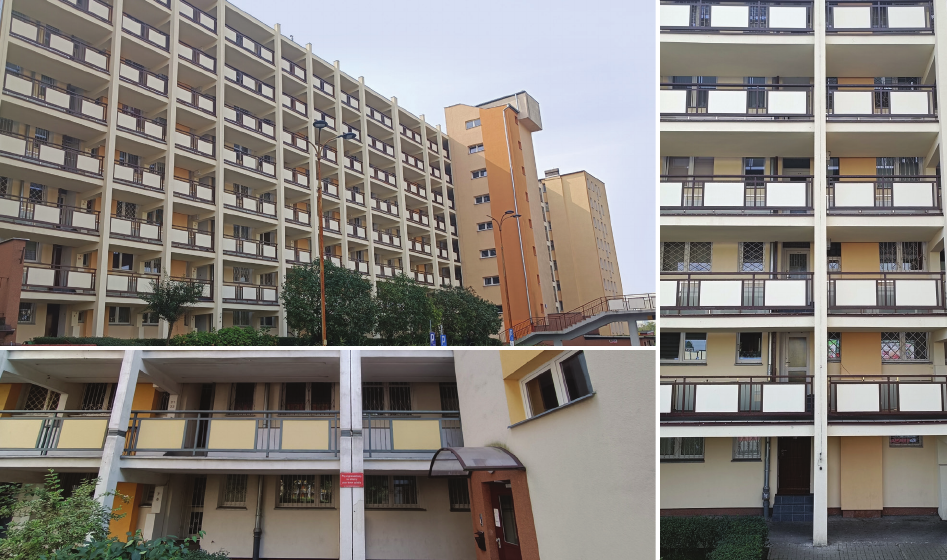
encouraged (Fig. 2). Hansen wrote about it: Being a com-
position of spatial subtext – it will become a multi-layered,
constantly living phenomenon. In relation to the conven-
tion of a closed composition, which relies mainly on the
craftsmanship of the crafted object, the convention of an
open composition will consist in action characterized by
a “passepartout” of changes taking place in space. It will
be the art of events. Time works more strongly than it did
so that we can continue to trust only the unchanging, once
established relationship of elements (Hansen 1959, 5). Han-
sen’s theory had a signicant impact on Polish concepts
of environment, happening and performance in the 1960s.
be limited to creating a “perceptual background”, so that
architecture becomes a tool that can be managed and adapt-
ed to the needs of users. His participation in the work of
Team 10 and his symptomatic presence in 1959 in Otterlo,
when CIAM was closed down, demonstrate the revisionist
and anti-authoritarian nature of his activities as an architect.
Taken together, both concepts can be seen as striving to
create a space – physical and social – in which individuals
have greater freedom and opportunity to express themselves
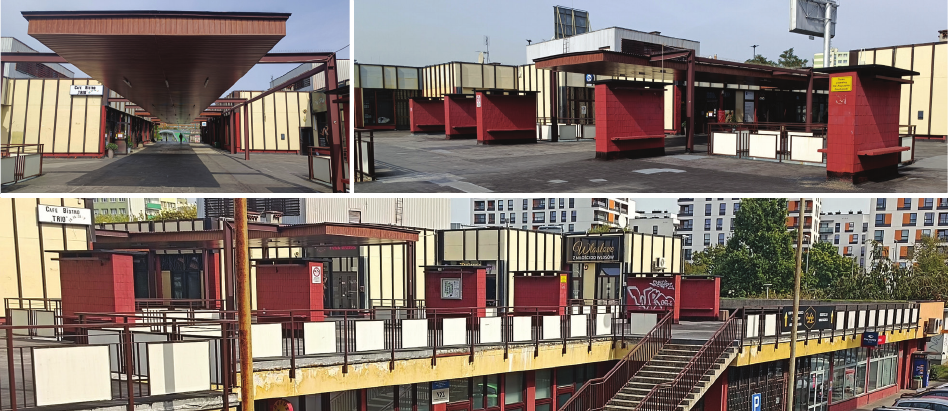
(Fig. 1).
3. Participation as an element of the social and creative
process.
This idea results directly from the values shared by Pop -
per and Hansen analyzed above. Popper emphasized the
role of citizens in shaping politics and society through ac-
tive participation and criticism. The Open Society by its
nature assumes the participation and cooperation of free
citizens. This is possible thanks to the existence of a space
of tolerance, freedom and responsibility. Only in such con-
ditions can there be a variety of forms of cooperation be-
tween citizens and the implementation of various, often
fun damentally dierent concepts and lifestyles. The Open
So ciety assumes citizens’ capacity for self-organization and,
at the same time, their responsibility for what happens in the
public space. This requires the presence of civic organiza-
tions that either cooperate with public authorities or oper-
ate independently. This is the essence of liberal democracy,
which Popper strongly advocated.
In his concept, Hansen emphasized the importance of
user participation in the process of creating and modifying
space. Referring to art in his programmatic text, he wrote:
It will create a sense of need for each of us, help us dene
and nd ourselves in the space and time in which we live.
It will be a space consistent with our complicated and yet
unknown psyche. This will happen because we will exist as
organic elements of art. We will walk in it, not celebrate
Fig. 1. Przyczółek Grochowski Housing Estate in Warsaw, 1970s. The trade pavilion – note the free interpenetration of spaces and partial,
characterized by artistic values, roofing providing shelter from the sun and rain exposure (photos by A. Zaguła)
Il. 1. Osiedle Przyczółek Grochowski w Warszawie, lata 70. XX w. Pawilon handlowy – zwraca uwagę swobodne przenikanie się przestrzeni oraz
częściowe, charakteryzujące się walorami artystycznymi, zadaszenie zapewniające schronienie przed działaniem słońca i deszczu (fot. A. Zaguła)
92 Artur Zaguła, Miłosz Gortyński
It seems that a rationalist approach also characterizes
Hansen’s beliefs. The last sentences of his programmatic
text read as follows: Open form is not just a speculative
invention of our times. It is primarily a post-observation
conclusion of existing systems (Hansen 1959, 5). This may
be due to the fact that he shares the view that the basis of
rational reasoning is based on arguments and observations.
However, according to Popper’s classication, it is closer to
“non-critical rationalism”. All his energy was directed to-
wards the future, towards building a new, egalitarian, ideal
society. Behind this was a utopian belief in human possi-
bilities of creating “paradise on earth”, but also in the new
system of socialism. It was supposed to enable the imple-
mentation of the Linear Continuous System (LSC), a new
settlement system created by Hansen. In a 1968 discussion,
Hansen stated: It seems to me that the LSC is very realistic
and I believe that it will be implemented. First of all, because
it corresponds to the common interests of society and the
government. On the one hand, the LSC, having a huge mar-
gin of exibility, is based on the irrational features of life,
on the other hand, it allows you to shape matter much more
rationally than in traditional structures of human habitats
(Szczerski 2009, 80). However, for many dierent reasons,
this utopian vision had no chance of being realized in the
Polish People’s Republic. Another argument that Hansen’s
rationalism is “non-critical” is the language he uses both as
a writer and a speaker. It is an extremely persuasive lan-
guage, as Jacek Friedrich writes: However, Oskar Hansen’s
It was fully expressed in his competition entry for the in-
ternational monument to the victims of fascism in Aus-
chwitz-Birkenau (together with Jerzy Jarnuszkiewicz and
Julian Pałka, in 1957).
5. Rationalism as the main value in society and archi-
tecture.
For Popper, critical rationalism is the basis and most im-
portant feature of the Open Society as opposed to the irra-
tionality of the Closed Society. In his book, Popper denes
rationalism as […] readiness to listen to critical arguments
and to learn from experience. It is fundamentally an attitude
of admitting that “I may be wrong and you may be right,
and by an eort, we may get nearer to the truth.” It is an
attitude which does not lightly give up hope that by such
means as argument and careful observation, people may
reach some kind of agreement on many problems of impor-
tance […] (Popper 1966, vol. 1, 225). This does not mean,
however, that Popper supports every type of rationalism.
He distinguishes two types of it – “critical rationalism” and
“non-critical rationalism” or “consistent”. The former is an
advantage of the citizens of the Open Society, the latter is its
radical form, which Popper denes as irrational faith in rea-
son (Popper 1993, 243). The former is intersubjective in
nature, the latter is largely doctrinaire and is often the basis
for creating utopian visions of an “earthly paradise”. This is
what prompts Popper to criticize him, because he believes
that the basis of rationalist politics is the belief that it is im-
possible to create heaven on earth (Popper 1993, 271).
Fig. 2. Przyczółek Grochowski Housing Estate in Warsaw, 1970s. The gallery building manifesting the Open Form. Its author, Oskar Hansen,
designed the structure to allow its inhabitants to move freely through the block, choosing any staircase according to their preference
(photos by A. Zaguła)
Il. 2. Osiedle Przyczółek Grochowski w Warszawie, lata 70. XX w. Budynek galerii ucieleśnia Otwartą Formę. Jego autor, Oskar Hansen,
zaprojektował konstrukcję tak, aby umożliwić mieszkańcom swobodne poruszanie się po bloku, wybierając dowolne schody według
własnych preferencji (fot. A. Zaguła)
Oskar Hansen’s Open Form in the context of the Open Society concept by Karl Popper
93
statements are particularly worth considering due to at least
three features: rstly, Hansen manifests in them,
to a greater
extent than most of his writing colleagues, the desire to cre-
ate holistic approaches, methodical, systemic; secondly – his
publications are of an extremely persuasive nature, you can
read in them a kind of sense of mission, which, of course,
characterizes the modern movement in general, but in Han-
sen’s works it reaches a particularly high level; thirdly, and
nally – Hansen, like few others, tries to impose his own
terms of discourse on the recipient in his statements: hence
the strong appearance of rationality, objectivity, and science
accompanying statements that are otherwise very subjective
and arbitrary (Friedrich 2009, 47, 48).
As we can see, although both of them referred to a ratio-
nalist view of the world, there are clear dierences in its in-
terpretation. While Popper represents what he calls “critical
rationalism”, Hansen is a representative of a “non-critical
rationalist”.
To sum up, it should be said that despite clear dierenc-
es in worldview, there are many ideas and values that are
shared by both theorists. It is worth noting that both in Pop-
per’s Open Society and Hansen’s Open Form, what mat-
ters most is the human being as an individual who needs
a piece of common space in society. Although Open Form
was an ideal used in art and design in the post-war period,
its main goal was not necessarily social progress, but rather
the development of a decentralized type of democracy im-
plemented by each person using each public space.
Juliusz Słowacki Housing Estate in Lublin
as an example of the implementation
of the Open Form
The housing estate designed and built by Zoa Garliń-
ska-Hansen (1924–2013) and Oskar Hansen in the years
1964–1970 is a material example of the implementation
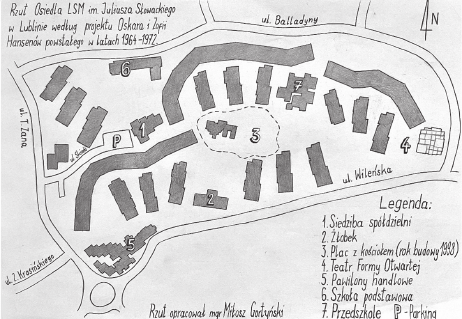
of the Open Form in architecture described above (Fig. 3).
Therefore, this architectural implementation is a case study
that allowed us to verify the credibility of the ideas de-
scribed above. The estate was intended to reconcile a sense
of individuality and belonging to a community.
The ideal of democratization of living space and individu-
alistic approach was realized by surveying future users (Filas
2009, 103, 107, 108), who could express their own opinions,
needs and proposals. This gave the designers the opportunity
to plan the apartments to meet their desires and expectations.
Zoa and Oskar Hansen embodied the principles of Open
Form in architecture, enabling the adaptation of living spaces
to various family models, needs and preferences. As a result,
a characteristic feature of the designed buildings emerged,
i.e., the asymmetrical location of balconies, which reected
the personalization of interior spaces. The principles of Open
Form were usually implemented by Hansen within the detail-
ing of the buildings. There were variations in the size and lo-
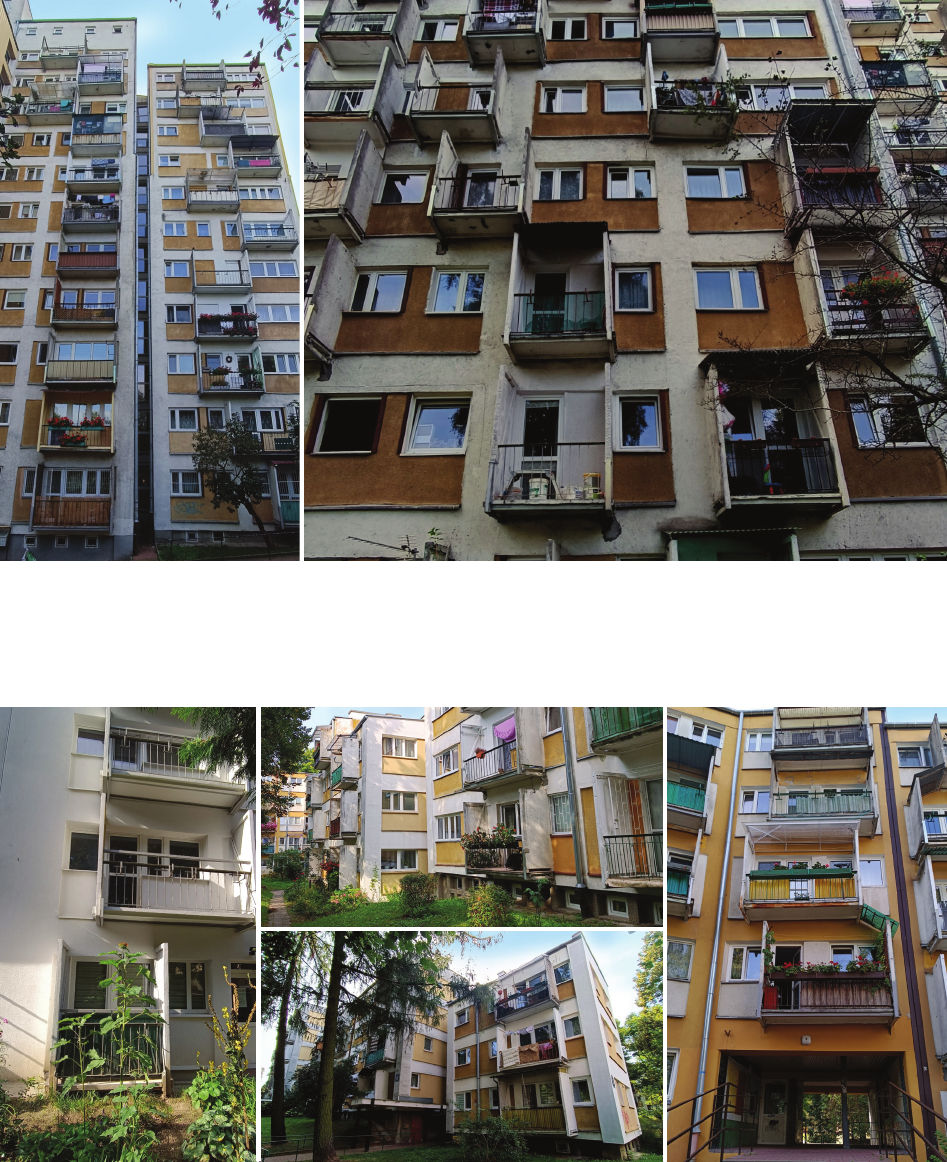
cation of balconies, entrances and passageways, for example,
in the “Wężowce” [“Serpents”] as well as staircases (Fig. 4).
In the Słowacki Housing Estate, such details included also
loggias on the south side, which residents could paint in any
color they wished, or pantries protruding from the north side,
projecting beyond the wall line, both enlarging the space of
small kitchens and creating a spatial, rhythmic, artistic accent
in the façade of the blocks (Szczerski 2009, 86, 89).
Oskar Hansen’s ideal of free transformation of space and
forms, thanks to which citizens could enjoy the opportunity
to jointly shape their places from the bottom up, respond-
ing to the needs of society, was also embodied in the LSM
Housing Estate (Fig. 5). Hansen incorporated a space called
the “amphitheater” or Theater of Open Form, which was an
articial mound lled with platforms, benches and tables.
In the Hansens’ opinion, the function of this space was to
foster interpersonal relationships (individual in communi-
ty), without suggesting a spatial dominant, so that everyone
would sit and look in their preferred direction. This proves
the Hansen’s ideological hostility towards the traditional hi-
erarchy, including those embedded in architectural design.
The Linear Continuous System, which was the urban
plan ning proposal of Hansen, was materialized in the design
of the Juliusz Słowacki estate, composed as longitudinal,
ribbon-shaped blocks called “Wężowce” [“Serpents”] and
point blocks called “Betki”. According to the design, the
“Wężowce” were to surround the estate from the northern
side, separating it from the outer parts of the city, empha-
sizing the autonomy and isolation of the space. The slal-
oming shape of the residential block was an Open Form
experiment, the aim of which was to search for architectural
solutions that would decentralize and democratize, while
also providing asylum to the residents. “Wężowce” marked
a trail among bushes and trees as well as mounds of earth
coming directly from the pits dug for the construction of
the foundations of the estate (Fig. 6). Despite his atheistic
beliefs, Hansen was convinced of the need to preserve this
land as a substance spiritually coherent with the place where
the architecture was conceived.
It should be noted that Hansen was a specialist in the
eld of sculptural form and it was on this foundation that
Fig. 3. Plan of the Juliusz Słowacki Housing Estate in Lublin, 1964–1970.
1 – Co-operative headquarters, 2 – nursery, 3 – square with church
(year of construction 1998), 4 – open Form Theatre, 5 – retail pavilions,
6 – primary school, 7 – kindergarten, P – car park
(drawing by M. Gortyński)
Il. 3. Plan osiedla im. Juliusza Słowackiego w Lublinie, 1964–1970.
1 – siedziba spółdzielni, 2 – żłobek,
3 – plac z kościołem (rok budowy 1998), 4 – Teatr Formy Otwartej,
5 – pawilony handlowe, 6 – szkoła podstawowa, 7 – przedszkole,
P – parking (rys. M. Gortyński)
94 Artur Zaguła, Miłosz Gortyński
Fig. 4. Juliusz Słowacki Housing Estate in Lublin, 1964–1970. The façade of the blockhouse. Note the asymmetrical arrangement of balconies
(photos by A. Zaguła)
Il. 4. Osiedle im. Juliusza Słowackiego w Lublinie, 1964–1970. Fasada bloku. Zwraca uwagę asymetryczny układ balkonów (fot. A. Zaguła)
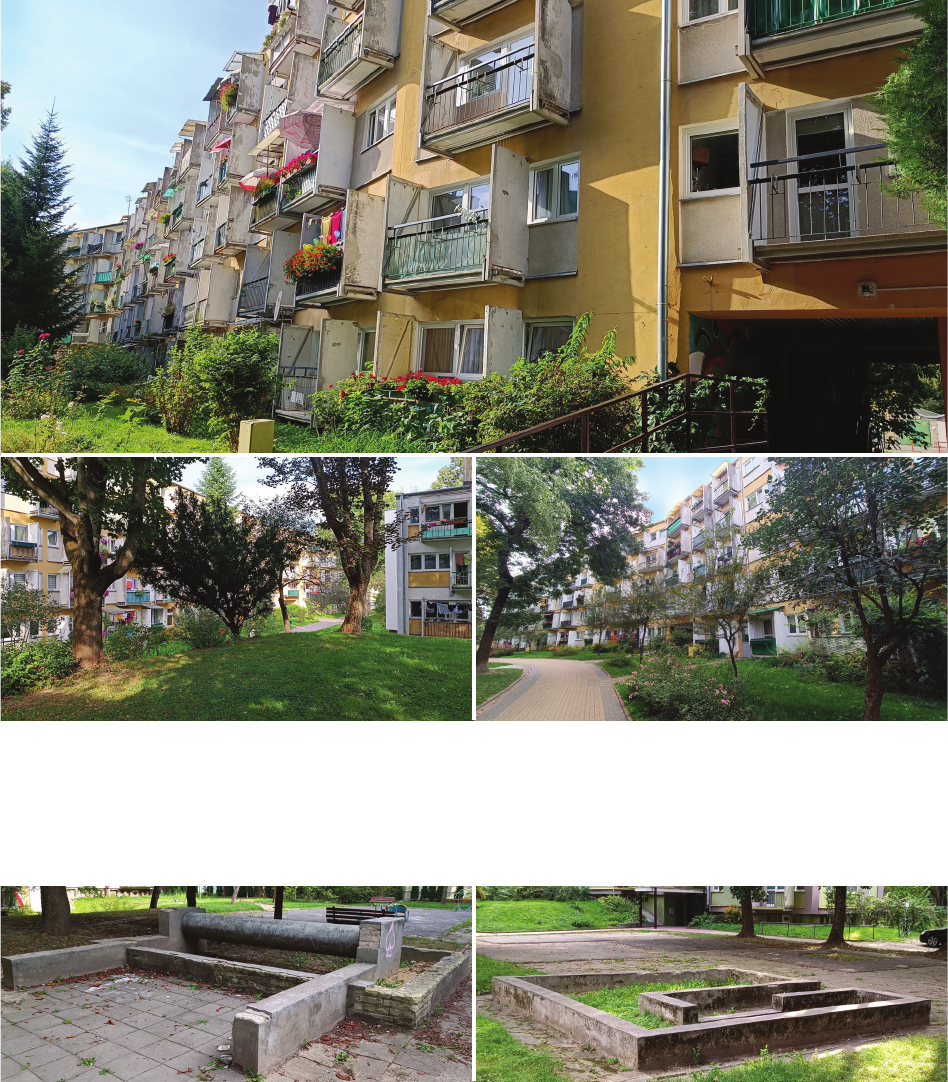
Fig. 5. Juliusz Słowacki Housing Estate in Lublin, 1964–1970. Block located nearby T. Zana Street.
One can grasp an attempt to adapt and individualize the space according to its inhabitants’ needs (photos by A. Zaguła)
Il. 5. Osiedle im. Juliusza Słowackiego w Lublinie, 1964–1970. Blok położony w pobliżu ul.T. Zana.
Widać tu próbę adaptacji i indywidualizacji przestrzeni zgodnie z potrzebami mieszkańców (fot. A. Zaguła)
he developed his concept of Open Form. He regarded ar-
chitecture as a tool for encoding Open Form into the mass
consciousness of the society of which he was a part. It is
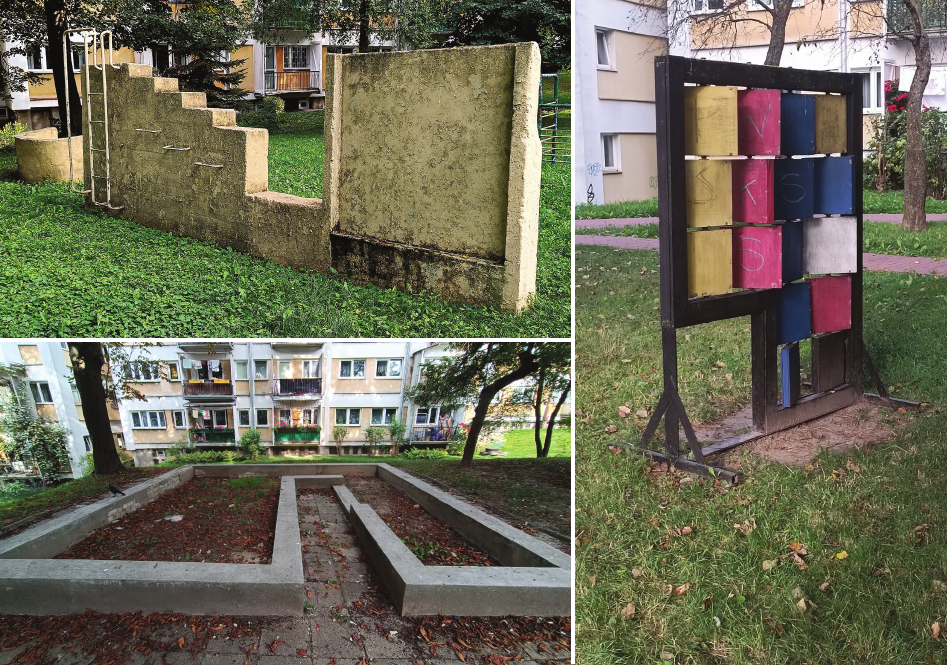
signicant that playgrounds, designed as an integral part of
the Słowacki Estate, represent a style that allows potential
users to dene, interpret and use the space freely. These are
not conventional playgrounds; rather, they are functional
sculptures with no predetermined purpose. According to
Hansen, their role was to encourage children to invent their
own games, using simple, primitive objects (Fig. 7).
Oskar Hansen’s Open Form in the context of the Open Society concept by Karl Popper
95
Fig. 6. Juliusz Słowacki Housing Estate in Lublin, 1964–1970. The “wężowiec” block enveloping the north side of the Słowacki Estate.
The building appears to be a continuous architectural body, formed in harmony with the natural contours of its surroundings (photos by A. Zaguła)
Il. 6. Osiedle im. Juliusza Słowackiego w Lublinie, 1964–1970. Bryła „wężowca” otaczająca północną stronę osiedla.
Budynek sprawia wrażenie ciągłej bryły architektonicznej, ukształtowanej w harmonii z naturalnymi konturami otoczenia (fot. A. Zaguła)
Fig. 7. Juliusz Słowacki Housing Estate in Lublin, 1964–1970. One of many playgrounds built according to Oskar Hansen’s design,
manifesting the principles of Open Form (photos by A. Zaguła)
Il. 7. Osiedle im. Juliusza Słowackiego w Lublinie, 1964–1970. Jeden z wielu placów zabaw zrealizowanych według projektu Oskara Hansena,
ucieleśniających zasady Formy Otwartej (fot. A. Zaguła)
The analysis of the Juliusz Słowacki Housing Estate in
Lublin clearly reveals an attempt to implement the princi-
ples of Open Form. All of the aforementioned ideas – indi-
vidual freedom; counteracting authoritarianism; participa-
tion; exibility and adaptation; rationalism – underpinned
this project. Unfortunately, these positive intentions often
ended in failure, whether due to the utopian thinking on the
part of the designers, economic and executive reasons, or,
nally, the communist government, which had the power
to thoroughly change or even completely undermine the
most well-intentioned premises. The appearance of the es-
tate reveals the shortcomings of the architects’ design. For
instance, the residents received balconies without any pro-
tection against weather conditions, which is why many of
them added self-constructed, makeshift covers and shelters.
Moreover, the apartments designed on the basis of surveys
96 Artur Zaguła, Miłosz Gortyński
ultimately ended up in the hands of entirely dierent occu-
pants, which was a consequence of socialist social policies
implemented within the context of an extremely inecient
centrally planned economy.
Discussion
The bitter truth behind the idea of Open Form is that it
can only serve its true purpose if the people who use the
space created on its principles share its ideas. This only hap-
pens in a society created in Hansen’s imagination and not
in reality. The examples of the Open Space in places such
as Juliusz Słowacki Housing Estate in Lublin were used in
unfortunate ways, which were not predicted by their design-
ers. The decentralized amphitheatre was quickly adopted by
local people to become the improvised space to smoke and
drink. The playgrounds for children were full of concrete
structures, which posed a risk of falls and injuries during
play. Even the ats in the Juliusz Słowacki Housing Estate
in Lublin, which were personally designed for specic fam-
ilies, after architects interviewed them about their needs and
preferences, were ultimately occupied by completely dier-
ent people.
According to the authors’ belief, the idea of the Open
Society presents progress as the natural destiny of every
society. Zoa and Oskar Hansen certainly dreamed of cre
-
ating a humanistic, progressive society in post-war Poland
through architectural design. Unfortunately, the revolution-
ary nature of the political system they lived under, aected
the way they were thinking about the citizens and their place
in the state. The linear system was a materialization of an
openly authoritarian way of thinking about the surrounding
world. Popper held humanistic views, however, they were
based on a traditional set of principles derived from Christi-
anity. Therefore, his view of progress, or to be precise evo-
lution, was quite dierent. It actually exists, as it exists in
the aging Hansen’s architecture today.
It is interesting that the architecture and urban planning
proposed by Hansen, retained their decentralized character
up until the political transformation in Poland in 1989. This
was not because of the societal freedom or subjectivity, but
rather due to the authoritarian tendencies of the authorities,
who refused to permit the construction of the church that
the community had demanded. Today, in the central part of
the Juliusz Słowacki Housing estate, a new church, repre-
senting a traditional theocratic hierarchy, rises above the
linear buildings and trees. This situation demonstrates the
paradox of Hansen’s theory. The authors of the article For-
ma Otwarta jako passe-partout patriarchatu? [Open Form
as a passe-partout of patriarchy] wrote: “As is well known,
Fig. 8. Juliusz Słowacki Housing Estate in Lublin, 1964–1970. Other examples of the playgrounds manifesting the Open Form ideals
central to their designer’s concept (photo by A. Zaguła)
Il. 8. Osiedle im. Juliusza Słowackiego w Lublinie, 1964–1970. Inne przykłady placów zabaw ucieleśniających ideały Formy Otwartej,
kluczowe dla koncepcji ich projektanta (fot. A. Zaguła)
Oskar Hansen’s Open Form in the context of the Open Society concept by Karl Popper
97
the theory of Open Form postulates, among other things,
democracy, egalitarianism, “hierarchylessness”, non-dog-
ma tic, decentralization and asymmetry.” The problem,
how ever, is that the structure of this theory is antinomic to
these postulates [...]. For, in our opinion, the structure of
this theory is by no means “decentralized.” On the contrary
– it is precisely centralized (albeit unconsciously) along the
axis of symmetry creating schematic, “black and white”
di visions and “totalizing” simplications. At the center of
this structure stands a “cathedral” from which the theorist
de livers arbitrary sermons sealed with dogmatic exclama-
tions (Klimaszewski, Kozak, and Malec 2009, 133, 134).
The problem is also that the radical and unrealistic, but still
in teresting and valuable ideas of Zoa and Oskar Hansen
were inadequate in relation to a society that went through
chaos and uncertainty in the cruelest and most devastating
conict in history.
Today, people who at least once in their lifetime had
a chance to live in spaces designed by Zoa and Oskar
Hansen generally do not express overly enthusiastic ap-
preciation for them. Instead, they talk harshly about the
narrowness, darkness, rough surfaces and little to no ther-
mal insulation. Flats become dangerously warm in sum-
mer and unbearably cold in winter due to the shape and
size of windows, thickness of the walls and lack of ther-
mal modernization, postponed for decades. Entire genera-
tions have been raised on the unsafe concrete playgrounds
(Fig. 8). One could probably argue that the very people
in Poland for whom Zoa and Oskar Hansen dedicated
their architectural and artistic legacy were not ready – or
perhaps not yet mature enough – to fully embrace or un-
derstand it.
Conclusion
The question is: what common value connects ideals
such as Karl Popper’s Open Society and Oskar Hansen’s
Open Form? It is important to note that what matters most
in both of these concepts is the human being as an indi-
vidual requiring a share of common space within society.
Even though Open Form was an ideal primarily applied to
arts and design in the post-war era, its main goal was not
necessarily social progress in the traditional sense, but rath-
er the advancement of a decentralized type of democracy,
one exercised by each human being using a public space.
Open Form could be also understood in a more personal or
private context, as demonstrated by Zoa and Oskar Han-
sen in their wooden house in Szumin. Although the living
space was not particularly large, it was designed to allow
for exible re-organization, in response to changing life
situations.
In the end, we cannot help but recognise that both Open
Form and the Open Society, as ideals, respond to what ev-
eryday life truly demands: a vision for healing our shared
environment, grounded in a deep and sincere belief in hu-
manity. Today, we are in a position to evaluate whether the
Modernist, democratic and decentralized vision created
by architects in the 1960s served its purpose and to what
extent. And this history brings an important context to ar-
chitecture as a cultural phenomenon, the Open Society as
a philosophical current and Open Form as a design ideal,
all interconnected. This reection is especially important
now, as we increasingly live in ideological bubbles, pay-
ing less and less attention to what unites us than to what
divides us.
References
Baranowski, Mariusz. “Społeczeństwo otwarte” jako konsekwencja sta-
nowiska krytycznego racjonalizmu.” Kultura i Społeczeństwo 53,
no. 1 (2009): 69–82. https://doi.org/10.35757/KiS.2009.53.1.4.
Filas, Paulina. “Lubelskie osiedle im. Juliusza Słowackiego – między
wizją a realizacją.” In Wobec Formy Otwartej Oskara Hansena.
Idea – utopia – reinterpretacja, edited by Marcin Lachowski, Mag-
dalena Linkowska, Zbigniew Sobczuk. Towarzystwo Naukowe
KUL, 2009.
Friedrich, Jacek. “Kilka uwag o języku i retoryce Oskara Hansena na
marginesie jego wypowiedzi omawiających Linearny System Cią-
gły.” In Wobec Formy Otwartej Oskara Hansena. Idea – utopia – re-
interpretacja, edited by Marcin Lachowski, Magdalena Linkowska,
Zbigniew Sobczuk. Towarzystwo Naukowe KUL, 2009.
Gadamer, Hans Georg. Prawda i metoda. Translated by Bogdan Baran.
Inter Esse, 1993.
Hansen, Oskar. “Forma Otwarta.” Przegląd Kulturalny no. 5 (1959): 5.
Hansen, Oskar. Zobaczyć świat. Edited by Jola Gola. Zachęta Narodowa
Galeria Sztuki, 2005.
Klimaszewski, Cezary, Tomasz Kozak, and Tomasz Malec. “Forma
Otwarta jako passe-partout patriarchatu?” In Wobec Formy Otwartej
Oskara Hansena. Idea – utopia – reinterpretacja, edited by Marcin
Lachowski, Magdalena Linkowska, Zbigniew Sobczuk. Towarzyst-
wo Naukowe KUL, 2009.
Ockman, Joan. “Oskar Hansen’s Radical Humanism: Open Form Against
a Cold War Background.” In Oskar Hansen: Opening Modernism.
On Open Form Architecture, Art and Didactics, edited by Aleksan-
dra Kędziorek, Łukasz Ronduda. Museum of Modern Art in War-
saw, 2014.
Pelkonen, Eeva-Liisa. “Helsinki-Warsaw, c. 1960.” In Team 10 East: Re-
visionist Architecture in Real Existing Modernism, edited by Łukasz
Stanek. Museum of Modern Art in Warsaw, 2014.
Popper, Karl P. Społeczeństwo otwarte i jego wrogowie. Translated by
Halina Krahelska. PWN, 1993.
Popper, Karl P. The Open Society and Its Enemies. Vol. 1: The Spell of
Plato, Routledge, 1966.
Popper, Karl P. The Open Society and Its Enemies. Vol. 2: Hegel and Marx.
Routledge, 1966.
Springer, Filip. Zaczyn: o Zoi i Oskarze Hansenach. Karakter, 2022.
Stanek, Łukasz, and Dirk van den Heuvel. “Introduction: Team 10 East
and Several Other Useful Fictions.” In Team 10 East: Revisionist
Architecture in Real Existing Modernism, edited by Łukasz Stanek.
Museum of Modern Art in Warsaw, 2014.
Szczerski, Andrzej. “Linearny System Ciągły i awangardowa utopia.”
In Wobec Formy Otwartej Oskara Hansena. Idea – utopia – rein-
terpretacja, edited by Marcin Lachowski, Magdalena Linkowska,
Zbigniew Sobczuk. Towarzystwo Naukowe KUL, 2009.
Włodarczyk, Wojciech. “Rozmowa z Oskarem Hansenem.” In Wobec
Formy Otwartej Oskara Hansena. Idea – utopia – reinterpretacja,
edited by Marcin Lachowski, Magdalena Linkowska, Zbigniew
Sobczuk. Towarzystwo Naukowe KUL, 2009.
Zwoliński, Zbigniew. “Tezy hermeneutyki Gadamera.” Przegląd Filozo-
czny 14, no. 2 (2005): 253–62.
98 Artur Zaguła, Miłosz Gortyński
Streszczenie
Forma Otwarta Oskara Hansena w kontekście koncepcji społeczeństwa otwartego według Karla Poppera
i realia architektoniczne w Polsce przed rokiem 1989
W artykule przedstawiono wzajemne relacje między koncepcjami teoretycznymi Formy Otwartej Oskara Hansena i społeczeństwa otwartego
Karla Poppera. Ich analiza i porównanie mają zarówno służyć poszerzeniu wiedzy na temat rozwoju modernistycznych koncepcji w architekturze
i urbanistyce, jak i pokazać, iż wychodzące z różnych przesłanek, założeń i okoliczności teorie łączą pewne fundamentalne ideały i wartości. Metody:
hermeneutyczna i historyczno-interpretacyjna pozwoliły na rozpoznanie rzeczywistości materialnej i społecznej w złożonym kontekście czasów po
II wojnie światowej. Dodatkowo studium przypadku jednego ze zrealizowanych osiedli mieszkaniowych Oskara Hansena pozwoliło na werykację
teoretycznych podstaw Formy Otwartej z próbą jej materializacji. Analiza obydwu teoretycznych konceptów pozwoliła na sformułowanie pod-
stawowych wartości je łączących: indywidualnej wolności; przeciwdziałania autorytaryzmowi; partycypacji społecznej; elastyczności i adaptacji;
racjonalizmu. W konkluzji wskazano, że zarówno Forma Otwarta, jak i społeczeństwo otwarte to próby uzdrowienia naszego wspólnego otoczenia,
jako wizja oparta na prawdziwej i głębokiej wierze w ludzkość. Jest to tym ważniejsze, że żyjąc obecnie w ideologicznych bańkach, mniej uwagi
poświęcamy temu, co nas łączy, niż temu, co nas dzieli.
Słowa kluczowe: Forma Otwarta, architektura modernistyczna, społeczeństwo otwarte, linearny system ciągły