
Criterion of knowledge
A good starting point for our reflection on poverty and
wealth can be statistical reports which comprise such data
as numbers of people who are included in groups of the
so called extreme poverty, relative poverty as well as
statutory or realistic statutory poverty [1, p. 2]. Following
this line of reasoning, we ought to mention ways of mea-
suring poorness in Poland and territorial differences in
national ranges of poverty and on this basis determine risk
indexes, e.g. of poverty [cf. 1]. This kind of reasoning
would facilitate scientific development which is becom-
ing more and more specialised and at the same time more
and more enslaved by principles of verifiability. It is often
the case that a researcher who mainly uses quantitative
knowledge is perceived as the one who knows more and
is associated with the author of a report containing empi-
rically reliable calculations which are proved in the par-
ticular probabilistic space. Reductive reasoning which has
undergone enormous changes in its methodology, al -
though “it does eliminate various myths from scientific
circulation” – as it was noticed by Jerzy Lukszyn and Wan-
da Zmarzer – has unfortunately fallen from grace [cf. 2].
José Ortega y Gasset, the author of the famous The Re -
volt of the Masses [3], sacrificed scientific rigors and
me tho do logical purity in favour of intuition and the so
called pre dicting. The author was accused of camouflag-
ing radi ca lism by a brilliant style, overusing a black and
white tech nique of describing social phenomena and ma -
ni pu la ting readers, which was connected by critics with,
2013
4(36)
DOI: 10.5277/arc130407
Jacek Kotz, Anna Nowel-Śmigaj*
Bieda i bogactwo. Próby artykulacji problemu
i dialog ze studentem architektury, autorem projektu
Poverty and wealth. Attempts to define the problem
and dialogue with a student of architecture – author of the project
* Wydział Architektury Politechniki Wrocławskiej/Faculty of
Architecture, Wrocław University of Technology.
Kryterium wiedzy
Refl eksję na temat biedy i bogactwa można rozpo-
cząć od doniesień statystycznych, podając dane o liczbie
obywateli, których ujęto w grupach tak zwanego ubós-
twa skrajnego, relatywnego, ustawowego lub urealnio-
nego ustawowego [1, s. 2]. Idąc tym tropem, należałoby
wspom nieć o sposobach pomiaru ubóstwa w Polsce, zróż-
nicowaniach terytorialnych zasięgu biedy w kraju i okreś-
lić na ich podstawie wskaźniki zagrożeń, na przykład, ubó-
stwem [por. 1]. Tak przyjęty rodzaj myślenia sprzyjałby
rozwojowi nauki coraz bardziej wyspecjalizowanej i coraz
bardziej zniewolonej regułami weryfi kowalności. Sta
ło się
bowiem tak, że badacza, który posługuje się wiedzą ilo-
ściową, uważamy za tego, który wie więcej, utożsamiamy
z autorem raportu, twórcą empirycznie wiarygodnych ob-
liczeń, udowodnionych w konkretnej przes trzeni probabi-
listycznej. Myślenie redukcyjne, w którego metodologii
dokonały się ogromne zmiany, choć „eliminuje z obiegu
naukowego rozmaite mity” – jak zauważa Jerzy Lukszyn
i Wanda Zmarzer – popadło niestety w niełaskę [por. 2].
Na rzecz intuicji i tak zwanego przepowiadania po-
święcił rygory naukowe i czystość metodologiczną José
Or tega y Gasset, twórca słynnego Buntu mas [3]. Auto-
ro wi zarzucono kamufl owanie radykalizmu błyskotliwym
stylem, nadużywanie czarno-białej techniki opisu zjawisk

84 Jacek Kotz, Anna Nowel-Śmigaj
inter alia, instigating social antagonisms. The applied
com pa ri sons and generalisations concerning history were
flagrant.
In fact, authors such as José Ortega y Gasset by reduc-
ing many premises in favour of a target which involves
de termining aftermaths, not only estimate the hitherto
scien tific achievements but they also start a certain me -
cha nism of estimating knowledge. The generalisations
for med by them – effects of deliberate intentional explo-
ration of achievements of many sciences – seen against
the background of arduous efforts of researchers who use
particular paradigms, can be named unserious know ledge.
We must bear in mind that the predictions about the con-
temporary world presented by Ortega y Gasset can en -
liven a dis course on the reality and even introduce order
into some motifs because they start a process that can be
re ferred to as creative thinking and this, according to
authors, is the most adequate approach to the contempo-
rary world.
In this article contextual interpretation
1
was assumed
to be the most appropriate manner of discussing projects
dealing with the problem of poverty and wealth – two
abstract categories as regards their meaning that are worth
discussing today. The main reason why this method was
chosen is a possibility to depart from stiff rigours of the
analytic workshop for the good of interpretation under-
stood not only as clarification of a message interpreted by
means of special tools, but also as an element of the com-
munication process. The students’ projects referred to the
background presented below, determined by the selected
generalisations of Ortega y Gasset, do not lose their indi-
vidual original characteristics. Quite contrary, they gain
a broader dimension and can be understood by means of
a new language of interpretation, perhaps less specialised
but more understandable due to the topics involved.
The authors think that in the context of the aforemen-
tioned generalisations their attitude towards not evaluat-
ing the students’ works, i.e. not assessing them in the
context of the quality of the presented visions or the
observed intellectual level of the students is more under-
standable. The authors’ aim was rather to subject the stu-
dents’ works to contextual interpretation and to determine
a possible improvement programme connected with the
teach ing process. The main idea of this programme was
based upon Emmanuel Levinas philosophy who put for-
ward the thesis that a man who is able to turn to the world,
returns to himself [4, ch. 3].
My own self in a chorus of masses
One of the selected generalizations of Ortega y Gasset
is as follows: […] we live in an era that is characte ri zed
by the sense of enormous possibilities of performance
but at the same time this era does not know what to per-
1
Contextual interpretation comprises an analysis of factors which
might have a significant influence on the projects made by the students.
In this article texts by José Ortega y Gasset and Bauman dealing with
problems of contemporary man as well as poverty and wealth constitute
the interpretation background.
społecznych i manipulowanie czytelnikami, które kryty-
cy łączyli, między innymi, z podsycaniem antagonizmów
społecznych. Raziły stosowane porównania i generaliza-
cje na temat historii.
Rzeczywiście, tacy autorzy jak Ortega y Gasset, redu-
kując wiele przesłanek w imię celu, którym jest określe-
nie następstw, nie tylko sami wartościują dotychczasowe
osiągnięcia nauk, ale i uruchamiają pewien mechanizm
wartościowania wiedzy. Tworzone przez nich uogólnie-
nia – efekty celowej, intencjonalnej eksploracji osiągnięć
wielu dyscyplin – na tle mozolnych wysiłków badaczy,
posługujących się określonymi paradygmatami, można
nazwać wiedzą niepoważną. Należy zauważyć, że przed-
stawione przez Ortegę y Gasseta prognozy na temat świata
współczesnego mogą zarówno ożywiać dyskurs o rze-
czywistości, jak i wręcz porządkować niektóre wątki, po-
nieważ uruchamiają to, co określić można jako myśle-
nie twórcze, najbardziej, zdaniem autorów, adekwatne do
współczesnego świata.
W niniejszym artykule interpretację kontekstową
1
uznano za właściwy sposób omawiania projektów podej-
mujących problem biedy i bogactwa – dwóch abstrakcyj-
nych pod względem znaczenia kategorii, na których temat
warto dziś debatować. Głównym powodem wyboru takiej
metody jest możliwość odejścia od sztywnych rygorów
warsztatu analitycznego na rzecz interpretacji rozumia-
nej nie tyle jako wykładnia interpretowanego za pomocą
specjalnych narzędzi przekazu, ile jako element procesu
komunikacyjnego. Projekty studentów odniesione do tła
przedstawionego poniżej, określonego przez wybrane ge-
neralizacje autorstwa Ortegi y Gasseta nie tracą indywi-
dualnych, oryginalnych właściwości. Dzieje się wręcz od-
wrotnie – zyskują one szerszy wymiar, dają się odczytać
za pomocą nowego języka interpretacji, być może mniej
wyspecjalizowanego, ale – co determinuje ich tematyka –
bardziej zrozumiałego.
Autorzy uważają, iż w kontekście wspomnianych ge-
neralizacji ich postawa nakierowana na niepoddawanie
ocenom prac studentów, to jest niewartościowanie ich
w kontekście jakości prezentowanych wizji ani też prze-
jawiającego się w nich poziomu intelektualnego studen-
tów, staje się bardziej zrozumiała. Celem autorów było ra-
czej poddanie prac studenckich interpretacji kontekstowej
oraz określenie możliwego programu naprawczego zwią-
zanego z procesem dydaktycznym. Główną ideę tego pro-
gramu oparto na fi lozofi i Emmanuela Levinasa stawiają-
cego tezę, iż człowiek, który umie zwrócić się ku światu,
znów wraca do siebie [4, ch. 3].
Własne ja w chórze mas
Jedno z wybranych uogólnień autorstwa Ortegi y Gas-
seta brzmi: [...] żyjemy w epoce, którą cechuje poczucie
olbrzymich możliwości realizacji, ale która nie wie, co
1
Interpretacja kontekstowa obejmuje analizę czynników, które
mogły mieć znaczący wpływ na projekty wykonywane przez studentów.
W artykule tło interpretacji stanowią teksty Ortegi y Gasseta oraz Bau-
mana, które poruszają problemy współczesnego człowieka oraz biedy
i bogactwa.

Bieda i bogactwo /Poverty and wealth 85
form. It controls all things but it is not able to control
itself. It feels lost in the excess of its own possibilities
[3, p. 35].
The problem of how the students understand these pos-
sibilities or rather their perception connected with control
without an objective, one effect of which is a specific
moral trap that combines a feeling of improving the world
with a manifested feeling of guilt resulting from taking
advantage of, e.g. economic privileges, shall be discussed
in further parts of the article. At this stage the authors sug-
gest extending a discursive background on the basis of
more general questions posed by José Ortega y Gasset.
These questions refer to, inter alia, participation in the
world which can be determined by means of common-
place phrases such as “saving face” and protecting “my
own self” from “a chorus” of mediocrity.
According to Ortega y Gasset, who in The Revolt of the
Masses describes the phenomenon of the modern so cie ty
logic, the observable attitudes expressed by the students’
projects – such as a specific manifestation of power,
a lack of humbleness and distance in relation to their own
ignorance or inability to see a difference between popular
commonplace knowledge and empirical science resulting
from the process of researching regularities – are manifes-
tations of masking and simultaneously ennoblement of
crisis. The effects of this ennoblement are, in the author’s
opinion, axiological: Mass man simply has no morality
which is always, as a matter of fact, a feeling of being
subordinated to something with the awareness of service
and commitment. But perhaps it is wrong to say that man
“simply” has no morality. It is not only the fact that this
type of man rejects morality and feels free from it. It is not
possible to become free from morality in any way. Some-
thing referred to as amorality, which is even grammati-
cally incorrect, in reality does not exist at all. If you do
not want to be subordinated to any norm, velis nolis you
have to subordinate yourself to a norm which involves
negating the existence of all morality and this is not an
amoral attitude but an immo ral one. This is negative
mo rality in which the latter is kept in the form of an empty
place [3, p. 63].
Therefore, it is worth emphasising that in the light of
the conducted research the observations of the author of
The Revolt of the Masses are significant for two reasons.
The student who deals with a closed task entitled “Poverty
(and) wealth” must express his opinion and reveal his
attitude, whereas the researcher interpreting this work
must recognise this ready product as, for example, a ma -
nifestation of expressing “my own self” or, following
Or tega y Gasset’s reasoning, a lack of this attitude or
subordinating, paradoxically, to this lack or to something.
This type of communication makes it difficult to find an
objective or even a specific code shared by the sender and
the recipient because, according to Ortega y Gasset, for
mo dern man it makes no difference whatsoever whether
he assumes the mask of a reactionary or a revolutionary;
whether he is characterised by an active or passive atti-
tude; sooner or later it comes to light that [...] he ignores
[...] his obligations and at the same time thinks – not
know ing why – that his rights are unlimited [3, p. 63].
ma realizować. Panuje nad wszystkimi rzeczami, ale nie
jest panią samej siebie. Czuje się zagubiona w nadmiarze
włas nych możliwości [3, s. 35].
Rozumienie owych możliwości przez studentów, a ra-
czej ich odczuwania związanego z pozbawionym celu
pano waniem, którego jednym z efektów jest swois ta mo-
ral na pułapka łącząca poczucie ulepszania świata z prze -
ja wiającym się jednocześnie poczuciem winy za ko rzysta-
nie, na przykład, z ekonomicznych przywilejów, zos tanie
omó wiona w dalszej części artykułu. Autorzy w tym miejs
-
cu proponują rozbudowanie zaplecza dyskursywne go na
podstawie ogólniejszych pytań stawianych przez José
Or tegę y Gasseta. Pytania te dotyczą, między innymi,
uczest nictwa w świecie, które określić można za pomo cą
obie gowych związków frazeologicznych w rodzaju: „za -
cho wania twarzy” i obrony „własnego ja” przed „chórem”
przeciętności.
Zdaniem Ortegi y Gasseta, który w Buncie mas opisu-
je zjawisko logiki społeczeństwa nowoczesnego, posta-
wy możliwe do zauważenia i wyrażające się w projek-
tach studenckich – takie jak specyfi czna manifestacja
wiedzy, brak pokory i dystansu wobec własnej niewie-
dzy czy nieumiejętność odróżnienia wiedzy potocznej,
obiegowej od na przykład empirycznej, lecz będącej wy-
ni kiem badania prawidłowości – są przejawem masko-
wa nia i zarazem nobilitacji kryzysu. Efekty owej nobi-
li tacji mają, zdaniem tego autora, wymiar aksjologiczny:
Człowiek masowy po prostu nie ma moralności, która
zawsze, z istoty rzeczy, jest poczuciem podporządkowa-
nia się czemuś, świadomością służby i zobowiązania. Ale
może błędem jest mówić, iż „po prostu” nie ma. Bo nie
chodzi tu tylko o to, że ten typ człowieka odrzuca moral-
ność, czuje się od niej wyzwolony. Od moralności w żaden
sposób nie można się
uwolnić. To, co określamy słowem
amoralność, które nawet gramatycznie nie jest popraw-
ne, w rzeczywistości nie istnieje. Jeśli nie chcesz podpo-
rządkować się żadnej normie, to musisz velis nolis pod-
porządkować się normie, jaką jest negowanie istnienia
wszelkiej moralności, a to nie jest postawa amoralna,
lecz niemoralna. Jest to moralność negatywna, w któ-
rej ta druga zachowana jest w formie pustego miejsca
[3, s. 63].
Warto zatem podkreślić, że w świetle podjętych ba-
dań spostrzeżenia twórcy Buntu mas są istotne z dwóch
powodów. Student wykonujący zadanie klauzurowe za -
tytułowa ne „Bieda (i) bogactwo” musi zająć pewne
stanowis ko, ujawnić swoją postawę, natomiast interpre-
tujący jego pracę – uznać gotowy wytwór za, na przyk ład,
przejaw wypowiedzenia „własnego ja” bądź też, podą -
żając za tokiem myślenia Ortegi y Gasseta, braku pos-
tawy czy podporządkowania, paradoksalnie, owemu bra-
kowi lub czemuś. W tak rozumianej komunikacji trudno
znaleźć nie tylko cel, ale i właściwy, wspólny dla nadaw-
cy i odbiorcy kod, gdyż – jak pisze Ortega y Gasset – dla
współczesnego człowieka: Jest rzeczą zupełnie obojętną,
czy przybiera maskę reakcjonisty czy rewolucjonisty; czy
go cechuje postawa bierna czy aktywna; prędzej czy póź-
niej wychodzi na jaw, iż [...] ignoruje [...] obowiązki, a za-
razem uznaje, sam nie wiedząc dlaczego, że prawa jego są
nieograniczone [3, s. 63].

86 Jacek Kotz, Anna Nowel-Śmigaj
Atrybuty władzy w rękach studenta
Zaskakujące dla autorów publikacji było to, iż kilka
spośród poddanych analizie prac przedstawia kategorie
biedy i bogactwa jako dwa niepowiązane ze sobą świa-
ty, często oddzielone murem, rzeką, czy nawet piorunem.
Wypowiedzi studentów, o charakterze sentencji, takie jak
„brak łagodnej granicy pomiędzy biedą i bogactwem”,
wymagają od prowadzących interpretacji, a tym samym
próby podjęcia dialogu z autorami prac. W rozmowach to-
czonych podczas konsultacji zauważyć natomiast można
– typowe dla ignorowania obowiązku – zmęczenie, które
przejawia się powierzchowną pewnością siebie, kamufl o-
waniem się osiąganym za pomocą przysłowio wego „cho-
wania głowy w piasek”. Żaden ze studentów nie poddał
krytyce uwag prowadzących zadanie klauzurowe, utrzy-
mując tylko, że leżące u podstaw projektu tezy ideowe
były słuszne. Postawę taką psycholodzy tłumaczą bra-
kiem umiejętności przeciwstawienia się sytuacji budzą-
cej lęk [por. 5].
Zarówno przyjmujący postawę, wedle określeń Ortegi
y Gasseta, reakcyjną, jak i rewolucyjną (bez względu na
obraną przez siebie metodę zbawienia świata) w momen-
cie pojawienia się propozycji podjęcia dyskusji na temat
wykonanych prac pozostawali bierni. Nawet sugestia czy-
niona przez prowadzących o dającym się zaobserwować
w trakcie realizacji zadania klauzurowego błędnym uży-
ciu zadomowionych w kulturze symboli nie deprymowa-
ła studentów. Ich zachowania można kojarzyć raczej z iry-
tacją, która narastała, kiedy nauczyciel usiłował nakłonić
do dyskursu intelektualnego, pytając o przyczyny, źródła
i prosząc o wyjaśnienia.
Autor Buntu mas, charakteryzując człowieka współ-
czesnego, użył zwrotu „są przekonani”. Rozmowy ze stu-
dentami dowiodły, że dziś mamy do czynienia, o ile nie
z silnie utrwalonym przekonaniem, to wręcz z dominacją
opisanego wzoru myślenia. Banalność i przeciętność nie
są traktowane jako wady. Paradoksem jest, iż określenie
„ludzkie gusty różnią się” – będące sensu largo wykładnią
wzniosłości i odziedziczonych po modernizmie: niepow-
tarzalności, indywidualizmu i podmiotowości – w tym
kontekście staje się pragmatycznym i fi lozofi cznym na-
rzędziem absolutyzowania prawa do bycia przeciętnym
oraz do narzucania tego prawa innym.
Specyfi czny brak chęci autorów prac do podejmowania
rozmowy na temat ich kształtu oraz proponowanej przez
nich metody przedstawiania w formie abstrakcyjnej (na
przykład: klas ludzi, którym przyporządkowano pewne
atrybuty, czasem bardzo wymowne i jednoznaczne) moż-
na połączyć z poglądem na to, co Ortega y Gasset określa
jako przejaw nowej władzy organizującej życie publicz-
ne. To zaś […] nie ogranicza się jedynie do sfery polity-
ki […] należy do niego również działalność intelektualna,
moralna, gospodarcza, religijna; obejmuje ono wszelkie
sfery życia zbiorowego, włącznie ze sposobem ubierania
się czy zabawy [3, s. 2].
Użycie słowa władza w odniesieniu do postaw uwi-
docz nionych przez studentów wydaje się trafne, lecz
wyma ga kilku dodatkowych wyjaśnień. W tradycyjnych
relacjach student–nauczyciel akademicki układ instytu-
Attributes of power in student’s hands
The authors of this study find it surprising that in some
of the analysed works the categories of poverty and wealth
were presented as two unrelated worlds, often divided by
a wall, a river or even a thunderbolt. The students’ state-
ments of conclusive character such as “lack of a gentle
border between poverty and wealth” require the research-
ers’ interpretation and at the same time their attempts at
starting a dialogue with the authors of these works. In the
conversations held during consultations we can notice –
typical of ignoring obligations – tiredness which is mani-
fested by superficial confidence and camouflaging achieved
by means of proverbial “hiding your head in the sand”.
There were no students who would criticise remarks of the
researchers conducting the closed task – they basically
recognised the fact that ideological theses underlying the
project were right. Psychologists explain this attitude by
a lack of abilities to oppose a si tua tion arousing fear [cf. 5].
Both those who assumed an approach that was reac-
tionary and revolutionary – according to definitions by
Ortega y Gasset – regardless of their own actual method
of saving the world, the moment when a discussion about
their works was suggested, remained passive. Even when
they heard the researchers’ suggestion that the symbols
present in culture which were used during the closed task
performance were wrong, their only reaction was far from
being disconcerted. Rather, the students’ behaviours can
be associated with irritation that grew when the research-
er tried to induce them to start an intellectual discourse by
asking them questions about reasons and sources and
requesting some explanations.
The author of The Revolt of the Masses, when describ-
ing modern man, used this phrase: “they are convinced”.
Conversations with students showed that what we are fac-
ing today is not only a firmly established conviction but
even the dominance of the aforementioned model of rea-
soning. Banality and mediocrity are not perceived as de -
fects. It is a paradox that the expression “there’s no
ac counting for tastes” – which is sensu largo the interpre-
tation of loftiness and inheritance of modernism: unique-
ness, individualism and subjectivity – in this context be -
comes a pragmatic and philosophical tool that absolutizes
the right to be mediocre and to impose this right on others.
Specific unwillingness of the authors of the works to
start a conversation about their shapes as well as a presen-
tation method in the abstract form suggested by them (for
example, presenting classes of people to whom certain
attributes were assigned, sometimes very meaningful and
unambiguous) may be connected with Ortega y Gasset’s
view on a manifestation of new power that organizes pub-
lic life. However, this [...] is not limited only to politics
[...] it also comprises intellectual, moral, economic and
religious activities; it also involves all spheres of collec-
tive life, including the sort of clothes people wear or how
they have fun [3, p. 2].
Using the word power in reference to the attitudes
demonstrated by students seems accurate, but it requires
some additional clarifications. In traditional student–aca-
demic teacher relations the institutional system de termi-

Bieda i bogactwo /Poverty and wealth 87
nes some roles for people which are interpreted in catego-
ries of the so called good education. In a new com muni-
cation situation, referring to power, we must bear in mind
a relation that can be named as “correct” with a weakly
emphasised subordination relationship between a superior
and a subordinate. Students are neither tactless nor criti-
cal. Their behaviours do not reveal any manifes tations of
intending to change the roles. Should such atti tudes be
observed, the former remarks ought to be seen as sense-
less because we would deal with an attempt at confronta-
tion, resistance, possibly even a revolt. This situation
could be then classified as an act of trying to create some
micro-social division. Meanwhile, as it was noticed by
Ortega y Gasset, power in the amorphous but simultane-
ously atomised world of masses falls to everyone.
In that world there are no authorities either because
a psychological diagram of contemporary mass man [...]
includes two basic features: a free expansion of demands
and needs that life brings, in particular with reference to
oneself and a deeply rooted lack of gratitude for those who
made this comfortable life possible. Both of these features
are characteristic of a spoiled child psyche [3, p. 18].
Poverty as a margin separated by an abyss
2
The interpretation trails discussed in the article, which
were referred to the selected closed task type works of the
faculty of architecture students, are not only set in the afo-
rementioned José Ortega y Gasset’s book. Numerous ob -
servations referring to their interpretation are contai ned in
the study by Zygmunt Bauman Postmodernity and its dis-
contents and Wasted Lives [6], [7]. The analysed works –
written by students who are a generation that intends to
“slip in” [3, p. 26], as it was put by Ortega y Gas set, to ci -
vi lisation, interpreted in the perspective of Bauman views
– express a longing for order, predicta bility and eli mi-
nation of tension which is experienced in the so cial reali-
ty. They constitute a presentational analo gon of a bi nary
division of the world into two parts, which can be inter-
preted through explicit examples cited by the philosopher.
In a similar way as in the past fools used to be dis-
patched on ships in order to “cleanse” the society, today
neigh bours are treated as germs and minorities are ex clu-
ded by means of the epithet “slob” [6, p. 12], in the stu-
dents’ works the rich and the poor are separated by walls,
roads, routes or a meaningfully used scale symbolising
a difference and system strong – weak constitu ting lines
of a strict social division that is reflected in space. The
reverse nature of these worlds is even expressed in the
works which refer to a religious sphere, for exam ple, on
the side of the poor, i.e. in their world, there is no temple.
The worlds of poverty (and) wealth are by no means
connected relationally in the discussed presentations,
therefore they do not form any structure; they are com-
pletely split and devoid of any hope for a change
3
. A di -
2
The title is a quotation from a phrase that was used in one of the
analysed works by its author.
3
Social exclusion and inclusion have their metaphorical equiva-
lentslents in the form of spatial ideas valorised as oppositions observed
cjo nalny wyznacza ludziom pewne role, interpretowane
w kategoriach tak zwanego dobrego wychowania. W no-
wej sytuacji komunikacyjnej, mówiąc o władzy, należy
mieć na myśli relację, którą określić można jako „popraw-
ną”, ze słabo zaznaczonym stosunkiem zależnościowym
zachodzącym pomiędzy przełożonym a podwładnym.
Stu denci nie są ani nietaktowni, ani krytyczni. W ich za-
chowaniach nie uwidoczniają się również przejawy dąże-
nia do zmiany ról. Gdyby postawy takie zaobserwowano,
wcześniejsze uwagi należałoby potraktować jako pozba-
wione sensu, albowiem mielibyśmy do czynienia wów-
czas z próbą konfrontacji, oporu, o ile nie buntu. Sytuację
taką można byłoby wówczas kwalifi kować jako próbę
wytworzenia jakiegoś mikrospołecznego podziału. Tym-
czasem, jak zauważył Ortega y Gasset, władza, w amor-
fi cznym, lecz jednocze
śnie zatomizowanym świecie mas
przypada każdemu.
W świecie tym nie występują również autorytety, po-
nieważ W diagram psychologiczny współczesnego czło-
wieka masowego możemy [...] wpisać dwie podstawowe
cechy: swobodną ekspansję życiowych żądań i potrzeb,
szczególnie w odniesieniu do własnej osoby, oraz silnie
zakorzeniony brak poczucia wdzięczności dla tych, którzy
owo wygodne życie umożliwili. Obie cechy są charakte-
rystyczne dla psychiki rozpuszczonego dziecka [3, s. 18].
Bieda jako margines oddzielony przepaścią
2
Podjęte w artykule tropy interpretacyjne, które zostały
odniesione do wybranych prac klauzurowych studentów
wydziału architektury, nie są osadzone jedynie w dziele
José Ortegi y Gasseta. Wiele znaczących dla ich interpre-
tacji spostrzeżeń wniosła publikacja Zygmunta Baumana
Ponowoczesność jako źródło cierpień oraz Życie na prze-
miał [6], [7]. Prace studentów – pokolenia, które usiłuje
„wślizgnąć się” [3, s. 26], jak powiedział Ortega y Gasset,
do cywilizacji, interpretowane w perspektywie Bauma-
nowskiej, wyrażają tęsknotę za ładem, przewidy walnością
i wyeliminowaniem napięcia odczuwanego w spo łecznej
rzeczywistości. Stanowią one przedsta wieniowy analo-
gon binarnego podziału świata na dwie częś ci, który moż-
na interpretować wymownymi przykładami przytaczany-
mi przez fi lozofa.
Podobnie jak niegdyś głupców ekspediowano na stat-
kach w celu „oczyszczenia” społeczeństwa, dziś sąsia-
dów traktuje się jak zarazki, a mniejszości wyklucza epi-
tetem „brudasy” [6, s. 12], tak w pracach studentów tych
biednych i tych bogatych dzielą mury, drogi, szlaki lub
wymownie użyta skala symbolizująca różnicę i układ
silny–słaby, będące liniami ścisłego podziału społecznego
odzwierciedlającego się w przestrzeni. Odwrotność tych
światów wyraża się nawet w pracach odnoszących się do
sfery religijnej, na przykład po stronie biednych – a więc
w ich świecie – nie ma świątyni.
Światy: biedy (i) bogactwa w żaden sposób nie są rela-
cyjnie powiązane w omawianych przedstawieniach, dla -
2
Tytuł jest cytatem z określenia użytego w jednej z analizowanych
prac przez jej autora.

88 Jacek Kotz, Anna Nowel-Śmigaj
tego też nie tworzą żadnej struktury; są całkowicie roz-
szczepione i wyzbyte nadziei na zmianę
3
. Dychoto miczny
podział świata na dominujących i zdominowanych sta-
nowi więc – w opinii autorów – obraz świata społecz-
nego, zinterioryzowany przez studentów w ich pracach.
Niemniej ujawniają się w tych pracach kolokwialnie
interpreto wane znaki kulturowe, jak chociażby drabina,
stanowiąca w projekcie jedynie narzędzie, za pomocą któ-
rego można przejść „na drugą stronę”.
W kontekstowej interpretacji prac studentów za naj -
bardziej istotne autorzy uważają dwa możliwe do do-
s trzeże nia w nich wątki: ponowoczesny kult czystości
i bez względność ponowoczesnego społeczeństwa wobec
biedy. Zmaterializowanymi formami sanacji są głównie:
strzeżone osiedla dla bogaczy, kamery pilnujące ich bez-
pieczeństwa i mury otaczające ekskluzywne enklawy.
Formom zmaterializowanym, jak zauważa Bauman, towa -
rzyszą okrutne idee: postulaty ograniczenia wydatków pu-
blicznych dla osób „nieradzących” sobie z konsumpcją,
usuwanie żebraków z galerii handlowych, gdyż ob ni żają
atrakcyjność świątyń wolności, deportacje, krymi nali
za -
cja ubóstwa, demontaż państwa opiekuńczego przy wzroś-
cie nakładów na policję i więziennictwo [por. 7, s. 83].
Warto jednak zwrócić uwagę na wskazywany przez
Bau mana przejaw okrucieństwa współczesnego systemu
z kon sumpcyjnym stylem życia, który z kolei ma łago-
dzić inne „dolegliwości” [por. 6]. W konsekwencji w no-
wym społeczeństwie osoba zmarginalizowana, na przyk-
ład nędzarz widoczny w przestrzeni publicznej, zaburza
manifestujące się w tym systemie poczucie zadowolenia
i tworzone przezeń wyobrażenia o świecie, komplikując
je i de zawuując, wprowadza weń nieprzejrzystość, ambi-
walencję i odczucie niepewności. Należy tych obcych, jak
pisze Bauman, pożreć lub zwymiotować: […] dosłownie
lub w przenośni i przeobrażeniu ich w drodze przemiany
materii, w substancję nieodróżnialną od własnej. Kiedyś
ponoć strategia antropofagiczna [pożerania – przyp. auto-
rów] przybierała postać kanibalizmu. W erze nowoczesnej
odrodziła się
w kształcie asymilacji – kanibalizmu kultu-
3
Społeczna ekskluzja i inkluzja posiadają swe metaforyczne odpo-
wiedniki w postaci wyobrażeń przestrzennych, waloryzowanych jako
opozycje zachodzące pomiędzy tym, co wewnętrzne, a tym, co zewnętrz-
ne. To kieruje nas z kolei ku podstawowej kategorii antropologicznie
pojmowanej granicy, moderującej owe przeciwieństwa w aspektach:
społecznym i przestrzennym, stanowiącej szeroko rozumiane miejsce
przejścia pomiędzy nimi. Jej niejasna morfologia wynika z faktu, iż nie
w pełni należy ona do każdego z nich, stanowiąc ich część wspólną.
Zajęcia prowadzone z przedmiotu odnoszą się do kategorii granicy
ujmowanej w perspektywie jej przestrzennego i społecznego działania.
Kategorie biedy i bogactwa ujmowane w strukturalistycznej perspekty-
wie są ze sobą wzajemnie powiązane, w tym sensie, iż ta pierwsza nie
może istnieć bez tej drugiej. Tym, co powoduje możliwość ujęcia ich
w prosty system różnic, jest właśnie kategoria granicy, umożliwiająca
jednocześnie wzajemne przejście pomiędzy biegunami bogactwa i bie-
dy. Oznacza to również, iż wiążąca je opozycja binarna posiada charak-
ter dynamiczny, powodując, iż po pierwsze – biedni mogą stać się bo -
gaty mi w tym najbardziej kolokwialnym rozumieniu i vice versa, po
drugie zaś – jeśli opozycję tę odniesiemy do rozważań Rogera Caillois
o sac rum – wówczas należy uznać te kategorie za efemeryczne, w tym
rozumieniu, iż na przykład materialna bieda nie oznacza ubóstwa inte-
lektualnego i odwrotnie, oraz że kategorie te mogą być różnie walory-
zowane społecznie.
cho tomous division of the world into the dominating and
the dominated thus constitutes, in the authors’ opinions,
an image of the social world which is interiorized by the
students in their works. Nevertheless, these works reveal
colloquially interpreted cultural signs, for example, a lad-
der that in the project constitutes only a tool by means of
which it is possible to go “to the other side”.
There are two discernible motifs that in the authors’ opin-
ion are the most significant in the contextual interpretation
of the students’ works, namely, a postmodern cult of cleanli-
ness and unconditionality of the postmodern society towards
poverty. Materialised forms of cleansing are mainly the fol-
lowing: guarded housing estates for the rich, video cameras
keeping an eye on their safety and walls surrounding exclu-
sive enclaves. As Bauman notices, these materialised forms
are accompanied by ruthless ideas such as demands to
reduce government spending on people who are “unable to
deal with” consumption, re moving beggars from shopping
malls because they lower the attractiveness of temples of
freedom, deportations, cri minalisation of poverty, disman-
tling the welfare state accompanied by increasing expendi-
tures on the po lice and the penitentiary system [cf. 7, p. 83].
It is worth, however, focusing attention on a certain
ma nifestation of cruelty – as indicated by Bauman – of
the contemporary system with the consumer lifestyle
which in turn is supposed to alleviate other “inconvenien-
ces” [cf. 6]. As a consequence, in a new society a margi-
na lised person, e.g. a pauper visible in public space inter-
feres with a feeling of satisfaction and the resultant ideas
about the world manifested by the sys tem, thus compli-
cating and disavowing these ideas, introducing a lack of
transparency, ambivalence, and a feeling of un certainty.
According to Bauman, these strangers ought to be de vou-
red or vomited: […] literally or metaphorically and by
metabolism transformed into a substance indistinguish-
able from our own. Apparently, an anthropopha gic strat-
egy [devouring – note by authors] used to have the form
of cannibalism. In the modern era it was reborn in the
shape of assimilation – cultural cannibalism: attempts to
make look similar that which was once different, to exter-
minate different lifestyles, different memory judgments or
between that which is internal and that which is external. This in turn
guides us to the basic category of an anthropologically understood bor-
der that moderates these opposites in their social and spatial aspects thus
constituting a broadly perceived place of transition between them. Its
unclear morphology results from the fact that it does not fully belong
to each of them but it constitutes their common part. Classes conducted
in this subject refer to the category of a border understood in the per-
spective of its spatial and social functioning. Categories of poverty
and wealth seen from the structuralist point of view are mutually con-
nected in that the former cannot exist without the latter. It is possible to
deal with these categories using a simple system of differences, namely
by the category of a border which at the same time enables a mutual
tran sition between the poles of poverty and wealth. This also means that
the binary opposition connecting them has a dynamic character which
results in the following situation: firstly, the poor may become the rich
in this most colloquial understanding and vice versa, and secondly, if we
refer this opposition to Roger Caillois’ considerations on sacrum, then we
must recognise these categories as ephemeral, i.e. for example, ma terial
poverty does not mean intellectual poverty and conversely as well as the
fact that these categories might be valorised socially in a different way.

Bieda i bogactwo /Poverty and wealth 89
different languages. The other strategy – anthropoemic –
consists in “vomiting strangers”: expelling them from
areas of order or isolating them from being in touch with
those engulfed by this order and those who were legiti-
mate occupiers of the ordered space [6, pp. 37–38].
The analysed narrations mainly illustrate their authors’
unwillingness to notice a broadly understood ambiva-
lence of the category of poverty and wealth, i.e. their
mutual dialectic relationship and the possibility to refer
them to various systems of values and perception. The
topic of “Poverty (and) wealth”, although it was expressed
in a suggestive way, did not result in a desired reflection
on the part of the students and it did not become a stimu-
lus for them to start intellectual search. Perhaps the stu-
dents feel the need to think about sociological problems,
for example, social mechanisms underlying the reasons of
poverty and wealth and contributing to poverty or margin-
alisation; however, it was difficult for them to present
abstractions in particular forms, which was revealed in
the closed task. More often the concepts contain generali-
sations and commonplace knowledge which is sometimes
of a colloquial and infantile character.
Most authors intended to emphasise the motifs axio-
logically (e.g. one of the works even contained a demago-
gical thesis that the poor, weaker, and more numerous
work for the rich, strong and few, therefore the author
named them an elite). The remarks which often accompa-
nied the pictures had the form of threadbare slogans such
as “poor people striving for a better material status work
hard need spiritual support”
4
, “people do not strive for any-
thing
be cause they already achieved everything”, “each
poor person desires to be rich”, “to be rich first you have to
earn a lot”, “when they achieve what they want, they forget
about the most important things and they build a wall.”
The number of verbal comments is also a feature dis-
tinguishing the projects and illustrating their authors’
helplessness in the sphere of using a visual symbolic
utterance. The students could not cope with construc-
ting a message, hence they created mind mapping, they
accompanied naive representations with banal descrip -
tions placed at random. The observation is explained
by Ortega y Gasset in the following words: A man who
claims the right to have his own opinion about something
but makes no effort to think it over beforehand, is a per-
fect example of the invariable and absurd way of being
a human, which I called revolted mass [3, p. 12].
Conclusions
Authors of reductive and prognostic studies have been
criticised many times for a too generalised approach to
the society [cf. 8]. They were mainly reproached for their
misanthropy, aversion to the human race that – as
Emmanuel Kant would say – was created from a crooked
piece of wood, therefore it cannot be straightened. A tem-
ptation to “straighten man” always originated from the
need to improve a human being, although this need of
4
Original spelling.
rowego: czynienia jednakim tego, co różnym zastano, tę-
pienia odmiennych sposobów życia, odmiennych osądów
pamięci czy odmiennych języków. Druga strategia antro-
poemiczna, polegająca na „wymiotowaniu obcych”: wy-
ganianiu ich poza granice obszaru objętego ładem lub
izolowaniu ich od wszelkiego kontaktu z tymi, których ład
ogarniał i którzy byli przestrzeni uporządkowanej lokato-
rami pełnoprawnymi [6, s. 37–38].
Analizowane narracje ilustrują przede wszystkim wy-
rażoną w nich niechęć do dostrzegania szeroko rozumia-
nej ambiwalencji kategorii biedy i bogactwa, to jest ich
dialektycznego powiązania oraz umiejętności odniesienia
ich do różnych systemów wartości i postrzegania. Temat
„Bieda (i) bogactwo” mimo sugestywnego zapisu nie wy-
wołał wśród studentów pożądanej refl eksji, nie stał się dla
nich również bodźcem do poszukiwań intelektualnych.
Być może studenci odczuwają potrzebę myślenia o prob-
lemach socjologicznych, na przykład o społecznych me-
chanizmach stojących u ź
ródeł powstawania biedy i bo-
gactwa, kształtujących ubóstwo czy marginalizację, ale
– co uwidoczniło zadanie klauzurowe – trudno im było
zaprezentować abstrakcje w określonych formach. Częś-
ciej w koncepcjach pokutują schematy i wiedza obiego-
wa, mająca niekiedy charakter potoczny i infantylny.
Największa grupa autorów dążyła do aksjologicznego
spuentowania wątków (jedna z prac zawiera nawet de-
mago giczną tezę, że biedni, słabsi, liczniejsi pracują na
boga tych, silnych, nielicznych, dlatego nazwanych przez
autor kę elitą). Często uwagi towarzyszące warstwie ry-
sun ko wej posiadają wydźwięk mocno zużytych senten-
cji w rodzaju: „ludzie biedni, dążąc do większego statu -
su materialnego ciężko pracują potrzebują duchowego
wspar cia”
4
, „ludzie do niczego nie dążą, bo wszystko
już osiągnęli”, „każdy biedny pragnie być bogaty”, „aby
być bogatym trzeba się najpierw tego bogactwa dorobić”,
„gdy już osiągną tego co chcą, zapominają o rzeczach
najbar dziej istotnych i budują mur”.
Liczba komentarzy słownych jest także cechą, która
wyróżnia projekty, i która świadczy o bezradności ich
auto rów w obszarze posługiwania się wizualną wypowie-
dzią symboliczną. Studenci nie radzili sobie z konstru-
owaniem przekazu, dlatego tworzyli mapy myśli (mind
mapping), opatrywali naiwne przedstawienia banalny-
mi opisami umieszczanymi w przypadkowych miejscach.
Obserwację tłumaczy Ortega y Gasset: Człowiek, który
przypisuje sobie prawo posiadania własnego zdania na
jakiś temat, nie zadając sobie uprzednio trudu, by go prze-
myśleć, jest doskonałym przykładem owego niezmiennego
i absurdalnego sposobu bycia człowiekiem, który nazwa-
łem zbuntowaną masą
[3, s. 12].
Wnioski
Za zbyt uogólniające podejście do społeczeństwa auto-
rów publikacji redukcyjnych i prognostycznych krytyko-
wa no wiele razy [por. 8]. Dominował zarzut mizan tropii,
niechęci do ludzkiego gatunku, który – jak powiedział -
4
Pisownia oryginalna.

90 Jacek Kotz, Anna Nowel-Śmigaj
by Immanuel Kant – został zrobiony z krzywego kawał-
ka drewna, dlatego nie można go wyprostować. Pokusa
owego „prostowania” brała się zawsze z potrzeby udos-
ko nalenia człowieka, choć często potrzeba doskonało-
ści prze radzała się w chorobliwą antrofobię wspomnia-
nych au torów. W efekcie głosy krytyków i tych poddanych
kryty ce, współtworzące zbiorowy portret człowieka, znaj-
duj ą się na forum dyskusyjnym.
Dialog między tezami Ortegi y Gasseta i Baumana
a wątkami zawartymi w projektach studentów, możli-
wymi do dostrzeżenia i poddającymi się interpretacji
w kontekście tez wymienionych autorów, można by kon-
ty nuo wać. Wzbogaciłby ją najnowszy dyskurs wokół
no woczes nego polis. Socjologowie miasta, tacy jak Ash
Amin i Nigel Thrift, zauważają, że wykluczenie społeczne,
które dotyczy między innymi – jak czytamy w dokumen-
cie przygotowanym w 2003 r. przez Zespół Zada nio-
wy ds. Reintegracji Społecznej opracowujący Narodową
Strategię Integracji Społecznej dla Polski – osób niepeł-
nosprawnych ruchowo oraz bezdomnych, prowadzić mo-
że do separacji i degradacji przestrzennej [9]–[11].
Ciekawe, czy problem degradacji przestrzennej w ta-
kim rozumieniu zainteresowałby studentów architek tury.
Czy kojarzyliby degradację z układem wertykalnym, co
świadczyłoby znów o dominacji dychotomicznego po-
działu na „tych” i „tamtych” (zapewne z atrybutami – sil-
ny, słaby)? Czy ktoś podjąłby wysiłek intelektualny, szu-
kając źródeł wyjścia z impasu i pokazałby degradację jako
kolejną utratę, ale postrzeganą w procesie współzależ noś-
ci biedy (i) bogactwa. W procesie, który trwa i służy me-
tropolizacji i prywatyzacji jednocześnie, podtrzymywaniu
więzi anonimów oraz tożsamości człowieka – tj. własne-
go ja. Czy przyszły samoświadomy architekt poszukiwał-
by drogi do przestrzeni dobrej, bo możliwej do ogarnięcia
spojrzeniem i rozpoznawalnej, a jednocze
śnie autentycz-
nej – zatem takiej, która umożliwia zakorzenienie w niej,
w dalszej kolejności zaś – różnorodnej, estetycznie i emo-
cjonalnie inspirującej?
Kończąc tekst ideą programu naprawczego, której
twór ca, Emmanuel Levinas, zdawał sobie sprawę, że wie-
dza może być tylko cząstkowa i posiada charakter nie-
ciąg ły, autorzy akcentują raz jeszcze rolę kontekstowej in-
ter pretacji rozumiejącej. Metodę warto wykorzystać do
kształ cenia umiejętności nie tyle do wślizgiwania się do
cy wilizacji [3, s. 26], ile obrony własnego ja w masie. Ar-
chi tekt powinien być świadomy tego, że istnieją czynni-
ki, które kształtują jego wyobrażenie o świecie, oraz tego,
że istnieją warunki poznawcze, w których owo wyobra-
żenie można zmienić. To z kolei wiąże się ściśle ze świa-
tem wartości i świadomym określeniem swego miejsca
w świecie.
Jedynie na tak osadzonym w świadomości fundamen-
cie człowiek buduje system wartości i w konsekwencji –
stosunek do innych ludzi. A tym innym przecież architekt
ma służyć w przyszłości. Z tego powodu antropologiczna
kategoria granicy, której istotą jest moderowanie przejść
pomiędzy kategoriami wzajemnych przeciwieństw, będą-
ca istotą zajęć z przedmiotu „architektura monumental-
na”, stanowić może część wspomnianego już programu
naprawczego.
perfectness was often transformed into obsessive anthro-
pophobia
of the aforementioned authors. As a result,
voices of critics and those subjected to criticism co-creat-
ing a collective image of man are on the discussion forum.
A dialogue between theses by Ortega y Gasset and
Bauman on the one hand and the motifs contained in the
students’ projects on the other hand – the observable motifs
that can be subjected to interpretation in the context of the
theses of the aforementioned authors – could be contin-
ued. Our interpretation would be enriched by the most
recent discourse on the modern polis. Urban sociologists,
e.g. Ash Amin and Nigel Thrift notice that social exclusion
which comprises, inter alia – as we learn from the docu-
ment prepared in 2003 by the Task Team for Social Re in-
te gration working on the National Social Integration Stra-
tegy for Poland – physically disabled and homeless persons,
may lead to spatial separation and degradation [9]–[11].
We could ask whether this understanding of the prob-
lem of spatial degradation could be of some interest to
students of architecture. Would they associate degradation
with the vertical system which would confirm the domi-
nance of a dichotomous division into “these” and “those”
(most probably with attributes – strong, weak)? Would
anyone make an intellectual effort looking for sources of
coming out of the impasse and show degradation as a yet
another loss but perceived in the process of interdepen-
dence of poverty (and) wealth? This process is still on and
serves metropolisation and privatisation at the same time
and helps maintain bonds of anonymous persons and the
identity of man, i.e. one’s own self. Would a future self-
conscious architect search for a road to a good space
which is good because it can be taken in and recognisable
and which is simultaneously authentic, therefore the
space that we can be rooted in and furthermore which is
varied and inspiring aesthetically and emotionally?
Bringing our reflections to an end, let us recall the idea
of an improvement programme whose author Emmanuel
Levinas was well aware that knowledge can be only partial
and discontinuous, hence the authors emphasise once
again the role of contextual understanding interpretation.
This method is worth using in the formation of skills that
not only enable slipping into civilisation [3, p. 26] but
secure the protection of one’s own self in the mass. An ar -
chitect ought to be aware of the existence of factors which
shape his ideas about the world and that there exist cogni-
tive conditions in which these ideas can be changed. This
in turn is strictly connected with the world of values and
conscious determination of one’s own place in the world.
It is only on the foundation set in the awareness in this
way that a human being builds a system of values and con-
sequently an attitude to other people. And it is for others
that an architect is supposed to serve in the future. For this
reason, the anthropological category of a border whose
essence involves moderating transitions between ca tegories
of mutual opposites forming the substance of the classes
in the subject “monumental architecture”, may con stitute
a part of the aforementioned improvement programme.
Translated by
Bogusław Setkowicz

Bieda i bogactwo /Poverty and wealth 91
Bibliografia /References
[1] Ubóstwo w Polsce w 2011 r. (na podstawie badań budżetów gospo-
darstw domowych), http://www.stat.gov.pl/cps/rde/xbcr/gus/WZ_
ubostwo_w_polsce_2011.pdf [accessed: january 2013].
[2] Lukszyn J., Zmarzer W., Teoretyczne podstawy terminologii, Ka -
tedra Języków Specjalistycznych UW, Warszawa 2001.
[3] Ortega y Gasset J., Bunt mas, Wydawnictwo Literackie MUZA,
Warszawa 2008.
[4] Levinas E., Existence and existents, Kluwer Academic Publishers,
Dordrecht, Boston, London 1988; http://ebookbrowse.com/existence-
and-existents-emmanuel-levinas-pdf-d41838121 [accessed: janu-
ary 2013].
[5] Grzesiuk L., Psychoterapia. Szkoły, zjawiska, techniki i specyficz ne
problemy, Wydawnictwo Naukowe PWN, Warszawa 1995.
[6] Bauman Z., Ponowoczesność jako źródło cierpień, Wydawnictwo
Zygmunt Bauman, Wydawnictwo Sic!, Warszawa 2000.
[7] Bauman Z., Życie na przemiał, Wydawnictwo Literackie, Kraków
2004.
[8] Magierowski M., Krytycy Samuela P. Huntingtona a rozwój nauk
społecznych, KRYTYKA.org 2009; http://krytyka.org/krytycy-
samuela-p-huntingtona-a-rozwoj-nauk-spolecznych [accessed:
january 2013].
[9] Amin A., Thrift N., Cities. Reimagining the urban, Polity Press,
Cambridge 2002.
[10] Besteman C., Gusterson H., Why America’s Top Pundits Are
Wrong. Anthropologists Talk Back, University of California Press,
Berkeley 2005.
[11] Narodowa Strategia Integracji Społecznej dla Polski, dokument
przygotowany przez Zespół Zadaniowy do Spraw Reintegracji
Społecznej, powołany 14 kwietnia 2003 r. przez Prezesa Rady
Ministrów; http://www.mpips.gov.pl/userfiles/File/mps/NSIS.pdf
[accessed: january 2013].
Streszczenie
W artykule analizowano wybrane prace klauzurowe wykonane przez studentów wydziału architektury drugiego roku studiów magisterskich w roku
akademickim 2011–2012. Rysunki zatytułowane „Bieda (i) bogactwo”, wykonane w ramach przedmiotu „architektura monumentalna”, były rozwa-
żane w szerokich kontekstach wykluczenia społecznego i marginalizacji.
Wykluczenie społeczne i marginalizacja posiada swe metaforyczne ekwiwalencje w formie wyobrażeń przestrzennych, waloryzowanych jako opo-
zycje zachodzące pomiędzy tym, co wewnętrzne, a tym, co zewnętrzne. To kieruje nas, z kolei, ku pierwotnej i antropologicznie pojmowanej kate-
gorii granicy, moderującej owe przeciwieństwa w aspektach, co najmniej, społecznym i przestrzennym. Kategoria ta, według Edmunda Leacha, Wła-
dimira Toporowa i Stefana Czarnowskiego stanowi szeroko rozumiane miejsce przejścia między nimi. Zajęcia prowadzone z przedmiotu odnoszą
się do kategorii granicy ujmowanej w perspektywie jej przestrzennego i społecznego działania. Ponieważ jeden z podstawowych powodów powsta-
wania marginalizacji społecznej stanowi bieda, dlatego artykuł ten został wzbogacony o charakterystykę współczesnych przemian społecznych oraz
idących za tym trudności z identyfi kacją nowoczesnego polis. Socjologowie miasta, tacy jak: Richard D. Alba, Ash Amin i Nigel Thrift zauważają,
że wykluczenie społeczne, które dotyczy między innymi – jak czytamy w dokumencie przygotowanym w 2003 r. przez Zespół Zadaniowy ds. Rein-
tegracji Społecznej opracowujący Narodową Strategię Integracji Społecznej dla Polski – osób niepełnosprawnych ruchowo oraz bezdomnych, pro-
wadzić może do separacji i degradacji przestrzennej.
Istotny zatem wydaje się dialog młodego człowieka z zachodzącymi we współczesnym świecie przemianami społecznymi, aby dzięki dokonanej re-
fl eksji człowiek ów uświadomił sobie, na ile rzeczywistość współtworzy jego wyobrażenie o świecie, system wartości i stosunek do ludzi, którym
ma służyć jako architekt.
Słowa kluczowe: architektura monumentalna, bieda, bogactwo, granica, prace studentów architektury
Abstract
This work analyses selected invigilated examination-papers performed by second year students of the department of architecture during their master’s
degree course in the academic year 2011–2012. Depictions entitled “Poverty (and) wealth”, carried out within confi nes of Monumental architecture
subject, have been considered in a broad contextes of social exclusion and marginalization. Societal exclusion and inclusion possess their metaphori-
cal equivalences in the form of spatial images, valorized as oppositions occurring between the internal and the external. This, in turn, leads us towards
primeval and anthropologically conceived category of border, moderating aforementioned oppositions in, at least, social and spatial aspects. This
category, according to Edmund Leach, Vladimir Toporow and Stefan Czarnowski, constitutes a widely understood point of transition between them.
Classes related to this subject consider the category of the border, expressed in a perspective of its spatial and societal working.
As one of the basic reasons of social marginalization coming into being is poverty, that is why this article has been enriched by contemporary social
changes profi le and, what follows, diffi culties with identifi cation of the modern polis. Sociologists of the city such as Richard D. Alba, Ash Amin
and Nigel Thrift observe that social exclusion which concerns among others physically disabled and homeless (as we read in the document issued in
2003 by Task Group for Social Reintegration, drawing up National Social Integration Strategy for Poland) may lead towards separation and spatial
deterioration of the excluded.
The young man’s dialogue with the contemporary world’s social changes seems therefore essential, because it may lead, to the realization how the
reality co-originates their image of the world, value system and attitude towards people they are going to serve as architects.
Key words: monumental architecture, poverty, wealth, border, the work of architecture students
92 Jacek Kotz, Anna Nowel-Śmigaj
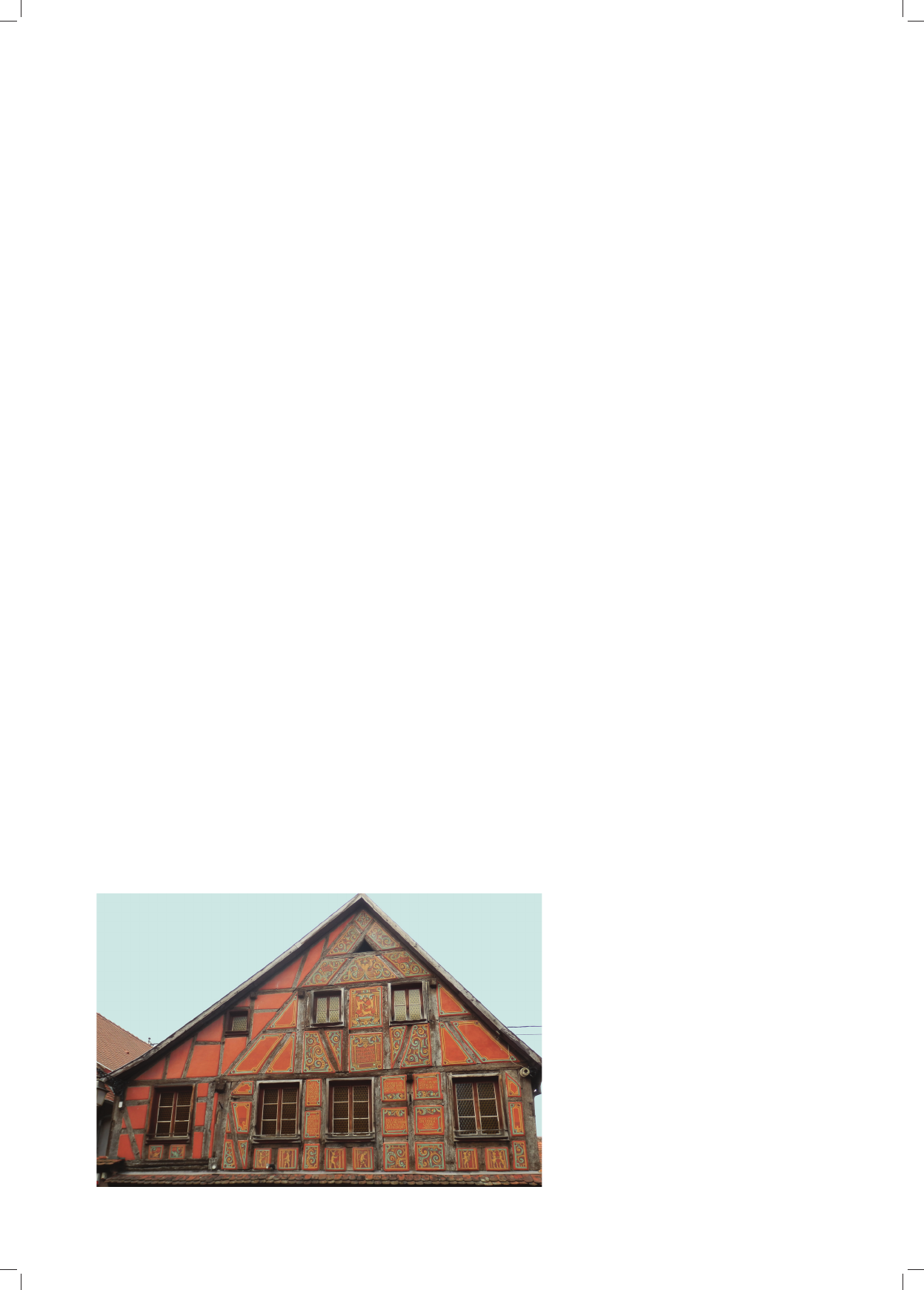
Pfaffenhoffen – charakterystyczna dla Alzacji
polichromia malarska (Wandmalerei)
(fot. D. Kowalska)
Pfaffenhoffen – a typical Alsatian
polychrome paint (Wandmalerei)
(photo by D. Kowalska)