
2016
3(47)
DOI: 10.5277/arc160301
Tadeusz Zipser*
Przewidywanie stanów, modelowanie procesów i budowanie decyzji
Prediction of states, modelling of processes and building the decision
Wprowadzenie
W roku 1913, a więc ponad 100 lat temu prof. Ignacy
Drexler rozpoczął we Lwowie, na tamtejszej Politechnice
wykłady z urbanistyki, a wkrótce założył pierwszą i naj-
starszą na gruncie polskiego technicznego szkolnictwa
wyższego placówkę naukowo-dydaktyczną zajmująca się
tą tematyką. W owym czasie liczba ludności na naszym
globie wynosiła około 1 750 000 000. Tak więc w ciągu
stulecia uległa ona czterokrotnemu zwiększeniu, bo dziś
przekracza już 7 miliardów. Co więcej, od kilku lat (od
2007 r.) połowa ludzkości mieszka w miastach. Jeśli zwa-
ży się, iż ostatnie podwojenie zaludnienia ziemi zajęło
około 44 lat, co przyrównać można do połowy możliwej
dziś do osiągnięcia w krajach rozwiniętych długości ży-
cia, łatwo można dojść do wniosku, że w naszych czasach
nie jest wykluczone, że człowiek w ciągu swego życia
może być świadkiem czterokrotnego wzrostu populacji.
Pokazuje to, na razie pod względem ilościowym, rozmia-
ry zadań, jakie nieustannie obciążają naszą cywilizację.
Przywołanie daty narodzin edukacji urbanistycznej na
naszym obszarze nie jest tu przypadkowe. Katedra Pla-
nowania Przestrzennego Politechniki Wrocławskiej może
uważać się za spadkobiercę w prostej linii tej lwowskiej
placówki, gdyż długoletnim następcą prof. Drexlera – kie-
rownikiem tamtej lwowskiej katedry – był do roku 1945
prof. Tadeusz Wróbel – potem pierwszy dziekan Wy-
działu Budownictwa na Politechnice Wrocławskiej oraz
kierownik Katedry Urbanistyki na Wydziale Architektu-
Introduction
In 1913, that is over 100 years ago, Professor Ignacy
Drexler began to give lectures on city planning at the Uni-
versity of Technology in Lviv, and soon afterwards he
esta blished the rst and the oldest research and teaching
insti tution dealing with that subject based on the Polish
technical education system. The number people living at
that time on the globe was about 1 750 000 000. Over
one century, it has increased four times and now it is over
7 bi llion. Moreover, for a few years now (since 2007) half
of the population has been living in the cities. If it is kept
in mind that it took the population of the globe to double
in about 44 years which can be assumed to correspond
today to half of the life span in the developed countries,
it is easy to conclude that it is possible nowadays that we
may witness the population quadruple during our life-
times. This shows, for the time being quantitatively, how
big the tasks are for our civilization to bear.
The reference to the date of birth of the city planning
education in our area is not a coincidence. The Chair of
Spatial Planning at Wrocław University of Science and
Technology can be considered to be the direct heir of that
University in Lviv because the Chair at that University
was headed until 1945 by Professor Tadeusz Wróbel –
who took over that position for many years after Professor
Drexler – and was later the rst dean of the Faculty of
Civil Engineering at Wrocław University of Science and
Technology and the head of the Chair of City Planning at
the Faculty of Architecture until 1960. He was also the
supervisor of the Ph.D. dissertation of the author of this
paper. When Professor Wróbel was still the head of the
Chair of City Planning, the major signicance was placed
* Wydział Architektury Politechniki Wrocławskiej/Faculty of Ar-
chi tecture, Wrocław University of Science and Technology.

4 Tadeusz Zipser
ry tejże Politechniki do roku 1960. Był też promotorem
pracy doktorskiej piszącego te słowa. Jeszcze w Katedrze
Urbanistyki za kierownictwa prof. Wróbla przypisywa-
no zasadnicze znaczenie temu, jakiej przyszłości należy
oczekiwać dla miast i jak można by ją świadomie pró-
bować kształtować. Świadczył o tym zakres tematyki dy-
daktycznej, a nawet sama struktura wewnętrzna Katedry
podzielonej na kilka zespołów, tworząca ramy współpra-
cy interdyscyplinarnej. Ten kierunek nabrał szczególnego
znaczenia w połowie lat 60. ubiegłego wieku, wyodrębnił
też określony zakres działań skierowanych na kompleto-
wanie spójnego warsztatu metodologicznego. Chodziło tu
głównie o obiektywizację i kwantykację narzędzi plano-
wania opartego na technikach prognozowania nie tylko
gotowych stanów zagospodarowania przestrzeni, ale rów-
nież procesów funkcjonowania i mechanizmów rozwoju.
W tych ramach znalazła się teoretyczna próba uzasad-
nienia proponowanej nowej struktury przestrzennej mia-
sta, ale również analizy i prognozy o bezpośrednim zasto-
sowaniu praktycznym.
Maszyna licząca i nowoczesność ujęć
Oba typy zadań ruszyły z miejsca z impetem wraz
z pojawieniem się realnej obecności nowego narzędzia
zmieniającego radykalnie formułę oczekiwanych roz-
wiązań. Narzędziem tym był komputer. Nazywany wtedy
maszyną cyfrową stał się praktycznie dostępnym instru-
mentem badań, elastycznym, jeśli chodzi o różny zakres
i rozmiar zadania, które mogło zeń korzystać, dostępnym
dla osób umiejących samodzielnie programować. Była to
działająca od jesieni 1962 r. maszyna brytyjska Elliott 803
zainstalowana w nowo powstałej Katedrze Metod Nume-
rycznych Uniwersytetu Wrocławskiego [1]. Tejże jesieni
pracownik Katedry Urbanistyki dr Tadeusz Zipser urucho-
mił na Elliocie własny program, co było pierwszym w Pol-
sce zastosowaniem elektronicznej techniki obliczeniowej
w urbanistyce w postaci analizy warunków doboru rodzaju
węzła ulicznego w określonej sytuacji ruchu miejskiego.
Można więc dzięki temu było obiektywnie przetestować
efekty proponowanych zasad teoretycznej struk tury trój-
kątowo-łańcuchowej obszarów zurbanizowa nych, dodat-
kowo wiążąc jej założenia z szerszym tłem problematy -
ki podlegającej ilościowemu modelowaniu. Niezależnie
od tego zespół powstały w ramach Katedry, a od roku 1969
tworzący Zakład Urbanizacji i Planowania Przestrzen-
nego podjął się wykonywania bieżących usług oblicze-
niowych na życzenie wielu organów planistycznych [2].
Sporządzono prognozy ruchu miejskiego (wymiana
prze jazdów międzyrejonowych i obciążenie ulic) dla
Wro cła wia, Poznania, Gliwic, Jeleniej Góry, kilkakrotnie
dla Kra kowa, wreszcie dla liczącego ponad 500 rejonów
ze społu miast Górnośląskiego Okręgu Przemysłowego
jako studium planu Kolei Regionalnej oraz na potrzeby
mię dzy na rodowego systemu obsługi ruchu turystycznego
wo kół Tatr, a później dla aglomeracji wałbrzyskiej.
Połączenie tych dwu wątków – zamierzenia badaw-
czego dotyczącego optymalizacji struktury przestrzennej
terenu zurbanizowanego oraz zdobywania doświadczenia
z zakresu modelowania ruchu – wyłoniło jako dominu-
on what future the cities should expect and how it could
be consciously developed. It was evident in the subjects
which were taught and even the very internal structure of
the Chair divided into several teams, creating the frame
of interdisciplinary cooperation. That faculty became es-
pecially important in the middle of the 1960s and it even
developed a specic scope of actions dedicated to deve-
loping a uniform teaching methodology. Its main objec-
tive was to develop objectivization and quantication of
the planning tools based on techniques of forecasting not
only the existing states of space development but also the
processes of functioning and mechanism of growth.
This was the framework for the theoretical attempt at
justifying the suggested new structure of the city space
as well as the analysis and forecast of the direct practical
application.
The calculating machine and modern presentations
Both types of tasks were immediately tackled once the
new tool changing radically the formula of expected so-
lutions really emerged. This tool was the computer, then
called a calculating device, which became a practically
available research instrument, exible in respect of the
scope and the kind of task which could make use of it,
available to people who knew how to program unaided.
It was the British Elliott 803 which operated since the
fall 1962 installed in the newly opened Chair of Numeri-
cal Methods at the University of Wrocław [1]. That fall,
Tadeusz Zipser, Ph.D. who worked in the Chair of City
Planning launched his own program on Elliot which was
the rst application in Poland of electronic computation
technique in the city planning in the form of analysis of
the junction selection conditions in a specic city trafc
situation. It was then possible to objectively test the
effects of suggested principles of the theoretical triangle
and chain structure of urban areas, additionally combining
its assumptions with the wider background of the issues
being subjected to quantitative modelling. Regardless of
that the team which was set up at the Chair, which in 1969
became the Institute of City and Space Planning, started to
perform calculations at the request of numerous planning
bodies [2].
It developed the city trafc forecasts (between regions
and street trafc load) for Wrocław, Poznań, Gliwice,
Jelenia Góra, on several occasions for Kraków, and nally
for the Upper Silesian Industrial Area with over 500 re-
gions as the study of the plan for the Regional Railroad
System as well as for the needs of the international system
of tourism management around the Tatra Mountains and
later for the agglomeration of Wałbrzych.
Combining those two issues – research objective re-
garding the optimization of the spatial structure of urban
area and gaining experience in trafc modelling – gave
rise to the emergence of the primary direction of activities
being the modelling of the settlement processes in vari-
ous scales, including individual city districts, regions or
even the whole country and ultimately to the continental
scale [3]. This trend includes an important and decisive
stage of almost a decade-long (1972–1979) work over

Przewidywanie stanów, modelowanie procesów i budowanie decyzji /Prediction of states, modelling of processes and building the decision
5
jący kierunek działania modelowanie procesów kształ-
towania się systemu osadniczego w różnych skalach od
poszczególnej dzielnicy miejskiej do regionu czy nawet
kraju, a w końcu i do skali kontynentalnej [3]. Wpisuje się
w ten trend jako ważny i decydujący etap prawie dziesię-
cioletnia (1972–1979) praca nad symulacyjną prognozą
struktury przestrzennej Polski, zlecona przez ówczesną
Państwową Komisję Planowania Gospodarczego, i rów-
nolegle inne teoretyczne opracowania w ramach Proble-
mu Węzłowego 11.2.1. „Przestrzenne Zagospodarowanie
Kraju” koordynowanego przez Instytut Geograi PAN.
Były to tematy: „Modele symulacyjne sieci osadniczej”,
„Metody numeryczne całościowej oceny porównawczej
układów komunikacyjnych”, „Analiza i ocena alternatyw-
nych modeli docelowych systemu osadniczego” i „Meto-
dy planowania rozwoju okręgów uprzemysławianych” [3]
oraz przygotowane na użytek Instytutu Handlu Wewnętrz-
nego i Konsumpcji: „Określenie na podstawie modelowa-
nia numerycznego wzorca ośrodków usługowych” [4].
Towarzyszy temu seria rozpraw doktorskich rozwiązu-
jących pewne cząstkowe lub pochodne zadania (około 20
w okresie 1975–2015).
Symulacje, koncentracja i równowaga
W trakcie tych długotrwałych działań badawczych
i usługowych zawsze na pierwszy plan wysuwały się za-
gadnienia powiązane z różnymi aspektami koncentracji.
Koncentracja okazała się dodatkowo czymś, co pojawia
się spontanicznie, a czasem wręcz staje się przeszkodą
w uzyskaniu zamierzonych stanów. Stopień zrozumienia
różnych przejawów tego czynnika zadecydował o obraniu
jako głównego narzędzia odzwierciedlania najbardziej
prawdopodobnych wariantów procesów rozwojowych
idei intervening opportunities nazwanej u nas modelem
„pośrednich możliwości” [5].
Nadrzędną jednak decyzją był wybór metody symula-
cyjnej, wtedy w latach 60. wcale nie tak oczywisty i po-
pularny jak dzisiaj. Wśród tematyki programu „Proble-
mu węzłowego 11.2.1” wyznaczył nam on wówczas
po zycję szczególną i wyjątkową jako jedynemu wyko-
nawcy cyklu badawczego o prolu ogólnoteoretycznym
poświęcone go modelowaniu symulacyjnemu w transpor-
cie i osad nictwie.
Dla naszych dalszych rozważań ważne jest rozróż-
nienie, nie dla wszystkich oczywiste, między modelem
symulacyjnym a symulacją. Ta ostatnia wymaga stoso-
wania pewnych algorytmów, a więc też można tu mó-
wić o modelu. Chodzi jednak o pewną subtelną różnicę.
Wspom niane wyżej algorytmy można by określić jako
modele symulacji, to znaczy sposoby możliwie wierne-
go i szczegółowego odtwarzania szeregu zjawisk po to,
aby przeprowadzając sztuczny eksperyment, wykryć
ewentualne zależności i regularności. Natomiast nazwę
model symulacyjny proponuje się tu używać w przypad-
ku, kiedy takie zależności są już znane lub się je zakła-
da, starając się przeprowadzać doświadczenia na wyż-
szym poziomie ogólnoś ci z jednoczesnym, na ogół tak
charakterystycznym dla pojęcia modelu, uproszczeniem
i uwolnieniem od wielu drugorzędnych szczegółów. Siłą
the simulation forecast of the spatial structure of Poland
commissioned by the National Committee for Economic
Planning and other parallel theoretical studies within the
Crucial Problem 11.2.1. “The Spatial Development of the
Country” coordinated by the Institute of Geography at the
Polish Academy of Sciences. The subjects included: “The
Simulation Models of the Settlement Network”, “The Nu-
merical Methods of the General Comparative Evaluation
of the Transit Systems”, “The Analysis and Evaluation of
Alternative Target Models of the Settlement System” and
“The Industrial Area Growth Planning Methods” [3] and
developed for the needs of the Institute of Internal Trade
and Consumption: “The Calculation of the Pattern for Ser-
vices Centers on the Basis of Numerical Modeling” [4].
This is accompanied by a number of Ph.D. disserta-
tions resolving some partial or derivative tasks (about
20 in 1975–2015).
Simulations, concentration, and balance
During those long-lasting research and services activi-
ties, the issues connected with different concentration as-
pects always came up as the most crucial ones. Addition-
ally, the issue of concentration emerged spontaneously or
sometimes it would even prevent the achievement of ex-
pected states. The degree of understanding various aspects
of this factor determined the selection of the main tool
rendering the most likely variants of the development pro-
cesses of the idea known as intervening opportunities [5].
The most important decision, however, was the selec-
tion of the simulation method; it was not so obvious and
popular in the 1960s. The issues included in the “Crucial
Problem 11.2.1” program dened then our special and
unique position as the only entity to conduct the general
theoretical research dedicated to simulation modelling in
transport and settlement.
It is important in our further deliberations to make
a distinction, which is not obvious to everybody, between
a simulation model and a simulation. The latter requires
the application of a certain algorithm, and so one can talk
about a model. It is, however, about a certain subtle differ-
ence. The algorithms mentioned above can be described as
simulation models that is the ways to render faithfully and
precisely a number of phenomena to conduct an articial
experiment and detect any possible interactions and regu-
larities. On the other hand, it is suggested that a simulation
model can be used in the case when such interactions are
already known or assumed, trying to conduct experiments
at a higher level of generality and at the same time with,
usually so typical of the notion of model, simplication
and with no secondary details. Obviously, the distinction
described here is connected with a different scale regard-
ing both space and often also time. Anyway, sometimes
these kinds of approach complement each other and co-
operate for instance when the values of parameters to be
used in the simulation model need to be determined and
it can be done through simulating the basic phenomena.
The co-existence of two models describing the spatial
distribution of contacts, which is obviously a necessary
element of transport forecasts and analyses, is a good

6 Tadeusz Zipser
rzeczy to omawiane tu rozróżnienie wiąże się z odmienną
przestrzenną, a często i czasową skalą. Zresztą niekiedy
te sposoby podejścia się uzupełniają i współpracują, na
przykład, gdy trzeba ustalić wartość parametrów na uży-
tek modelu symulacyjnego i można to zrobić na drodze
symulowania zjawisk elementarnych.
Dobrym przykładem szerokiego działania modelu sy-
mulacyjnego, którego operacjami rządzą założone funk-
cyjne formuły, jest współistnienie dwu modeli opisują-
cych przestrzenny rozpływ kontaktów, co, rzecz jasna,
stanowi niezbędny składnik prognoz i analiz transporto-
wych. Mimo że stosowane przez nie mechanizmy są wy-
raźnie inne, oba dają jednak zbliżone wyniki i oba ucho-
dzą za wiarygodne.
Wybór jednego z nich to kwestia wygody, przyzwycza-
jenia i różnego znaczenia przypisanego aspektom rzeczy-
wistości, do których się odwołują.
Sytuacja jednak się zmienia, kiedy nie chodzi już tylko
o sprawność tego narzędzia w prostych rutynowych za-
daniach, ale budowanie teorii, wyjaśnianie przebiegu dia-
gnozy i wielokrotnych odtworzeń procesów oraz możli-
wość ich interpretowania w kategoriach jeszcze szerszych
teorii, co wróży szanse na unikację ujęć. Te dwa odmien-
ne w swych wyjściowych założeniach sposoby podejścia
to tzw. model „grawitacji” i nieco młodszy odeń model
„pośrednich możliwości”. Oba przechodziły wiele mody-
kacji, które zwłaszcza w tym drugim przyniosły daleko
idące przekształcenia formuły, gdy od prostej determini-
stycznej zależności przeszły do ujęcia probabilistycznego
(pod koniec lat 50. zeszłego wieku).
Obie te propozycje modelowe uwzględniały potrzebę
odtworzenia ogólnej prawidłowości w traktowaniu wpły-
wu dystansu przestrzennego na intensywność kontaktu,
ale niejako polem najbardziej bezpośredniego i natych-
miast podlegającego werykacji zastosowania był ruch
uliczny i drogowy w obszarach intensywnie zurbani-
zowanych. To co ostatecznie różniło je i różni nadal, to
odniesienie się do wpływu rosnącego dystansu, który dla
idei grawitacji jest bezpośrednim czynnikiem tłumiącym
kontakt, a dla idei pośrednich możliwości oddziałuje dużo
elastyczniej jako kształtujący sposób penetracji zbioru
możliwych celów kontaktu według ich uporządkowania
od najbliższych do najdalszych [3].
Inaczej mówiąc, idea grawitacyjna koncentrowała się
na zjawisku tłumienia ruchu pojmowanego w takim razie
jako coś automatycznego, „przymusowego”, powstające-
go ze zwykłego iloczynu jednostkowych elementów, ze
słabą zdolnością ich różnicowania, zresztą tylko za pomo-
cą podatności na owo tłumienie przez odległość.
Mechanizm pośrednich możliwości
Podejście „pośrednich możliwości” potrzebuje czynni-
ka aktywnego, który bezpośrednio odczuwa nie dystans,
ale różnorodną naturę obiektów mogących stać się celem
ruchu, odpowiednio do tego, jaką potrzebę może kontakt
z nimi zaspokoić. Pozbawienie modelowego mechanizmu
możliwości reagowania na uciążliwy dystans wymagają-
cy pokonania, czasem wręcz nierealnego przebycia kon-
kretnej odległości, przesuwa ten problem w inne miejsce.
example of a popular application of the simulation model
whose operations are controlled by complex function for-
mulas. Although the mechanisms employed by them are
clearly different, they both provide similar results and
they both are regarded to be reliable.
The selection of one of them is a question of conve-
nience, habit, and the different meaning assigned to the
aspects of reality they regard.
The situation, however, changes when it is not only
about the efciency of that tool in simple and routine
tasks but about building a theory, explaining the course
of diagnosis as well as multiple presentations of the pro-
cesses and the possibility of their interpretation in respect
of even older theories which provides a chance for uni-
cation of presentations. Those two approaches which
differ in respect of their original assumptions are the so-
called “gravity” model and a slightly younger “interven-
ing opportunities” model. They both have been modied
a number of times which, especially in the latter one, re-
sulted in far reaching transformations of the formula when
they changed from a simple deterministic relationship to
a probabilistic presentation (at the end of the 1950s).
Both of these model proposals took into account the
need to restore the general pattern in treatment of the in-
uence of the spatial distance on contact intensity, but the
street trafc in intensively urbanized areas was the kind of
eld of the most direct application and subject to imme-
diate verication. The ultimate difference between them
was and still is the approach to the inuence of the grow-
ing distance which for the idea of gravity is the factor di-
rectly inhibiting the contact and in respect of the idea of
intervening opportunities it operates much more exibly
as a way of penetrating the set of possible objectives of
contacts according to their order from the closest to the
furthest [3].
In other words the idea of gravity focused on the inhi-
bition of trafc understood as something automatic and
“obligatory” being the simple product of individual ele-
ments which are hard to distinguish, and anyway only
through the susceptibility to that inhibition by distance.
The mechanism of intervening opportunities
The “intervening opportunities” approach needs an ac-
tive factor that does not feel the distance directly but the
varied nature of the objects which can become the move-
ment destination, depending on what need the contact
with them can satisfy. When the model mechanism cannot
react to the distance which needs to be covered, which is
sometimes even simply impossible, the problem shifts to
a different area and a totally new additional aspect and
object of modelling emerges that is the development of
such a placement of sources and destinations of contacts
in respect of one another that they really can be achieved.
This way the apparent weakness of the model, its in-
completeness, proves to be its strength when it generates
its connection with the space development principles, es-
pecially in respect of concentration distribution and inten-
sity. These are the processes of migration and balanced
location of the activities that create the networks of cities,

Przewidywanie stanów, modelowanie procesów i budowanie decyzji /Prediction of states, modelling of processes and building the decision
7
Mianowicie stawia on całkiem nowy dodatkowy aspekt
i przedmiot modelowania, to jest kształtowania takiego
wzajemnego usytuowania źródeł i celów kontaktów, aby
były one rzeczywiście możliwe do zrealizowania.
W ten sposób pozorna słabość modelu, jego niekom-
pletność okazuje się jego siłą, kiedy generuje swój zwią-
zek z regułami konstruującymi struktury zagospodarowa-
nia przestrzeni, zwłaszcza w kategoriach rozmieszczenia
i nasilenia koncentracji. To owe procesy migracji ludno-
ści i wyważonego lokalizowania aktywności tworzą sieci
miast, ośrodków produkcji i usług oraz infrastruktural-
nych więzi, a w efekcie zależności hierarchiczne [6].
Właśnie ten fakt sprawił, że posługiwanie się podej-
ściem pośrednich możliwości przeniosło główne pole
ob ser wacji i badań na procesy rozwojowe w systemie
osad niczym z pierwotnego pola prognoz transportowych,
na którym to jednak też ujawnił się niesłychanie waż -
ny dodatkowy argument na rzecz pośrednich możliwoś ci.
To mianowicie, że kluczowy parametr tego modelu, gdy
przychodziło do jego zastosowań w prognozach ruchu
miejskiego, wykazywał wszędzie, niezależnie od różnic
położenia geogracznego i cech lokalnego środowiska,
bardzo zbliżony rząd wielkości. Oznaczało to, że jest on
wielkością uniwersalną i wyznacznikiem naszej ogólno-
światowej już cywilizacji, a przynajmniej jej dzisiejszej
fazy.
W kategoriach zaś ogólnego schematu budowanego na
bazie podobieństwa do żywych organizmów jest to głębo-
ka cecha „zjologii” systemu osadniczego [7]. Właściwie
nieco paradoksalnie okazało się również, że to nie mo-
del grawitacji, ale model pośrednich możliwości bliższy
jest analogii z zyczną grawitacją pod względem nie-
uchronnej tendencji do koncentracji aż do stadium „czar-
nej dziury”, którą zdają się już dziś przypominać ponad
dwudziestomilionowe miasta. I to właśnie ta konieczność
osiągania pewnego niezbędnego stopnia koncentracji była
de facto najczęściej przedmiotem modelowań.
Na tym polegały modelowania struktur miejskich
i mikroregionalnych z lat 70. ubiegłego wieku (Kraków,
Poznań, Gliwice, zespół Bielawa–Dzierżoniów–Piecho-
wi ce, Świdnica, Konin, Legnicko-Głogowski Okręg Mie-
dziowy).
Największą i decydującą próbą było kilkakrotne wa-
riantowe modelowanie całej struktury osadniczej (miej-
skiej) Polski. Chodziło o 292 lub 340 rejonów, które dys-
ponowały sumą liczby źródeł i celów relacji dom–praca
odpowiadającej w roku 1970 około 17 milionom ludności
miejskiej oraz wszystkie podlegały selektywności tego
kontaktu wynoszącej 0,00005 [3]. Chociaż wyniki nie
były tutaj tak bliskie rzeczywistości jak w późniejszej,
testującej koncepcję procedury, wersji „samosterującej”
(„samouczącej”), to jednak już po kilku iteracjach uzy-
skiwano współczynnik korelacji równy 0,897 dla zbioru
59 największych miast, traktując rdzeń Górnego Śląska (8
miast) jako jedno miasto. W ślad za tym poszły podobne
eksperymenty dla innych krajów Europy.
Ogólnie można więc mówić o zadowalających, cza-
sem wręcz zaskakująco dobrych rezultatach dość proste-
go modelowania, co trzeba podsumować jako wskazanie,
że przynajmniej w zakresie największych, wiodących
production and service centers, infrastructural bonds and
ultimately hierarchical relationships [6].
As a result of this very fact the application of the in-
tervening opportunities approach shifted the main eld of
observation and research to the developmental processes
in the settlement system from the original eld of transit
forecasts, where the exceptionally important additional ar-
gument in favor of the intervening opportunities emerged
anyway. Namely, the key parameter of that model regard-
ing its application in the city trafc forecasts demonstrat-
ed similar values, regardless of geographical location and
the features of local environment. This meant that it is the
universal value and it marks our global civilization or at
least its today’s stage.
In respect of the general structure developed similarly
to the living organisms, it is a profound characteristic fea-
ture of the settlement system “physiology” [7]. Actually,
slightly paradoxically, it turned out that it is not the grav-
ity model but the intervening opportunities model which
is closer to the analogy with the physical gravity in respect
of the inevitable trend to the concentration all the way to
the “black hole” stage which the cities with more than
twenty million inhabitants seem to resemble already to-
day. This is that very necessity of achieving the necessary
degree of concentration that was in fact the most popular
object of modellings.
This is what the modellings of the urban and micro-
regional structures from the 1970s were all about (Kra-
ków,
Poznań, Gliwice, Bielawa–Dzierżoniów–Piechowice,
Świd nica, Konin, Legnicko-Głogowski Okręg Miedziowy).
The biggest and the decisive test was the several vari-
ant modelling of the whole settlement (urban) structure
of Poland. It regarded 292 or 340 regions whose number
of the house-work relationship sources and destinations
corresponded to about 17 million city inhabitants in 1970
and they all were subject to selectivity of that contact
which reached 0.00005 [3]. Although the results were not
as close to reality as in the later “self-controlling” (“self-
learning”) version, testing the procedure concept, already
after a few iterations the rate of correlation was reached
at 0.897 for 59 biggest cities, treating the core of Upper
Silesia (8 cities) as one city. This was followed by similar
experiments for other European countries.
In general, it can be then noted that the results of rather
simple modelling were satisfactory or even surprisingly
good, which should be summed up as an indicator of the
fact that at least the biggest, leading urban centers are con-
trolled by simple and at the same time great powers with
the same characteristics as a regular mechanism spontane-
ously trying to reach its steady state, that is the state deter-
mined by the stable balance in a given set of conditions.
The fact that exactly the same states do not exist in the real
world is explained by certain distorting interactions which
always exist. It is important, however, that when they are
absent or stop to operate, the state which was set will be
restored automatically [7]. This in fact means that what
we are dealing with in practice is in such a case always
close to the “set state”. This is exactly, as we assume, what
makes modelling reasonable although the complete cor-
relation is unattainable.

8 Tadeusz Zipser
skupisk miejskich rządzą proste, a zarazem potężne siły
o znamionach regularnego mechanizmu spontanicznie dą-
żącego do swego steady state, czyli stanu ustalonego przez
stabilną równowagę w danym zbiorze warunków. Fakt, że
w świecie realnym dokładnie takie stany nie występują,
tłumaczy się tym, że zawsze istnieją jakieś oddziaływania
zniekształcające. Niemniej ważne jest, że przy ich braku,
ustaniu lub przerwie w działaniu, stan ustalony powróci
samoczynnie [7]. To zaś znaczy, że to, z czym mamy do
czynienia w praktyce, jest w takim przypadku zawsze bli-
skie „stanowi ustalonemu”. To właśnie, jak zakładamy,
nadaje sens modelowaniu, mimo że korelacja zupełna nie
jest osiągalna.
Model generowania decyzji planistycznych
Złożoność problemu, który zawiera w sobie przecież
także wiele oczekiwań, norm, pożądanych standardów
narzucanych z zewnątrz systemu przestrzennego, nasu-
wa ideę, aby sposób rozwiązania zadania planistycznego
przypominał symulację procesu decyzyjnego, w którym
gwarantowane jest wzięcie pod uwagę wszystkich wyj-
ściowych dezyderatów. Symulacja taka ma wykryć wszel-
kie sprzeczności, rzeczywiste skutki, zwłaszcza te ubocz-
ne, niezauważone od razu pola koniktów, a tym samym
wykluczyć nierealne założenia. Pomocny w osiągnięciu
tego celu jest oferowany przez zespół Zakładu Urbani-
zacji i Planowania Przestrzennego od roku 1974 model
decyzyjno-symulacyjny ORION [3].
W roku 1974 Zakład Urbanizacji i Planowania Prze-
strzennego Politechniki Wrocławskiej był zaangażowa-
ny między innymi w zadanie o charakterze praktycznym
związane z pracami planistycznymi prowadzonymi przez
Biuro Rozwoju Miasta Krakowa, zresztą jako jedno
z wielu ekspertyz.
Właśnie na potrzeby tego tematu kierujący pracą Ta-
deusz Zipser zaczął rozważać możliwość skonstruowa nia
rozbudowanego systemu symulacji komputerowej, która
miałaby wspomagać działania planistyczne na zasa dzie
modelowego odtwarzania procesu decyzji planistycz nych
od momentu przyjęcia programu funkcjonalnego oraz
założeń dotyczących standardów funkcjonowania kom -
pletnego układu zagospodarowania przestrzennego w skali
miasta i regionu. Powstał wtedy szczegółowy sche mat
blokowy, a następnie program obliczeniowy (w ję zyku Al-
gol), uruchomiony i przetestowany. Model ten ot rzymał
nazwę ORION (Optative Repartition in Oppor tunity Net-
work) i pod nią znalazł się w raportach problemu węzło-
wego przygotowanych dla Instytutu Geograi Polskiej
Akademii Nauk, zresztą razem z załączonym pełnym
schematem blokowym i programem obliczeniowym dla
maszyny cyfrowej.
Miał on znaleźć swe główne zastosowanie także w dru -
gim etapie symulacyjnej prognozy Struktury Systemu
Osad niczego Polski (co zresztą wykonano tylko częś cio wo
i w uproszczeniu z powodu braku dostatecz nie szcze gó -
łowych i kompletnych danych dezaktualizo wanych przez
reformę administracyjnego podziału kraju w 1976 r.).
Jednocześnie zaczęto stosować model do wspomaga-
nia decyzji planistycznych różnych podmiotów, takich
The model of generating planning decisions
The complexity of the issue, which actually is also
the source of a lot of expectations, norms, required stan-
dards of the spatial system imposed from outside, pro-
vides the idea to resolve the planning task through a deci-
sion-making process simulation which guarantees that all
output demands are taken into account. Such a simulation
shall detect all contradictions, actual consequences, espe-
cially side-effects, initially unnoticed conict areas, and
thus eliminate unrealistic assumptions. When achieving
that goal it is helpful to use the decision-simulation model
ORION which has been offered by the team of the Insti-
tute of City and Spatial Planning since 1974 [3].
In 1974, the Institute of City and Spatial Planning at
Wrocław University of Science and Technology was in-
volved among others in a practical task connected with
the planning work conducted by the Kraków City Devel-
opment Ofce.
It was that very task which made Tadeusz Zipser who
headed the work consider the possibility of constructing
an elaborate computer simulation system which would
support the planning activities on the basis of a model
presentation of the planning decision-making process
from the moment of approving the function program and
assumptions regarding the standards of operating of the
complete space development for the city and the region.
It was then that a detailed block diagram was developed
followed by a computation program (in Algol language)
which was launched and tested. The model was named
ORION (Optative Repartition in Opportunity Network)
and under that name it was employed in the reports on
the crucial problem prepared for the Institute of Geogra-
phy at the Polish Academy of Sciences, together with the
complete block diagram and computation program for the
digital machine attached to it.
It was supposed to be used mainly also in the second
stage of simulation forecast of the Settlement System
Structure in Poland (which anyway was performed only
patrially and in simplication due to the lack of sufcient-
ly detailed and complete data which became outdated as
a result of the reform of the administrative division of Po-
land in 1976).
At the same time the model to support of the plan-
ning decisions made by various entities was used; they
included for instance the Institute of Tourism in Warsaw,
the Institute of Internal Market and Consumption in War-
saw, Legnicko-Głogowski Okręg Miedziowy, Nowy Sącz
Province, agglomeration of Poznań, the city of Kraków,
Kraków City Complex and the city of Wrocław as well as
in several diploma theses at the Faculty of Architecture at
Wrocław University of Science and Technology.
The applications listed above took place in 1975–1990
and they had different versions, depending on the nature
of tasks and problems considered by the institutions to be
crucial.
The essence of that modelling system, which can be de-
scribed as a decision simulation model, was presented at
the Regional Science Association Congress in Budapest in
1975 (paper by T. Zipser) where it was found interesting

Przewidywanie stanów, modelowanie procesów i budowanie decyzji /Prediction of states, modelling of processes and building the decision
9
jak: Instytut Turystyki w Warszawie, Instytut Rynku We-
wnętrznego i Konsumpcji w Warszawie, Legnicko-Gło-
gowski Okręg Miedziowy, województwo nowosądeckie,
aglomeracja poznańska, miasto Kraków, Krakowski Ze-
spół Miejski i miasto Wrocław, a także w ramach paru
prac dyplomowych na Wydziale Architektury Politechni-
ki Wrocławskiej.
Wymienione zastosowania miały miejsce w latach
1975–1990 i realizowane były w różnych wersjach w za-
leżności od charakteru zadań i problemów uznanych przez
zlecające instytucje za kluczowe.
Istota tego systemu modelowań, które można określić
jako model symulacyjno-decyzyjny, została przedstawio-
na na Kongresie Regional Science Association w Buda-
peszcie w roku 1975 (referat T. Zipsera), gdzie wywołała
zainteresowanie Waltera Isarda. Zadał on wiele pytań do-
tyczących struktury modelu. Następnie w roku 1985 mo-
del pokrótce zaprezentowany został w „Przeglądzie Geo-
gracznym” w artykule pt. Modele procesów urbanizacji
[8], a wreszcie znalazł szersze omówienie w książce w cy-
klu Studia Komitetu Przestrzennego Zagospodarowania
Kraju PAN w roku 1988 (o takim samym tytule) [3].
Działanie tego modelu oraz propozycje pewnych no-
wych form wykorzystania i ukierunkowania jego zasto-
sowań, jak również zmodykowanego, syntetycznego
wartościowania wariantów wyników analizował w swojej
pracy doktorskiej w roku 1986 Tomasz Ossowicz. W re-
zultacie skrócona wersja modelu z tymi właśnie mody-
kacjami stanowiła narzędzie analityczne w szeregu zasto-
sowań modelu ORION w 2. połowie lat 80. W roku 1994
wydano odrębną publikację pt. Model symulacyjno-decy-
zyjny ORION, zawierającą bardzo szczegółową prezenta-
cję procedur tej późnej wersji modelu [9].
W ramach Kongresu Regional Science Association
w roku 1988 w Stambule T. Ossowicz i J. Sławski przed-
stawili referat na temat modelu ORION wraz z pokaza-
niem przykładu zastosowania. Referat ten został opubli-
kowany po Kongresie w zeszycie „Papers of the Regional
Science Association” 1989 [10].
Już na początku, tj. w latach 70. XX w., autor koncepcji
modelu T. Zipser określił go jako nie tylko konkretne na-
rzędzie symulacji komputerowej, ale również jako szeroki
program badań, gdyż w pełni wiarygodne zastosowanie
tego systemu modelującego wymaga rozpoznania całego
szeregu zależności i ustalenia konkretnych wartości para-
metrów.
Ideą modelu ORION było więc zbudowanie mecha-
nizmu odtwarzającego procesy rozwoju sieci osadniczej
na podstawie analizy zasad funkcjonowania składni-
ków przestrzeni zagospodarowanej w sposób, który od-
zwierciedla ten mechanizm w kategoriach rozważania go
przez wirtualny zespół podejmujący decyzje planistyczne.
Przez decyzje planistyczne rozumie się działanie po-
przedzające zachowania przestrzenne osób i instytucji,
obserwowane w procesach osadniczych oraz codziennym
życiu miast i regionów. Już przy pierwszym podejściu do
problemu narzuca się konieczność podziału decyzji prze-
strzennych na takie, które wywołują powstanie nowych
lub relokacje istniejących działalności, oraz na takie, jakie
ustalają cykliczne, rutynowo powtarzane przemieszcze-
by Walter Isard who asked many questions regarding the
structure of the model. Next, in 1985, the model was pre-
sented briey in “Przegląd Geograczny” (“Geographic
Review” in the article titled the Modele procesów urbani-
zacji (Model of Urbanization Processes) [8] and nally
it was described at length in the book published in the
series Studies of the Committee for Spatial Development
of Poland by the Polish Academy of Sciences in 1988 (the
same title) [3].
The operation of this model and the proposals of cer-
tain new forms of its specic use as well as the modied,
synthetic evaluation of the variants of the results were
analyzed by Tomasz Ossowicz in his Ph.D. dissertation in
1986. As a result the simplied version of the model with
those very modications was the analytical tool in a num-
ber of applications of the model ORION in the 2
nd
half
of the 1980s. In 1994, a separate publication was issued
titled Model symulacyjno-decyzyjny ORION (Decision
Simulation Model ORION) with a very detailed presenta-
tion of the procedures of that later model version [9].
In 1988, T. Ossowicz and J. Sławski presented a paper
on the model ORION with an example of its application
at the Regional Science Association Congress held in Is-
tanbul. The paper was published after the Congress in the
“Papers of the Regional Science Association” 1989 [10].
Already at the very beginning, that is in the 1970s, the
author of the model concept T. Zipser described it not only
as a specic computer simulation tool but also as a broad
program of research because a completely reliable appli-
cation of that modelling system requires the recognition
of a whole number of interactions and the determination
of specic parameter values.
The idea of the model ORION was then to build a me -
chanism presenting the settlement network development
processes on the basis of analysis of the principles of
operation of the elements of the space developed in the
way which reects that mechanism in respect of its consi-
deration by the virtual team making planning decisions.
Planning decisions mean the activities preceding the
spatial behaviors of people and institutions observed in
the settlement processes and everyday life of the cities and
regions. Already with the rst approach to the problem,
it becomes necessary to divide the spatial decisions into
those which initiate new activities or cause a relocation
of the existing activities and those which cause regular,
routinely repeated relocations. The necessary evaluation
of the operation of model pictures of states takes into ac-
count the existence of the following factors:
– those determining necessary contacts between ac-
tivities;
– those connected with conicts, such as the problems
caused by industry regarding residential housing, recre-
ation and farming areas, damage to the natural environ-
ment;
– those connected with the characteristic features of
the area (hydrogeological conditions, climate, location of
raw materials, accessibility to railroad transportation sys-
tem, etc.).
The simulated process of unobstructed location search
is limited by the “capacity” of the available area to be

10 Tadeusz Zipser
nia. Konieczna ocena funkcjonowania tworzonych mo-
delowo obrazów stanu uwzględnia zatem to, że istnieją
czynniki:
– dyktujące niezbędne kontakty między aktywnoś-
ciami;
– związane z koniktami, np. uciążliwości powodo-
wane przez przemysł w stosunku do zabudowy mieszka-
niowej, do terenów rekreacyjnych i rolniczych, niszczenie
środowiska przyrodniczego;
– związane z predyspozycjami charakteryzującymi
właściwości terenu (warunki hydrogeologiczne, klima-
tyczne, położenie surowców, dostępność transportu kole-
jowego itp.).
Symulowany proces swobodnego poszukiwania loka-
lizacji jest ograniczony „pojemnością” terenu przydatne-
go do zagospodarowania. Rola tego czynnika polega na
przeciwdziałaniu tworzeniu się nadmiernych koncentracji
zagospodarowania, co mogłoby wywoływać wtórne ne-
gatywne skutki dla warunków egzystencji ludzi, instytucji
i środowiska przyrodniczego.
Fakt, że w modelu ORION tak dużą wagę przypisuje
się parametrowi selektywności, wynika nie tylko z tego,
że przyjęto w nim mechanizm pośrednich możliwości
jako cząstkowy model odpowiedzialny za odwzoro-
wywa nie zjawisk przepływu wymienianych w systemie
kon tak tów. Mógłby on być w zasadzie zastąpiony przez
mo del grawitacji, oczywiście przy odpowiedniej zamia -
nie parametrów. Ważniejszym jednak powodem oparcia
się na pośrednich możliwościach jest to, że właśnie se-
lektywność, jako prawdopodobieństwo zaakceptowania
potencjalnego celu kontaktów, oraz reguła minimum
ener gii (kosztu, wysiłku, czasu itp.) stanowiące istotę
tego modelu okazały się dobrym narzędziem wyjaśniają-
cym zaistniałe i przebiegające nadal procesy koncentra-
cji. Wy kazały to niezależne postdykcyjne symulacje za-
wią zy wania się struktur w skali od poszczególnych miast
średniej wielkości, poprzez aglomeracje miejskie, regio-
ny zurbanizowane aż po układy o rozmiarach krajów
i części kontynentów. Mechanizm pośrednich moż li wości
był tu częścią napędzającą w procedurach prze sunięć
bilansują cych i podobnie jak zastosowany do sy mulacji
wymiany ruchu przy ustalonych źródłach i celach dobrze
spełniał swoje zadanie. Pewne udoskonalenia mode-
lu okazały się tu (jak np. wersja modelu splotowego)
bardziej wiarygodne niż model grawita cji i model A.G.
Wilsona maksymalizujący entropię (zresz tą maksy ma-
lizuje entropię również każda wersja mode lu pośred nich
możliwości stosująca wykładniczy rozkład prawdo po do-
bień stwa) [3]. Trzeba do tego dodać warian ty szczegól-
ne mo delu wprowadzające selektywność zbio rową oraz
te, które korzystając z hierarchicznej sieci do stępności
wzajemnej jednostek, odtwarzają zależność typu prawa
Zipfa [6].
W toku iteracji modelu ORION dokonuje się prób uzy-
skania rozwiązań na drodze wprowadzanych zmian, któ-
rych interpretacja jest raczej przejrzysta. Dlatego właśnie
można mówić o uczeniu się procedur w trakcie modelo-
wania.
Mamy trzy zasadnicze pola dla takiej operacji. Pierw-
sze z nich to ewentualne stwierdzenie, że założony po-
developed. The role of this factor consists in preventing
excessive development concentrations which might cause
secondary negative consequences for the living conditions
of people, institutions and the natural environment.
A lot of signicance is placed in the model ORION on
the selectivity parameter not only because it applies the
mechanism of intervening opportunities as a partial model
responsible for the presentation of the ow phenomena
mentioned in the system of contacts. Actually, it could be
replaced, obviously upon an adequate change of param-
eters, by the gravity model. However, a more important
reason why the intervening opportunities should be relied
on is that selectivity, as the likelihood of accepting the po-
tential destinations of contacts, and the principle of mini-
mum energy (cost, effort, time, etc.), being the essence
of that model, proved to be a good tool to explain the ex-
isting concentration processes. This was demonstrated by
independent post-diction simulations of the development
of the structures from individual medium-sized cities,
through urban agglomerations, to urban regions, to whole
countries or parts of continents. The mechanism of inter-
vening opportunities was the driving force in the balance
movement procedures, and just like when applied in the
simulations of trafc exchange with the assigned sources
and destinations it served its objective well. Certain im-
provements of the model (e.g. tangle model) proved more
reliable than the gravity model and A.G. Wilson’s model
maximizing entropy (every version of the intervening
opportunities model applying the exponential distribu-
tion of probability also maximizes entropy anyway) [3].
It should be added that the special variants of the model
intro ducing collective selectivity as well as those which
re present the Zipf’s law type of interdependence while
using the entties’ hierarchical network of mutual accessi-
bi lity [6].
In the course of the model ORION iteration attempts
are made at developing solutions by introducing changes
whose interpretation is rather clear. That is why one can
talk about learning the procedures during modelling.
There are three basic areas for such an operation. The
rst of them is the determination if the assumed level of
predisposition for a given activity, or in other words the
evaluation of the usability of a given area to accommodate
a given activity, should change. This results from a simu-
lation experiment taking into account the known and de-
ned interdependencies in the system and that is why the
arguments in favor of correcting the predisposition are to
be analyzed. The model states that the maintaining of the
current evaluation is not reasonable and this is the learn-
ing element of the experiment which affects further de-
velopment.
The second area includes the verication of whether
the modelling of the spread of contacts exceeds the as-
sumed critical distance or other “limits” and if so, what
is the percentage of contacts going beyond standards.
The reaction of the procedure is either to stop and cancel
that simulation path or to continue and negatively affect
the source activity, depending on the tolerance assumed
for a specic category of contact and activity. A too high
number of such situations or possibly a total inability

Przewidywanie stanów, modelowanie procesów i budowanie decyzji /Prediction of states, modelling of processes and building the decision
11
to meet the assumed limitations can also result in their
change (e.g. extending the critical range). Such a lack of
realism or actually a utopian character of certain standards
is a form of learning as well.
The third area is modelling conicts. This is, however,
the least recognized area and furthermore it is the least
suitable for a reliable, numerical representation of the ef-
fects, however, the chances of achieving the suggested
conditions of functioning of the system of activities in
a specic spatial system can be evaluated in a similar way.
Models of limitations
and the need of polycentricity
These are the very conicts and possible barriers in
presenting the development picture suggested by the mod-
el that draw attention to the issue of complementing the
system with the procedures analyzing both the implemen-
tation obstacles and improvements (e.g. self-nancing)
in order to demonstrate the most favorable course of that
process. The work on that complementation is in process.
Even a bigger problem is connected with the fact that
the model ORION itself is determined by a specically
dened set of activities assigned at the outset to the com-
putation system. However, it seems recommended in to-
day’s and even more so in the expected state of changing
needs and uncertainty of resources, to cover the earlier
stage of the program development, and even the prole of
operation of the settlement units, especially in the scale of
the region, by the model control. Such a study was under-
taken by the team of the Chair already in the 1980s within
the Central Program of the Fundamental Studies titled the
“Model of Ecologically Conditioned Limitation and the
Direction of the Development of Settlement Systems”. It
assumed that the objective of the limitation of the uncon-
trolled development is to avoid the loss of ecological bal-
ance which cannot be guaranteed, at least everywhere and
in the long run, only with the use of summary bans and
other similar regulations.
The proposed model was supposed to confront on the
basis of an “input-output” matrix type simulation tool the
supply of resources and the environmental resistance with
the expectation variants in respect of providing the right
level of consumption on the part of society and its produc-
tivity level. That is why – if you actually want to analyze
that point of contact between technology and nature – the
full range of relationships, including the consumer needs,
should be included in the scope of observation, and that
scope must be considered as a whole and then the de-
mands to protect the environment become internal regula-
tors and not imposed from outside [11]. They participate
in calibrating the ows between activities, modifying the
proportions and shares, but still searching for the maxi-
mum, admissible circulation. Today, it may be the main
tool for developing the strategy of a sustainable region.
Finally, even a greater perspective, greater in the sense
of space and in respect of time, regards a rather univer-
sally understood and recognized need of introducing ef-
fective polycentricity. Obviously, this is about a long-term
and varied process. A special variant of self-controlling
ziom predyspozycji dla danej aktywności, inaczej mówiąc
ocena przydatności określonego obszaru do jej przyjęcia,
powinien ulec zmianie. Jest to wynik eksperymentu sy-
mulacyjnego uwzględniającego znane i zdeniowane za-
leżności w systemie i dlatego argumenty na rzecz korekty
predyspozycji są do prześledzenia. Model stwierdza, że
utrzymanie dotychczasowej oceny nie znajduje uzasad-
nienia i to stanowi element doświadczenia uczącego, wy-
wierającego wpływ na dalsze postępowanie.
Drugi zakres polega na sprawdzeniu, czy przebiega-
jące modelowanie rozprzestrzeniania się kontaktów nie
przekracza założonego dystansu krytycznego lub innych
„pułapów”, a jeżeli tak, to jaki procent kontaktów nara-
żony jest na takie wykroczenie poza standard. Reakcją
procedury jest tu albo przerwanie i anulowanie tej ścieżki
symulacji, albo kontynuowanie jej z negatywnym skut-
kiem dla aktywności źródłowej w zależności od przyjętej
tolerancji dla konkretnej kategorii kontaktu i aktywności.
Zbyt wielka liczba takich sytuacji, ewentualnie całkowita
niemożność spełnienia założonych ograniczeń może rów-
nież prowadzić do ich zmiany (np. poszerzenia krytycz-
nego zasięgu). Takie uznanie braku realizmu, czy wręcz
utopijnego charakteru pewnych standardów jest również
formą uczenia się.
Trzecie pole to modelowanie koniktów. Tu – jakkol-
wiek jest to dziedzina najmniej rozpoznana i do tego naj -
mniej nadająca się do wiarygodnego, numerycznego re-
prezentowania skutków – można przynajmniej ocenić,
w podobny jak wyżej sposób, szanse osiągnięcia w kon-
kretnym układzie przestrzennym postulowanych warun-
ków funkcjonowania systemu aktywności.
Modele ograniczeń
i potrzeba policentryczności
Właśnie konikty i ewentualne bariery w realizacji
obrazu zagospodarowania postulowanego przez model
stawiają na porządku dziennym sprawę uzupełnienia sys-
temu przez procedury analizujące zarówno utrudnienia,
jak i ułatwienia (np. samonansowanie) realizacyjne, aby
wskazać najkorzystniejsze ścieżki tego procesu. Prace
nad tym uzupełnieniem są w toku.
Jeszcze poważniejszy problem wiąże się z tym, że sam
model ORION zdeterminowany jest sztywno określonym,
zadanym na wejściu do aparatu obliczeniowego zestawem
aktywności. Tymczasem w dzisiejszym, a jeszcze silniej
w prognozowanym stanie zmienności potrzeb i niepew-
ności środków wydaje się wskazane objęcie modelową
kontrolą wcześniejszej fazy tworzenia programu, a nawet
prolu funkcjonowania jednostek osadniczych zwłaszcza
w skali regionu. Takiego opracowania podjął się zespół
Katedry już latach 80. ubiegłego wieku w ramach tematu
Centralnego Programu Badań Podstawowych pt. „Model
ekologicznie uwarunkowanego ograniczenia i ukierunko-
wywania rozwoju układów osadniczych”. Przyjęto tam,
że ograniczenie rozwoju niekontrolowanego ma na celu
uniknięcie załamania się równowagi ekologicznej, któ-
rej nie da się, przynajmniej wszędzie i na dłuższą metę,
zapewnić jedynie za pomocą doraźnych zakazów i tym
podobnych zabiegów.

12 Tadeusz Zipser
modelling was dedicated to the preliminary recognition of
its chances. In the course of this procedure the algorithm
distributing contacts, while moving the destinations (e.g.
workplaces) or destinations and sources (inhabitants), can
change the selectivity parameter from iteration to iteration
for every region in order to achieve the level of population
in the region known in advance. This modelling variant
conducted an “adverse” procedure, namely it started from
the reality state, trying to reach a uniform distribution. It
seems that such a procedure has never been applied be-
fore. It is supposed to serve in recognizing the chances of
relieving excessive concentration which does not provide
any benets anymore and it is only a liability. It can be
connected on a local scale (city, agglomeration) with the
idea of reverse diffusion which introduces the newly de-
veloped and rational patterns of investment in urban space
on the city edges (instead of a chaotic “sprawl”) which at
the same time slowly extends their presence towards the
system center.
Conclusions
Almost one hundred years ago, in 1920, Ignacy Drex-
ler presented his pioneering urban study titled Great Lviv
[12] where he applied a farsighted, comprehensive, and
strategic approach, signicantly emphasizing the role of
far-reaching contacts in the geographical space. The Chair
of Spatial Planning, which is trying to continue the re-
search initiated by its predecessor from Lviv as well as
apply the gained experience in practice, deals with the is-
sue of structures of urban area with the use of tools which
have been available only for a half of a century. They
enforce the formula of simulation of processes and arti-
cial experiments, focusing on quantitatively represented
“physiology” of the city and region [11]. Out of necessity,
following the great civilizational changes that took place
in the previous and this century, even the “great world”
has become the object of observations.
Translated by
Tadeusz Szałamacha
Proponowany model miał w oparciu o aparat symula-
cyjny typu macierzy „input-output” konfrontować podaż
zasobów i odporność środowiska z wariantami oczekiwań
co do zapewnienia właściwego poziomu konsumpcji spo-
łeczeństwa i jego zarabiającej na ten poziom produktyw-
ności. Dlatego – jeśli pragnie się rzeczywiście rozpatrywać
ów styk technologii i natury – należy wciągnąć w zasięg
obserwacji pełny obieg relacji, aż po repertuar potrzeb
konsumenta, i ten zakres musi być traktowany jako ca-
łość. Wówczas postulaty ochrony środowiska stają się
wewnętrznymi regulatorami nienakładanymi z zewnątrz
[11]. Biorą one udział w kalibrowaniu przepływów mię-
dzy aktywnościami, modykując proporcje i udziały, ale
stale poszukując maksymalnego, dopuszczalnego obiegu.
Dzisiaj może być to główny aparat tworzenia strategii da-
jącego się podtrzymać rozwoju regionu.
Wreszcie jeszcze większa perspektywa, większa w zna-
czeniu przestrzeni i w wymiarze czasu, dotyczy raczej po-
wszechnie zrozumiałej i uznanej potrzeby wprowadzania
efektywnej policentryczności. Siłą rzeczy chodzi o proces
długofalowy i zróżnicowany. Rozpoznaniu wstępnemu
jego szans został poświęcony specjalny wariant modelo-
wania samosterującego. W ramach tego postępowania al-
gorytm rozsyłający kontakty, dokonując przesunięć celów
(np. miejsc zatrudnienia) lub celów i źródeł (mieszkań-
ców), może zmieniać parametr selektywności z iteracji
na iterację dla każdego rejonu, aby uzyskać znaną z góry
wielkość zaludnienia w rejonie. Wariant tego modelo-
wania przeprowadzał „odwrotne” postępowanie, to jest:
rozpoczynał od stanu rzeczywistego, dążąc do osiągnię-
cia rozmieszczenia równomiernego. Jak się wydaje, takie
postępowanie nie było dotąd nigdy stosowane. Ma ono
służyć do rozpoznania szans na rozładowanie nadmiernej
koncentracji, to jest takiej, która nie przynosi już żadnej
korzyści, a tylko uciążliwości. Można to w skali lokalnej
(miasto, aglomeracja) połączyć z ideą dyfuzji wstecznej,
która wypracowane nowe i racjonalne wzorce przestrzen-
nego miejskiego zainwestowania wprowadza na obrzeżu
miasta (w miejsce chaotycznego „sprawl”), po czym po-
woli rozszerza ich obecność w kierunku centrum układu.
Podsumowanie
Prawie sto lat temu (1920) Ignacy Drexler przedsta-
wił swoje pionierskie opracowanie urbanistyczne Wielki
Lwów [12], w którym posłużył się dalekowzrocznym,
całościowym ujęciem o charakterze strategicznym, kła-
dąc wyraźny nacisk na rolę dalekosiężnych kontaktów
w przestrzeni geogracznej. W Katedrze Planowania
Przestrzennego, która w dużej mierze stara się kontynu-
ować linię badawczą swojej lwowskiej poprzedniczki,
ale także sprowadzać nabyte doświadczenia do stadium
praktycznej wiedzy, problematykę struktur zurbanizowa-
nego obszaru poddaje się narzędziom dostępnym dopiero
od półwiecza. Narzucają one formułę symulacji procesów
i sztucznych eksperymentów, koncentrując się na ilościo-
wo reprezentowanej „zjologii” miasta i regionu [11].
W ślad zaś za olbrzymimi zmianami cywilizacyjnymi
zeszłego i obecnego wieku przedmiotem obserwacji staje
się z konieczności nawet „wielki świat”.

Przewidywanie stanów, modelowanie procesów i budowanie decyzji /Prediction of states, modelling of processes and building the decision
13
Bibliografia /References
[1] Zipser T., Elliott 803 – desant nowoczesności, [w:] E. Dobierze-
jewska-Mozrzymas, A. Jezierski (red.), W poszukiwaniu jedności
– dwudziestolecie Studium Generale, Wydawnictwo UWr, Wrocław
2014, 249–260.
[2] Bagiński E. (red.), Zarys metod i technik badawczych w planowaniu
przestrzennym, Ocyna Wydawnicza PWr, Wrocław 1996.
[3] Zipser T., Sławski J., Modele procesów urbanizacji. Teoria i jej wy-
korzystanie w praktyce planowania, Studia KPZK PAN, t. 97, Pań-
stwowe Wydawnictwo Ekonomiczne, Warszawa 1988.
[4] Mynarski S. (red.), Badania przestrzenne rynku i konsumpcji. Prze-
wodnik metodyczny, PWN, Warszawa 1992, 229–230.
[5] Zipser T., The territorial production complex as a selfbalancing net-
work of spatial relations, [w:] M. Jerczyński, M.K. Bandman (ed.),
Economic Models in Regional Development, PWN, Warszawa 1976.
[6] Zipser T., Mlek M., Zipser W., Zipf’s law in hierarchically ordered
open system, „Jahrbuch fuer Regionalwissenschaft” 2011, Jg. 31,
H. 2, 93–112.
[7] Miller J.G., Systemy żywe, „Prakseologia” 1969, Nr 34, 7–264.
[8] Zipser T., Modele procesów urbanizacji – teoria i jej wykorzystanie
w praktyce planowania. Potrzeba modelu „otwartego”, „Przegląd
Geograczny” 1985, T. 57, z. 3, 283–299.
[9] Brzuchowska J., Litwińska E., Ossowicz T., Sławski J., Zipser T.
et al., Model symulacyjno-decyzyjny ORION, Oficyna Wydawnicza
PWr, Wrocław 1994.
[10] Ossowicz T., Sławski J., The allocation model ORION: its develop-
ment and applications, „Papers of the Regional Science Associa-
tion” 1989, Vol. 66, 31–46.
[11] Zipser T., Cywilizacyjne aspekty strategii rozwoju miast, [w:]
T. Domański (red.), Marketing terytorialny: strategiczne wyzwania
dla miast i regionów, Uniwersytet Łódzki, Łódź 1997, 88–97.
[12] Drexler I., Wielki Lwów, Gmina Miasta Lwowa, Lwów 1920.
Streszczenie
W artykule omawia się pewien zakres pola prac badawczych o silnym powiązaniu z praktycznymi zadaniami planowania przestrzennego. Planowanie
przestrzenne postrzega się tu jako znajdowanie możliwie najlepszych form struktury deniowanej jako rozmieszczenie elementów oraz organizację
połączeń między nimi, na potrzeby systemu, jaki tworzy aktualny stan naszej cywilizacji. Prezentuje się tu pewien wachlarz podejść wypróbowanych
w kilkudziesięcioletniej aktywności Katedry Planowania Przestrzennego na Politechnice Wrocławskiej, akcentując szczególnie ujęcia ilościowe
i techniki modelowania symulacyjnego. Z jednej strony bierze się pod uwagę obecność spontanicznie działających wielkoskalowych mechanizmów
dążących do swych stanów równowagi. Z drugiej strony stara się analizować proces dochodzenia do określonych decyzji podejmowanych przez
użytkownika systemu cywilizacyjnego, kontrolując jego założenia i dezyderaty z punktu widzenia ich obiektywnego uzasadnienia i realnego praw-
dopodobieństwa ich urzeczywistnienia.
Słowa kluczowe: urbanizacja, koncentracja osadnictwa, modelowanie symulacyjne
Abstract
The paper discusses a certain section of the eld of research with strong links to the practical tasks of spatial planning. Spatial planning is seen here
as nding the best possible forms of structure, dened as the distribution of elements and organization of connections between them for a system that
forms our current civilization. We present here a range of approaches proven in decades of activity of the Spatial Planning Department at the Wrocław
University of Science and Technology emphasizing especially the quantitative techniques of simulation modelling. On the one hand, it takes into
account the presence of spontaneous large-scale operating mechanisms striving for their equilibrium states. On the other hand, it seeks to analyze
the process of inquiry into certain decisions taken by the user of the civilization system controlling its foundation and desiderata from their objective
justication point of view and the real probability of their realization.
Key words: urbanization, concentration of settlements, modelling simulation
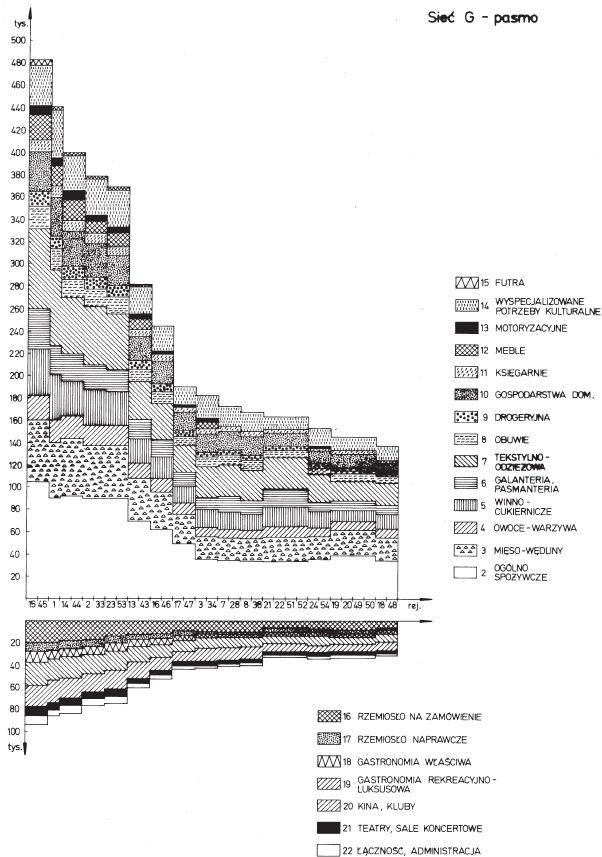
Profil branżowy ośrodków handlowych według
symulacji ORION
Profiles of shopping centers branches according
to ORION simulation model
Źródło/Source: Określenie wzorców sieci ośrodków
usłu go wych na podstawie modelowania numerycznego,
praca zbio ro wa pod red. T. Zipsera, raport z prac Ze -
społu Ba daw czego nr 8 Instytutu Ar chi tektury i Ur ba-
nistyki Poli tech niki Wrocławskiej, Wrocław 1978