2025
3(83)
Ewa Maria Netczuk-Pol*, Łukasz Karol Netczuk**
Reconstruction of the façade and tower of the church
of the Exaltation of the Holy Cross in Kostomłoty
according to the design by Karl Friedrich Schinkel
against the background of his other projects
as an example of the reconstruction of a Baroque church
in the spirit of Neo-Gothic
DOI: 10.37190/arc250304
Published in open access. CC BY NC ND license
Abstract
Kostomłoty is currently a small village in the Lower Silesian Voivodeship near Wrocław. The most valuable monument of the settlement is the
parish church of the Exaltation of the Holy Cross, located in the centre on the western side of the market square. Due to the sparse iconographic mate-
rials of the church from before 1900 and the lack of extensive research, it is dicult to determine the exact changes that took place in the building. The
Gothic structure of the church was erected in the mid-14
th
century. In the mid-16
th
century, it was renovated and expanded with a Renaissance porch.
In the Baroque period, the tower received a new spire. A query in foreign archives conducted by the authors revealed a plan for the reconstruction of
the church from 1818, signed by Karl Friedrich Schinkel. In 1818–1819, based on the design of Schinkel, a new tower with staircase annexes was
built on the foundations of the old one in the spirit of Neo-Gothic, creating a kind of westerwork. A detailed comparative analysis of the design and
iconography of the historical tower from 1898–1909 shows that this project was almost entirely completed.
Schinkel’s designs for the reconstruction of existing buildings received signicantly less attention than his designs for new buildings. This work,
as a contribution to the topic, sheds some light on the project of the Neo-Gothic reconstruction of the baroque church and its implementation in the
context of other Neo-Gothic tower masses designed by the same architect.
Key words: Karl F. Schinkel, Neo-Gothic, reconstruction, church tower, Kostomłoty
Introduction
Kostomłoty is a small village in the Lower Silesian Voi-
vo deship, located near Wrocław. The most valuable his-
torical monument of the settlement is the parish church of
the Exaltation of the Holy Cross, situated in the centre of
the village on the western side of the market square. The
church’s original patron was St. Gotthard (also known as
Gotard or Godehard), Bishop of Hildesheim, who was can
-
onized in 1131 (Ecke 1927, 19). Kostomłoty was originally
a ducal village before coming under the ownership of the
Monastery of St. Vincent in Wrocław (initially Benedic-
tine, and later – until the secularization of the order in 1810
– Pre monstratensian), serving as their summer residence
(Heyne 1860). In 1214, the village was granted town rights
based on the Środa Śląska model. The town suered sig-
nicant destruction during the Thirty Years’ War; only the
church survived. As a result of the war, in addition to wide-
spread damage, the town lost its municipal rights. These were
restored on May 29, 1692, by Emperor Leopold I, thanks
to the intervention of the Premonstratensian abbot. After
Silesia was annexed by Prussia, the town began to lose its
* ORCID: 0000-0002-2514-8314. Faculty of Architecture, Wro-
cław University of Science and Technology, Poland, e-mail: ewa.pol@
pwr.edu.pl
** ORCID: 0000-0001-9250-860X. Creoproject sp. z o.o., Wro-
cław, Poland.
38 Ewa Maria Netczuk-Pol, Łukasz Karol Netczuk
signicance. Ultimately, Kostomłoty permanently lost its town
status in 1875 (Oszczanowska, Sebzda and Trenkler 2010).
State of research
History of the church
The Gothic parish church of the Exaltation of the Holy
Cross, later expanded in Renaissance and Neo-Gothic forms,
together with the adjoining cemetery, constitutes a signi-
cant architectural and landscape landmark of Kostomłoty.
The church is rst mentioned in a document issued by Pope
Innocent III on August 12, 1201, as ecclesia St. Godardi in
Costomlot (Oszczanowska 2017). It most likely existed ear-
lier,
although there is no direct evidence to conrm this.
The currently preserved structure is predominantly Go-
thic in the core of both the nave and the chancel – it was
erected in the mid-14
th
century. The church was renovated in
the mid-16
th
century and expanded between 1582 and 1585
with the addition of a Renaissance-style southern porch.
During the Baroque period, the tower was topped with a sty-
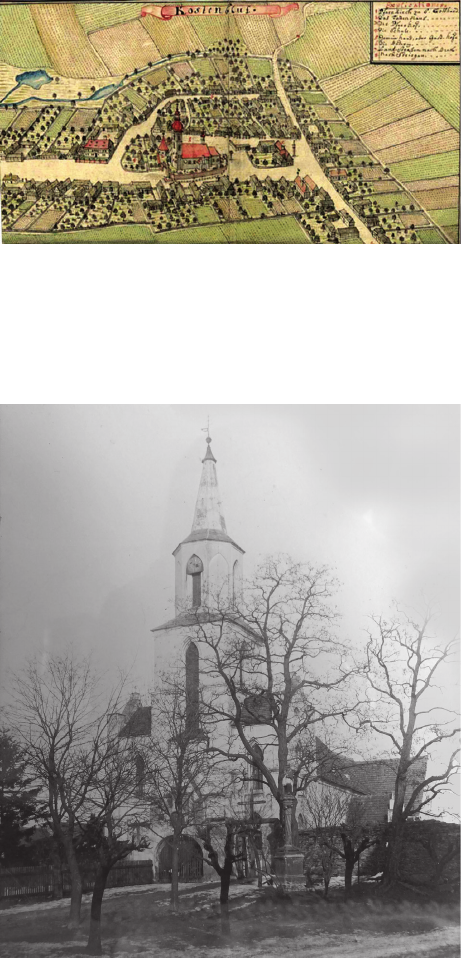
listic helmet-shaped dome, visible in engravings by Fried-
rich Bernhard Werner from the mid-17
th
century (Fig. 1).
The church retained this form until 1815, when the old tow-
er was dismantled. Subsequently, between 1818 and 1819,
a new tower was constructed on the foundations of the old
one, along with staircase annexes, based on a design by Karl
Friedrich Schinkel. Executed in the spirit of Neo-Gothic, the
design created a distinctive westwerk. The project included
the western façade and was realised almost in its entirety
(Oszczanowska 2017).
In the 19
th
and 20
th
centuries, the church underwent nu-
me rous renovations. In 1861, the organ gallery became the
focus of reconstruction eorts, and in 1867, restoration
work was carried out on the tower and the choir loft. In
1879, a previously unrealised design for remodelling the
organ gallery was implemented. In 1880, a design for the
reconstruction and extension of the second storey (a gallery)
of the sacristy was prepared, followed in 1881 by a proj-
ect for a baptismal chapel on the south side of the chancel
and the extension of the eastern choir. Both projects were
realised, as conrmed by plans from 1894. In 1892, an un-
executed expansion design for the church was drawn up
and signed by Willert, the Royal District Building Inspec-
tor from Leśnica. By 1909, the reconstruction of the tower
based on Schinkel’s design had certainly been completed,
including the installation of a cross-bearing ball and likely
some of the architectural decoration. According to research-
ers (and in our opinion), this reconstruction took place in
1909, as evidenced by commemorative photographs of the
church’s façade and interior from that year (Fig. 2). After
1945, regular maintenance work was carried out, namely,
in 1959–1960 the roof covering was replaced, in 1970 the
tower was renovated, and in 1997 the façade was restored.
In 2003, conservation work was undertaken on interior fur-
nishings and decorative elements (Oszczanowska, Sebzda
and Trenkler 2010; Oszczanowska 2017). The most recent
renovation took place in 2024 and was related to the resto-
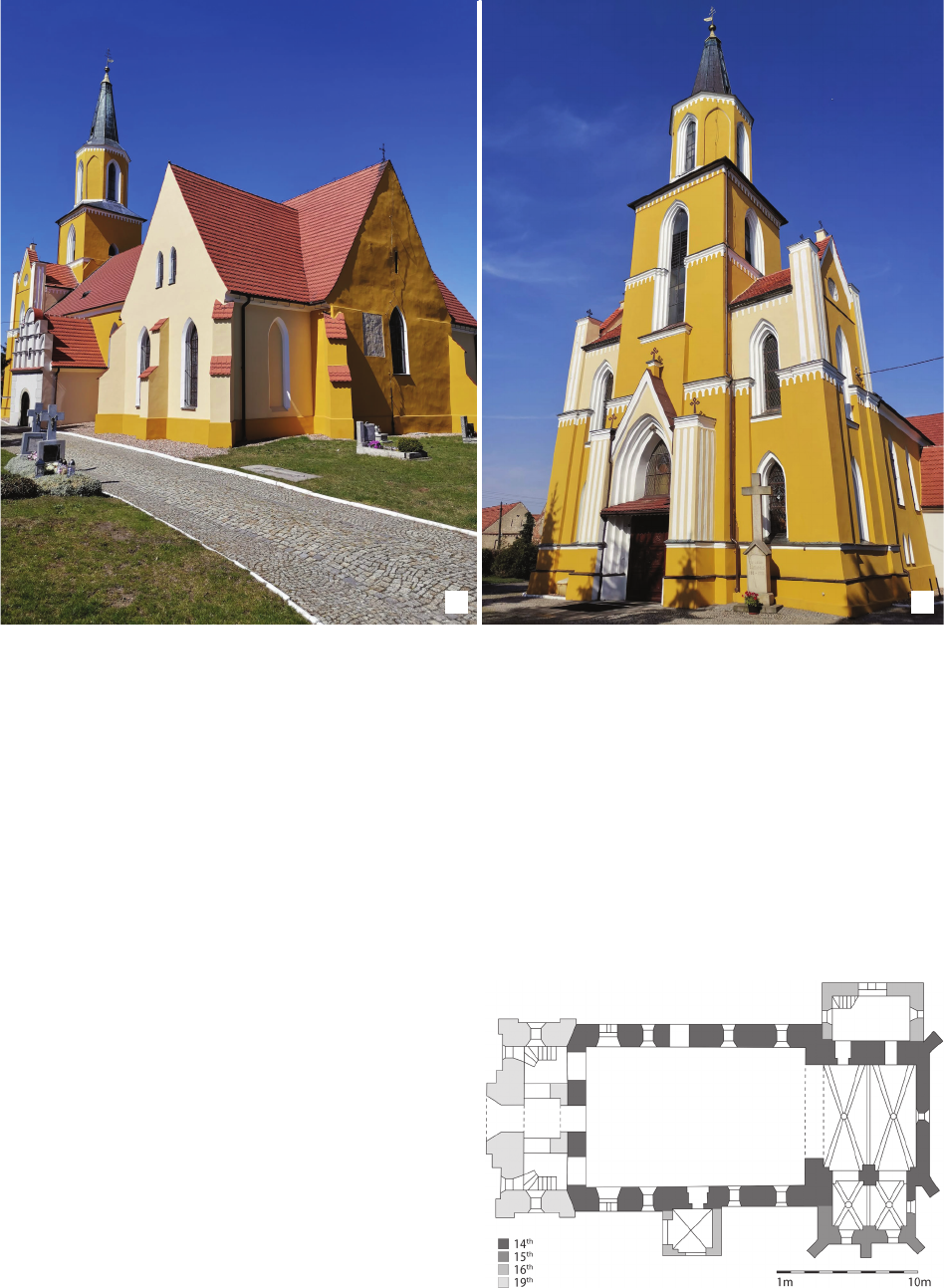
ration of the church façades (Fig. 3).
The dating of the various stages of the expansion of the
church in Kostomłoty, prepared by Bożena Danielska in
1998 and presented in the Leksykon zabytków architektury
Dolnego Śląska [Lexicon of Architectural Monuments of
Lower Silesia] (Pilch 2005), does not fully align with the
preserved iconographic material. The 19
th
-century Neo-
Gothic chapel is clearly identied in it as a structure from
the 15
th
century, while the remnants of the tower in the
western mass, visible in Werner’s mid-18
th
-century engrav-
ing, are considered – along with the added stairwell annexes
– to be part of a 19
th
-century reconstruction (Fig. 4).
Fig. 1. The oldest representation of the church in Kostomłoty
in a graphic by Friedrich Bernhard Werner (source: Werner 1751–1800)
Il. 1. Najstarsze przedstawienie kościoła w Kostomłotach
na grafice Friedricha Bernharda Wernera (źródło: Werner 1751–1800)
Fig. 2. Western elevation of the church in Kostomłoty
from the square in front of the cemetery gate, 1909
(source: private collection, made available thanks to the kindness
of the parish priest, Rafał Kupczak PhD)
Il. 2. Elewacja zachodnia kościoła w Kostomłotach
z placu przed bramą cmentarną, 1909
(źródło: kolekcja prywatna, udostępnione dzięki życzliwości
proboszcza parafii ks. dra Rafała Kupczaka)
Reconstruction of the façade and tower of the church of the Exaltation of the Holy Cross in Kostomłoty 39
Description of our own research
Research period and methods
This article synthesizes available historical and icono-
graphic sources depicting the church in Kostomłoty, as well
as the results of stratigraphic research conducted as part of
the preparation for a conservation renovation project of the
church’s interior in Kostomłoty in August 2018 (Netczuk,
Netczuk-Pol and Żmuda 2018).
The research methods employed by the authors of this
article included archival queries (used for the historical and
iconographic analysis of the church) as well as comparative
analysis of churches designed by Schinkel from a similar
period. The collected material, along with correspondence
exchanged with the scientic department of the Berlin State
Museums of the Prussian Cultural Heritage Foundation,
made it possible to conrm the authorship of the church’s
façade design in Kostomłoty, in line with the conclusions
drawn from the comparative analysis.
Historical and iconographic analysis:
preserved iconography
Archival material concerning the church prior to 1900
is rather limited. It consists mainly of postcards depicting
general views of Kostomłoty. The earliest available graphic
Fig. 3. The church in Kostomłoty after renovation of the façade in 2024:
a) view from the west, b) view from the front (photo by R. Kupczak, 2024)
Il. 3. Kościół w Kostomłotach po renowacji fasady w 2024 r.:
a) widok od zachodu, b) widok od frontu (fot. R. Kupczak, 2024)
a b
Fig. 4. Dating of the individual stages of the expansion
of the church in Kostomłoty according to Bożena Danielska
with corrections (source: Pilch 2005)
Il. 4. Datowanie poszczególnych etapów rozbudowy kościoła
w Kostomłotach według Bożeny Danielskiej
z naniesionymi poprawkami (źródło: Pilch 2005)
representation is a city plan by Werner from the mid-18
th
century. Particular attention should be paid to the appear-
ance of the southern porch, especially its gable, which dif-
fers somewhat from its current form.
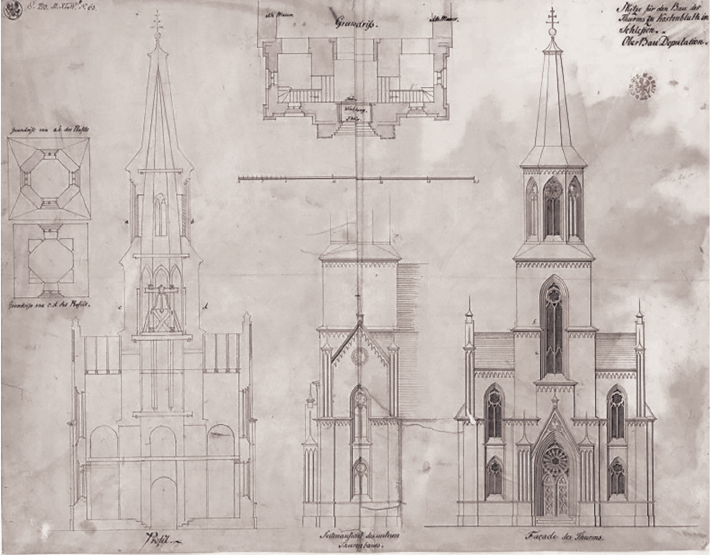
The most valuable available material is the church ren-
ovation plan from 1818, signed by Karl Friedrich Schinkel
40 Ewa Maria Netczuk-Pol, Łukasz Karol Netczuk
west axis. The nave was constructed on a rectangular plan
resembling a trapezoid, with a wider western and narrower
eastern end. The chancel (presbytery) is rectangular in plan.
On the north side, it adjoins a sacristy with a gallery on the
second oor; on the south side, there is a baptismal chapel.
Attached to the south side of the main nave is a Renais-
sance porch with a portal and a gable designed in the form
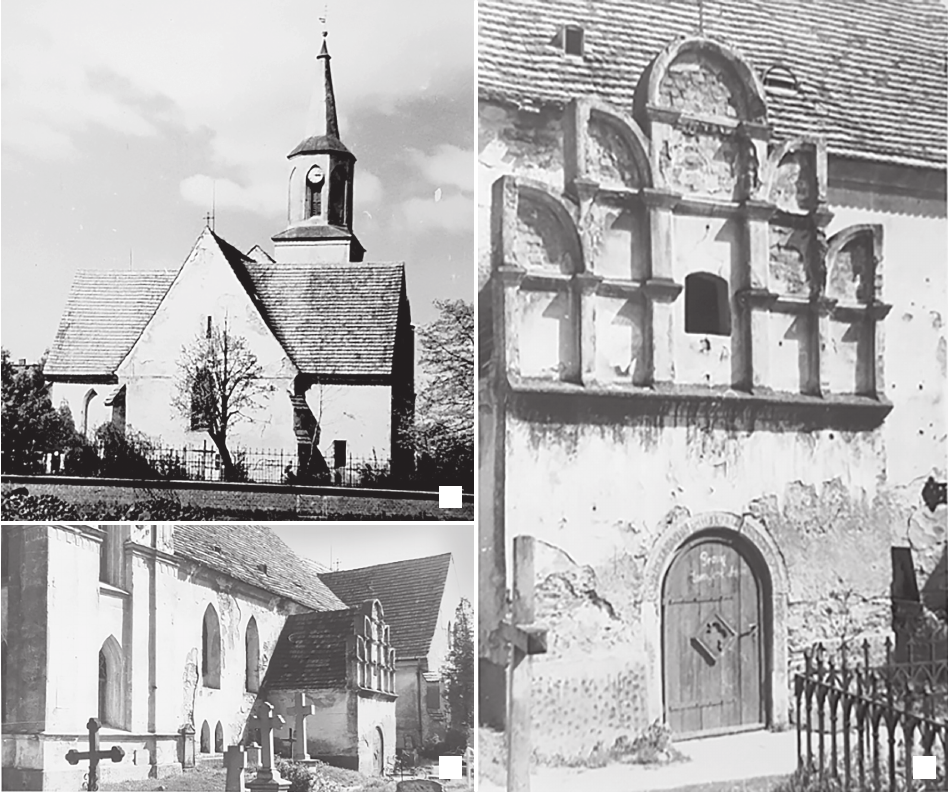
of an attic in the Mannerist style (Fig. 5). It currently serves
as the Chapel of the Blessed Virgin Mary. In the western
part of the nave is a wooden gallery (empora), accessible
from the tower mass. The corners of the chancel and the
southern chapel are reinforced with buttresses. The western
part of the nave includes a tower mass with a four-storey
tower (centrally positioned above the porch), anked sym-
metrically to the north and south by stairwell annexes, each
covered with gabled roofs. The tower’s top storey is octag-
onal and topped with a steep pyramidal spire clad in metal,
a feature characteristic of Schinkel’s Neo-Gothic designs.
The structure is crowned with a ball, a cross, and a weather
vane bearing the date: 1818. The nave, sacristy with gallery,
Fig. 5. The church in Kostomłoty in 1957: a) view from the east, b) view of the southern façade, c) view of the southern porch
(source: Malinowski 1957)
Il. 5. Kościół w Kostomłotach w 1957 r.: a) widok od wschodu, b) widok południowej elewacji, c) widok południowej kruchty
(źródło: Malinowski 1957)
a
b c
(“Kostenblut [Kostomłoty, formerly Neumarkt County [ehe-
mals Kreis Neumarkt]…”). A comprehensive guide to this
architect’s works is Andreas Bernhard’s book (2006); unfor-
tunately, it contains no mention of the Kostomłoty church
renovation as one of Schinkel’s executed projects. Howev-
er, a detailed comparative analysis of the design with the
earliest available illustrations and photographs of the tower
from 1898–1909 shows that the project was almost fully car-
ried out. The only elements that were not executed include
the tracery decorations in the niches, window tracery, and
arcade friezes. The latter were completed before 1909.
Exterior form – current state
The parish church is situated on an elevation (a hill) in the
western part of the market square, which is elongated along
an east–west axis. The building is surrounded by a cemete ry
of an irregular shape, roughly resembling an oval.
The church is built of brick and rubble stone and is entire-
ly plastered. The building’s layout is oriented along an east–
Reconstruction of the façade and tower of the church of the Exaltation of the Holy Cross in Kostomłoty 41
foundation. This hypothesis requires further verication.
The results may be inconclusive, as remnants of the earlier
walls may have been demolished during renovations. Above
the roof eaves, the tower clearly has two stories. The entire
structure is topped with a two-story onion-shaped dome in
the Baroque style, with a single window. A turret with a Ba-
roque onion-shaped dome was located at the top of the main
roof ridge, closer to the eastern wall.
The southern entrance was preceded by a Renaissance
porch with a characteristic Mannerist attic, preserved to
this day. The southern wall clearly displays windows with
roughly square proportions topped by a semicircular lintel.
To the west of the porch were two windows, likely splayed
or framed, while one to the east was located much higher
than today and was smaller.
The secondary Gothicization of the building, designed
by Schinkel in the 1
st
half of the 19
th
century, most likely
led to a change in the shape of the windows by lowering the
height of the sills. The lintels were also transformed, receiv-
ing a Gothic pointed arch (according to an erroneous state-
ment on the white card [Danielska 1998], this shape dates
from the 16
th
century). The original shape of the windows
is unknown. Werner’s engraving does not show a chapel
on the south side of the chancel, which means it must have
been built in connection with the reconstruction and expan-
sion of the church in the 19
th
century, not in the 15
th
century,
as suggested by Danielska’s study (Pilch 2005).
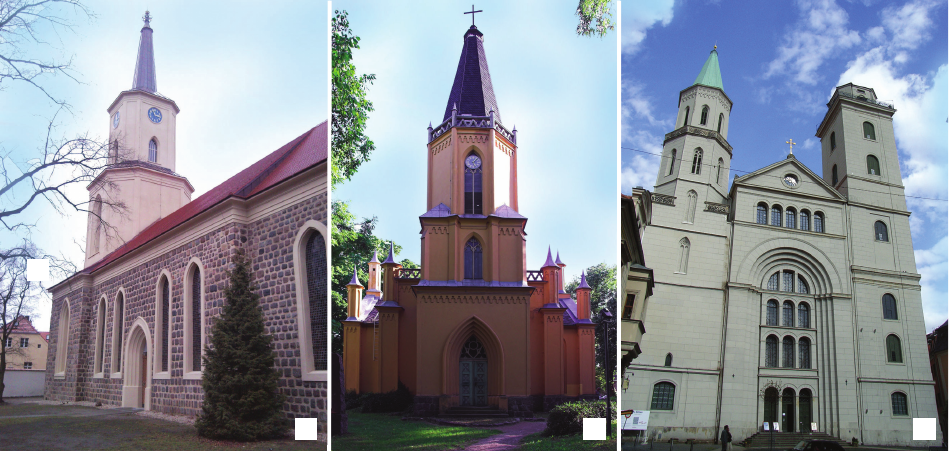
Similar churches designed by Schinkel
A general comparative analysis of Neo-Gothic church-
es designed by Schinkel allows us to identify three build-
ings that are most similar in form and time of construction
to the church in Kostomłoty (Pieske 1994): the tower of
and southern baptismal chapel are all covered with gable
roofs clad in ceramic tiles.
The western façade is tripartite and symmetrical, with
a central tower and two-storey stairwell annexes on either
side. The tower was constructed largely in accordance with
Schinkel’s design (Fig. 6), though not in its entirety – its
rich Neo-Gothic tracery program was omitted. The central
entrance portico is topped with a wimperg (a Gothic or-
namental gable) and features a recessed, pointed arch sur-
round. On either side are uted pedestals, identical to those
anking the second storey of the stairwell annexes. The side
elevations feature irregularly placed pointed-arch windows,
which were added later during the Neo-Gothic renovation.
This theory is supported by the discovery in 2018 of Re-
naissance polychromes dating from the 16
th
century, which
conict spatially with the current window placement (Wan-
tuch-Jarkiewicz, Jarkiewicz 2018). On the north side, an
early Renaissance sandstone portal from around 1550 has
been bricked up. Fragments of Renaissance diamond-pat-
tern sgrato have also been revealed on the northern eleva-
tion. Centrally located on the southern elevation is a Renais-
sance porch with a sandstone portal featuring an inscription
on the archivolt. The corners are decorated with pseudo-rus-
tication, and the gable is topped with a three-axis, four-tier
Renaissance attic, composed of quarter- and semicircular
elements.
External structure
The oldest illustration depicting the church is a panorama
of Kostomłoty, created by Werner around 1750. The church
tower is square in plan and abuts the western wall of the
nave. Reinforcements in the form of stepped buttresses are
visible on the tower’s western walls, suggesting a medieval
Fig. 6. Design of the tower
reconstruction and the addition of
staircase annexes according to
Schinkel from 1818
(source “Kostenblut (Kostomłoty,
ehemals Kreis Neumarkt)…”)
Il. 6. Projekt przebudowy wieży
i dobudowy aneksów
klatek schodowych
według Schinkla z 1818 r.
(źródło: “Kostenblut (Kostomłoty,
ehemals Kreis Neumarkt)…”)
42 Ewa Maria Netczuk-Pol, Łukasz Karol Netczuk
St. Andrew’s Church in Teltow (Fig. 7a), the Evangelical
Church in Großbeeren (Fig. 7b), and the façade in Zittau
(Fig. 7c).
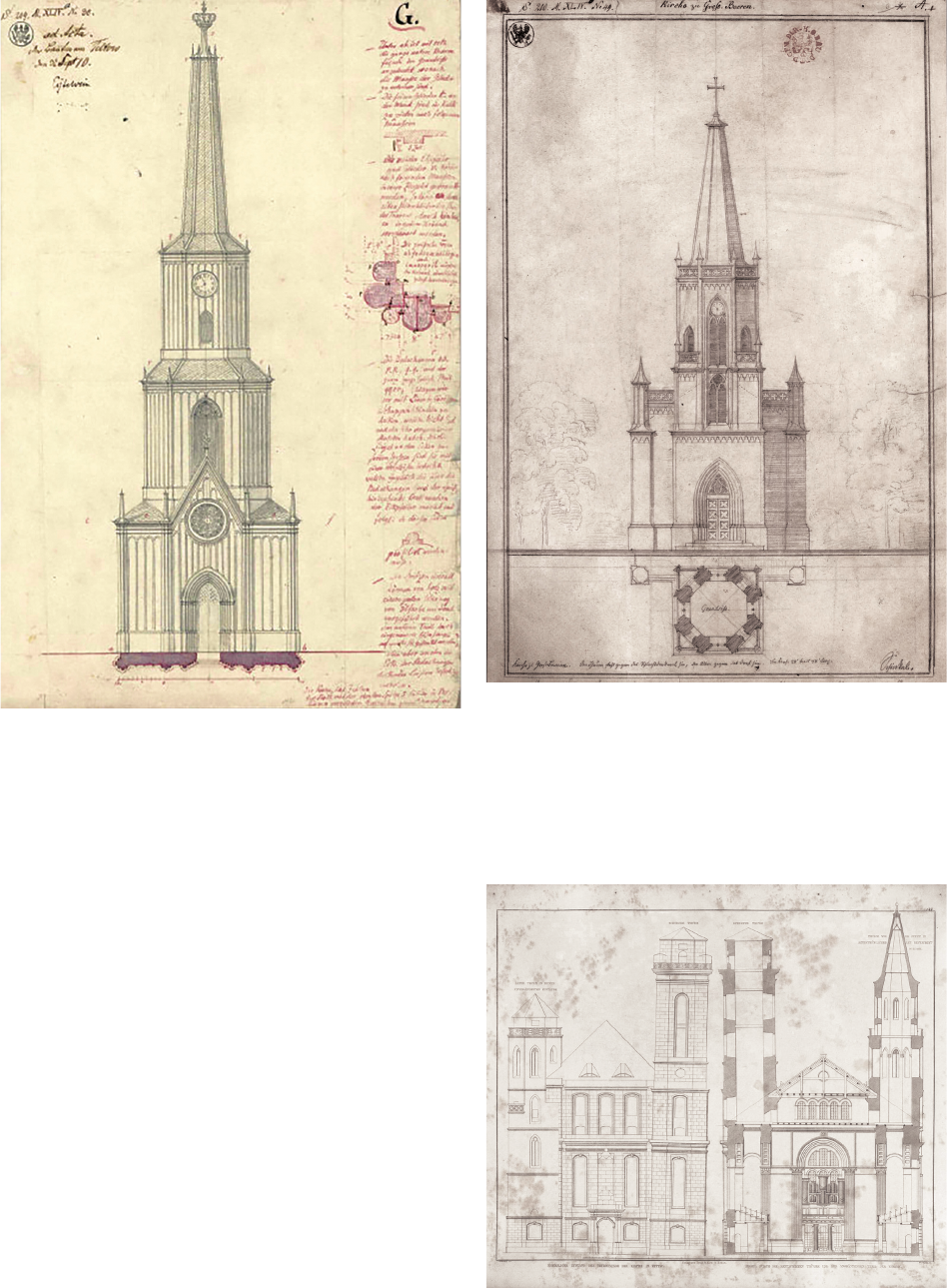
The rst mention of St. Andrew’s Church in Teltow dates
back to the 13
th
century. It is described as a eldstone struc -
ture. The building was repeatedly destroyed by res that rav-
aged the city. On August 17, 1801, it burned to the ground,
leaving only the brick walls. The rst reconstruction proj-
ect was prepared by master builder Schwarz, but it was
not accepted for implementation. The church’s nal form
was given in 1810 by Schinkel – he created a Neo-Gothic
design (Fig. 8), which has survived unchanged to this day.
He designed the southern, northern, and western portals,
as well as the wall with the choir. Additionally, the front
façade received a two-story tower mass, designed on an oc-
tagonal plan, topped by a pyramidal helmet-shaped dome
with a crown (tower construction: 1811–1812) (“Die Schin-
kel-Kirche zu Großbeeren” 1998).
Another church with a form similar to the one in Kosto-
młoty is the Evangelical Church in Großbeeren, built be-
tween 1818 and 1820 according to Schinkel’s design
(Fig. 9)
on the ruins of a church burned down during war-
fare in 1760. It was designed in the Neo-Gothic style. The
church’s plan is a Greek cross with a two-story tower on
the northern axis. The rst story of the tower is square, the
second octagonal. The entire structure is topped with an oc-
tagonal pyramidal dome with a bell tower (Große 2016).
The Church of St. John in Zittau (German: Zittau; Czech:
Žitava; Polish: Żytawa) was also rebuilt according to Schin-
kel’s plans. It was rst mentioned in the late 13
th
century,
when it was a three-nave church with two towers at the
Fig. 7. Schinkel’s church façades’ designs most similar to the design of the church in Kostomłoty:
a) the tower of St. Andrew’s Church in Teltow (source: Wikimedia Commons),
b) the Evangelical Church in Großbeeren (author: Peter Groth, Wikimedia Commons, CC BY-SA 3.0),
c) reconstruction of the western façade of St. John’s Church in Zittau (author: Manecke, Wikimedia Commons, CC BY-SA 3.0)
Il. 7. Elewacje kościołów projektu Schinkla, które są najbardziej zbliżone do projektu kościoła w Kostomłotach. Są to:
a) wieża kościoła św. Andrzeja w Teltow (źródło: Wikimedia Commons),
b) kościół ewangelicki w Großbeeren (autor: Peter Groth, Wikimedia Commons, CC BY-SA 3.0),
c) przebudowa fasady zachodniej kościoła św. Jana w Żytawie (autor: Manecke, Wikimedia Commons, CC BY-SA 3.0)
a
ba c
front. In the 16
th
century, it was expanded with another nave,
creating a four-nave hall church. The church was destroyed
in 1757 during the Seven Years’ War. In 1766, construction
began on the foundations of the old church in the Baroque
style; it was nally completed in 1804. Unfortunately, the
church was designed incorrectly and suered from serious
structural problems, particularly in the roof structure and
the central part of the front façade and the southern tower.
Schinkel, then head of the Prussian construction delegation,
began the process of repairing the building. The renovation
work was supervised by his student, Carl August Schramm.
The renovation included replacing the barrel vault with
a lighter coered vault (excessive loads on the vault caused
the southern tower to lean) and covering it with a simple
gable roof (Fig. 10). The northern tower received an octag-
onal gable with a pyramidal helmet-shaped dome topped
with a bell turret. For structural reasons, the taller southern
tower could not be given a pointed dome. The entire façade
was constructed in the neoclassical style (Große 2016).
Conclusions
Comparing the oldest available representation of the
church in Kostomłoty with Schinkel’s design allowed us to
determine the changes that occurred in the original known
form of the tower mass, the location and form of windows
and doors. The Gothicization project was carried out al
most
entirely within the form and structure of the tower mass. The
arrangement of window and door openings and their shape,
as well as the arrangement of cornices, re cesses,
pilasters,
and gables, are consistent with the design assumptions.
Reconstruction of the façade and tower of the church of the Exaltation of the Holy Cross in Kostomłoty 43
No costly tracery was performed on the windows and en-
trance portal – in their place simpler doors were installed,
with a transom and stained-glass windows in steel frames.
The arcaded Neo-Gothic frieze under the cornice of all sto-
reys was also abandoned. Furthermore, the window proles
(stepped) were simplied, and sharp pinnacles were omitted
on the pilasters anking the gables of the tower’s “transept”
and the wimperg (gable) of the main portal. The corner
windows of the octagonal tower were also simplied to at
niches. In the plan, the current direction of ascent in the side
staircases is opposite to that planned in the design: original-
ly, the entrance to the porch was supposed to be located on
both sides.
Summary
A general comparative analysis with other Neo-Gothic
churches designed by Schinkel allows us to conclude that
Fig. 8. Design of the façade of St. Andrew’s Church in Teltow
according to Schinkel (source: Staatliche Museen zu Berlin,
Kupferstichkabinett / Wolfram Büttner, https://recherche.smb.museum/
detail/1506073/teltow--st--andreaskirche--turmentwurf-
?language=de&question=teltow&limit=15&sort=relevance
&controls=none&objIdx=5)
Il. 8. Projekt fasady kościoła św. Andrzeja w Teltow według Schinkla
(źródło: Staatliche Museen zu Berlin, Kupferstichkabinett / Wolfram
Büttner, https://recherche.smb.museum/detail/1506073/teltow--st--an-
dreaskirche--turmentwurf-?language=de&question=teltow
&limit=15&sort=relevance&controls=none&objIdx=5)
Fig. 9. Design of the façade of the Protestant Church in Großbeeren
according to Schinkel
(source: https://smb.museum-digital.de/object/88265)
Il. 9. Projekt fasady kościoła ewangelickiego w Großbeeren
według Schinkla
(źródło: https://smb.museum-digital.de/object/88265)
Fig. 10. Design for the reconstruction of the façade of the church
in Zittau (Polish: Żytawa) according to Schinkel
(source: https://smb.museum-digital.de/object/90224)
Il. 10. Projekt przebudowy fasady kościoła w Zittau (pol. Żytawa)
według Schinkla
(źródło: https://smb.museum-digital.de/object/90224)
44 Ewa Maria Netczuk-Pol, Łukasz Karol Netczuk
References
Bernhard, Andreas. Karl Friedrich Schinkel. Führer zu seinen Bauten.
Vol. 2: Von Aachen bis Sankt Petersburg. Dt. Kunstverlag, 2006.
Danielska, Bożena. „Kostomłoty – Kościół Podwyższenia Krzyża Świę-
tego.“ Wrocław, 1998 [Manuscript in WKZ, Wrocław].
“Die Schinkel-Kirche zu Großbeeren.” Peda Kunstführer, nr 428 (1998).
Ecke, Karl. Beiträge zur Geschichte der Ortschaften Illnisch und Ro-
molkwitz. [s.n.], 1927.
Große, Gerhard, ed. Sankt Johannis Zittau – Kirche, Kulturstätte, Bau-
denkmal. Eine kulturhistorische Dokumentation über die Johannis-
kirche von den Anfängen bis zur Gegenwart. Graphische Werkstät-
ten, 2016.
Heyne, Johann. Dokumentirte Geschichte des Bisthums und Hochstiftes
Breslau. Aus Urkunden, Altenstücken, älteren Chronisten und neue-
ren Geschichtschreibern. Vol. 1. Verlag von Wilh. Gottl. Korn, 1860.
“Kostenblut (Kostomłoty, ehemals Kreis Neumarkt). Entwurf zum Neu-
bau des Turms der katholischen Kirche. Grundrisse, Querschnitt und
Aufrisse.” Accessed April 10, 2024, at http://www.smb-digital.de/
eMuseumPlus?service=ExternalInterface&module=collection&ob-
jectId=1506109&viewType=detailView.
Malinowski, Zygmunt. “Ekspertyza wstępna Kościoła w Kostomło-
tach.” Wrocław, 1957 [Manuscript in WKZ, Wrocław].
Netczuk, Łukasz Karol, Ewa Netczuk-Pol, and Bartosz Żmuda. “Studium
historyczno-ikonograczne kościoła pw. Podwyższenia Krzyża Świę-
tego w Kostomłotach do projektu remontu konserwatorskiego wnętrz.”
Wrocław, 2018. [Manuscript in parish archives].
Oszczanowska, Bogna. “Kościół paraalny pw. Podwyższenia Krzyża
Świętego.” Published October 27, 2017. Accessed August 10, 2025,
at https://zabytek.pl/pl/obiekty/g-231342.
Oszczanowska, Bogna, Beata Sebzda, and Donata Trenkler. “Studium
war tości kulturowych gminy Kostomłoty, powiat średzki, wojewódz-
two dolnośląskie.” Wrocław, 2010. [Manuscript in WUOZ, Wrocław].
Pieske, Manfred. Stadtbilder aus Teltow. Stadtbild-Verlag, 1994.
Pilch, Józef. Leksykon zabytków architektury Dolnego Śląska. Arkady,
2005.
Wantuch-Jarkiewicz, Katarzyna, Artur Jarkiewicz. “Badania stratygra -
czne ścian wnętrza kościoła paraalnego pw. Podwyższenia Krzy-
ża Świętego w Kostomłotach.” Wrocław, 2018. [Manuscript in pa-
rish archives].
Werner, Friedrich Bernhard. Topographia seu Compendium Silesiae.
Pars II. [s.n.], 1751–1800. [Manuscript in Biblioteka Uniwersytetu
Wrocławskiego, IV F 113 b wol. 2. oai:bibliotekacyfrowa.pl:16339].
Streszczenie
Przebudowa fasady i wieży kościoła pw. Podwyższenia Krzyża Świętego w Kostomłotach według projektu Karla Friedricha Schinkla
na tle innych jego realizacji jako przykład przebudowy barokowego kościoła w duchu neogotyku
Kostomłoty to obecnie niewielka wieś w województwie dolnośląskim, nieopodal Wrocławia. Najcenniejszym zabytkiem osady jest zlokalizowany
w centrum, po zachodniej stronie placu rynkowego, kościół paraalny pw. Podwyższenia Krzyża Świętego. Ze względu na nieliczne zachowane ma-
teriały ikonograczne kościoła sprzed 1900 r. oraz brak szerszych badań trudno ustalić dokładne zmiany zachodzące w bryle budynku. Gotycką bryłę
kościoła wzniesiono w połowie XIV w. W połowie XVI w. została wyremontowana i rozbudowana o renesansową kruchtę. W okresie baroku wieża
otrzymała nowy hełm. Przeprowadzona przez autorów kwerenda w zagranicznych archiwach ujawniła plan przebudowy kościoła z 1818 r. sygnowany
przez Karla Friedricha Schinkla. W latach 1818–1819 na podstawie tego projektu w duchu neogotyku na zrębach starej wieży wybudowano nową
wraz z aneksami klatek schodowych, tworząc swoisty westerwerk. Szczegółowa analiza porównawcza projektu i ikonograi historycznej wieży z lat
1898–1909 wykazuje, że projekt zrealizowano niemalże w całości.
Projektom przebudów istniejących obiektów autorstwa Schinkla poświęcono zdecydowanie mniej uwagi niż projektom nowych budynków. Niniej-
sza praca rzuca nieco światła na projekt neogotyckiej przebudowy barokowego kościoła i jego realizację na tle innych neogotyckich masywów wieżo-
wych zrealizowanych według projektu tego samego architekta.
Słowa kluczowe: Karl F. Schinkel, neogotyk, przebudowa, wieża kościelna, Kostomłoty
the Kostomłoty church tower’s façade design most close-
ly resembles the design of the Teltow church tower (the
octagonal lantern and dome, cornice friezes, and charac-
teristic pinnacles in the form of spires) and the western
façade of the church in Zittau (the distinctive octagonal
helmet-shaped dome), rebuilt between 1834 and 1837. The
church in Großbeeren, the church tower in Zittau, and the
church tower in Kostomłoty were designed during the same
period (1817–1821). Nevertheless, the western mass of the
Kostomłoty church demonstrates greater stylistic coher-
ence than the other similar Schinkel designs, and it is char-
acterised by good proportions and a rich façade program.
It is an example of a mature work in the Neo-Gothic style.
Translated by
Bogusław Setkowicz