2024
4(80)
Łukasz Bednarz*, Alicja Hoyenski**, Gabriela Wojciechowska***
Research and structural conservation of historic vaults
DOI: 10.37190/arc240405
Published in open access. CC BY NC ND license
Abstract
This paper focuses on issues concerning the research and conservation of historic vaults with particular emphasis on condition analysis. Tradi-
tional and modern methods of strengthening vaults are presented, including techniques using composite materials such as: FRP (Fiber Reinforced
Polymer), FRCM (Fiber Reinforced Cementitious Matrix).
The process of assessing the condition of the vault using various methods, e.g., visual inspection, laser scanning, non-destructive NDT, is dis-
cussed. The paper presents an example of the use of carbon mesh to reinforce a vault in a historic building – highlighting the need for diagnostic mon-
itoring after repair work. The use of the HBIM (Historic Building Information Modelling) model to accurately represent the geometry and structural
analysis of the vault is described. The numerical model was created using the nite element method (FEM).
Eective conservation of historic vaults requires a harmonious combination of traditional methods and modern technologies. It has been shown
that the correct identication of structural problems and the adoption of appropriate conservation strategies are key to preserving architectural heri-
tage and ensuring its integrity for future generations. In addition, the importance of continuous diagnostic monitoring of the vault after repair enabling
ongoing assessment of the eectiveness of the methods used and early detection of possible structural problems was highlighted.
Key words: composite materials, historic vaults, exible joints, HBIM models
Introduction
As one of the most responsible structures, historic
vaults can lose their strength and aesthetic qualities when
exposed to adverse factors. Often, for reasons such as deg-
radation of materials changes in loads, altered water and
soil relations or the need to adapt to modern safety stan-
dards require strengthening measures. The conservation of
vaults often requires a combination of structural and ar-
chitectural conservation techniques. Reinforcements must
be planned and carried out with respect for the historical,
scientic and architectural values of these elements. The
design and selection of strengthening materials should re-
sult from a thorough assessment of the technical condition,
load analysis and stress distribution. The most common
methods of stabilising the technical condition and reinforc-
ing vaults include the use of tie-beam systems, glued-in
steel bars or sheets, injection and the increasingly popular
composite materials in the form of meshes, rods, cords,
mats and tapes of FRP (Fiber Reinforced Polymers) or
FRCM (Fiber Reinforced Cementitious Matrix) and poly-
meric prone joints (Jasieńko, Łodygowski, and Rapp 2006;
Kwiecień 2013; Bednarz 2021). Reinforcing the vaults
with these high-strength and exible construction materi-
als ensures increased stability and durability of the vaults.
The article presents the dierent types of reinforcement
used in the conservation of historic vaults, including tradi-
tional, modern and mixed methods, as well as an example
of the implementation of reinforcement from Silesia using
carbon nets, maintaining the authenticity and durability of
historic vaults.
Technical condition assessment of the vault
Before a strengthening and maintenance method is cho-
sen, a survey should be carried out to determine the con-
dition of the vault. This process involves several steps and
* ORCID: 0000-0002-1245-6027. Faculty of Civil Engineering,
Wrocław University of Science and Technology, Poland.
** ORCID: 0000-0003-1684-1579. Faculty of Architecture, Wro-
cław University of Science and Technology, Poland.
*** ORCID: 0000-0001-7041-5373. Faculty of Architecture, Wro -
cław University of Science and Technology, Poland, e-mail: gabriela.
wojciechowska@pwr.edu.pl
44 Łukasz Bednarz, Alicja Hoyenski, Gabriela Wojciechowska
uses various methods to gain a thorough understanding of
the current condition of the structure and to identify poten-
tial problems.
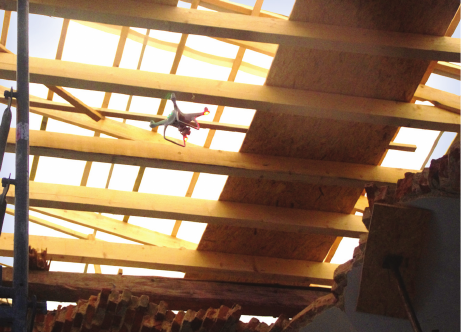
The visual inspection (Fig. 1) is the rst step in assess-
ing the technical condition of the vault. It allows the initial
identication of damage such as cracks, scratches, material
loss, dampness or deformation. Based on these observa-
tions, it can be determined which areas require more de-
tailed examination.
The condition assessment should include the produc-
tion of drawing (metric) documentation, in which struc-
tural damage, e.g., existing scratches and material loss, is
marked. The documentation should include detailed archi-
tectural drawings (Łużyniecka 2022), photographs, possi-
bly photogrammetric studies and/or 3D laser scanning to
create digital models of the structure. These models may
include geometric data augmented with metadata on mate-
rial parameters, architectural characteristics and the trans-
formation of the building – if HBIM (Historic Building In-
formation Modelling) documentation is developed or used
o-the-shelf.
It must be remembered that a correct assessment of the
state of preservation and the cause of damage results not
only from a thorough inventory and modelling, but also
from a knowledge of the history of transformations to
which the building has been subjected over the centuries.
This is followed, if possible, by material tests, includ
ing
strength tests, e.g., compressive and peel strength, chemi-
cal and physical analyses, material composition. Particular-
ly non-destructive methods (Non Destructive Test – NDT)
appear to be very useful at this stage of the procedure.
Based on the results, a suitable model should be selected
for the calculation (static or dynamic) (Scacco et al. 2020).
In vaults of brick, stone, concrete or mixed construction,
a structural analysis is recommended. Because the geom-
etry of vaults is dicult to capture in traditional computa-
tional models, FEM (Finite Element Method) models are
helpful in this respect. The use of FEM allows a detailed
analysis of the elements under the inuence of the loads
Fig. 1. Visual inspection of a failing vault using a drone
(photo by G. Wojciechowska)
Il. 1. Inspekcja wizualna sklepienia w stanie awarii przy użyciu drona
(fot. G. Wojciechowska)
acting on them (existing and designed). FE models are
valuable tools for the analysis and design of structural rein-
forcement using dierent types of materials. These models
use numerical methods to simulate the behaviour of the
structure and assess the eectiveness of the reinforcement
used. They also allow the simulation of dierent loading
variations and potential failures such as cracking, delami-
nation or overstressing.
Types of reinforcement for historic vaults
Reinforcing historic vaults is a process that requires
both knowledge of building technology and a deep un-
derstanding of the static working of these structures and
knowledge of conservation doctrine. Dierent methods are
used to ensure the durability and stability of these struc-
tures: traditional, modern or mixed. The type of reinforce-
ment chosen depends, among other things, on the technical
condition of the vault and the extent of the conservation
work that may be required, depending, for example, on the
artistic and architectural qualities of the vault.
Traditional methods
of reinforcing historic vaults
Traditional reinforcement techniques have been tested
for hundreds of years, proving their eectiveness and du-
rability. However, traditional materials may not provide
sucient strength to withstand dynamic forces in areas
exposed to vibrations from, for example, road or rail traf-
c. Traditional reinforcement methods may not meet the
requirements of current building standards for load-bear-
ing capacity and safety, especially for structures requiring
additional reinforcement due to new loads
Steel tie rods
Tie-beams can be used in a variety of vault types and
are tailored to the specic structural needs of a particular
building. They usually connect opposing vault headers,
thereby reducing strutting forces in the supports. In this
way, they prevent the vault from spreading laterally, which
could compromise the integrity of the entire structure. The
introduction of tie beams into the vault neutralises these
forces. This maintains stability and extends the life of
historic buildings. Anchoring elements must be properly
matched to the wall material to ensure adequate adhesion
and strength of the connection. Once the ends of the tie
bars are xed in the walls, the bars are tensioned using
special tensioning devices. This process involves gradu-
ally increasing the tension in the bars until a suitable level
of vault stabilisation is achieved. Steel tie rods are exposed
to corrosion and therefore need to be protected from the
elements. Various methods of protection are used, e.g.,
galvanising, painting with anti-corrosive paints, applica-
tion of protective coatings. The installation of tie-beams is
relatively non-invasive (usually the tie-beams have a small
cross-section and do not obscure the vault), which is im-
portant for historic buildings where the preservation of the
original building fabric is a priority.
Research and structural conservation of historic vaults 45
Injections
Injections are the process of introducing special injec tion
materials into cracks and ssures in masonry to strengthen
t
he structure from within. Injection materials include epo -
xy resins, cements, mineral mixtures and other specialised
substances to improve the cohesion and load-bearing ca-
pacity of the vault. Injections are primarily used to ad-
dress micro-spaces and cracks that can weaken the vault
structure. The process begins with a thorough analysis of
the condition of the structure, identifying the damage and
determining the areas requiring intervention. Pressurised
injection materials are then injected into the designated ar-
eas and all cracks and cavities are carefully lled. One of
the key decisions concerns the selection of the appropriate
material. Epoxy resins are characterised by their high me-
chanical strength and excellent adhesion to the substrate
– this makes them ideal for reinforcing highly stressed
structures. Cements and mineral mixtures, on the other
hand, are more compatible with historic building materi-
als, which is important in terms of preserving the authen-
ticity of the historic substance.
The injection process usually uses special injection
pumps that allow precise dosing of the material and con-
trol of the injection pressure. Monitoring and controlling
the eectiveness of the injection is also an important step,
where non-destructive methods, such as ultrasound, are of-
ten used. With these techniques, it is possible to accurately
determine the degree of gap lling and assess the eective-
ness of the reinforcement.
The injection method contributes to the strength of the
constituent materials, improves the load-bearing capacity
of the structure, and eectively seals and protects against
moisture and aggressive gases that can penetrate the ma-
sonry. The process of regenerating masonry vaults using
injection is very delicate and requires a series of carefully
selected preliminary measures. The selection of the injec-
t ant components and the adaptation of the consistency to
the specic needs of the case are crucial.
Reinforcing historic vaults using injection has many ad-
vantages. First and foremost, it is relatively non-invasive,
eectively reinforcing while preserving the original char-
acter of the monument. In addition, injections can be used
in conjunction with other strengthening methods, such as
glued-in steel bars or composite mesh, so that comprehen-
sive stabilisation of the structure can be achieved.
Bonded steel bars or sheets
The technique of inserting steel bars or plates involves
introducing steel elements into the construction of vaults
to carry additional loads and improve the integrity of the
building. The strengthening process begins with a thor-
ough analysis of the technical condition of the vault and the
iden
tication of the areas that need strengthening. Once
these areas have been determined, appropriate cuts or holes
are made in the structure into which the steel bars or plates
will be inserted. The steel elements are then thoroughly
cleaned and protected against corrosion. When steel bars
are pasted in, the elements are placed in specially prepared
channels that can be made in the vault. The bars are then
xed with special epoxy or cement adhesives to ensure
their permanent bond to the structure. These adhesives
are characterised by high strength and excellent adhesion
to a variety of building materials, which guarantees the
eectiveness of the reinforcement. As with the bars, the
pasting of the steel sheets consists of placing them in pre-
pared notches in the vault. These plates are usually pasted
on the surface of the vault or in its cross-section – depend-
ing on the specic construction and reinforcement needs.
The process requires precise surface preparation, as well
as the right choice of adhesives. This method allows for
a signicant increase in the strength of the structure, but
due to the extent of the work it does not allow for rapid
reinforcement, which is crucial when the structure needs
to be secured quickly.
Modern methods of reinforcing historic vaults
Modern reinforcement techniques use composite ma-
terials and technologies that minimally interfere with the
original structure of monuments. Modern composite mate-
rials are lightweight and have high tensile strength, making
them suitable for increasing the load-bearing capacity of
vaults without signicant additional weight. They are also
exible, allowing them to accommodate possible “move-
ments” and deformations of the vault. This is particularly
important for structures located both in areas with increased
seismic activity and in historic city centres with increased
vehicular trac. These materials are corrosion-resistant,
ensuring long-term durability and minimising the risk of
deterioration over time. Reinforcing historic structures
with innovative composite materials follows conservation
principles – it is minimally invasive and reversible (with
proper design and execution).
Among the most common modern strengthening meth-
ods are surface reinforcement with composite materials
and polymeric exible joints.
Surface reinforcement using composite materials
(FRP/FRCM)
Surface reinforcements using composite materials can
be in the form of meshes, rods, cords, mats, tapes and
sec tions of FRP or FRCM systems. Thanks to their high
strength and low weight, they eectively reinforce struc-
tures while minimising interference with the historic fab-
ric. FRCM systems use reinforcing bres (carbon, glass,
basalt, aramid, PBO (e.g., polyparaphenylene benzobi-
soxazoles) as the xing matrix; the mineral compositions
have relatively good vapour permeability and do not block
moisture migration in the form of water vapour, which is
very important when there are, for example, frescoes on
the vaults, on the side of their palisade, which require
structural intervention. It is important to remember to
analyse in detail the method of application and the type
of composites used. Improper use, disregarding the laws
of statics and building physics, can be associated with the
destruction of an object of considerable architectural and
cultural value.
46 Łukasz Bednarz, Alicja Hoyenski, Gabriela Wojciechowska
Numerous studies have shown (Valluzzi, Tinazzi, and
Mo dena 2002; Oliveira, Basilio, and Lourenço 2010; Ca-
rozzi, Milani, and Poggi 2014; Lignola et al. 2017) that
this type of reinforcement is suitable for the repair of struc-
tures, including masonry, as it provides them with an ade-
quate level of safety, especially when these are subjected
to asymmetric loads.
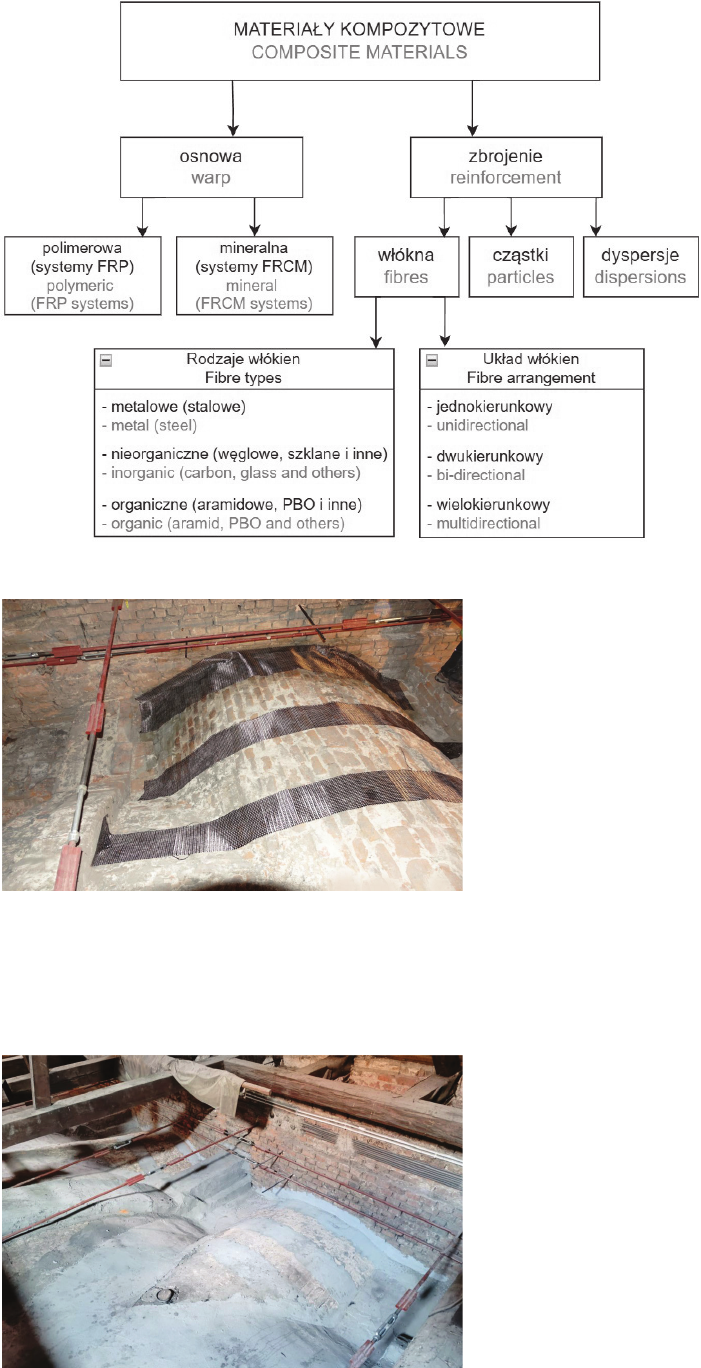
The term composite material refers to a material that is
constructed from at least two dierent components, with
their combination occurring at the macroscopic level. In
most composite materials, two phases are distinguished:
a matrix (matrix), which acts as a binder, and a dispersed
phase (reinforcement) (Fig. 2). The properties of the com-
posite depend on the properties of the two phases, their
proportions in the total volume of the composite, how the
dispersed phase is distributed in the matrix and its geomet-
rical features. Depending on the type of dispersed phase,
composite materials are divided into particle-reinforced,
dispersion-reinforced and bre-reinforced.
Fibre-reinforced composites, which are very often used
to reinforce masonry structures, use various bres as load-
bearing elements (Figs. 3, 4). The matrix not only binds
the bres together, but also distributes external loads be-
tween the bres and protects them from external inuences.
FRP bre-reinforced composites in polymer matrixes
(thermoplastic and thermosetting resins) and FRCM in
mineral matrixes are characterised by very good technical
performance, as well as relatively simple production meth-
ods and moderate costs. These characteristics make them
extremely eective for practical use – while providing ex-
cellent mechanical strength with minimal dead weight.
Glass bres are the oldest and cheapest bres used to
reinforce composites. A major disadvantage of the resin
matrix composite reinforcement system is the poor re
resistance of the bonding – the adhesive, where already at
Fig. 2. Composite materials
(elaborated by Ł. Bednarz)
Il. 2. Materiały kompozytowe
(oprac. Ł. Bednarz)
Fig. 3. Vault during installation of carbon mesh composite
reinforcement (photo by Ł. Bednarz)
Il. 3. Sklepienie w trakcie układania zbrojenia kompozytowego
z siatek węglowych (fot. Ł. Bednarz)
Fig. 4. Vault after reinforcement (photo by Ł. Bednarz)
Il. 4. Sklepienie po wykonaniu wzmocnienia (fot. Ł. Bednarz)
Research and structural conservation of historic vaults 47
60°C the shimmering process starts and the linear and form
deformability increases.
FRCM systems use an inorganic mortar consisting of
a hydraulic binder and additives – chemically, physically
and mechanically compatible with the substrate, especial-
ly brick masonry. FRCM systems oer several important
advantages, including: heat resistance, applicability to
damp substrates, ease of application on uneven substrates,
and applicability over a wide temperature range from +5°C
to +40°C.
Polymeric flexible joints
Polymeric exible joints are used to connect and rein-
force damaged or weakened vault components to both ensure
structural stability and maintain historic integrity (Kwie cień
2013).
In this method, susceptible polyurethanes are used
to strengthen masonry structures – primarily through injec-
tions that create exible joints that can transmit and dissi-
pate signicant amounts of deformation energy. The pliable
polyurethanes are used in two main roles: as exible joints
for lling cracks in masonry (PolyUrethane Flexible Joints
– PUFJ) and as an adhesive layer and matrix in composite
joints (Fibre Reinforced Polyurethane – FRPU).
In laboratory tests, exible polyurethane joints were
shown to signicantly increase the load-bearing capacity
of masonry structures compared to traditional repair meth-
ods such as cement mortars or rigid epoxy resins. In four-
point bending tests, polyurethane joints outperformed the
traditional ones because they did not damage the repaired
bricks. This is crucial in the conservation of historic ma-
sonry – as preserving the original material is a priority.
Vulnerable polyurethanes used as adhesives to reinforce
masonry using FRPU composites reduce the stress concen-
trations typical of rigid layers made of mineral mortars or
epoxy resins. As a result, shear stresses are more evenly
distributed, protecting composite bres and brittle masonry
substrates from localised damage that can lead to rapid peel-
ing and reduced joint eectiveness. As a result, the use of
polyurethanes increases the load-bearing capacity of the re-
inforcement and protects historic substrates from damage.
The two main applications of susceptible polyurethanes
in FRPUs are – the use of ready-made composite lami-
nates (with bres embedded in an epoxy matrix) bonded to
a weak substrate with a susceptible polyurethane adhesive,
and the use of highly deformable polyurethanes as a matrix
for the composite bres. In the rst case, the composite
laminates transfer loads more uniformly and reduce the
risk of local damage. In the second, the exible polyure-
thane matrix evens out the curvature of the bres – thus
enabling loads to be transferred evenly over a greater num-
ber of bres, increasing the strength of the composite and
reducing shear stresses in the substrate.
The use of a susceptible polyurethane matrix in FRPU
technology not only distributes stresses over all the bres in
the cross-section, but also acts as an elastic adhesive layer
and increases the ability of masonry structures to withstand
dynamic loads and uneven settlements. This is particu-
larly important for historic buildings, where maintaining
structural integrity is crucial to their longevity and safety.
Mixed methods
Reinforcing historic vaults often requires mixed meth-
ods, which combine a variety of techniques to ensure
optimal stabilisation and preserve the authenticity of the
structure. Mixed methods combine traditional and modern
technologies to achieve optimum results in the conserva-
tion process. In some cases, especially when vaults are se-
verely damaged, a combination of traditional techniques
(e.g., steel bar pasting) and modern composite materials
is used. This approach allows for optimal strengthening of
critical areas of the vault, while maintaining the structural
integrity and aesthetic appearance of the historic building.
Another example is the use of tie-beams with composite
meshes.
Diagnostic monitoring
Once the vaults have been reinforced, systematic diag-
nostic monitoring of the vaults is necessary (Bednarz 2021;
2023; Bednarz et al. 2021) to ensure that the reinforcement
is eective and that there are no signs of further damage or
material degradation. This enables and early response to
potential problems, and ensures the long-term preservation
of historic vaults.
The diagnostic monitoring of historic buildings itself,
associated with what is known as Structural Health Mon-
itoring (SHM), is the process of observing and analysing
the condition of a building in real time. It is one of the
tools of diagnostics in its broadest sense, alongside mate-
rials testing and structural analysis – extremely helpful in
the early detection of structural defects or damage posing
potential safety risks to people and the structure itself.
The purpose of diagnostic monitoring is to continu-
ously measure key geometrical, mechanical and physical
parameters of a structure or its components that change
over time. This provides knowledge of a given situation
by identifying the mechanisms of change at an early stage.
Thus, diagnostic monitoring is intended to facilitate the
implementation of appropriate preventive and corrective
measures in historic structures.
Example of implementation
of reinforcement with carbon mesh
Using the example of research carried out on the vault-
ing of a church in Silesia, it is possible to illustrate how
the methods described in this article can be used to assess
the technical condition and select an appropriate method of
structural conservation of the vaulting (Fig. 5). The lunette
vaulted church was built in the 18
th
century. The vaults of
the church can be divided into two zones. Zone one, which
is the largest part, is the vaulting of the nave. It is a cradle
vault divided into bays by porticos located on the dorsal side
of the vault. Within each bay there are two lunettes located
opposite each other. There are a total of ve bays with-
in the nave. The radius of the vault arch is approximately
3.45 m, the arrow approximately 3.33 m. The lunettes
with a ridge descending towards the outside. Based on
the measurements, the thickness of the vault shell was
48 Łukasz Bednarz, Alicja Hoyenski, Gabriela Wojciechowska
present between the 1
st
and 2
nd
and 2
nd
and 3
rd
bays on
the side of the rainbow arch under the vault arches xed at
a height of approximately 6.50 m above the oor. The area
of the chancel and apse can be considered as the second
zone. The chancel has a cross vault. The thickness of the
vault shell was assumed to be about 0.12 m, with ridge
gourds about 0.30 m thick and about 0.25 m wide. The
semi-circular apse of the presbytery is covered by a vault-
ed ceiling with three radial lunettes in a complex form of
arches. The layout of the apse, like that of the entire vault,
is symmetrical (Fig. 6). The above-mentioned areas are
separated from each other by a rainbow arch. The support
of the vault in question is provided by the perimeter walls
of the nave and chancel.
The most worrying damage in the analysed building is
the cracks mainly concentrated in the zone of the vaults
and the external walls of the nave. The main axis along
which cracks and ssures appear is the axis of the nave
and the lines running transversely to the axis of the nave,
passing through the central part of the vault. They cover al-
most the entire surface of the vault. These cracks have their
continuation on the side walls and near the window open-
ings (damage to the lintels is visible). A similar situation is
present in the chancel and apse area. There, too, numerous
cracks and scratches are visible (Fig. 7). No major damage
was found in the axis of the apse.
The outstanding scratch is a crack running across the
rainbow arch, which is a continuation of the damage to the
nave vault in the main axis of the church.
The previously described scratches have varying de-
grees of opening. The largest cracks are found in the con-
nection between the vaults and the external walls (they can
be up to several centimetres wide on the dorsal side of the
vaults). Numerous cracks of considerable opening also oc-
cur on the external walls of the body and the tower. Some
of the wall scratches are also visible on the outside of the
building.
The arrangement of the described scratches indicates
the occurrence of tensile forces within the vaults and the
walls supporting them. The direction of these forces is
mainly directed across the axis of the church. The prob-
able cause of this situation is the location of the church
on a small escarpment cut o from the road by a retain-
ing wall excessively irrigated periodically by water from
surface run-o from the adjacent cemetery and trac of
heavy agricultural machinery.
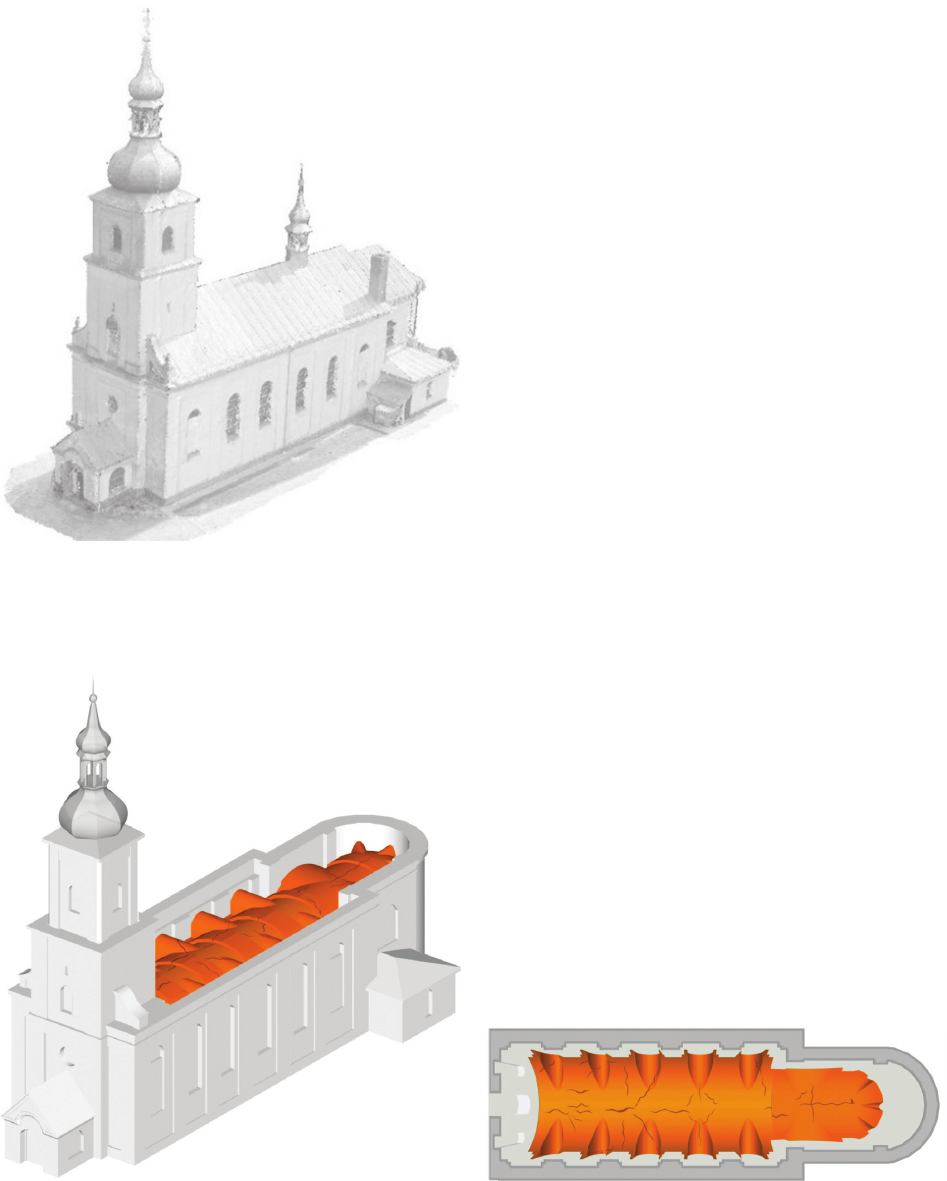
Fig. 5. Laser scanning point cloud (elaborated by G. Wojciechowska)
Il. 5. Chmura punktów ze skaningu laserowego (oprac. G. Wojciechowska)
Fig. 6. HBIM model – simplified model of the body of the church
and detailed model of the vault (elaborated by A. Hoyenski)
Il. 6. Model HBIM – uproszczony model bryły kościoła
i szczegółowy model sklepienia (oprac. A. Hoyenski)
Fig. 7. View of the vault from below – damage inventory
(elaborated by A. Hoyenski)
Il. 7. Widok sklepienia od dołu – inwentaryzacja uszkodzeń
(oprac. A. Hoyenski)
assumed to be approximately 0.12 m, the ridged ridges
to be
approximately 0.30 m thick and from approximate-
ly 0.47 m to approximately 0.60 m wide. Additional re-
inforcements of the vault in question (two steel ties) are
Research and structural conservation of historic vaults 49
Description of the study
To accurately represent the geometry of the vault, laser
scanning was used. It provided precise data on the shape
and dimensions of the vault and enabled a detailed digital
representation to be created. Figure 5 shows the data in the
form of a point cloud – from this a detailed 3D model of
the vault was created (Figs. 6, 7).
Model HBIM
Historic Building Information Modelling (HBIM) is
a tool that allows the integration of collected data into
a single digital model. In the case of the church in question,
the HBIM model included data from laser scanning (vault
geometry) and non-destructive testing (material data). Due
to the specic nature of the task, the vault model was made
at a higher level of detail than the exterior walls of the
church (Fig. 6). The model was the basis for simulations
of the behaviour of the structure under dierent loads in
numerical analysis software.
Numerical model
based on the finite element method
(FEM)
The analysis of masonry structure performance and cal -
culations are very complex issues. This is due to the two-
material structure of the masonry, which consists of bricks
joined by a thin layer of mortar. This composite structure
leads to anisotropy and non-linear material behaviour. In
engineering practice, simplied calculation methods based
on long-term experimental studies conducted on real or
simplied models of masonry are often used (Magenes,
Calvi 1997; Hendry 2001).
However, when a precise analysis of both the material
itself and the structure made of it is needed, this approach
proves insucient. This is particularly the case when an-
alysing historic and historical buildings. When renovating
and reinforcing these structures, which usually have a com-
plex static system and high dead weight, it is necessary to
use more advanced calculation methods. In such cases, the
nite element method (FEM) is very helpful.
The calculations carried out using FEM allowed a de-
tailed analysis of the mechanical properties of the vault.
The numerical model was created using a homogenis-
ed material model, the parameters of which were deter-
mined, among other things, on the basis of laboratory
tests. The nite element method provided simulation of the
stress and strain distribution under various loading scenar-
ios. This made it possible to identify the weakest points in
the structure and predict potential failure locations.
Choice of amplification method
Due to the extensive damage to the vaults, with cracks
on the dorsal side reaching up to several centimetres in
opening width, and the scratching of the external walls,
it was necessary to reinforce the object at the level of the
vaults. In this case, the decision was made to use steel
ties to stien the longitudinal and transverse system of
the building. Within the vaults, injections were designed
as well as reinforcement and consolidation of the dorsal
surface with C-FRCM (Carbon Fiber Reinforced Ce
-
mentitious Matrix).This state-of-the-art reinforcement
method ensures adequate load-bearing capacity, dura-
bility and minimal interference with the original historic
structure.
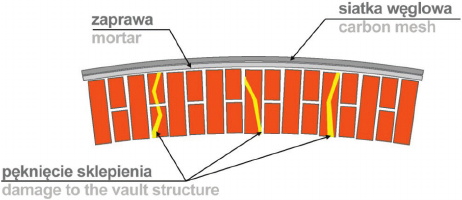
Reinforcement of the vaults with carbon nets accord-
ing to the C-FRCM system was carried out over the entire
scratch area in a single layer on the dorsal side (Fig. 8).
Larger cavities and irregularities in the vaults were lled
with the system’s levelling mortar. An approximately
3 mm thick system-specic xing mortar was applied to
the moistened substrate. The carbon mesh was immedi-
ately blended in and covered with a second layer of the
approximately 3 mm thick system xing mortar. The mesh
was laid from armpit to armpit of the vault and from rib to
rib, extending the mesh over the ribs and over the walls to
a height of min. 20 cm.
Once the reinforcements were in place, anchoring of the
carbon mesh reinforcements to the walls was carried out
using rolled-up strips of mesh (min. 40 × 60 cm in size)
xed in the openings in the walls in an arrangement de-
termined during the work. Holes 30–36 in diameter and
at least 25 cm deep were lled with an epoxy compound
after thorough cleaning and blowing out with compressed
air, and then a coiled carbon mesh was placed in them. The
parts of the mesh protruding from the wall were blended
into the 3 mm thick xing system mortar. A similar proce-
dure was carried out on the vaults and dorsal ribs by us-
ing anchor spacing every min. 1.5 m (for linear joints) and
1 pc. / 1.5 m
2
(for surface connections).
Diagnostic monitoring
Once the repair work was completed, it was recom-
mended that a diagnostic monitoring system be im-
plemented that included the installation of meters to
monitor key parameters of the structure, i.e., scratches,
deviation from vertical, temperature and humidity inside
and outside. The monitoring data should be analysed on
a regular basis, allowing an ongoing assessment of the
eectiveness of the repairs and a rapid response to any
problems.
Fig. 8. Diagram of vault repair using carbon mesh
(elaborated by A. Hoyenski)
Il. 8. Schemat naprawy sklepienia przy użyciu siatki węglowej
(oprac. A. Hoyenski)
50 Łukasz Bednarz, Alicja Hoyenski, Gabriela Wojciechowska
Summary
The investigation and conservation of historic vaults is
a complex process requiring an interdisciplinary approach
combining traditional repair techniques with modern
methods of analysis and strengthening. The assessment
of the technical condition of a historic vault is non-sim-
ple and multi-stage. It requires the use of various research
methods. Visual inspection, photogrammetry, laser scan-
ning, non-destructive testing, HBIM modelling and nu-
merical modelling using FEM collectively allow precise
diagnosis and eective strengthening of historic buildings
to ensure their durability and safety.
The paper presents a variety of strengthening tech-
niques, including traditional methods such as the use of
tie-beams, injection, and the pasting of steel bars or plates,
as well as modern approaches using composite materials.
It also highlights the advantages of mixed methods
combining traditional and modern techniques to enable
a more comprehensive approach to the conservation of his-
toric structures. Special attention was given to innovative
solutions (such as the use of susceptible polyurethanes in
FRPU systems and C-FRCM composites) and their eec-
tiveness in repairing damaged masonry structures.
The practical application of the methods described is
illustrated on the example of a study of the vaults of a church
in Silesia. Thanks to a comprehensive assessment of the
technical condition and the use of carbon nets to reinforce the
vault, the durability and safety of the structure was achieved
with minimal interference with its original character.
Once a historic vault has been repaired, it is essential to
implement systematic diagnostic monitoring to enable long-
term evaluation of the eectiveness of the maintenance
work carried out and early detection of any problems. Di-
agnostic monitoring is a key element of a preventive main-
tenance strategy.
In conclusion, it can be assumed that eective conserva-
tion of historic vaults requires a harmonious combination
of traditional methods and modern technologies. An inter-
disciplinary approach taking into account the latest devel-
opments in materials engineering and digital technology is
essential in preserving cultural and architectural heritage
for future generations.
Translated by
Łukasz Bednarz,
Alicja Hoyenski,
Gabriela Wojciechowska
References
Bednarz, Łukasz. Monitoring diagnostyczny obiektów historycznych.
Ocyna Wydawnicza ATUT – Wrocławskie Wydawnictwo Oświa-
towe, 2023.
Bednarz, Łukasz. “Wybrane materiały stosowane w renowacji zabytko-
wych murów.” Inżynier Budownictwa 5 (2021): 57–60.
Bednarz, Łukasz, Dariusz Bajno, Zygmunt Matkowski, Izabela Skrzyp-
czak, and Agnieszka Leśniak. “Elements of pathway for quick and
reliable health monitoring of concrete behavior in cable post-ten-
sioned concrete girders.” Materials 14, no. 6 (2021): 1–29. https://
doi.org/10.3390/ma14061503.
Carozzi, Giulia, Gabriele Milani, and Carlo Poggi. “Mechanical proper -
ties and numerical modeling of Fabric Reinforced Cementitious
Matrix (FRCM) systems for strengthening of masonry structures.”
Composite Structures 107 (2014): 711–725. https://doi.org/ 10.1016/ j.
compstruct.2013.08.026.
Hendry, Arnold William. “Masonry walls: materials and construction.”
Construction and Building Materials 15, no. 8 (2001), 323–330.
https://doi.org/10.1016/S0950-0618(01)00019-8.
Jasieńko, Jerzy, Tomasz Łodygowski, and Piotr Rapp. Naprawa, kon-
serwacja i wzmacnianie zabytkowych konstrukcji ceglanych. Dol-
nośląskie Wydawnictwo Edukacyjne, 2006.
Kwiecień, Arkadiusz. Polimerowe złącza podatne w konstrukcjach mu
rowych i betonowych. Wydawnictwo PK, 2013.
Lignola, Gian Piero, Carmelo Caggegi, Francesca Ceroni et al. “Perfor-
mance assessment of basalt FRCM for retrot applications on ma-
sonry.” Composites. Part B: Engineering 128 (2017): 1–18. https://
doi.org/10.1016/j.compositesb.2017.05.003.
Łużyniecka, Ewa. “The use of 2D vector studies as an architectural re-
search stage in the era of digital spatial models.” Architectus 71,
no. 3 (2022): 79–86. https://doi.org/10.37190.
Magenes, Guido, and Gian Michele Calvi. “In‐plane seismic response of
brick masonry walls.” Earthquake Engineering & Structural Dy na mics
26, no. 11 (1997): 1091–1112. https://doi.org/10.1002/(SICI)1096-
9845(199711)26:11<1091::AID-EQE693>3.0.CO;2-6.
Oliveira, Daniel V., Ismael Basilio, and Paulo Brandão Lourenço. “Ex-
perimental behavior of FRP strengthened masonry arches.” Jour-
nal of Composites for Construction 14, no. 3 (2010): 312–322.
https://doi.org/10.1061/(ASCE)CC.1943-5614.0000086.
Scacco, Jacopo, Bahmi Ghiassi, Gabriele Milani, and Paulo B. Lou-
renço. “A fast modeling approach for numerical analysis of unre-
inforced and FRCM reinforced masonry walls under out-of-plane
loading.” Composites Part B: Engineering 180 (2020): 107553.
https://doi.org/10.1016/j.compositesb.2019.107553.
Valluzzi, Maria Rosa, Davide Tinazzi, and Carlo Modena. “Shear behav-
ior of masonry panels strengthened by FRP laminates.” Construc-
tion and Building Materials 16, no. 7 (2002): 409–416. https://doi.
org/10.1016/S0950-0618(02)00043-0.
Research and structural conservation of historic vaults 51
Streszczenie
Badania i konserwacja konstrukcyjna sklepień historycznych
W artykule skupiono się na zagadnieniach dotyczących badań i konserwacji sklepień historycznych ze szczególnym uwzględnieniem analizy stanu
technicznego. Przedstawiono tradycyjne oraz nowoczesne metody wzmacniania sklepień, w tym techniki wykorzystujące materiały kompozytowe,
takie jak FRP (Fiber Reinforced Polymer) i FRCM (Fiber Reinforced Cementitious Matrix).
Omówiono proces oceny stanu technicznego sklepienia, wykorzystując metody takie jak inspekcja wizualna, skaning laserowy oraz nieniszczące
badania NDT (non-destructive testing). W artykule przedstawiono przykład zastosowania siatek węglowych do wzmocnienia sklepienia w historycz-
nym obiekcie, podkreślając konieczność monitoringu diagnostycznego po przeprowadzeniu prac naprawczych. Opisano zastosowanie modelu HBIM
(Historic Building Information Modelling) do precyzyjnego odwzorowania geometrii i analizy konstrukcyjnej sklepienia. Model numeryczny został
utworzony przy użyciu metody elementów skończonych (MES).
Efektywna konserwacja sklepień historycznych wymaga harmonijnego połączenia tradycyjnych metod z nowoczesnymi technologiami. Wyka-
zano, że właściwa identykacja problemów konstrukcyjnych oraz zastosowanie odpowiednich strategii konserwatorskich są kluczowe dla zacho-
wania dziedzictwa architektonicznego i zapewnienia jego integralności na przyszłe pokolenia. Ponadto podkreślono znaczenie ciągłego monitoringu
diagnostycznego sklepienia po naprawie, co pozwala na bieżącą ocenę skuteczności zastosowanych metod oraz wczesne wykrywanie ewentualnych
problemów strukturalnych.
Słowa kluczowe: materiały kompozytowe, sklepienia historyczne, złącza podatne, modele HBIM