2024
4(80)
Baris Wenzel*, Christian Vöhringer**, Benjamin Schmid***,
Christiane Weber****
Retro-digitising non-Euclidean physical models in construction history:
Challenges, results and potentials
DOI: 10.37190/arc240404
Published in open access. CC BY NC ND license
Abstract
A range of established methods are currently available for the production of digital models to document, survey, or further develop buildings.
Equipment and other technologies have been adopted from other disciplines, such as geodesy, and further developed specically for the construction
industry. These methods, therefore, have a very specic purpose and quickly reach their limits when they leave this primary area of application. As
part of a research project “Last Witnesses – Physical Models in Civil Engineering” funded by the German Research Foundation (DFG SPP 2255), an
attempt was made to transfer known methods of retro-digitisation from architecture to smaller-scale objects to create digital representations. These
small-scaled objects are so-called physical models (Messmodelle), a particular type of model mainly used in civil engineering in the past to test
load-bearing structures. The models were mainly used in the 20
th
century to calculate the behaviour of complex structures; however, both the model
building and the mathematical calculations were very time consuming and prone to errors. From the 1960s and 1970s onwards they were replaced by
the rst powerful computers in the construction industry.
This contribution will discuss the special characteristics of these physical models and why they were replaced by computers. We describe the appli-
cability of the dierent non-destructive methods of retrodigitisation and analyse the advantages and disadvantages of the structured light 3D scan, the
3D laser scan, and photogrammetry. In a further step, the potential of the produced digital twins in dierent contexts, such as restoration, engineering,
or architectural history, will be demonstrated.
Key words: architecture, physical models, reverse engineering, digital twin, data storage
Research Project “Last Witnesses
– Physical Models in Civil Engineering”
Physical testing models form a special class of models
that were mainly used in the eld of civil engineering, un-
til the advent of powerful computers in the construction
industry from the 1960s onwards. Such models served
to analyse, understand, and nally, even dimension and
test load-bearing structures (Bühler, Weber 2022). While
form-nding models were used to establish the geome-
try, measurement models were used to calculate forces,
but also allow for experimentation with dierent forms
and materials. Such physical models – in German called
Messmodelle – were mainly in use during the 20
th
centu-
ry, when drawing, dimensioning, and calculating the shape
and construction of cable bridges, dams and wide-span
lightweight structures or shells was time consuming, or not
even possible with the known calculation methods
1
.
1
The research project “Last Witnesses – Physical Models in Civil
Engineering” was part of the priority program “Cultural Heritage Con-
struction” (SPP 2255) funded by the German Research Foundation DFG
from 2020 to 2024. Scientists from the elds of construction history,
engineering and restoration sciences have been cooperating in the pro-
ject (DFG 2024).
*
ORCID: 0009-0000-5738-2722. Institute of Architectural Hi -
story, University of Stuttgart, Germany, e-mail: baris.wenzel@ifag.uni-stutt-
gart.de
** ORCID: 0000-0002-0596-0989. Institute of Architectural
History, University of Stuttgart, Germany.
*** ORCID: 0000-0003-0593-8340. Institute of Architectural
History, University of Stuttgart, Germany.
**** ORCID: 0000-0001-5446-8707. Institute of Architectural
History, University of Stuttgart, Germany.
32 Baris Wenzel, Christian Vöhringer, Benjamin Schmid, Christiane Weber
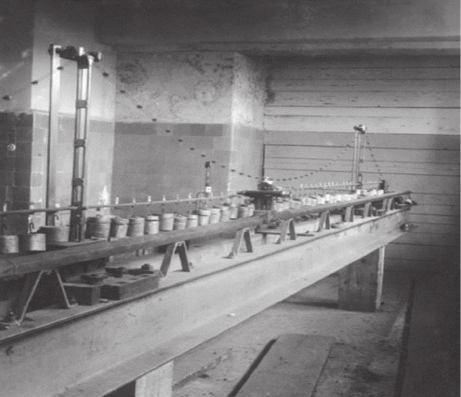
One early example is the scale model for a suspension
bridge over the Rhine at Rodenkirchen near Cologne, built
in the 1940s by the Stuttgart Material Testing Institute (Ma -
terialprüfungsanstalt Stuttgart – MPA). As it was very di-
cult to calculate the deformation of this statically overdeter-
mined structure, the Stuttgart civil engineer Fritz Leonhardt
(1909–1999), who led the project, had commissioned this
physical model on a scale of 1:100, which is documented
in photographs, today preserved in the Stuttgart University
archives (Fig. 1).
Like architectural models, physical models at the same
time could serve as a communication medium and planning
tool, but unlike these, they often were damaged or even de-
stroyed in the measuring process. For example, models of
concrete shells have been tested for cracking until failure,
resulting in the destruction of the model. Thus, the model
itself was not preserved, but data from the impact under
load was documented as shown in photographs – or even
more abstract data deduced from these. The ndings of the
research project are therefore only a very small number of
surviving objects, mostly only fragments of experiments.
The experimental set-up, including the measuring equip-
ment, has not survived at all, as it was reused for further
experiments. The appendix lists all the models researched
(based on Addis 2021), including those objects that can
only be reconstructed using images or archival material
(appendix). The Table of Surviving and Lost Models al-
lows for a preliminary evaluation of the ratio between pho -
tographic and material remains of testing models and it can
be stated that only a few physical models, or more precisely
fragments of these, have survived or found their way into
collections or archives. This may generally have occurred
due to the engineers’ lack of historical awareness and their
general underestimation of the importance of construction
as cultural heritage (Schmid 2023).
Fig. 1. Physical model (scale 1:100) for the bridge over the Rhine
at Rodenkirchen proposed by Fritz Leonhardt
(photo: saai Karlsruhe, collection Fritz Leonhardt)
Il. 1. Model fizyczny (skala 1:100) mostu nad Renem w Rodenkirchen
zaproponowany przez Fritza Leonhardta
(źródło: saai Karlsruhe, kolekcja Fritza Leonhardta)
Fortunately, certain physical models like the model for
the Olympic roof construction for Munich in 1972, de-
signed by the famous architect Frei Otto (1925–2015),
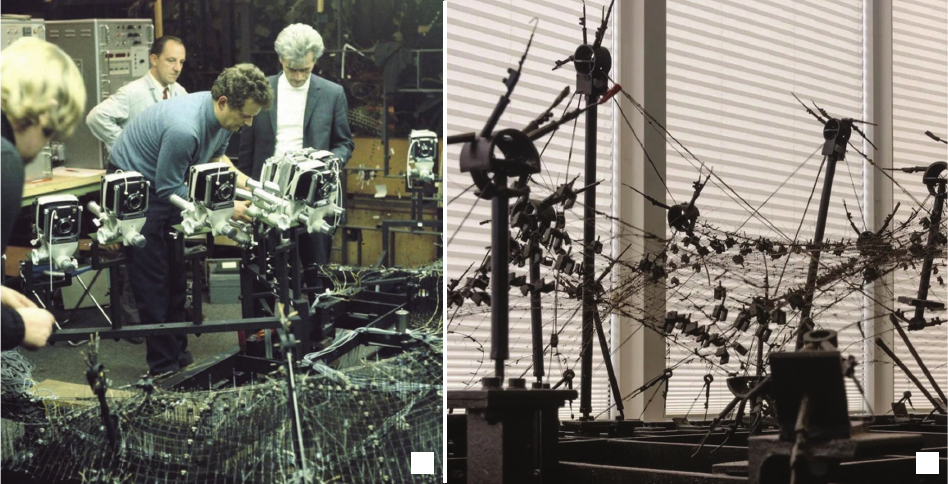
have ever been an object of broad public interest. The
ligree wireframe model is still on public display in the
visitor centre of the Olympic Park in Munich today and of-
fers detailed insights into a very courageous phase of civil
engineering (Fig. 2b). It fascinates as an in-between object:
At the same time, it is very specic concerning forces but
also abstract concerning form.
From analogue to automated
– limits of physical models
The very few still existing models are precious objects
and knowledge sources of engineering practice between
1920s and 1970s. All the more so, as they took place at
the thresholds from analogue experimentation to early
data processing with computers, developing novel in-
terfaces. For the Munich Olympic Roofs, Frei Otto’s in-
stitute for lightweight construction (Institut für Leichte
Flächentragwerke – IL) at Stuttgart University built sev-
eral form nding models of polyester mesh on a scale of
1:200. For the statical calculation of the execution of the
cable net construction, physical models at a scale of 1:125
were developed (Fig. 2). The cable net in the model is
made of stainless steel wires with a diameter of 0.2 mm
and the edge cables are made of copper wires. In order
to determine the deformations under load, the model was
loaded with steel weights that could be moved by means
of a pneumatic substructure. In addition to strain gauges
and protractors, photogrammetry with a large number of
cameras was also used in these tests, which is why they are
also known as multimedia tests. After these tests, the mod-
els were also to be used to determine the cut pattern, used
for the production and installation of the rope net. Due to
the size of the structures and the maximum working range
of the IL measuring table, the chosen scale was 1:125. The
small scale, as well as the high preload and its tolerance
values, meant that a very high level of precision in mod-
el building was required. The cutting pattern information
was obtained through photogrammetry at the Institute for
the Application of Geodesy in Civil Engineering (Institut
für angewandte Geodäsie im Bauwesen – IAGB) at the
Stuttgart University under the direction of Klaus Linkwitz
(1927–2017). As it would not have been possible to build
all the necessary detailed models in time, two new, com-
puterized methods were used to determine the dimensions
of the roof cutting patterns of the Olympic Park, in addi-
tion to the classic manual measurement at the IAGB. Klaus
Linkwitz and his Stuttgart colleague John Hadji Argyris
(1913–2004) set about calculating the geometry and,
derived from this, the cuts of the cable nets, taking into
account material and temperature inuences under pre-
tension. A CDC 6600 super computer from Control Data
Corporation at the Stuttgart University was used for this
purpose. Argyris worked on the sports hall based on the
nite element method (FEM), which he co-developed. In
FORTRAN IV, a program was created in which the topolo-
gy (Gade et al. 2022) of a network is described, an iterative
Retro-digitising non-Euclidean physical models in construction history: Challenges, results and potentials 33
determination of equilibrium is carried out, various load
cases can be simulated, and drawings can be created.
Linkwitz and his team developed a dierent calculation
program based on the method of least square deviations,
which was used immediately after its completion in May
1970 for the calculation of the stadium, and subsequently
for the cable nets of the two minor cable net constructions
at the Munich Olympic site. The very eective and at the
same time extremely robust and computationally ecient
numerical method developed by Linkwitz under great time
pressure is known today as the force density method for
determining the shape of prestressed cable meshes and is
also used for textile membrane structures.
The justied concerns of engineers as well as their curi-
osity about innovative computer-aided methods have con-
tributed to the fact that, at the height of the development
of measurement modeling statics, its end was also in sight.
Two essential computer calculation tools were developed
in this way, which are still used in daily calculations today
(Schmid et al. 2024; Schlaich et al. 1972).
Materiality in models
– appearance and behaviour
Models are always a reduction to the important aspects
of an object. Everything that seems unimportant is left out.
The simpler the model, the better, as the German physicist
Heinrich Hertz (1857–1897) said (Ortlieb 2008). When
a physical model was created for a building in the high
modern era, the reduction to the essentials was an import-
ant goal. Creating the models was usually a time-consum-
ing process. In the model for Munich’s Olympic Stadium,
for example, all the nodes of the cable mesh had to be man-
ually knotted, which led to only representing every fourth
mesh in the model.
The question of materiality played a major role in phys-
ical models. According to similarity mechanics, a material
with similar properties was usually chosen. But there were
limits to scalability, as the model of the Alster indoor swim-
ming pool that has survived at Stuttgart University shows.
This huge model realised by the Stuttgart Institute of
Model Statics (Institut für Modellstatik – IMS) is made of
acrylic glass, while the roof of the realized building (com-
pleted in Hamburg 1973) was made of reinforced concrete
(Fig. 3a) (Schmid, Weber 2021). The problem with scaling
the material was the grain size of the sand added to the
concrete. Preliminary investigations at the IMS resulted in
a minimum thickness of 1 cm for the planned model made
of micro-concrete. The resulting scale would have made
the model very large. The ratio of the internal and external
surfaces changes drastically when scaling, because while
the surface area only increases quadratically, the volume’s
growth is cubic. Furthermore, the theory of elasticity re-
quires materials with a homogeneous continuum for the
calculation of load-bearing structures, which is dicult to
achieve with natural building materials. Therefore, a mate-
rial with similar physical characteristics, such as a similar
modulus of elasticity, was chosen to build the model.
Acrylic resin proved to be a suitable modelling ma-
terial for simulating concrete elements, not only for the
Hamburg shell model but also for the many models created
by the Swiss engineer Heinz Hossdorf (1925–2006). In ad-
dition to its homogeneous nature, it was easier to process
and prepare for the experiments. As it is transparent, cracks
and air inclusions are easily recognizable and the strain
gauges could be placed exactly on top of each other, which
Fig. 2. Multimedia experiments on the model of the stadium roof in Munich at a scale of 1:125:
a) in 1964–1972 (source: ILEK Stuttgart), b) in 2023, at Visitor Centre of the Olympic Park in Munich (photo by B. Schmid)
Il. 2. Eksperymenty multimedialne na modelu dachu stadionu w Monachium w skali 1:125:
a) w 1964–1972 (źródło: ILEK Stuttgart), b) w 2023 r. w Centrum dla zwiedzających Parku Olimpijskiego w Monachium (fot. B. Schmid)
a b
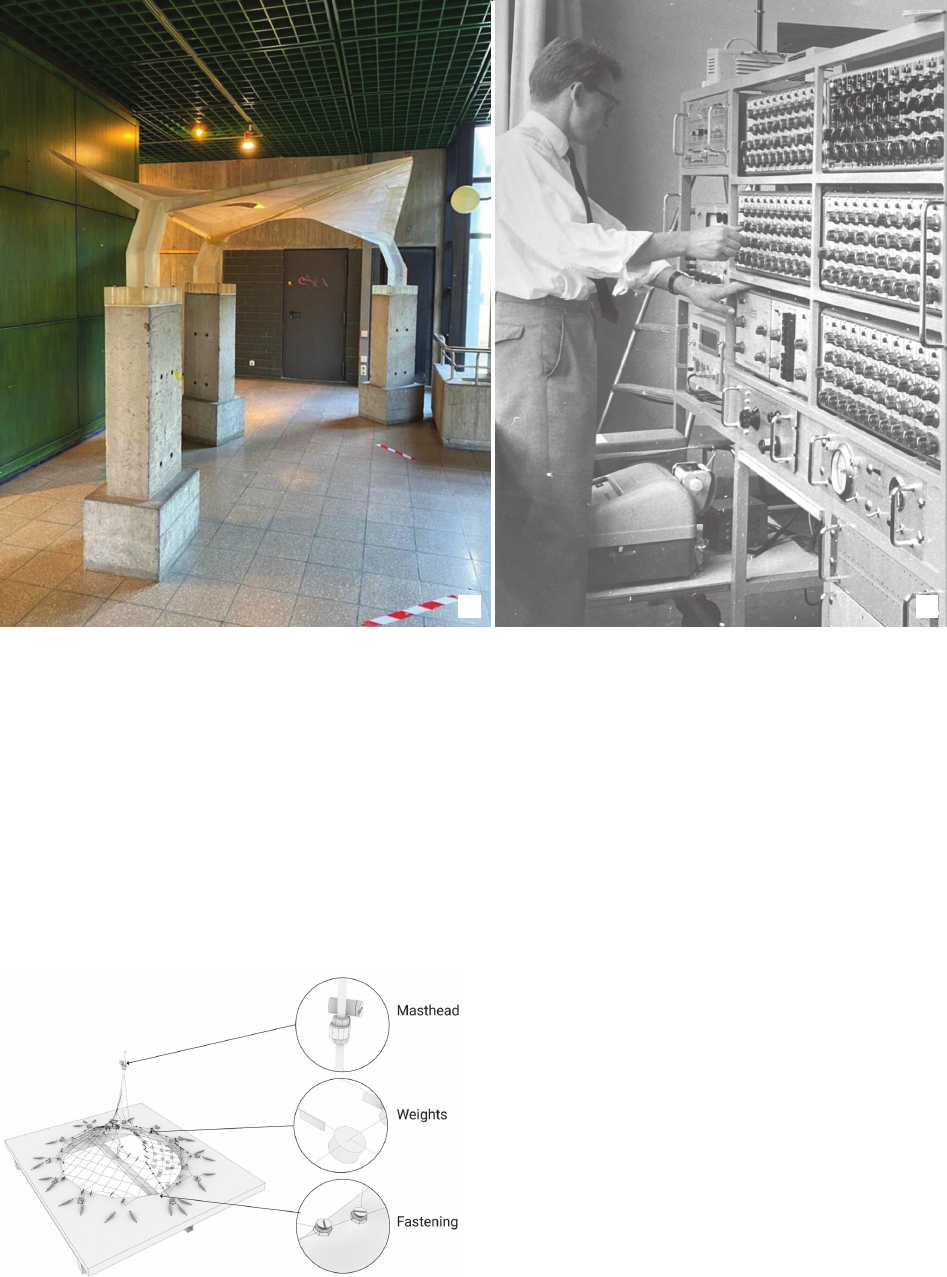
34 Baris Wenzel, Christian Vöhringer, Benjamin Schmid, Christiane Weber
led to more accurate measured. Strain measurements were
made with strain gauges, an automatic measuring device
and edited via pinhole printers (Fig. 3b) (Hossdorf 1971).
Only a few of these models and of the complex mea-
suring equipment, which illustrate the transition from an-
alogue structural calculations to computer-based methods
in the 1970s, have survived. These few surviving models
store knowledge for the engineering and technical practic-
es of their time and are only handed down in fragments.
Retrodigitisation/retro-engineering
of the surviving physical models – methods
Digital representations of these physical models were
created as part of our project “Last Witnesses” as a basis
for further scientic research into these objects of transi-
tion. We have carried out a retro-digitisation of these ob-
jects like the model for the IL pavilion (Schmid, Weber
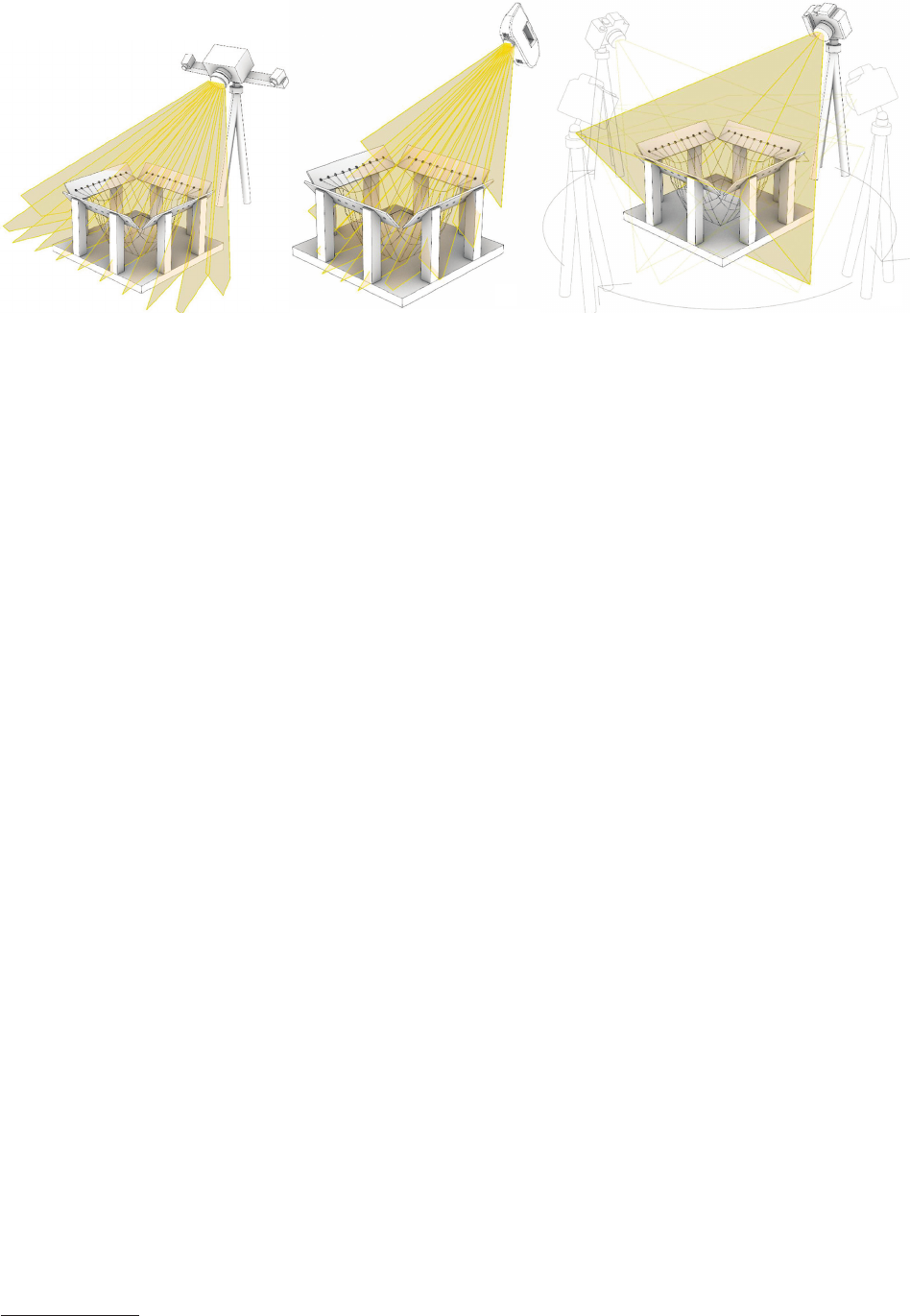
2021; Wenzel et al. 2021) (Fig. 4). The mast and cable-roof
construction were in early 1967 a 1:1 testing model for the
German Pavilion at the EXPO67 in Montreal, designed by
Rolf Gutbrod (1910–1999), Fritz Leonhardt, and Frei Otto.
The construction of this mock-up was later translocat-
ed and became Frei Otto’s institute, Institut für Leichte
Flächen tragwerke (IL) (Weber 2011, 68–83; Kleinmanns
et al. 2020). We refer to these retro-digitised models as dig-
ital twins, although we are aware that this term has a some-
what broader meaning in the mechanical engineering: the
concept of digital twins in general drove the digitisation
of industrial product development because it consequently
avoids costly and time-consuming material testing, mock-
ups and prototypes (like the IL Pavilion at its time). Digital
twins help to simulate and predict the present and future
behaviour of a physical object, which in turn allows for
Fig. 3. A surviving model and its measuring device: a) the acrylic model of the Alster swimming pool in Hamburg (photo by B. Schmid),
b) automatic measuring system and pinhole printer at the IMS (source: Stuttgart University Archive, collection IMS)
Il. 3. Zachowany model i jego urządzenie pomiarowe: a) akrylowy model basenu pływackiego Alster w Hamburgu (fot. B. Schmid),
b) automatyczny system pomiarowy i drukarka otworkowa w IMS (źródło: Archiwum Uniwersytetu w Stuttgarcie, zbiory IMS)
a b
Fig. 4. Digital representation of the physical model of IL Pavilion.
It consists of very thin spring steel wire, which is difficult to capture
using conventional recording methods (drawing by B. Wenzel, J. Nett)
Il. 4. Cyfrowa reprezentacja fizycznego modelu Pawilonu IL.
Składa się z bardzo cienkiego stalowego drutu sprężynowego,
który trudno uchwycić za pomocą konwencjonalnych metod rejestrowania
(rys. B. Wenzel, J. Nett)
Retro-digitising non-Euclidean physical models in construction history: Challenges, results and potentials 35
object optimisation and to oer variants easily, altogether
improving business eciency and hopefully sustainabili-
ty. While the term and procedure are standard in industrial
product development, with aerospace and automotive in-
dustries being forerunners, there are up to now only few
known applications for the architecture and engineering
sector. Industry 4.0 oers important orientation to the
construction industry in dealing with digital planning and
management. Comprehensive networking of data sources
and the coupling of simulation models are increasingly im-
portant for building processes such as BIM and integrative
computational design and construction
2
.
The digital representations of the surviving physical mod
-
els in the “Last Witnesses” project were created using state-
of-the-art digital tools. Algorithms as well as dierent mod
-
elling programmes were tested for their applicability. There
are two dierent methods of reversed engineering available
and both have been tested for the generation of digital twins:
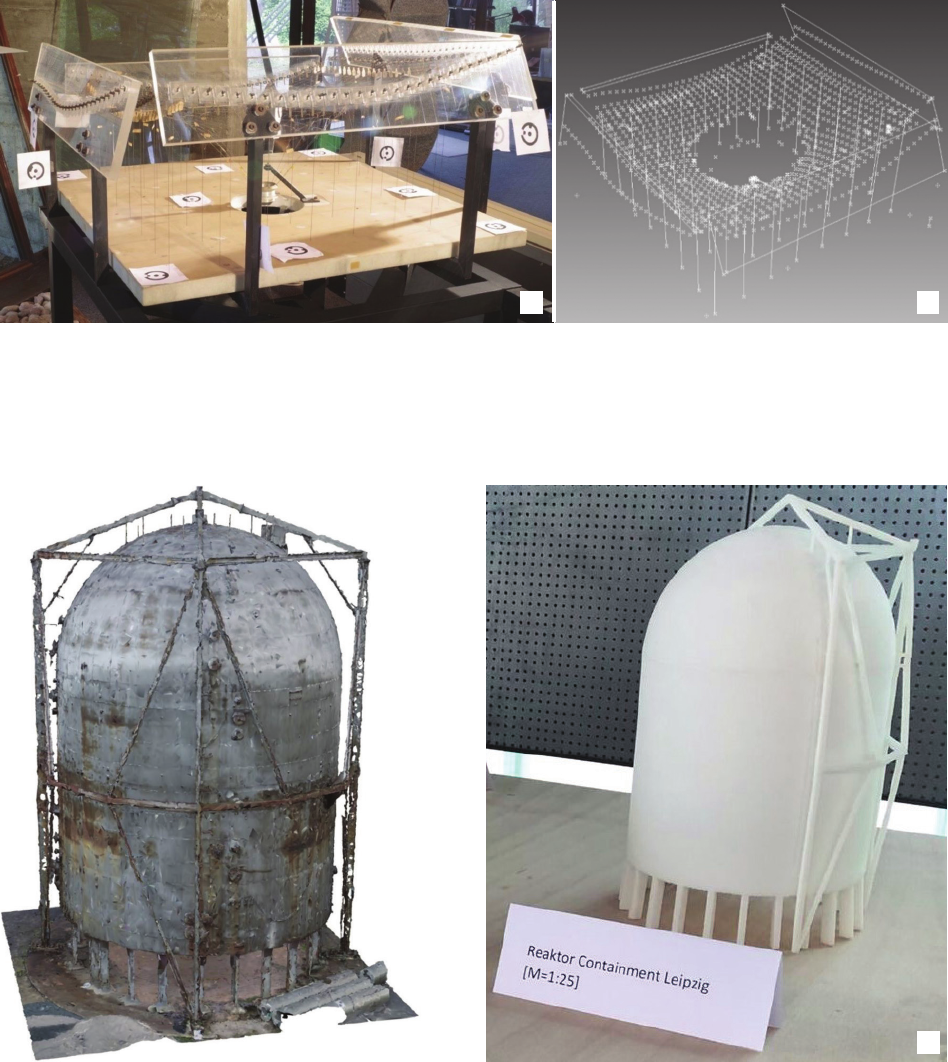
A. By using the structured light 3D scan, a 3D mesh-
face is computed by projecting a simple stripe pattern on
the object. The degree of distortion is measured by com-
paring the projected stripes with detected stripes, which
allows the calculation of the relevant information about
depth. Evaluation of the depth applies for all correspon-
dences with respect to the focal points of the camera. The
result is a cloud of 3D points.
B. By using 3D laser scan, the scanner emits a laser
beam, which results in reections from the surroundings,
and these reections are received by the optics. In this
case, a rotating mirror deects the beam and the laser light
received by the scanner is evaluated accordingly and again
results in a cloud of 3D points.
Both methods were tested on a representative replica of
a cable net model, but neither provided satisfactory results.
The diculties in collecting data for reverse engineering
2
For the Stuttgart based cluster of excellence on Integrative Com-
putational Design and Construction for Architecture see https://www.
intcdc.uni-stuttgart.de/
are the often very thin wires or transparent or translucent
components like acrylic plastics or glass bre-reinforced
plastics, which formed the physical models of lightweight
constructions and shells.
These objects are hard to recognise by laser technolo-
gies, so it was necessary to turn to the most time-consum-
ing method, photogrammetry, which is manual, but most
of the time leads to the best results (Fig. 6). For the photo-
grammetric method, an object is rst recorded with a cam-
era from various angles. Every externally visible point
must be clearly visible in at least two photos. By using at
least two corresponding image points from two dierent
recording positions, if the mutual position is known, the
two rays can be brought to intersection and each object
point can be calculated three-dimensionally.
Therefore, the process of retro-digitization usually be-
gins by taking photographs of the model with a digital sin-
gle-lens reex camera. In the next step, the results serve
as the basis for the extraction of relevant 3D points with
PhotoModeler. In order to make this possible, the photos
have to be referenced using target points and an overlap of
the images is calculated. Then, the program Rhinoceros3D
is used to scale the geometry and align the extracted points
in a global coordinate system. Grasshopper3D allowed the
authors to automate the creation of dierent parts of the
models. Kangaroo2 (a particle-based live physics engine)
enabled the simulation of elastic models’ conditions. Some
eort was spent to connect Grasshopper with a database
for the models, via a Plug-In written in C#.
For the retro-digitisation of more solid types of models,
like a large 1:5 model of a reactor container made of steel,
which belongs to Leipzig University, the laser technique
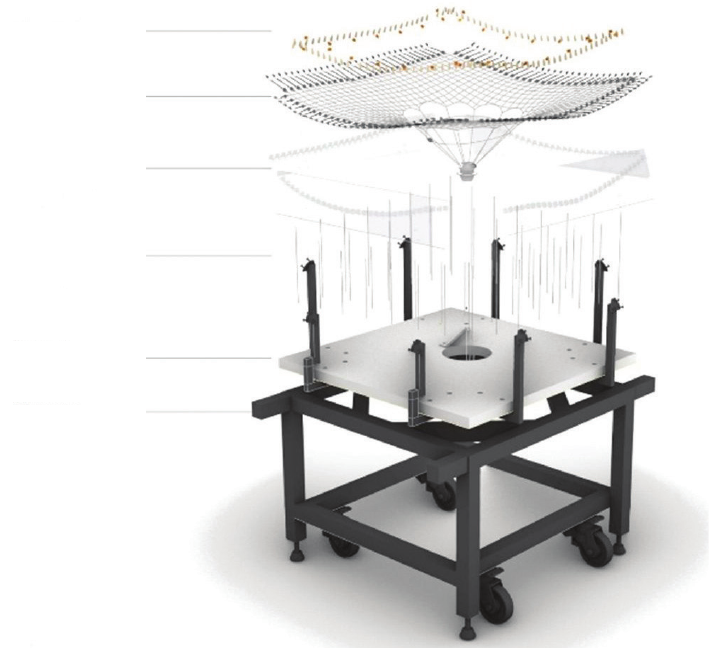
(B) was combined with photogrammetry (Fig. 7). The
5-meter-tall object was photographed by a drone.
Use and benefits of retro-digitised data
Today’s structural analysis programs allow for much
more freedom when planning digital models. You can assign
Fig. 5. Diagrams of function from retrodigitization tools, which were tested for their suitability for the thin wires (up to 0.8 mm):
a) structured light scanner, b) LIDAR scanner, c) photogrammetry (drawing by B. Wenzel)
Il. 5. Schematy funkcjonowania narzędzi retrodigitalizacji, które zostały przetestowane pod kątem ich przydatności do cienkich drutów (do 0,8 mm):
a) skaner światła strukturalnego, b) skaner LIDAR, c) fotogrametria (rys. B. Wenzel)
a b c
36 Baris Wenzel, Christian Vöhringer, Benjamin Schmid, Christiane Weber
a
ny existing material and even create materials with prop-
erties that did not previously exist. In most cases, col-
umns, beams and other elements are only available as
lines, to which properties such as material and diameter
are assigned. Discretised models usually only visualise the
diameters of the supporting elements. The surface prop-
erties are generally not important and therefore omitted
for the sake of the simplication, as described at the be-
ginning. When it comes to such matters of surfaces and
external appearance, there are already AI-supported tools
Fig. 6. Surviving model and its cloud of digital 3D Points: a) low point T2 physical model of the Munich Olympia Park Swimming Pool,
b) points extracted by using photogrammetry (photo and drawing by F. Brauner)
Il. 6. Zachowany model i odpowiadająca mu chmura punktów: a) model fizyczny T2 niskiego punktu basenu w monachijskim Parku Olimpijskim,
b) punkty wyodrębnione za pomocą fotogrametrii (fot. i rys. F. Brauner)
a b
Fig. 7. 3D-Scan of a surviving model and its 3D-Resinprint:
a) for the reactor containment model state of the art tools like drones and terrestrial laser-scanners were used.
This model is represented by a polygon-mesh with 220355 vertices and 309975 faces and is fully textured,
b) the same model as a 3D resin print for an exhibition
(drawing and 3D prints by B. Wenzel)
Il. 7. Skan 3D zachowanego modelu i jego wydruk trójwymiarowy:
a) do modelu obudowy reaktora wykorzystano najnowocześniejsze narzędzia, takie jak drony i naziemne skanery laserowe.
Model ten jest reprezentowany przez siatkę wielokątów z 220355 wierzchołkami i 309975 ścianami i jest w pełni teksturowany,
b) ten sam model jako wydruk 3D z żywicy na wystawę (rys. B. Wenzel)
a b
Retro-digitising non-Euclidean physical models in construction history: Challenges, results and potentials 37
Fig. 8. Damage mapping for
restoration purposes
as exemplified in the lowpoint
model T2 (see: Fig. 6)
for the Munich Olympic stadium
(drawing by F. Brauner)
Il. 8. Mapowanie uszkodzeń
na potrzeby renowacji,
jak pokazano na przykładzie
modelu punktu najniższego T2
(por. rys. 6)
dla Stadionu Olimpijskiego w
Monachium (rys. F. Brauner)
that automatically assign UV maps to models. Work that
a few months ago had to be done laboriously by hand can
now be done by an AI in just a few moments, if you enter
the right prompt. The associated polygon meshes are also
partly generated by text prompts. We can therefore assume
that very soon AI will create a structural analysis model
and its calculations.
So, the thus produced digital representations Will serve
as a basis for further scientic processing in disciplines
such as restoration science, architectural history and civil
engineering. Concerning restoration and conservation, the
digital model helps to document the materiality and surface
quality, including signs of use, and oers possibilities for
damage mapping to provide a valuable basis for the resto-
ration process (Fig. 8). The digital twin of the retrodigitised
object can be developed as an annotation tool, useful for
recording archival sources as well as the documentation of
the restoration process by integrating the reports or photos.
In this regard the further development of retro-digitisation
presents us with the same challenges as HBIM methods,
where the aim is to store information on damage, changes,
and sources for historical buildings in a BIM model.
From an engineering and mechanical perspective, static
simulations, and calculations of structural parameters for
changing conditions (caused, e.g., by climate change, such
as greater amounts of precipitation and increased snow
loads or wind eects) could be simulated and evaluated.
The inuence of increasing precipitation could for exam-
ple be tested on the digital twin of the Munich Olympic
Sports Hall (Fig. 9) (Wenzel et al. 2021).
One research perspective is the digital reconstruction of
the lost test facilities. With the help of virtual animations,
the mechanical testing process of the physical model can
be visualised as a lost practice of civil engineering. For
example, Frei Otto’s suspended model for the Multihalle
Mannheim, which makes use of the reverse principle,
currently kept in the German Architecture Museum in
Frankfurt (Fig. 10).
Like their material brothers, the digital models store
knowledge, carrying information about an innovation-pro-
ducing lost engineering practice and about how this in-
formation was communicated and transferred into build-
ing practice. Within the research project, for archival and
conservation purposes, data contained in the digital twins
is the basis for cataloguing and categorising the objects.
A follow-up project intends to store the model-data in an
open database according to principles of FAIR for an in-
terested public. In the future, a constantly expanding data-
base of digital models should be made accessible in virtual
spaces, for example for academic institutions or museums,
to make the objects virtually tangible by using augmented
reality.
Conclusion
When the applicants asked for funding in 2019, the
expectations to nd more last witnesses of physical test-
ing models and measurement models from construction
and engineering were high. We assumed that there might
well be larger numbers of unknown objects. As an open
call which led to very poor responses, we had to revise
Information layer
Plumbs as aid
for projection
and verification
Projection layer
(also substructure)
Acrylic glass as aid
for tesnioning
Construction layer
Substructure
38 Baris Wenzel, Christian Vöhringer, Benjamin Schmid, Christiane Weber
Fig. 9. The digital twin of the measurement model of the Olympic Park sports hall in Munich in use for a qualitative rainwater runoff
analysis algorithm on the polygonmesh created by photogrammetry and a physics based particle spring system
(drawing by B. Wenzel)
Il. 9. Cyfrowy bliźniak modelu pomiarowego hali sportowej w Parku Olimpijskim w Monachium używany do algorytmu analizy jakościowego
odpływu wody deszczowej na siatce wielokątnej utworzonej za pomocą fotogrametrii i opartego na fizyce układu sprężyn cząsteczkowych
(rys. B. Wenzel)
Fig. 10. Digital model of the physical model of Multihalle Mannheim:
The so-called inversion principle (below) was applied to the load-bearing structures subjected to compression
(drawing by B. Wenzel)
Il. 10. Cyfrowy model fizycznego modelu hali widowiskowej Multihalle Mannheim:
Do konstrukcji nośnych poddanych ściskaniu zastosowano tzw. zasadę inwersji (poniżej)
(rys. B. Wenzel)
Retro-digitising non-Euclidean physical models in construction history: Challenges, results and potentials 39
Acknowledgements
This work was supported by the Deutsche Forschungs gemein schaft
(DFG, German Research Foundation) under Ger many’s Excellence Stra-
tegy – EXC 2120/1 – 390831618 and the SPP 2255.
our assumption: for German-speaking countries, no more
than a dozen physical models could be identied. At the
same time, the aesthetic, technical and techno-historical
estimation and our construction knowledge of the rare sur-
viving objects has grown immensely. The reasons why the
age of model statics came to an end in the 1970s could be
claried and the models that fall into this transition phase
could be examined for traces of the beginning automated
technology.
For these few “surviving witnesses”, matters of resto-
ration and conservation concepts became even more im-
portant and resulted in an ongoing campaign to save and
valorise the remaining models and model-fragments of
outstanding scientic as well as public interest. For this
purpose, the digital representations of the models had to
be created specically, which led us to develop methods
for the production of digital models, exploring and assess-
ing methods from other disciplines such as geodesy. It is
noteworthy, that techniques from the days of early light-
weight constructions like photogrammetric approaches
still proved the most reliable method for our project, albeit
now done with digital cameras and eventually semi-auto-
mated. This transfer of established methods from geode-
sy in architecture to smaller-scale objects also opens up
further research perspectives and concepts for their future
preservation considering scientic purposes in teaching
and experimentation by exploring an integrative AI envi-
ronment for example, to reconstruct destroyed or no longer
preserved models and their testing environment on the ba-
sis of photographic and text-based records.
Our aim is an evaluation that focuses on developing
concepts for their future preservation considering scientic
purposes in teaching and experimentation even more as the
last witnesses of model statics allow us to re-engage with
past ingenuity and cultures of evidence, which in turn may
foster nowadays approaches (Bühler, Weber 2021).
References
Addis, Bill, ed. Physical models: their historical and current use in civil
and building engineering design. Ernst & Sohn, 2021.
Bühler, Dirk, and Christiane Weber. “Epilogue: A future for models from
the past.” In Physical models. Their historical and current use in
civil and building engineering design, edited by Bill Addis. Ernst
& Sohn, 2021.
DGF, SPP 2255. Construction as cultural heritage – Principles for en-
gineering-based and interlinked conservation strategies for the built
heritage of the high modern era. Accessed May 24, 2024. https://
gepris.dfg.de/gepris/projekt/422730777?language=en.
Gade, Jan, Ekkehard Ramm, Karl-Eugen Kurrer, and Manfred Bischo.
“Marc Biguenets Beitrag zur Berechnung der Seilnetztragwerke für
die Olympischen Spiele 1972.” Stahlbau 91, H. 9 (2022): 612–21.
https://doi.org/10.1002/stab.202200048.
Hossdorf, Heinz. Modellstatik. Bauverlag, 1971.
Kleinmanns, Joachim. “Der deutsche Pavillon der Expo 67 in Montreal:
ein Schlüsselwerk deutscher Nachkriegsarchitektur.” DOM, 2020.
Ortlieb, Claus Peter. “Heinrich Hertz und das Konzept des mathema-
tischen Modells des Modellbegris.” In Heinrich Hertz (1857–
1894) and the Development of Communication. Proceedings of the
International Scientic Symposium in Hamburg Oct. 8–12, 2007,
Norderstedt 2008. Accessed May 17, 2024, at https://www.math.
uni-hamburg.de/personen/ortlieb/OrtliebHertzModell.pdf.
Schlaich, Jörg, H. Altmann, R. Bergermann, K. Gabriel, K. Horstkötter,
K. Kleinhanss, et al. “Das Olympiadach in München.” IABSE 9,
(1972): 365–77. https://doi.org/10.5169/SEALS-9577.
Schmid, Benjamin, Eberhard Möller, Andreas Putz, Christiane Weber,
and Baris Wenzel. “Die Seilnetzmodelle zur Olympiadachlandschaft
in München. Letzte Zeugen der Modellstatik. Ein Bericht aus dem
DFG-Schwerpunktprogramm Kulturerbe Konstruktion”. Stahlbau
93 (2024). https://doi.org/10.1002/stab.202400017.
Schmid, Benjamin, and Christiane Weber. “Das Messmodell für die Al-
ster-Schwimmhalle Hamburg – ein interdisziplinäres Zusammen-
wir ken Stuttgarter Bauingenieure auf dem Gebiet der Modellstatik.”
Schrif tenreihe der Gesellschaft für Bautechnikgeschichte 5 (2021):
207–22.
Schmid, Benjamin, Christiane Weber, Baris Wenzel, and Eberhard Möl-
ler. “Tool – Object – Fragment: The Afterlife of Physical Measure-
ment Mo dels.” In Structural Ana lysis of Historical Constructions.
SAHC 2023, edited by Yohei Endo, and Toshikazu Hanazato. Hei del-
berg, 2023. https://doi.org/10.1007/978-3-031-39450-8_75.
Weber, Christiane. “Der deutsche Pavillon auf der Weltausstellung in
Montréal 1967.” In Rolf Gutbrod. Bauen in den Boomjahren der
1960er, edited by Klaus Jan Philipp. Müry Salzmann, 2011.
Wenzel, Baris, Eberhard Möller, Benjamin Schmid, and Christiane We-
ber. “Last Witness and digital twin – physical and digital modeling
the Munich Olympic sport hall – a case study.” In X. International
Conference on Textile Composites and Inatable Structures – Struc
tural Membranes 2021, edited by Kai-Uwe Bletzinger, Roland
Wüch ner, and Carlos Lázaro, at https://www.scipedia.com/pub-
licWenzel_Moeller_2021a.
Streszczenie
Retrodigitalizacja nieeuklidesowych modeli zycznych w historii budownictwa. Wyzwania, efekty i możliwości
Obecnie dostępnych jest wiele metod tworzenia modeli cyfrowych do dokumentowania, badania lub dalszego rozwoju budynków. Sprzęt i inne tech-
nologie zostały przejęte z innych dyscyplin, takich jak geodezja, i są dalej rozwijane specjalnie dla branży budowlanej. Dlatego też metody te mają bar-
dzo konkretny cel i ich zastosowanie jest ograniczone przy zmianie głównego obszaru zastosowań. W ramach projektu badawczego „Ostatni świadkowie

40 Baris Wenzel, Christian Vöhringer, Benjamin Schmid, Christiane Weber
Appendix
Table of surviving and documented measurement models* (elaborated by authors based on Addis 2021)
Aneks
Tabela zachowanych i opracowanych modeli pomiarowych (oprac. autorzy na podstawie Addis 2021)
Object Time Page
Technische Hochschule München Tonnenechtwerk 1895 274 f.
Gebäude 23 Zeiss Süd Jena 1924 276 f.
Schott Dome 1924 275 f.
Dywidagschale Bootsbauhalle Düsseldorf 1925 278 f.
Zylindrische Dywidagschale 1/2 1925 279 f.
Zylindrische Dywidagschale 2/2 1925 280 f.
Markthalle Frankfurt 1927 282 f.
Markthalle Leipzig Kuppel 1927 285 f.
Markthalle Leipzig Kellerdecke 1927 286 f.
Markthalle Budapest Schale 1930 287 f.
Markthalle Budapest Träger 1930 288
Kuppelartige Dywidag Schale (Markthalle Dresden) 1931 289 .
Beton Hangars Orvieto, Orbetello, Torre del Lago 1/2 1935–1936 306 f.
Beton Hangars Orvieto, Orbetello, Torre del Lago 2/2 1938–1939 308
Pavillon Messe Mailand 1947 –
E42 Bogen Weltausstellung Rom 1939 310 f.
Kragarmplatte Hospital Clinico Universität Madrid 1929 324 .
Innenhofüberdachung Escuela elemental de trabajo 1934 326 f.
Hipodromo de la Zarzuela / Überdachung Tribüne Pferderennbahn Madrid 1935 347 f.
Oberlicht Operationssäle Hospital Clinico Universtität Madrid 1935 329 f.
Markthalle Algeciras Spanien 1934 330 .
Frontan Recoletos Madrid 1935 333 .
White River Brücke Lake Taneycomo 1931 402
Yadkin River Brücke Albermale und Nount Gilead – 402
Ashtabula River 1927 402
Bahn Brücke Weikersheim 402
Rheinbrücke Köln-Rodenkirchen 1939 416
Elbbrücke Hamburg – 417
Druckring Kuppel München Hauptbahnhof 1940 420
Kuppel München Hauptbahnhof 1940 418 .
Rheinbrücke Emmerich 1961 420 f.
Alsterschwimmhalle late 1960s 422 .
Deutscher Pavillon Montreal Expo 67’ late 1960s 427 .
Olympia Stadion München late 1960s 431 .
King Abdul Aziz Sporthalle Jeddah 1981 435
Pirelli Hochhaus Mailand 1955 449 .
Boden Galfa Hochhaus Mailand 1958 452
Stütze Velasca Hochhaus Mailand 1956 45
– modele zyczne w budownictwie lądowym” nansowanego przez Niemiecką Fundację Badawczą (DFG SPP 2255) podjęto próbę przeniesienia zna-
nych metod retrodigitalizacji z architektury na obiekty o mniejszej skali w celu stworzenia reprezentacji cyfrowych. Te obiekty o małej skali to tak zwane
modele zyczne (Messmodelle), szczególny typ modelu stosowany w przeszłości głównie w inżynierii lądowej do testowania konstrukcji nośnych.
Modele te były używane w XX w. do obliczania zachowania złożonych konstrukcji, jednak zarówno tworzenie modelu, jak i obliczenia matematyczne
były bardzo czasochłonne i podatne na błędy. Od lat 60. i 70. XX w. zostały one zastąpione przez pierwsze wydajne komputery w branży budowlanej.
W artykule omówiono szczególne cechy tych modeli zycznych i powody, dla których zostały zastąpione komputerami. Opisano przydatność
różnych nieniszczących metod retrodigitalizacji i zanalizowano zalety i wady skanowania 3D światłem strukturalnym, skanowania laserowego 3D
i fotogrametrii. W kolejnym kroku zademonstrowano potencjał wytworzonych cyfrowych bliźniaków w różnych kontekstach, takich jak renowacja,
inżynieria lub historia architektury.
Słowa kluczowe: architektura, modele zyczne, inżynieria odwrotna, cyfrowy bliźniak, przechowywanie danych

Retro-digitising non-Euclidean physical models in construction history: Challenges, results and potentials 41
Table of surviving and documented measurement models (based on Addis 2021)
Object Time Page
Bodenplatte Velasca Hochhaus Mailand – 452
Börsenhochhaus Place Victoria Montreal 1962 452 .
Parque Central Hochhaus Caracas Venezuela 1969 460 f.
St. Mary’s Kathedrale San Francisco 1/3 1965 461 .
St. Mary’s Kathedrale San Francisco 2/3 1965 461 .
St. Mary’s Kathedrale San Francisco 3/3 1965 461 .
St. Mary’s Kathedrale Tokyo ca. 1964 462
Australia Square Hochhaus Sydney 1964–1965 462
MLC Centre Hochhaus Sydney ca. 1972 462
SCOPE Cultural and Convention Center Norfolk 1967 462
Hyperbolische Paraboloidelemente Dach Newark International Airport New Jersey 1968–1969 462
Rupert C. Thompson Arena Dartmouth College New Hampshire 1970–1971 462 f.
Mole Antonelliana Turin 1955 465 f.
Brückendeck Lake Maracaibo Venezuela /
Brückendeck General-Rafael-Urdaneta-Brücke Venezuela
1958 465 .
Brückenpfeiler Polcevera Brücke Genua 1962 466 f.
Fahrbahn Eisenbahnbrücke Venedig 1963 466
Brücke Basento Potenza 1/4 1967–1975 466 . + 589 .
Brücke Basento Potenza 2/4 – 467 f. + 589 .
Zarate-Brazo Lago Brücke Argentinien 1971 467 f.
Kirchendach Xeralli Pyrenäen – 482 f.
Schalendach für National Automotive Company ENASA – 484 f.
Dach Kirche Sant Felix und Ragula Zürich 1/3 1949 485 .
Dach Kirche Sant Felix und Ragula Zürich 2/3 1949 485 .
Dach Kirche Sant Felix und Ragula Zürich 3/3 1949 485 .
Experimentelles Fertigteil-Schalendach 1949 487 .
Lagerhaus Fabrik Nadam Havenwerke 1956 491 .
Mensadach Universidad Laboral Tarragona Campus 1956 493 f.
Club Tachira Complex Caracas 1957 494 f.
Bürodach Barcadi Havana 1959 498 .
Kirche La Paz Barcelona 1961 500 f.
Canadrome Madrid 1/2 1961 502 .
Canadrome Madrid 2/2 1961 503 .
Palau Blaugrana Sportstadion Barcelona 1970s 505 f.
Strassenbrücke 1954 C&CA 1954 514 f.
Fleet Brücke Hampshire 1954 514 f.
Clifton Brücke Nottingham 1954 517 .
Auto Showroomdach Lincolnshire Motor Company 1958 520 .
Texas Instruments Factory Bedford 1959 522
Dach Commonwealth Institut London 1959–1960 522 f.
Dach Smitheld Poultry Markthalle London 1960–1961 523 f.
Medway Viadukts 1959 526 f.
Hammersmith Überführung Hochstrasse London 1959 526 .
Huntley’s Point Overpass Glasesdale Australia 1961 528
Dach Sydney Opera House 1962 529
Metropolitan Kathedrale Liverpool 1961–1964 529 .
Cumberland Basin Viadukt Bristol 1962 531 .
Mancunian Way 1963–1964 534 f.
Tinsley Viaduct M1 Sheeld 1964 536 f.
West Way London 1/2 1965 537 f.
West Way London 2/2 1965 537 f.

42 Baris Wenzel, Christian Vöhringer, Benjamin Schmid, Christiane Weber
Object Time Page
CEGB Cooling Tower 1965–1968 538 f.
West Gate Bridge Melbourne Australien 1967 539 f.
Gateshead Viadukt A1 1967–1970 540
Erhöhter Abschnitt M11 London Cambridge Autobahn 1970–1971 540
Vischer Haus Elsass 1960 553 f.
Holz Pavillon nahe Basel 1959 553 .
Bruder Klaus Kirche St. Gallen Schweiz 1957 554 f.
Lagerhaus Verband Schweizerische Konsumvereine Wangen bei Olten 1958–1961 555 f.
Überdachung Lesesaal der Universitätsbibliothek Basel 1964 557 f.
Dach Stadttheater Basel 1968 557 .
Kiessilos Günzgen Solothurn 1960 560 f.
Brückenübergang Köhlbrandbrücke – 560 f.
Pavillon Kern-Element Expo’64 Lausanne 1964 561 f.
Pavillon Element Expo’64 Lausanne 1964 561 .
National Westminster Tower London 1971 566
Brücke Basento Potenza 3/4 – 467 f. + 589 .
Brücke Basento Potenza 4/4 – 467 f. + 589 .
Bellinzona Schale 1964 620 f.
Museum Dübendorf bei Zürich – 623 f.
Dach Konzerthalle Hotel Kreuz Langenthal 1954–1955 625 f.
Heilig Geist Kirche Lommiswol bei Solothurn 1967 626 f.
Dach Sicli SA Fabrik Genf 1968 627 f.
Dach Gips Union Bex 1968 626 .
Essener Gitterschale 1/2 1962 639 f.
Essener Gitterschale 2/2 – 648 .
Multihalle Mannheim 2/3 – 652 f.
Multihalle Mannheim 3/3 1976 656 f.
Olympia Halle München late 1960s 1036 f.
Neue Kleiner-Belt-Brücke 1964 1036 f.
IL Pavillon 1966 426 .
Multihalle Mannheim 1/3 – 641 .
Müther Schale Sport- und Kongresshalle Rostock 1970 –
Stadtzentrum Tucuman 1949 314 .
Tiefpunkt T2 late 1960s –
Reaktor Containment Leipzig early 1980s –
Table of surviving and documented measurement models (based on Addis 2021)
* All models mentioned in this article are underlined.