
2024
4(80)
Beata Malinowska-Petelenz*, Anna Petelenz**,
Magdalena Jagiełło-Kowalczyk***, Małgorzata Petelenz****,
Radosław Rybkowski*****
Route 66: Study of cultural and architectural context
DOI: 10.37190/arc240412
Published in open access. CC BY NC ND license
Abstract
Route 66 – America’s Mother Road – continues to resonate in the Polish perception of US history, culture and architecture. In this study, we used
an innovative, multi-stage qualitative visual research method. As part of a research tour organised in 2018 to explore the cultural signicance of
Route 66 from an architectural perspective, photographic documentation and in situ freehand drawings were prepared and were then used for further
research. In the nal phase of the project, we used visual analysis to understand the cultural signicance of the roadside architecture along Route 66.
The results reected Polish perceptions of Route 66 and its users’ characteristics. The genius loci along Route 66 was shown to be based on fragment-
ed architectural structures, the randomness of forms and the dominant natural landscape.
Key words: architecture, landscape, tourism, cultural signicance, visual research method
Introduction
In Poland, Route 66 has been a symbol of the Ameri-
can dream and American liberty for many years. In the 21
st
century, the route continues to attract the attention of Pol-
ish viewers and readers, as reected in texts published by
popular websites (Sosnowska 2020; Białek 2023). In early
2022, the National Library catalogue cited 48 items relating
to Route 66, of which only 4 were translations from foreign
languages. Although the number of Polish publications de-
voted to this “Mother of all roads” (Steinbeck 2012)
may
seem limited, only 12 publications mentioning Route 66
and published after January 2000 can be found in the inter-
national Scopus database.
The main objective of this study was nevertheless not
to solely analyse the roadside architecture along Route 66.
Main aim was to demonstrate the eects of the application
of a qualitative method in research on architecture, and to
answer the question on how to combine the perspective of
cultural studies with architecture so as to better understand
the role and place of architecture in human life.
Route 66
– cultural context
Route 66 was opened as a federal highway in Novem-
ber 1926, just a few years before the Great Depression.
It was a part of an economic expansion programme and
was to serve as a link between communities. However, no
one could have predicted the great changes that the com-
missioning of this route would entail (Knudson 2012).
The new highway proved not only to be a convenient link
between the West Coast and Chicago, but also a driving
force that changed the surrounding towns, settlements and
residents forever. The growing popularity of Route 66 also
* ORCID: 0000-0001-9042-8139. Faculty of Architecture, Ta-
deusz Kościuszko Cracow University of Technology, Poland.
**
ORCID: 0000-0002-6965-7567. Fundacja AP KunstArt Fund,
Poland.
*** ORCID: 0000-0002-3971-839X. Faculty of Architecture,
Ta deusz Kościuszko Cracow University of Technology, Poland.
**** ORCID: 0000-0001-7038-1687. Faculty of Architecture,
Ta deusz Kościuszko Cracow University of Technology, Poland, e-mail:
malgorzata.petelenz@pk.edu.pl
***** ORCID: 0000-0002-2556-6698. Department of American
Culture, Jagiellonian University, Poland.
122 Beata Malinowska-Petelenz, Anna Petelenz, Magdalena Jagiełło-Kowalczyk, Małgorzata Petelenz, Radosław Rybkowski
Rodriguez and Coronado 2014). The starting point was
to identify the roadside architecture of Route 66, the fea-
tures constitutive of areas adjacent to US highways, and
its compliance (or non-compliance) with UN Sustainable
Development Goals no. 3 and 11: “Good health and qual-
ity of life” and “Sustainable cities and communities”. The
road as an essential and constitutive element of American
culture has its visual and spatial manifestation in roadside
architecture (United Nations 2022).
Research assumptions
Qualitative research in architecture requires a clear and
precise denition of the research procedure so that the re-
sults can be intersubjectively veried. It is in qualitative re-
search, where the researcher and their subjective approach
plays a key role, that the procedure gains signicance. This
is because it is important that the results do not become
merely a record of individual impressions. As Uwe Flick
emphasises: […] You should try to make the design of your
research and the methods as explicit and clear, and with as
much detail, as possible (Flick 2007, 114). In the context
of the subject under study, we assumed that the main user
of Route 66 was a viewer that moves fast (by car), and the
genius loci of the area stems from experiences and per-
ceptions created by scattered architectural structures that
blend into the landscape context. The visual method was
chosen as the most appropriate to identify the factors that
determine the distinctive atmosphere that results from the
architectural and landscape conditions along the road.
Of all the arts, architecture has the greatest impact on
nature, the landscape, the human environment and thus
determines an individual’s wellbeing and the life of a com-
munity. It is also sometimes seen as a purely sculptural or
visual art. Simon Unwin (2019) proposes that the concept
of extra-linguistic metaphor – a visual metaphor related to
user experience – should be introduced to its study.
If architecture can be a metaphor, it expects an audience
capable of deciphering it and understanding its meaning.
While some disciplines ignore the importance of the visual,
[…] cultural studies has always assumed an analysis of the
visual […]. [It] is concerned with “how culture is produced,
enacted and consumed”, so it is unavoidable that scholars
working in this eld will focus on visual issues (Pink 2008,
128). We proposed a carefully designed three-step method.
Method and procedure
John W. Creswell (2013) in his fundamental textbook
Re search Design. Qualitative, Quantitative and Mixed Me -
thods
Approaches, clearly indicates that sound work by
a researcher who uses qualitative methods must include
the following steps:
1) data collection/documentation, during which the
author […] should identify what data the researcher will
record and the procedures for recording data (Creswell
2009, 181),
2) interpreting data, or transforming data into informa-
tion – which involves […] making sense out of text and
image data (Creswell 2009, 183),
attracted small and larger businesses. The most important
change was not just economic – it went much deeper.
Symbolically and physically, the highway, together with
its accompanying commercial services for travellers, be-
came the newest and most inuential landscape in 20
th
-cen-
tury America. The automotive world: the highways, the
drivers and passengers of cars, trucks, buses and motorcy-
cles – created a new way of expressing the Ame rican life-
style – the freedom and passion to move and travel, whether
for work
or recreation (Jakle, Sculle 2004). Trains and rail-
ways, dominant in the late 19
th
and early 20
th
centuries, did
not provide the kind of independence that Americans found
in cars. From the beginning, they associated them with ev-
erything the railway was not. Private, rather than owned by
a large company, independent of a timetable, the car was
understood as a vehicle for escaping into adventure (Nye
2011, 104). Travelling by car was reminiscent of the days
of the pioneers. Jean Baudrillard (2011) also wrote about
viewing reality from the windows of a speeding car in his
famous manifesto America.
Route 66
– architectural context
Architecture is created at the intersection of engineer-
ing, construction and technology as well as art, creativity
and sometimes fashion. It must also answer societal needs
and aspirations, and should serve the well-being of indi-
viduals and groups, which is why it always reects the so-
cial and cultural context. The dynamism of local American
architecture calls for innovative modes of research that are
open to faster interpretations and reinterpretations (Bau-
man 2006). It also requires a specic perspective – prefer-
ably one from the window of a moving car. Robert Venturi,
Denise Scott Brown and Steven Izenour (2013) presented
such a discussion of local architecture, and in their man-
ifesto Learning from Las Vegas oered an in-depth anal-
ysis of the titular city, which is an extreme exemplica-
tion of eclectic and functional architecture that abolishes
the rift between function and form, mass and ornament.
Marta Mroczek (2016) presented an insightful analysis of
roadside architecture – she called it auto-architecture. Its
distinctive features found in the desert or in the vicinity
of small settlements have become important landmarks.
Architecture organises space, but this is not all – its
signicance goes beyond the mere structure of organised
space (Whyte 2006). Umberto Eco (1997, 174) noted that
[…] we commonly do experience architecture as commu-
nication, even while recognising its functionality. The way
architecture is interpreted changes with the times, as well
as the dominant culture, so researchers should […] explore
how architecture is interpreted by its users and viewers
(Whyte 2006, 171). Our research on Route 66’s roadside
architecture is an exploration of the architecture itself, but
more importantly it is an analysis of the Polish viewer’s
interpretation of roadside architecture (Diener 2000).
Landscapes of everyday life, such as roadside archi-
tecture, have begun to attract the attention of cultural re-
searchers since the early 1980s (Jackson 1984), but specif-
ic roadside heritage studies are recent and still few (Ruiz,
Route 66: Study of cultural and architectural context 123
3) interpretation, namely explaining their meaning. The
essence of this task is best encapsulated by the question:
What insight is gained from this? The insight can be the
researcher’s personal interpretation, couched in the under-
standing that the inquirer brings to the study from her or his
own culture, history, and experiences (Creswell 2009, 189).
It must be highlighted here that the researcher who
draws on their culture, history and experiences (Creswell
2009, 189) becomes an important part of the research pro-
cess. The individual, subjective view of a single researcher
does not invalidate the cognitive value brought by research
carried out in this way. But it denitely requires what Uwe
Flick wrote about, namely dening the research procedure
in such a way that it is […] explicit and clear, and with as
much detail, as possible (Flick 2007, 114).
The participants of the research project on Route 66’s
roadside architecture were three architecture researchers
aliated with the Cracow University of Technology (Bea-
ta Malinowska-Petelenz, Magdalena Jagiełło-Kowal czyk,
Małgorzata Petelenz) and two cultural studies resear chers
(Anna Petelenz, Radosław Rybkowski).
The rst stage of the study consisted of a research
tour. The tour was made possible by an institutional grant
to study selected cities in the US and their response to
natural disaster risks. The team’s itinerary was planned
months before the actual visit to the US in August 2018.
The research covered the western part of Route 66 (from
Los Angeles to Las Vegas and back) with a number of de-
tours deep into the country to investigate the wider land-
scape and the area’s architectural context. The diversity
of the authors’ areas of expertise was expected to result
in an interdisciplinary study and a holistic approach to
determining the quality of space and genius loci along
Route 66. The researchers focused on several themes that
linked the authors’ elds, such as architecture and nature,
the cultural context of US architecture, and the role of the
road and architecture in landscape interpretation. The fol-
lowing detailed stages were distinguished in the research
process:
1) in-situ photographic and drawing documentation,
2) selection of visual data.
In-situ photographic
and drawing documentation
During the Route 66 exploration, all members of the
team took photographs of places that each individual mem-
ber felt were worth documenting. Malinowska-Petelenz
also drew views of particular interest to her, thus docu-
menting the team’s most unique impressions. The sketches
became visual metaphors for the places that were visited.
Architecture gains meaning through the cultural context
brought in by its audience, so an analysis of the buildings
and the surrounding landscape alone could not produce
satisfactory results. The team therefore used photographs
both as a form of “objective” documentation of the archi-
tecture in its surroundings and as a personal interpretation
of its meaning. These sketches represent a personal, sub-
jective view, and the very making of these sketches be-
came […] a powerful methodological tool in anthropolog-
ical research […] and also served as a probe to trigger
and explore their social memories, transcending the limits
of lineal textual representation (Afonso, Ramos 2004, 76).
Selection of visual data
In the next stage of the research process, from among
hundreds of photos and numerous sketches, we selected
those that we considered signicant from an architectural
and culture studies perspective. By selecting the icono-
graphic material together, we achieved a kind of objectiv-
ity, as we selected for further analysis only those materials
that, via consensus of all team members, provided a good
illustration of the cultural context of Route 66’s roadside ar-
chitecture. Thus, at the level of iconographic material selec-
tion, care was taken to ensure its semantic intersubjectivity.
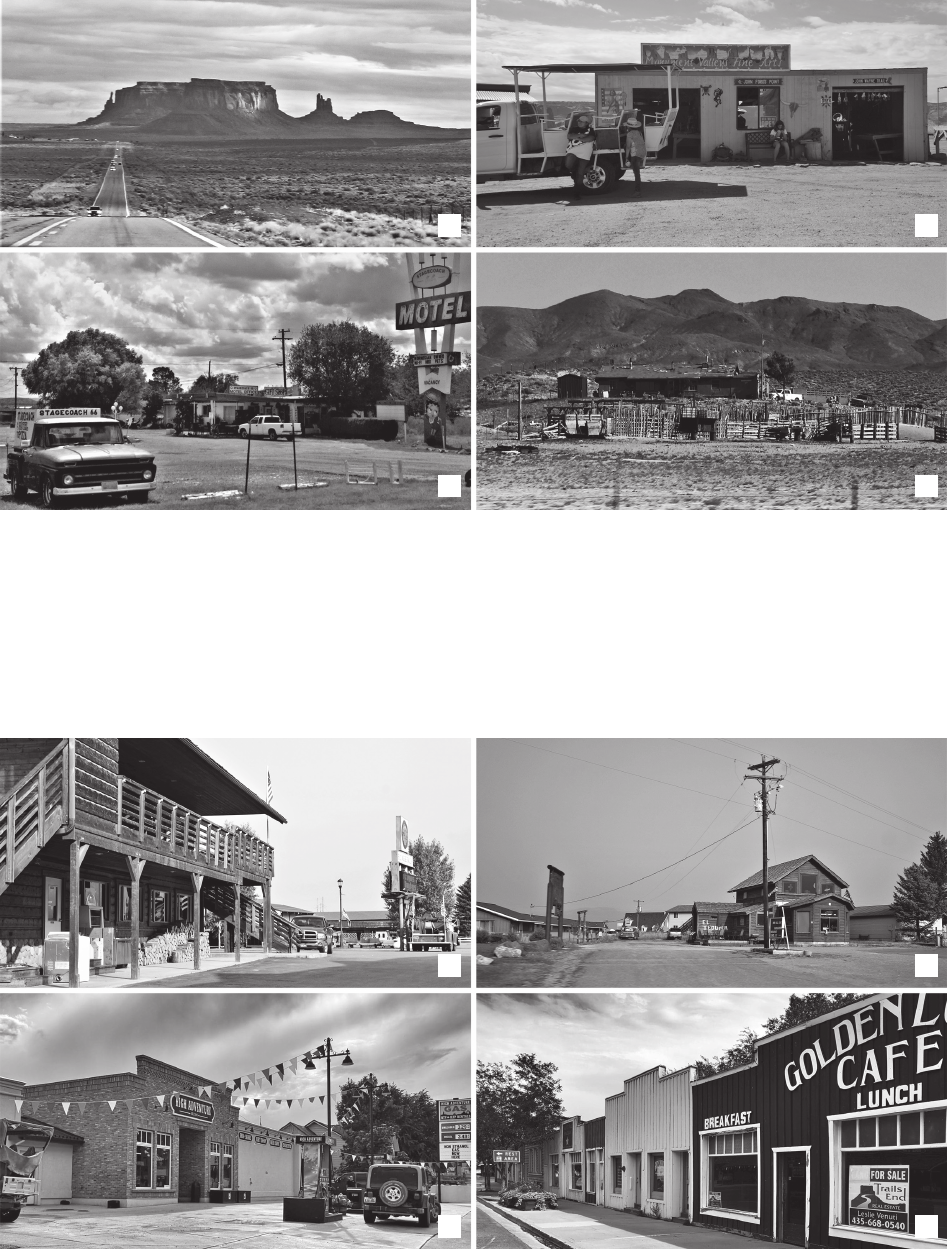
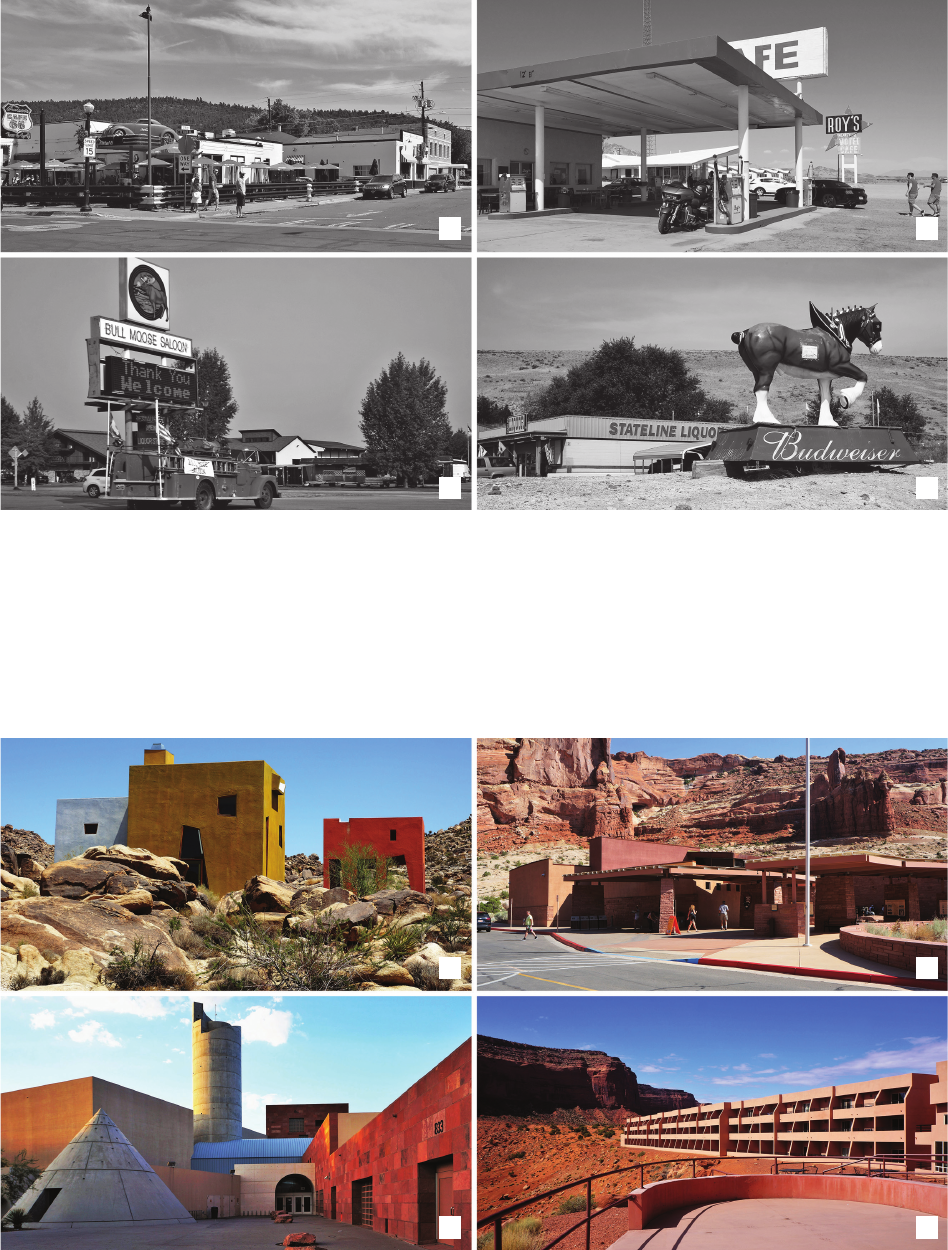
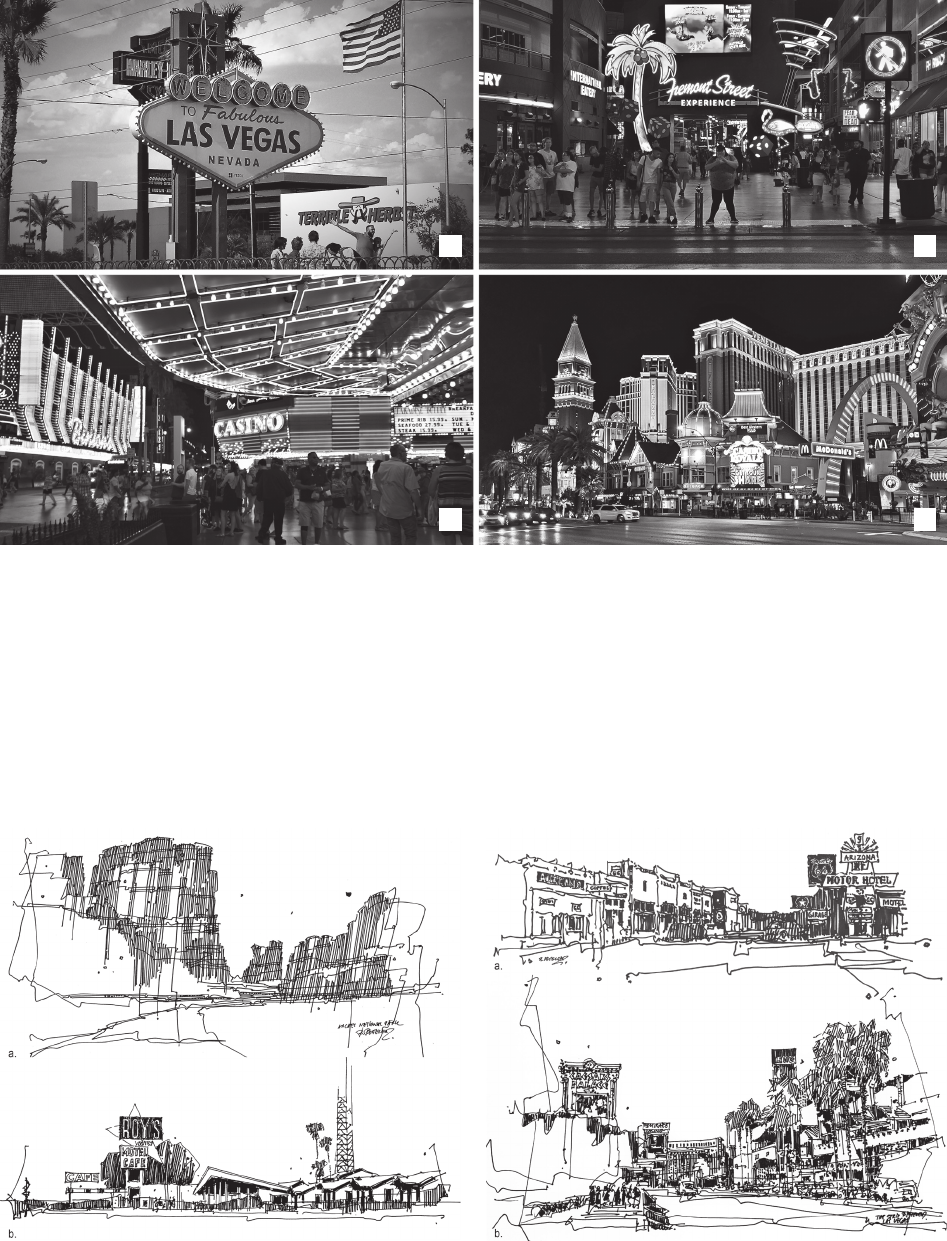
In the visual material that emerged, several thematic groups
can be distinguished: the road (Fig. 1), roadside architec-
ture (Fig. 2), advertising elements (Fig. 3), Modernist New
Regionalism (Fig. 4), Las Vegas as a distinctive and dier-
ent space (Fig. 5) (Malinowska-Petelenz, Petelenz 2019).
After returning to Poland, the second phase of research
was initiated. Over the course of several meetings and
discussions, we unanimously selected 20 photographs
(Figs. 1–5) and four sketches (Figs. 6, 7) that best repre-
sented Route 66’s roadside architecture and documented
its characteristic elements.
In the subsequent stages of group work, the team split
itself into two sub-teams according to their research back-
ground and experience. Sub-team A analysed the pre-
pared data/visual material in terms of cultural meanings.
Sub-team B, on the other hand, analysed the same visual
material from an architectural research perspective. Both
components used MAXQDA2020, a popular Computer-
Assisted Qualitative Data Analysis Software (
CAQDAS).
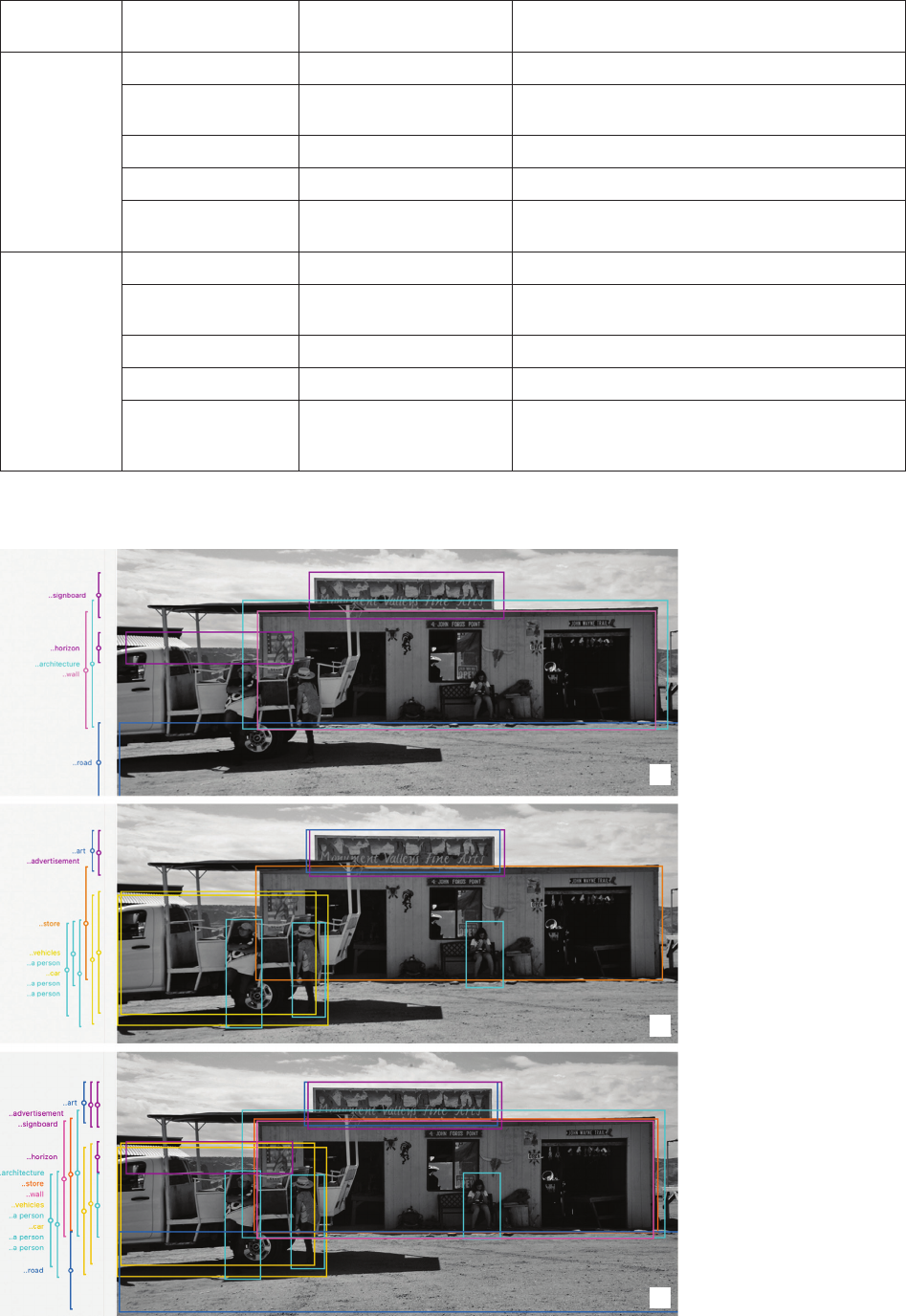
This software can encode photographs and other visual ma-
terial by specifying a fragment of an illustration (this is al-
ways in the form of a rectangle) and assigning it a meaning
by including this fragment in a given code (see Fig. 8). The
benet of MAXQDA was particularly evident in the next
stage of the adopted research procedure – this was due to
the epochal shift towards visuality in our culture (Kuckartz,
Rӓdiker 2013).
Determination of codes – characteristic elements
– sub-team A
The team explored interest in the “ordinariness” or “ev-
erydayness” of culture, culture as a process by which a so-
ciety or social group produces meanings. This approach
allowed the team to document […] both the “how” and
the “what” of culture, both in terms of production and con-
text (Lister, Wells 2004, 4). The focus was placed on dis-
tinguishing the key characteristic elements that occurred
repeatedly in the visual landscape along Route 66, which
were then classied into the groups listed in Table 1.
Determination of codes – characteristic elements
– sub-team B
In the course of the discussion, the team distinguished
a number of semantic terms to be crossed with the visual
124 Beata Malinowska-Petelenz, Anna Petelenz, Magdalena Jagiełło-Kowalczyk, Małgorzata Petelenz, Radosław Rybkowski
Fig. 1. Road: a) Monument Valley, Utah, b) roadside shack, Monument Valley,
c) Stagecoach Motel, Route 66, Seligman, Arizona,
d) Route 95, road to Hawthorne, Nevada – old abandoned house
(photo by B. Malinowska-Petelenz)
Il. 1. Droga: a) Monument Valley, Utah, b) przydrożny barak, Monument Valley,
c) Stagecoach Motel, Route 66, Seligman, Arizona,
d) Route 95, droga do Hawthorne, Nevada – stare, opuszczone domostwo
(fot. B. Malinowska-Petelenz)
Fig. 2. Roadside architecture: a) Bull Moose Lodge motel, Alpine, Wyoming,
b) wooden roadside architecture – Alpine, Wyoming,
c), d) distinctive buildings along the main historic Route 66, Williams City, Arizona
(photo by B. Malinowska-Petelenz)
Il. 2. Architektura przydrożna: a) motel Bull Moose Lodge, Alpine, Wyoming,
b) drewniana architektura przydrożna – Alpine, Wyoming,
c), d) charakterystyczna zabudowa wzdłuż głównej, historycznej Route 66, Williams City, Arizona
(fot. B. Malinowska-Petelenz)
a b
c d
a b
c d
Route 66: Study of cultural and architectural context 125
Fig. 3. Advertising elements: a) Cruiser’s Route 66 Café bar, Williams, Arizona,
b) Roy’s Motel bar & Café, Route 66 – iconic lone gas station stop, Mojave Desert, Amboy, California,
c) Bull Moose Saloon advertisement, Alpine, Wyoming, d) liquor store advertisement, Route 95, Nevada (between Luning and Hawthorne)
(photo by B. Malinowska-Petelenz)
Il. 3. Elementy reklamowe: a) bar Cruiser’s Route 66 Cafe, Williams, Arizona,
b) bar Roy’s Motel & Café, Route 66 – ikona samotnego przystanku na stacji benzynowej, pustynia Mojave, Amboy, California,
c) reklama Bull Moose Saloon, Alpine, Wyoming, d) reklama sklepu alkoholowego, Route 95, Nevada (między Luning a Hawthorne)
(fot. B. Malinowska-Petelenz)
Fig. 4. Modernist New Regionalism – examples: a) The Monument House, Mojave Desert, Joshua Tree National Park (design by Josh Schweitzer, 1990),
b) Visitor Centre building in Arches National Park, Moab Utah (design by Chamberlin Architects 2004–2005),
c) Las Vegas Central Library and Children’s Museum, Las Vegas suburb, Nevada (design by Antoine Predock, 1990),
d) Hotel View Monument Valley, Utah (design by Robert Maze Desert Sky Designs, 2008) (photo by B. Malinowska-Petelenz)
Il. 4. Neoregionalizm modernistyczny – przykłady: a) The Monument House, pustynia Mojave, Joshua Tree National Park (proj. Josh Schweitzer, 1990),
b) budynek Visitor Center w Arches National Park, Moab Utah (proj. Chamberlin Architects 2004–2005),
c) Las Vegas Central Library i Children’s Museum, przedmieścia Las Vegas, Nevada (proj. Antoine Predock, 1990),
d) Hotel View Monument Valley, Utah (proj. Robert Maze Desert Sky Designs, 2008) (fot. B. Malinowska-Petelenz)
a b
c d
a b
c d
126 Beata Malinowska-Petelenz, Anna Petelenz, Magdalena Jagiełło-Kowalczyk, Małgorzata Petelenz, Radosław Rybkowski
Fig. 5. Las Vegas, Nevada:
a) the iconic sign at the entrance to Las Vegas, b) signs and neon lights along Freemont Street,
c) shops and casinos along Freemont Street, d) the nighttime lighting of the Las Vegas Strip
(photo by B. Malinowska-Petelenz)
Il. 5. Las Vegas, Nevada:
a) legendarny znak przy wjeździe do Las Vegas, b) szyldy i neony wzdłuż Freemont Street,
c) sklepy i kasyna wzdłuż Freemont Street, d) nocne oświetlenie Las Vegas Strip
(fot. B. Malinowska-Petelenz)
Fig. 6. The road as cultural heritage in the US, open landscape:
a) Arches National Park, Utah,
b) Roy’s Motel & Café, Amboy, California
(drawing by B. Malinowska-Petelenz)
Il. 6. Droga jako dziedzictwo kulturowe USA, krajobraz otwarty:
a) Arches National Park, Utah,
b) Bar Roy’s Motel & Café, Amboy, California
(rys. B. Malinowska-Petelenz)
Fig. 7. The road as cultural heritage of the US, urban interiors:
a) Route 66, Williams City, Arizona,
b) The Strip, Las Vegas, Nevada
(drawing by B. Malinowska-Petelenz)
Il. 7. Droga jako dziedzictwo kulturowe USA, wnętrza urbanistyczne:
a) Route 66, Williams City, Arizona,
b) The Strip, Las Vegas, Nevada
(rys. B. Malinowska-Petelenz)
a b
c d

Route 66: Study of cultural and architectural context 127
Table 1. Codes of characteristic elements present along Route 66, linked to cultural context (elaborated by M. Petelenz)
Tabela 1. Kody elementów charakterystycznych obecnych wzdłuż Route 66, powiązane z kontekstem kulturowym (oprac. M. Petelenz)
Group
of elements
Element
(Polish)
Coding
(English)
Additional commentary
Vehicles
samochód car
Vehicles were divided into more specific groups
due to being the predominant form of vehicular travel
along Route 66. Old cars are also an important element,
which (sometimes as a form of display) give the space
a timeless character
stary samochód old car
grupa samochodów
w oddali
multiple cars in the distance
motocykl motorcycle
The American
flag
amerykańska flaga the american flag
It is both a frequent element and one that is highly essential
to the expression of the local place-based identity
Nature
zalesione wzgórze forested hill
Both individual elements of nature and whole areas
characteristic of American open areas were distinguished
góry mountains
horyzont horizon
daleka pusta przestrzeń vast open space
drzewo tree
Shabby fence niedbałe ogrodzenie shabby fence
An element that defines the geometry and aesthetics
of a space
Buildings
kasyno casino
Several types of buildings whose uses could be clearly
identified were distinguished, and a group of elements
(buildings) whose use could not be determined visually
were marked
stacja benzynowa gas station
jadłodajnia eatery
budynek building
dom mieszkalny house
sklep store
motel motel
Route 66 66
Route 66 sztuka art The road – a constantly visible, distinctive feature
Art Reklamy advertisement Aesthetic function
Advertisements
Las Vegas Las Vegas
Advertisements are an inseparable element of Route 66’s
landscape, initially the advertisements associated not only
with selling land, but also concerning Las Vegas, were seen
as a characteristic, distinct element
na sprzedaż for sale
grupa ludzi people (crowd)
People ludzie (policzalni)
people
(but you can count them)
People are both an indicator of a site’s degree
of activity and allow characterisation
of the dominant user of a space
characteristic architectural elements. Five terms that dene
spatial composition were borrowed from composition the-
ory. Five culturally relevant landscape terms were also dis-
tinguished to dene its natural and human-made elements.
The semantic terms have been presented in Table 2.
Examples of the results of the two teams’ work are
shown in Figure 8a, b.
Interpretation
This stage of the study demonstrated MAXQDA’s ben-
ets. It made it very easy to connect the coding by sub-
teams A and B and to verify the most commonly co-oc-
curring cultural and architectural codes. In cases where
sub-team A encoded a given visual material (data) using
codes that referred to distinct cultural elements of the land-
scape and architecture along Route 66, sub-team B coded
that same graphical material suing the second code group
– terms used in architectural analysis (e.g., compositional
accent, landmark, natural landscape, greenery). The two
sub-teams worked separately to avoid biases caused by
coding already done by others. The process of this double
coding is shown in Figure 8c.
The use of visual methods is a well-established research
approach, but it still needs to be employed more wide-
ly, including in the study of architecture – particularly in
128 Beata Malinowska-Petelenz, Anna Petelenz, Magdalena Jagiełło-Kowalczyk, Małgorzata Petelenz, Radosław Rybkowski
Group of terms
Term
(Polish)
Coding
(English)
Additional commentary
Composition
elements
akcent kompozycyjny compositional accent An element that stands out from the background
dominanta
kompozycyjna
landmark An element that dominates over its surroundings
tło vast open space As a background for distinctive elements
ściana wall A vertical plane that delineates a given space
horyzont horizon
An important horizontal direction that emphasises
the horizontality of the open landscape
Culturally
relevant terms
krajobraz naturalny natural landscape Landscape – the terrain and open space
architektura architecture
As a mass and other types of structures built by humans,
which do not fall under the other categories
zieleń greenery For example, trees, shrubs, forested hillsides
szyld signboard One of the most numerous details in space
droga road
Road in the physical sense,
but understood
as a cultural narrative axis for the landscape
Table 2. Codes of characteristic elements present along Route 66, linked to architectural context (elaborated by M. Petelenz)
Tabela 2. Kody elementów charakterystycznych obecnych wzdłuż Route 66, powiązane z kontekstem architektonicznym (oprac. M. Petelenz)
Fig. 8. Example of coding
– codes:
a) related to architecture,
b) related to culture,
c) intersection of codes
of group a and b (photo by
B. Malinowska-Petelenz)
Il. 8. Przykład kodowania
– kody:
a) związane z architekturą,
b) związane z kulturą,
c) przecinanie się kodów
grupy a i b
(fot. B. Malinowska-Petelenz)
a
b
c
Route 66: Study of cultural and architectural context 129
Fig. 9. Relationships between
codes of cultural meaning and
architectural context
(elaborated by M. Petelenz)
Il. 9. Relacje między kodami
o charakterze znaczeń
kulturowych oraz kontekstu
architektonicznego
(oprac. M. Petelenz)
demonstrating the role and place of architecture in people’s
lives (Rose 2016). The use of this method also allowed us
to test the validity of the approach, bearing in mind that
it […] is in the initial but developing phase of qualitative
research (Rodrigues, Costa and Moreira 2019, 236). It has
also been tested whether it can be successfully […] incor-
porated into qualitative research projects in various ways:
analysis of visual data (photos, videos, posters, etc.) (Ro-
drigues, Costa and Moreira 2019, 236).
As noted by Rodrigues et al. (2019), the visual research
method requires images not only to provide material for
investigation, but also to explain and present the results.
Using software that supports qualitative analysis (such
as MAXQDA) allows even extensive visual material to be
examined relatively easily. The most valuable results were
achieved by reviewing the code relationships used during
the third stage of the research. We compared the codes used
from the perspective of cultural meanings and architectural
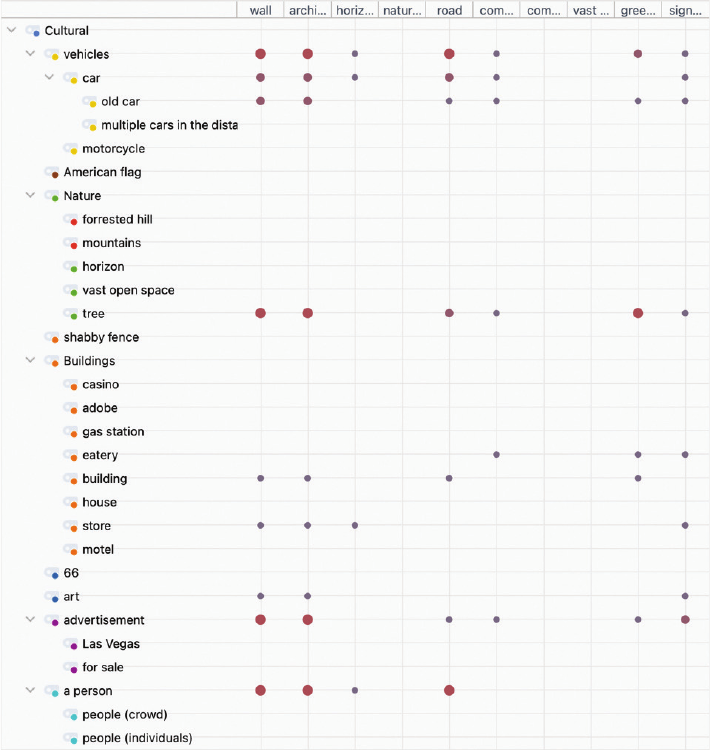
context with each other. Segments with intersecting codes
were sought to understand the relationship between archi-
tecture and culture along Route 66, as presented in Figure
9. The visual material selection from stage 1 and its coding
in stage 2 demonstrated that, from the perspective of the
Polish research team that had travelled along Route 66, the
visual representation consisted of vehicles and cars (46 en-
coded fragments) and not people (21 encoded fragments),
which meant that people in cars were the main users of
this space.
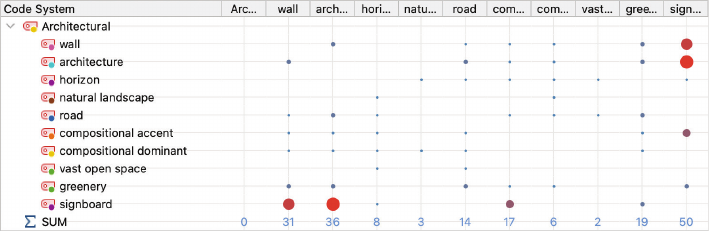
The aforementioned sketches proved to be highly valu-
able material and were coded separately using solely ar-
chitectural context codes. The results of the analysis have
been shown in Figure 10. From this, it can be concluded
that signboards proved to be a constitutive element for the
visual landscape along Route 66. They most often co-oc-
curred with architectural substance and the wall under-
stood as a compositional element. They also mostly acted
as compositional accents.
Considering the entire study of the visual character-
istics of the space along Route 66 (the results from the
MAXQDA investigation combined with the impressions
of the participants in the in-situ landscape observations),
the following conclusions can be drawn:
– the area displays a symbiosis of numerous natural
elements (mountains, greenery, open space, etc.) and hu-
man-made elements (architecture, fences, signs, road, etc.).
Codes related to architecture were the most numerous: ar-
chitecture (29), wall (24), buildings (30), with nature being
equally important: greenery (25) and trees (18). The com-
positional dominance of natural elements can also be seen,
– the variable (moving) elements were dominated by
vehicles, not people, so the main users of the space were
motorised,
130 Beata Malinowska-Petelenz, Anna Petelenz, Magdalena Jagiełło-Kowalczyk, Małgorzata Petelenz, Radosław Rybkowski
Fig. 10. Relationship of codes
between categories
of architectural analysis
(elaborated by M. Petelenz
on the basis of drawings by
B. Malinowska-Petelenz)
Il. 10. Relacje kodów między
kategoriami analizy
architektonicznej
(oprac. M. Petelenz na podstawie
rys. B. Malinowskiej-Petelenz)
– the landscape is repeatedly characterised by open
space and the visible horizon emphasises the innity of
perspective plans and the compositional horizontality of
the vista,
– the main boundaries of the space (walls) are visible in
the form of the architectural mass,
– both architecture and the natural landscape are char-
acterised by horizontality (the vast majority of coded areas
dened by lying rectangles). This composition is broken
up by accents in the form of tall columns with signs or the
American ag,
– compositional accents are often present in the space,
landmarks are much less frequent – there is a lack of ele-
ments that bring structure to the spatial composition, while
numerous details can be observed, which increase its frag-
mentation and a sense of chaos,
– roadside architecture is also characterised by a lack
of a coherent, clear façade – obscured by signs and ad-
vertisements, the form and overall spatial composition is
fragmented.
Conclusions
Our experience in the study of roadside architecture
along Route 66 in the United States conrmed that a well-
planned and executed research procedure can lead to con-
clusions. Sometimes these conclusions were surprising to
ourselves, such as the loss of prominence of the building’s
facade in favour of an advertisement obscuring it. The
overlap of coding that reected cultural and architectur-
al contexts became an armation that travel in the Unit-
ed States is dened by an endless narrative of the road
(Fig. 1). Outside of large cities or metropolises (e.g., Las
Vegas), the land is mostly empty. Peter Zumthor, author
of the groundbreaking book Thinking architecture (2010),
noted that the dierence between the landscape and the
city is that the city both inspires and irritates, gives you
wings or suocates. The city can be a place for a sustain-
able and thriving community, but it can also make individ-
ual and social life unbearable. Landscape, in turn, is also
about peace and freedom, as nature has a dierent sense
of time. In the landscape, time is innite, while in the city
it can be as dense as space. It is this advantage: the all-en-
compassing landscape and the car required to experience it
that has given rise to the frontier and highway architecture
– depicted in novels and lms.
The scattered development typical of Route 66 gives an
impression of chaos and discontinuity, which is a distinc-
tive feature of its roadside architecture. At the same time,
and this is another surprising result of our research, despite
the economic and cultural signicance of this American
“mother of all roads”, nature plays an important role. One
manifestation of this is the high saturation with the code
tree, which appears almost as often as advertisement. And
– signicantly – it is thanks to the multi-stage research pro-
cedure that safeguards against an overly subjective reading
of the visual material that it became possible to discern
such an intense presence of nature along Route 66. This
road is a very good example that architecture that coexists
with the natural landscape does not in fact become an at-
tempt at imitating it. Through roadside architecture, nature
is reinterpreted and can be read as one of the possible inter-
pretations of the role of the landscape by those who travel
it (Stoppani 2019).
An analysis of roadside architecture in the context of
US cultural heritage leads to the conclusion that scattered
and impermanent development, often articial-like and
gaudy in character, together with the local terrain of the
prairies and canyons, form a distinct and unique local out-
line of the American landscape – created by natural condi-
tions and its roadside, episodic architecture. Its scattering
and apparent instability, the desert highway, the road from
one neon sign to another, build its genius loci. However,
one of the most common features of all these areas seems
to be the visual uniqueness created by scattered architec-
tural structures easily noticed by the main viewer – the one
who moves fast.
As authors who delved into Route 66 and its roadside
architecture, we put ourselves in the role of attentive ob-
servers. Through rigorously dened stages of exploration,
we were able to see just how deeply roadside architecture is
rooted in nature, irrespectively of Route 66’s technological
advancement. The sustainable combination of culture (and
technology and engineering) and nature proved to be the
basis of liveable places, no matter how remote they were
from their local metropolis. The research trip along Route
66 proved that protecting cultural heritage and showcasing
natural beauty is by far the best way to ensure a sustainable
future for the communities who live along the road. This is
a lesson that other regions that represent a similar combi-
nation of cultural heritage and natural scenic beauty should
take seriously so as to make this space more welcoming to
residents and attractive to tourists.
Translated by
Krzysztof Barnaś
Route 66: Study of cultural and architectural context 131
References
Afonso, Anna I., and Manuel J. Ramos. “New graphics for old stories.”
In Working Images. Visual Research and Representation in Ethnog-
raphy, edited by Ana Isabel Alfonso, László Kürti, and Sarah Pink.
Routledge, 2004.
Baudrillard, Jean. Ameryka. Translated by Renata Lis. Sic!, 2011.
Bauman, Zygmunt. Płynna nowoczesność. Wydawnictwo Literackie, 2006.
Białek, Artur. “Route 66 – najpopularniejsza droga w USA. Z czego sły-
nie?” National Geographic Polska. Published January 7, 2023. Ac-
cessed July 31, 2024, at https://www.national-geographic.pl/travel-
er/artykul/route-66-najpopularniejsza-droga-w-usa-z-czego-slynie.
Creswell, John W. Research design: qualitative, quantitative, and mixed
methods approaches. SAGE Publications, 2009.
Diener, Ed. “Subjective well-being: The science of happiness and a pro-
posal for a national index.” American Psychologist 55, no. 1 (2000):
34–43. https://doi.org/10.1037/0003-066X.55.1.34.
Eco, Umberto. “Function and sign: The semiotics of architecture.” In Re-
thinking Architecture. A Reader in Cultural Theory, edited by Neal
Leach. Routledge, 1997.
Flick, Uwe. Designing qualitative research. SAGE Publications, 2007.
Jackson, John B. Discovering the vernacular landscape. Yale University
Press, 1984.
Jakle, John, and Keith Sculle. Signs in America’s Auto Age: Signatures of
Landscape and Place. University of Iowa Press, 2004.
Knudson, David. Route 66: The mother road. Shire Publications, 2012.
Kuckartz, Udo, and Stefan Rädiker. Qualitative Content Analysis. Meth-
ods, Practice and Software. Sage, 2013.
Lister, Martin, and Liz Wells. “Seeing Beyond Belief: Cultural Studies as
an Approach to Analysing the Visual.” In Handbook of Visual Analysis,
edited by Theo Van Leeuwen, Carey Jewitt. SAGE Publications, 2004.
Malinowska-Petelenz, Beata, and Anna Petelenz. “Fifty shades of Las
Vegas.” Technical Transactions 116, no. 6 (2019): 49–62. https://
doi.org/10.4467/2353737XCT.19.060.10613.
Mroczek, Marta. “Przydrożna architektura w ujęciu popkulturowym.”
Architecturae et Artibus 8, no. 1 (2016): 64–75.
Nye, David E. “Redening the American sublime, from open road to in-
terstate.” In Route, Roads and Landscapes, edited by Mari Hvattum,
Brita Brenna, Beate Elvebakk, Janike Kampevold Larsen. Rout-
ledge, 2011.
Pink, Sarah. “Analysing visual experience.” In Research method for Cul-
tural Studies, edited by Michael Pickering. Edinburgh University
Press, 2008.
Rodrigues, Ana Isabel, António Pedro Costa, and António Moreira. “Us-
ing CAQDAS in Visual Data Analysis: A Systematic Literature Re-
view.” In Computer Supported Qualitative Research. New Trends
on Qualitative Research, edited by António Pedro Costa, Luís Paulo
Reis, António Moreira. Springer, 2019.
Rose, Gillian. Visual methodologies: An introduction to researching with
visual materials. SAGE Publications, 2016.
Ruiz, Rita, Francisco Rodríguez, and José M. Coronado. “Identica-
tion and assessment of engineered road heritage: A methodological
approach.” Journal of Cultural Heritage 15, no. 1 (2014): 36–43.
https://doi.org/10.1016/j.culher.2013.01.001.
Sosnowska, Anna. “Najsłynniejsza droga świata.” Onet Podróże (2020).
Accessed July 31, 2024, at https://podroze.onet.pl/ciekawe/route-66-
naj slynniejsza-droga-swiata-w-usa-ciekawostki-historia-legendy/
tyhnmsr.
Steinbeck, John. Grona gniewu. Translated by Alfred Liebfeld. Prószyń-
ski i S-ka, 2012.
Stoppani, Teresa. Unorthodox ways to think the city: representations,
constructions, dynamics. Routledge, 2019.
United Nations, The Sustainable Development Goals Report 2022.
Accessed December 17, 2024, at https://unstats.un.org/sdgs/re-
port/2022/The-Sustainable-Development-Goals-Report-2022.pdf.
Unwin, Simon. Metaphor. Routledge, 2019.
Venturi, Robert, Denise Scott Brown, and Steven Izenour. Uczyć się od
Las Vegas. Zapomniana symbolika formy architektonicznej. Trans-
lated by Anna Porębska. Karakter, 2013.
Whyte, William. “How do buildings mean? Some issues of interpretation
in the history of architecture.” History and Theory 45, no. 2 (2006):
153–177.
Zumthor, Peter. Myślenie architekturą. Translated by Artur Kożuch. Ka-
rakter, 2010.
Streszczenie
Route 66. Badanie kontekstu kulturowego i architektonicznego
Route 66 – Droga Matka Ameryki – wciąż rezonuje w polskim postrzeganiu historii, kultury i architektury Stanów Zjednoczonych. Zespół ba-
dawczy zastosował innowacyjną metodę zorganizowaną jako kilkustopniowa jakościowa metoda badań wizualnych. W ramach zorganizowanego
w 2018 r. wyjazdu studyjnego, którego celem było poznanie kulturowego znaczenia Route 66 z perspektywy architektury, przygotowano dokumentację
fotograczną oraz materiały rysunkowe in situ – posłużyły one następnie do dalszych badań. W końcowej fazie projektu zespół zastosował analizę wi-
zualną, aby zrozumieć kulturowe znaczenie architektury przydrożnej wzdłuż Route 66. Wyniki badania odzwierciedlały polskie postrzeganie Route 66
i charakterystykę użytkownika. Wykazano, że genius loci wzdłuż Route 66 bazuje na rozdrobnionych strukturach architektonicznych, przypadkowości
form i dominującym krajobrazie naturalnym.
Słowa kluczowe: architektura, krajobraz, turystyka, znaczenie kulturowe, metoda badań wizualnych